Showing posts with label Cancer. Show all posts

Bayer Battered

SUBHEAD: After buying Monsanto Bayer suffers major blow losing second RoundUp cancer trial.

By Tyler Durden on 20 March 2019 for Zero Hedge -
(https://www.zerohedge.com/news/2019-03-20/bayer-battered-after-suffering-major-blow-second-roundup-cancer-trial-loss)


Image above: Plaintiff DeWayne Johnson looks on at the start of the Monsanto trial in San Francisco, California on July, 09, 2018. From (https://www.sfgate.com/nation/article/Does-Roundup-cause-cancer-Patient-s-case-13061244.php).

Bayer AG shares are down over 12% in European trading - the biggest drop since 2003 - after a U.S. jury found the RoundUp weed killer was a substantial factor in a California man's cancer. This is the second case that has gone against manufacturer Monsanto, acquired by Bayer last year.

On Tuesday, a federal court jury in San Francisco ruled unanimously for plaintiff DeWayne Johnson,  in a lawsuit against Monsanto. Attorneys say the trial, which will determine in a second phase whether the company is liable and if so, for how much, could help determine the fate of hundreds of similar lawsuits.

The plaintiff's attorneys said he developed non-Hodgkin lymphoma after 26 years of regularly using Roundup to tackle weeds and poison oak, according to the Wall Street Journal. The active ingredient in Roundup and Ranger Pro is glyphosate, a herbicide.

Hardeman’s case is considered a “bellwether” trial for hundreds of other plaintiffs in the US with similar claims, which means the verdict could affect future litigation and other cancer patients and families. Monsanto, now owned by the German pharmaceutical company Bayer, is facing more than 9,000 similar lawsuits across the US.

The decision strikes another blow to the German pharmaceuticals group. In August, a jury ordered its Monsanto unit to pay $289 millionafter determining it failed to warn customers of the potential cancer risks of two of its weedkillers, Roundup and Ranger Pro. The verdict was cut to $78.5 million on appeal.

Analysts are broadly negative on the news, BUT appear to be buyers of any dip... and today's a big dip.
News is a “major blow,” according to Baader (buy, PT EU123), which says Bayer shares might move towards EU60 in the short-term. If stock falls toward 2018 lows, probability of Bayer becoming a target for activists or a takeover will increase.
Morgan Stanley (overweight, PT EU82) says there was “budding enthusiasm” among investors for either a potential “surprise” verdict in favor, or a hung jury, given multiple days elapsing during deliberations.
Overhang on Bayer shares “could be significant” as outcome was considered by some investors to be a potential bellwether for ~765 outstanding glyphosate cases, Goldman Sachs analyst Keyur Parekh (buy, PT EU78) writes.
Citi says “steady heads required” as >EU20b of litigation risk is already priced into the shares. Says legal checks instruct bank to be more focused on the upcoming Hall vs Monsanto trial being held in St Louis from April 1. St Louis result will better determine whether the estimate of a potential settlement liability of $1-6b needs to be refined.
Any extreme weakness is an opportunity to buy, according to Bernstein (outperform, PT EU86) as an ultimate liability well above the $5b is already “baked-in
Monsanto says studies have established that Roundup's active ingredient, glyphosate, is safe. It has appealed a separate U.S. court decision last year in favor of a man who used Roundup.
"We are disappointed with the jury's initial decision, but we continue to believe firmly that the science confirms that glyphosate-based herbicides do not cause cancer," Bayer said in a press release.
"Bayer stands behind these products and will vigorously defend them."


.

Bayer Beware!

SUBHEAD: Lawyers claim to have "Explosive" documents concerning Monsanto and RoundUp.

By Tyler Durden on 11 September 2018 for Zero Hedge -
(https://www.zerohedge.com/news/2018-09-07/bayer-beware-lawyers-claim-have-explosive-monsanto-documents)


Image above: Common Ragweed is becoming resistant to glyphsate applications in Nebraska. Ragweed plants from a glyphosate-resistant (left) and susceptible population (right) three weeks after application of 44 ounces per acre of Roundup PowerMax (that is one ounce per thousand square feet). From (https://cropwatch.unl.edu/glyphosate-resistant-common-ragweed-confirmed-nebraska).

Lawyers involved in a California lawsuit against Monsanto claim to have "explosive" documents concerning the Bayer-owned agrochemical giant's activities in Europe, according to Euronews.
"What we have is the tip of the iceberg. And in fact we have documents now in our possession, several hundreds documents, that have not been declassified and some of those are explosive," said US lawyer Robert Kennedy Jr, adding - "And many of them are pertinent to what Monsanto did here in Europe. And that's just the beginning."
Monsanto - bought by Germany's Bayer AG in June for $66 billion, was ordered in August to pay a historic $289 million to a former school groundskeeper, Dewayne Johnson, who said Monsanto's Roundup weedkiller gave him terminal cancer. Monsanto says it will appeal the verdict.

Environmental lawyers have been in Brussels in order to address a European Parliament special committee on the issue.
"They are fighting a fight for more democracy and for transparency and to get a better insight in how big corporation such as Monsanto act and try to manipulate the facts," said Belgium MEP Bart Staes.
Last November EU approved the use of glyphosate - a key chemical in Roundup, following five years of heated debate over whether it causes cancer. While it was approved for just five years until 2022 vs. the usual 15 years, there are now rumors that they will withdraw Roundup's license this year altogether.

Labeled a carcinogen by the EPA in 1985, the agency reversed its stance on glyphosate in 1991. The World Health Organization's cancer research agency, however, classified the compound as "probably carcinogenic to humans" in 2015. California, meanwhile, has the chemical listed in its Proposition 65 registry of chemicals known to cause cancer. 

See also:
Ea O Ka Aina: A MAtch Made in Hell 6/30/18

.

Monsanto and EPA collusion

SUBHEAD: More evidence of collusion between the EPA and Monsanto covering up RoundUp cancer link.

By Josh Nelson on 29 March 2017 for Credo -
(https://act.credoaction.com/sign/monsanto_epa)


Image above: This story goes back to 2015 revelations, but more just keeps pouring forth. From (http://thefreethoughtproject.com/unearthed-documents-reveal-monsanto-epa-knew-glyphosates-toxic-carcinogenic-effects/).

Stunning new documents unsealed by a federal judge suggest that Monsanto worked directly with federal regulators to hide the health risks of and manipulate the science behind its best-selling herbicide, RoundUp.

The documents reveal that Monsanto pressured Environmental Protection Agency (EPA) officials to not publicly release information on the cancer risks of glyphosate, the main ingredient in RoundUp, ghostwrote research for the EPA and worked with a senior official at the agency to quash a federal review of the chemical.1

These documents suggest an unprecedented level of collusion between the EPA and Monsanto to cover up evidence that RoundUp is a likely carcinogen. The Office of Inspector General of the EPA, an independent office tasked with investigating fraud and abuse in the agency, must immediately launch an investigation to hold Monsanto and all EPA employees involved accountable.

In 2015, the World Health Organization (WHO) declared glyphosate a probable carcinogen, which spurred a class-action lawsuit brought by hundreds victims who developed cancer after being exposed to the chemical.

These newly uncovered documents reveal that months before the WHO’s determination, an EPA official tipped off Monsanto to the upcoming ruling in an effort to aid the agricultural giant’s public relations campaign.

The official promised the company that he would attempt to beat back an upcoming review of glyphosate by the Department of Health and Human Services, saying “If I can kill this, I should get a medal.” HHS subsequently never completed the review.2

Unsealed documents also suggest that a Monsanto executive gave his employees the go-ahead to ghostwrite favorable research on glyphosate and later attribute the studies to academics by merely placing their names on the research.3

Given Donald Trump’s appointment of Scott Pruitt to head the EPA, this is a crucial opportunity for the the Office of the Inspector General to prove that it will remain truly independent under a Trump administration determined to exert total control and suppress all dissent.

The inspector general of the Department of Health and Human Services has recently launched an investigation into the Trump administration, so there is precedent for the EPA inspector general to follow suit.4

Monsanto has a long and dark history covering up glyphosate’s dangers, but it’s simply unconscionable that the EPA would collude with Monsanto to conceal the serious threat the chemical poses to public health.

The defeat of Trumpcare shows that our activism works. Now it’s time for the the Office of the Inspector General to do its job and hold Monsanto and EPA employees accountable.

Tell the Office of Inspector General of the EPA: Investigate collusion between Monsanto and the EPA. Click here (https://act.credoaction.com/sign/monsanto_epa) to sign the petition.

References:
  1. Danny Hakim, "Monsanto Weed Killer Roundup Faces New Doubts on Safety in Unsealed Documents," The New York Times, March 14, 2017.
  2. Reynard Loki, "Has Monsanto Orchestrated a Massive Cancer Coverup? Unsealed Court Case Documents Point to a Scandal," AlterNet, March 17, 2017.
  3. Lorraine Chow, "Monsanto Faces Hundreds of New Cancer Lawsuits as Debate Over Glyphosate Rages On," EcoWatch, March 22, 2017.
  4. Mary Papenfuss, "Inspector General Probes Trump Administration’s Move To Pull Obamacare Enrollment Ads," The Huffington Post, March 25, 2017.

.

EPA obedient to Monsanto

SUBHEAD: Don't expect Obama administration to save farm workers from Non-Hodgkin lymphoma.

By Alexis Baden-Mayer 15 December 2016 for Truth-Out -
(http://www.truth-out.org/speakout/item/38751-obama-s-epa-has-a-weakness-for-monsanto)


Image above: Photo illustration of boy eating corn with quote from World Health Organization IARC Report on Glyphosate "Glyphosate can be found in soil,air, surface waterand groundwater, as well as in food." See connection to WHO full report below. From (http://www.ifoam.bio/en/news/2015/08/04/who-publishes-full-probable-human-carcinogen-report-glyphosate).

The Environmental Protection Agency (EPA) is convening an advisory panel to review the science that links the main ingredient in the world's #1 herbicide with cancer.

But don't expect one of the last acts of the Obama administration to be to save US farmers and agricultural workers from the ravages of Non-Hodgkin lymphoma.

All signs point to EPA caving to Monsanto, the company that markets glyphosate in its flagship Roundup herbicide.

The saga started in 1985, when the EPA classified glyphosate as a possible human carcinogen, based on the presence of kidney tumors in male mice.

By 1991, the EPA had received enough pushback from Monsanto to reverse this decision.
In 2009, the EPA began its registration review of glyphosate, required once every 15 years for all pesticides.

In March 2015, the EPA was trying to wrap up that review when the World Health Organization's (WHO) International Agency for Research on Cancer assessed the carcinogenicity of glyphosate and determined that it was a probable human carcinogen. The EPA said it would consider the WHO finding in its own review of glyphosate.

In May 2016, the EPA "mistakenly" released an assessment of glyphosate that contradicted the World Health Organization's finding that the herbicide was a probable human carcinogen. The leak gave Monsanto ammunition in its fight to keep its profitable Roundup on the market. (In 2015, Monsanto made nearly $4.76 billion in sales and $1.9 billion in gross profits from herbicide products, mostly Roundup.)

After the leak, EPA tried to restore legitimacy to the process by insisting that it hadn't yet made a decision on glyphosate's carcinogenicity and convening a Scientific Advisory Panel to review the matter.

In September, for the Scientific Advisory Panel's review, EPA released "Glyphosate Issue Paper: Evaluation of Carcinogenic Potential." The paper concluded that glyphosate is not likely to be carcinogenic to humans at doses relevant to human health.

An analysis of the study by Food & Water Watch researcher Amanda Starbuck exposed several deficiencies in the science EPA used to reach its conclusion that glyphosate is not likely to be carcinogenic to humans:
  1. More than half of the studies were submitted by the industry. The EPA looked at 131 studies to decide if Roundup causes cancer, but 71 were unpublished industry studies.

  2. Independent studies were 30 times more likely to find glyphosate's toxicity than those from the industry -- but the EPA ultimately concluded that there was "no convincing evidence" of glyphosate's toxicity.

  3. The EPA used a "weight of evidence" approach, which means that heavy industry slant overwhelmed the independent published findings -- including a study that linked glyphosate with the growth of breast cancer cells.
Jennifer Sass, senior scientist at the Natural Resources Defense Council's Health Program argues that the EPA's science is so poor that:
EPA violated its own Cancer Guidelines by dismissing evidence of non-Hodgkin's lymphoma (NHL) in people.

Even a meta-analysis of many epidemiologic studies that was sponsored by the agrochemical industry reported a statistically significant risk of NHL cancers when glyphosate-exposed individuals were compared with individuals never exposed to glyphosate. IARC's analysis reported similar results.

EPA's Cancer Guidelines are consistent with calling this "suggestive evidence of carcinogenic potential" for "evidence of a positive response in studies whose power, design, or conduct limits the ability to draw a confident conclusion."
Knowing that the EPA's weak science wasn't up to a serious review, CropLife, the trade association that lobbies on behalf of Monsanto and the rest of the pesticide industry, launched a campaign to discredit scientists chosen for the EPA's Scientific Review Panel.

CropLife succeeded in getting EPA to cancel the panel's October meeting, remove an esteemed epidemiologist from the panel, and reschedule the meeting for December 13-16.

The EPA has received 254,392 comments from the public in advance of the meeting.

Nearly all of the people who submitted comments support a finding that glyphosate is a probable carcinogen, including the 119,857 members of the Organic Consumers Association who signed a petition asking the EPA to follow the World Health Organization's finding.

Organizations that organized their members to submit public comments include Beyond Pesticides, Center for Biological Diversity, Center for Food Safety, Consumers Union, Food Democracy Now, Food & Water Watch, Friends of the Earth, Moms Across America, Natural Resources Defense Council, Pesticide Action Network North America, and U.S. Public Interest Research Group.


IARC Glyphosate & Cancer Report Link

SUBHEAD: Who publishes full probable human carcenoen report on Glyphosae.

By Staff on 4 August 2015 for IFOAM -
(http://www.ifoam.bio/en/news/2015/08/04/who-publishes-full-probable-human-carcinogen-report-glyphosate)

The World Health Organization’s cancer agency IARC has published the full report which caused a huge worldwide response, when they announced earlier this year that the World’s most sold herbicide, glyphosate, is a probable human carcinogen.

The assessment by the International Agency for Research on Cancer (IARC) of glyphosate, which is used in herbicides with estimated annual sales of USD 6 Billion, is of special concern to Monsanto, the company that brought glyphosate to market under the trade name Roundup in the 1970s.

The IARC reached its decision based on the view of 17 experts from 11 countries, who met in Lyon, France, to assess the carcinogenicity of 5 organophosphate pesticides.

Since the IARC report was released in March 2015 many countries have been looking at possible bans on glyphosate-based herbicides and Sri Lanka even announced a complete ban. Supermarkets across Europe have also removed glyphosate-based herbicides from their shelves.

You can find the full IARC Report here:
monographs.iarc.fr/ENG/Monographs/vol112/mono112-02.pdf (link is external)
Source: http://sustainablepulse.com/ (link is external)


Indian Point Nuclear Accident

SUBHEAD:  Operator unable to prevent its highly radioactive coolant from leaking into groundwater.

By Admin on 26 February 2016 for ENE News -
(http://enenews.com/uncontrollable-radioactive-flow-coming-nuclear-plant-nyc-actual-releases-trillions-times-higher-reported-during-latest-leak-cracks-multiple-spent-fuel-pools-intense-investigation-underway-be)


[IB Publisher's note: Emphasis below provided by ENE News Admin. Indian Point Nuclear Plant provides about one quarter of the regions electrical power and includes New York City. There is no politically or economically acceptable way to shut it down - at this time.]


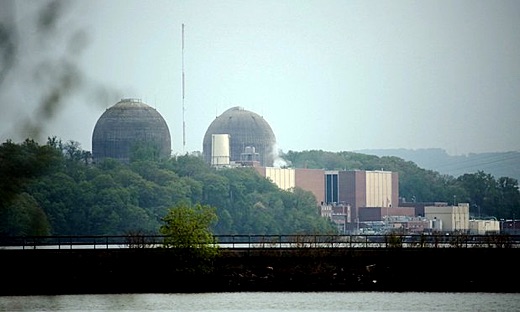
Image above: Smoke rises from the Indian Point Energy Center in Buchanan, New York, where last May an explosion and fire led to thousands of gallons of transformer fluid being released into the Hudson river. Photograph by Ricky Flores/AP. From (http://www.theguardian.com/us-news/2015/may/11/indian-point-nuclear-reactor-shut-down-blast-fire)


Inhabitat  on 26 February 2016
No matter where you live, “uncontrollable radioactive flow” is not a phrase that you want to hear in relation to your local water source … According to the Huffington Post’s report, for more than a decade, the Indian Point plant has been unable to prevent its highly radioactive reactor and spent fuel pool coolant from leaking into groundwater routes that eventually lead into the Hudson River. Entergy, the operator of the plant, seems to zero in solely on tritium… The most recent leak, however, according to an assessment by the New York Department of State as part of its Coastal Zone Management Assessment, contains a variety of radioactive elements such as strontium-90, cesium-137, cobalt-60, and nickel-63 in addition to tritium…

 Huffington Post on 15 February 2016
For more than a decade, it has been impossible for operators of the Indian Point nuclear power plant to stop highly radioactive reactor and spent fuel pool coolant from leaking into the groundwater and migrating to the Hudson River… there is no indication that the company has developed the ability to prevent the latest uncontrolled leaks from following the underground waterway into the Hudson. And because the river is a tidal estuary flowing as much as 20 miles above and below the nuclear site, radioactive contaminants may be sucked into the drinking water systems of several river towns… Entergy representatives declined to comment on planned and unplanned radioactive discharges into the environment. The sequence of events leading to leaks of radioactive liquids from Indian Point 2 is the subject of an intense investigation… to determine how the leak occurred and whether or not it can be stopped… In the past, the Coastal Zone Management report states, “radioactive releases have been detected at the Indian Point facility from cracks in two different spent fuel pools. Leaks of radioactive liquids from the Indian Point 2 spent fuel pools have reached the Hudson River”…

See also: CBS: Radiation leak "getting worse" at nuclear plant near NYC -- Levels increase over 120,000%, almost 15 million pCi/L -- Governor: "Extremely disconcerting" -- Expert: I don't think they know where it's coming from -- Radioactive Antimony now being detected (VIDEO)
Watch a local news broadcast on the most recent leak here


Previous Reports on Indian Point

SUBHEAD: Indian Point Plant contaminates the Hudson River with uncontrollable radioactive flow.


NY Daily News 11 February, 2016
 Cuomo to launch probe into troubled Indian Point power plant as radioactive leak gets worse — The amount of radioactive tritium leaking from the Indian Point nuclear power plant is growing, officials said… New samples from groundwater monitoring wells show 80% higher concentrations of tritium compared with when the leak was first reported Saturday… Wednesday, [Cuomo] ordered a more sweeping investigation… “Last week the company reported alarming levels of radioactivity at three monitoring wells, with one well’s radioactivity increasing nearly 65,000%,” Cuomo said… “The news just keeps getting worse,” said Paul Gallay, president of the watchdog group Riverkeeper.

The Journal News 11 February 2016
Tritium levels reported last week were the ‘highest that they’ve seen to date‘ at the plant

WAMC 11 February 2016  
Tritium Levels Spike In Groundwater… Additional testing has turned up higher levels of radioactive tritium in groundwater than what was reported last week at the Indian Point nuclear power plant… One reading showed an 80 percent increase in tritium levels over the 65,000 percent increase initially reported… [An NRC spokesman said] “So given the migration of that water, we would expect those to continue to go up for a period of time… Our specialist inspector will be there… tasked with trying to better understand exactly what happened”…

Associated Press 10 February 2016
New testing has shown that the amount of tritium in the groundwater below the Indian Point power plant in Buchanan, New York, is about 740 times the amount allowed in drinking water… Entergy Corp., which operates the plant at the edge of the Hudson River, said Wednesday that the latest samples from monitoring wells found tritium at a level of 14.8 million picocuries per liter [up from 12,300 pCi/L, a 120,000% increase]. The [EPA] has set a limit of no more than 20,000 picocuries per liter in drinking water… [C]ritics of nuclear plants said the mere fact of the leak’s occurrence is cause for concern, partly because investigators had yet to pinpoint how it happened. “There a leak somewhere, and I don’t think they know where it is,” said Arnold Gundersen, a nuclear engineer and former industry executive… Gundersen said he was concerned that other, potentially more problematic elements could also have leaked out… [Indian Point spokesman Jerry Nappi] said testing had also found elevated levels of antimony, at about 5,500 picocuries per liter… “It’s like an old car ready to fall apart“… said Assemblyman Tom Abinanti…

Reuters 10 Feb  2016: Entergy said it continues to look for the source of the tritium leak

CBSNY/AP 10 February 2016
The radioactive water leak at the Indian Point Nuclear power plant is getting worse. Gov. Andrew Cuomo said in a statement Wednesday that the level of radioactive tritium-contaminated water that leaked into the groundwater at the nuclear facility has increased by 80 percent since last week’s initial report… Cuomo called it “extremely disconcerting.” “Today, I have further directed that the three agencies integrate their investigations to thoroughly explore whether the operational problems that are suspected to have caused the uptick in unexpected outages of the plant may also be causing the leak of radioactive water into the environment”… the New York governor said.

WAMC 10 February 2016
Additional testing has turned up even higher levels of radioactive tritium than what was reported last week…

Watch FOX 5 NY’s broadcast here

.

Fukushima impacts are ongoing

SUBHEAD: There will be at least 100,000 and as many as one million more cancers in Japan because of Fukushima disaster.

By Arne Gundersen on 4 November 2015 for Fairewinds Assoc.(http://www.fairewinds.org/nuclear-energy-education/cancer-on-the-rise-in-post-fukushima-japan)

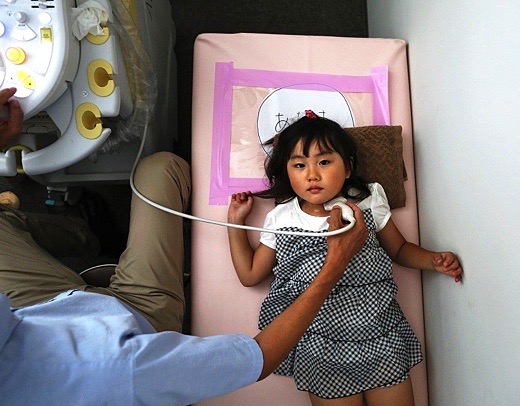
Image above: A doctor conducts a thyroid examination on four-year-old Maria Sakamoto in Iwaki, Japan. From (http://www.theguardian.com/world/2014/mar/09/fukushima-children-debate-thyroid-cancer-japan-disaster-nuclear-radiation).

Cancer on the Rise in Japan

It’s been almost five years from the Fukushima Daiichi meltdowns, and the news from Japan is still not good. Two reports recently released in Japan, one by Japanese medical professionals and the second from Tokyo Power Corporation – TEPCO – acknowledged that there will be numerous cancers in Japan, much greater than normal, due to the radioactive discharges from the triple meltdown at Fukushima Daiichi.


In Fairewinds’ latest update of the ongoing nuclear catastrophe at Fukushima Daiichi, Chief Engineer Arnie Gundersen presents two reports that confirm the direct link of numerous cancers in Japan to the triple meltdown. Based upon data from Japanese medical professionals and utility owner of the meltdown site, Tokyo Electric Power Company (TEPCO), Arnie concludes that heavy radioactive discharges will be the cause of enormous spikes in cancer in Japan.

TEPCO’s press release confirms the leukemia diagnosis for a TEPCO worker due to his ongoing exposure during the last four years to radiation from the Fukushima Daiichi triple meltdown. Sadly, during the early months of the Fukushima Daiichi emergency, most TEPCO workers did not wear the required dosimeters required to measure each employee’s exposure to radiation, which has made accurate assessment of the radiation doses received by TEPCO employees impossible.

The second report, provided by esteemed Japanese medical professionals, reveals that the incidence of thyroid cancer is approximately 230 times higher than normal in the Fukushima Prefecture.  This disturbing number for the people of Japan is solely due to the Fukushima Daiichi disaster and the ongoing radioactivity emanating from the decimated nuclear site.

In this video, Arnie recounts his presentation from 2013 at the New York Academy of Medicine where he forecast continuous radiation releases from the Fukushima Daiichi nuclear plant, and also the devastating health effects for the Japanese people, despite the chronically underestimated radiation exposure levels propagated by the International Atomic Energy Agency, and the Japanese government.

In this video below, Arnie recounts his presentation from 2013 at the New York Academy of Medicine where he forecast continuous radiation releases from the Fukushima Daiichi nuclear plant, and also the devastating health effects for the Japanese people, despite the chronically underestimated radiation exposure levels propagated by the International Atomic Energy Agency, and the Japanese government.


Video above: From (http://www.fairewinds.org/nuclear-energy-education/cancer-on-the-rise-in-post-fukushima-japan). From (https://vimeo.com/144307674).


Uncontrolled chain reaction
SUBHEAD: Former Japanese Ambassador calls for Japan calling off 2020 Olympics in Tokyo because of ongoing and future dangers posed by Fukushima disaster.

By Admin on 4 November 2015 for ENE News -
(http://enenews.com/former-japan-ambassador-uncontrolled-nuclear-chain-reactions-suspected-fukushima-troubling-indications-recurring-criticality-tellurium-132-detected-100-miles-plant-recriticality-issue-discussed)


Image above: Time for a retreat. Workers removing logo from Tokyo 2020 Olympic Games poster after accusation of plagiarism. From (http://www.japantimes.co.jp/community/2015/11/04/voices/time-come-honorable-retreat-tokyo-2020-fukushima#.Vj-r58onpBo).

Japan Times, Nov 4, 2015 (emphasis added): The former Japanese ambassador to Switzerland, Mitsuhei Murata, recently suggested that Japan should stage an ‘honorable retreat’ from hosting the 2020 Olympics due to the unpredictable situation at the crippled Fukushima No. 1 nuclear power plant.

Japan Times (Hotline to Nagatacho — Brian Victoria, Kyoto), Nov 4, 2015: [F]ormer Japanese ambassador to Switzerland, Mitsuhei Murata, recently proposed… for Japan to stage an “honorable retreat” from hosting the 2020 Olympics…

In the September issue of Gekkan Nippon, Murata… noted the danger still posed by large numbers of spent fuel rods suspended in spent fuel pools in reactors 1, 2 and 3 [which] can’t be removed from the damaged reactor buildings due to the high levels of radioactivity surrounding these reactors…

Murata’s gravest concern is a number of troubling indications of recurring criticality [ i.e. uncontrolled nuclear chain reactions] in one or more of the reactors at Fukushima No. 1. For example, he notes that in December 2014, both radioactive iodine-131 and tellurium-132 were reported as having been detected in Takasaki city, Gunma Prefecture [~130 miles SW of Fukushima Daiichi]. Given the short half-lives of these radioactive particles, their presence could not be the result of the original meltdowns at Fukushima.

Ambassador Murata to Dr. Thomas Bach (President of the International Olympic Committee), Jun 15, 2015: Allow me to send you a letter, motivated by my sense of mission to inform you of the worsening situation in Fukushima, which regrettably is being downplayed by our Government and does not seem to be well known internationally…

Contrary to the assurances of the Japanese Government and [TEPCO], the situation at the site of the Fukushima Daiichi Nuclear Power Plant is not at all under control… Not only do we have a continued contamination of the groundwater and the Pacific Ocean… but the brittle structure of the damaged plant represents itself a serious threat, in particular in our earthquake prone region.

Ambassador Murata to Susana Malcorra (United Nations Chef de Cabinet), Aug 27, 2015: I am sending you my fourth message to President Bach of The IOC. I inform him of my message addressed to Prime Minister Abe. In my message… I ask for the first concrete international cooperation concerning the method  of cooling spent fuel rods making use of zinc instead of water. This is crucially important.

The Pacific Ocean is more and more contaminated with the daily release of more than 300 tons radioactive groundwater. I remind Prime Minister Abe that the decision to retreat from the Tokyo Olympic Games and carry out an international verification of the suspected re-criticality is urgently needed…

My interview article was published in the magazine “Monthly Japan” (September). The article entitled “An honorable retreat from the Tokyo Olympic Games” is given a central place. Reactions are noteworthy and encouraging. Conscientious citizens start questioning the integrity of the IOC. Please convey my warmest greetings to Secretary-General Ban-kimoon.

Interestingly, two weeks ago the head of Japan’s Nuclear Regulation Authority addressed the recriticality issue:
Fukushima Minpo, Oct 20, 2015: Nuclear regulator chief says Fukushima Daiichi recriticality “physically impossible” — Shunichi Tanaka, chairman of the Nuclear Regulation Authority, visited the Minamisoma city government for talks with Mayor Katsunobu Sakurai on Oct. 22. 
Regarding Tokyo Electric Power Co.’s crippled Fukushima Daiichi nuclear power plant, Tanaka said, “We are no longer in a situation that prevents residents from returning (to their evacuated hometowns). Recriticality is physically impossible.”

See also: MIT professor: “There is a high probability that, if a quake of magnitude 7.9 or above, or some other serious event, strikes Fukushima, a ‘criticality’ will occur… The next criticality may be far more serious”

And: Gov’t Document: Re-criticality a threat at Fukushima


.

RoundUp carcenogenic in California

SUBHEAD: California just announced it will label Monsanto's glyphosate as cancer causing chemical.

By Claire Bernish on 12 September 2015 for Anti-Media -
(http://theantimedia.org/california-just-announced-it-will-label-monsantos-roundup-as-cancer-causing/)


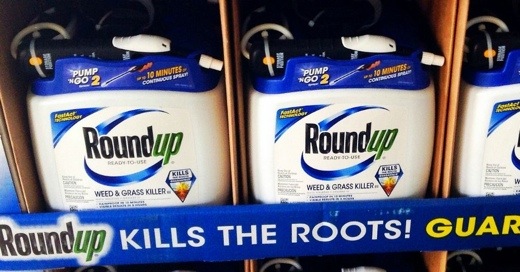
Image above: Photo illustration of a RoundUp home consumer product. From (http://sustainablepulse.com).

California just dealt Monsanto a blow as the state’s Environmental Protection Agency will now list glyphosate — the toxic main ingredient in the U.S.’ best-selling weedkiller, Roundup — as known to cause cancer.

Under the Safe Drinking Water and Toxic Enforcement Act of 1986 — usually referred to as Proposition 65, its original name — chemicals that cause cancer, birth defects, or other reproductive harm are required to be listed and published by the state. Chemicals also end up on the list if found to be carcinogenic by the International Agency for Research on Cancer (IARC) — a branch of the World Health Organization.

In March, the IARC released a report that found glyphosate to be a “probable carcinogen.”
Besides the “convincing evidence” the herbicide can cause cancer in lab animals, the report also found:
“Case-control studies of occupational exposure in the U.S.A., Canada, and Sweden reported increased risk for non-Hodgkin lymphoma that persisted after adjustments to other pesticides.”
California’s decision to place glyphosate on the toxic chemicals list is the first of its kind. As Dr. Nathan Donley of the Center for Biological Diversity said in an email to Ecowatch,
“As far as I’m aware, this is the first regulatory agency within the U.S. to determine that glyphosate is a carcinogen. So this is a very big deal.”
Now that California EPA’s Office of Environmental Health Hazard Assessment (OEHHA) has filed its notice of intent to list glyphosate as a known cancer agent, the public will have until October 5th to comment. There are no restrictions on sale or use associated with the listing.

Monsanto was seemingly baffled by the decision to place cancer-causing glyphosate on the state’s list of nearly 800 toxic chemicals. Spokesperson for the massive company, Charla Lord, told Agri-Pulse that:
“glyphosate is an effective and valuable tool for farmers and other users, including many in the state of California. During the upcoming comment period, we will provide detailed scientific information to OEHHA about the safety of glyphosate and work to ensure that any potential listing will not affect glyphosate use or sales in California.”
Roundup is sprayed on crops around the world, particularly with Monsanto’s Roundup-Ready varieties — genetically engineered to tolerate large doses of the herbicide to facilitate blanket application without harming crops. Controversy has surrounded this practice for years — especially since it was found farmers increased use of Roundup, rather than lessened it, as Monsanto had claimed.

Less than a week after the WHO issued its report naming glyphosate carcinogenic, Monsanto called for a retraction — and still maintains that Roundup is safe when used as directed.

On Thursday, an appeals court in Lyon, France, upheld a 2012 ruling in favor of farmer Paul Francois, who claimed he had been chemically poisoned and suffered neurological damage after inhaling Monsanto’s weedkiller, Lasso. Not surprisingly, the agrichemical giant plans to take its appeal to the highest court in France.

It’s still too early to tell whether other states will follow California’s lead.


WHO "Glyphosate probable carcenogen"

SUBHEAD: The World Health Organization assessment was announced in March of this year.

By Judy Carman on March 21 2015 for Sustainable Pulse -
(http://sustainablepulse.com/2015/03/21/who-declares-that-glyphosate-herbicides-probably-cause-cancer/#.VfcBCHsnpBo)

The World Health Organisation’s cancer agency has declared the world’s most widely used weedkiller – glyphosate – a “probable human carcinogen” in a move that will alarm the agrochemical industry and amateur gardeners.

The assessment by the International Agency for Research on Cancer (IARC) of glyphosate, which is used in herbicides with estimated annual sales of USD 6 Billion, will be of special concern to Monsanto, the company that brought glyphosate to market under the trade name Roundup in the 1970s.

Over 80% of GM crops worldwide are engineered to be grown with the herbicide.

The IARC has no regulatory role and its decisions do not automatically lead to bans or restrictions, but campaigners are expected to use them to put pressure on regulators.

The IARC reached its decision based on the view of 17 experts from 11 countries, who met in Lyon, France, to assess the carcinogenicity of 5 organophosphate pesticides.

The IARC’s assessment of the 5 pesticides is published in the latest issue of The Lancet Oncology.
Europe is set to re-approve glyphosate this year.

The IARC assessment is here (register to gain free access):
www.thelancet.com/journals/lanonc/article/PIIS1470-2045%2815%2970134-8/abstract

See also:
Ea O Ka Aina: RoundUp to be labeled carcinogenic 9/8/15

.

RoundUp to be labeled carcinogen

SUBHEAD: California's EPA to label Monsanto's glyphosate a "probable carcinogenic" product as a result of WHO finding.

By Nadia Prubis on 8 September 2015 for Common Dreams -
(http://www.commondreams.org/news/2015/09/08/monsanto-favorite-glyphosate-soon-join-californias-cancer-list)


Image above: Retail RoundUp product available to public to be labeled a "probable carcinogen". From original article.

In an unprecedented move, the California Environmental Protection Agency (Cal/EPA) will soon start labeling the common herbicide ingredient glyphosate a "probable carcinogenic," stepping up efforts to protect health and wildlife in the agriculture-heavy state even as use of weedkillers that include such toxins hits an all-time high.

Under Proposition 65, California is required to publish a list of chemicals known to cause cancer or birth defects. Glyphosate—favored ingredient of agrochemical producers like Monsanto and Dow—was declared "probably carcinogenic to humans" in March by the International Agency for Research on Cancer (IARC), a body of the World Health Organization.

"California's taking an important step toward protecting people and wildlife from this toxic pesticide," said Dr. Nathan Donley, staff scientist with the Center for Biological Diversity (CBD). "More than 250 million pounds of glyphosate are used each year in the United States, and the science is clear that it’s a threat to public health and countless wildlife species. It’s long past time to start reining in the out-of-control use of glyphosate in the United States."

In an email to EcoWatch, Donley added that California appears to be the first state to take such measures against the chemical. "As far as I'm aware, this is the first regulatory agency in the U.S. to determine that glyphosate is a carcinogen," he wrote. "So this is a very big deal."

Giving a chemical 'Prop 65'designation does not prevent sale or use of the substance, and glyphosate will only join the list after a 30-day period of public comment. Still, the news was received warmly by environmental advocates, who say it's important for California to acknowledge the IARC's findings and respond accordingly.

Rebecca Spector, west coast director at Center for Food Safety, told EcoWatch, "Since The World Health Organization’s research arm recently declared glyphosate is probably carcinogenic to humans, listing it under Prop 65 and requiring it to be labeled as such is a logical next step."

According to CBD, use of glyphosate is at an all-time high. "Its use increased more than 20-fold, from 10 million pounds in 1990, largely due to the widespread adoption of crops, particularly corn and soy, that are genetically engineered to withstand what would otherwise be fatal doses of glyphosate," the center wrote in a statement.

Recent studies have also linked its widespread usage to declining populations of Monarch butterflies and has even been found in the blood and urine of agricultural workers.

France announced in June that it would cease over-the-counter sales of Roundup over its carcinogenic concerns.

Donley said Friday, "The spike in usage of glyphosate is really concerning because more use equals more exposure. It's nearly impossible for people to limit exposure to this toxin because it is just so widespread. That’s why we need much tighter controls on its use."

.

European Union approves RoundUp

SUBHEAD: Despite WHO report glysophate is a probable carcinogen, Big Ag gets EU use approval.

By Lauren McCauley on 15 July 2015 for Common Dreams -
(http://www.commondreams.org/news/2015/07/15/citing-big-ag-research-eu-set-approve-toxic-weedkiller)


Image above: Protest in France over Monsanto pesticides. Trend-setting France bans Monsanto’s Roundup for home gardens. From (http://occupycorporatism.com/trend-setting-france-bans-monsantos-roundup-for-home-gardens/).

European regulators—under the influence of industry-backed research—are on the cusp of re-approving the use of the Roundup chemical glysophate, reporting Wednesday revealed, despite the fact that the World Health Organization recently deemed the widely-used herbicide a probable carcinogen.

An imminent decision by the European Food Safety Authority will determine whether glysophate, a main ingredient in Monsanto’s Roundup and Dow’s Enlist Duo, will be permitted on the continent. Sources from within the agency told the Guardian that findings by the WHO research group, the International Agency for Research on Cancer (IARC), may delay the approval.

However, documents obtained by the newspaper show that a key assessment by the German Federal Institute for Risk Assessments (BfR), sourcing information from agrochemical industry research, "has drawn contrary conclusions from the IARC’s data."

The Guardian reports that the BfR paper "relied heavily on unpublished papers provided by the Glyphosate Task Force, an industry body dedicated to the herbicide’s relicensing," whose website is run by Monsanto UK.

Further, the report found "very limited evidence of carcinogenicity" in mice exposed to the chemical, and recommended its re-approval calling for an even further relaxed "acceptable daily intake from 0.3 to 0.5 mg per kilogram of bodyweight per day."

Since a Monsanto chemist discovered the herbicide in the 1970s, its use has exploded. The development of glysophate-resistant genetically modified corn and soybean seeds only further hastened its spread.

In Europe, the Guardian notes, "The weedkiller is so widely-used that residues are commonly found in British bread. One survey found that people in 18 EU countries had traces of the weedkiller in their urine."

When asked about the potential re-approval of the toxic herbicide, Greenpeace spokesperson Franziska Achterberg told the Guardian that "Regulators should stop playing Russian roulette with people’s health."


Roundup probably causes cancer

SUBHEAD: Glyphosate, favored chemical of Monsanto & Dow, declared 'Probable' source of cancer for humans.

By John Queally on 23 March 2015 for Common Dreams  -
(http://www.commondreams.org/news/2015/03/23/glyphosate-favored-chemical-monsanto-dow-declared-probable-source-cancer-humans)


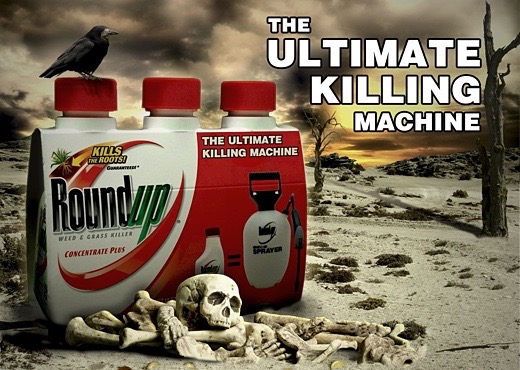
Image above: From (http://www.dcclothesline.com/2015/03/22/world-health-organization-admits-roundup-probably-causes-cancer/).

In a determination that could have far-reaching implications for the agro-chemical giants like Dow Chemical and Monsanto, the research arm of the World Health Organization has declared that glyphosate—the key ingredient of widely-used herbicides such as Roundup—should now be categorized as a "probable carcinogen" for humans.

In a report published on Friday in The Lancet Oncology medical journal, the International Agency for Research on Cancer (IARC), based in France, announced its findings after a meeting of 17 oncology experts from 11 countries met to review the available scientific research exploring the connection between glyphosate, as well as several organophosphate insecticides, and various human cancers.

According to IARC, glyphosate is used in more than 750 different herbicide products and its use has been detected in the air during spraying, in water and in food. The panel of experts concluded that "limited evidence" exists to show the herbicide can cause non-Hodgkins lymphoma in humans and additional "convincing evidence" that it can cause other forms of cancer in both rats and mice.

Researchers noted that glyphosate has been found in the blood and urine of agricultural workers, showing the chemical has been absorbed by the bodies of those who work most with it.

As the Associated Press explained, the research agency—which provides academic and scientific research FOR the WHO—has four levels of risks for possible cancer-causing agents: known carcinogens, probable or possible carcinogens, not classifiable and probably not carcinogenic. Glyphosate now falls in the second level of concern.

Though Monsanto immediately and predictably rejected the findings of the IARC, scientists who have long-warned of the public health impacts and wider dangers of glyphosate say the announcement should add urgency to the debate about whether or not such products should be allowed to dominate the world's agricultural systems.

"The widespread adoption of GMO corn and soybeans has led to an explosion in the use of glyphosate – a main ingredient in Monsanto’s Roundup and Dow’s Enlist Duo," said Ken Cook, president and co-founder of the Environmental Working Group. "Consumers have the right to know how their food is grown and whether their food dollars are driving up the use of a probable carcinogen."

Though the IARC's finding have no regulatory bearing on the U.S. Environmental Protection Agency determinations about glyphosates and the other compounds studied, they do add weight to the body of evidence showing how harmful such chemicals are.

According to Marquez and her colleagues at PAN, since Monsanto’s signature "RoundUp Ready" corn and soy crops were introduced in 1996, more than 500 million additional pounds of glyphosate and other herbicides have been used in the United States.

"It should be noted that in well over a decade’s use of glyphosate in GE crops, hundreds of millions of pounds of this chemical have been released into the environment," said Marquez. "USGS surveys document widespread water contamination, and — as documented in a recent Consumer Reports study — residues of glyphosate also show up in our food. Even though glyphosate is so widely used, the U.S. does not currently conduct biomonitoring for glyphosate residues, and USDA conducts only minimal testing for food residues."

What's more, the pesticides and herbicides on which farmers have now been forced to rely may no longer be working. As Marquez explains: "The dramatic growth in herbicide use in the U.S. driven by GE technology has resulted not only in increased human exposure to these chemicals, but also in the development of herbicide-resistant ‘superweeds.’ Farmers are offered more toxic mixes of herbicides as a so-called solution to this new problem. Dow’s recently approved Enlist seeds — designed for use with a mixture of glyphosate and the antiquated, highly toxic herbicide, 2,4-D — offer a case in point."

In other words, the more these chemicals are used, the less effective they become.

According to Marquez, "This increasingly dangerous pesticide treadmill calls into question the logic of genetically engineered herbicide technologies that rapidly lose their utility to farmers and — as IARC’s recent finding makes clear —put human health at risk."

As Al-Jazeera notes, scientists and farmers from around the world have raised other concerns over glyphosate and tried to ban its use:
Channa Jayasumana,with Rajarata University of Sri Lanka, published a study in the International Journal of Environmental Research and Public Health in 2014 on a possible link between glyphosate and chronic kidney disease in farmworkers. His research found that excessive heat and dehydration may weaken the workers' bodies, making them more susceptible to pesticides and heavy metals, which can lead to kidney disease.

Based on that research, the Sri Lankan government moved to ban glyphosate in spring of 2014. But Monsanto raised objections to the report's findings, and the ban was lifted. The chemical was, and continues to be, widely used on farms in the country.

The research also suggested a link between glyphosate and a mysterious kidney disease that has killed thousands of farmworkers in Central America. At least 20,000 farm workers have died of chronic kidney disease in Nicaragua in the last two decades, The Guardian reported in February. Researchers who have studied the disease in Central America say that it mainly affects agricultural laborers working under conditions of excessive heat and dehydration, but other factors, including pesticides, may play a role.
In addition, a peer-reviewed paper in 2014titled "Genetically Engineered Crops, Glyphosate and the Deterioration of Health in the United States of America"(pdf)—linked glyphosate to a huge increase in the incidence of 22 chronic diseases across the United States.

Emily Marquez, Ph.D., a staff scientist at the Pesticide Action Network, in a statement on Monday, said, "Given glyphosate’s widespread usage with crops genetically engineered to tolerate herbicides, IARC’s finding comes none too soon."

.

Big Ag Big Threat

SUBHEAD: A menacing mix in antibiotic resistance, herbicides, heavy metals and factory farms.

By Lynne Peeples on 24 March 2015 for Huffington Post  -
(http://www.huffingtonpost.com/2015/03/24/antibiotic-resistance-herbicides-heavy-metals_n_6935626.html)


Image above: Detail of aerial photo of beef feedlot. A recently released batch of aerial photographs by British artist Mishka Henner show that factory farming is taking its toll on our planet. In addition to producing nutrient-poor "food" rife with GMOs, these farms are literally carving swaths of death through the American landscape. Henner's shocking photos provide bird's eye proof of the destruction that follows when industrial beef farming moves into town.  From (http://inhabitat.com/mishak-henners-apocalyptic-photos-show-how-factory-farming-is-destroying-the-american-landscape/mishak-henner-feedlot-photography-3/).

Two common Big Agriculture production practices -- feeding antibiotics to livestock and spraying herbicides on conventional crops -- each face condemnation from the environmental community.

And there's been plenty of new fodder in the last week: One study predicted that antibiotic use in livestock will soar by two-thirds globally from 2010 to 2030, and another declared that Monsanto's popular Roundup herbicide is "probably carcinogenic to humans."

The latest research may merge the herbicide and antibiotic battle lines. The use of common herbicides, such as Roundup, Kamba and 2,4-D, according to a study published on Tuesday, may help drive antibiotic resistance.

Antibiotic-resistant infections take the lives of more than 23,000 Americans every year. The World Health Organization and the U.S. Centers for Disease Control and Prevention are among major groups warning of the dire threat posed to public health. Antibiotic resistance stemming from overuse in livestock also is the target of a bill re-introduced in Congress on Tuesday.

Environmental health advocates predict the use of herbicides will continue to rise as farmers plant more genetically modified seeds engineered to survive weedkillers. The U.S. Environmental Protection Agency recently approved Enlist seeds, which are designed for use with a mix of 2,4-D and glyphosate, the chief ingredient in Roundup.

In some cases, combinations of herbicides and antibiotics in the new study made bacteria more susceptible to antibiotics, or had no effect. But more often, it had the opposite effect. If the disease-causing bacteria -- E. coli and salmonella -- were exposed to high enough levels of herbicide, the researchers found that the microbes could survive up to six times more antibiotic than if they hadn't been exposed to herbicide. They studied five common classes of the drugs: ampicillin, chloramphenicol, ciprofloxacin, kanamycin and tetracycline.

"In a sense, the herbicide is 'immunizing' the bacteria to the antibiotic," said Jack Heinemann, lead author of the study and researcher at the University of Canterbury in New Zealand. He noted that the levels of herbicide tested in the study were above legal limits for residues on food, but lower than what's commonly applied to commercial crops.

The new finding builds on emerging evidence that multiple environmental contaminants may play a role in the rise of antibiotic resistance. Swedish researchers reported in September that antibiotic residues and heavy metals in the environment -- even at "infinitesimally low" concentrations -- may team up to drive the growth of antibiotic resistance. In addition to metals potentially leaching into the environment from other industries, construction or health care facilities, some farmers use arsenic in animal feed and as a pesticide. Mercury can also contaminate fish meal, while copper is common in swine fodder.

"This could be an important contributor" to antibiotic resistance, Dan Andersson, lead author of that study and a microbiologist at Upsalla University in Sweden, told The Huffington Post in October.

Mark Silby, a biologist at the University of Massachusetts, Dartmouth, noted an "important parallel," between the heavy metal and herbicide studies. "Low-level antibiotics can be of considerable importance in the evolution of antibiotic resistance, by means which we may not be very good at anticipating," he said.

Most research in the past has looked at chemicals or other contaminants in isolation, rather than as the cocktail that typically lingers in the environment -- especially near farms -- and is enlisted in modern agricultural practices. Livestock feed, and the fields on which animals graze, may contain traces of antibiotics, herbicides and heavy metals.

Heinemann, too, emphasized that "combinations of exposures to what we think of as different kinds of chemicals can matter."

He also pointed to the core issue of the overuse of antibiotics in both medicine and agriculture. His team's study was published the same day that Rep. Louise Slaughter (D-N.Y.) re-introduced the Preservation of Antibiotics for Medical Treatment Act. The bill has the support of 50 city councils and more than 450 medical, consumer advocacy and public health groups.

"Right now, we are allowing the greatest medical advancement of the 20th century to be frittered away, in part because it's cheaper for factory farms to feed these critical drugs to animals rather than clean up the deplorable conditions on the farm," Slaughter, the only microbiologist in Congress, said in a statement Tuesday. "My legislation would save eight critical classes of antibiotics from being routinely fed to healthy animals, and would reserve them only for sick humans and sick animals."

The U.S. Food and Drug Administration offers voluntary guidance to the pharmaceutical industry on the use of antibiotics in livestock, including a request that drugmakers change their labels by December 2016 to exclude uses for growth promotion. The FDA hasn't imposed a ban or mandatory restrictions.

Advocates are not impressed, pointing to potential loopholes in the voluntary guidance.
Slaughter's bill has faced steep opposition since its first iteration in 1999. In the last Congress, according to a press release from her office on Tuesday, 82 percent of lobbying reports filed on her bill came from “entities hostile to regulation.”

Slaughter is among experts and advocates who largely blame the pressing public health problem on the routine administration of low doses of antibiotics to cattle, swine, chickens and other livestock. Just as an incomplete course of antibiotics can result in the rise of a more virulent infection in a person, this use in animals -- often to prevent the spread of disease or to simply promote growth -- means bacteria that can withstand the drugs will survive, reproduce and pass on their resistance to the next generation of bugs on the farm.

Food animals receive about 80 percent of the antibiotics sold in the U.S. Livestock antibiotics are thought to affect human health via multiple pathways: direct or indirect contact with food, water, air or anywhere urine or manure goes.

While some fast food brands and retailers have begun eliminating medically-important antibiotics from their supply chains, the agriculture industry maintains that its practices are critical for livestock health and not a significant contributor to the rise of antibiotic resistance. The Animal Health Institute, which represents pharmaceutical companies, suggested that the herbicide and heavy metal studies further support their case.


Image above: No this is not a computer circuit-board. It's your Big Mac under construction. It's also a wider view of photo above, is just part aerial photo by Mishka Henner of beef feedlot runoff.  Antibiotics and GMO contaminants such as pesticides and glyphosate and 2-4-D in urnine and fecal matter coolect in runoff and end in toxic pools. This is reason enough to eat free range grass fed beef (if you are going to eat beef at all).  From (http://inhabitat.com/mishak-henners-apocalyptic-photos-show-how-factory-farming-is-destroying-the-american-landscape/mishak-henner-feedlot-photography-3/).

"These studies are further indications that antibiotic resistance is a very complex issue and there are non-antibiotic compounds that can select for resistance," Ron Phillips, vice president of legislative and legal affairs with the group, told HuffPost in an email. "That's why simple solutions will only waste resources while not addressing the real issue. We must address the issue of antibiotic resistance with careful, science-based" approaches.

Charla Lord, a spokeswoman for Monsanto, added that her company was taking a closer look at the "very complicated" study. She said more research is needed to identify what components in the herbicide may be linked to any effects.

Amy Pruden, an expert on antibiotic resistance at Virginia Tech, agreed that the studies "definitely complicate things" and add evidence that "it's not just antibiotics that contribute to the problem."

Pruden emphasized the need for "a really broad management plan that thinks comprehensively about all the things that contribute to the failure of antibiotic treatment." She noted that antibiotic overuse, including in livestock, is far from off the hook. "It's common sense that antibiotics themselves are the core issue," she said. "It's just that even if we cut way back on them, we still might have work to do and other things to think about."

Silby agreed. "Obviously, sick animals should be looked after appropriately, but the large-scale use of antibiotics as growth enhancers has almost certainly been a significant driver of antibiotic resistance."

See also:
Ea O Ka Ania: NZ dairy model isn't Mahaulepu 3/9/15

.

Roundup and Lymphoma

SOURCE: Shannon Rudolph (shannonkona@gmail.com)
SUBHEAD: A major new review finds Roundup is anything but harmless. It doubles your risk of lymphoma.

By Leah Zerbe on 5 June 2014 for the Cornucopia Institute -
(http://www.cornucopia.org/2014/06/roundup-chemical-doubles-risk-lymphoma/)


Image above: A Roudup three-pack to take home with you. From (http://sustainablepulse.com/2014/04/06/worlds-number-1-herbicide-discovered-u-s-mothers-breast-milk/).


Forwarded by Shannon Rudolph via Carol from Kauai
PAY ATTENTION!
I forked out $400 to have my urine, tap and well water tested for glyphosate, the main ingredient in Roundup and one of the MANY pesticides that are sprayed ALMOST EVERY DAY on the (Kauai) Westside.

Tap water: undetectable ppb (parts per billion).

Well water: 0.1 ppb

The maximum allowable concentration in European drinking water, 700 ppb is the allowable amount in US drinking water...would that be 7000 times higher?

My urine: 9.2 ppb.
What? I've never used Roundup in my life. I eat mostly organic. It doesn't appear I'm drinking it. Is it raining on my house and my garden almost every day?

What the hell is it going to take for us to stop this chemical insanity?????

Carol

There’s been a striking increase in the number of non-Hodgkin’s lymphoma cases over the past three decades, and a major new scientific review suggests chemical pesticides—particularly glyphosate, the active ingredient in the popular weedkiller Roundup—are playing an important role in fueling the cancer.

The review, recently published in the International Journal of Environmental Research and Public Health, examined 44 papers to see how 80 active ingredients in 21 different chemical classes impacted farmers’ risk of non-Hodgkin’s lymphoma.

The International Agency for Research on Cancer researchers found that exposure to glyphosate doubled a person’s risk of developing non-Hodgkin’s lymphoma. That’s problematic, since the chemical is now so heavily used it’s winding up in the rain! The reason for the surge in glyphosate use can be attributed to the rise of genetically engineered crops. Monsanto, the manufacturer of Roundup, developed genetically engineered seeds that were designed to withstand heavy Roundup sprayings. In the last 20 years, the use of these seeds has skyrocketed.


Despite being hailed by industry as a way to reduce chemical use in farming, Professor Chuck Benbrook, PhD, a research professor at Washington State University, recently found that between 1996 and 2011, GMO technology actually increased herbicide use by 527 million pounds—that’s an 11 percent bump.

For one pound of insecticide avoided, four pounds of herbicides are used. Since weeds are developing resistance to glyphosate because it’s being overused, farmers are applying higher levels of glyphosate more frequently. In fact, Norwegian scientists recently detected extreme levels of Roundup in a popular U.S. food ingredient.

Roundup and its active ingredient glyphosate have been linked to:
  • death of human embryonic cells
  • breast cancer and other cancers
  • infertility
  • hormone disruption
  • birth defects
  • eye, skin, and respiratory irritation
  • spontaneous abortions in farm animals.

“Data has been emerging that point to various health and environmental consequences resulting from glyphosate and Roundup use. These include an increased risk of non-Hodgkin’s lymphoma, genetic damage, neurological impacts, as well as water contamination, impacts on amphibians and immune function, and increasing weed resistance,” explains Warren Porter, PhD, professor of environmental toxicology and former chair of zoology at the University of Wisconsin–Madison.

The chemical is so widely used—farmers sprayed approximately 57 million pounds in 2010 alone—that glyphosate is routinely detected in human and even cow urine. Scientists have shown that incredibly tiny doses can trigger health problems, including potentially irreversible biological changes.

“A compound that supposedly degrades rapidly due to sunlight has been measured by the United States Geological Survey in the atmosphere and water—in abundance—all over the Midwest over multiple years,” Porter adds. “This compound can affect the rate of conversion of testosterone to estrogen, which implies effects on sexual development and sexual preferences.”

Aside from the Roundup-non-Hodgkin’s lymphoma connection, researchers also found 2,4-D exposure in farming led to a 40 percent higher increase in non-Hodgkin’s lymphoma risk. That’s worth noting, too, since the federal government is considering the approval of GMO seeds designed to withstand both 2,4-D and glyphosate.

More From Rodale News:
The Biggest GMO Myths, Busted

Scientists believe many of these farming chemicals—substances commonly detected on and in the nonorganic foods we eat—are negatively impacting white blood cells, throwing our immune systems out of whack.

To avoid Roundup in your food:

  • Eat organic whenever possible. GMO seeds designed to be sprayed with glyphosate; these GMO seeds are banned in organic agriculture.
  • Avoid nonorganic processed foods as much as possible.
  • If you do opt for nonorganic processed foods, look for “Non-GMO Verified” options, or foods without corn, soy, canola, or cotton oil ingredients. (Note: These foods could still contain other harmful systemic pesticides.)
To avoid Roundup around your home:
  • Use safer weed-killing products, like Burnout.
  •   Raise your lawnmower deck to at least 3 inches, which is usually as high as most residential lawnmowers go. This height will eliminate a lot of broadleaf weeds. Mowing your grass too low could turn your green grass brownish, and eliminate taller grass’s weed-suppressing shade.
  • Use these other organic lawn care tricks.
 To avoid Roundup in your water:
  •  If you have well water, find a certified water-testing source to determine contaminants, including pesticides, in your water supply.
  • If you are hooked up to a public water system, look at your water bill and contact your water utility to ask to see the most recent “consumer confidence report” or water quality report so you can identify contaminants in your area. If you use a well, you can request a report from a nearby utility to gauge potential local contaminants, including chemical pesticides.
  •  To remove levels of glyphosate from your water, the Environmental Protection Agency recommends using granular activated-carbon filters.
 More Food Chemicals Linked to Non-Hodgkin’s Lymphoma
Carbamate insecticides. Found in bug sprays or baits, including Sevin products sold in many home-improvement stores, to kill cockroaches, ants, fleas, crickets, aphids, and other bugs found in the home and garden. In federal pesticide-residue tests, this type of chemical most commonly turned up on nonorganic frozen strawberries, hot and sweet bell peppers, and peaches.

Organophosphate insecticides. Highly toxic to birds, bees, and humans, organophosphate pesticides are also linked to the most common form of childhood cancer, acute lymphoblastic leukemia. Foods more commonly containing organophosphate insecticide residues include nonorganic strawberries, celery, and corn.


.

It's time for a shutdown!

SUBHEAD: The elite fear rejection of atomic energy because it would crash the global economy relying on it for energy.

By Juan Wilson on 31 December 2013 for Island Breath -
(http://islandbreath.blogspot.com/2013/12/its-time-for-shutdown.html)


Image above: Illustration by Victor Juhasz for Rolling Stone From (http://eon3emfblog.net/?p=2729).

Today I received a comment this morning on an article A Brief Radiaition Spike on Kauai 12/27/13.  That post has been the most widely read on this site in the four years of its existence (over 5,000 reads).


I am a radiation protection professional (Health Physics). From what I read of your article you are anxious over the temporary "spike" readings from your Radex RD1212 at 1-3 microsieverts level.

I share the mistrust of officials in charge of the TEPCO disaster but honestly your readings are nothing to be alarmed at whatsoever. I could explain in detail why and offer a way for you to independently verify your exposure and risk. I don't want to waste my time if you don't want to hear it but if you do I'll shed some light on it. Totally up to you, however I'd hate to see you stress over these levels, honestly
From Speculative Measures


Mt response was as follows.


Aloha Speculative Measures,

I am not very anxious of a singular (or even infrequent) spike in background radiation. I am worried that there will be a point where the Fukushima NPS will have to be abandoned and further Tepco mitigation is halted.

This  could happen if, for example, some fuel pellets blown out of reactor #3 during its nuclear explosion,dell into the spent fuel pond and eventually produce a pyrophoric fire or criticality.

There are many other scenarios might result in abandoning the site to the fates. Another is an earthquake that would knock down what left of building #4.

Abandoning the site would likely result in the eventual uncontrolled dispersal of a continuous stream of transuranic (hot)  particles into the atmosphere.

The spike we saw here on Kauai was likely hot particles from steam vented from the #3 cooling pond on 12/24-12/27. The jetstream (that is more irregular die to global warming) was blowing south to Kauai, in the days leading to the spike.

I conclude that in such conditions we will have hot particles in the air at times here. I don't care what you say, my research on this issue tells me that inhaling even small numbers of hot particles is a death sentence.

Dispersal of transuranic material is likely happening now from underground contact of the corium with tidal ocean water going into the Pacific Ocean.  This material will eventually work its way up the food chain and into us.

Transuranic material will also be washed from the ocean into intertidal areas (the beaches of the Pacific Ocean shorelines). Ultimately this hot material will be carried as dust past the beaches and into the interior or our islands and the mainland.

Fukushima's 311 will certainly be seen as a much worse disaster for America (and the world) than the World Trade Center 911. It will be viewed as the worst human engineering disaster of all time.

For me, it has now passed Global Warming, Peak Oil, and Financial Collapse as the near term most immediate problem humans have to deal with.

Mankind will be lucky if it has the industrial and energy resources necessary to quench this fire and shutdown the 500 off nuclear power plants operating today before each becomes another Fukushina.

As a radiation health professional do you approve of the actions of your colleagues aboard with USS Ronald Reagan who advise the crew that they were in no danger from hot particles hitting the deck?

IB Publisher


There are plenty of reasons to worry about elevated background low level radiation. As is commonly understood for regular "low level" radiation tests for mammograms; the diagnostics are more dangerous to health than the risk of the disease.

With Fukushima we are going to be dealing with ever increased levels widespread dispersal of low level (cesium and iodine) and high level (uranium, plutionium) radio activeelements. The former persist in the environment for centuries and the former for millennia.

More to the point, the failure of Tepco to get control of the continued dispersal of new radioactive elements into the atmosphere and ocean means the dispersal itself may not end for centuries or millennia.

The bottom line is that no radiation health professional has any way of knowing the long term risks to the biosphere from Fukushima (and other nuclear power plant failures). I work on the assumption that they are likely bad to current species of flora and fauna on the planet.

It seems to me that the industrial nations, along with their corporations and military don't want a panic. They fear rejection of atomic energy because it would crash the global economy relying on it for energy. They certainly don't want a collapse of the current electric grid dependent consumer economy.

I say  FUCK THEM!

It's time a real cleanup and a worldwide shutdown!

Note: this is a followup to my response above:


It will be interesting to see what kind of commitment the government of Japan sustains to recover the fuel. I'm thinking they will get most of the fuel using robotics simply due to the economic fallout if they don't, but who knows. You'r right there's certainly not an easy, quick or cheap remedy.

Regarding hot particles, it's not a very precise term. When that term is used in Radiation Protection circles it refers to a specific type of material - an exceedingly small, fragmented fuel particle. Their also know as "fuel fleas" because being so small and so activated they often carry a high static charge that can cause them to jump to alternately charge objects. Now there can be radioactive particles that have elevated activity that indeed could pose health risks, particularly if concentrated, but these are not "hot particles" as the term is used.

I think if you were to find them they would be attached to some sort of debris. On their own they are typically much heavier than water so I would't expect to find them too far from the event site (i.e not >100 mi) but can very piggy back on debris from the site or potentially in sea-life as you alluded to. Honestly I'd be super surprised to see a "hot particle" anywhere near Hawaii but please keep us posted!

Regardless, were you to find a hot particle here are 3 characteristics to look for:

They are hot! - If you're not seeing at least 1000uSV/hr it's probably not a "hot particle". It could be an activation product which is a lesser of the two concern but hot particles are hot. By hot I mean 10,000-100,000 uSV/hr - we find some as high as 500,000 uSV/hr (50R/hr in US units) although most are in the former range. So if you're not seeing at least 1000uSV/hr I wouldn't spend the money getting it analysed.

Discrete high energy - If you were to have a hot particle on the end of a Popsicle stick and put it in front of your meter you would see wild swings in your meters response depending on how you position it. A few centimeters would mean the difference between 1000uSV and 10000uSV.

Beta discrimination - A significant portion of the radiation is in the form of Beta Radiation. You can stop almost all Beta radiation with a credit card. If your meter had a Beta Window (a thin film in front of the detector vs a hard plastic encasement such as yours has) you could perform a "field check" by measuring the bare particle then measuring it again with a credit card in front. If you see the sustained meter reading drop by 1/2 when using the credit card AND an original reading of at least >1000 uSV/hr sustained, then you could have a Hot Particle. If a credit card thickness of plastic doesn't drop the meter response by 1/2 you have something else.

From Speculative Measures

.
Hey, Speculative Measures,  thanks for your analysis.