Showing posts with label Sonar. Show all posts

Stop Navy killing marine mammals

SOURCE: Koohan Paik (koohanpaik@gmail.com)
SUBHEAD:  Tell the Navy to examine alternatives that would limit activities harmful to marine mammals.

By Dave Henkin on 6 December 2017 for Earth Justice -
(https://secure.earthjustice.org/site/SPageNavigator/P2A_NavySonar.html)


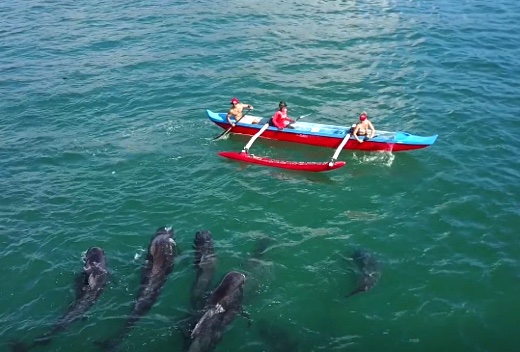
Image above: Outrigger canoe tries to keep this pod of pilot whales from beaching at Kalapaki on Kauai - five of them died. From (http://www.hawaiinewsnow.com/story/36592433/officials-investigating-several-whales-stranded-at-kauais-kalapaki-beach).

The key to reducing harm to marine mammals is to restrict harmful Navy activities in sensitive marine habitat.

Unfortunately, the Navy proposes stripping protections from critical areas.

Thousands of whales, dolphins and other marine mammals could suffer permanent injury—and even death—from warfare training exercises if the Navy walks back their agreement to a reasonable testing and training plan.

Over the next five years, the Navy wants to fire tens of thousands of rockets, missiles and projectiles and blast sonar for tens of thousands of hours in waters off Hawai‘i and Southern California that are home to dozens of vulnerable marine mammal species.

To marine mammals, the deafening sounds from Navy activities can be fatal. In the dark depths of the ocean, these mammals rely almost entirely on sound to “see” their world. It’s how they feed, mate, communicate and navigate. If a whale or dolphin can’t hear, it can’t survive.

Before the Navy can adopt its testing and training plan, it needs to consider public input under the National Environmental Policy Act, or NEPA. You have only until December 12 to tell the Navy to commit to a reasonable plan that achieves military preparedness while maximizing marine mammal safety.


Image above: Two dying pilot whales on the sand at Kalapaki Beach. From (http://www.hawaiinewsnow.com/story/36592433/officials-investigating-several-whales-stranded-at-kauais-kalapaki-beach).

After a landmark settlement with Earthjustice in 2015, the Navy voluntarily agreed to safeguards for whales, dolphins and other marine mammals, protecting vast swaths of vital ocean habitat. But these common sense measures are conspicuously missing from Navy’s draft plan for the next five years of training and testing around the Hawaiian Islands and off Southern California.

The settlement proved that the Navy can both protect our nation and minimize harm to whales and dolphins by limiting the use of sonar and explosives in vital habitats.

The waters off the coast of Southern California are a globally important feeding area for endangered whales, and, for numerous small, resident whale and dolphin populations off Hawai‘i, the islands are literally their only home.

For years, scientists have documented that mid-frequency sonar wreaks havoc on the ocean environment, causing serious impacts to marine mammals, such as permanent hearing loss, lung injuries, strandings, habitat abandonment and even death.

The Navy already acknowledged that it doesn’t need to train in every square inch of the ocean and that it can take reasonable steps to reduce the deadly toll of its activities. Tell it to examine and pursue alternatives that protect both the nation and irreplaceable marine life.

See also: 
Ea O Ka Aina: Air Force plans to bomb whales 2/6/17
Ea O Ka Aina: Hawaiian spinner dolphin restriction 1/9/17
Ea O Ka Aina: Navy to dump 20K tons of poison 11/16/16
Ea O Ka Aina: PMRF injuring marine mammals10/9/16
Ea O Ka Aina: Judgement against RIMPAC 2016 5/29/16
Ea O Ka Aina: US court RIMPAC Impact decision 4/3/15
Ea O Ka Aina: PMRF RIMPAC Claptrap 11/22/14
Ea O Ka Aina: RIMPAC 2014 - another whale death 7/26/14
Ea O Ka Aina: Navy Injury & Death Toll 3/19/14
Ea O Ka Aina: Navy License to Kill 10/9/12
Ea O Ka Aina: Navy admits threat to sea mammals 5/10/12
Ea O Ka Aina: Talk on Ocean Noise 12/28/11
Ea O Ka Aina: Navy to kill Pacific whales 1/17/09

Federal Court slams Navy sonar

SOURCE: KAtherine Muzik PHD (kmuzik@gmail.com)
SUBHEAD: 9th District Court of Appeals rejects US Navy's rules on ocean sonar use.

By Staff on 16 July 2016 for the Associated Press -
(http://abcnews.go.com/US/wireStory/federal-appeals-court-rejects-navy-sonar-rules-40627158)


Image above: Orca jumps for joy. From original article.

A federal appeals court ruled Friday that the U.S. Navy was wrongly allowed to use sonar that could harm whales and other marine life.

The Ninth U.S. Circuit Court of Appeals reversed a lower court decision upholding approval granted in 2012 for the Navy to use low-frequency sonar for training, testing and routine operations.

The five-year approval covered peacetime operations in the Pacific, Atlantic, and Indian Oceans and the Mediterranean Sea.

The appellate panel sent the matter back to the lower court for further proceedings.

A message seeking comment from representatives of the U.S. Pacific Fleet in Honolulu was not immediately returned.

Sonar, used to detect submarines, can injure whales, seals, dolphins and walruses and disrupt their feeding and mating

The 2012 rules adopted by the National Marine Fisheries Service permitted Navy sonar use to affect about 30 whales and two dozen pinnipeds, marine mammals with front and rear flippers such as seals and sea lions, each year.

The Navy was required to shut down or delay sonar use if a marine mammal was detected near the ship. Loud sonar pulses also were banned near coastlines and in certain protected waters.

Environmental groups, led by the Natural Resources Defense Council, filed a lawsuit in San Francisco in 2012, arguing that the approval violated the Marine Mammal Protection Act.

The appellate court ruled 3-0 that the approval rules failed to meet a section of the protection act requiring peacetime oceanic programs to have "the least practicable adverse impact on marine mammals."

"We have every reason to believe that the Navy has been deliberate and thoughtful in its plans to follow NMFS guidelines and limit unnecessary harassment and harm to marine mammals," the appellate ruling said.

However, the panel concluded that the fisheries service "did not give adequate protection to areas of the world's oceans flagged by its own experts as biologically important," according to a summary accompanying the court's decision.

"The result is that a meaningful proportion of the world's marine mammal habitat is under-protected," according to the decision.

.

DLNR responsibility on RIMPAC

SUBHEAD: 60 Day Legal Notice to Enforce the U.S. Endangered Species Act on the U.S. Navy and RIMPAC.

By Terry Lilly on 5 July 2016 in Island Breath -
(http://islandbreath.blogspot.com/2016/07/dlnr-responsibility-on-rimpac.html)


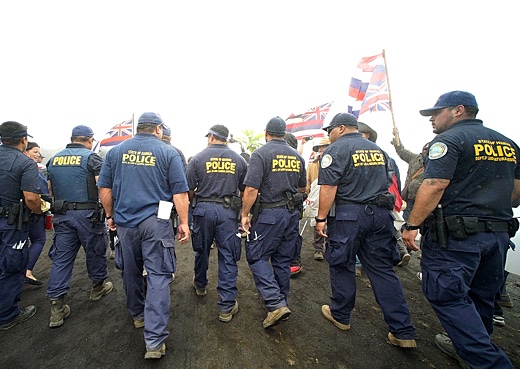
Image above: DLNR police armed with semiautomatic weapons enforcing restrictions on Hawaiian protest of construction of Thirty Meter Telescope on a sacred part of the summit of Mauna Kea mountain on the Big Island in 2015.  From (http://www.civilbeat.org/2015/12/should-hawaiis-dlnr-cops-carry-semi-automatic-weapons/).

[IB Publisher's note: The following is a letter from Terry Lilly to Mrs. Suzanne Case Chairperson of the Hawaii Department of Land & Natural Resources to enforce the US Endangered Species Act  against the U.S. Navy for conducting RIMPAC 2016 and damaging the environment in and around Hawaii. Certainly, the DLNR fully enforce regulations along the beaches of Polehale and Kalalau to keep residents without the proper permits from camping (presumably to protect these pristine environments.]

Dear Mrs. Case,
As Chair Person of the Hawaii DLNR you are head of law enforcement and bound by law to enforce the US Endangered Species Act (ESA) here in Hawaii. When you took your oath of office you swore to uphold US and State Law.

The federal and state ESA claims " Any employee or agent of the department upon whom the board has conferred powers of police officers, including the power to serve and execute warrants and arrest offenders, or issue citations throughout the state, and any police officer of the counties of this state shall have the authority to enforce any of the provisions of this chapter or any rule adopted under this chapter".
Furthermore, it has been determined in court "That the Willful Omission of enforcing the ESA can be considered a Take under the law itself". Which means that you are obligated to enforce this law.

I know you are well aware of the wording in the ESA and are aware of the need for the Navy to do a Habitat Conservation Plan before operating in the habitat of Hawaiian endangered species.

The reason I know you know this law is because in December of 1998 you attended and graduated from the same class I did in California which was hosted by the US Fish and Wildlife Service and Craig Potter who wrote the ESA in 1973.

The class was called "Endangered Species Act and Habitat Conservation Planning". You are listed on the attendance sheet as "Suzanne Case : The Nature Conservancy: 201 Mission Street 4th FL San Francisco CA : 415-281-0466.

During that class we were both give many legal quotes out of the ESA itself and also many court case studies.

We were presented by the top environmental attorney firms in the USA and Craig Potter himself these quotes about the ESA.
1. ESA Section 7 requires that EVERY Federal agency consult with the Fish and Wildlife Service (FWS) to ensure that the agency actions are "not likely to jeopardize the continued existence or ANY endangered species or result in the destruction or adverse modification of designated critical habitat of such species.
I can prove that the war ships off our coastline during RIMPAC and the US Navy five year long electronic microwave war testing here in Hawaii is "likely" to jeopardize the critical habitat of the endangered green sea turtle, hawksbill turtle and monk seal. These ships put out billions off watts of electromagnetic energy they discharge into the sea and they are using high intensity sonar. Both of these events harm, harass and take our endangered species.
2. 16 U.S.C. 1536 (a)(3)(4), 50 C.F.R. 402.14 legal code claims that : If the agency determines that an endangered species MAY be present in the area affected by the action and proposed actions is LIKELY to effect the species the ESA REQUIRES consultation.
NOAA has already determined that all Hawaiian waters are critical habitat for the monk seal because these endangered species travel in between islands!

Plus the very rare hawksbill turtle travels between islands and the baby green sea turtles live out at sea for the first part of their life.

So it is obvious that the wide area of sea that the Navy is discharging electricity into, blasting with explosives, sinking ships with bombs and using massive amounts of sonar and underwater (DARPA) tested electronics to track and destroy submarines is "likely" to harm, harass and take our endangered species.
3. Section 7 V. Section 10 of the ESA is a process by which FEDERAL agencies obtain permission to "TAKE" endangered species. The Navy must file for and receive an Incidental Take Permit to START RIMPAC or their microwave war test.
Section 7 outlines the process that the Navy must take to get a permit to operate in the habitat of our endangered turtles, whales and monk seas. This process is called an HCP.

It is described by law as:
Habitat Conservation Plan as a plan describing the ANTICIPATED effect of proposed taking on the affected species and HOW that TAKE will be minimized and mitigated for : the plan is submitted with and Incidental Take Permit.

No HCP was done or submitted by the Navy to operate RIMPAC! RIMPAC is in direct violation of the most powerful environmental law ever adopted by a country on our planet.

Commander Bruce Hay from PMRF openly told all of us on the KKCR radio show and in a private meeting with the top PMRF officials "RIMPAC 2014 had no way to monitor the effects on the sea turtles and coral reefs". He further said "RIMPAC 2016 will be operated just like RIMPAC 2014 and the Navy has NOT done an environmental study ahead of time or a Habitat Conservation Plan".

The ESA has been held up in court against the US Navy in dozens of law suits filed by the NRDC and Earth Justice and once again it looks like we must got to court to force the Navy to follow our Endangered Species Act, Marine Mammal Protection Act and Clean Water Act.

As a citizen of the USA I have the LEGAL rite to make you enforce the ESA onto the Navy. I have the legal rite to sue the Navy, NOAA, and the DLNR for violating the ESA and, or lack of enforcement of the ESA.

This is called a Citizens Suit. It is described in the ESA section 11 as : To enjoin any person, INCLUDING the United States of America and other governmental instrumentality or agencies, who allege to be in violation of the ACT or its implementing regulations.

Craig Potter who wrote the ESA said " This is the peoples law" because the people own the wildlife, not the government.

Well I am "the people" and I wish to formally allege that the US Navy is currently in violation of the ESA for not doing the needed Habitat Conservation Plan before RIMPAC started. I allege that you are violating the ESA for lack of enforcing the ESA onto the military. I allege that very same actions on NOAA for their lack of enforcing the ESA onto the military.

I am alleging these violation on behalf of the endangered sea turtles, whales, monk seals and their coral reef habitat because I have direct proof via HD video with time, date and GPS of the US Navy and their guests during the 2014 RIMPAC harming, harassing and taking our endangered species.
.
Since Commander Bruce Hay said "that RIMPAC 2016 will operated like RIMPAC 2014" and we know the capabilities of the ships currently involved in RIMPAC today we easily have the "Likelihood" that these current operations are effecting the habitat of our endangered species.

Therefore by law the military needs to stop ALL activities in Hawaiian waters and do the needed Habitat Conservation Plan and acquire the needed Incidental Take Permit to resume their destructive activities!

Please look at this letter as a legal 60 day notice under the ESA to force you to enforce the ESA on the US Navy. This is the responsibility of the oath of office you hold.

I would be more than happy to meet with you and your legal council in person and go over all of the documented proof I have of the violations of the ESA the Navy has committed. I already had a high profile meeting with the Navy brass in Kauai of which they did NOT dis agree with any of these violations!

Aloha,
Terry Lilley: Marine Biologist
Hanalei HI
808-212-8600

See also:
Ea O Ka Aina: Oceans4Peace Pacific Pivot Panel 6/18/16
Ea O Ka Aina: Ocean 4 Peace Events 6/11/16
Ea O Ka Aina: Prepare for RIMPAC 2016 War in Hawaii 5/22/16
Ea O Ka Aina: Navy to "take" millions of mammals 5/17/16
Ea O Ka Aina: US court RIMPAC Impact decision 4/3/15
Ea O Ka Aina: RIMPAC 2014 Impact Postmortem 10/22/1
Ea O Ka Aina: RIMPAC 2014 in Full March 7/16/14
Ea O Ka Aina: 21st Century Energy Wars 7/10/14
Ea O Ka Aina: RIMPAC War on the Ocean 7/3/14
Ea O Ka Aina: Voila - World War Three 7/1/14
Ea O Ka Aina: The Pacific Pivot 6/28/14
Ea O Ka Aina: RIMPAC IMPACT 6/8/14
Ea O Ka Aina: RIMPAC Then and Now 5/16/14
Ea O Ka Aina: Earthday TPP Fukushima RIMPAC 4/22/14
Ea O Ka Aina: The Asian Pivot - An ugly dance 12/5/13
Ea O Ka Aina: Help save Mariana Islands 11/13/13
Ea O Ka Aina: End RimPac destruction of Pacific 11/1/13 
Ea O Ka Aina: Moana Nui Confereence 11/1/13
Ea O Ka Aina: Navy to conquer Marianas again  9/3/13
Ea O Ka Aina: Pagan Island beauty threatened 10/26/13
Ea O Ka Aina: Navy license to kill 10/27/12 
Ea O Ka Aina: Sleepwalking through destruction 7/16/12
Ea O Ka Aina: Okinawa breathes easier 4/27/12
Ea O Ka Aina: Navy Next-War-Itis 4/13/12
Ea O Ka Aina: America bullies Koreans 4/13/12
Ea O Ka Aina: Despoiling Jeju island coast begins 3/7/12
Ea O Ka Aina: Jeju Islanders protests Navy Base 2/29/12
Ea O Ka Aina: Hawaii - Start of American Empire 2/26/12
Ea O Ka Aina: Korean Island of Peace 2/26/12   
Ea O Ka Aina: Military schmoozes Guam & Hawaii 3/17/11
Ea O Ka Aina: In Search of Real Security - One 8/31/10
Ea O Ka Aina: Peace for the Blue Continent 8/10/10
Ea O Ka Aina: Shift in Pacific Power Balance 8/5/10
Ea O Ka Aina: RimPac to expand activities 6/29/10
Ea O Ka Aina: RIMPAC War Games here in July 6/20/10
Ea O Ka Aina: Pacific Resistance to U.S. Military 5/24/10
Ea O Ka Aina: De-colonizing the Pacific 5/21/10
Ea O Ka Aina: RIMPAC to Return in 2010 5/2/10
Ea O Ka Aina: Living at the Tip of the Spear 4/5/10
Ea O Ka Aina: Living at the Tip of the Spear 4/15/10
Ea O Ka Aina: Guam Land Grab 11/30/09
Ea O Ka Aina: Guam as a modern Bikini Atoll 12/25/09
Ea O Ka Aina: GUAM - Another Strategic Island 11/8/09
Ea O Ka Aina: Diego Garcia - Another stolen island 11/6/09
Ea O Ka Aina: DARPA & Super-Cavitation on Kauai 3/24/09
Island Breath: RIMPAC 2008 - Navy fired up in Hawaii 7/2/08
Island Breath: RIMPAC 2008 uses destructive sonar 4/22/08
Island Breath: Navy Plans for the Pacific 9/3/07
Island Breath: Judge restricts sonar off California 08/07/07
Island Breath: RIMPAC 2006 sonar compromise 7/9/06
Island Breath: RIMPAC 2006 - Impact on Ocean 5/23/06
Island Breath: RIMPAC 2004 - Whale strandings on Kauai 9/2/04
Island Breath: PMRF Land Grab 3/15/04 
.

Oceans 4 Peace Events

SUBHEAD: A mission to educate the public about the adverse effects of the 2016 RIMPAC.

By Juan Wilson on 11 June 2016 for Oceans4Peace -
(http://islandbreath.blogspot.com/2016/06/oceans-4-peace-events.html)


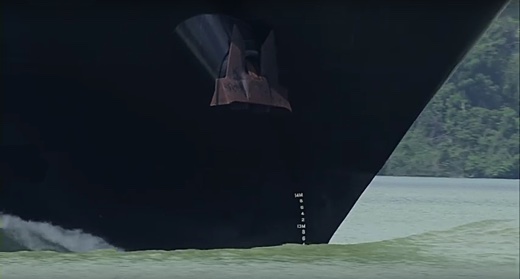
Image above: Still frame of ship bow plowing the ocean. From video "Sonic Sea" trailer below.

WHAT:
RIMPAC 2016 - The US Navy is sponsoring the armed navies of 24 countries to come to Hawaiian waters and practice naval war. They call these war exercises, RIMPAC, short for rim of the Pacific. These foreign navies will blast whale-killing active sonar, shoot missiles, shoot torpedoes, drop bombs, plant mines, sink ships, test new experimental weapons and otherwise harass, pollute and upset our ocean environment and the creatures who live in it. Oceans4Peace will sponsor teach-ins, a film series, contacts with decision makers and other public education events.

WHERE:
Around the Hawaiian Islands and the Pacific Missile Research Facility on Kauai.

WHEN:
June and July 2016

ACTION:
 Sign our petition to stop RIMPAC 2016
 "Oceans4Peace : Stop the Rim of the Pacific (RIMPAC) exercises"

To sign click here:
(https://www.change.org/p/oceans4peace-stop-the-rim-of-the-pacific-rimpac-exercises?recruiter=1616584&utm_source=share_petition&utm_medium=email&utm_campaign=share_email_responsive)

Oceans4Peace is sponsoring discussions, teach-ins, a film series and other public education events. See calendar below or go to(http://www.oceans4peace.org/page/page/8901763/2016-6.htm) or

RIMPAC IMPACT
Panel Discussion
Friday, June 17th 2016  6:00pm
Kapaa Library
Technology Effects on Whales - Kalasara Setaysha - Oceans4Peace
The Threats to Coral - Dr. Katherine Muzik - Marine Biologist NTBG
Expansion of US Militarism in the Pacific - Juan Wilson - Kauai Sierra Club

MOVIE SERIES
"Sonic Sea" A film about noise in the ocean, especially Navy sonar.
Thursday, June 23rd 6:00pm  2016
Koloa Neighborhood Center
Discussion with Gorden Labedz

"Sonic Sea" A film about noise in the ocean, especially Navy sonar.
Friday, June 24th 7:00pm 2016
Kapaa Library
Discussion with  Kalasara Setaysha

“Sonic Sea” A film about noise in the ocean, especially Navy sonar.
Sunday, June 26th 6 :00pm 2016
Princeville Neighborhood Center
Discussion with Rick Cooper

“Why We Fight”  A film about the US military.
Friday, July 1st 1016  6:30pn
Koloa Neighborhood Center
Discussion with Rick Cooper

"Oceans" Disney documentary film about the ocean.
Saturday, July 9th 1:00pm
Hanapepe Library
Discussion with Gorden Labedz

“Why We Fight”A film about the US military.
Sunday, July 10th 1:00pm
Kapaa Neighborhood Center
Discussion with Rick Cooper

“Why We Fight”  A film about the US military.
Friday, July 15th, 6:30pnm
Hanapepe Library
Discussion Rick Cooper

“Oceans”  Disney documentary film about the ocean.
Sunday, July17th 206 1:00pm
Kapaa Neighborhood Center
Discussion with Gorden Labedz

Oceans4Peace is a Coalition of Kauai Conservation and Social Justice groups whose Mission was to educate the general public about the adverse effects of the 2016 RIMPAC, Rim of the Pacific, Naval war exercises.

The Coalition continues to monitor the US Navy for abuses to the ocean, its inhabitants and ecosystem. With Hawaii the center of the US Naval Fleet and Kauai the center of Naval war research, our Coalition continues to update its educational Process.

Presently, the on-going threat to our Ocean is the increase of the US Naval presence in the Pacific, "the Pacific Pivot," especially in the new Marine Sanctuary of the Northwest Hawaiian Islands.

The Navy has excluded all human activity there, except their own. They admit to using mid frequency and low frequency active Sonar in this so-called 'Protected Area'. This extreme sound blasting Sonar has been shown to cause harm to all ocean life, especially to marine mammals that rely on hearing for their existence.

The Navy, in partnership with the South Korean and Japanese governments, continues to build military bases only a few hundreds of miles from China, at Jeju Island in South Korea and Oura Bay, Okinawa, Japan. Both projects necessitate environmental destruction on a massive scale. We can ill afford this military buildup or the arms race with China it will provoke.

Our 'Oceans 4 Peace Coalition' is seeking the real answers, which enable us to report the truth. This page will keep you updated on US Navy impacts on our Ocean.


Video above: Still frame of ship bow plowing the ocean. From video "Sonic Sea" trailer below. From (https://youtu.be/T-jabL64UZE).

Oceans4Peace supporting organizations
Kohola Leo (Whale Voice)
Kauai Alliance for Peace and Social Justice
Surfrider Foundation
Kauai Sierra Club


Video above: "RIMPACT IMPACT" film shown by Juan Wilson at Oceans4Peace Panel Discussion 6/7/14. From (http://youtu.be/NLZx9fg7Gvg).

See also:
Ea O Ka Aina: Oceans for Peace Pacific Pivot Panel 6/18/16
Ea O Ka Aina: Prepare for RIMPAC 2016 War in Hawaii 5/22/16
Ea O Ka Aina: Navy to "take" millions of mammals 5/17/16
Ea O Ka Aina: US court RIMPAC Impact decision 4/3/15
Ea O Ka Aina: RIMPAC 2014 Impact Postmortem 10/22/1
Ea O Ka Aina: RIMPAC 2014 in Full March 7/16/14
Ea O Ka Aina: 21st Century Energy Wars 7/10/14
Ea O Ka Aina: RIMPAC War on the Ocean 7/3/14
Ea O Ka Aina: Voila - World War Three 7/1/14
Ea O Ka Aina: The Pacific Pivot 6/28/14
Ea O Ka Aina: RIMPAC IMPACT 6/8/14
Ea O Ka Aina: RIMPAC Then and Now 5/16/14
Ea O Ka Aina: Earthday TPP Fukushima RIMPAC 4/22/14
Ea O Ka Aina: The Asian Pivot - An ugly dance 12/5/13
Ea O Ka Aina: Help save Mariana Islands 11/13/13
Ea O Ka Aina: End RimPac destruction of Pacific 11/1/13 
Ea O Ka Aina: Moana Nui Confereence 11/1/13
Ea O Ka Aina: Navy to conquer Marianas again  9/3/13
Ea O Ka Aina: Pagan Island beauty threatened 10/26/13
Ea O Ka Aina: Navy license to kill 10/27/12 
Ea O Ka Aina: Sleepwalking through destruction 7/16/12
Ea O Ka Aina: Okinawa breathes easier 4/27/12
Ea O Ka Aina: Navy Next-War-Itis 4/13/12
Ea O Ka Aina: America bullies Koreans 4/13/12
Ea O Ka Aina: Despoiling Jeju island coast begins 3/7/12
Ea O Ka Aina: Jeju Islanders protests Navy Base 2/29/12
Ea O Ka Aina: Hawaii - Start of American Empire 2/26/12
Ea O Ka Aina: Korean Island of Peace 2/26/12   
Ea O Ka Aina: Military schmoozes Guam & Hawaii 3/17/11
Ea O Ka Aina: In Search of Real Security - One 8/31/10
Ea O Ka Aina: Peace for the Blue Continent 8/10/10
Ea O Ka Aina: Shift in Pacific Power Balance 8/5/10
Ea O Ka Aina: RimPac to expand activities 6/29/10
Ea O Ka Aina: RIMPAC War Games here in July 6/20/10
Ea O Ka Aina: Pacific Resistance to U.S. Military 5/24/10
Ea O Ka Aina: De-colonizing the Pacific 5/21/10
Ea O Ka Aina: RIMPAC to Return in 2010 5/2/10
Ea O Ka Aina: Living at the Tip of the Spear 4/5/10
Ea O Ka Aina: Living at the Tip of the Spear 4/15/10
Ea O Ka Aina: Guam Land Grab 11/30/09
Ea O Ka Aina: Guam as a modern Bikini Atoll 12/25/09
Ea O Ka Aina: GUAM - Another Strategic Island 11/8/09
Ea O Ka Aina: Diego Garcia - Another stolen island 11/6/09
Ea O Ka Aina: DARPA & Super-Cavitation on Kauai 3/24/09
Island Breath: RIMPAC 2008 - Navy fired up in Hawaii 7/2/08
Island Breath: RIMPAC 2008 uses destructive sonar 4/22/08
Island Breath: Navy Plans for the Pacific 9/3/07
Island Breath: Judge restricts sonar off California 08/07/07
Island Breath: RIMPAC 2006 sonar compromise 7/9/06
Island Breath: RIMPAC 2006 - Impact on Ocean 5/23/06
Island Breath: RIMPAC 2004 - Whale strandings on Kauai 9/2/04
Island Breath: PMRF Land Grab 3/15/04  

.

Participation in RIMPAC 2016

SUBHEAD: The countries participating in largest naval war exercise reach record number and include NATO.

By Juan Wilson  1 June 2016 for Island Breath  -
(http://www.stripes.com/news/pacific/27-nations-set-to-join-rimpac-exercise-in-hawaii-california-1.412494)

http://www.islandbreath.org/2016Year/06/160601pacrimbig.jpg
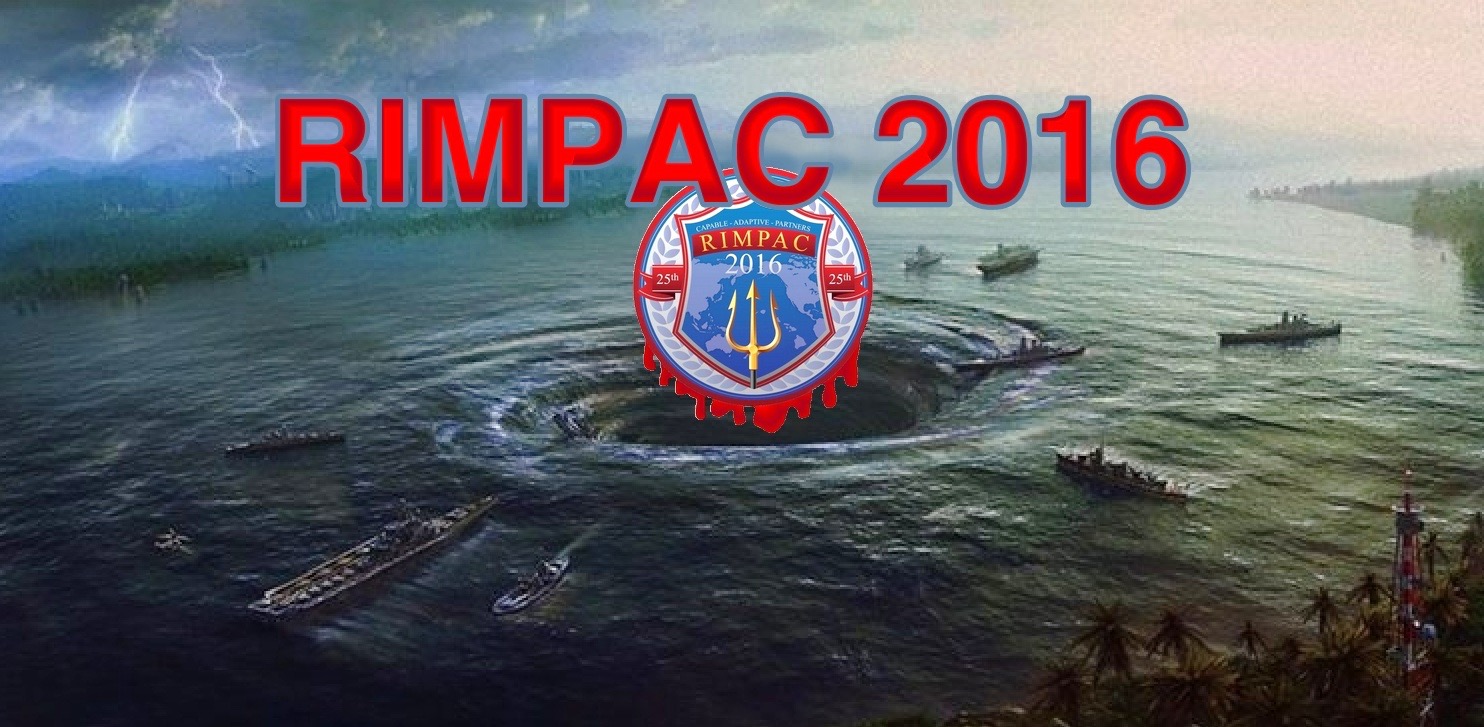
Image above: Teaser poster for "Pacific Rim II" film being produced now and ready for 2018. Mashup by Juan Wilson. Click to embiggen.

Note below the two recent articles  (5/31 and 6/1) in Stars and Stripes and Naval Today respectively that are puff pieces more than actual news stories. They both concern RIMPAC 2016 - the international naval war exercises that will begin toward the end of this month.

Both of these articles seem to have been "crafted" from the same US Navy public relations announcement. They cover the same points with about the same amount of detail in the same order.

The gist of the pieces are:
One: To congratulate the US Navy for convincing four new non-Pacific nations (Brazil, Denmark, Germany and Italy) for joining the Rim of the Pacific nations involved with Pacific Naval warfare. Three out of four of them are allies in the North Atlantic Treaty Organization.

Two: To dampen criticism, from the likes of Sen John McCain, that the Chinese Navy should be disenvited from participating as observers in RIMPAC 2016 as they were in 2014. Obviously, the US wants China to see what they would face in and conflict in the South China Sea if they continue to build up they Naval presence in the Western Pacific.

Three: The public relations effort  invokes “The Great Green Fleet” using conservation efforts and alternative fuels; and focusing on rescue and disaster relief operations is a screen for deadlier activities that even in "practice" mode are lethal to the life in the ocean..
As to my opinion of these gists:
One:  The US Navy Pacific fleet in including three NATO navies from the Atlantic Ocean under its wing in the Pacific. Always remember that attacking any NATO nation is an attack on all. In my opinion the US Navy wants to make sure that if there is trouble in the Western Pacific that it will be the US Navy and not NATO doing the coordination.
Two: The US Navy wants the Chinese Navy to observe how mighty and dominant it is in command and control on the Pacific Ocean. They also want the Chinese available for public relations purposes. Also The relationship of a panoramic flotilla of 45 RIMPAC ships from 27nations in proportion to a couple of ships from the Chinese Navy in passive obervation makes a great photo opportunity.
Three: No amount of "Green Fleet" bullshit can obscure the deadly impact of high energy sonar, radar, amphibious operations and live ammo exercises on the Pacific Ocean and its denizens - live reefs, fish, birds, ocean mammals and to the the ecosystems that support them.
It should be noted that buried in the second story below is the detail that Japan Maritime Self Defense Force Rear Adm. Koji Manabe was named the vice commander of the RIMPAC 2016 Combined Task Force. This is interesting because his role was only enabled by an adjustment to Japanese law that disallows any military activity other than that needed for self defense - the old rules would not have allowed a leading role in such an activity as RIMPAC.

As the United States pushes militarily forward in Eastern Europe and the Middle East, it expands its already dominant role throughout the Pacific region. To me it looks like we are pushing for World War Three.  And that's a bad idea. As I have said before - the central role of our navy should not be to threaten live throughout the world, but to protect the oceans and those who live in it.


Twenty 27 countries in RIMPAC 2016

By Wyatt Olsen  31 May 2016 for Stars & Stripes  -
(http://www.stripes.com/news/pacific/27-nations-set-to-join-rimpac-exercise-in-hawaii-california-1.412494)


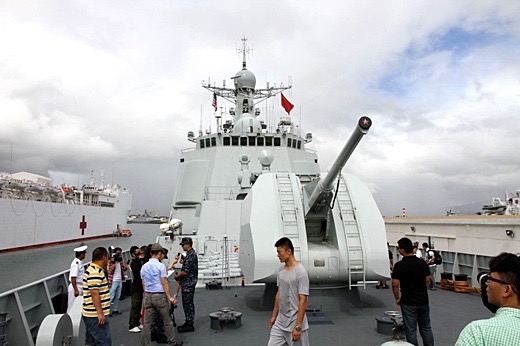
Image above: Reporters and other visitors gather to inspect the bow of the Haikou, China's flagship destroyer, during the 2014 Rim of the Pacific exercise in Hawaii. From original article.

Four nations will join this summer’s Rim of the Pacific drills in Hawaii, increasing the number of countries participating in the world’s largest international maritime exercise to 27.

Brazil, Denmark, Germany and Italy will take part for the first time in the biennial RIMPAC, which is slated to begin June 30 and end Aug. 4, the Navy said Tuesday. China, which joined the exercise in 2014, will also participate.

This year’s U.S. Pacific Fleet-hosted drills – which will focus on disaster relief, maritime security, sea control and complex warfighting – will include 45 ships, five submarines, more than 200 aircraft and 25,000 personnel.

Participating nations include Australia, Brunei, Canada, Chile, Colombia, France, India, Indonesia, Japan, Malaysia, Mexico, the Netherlands, New Zealand, Norway, Peru, South Korea, the Philippines, Singapore, Thailand, Tonga and the United Kingdom.

Drills will include amphibious operations, gunnery, counter-piracy, mine clearance, explosive ordnance disposal and diving and salvage operations. Defensive training against missiles, submarines and aircraft will also take place.

While most of the exercise is held in Hawaii, amphibious operations will take place in Southern California, featuring a harpoon missile shoot from a Navy littoral combat ship. A submarine rescue is new for this year, the Navy said.

Playing a major role in this year’s RIMPAC is the Navy’s “Great Green Fleet,” a yearlong initiative that uses energy conservation measures and alternative fuels to demonstrate how cutting energy costs can contribute to overall military readiness.

Almost all the vessels participating will use an approved alternate-fuel blend, the Navy said.

Some in Congress have called for China to be disinvited to RIMPAC, citing the country’s expansionist actions in the South China Sea, where it has enlarged small atolls through sand dredging.

The country has built facilities and runways on some, construction the U.S. characterizes as militarization.

Last month, U.S. Rep. Mark Takai, of Hawaii, a member of the House Armed Services Committee, asked Secretary of Defense Ash Carter to reconsider China’s invitation in light of its naval actions over the past two years.

“I guess my question is why then should we reward China for this aggressive behavior by including them in an event meant for allies and partners?” Takai said to Carter during a March hearing. He described China’s behavior as “the polar opposite of U.S. objectives in the region.”

In late April, China told the U.S. it would deny a Hong Kong port visit by the USS John C. Stennis aircraft carrier strike group planned for May 3-8. The denial likely came in response to the strike group’s recent presence near the disputed Spratly Islands close to the Philippines.

U.S. Pacific Fleet commander Adm. Scott Swift has said on numerous occasions he believes the path forward with China is to deepen relationships with military-to-military contact.

In 2014, China sent four ships to RIMPAC, including the destroyer Haikou and hospital ship Peace Ark. It also sent a spy ship, which remained in international waters off Hawaii.


Record participation in RIMPAC 2016

By Staff 1 June 2016 for Naval Today -
(https://navaltoday.com/2016/06/01/record-number-of-countries-to-take-part-in-rimpac-2016/)

With four new participants, the number of countries taking part in RIMPAC, the world’s largest international maritime exercise, rose to 27.

45 ships, five submarines, more than 200 aircraft and 25,000 personnel will participate in the biennial Rim of the Pacific (RIMPAC) exercise scheduled June 30 to August 4, in and around the Hawaiian Islands and Southern California.

This is the first time that Brazil, Denmark, Germany, and Italy are participating in RIMPAC 2016. Additional firsts will involve flexing the command and control structure for various at sea events and incorporating a submarine rescue exercise.

Other participants will be forces from:

Australia, Brazil, Brunei, Canada, Chile, Colombia, Denmark, France, Germany, India, Indonesia, Italy, Japan, Malaysia, Mexico, Netherlands, New Zealand, Norway, People’s Republic of China, Peru, the Republic of Korea, the Republic of the Philippines, Singapore, Thailand, Tonga, the United Kingdom and the United States.

This year will see amphibious operations in the Southern California operating area, feature a harpoon missile shoot from a U.S. Navy littoral combat ship and highlight fleet innovation during the Trident Warrior experimentation series.

RIMPAC 2016 is the 25th exercise in the series that began in 1971. Hosted by U.S. Pacific Fleet.
It will be led by U.S. Vice Adm. Nora Tyson, commander of the U.S. 3rd Fleet (C3F), who will serve as the Combined Task Force (CTF) Commander.

Royal Canadian Navy Rear Adm. Scott Bishop will serve as deputy commander of the CTF, and Japan Maritime Self Defense Force Rear Adm. Koji Manabe as the vice commander.

See also:
Ea O Ka Aina: Judgement Against RIMPAC 2016 5/29/16
Ea O Ka Aina: Prepare for RIMPAC War in Hawaii 5/22/16
Ea O Ka Aina: Navy to "take" millions of mammals 5/17/16
Ea O Ka Aina: US court RIMPAC Impact decision 4/3/15
Ea O Ka Aina: RIMPAC 2014 Impact Postmortem 10/22/1
Ea O Ka Aina: RIMPAC 2014 in Full March 7/16/14
Ea O Ka Aina: 21st Century Energy Wars 7/10/14
Ea O Ka Aina: RIMPAC War on the Ocean 7/3/14
Ea O Ka Aina: Voila - World War Three 7/1/14
Ea O Ka Aina: The Pacific Pivot 6/28/14
Ea O Ka Aina: RIMPAC IMPACT 6/8/14
Ea O Ka Aina: RIMPAC Then and Now 5/16/14
Ea O Ka Aina: Earthday TPP Fukushima RIMPAC 4/22/14
Ea O Ka Aina: The Asian Pivot - An ugly dance 12/5/13
Ea O Ka Aina: Help save Mariana Islands 11/13/13
Ea O Ka Aina: End RimPac destruction of Pacific 11/1/13 
Ea O Ka Aina: Moana Nui Confereence 11/1/13
Ea O Ka Aina: Navy to conquer Marianas again  9/3/13
Ea O Ka Aina: Pagan Island beauty threatened 10/26/13
Ea O Ka Aina: Navy license to kill 10/27/12 
Ea O Ka Aina: Sleepwalking through destruction 7/16/12
Ea O Ka Aina: Okinawa breathes easier 4/27/12
Ea O Ka Aina: Navy Next-War-Itis 4/13/12
Ea O Ka Aina: America bullies Koreans 4/13/12
Ea O Ka Aina: Despoiling Jeju island coast begins 3/7/12
Ea O Ka Aina: Jeju Islanders protests Navy Base 2/29/12
Ea O Ka Aina: Hawaii - Start of American Empire 2/26/12
Ea O Ka Aina: Korean Island of Peace 2/26/12   
Ea O Ka Aina: Military schmoozes Guam & Hawaii 3/17/11
Ea O Ka Aina: In Search of Real Security - One 8/31/10
Ea O Ka Aina: Peace for the Blue Continent 8/10/10
Ea O Ka Aina: Shift in Pacific Power Balance 8/5/10
Ea O Ka Aina: RimPac to expand activities 6/29/10
Ea O Ka Aina: RIMPAC War Games here in July 6/20/10
Ea O Ka Aina: Pacific Resistance to U.S. Military 5/24/10
Ea O Ka Aina: Guam Land Grab 11/30/09
Ea O Ka Aina: Guam as a modern Bikini Atoll 12/25/09
Ea O Ka Aina: GUAM - Another Strategic Island 11/8/09
Ea O Ka Aina: Diego Garcia - Another stolen island 11/6/09
Ea O Ka Aina: DARPA & Super-Cavitation on Kauai 3/24/09
Island Breath: RIMPAC 2008 - Navy fired up in Hawaii 7/2/08
Island Breath: RIMPAC 2008 uses destructive sonar 4/22/08
Island Breath: Navy Plans for the Pacific 9/3/07
Island Breath: Judge restricts sonar off California 08/07/07
Island Breath: RIMPAC 2006 sonar compromise 7/9/06
Island Breath: RIMPAC 2006 - Impact on Ocean 5/23/06
Island Breath: RIMPAC 2004 - Whale strandings on Kauai 9/2/04
Island Breath: PMRF Land Grab 3/15/04

.

Naval sonar damage settlement

SUBHEAD: Navy, bowing to two legal suits, agrees to limit Pacific trainings to protect marine life.

By Chris De Angelo on 15 September 2015 for Huffington Post -
(http://www.huffingtonpost.com/entry/navy-settlement-sonar-explosives-testing-in-california-hawaii_55f73373e4b0c2077efbba5e)


Image above: Two dolphin race ahead of the bow of the USNS Kaiser. From (http://news.discovery.com/earth/online-protests-against-navy-sonar-plans-120706.htm).

The U.S. Navy estimates it inadvertently kills 155 whales and dolphins off the coasts of Hawaii and Southern California in five years. Its training exercises also injure some 2,000 marine animals over the same period.

On Monday, thanks to a pair of lawsuits brought by environmental groups Earthjustice and the Natural Resources Defense Council, the Navy agreed to limit its use of sonar and other harmful training activities in critical habitats for whales, dolphins and other marine mammals.

The settlement, finalized by a federal judge in Honolulu, reconciles a decade-old debate about the Navy's sonar practices.

The agreement includes limits or bans on mid-frequency active sonar and explosives in specified areas. Earthjustice attorney David Henkin said that, at great distances, sonar can disrupt feeding and communication of marine mammals. At closer distances, it can lead to deafness or even death.

In Southern California, the Navy will no longer be able to use sonar in important habitats for beaked whales between Santa Catalina Island and San Nicolas Island, as well as in blue whale feeding areas near San Diego.

In Hawaii, the agreement prohibits sonar and explosives training on the eastern side of the Big Island and north of Molokai and Maui. The environmental groups say the restrictions will protect Hawaiian monk seals and small populations of toothed whales, including the endangered false killer whale.

The Natural Resources Defense Council called the settlement a "huge victory," but said it won’t end the advocacy group's fight to protect marine mammals from Navy sonar.

"We’ll now work to expand this success to the Navy’s other ranges ... and to make the protections we’ve achieved permanent for marine mammals off Southern California and Hawaii," spokesman Kimiko Martinez told HuffPost.

See also:
Ea O Ka Aina: RIMPAC 2014 - another whale death in Hanalei 7/27/14
Ea O Ka Aina: RIMPAC 2014 in Full March 7/16/14
Ea O Ka Aina: 21st Century Energy Wars 7/10/14
Ea O Ka Aina: RIMPAC War on the Ocean 7/3/14
Ea O Ka Aina: Voila - World War Three 7/1/14
Ea O Ka Aina: The Pacific Pivot 6/28/14
Ea O Ka Aina: RIMPAC IMPACT 6/8/14
Ea O Ka Aina: RIMPAC Then and Now 5/16/143
Ea O Ka Aina: Help save Mariana Islands 11/13/13
Ea O Ka Aina: End RimPac destruction of Pacific 11/1/13 
Ea O Ka Aina: Moana Nui Conference 11/1/13
Ea O Ka Aina: Navy to conquer Marianas again  9/3/13
Ea O Ka Aina: Pagan Island beauty threatened 10/26/13
Ea O Ka Aina: Navy license to kill 10/27/12
Ea O Ka Aina: Sleepwalking through destruction 7/16/12
Ea O Ka Aina: Despoiling Jeju island coast begins 3/7/12
Ea O Ka Aina: Jeju Islanders protests Navy Base 2/29/12 
Ea O Ka Aina: Military schmoozes Guam & Hawaii 3/17/11
Ea O Ka Aina: RimPac to expand activities 6/29/10
Ea O Ka Aina: RIMPAC War Games here in July 6/20/10
Ea O Ka Aina: Guam Land Grab 11/30/09
Ea O Ka Aina: Guam as a modern Bikini Atoll 12/25/09
Island Breath: RIMPAC 2008 - Navy fired up in Hawaii 7/2/08
Island Breath: RIMPAC 2008 uses destructive sonar 4/22/08
Island Breath: Navy Plans for the Pacific 9/3/07
Island Breath: Judge restricts sonar off California 08/07/07
Island Breath: RIMPAC 2006 sonar compromise 7/9/06
Island Breath: RIMPAC 2006 - Impact on Ocean 5/23/06
Island Breath: RIMPAC 2004 - Whale strandings on Kauai 9/2/04


.

PMRF RIMPAC Claptrap

SOURCE: Gorden Labetz (glabedzmd@aol.com)
SUBHEAD: PMRF propaganda says navy exercises not harmful to marine life, but facts disagree.

By Chris D'Angelo on 21 November 2014 for the Garden Island -
(http://thegardenisland.com/news/local/no-scientific-evidence/article_0006f856-713f-11e4-9ff7-6bf7648d8280.html)


Image above: A pod of dolphins swims in front of the USNS Alan Shepard. From article below.

[IB Publisher note: Below this TGI piece is by KPBS from August 2013 that indicates the Navy has negotiated a five year agreement that would allow "takes" or killings of hundreds of sea mammals and injuring of thousands of others in exercises like RIMPAC]

The U.S. Pacific Fleet in Pearl Harbor says community concerns that the Rim of the Pacific maritime exercise and Kauai’s Pacific Missile Range Facility are negatively impacting marine life are unfounded.

In early October, after hearing from several constituents, Hawaii Congresswoman Tulsi Gabbard requested information about the Navy’s efforts to monitor the effects of RIMPAC and PMRF on the ocean and marine ecosystems.

“In response to concerns of your constituents, there has been no scientific evidence that RIMPAC 2014 or exercises at the Pacific Missile Range Facility (PMRF) have caused damage to marine life,” USPF Commander Adm. Harry B. Harris Jr. wrote in a response to Gabbard.

In his three-page letter, Harris discussed the aggressive steps taken by the Navy to avoid harming marine mammals, sea turtles and corals, through the use of protective measures during training, especially with sonar and explosives.

Harris also pointed out that the Navy funded over $300 million in independent research over the past 10 years, making it a world leader in marine mammal research and monitoring.

“The Navy works with regulatory agencies, using the best available science, to obtain necessary authorizations and continues to further our understanding of marine mammals through research and monitoring,” he wrote.

Others, however, say the military exercises are harming marine life.

Katherine Muzik, a local marine biologist, said it is proven — as written about in Joshua Horwitz’s book “War of the Whales” — that sonar is lethal to whales. It is only logical, she said, that it would also have deleterious, if not lethal, effects on invertebrates, including shrimp and coral, which rely on vibrations for detecting prey, escaping predators and reproducing.

“I would bet on my life that sonar is hurting other creatures,” she said. “We don’t have the proof, but the absence of proof doesn’t mean it’s an absence of fact.”

Muzik said that with so many factors already damaging the marine environment — warming ocean temperatures, acidification and pollution — for the U.S. military to insist on purposefully, knowingly and deliberately maiming and killing marine life in the name of practice is unacceptable and tragic.

In August 2013, a pair of environmental impact statements detailed that U.S. Navy training and testing activities could inadvertently kill hundreds of whales and dolphins — an injure thousands more — between 2014 and 2018. The studies included waters off the East Coast, the Gulf of Mexico, Southern California and Hawaii.

Most of the deaths — as many as 155 off Hawaii and Southern California — would come from detonating underwater explosives, while some could be caused by sonar testing or animals being struck by ships. In addition to deaths, the EIS report said the activities off Hawaii and Southern California could cause 2,039 serious injuries, 1.86 million temporary injuries and 7.7 million instances of behavioral change.

“I think it’s bogus when they say they have a lookout,” Muzik said. “I think the truth is there are animals there, they know there are animals there, and they are allowed to take them.”

Held every two years and hosted by the Pacific Fleet, RIMPAC is the world’s largest international maritime war exercise. In total, 22 nations, 49 surface ships, six submarines, more than 200 aircraft and 25,000 personnel participated in this year’s event, which lasted from June 26 to Aug. 1 and included live fire target practice and the sinking of the decommissioned USS Tuscaloosa 57 nautical miles northwest of Kauai.

The drills take place in the Hawaii Operating Area and several off-shore ranges, including PMRF.

Harris told Gabbard there are steps the Navy must take to minimize harm to the environment — per environmental laws such as the Marine Mammal Protection Act and the Endangered Species Act — during its trainings, including RIMPAC.

Before each RIMPAC, Harris wrote, the Navy briefs participating U.S. and foreign units about protective measures, as well as reminds service members to avoid interaction with sea turtles, Hawaiian monk seals, dolphins, coral reefs and Essential Fish Habitats. Additionally, Navy officials complete Marine Species Awareness Training and units are required to report sonar use and submit daily marine mammal sighting reports.

Prior to and during training with sonar, the Navy uses trained, qualified lookouts to search the area for marine mammals, according to Harris. If one is sighted within 1,000 yards, sonar transmissions are reduced. Within 200 yards, sonar is shut down completely.

“Safety zones are also established to protect marine life from the effects of explosive and non-explosive munitions,” he wrote.

In an emailed statement Wednesday, Gabbard said she has been “deeply concerned about the scope of devastation” of Kauai’s coral reefs, which continue to suffer from an outbreak of black band coral disease. Over the past year, she said she has reached out to experts in marine biology, local and federal officials, and the U.S. military to ask about potential causes and how the disease can be stopped.

“The broader scientific community does not point to the U.S. Navy as the cause of this coral disease,” Gabbard wrote to The Garden Island. “Rather, experts agree it likely is a combination of runoff, growing population and development, and overfishing, among other cited causes.”

Gordon LaBedz of the Surfrider Foundation Kauai Chapter, which sued the Navy over the 2006 RIMPAC exercises, described Harris’ response letter as “100 percent predictable,” and said he puts the Navy right up there will the commercial fishing industry in terms of the world’s most environmentally destructive entities.

“In my 30 years of suing the Navy, I’ve never experienced them as good stewards of the environment,” he said.

As for Harris’ comments about there being no evidence, LaBedz said it bothers him. When a whale dies, it sinks. It doesn’t float on the surface where it can be found, he said.

In his letter, Harris also addressed a situation in July in which a 16-foot sub adult pilot whale washed ashore and died in Hanalei Bay. In response, the Navy conducted an aerial survey in accordance with the Pacific Fleet’s Stranding Response Plan.

While LaBedz said he is convinced that whale died as a result of sonar, Harris said, “To date, there is no evidence of a connection to Navy.”

When asked how someone would obtain the scientific evidence referenced by Harris, and what that evidence might be, or look like, Pacific Fleet spokesman Mark Matsunaga wrote, “The Navy uses the best available science in its environmental analysis and lists these references at the end of each resource section of our EISs,” and referred TGI to a series of websites, including www.hstteis.com.


Navy Plans to Kill Marine Mammals
SUBHEAD: Navy five year plan expects to kill hundreds of dolphins and whales and injuring thousands.

By David Wagner on 30 August 2013 for KPBS -
(http://www.kpbs.org/news/2013/aug/30/navy-says-its-probably-about-bomb-hundreds-dolph/)

In two reports published August 30th, 2013, the U.S. Navy acknowledges that bomb testing and sonar use over the next five years will likely kill hundreds of marine mammals and seriously injure thousands more.

In two reports published Friday, the U.S. Navy acknowledged that bomb testing and sonar use over the next five years will likely kill hundreds of marine mammals and seriously injure thousands more.
To get permits for these training exercises, the military is required to report on the environmental impact of its proposed operations.

By the Navy's own count, training procedures from 2014 through 2019 could result in the deaths of over 340 dolphins and whales.

Most of those deaths would be caused by bombs the Navy plans to detonate off the East Coast, in the Gulf of Mexico, and between Southern California and Hawaii. But some deaths—as well as "behavioral changes" for millions more susceptible marine mammals—could stem from the Navy's active sonar use, which environmentalists have been criticizing for years.

"Mid-frequency sonar is an intense noise source that propagates through the ocean at the frequency that certain whales and dolphins are most sensitive to," says Giulia Good Stefani, an attorney with the Southern California office of the Natural Resources Defense Council.

Researchers are still trying to fully understand the effects of sonar on marine mammals, but they've found connections between sonar and recent mass whale strandings. Sonar has been known to damage hearing in marine mammals, which can prove fatal for creatures that rely on echolocation to move through the ocean and find food.

But the Navy contends that bomb training and sonar operation are crucial to national security and cannot be simulated. In a video statement, Rear Admiral Kevin Slates describes these as "perishable skills that require training at sea under realistic conditions."

"We don't argue that the Navy doesn't need to train," counters Stefani. "We simply have asked the Navy to try to reduce the impact it's having on marine mammal populations.


See also:
Ea O Ka Aina: RIMPAC Impact Postmortem 10/22/14
Our congresswoman Tulsi Gabbarb seeking information from Navy on their methods of protecting ...
Ea O Ka Aina: RIMPAC 2014 - another whale death 7/26/14
It's not like this has not happened here before. The Navy washes off the blood and wears white.
Ea O Ka Aina: RIMPAC 2014 in Full March 7/17/14
Even if RIMPAC didn't harm wildlife or the environment these war games are pointless.
Ea O Ka Aina: RIMPAC War on the Ocean 7/3/14
The unseen wars on the Pacific Ocean lead by the United States Navy is cranking up this summer.
Ea O Ka Aina: The Pacific Pivot  6/26/14

RIMPAC is only a small piece of a huge, systemized federal project of destruction in the Pacific.
Ea O Ka Aina: RIMPAC IMPACT 6/8/14
If you think that RIMPAC 2014 will be anything but harmful to Hawaii you are delusional.
Ea O Ka Aina: Operation Dominic & Hawaii  6/3/14
US nuclear tests on Johnson Island tell us that this year's RIMPAC will be more of the same destruction to the Pacific Ocean.
Ea O Ka Aina: RIMPAC Now and Then 5/16/14
The history of RIMPAC exercises tells us that this year will be more of the same. Destruction to life in the Pacific Ocean.
Ea O Ka Aina: Earthday TPP Fukushima RIMPAC 4/22/14

Excuse us while we turn the Pacific Ocean into a radioactive ashtray.
Ea  O Ka Aina: An Ugly Dance  - The Asian Pivot 12/5/13
It's a feeble attempt by USA to outplay Asia in the game of who can destroy the planet the fastest.
Ea O Ka Aina: End RIMPAC destruction of Pacific 11/1/13
Pacific Rim countries led by the US Navy take part in exercises in death and destruction in our ocean.
Ea O Ka Aina: Sleepwalking through destruction 7/16/12
Ea O Ka Aina: Military schmoozes Guam & Hawaii 3/17/11
Ea O Ka Aina: Pacific Resistance to U.S. Military 5/24/10
Ea O Ka Aina: Shift in Pacific Power Balance 8/5/10
Ea O Ka Aina: RIMPAC to Return in 2010 5/2/10 
Ea O Ka Aina: Living at the Tip of the Spear 4/5/10
Ea O Ka Aina: Guam Land Grab 11/30/09
Ea O Ka Aina: Guam as a modern Bikini Atoll 12/25/09
Ea O Ka Aina: GUAM - Another Strategic Island 11/8/09
Ea O Ka Aina: Diego Garcia - Another stolen island 11/6/09
Ea O Ka Aina: DARPA & Super-Cavitation on Kauai 3/24/09
Island Breath: RIMPAC 2008 - Navy fired up in Hawaii 7/2/08
Island Breath: RIMPAC 2008 uses destructive sonar 4/22/08
Island Breath: Navy Plans for the Pacific 9/3/07
Island Breath: Judge restricts sonar off California 08/07/07
Island Breath: RIMPAC 2006 sonar use feared 5/23/06
Island Breath: RIMPAC 2006 sonar compromise 7/9/06
Island Breath: RIMPAC 2004 Strands whales in Hanlei 09/02/04 
Island Breath: PMRF Land Grab 6/5/04 

.

RIMPAC 2014 - another whale death

SUBHEAD: It's not like this has not happened here before. The Navy washes off the blood and wears white.

By Juan Wilson on 27 July 2014 for Island Breath -
(http://islandbreath.blogspot.com/2014/07/rimpac-2014-another-whale-dead.html)


Image above: Image of pilot whale washed against shore along Hanalei Beach looking west. Photos provided by Pamela Burnell on 7/25/14. She noted: "My husband took these this morning.. 7ish.. distressing photo. He said it looked like it got shot??? It was still barely alive and thrashing about at the time."

It's not as if this has not happened before when the U.S. Navy is operating nearby. Shit happens! In this case another whale is stranded in Hanalei Bay here on Kauai during a RIMPAC exercise. Ten years ago, in 2004, it was 200 melonhead whales stranded (see below).

Some might call the current situation an improvement. Others might say the U.S. Navy is getting smarter about hiding the evidence of its crimes. And based on what we know now they are premeditated crimes.


By Phil Gast on 11 May 2012 for CNN -
(http://www.cnn.com/2012/05/11/us/navy-marine-mammals/)
Navy treads fine line when protecting marine mammals.

"I am not saying they are not well-intentioned," said Zak Smith, staff attorney with the Natural Resources Defense Council. "But I am not sure their choices make the U.S. Navy the best environmental stewards they could be."

The debate over sonars and whales has gone on for years. It centers on balancing the need to defend the United States, while safeguarding its natural resources...

... Smith argued that the use of lookouts aboard Navy ships is not fully effective.

"Most marine mammals don't spend much time at the surface," he said. "When they do, you better have good weather conditions to see them."

Smith points to other consequences from the use of sonar and other acoustic sources off California and Hawaii.

Government estimates for 2014 to 2019 indicate there may be about 2 million cases of temporary hearing loss among marine animals, Smith told CNN. "Marine mammals use hearing the same way we use sight" to find food, he said.

"This kind of constant barrage and harassment is not a recipe for healthy populations," Smith added.


By David Kirby on 18 December  2013 for Yahoo News -  (http://www.natureworldnews.com/articles/5803/20140128/navy-sued-violating-marine-mammal-protection-act-connection-sonar-training.htm)


A coalition of animal and environmental organizations filed a lawsuit Monday against the National Marine Fisheries Service asking it to compel the U.S. Navy not to proceed with a five-year plan to increase sonar and live-fire training exercises in a massive swath of the Pacific Ocean.


Announced last Friday but anticipated for months, the naval plan would, according to a study conducted by the Navy, kill or injure up to 2,200 marine mammals. An additional 9.6 million incidences of minor harassment, such as forcing whales and dolphins to stop feeding in a certain area, could also occur.

Through 2019, Navy training and testing in this zone, which covers an area of the eastern Pacific Ocean larger than all 50 U.S. states combined, will emit upwards of 60,000 hours of the military’s “most powerful mid-frequency active sonar,” emit more than 50,000 hours of other frequency sonar, and detonate more than 260,000 explosives, according to a lawsuit—filed Monday in federal court in Honolulu by Earthjustice, the Center for Biological Diversity, and other groups—seeking an injunction against the plan.

Barring a court victory by the coalition, the carnage will be considerable.

Under current rules, Navy training and testing in the zone are permitted to kill or injure up to 100 marine mammals over a five-year period. “Now, they’re going to be killing or injuring 2,200 over five years—or 22 times more,” says David Henkin, an Earth Justice staff attorney.


From Koohan Paik on 30 July 2014 via email
I want to share with you all a very interesting comment I received from a top cetacean expert from Holland, now based in Peru, after I sent him the news of the whale washing ashore at Hanalei. Here's what he said (I highlighted the parts i found interesting):

"Seems things are turned upside down, why not have the Navy demonstrate they supposedly are not the culprits, the burden of proof should be on them as they are a proven hazard. A subadult pilot whale in good body weight coming ahore alive, alone and dying would be most consistent with acoustic trauma.

Let's see what the necropsy says. but then who will trust NOAA Fishery to report all the evidence. And Navy got themselves mortality allowance to start with. Any democratic consultation on that?"


and in another comment...

"Nobody should jump to conclusions before necropsy results are in, absolutely. But it is accepted and normal practice in any scientific investigation to suggest working hypotheses re most plausible causes of a studied phenomenon that requires explanation.

This helps focus the investigation. Anybody who suggests a priori that the RIMPAC exercises should not be a primary suspect, is being un-scientific, and is invited to provide arguments of why not."


Dolphins, whales and other marine mammals that depend on sonar and echolocation to find food and navigate, will be in the crosshairs of a five-year naval exercise in the waters between Southern California and Hawaii.


< The lawsuit, which was filed by the influential non-profit group National Resources Defense Council (NRDC) and several conservation organizations, says that the federal government, via the National Marine Fisheries Services, illegally granted the Navy permission to harm marine mammals during its ongoing underwater sonar and explosives training activities, which are scheduled to take place until 2018.
The U.S. Navy's current strategy to "protect" America will inevitably lead to the destruction of life in the oceans. They have no healing tools - only weapon systems. They continue to deal death and destruction while pretending to care for the environment. RIMPAC - what a load of bullshit!


Below is the Garden Island News story.


Whale washes up, dies
By Tom LaVenture  on 26 July 2010 for the Garden Island -
(http://thegardenisland.com/news/local/whale-washes-up-dies/article_d6bd3ca6-148e-11e4-9dfe-0019bb2963f4.html)


Image above: Image og pilot whale washed against shore along Hanalei Beach looking east. Photos provided by Pamela Burnell on 7/25/14.

A 16-foot sub adult pilot whale was pulled from the water at Waioli Beach Park after it died Friday.

Terry Lilley, of Hanalei, a marine biologist who has been studying coral disease on the North Shore, said he was on the scene early Friday when the whale was still alive and washing up to shore.

“This whale was alive and breathing at 6 a.m. this morning,” Lilley said. “It was sideways and just rolling in. It was already dying and there was no way to save it.”

The popular beach on Hanalei Bay was crowded with hundreds of people who watched as the mammal was moved from the shoreline to a trailer and taken from the scene just before noon.

The state Department of Land and Natural Resources took charge of removing the whale, using heavy equipment from the County of Kauai and a DLNR trailer. It was unknown if the whale was a male or female.

NOAA Fisheries Service, Pacific Islands Region spokesperson Wende Goo, said the death is being investigated.

“Arrangements are being made for a necropsy and other procedures,” Goo said. “We currently do not have enough information to be able to say how the whale died.”

Department of Land and Natural Resources enforcement personnel secured the site to safely recover the whale from where a large crowd watched.

Officials on scene discussed with volunteers the appearance of what looked like bite marks, possibly from a type of dogfish shark that gets its name from the way they attach and bite flesh with their snout, leaving deep, round marks on its prey.

Jean Souza, Hawaii programs coordinator for the Humpback Whale Hawaiian Islands National Marine Sanctuary, spoke to bystanders after the recovery to explain what had occurred and what would happen next to the whale. She said it is not uncommon for whales to beach there.

“Many times when they strand here in Hawaii, it is not like on the Mainland where a big tidal shift might cause them to get confused,” Souza said. “Most of the stranding that happens in Hawaii is because something is wrong with the animal.”

The mammal looked fresh with the skin intact and not yet decomposing, she said.

“That is the reason for quickly getting it off the beach to ship it to Oahu, for NOAH Fisheries to conduct a complete necropsy,” Souza said. “Because it is fairly fresh that means the chances are good for getting good information about tissue and structure.”

Lilley said the death could be a result of the military’s RIMPAC exercises going on in Hawaiian waters. The fact that a young and otherwise healthy whale died showing no visible signs of disease or attack should make military sonar and other war game activities suspect, he said.

Lilley said the military has a permit to injure or kill whales and dolphins during the ongoing multinational maritime exercise.

“This pilot whale has great body weight, and shows no visible infections, no problems with its mouth, and just two round wounds on the side that look like gaff wounds,” Lilley said. “This is a very healthy adult pilot whale with good weight, no obvious problems.”

Navy spokesman Lt. Cmdr. Nick Sherrouse said there is no indication that the loss of this animal was caused by naval activities and it would be premature to speculate.

“The Navy cares about the ocean environment, and we are fully cooperating with the National Marine Fisheries Service on the investigation,” Sherrouse said.


RIMPAC 2010 return stirs debate
By Coco Zyckos on 11 July 2010 for the Garden Island -
(http://thegardenisland.com/news/local/rimpac-return-stirs-debate/article_223d6a68-8d7d-11df-8d90-001cc4c002e0.html)


Image above: A mix of cetacean species stranded together in Tasmania in 2009 was enough to arouse suspicions of a human factor, including the use of sonar by the military. Photo by Dennis Fujimoto. From (http://kahea.wordpress.com/2009/03/02/another-mass-whale-stranding/).

The return of the military’s biennial Rim of the Pacific Exercise this month has environmentalists concerned.

Training activities associated with sonar have coincided with marine mammal strandings in the past, including some 200 melon-headed whales which herded into Hanalei Bay for more than 28 hours during the Navy’s 2004 RIMPAC exercises, according to National Oceanic and Atmospheric Administration documents.


“During this period, please keep your eyes open” said Surfrider’s Dr. Carl Berg. “We have to be super vigilant and really look out for the marine environment.”

Even though “causation” of the 2004 event was never “unequivocally determined,” the NOAA reported that “the active sonar transmissions” during that time were “a plausible, if not likely, contributing factor.”

“For them to come into the bay is definitely unusual behavior,” said Pacific Missile Range Facility spokesman Tom Clements.

However, one to two marine mammal strandings occur “somewhere in the state” each month, he said. “Biologists have told me this is a natural occurrence, and necropsies typically show disease as the cause.”

There has been no evidence of any stranding taking place during RIMPAC’s month-long exercises of 2006 and 2008, Clements added.

Marine mammals — who use sound to communicate, travel and discover food — have attempted to avoid sonar in the past, according to NOAA documents. Four mass strandings — Greece in 1996, Bahamas in 2000, Madeira in 2000 and Canary Islands in 2002 — involved beaked whales (similar to melon-headed whales) and NOAA identified the “most likely” cause as “active military sonar.”

Sonar produces “intense sound waves that sweep the ocean like a floodlight, revealing objects in their path,” according to the Natural Resources Defense Council. Some sonar systems emit sound waves that “can travel tens or even hundreds of miles of ocean.”

Even at 300 miles, the “sonic waves” can “retain an intensity of 140 decibels — a hundred times more intense than the level known to alter the behavior of large whales,” the NRDC says.

Many of the whales involved in mass strandings where they beach themselves suffer “physical trauma, including bleeding around the brain, ears and other tissues” along with “large bubbles in their organs,” according to the NRDC.

“Deep-diving whales seem to be especially affected by low-frequency sounds, even at quite low received levels,” according to a 1998 study conducted by A. Frantzis at the Department of Biology’s Zoological Laboratory in Athens, Greece.

Melon-headed whales “prefer deep, equatorial ocean waters and are thought to feed deep in the water column,” according to NOAA.

The Navy’s most widely used sonar systems operate in the mid-frequency range, according to the NRDC.

Sonar is “not the primary focus” of the Navy’s training activities, Clements said. And several measures are employed when training in areas known to host marine mammals.

In addition, the Navy is one of the “largest contributors” to the billions of dollars spent every year to determine the effect of sonar on marine mammals.

“There is a whole lot more research to be done before we start looking at conclusions,” Clements said.

Moreover, this year’s RIMPAC activities are “almost exclusively off-shore,” Clements said. There are no scheduled actives on Kaua‘i.

“We’re not calling wolf,” Berg said. “This is something that’s real. It could happen again.”


RIMPAC 2008 - Navy to use sonar


By William Cole on 24 January 2007 in the Honolulu Star Bulletin -
(http://the.honoluluadvertiser.com/article/2007/Jan/24/ln/FP701240404.html)
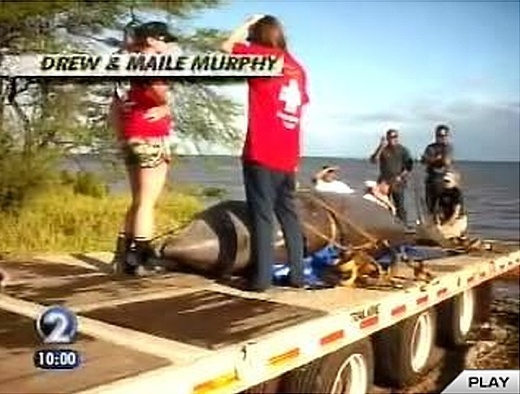

Image above: Still image from KITV-News video of stranded dead beaked whale being removed from beach on Molokai durint RIMPAC 2008. From (http://www.islandbreath.org/2008Year/17-peace_war/0817-27RIMPACkillswhale.html). See also (http://earthjustice.org/news/press/2008/navy-sonar-heard-nearby-one-day-before-whale-strands-on-moloka-i-beach).

The Defense Department has exempted the Navy and its use of sonar from the federal Marine Mammal Protection Act for two years — causing an outcry from a national environmental group that maintains the underwater sound harms whales.

Last summer, a six-month exemption granted during biennial Rim of the Pacific, or Rimpac, naval exercises off Hawai'i led to a legal challenge, and a federal judge briefly prohibited midfrequency sonar use during the war games.

Rimpac is one of the largest naval exercises in the world, and last year involved eight nations, more than 40 ships, six submarines, 160 aircraft and almost 19,000 service members.

The new two-year exemption is the latest turn in an ongoing battle that has pitted environmentalists and emerging science on the harm of sonar to whales against the Navy's need for sonar training to detect a growing fleet of extremely quiet foreign diesel submarines.

The next court clash could come over expected Navy sonar use off the coast of California, but the Defense Department exemption would extend through the 2008 Rimpac exercises off Hawai'i.

Federal marine regulators last spring said sonar use was a "plausible, if not likely, contributing factor" in the stranding of up to 200 melon-headed whales off Kauai during July 2004 Rimpac war games.

The mass stranding of such whales was the largest recorded in Hawaii waters, but the science related to sonar impact on various types of marine animals is far from clear-cut.

"The Navy's position is that continued training with active sonar is absolutely essential in protecting the lives of our sailors and defending the nation," the Pentagon said yesterday in announcing the exemption.

PROTECTION EFFORTS
The Defense Department also said the Navy continues to work with the National Oceanic and Atmospheric Administration, or NOAA, on a long-term sonar-use plan, and a range of marine mammal protection measures will remain in place.

"We will continue to employ stringent mitigation measures, developed with NOAA's concurrence, to protect marine mammals during all sonar activities," said Rear Adm. James Symonds, director of environmental readiness for the Navy.

But the Natural Resources Defense Council, which filed suit against the Navy in 2005 over midfrequency sonar use, said "numerous" mass strandings and deaths have been associated with sonar use.

Joel Reynolds, a senior attorney and director of the Natural Resources Defense Council's Marine Mammal Protection Project, objected to the exemption from federal law.

"Obviously, the (Marine Mammal Protection Act) is a statute that is designed to protect marine mammals," Reynolds said. "When you nullify that, there's no getting around the fact that they are undermining the protection that federal environmental law provides."

Reynolds said the Navy has "more than enough room in the ocean to train effectively without injuring or killing endangered whales and other marine species," but chooses some locations because of their convenience.

PERMIT TO 'HARASS'
Responding to growing scientific evidence that sonar can disrupt, injure or kill whales or dolphins, the Navy for the first time last summer sought a federal permit under the Marine Mammal Protection Act to "harass" the sea creatures when it uses midfrequency sonar during Rimpac.

After NOAA Fisheries granted the permit, environmental groups sued to try to stop it. The Defense Department stepped in, said national defense concerns pre-empted the act, and granted a six-month exemption.

A federal judge subsequently said other environmental laws still applied and ordered the Navy and environmental groups to negotiate.

SAILORS ON LOOKOUT
Among the protections the Navy agreed to undertake were to not use sonar within 25 miles of the Northwestern Hawaiian Islands Marine National Monument, and to report the presence of marine mammals detected through underwater listening devices or visual scanning.

The Navy also posted one person per ship whose job it was to search the waters for marine mammals during the exercises, and three others keeping an eye out.

Instead of applying for federal permits to "harass" marine animals for each and every sonar exercise, the Navy wants to conduct environmental impact analyses for "bodies of water."

"We did it (individually) for Rimpac, and that was kind of the example of, 'This isn't going to work,' " said Lt. Ryan Perry, a Navy spokesman at the Pentagon.

Reynolds said the Navy can accomplish some of its sonar training at locations such as the Pacific Missile Range Facility ocean areas, "but the way they've done it historically is to train all over the Hawaiian Islands, and inside of sanctuaries, really without regard to environmental harm. I think that's a mindset that has to change."


RIMPAC 2004 - Melonheads Stranded

Editorial on 1 September 2004 in the Honolulu Star Bulletin -
(http://www.islandbreath.org/2004Year/03-environment/enviro17Whales&Navy.html)


Image above: Two-hundred melon-head whales swim in circles in the shallow waters of Hanalei Bay in this July 3, 2004. The return of Navy RIMPAC exercises this month has environmentalists concerned a similar situation could arise again. Photo by Dennis Fujimoto. From (http://thegardenisland.com/news/local/rimpac-return-stirs-debate/article_223d6a68-8d7d-11df-8d90-001cc4c002e0.html).

The Navy has acknowledged that sonar was used in the hours before a pod of deep-water whales swam into Hanalei Bay. New information calls into question the Navy's contention that the use of sonar during maneuvers off Kauai had nothing to do with driving a large pod of deep-water whales into Hanalei Bay during the Fourth of July weekend.

The information further validates a collection of evidence, which the Navy dismisses, that sonar presents a danger to marine life and buttresses arguments for some restraints.


About 200 melon-headed whales alarmed residents and marine biologists they were spotted in the bay about 7:30 a.m. July 3, swimming in a tight circle about 100 feet from the beach. These whales normally stay at least 15 miles off shore. Specialists and volunteers managed to herd the whales out to sea, but a newborn calf became separated from the pod and eventually died of starvation.

At the time, Rim of the Pacific naval exercises were being conducted about 20 miles northwest of Kauai, but Navy officials said no sonar had been used before the whales were seen in the bay. A spokesman told the Star-Bulletin that active sonar-tracking simulations had not begun until 8 a.m. while another told the Washington Post the exercises began at 8:30 a.m.

The Navy now acknowledges that ships had used their sonar at intervals through about 20 hours before the whales appeared in the bay and specifically from 6:45 and 7:10 a.m. on July 3, according to the Post.

The Navy still maintains that the ships' distance and the time frame do not mesh with the near-stranding, but its conclusions appear as uncertain as its credibility.

Growing evidence suggests that sonar can kill marine mammals by causing their organs to hemorrhage or by frightening them so they beach, as the Navy has admitted happened in the Bahamas four years ago. There have been dozens of other incidents -- off the coast of Washington State, the Canary Islands, northwest Africa, the U.S. Virgin Islands and in Greece -- when strandings and deaths have coincided with sonar exercises.

Moreover, scientists suspect that most of the mammals harmed by sonar use aren't even tallied since their deaths may occur at sea.

The Navy says exercises are necessary to prepare sailors and Marines to counter a substantial and growing threat from diesel submarines that can only be detected by active sonar, but safeguards may be in order. Training can be conducted in low-risk areas and sonar signals can be reduced to minimize risk to ocean wildlife. Protecting whales and other marine animals need not be at odds with national security.


Kayaks used to move the whales out to sea

By Mary Vorsino on 5 July 2004 for the Honolulu Star Bulletin -

(http://archives.starbulletin.com/2004/07/05/news/story4.html)

Hundreds of volunteers herded a pod of about 200 melon-headed whales out of Kauai's Hanalei Bay and into deeper water yesterday morning, a day after the animals had initially come near shore in what experts called unusual behavior.

"It was a storybook ending," said Bob Braun, a veterinarian who helped lead the effort to get the whales out of the bay, "scripted from Hollywood ... and putting an exclamation point on Independence Day."

While in the bay, the whales stayed "in a fairly tight group" about 100 yards offshore and did not appear to be in distress, Braun said.

Some 200 volunteers, officials with the National Oceanic and Atmospheric Administration and marine biologists from other organizations drove the whales into deeper water by moving out from shore in kayaks and canoes, he said.

"There was an awful lot of people involved," Braun said. "It was an extraordinary effort by a very large, diverse group."

By about 10:30 a.m. the group had prodded the pod more than a half-mile out. No whales had returned to the bay last night, but residents were expected to monitor the waters and alert officials if the animals returned.

The whales were first spotted in the bay at about 7:30 a.m. Saturday. Lifeguards said they remained tightly packed together throughout yesterday and made no effort to swim toward the beach or the open mouth of the bay.

Marine biologists on Oahu who specialize in whale strandings arrived at the bay Saturday evening and camped on the beach overnight to make sure no whales came too close to shore. Bay residents also kept a close watch, Braun said.

Pods of melon-headed whales, which range from 100 to 500, are often seen in Hawaiian waters, but they usually swim at least 20 miles offshore.

"They're an offshore species," said Tamra Faris, a NOAA assistant regional administrator for protective species. "It's very unusual. ... The main pod was in a fairly healthy state."

The last time there was a mass sighting of melon-headed whales close to shore was about 40 years ago off the Big Island. There is no record of any similar events occurring in Hanalei Bay, Faris said.

It's still unclear why the whales came into the bay, she said.

And it's too early to tell whether Navy Rim of the Pacific sonar exercises Saturday morning were a factor in the whales' behavior, said RIMPAC spokesman Lt. Cmdr. Greg Geisen.

After the Navy received word of the whales' movement into the bay Saturday afternoon, sonar operations were suspended as a precaution.

"There's so many potential causes of this," said Brad Ryon, a NOAA marine biologist. "It's really hard to determine what it would be. There's always a potential that (the sonar) might have some effect. But there's not enough information to conclude anything about the cause."

The Navy had six ships about 23 miles northwest of Kauai at about 8 a.m. Saturday in operations that involved underwater sonar tracking, Geisen said.

He said the Navy will look over the ships' logs to determine how close they were to the pod while sonar was in use. He could not say when sonar tracking would be resumed.

"The best we can do is to make sure that we have a very good idea on where our vessels were when they were using that sonar," he said.

Navy scientists and mathematicians, Geisen said, are trying to figure out whether "sound could have traveled" in the direction of the whales.

See also:
Ea O Ka Aina: RIMPAC 2014 in Full March 7/16/14
Ea O Ka Aina: 21st Century Energy Wars 7/10/14
Ea O Ka Aina: RIMPAC War on the Ocean 7/3/14
Ea O Ka Aina: Voila - World War Three 7/1/14
Ea O Ka Aina: The Pacific Pivot 6/28/14
Ea O Ka Aina: RIMPAC IMPACT 6/8/14
Ea O Ka Aina: RIMPAC Then and Now 5/16/14
Ea O Ka Aina: Earthday TPP Fukushima RIMPAC 4/22/14
Ea O Ka Aina: The Asian Pivot - An ugly dance 12/5/13
Ea O Ka Aina: Help save Mariana Islands 11/13/13
Ea O Ka Aina: End RimPac destruction of Pacific 11/1/13 
Ea O Ka Aina: Moana Nui Confereence 11/1/13
Ea O Ka Aina: Navy to conquer Marianas again  9/3/13
Ea O Ka Aina: Pagan Island beauty threatened 10/26/13
Ea O Ka Aina: Navy license to kill 10/27/12 
Ea O Ka Aina: Sleepwalking through destruction 7/16/12
Ea O Ka Aina: Okinawa breathes easier 4/27/12
Ea O Ka Aina: Navy Next-War-Itis 4/13/12
Ea O Ka Aina: America bullies Koreans 4/13/12
Ea O Ka Aina: Despoiling Jeju island coast begins 3/7/12
Ea O Ka Aina: Jeju Islanders protests Navy Base 2/29/12
Ea O Ka Aina: Hawaii - Start of American Empire 2/26/12
Ea O Ka Aina: Korean Island of Peace 2/26/12   
Ea O Ka Aina: Military schmoozes Guam & Hawaii 3/17/11
Ea O Ka Aina: In Search of Real Security - One 8/31/10
Ea O Ka Aina: Peace for the Blue Continent 8/10/10
Ea O Ka Aina: Shift in Pacific Power Balance 8/5/10
Ea O Ka Aina: RimPac to expand activities 6/29/10
Ea O Ka Aina: RIMPAC War Games here in July 6/20/10
Ea O Ka Aina: Pacific Resistance to U.S. Military 5/24/10
Ea O Ka Aina: Guam Land Grab 11/30/09
Ea O Ka Aina: Guam as a modern Bikini Atoll 12/25/09
Ea O Ka Aina: GUAM - Another Strategic Island 11/8/09
Ea O Ka Aina: Diego Garcia - Another stolen island 11/6/09
Ea O Ka Aina: DARPA & Super-Cavitation on Kauai 3/24/09
Island Breath: RIMPAC 2008 - Navy fired up in Hawaii 7/2/08
Island Breath: RIMPAC 2008 uses destructive sonar 4/22/08
Island Breath: Navy Plans for the Pacific 9/3/07
Island Breath: Judge restricts sonar off California 08/07/07
Island Breath: RIMPAC 2006 sonar compromise 7/9/06
Island Breath: RIMPAC 2006 - Impact on Ocean 5/23/06
Island Breath: RIMPAC 2004 - Whale strandings on Kauai 9/2/04
Island Breath: PMRF Land Grab 3/15/04