Showing posts with label EPA. Show all posts

Kavanaugh to Earth - "Drop Dead!"

SUBHEAD: Supreme Court lets stand an anti-EPA decision written by then Judge Kavanaugh.

By Jay Michaelson on 10 October 2018 for The Daily Beast -
(https://www.thedailybeast.com/kavanaugh-and-supreme-court-to-planet-drop-dead)


Image above: Illustration of grumpy, bitter Burt O'Kavanaugh smelling coal burning smokestacks. From original article.

In the same week that the world’s scientists declared global climate disruption has reached a “point of no return”, the Supreme Court, Brett Kavanaugh, and the Trump administration all agreed to do nothing about it.

On Monday, the United Nations’ Intergovernmental Panel on Climate Change (IPCC) released a special report describing the effects of climate change that are already being felt today, and the disastrous effects that could come as soon as 2040 absent dramatic action.

Then on Tuesday, the Supreme Court, at the request of the Trump administration, dismissed an appeal of a D.C. Circuit decision that prevented the EPA from regulating a powerful greenhouse gas.

The author of that decision: Judge Kavanaugh.

For anyone waiting for the impact now-Justice Kavanaugh will have on the Supreme Court, you need wait no longer.

While Kavanaugh was not involved in the decision to dismiss this case, it is his opinion is now the law of the land — and is it a disaster for the environment.

David Doniger, who had argued the case for the Natural Resources Defense Council, said in a statement that “Coming only a day after the world’s leading climate scientists called for urgent action to curb dangerous carbon pollution, the court’s decision lets irresponsible companies continue harming our planet.”

The regulation in question dates back to the good old days when the EPA accepted the global consensus of climate scientists that manmade gas emissions are causing the earth’s atmosphere to trap more heat – a phenomenon that, among other things, enabled life on earth to develop 2.5 billion years ago, but which is now causing the Earth’s climate to warm at a breakneck pace unlike anything in the history of the planet.

Among the gases doing the most damage are hydrofluorocarbons.

While HFCs are helpful in preventing ozone loss (they replaced chlorofluorocarbons, which cause it), they are nasty greenhouse gases – nicknamed “super-pollutants” because each molecule causes around 14,000 times as much warming as a CO2 molecule. And they are ubiquitous, found in millions of household products from air conditioners to hairspray.

So, in 2015, the EPA effectively banned companies from using HFC in their products when alternatives were available. A consortium of industries sued – although since the leading HFC alternative is manufactured by Honeywell, Inc., it sided with environmentalists.

In August, 2017, the D.C. Circuit court struck down the regulation, in a 2-1 opinion written by Kavanaugh. The court held that while the relevant provision of the Clean Air Act gave the EPA authority to ban ozone-depleting chemicals, it could not ban the replacements for those chemicals, such as HFCs.

That suited the Trump-era EPA just fine; they were planning to roll back the HFC regulations, part of Obama’s Climate Action Plan, anyway.

And so while Honeywell and environmental groups appealed the decision to the Supreme Court, the EPA filed a memo arguing that since they weren’t going to regulate HFCs anyway, there would be no point in the Court taking the case.

The Court agreed today – which makes sense, really. There would be little point going through the effort of a Supreme Court briefing, argument, and decision process if, at the end of the day, the regulation is doomed anyway. So they dismissed the case.

The larger contexts, of course, are Kavanaugh and climate change.

Kavanaugh’s opinion in Mexichem Fluor vs. EPA is the perfect example of his view that agencies may not act without specific statutory authority.

That sounds like a neutral principle, but in practice, it would spell the end for a huge swath of environmental, health, safety, labor, financial, commercial, and other regulations.

Congress has neither the time nor the expertise to specify every consequence of every law it passes.

That’s why it delegates that level of decision-making to agencies, who have teams of experts (until the Trump administration, anyway) to work out the details.

In the case of HFCs, the EPA noted that it had the authority to replace ozone-depleting chemicals with “safe substitutes.” HFCs, it said, are unsafe, because they are climate change super-pollutants. But Judge Kavanaugh called this a “novel reading” of the statute and struck down the regulations.


.

Monsanto and EPA collusion

SUBHEAD: More evidence of collusion between the EPA and Monsanto covering up RoundUp cancer link.

By Josh Nelson on 29 March 2017 for Credo -
(https://act.credoaction.com/sign/monsanto_epa)


Image above: This story goes back to 2015 revelations, but more just keeps pouring forth. From (http://thefreethoughtproject.com/unearthed-documents-reveal-monsanto-epa-knew-glyphosates-toxic-carcinogenic-effects/).

Stunning new documents unsealed by a federal judge suggest that Monsanto worked directly with federal regulators to hide the health risks of and manipulate the science behind its best-selling herbicide, RoundUp.

The documents reveal that Monsanto pressured Environmental Protection Agency (EPA) officials to not publicly release information on the cancer risks of glyphosate, the main ingredient in RoundUp, ghostwrote research for the EPA and worked with a senior official at the agency to quash a federal review of the chemical.1

These documents suggest an unprecedented level of collusion between the EPA and Monsanto to cover up evidence that RoundUp is a likely carcinogen. The Office of Inspector General of the EPA, an independent office tasked with investigating fraud and abuse in the agency, must immediately launch an investigation to hold Monsanto and all EPA employees involved accountable.

In 2015, the World Health Organization (WHO) declared glyphosate a probable carcinogen, which spurred a class-action lawsuit brought by hundreds victims who developed cancer after being exposed to the chemical.

These newly uncovered documents reveal that months before the WHO’s determination, an EPA official tipped off Monsanto to the upcoming ruling in an effort to aid the agricultural giant’s public relations campaign.

The official promised the company that he would attempt to beat back an upcoming review of glyphosate by the Department of Health and Human Services, saying “If I can kill this, I should get a medal.” HHS subsequently never completed the review.2

Unsealed documents also suggest that a Monsanto executive gave his employees the go-ahead to ghostwrite favorable research on glyphosate and later attribute the studies to academics by merely placing their names on the research.3

Given Donald Trump’s appointment of Scott Pruitt to head the EPA, this is a crucial opportunity for the the Office of the Inspector General to prove that it will remain truly independent under a Trump administration determined to exert total control and suppress all dissent.

The inspector general of the Department of Health and Human Services has recently launched an investigation into the Trump administration, so there is precedent for the EPA inspector general to follow suit.4

Monsanto has a long and dark history covering up glyphosate’s dangers, but it’s simply unconscionable that the EPA would collude with Monsanto to conceal the serious threat the chemical poses to public health.

The defeat of Trumpcare shows that our activism works. Now it’s time for the the Office of the Inspector General to do its job and hold Monsanto and EPA employees accountable.

Tell the Office of Inspector General of the EPA: Investigate collusion between Monsanto and the EPA. Click here (https://act.credoaction.com/sign/monsanto_epa) to sign the petition.

References:
  1. Danny Hakim, "Monsanto Weed Killer Roundup Faces New Doubts on Safety in Unsealed Documents," The New York Times, March 14, 2017.
  2. Reynard Loki, "Has Monsanto Orchestrated a Massive Cancer Coverup? Unsealed Court Case Documents Point to a Scandal," AlterNet, March 17, 2017.
  3. Lorraine Chow, "Monsanto Faces Hundreds of New Cancer Lawsuits as Debate Over Glyphosate Rages On," EcoWatch, March 22, 2017.
  4. Mary Papenfuss, "Inspector General Probes Trump Administration’s Move To Pull Obamacare Enrollment Ads," The Huffington Post, March 25, 2017.

.

Monsanto colluded with EPA

SUBHEAD: They were unable to prove Roundup does not cause cancer, unsealed court docs reveal.

By Tyler Durden on 14 Marxh 2017 for Zero Hedge -
(http://www.zerohedge.com/news/2017-03-14/court-docs-prove-monsanto-collusion-epa-kill-cancer-study-admits-cant-say-roundup-do)

http://www.islandbreath.org/2017Year/03/170314doc1big.jpg
Image above: Illustration of Monsanto government collusion in hiding danger of GMO food and Round-Up by David Dees. From (https://uspiked.com/health/2017/03/02/glyphosate-monsanto-and-epa-under-the-scope/).

If we had a dime for every kooky, left-wing theory we've heard alleging some vast corporate conspiracy to exploit the treasures of the Earth, destroy the environment and poison people with unknown carcinogens all while buying off politicians to cover their tracks, we would be rich. The problem, of course, is that sometimes the kooky conspiracy theories prove to be completely accurate.

Lets take the case of the $60 billion ag-chemicals powerhouse, Monsanto, and their controversial herbicide, Roundup as an example.

For those who aren't familiar, Roundup Ready is Monsanto’s blockbuster weedkiller, credited with transforming U.S. agriculture, with a majority of farm production now using genetically modified seeds resistant to the chemical.

For years the company has assured farmers that their weed killing product was absolutely safe to use. As proof, Monsanto touted the approval of the chemical by the Environmental Protection Agency (EPA).

That said, newly unsealed court documents released earlier today seemingly reveal a startling effort on the part of both Monsanto and the EPA to work in concert to kill and/or discredit independent, albeit inconvenient, cancer research conducted by the World Health Organization's International Agency for Research on Cancer (IARC)....more on this later.

But, before we get into the competing studies, here is a brief look at the 'extensive' work that Monsanto and the EPA did prior to originally declaring Roundup safe for use (hint: not much).

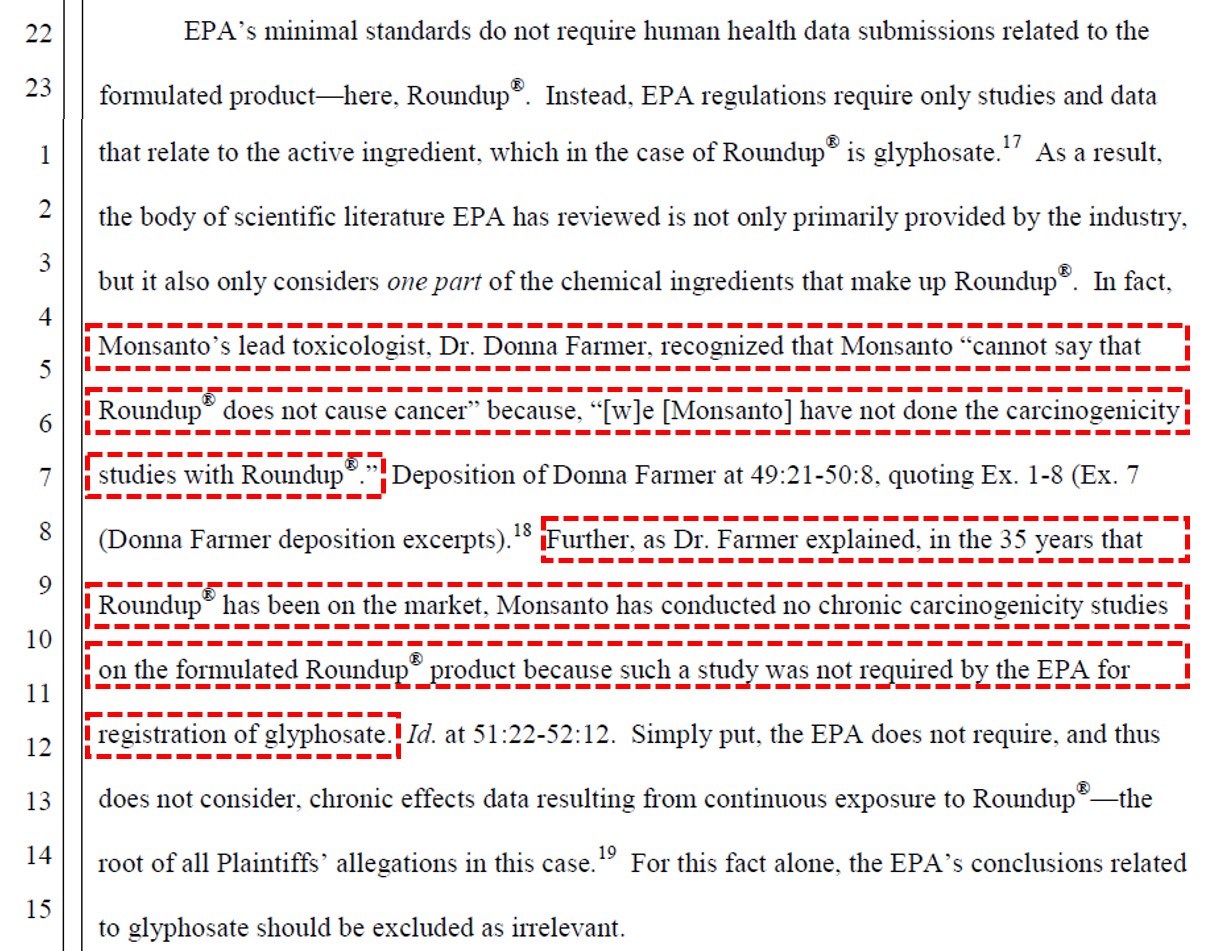
As the excerpt below reveals, the EPA effectively declared Roundup safe for use without even conducting tests on the actual formulation, but instead relying on industry research on just one of the product's active ingredients.

"EPA's minimal standards do not require human health data submissions related to the formulated product - here, Roundup. Instead, EPA regulations require only studies and data that relate to the active ingredient, which in the case of Roundup is glyphosate.

As a result, the body of scientific literature EPA has reviewed is not only primarily provided by the industry, but it also only considers one part of the chemical ingredients that make up Roundup."

Meanwhile, if that's not enough for you, Donna Farmer, Monsanto's lead toxicologist, even admitted in her deposition that she "cannot say that Roundup does not cause cancer" because "[w]e [Monsanto] have not done the carcinogenicity studies with Roundup."

http://www.islandbreath.org/2017Year/03/170314doc1big.jpg
Image above: Document #2 from original article. Click to enlarge.

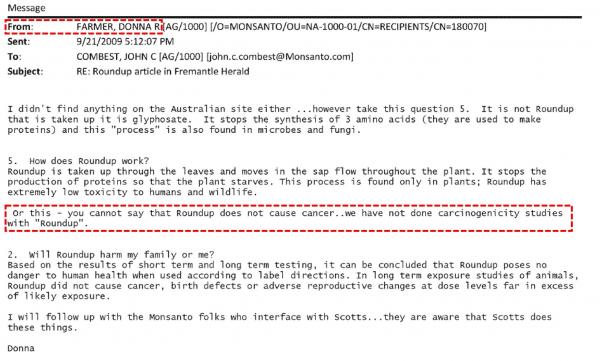
And just in case you're the super skeptical type, here is Farmer's actual email, from back in 2009, which seems pretty clear:

"you cannot say that Roundup does not cause cancer..we have not done carcinogenicity studies with "Roundup".

http://www.islandbreath.org/2017Year/03/170314doc2big.jpg
Image above: Document #2 from original article. Click to enlarge.

And while the revelations above are quite damning by themselves, this is where things get really interesting.

In early 2015, once it became clear that the World Health Organization's IARC was working on their own independent study of Roundup, Monsanto immediately launched their own efforts to preemptively discredit any results that might be deemed 'inconvenient'.

That said, Monsanto, the $60 billion behemoth, couldn't possibly afford the $250,000 bill that would come with conducting a legitimate scientific study led by accredited scientists.  Instead, they decided to "ghost-write" key sections of their report themselves and plotted to then have the independent scientists just "sign their names so to speak."
"A less expensive/more palatable approach might be to involve experts only for the areas of contention, epidemiology and possibly MOA (depending on what comes out of the IARC meeting), and we ghost-write the Exposure Tox & Genetox sections...but we would be keeping the cost down by us doing the writing and they would just edit & sign their names so to speak."


http://www.islandbreath.org/2017Year/03/170314doc3big.jpg
Image above: Document #3 from original article. Click to enlarge.

Finally, when all else fails, you call in those "special favors" in Washington D.C. that you've paid handsomely for over the years.

And that's where Jess Rowland, the EPA's Deputy Division Director for the Office of Chemical Safety and Pollution Prevention and chair of the Agency's Cancer Assessment Review Committee, comes in to assure you that he's fully exploiting his role as the "chair of the CARC" to kill any potentially damaging research..."if I can kill this I should get a medal."

http://www.islandbreath.org/2017Year/03/170314doc4big.jpg
Image above: Document #4 from original article. Click to enlarge.

All of which begs the question of whether the D.C. swamp is just too large to be drained.

.

Fukushima's radiation impact

SUBHEAD: EPA's Emergency Radiation Limits are coverup for danger of Fukushima's continued pollution.

By Mike Ludwig on 10 January 2017 for Truth Out -
(http://www.truth-out.org/news/item/39044-are-the-epa-s-emergency-radiation-limits-a-cover-for-fukushima-fumbles)


Image above: Illustration of Godzilla, the monster awoken from below the ocean by nuclear bombs. From (http://radioactivechat.blogspot.com/2012/01/fukushima-daiichi-running-without.html).

The Environmental Protection Agency (EPA) is poised to issue guidelines that would set radiation limits for drinking water during the "intermediate period" after the releases from a radioactive emergency, such as an accident at a nuclear power plant, have been brought under control.
.
Opponents say that under the proposed guidelines, concentration limits for several types of radionuclides would allow a lifetime permissible dose in a week or a month, or the equivalent of 250 chest x-rays a year, according to Public Employees for Environmental Responsibility, a watchdog group that represents government employees.

The EPA has stressed that the proposal is aimed at guiding state and local leaders during a crisis and would not change existing federal radiation limits for the water we drink every day, which are much more stringent, and assume there may be decades of regular consumption.

Critics of the new proposal say the emergency guidelines are a public relations ploy to play down the dangers of radiation and provide cover for an agency that fumbled during the Fukushima disaster in 2011.

The emergency limits are even higher than those proposed by the EPA during the final days of the Bush administration, which withdrew the proposal after facing public scrutiny and left the Obama administration with the job of finalizing the guidelines.

Now, in the twilight of the Obama administration, the EPA's "Protective Action Guidelines" for drinking water are once again drawing fire from nuclear watchdogs and public officials.

"The message here is that the American public should learn to love radiation, and that much higher levels than what are set by the statutory limits are OK," said Jeff Ruch, executive director of Public Employees for Environmental Responsibility (PEER), a watchdog group that represents government employees.

PEER says that internal documents released under the Freedom of Information Act show the EPA's radiation division hid proposed limits for dozens of radionuclides from the public -- and even from other divisions within the agency that were critical of the plan -- in order to "avoid confusion" until the final guidelines were released.

"It's not like this has been done with a lot of openness," Ruch said. "We had to sue them to find out what levels they would allow."

EPA Caught With Its "Pants Down" During Fukushima
In 2011, the Fukushima Daiichi Nuclear Power Plant in Japan suffered a meltdown after a deadly earthquake and tsunami and released massive amounts of dangerous radioactive contaminants into the ocean and atmosphere.

Ruch said the EPA was caught with its "pants down" as this radiation was detected in air, rainwater and even milk in the United States. The EPA had been working since the early 1990s to develop guidelines on how the government should respond to such a disaster, but specific limits for radiation in drinking water are only now being set.

As Truthout reported at the time, the EPA told the public that radiation from the disaster would not reach the US at levels high enough to pose a public health concern, even as the agency's own data showed concentrations of radionuclides in rain water far exceeding federal drinking water standards.

As Japan struggled with a major nuclear crisis and the media debated the relative danger of radioactive plumes blowing about the world's atmosphere, the EPA quietly stopped running extra tests for radiation less than two months after the disaster began.

By then, samples of cow's milk, rain and drinking water from across the country tested positive for radiation from the Fukushima plant, and nuclear critics warned that it was difficult to tell whether there could be impacts on human health in the absence of enhanced radiation monitoring.

The EPA's radiation division is now on the verge of approving a long-awaited update to its Protective Action Guidelines for responding to such a "large-scale emergency."

Ruch said employees from other divisions of the EPA were cut out of the decision-making process, and internal EPA documents indicate that the concentration limits were set higher than those detected during Fukushima to cover for the EPA's embarrassing performance.

Ruch points to notes from a 2014 briefing at the EPA's radiation division, which state that the agency "experienced major difficulty conveying its message to the public" that concentrations of radioactive material in rain water, although higher than federal Maximum Containment Levels (MCLs), "were not of immediate concern to public health" during the Fukushima crisis.

No Safe Dose of Radiation
The EPA's new proposed guidelines are ostensibly meant to help public officials decide when to take protective actions to reduce exposure to radiation, such as asking the public to switch from tap water to bottled water.

Most of the manual has already been finalized, except for the section on drinking water, which has been mired in controversy since the Bush administration.

In June, the EPA put the proposal up for public comment, but only made limits for four types of radionuclides publicly available. Critics say the agency still received 60,000 comments opposing the guidelines, including statements from 65 environmental groups.

PEER sued the agency under the Freedom of Information Act in October, and the EPA released the proposed limits for dozens of other radionuclides just days before the Christmas holiday.

Dan Hirsch, president of the Committee to Bridge the Gap, a nuclear watchdog group, attended a briefing with EPA officials on Thursday and told Truthout that the agency intends to finalize the guidelines despite ongoing protests.

"It's really hard to believe," Hirsch said.

Underlying the debate are MCLs for radioactive material in drinking water set by the Safe Drinking Water Act of 1974. Hirsch said that the nuclear industry has tried to "get out from under" these limits for years, but federal law prohibits them from being lowered. So, the industry and its allies at the EPA focused on the Protective Action Guidelines instead.

The MCLs are based on the idea that adults should not be exposed to more than 4 millirem (mrem) of radiation in drinking water each year for a 70-year period, for a total of 280 mrem in an average lifetime.

Since the "intermediate phase" following a nuclear emergency is expected to be temporary, the emergency radionuclide limits are capped at amounts that would expose adults to a maximum 500 mrem dose of radiation over the course of a year.

Hirsch said that such as dose of radiation is equivalent to receiving a chest x-ray about five days a week for a year. The EPA arrived at these figures by "playing" with the numbers used to calculate radiation absorbed by human organs, which in turn increased the amount of certain radionuclides that can be present in drinking water by hundreds, thousands and even tens of thousands of times.

Hirsch said guidelines reflect the nuclear industry's longstanding argument that MCLs are far too low, and the public should accept higher doses of radiation as permissible in an emergency.

The EPA claims there have been "advancements in scientific understanding of radiation dose and risk" since it began drawing up the Protective Action Guidelines back in 1992, and its emergency dose guidelines are based on the "latest science." The guidelines are also designed to provide flexibility for decision-makers responding to a crisis.

Nuclear critics, however, argue that no dose of radiation is safe. Even small doses can cause cancer in small portions of a large population.

"The science has actually worked in the opposite direction over the years," Hirsch said. "Science has concluded that radiation is much more dangerous than what was assumed in the '70s."

The guidelines are based on expected exposure over the course of one year, but both Ruch and Hirsch point out that radiation from nuclear calamity could persist for far longer -- just look at the fallout from Fukushima, which Japan has struggled with for years.

Radiation from the disaster is still being detected in fish on North America's western coast. They argue that the public needs better protections in the event of an emergency, and the nuclear industry should not be let off the hook based on inflated safety limits.

"The whole thing appears to be [an attempt to] achieve a post-incident reaction of 'don't worry be happy,'" Ruch said.

When even small doses of radiation are understood to pose a health risk, however small, setting radiation limits for a nuclear emergency is bound to be controversial.

Unfortunately, this is the radioactive reality of living in the modern nuclear world.


• Mike Ludwig is an investigative reporter at Truthout and a contributor to the Truthout anthology, Who Do You Serve, Who Do You Protect? Follow him on Twitter: @ludwig_mike.

See also:
TruthOut: Radiation Detected in Milk, Air and Water - Is America Safe?
Care2: Fukushima Update: The Nuclear Disaster That Won't Go Away
TruthOut: Nuclear Power Is Not "Green Energy": It Is a Fount of Atomic Waste
TruthOut: Nuclear fuel found 15 miles from Tokyo — Uranium in ‘glassy’ spheres flew over 170 km
Fukushima Nano Bucky Ball Hot Particles Filled With Uranium, Plutonium, And Cesiu
Ea O Ka Aina: Tokyo damaged by nuclear pellet rain 9/24/16
Ea O KA Aina: Nuclear Power and Climate Failure 8/24/16 
Ea O Ka Aina: High radioactivity in Tokyo  8/22/16
Ea O Ka Aina: Nuclear Blinders 8/18/16
Ea O Ka Aina: Fukushima and Chernobyl 5/29/16
Ea O Ka Aina: Fukushima radiation damages Japan 4/14/16
Ea O Ka Aina: Fukushima's Nuclear Nightmare 3/13/16
Ea O Ka Aina: Fifth Fukushima Anniversary 3/11/16
Ea O Ka Aina: Fukushima impacts are ongoing 11/8/15
Ea O Ka Aina: Petroleum and Nuclear Coverups 10/21/15
Ea O Ka Aina: Fukushima Radiation Contamination 10/13/15
Ea O Ka Aina: Radioactive floods damage Japan 9/22/15
Ea O Ka Aina: Fir trees damaged by Fukushima 8/30/15
Ea O Ka Aina: Japan restarts a nuclear plant 8/11/15
Ea O Ka Aina: Fukushima disaster will continue 7/21/15
Ea O Ka Aina: Too many fish in the sea? 6/22/15
Ea O Ka Aina: Fukushima prefecture uninhabitable 6/6/15
Ea O Ka Aina: In case you've forgotten Fukushima 5/27/15
Ea O Ka Aina: Radiation damages top predator bird 4/24/15
Ea O Ka Aina: Fukshima die-offs occurring 4/17/15
Ea O Ka Aina: Fukushima Impact Update 4/13/15
Ea O Ka Aina: Fukushima - the end of atomic power 3/13/15
Ea O Ka Aina: Where is the Fukushima Data? 2/21/15
Ea O Ka Aina: Fuku-Undo 2/4/15
Ea O Ka Aina: Fukushima MOX fuel crossed Pacific 2/4/15
Ea O Ka Aina: Fukushima worst human disaster 1/26/15
Ea O Ka Aina: Japan to kill Pacific Ocean 1/23/15
Ea O Ka Aina: Japan's Environmental Catastrophe 8/25/14
Ea O Ka Aina: Earthday TPP Fukushima RIMPAC 4/22/14
Ea O Ka Aina: Fukushima Daiichi hot particles 5/30/14
Ea O Ka Aina: Japanese radiation denial 5/12/14
Ea O Ka Aina: Entomb Fukushima Daiichi now 4/6/14
Ea O Ka Aina: Fukushima Disaster 3 Years Old 4/3/14
Ea O Ka Aina: Tsunami, Fukushima and Kauai 3/9/14
Ea O Ka Aina: Japanese contamination 2/16/14
Ea O Ka Aina: Bill for Fukushima monitoring 2/9/14
Ea O Ka Aina: Tepco under reporting of radiation 2/9/14
Ea O Ka Aina: Fukushima Fallout in Alaska 1/25/14
Ea O Ka Aina: Fukushima engineer against nukes 1/17/14
Ea O Ka Aina: California to monitor ocean radiation 1/14/14
Ea O Ka Aina: Demystifying Fukushima Reactor #3 1/1/14
Ea O Ka Aina: US & Japan know criticality brewing 12/29/13
Ea O Ka Aina: Fukushima Forever 12/17/13
Ea O Ka Aina: Brief radiation spike on Kauai 12/27/13
Ea O Ka Aina: USS Ronald Reagan & Fukushima 12/15/13
Ea O Ka Aina: Fukushima Pacific Impact 12/11/13
Ea O Ka Aina: Berkeley and Fukushima health risks 12/10/13
Ea O Ka Aina: Madness engulfs Japan 12/4/13
Ea O Ka Aina: Edo Japan and Fukushima Recovery 11/30/13
Ea O Ka Aina: Reaction to Fukushima is Fascism 11/30/13
Ea O Ka Aina: Radioisotopes in the Northern Pacific 11/22/13
Ea O Ka Aina: Fukushima cleanup in critical phase 11/18/13
Ea O Ka Aina: Fukushima fuel removal to start 11/14/13
Ea O Ka Aina: Fukushima, What me worry? 11/13/13
Ea O Ka Aina: Remove other Fukushina fuel 10/29/13
Ea O Ka Aina: End to Japanese Nuclear Power? 10/3/13
Ea O Ka Aina: Fukushima & Poisoned Fish 10/3/13
Ea O Ka Aina: Fuel Danger at Fukushima 9/27/13
Ea O Ka Aina: Reactor #4 Spent Fuel Pool 9/16/13
Ea O Ka Aina: Fukushima is Not Going Away 9/9/13
Ea O Ka Aina: X-Men like Ice Wall for Fukushima 9/3/13
Ea O Ka Aina: Fukushima House of Horrors 8/21/13
Ea O Ka Aina: Fukushima Apocalypse 8/21/13
Ea O Ka Aina: Fukushima Radioactive Dust 8/20/13
Ea O Ka Aina: Cocooning Fukushima Daiichi 8/16/13
Ea O Ka Aina: Fukushima radiation coverup 8/12/13
Ea O Ka Aina: Leakage at Fukushima an emergency 8/5/13
Ea O Ka Aina: Fukushima burns on and on 7/26/13
Ea O Ka Aina: What the Fukashima? 7/24/13
Ea O Ka Aina: Fukushima Spiking 7/15/13
Ea O Ka Aina: G20 Agenda Item #1 - Fix Fukushima 7/7/13
Ea O Ka Aina: Fukushima and hypothyroid in Hawaii 4/9/13
Ea O Ka Aina: Japan to release radioactive water 2/8/13
Ea O Ka Aina: Fukushima as Roshoman 1/14/13
Ea O Ka Aina: Fukushia Radiation Report 10/24/12
Ea O Ka Aina: Fukushima Fallout 9/14/12
Ea O Ka Aina: Fukushima Unit 4 Danger 7/22/12
Ea O Ka Aina: Fukushima denial & extinction ethics 5/14/12
Ea O Ka Aina: Fukushima worse than Chernobyl 4/24/12
Ea O Ka Aina: Fukushima dangers continue 4/22/12
Ea O Ka Aina: Fukushima children condemned 3/8/12
Ea O Ka Aina: Fukushima fights chain reaction 2/7/12
Ea O Ka Aina: Tepco faking Fukushima fix 12/24/11
Ea O Ka Aina: The Non Battle for Fukushima 11/10/11
Ea O Ka Aina: Fukushima Debris nears Midway 10/14/11
Ea O Ka Aina: Fukushima Radiation Danger 7/10/11
Ea O Ka Aina: Fukushima Abandoned 9/28/11
Ea O Ka Aina: Deadly Radiation at Fukushima 8/3/11
Ea O Ka Aina: Fukushima poisons Japanese food 7/25/11
Ea O Ka Aina: Black Rain in Japan 7/22/11
Ea O Ka Aina: UK PR downplays Fukushima 7/1/11
Ea O Ka Aina: Fukushima #2 & #3 meltdown 5/17/11
Ea O Ka Aina: Fukushima sustained chain reaction 5/3/11
Ea O Ka Aina: Ocean Radioactivity in Fukushima 4/16/11
Ea O Ka Aina: Japan raises nuclear disaster level 4/12/11
Ea O Ka Aina: Fukushima No Go Zone Expanding 4/11/11
Ea O Ka Aina: Fukushima to be Decommissioned 4/8/11
Ea O Ka Aina: Fukushima Poisons Fish 4/6/11
Ea O Ka Aina: Learning from Fukushima 4/4/11
Ea O Ka Aina: Fukushima Leak goes Unplugged 4/3/11
Ea O Ka Aina: Stick a fork in it - It's done! 4/2/11
Ea O Ka Aina: Fukushima reactors reach criticality 3/31/11
Ea O Ka Aina: Fukushima Non-Containment 3/30/11
Ea O Ka Aina: Fukushima Meltdown 3/29/11
Ea O Ka Aina: Fukushima Water Blessing & Curse 3/28/11

    .

    EPA obedient to Monsanto

    SUBHEAD: Don't expect Obama administration to save farm workers from Non-Hodgkin lymphoma.

    By Alexis Baden-Mayer 15 December 2016 for Truth-Out -
    (http://www.truth-out.org/speakout/item/38751-obama-s-epa-has-a-weakness-for-monsanto)


    Image above: Photo illustration of boy eating corn with quote from World Health Organization IARC Report on Glyphosate "Glyphosate can be found in soil,air, surface waterand groundwater, as well as in food." See connection to WHO full report below. From (http://www.ifoam.bio/en/news/2015/08/04/who-publishes-full-probable-human-carcinogen-report-glyphosate).

    The Environmental Protection Agency (EPA) is convening an advisory panel to review the science that links the main ingredient in the world's #1 herbicide with cancer.

    But don't expect one of the last acts of the Obama administration to be to save US farmers and agricultural workers from the ravages of Non-Hodgkin lymphoma.

    All signs point to EPA caving to Monsanto, the company that markets glyphosate in its flagship Roundup herbicide.

    The saga started in 1985, when the EPA classified glyphosate as a possible human carcinogen, based on the presence of kidney tumors in male mice.

    By 1991, the EPA had received enough pushback from Monsanto to reverse this decision.
    In 2009, the EPA began its registration review of glyphosate, required once every 15 years for all pesticides.

    In March 2015, the EPA was trying to wrap up that review when the World Health Organization's (WHO) International Agency for Research on Cancer assessed the carcinogenicity of glyphosate and determined that it was a probable human carcinogen. The EPA said it would consider the WHO finding in its own review of glyphosate.

    In May 2016, the EPA "mistakenly" released an assessment of glyphosate that contradicted the World Health Organization's finding that the herbicide was a probable human carcinogen. The leak gave Monsanto ammunition in its fight to keep its profitable Roundup on the market. (In 2015, Monsanto made nearly $4.76 billion in sales and $1.9 billion in gross profits from herbicide products, mostly Roundup.)

    After the leak, EPA tried to restore legitimacy to the process by insisting that it hadn't yet made a decision on glyphosate's carcinogenicity and convening a Scientific Advisory Panel to review the matter.

    In September, for the Scientific Advisory Panel's review, EPA released "Glyphosate Issue Paper: Evaluation of Carcinogenic Potential." The paper concluded that glyphosate is not likely to be carcinogenic to humans at doses relevant to human health.

    An analysis of the study by Food & Water Watch researcher Amanda Starbuck exposed several deficiencies in the science EPA used to reach its conclusion that glyphosate is not likely to be carcinogenic to humans:
    1. More than half of the studies were submitted by the industry. The EPA looked at 131 studies to decide if Roundup causes cancer, but 71 were unpublished industry studies.

    2. Independent studies were 30 times more likely to find glyphosate's toxicity than those from the industry -- but the EPA ultimately concluded that there was "no convincing evidence" of glyphosate's toxicity.

    3. The EPA used a "weight of evidence" approach, which means that heavy industry slant overwhelmed the independent published findings -- including a study that linked glyphosate with the growth of breast cancer cells.
    Jennifer Sass, senior scientist at the Natural Resources Defense Council's Health Program argues that the EPA's science is so poor that:
    EPA violated its own Cancer Guidelines by dismissing evidence of non-Hodgkin's lymphoma (NHL) in people.

    Even a meta-analysis of many epidemiologic studies that was sponsored by the agrochemical industry reported a statistically significant risk of NHL cancers when glyphosate-exposed individuals were compared with individuals never exposed to glyphosate. IARC's analysis reported similar results.

    EPA's Cancer Guidelines are consistent with calling this "suggestive evidence of carcinogenic potential" for "evidence of a positive response in studies whose power, design, or conduct limits the ability to draw a confident conclusion."
    Knowing that the EPA's weak science wasn't up to a serious review, CropLife, the trade association that lobbies on behalf of Monsanto and the rest of the pesticide industry, launched a campaign to discredit scientists chosen for the EPA's Scientific Review Panel.

    CropLife succeeded in getting EPA to cancel the panel's October meeting, remove an esteemed epidemiologist from the panel, and reschedule the meeting for December 13-16.

    The EPA has received 254,392 comments from the public in advance of the meeting.

    Nearly all of the people who submitted comments support a finding that glyphosate is a probable carcinogen, including the 119,857 members of the Organic Consumers Association who signed a petition asking the EPA to follow the World Health Organization's finding.

    Organizations that organized their members to submit public comments include Beyond Pesticides, Center for Biological Diversity, Center for Food Safety, Consumers Union, Food Democracy Now, Food & Water Watch, Friends of the Earth, Moms Across America, Natural Resources Defense Council, Pesticide Action Network North America, and U.S. Public Interest Research Group.


    IARC Glyphosate & Cancer Report Link

    SUBHEAD: Who publishes full probable human carcenoen report on Glyphosae.

    By Staff on 4 August 2015 for IFOAM -
    (http://www.ifoam.bio/en/news/2015/08/04/who-publishes-full-probable-human-carcinogen-report-glyphosate)

    The World Health Organization’s cancer agency IARC has published the full report which caused a huge worldwide response, when they announced earlier this year that the World’s most sold herbicide, glyphosate, is a probable human carcinogen.

    The assessment by the International Agency for Research on Cancer (IARC) of glyphosate, which is used in herbicides with estimated annual sales of USD 6 Billion, is of special concern to Monsanto, the company that brought glyphosate to market under the trade name Roundup in the 1970s.

    The IARC reached its decision based on the view of 17 experts from 11 countries, who met in Lyon, France, to assess the carcinogenicity of 5 organophosphate pesticides.

    Since the IARC report was released in March 2015 many countries have been looking at possible bans on glyphosate-based herbicides and Sri Lanka even announced a complete ban. Supermarkets across Europe have also removed glyphosate-based herbicides from their shelves.

    You can find the full IARC Report here:
    monographs.iarc.fr/ENG/Monographs/vol112/mono112-02.pdf (link is external)
    Source: http://sustainablepulse.com/ (link is external)


    Two RUP pesticides to worry about

    SOURCE: Ken Taylor (littlewheel808@gmail.com)
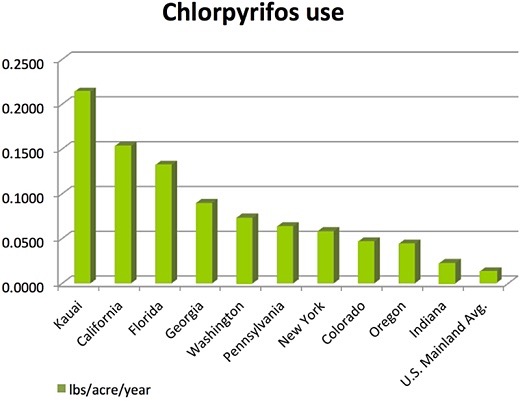
    SUBHEAD: Atrazine and Chlorpyrifos are dangerous restricted use pesticides heavily used on Kauai.

    By Dr. Lee Evslin on 3 Monday 2016 for the Garden Island -
    (http://thegardenisland.com/news/opinion/guest/of-kauai-s-pesticides-are-having-a-bad-year/article_f419ec77-6e03-5c44-92c9-b23264b28a97.html)


    Image above: Waimea, Kauai in foreground adjacent to hundreds of pesticide soaked acres experimental GMO crops. Waimea Middle School's yard faces the fields. Children have gotten sick there. From (https://www.theguardian.com/us-news/2015/aug/23/hawaii-birth-defects-pesticides-gmo).

    Atrazine and Chlorpyrifos are two of the most heavily sprayed restricted use (RUPs) pesticides on Kauai. In the past year they have come under increasing fire from specialists in pediatric neurology, the EPA, U.S. Fish and Wildlife Service (USFWS), and the National Marine Fisheries Service (NMFS).
    1. On Oct. 30 2015, the EPA recommended the prohibition of Chlorpyrifos for agricultural use in the U.S. They stated that it was risky for workers and it was found to contaminate surface waters. Chlorpyrifos is the chemical that led to the symptoms experienced by the Syngenta workers. This recommendation for prohibition is still under review.
    2. In April 2016, the European Union did prohibit Chlorpyrifos for agricultural use in all 29 countries. They did this with very little advance notice, stating that they acted rapidly due to health concerns.
       
    3. In April 2016, the EPA released a statement drawn up with consultation with the Fish and Wildlife and Marine Fisheries Services. They stated that after reviewing 1400 studies they concluded that Chlorpyrifos was “likely to adversely affect” 97 percent of endangered species both on the land and in the water.

    4. In July 2016, Project TENDR released a position paper. Leading experts in neurologic development and in related fields created this document. They stated that there is an alarming national increase in neurobehavioral disorders in children and increasing evidence that environmental toxins were playing a role. Pesticides were first in their list of these toxins and Chlorpyrifos is a prominent chemical in the studies they reviewed.

    5. In April 2016, the EPA released a position paper on Atrazine. They stated that after reviewing hundreds of studies they concluded that at currently allowable levels of spraying, Atrazine was likely to exceed safe levels of exposure for land and sea animals. The EPA stated their “levels of concern for chronic risk are exceeded by as much as 22, 198 and 62 times for birds, mammals and fish, respectively.” Of note also is that Atrazine has been prohibited in Europe for decades.
    We all sign an agricultural form when we fly into Hawaii. It seems that one could be sanctioned for bringing an orange into the state and not declaring it. Gov. Linda Lingle used to announce on every flight that we have one of the most fragile ecosystems in the world.

    The EPA is being very clear about their increasing concern about both of these chemicals. I can only speak for myself but my concern about the possible effect of these chemicals on human health and on the environment has increased also.

    Dr. Lee Evslin is a retired physician. He has lived and practiced on Kauai since 1979. He also served as the CEO of Kauai Medical Clinic and Wilcox Hospital.


    Image above: Graph showing the highest concentration per acre of Chlorpyrios on agricultural fields are on the small island of Kauai. More than ten times the US mailand average. From (http://grist.org/business-technology/gmo-companies-are-dousing-hawaiian-island-with-toxic-pesticides/).

    [IB Publisher's Note: In addition a study published by the National Institute of Health in 2014 titled "Effects of atrazine and chlorpyrifos on DNA methylation in the liver, kidney and gill of the common carp" demonstrated that long-term exposure to Atrazine and Chlorpyrifos or Atrazine/Chlorpyrifos mixtures could disrupt genomic DNA."]
    .

    EPA allows fracking fluid in Gulf

    SUBHEAD: EPA plans to allow unlimited dumping of fracking wastewater in the Gulf of Mexico.

    By Mike Ludwig on 22 September 2016 for TruthOut -
    (http://www.truth-out.org/news/item/37710-epa-plans-to-allow-unlimited-dumping-of-fracking-wastewater-in-the-gulf-of-mexico)


    Image above: In May 2016 a Shell oil facility leake 90,000 gallons of oil into the Gulf of Mexico, according to federal authorities. From (https://thinkprogress.org/yet-another-oil-spill-wreaks-havoc-on-the-gulf-of-mexico-and-nearby-coastal-communities-1e3b62d92d1#.2ac8u4hdh).

    Environmentalists are warning the Environmental Protection Agency (EPA) that its draft plan to continue allowing oil and gas companies to dump unlimited amounts of fracking chemicals and wastewater directly into the Gulf of Mexico is in violation of federal law.

    In a letter sent to EPA officials on Monday, attorneys for the Center for Biological Diversity warned that the agency's draft permit for water pollution discharges in the Gulf fails to properly consider how dumping wastewater containing chemicals from fracking and acidizing operations would impact water quality and marine wildlife.

    The attorneys claim that regulators do not fully understand how the chemicals used in offshore fracking and other well treatments -- some of which are toxic and dangerous to human and marine life -- can impact marine environments, and crucial parts of the draft permit are based on severely outdated data. Finalizing the draft permit as it stands would be a violation of the Clean Water Act, they argue.

    "The EPA is endangering an entire ecosystem by allowing the oil industry to dump unlimited amounts of fracking chemicals and drilling waste fluid into the Gulf of Mexico," said Center attorney Kristen Monsell. "This appalling plan from the agency that's supposed to protect our water violates federal law, and shows a disturbing disregard for offshore fracking's toxic threats to sea turtles and other Gulf wildlife."

    The Center has a history of using legal action to stop polluters and challenge the government to enforce environmental regulations, so the letter could be seen as a warning shot over the EPA's bow.

    Earlier this year, lawsuits filed by the Center and another group won a temporary moratorium on offshore fracking in the Pacific Ocean, and the groups are currently preparing to challenge fracking in the Santa Barbara Channel under the Endangered Species Act.

    Offshore fracking involves pumping water, chemicals and sand at extremely high pressure into undersea wells to break up rock and sand formations and clear pathways for oil and gas. Offshore drillers also treat wells with corrosive acids, such as hydrochloric acid, in a process known as "acidizing."

    The technologies have been used hundreds of times to enhance oil and gas production at hundreds of Gulf wells in recent years, and environmentalists say use of the technology could increase in the future as the industry seeks to maximize production in aging offshore fields.

    Still, little was publicly known about these "well treatments" until Truthout and environmental groups began filing information requests with federal regulators.

    Regulators and the fossil fuel industry say offshore fracking operations have a good safety record and tend to be smaller in size compared to onshore operations, but environmentalists continue to worry about the chemicals used in the process because many of them are known to harm marine wildlife.
    Plus, dolphins and other species in the Gulf are still suffering from the lingering effects of the 2010 BP oil spill.

    Under the EPA's current and draft permits, offshore drillers are allowed to dump an unlimited amount of fracking and acidizing chemicals overboard as long as they are mixed with the wastewater that returns from undersea wells.

    Oil and gas platforms dumped more than 75 billion gallons of these "produced waters" directly into the Gulf of Mexico in 2014 alone, according to the Center's analysis of EPA records.

    These large volumes of wastewater cannot contain oil and must meet toxicity standards, but oil and gas operators are only required to test the waste stream a few times a year. Monsell said these tests could easily be conducted at times when few or no fracking chemicals are present in the wastewater.

    The EPA expects these chemicals to have little impact on the environment because the large volumes of wastewater and the ocean dilute them, but the Center points out that much of the EPA's data on the subject comes from studies prepared in the 1980s and 1990s. Offshore production technology has advanced since then and hundreds of frack jobs have occurred in the Gulf in the past five years alone.

    "All they have to do is ask the Interior Department for this information, because they just compiled it all for us," said Monsell, referring to the thousands of documents recently released to Truthout and the Center under the Freedom of Information Act.

    These documents, released under a legal settlement between the Interior Department and the Center, show that regulators approved more than 1,500 frack jobs at over 600 Gulf wells between 2010 and 2014 with permit modifications that were exempted from comprehensive environmental reviews.

    Monsell said the EPA's permit is just another example of a federal agency "rubber-stamping" permits for offshore fracking without taking a hard look at how the technology impacts the environment.

    The EPA, she argues, should prohibit the dumping of hazardous fracking chemicals and other wastes directly into ocean altogether.

    "It's the EPA's job to protect water quality from offshore fracking, not rubber-stamp the dumping of the wastewater from this dangerous, disgusting practice," Monsell said.

    The draft permit does prohibit the dumping of oil in the Gulf and proposes a new rule that would require oil and gas operators to keep an inventory of the fracking and acidizing chemicals kept on board.

    This inventory must be made available to regulators upon request. The government's most up-to-date list of offshore fracking chemicals is now 15 years old, and the Interior Department regulators are currently working to update it.

    Monsell worries, however, that these inventories would not track how much of the chemicals are dumped overboard, and the public will not be able to access them unless the EPA or Interior Department requests copies first.

    Even then, watchdogs may have to wait on the government to process more information requests in order to make those inventories public.


    • Mike Ludwig is an investigative reporter at Truthout and a contributor to the Truthout anthology, Who Do You Serve, Who Do You Protect? Follow him on Twitter: @ludwig_mike.

    .

    EPA vs Pflueger and other violators

    SOURCE:  Michael Guard Sheehan (mailto:hanaleirivermichael@gmail.com)
    SUBHEAD: EPA closes Pflueger case on Kauai but ignores other owner's environmental violations.

    By Dean Higuchi on 24 August 2016 for the EPA.gov -
    (https://www.epa.gov/newsreleases/epa-closes-pflueger-stormwater-case-after-successful-restoration-kauai-property)


    Image above: This photo from 2004 was taken prior to environmental damage caused by this unauthorized grading and landscaping by retired car dealer James Pflueger on his Pila’a property. From (http://www.staradvertiser.com/breaking-news/pfluegers-environmental-repairs-on-kauai-shoreline-meets-epa-muster/).

    Editorial comment  by Michael Guard Sheehan:
    This case is a tragic case of selective enforcement against one man while surrounding him were numerous persons and politicians doing far worse to the Environment with their own illegal digging and construction in Habitats for Endangered Species. Instead of self-congratulatory news releases, your organization should be shamefully quiet and reflective.

    The U.S. Environmental Protection Agency announced the successful conclusion of its case against James Pflueger for construction activities that damaged his former property and the beach and coral reefs at Pila’a on Kauai. The consent decree settling the Clean Water Act violations was closed after Pflueger stabilized and restored the slopes and streams.

    “Thanks to the work completed under this settlement, this once-degraded land has a healthy population of native trees and shrubs and restored stream channels,” said Alexis Strauss, EPA’s Acting Regional Administrator for the Pacific Southwest. “With continued care by the new owners, these restoration efforts can be sustained for the future.”

    EPA initiated its case after Pflueger conducted extensive grading and construction at the 378-acre coastal site without obtaining necessary Clean Water Act permits. Those activities included excavating a hillside to expose a 40-foot vertical road cut, grading a coastal plateau, creating new access roads to the coast, and dumping dirt and rock into three perennial streams. As a result, massive discharges of sediment-laden stormwater flowed to the ocean at Pila’a Bay in November 2001.

    The settlement required Pflueger to build a wall to stabilize the road cut adjacent to the shoreline, remove dam material in streams, install erosion controls on roadways and trails, terrace slopes to slow runoff, use native plants to control erosion, and control invasive plants and animals on the property. He was also required to reconstruct natural rock-lined stream beds and reestablish native plants along the banks.

    The 2006 stormwater settlement was the largest for federal Clean Water Act violations at a single site, by a single landowner, in the United States. Pflueger paid $2 million in penalties to the State of Hawaii and the United States, and was expected to spend approximately $5.3 million to conduct the required restoration efforts.

    The State of Hawaii was a co-plaintiff in EPA’s case against Pflueger, and the settlement was joined by the Limu Coalition and Kilauea neighborhood organizations, which had also filed a lawsuit against Pflueger.

    EPA and local community organizations involved in the settlement conducted oversight inspections throughout a ten-year restoration effort that was slowed by funding obstacles and the necessity of adapting the restoration projects to changing field conditions.

    .

    Agent Orange Crops Halted

    SOURCE: Shaka Movement (info@ShakaMovement.org)
    SUBHEAD: The EPA is revoking the registration of “Enlist Duo,” a toxic pesticide to be used with GMO crops.

    By Staff on 27 November 2015 for Center for Food Safety -
    (http://lxwl.mj.am/nl/lxwl/1hoti.html)


    Image above: From original article.


    Great news! In response to CFS litigation, the Environmental Protection Agency (EPA) has announced it is revoking the registration of “Enlist Duo,” a toxic pesticide designed to be used with genetically engineered “Agent Orange” crops!

    Responding to a lawsuit brought by Center for Food Safety and Earthjustice, yesterday EPA announced it is revoking the registration of “Enlist Duo,” a toxic combination of glyphosate and 2,4-D – the main ingredient in Agent Orange.

    Approved by the agency just over a year ago, Dow’s Enlist Duo was created for use on the next generation of genetically engineered (GE) crops, what we dubbed “Agent Orange crops”, designed to withstand being drenched with this potent herbicide cocktail.

    In its court filing, EPA stated it is taking this action after realizing that the combination of these chemicals is likely significantly more harmful than it had initially believed.

    EPA had approved use of Enlist Duo in Illinois, Indiana, Iowa, Ohio, South Dakota, Wisconsin, Arkansas, Kansas, Louisiana, Minnesota, Missouri, Mississippi, Nebraska, Oklahoma, and North Dakota, and had intended to approve it in additional areas in the near future.

    Dow created Enlist crops as a quick fix for the problem created by “Roundup Ready” crops, the previous generation of genetically engineered crops designed to resist the effects of glyphosate, the active ingredient in Monsanto’s Roundup herbicide.

    Just as overuse of antibiotics has left resistant strains of bacteria to thrive, repeated use of Roundup on those crops allowed glyphosate-resistant “superweeds” to proliferate, and those weeds now infest tens of millions of acres of U.S. farmland.

    Enlist crops allow farmers to spray both glyphosate and 2,4-D without killing their crops, which they hope will kill weeds resistant to glyphosate alone.

    But some weeds have already developed 2,4-D resistance, and the escalating cycle of more toxic pesticides in the environment will continue unless EPA stops approving these chemicals, and USDA stops rubber-stamping new genetically engineered crops.

    The decision by EPA to withdraw the illegally approved Enlist Duo crops is a huge victory for the environment and the future of our food!

    Thanks for your support. We are so grateful to be able to share this tremendous victory with you!

    - the Center for Food Safety team

    Read more about this victory: http://www.centerforfoodsafety.org/press-releases/4144/epa-pulls-registration-for-dows-enlist-duo-herbicide-citing-high-toxicity-levels< .

    EPA approves 2-4-D for GMOs

    SUBHEAD: Dow Chemical's new line of GMO seeds will drastically increase the use of 2,4-D, a toxic pesticide.

    By Linda Wells on 16 October 2014 for Earth Island -
    (http://www.earthisland.org/journal/index.php/elist/eListRead/epas_approval_of_toxic_pesticide_ignores_health_and_safety_risks/)


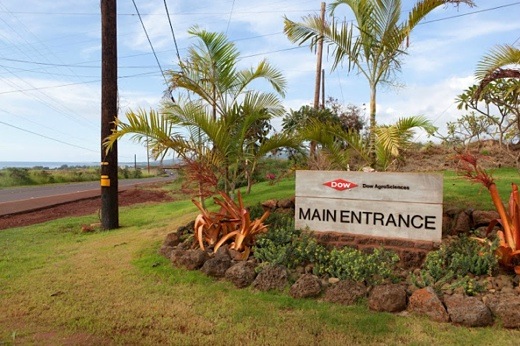
    Image above: Dow Agro-Science main facility entrance lies between Waimea and Hanapepe along the Kaumualii Highway on Kauai, Hawaii. This is where the 2-4-D will be tested on humans residents; particularly those (many of whom are employees) living in nearby Makaweli and Kaumakani. Photo by Ian Umeda. From (http://earthfirstjournal.org/newswire/2012/02/26/dow-and-monsanto-set-to-team-up-to-reintroduce-agent-orange-pesticide-in-the-midwest/).

    It's official. Yesterday, the US Environmental Protection Agency approved Dow AgroSciences’ new pesticide product Enlist Duo, a combination of the herbicides 2,4-D and glyphosate. Given that the US Department of Agriculture has already cleared the way for Dow’s new genetically engineered corn and soybean crops, this pesticide and seed combination can now be sold commercially.

    The move is bound to drastically increase the use of 2,4-D, a harmful and volatile chemical linked to reproductive harms and cancer.

    This is a turning point, not just for grain production but also for food production in the US and across the world. The introduction of Enlist corn and soybeans, and the widespread adoption of this new seed line, will have pervasive impacts on farmer livelihoods, public health and control of our food system.

    This is a decision that our regulators should not have taken lightly. And yet, it seems they did. Both USDA and EPA set up an intentionally narrow scope for evaluating the potential harms posed by 2,4-D resistant crops – one that ignored the biggest problems and held up irrelevant factors as evidence of safety.

    As small farmers brace for the impact of pesticide drift that will hit their farms once the Enlist crops are introduced, it is time for us to look forward. It's time to demand a regulatory system that takes a rigorous approach to pesticides and genetically engineered crops, one that values small farmers as much as industrial agriculture – and public health as much as corporate profit.

    It's a set up
    Dow Chemical's Enlist seeds and pesticides passed this approval process with relative ease, despite extended public outcry from farmers, health professionals and communities across the country.
    Dow, and the other "Big 6" global pesticide corporations, would have us believe that this was a drawn-out, rigorous approval process that once again proves the safety and necessity of genetically engineered crops. The reality is that the whole process was a tricky sleight-of-hand: Enlist passed the test because the test itself was set up to be a cakewalk.

    From the beginning, opponents of 2,4-D-resistant crops have focused on three main objections:
    1. Enlist crops will mean a massive increase in the use of the toxic and volatile chemical 2,4-D. Neighboring farms, especially those that grow fruits and vegetables, will be put at risk for increased crop damage. Their livelihoods will be threatened, and fruit and vegetable production will become an even riskier venture for US farmers.
    2. Rural exposure to 2,4-D will also increase to unprecedented levels. 2,4-D is linked to cancer and reproductive harm, among other negative impacts. USDA itself predicts 2,4-D use in corn and soybean production to increase between 500 and 1,400 percent over the course of nine years.
    3. Dow is presenting Enlist as the answer to farmer's prayers about "superweeds," an economic must-have that outweighs any side effects. But the truth is that superweeds developed because of Monsanto's RoundUp Ready seed line, the current king of pesticide-resistant crops — and there's nothing to stop weeds from developing resistance to 2,4-D just as they have to glyphosate, RoundUp's active ingredient. USDA needs to invest in real solutions for weed management, not allow this false solution to exacerbate the problem.
    And of these major points, how many were accounted for in the approval process run by USDA and EPA? Not a single one.

    Agency hot potato
    What happened? Well, to Administrators Tom Vilsack (USDA) and Gina McCarthy (EPA), when it comes to evaluating the safety of new GE crops, apparently the buck stops  somewhere else. Each agency accepted the narrowest possible interpretation of its responsibilities to safeguard our fields and families.

    USDA essentially decided to only look at the damage that GE seeds themselves would cause, ignoring the threat of pesticide drift entirely — and passing the onus of evaluating pesticide-related issues to EPA.

    Meanwhile, EPA did a rather shoddy job of addressing the health impacts of this dramatic increase in 2,4-D use. McCarthy didn't consider tthe cumulative damage that will result from repeated 2,4-D exposures, and instead insisted that 2,4-D health impacts in general had already been evaluated by a previous process. As for crop damage from pesticides, well, crop damage is USDA's domain. So EPA didn't consider that issue at all.

    And neither Vilsack nor McCarthy tackled the one of the biggest questions: Why would we put a product on the market that's going to make superweeds even more out of control? As stated in a recent LA Times editorial:
    “No agency looks at the bigger policy question of whether the nation is embarking on a potentially dangerous path toward creating ever-more resistant weeds and spraying them and crops with larger and larger doses of stronger herbicides. That question should be answered before the country escalates the war out in the fields.”
    Hear, hear!

    Do better.
    It's time to intercept this game of agency hot-potato with clearly defined directives for protecting farmers and rural families. PAN is joining allies in demanding that USDA and EPA produce a new, more robust process for the approval of new GE crops and pesticides – one that considers the full implications of these new products before they hit the market, from pesticide drift to cumulative impacts.

    No distractions, no loopholes. Let's take our food and farming system seriously, and make decisions based on all of the facts.

    Take action
     Join PAN and partners in calling on President Obama to step in and keep 2,4-D crops from hitting the market. He has the authority to direct USDA and EPA to take a closer look at on-the-ground impacts and better protect community health and farmer livelihoods.


    .

    EPA tool of Fracking

    SUBHEAD: EPA's water contamination investigation halted in Texas after Range Resources company protest.

    By Ramit Plushnick-Masti on 16 January 2013 in Huffington Post -
    (http://www.huffingtonpost.com/2013/01/16/epa-water-contamination-investigation-fracking_n_2484568.html)


    Image above: man ignites methane coming through his water line to demonstrate contamination. From original article.

    When a man in a Fort Worth suburb reported his family's drinking water had begun "bubbling" like champagne, the federal government sounded an alarm: An oil company may have tainted their wells while drilling for natural gas.

    At first, the Environmental Protection Agency believed the situation was so serious that it issued a rare emergency order in late 2010 that said at least two homeowners were in immediate danger from a well saturated with flammable methane. More than a year later, the agency rescinded its mandate and refused to explain why.

    Now a confidential report obtained by The Associated Press and interviews with company representatives show that the EPA had scientific evidence against the driller, Range Resources, but changed course after the company threatened not to cooperate with a national study into a common form of drilling called hydraulic fracturing. Regulators set aside an analysis that concluded the drilling could have been to blame for the contamination.

    For Steve Lipsky, the EPA decision seemed to ignore the dangers in his well, which he says contains so much methane that the gas in water pouring out of a garden hose can be ignited.

    "I just can't believe that an agency that knows the truth about something like that, or has evidence like this, wouldn't use it," said Lipsky, who fears he will have to abandon his dream home in an upscale neighborhood of Weatherford.

    The case isn't the first in which the EPA initially linked a hydraulic fracturing operation to water contamination and then softened its position after the industry protested.

    A similar dispute unfolded in west-central Wyoming in late 2011, when the EPA released an initial report that showed hydraulic fracturing could have contaminated groundwater. After industry and GOP leaders went on the attack, the agency said it had decided to do more testing. It has yet to announce a final conclusion.

    Hydraulic fracturing — often called "fracking" — allows drillers to tap into oil and gas reserves that were once considered out of reach because they were locked in deep layers of rock.

    The method has contributed to a surge in natural gas drilling nationwide, but environmental activists and some scientists believe it can contaminate groundwater. The industry insists the practice is safe.

    Range Resources, a leading independent player in the natural gas boom, has hundreds of gas wells throughout Texas, Pennsylvania and other mineral-rich areas of the United States. Among them is a production site — now owned by Legend Natural Gas — in a wooded area about a mile from Lipsky's home in Weatherford, about a half-hour drive west of Fort Worth.

    State agencies usually regulate water and air pollution, so the EPA's involvement in the Texas matter was unusual from the start. The EPA began investigating complaints about the methane in December 2010, because it said the Texas Railroad Commission, which oversees oil and gas drilling, had not responded quickly enough to the reports of bubbling water.

    Government scientists believed two families, including the Lipskys, were in danger from methane and cancer-causing benzene and ordered Range Resources to take steps to clean their water wells and provide affected homeowners with safe water. The company stopped doing that after state regulators declared in March 2011 that Range Resources was not responsible. The dispute between the EPA and the company then moved into federal court.

    Believing the case was headed for a lengthy legal battle, the EPA asked an independent scientist named Geoffrey Thyne to analyze water samples taken from 32 water wells. In the report obtained by the AP, Thyne concluded from chemical testing that the gas in the drinking water could have originated from Range Resources' nearby drilling operation.

    Meanwhile, the EPA was seeking industry leaders to participate in a national study into hydraulic fracturing. Range Resources told EPA officials in Washington that so long as the agency continued to pursue a "scientifically baseless" action against the company in Weatherford, it would not take part in the study and would not allow government scientists onto its drilling sites, said company attorney David Poole.

    In March 2012, the EPA retracted its emergency order, halted the court battle and set aside Thyne's report showing that the gas in Lipsky's water was nearly identical to the gases the Plano, Texas-based company was producing.

    "They said that they would look into it, which I believe is exactly what they did," Poole said. "I'm proud of them. As an American, I think that's exactly what they should have done."

    The EPA offered no public explanation for its change in thinking, and Lipsky said he and his family learned about it from a reporter. The agency refused to answer questions about the decision, instead issuing a statement by email that said resolving the Range Resources matter allowed the EPA to shift its "focus in this case away from litigation and toward a joint effort on the science and safety of energy extraction."

    Rob Jackson, chairman of global environmental change at Duke University's Nicholas School of the Environment, reviewed Thyne's report and the raw data upon which it was based. He agreed the gas in Lipsky's well could have originated in a rock formation known as the Barnett shale, the same area where Range Resources was extracting gas.

    Jackson said it was "premature" to withdraw the order and said the EPA "dropped the ball in dropping their investigation."

    Lipsky, who is still tied up in a legal battle with Range Resources, now pays about $1,000 a month to haul water to his home. He, his wife and three children become unnerved when their methane detectors go off. Sometime soon, he said, the family will have to decide whether to stay in the large stone house or move.

    "This has been total hell," Lipsky said. "It's been taking a huge toll on my family and on our life."

    The confidential report relied on a type of testing known as isotopic analysis, which produces a unique chemical fingerprint that sometimes allows researchers to trace the origin of gas or oil.

    Jackson, who studies hydraulic fracturing and specializes in isotopic analysis, acknowledged that more data is needed to determine for certain where the gas came from. But even if the gas came from elsewhere, Range Resources' drilling could have contributed to the problem in Lipsky's water because gas migrates, he added.

    The company insists the gas in Lipsky's water is from natural migration and not drilling. Range Resources' testing indicates the gas came from a different rock formation called Strawn shale and not the deeper Barnett shale, Poole said.

    In addition, he said, isotopic analysis cannot be used in this case because the chemical makeup of the gases in the two formations is indistinguishable. A Range Resources spokesman also dismissed Thyne and Jackson as anti-industry.

    Range Resources has not shared its data with the EPA or the Railroad Commission. Poole said the data is proprietary and could only be seen by Houston-based Weatherford Laboratories, where it originated. It was analyzed for Range Resources by a Weatherford scientist, Mark McCaffrey, who did not respond to requests for an interview.

    Gas has always been in the water in that area, Poole said. And years before Range Resources began drilling, at least one water well in the neighborhood contained so much methane, it went up in flames.

    At another home with dangerously high methane levels in the water, the company insisted the gas had been there since the well was first dug many years ago. The homeowner was not aware of anything wrong until Range Resources began drilling in 2009.

    Jackson said it was "unrealistic" to suggest that people could have tainted water and not notice.

    "It bubbles like champagne or mineral waters," he said. "The notion that people would have wells and have this in their water and not see this is wrong."
    • Associated Press writers Nomaan Merchant in Dallas, Allen Breed in Raleigh, N.C., and Michael Rubinkam in Allentown, Pa., contributed to this report.


    .

    Poisoning the well

    SUBHEAD: How the Feds let industry pollute the nation’s underground water supply pumping waste underground.

    By Abraham Lustgarten on 11 December 2012 for Pro Publica -
    (http://www.propublica.org/article/poisoning-the-well-how-the-feds-let-industry-pollute-the-nations-undergroun/single)


    Image above: A view of the dry bed of the E.V. Spence Reservoir in Robert Lee, Texas, in October 2011. Records show that environmental officials have granted more than 50 aquifer exemptions for waste disposal and uranium mining in the drought-stricken stat. From original article. 

    Federal officials have given energy and mining companies permission to pollute aquifers in more than 1,500 places across the country, releasing toxic material into underground reservoirs that help supply more than half of the nation's drinking water.

    In many cases, the Environmental Protection Agency has granted these so-called aquifer exemptions in Western states now stricken by drought and increasingly desperate for water.


    EPA records show that portions of at least 100 drinking water aquifers have been written off because exemptions have allowed them to be used as dumping grounds.

    "You are sacrificing these aquifers," said Mark Williams, a hydrologist at the University of Colorado and a member of a National Science Foundation team studying the effects of energy development on the environment. "By definition, you are putting pollution into them. ... If you are looking 50 to 100 years down the road, this is not a good way to go."

    As part of an investigation into the threat to water supplies from underground injection of waste, ProPublica set out to identify which aquifers have been polluted.

    We found the EPA has not even kept track of exactly how many exemptions it has issued, where they are, or whom they might affect.

    What records the agency was able to supply under the Freedom of Information Act show that exemptions are often issued in apparent conflict with the EPA's mandate to protect waters that may be used for drinking.

    Though hundreds of exemptions are for lower-quality water of questionable use, many allow grantees to contaminate water so pure it would barely need filtration, or that is treatable using modern technology.

    The EPA is only supposed to issue exemptions if aquifers are too remote, too dirty, or too deep to supply affordable drinking water. Applicants must persuade the government that the water is not being used as drinking water and that it never will be.

    Sometimes, however, the agency has issued permits for portions of reservoirs that are in use, assuming contaminants will stay within the finite area exempted.

    In Wyoming, people are drawing on the same water source for drinking, irrigation and livestock that, about a mile away, is being fouled with federal permission. In Texas, EPA officials are evaluating an exemption for a uranium mine — already approved by the state — even though numerous homes draw water from just outside the underground boundaries outlined in the mining company's application.

    The EPA declined repeated requests for interviews for this story, but sent a written response saying exemptions have been issued responsibly, under a process that ensures contaminants remain confined.

    "Aquifer Exemptions identify those waters that do not currently serve as a source of drinking water and will not serve as a source of drinking water in the future and, thus, do not need to be protected," an EPA spokesperson wrote in an email statement. "The process of exempting aquifers includes steps that minimize the possibility that future drinking water supplies are endangered."

    Yet EPA officials say the agency has quietly assembled an unofficial internal task force to re-evaluate its aquifer exemption policies. The agency's spokesperson declined to give details on the group's work, but insiders say it is attempting to inventory exemptions and to determine whether aquifers should go unprotected in the future, with the value of water rising along with demand for exemptions closer to areas where people live.

    Advances in geological sciences have deepened regulators' concerns about exemptions, challenging the notion that waste injected underground will stay inside the tightly drawn boundaries of the exempted areas.

    "What they don't often consider is whether that waste will flow outside that zone of influence over time, and there is no doubt that it will," said Mike Wireman, a senior hydrologist with the EPA who has worked with the World Bank on global water supply issues. "Over decades, that water could discharge into a stream. It could seep into a well. If you are a rancher out there and you want to put a well in, it's difficult to find out if there is an exempted aquifer underneath your property."

    Aquifer exemptions are a little-known aspect of the government's Underground Injection Control program, which is designed to protect water supplies from the underground disposal of waste.

    The Safe Drinking Water Act explicitly prohibits injection into a source of drinking water, and requires precautions to ensure that oil and gas and disposal wells that run through them are carefully engineered not to leak.

    Areas covered by exemptions are stripped of some of these protections, however. Waste can be discarded into them freely, and wells that run through them need not meet all standards used to prevent pollution. In many cases, no water monitoring or long-term study is required.

    The recent surge in domestic drilling and rush for uranium has brought a spike in exemption applications, as well as political pressure not to block or delay them, EPA officials told ProPublica.

    "The energy policy in the U.S is keeping this from happening because right now nobody — nobody — wants to interfere with the development of oil and gas or uranium," said a senior EPA employee who declined to be identified because of the sensitivity of the subject. "The political pressure is huge not to slow that down."

    Many of the exemption permits, records show, have been issued in regions where water is needed most and where intense political debates are underway to decide how to fairly allocate limited water resources.

    In drought-stricken Texas, communities are looking to treat brackish aquifers beneath the surface because they have run out of better options and several cities, including San Antonio and El Paso, are considering whether to build new desalinization plants for as much as $100 million apiece.

    And yet environmental officials have granted more than 50 exemptions for waste disposal and uranium mining in Texas, records show. The most recent was issued in September.

    The Texas Railroad Commission, the state agency that regulates oil and gas drilling, said it issued additional exemptions, covering large swaths of aquifers underlying the state, when it brought its rules into compliance with the federal Safe Drinking Water Act in 1982. This was in large part because officials viewed them as oil reservoirs and thought they were already contaminated. But it is unclear where, and how extensive, those exemptions are.

    EPA "Region VI received a road map — yes, the kind they used to give free at gas stations — with the aquifers delineated, with no detail on depth," said Mario Salazar, a former EPA project engineer who worked with the underground injection program for 25 years and oversaw the approval of Texas' program, in an email.

    In California, where nearly half of the nation's fruits and vegetables are grown with water from as far away as the Colorado River, the perennially cash-strapped state's governor is proposing to spend $14 billion to divert more of the Sacramento River from the north to the south. Near Bakersfield, a private project is underway to build a water bank, essentially an artificial aquifer.

    Still, more than 100 exemptions for natural aquifers have been granted in California, some to dispose of drilling and fracking waste in the state's driest parts. Though most date back to the 1980s, the most recent exemption was approved in 2009 in Kern County, an agricultural heartland that is the epicenter of some of the state's most volatile rivalries over water.

    The balance is even more delicate in Colorado. Growth in the Denver metro area has been stubbornly restrained not by available land, but by the limits of aquifers that have been drawn down by as much as 300 vertical feet. Much of Eastern Colorado's water has long been piped underneath the Continental Divide and, until recently, the region was mulling a $3 billion plan to build a pipeline to bring water hundreds of miles from western Wyoming.

    Along with Wyoming, Montana and Utah, however, Colorado has sacrificed more of its aquifer resources than any other part of the country.

    More than 1,100 aquifer exemptions have been approved by the EPA's Rocky Mountain regional office, according to a list the agency provided to ProPublica. Many of them are relatively shallow and some are in the same geologic formations containing aquifers relied on by Denver metro residents, though the boundaries are several hundred miles away. More than a dozen exemptions are in waters that might not even need to be treated in order to drink.

    "It's short-sighted," said Tom Curtis, the deputy executive director of the American Water Works Association, an international non-governmental drinking water organization. "It's something that future generations may question."

    To the resource industries, aquifer exemptions are essential. Oil and gas drilling waste has to go somewhere and in certain parts of the country, there are few alternatives to injecting it into porous rock that also contains water, drilling companies say. In many places, the same layers of rock that contain oil or gas also contain water, and that water is likely to already contain pollutants such as benzene from the natural hydrocarbons within it.

    Similarly, the uranium mining industry works by prompting chemical reactions that separate out minerals within the aquifers themselves; the mining can't happen without the pollution.

    When regulations governing waste injection were written in the 1980s to protect underground water reserves, industry sought the exemptions as a compromise. The intent was to acknowledge that many deep waters might not be worth protecting even though they technically met the definition of drinking water.

    "The concept of aquifer exemptions was something that we 'invented' to address comments when the regulations were first proposed," Salazar, the former EPA official, said. "There was never the intention to exempt aquifers just because they could contain, or would obviate, the development of a resource. Water was the resource that would be protected above all."

    Since then, however, approving exemptions has become the norm. In an email, the EPA said that some exemption applications had been denied, but provided no details about how many or which ones. State regulators in Texas and Wyoming could not recall a single application that had been turned down and industry representatives said they had come to expect swift approval.

    "Historically they have been fairly routinely granting aquifer exemptions," said Richard Clement, the chief executive of Powertech Uranium, which is currently seeking permits for new mining in South Dakota. "There has never been a case that I'm aware of that it has not been done."

    Aquifer Exemptions Granted
    The aquifer exemptions approved by the EPA each year are according to a partial list of approvals provided to ProPublica by the agency in response to a FOIA request. 

    In 1981, shortly after the first exemption rules were set, the EPA lowered the bar for exemptions as part of settling a lawsuit filed by the American Petroleum Institute. Since then, the agency has issued permits for water not "reasonably expected" to be used for drinking. The original language allowed exemptions only for water that could never be used.

    Oil companies have been the biggest users of aquifer exemptions by far. Most are held by smaller, independent companies, but Chevron, America's second-largest oil company, holds at least 28 aquifer exemptions. Exxon holds at least 14. In Wyoming, the Canadian oil giant EnCana, currently embroiled in an investigation of water contamination related to fracking in the town of Pavillion, has been allowed to inject into aquifers at 38 sites.

    Once an exemption is issued, it's all but permanent; none have ever been reversed. Permits dictate how much material companies can inject and where, but impose little or no obligations to protect the surrounding water if it has been exempted. The EPA and state environmental agencies require applicants to assess the quality of reservoirs and to do some basic modeling to show where contaminants should end up. But in most cases there is no obligation, for example, to track what has been put into the earth or — except in the case of the uranium mines — to monitor where it does end up.

    The biggest problem now, experts say, is that the EPA's criteria for evaluating applications are outdated. The rules — last revised nearly three decades ago — haven't adapted to improving water treatment technology and don't reflect the changing value and scarcity of fresh water.

    Aquifers once considered unusable can now be processed for drinking water at a reasonable price.

    The law defines an underground source of drinking water as any water that has less than 10,000 parts per million of what are called Total Dissolved Solids, a standard measure of water quality, but historically, water with more than 3,000 TDS has been dismissed as too poor for drinking. It also has been taken for granted that, in most places, the deeper the aquifer — say, below about 2,000 feet — the higher the TDS and the less salvageable the water.

    Yet today, Texas towns are treating water that has as high as 4,000 TDS and a Wyoming town is pumping from 8,500 feet deep, thousands of feet below aquifers that the EPA has determined were too far underground to ever produce useable water.

    "You can just about treat anything nowadays," said Jorge Arroyo, an engineer and director of innovative water technologies at the Texas Water Development Board, which advises the state on groundwater management. Arroyo said he was unaware that so many Texas aquifers had been exempted, and that it would be feasible to treat many of them. Regarding the exemptions, he said, "With the advent of technology to treat some of this water, I think this is a prudent time to reconsider whether we allow them."

    Now, as commercial crops wilt in the dry heat and winds rip the dust loose from American prairies, questions are mounting about whether the EPA should continue to grant exemptions going forward.

    "Unless someone can build a clear case that this water cannot be used — we need to keep our groundwater clean," said Al Armendariz, a former regional administrator for the EPA's South Central region who now works with the Sierra Club. "We shouldn't be exempting aquifers unless we have no other choice. We should only exempt the aquifer if we are sure we are never going to use the water again."

    Still, skeptics say fewer exemptions are unlikely, despite rising concern about them within the EPA, as the demand for space underground continues to grow. Long-term plans to slow climate change and clean up coal by sequestering carbon dioxide underground, for example, could further endanger aquifers, causing chemical reactions that lead to water contamination.

    "Everyone wants clean water and everyone wants clean energy," said Richard Healy, a geologist with the U.S. Geological Survey whose work is focused on the nexus of energy production and water. "Energy development can occur very quickly because there is a lot of money involved. Environmental studies take longer."
    .