SUBHEAD: Don't expect Obama administration to save farm workers from Non-Hodgkin lymphoma.
By Alexis Baden-Mayer 15 December 2016 for Truth-Out -
(http://www.truth-out.org/speakout/item/38751-obama-s-epa-has-a-weakness-for-monsanto)
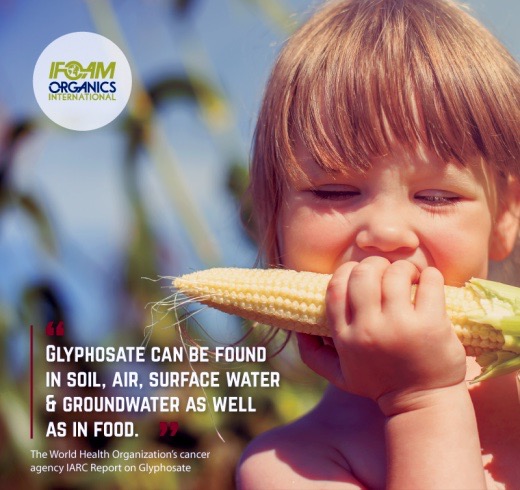
Image above: Photo illustration of boy eating corn with quote from World Health Organization IARC Report on Glyphosate "Glyphosate can be found in soil,air, surface waterand groundwater, as well as in food." See connection to WHO full report below. From (http://www.ifoam.bio/en/news/2015/08/04/who-publishes-full-probable-human-carcinogen-report-glyphosate).
The Environmental Protection Agency (EPA) is convening an advisory panel to review the science that links the main ingredient in the world's #1 herbicide with cancer.
But don't expect one of the last acts of the Obama administration to be to save US farmers and agricultural workers from the ravages of Non-Hodgkin lymphoma.
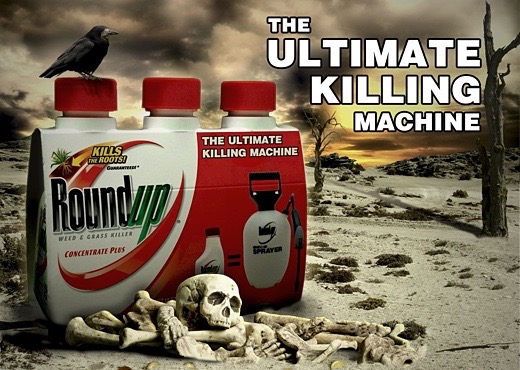
All signs point to EPA caving to Monsanto, the company that markets glyphosate in its flagship Roundup herbicide.
The saga started in 1985, when the EPA classified glyphosate as a possible human carcinogen, based on the presence of kidney tumors in male mice.
By 1991, the EPA had received enough pushback from Monsanto to reverse this decision.
In 2009, the EPA began its registration review of glyphosate, required once every 15 years for all pesticides.
In March 2015, the EPA was trying to wrap up that review when the World Health Organization's (WHO) International Agency for Research on Cancer assessed the carcinogenicity of glyphosate and determined that it was a probable human carcinogen. The EPA said it would consider the WHO finding in its own review of glyphosate.
In May 2016, the EPA "mistakenly" released an assessment of glyphosate that contradicted the World Health Organization's finding that the herbicide was a probable human carcinogen. The leak gave Monsanto ammunition in its fight to keep its profitable Roundup on the market. (In 2015, Monsanto made nearly $4.76 billion in sales and $1.9 billion in gross profits from herbicide products, mostly Roundup.)
After the leak, EPA tried to restore legitimacy to the process by insisting that it hadn't yet made a decision on glyphosate's carcinogenicity and convening a Scientific Advisory Panel to review the matter.
In September, for the Scientific Advisory Panel's review, EPA released "Glyphosate Issue Paper: Evaluation of Carcinogenic Potential." The paper concluded that glyphosate is not likely to be carcinogenic to humans at doses relevant to human health.
An analysis of the study by Food & Water Watch researcher Amanda Starbuck exposed several deficiencies in the science EPA used to reach its conclusion that glyphosate is not likely to be carcinogenic to humans:
CropLife succeeded in getting EPA to cancel the panel's October meeting, remove an esteemed epidemiologist from the panel, and reschedule the meeting for December 13-16.
The EPA has received 254,392 comments from the public in advance of the meeting.
Nearly all of the people who submitted comments support a finding that glyphosate is a probable carcinogen, including the 119,857 members of the Organic Consumers Association who signed a petition asking the EPA to follow the World Health Organization's finding.
Organizations that organized their members to submit public comments include Beyond Pesticides, Center for Biological Diversity, Center for Food Safety, Consumers Union, Food Democracy Now, Food & Water Watch, Friends of the Earth, Moms Across America, Natural Resources Defense Council, Pesticide Action Network North America, and U.S. Public Interest Research Group.
IARC Glyphosate & Cancer Report Link
SUBHEAD: Who publishes full probable human carcenoen report on Glyphosae.
By Staff on 4 August 2015 for IFOAM -
(http://www.ifoam.bio/en/news/2015/08/04/who-publishes-full-probable-human-carcinogen-report-glyphosate)
The World Health Organization’s cancer agency IARC has published the full report which caused a huge worldwide response, when they announced earlier this year that the World’s most sold herbicide, glyphosate, is a probable human carcinogen.
The assessment by the International Agency for Research on Cancer (IARC) of glyphosate, which is used in herbicides with estimated annual sales of USD 6 Billion, is of special concern to Monsanto, the company that brought glyphosate to market under the trade name Roundup in the 1970s.
The IARC reached its decision based on the view of 17 experts from 11 countries, who met in Lyon, France, to assess the carcinogenicity of 5 organophosphate pesticides.
Since the IARC report was released in March 2015 many countries have been looking at possible bans on glyphosate-based herbicides and Sri Lanka even announced a complete ban. Supermarkets across Europe have also removed glyphosate-based herbicides from their shelves.
You can find the full IARC Report here:
monographs.iarc.fr/ENG/Monographs/vol112/mono112-02.pdf (link is external)
Source: http://sustainablepulse.com/ (link is external)
By Alexis Baden-Mayer 15 December 2016 for Truth-Out -
(http://www.truth-out.org/speakout/item/38751-obama-s-epa-has-a-weakness-for-monsanto)
Image above: Photo illustration of boy eating corn with quote from World Health Organization IARC Report on Glyphosate "Glyphosate can be found in soil,air, surface waterand groundwater, as well as in food." See connection to WHO full report below. From (http://www.ifoam.bio/en/news/2015/08/04/who-publishes-full-probable-human-carcinogen-report-glyphosate).
The Environmental Protection Agency (EPA) is convening an advisory panel to review the science that links the main ingredient in the world's #1 herbicide with cancer.
But don't expect one of the last acts of the Obama administration to be to save US farmers and agricultural workers from the ravages of Non-Hodgkin lymphoma.
All signs point to EPA caving to Monsanto, the company that markets glyphosate in its flagship Roundup herbicide.
The saga started in 1985, when the EPA classified glyphosate as a possible human carcinogen, based on the presence of kidney tumors in male mice.
By 1991, the EPA had received enough pushback from Monsanto to reverse this decision.
In 2009, the EPA began its registration review of glyphosate, required once every 15 years for all pesticides.
In March 2015, the EPA was trying to wrap up that review when the World Health Organization's (WHO) International Agency for Research on Cancer assessed the carcinogenicity of glyphosate and determined that it was a probable human carcinogen. The EPA said it would consider the WHO finding in its own review of glyphosate.
In May 2016, the EPA "mistakenly" released an assessment of glyphosate that contradicted the World Health Organization's finding that the herbicide was a probable human carcinogen. The leak gave Monsanto ammunition in its fight to keep its profitable Roundup on the market. (In 2015, Monsanto made nearly $4.76 billion in sales and $1.9 billion in gross profits from herbicide products, mostly Roundup.)
After the leak, EPA tried to restore legitimacy to the process by insisting that it hadn't yet made a decision on glyphosate's carcinogenicity and convening a Scientific Advisory Panel to review the matter.
In September, for the Scientific Advisory Panel's review, EPA released "Glyphosate Issue Paper: Evaluation of Carcinogenic Potential." The paper concluded that glyphosate is not likely to be carcinogenic to humans at doses relevant to human health.
An analysis of the study by Food & Water Watch researcher Amanda Starbuck exposed several deficiencies in the science EPA used to reach its conclusion that glyphosate is not likely to be carcinogenic to humans:
Jennifer Sass, senior scientist at the Natural Resources Defense Council's Health Program argues that the EPA's science is so poor that:
- More than half of the studies were submitted by the industry. The EPA looked at 131 studies to decide if Roundup causes cancer, but 71 were unpublished industry studies.
- Independent studies were 30 times more likely to find glyphosate's toxicity than those from the industry -- but the EPA ultimately concluded that there was "no convincing evidence" of glyphosate's toxicity.
- The EPA used a "weight of evidence" approach, which means that heavy industry slant overwhelmed the independent published findings -- including a study that linked glyphosate with the growth of breast cancer cells.
EPA violated its own Cancer Guidelines by dismissing evidence of non-Hodgkin's lymphoma (NHL) in people.Knowing that the EPA's weak science wasn't up to a serious review, CropLife, the trade association that lobbies on behalf of Monsanto and the rest of the pesticide industry, launched a campaign to discredit scientists chosen for the EPA's Scientific Review Panel.
Even a meta-analysis of many epidemiologic studies that was sponsored by the agrochemical industry reported a statistically significant risk of NHL cancers when glyphosate-exposed individuals were compared with individuals never exposed to glyphosate. IARC's analysis reported similar results.
EPA's Cancer Guidelines are consistent with calling this "suggestive evidence of carcinogenic potential" for "evidence of a positive response in studies whose power, design, or conduct limits the ability to draw a confident conclusion."
CropLife succeeded in getting EPA to cancel the panel's October meeting, remove an esteemed epidemiologist from the panel, and reschedule the meeting for December 13-16.
The EPA has received 254,392 comments from the public in advance of the meeting.
Nearly all of the people who submitted comments support a finding that glyphosate is a probable carcinogen, including the 119,857 members of the Organic Consumers Association who signed a petition asking the EPA to follow the World Health Organization's finding.
Organizations that organized their members to submit public comments include Beyond Pesticides, Center for Biological Diversity, Center for Food Safety, Consumers Union, Food Democracy Now, Food & Water Watch, Friends of the Earth, Moms Across America, Natural Resources Defense Council, Pesticide Action Network North America, and U.S. Public Interest Research Group.
IARC Glyphosate & Cancer Report Link
SUBHEAD: Who publishes full probable human carcenoen report on Glyphosae.
By Staff on 4 August 2015 for IFOAM -
(http://www.ifoam.bio/en/news/2015/08/04/who-publishes-full-probable-human-carcinogen-report-glyphosate)
The World Health Organization’s cancer agency IARC has published the full report which caused a huge worldwide response, when they announced earlier this year that the World’s most sold herbicide, glyphosate, is a probable human carcinogen.
The assessment by the International Agency for Research on Cancer (IARC) of glyphosate, which is used in herbicides with estimated annual sales of USD 6 Billion, is of special concern to Monsanto, the company that brought glyphosate to market under the trade name Roundup in the 1970s.
The IARC reached its decision based on the view of 17 experts from 11 countries, who met in Lyon, France, to assess the carcinogenicity of 5 organophosphate pesticides.
Since the IARC report was released in March 2015 many countries have been looking at possible bans on glyphosate-based herbicides and Sri Lanka even announced a complete ban. Supermarkets across Europe have also removed glyphosate-based herbicides from their shelves.
You can find the full IARC Report here:
monographs.iarc.fr/ENG/Monographs/vol112/mono112-02.pdf (link is external)
Source: http://sustainablepulse.com/ (link is external)