Showing posts with label Erosion. Show all posts

It's all temporary

SUBHEAD: Media and the devices that present content are transient like everything else. Get used to it.

By Juan Wilson on 13 March 2017 for Island Breath -
(http://islandbreath.blogspot.com/2017/03/its-all-temporary.html)


Image above: Photo of obsolete and/or broken technologies I keep on a windowsill to remind me of the transience of media reality. Photo by Juan Wilson.

The last few weeks I've been trying to replay some video tapes I shot in the years between 1997 and 2007. In that decade I was using Sony Hi8 Digital video camera. I had about almost a hundred hours plus of recordings. My kids, my wife's kids, living in Panama NY, visiting Panama Central America. Living on Maui, renting a house on the Big Island, moving to Kauai, etc.

Problem was my older SonyHi8 was dead and the newer Digital Hi8 wasn't tracking the tape well. I went to Ebay and found  an "as good as new" digital Hi8. It tore three tapes in half. I returned it and went back to my newer Hi8. After lots of coaxing I got it to go and have been able to view a few of the tapes.

Bottom line. You cannot go back very far relying on digital recordings or records of your life to be there when you want them in the future.

I have kept libraries of records from various digital technologies going back to the 1960's and unless I get a special pass for the "Old Digital Devices section of the Smithsonian Museum I will likely never see or hear the content of those libraries.

For example, in the late 1960's I was studying architecture at the Cooper Union in New York. They had a new computer center that took up two classrooms that ran Digital Equipment Corporation (DEC) state of the art PDP-8 computer. It compiled programs and read data off punch cards and would type the results on a 17" wide chain driven impact printer.

A classmate, Ralph Lerner and I wrote structural engineering programs in Fortran IV and could calculate structural engineering stresses on various frames by punching cards describing loads and their arrangement on the frame. The impact printer would draw the frame and note results of calculations.

I have a library of all the programs Ralph and I wrote. They have weathered the 50 years but I have no DEC computer to compile programs and run data cards through. In fact DEC corporation, once number the number two to IBM, no longer exists. I will never see those programs run again.

Later, in the early 1980s working in the field of architecture at Davis Brody & Associates I used DEC VAX-11 computer. The VAX was the first widely used 32-bit minicomputer.

The VAX-11 was capable of running serious Computer Aided Design software. Davis-Brody had a version of G3, the program designed for General Electric to do engineering drawings for such things as nuclear power plants.

Our first workstation cost $250,000. AutoCad today costs about 1% of that today.

I still have DEC 1" compact tapes that contain the G3 program and the macro-programs we developed specifically for architecture. Those tapes will never see a VAX-11 again.

I also have 5.25" floppies from PC computers as well as 3.5" floppies used by Amiga and Macintosh machines. I even have an bunch of 100mb ZIP discs. None of these will be spun up.

I won't go into the various other formats for work and entertainment I have kept remnants of, but the list goes on.

What has worked of all those decades? Reel-to-reel and LP records. Machines to play those media are still being manufactured. I think the most durable recording technology in my lifetime has been the cassette audio tape. I have several hundred that go back to the early 1970s and they still sound fresh. I think that's in part because I recorded most on high-end tapes.

It is getting harder to find cassette tape recorders, but they are still available. If you want to hear your tapes into the future get a good one like the Tascam CC-222 mk IV.

I received a CC0-222 from my wife Linda for my 70th birthday two years ago. It's a wonderful machine - a high end cassette that will dub a tape to CD or a CD to tape. The later path might be in order after you read the article below on CD disintegration.


Your CD's are rotting

SUBHEAD: Certifying a CD-ROM did not place any requirement on the chemical or physical stability of the disc.

By Cory Doctorow on 11 March 2017 for Boing Boing -
(http://boingboing.net/2017/03/11/bitrot.html)


Image above: A CD of questionable veracity. From original article.

In 2009, the Library of Congress commissioned a research report into the degradation of CD-ROMs in storage as a way of assessing the integrity of the media in its collection: the news isn't pretty.

The standards for certifying a CD-ROM did not "place any requirement on the chemical or physical stability of the disc," so depending on the manufacturer and process, the discs you've put away on shelves may have wildly different material properties.

The study involved taking a trove of discarded/duplicate CD-ROMs from the LoC's collection and subjecting them to "accelerated aging" processes to see how many errors emerged as the media aged. Keeping discs dry and cool helped reduce error rates, but even so there's a lot of bitrot there.

One thing that's happened since this study is an acceleration in the plunging costs of online storage -- HDDs and SSDs -- and cloud services, which are all "live" media, regulated by microcontrollers that continuously poll their storage media for degradation, marking off sectors as bad when they turn and copying their data to still-good sectors before it becomes unreadable.

This is a major difference between today's state of affairs and the long, awkward adolescence of mass storage, when keeping all your data online was prohibitively expensive, which meant that some fraction of your archives would end up on offline/nearline media, from tapes to CDs to Zip and Jazz and floppy discs.

All media is subject to entropy, but offline/nearline media is not easily hedged against the Second Law of Thermodynamics with measures like continuous scheduled offsite backups and continuous defect-scanning.
The results of this study show that individual CD-ROM life expectancies in a large collection such as that held by the Library of Congress can be expected to cover a wide range. In addition, the BLER degradation rate of individual discs will be dependant on the environmental conditions to which the disc is exposed. Selecting optimal conditions for temperature and relative humidity in facilities where compact discs are stored can be expected to have a significant impact on service life.

Other factors not covered in this study, such as handling, labeling, and exposure to certain materials or chemicals, also affect service life and must be considered as part of a comprehensive approach to preserving digital information on compact disc media.
The test population selected for this experiment was extremely diverse; representing discs constructed using different materials, from different manufacturers and record labels.

Although the selected discs covered a relatively limited period of manufacture the wide distribution of life expectancies demonstrates the effect of these varied construction parameters on disc life. 10% of the discs failed at an estimated life of less than 25 years, including 6 discs (5%) that failed too early to obtain meaningful data or a meaningful lifetime estimate. 23 discs (16%) had insufficient increase in errors during the test, and thus, had infinite lifetimes, by the standards of the ISO test method. These results illustrate why it is so difficult to make broad generalizations about the lifetime of optical media.

The Library of Congress plans to conduct analyses of the material composition of selected discs from both this study and the on-going Natural Aging Study to look for trends in failure modes as they relate to the chemistry of the disc. An understanding of these failure modes can help in identifying discs that are prone to early failure so that the data can be transferred to more stable media before they reach end-of-life.
COMPACT DISC SERVICE LIFE: AN INVESTIGATION OF THE ESTIMATED SERVICE LIFE OF PRERECORDED COMPACT DISCS (CD-ROM) [Chandru J. Shahani, Michele H. Youket and Norman Weberg/Library of Congress]

.

Climate Chaos

SUBHEAD: As the North Pole melts in November and wildfires rage Across USA well into winter.

By Dahr Jamail on 12 December 2016 for Truth Out -
(http://www.truth-out.org/news/item/38689-as-north-pole-melts-in-november-wildfires-rage-across-us-well-into-winter)


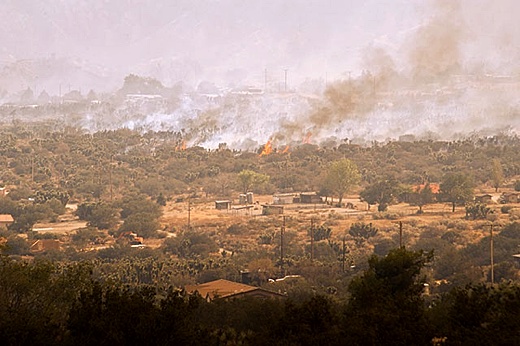
Image above: Flames along the south side of California State Route 138 in Phelan, California, on August 17, 2016. As climate disruption intensifies, wildfires will be burning well into winter. Photo by Andrew Cullen for The New York Times. From original article.

This is the first anthropogenic climate disruption (ACD) dispatch to be written since the election, which heralded the arrival of a president-elect who will become the only western leader who is an ACD denier.

While President Obama remained clearly in the pocket of the fossil fuel industry, with his unwillingness to take the radical actions necessary to mitigate (if even nominally) the already-dire impacts of ACD, he was, at least, willing to admit we live in a crisis never seen before.

As if underscoring the specter of Trump -- and Obama's failure to take appropriate measures, as the proverbial Titanic gurgles ever downward -- the Arctic has been especially warm over the last few weeks. During the second half of November, temperatures at the North Pole were a shocking 36 degrees warmer than normal.

During a time when winter usually sets in and the Arctic sea ice freezes up, ice has been melting instead of freezing. Temperatures in late November were akin to what they normally are at the end of August.

It was Gaia sending yet another unmistakable message, and it was profound enough that Bob Henson with the WeatherUnderground said, "There are weather and climate records, and then there are truly exceptional events that leave all others in the dust. Such has been the case across Earth's high latitudes during this last quarter of 2016."

For perspective, add 36 degrees to whatever your weather is right now, wherever you are. How normal is that? Think about how plants and animals in your area would or wouldn't adapt to that. What would happen to your food and water supply?

To give you another idea of how dramatically things have already changed in the Arctic as the region is in the midst of an ecological disintegration, Captain Cook's records of the region from 1778 reveal a literally different world. His expedition was stopped from sailing north of the Bering Strait by "ice which was as compact as a Wall and seemed to be ten or twelve feet high at least," according to the captain's journal.

In continued attempts to sail further north, Cook's ships followed this ice edge all the way to Siberia, but to no avail.

Meanwhile, back in the 21st century, longtime climate scientists are emphasizing that we're currently seeing an unprecedented situation.

Two days after it was revealed that temperatures at the North Pole were 36 degrees above normal, Walt Meier, a research scientist with the Cryospheric Sciences Laboratory at NASA's Goddard Space Flight Center, who has tracked sea ice data going back to 1979, announced, "It looks like, since the beginning of October, that for the first time we are seeing both the Arctic and Antarctic sea ice running at record low levels."

According to a recent report by the World Meteorological Organization, Earth is now on track to hit 1.2 degrees Celsius hotter than preindustrial temperatures before the end of this year.

According to the recently released annual "Emissions Gap Report" from the UN's Environmental Program (UNEP), current Paris Climate Agreement emissions cuts will still result in 3.5C of planetary warming by 2100. "Current commitments will reduce emissions by no more than a third of the levels required by 2030 to avert disaster," two UNEP leaders warned in the report's introduction.

Recently published research in a prestigious scientific journal shows that ACD is likely already progressing so rapidly that scientists are warning it could well already be "game over." Because the research shows that Earth's climate could be far more sensitive to greenhouse gases than previously believed, they are warning of a temperature rise that is on the "apocalyptic side of bad:" more than 7C within one lifetime from now.

Less importantly, but still shocking and useful to consider (especially since plenty of people seem to believe economics are more important than a habitable planet): Another recent report estimates that the world economy will lose $12 trillion due to ACD damages alone.

A recent report in Bloomberg News lays out the fact that Americans around the US (Florida, Louisiana, East Coast island areas, Alaska, etc.) are already being forced to move due to ACD impacts like storms, erosion and rising seas.

Meanwhile, the global immigration crisis caused by ACD continues apace. A recent report shows that global military leaders have warned of an "unimaginable" global refugee crisis if business as usual persists, and, of course, there is no real sign of it abating.

Brig. Gen. Stephen Cheney, a member of the US Department of State's foreign affairs policy board and CEO of the American Security Project, said, "We're already seeing migration of large numbers of people around the world because of food scarcity, water insecurity and extreme weather, and this is set to become the new normal."

An example of this within the US comes in the form of record-setting wildfires that have been burning across vast swaths of the southeast well into November. You'll find more on this below in the "Fire" section, but it's crucial to note that one of the wildfires scorching Tennessee is the largest in a century, and perhaps in the history of record-keeping. At least a dozen people have died across the southeast from the November wildfires, which are continuing to burn at the time of this writing.

The overview of the oceans continues to grow ever more bleak.

A recent report indicates that ocean life is literally suffocating from low oxygen levels caused by ACD. The report shows that oceans, coastal seas, estuaries, and many rivers and lakes are experiencing dramatic declines in dissolved oxygen levels, and this phenomenon is occurring at a global level now.

As a whole, 2016 has been bleak news for anyone interested in the future of the planet. The World Meteorological Organization recently announced that this year is already "very likely" to be the world's warmest ever. 2015 was the previous hottest year on record, and at that time it was the hottest year since record-keeping began.

Earth
Die-offs of planetary flora and fauna continue to increase in scope and frequency.
A recent report revealed how rising sea levels are pushing saltwater further into US wetlands across the coastal southeast, as well as along parts of the east coast, killing trees from Florida all the way up to New Jersey.

Meanwhile in California, a US Forest Service official recently called the ongoing die-off of what is now over 100 million trees there "unprecedented," and blamed the brunt of it on the ongoing ACD-fueled drought afflicting that state.

Similarly, a recent study published in the journal Global Change Biology showed that yellow cedars in Alaska and British Columbia, trees that can live for 1,000 years, are now dying off over vast areas due to warming from ACD.

Trees across 1,500 square miles are now undergoing a die-off linked directly to ACD, and the forecast for them is grim, since approximately half of the forested area that is currently considered suitable for the yellow cedars will no longer be so by 2100 due to ongoing temperature rise and shifting of winter precipitation from snow to rainfall.

Another disturbing report showed that the world has hundreds of millions fewer birds than it did just a few decades ago, thanks to ACD impacts, dwindling habitat, hunters and pollution.

In the Arctic region of Russia, more than 80,000 reindeer have died as a result of retreating Arctic sea ice.

In a massive new study in the journal Nature, scores of international authors have documented a climate "feedback loop" that they say will likely make ACD considerably worse in upcoming decades. The study addresses the soil-carbon loop in the climate system, which deals primarily with Earth's soils.

Soils store a massive amount of carbon in their plants, and the roots of plants that have lived and died there. Scientists have long since warned that as warming increases, microorganisms living in soils would naturally respond by increasing their respiration rates, a process that then releases more CO2 or methane into the atmosphere. The new study shows that this process is already happening.

Water
As usual, the impacts of ACD across the planet are the most pronounced and obvious in the watery realms (which are increasingly losing their water).

A recently published study showed that, due to dramatically changed vegetation across the Mediterranean region, Spain could be a desert by the year 2100.

Across Africa, ongoing drought is destabilizing countries as it persists. It is the worst drought in 35 years, and has left more than 21 million people in need of food assistance. Unfortunately, yet not surprisingly, the United Nation's Special Envoy Macharia Kamau told journalists in Mozambique recently, "The crisis has yet to peak."

Drought continues plaguing large sections of China. In one region, China's largest freshwater lake is rapidly turning into prairie, as it has neared low-level lines nearly two months earlier than it has done historically.

Meanwhile in Bolivia, President Evo Morales has told people to "prepare for the worst" as the small Andean Mountain country is wracked by a historic drought. Reservoirs that supply water to Bolivia's largest city are now nearly empty.

The drought is primarily fueled by vanishing glaciers across the country, which are a key supplier of water during the dry season. Of course, the glaciers are melting away at record rates due primarily to ACD.

Closer to home, in Utah, recent NASA satellite imagery reveals that the Great Salt Lake is drying up rapidly, as five years of drought have seen the lake's area decrease by 40 percent.

Meanwhile, yet another study was published recently tying US western states' record low snowpack to ACD.

The climate has warmed so much in Canada, that the city of Montreal has invested $7.3 million to save its ice skating rinks. Incredibly, the money will be used to buy refrigerated ice skating rinks.

Looking further north, Russia, China and other countries are rapidly stepping up plans to exploit melting Arctic sea ice by making preparations for their large cargo ships to use the soon-to-be new shipping lanes. Once shipping begins, it will only be a matter of time before the inevitable environmental disasters start to occur in the Arctic.

In Antarctica things continue to worsen, as odd rifts in the middle of the ice shelf of that continent's Pine Island Glacier might be a sign of a new mechanism that could lead to that glacier's collapse, as well as the collapse of other glaciers.

Sea level rise continues apace. A recently published study shows us that ACD is set to cause the most rapid of sea level rise ever experienced in human history, which will make it challenging, to say the least, for megacities on the coasts to adapt. So far, several island and coastal towns facing sea level rise in the far north have had to relocate entirely.

On that note, the first female head of a Pacific Island nation, Hilda Heine of the Marshall Islands, recently told the press that ACD is a "matter of life and death" for her country.

Lastly in this section, a sign of things to come: In the wake of Hurricane Matthew, the town of Nichols, South Carolina was damaged so heavily by flooding that it is an open question as to whether it will be rebuilt at all.

Fire
Wildfires across the US continued to burn far into November, another sign of how far along we are, in terms of ACD impacts. Increasingly, there is no longer a contained wildfire "season," as the planet continues to warm apace.

From the southern US all the way up to New England, November saw fires burning across the country.

Meteorologist Stu Ostro spoke of "surreal" smoke across Atlanta, Georgia; while in Chattanooga, Tennessee hundreds of people were hospitalized from smoke inhalation, while air quality alerts were issued across the Carolinas and Georgia.

By late November, thousands of firefighters had mobilized to fight fires across the southeast, an area that rarely sees wildfires beyond the end of summer. At least 15 major wildfires across the region had, at the time of this writing, burned in excess of 15,500 acres -- including more than 15,000 acres in Great Smoky Mountains National Park -- and have led to several deaths.
Also in November, wildfires were burning across parts of New York, North Dakota and New Hampshire as well.
Welcome to the future of the US, where wildfires will be burning well into winter.

Air
Temperature records across the planet continue to be set at a record pace.

In the US, November saw several stunning examples of this. The mile-high city of Denver, Colorado saw 78 degrees well into November, while Dallas, Texas saw 88 degrees in the middle of that month.
As aforementioned, the Arctic saw stunningly warm temperatures in November, when one day in the latter part of that month several locations saw temperatures spike well over 36 degrees above average.

Meanwhile, global "weirding" continues, as a recent study showed that the polar vortex is shifting due to ACD, which means winters in eastern North America will be longer. The polar vortex is a zone of frigid air that encircles the Arctic and makes its presence known the most during the winter months.

Also in the Arctic, as that region warms, another recently published study showed that more ancient diseases that were buried deep in the permafrost will be released, posing increasing threats to humans and wildlife. Last summer, anthrax killed a 12-year-old boy in a remote area of Siberia, and at least 20 others in Siberia were diagnosed with the disease. (Twenty may not seem like a large number, but bear in mind that this is an extremely lightly populated area.) Scientists are expressing concern over the fact that infectious microorganisms are now emerging from their deep freeze as permafrost across the entire Arctic continues to melt at unprecedented rates.

Lastly, and quite alarmingly, another recent study showed that the planet is far more sensitive to greenhouse gas levels than previously believed. It showed that climate models are likely underestimating how sensitive the planet is, due to the fact that the greenhouse effect will be amplified the more temperatures increase.

This means the pace of ACD is about to accelerate.

Denial and Reality
Almost needless to say, the most important act of denial over the last month was the US electing an ACD denier into the highest office in the country. President-elect Trump now actively threatens to pull the US out of the Paris climate agreements, eviscerate the EPA and appoint fossil-fuel loyalists into key government positions.

Trump has already said he will strip NASA's Earth Science Division, which conducts vast arrays of studies around ACD and its ongoing impacts across the planet, of funding. A member of Trump's cabal is calling the move a crackdown on "politicized science."

Steve Bannon, who has emerged as Trump's chief strategist, has extreme views on many subjects, including ACD, which he calls an elaborate hoax. He refers to renewable energy as "a scam." Bannon is known for helping influence Trump's "views" on ACD and has called environmentalists "greentards" and "totally fucking wrong on climate change."

As is now well known, Trump has claimed that ACD is a "Chinese hoax." Inconveniently for Trump, during the recent UN Climate Summit in Morocco, China's vice foreign minister, Liu Zhenmin, told reporters that Trump is wrong to have accused China of portraying ACD as a "hoax."

 "Look at the history of climate change negotiations, in fact [they were] launched in the late '80s under the administration of Republican President Reagan and George Bush, supported by the United Nations Intergovernmental Panel on Climate Change (IPCC)," Liu told reporters, according to Bloomberg and reports from within the Chinese media.

The Republican Party, which continues to remain the only major political party on the planet that denies the reality of ACD, continues to be funded, backed and heavily controlled by the fossil fuel industry, hence its denial of ACD in order to protect profit-making.

Meanwhile, there is more news on the reality front than is even possible to keep up with.

The government of Australia's New South Wales recently unveiled a plan by which it aims to reach zero CO2 emissions by the year 2050 in order to work towards mitigating the worsening impacts of ACD as best as it can. It will do so primarily by making a concerted effort to shift over to renewable energies and increase battery storage capacity.

On a sobering note, a recently published study showed that the average American is responsible for melting 538 square feet of Arctic summer sea ice each year.

The UN's World Meteorological Organization announced in November that the past five years were the hottest ever on record, and that greenhouse gas emissions have increased the risks of extreme weather events by as much as tenfold.

Disturbingly, a recently published study that surveyed more than 250 different plants and animals found that their ability to adapt to changes in rainfall and temperature cannot keep pace with ACD-generated changes in their environments. In short, this means that the climate is changing "too fast" for species, according to the report.

Not that validation from fossil fuel companies is necessary to confirm the reality of ACD, but it is indeed nice to have. On November 1, Simon Henry, the chief financial officer for Shell, the world's second-largest oil company, said demand for oil will begin dropping permanently in the next five to 15 years, according to an article in World Oil. He went on to admit that his company will focus on making money by focusing on natural gas and renewable energy.

To conclude this month's dispatch, it's worth quoting the UN, which in November provided a very apocalyptic vision of the future of ACD, painting a picture of a changed world filled with famine, war and disease.

 "We will grieve over the avoidable human tragedy; the growing numbers of climate refugees hit by hunger, poverty, illness and conflict will be a constant reminder of our failure to deliver," the UN warned, via its Environment Program. The UNEP released a report that predicted the Earth's temperature is already set to increase by up to 3.4C (above the preindustrial temperature baseline) by 2100. This temperature change should take at least tens of thousands of years to occur naturally, but will have been attained by humans in just a little over two centuries.

It is worth remembering that the rapidly increasing global temperature has consistently outpaced even the worst-case predictions by the UN. Predictions of warming that reaches 8C by 2100 have not been uncommon, with some predictions reaching 12C. Bear in mind that humans have never lived on a 3.5C-warmed planet.

 • Dahr Jamail, a Truthout staff reporter, is the author of The Will to Resist: Soldiers Who Refuse to Fight in Iraq and Afghanistan (Haymarket Books, 2009), and Beyond the Green Zone: Dispatches From an Unembedded Journalist in Occupied Iraq (Haymarket Books, 2007). Jamail reported from Iraq for more than a year, as well as from Lebanon, Syria, Jordan and Turkey over the last 10 years, and has won the Martha Gellhorn Award for Investigative Journalism, among other awards.
His third book, The Mass Destruction of Iraq: Why It Is Happening, and Who Is Responsible, co-written with William Rivers Pitt, is available now on Amazon. HE is also the author of the book, The End of Ice, forthcoming from The New Press. He lives and works in Washington State.

.

EPA vs Pflueger and other violators

SOURCE:  Michael Guard Sheehan (mailto:hanaleirivermichael@gmail.com)
SUBHEAD: EPA closes Pflueger case on Kauai but ignores other owner's environmental violations.

By Dean Higuchi on 24 August 2016 for the EPA.gov -
(https://www.epa.gov/newsreleases/epa-closes-pflueger-stormwater-case-after-successful-restoration-kauai-property)


Image above: This photo from 2004 was taken prior to environmental damage caused by this unauthorized grading and landscaping by retired car dealer James Pflueger on his Pila’a property. From (http://www.staradvertiser.com/breaking-news/pfluegers-environmental-repairs-on-kauai-shoreline-meets-epa-muster/).

Editorial comment  by Michael Guard Sheehan:
This case is a tragic case of selective enforcement against one man while surrounding him were numerous persons and politicians doing far worse to the Environment with their own illegal digging and construction in Habitats for Endangered Species. Instead of self-congratulatory news releases, your organization should be shamefully quiet and reflective.

The U.S. Environmental Protection Agency announced the successful conclusion of its case against James Pflueger for construction activities that damaged his former property and the beach and coral reefs at Pila’a on Kauai. The consent decree settling the Clean Water Act violations was closed after Pflueger stabilized and restored the slopes and streams.

“Thanks to the work completed under this settlement, this once-degraded land has a healthy population of native trees and shrubs and restored stream channels,” said Alexis Strauss, EPA’s Acting Regional Administrator for the Pacific Southwest. “With continued care by the new owners, these restoration efforts can be sustained for the future.”

EPA initiated its case after Pflueger conducted extensive grading and construction at the 378-acre coastal site without obtaining necessary Clean Water Act permits. Those activities included excavating a hillside to expose a 40-foot vertical road cut, grading a coastal plateau, creating new access roads to the coast, and dumping dirt and rock into three perennial streams. As a result, massive discharges of sediment-laden stormwater flowed to the ocean at Pila’a Bay in November 2001.

The settlement required Pflueger to build a wall to stabilize the road cut adjacent to the shoreline, remove dam material in streams, install erosion controls on roadways and trails, terrace slopes to slow runoff, use native plants to control erosion, and control invasive plants and animals on the property. He was also required to reconstruct natural rock-lined stream beds and reestablish native plants along the banks.

The 2006 stormwater settlement was the largest for federal Clean Water Act violations at a single site, by a single landowner, in the United States. Pflueger paid $2 million in penalties to the State of Hawaii and the United States, and was expected to spend approximately $5.3 million to conduct the required restoration efforts.

The State of Hawaii was a co-plaintiff in EPA’s case against Pflueger, and the settlement was joined by the Limu Coalition and Kilauea neighborhood organizations, which had also filed a lawsuit against Pflueger.

EPA and local community organizations involved in the settlement conducted oversight inspections throughout a ten-year restoration effort that was slowed by funding obstacles and the necessity of adapting the restoration projects to changing field conditions.

.

Fed up with factory farming

SUBHEAD: Is factory farming destroying the planet? These five films have an answer!

By Beth Kelly on 25 March 2015 for Island Breath -
(http://islandbreath.blogspot.com/2015/03/fed-up-with-factory-farming.html)

http://www.islandbreath.org/2015Year/03/150325hdfbig.jpg
Image above: What does factory farming look like on Kauai? It might look like a milk factory dairy. Like the Pierre Omidyer proposed Hawaii Dairy Farm in Mahulepu Valley. To get an idea of HDF's impact we have superimposed a image of the Aurora "Organic" Dairy Farm (in Boulder, Colorado) over the red line boundary of HDF.  We used GoogleEarth and an mirror image of an aerial photo of the AODF andadjusted the scale and perspective as best we could. From (http://www.cornucopia.org/horizon-factory-farm-photo-gallery/aurora-factory-farm-photo-gallery/). See also (http://www.auroraorganic.com/). Graphics by Juan Wilson. Click to embiggen.

Food is something that we take for granted in the modern world. We go to huge grocery stores, buy incredible amounts of food, and don't give much more thought to it. We might even assume that idyllic farmers are working hard to grow and harvest the best quality and most nutritious food possible. The problem is that this assumption is quite naïve.

Modern agriculture is about as far from this rustic portrait of a small family farm as possible. Farm operations today are more like an industrial factory that cranks out food on an assembly line. Health and nutrition are often sacrificed in favor of efficiency and profits.

A number of recent documentaries expose the harmful effects of agribusiness and factory farming. Here are five documentaries that lift the curtain and show us behind the scenes of modern agriculture:

More Than Honey (2012)

Video above: Official Trailer for movie "More than Honey". From (https://youtu.be/2NT05qEJxUk).

This film takes a close look at bees and their relationship with humankind. It examines a wide variety of honeybee colonies in California, Switzerland, Australia, and China in an attempt to discern what factors account for the widespread decline of the bee population due to colony collapse. More Than Honey suggests that modern chemical pesticides play a large role in destroying bee populations and discusses the dire consequences if bees should become extinct. Viewers rave about the film's breathtaking cinematography, as it is a visually stunning film with a well-told story.


Farmageddon (2011)

Video above: Trailer for movie "Farmageddon" From (https://youtu.be/IH_my56FkuQ).

This film is a wake up call for those who are unaware of the way the Federal Government acts against smaller farmers all over America. It details the way that small organic farmers producing healthy and nutritious foods are systematically harassed by the United States government. This harassment is motivated by the influence that large corporate agribusinesses have on the government. By raising awareness of these issues, people will protest the dominance of big business in agriculture and give small family farms a new future.


Food, Inc. (2008)

Video above: Official trailer for "Food Inc." From (https://youtu.be/5eKYyD14d_0).

A penetrating look at the industrialized production of food in the United States, this film shows that both animal and plant farming produces food that is not only unhealthy and harmful to the environment, but abuses and oppresses both animals and human employees. The companies that claim to take care of our needs are actually exploiting us for gain. Food, Inc. insists that we can make a difference. By changing our buying practices and voting, we can let these money-hungry companies that we want change.


King Corn (2007)

Video above: Trailer for King Corn. From (https://youtu.be/Pr5HQrgg9mM). See full length film here (http://www.filmsforaction.org/watch/king_corn_2007/).

Two college friends go on journey through the American food supply. They begin by moving from Boston to Iowa, where they farm one acre of corn. Along the way, they examine how government subsidies create incentives to overproduce corn as well as the consequences of this overproduction. The two also show the prominence of high fructose corn syrup as a cheap food ingredient and the problems this causes for the American diet. The film chronicles the plight of small family farms that cannot compete against the huge agribusinesses that control the industry.


Crude Impact (2006)

Video above: Trailer for "Crude Impact". From (https://youtu.be/EwyAA2Zt8CI). See full length film here (https://vimeo.com/33552646).

Our modern society is powered almost exclusively by fossil fuels. Crude Impact takes a critical look at an environmental crisis that is being created by this reliance, spreading awareness to energy and gas companies, major corporations, and the general public who seek to find solutions for this crisis. From global warming to overpopulation, this film takes a hard look at the way using fossil fuels affects human culture. It also examines the issue of “peak oil.” As demand for energy increases, supplies of fossil fuels will dwindle. The resulting exponential rise in the cost of energy could be devastating. The film also examines some potential solutions that would mitigate this disaster.


These films challenge us to critically examine where our food comes from. When we have the facts, we can call for change, seek out healthy alternatives, and use our purchasing power to demand the production of healthy food. In addition, we can call upon our leaders to change the system for the better and pay more attention to the sources of our food. Otherwise, we may jeopardize our health and our environment all for the sake of “good-tasting” food.

See also:
Ea O Ka Ania: NZ dairy model isn't Mahaulepu 3/9/15

.

To save Future live in Present

SUBHEAD: “The kingdom of heaven is at hand” because, if not at hand, it is nowhere.

By Wendell Barry on 23 March 2015 for Yes Magazine -
(http://www.yesmagazine.org/issues/together-with-earth/wendell-berry-climate-change-future-present)


Image above: Turning around from the 13th and Webster intersection where the Ameritrade Park sign is, you will see the third largest mural in the nation. The gigantic painting of Omaha's past, present, and future covers the east side of the Energy Systems Building. From (http://www.beepbeep.org/4delos/archives/2010/06/meg-saligmans-fertile-ground.html).

This excerpt consists of two numbered parts. The first was written in 2013 and the second in 2014.

I. [2013]

So far as I am concerned, the future has no narrative. The future does not exist until it has become the past. To a very limited extent, prediction has worked. The sun, so far, has set and risen as we have expected it to do. And the world, I suppose, will predictably end, but all of its predicted deadlines, so far, have been wrong.

The End of Something—history, the novel, Christianity, the human race, the world—has long been an irresistible subject. Many of the things predicted to end have so far continued, evidently to the embarrassment of none of the predictors.

The future has been equally, and relatedly, an irresistible subject. How can so many people of certified intelligence have written so many pages on a subject about which nobody knows anything? Perhaps we need a book— in case we don’t already have one—on the end of the future.

None of us knows the future. Fairly predictably, we are going to be surprised by it. That is why “Take...no thought for the morrow...” is such excellent advice. Taking thought for the morrow is, fairly predictably, a waste of time.

I have noticed, for example, that most of the bad possibilities I have worried about have never happened.

And so I have taken care to worry about all the bad possibilities. I could think of, in order to keep them from happening. Some of my scientific friends will call this a superstition, but if I did not forestall so many calamities, who did?

However, after so much good work, even I must concede that by taking thought for the morrow we have invested, and wasted, a lot of effort in preparing for morrows that never came. Also by taking thought for the morrow we repeatedly burden today with undoing the damage and waste of false expectations—and so delaying our confrontation with the actuality that today has brought.

The question, of course, will come: If we take no thought for the morrow, how will we be prepared for the morrow?
I am not an accredited interpreter of Scripture, but taking thought for the morrow is a waste of time, I believe, because all we can do to prepare rightly for tomorrow is to do the right thing today.

The passage continues: “for the morrow shall take thought for the things of itself. Sufficient unto the day is the evil thereof.” The evil of the day, as we know, enters into it from the past. And so the first right thing we must do today is to take thought of our history. We must act daily as critics of history so as to prevent, so far as we can, the evils of yesterday from infecting today.

Another right thing we must do today is to appreciate the day itself and all that is good in it. This also is sound biblical advice, but good sense and good manners tell us the same. To fail to enjoy the good things that are enjoyable is impoverishing and ungrateful.

The one other right thing we must do today is to provide against want. Here the difference between “prediction” and “provision” is crucial.

To predict is to foretell, as if we know what is going to happen. Prediction often applies to unprecedented events: human-caused climate change, the end of the world, etc. Prediction is “futurology.”

To provide, literally, is to see ahead. But in common usage it is to look ahead. Our ordinary, daily understanding seems to have accepted long ago that our capacity to see ahead is feeble. The sense of “provision” and “providing” comes from the past, and is informed by precedent.

Provision informs us that on a critical day—St. Patrick’s Day, or in a certain phase of the moon, or when the time has come and the ground is ready—the right thing to do is plant potatoes. We don’t do this because we have predicted a bountiful harvest; history warns us against that.

We plant potatoes because history informs us that hunger is possible, and we must do what we can to provide against it. We know from the past only that, if we plant potatoes today, the harvest might be bountiful, but we can’t be sure, and so provision requires us to think today also of a diversity of food crops.

What we must not do in our efforts of provision is to waste or permanently destroy anything of value. History informs us that the things we waste or destroy today may be needed on the morrow. This obviously prohibits the “creative destruction” of the industrialists and industrial economists, who think that evil is permissible today for the sake of greater good tomorrow. There is no rational argument for compromise with soil erosion or toxic pollution.

For me—and most people are like me in this respect—“climate change” is an issue of faith; I must either trust or distrust the scientific experts who predict the future of the climate. I know from my experience, from the memories of my elders, from certain features of my home landscape, from reading history, that over the last 150 years or so the weather has changed and is changing. I know without doubt that to change is the nature of weather.

Just so, I know from as many reasons that the alleged causes of climate change—waste and pollution—are wrong. The right thing to do today, as always, is to stop, or start stopping, our habit of wasting and poisoning the good and beautiful things of the world, which once were called “divine gifts” and now are called “natural resources.”

I always suppose that experts may be wrong. But even if they are wrong about the alleged human causes of climate change, we have nothing to lose, and much to gain, by trusting them.

Even so, we are not dummies, and we can see that for all of us to stop, or start stopping, our waste and destruction today would be difficult. And so we chase our thoughts off into the morrow where we can resign ourselves to “the end of life as we know it” and come to rest, or start devising heroic methods and technologies for coping with a changed climate. The technologies will help, if not us, then the corporations that will sell them to us at a profit.

I have let the preceding paragraph rest for two days to see if I think it is fair. I think it is fair. As evidence, I will mention only that, while the theme of climate change grows ever more famous and fearful, land abuse is growing worse, noticed by almost nobody.

A steady stream of poisons is flowing from our croplands into the air and water. The land itself continues to flow or blow away, and in some places erosion is getting worse. High grain prices are now pushing soybeans and corn onto more and more sloping land, and “no-till” technology does not prevent erosion on continuously cropped grainfields.

Climate change, supposedly, is recent. It is apocalyptic, “big news,” and the certified smart people all are talking about it, thinking about it, getting ready to deal with it in the future.

Land abuse, by contrast, is ancient as well as contemporary. There is nothing futurological about it. It has been happening a long time, it is still happening, and it is getting worse. Most people have not heard of it. Most people would not know it if they saw it.

The laws for conservation of land in use were set forth by Sir Albert Howard in the middle of the last century. They were nature’s laws, he said, and he was right. Those laws are the basis of the 50-Year Farm Bill, which outlines a program of work that can be started now, which would help with climate change, but which needs to be done anyhow.

Millions of environmentalists and wilderness preservers are dependably worried about climate change. But they are not conversant with nature’s laws, they know and care nothing about land use, and they have never heard of Albert Howard or the 50-Year Farm Bill.

II. [2014]

If we understand that Nature can be an economic asset, a help and ally, to those who obey her laws, then we can see that she can help us now. There is work to do now that will make us her friends, and we will worry less about the future. We can begin backing out of the future into the present, where we are alive, where we belong. To the extent that we have moved out of the future, we also have moved out of “the environment” into the actual places where we actually are living.

If, on the contrary, we have our minds set in the future, where we are sure that climate change is going to play hell with the environment, we have entered into a convergence of abstractions that makes it difficult to think or do anything in particular. If we think the future damage of climate change to the environment is a big problem only solvable by a big solution, then thinking or doing something in particular becomes more difficult, perhaps impossible.

It is true that changes in governmental policy, if the changes were made according to the right principles, would have to be rated as big solutions. Such big solutions surely would help, and a number of times I have tramped the streets to promote them, but just as surely they would fail if not accompanied by small solutions.

And here we come to the reassuring difference between changes in policy and changes in principle. The needed policy changes, though addressed to present evils, wait upon the future, and so are presently nonexistent. But changes in principle can be made now, by so few as just one of us.

Changes in principle, carried into practice, are necessarily small changes made at home by one of us or a few of us. Innumerable small solutions emerge as the changed principles are adapted to unique lives in unique small places. Such small solutions do not wait upon the future. Insofar as they are possible now, exist now, are actual and exemplary now, they give hope. Hope, I concede, is for the future.

Our nature seems to require us to hope that our life and the world’s life will continue into the future. Even so, the future offers no validation of this hope. That validation is to be found only in the knowledge, the history, the good work, and the good examples that are now at hand.

There is in fact much at hand and in reach that is good, useful, encouraging, and full of promise, although we seem less and less inclined to attend to or value what is at hand. We are always ready to set aside our present life, even our present happiness, to peruse the menu of future exterminations. If the future is threatened by the present, which it undoubtedly is, then the present is more threatened, and often is annihilated, by the future.

“Oh, oh, oh,” cry the funerary experts, looking ahead through their black veils. “Life as we know it soon will end. If the governments don’t stop us, we’re going to destroy the world. The time is coming when we will have to do something to save the world. The time is coming when it will be too late to save the world. Oh, oh, oh.” If that is the way our minds are afflicted, we and our world are dead already.

The present is going by and we are not in it. Maybe when the present is past, we will enjoy sitting in dark rooms and looking at pictures of it, even as the present keeps arriving in our absence.

Or maybe we could give up saving the world and start to live savingly in it. If using less energy would be a good idea for the future, that is because it is a good idea. The government could enforce such a saving by rationing fuels, citing the many good reasons, as it did during World War II.

If the government should do something so sensible, I would respect it much more than I do. But to wish for good sense from the government only displaces good sense into the future, where it is of no use to anybody and is soon overcome by prophesies of doom.

On the contrary, so few as just one of us can save energy right now by self-control, careful thought, and remembering the lost virtue of frugality. Spending less, burning less, traveling less may be a relief. A cooler, slower life may make us happier, more present to ourselves, and to others who need us to be present.

Because of such rewards, a large problem may be effectively addressed by the many small solutions that, after all, are necessary, no matter what the government might do. The government might even do the right thing at last by imitating the people.

In this essay and elsewhere, I have advocated for the 50-Year Farm Bill, another big solution I am doing my best to promote, but not because it will be good in or for the future. I am for it because it is good now, according to present understanding of present needs. I know that it is good now because its principles are now satisfactorily practiced by many (though not nearly enough) farmers.

Only the present good is good. It is the presence of good—good work, good thoughts, good acts, good places—by which we know that the present does not have to be a nightmare of the future. “The kingdom of heaven is at hand” because, if not at hand, it is nowhere.


.

Wailua Bike Path Consideration

SUBHEAD: A letter on the Eastside bike bath at Wailua Beach that the Garden Island would not publish.

By Kip Goodwin on 10 December 2012 in Island Breath -
(http://islandbreath.blogspot.com/2012/12/wailua-bike-path-consideration.html)


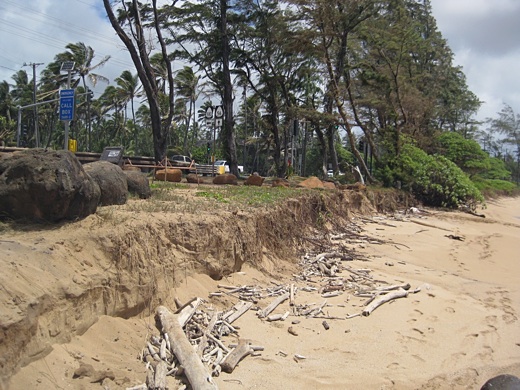
Image above: Current Wailua Beach erosion close to Kuhio Highway in front of abandoned Coco Palms hotel at Kuamoo Road. From (kas123@hawaii.rr.com).

[Author's note: After 9 days, 2 letters and email correspondence with the publisher, TGI has not printed this. On Sunday 12/9 they printed a press release from the mayor's office, disguised as a news story, "Ke Ala Hele Makalae rolling along". The referenced Council meeting has been on local government access tv every day since the 11/28 meeting. Kip]

The November 28th County Council meeting included a communication from Council member Kipukai Kuali`i to provide an update on recent extreme erosion at Wailua Beach and whether a proposed concrete multi use path on the beach should be relocated or scaled down.

The session featured a competition of photographs with photos taken by community members showing the washed away south parking lot last June and subsequent encroachment to within a few feet of Kuhio Highway. Other photos taken by Parks and Recreation Director Lennie Rapozo and Council Chair Jay Furfaro showed more recent sand accretion.

Whe public testimony was taken, six people expressed their disillusionment and disgust that the government is once again poised to pave over ground that is sacred to them in favor of development, this time in the piko of Hawai`i culture. Some said their traditional practices in that area are being threatened. Others said that memory of places is any indigenous culture's connection to the past and the culture suffers a slow death when that memory is severed. Others came forward to explain that beaches are dynamic in ways not fully understood and that static structures like the concrete slab path have proven to encourage beach loss.

Council Chair Furfaro shared that Coco Palms permits expire in January. An opportunity to obtain a strip of land for the path to go mauka, or for the highway to shift mauka, could arise in the ensuing planning process.

Council member Dickie Chang proposed a four foot wide crushed coral path makai the highway that can be walked in seven minutes, connecting multi use paths at the north and south ends of the beach. Information signs would describe Kaua`i's aloha for Wailuanuiaho`ano and commitment to preserving Kaua`i's fragile shore.

There was a proposal to narrow the traffic lanes, as was done on the H1 on Oahu, so highway and path can all go on the existing asphalt.

  These are sensible solutions. The beach environment is protected. There is a measure of respect for Kanaka Maoli. Taxpayers don't spend $1.9 Million that Building Division Chief Doug Haigh said is the cost. The makai lane won't be closed for three months. Since most path users are just out for a few hours of recreation it will have liitle impact on them. Bicycle riders who want to traverse the Wailua corridor can feel good about themselves for making a small sacrifice.

The photos taken over a four month period and shown at the 11/28 meeting represent a nanosecond in the history of sand movement at Wailua. Drawing hoped for conclusions from them to justify allowing this project is gambling with public funds. The Council and the Mayor should acknowledge that sea level rise and extreme weather events are already measured and recorded facts. Responsible civic leaders worldwide are formulating plans to retreat public infrastructure from the shore, not build closer.

Council Chair Furfaro said that Council rules and the Christmas break will almost certainly prevent the path issue from coming before the Council until January. Mr. Haigh said re- striping the highway is scheduled to begin right after New Year and the concrete slabs to go down starting Jan. 11. Kaua`i citizens have the right to expect that Director Rapozo and Chief Haigh will delay the start up and not obligate the taxpayer financially in the fabrication of path materials until options offered by Council members have been considered and questions asked of them by the Council have received satisfactory response.

.

Dust Bowl Revisited

SUBHEAD: Climate change and population will force more food production on limited land making it hard not to repeat the Dust Bowl.
.
By Janet Larsen on 16 November 2012 for Earth Policy Institute -
(http://www.earth-policy.org/plan_b_updates/2012/update109)


Image above: Children of Lakin, Kansas, going off to school. Details of hi-rez photos from Ken Burns' TV documentary "Dust Bowl". From (http://www.aptv.org/Pressroom/detail.asp?PressID=107).

On October 18, 2012, the Associated Press reported that “a massive dust storm swirling reddish-brown clouds over northern Oklahoma triggered a multi-vehicle accident along a major interstate…forcing police to shut down the heavily traveled roadway amid near blackout conditions.” Farmers in the region had recently plowed fields to plant winter wheat. The bare soil—desiccated by the relentless drought that smothered nearly two-thirds of the continental United States during the summer and still persists over the Great Plains—was easily lifted by the passing strong winds, darkening skies from southern Nebraska, through Kansas, and into Oklahoma.

Observers could not help but harken back to the 1930s Dust Bowl that ultimately covered 100 million acres in western Kansas, the Oklahoma and Texas Panhandles, northeastern New Mexico, and southeastern Colorado. Yet when asked if that was the direction the region was headed, Oklahoma’s Secretary of Agriculture Jim Reese was unequivocal: “That will never happen again.”

In the early decades of the twentieth century, earnest settlers of the semi-arid Plains, along with opportunistic “suitcase farmers” out to make a quick dollar, plowed under millions of acres of native prairie grass. Assured that “rain follows the plow,” and lured by government incentives, railroad promises, and hopes of carving out a place for their families, these farmers embraced the newly available tractors, powerful plows, and mechanized harvesters to turn over the sod that had long sustained Native American tribes and millions of bison.

The plowing began during years of rain, and early harvests were good. High wheat prices, buoyed by demand and government guarantees during the First World War, encouraged ever more land to be turned over. But then the Great Depression hit. The price of wheat collapsed and fields were abandoned. When the drought arrived in the early 1930s, the soils blew, their fertility stolen by the relentless wind. Stripped of its living carpet, freed from the intricate matrix of perennial prairie grass roots, the earth took flight.

Clouds as tall as mountains and black as night rolled over the land. Regular dust storms pummeled the homesteaders; the big ones drew notice when they clouded the sun in New York City and Washington, DC, even sullying ships hundreds of miles out in the Atlantic. Dunes formed and spread, burying railroad tracks, fences, and cars. “Dust pneumonia” claimed lives, often those of children. People fled the land in droves.


Image above: Three generations of women in Ulesses, Kansas, before the dust storm hits. Details of hi-rez photos from Ken Burns' TV documentary "Dust Bowl". From (http://www.aptv.org/Pressroom/detail.asp?PressID=107).

In The Worst Hard Time, Timothy Egan describes the topsoil loss, how a “rich cover that had taken several thousand years to develop was disappearing day by day.” The sodbusters had quickly illuminated the dangerous hubris in the 1909 Bureau of Soils proclamation: “The soil is the one indestructible, immutable asset that the nation possesses. It is the one resource that cannot be exhausted; that cannot be used up.” The rechristened Great Plains looked like it would revert back to its original name: the Great American Desert.

When a series of dust storms reached far-flung Washington, DC, in the spring of 1935, a reluctant Congress was finally convinced to allocate resources to help stabilize the soil. With government subsidies and direction from the newly created Soil Conservation Service, practices were introduced to help hold down the earth. Grasses were replanted; shelter belts of trees were planted to slow the persistent winds; contour farming or terracing was used to farm in line with the natural shape of the land; strip cropping was used to leave some protective cover on the soil; and crop rotations and fallow periods allowed the land to rest.

While some of the Dust Bowl land never recovered, the settled communities becoming ghost towns, many of the once-affected areas have become major food producers. By 1933 wheat production in Kansas, Texas, Oklahoma, and Colorado was slashed by nearly three-quarters from its 1931 high of 411 million bushels, taking until 1947 to reach that level again. In 2012, the wheat output of these four states exceeds 700 million bushels, a third of the U.S. wheat harvest.

After World War II, well-drilling and pumping technologies allowed farmers to tap into the Ogallala aquifer, a vast reservoir of water beneath the Plains, stretching from southern South Dakota through the Texas Panhandle. Irrigation expanded, with center-pivot sprinklers creating the green circles overlain on brown squares that are familiar to anyone who has flown over the central United States.

In recent decades irrigation has allowed the traditional Corn Belt to move westward onto drier lands. Kansas, for instance, sometimes called “the Wheat State,” harvesting one-sixth of the U.S. crop, now produces as much corn as it does wheat. The wheat is primarily rainfed, but more than half the corn is irrigated.

As extraction of the underground water has increased, however, water tables have fallen. The depletion is particularly concerning in the Central and Southern Plains where there is virtually no replenishment of the aquifer from rainfall, foreshadowing an end to the use of this finite resource. In the former Dust Bowl states, irrigation had its boom, but in many areas it is beyond its peak. With wells going dry, some farmers have returned to the more-common rainfed wheat farming, which typically yields far less than with irrigation; others have gotten out of wheat all together.

In Kansas the average drop in the water table is 23 feet (7 meters), but drops of 150 feet or more have been reported. The fall in water tables is even greater in the Texas Panhandle. Statewide, Texas’ irrigated area is down more than 20 percent from its high nearly 40 years ago. Only recently, after the water table fell fast during the back-to-back droughts, have limits been placed on withdrawals from individual wells there to slow the depletion. According to scientists at the University of Texas at Austin and the U.S. Geological Survey, if current rates of extraction continue, irrigation over a third of the southern High Plains will be untenable within 30 years.

Beyond the farm, climatologists are making it clear that the recent droughts are exactly the sort of event predicted to come more frequently as the planet heats up. So rainfed crops are in trouble, too. Models agree that with the global warming in store absent dramatic cuts in greenhouse gas emissions, much of the western United States—from Kansas to California—could enter into a long-term state of dryness, what physicist Joseph Romm has termed “dust-bowlification.”

With soil conservation measures in place, when drought revisited the Plains in the 1950s, the mid-1970s, the early 2000s, and again in 2011-2012—when Texas and Oklahoma baked in their hottest summers on record—a full-blown Dust Bowl did not develop. But will the ground hold forever? The United States is by far the world’s leading grain exporter; thus the fate of the nation’s “breadbasket” matters for food prices, and food security, around the globe.

While our understanding of and respect for the soil is greater now than it was at the turn of the last century, erosion still exceeds new soil formation on most acres. The combination of higher temperatures, prolonged drought, and irrigation limitations turns the prospects for continued large-scale crop production on the Plains grim. In case going through the worst recession since the Great Depression was not enough to remind Americans of hard times in the country’s past, climate change and the pressures of population and consumption growth pushing farmers to produce ever more food on limited land will make it harder to avoid a repeat of history.
.

Kekaha Beach Project

SOURCE: KEn Taylor (taylork021@hawaii.rr.com)
SUBHEAD: Disappearing Kekaha Beach is to have more than 80,000 cubic yards of sand restored.

By Cris Takushi on 23 October 2012 in Island Breath -

This post is from the content of a letter forwarded as email by Ken Taylor.
 
[IB Editor's note: There are those that think the recent "improvements" by the Army Corps of Engineers to Kikialoha Harbor upcurrent to Kekaha Beach was the source of its loss of almost the entire beach in the last year.]


Image above: Where once the Kekaha Beach lifeguard tower stood, now lies a graveyard of ironwood trees. From (http://www.hawaii-aloha.com/blog/2012/07/29/the-disappearance-of-kekaha-beach/).

Oceanit has been contracted by the State Department of Land and Natural Resources Division of Boating and Ocean Recreation (DLNR-DOBOR) to carry out this project.

The following is a summary of progress to date and some of the tasks that are coming up.
  • Project tasks underway.
  • Planning and Project Management
  • Coordination and meetings with agencies and affected groups.
  • Public Information Meeting held on 8/15/2012 at the Waimea Neighborhood Center.
  • PORTech Engineering of Lihue, Kauai has been contracted to do the Shoreline and Topographic Survey and has begun field work.
Right of Entry letters and e-mails have been sent out to affected landowners informing them of these surveys.
  • Research and Evaluation
  • Review of as-built plans from the State and US Army Corps of Engineers for the project area.
  • Review of previous studies and design data.
  • Review of past harbor modifications and maintenance.
  • Review of public comments and other public information.
  • Review of types of environmental controls required for alternatives.
  • Site Assessment
  • Assess possible borrow and stockpiling areas to take sand samples.
  • Planning for field work to take sand samples on east and west sides of harbor.
Tasks soon to be started.
  • Sand analysis of borrow and fill sites.
  • Feasibility Analysis
  • Evaluate different sand transport methods.
  • Conceptual Designs
  • Work with US Army Corp of Engineers to set up wave penetration gages


Image above: Hundreds of feet of sandy Kekaha Beach extended in front of lifeguard station as recently as a few years ago. From (http://hawaiiindependent.net/story/beyond-the-horizon-retirement-for-hawaii-residents-is-often-barely-there#.UIcKAIVBER5).

Background and Objectives
  • Design and develop a sand transport program to move sand from the up drift beach east of Kikiaola Harbor to the down drift beach west of the harbor. The program will include an initial transport of 80,000 cubic yards of sand to the eroded down drift beach and an annual sand bypassing scheme to nourish the down drift beach with 5,000 cubic yards of sand. The annual sand bypass would remove sand that has filled in the harbor entrance which is currently creating a safety and hazardous condition for harbor users. Cumulatively, these actions should reduce the rate of siltation, slow or stop the rate of erosion west of the harbor and improve the function of the harbor.
  • Prepare plans and specifications to repair damages to the west breakwater root structure. The continued beach erosion west of the harbor has damaged the root of the west breakwater by flanking. Continued erosion at this point will cut off the breakwater from land creating further damage to the shoreline.
  • Conduct a study to investigate the wave conditions at the dock and determine the degree of wave penetration. Although the docks have been repaired the facility is not a safe haven for docking boats because of potential damage caused by high wave action.
Oceanit plans to keep the landowners affected by this project and the users of Kikiaola Harbor and surrounding areas informed and involved. The project’s objectives were formulated by DLNR-DOBOR based in part on studies by the US Army Corp of Engineers, with a valuable amount of public feedback and concerns related to safety, liability and maintenance (boat docks, water depth, etc.) issues.

We welcome your feedback in the development of the solution. Please call, e-mail, or meet me in person during one of our site visits, which we will notify you in advance by e-mail throughout the project.

• Cris Takushi, is a Professional Engineer and the Project Manager for Oceanit. His number is
(808) 954-4129

.

Wailua Beach Erosion

SUBHEAD: Wailua Beach is backed against a new highway and eroding quickly. Should we jam in a bike path?  

By James Alalem & Ray Catania on 13 June 2012 in TGI -
(http://thegardenisland.com/news/opinion/mailbag/letters-for-wednesday-june/article_055bd342-b519-11e1-bf44-001a4bcf887a.html)


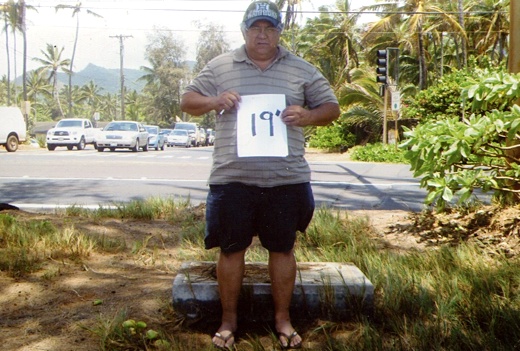
Image above: Ray Catania stands at concrete DOT electrical box controlling traffic signals at the intersection of Kuamoo Road and the newly widened Kuhio Highway and Wailua Bridge.

The Wailua Beach bike path supporters had better take notice on the latest shoreline erosion that is taking place on the beach today. This is where the path is supposed to pass.

The recent coastal surges that have happened in late May and early June have now broken through the county’s own 40-foot shoreline setback ordinance.

The electrical box fronting the Kuamoo Road intersection and the adjoining educational stand is now closer to the shoreline less than 19 feet from the crumbling sand dune.


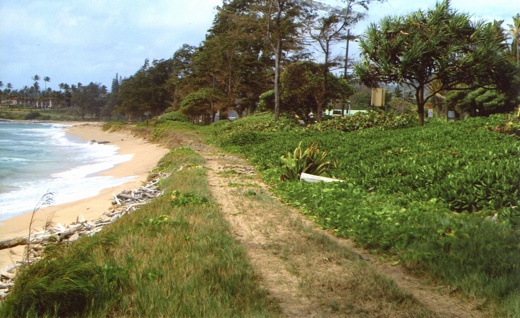
Image above: This photo from late May, 2012, is the sand path that went the whole length of the beach through a wide band of vegetation above the shoreline. Already much of Wailua Beach was in the ocean.


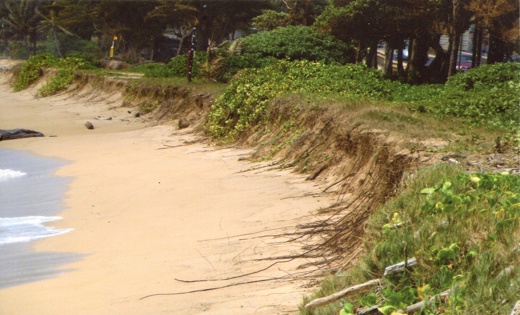
Image above: This is what was left of the same path in early June of 2012. Now much of that path is in the ocean.

Much of the planned bike path is now much less than 40 feet from the new high water mark. The sand path is crumbling and now developing cracks and water rivulets.

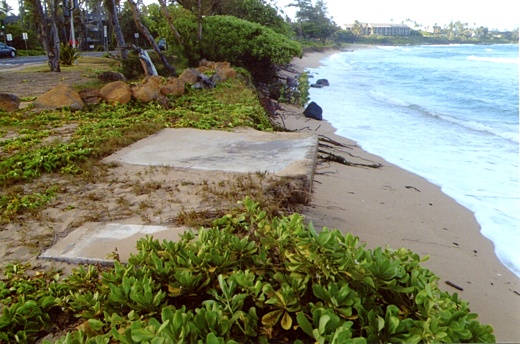
Image above. This is photo from late May, 2012, is of the concrete foundation for what was a beach-side lifeguard stand. In front of this station used to be sandlot volleyball court that is now in the ocean.

Image above: The ocean swirls over and past the life station foundation in this photo from early June 2012.

The concrete lifeguard base and the former volleyball sandlot, along with boundary boulders from the makeshift parking lot, have now fallen into the surge.

The “big bucks” spent so far on the Wailua Beach path and the cement path being built behind Kintaro would have been much better spent on hiring our youth for park cleanup and restoration this summer.

The Wailua Beach bike path is nothing more than a free ride for the tourist industry, a boondoggle for the corps of bike renters popping up in Wailua and a twisted view of paradise for some well-heeled newcomers who don’t understand protecting and leaving our Wailua Beach shoreline as-is.
Mayor Carvalho, stop this foolishness now.

[IB Editor's note: The section of Kuhio Highway between the south shore of the Wailua River past Kuamoo Road to Paploa Road is the most critical circulation problem on Kauai. 

A fortune was recently spent to widen the Kuhio Highway and Wailua Bridge as part of a solution to Kauai's worst traffic bottleneck between the two largest population centers on the island. The ocean may ruin this once in a lifetime investment in a matter of a few years. 


The only way to maintain reliable vehicular traffic around Kauai some decades into the future would have been to rebuild the highway and Wailua bridge crossing further inland impossible politically. From our point of view the bike and pedestrian path crossing of the river is the least of our worries. That's doable with county resources. 

What we might not have in the future is a highway crossing in the current location that can support multiple lanes of cement trucks and semi-tractor-trailers without driving them through the surf.]