Showing posts with label Conspiracy. Show all posts

The Real 9/11 Conspiracy

SUBHEAD: The US pretending it was not Saudi Arabia that flew two commercial jets into the World Trade Center towers.

By Sonali Kolatkar on 23 May 2016 for TruthDig -
(https://www.alternet.org/real-911-conspiracy)


Image above: North tower burning (right) as South tower is struck by commercial jet. From (https://www.alternet.org/real-911-conspiracy).

I remember watching the towers fall.

My sister called early in the morning to tell me to turn on the television. My husband and I, who had been working closely with Afghan women organizing against the Taliban, stared at the screen, aghast as the buildings crumbled.

Like everyone else the world over, we realized it was a moment that was going to change history. We also realized that ordinary people, including our friends in Afghanistan, were going to pay the price for something they likely had nothing to do with.

And sure enough, on Oct. 7, 2001, despite the fact that 15 of the 19 hijackers were Saudi nationals, the U.S. went to war with Afghanistan. That war, the longest in U.S. history, remains a bloody weight on our collective conscience.

But as soon as the towers fell and Congress rushed to hand over blanket authority to President Bush to wantonly bomb, whispers of “an inside job” began circulating on the internet.

Those whispers snowballed as the war expanded from Afghanistan to Iraq. Many anti-war activists, eager to undermine the flawed rationale for the Iraq War, insisted ever more shrilly that Bush and company were likely behind the attacks or knew ahead of time that the attacks were coming and failed to act purposefully.

Complex and convoluted arguments about the temperatures at which the towers’ beams melted were vociferously trotted out on public radio and in Internet chat rooms. Jesse Ventura jumped into the fray. Films like “Loose Change” and “Zeitgeist” offered seductive theories for Americans to latch onto as they became angry about our rush to war.

As a journalist, I often came under fire from the so-called “9/11 truthers” for being a “gatekeeper” and refusing to take the conspiracy theories seriously. I was much more interested in the devastation being wrought by the U.S. in the name of the 9/11 attacks.

And one irrefutable fact kept arising over and over in my mind: 15 of the 19 hijackers were Saudi nationals. It was a simple fact that everyone agreed on. It had nothing to do with secrets, lies or thermodynamics. It was out in the open.

Here is a plausible conspiracy: The Saudi government, known for aiding and abetting fundamentalist terrorist groups in order to legitimize its own extremist ideology, may well have been involved with some of the 9/11 terrorists, whether or not they knew the hijackers’ intentions.

Once those links were revealed, the U.S. government, which has a history of cozy relations with the Saudis for various reasons (oil, regional influence, weapons sales, etc.), may have wanted to overlook those embarrassing connections and instead divert the American public to countries it had an interest in, namely Iraq (with Afghanistan as a stepping stone).

But in 2004, the 9/11 Commission, a 10-person government panel created to investigate the attacks, absolved the Saudi Arabian government of any involvement. (It also faulted intelligence agencies for lack of coordination.) This was thought to be the end of the story. We were supposed to accept as mere coincidence the fact that the majority of the hijackers were Saudi citizens.
 
Now it turns out that the far more plausible 9/11 conspiracy could be true. After years of rumors that a classified section of a 2002 congressional report held the key to a Saudi role, The Guardian newspaper recently interviewed a member of the 9/11 Commission who confirmed these suspicions.

John Lehman, a Republican and former U.S. Navy secretary under President Reagan, asserted, “There was an awful lot of participation by Saudi individuals in supporting the hijackers, and some of those people worked in the Saudi government.” According to The Guardian, Lehman was aware of “five Saudi government officials who were strongly suspected of involvement in the terrorists’ support network.”

Lehman, along with several members of Congress, wants the Obama administration to declassify the so-called “28 pages” that were kept secret. While Obama decides whether or not to release the documents, the GOP-dominated Senate has just passed a bill that would allow families of 9/11 victims to sue the Saudi government. The Saudis are predictably outraged, and Obama will likely veto the bill to assuage the U.S. ally.

Why is any of this important, particularly given the GOP’s penchant for finding any excuse, however insignificant, to oppose Obama?

It is important because the entire premise of current U.S. foreign policy in the Middle East is based on an assumption that no government actors were involved in the 9/11 attacks.

 Rather, we were told, it was a series of shadowy and reprehensible groups, including “al-Qaida, the Taliban and their associated forces,” in Obama’s own words, that have been targeted for blame and elimination. Just who those “associated forces” are is unknown. In reality, the “enemy” is about as classified as Saudi Arabia’s role in 9/11.

The wars in Afghanistan and Iraq that began well over a decade ago unleashed chaos and violence. They generated the gulag in Guantanamo, Cuba. They were expanded via drone strikes in Pakistan, Libya, Yemen and Somalia.

They have killed untold numbers of innocents and inspired hatred toward the U.S. The U.S. has undermined the Arab Spring movements for democracy in countries like Egypt and even bolstered Saudi Arabia’s brutal quashing of democracy in Bahrain.

It has partnered with the Saudis on a bloody war in Yemen and continued its long-standing tradition of selling the wealthy Gulf monarchy more weapons than it knows what to do with.

The real 9/11 conspiracy is that, despite recent claims that “U.S.-Saudi relations are strained,” close ties between the two countries are worth far more than uncovering what really happened on Sept. 11, 2001.

The real conspiracy has been out in the open all along. We are told that we need to trust that our government is handling the terrorists who hate us and tried to kill us, even if many contend that the wars have made us less safe. But it turns out our government is simply and amiably working along with the nation most implicated in the 9/11 attacks.

None of this is to imply that the U.S. should have bombed Saudi Arabia instead of Afghanistan in 2001. Our post-9/11 military incursions all point to the singular fact that the “War on Terror” has been a “War of Terror.”

On the lengthy list of reasons our modern era of warfare is immoral, misguided, murderous, violent and in every sense wrong, the revelations of Saudi links to the 9/11 attacks ought to be the final straw.

See also:
Ea O Ka Aina: 9/11 The Day America Ended 9/11/16
Ea O Ka Aina: What We've Lost Since 911 6/16/14
Ea O Ka Aina: New Meaning for Day After 911 9/12/13
Ea O Ka Aina: 911 Aftermath - Our Self Defeat
9/10/11
Ea O Ka Aina: The Price of 911 9/7/11
Ea O Ka Aina: Giuliani 911 NY PD FD Fraud
8/31/11
Ea O Ka Aina: Israel as a Failed State
1/4/09
Island Breath: 7th Anniversary of September 11th
9/8/08
Island Breath: The War on Terror Begins 9/11/2001 9/9/06
Island Breath: Bush-Taliban Deal Disaster
4/9/04

.

How America Lost Its Mind

SUBHEAD: Our post-truth moment is the sum of mind-sets that have always made America "exceptional".

By Kurt Andersen on 24 August 2017 for The Atlantic -
(https://www.theatlantic.com/magazine/archive/2017/09/how-america-lost-its-mind/534231/)


Image above: Illustration of American fantasies over the decades by R. Kikuo Johnson. From original article.

“You are entitled to your own opinion,
but you are not entitled to your own facts.”
— Daniel Patrick Moynihan

“We risk being the first people in history to have been
able to make their illusions so vivid, so persuasive,
so ‘realistic’ that they can live in them.”
— Daniel J. Boorstin,

When did America become untethered from reality? I first noticed our national lurch toward fantasy in 2004, after President George W. Bush’s political mastermind, Karl Rove, came up with the remarkable phrase reality-based community.

People in “the reality-based community,” he told a reporter, “believe that solutions emerge from your judicious study of discernible reality … That’s not the way the world really works anymore.

A year later, The Colbert Report went on the air. In the first few minutes of the first episode, Stephen Colbert, playing his right-wing-populist commentator character, performed a feature called “The Word.” His first selection: truthiness.

“Now, I’m sure some of the ‘word police,’ the ‘wordinistas’ over at Webster’s, are gonna say, ‘Hey, that’s not a word!’ Well, anybody who knows me knows that I’m no fan of dictionaries or reference books. They’re elitist.

Constantly telling us what is or isn’t true. Or what did or didn’t happen. Who’s Britannica to tell me the Panama Canal was finished in 1914?

If I wanna say it happened in 1941, that’s my right. I don’t trust books—they’re all fact, no heart … Face it, folks, we are a divided nation … divided between those who think with their head and those who know with their heart …


Because that’s where the truth comes from, ladies and gentlemen—the gut.”

Whoa, yes, I thought: exactly. America had changed since I was young, when truthiness and reality-based community wouldn’t have made any sense as jokes. For all the fun, and all the many salutary effects of the 1960s—the main decade of my childhood—I saw that those years had also been the big-bang moment for truthiness.

And if the ’60s amounted to a national nervous breakdown, we are probably mistaken to consider ourselves over it.

Each of us is on a spectrum somewhere between the poles of rational and irrational. We all have hunches we can’t prove and superstitions that make no sense. Some of my best friends are very religious, and others believe in dubious conspiracy theories.

What’s problematic is going overboard—letting the subjective entirely override the objective; thinking and acting as if opinions and feelings are just as true as facts.

The American experiment, the original embodiment of the great Enlightenment idea of intellectual freedom, whereby every individual is welcome to believe anything she wishes, has metastasized out of control.

From the start, our ultra-individualism was attached to epic dreams, sometimes epic fantasies—every American one of God’s chosen people building a custom-made utopia, all of us free to reinvent ourselves by imagination and will.

In America nowadays, those more exciting parts of the Enlightenment idea have swamped the sober, rational, empirical parts.

Little by little for centuries, then more and more and faster and faster during the past half century, we Americans have given ourselves over to all kinds of magical thinking, anything-goes relativism, and belief in fanciful explanation—small and large fantasies that console or thrill or terrify us.

And most of us haven’t realized how far-reaching our strange new normal has become.

Much more than the other billion or so people in the developed world, we Americans believe—really believe—in the supernatural and the miraculous, in Satan on Earth, in reports of recent trips to and from heaven, and in a story of life’s instantaneous creation several thousand years ago.

We believe that the government and its co-conspirators are hiding all sorts of monstrous and shocking truths from us, concerning assassinations, extraterrestrials, the genesis of , the 9/11 attacks, the dangers of vaccines, and so much more.

And this was all true before we became familiar with the terms post-factual and post-truth, before we elected a president with an astoundingly open mind about conspiracy theories, what’s true and what’s false, the nature of reality.

We have passed through the looking glass and down the rabbit hole. America has mutated into Fantasyland.

How widespread is this promiscuous devotion to the untrue? How many Americans now inhabit alternate realities? Any given survey of beliefs is only a sketch of what people in general really think.

But reams of survey research from the past 20 years reveal a rough, useful census of American credulity and delusion. By my reckoning, the solidly reality-based are a minority, maybe a third of us but almost certainly fewer than half.

Only a third of us, for instance, don’t believe that the tale of creation in Genesis is the word of God. Only a third strongly disbelieve in telepathy and ghosts. Two-thirds of Americans believe that “angels and demons are active in the world.”

More than half say they’re absolutely certain heaven exists, and just as many are sure of the existence of a personal God—not a vague force or universal spirit or higher power, but some guy. A third of us believe not only that global warming is no big deal but that it’s a hoax perpetrated by scientists, the government, and journalists.

A third believe that our earliest ancestors were humans just like us; that the government has, in league with the pharmaceutical industry, hidden evidence of natural cancer cures; that extraterrestrials have visited or are visiting Earth.

Almost a quarter believe that vaccines cause autism, and that Donald Trump won the popular vote in 2016.

A quarter believe that our previous president maybe or definitely was (or is?) the anti-Christ.

According to a survey by Public Policy Polling, 15 percent believe that the “media or the government adds secret mind-controlling technology to television broadcast signals,” and another 15 percent think that’s possible. A quarter of Americans believe in witches.

 Remarkably, the same fraction, or maybe less, believes that the Bible consists mainly of legends and fables—the same proportion that believes U.S. officials were complicit in the 9/11 attacks.

When I say that a third believe X and a quarter believe Y, it’s important to understand that those are different thirds and quarters of the population.

Of course, various fantasy constituencies overlap and feed one another—for instance, belief in extraterrestrial visitation and abduction can lead to belief in vast government cover-ups, which can lead to belief in still more wide-ranging plots and cabals, which can jibe with a belief in an impending Armageddon.

Why are we like this?

The short answer is because we’re Americans—because being American means we can believe anything we want; that our beliefs are equal or superior to anyone else’s, experts be damned.

Once people commit to that approach, the world turns inside out, and no cause-and-effect connection is fixed. The credible becomes incredible and the incredible credible.

The word mainstream has recently become a pejorative, shorthand for bias, lies, oppression by the elites. Yet the institutions and forces that once kept us from indulging the flagrantly untrue or absurd—media, academia, government, corporate America, professional associations, respectable opinion in the aggregate—have enabled and encouraged every species of fantasy over the past few decades.

 A senior physician at one of America’s most prestigious university hospitals promotes “miracle cures” on his daily TV show. Cable channels air documentaries treating mermaids, monsters, ghosts, and angels as real.

When a political-science professor attacks the idea “that there is some ‘public’ that shares a notion of reality, a concept of reason, and a set of criteria by which claims to reason and rationality are judged,” colleagues just nod and grant tenure.

The old fringes have been folded into the new center. The irrational has become respectable and often unstoppable.

Our whole social environment and each of its overlapping parts—cultural, religious, political, intellectual, psychological—have become conducive to spectacular fallacy and truthiness and make-believe. There are many slippery slopes, leading in various directions to other exciting nonsense.

During the past several decades, those naturally slippery slopes have been turned into a colossal and permanent complex of interconnected, crisscrossing bobsled tracks, which Donald Trump slid down right into the White House.

American moxie has always come in two types. We have our wilder, faster, looser side: We’re overexcited gamblers with a weakness for stories too good to be true.

But we also have the virtues embodied by the Puritans and their secular descendants: steadiness, hard work, frugality, sobriety, and common sense.

A propensity to dream impossible dreams is like other powerful tendencies—okay when kept in check. For most of our history, the impulses existed in a rough balance, a dynamic equilibrium between fantasy and reality, mania and moderation, credulity and skepticism.

The great unbalancing and descent into full Fantasyland was the product of two momentous changes. The first was a profound shift in thinking that swelled up in the ’60s; since then, Americans have had a new rule written into their mental operating systems: Do your own thing, find your own reality, it’s all relative.

The second change was the onset of the new era of information. Digital technology empowers real-seeming fictions of the ideological and religious and scientific kinds. Among the web’s 1 billion sites, believers in anything and everything can find thousands of fellow fantasists, with collages of facts and “facts” to support them.

Before the internet, crackpots were mostly isolated, and surely had a harder time remaining convinced of their alternate realities. Now their devoutly believed opinions are all over the airwaves and the web, just like actual news. Now all of the fantasies look real.

Today, each of us is freer than ever to custom-make reality, to believe whatever and pretend to be whoever we wish. Which makes all the lines between actual and fictional blur and disappear more easily.

Truth in general becomes flexible, personal, subjective. And we like this new ultra-freedom, insist on it, even as we fear and loathe the ways so many of our wrongheaded fellow Americans use it.

Treating real life as fantasy and vice versa, and taking preposterous ideas seriously, is not unique to Americans.

But we are the global crucible and epicenter. We invented the fantasy-industrial complex; almost nowhere outside poor or otherwise miserable countries are flamboyant supernatural beliefs so central to the identities of so many people.

This is American exceptionalism in the 21st century. The country has always been a one-of-a-kind place. But our singularity is different now.

We’re still rich and free, still more influential and powerful than any other nation, practically a synonym for developed country. But our drift toward credulity, toward doing our own thing, toward denying facts and having an altogether uncertain grip on reality, has overwhelmed our other exceptional national traits and turned us into a less developed country.

People see our shocking Trump moment—this post-truth, “alternative facts” moment—as some inexplicable and crazy new American phenomenon. But what’s happening is just the ultimate extrapolation and expression of mind-sets that have made America exceptional for its entire history.

America was created by true believers and passionate dreamers, and by hucksters and their suckers, which made America successful—but also by a people uniquely susceptible to fantasy, as epitomized by everything from Salem’s hunting witches to Joseph Smith’s creating Mormonism, from P. T. Barnum to speaking in tongues, from Hollywood to Scientology to conspiracy theories, from Walt Disney to Billy Graham to Ronald Reagan to Oprah Winfrey to Trump.

In other words: Mix epic individualism with extreme religion; mix show business with everything else; let all that ferment for a few centuries; then run it through the anything-goes ’60s and the internet age. The result is the America we inhabit today, with reality and fantasy weirdly and dangerously blurred and commingled.

The 1960s and the Beginning of the End of Reason


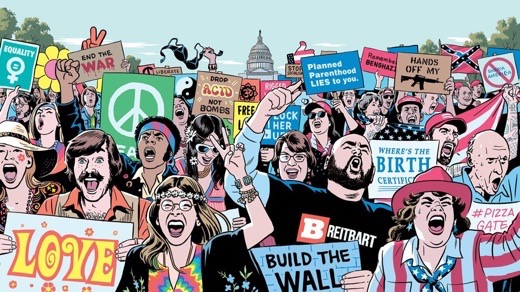
Image above: Illustration of American 1960's Counter Culture mixed with nutcakes of today. by R. Kikuo Johnson. From original article.

I don't regret or disapprove of many of the ways the ’60s permanently reordered American society and culture. It’s just that along with the familiar benefits, there have been unreckoned costs.

In 1962, people started referring to “hippies,” the Beatles had their first hit, Ken Kesey published One Flew Over the Cuckoo’s Nest, and the Harvard psychology lecturer Timothy Leary was handing out psilocybin and LSD to grad students.

And three hours south of San Francisco, on the heavenly stretch of coastal cliffs known as Big Sur, a pair of young Stanford psychology graduates founded a school and think tank they named after a small American Indian tribe that had lived on the grounds long before. “In 1968,” one of its founding figures recalled four decades later,
Esalen was the center of the cyclone of the youth rebellion. It was one of the central places, like Mecca for the Islamic culture. Esalen was a pilgrimage center for hundreds and thousands of youth interested in some sense of transcendence, breakthrough consciousness, LSD, the sexual revolution, encounter, being sensitive, finding your body, yoga—all of these things were at first filtered into the culture through Esalen. By 1966, ’67, and ’68, Esalen was making a world impact.
This is not overstatement. Essentially everything that became known as New Age was invented, developed, or popularized at the Esalen Institute. Esalen is a mother church of a new American religion for people who think they don’t like churches or religions but who still want to believe in the supernatural.

The institute wholly reinvented psychology, medicine, and philosophy, driven by a suspicion of science and reason and an embrace of magical thinking (also: massage, hot baths, sex, and sex in hot baths). It was a headquarters for a new religion of no religion, and for “science” containing next to no science.

The idea was to be radically tolerant of therapeutic approaches and understandings of reality, especially if they came from Asian traditions or from American Indian or other shamanistic traditions. Invisible energies, past lives, astral projection, whatever—the more exotic and wondrous and unfalsifiable, the better.

Not long before Esalen was founded, one of its co-founders, Dick Price, had suffered a mental breakdown and been involuntarily committed to a private psychiatric hospital for a year.

His new institute embraced the radical notion that psychosis and other mental illnesses were labels imposed by the straight world on eccentrics and visionaries, that they were primarily tools of coercion and control. This was the big idea behind One Flew Over the Cuckoo’s Nest, of course.

And within the psychiatric profession itself this idea had two influential proponents, who each published unorthodox manifestos at the beginning of the decade—R. D. Laing (The Divided Self) and Thomas Szasz (The Myth of Mental Illness).

“Madness,” Laing wrote when Esalen was new, “is potentially liberation and renewal.” Esalen’s founders were big Laing fans, and the institute became a hotbed for the idea that insanity was just an alternative way of perceiving reality.

These influential critiques helped make popular and respectable the idea that much of science is a sinister scheme concocted by a despotic conspiracy to oppress people.

Mental illness, both Szasz and Laing said, is “a theory not a fact.” This is now the universal bottom-line argument for anyone—from creationists to climate-change deniers to anti-vaccine hysterics—who prefers to disregard science in favor of his own beliefs.

You know how young people always think the universe revolves around them, as if they’re the only ones who really get it?

And how before their frontal lobes, the neural seat of reason and rationality, are fully wired, they can be especially prone to fantasy?

In the ’60s, the universe cooperated: It did seem to revolve around young people, affirming their adolescent self-regard, making their fantasies of importance feel real and their fantasies of instant transformation and revolution feel plausible.

Practically overnight, America turned its full attention to the young and everything they believed and imagined and wished.

If 1962 was when the decade really got going, 1969 was the year the new doctrines and their gravity were definitively cataloged by the grown-ups. Reason and rationality were over.

The countercultural effusions were freaking out the old guard, including religious people who couldn’t quite see that yet another Great Awakening was under way in America, heaving up a new religion of believers who “have no option but to follow the road until they reach the Holy City … that lies beyond the technocracy … the New Jerusalem.”

That line is from The Making of a Counter Culture: Reflections on the Technocratic Society and Its Youthful Opposition, published three weeks after Woodstock, in the summer of 1969. Its author was Theodore Roszak, age 35, a Bay Area professor who thereby coined the word counterculture.

Roszak spends 270 pages glorying in the younger generation’s “brave” rejection of expertise and “all that our culture values as ‘reason’ and ‘reality.’ ” (Note the scare quotes.)

So-called experts, after all, are “on the payroll of the state and/or corporate structure.” A chapter called “The Myth of Objective Consciousness” argues that science is really just a state religion.

To create “a new culture in which the non-intellective capacities … become the arbiters of the good [and] the true,” he writes, “nothing less is required than the subversion of the scientific world view, with its entrenched commitment to an egocentric and cerebral mode of consciousness.” He welcomes the “radical rejection of science and technological values.”


Earlier that summer, a University of Chicago sociologist (and Catholic priest) named Andrew Greeley had alerted readers of The New York Times Magazine that beyond the familiar signifiers of youthful rebellion (long hair, sex, drugs, music, protests), the truly shocking change on campuses was the rise of anti-rationalism and a return of the sacred—“mysticism and magic,” the occult, séances, cults based on the book of Revelation.

When he’d chalked a statistical table on a classroom blackboard, one of his students had reacted with horror: “Mr. Greeley, I think you’re an empiricist.”

As 1969 turned to 1970, a 41-year-old Yale Law School professor was finishing his book about the new youth counterculture. Charles Reich was a former Supreme Court clerk now tenured at one of ultra-rationalism’s American headquarters.

But hanging with the young people had led him to a midlife epiphany and apostasy. In 1966, he had started teaching an undergraduate seminar called “The Individual in America,” for which he assigned fiction by Kesey and Norman Mailer. He decided to spend the next summer, the Summer of Love, in Berkeley. On the road back to New Haven, he had his Pauline conversion to the kids’ values.

His class at Yale became hugely popular; at its peak, 600 students were enrolled. In 1970, The Greening of America became The New York Times’ best-selling book (as well as a much-read 70-page New Yorker excerpt), and remained on the list for most of a year.

At 16, I bought and read one of the 2 million copies sold. Rereading it today and recalling how much I loved it was a stark reminder of the follies of youth. Reich was shamelessly, uncritically swooning for kids like me.  

The Greening of America may have been the mainstream’s single greatest act of pandering to the vanity and self-righteousness of the new youth. Its underlying theoretical scheme was simple and perfectly pitched to flatter young readers:

There are three types of American “consciousness,” each of which “makes up an individual’s perception of reality … his ‘head,’ his way of life.”  

Consciousness I people were old-fashioned, self-reliant individualists rendered obsolete by the new “Corporate State”—essentially, your grandparents.  

Consciousness IIs were the fearful and conformist organization men and women whose rationalism was a tyrannizing trap laid by the Corporate State—your parents.

And then there was Consciousness III, which had “made its first appearance among the youth of America,” “spreading rapidly among wider and wider segments of youth, and by degrees to older people.”

If you opposed the Vietnam War and dressed down and smoked pot, you were almost certainly a III. Simply by being young and casual and undisciplined, you were ushering in a new utopia.

Reich praises the “gaiety and humor” of the new Consciousness III wardrobe, but his book is absolutely humorless—because it’s a response to “this moment of utmost sterility, darkest night and most extreme peril.”

Conspiracism was flourishing, and Reich bought in. Now that “the Corporate State has added depersonalization and repression” to its other injustices, “it has threatened to destroy all meaning and suck all joy from life.” Reich’s magical thinking mainly concerned how the revolution would turn out.

“The American Corporate State,” having produced this new generation of longhaired hyperindividualists who insist on trusting their gut and finding their own truth, “is now accomplishing what no revolutionaries could accomplish by themselves.

The machine has begun to destroy itself.” Once everyone wears Levi’s and gets high, the old ways “will simply be swept away in the flood.”

The inevitable/imminent happy-cataclysm part of the dream didn’t happen, of course. The machine did not destroy itself. But Reich was half-right. An epochal change in American thinking was under way and “not, as far as anybody knows, reversible …

There is no returning to an earlier consciousness.” His wishful error was believing that once the tidal surge of new sensibility brought down the flood walls, the waters would flow in only one direction, carving out a peaceful, cooperative, groovy new continental utopia, hearts and minds changed like his, all of America Berkeleyized and Vermontified.

Instead, Consciousness III was just one early iteration of the anything-goes, post-reason, post-factual America enabled by the tsunami.

Reich’s faith was the converse of the Enlightenment rationalists’ hopeful fallacy 200 years earlier.

Granted complete freedom of thought, Thomas Jefferson and company assumed, most people would follow the path of reason.

Wasn’t it pretty to think so.

I remember when fantastical beliefs went fully mainstream, in the 1970s.

My irreligious mother bought and read The Secret Life of Plants, a big best seller arguing that plants were sentient and would “be the bridesmaids at a marriage of physics and metaphysics.” The amazing truth about plants, the book claimed, had been suppressed by the FDA and agribusiness.

My mom didn’t believe in the conspiracy, but she did start talking to her ficuses as if they were pets.

In a review, The New York Times registered the book as another data point in how “the incredible is losing its pariah status.”

Indeed, mainstream publishers and media organizations were falling over themselves to promote and sell fantasies as nonfiction.

In 1975 came a sensational autobiography by the young spoon bender and mind reader Uri Geller as well as Life After Life, by Raymond Moody, a philosophy Ph.D. who presented the anecdotes of several dozen people who’d nearly died as evidence of an afterlife.

The book sold many millions of copies; before long the International Association for Near Death Studies formed and held its first conference, at Yale.

During the ’60s, large swaths of academia made a turn away from reason and rationalism as they’d been understood.

Many of the pioneers were thoughtful, their work fine antidotes to postwar complacency. The problem was the nature and extent of their influence at that particular time, when all premises and paradigms seemed up for grabs.

That is, they inspired half-baked and perverse followers in the academy, whose arguments filtered out into the world at large:

All approximations of truth, science as much as any fable or religion, are mere stories devised to serve people’s needs or interests. Reality itself is a purely social construction, a tableau of useful or wishful myths that members of a society or tribe have been persuaded to believe.

The borders between fiction and nonfiction are permeable, maybe nonexistent. The delusions of the insane, superstitions, and magical thinking?

Any of those may be as legitimate as the supposed truths contrived by Western reason and science. The takeaway: Believe whatever you want, because pretty much everything is equally true and false.

These ideas percolated across multiple academic fields. In 1965, the French philosopher Michel Foucault published Madness and Civilization in America, echoing Laing’s skepticism of the concept of mental illness; by the 1970s, he was arguing that rationality itself is a coercive “regime of truth”—oppression by other means. Foucault’s suspicion of reason became deeply and widely embedded in American academia.

During the ’60s, large swaths of academia made a turn away from reason and rationalism as they’d been understood. Many of the pioneers were thoughtful, their work fine antidotes to postwar complacency. The problem was the nature and extent of their influence at that particular time, when all premises and paradigms seemed up for grabs.

That is, they inspired half-baked and perverse followers in the academy, whose arguments filtered out into the world at large:

All approximations of truth, science as much as any fable or religion, are mere stories devised to serve people’s needs or interests.

Reality itself is a purely social construction, a tableau of useful or wishful myths that members of a society or tribe have been persuaded to believe.

The borders between fiction and nonfiction are permeable, maybe nonexistent. The delusions of the insane, superstitions, and magical thinking? Any of those may be as legitimate as the supposed truths contrived by Western reason and science. The takeaway: Believe whatever you want, because pretty much everything is equally true and false.

These ideas percolated across multiple academic fields. In 1965, the French philosopher Michel Foucault published Madness and Civilization in America, echoing Laing’s skepticism of the concept of mental illness; by the 1970s, he was arguing that rationality itself is a coercive “regime of truth”—oppression by other means. Foucault’s suspicion of reason became deeply and widely embedded in American academia.

When I first read that, at age 18, I loved the quotation marks. If reality is simply the result of rules written by the powers that be, then isn’t everyone able—no, isn’t everyone obliged—to construct their own reality? The book was timed perfectly to become a foundational text in academia and beyond.

A more extreme academic evangelist for the idea of all truths being equal was a UC Berkeley philosophy professor named Paul Feyerabend. His best-known book, published in 1975, was Against Method: Outline of an Anarchistic Theory of Knowledge.

“Rationalism,” it declared, “is a secularized form of the belief in the power of the word of God,” and science a “particular superstition.”

In a later edition of the book, published when creationists were passing laws to teach Genesis in public-school biology classes, Feyerabend came out in favor of the practice, comparing creationists to Galileo. Science, he insisted, is just another form of belief.

“Only one principle,” he wrote, “can be defended under all circumstances and in all stages of human development. It is the principle: anything goes.”

Over in anthropology, where the exotic magical beliefs of traditional cultures were a main subject, the new paradigm took over completely—don’t judge, don’t disbelieve, don’t point your professorial finger. This was understandable, given the times: colonialism ending, genocide of American Indians confessed, U.S. wars in the developing world.

Who were we to roll our eyes or deny what these people believed? In the ’60s, anthropology decided that oracles, diviners, incantations, and magical objects should be not just respected, but considered equivalent to reason and science.

If all understandings of reality are socially constructed, those of Kalabari tribesmen in Nigeria are no more arbitrary or faith-based than those of college professors.

In 1968, a UC Davis psychologist named Charles Tart conducted an experiment in which, he wrote, “a young woman who frequently had spontaneous out-of-body experiences”—didn’t “claim to have” them but “had” them—spent four nights sleeping in a lab, hooked up to an EEG machine.

Her assigned task was to send her mind or soul out of her body while she was asleep and read a five-digit number Tart had written on a piece of paper placed on a shelf above the bed. He reported that she succeeded.

Other scientists considered the experiments and the results bogus, but Tart proceeded to devote his academic career to proving that attempts at objectivity are a sham and magic is real. In an extraordinary paper published in 1972 in Science, he complained about the scientific establishment’s “almost total rejection of the knowledge gained” while high or tripping.

He didn’t just want science to take seriously “experiences of ecstasy, mystical union, other ‘dimensions,’ rapture, beauty, space-and-time transcendence.” He was explicitly dedicated to going there. A “perfectly scientific theory may be based on data that have no physical existence,” he insisted.

The rules of the scientific method had to be revised. To work as a psychologist in the new era, Tart argued, a researcher should be in the altered state of consciousness he’s studying, high or delusional “at the time of data collection” or during “data reduction and theorizing.”

Tart’s new mode of research, he admitted, posed problems of “consensual validation,” given that “only observers in the same [altered state] are able to communicate adequately with one another.”

Tart popularized the term consensus reality for what you or I would simply call reality, and around 1970 that became a permanent interdisciplinary term of art in academia. Later he abandoned the pretense of neutrality and started calling it the consensus trance—people committed to reason and rationality were the deluded dupes, not he and his tribe.

Even the social critic Paul Goodman, beloved by young leftists in the ’60s, was flabbergasted by his own students by 1969. “There was no knowledge,” he wrote, “only the sociology of knowledge. They had so well learned that … research is subsidized and conducted for the benefit of the ruling class that they did not believe there was such a thing as simple truth.”

Ever since, the American right has insistently decried the spread of relativism, the idea that nothing is any more correct or true than anything else.

Conservatives hated how relativism undercut various venerable and comfortable ruling ideas—certain notions of entitlement (according to race and gender) and aesthetic beauty and metaphysical and moral certainty. 
 
Yet once the intellectual mainstream thoroughly accepted that there are many equally valid realities and truths, once the idea of gates and gatekeeping was discredited not just on campuses but throughout the culture, all American barbarians could have their claims taken seriously.

Conservatives are correct that the anything-goes relativism of college campuses wasn’t sequestered there, but when it flowed out across America it helped enable extreme Christianities and lunacies on the right—gun-rights hysteria, black-helicopter conspiracism, climate-change denial, and more.

The term useful idiot was originally deployed to accuse liberals of serving the interests of true believers further on the left. In this instance, however, postmodern intellectuals—post-positivists, poststructuralists, social constructivists, post-empiricists, epistemic relativists, cognitive relativists, descriptive relativists—turned out to be useful idiots most consequentially for the American right.

“Reality has a well-known liberal bias,” Stephen Colbert once said, in character, mocking the beliefs-trump-facts impulse of today’s right. Neither side has noticed, but large factions of the elite left and the populist right have been on the same team.

 [IB Publisher's note: If you've read to here you are only part way through - about 40%. To read about Kurt Anderson's take the 70's and 80's and beyond go to (https://www.theatlantic.com/magazine/archive/2017/09/how-america-lost-its-mind/534231/) and search for:

"Conspiracy and Paranoia in the 1970s"

 Enjoy!


.

Connecting the dots - Trump to Brexit

SUBHEAD: How our democracy was hijacked in America and Britain by friends of Donald Trump.

By  Carole Cadwalladr on 7 May 2017 for the Guardian -
(https://www.theguardian.com/technology/2017/may/07/the-great-british-brexit-robbery-hijacked-democracy)
http://www.islandbreath.org/2017Year/06/170603linksbig.jpg
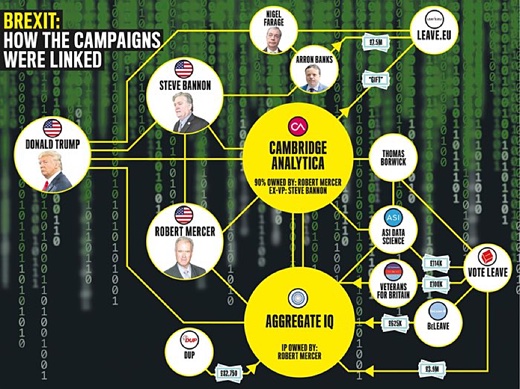
Image above: Diagram of links between Trump, Steve Bannon, Cambridge Analytica and Aggregate IQ, Nigel Farage and Brexit. Click to embiggen. From original article.

A shadowy global operation involving big data, billionaire friends of Trump and the disparate forces of the Brexit campaign influenced the result of the EU referendum. As Britain heads to the polls again, is its electoral process still fit for purpose?

In June 2013, a young American postgraduate called Sophie was passing through London when she was called up by the boss of a firm where she’d previously interned. The company, SCL Elections, went on to be bought by Robert Mercer, a secretive hedge fund billionaire, renamed Cambridge Analytica, and achieved a certain notoriety as the data analytics firm that played a role in both Trump and Brexit campaigns. But all of this was still to come.

London in 2013 was still basking in the afterglow of the Olympics. Britain had not yet Brexited. The world had not yet turned.

“That was before we became this dark, dystopian data company that gave the world Trump,” a former Cambridge Analytica employee who I’ll call Paul tells me. “It was back when we were still just a psychological warfare firm.”

Was that really what you called it, I ask him. Psychological warfare? “Totally. That’s what it is. Psyops. Psychological operations – the same methods the military use to effect mass sentiment change. It’s what they mean by winning ‘hearts and minds’. We were just doing it to win elections in the kind of developing countries that don’t  have many rules.”

Why would anyone want to intern with a psychological warfare firm, I ask him. And he looks at me like I am mad. “It was like working for MI6. Only it’s MI6 for hire.

It was very posh, very English, run by an old Etonian and you got to do some really cool things. Fly all over the world. You were working with the president of Kenya or Ghana or wherever. It’s not like election campaigns in the west. You got to do all sorts of crazy shit.”

On that day in January 2013, Sophie met up with SCL’s chief executive, Alexander Nix, and gave him the germ of an idea.

“She said, ‘You really need to get into data.’ She really drummed it home to Alexander. And she mentioned to him a firm that belonged to someone she knew about through her father.”
Who’s her father?

“Eric Schmidt.”

Eric Schmidt – the chairman of Google?”
I had been speaking to former employees of Cambridge Analytica for months and heard dozens of hair-raising stories, but it was still a gobsmacking moment. To anyone concerned about surveillance, Palantir is practically now a trigger word.

The data-mining firm has contracts with governments all over the world – including GCHQ and the NSA. It’s owned by Peter Thiel, the billionaire co-founder of PayPal and major investor in Facebook, who became Silicon Valley’s first vocal supporter of Trump.

In some ways, Eric Schmidt’s daughter showing up and referring to Palantir is just another weird detail in the weirdest story I have ever researched.

A weird but telling detail. Because it goes to the heart of why the story of Cambridge Analytica is one of the most profoundly unsettling of our time. Sophie Schmidt now works for another Silicon Valley megafirm: Uber. And what’s clear is that the power and dominance of the Silicon Valley – Google and Facebook and a small handful of others – are at the centre of the global tectonic shift we are currently witnessing.

It also reveals a critical and gaping hole in the political debate in Britain. Because what is happening in America and what is happening in Britain are entwined. Brexit and Trump are entwined. The Trump administration’s links to Russia and Britain are entwined.

And Cambridge Analytica is one point of focus through which we can see all these relationships in play; it also reveals the elephant in the room as we hurtle into a general election: Britain tying its future to an America that is being remade - in a radical and alarming way - by Trump.

There are three strands to this story. How the foundations of an authoritarian surveillance state are being laid in the US. How British democracy was subverted through a covert, far-reaching plan of coordination enabled by a US billionaire.

And how we are in the midst of a massive land grab for power by billionaires via our data. Data which is being silently amassed, harvested and stored. Whoever owns this data owns the future.

My entry point into this story began, as so many things do, with a late-night Google. Last December, I took an unsettling tumble into a wormhole of Google autocomplete suggestions that ended with “did the holocaust happen”. And an entire page of results that claimed it didn’t.

Google’s algorithm had been gamed by extremist sites and it was Jonathan Albright, a professor of communications at Elon University, North Carolina, who helped me get to grips with what I was seeing. He was the first person to map and uncover an entire “alt-right” news and information ecosystem and he was the one who first introduced me to Cambridge Analytica.

He called the company a central point in the right’s “propaganda machine”, a line I quoted in reference to its work for the Trump election campaign and the referendum Leave campaign.

That led to the second article featuring Cambridge Analytica – as a central node in the alternative news and information network that I believed Robert Mercer and Steve Bannon, the key Trump aide who is now his chief strategist, were creating.

I found evidence suggesting they were on a strategic mission to smash the mainstream media and replace it with one comprising alternative facts, fake history and rightwing propaganda.
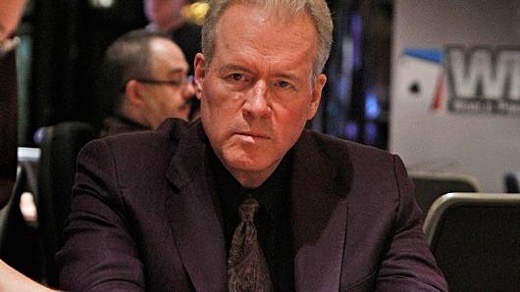

Image above: Robert Mercer in 2012 playing the World Poker Tour. From (http://www.cnbc.com/2014/11/07/robert-mercer-the-most-important-political-money-man-youve-never-heard-of.html).

Mercer is a brilliant computer scientist, a pioneer in early artificial intelligence, and the co-owner of one of the most successful hedge funds on the planet (with a gravity-defying 71.8% annual return). And, he is also, I discovered, good friends with Nigel Farage.

Andy Wigmore, Leave.EU’s communications director, told me that it was Mercer who had directed his company, Cambridge Analytica, to “help” the Leave campaign.

The second article triggered two investigations, which are both continuing: one by the Information Commissioner’s Office into the possible illegal use of data. And a second by the Electoral Commission which is “focused on whether one or more donations – including services – accepted by Leave.EU was ‘impermissable’”.

What I then discovered is that Mercer’s role in the referendum went far beyond this. Far beyond the jurisdiction of any UK law. The key to understanding how a motivated and determined billionaire could bypass ourelectoral laws rests on AggregateIQ, an obscure web analytics company based in an office above a shop in Victoria, British Columbia.

It was with AggregateIQ that Vote Leave (the official Leave campaign) chose to spend £3.9m, more than half its official £7m campaign budget. As did three other affiliated Leave campaigns: BeLeave, Veterans for Britain and the Democratic Unionist party, spending a further £757,750.

“Coordination” between campaigns is prohibited under UK electoral law, unless campaign expenditure is declared, jointly. It wasn’t. Vote Leave says the Electoral Commission “looked into this” and gave it “a clean bill of health”.

How did an obscure Canadian company come to play such a pivotal role in Brexit? It’s a question that Martin Moore, director of the centre for the study of communication, media and power at King’s College London has been asking too. “I went through all the Leave campaign invoices when the Electoral Commission uploaded them to its site in February.

And I kept on discovering all these huge amounts going to a company that not only had I never heard of, but that there was practically nothing at all about on the internet. More money was spent with AggregateIQ than with any other company in any other campaign in the entire referendum. All I found, at that time, was a one-page website and that was it. It was an absolute mystery.”

Moore contributed to an LSE report published in April that concluded UK’s electoral laws were “weak and helpless” in the face of new forms of digital campaigning.

Offshore companies, money poured into databases, unfettered third parties… the caps on spending had come off. The laws that had always underpinned Britain’s electoral laws were no longer fit for purpose. Laws, the report said, that needed “urgently reviewing by parliament”.

AggregateIQ holds the key to unravelling another complicated network of influence that Mercer has created. A source emailed me to say he had found that AggregateIQ’s address and telephone number corresponded to a company listed on Cambridge Analytica’s website as its overseas office: “SCL Canada”. A day later, that online reference vanished.

There had to be a connection between the two companies. Between the various Leave campaigns. Between the referendum and Mercer. It was too big a coincidence.

But everyone – AggregateIQ, Cambridge Analytica, Leave.EU, Vote Leave – denied it. AggregateIQ had just been a short-term “contractor” to Cambridge Analytica. There was nothing to disprove this. We published the known facts. On 29 March, article 50 was triggered.

Then I meet Paul, the first of two sources formerly employed by Cambridge Analytica. He is in his late 20s and bears mental scars from his time there. “It’s almost like post-traumatic shock. It was so… messed up. It happened so fast. I just woke up one morning and found we’d turned into the Republican fascist party. I still can’t get my head around it.”

He laughed when I told him the frustrating mystery that was AggregateIQ. “Find Chris Wylie,” he said.

Who’s Chris Wylie?

“He’s the one who brought data and micro-targeting [individualized political messages] to Cambridge Analytica. And he’s from west Canada. It’s only because of him that AggregateIQ exist. They’re his friends. He’s the one who brought them in.”

There wasn’t just a relationship between Cambridge Analytica and AggregateIQ, Paul told me. They were intimately entwined, key nodes in Robert Mercer’s distributed empire. “The Canadians were our back office.

They built our software for us. They held our database. If AggregateIQ is involved then Cambridge Analytica is involved. And if Cambridge Analytica is involved, then Robert Mercer and Steve Bannon are involved. You need to find Chris Wylie.”

I did find Chris Wylie. He refused to comment.

Key to understanding how data would transform the company is knowing where it came from. And it’s a letter from “Director of Defence Operations, SCL Group”, that helped me realise this. It’s from “Commander Steve Tatham, PhD, MPhil, Royal Navy (rtd)” complaining about my use in my Mercer article of the word “disinformation”.

I wrote back to him pointing out references in papers he’d written to “deception” and “propaganda”, which I said I understood to be “roughly synonymous with ‘disinformation’.” It’s only later that it strikes me how strange it is that I’m corresponding with a retired navy commander about military strategies that may have been used in British and US elections.

What’s been lost in the US coverage of this “data analytics” firm is the understanding of where the firm came from: deep within the military-industrial complex. A weird British corner of it populated, as the military establishment in Britain is, by old-school Tories.

Geoffrey Pattie, a former parliamentary under-secretary of state for defence procurement and director of Marconi Defence Systems, used to be on the board, and Lord Marland, David Cameron’s pro-Brexit former trade envoy, a shareholder.

Steve Tatham was the head of psychological operations for British forces in Afghanistan. The Observer has seen letters endorsing him from the UK Ministry of Defence, the Foreign Office and NATO.

SCL/Cambridge Analytica was not some startup created by a couple of guys with a Mac PowerBook. It’s effectively part of the British defence establishment. And, now, too, the American defence establishment. An ex-commanding officer of the US Marine Corps operations centre, Chris Naler, has recently joined Iota Global, a partner of the SCL group.

This is not just a story about social psychology and data analytics. It has to be understood in terms of a military contractor using military strategies on a civilian population. Us.

David Miller, a professor of sociology at Bath University and an authority in psyops and propaganda, says it is “an extraordinary scandal that this should be anywhere near a democracy. It should be clear to voters where information is coming from, and if it’s not transparent or open where it’s coming from, it raises the question of whether we are actually living in a democracy or not.”

Paul and David, another ex-Cambridge Analytica employee, were working at the firm when it introduced mass data-harvesting to its psychological warfare techniques. “It brought psychology, propaganda and technology together in this powerful new way,” David tells me.

And it was Facebook that made it possible. It was from Facebook that Cambridge Analytica obtained its vast dataset in the first place.

Earlier, psychologists at Cambridge University harvested Facebook data (legally) for research purposes and published pioneering peer-reviewed work about determining personality traits, political partisanship, sexuality and much more from people’s Facebook “likes”.

And SCL/Cambridge Analytica contracted a scientist at the university, Dr Aleksandr Kogan, to harvest new Facebook data. And he did so by paying people to take a personality quiz which also allowed not just their own Facebook profiles to be harvested, but also those of their friends – a process then allowed by the social network.

Facebook was the source of the psychological insights that enabled Cambridge Analytica to target individuals. It was also the mechanism that enabled them to be delivered on a large scale.

The company also (perfectly legally) bought consumer datasets – on everything from magazine subscriptions to airline travel – and uniquely it appended these with the psych data to voter files.

It matched all this information to people’s addresses, their phone numbers and often their email addresses. “The goal is to capture every single aspect of every voter’s information environment,” said David. “And the personality data enabled Cambridge Analytica to craft individual messages.”

Finding “persuadable” voters is key for any campaign and with its treasure trove of data, Cambridge Analytica could target people high in neuroticism, for example, with images of immigrants “swamping” the country. The key is finding emotional triggers for each individual voter.

Cambridge Analytica worked on campaigns in several key states for a Republican political action committee. Its key objective, according to a memo the Observer has seen, was “voter disengagement” and “to persuade Democrat voters to stay at home”: a profoundly disquieting tactic. It has previously been claimed that suppression tactics were used in the campaign, but this document provides the first actual evidence.

But does it actually work? One of the criticisms that has been levelled at my and others’ articles is that Cambridge Analytica’s “special sauce” has been oversold. Is what it is doing any different from any other political consultancy?

“It’s not a political consultancy,” says David. “You have to understand this is not a normal company in any way. I don’t think Mercer even cares if it ever makes any money. It’s the product of a billionaire spending huge amounts of money to build his own experimental science lab, to test what works, to find tiny slivers of influence that can tip an election.

Robert Mercer did not invest in this firm until it ran a bunch of pilots – controlled trials. This is one of the smartest computer scientists in the world. He is not going to splash $15m on bullshit.”

Tamsin Shaw, an associate professor of philosophy at New York University, helps me understand the context. She has researched the US military’s funding and use of psychological research for use in torture. “The capacity for this science to be used to manipulate emotions is very well established.

This is military-funded technology that has been harnessed by a global plutocracy and is being used to sway elections in ways that people can’t even see, don’t even realise is happening to them,” she says. “It’s about exploiting existing phenomenon like nationalism and then using it to manipulate people at the margins.

To have so much data in the hands of a bunch of international plutocrats to do with it what they will is absolutely chilling.

“We are in an information war and billionaires are buying up these companies, which are then employed to go to work in the heart of government. That’s a very worrying situation.”

A project that Cambridge Analytica carried out in Trinidad in 2013 brings all the elements in this story together. Just as Robert Mercer began his negotiations with SCL boss Alexander Nix about an acquisition, SCL was retained by several government ministers in Trinidad and Tobago.

The brief involved developing a micro-targeting programme for the governing party of the time.

And AggregateIQ – the same company involved in delivering Brexit for Vote Leave – was brought in to build the targeting platform.

David said: “The standard SCL/CA method is that you get a government contract from the ruling party. And this pays for the political work. So, it’s often some bullshit health project that’s just a cover for getting the minister re-elected. But in this case, our government contacts were with Trinidad’s national security council.”

The security work was to be the prize for the political work. Documents seen by the Observer show that this was a proposal to capture citizens’ browsing history en masse, recording phone conversations and applying natural language processing to the recorded voice data to construct a national police database, complete with scores for each citizen on their propensity to commit crime.

“The plan put to the minister was Minority Report. It was pre-crime. And the fact that Cambridge Analytica is now working inside the Pentagon is, I think, absolutely terrifying,” said David.


Image above: Steve Bannon in the East Room of the White House on February 15, 2017. Photo by Pete Marovich. From ((http://www.vanityfair.com/news/2017/04/steve-bannon-isnt-through-with-trump-yet).

These documents throw light on a significant and under-reported aspect of the Trump administration. The company that helped Trump achieve power in the first place has now been awarded contracts in the Pentagon and the US state department. Its former vice-president Steve Bannon now sits in the White House. It is also reported to be in discussions for “military and homeland security work”.

In the US, the government is bound by strict laws about what data it can collect on individuals. But, for private companies anything goes. Is it unreasonable to see in this the possible beginnings of an authoritarian surveillance state?

A state that is bringing corporate interests into the heart of the administration. Documents detail Cambridge Analytica is involved with many other right-leaning billionaires, including Rupert Murdoch. One memo references Cambridge Analytica trying to place an article with a journalist in Murdoch’s Wall Street Journal: “RM re-channeled and connected with Jamie McCauley from Robert Thomson News Corp office,” it says.

It makes me think again about the story involving Sophie Schmidt, Cambridge Analytica and Palantir. Is it a telling detail, or is it a clue to something else going on? Cambridge Analytica and Palantir both declined to comment for this article on whether they had any relationship.

But witnesses and emails confirm that meetings between Cambridge Analytica and Palantir took place in 2013. The possibility of a working relationship was at least discussed.

Further documents seen by the Observer confirm that at least one senior Palantir employee consulted with Cambridge Analytica in relation to the Trinidad project and later political work in the US. But at the time, I’m told, Palantir decided it was too much of a reputational risk for a more formal arrangement.

There was no upside to it. Palantir is a company that is trusted to handle vast datasets on UK and US citizens for GCHQ and the NSA, as well as many other countries.

Now though, they are both owned by ideologically aligned billionaires: Robert Mercer and Peter Thiel. The Trump campaign has said that Thiel helped it with data. A campaign that was led by Steve Bannon, who was then at Cambridge Analytica.

A leading QC who spends a lot of time in the investigatory powers tribunal said that the problem with this technology was that it all depended on whose hands it was in.

“On the one hand, it’s being done by companies and governments who say ‘you can trust us, we are good and democratic and bake cakes at the weekend’. But then the same expertise can also be sold on to whichever repressive regime.”

In Britain, we still trust our government. We respect our authorities to uphold our laws. We trust the rule of law. We believe we live in a free and fair democracy. Which is what, I believe, makes the last part of this story so profoundly unsettling.

The details of the Trinidad project finally unlocked the mystery that was AggregateIQ. Trinidad was SCL’s first project using big data for micro-targeting before the firm was acquired by Mercer. It was the model that Mercer was buying into.

And it brought together all the players: the Cambridge psychologist Aleksandr Kogan, AggregateIQ, Chris Wylie, and two other individuals who would play a role in this story: Mark Gettleson, a focus group expert who had previously worked for the Lib Dems. And Thomas Borwick, the son of Victoria Borwick, the Conservative MP for Kensington.

When my article linking Mercer and Leave.EU was published in February, no one was more upset about it than former Tory adviser Dominic Cummings, the campaign strategist for Vote Leave. He launched an irate Twitter tirade. The piece was “full of errors & itself spreads disinformation” “CA had ~0% role in Brexit referendum”.

A week later the Observer revealed AggregateIQ’s possible link to Cambridge Analytica. Cummings’s Twitter feed went quiet. He didn’t return my messages or my emails.

Questions had already been swirling about whether there had been any coordination between the Leave campaigns. In the week before the referendum, Vote Leave donated money to two other Leave groups – £625,000 to BeLeave, run by fashion student Darren Grimes, and £100,000 to Veterans for Britain, who both then spent this money with AggregateIQ.

The Electoral Commission has written to AggregateIQ. A source close to the investigation said that AggregateIQ responded by saying it had signed a non-disclosure agreement. And since it was outside British jurisdiction, that was the end of it. Vote Leave refers to this as the Electoral Commission giving it “a clean bill of health”.

On his blog, Dominic Cummings has written thousands of words about the referendum campaign. What is missing is any details about his data scientists. He “hired physicists” is all he’ll say. In the books on Brexit, other members of the team talk about “Dom’s astrophysicists”, who he kept “a tightly guarded secret”. They built models, using data “scraped” off Facebook.

Finally, after weeks of messages, he sent me an email. We were agreed on one thing, it turned out. He wrote: “The law/regulatory agencies are such a joke the reality is that anybody who wanted to cheat the law could do it easily without people realising.”

But, he says, “by encouraging people to focus on non-stories like Mercer’s nonexistent role in the referendum you are obscuring these important issues”.

And to finally answer the question about how Vote Leave found this obscure Canadian company on the other side of the planet, he wrote: “Someone found AIQ [AggregateIQ] on the internet and interviewed them on the phone then told me – let’s go with these guys. They were clearly more competent than any others we’d spoken to in London.”

The most unfortunate aspect of this – for Dominic Cummings – is that this isn’t credible. It’s the work of moments to put a date filter on Google search and discover that in late 2015 or early 2016, there are no Google hits for “Aggregate IQ”. There is no press coverage. No random mentions. It doesn’t even throw up its website. I have caught Dominic Cummings in what appears to be an alternative fact.

But what is an actual fact is that Gettleson and Borwick, both previously consultants for SCL and Cambridge Analytica, were both core members of the Vote Leave team.

They’re both in the official Vote Leave documents lodged with the Electoral Commission, though they coyly describe their previous work for SCL/Cambridge Analytica as “micro-targeting in Antigua and Trinidad” and “direct communications for several PACs, Senate and Governor campaigns”.

And Borwick wasn’t just any member of the team. He was Vote Leave’s chief technology officer.

This story may involve a complex web of connections, but it all comes back to Cambridge Analytica. It all comes back to Mercer.

Because the connections must have been evident. “AggregateIQ may not have belonged to the Mercers but they exist within his world,” David told me. “Almost all of their contracts came from Cambridge Analytica or Mercer. They wouldn’t exist without them.

During the whole time the referendum was going on, they were working every day on the [Ted] Cruz campaign with Mercer and Cambridge Analytica. AggregateIQ built and ran Cambridge Analytica’s database platforms.”

Cummings won’t say who did his modelling. But invoices lodged with the Electoral Commission show payments to a company called Advanced Skills Institute. It takes me weeks to spot the significance of this because the company is usually referred to as ASI Data Science, a company that has a revolving cast of data scientists who have gone on to work with Cambridge Analytica and vice versa.

There are videos of ASI data scientists presenting Cambridge Analytica personality models and pages for events the two companies have jointly hosted. ASI told the Observer it had no formal relationship with Cambridge Analytica.

Here’s the crucial fact: during the US primary elections, Aggregate IQ signed away its intellectual property (IP). It didn’t own its IP: Robert Mercer did. For AggregateIQ to work with another campaign in Britain, the firm would have to have had the express permission of Mercer.

Asked if it would make any comment on financial or business links between “Cambridge Analytica, Robert Mercer, Steve Bannon, AggregateIQ, Leave.EU and Vote Leave”, a spokesperson for Cambridge Analytica said: “Cambridge Analytica did no paid or unpaid work for Leave.EU.”

This story isn’t about cunning Dominic Cummings finding a few loopholes in the Electoral Commission’s rules. Finding a way to spend an extra million quid here. Or (as the Observer has also discovered) underdeclaring the costs of his physicists on the spending returns by £43,000.

This story is not even about what appears to be covert coordination between Vote Leave and Leave.EU in their use of AggregateIQ and Cambridge Analytica. It’s about how a motivated US billionaire – Mercer and his chief ideologue, Bannon – helped to bring about the biggest constitutional change to Britain in a century.


Image above: Donald Trump, in the White House Rose Garden announcing US exit from Paris Climate agreement on 2 June 2017. From (http://www.cnbc.com/2017/05/31/trump-paris-accord-exit-is-good-for-the-environment-commentary.html).

Because to understand where and how Brexit is connected to Trump, it’s right here. These relationships, which thread through the middle of Cambridge Analytica, are the result of a transatlantic partnership that stretches back years.

Nigel Farage and Bannon have been close associates since at least 2012. Bannon opened the London arm of his news website Breitbart in 2014 to support Ukip – the latest front “in our current cultural and political war”, he told the New York Times.

Britain had always been key to Bannon’s plans, another ex-Cambridge Analytica employee told me on condition of anonymity. It was a crucial part of his strategy for changing the entire world order.

“He believes that to change politics, you have to first change the culture. And Britain was key to that.

He thought that where Britain led, America would follow. The idea of Brexit was hugely symbolically important to him.”

On 29 March, the day article 50 was triggered, I called one of the smaller campaigns, Veterans for Britain. Cummings’s strategy was to target people in the last days of the campaign and Vote Leave gave the smaller group £100,000 in the last week. A small number of people they identified as “persuadable” were bombarded with more than a billion ads, the vast majority in the last few days.
I asked David Banks, Veterans for Britain’s head of communications, why they spent the money with AggregateIQ.

“I didn’t find AggegrateIQ. They found us. They rang us up and pitched us. There’s no conspiracy here. They were this Canadian company which was opening an office in London to work in British politics and they were doing stuff that none of the UK companies could offer.

Their targeting was based on a set of technologies that hadn’t reached the UK yet. A lot of it was proprietary, they’d found a way of targeting people based on behavioural insights. They approached us.”

It seems clear to me that David Banks didn’t know there might have been anything untoward about this. He’s a patriotic man who believes in British sovereignty and British values and British laws. I don’t think he knew about any overlap with these other campaigns. I can only think that he was played.

And that we, the British people, were played. In his blog, Dominic Cummings writes that Brexit came down to “about 600,000 people – just over 1% of registered voters”. It’s not a stretch to believe that a member of the global 1% found a way to influence this crucial 1% of British voters.

The referendum was an open goal too tempting a target for US billionaires not to take a clear shot at.

Or I should say US billionaires and other interested parties, because in acknowledging the transatlantic links that bind Britain and America, Brexit and Trump, so tightly, we also must acknowledge that Russia is wrapped somewhere in this tight embrace too.

For the last month, I’ve been writing about the links between the British right, the Trump administration and the European right. And these links lead to Russia from multiple directions. Between Nigel Farage and Donald Trump and Cambridge Analytica.

A map shown to the Observer showing the many places in the world where SCL and Cambridge Analytica have worked includes Russia, Lithuania, Latvia, Ukraine, Iran and Moldova. Multiple Cambridge Analytica sources have revealed other links to Russia, including trips to the country, meetings with executives from Russian state-owned companies, and references by SCL employees to working for Russian entities.

Article 50 has been triggered. AggregateIQ is outside British jurisdiction. The Electoral Commission is powerless. And another election, with these same rules, is just a month away. It is not that the authorities don’t know there is cause for concern.

The Observer has learned that the Crown Prosecution Service did appoint a special prosecutor to assess whether there was a case for a criminal investigation into whether campaign finance laws were broken.

The CPS referred it back to the electoral commission. Someone close to the intelligence select committee tells me that “work is being done” on potential Russian interference in the referendum.

Gavin Millar, a QC and expert in electoral law, described the situation as “highly disturbing”. He believes the only way to find the truth would be to hold a public inquiry. But a government would need to call it. A government that has just triggered an election specifically to shore up its power base. An election designed to set us into permanent alignment with Trump’s America.

Martin Moore of King’s College, London, pointed out that elections were a newly fashionable tool for would-be authoritarian states. “Look at ErdoÄŸan in Turkey. What Theresa May is doing is quite anti-democratic in a way. It’s about enhancing her power very deliberately. It’s not about a battle of policy between two parties.”

This is Britain in 2017. A Britain that increasingly looks like a “managed” democracy. Paid for by a US billionaire. Using military-style technology. Delivered by Facebook. And enabled by us. If we let this referendum result stand, we are giving it our implicit consent.

This isn’t about Remain or Leave. It goes far beyond party politics. It’s about the first step into a brave, new, increasingly undemocratic world.

Key names

SCL Group
British company with 25 years experience in military “psychological operations” and “election management”.

Cambridge Analytica
Data analytics company formed in 2014. Robert Mercer owns 90%. SCL owns 10%. Carried out major digital targeting campaigns for Donald Trump campaign, Ted Cruz’s nomination campaign and multiple other US Republican campaigns – mostly funded by Mercer. Gave Nigel Farage’s Leave.EU “help” during referendum.

Robert Mercer

 US billionaire hedge fund owner who was Trump’s biggest donor. Owns Cambridge Analytica and the IP [intellectual property] ofAggregateIQ. Friend of Farage. Close associate of Steve Bannon.

Steve Bannon
Trump’s chief strategist. Vice-president of Cambridge Analytica during referendum period. Friend of Farage.

Alexander Nix
 Director of Cambridge Analytica and SCL Group.

Christopher Wylie
Canadian who first brought data expertise and microtargeting to Cambridge Analytica; recruited AggregateIQ.

AggregateIQ
Data analytics company based in Victoria, British Columbia, Canada. Worked for Mercer-funded Pacs that supported the Trump campaign. Robert Mercer owns AggregateIQ’s IP. Paid £3.9m by Vote Leave to “micro-target” voters on social media during referendum campaign. Outside British jurisdiction.

Veterans for Britain
Given £100,000 by Vote Leave. Spent it with AggregateIQ.
 

BeLeave
Youth Leave campaign set up by 23-year-old student. Given £625,000 by Vote Leave & £50,000 by another donor. Spent it with AggregateIQ.

DUP
Democratic Unionist Party of Northern Ireland. Spent £32,750 with AggregrateIQ.

Thomas Borwick
Vote Leave’s chief technology officer. Previously worked with SCL/Cambridge Analytica and AggregateIQ.

ASI Data Science
 Data science specialists. Links with Cambridge Analytica, including staff moving between the two and holding joint events. Paid £114,000 by Vote Leave. Vote Leave declared £71,000 to Electoral Commission.

Donald Trump
US president. Campaign funded by Mercer and run by Bannon. Data services supplied by Cambridge Analytica and AggregrateIQ.

Nigel Farage
Former Ukip leader. Leader of Leave.EU. Friend of Trump, Mercer and Bannon.

Arron Banks
Bristol businessman. Co-founder of Leave.EU. Owns data company and insurance firm. Single biggest donor to Leave – £7.5m.

Some names, ages and other identifying details of sources in this article have been changed
This article was amended on 20 May 2017 to remove a reference to eBay.

.

Monsanto and EPA collusion

SUBHEAD: More evidence of collusion between the EPA and Monsanto covering up RoundUp cancer link.

By Josh Nelson on 29 March 2017 for Credo -
(https://act.credoaction.com/sign/monsanto_epa)


Image above: This story goes back to 2015 revelations, but more just keeps pouring forth. From (http://thefreethoughtproject.com/unearthed-documents-reveal-monsanto-epa-knew-glyphosates-toxic-carcinogenic-effects/).

Stunning new documents unsealed by a federal judge suggest that Monsanto worked directly with federal regulators to hide the health risks of and manipulate the science behind its best-selling herbicide, RoundUp.

The documents reveal that Monsanto pressured Environmental Protection Agency (EPA) officials to not publicly release information on the cancer risks of glyphosate, the main ingredient in RoundUp, ghostwrote research for the EPA and worked with a senior official at the agency to quash a federal review of the chemical.1

These documents suggest an unprecedented level of collusion between the EPA and Monsanto to cover up evidence that RoundUp is a likely carcinogen. The Office of Inspector General of the EPA, an independent office tasked with investigating fraud and abuse in the agency, must immediately launch an investigation to hold Monsanto and all EPA employees involved accountable.

In 2015, the World Health Organization (WHO) declared glyphosate a probable carcinogen, which spurred a class-action lawsuit brought by hundreds victims who developed cancer after being exposed to the chemical.

These newly uncovered documents reveal that months before the WHO’s determination, an EPA official tipped off Monsanto to the upcoming ruling in an effort to aid the agricultural giant’s public relations campaign.

The official promised the company that he would attempt to beat back an upcoming review of glyphosate by the Department of Health and Human Services, saying “If I can kill this, I should get a medal.” HHS subsequently never completed the review.2

Unsealed documents also suggest that a Monsanto executive gave his employees the go-ahead to ghostwrite favorable research on glyphosate and later attribute the studies to academics by merely placing their names on the research.3

Given Donald Trump’s appointment of Scott Pruitt to head the EPA, this is a crucial opportunity for the the Office of the Inspector General to prove that it will remain truly independent under a Trump administration determined to exert total control and suppress all dissent.

The inspector general of the Department of Health and Human Services has recently launched an investigation into the Trump administration, so there is precedent for the EPA inspector general to follow suit.4

Monsanto has a long and dark history covering up glyphosate’s dangers, but it’s simply unconscionable that the EPA would collude with Monsanto to conceal the serious threat the chemical poses to public health.

The defeat of Trumpcare shows that our activism works. Now it’s time for the the Office of the Inspector General to do its job and hold Monsanto and EPA employees accountable.

Tell the Office of Inspector General of the EPA: Investigate collusion between Monsanto and the EPA. Click here (https://act.credoaction.com/sign/monsanto_epa) to sign the petition.

References:
  1. Danny Hakim, "Monsanto Weed Killer Roundup Faces New Doubts on Safety in Unsealed Documents," The New York Times, March 14, 2017.
  2. Reynard Loki, "Has Monsanto Orchestrated a Massive Cancer Coverup? Unsealed Court Case Documents Point to a Scandal," AlterNet, March 17, 2017.
  3. Lorraine Chow, "Monsanto Faces Hundreds of New Cancer Lawsuits as Debate Over Glyphosate Rages On," EcoWatch, March 22, 2017.
  4. Mary Papenfuss, "Inspector General Probes Trump Administration’s Move To Pull Obamacare Enrollment Ads," The Huffington Post, March 25, 2017.

.

Empire of Lies

SUBHEAD: We can say that nothing new can be born without the death of something... and that all births are painful but necessary.


By Ugo Bardi on 8 February 2016 for Cassandra's Legacy-
(http://cassandralegacy.blogspot.com/2016/02/the-empire-of-lies.html)


Image above: The period of the  so-called “late” Roman Empire of 220 A.D. to the 600’offers significant lessons in how not to manage the army of a great power. From (http://cimsec.org/lessons-late-roman-army/11667).

At the beginning of the 5th century AD, Augustine, bishop of Hippo, wrote his "De Mendacio" ("On Lying"). Reading it today, we may be surprised at how rigid and strict Augustine was in his conclusions. A Christian, according to him, could not lie in any circumstances whatsoever; not even to save lives or to avoid suffering for someone.

The suffering of the material body, said Augustine, is nothing; what's important is one's immortal soul. Later theologians substantially softened these requirements, but there was a logic in Augustine's stance if we consider his times: the last century of the Western Roman Empire.

By the time of Augustine, the Roman Empire had become an Empire of lies. It still pretended to uphold the rule of law, to protect the people from the Barbarian invaders, to maintain the social order.

But all that had become a bad joke for the citizens of an empire by then reduced to nothing more than a giant military machine dedicated to oppressing the poor in order to maintain the privilege of the few.

The Empire itself had become a lie: that it existed because of the favor of the Gods who rewarded the Romans because of their moral virtues. Nobody could believe in that anymore: it was the breakdown of the very fabric of society; the loss of what the ancient called the auctoritas, the trust that citizens had toward their leaders and the institutions of their state.

Auguistine was reacting to all this. He was trying to rebuild the "auctoritas", not in the form of mere authoritarianism of an oppressive government, but in the form of trust. So, he was appealing to the highest authority of all, God himself.

He was also building his argument on the prestige that the Christians had gained at a very high price with their martyrs. And not just that. In his texts, and in particular in his "Confessions" Augustine was opening himself completely to his readers; telling them all of his thoughts and his sins in minute details. It was, again, a way to rebuild trust by showing that one had no hidden motives. And he had to be strict in his conclusions. He couldn't leave any openings that would permit the Empire of Lies to return.

Augustine and other early Christian fathers were engaged, first of all, in an epistemological revolution. Paulus of Tarsus had already understood this point when he had written: "now we see as in a mirror, darkly, then we'll see face to face."

It was the problem of truth; how to see it? How to determine it?

In the traditional view, truth was reported by a witness who could be trusted. The Christian epistemology started from that, to build up the concept of truth as the result divine revelation. The Christians were calling God himself as witness. It was a spiritual and philosophical vision, but also a very down-to-earth one.

Today, we would say that the Christians of late Roman times were engaged in "relocalization", abandoning the expensive and undefendable structures of the old Empire to rebuild a society based on local resources and local governance.

The age that followed, the Middle Ages, can be seen as a time of decline but it was, rather, a necessary adaptation to the changed economic conditions of the late Empire. Eventually, all societies must come to terms with Truth.

The Western Roman Empires as a political and military structure could not do that, It had to disappear, as it was unavoidable.

Now, let's move forward to our times and we have reached our empire of lies. On the current situation, I don't think I have to tell you anything that you don't already know.

During the past few decades, the mountain of lies tossed at us by governments has been perfectly matched by the disastrous loss of trust in our leaders on the part of citizens.

When the Soviets launched their first orbiting satellite, the Sputnik, in 1957, nobody doubted that it was for real and the reaction in the West was to launch their own satellites.

Today, plenty of people even deny that the US sent men to the moon in the 1960s. They may be ridiculed, they may be branded as conspiracy theorists, sure, but they are there.

Perhaps the watershed of this collapse of trust was with the story of the "Weapons of Mass Destruction" that we were told were hidden in Iraq. It was not their first, nor it will be their last, lie. But how can you ever trust an institution that lied to you so brazenly? (and that continue to do so?)

Today, every statement from a government, or from an even remotely "official" source, seems to generate a parallel and opposite statement of denial. Unfortunately, the opposite of a lie is not necessarily the truth, and that has originated baroque castles of lies, counter-lies, and counter-counter lies. Think of the story of the 9/11 attacks in New York.

Somewhere, hidden below the mass of legends and myths that have piled up on this story, there has to be the truth; some kind of truth. But how to find it when you can't trust anything you read on the Web?

Or think of peak oil. At the simplest level of conspiratorial interpretation, peak oil can be seen as a reaction to the lies of oil companies that hide the depletion of their resources. But you may also see peak oil as a scam created by oil companies that try to hide the fact that their resources are actually abundant - even infinite in the diffuse legend of "abiotic oil".

But, for others, the idea that peak oil is a scam created in order to hide abundance may be a higher order scam created in order to hide scarcity. Eve higher order conspiracy theories are possible. It is a fractal universe of lies, where you have no reference point to tell you where you are.

Eventually, it is a problem of epistemology. The same that goes back to Pontius Pilate's statement "what is truth?" Where are we supposed to find truth in our world?

Perhaps in science?

But science is rapidly becoming a marginal sect of people who mumble of catastrophes to come. People whom nobody believes any longer after they failed to deliver their promises of energy too cheap to meter, space travel, and flying cars.

Then, we tend to seek it in such things as "democracy" and to believe that a voting majority somehow defines "truth". But democracy has become a ghost of itself: how can citizens make an informed choice after that we discovered the concept that we call "perception management" (earlier on called "propaganda")?

Going along a trajectory parallel to that of the ancient Romans, we haven't yet arrived at having a semi-divine emperor residing in Washington D.C., considered by law to be the repository of divine truth. And we aren't seeing yet a new religion taking over and expelling the old ones. At present, the reaction against the official lies takes mostly the form of what we call "conspiratorial attitude."

Although widely despised, conspirationism is not necessarily wrong; conspiracies do exist and much of the misinformation that spreads over the web must be created by someone who is conspiring against us.

The problem is that conspirationism is not a form of epistemology. Once you have decided that everything you read is part of the great conspiracy, then you have locked yourself in an epistemological box and thrown away the key. And, like Pilate, you can only ask "what is truth?", but you will never find it.

Is it possible to think of an "epistemology 2.0" that would allow us to regain trust on the institutions and on our fellow human beings?

Possibly, yes but, right now, we are seeing as in a mirror, darkly. Something is surely stirring, out there; but it has not yet taken a recognizable shape. Maybe it will be a new ideal, maybe a revisitation of an old religion, maybe a new religion, maybe a new way of seeing the world.

We cannot say which form the new truth will take, but we can say that nothing new can be born without the death of something.

And that all births are painful but necessary.

.