Showing posts with label Pandemic. Show all posts

When Consensus is Fractured

SUBHEAD: In 2020 we found ourselves in a world where we could not agree on what is reality.


By Richard Heinberg on 18 December 2020 for Resilience.org -
(https://www.resilience.org/stories/2020-12-18/2020-the-year-consensus-reality-fractured/)
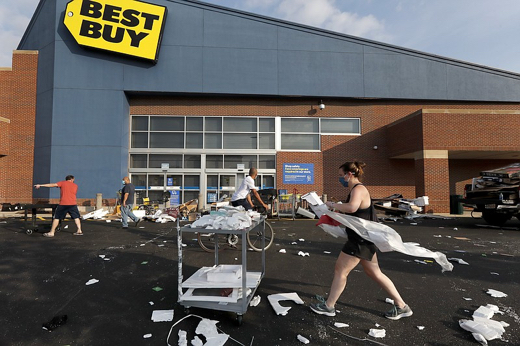

Image above: Volunteers help clean up the parking lot outside a Best Buy store, Monday, Aug. 10, 2020, after vandals struck overnight in the Lincoln Park neighborhood in Chicago. From (https://www.hotsr.com/news/2020/aug/11/hundreds-ransack-downtown-chicago-businesses/).

Virtually everyone agrees that 2020 was an abomination. An entire industry of opinion writers is busying itself with end-of-year hand wringing, scouring every online thesaurus for adjectives to express just how horrible the last twelve months have been. 

But what facet of the awfulness to focus on? For the appalled chronicler, the most obvious starting points are the coronavirus pandemic, which has left illness, death, shuttered businesses, and lost jobs trailing in its wake, and the chaotic US presidential election, in which the soundly defeated incumbent has attacked and seriously weakened the very foundations of democracy on his way out the door. 

These two baskets of grim news (pandemic and election) have been accompanied by a shift in the national (and, to some extent, global) zeitgeist—a shift that’s been obvious to anyone paying attention, but that’s nevertheless challenging to capture in words. 

Let’s call it the fracturing of consensus reality. While it won’t be the top story of the year according to most news roundups, it may end up being just as impactful as anything else that’s happened during our latest orbit of the sun. And that’s saying something. 

What’s Real? Let’s All Agree As social and linguistic creatures, we humans—operating in groups—create shared mental worlds. We perceive sensory data, then we verbalize and conceptualize those perceptions, and finally we check our verbalized and conceptualized accounts of reality with other people. 

Over time, a consensus emerges. This language-mediated reality-building process is hardly new; it’s been going on since we all lived by hunting and gathering. Then, everybody within their little groups shared the same stories and the same basic mental map of the world.

After we adopted agriculture, social classes and full-time division of labor ensued. With slavery, kings, and a dramatic reduction in the social power of women, consensus reality became more of a Venn diagram, with the king having the final word in defining the overlapping region on the diagram representing consensus. 

Later, the emergence of writing and Big God religions enabled reality to be codified for empires, and elements of the dominant consensus (e.g., Roman law and Christianity) could be spread among alien cultures. 

For most Europeans, even as dynasties came and went, reality remained essentially whatever the Bible, the church, and the king or emperor said it was. Consensus reality was never consistent or complete and never a correct map of what it purported to represent; it was always an approximation skewed by power relations. 

Some people’s realities were privileged, while other people’s were marginalized, excluded, or intentionally destroyed. And there were always blind spots—actual trends, vulnerabilities, and consequences that nobody noticed or talked about, such as the gradual depletion of natural resources—that only became “real” when they could no longer be ignored. The modern era (from roughly 1500 on) brought new sources of diversity to the consensus-building process. 

As Europeans conquered societies around the globe, “reality” began to reflect the sounds and flavors of these diverse cultures; the result was everything from jazz to fusion cuisine. Meanwhile, the power of commerce greatly increased, reducing the influence of church and aristocracy. 

Increased diversity and a shift toward commercial primacy were accompanied by new integrative trends in the process of collective reality-building. Principal among these was the emergence of science—a self-correcting method for discovering objective truth. 

Of course, science had its blind spots, too (for example, it was often subject to commercial influence—witness the long lags in recognizing the nasty side effects of tobacco and pesticides), but it was persuasive: assertions could be tested by controlled experiment. 

Over the decades, science built formidable structures of knowledge that most people lacked the expertise or temerity to question, but that could be verified by anyone with the necessary resources. Reality became “enlightened.” Another integrative trend consisted of the development of new communication tools—the printing press, and later radio, movies, and television. 

Increasingly, through these media, nearly everyone was exposed to common facts, ideas, and images. The wealthy banker and the destitute farmer uprooted by the dust bowl were marinated in the same Hollywood imagery, and the same civics homilies taught in compulsory public schools. 

Cracks in the Modern Consensus The emerging global consensus suffered a couple of serious ruptures during the modern era. In Europe, fascism brought more than a new set of political power relations; it created a mental universe so dominated by notions of racial and national superiority that it demanded the rewriting of textbooks. 

And in Russia, communism built a narrative in which the dictatorship of the proletariat—under constant attack by the forces of capitalism—must ultimately prevail, leading to a workers’ paradise. 

Both fascists and communists used new mass communication tools (radio, movies, and newspapers) to give their consensus realities force and credibility. Even science could be repurposed to support alternate realities. In the Soviet Union, the state decided to back an alternative to natural selection and science-based agriculture. 

The originator of this heterodox set of views, Trofim Lysenko, became Director of the Soviet Union’s Academy of Agricultural Sciences, where—with Stalin’s approving help—he rooted out the study of Mendelian genetics and taught instead the theory that characteristics acquired by parents can be directly transmitted to their offspring. 

Opponents of Lysenko were accused of “mysticism, obscurantism, and backwardness,” then banished to Siberian work camps. As a result, biological science in the Soviet bloc was set back decades. After the defeat of fascism in WWII and the fall of the Soviet bloc, the West’s consensus—shaped largely by the US—seemed to become reunified and stabilized. 

Political scientist Francis Fukuyama called it “the end of history.” But blind spots persisted and grew. Some of these profoundly shaped not just the dominant worldview itself, but the contours of daily life for multitudes. 

One telling example: the so-called science of economics codified for nearly everyone the false assumption that perpetual growth in industrial activity is possible, and denied all evidence to the contrary. 

Economics concealed other blind spots as well, as it continually ignored widespread signs that the “free market” does not in fact benefit everyone, and that people do not actually behave like idealized rational self-interest-maximizing robots. 

Some persistent and periodically worsening cracks in the consensus ripped along economic, ethnic, or political fault lines: especially during the Jim Crow era, African-Americans and European-Americans in southern US states inhabited sharply different realities, and stark inequities have persisted to the present. 

Other cracks, fed by suspicions that powerful people were manipulating the consensus to their own benefit, led to what came to be known as conspiracy theories—including doubts about the official accounts of the JFK assassination and 9/11, as well as misgivings about the safety and “real” purpose of water fluoridation and vaccination. Meanwhile, communications media were evolving still further. 

While radio and television had a largely unifying effect during the 20th century, the internet and social media are proving to be disintegrative to consensus in the 21st. Algorithms capture users’ interests and prejudices and feed them news and opinion articles that lead them to have ever-more-extreme views. 

“Do you think the government is suppressing information about space aliens? You don’t know the half of it! Read this!” 

The radicalizing propensity of social media was a factor in the sudden political ascendancy of Donald Trump, who acted as both symptom and driver of consensus breakdown. As a real estate developer and reality TV personality, he seemed an exceedingly inexperienced and unlikely candidate for the top political office in the country, and arguably the world. His intellect and ethics were widely suspect. 

But he had the ability to give utterance to the grievances of a sector of the populace that feels left behind—people of mostly European ancestry in low-density towns and rural areas across the nation (in recent decades, most of America’s wealth and cultural attention has flowed to high-density, multi-ethnic cities). 

Even if Trump could not change the material circumstances of small-town families, he could make them feel as though they had a voice. Ironically—and perhaps therefore somehow even more fittingly—it was the voice of a gaudily privileged New Yorker. 

But it was an angry voice, and it spoke in words of few syllables. He was the first Twitter President. The Trump team’s communication strategy, in the immortal words of former top adviser Steve Bannon, was to “flood the zone with shit.” Disruption of consensus reality wasn’t a regrettable side effect of their efforts; it was a central goal. 2020: The Dam Breaks In short, prior to the year now ending, consensus reality in the US was already starting to crumble. But 2020 delivered two sledgehammer blows: a pandemic and a polarizing presidential election. First, the pandemic. 

As many observers have pointed out, COVID-19 has greatly varying infection and death rates by nation, and countries with higher levels of social cohesion have generally tended to do better at combatting the disease. 

The United States has fared the worst of all countries in raw numbers, with over 17 million total cases so far and over 300,000 deaths (about a dozen smaller countries, including Belgium and San Marino, have suffered higher per capita rates of infection and mortality). Currently the US is seeing over 200,000 new cases each day and roughly 2,500 deaths. 

Unless the trend changes, total mortality for the country may eventually begin to rival that of the 1918-1919 influenza pandemic, in which about 675,000 died (though the per capita death rate will almost certainly not be as grim, given today’s far larger population). 

 Why has the US suffered such a horrific outcome? 

Much of the blame certainly must be borne by President Trump and his political appointees and allies in the federal government. They mounted almost no coordinated national pandemic response; instead, states were left to formulate their own policies and to compete with each other for medical supplies. 

Messaging from the executive branch was likewise unhelpful or downright counterproductive: in the early weeks, when the virus was largely just a distant menace and preparations could have made a huge difference, the President dismissed the need for concern (on January 22, he told a CNBC interviewer, “We have it totally under control. It’s one person coming in from China, and we have it under control. It’s going to be just fine.”). 

Then, when it became clear that sickness was spreading and people were dying, Trump invented the term “China virus,” evidently seeking to deflect blame while still failing to forge a national response plan. Later in the year, as economic and political concerns took the spotlight, 

Trump returned to almost completely ignoring the disease, even omitting attendance, for weeks at a time, at meetings of his coronavirus task force. With no clear messaging from the President, it was essential that the appropriate federal agencies step in. But here again the response faltered. 

The Centers for Disease Control at first advised the public against mask wearing, despite clear evidence that masks were effective at stopping the spread of the disease. Only later, once masks became more widely available, did the CDC change its recommendation. 

But this self-contradiction had undercut the agency’s credibility. Many people continued to believe that mask wearing is ineffective, while the President encouraged his followers to see mask mandates as government overreach. Conspiracy theories immediately filled the vacuum of leadership and consistent government messaging. 

Millions of people, stuck at home under lockdowns, were spending more time than ever on social media and Google, exploring ideas and opinions about the coronavirus. A pair of YouTube documentaries titled “Plandemic” became instant sensations.

 Many people adopted the view that there simply is no pandemic, and that the “fake news” media ginned up the story as a way to enable globalist liberal elites to exert more control over citizens and the economy. Now that vaccines are on the horizon, the conspiracy mill is cranking harder and faster than ever. While the anti-vax movement has been slowly simmering for decades, its current leaders’ books are suddenly among the top-sellers on Amazon.

Up to a third of Americans say they will likely refuse to take a vaccine when it is available. While many people hope that the advent of vaccines will halt the pandemic in its tracks, anti-vax fervor, along with the soaring rate of infections, may mean that the disease will continue to spread and kill far into the new year. If Americans were divided prior to the pandemic, their tribalism only intensified as the decision about whether to wear a mask became an instantly visible expression of group identity. 

But division was deepened also by the fact that 2020 was a presidential election year. Elections are always polarizing. That’s the point: each voter must choose one candidate or another; “all of the above” is not an option. 

But this election season pushed the polarization needle far into the danger zone. Democrats steeped themselves in books and articles detailing accusations that Donald Trump presents all the clinical symptoms of narcissistic personality disorder, and that he is an authoritarian, a rapist, a tax cheat, a business fraudster, a Russian puppet, and a traitor.

At the same time, followers of QAnon (who is supposedly a patriotic government insider) spread the notion that leading Democrats are Satan-worshiping pedophiles running a global child sex-trafficking ring, while Trump—a messiah sent by God—heads a heroic behind-the-scenes effort to preserve decency, freedom, and Christianity (QAnon believers now occupy seats in Congress and many state houses). The election outcome was unequivocal. 

Biden bested Trump by 7 million popular votes, with electoral votes stacked 306 to 232. Even Republican election officials in swing states said the balloting went off with scarcely a hitch. But Trump, evidently unwilling to be seen as a loser (or perhaps wishing to avoid prosecution for financial crimes once he leaves office), claimed that the election was rigged and that he had actually won. 

A flurry of almost 60 lawsuits followed, two making their way to the Supreme Court; all were dismissed. No convincing evidence of widespread irregularities was produced. Nevertheless, Trump’s followers adopted the narrative that millions of dead people had voted for Biden, and that suitcases full of illicit Biden ballots had been surreptitiously delivered to vote tabulators. According to one poll, only a quarter of Republicans think Biden was legitimately elected.

 A steady drumbeat of evidence-free assertions resounding through right-wing media channels and parroted by Republican elected officials (who fear retribution from Trump’s base) has created a formidable alternate reality in which Trump won fair and square, while Biden is being falsely elevated to the highest office.

 Consensus Dynamics Cognitive dissonance—the holding of contradictory thoughts or beliefs—makes people miserable. And when a person’s own interpretation of reality runs counter to the consensus reality, some degree of paranoia or depression often results. 

Alternatively, a person unmoored from the dominant consensus may become a dedicated paradigm warrior intent on converting others to their own views, sometimes even by violence. The loss of consensus is therefore also problematic for society as a whole. 

People who have left the consensus behind may disregard or flout norms (such as longstanding informal rules with regard to elections and Congressional procedures). Society then becomes less capable of solving problems; and so, if economic, social, or environmental crises materialize, societal collapse of one sort or another becomes a real possibility. 

As individuals find themselves not just disagreeing on politics or religion, but living in different and directly conflicting mental universes, they individually experience cognitive pain and anguish. Families are torn apart, friendships severed. 

But the collective risks of consensus breakdown go deeper, and include the possibility of widespread rage, pushing society toward civil violence, coup, or state failure. If, as is often the case, the fracturing of consensus results in (or is caused by) strong feelings of grievance among one group against another, a cycle of retribution may ensue. 

Recent brain research by James Kimmel, Jr. at the Yale University School of Medicine shows that the brain on grievance craves retribution in much the same way a brain addicted to heroin craves more heroin. 

 Is the fracturing of consensus reality a symptom of societal decline due to other factors (such as economic crisis or limits to vital resources), or is it an independent variable, capable of causing collapse by itself? 

In my view, the former is more likely the case: if a society is doing well economically, it is usually able to resolve occasional cognitive contradictions over time. A polarizing demagogue (like Joseph McCarthy or George Wallace) may appear, but the status quo eventually reasserts itself.

However, if a society is experiencing an economic, political, or social emergency, consensus breakdown may contribute to a self-reinforcing process of collapse. People’s views of reality don’t diverge arbitrarily and without cause. They do so because people’s self-interests (which may differ by income, status, region, religion, or ethnicity) are becoming further divided. The divergence of worldviews is thus a secondary problem.

But once consensus begins to shatter, people’s interests are likely to diverge even further as bifurcating worldviews create economic and social islands. People may even separate geographically, moving to be closer to people with whom they share values and views. 

Further, if an increasing majority people in a given community are espousing a new shared belief, others may feel compelled to alter their previous beliefs in order to belong. The fragmentation of consensus reality isn’t just a war of ideas. It is a more profound and disturbing process both psychologically and socially. People who have abandoned, or who have been abandoned by, the consensus may find dubious new beliefs to cling to; but they may also become keenly aware of cultural blind spots that others continue to ignore. 

They feel themselves flung into a new universe; the experience can be either terrifying or thrilling, or both. One of the effects of loss of consensus is the lowering of social trust. Trust is the basis of cooperation, and high levels of cooperation are required for modern complex societies to function. 

According to surveys by Pew Research Center, 71 percent of Americans think interpersonal trust has weakened in the past 20 years. There is a strong correlation between low trust and Trump voters—which could be an explanation for why the pre-election 2020 polls were inaccurate: people who are distrustful not only disproportionately voted for Trump but also refused to participate in polling surveys. Because the costs to society of loss of consensus are obvious and considerable, societies invest heavily in maintaining a shared worldview. 

But if there are severe and growing flaws in that consensus, keeping it whole may not be an option. 

When consensus fractures into two directly competing narratives, some people may seek to resolve cognitive dissonance by claiming that the two narratives are equally valid. But this is a difficult stance to maintain, as the narratives are usually mutually exclusive. Take the current case with regard to the US presidential election: the main competing reality claims are not on equal footing with regard to facts or outcomes. 

The “Trump really won” claim is simply fantasy; the “Biden really won” claim is backed by clear evidence that will result in the actual inauguration of a new President. But, in a way, facts are beside the point. Over a third of Americans are so alienated from the consensus that they prefer to believe obviously fabricated lies rather than to acknowledge demonstrable proof. 

The new Republican “reality” is tenable not because it is based on anything physically verifiable, but because it is emotionally satisfying for people who refuse to accept the dominant narrative. In the post-Trump era, traditional Republican ideology (low taxes, states’ rights, limited government spending) becomes entirely expendable. 

Any argument that “owns the Dems” is good, regardless how specious. 

Democracy itself becomes an impediment to the goal of wrecking the consensus. Defenders of the dominant worldview can’t understand why anyone would be so upset with it. Isn’t it based on science and established values and traditions? 

Doesn’t the alternative represent a devolution into pseudoscience, conspiracy theories, and deepening dissension? 

To a certain extent, the fervor of the disestablishmentarian faction is traceable to economic and social trends mentioned earlier (the flow of wealth and power to coastal urban centers and the slow demographic shift of the country toward multi-ethnicity). The upholders of the mainstream consensus accept those trends, which their elites use to their own advantage, but they fail to take account of those left behind, or to see the holes and blind spots in the consensus they defend. 

 Perhaps the deepest blind spot in the current US consensus is that it has no satisfying and unifying vision, no coherent ideology; its main guiding value is simply “more.” Its implicit message: we must keep on doing what we’re doing (producing more wealth by turning more of nature into waste) because to do otherwise would result in economic Armageddon. 

The best we can do is to somehow avert catastrophic climate change and reduce extreme wealth inequality with technical work-arounds, even as we continue to do the very things that cause those problems. 

 The central lie of the consensus is that the rising tide of economic growth will lift all boats . . . eventually. But eventually never seems to come. As the folly of expecting endless economic growth on a finite planet starts to reveal itself—via the need for ever more drastic measures to maintain the appearance of growth and to prevent widespread destitution—something has to give. People who feel unfairly treated as the impossible perpetual-growth machine decelerates begin fleeing the consensus, even if doing so leads them to curse imaginary scapegoats and believe obvious fictions. 

 Can the Old Consensus Be Repaired? Can a New One Be Built? Joe Biden is central casting’s answer to the call for a tried-and-true figurehead to restore the old consensus. Anyone who’s not swept up in anti-elite fervor probably finds it easy to sympathize with his exhortation to bring America back together, and his intention to be President of all the people, including those who voted against him.

However, Biden faces daunting if not insurmountable challenges. These arise not just from fervent, defeated, and angry Trumpists, who may attempt to run a “shadow” presidency, countering every action of the new administration. 

There are also hurdles inherent in the taming of the pandemic and the stabilization of the economy. Less widely acknowledged but perhaps most formidable of all is the challenge of finally coming to terms with the blind spots and lies embedded in the worldview that still runs the machinery of our economy and government. Consumerism—a way of organizing the economy that is fundamentally at odds with nature’s limits—is so deeply and implicitly woven into the warp and weft of modern America that only a cathartic collapse and renewal is likely to expunge it. 

The best Biden can likely do, even if he has the strategic brilliance to propose a Rural New Deal, is to be a competent placeholder. The perplexing fact is that we don’t know what kind of new consensus may emerge, or when. 

Indeed, it is entirely possible that, in the context of energy and economic decline, the human ideasphere will remain fragmented from now onward. However, I’d like to think that a new consensus is indeed possible, and that it will comprise the best of what we humans have learned so far. 

And, though what follows is entirely speculative, it seems appropriate to close this essay with an exploration of what that consensus might look like. Science would be an obvious candidate for inclusion, blind spots and all: its self-correcting mechanism tends to deliver improving approximations of truth with regard to physical reality. 

Of course, in a world with a smaller and slower economy and much less energy available, only comparatively small and simple experiments might be possible, but it’s the method that matters. 

 Science can’t tell us much about values and goals. For those, knowledge is less important than wisdom. And wisdom comes from intelligent self-control. As sages have always taught, it is in the taming of selfish urges that we find compassion and contentment. 

After the environmental and social mayhem that our two-century fossil-fueled consumerist mania will ultimately and undoubtedly unleash, I think we are likely to develop a strong and healthy collective skepticism regarding the aggregation of power for its own sake. 

A sustainability-oriented worldview would acknowledge the ongoing need for a low and stable population relative to environmental carrying capacity. And it would prize sufficiency, equity, resilience, and happiness above accumulation and ostentatious display. 

Our remarkable human capacities for language and tool making have gotten us into plenty of trouble over the millennia, never more so than now. A healthy consensus worldview would channel those outsized abilities away from geopolitical dominance and the production of wealth for the few, and toward the democratic (rather than just elite) production of beauty in all its possible forms—including poetry, literature, movement, music, art, drama, and architecture. And it would guide aesthetic appreciation toward the enhancement and emulation of nature.

Finally, a future consensus would take account of varying human needs, proclivities, modes of expression, histories, brain chemistry, and more, seeking reconciliation and community rather than exploitation and dominance. 

Such a consensus reality, such a culture, is far from where we are now. Between here and there sits a valley we must cross. If we travel together, we have a better chance of arriving safely on the other side. That requires healing the divisions among us, if and when we disagree. 

Have a peaceful holiday season.

.

The Great Unravelling

SUBHEAD: Part of a discussion series on adapting to the environmental crises we have created.

By Asher Miller on 28 October 2020 for the Post Carbon 
(https://www.postcarbon.org/is-the-great-unraveling-upon-us/)

Image above: Firefighters conduct a back-burn operation along Route CA-168 during the Creek fire as it approaches the Shaver Lake Marina on Sunday, Sept. 6, 2020. Photo by Kent Nishimura for The Los Angeles Times. From (https://www.latimes.com/california/story/2020-09-27/times-photos-california-fires).

Introducing “The Great Unraveling?”, a series of interviews with some of the world’s foremost experts on a broad range of environmental and societal challenges, culminating with a powerful discussion on what these converging and accelerating crises mean, and how we can respond.

What if we don’t look back on 2020 as the year from hell, a painful and surreal slip on the otherwise generally smooth path of progress? What if, instead, we look back in five or ten or twenty years to 2020 as the moment when everything started to really and truly unravel?

Of course, what I’ve presented is a false choice. The truth is that for billions of people (and other species!) the unraveling has been occurring for a long time, assuming they had anything that could be unravelled to begin with.

People who have been left behind or churned up by the relentless machine of exploitative capitalism. People and natural ecosystems already on the frontline of the climate crisis. Communities that have lost their social cohesion and ability to confront problems collectively.

2020 has exposed and supercharged the fragility, unsustainability, and injustice of so many of our global systems:
  • untenable economic and racial inequality;
  • brittle, globalized supply chains controlled by a relatively small number of corporations;
  • a global climate system that’s already fevered at 1.2ÂșC warming;
  • growing political instability, distrust, and the rise of authoritarian governments;
  • the collapse of biodiversity and the crossing of other planetary boundaries;
  • an economy dependent on growth, consumption, debt, energy, & population;
  • the failure of governmental institutions to respond to, let alone anticipate, crises;
  • the likely peak in the amount of energy available to power modern society.
These crises were already here or looming long before the coronavirus pandemic hit us broadside this year. In fact, my colleagues at Post Carbon Institute, the many writers who we have featured here at resilience.org, and allies across the globe have been sounding the alarm for decades that the Great Acceleration would inevitably lead to a Great Unraveling or even collapse. That forewarning may now be moot.

To begin considering how to navigate the “Great Unraveling,” we must first try to understand how various environmental and social systems may interact. So a few months ago, Post Carbon Institute and Anthropocene Actions asked some of the world’s foremost experts to share their views of where things stand with some of our most pressing environmental and societal challenges, particularly in the wake of the pandemic.

We then hosted a powerful discussion with an esteemed, diverse panel on what these converging and accelerating crises mean, and how we can respond.

Facing up to these interconnected crises requires unprecedented cooperation and coordination, if we have any hope of creating a sustainable, equitable, and resilient world. To this end, campaigners, politicians, companies, governments, and communities all across the world are pushing for and enacting change. 

But these efforts will have to remain robust, flexible, and resilient in the face of growing destabilization. And they must be grounded in an understanding of the systemic nature of the predicament we face.

The wrenching disruption of the pandemic presents barriers to change, as shown by those seeking to reinforce the pre-pandemic status quo. But this historic moment also presents opportunities to move toward a sustainable society that benefits all. The key to a better future is to learn how to manage the compounding crises of a more destabilized future – how to navigate the Great Unraveling. 

  .

Winning the Trifecta

SUBHEAD: To win we will have to solve all our problems together... health, wealth and environment.

By Juan Wilson on 24 June 2020 for Island Breath -
(https://islandbreath.blogspot.com/2020/06/winning-trifecta.html)


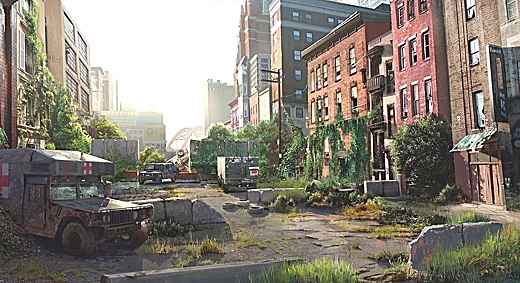
Image above: An urban street in America after a major collapse. From (https://www.masktactical.com/urban-survival-series-part-1/).

A trifecta is a certain kind of bet in a horse race. The better makes a great deal of money if he wins, but the chances are slim. The better must not only win on picking the first place finisher of the race, but also the second and third place winners.

We humans have to win against a trifecta of disasters that we have brought unto ourselves by greed, complacency and ignorance.

We have known for  more than three generations that the jig was up. We realized humans were destroying the Earth that is our only home. Its was 1970 (50 years ago) that President Richard Nixon, a conservative Republican, who signed into law the US Environmental Protection Agency.

There were high hopes that some remedy to our environmental plight might be found. It wasn't found and it wasn't in our short term interest to do so.  We avoided finding a way to save the Earth and the creatures that inhabit it because it wasn't as profitable or as comfortable as continuing on  burning up the planet for profit and comfort. 

Well, now we will have to win a trifecta to survive and flourish any longer. We face three implacable dangers that are intertwined.
  • Economic Collapse
  • Environmental Collapse
  • Worldwide Fatal Pandemic
The financial collapse is from over-borrowing against the future to continue economic growth as the means of creating wealth.

The environmental collapse is a result of supplying and utilizing the resources for the energy and resources for ever growing economic growth.

In my mind the worldwide fatal pandemic is a correction by Gaia (Mother Nature) for the financial and environmental collapse we have created. Mother Nature is shaking off her blood sucking tics.

There is little time or the will among us to change our ways... but for those that survive the 2020's it will because they have embraced small scale locally resourced food and fabrication. Those survivors will be using hand tools and sailboats rather than tractors and container ships to operate their steady state economy.

As we have been recommending for years... get a head start! As John Michael Greer wrote in 2012 "Collapse Now and Avoid the Rush!". That means getting educated to the situation and acting on it right now. 

If you are a newby to these thoughts you will have to work overtime to catch up. As James Howard Kunstler envisioned in his Would Made By Hand novels, most middle class suburbanites like car salesmen and insurance men will be lucky if they end up living on a productive plantation doing manual labor. 

Manual skills, whether making a barrel, playing a violin, or stitching up a wound, will have real and lasting value in the future. 

As things stand now, I have no clue how long we will have a "world wide web" to go to in the future. Right now we can count on it to inform us the answer to all the questions that we have. 

Once it is unreliable or down we will have only the hard copy left in the schools the libraries or your bookshelves for reference. You might try finding an Encyclopedia set that's been abandoned by your local library or at a local garage sale.


.

Dance Macabre

SUBHEAD: Hundreds of kinds of services no longer have customers who can afford their offerings.

By James Kunstler on 18 May 2020 for Kunstler.com
(https://kunstler.com/clusterfuck-nation/dance-macabre/)


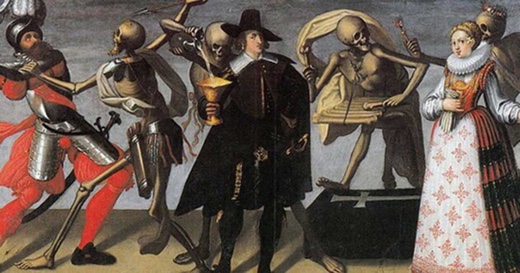
Image above: Painting from the 16th or 17th century illustrating the "Dance Macabre". From (https://www.ancient-origins.net/news-history-archaeology/dance-macabre-how-dead-danced-living-medieval-society-009063).

Western Civ’s most infamous encounter with pandemic disease, so far, was the big first wave of the Black Death that had a marathon run from 1346 to 1353. That bug was the real deal. It killed folks left and right, every age group, every social station, and it killed them ugly.

Few who caught it survived. Up to half the population of Europe perished, along with a lot of their social and economic ways.

The cause of the Black Death was subject to every possible explanation except the actual one, Yersina pestis, a bacterium associated with rats and their insect parasites, fleas and lice, who also enjoyed an association with humans living in the generally squalid conditions of the day — the ancient Roman habit of bathing long forgotten.

At the top of their list of causes was an angry God, and his wicked erstwhile subordinate, Satan.

The “experts” of that time tended to cluster in the church hierarchy, with its drear obsessions and compulsions. The squishy boundary between the supernatural and reality loosed all manner of derangement.

The Jews came in for much vilification, leading to massacres in Strasbourg, Mainz, and Cologne. On the whole, the episode represented a terrific humbling of humanity. The allegory of the Dance Macabre summed it up in mankind’s universal antic journey to the Palookaville of death.

On the plus side, as modern interpolators might say, the bubonic plague winnowed down Europe’s population to a scale more congenial with its resource base. After that big first wave of the disease, land was cheaper and human labor better rewarded.

Eventually, more food got around. Incidentally, the plague provoked nostalgia for the classical antiquity of Greece and Rome, especially among the scholars of Florence, launching the extravaganzas of the Renaissance, the Enlightenment, and eventually our own pageant of techno-supremacist Modernity.

Covid-19 seems rather a punk-ass illness compared to the Black Death. Its victims by far are people already on a fast track to the last roundup. We know exactly what causes it, if not so exactly its origin, and yet the response among our experts has been far more ambiguous than those long-ago bishops of Christendom to the Great Plague.

The various scientists, physicians, public health officers, and politicians seem, to the casual observer, about equally divided between those who consider the corona virus a grave threat and those who insist it’s hardly worse than any annual flu. What is one to believe? Or do?

Which brings us to the verge of the Great Opening-up. The current nostalgia for pre-Covid-19 business-as-usual is understandably intense.

Gone especially from daily life are all the ceremonies of human togetherness, from gatherings of friends to the casual shoulder-rubbings of urban life to the crowded venues of the lively arts to the great moiling orgies of pro sports.

The life of the perpetual jigsaw puzzle, YouTube, and Netflix has proved inadequate to human aspiration. Gone, too, are livelihoods, revenue streams, and rewarding roles in everyday existence. The itch to get out and do, get out and make, get out and be, is overwhelming.

Behind those plain yearnings, though, looms the specter of a system that appeared to be already foundering before Covid-19 entered the scene. There is, at least, considerable agreement that the disease catalyzed the disorders of finance and economy and accelerated the damage — just not among the people most responsible for engineering the fragilities that actually crashed things.

Jerome Powell, Pope of the Church of the Federal Reserve, went on the 60-Minutes show Sunday night to reassure the nation that things will eventually get back to normal. “I think you’ll see the economy recover steadily through the second half of this year.”

Yessir, if you say so. Were his fingers crossed? You couldn’t tell because the camera had him framed in a head-shot. Personally, I think the Fed Chairman was blowing smoke up the nation’s wazoo.

Spooky as it’s been, the Covid-19 virus has also been a great cover-story for the natural collapse of a severely unbalanced, ecologically unsound, and dishonestly represented set of arrangements that are now unspooling at horrifying speed.

The car industry is dying. The airline industry is laying out its fleet of big birds in desert graveyards. The college racketeering operation went off a cliff, along with medical profiteering. Agribusiness no longer has a business model.

Hundreds of kinds of services no longer have customers who can afford their offerings from acupuncture to zymurgy.

None of that will be fixed by injections of miracle money borrowed from ourselves in quantities that would turn every US citizen into a millionaire — if it wasn’t just pounded down the rat-holes of the stock and bond markets. The big question about the Great Opening-up is when the recognition of all that turns to raw emotion.

Covid-19 may still be with us then, but it will be the least of our problems.

The masks will come off. The dance will commence.
.

Not a Cause but a Trigger

SUBHEAD: This corona virus pandemic may cause civilization to collapse for good reasons.

By Ugo Bardi on 16 April 2020 for Cassandra's Legacy -
(https://cassandralegacy.blogspot.com/2020/04/collapse-coronavirus-is-not-cause-it-is.html)


Image above: Illustration by Steven Castelluccia of economic collapse caused by pandemic a peak consumption. From original article.

Do you remember the story of the straw that broke the camel’s back? It is an illustration of how overloaded systems are sensitive to small perturbations. Could the COVID-19 epidemic be the straw that breaks the back of the world’s economy?

Like an overloaded camel, the world’s economy is strained by at least two tremendous burdens: one is the increasing costs of production of mineral resources (don’t be fooled by the current low prices of oil: prices are one thing, costs are another). Then, there is pollution, including climate change, also weighing on the economy.

These two factors define the condition called “overshoot,” occurring when an economic system is consuming more resources than nature can replace. Sooner or later, an economy in overshoot has to come to terms with reality. It means that it can’t continue to grow: it must decline.

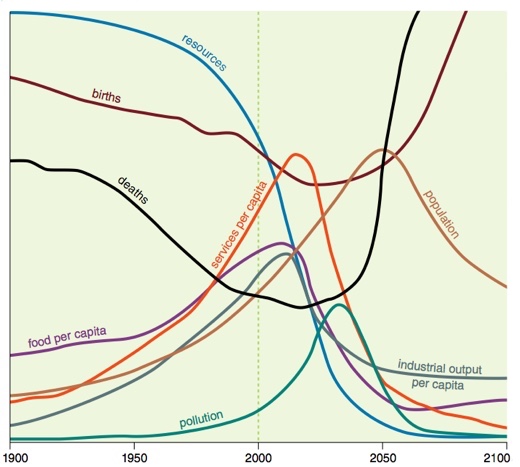
These considerations can be quantified. It was done for the first time in 1972 with the famous report The Limits to Growth sponsored by the Club of Rome. Widely disbelieved at the time, today we recognize that the model used for the study had correctly identified the trends of the world’s economy.

The results of the study showed that the double burden of resource depletion and pollution would bring economic growth first to a halt and then cause it to collapse, probably at some moment during the first decades of the 21st century.

Even with very optimistic assumptions on the availability of natural resources and of new technologies the calculations show that the collapse could at best be postponed, but not avoided.

Many later studies confirmed these results: collapse turns out to be a typical feature of systems in overshoot, a phenomenon called sometimes the “Seneca Cliff” from a sentence of the ancient Roman philosopher Lucius Annaeus Seneca.


Image above: Chart of the projections by the Club of Rome in March 1972 showing the projected " Limits to Growth". Note now in 2020 we have recently passed maximum food production and industrial output per person and are approaching maximum pollution as we slide down the steepest losses of resources. From (https://damnthematrix.wordpress.com/2012/04/11/so-much-for-debunking-the-club-of-rome/)

The coronavirus, in itself, is a minor perturbation, but the system is poised for collapse and the epidemics may trigger it. We already saw how the world’s economy is fragile: it nearly collapsed in 2008 under the relatively small perturbation of the crash of the subprime mortgage market.

At that time, it was possible to contain the damage but, today, the fragility of the system has not improved and the coronavirus may be a stronger perturbation.

The collapse of entire sectors of the economy, such as the tourism industry (more than 10% of the world’s gross product), is already ongoing and it may be impossible to stop it from spreading to other sectors.

So, what exactly is it going to happen to us? Since we started with mentioning a camel, we may also mention a famous statement by Shaykh Rāshid that we can summarize as, "My father rode a camel, I drive a Mercedes, my son will ride a camel." Might that sentence have been truly prophetic?

Indeed, the coming crisis might turn out to be so bad to push us back to the Middle Ages. But it is also true that all major epidemics in history have seen a robust rebound after the collapse.

Consider that, in the mid-14th century, the “black death” killed perhaps 40% of the population of Europe but, a century later, Europeans were discovering America and starting their attempt of conquering the world. It may be that the black death was instrumental in this rebound: the temporary reduction of the European population had freed the resources necessary for a new leap forward.

Could we see a similar rebound of our society in the future? Why not? After all, the coronavirus could be doing us a favor by forcing us to abandon the obsolete and polluting fossil fuels we use today. The current low market prices are the result of the contraction of the demand and are likely to be the straw that breaks the back of the oil industry. That will leave space for new and more efficient technologies.

Today, solar energy has become so cheap that it is possible to think of a society fully based on renewable energy. It won’t be easy, but recent studies show that it can be done.

That doesn’t mean that the near term collapse can be avoided. The transition to a new energy infrastructure will require enormous investments, impossible to find in a moment of economic contraction we expect for the near future.

But, in the long run, the transition is unavoidable and there is hope for a "Seneca rebound" toward a new society based on clean and renewable energy, no more plagued by the threats of depletion and climate change.

It will take time, but we can heal the poor camel’s back.

.

Covid19 Best Case Scenario

SUBHEAD: Imagining the aftermath of the pandemic and monetary collapse as a time of rebirth.

By Atossa Araxia Abrahamian on 20 March 2020 for the Nation -
(https://www.thenation.com/article/world/coronavirus-future-fiction/)

   
Image above: A view of optimism from a perspective of Islam. From (https://aboutislam.net/spirituality/be-optimistic-about-the-future-trust-in-allahs-plan/).

The virus made itself known in the Chinese city of Wuhan in December in the form of a respiratory illness not unlike pneumonia.

At first, no one knew quite where the disease had come from, but it seemed to touch workers at a wet market where exotic live animals were sold.

Before long, a 61-year-old man with preexisting health conditions died. He’d been a regular at the market, so they blamed the bats, then the pangolins, then the shoppers who procured these delicacies, and finally, just China.

Within weeks, the region was on lockdown, and flights were canceled.

But it was too late for containment. The virus had taken up residence in lungs and on fingertips, clothing and cardboard. Deterred only by soap and water, it traveled far and wide: to South Korea and Thailand, to Seattle and London.

One case was detected in the prophetically named French ski town of Contamines; a large outbreak occurred in Milan before spreading thick and fast throughout Italy. Hospital wards filled.

People panic-shopped for hand sanitizer and, bafflingly, toilet paper. On January 30, the World Health Organization declared the virus a public health emergency; six weeks later, it deemed the crisis a full-blown pandemic.

As winter gave way to spring, the virus crept into schools, cafés, subway cars, and nursing homes. Universities closed dorms and moved to conduct classes online. Remote work protocols were adopted. Service work dried up, dealing cab drivers and waiters and aestheticians an economic blow.

Children were told to stay home from school; parents were not told what to do with their children. But we are social creatures, unfit for long periods of solitude. When large gatherings were shut down, phone calls went unscreened and were even answered. People checked in. People cared.

As the plague spread, the human cost was staggering. Tens of thousands died. Millions more were sickened. It hit the elderly the hardest, as well as those with underlying conditions. The funeral industry boomed, as did the appeal of apocalyptic cults and slickly branded start-up religions.

Fortunately, children were mostly spared, and communities came together to make sure they caught up on their schoolwork in the absence of classrooms, courses, and teachers.

Facing anger, outrage, and grief from their citizens, governments realized that those who could not do their jobs remotely—not to mention those whose work had dried up–would be destitute if they did not receive significant aid.

So that’s what workers received: help, in the form of cash, food, and services. Means-testing went out the window. Work requirements were a joke. Debt payments and water bills and evictions were suspended, then canceled altogether.

Central banks enacted radical measures to stimulate the economy. There were no interest rates left to cut, so lending turned into giving.

No one asked where all the money was coming from, because everyone understood that this was where it had always come from. Some states actually ended up saving money: the happy result of all wars’ being put on hold thanks to a unanimous resolution in the UN Security Council.

Iran reached a détente with Israel after medical researchers banded together to develop a treatment that saved the life of millions, including former prime minister Benjamin Netanyahu. The treatment prevented him from infecting his cellmates in his supermax prison; he ended up succumbing to a stroke.

All but a tiny number of inmates in the United States were released. State funerals for politicians who said they could pray their way out of becoming sick were broadcast online, but attended by no one.

Military contractors started churning out medical supplies; soldiers mobilized to build homes and hospitals; unemployed workers pledged to build small-scale local green infrastructure. Austerity became a distant nightmare of the past.

With the airline industry in shambles and industrial activity at a virtual standstill, carbon emissions dropped dramatically. Demand for oil dried up, too.

Endangered species, unaffected by the virus, began to proliferate. Bats were studied and revered for their immunity to this virus, and many others. Pangolins were never seen at the dinner table again.

Because of stringent precautionary measures and warmer temperatures, the virus did not hit African states as hard as Western ones—a small mercy that nonetheless pushed countries there to establish a continental health system, with the help of the World Health Organization and an interest-free grant from the World Trade Organization, which changed its mission statement entirely.

Instead of lending to economically ailing nations, it would pool funding and make debt-free development grants, reasoning it was the only way to avoid a market crash.

Refugees living in camps—in South America, Lebanon, Greece, and beyond—were rehoused in decent accommodations to cut back on the risk of spreading the infection. They helped with relief efforts, earning them the admiration of locals and helping them integrate in their new homes.

Under the crushing weight of an overburdened health care system, countries began recognizing each others’ medical licenses, easing visa restrictions on doctors and nurses from less affected regions to emigrate and offering high-quality health care to everyone, no questions asked.

People necessarily crossed fewer borders, but when they did, they were greeted with open arms.

The TSA stopped banning liquids on flights, beginning with 12-ounce containers of hand sanitizer. Scientists worked around the clock to develop vaccines; philanthropists poured money into the initiative, even though they would no longer receive tax breaks for their efforts.

As their daily lives were upended, reorganized, and reimagined by the demands of the pandemic and the community, workers around the world adjusted to their new rhythms.

In China, where the crisis began, months of lockdown gave way to blue skies and clean breezes. The smog had cleared—a result of massive factory shutdowns. The sun shone brighter. It was easier to breathe.

Young peopled wondered, Why couldn’t the air be so clean every day? Why did they have to choose?

Farmers even found their livestock thriving, and their crops growing better—a consequence of cleaner soil and water, as well as regulation by health authorities to prevent immunocompromization and animal-borne infections.

For office workers, as the months passed, they began to question the way they had been living before the virus. They missed human contact, but not their commutes.

They wanted to see their colleagues, though were relieved to shed the artifice of the nine-to-five, the endless meetings, the pretending to be busy at all hours of the day, the sad desk lunches and minute-counting.

They worked when they needed to, and stopped when it was over. They spent more time with their families and made bad music and bad art.

See also:
World After Covid-19 Pandemic 3/20/20
Island Breath: Is Corona Virus a Bioweapon 2/20/20
.

World after the COVID-19 Pandemic

SUBHEAD: The pandemic will changes the world. Here are the thoughts of several global thinkers.

By contributors to Foreign Policy Magazine on 20 March 2020 -
(https://foreignpolicy.com/2020/03/20/world-order-after-coroanvirus-pandemic/)


Image above: Illustration of fight against 2019 Novel Coronavirus pandemic. From original article.

Like the fall of the Berlin Wall or the collapse of Lehman Brothers, the coronavirus pandemic is a world-shattering event whose far-ranging consequences we can only begin to imagine today.

This much is certain: Just as this disease has shattered lives, disrupted markets and exposed the competence (or lack thereof) of governments, it will lead to permanent shifts in political and economic power in ways that will become apparent only later.

To help us make sense of the ground shifting beneath our feet as this crisis unfolds, Foreign Policy asked 12 leading thinkers from around the world to weigh in with their predictions for the global order after the pandemic.


A World Less Open, Prosperous, and Free

By Stephen M. Walt

The pandemic will strengthen the state and reinforce nationalism. Governments of all types will adopt emergency measures to manage the crisis, and many will be loath to relinquish these new powers when the crisis is over.

COVID-19 will also accelerate the shift in power and influence from West to East. South Korea and Singapore have responded best, and China has reacted well after its early mistakes. The response in Europe and America has been slow and haphazard by comparison, further tarnishing the aura of the Western “brand.”

What won’t change is the fundamentally conflictive nature of world politics.

Previous plagues—including the influenza epidemic of 1918-1919—did not end great-power rivalry nor usher in a new era of global cooperation. Neither will COVID-19. We will see a further retreat from hyperglobalization, as citizens look to national governments to protect them and as states and firms seek to reduce future vulnerabilities.

In short, COVID-19 will create a world that is less open, less prosperous, and less free. It did not have to be this way, but the combination of a deadly virus, inadequate planning, and incompetent leadership has placed humanity on a new and worrisome path.


The End of Globalization as We Know It

By Robin Niblett

The coronavirus pandemic could be the straw that breaks the camel’s back of economic globalization.

China’s growing economic and military power had already provoked a bipartisan determination in the United States to decouple China from U.S.-sourced high technology and intellectual property and try to force allies to follow suit.

Increasing public and political pressure to meet carbon emissions reduction targets had already called into question many companies’ reliance on long-distance supply chains. Now, COVID-19 is forcing governments, companies, and societies to strengthen their capacity to cope with extended periods of economic self-isolation.

It seems highly unlikely in this context that the world will return to the idea of mutually beneficial globalization that defined the early 21st century. And without the incentive to protect the shared gains from global economic integration, the architecture of global economic governance established in the 20th century will quickly atrophy.

It will then take enormous self-discipline for political leaders to sustain international cooperation and not retreat into overt geopolitical competition.

Proving to their citizens that they can manage the COVID-19 crisis will buy leaders some political capital. But those who fail will find it hard to resist the temptation to blame others for their failure.


A More China-Centric Globalization

By Kishore Mahbubani

The COVID-19 pandemic will not fundamentally alter global economic directions. It will only accelerate a change that had already begun: a move away from U.S.-centric globalization to a more China-centric globalization.

Why will this trend continue? The American population has lost faith in globalization and international trade. Free trade agreements are toxic, with or without U.S. President Donald Trump. By contrast, China has not lost faith.

Why not?

There are deeper historical reasons. Chinese leaders now know well that China’s century of humiliation from 1842 to 1949 was a result of its own complacency and a futile effort by its leaders to cut it off from the world. By contrast, the past few decades of economic resurgence were a result of global engagement.

The Chinese people have also experienced an explosion of cultural confidence. They believe they can compete anywhere.

Consequently, as I document in my new book, Has China Won?, the United States has two choices. If its primary goal is to maintain global primacy, it will have to engage in a zero-sum geopolitical contest, politically and economically, with China.

However, if the goal of the United States is to improve the well-being of the American people—whose social condition has deteriorated—it should cooperate with China. Wiser counsel would suggest that cooperation would be the better choice. However, given the toxic U.S. political environment toward China, wiser counsel may not prevail.


Democracies Will Come out of Their Shell

By G. John Ikenberry

In the short term, the crisis will give fuel to all the various camps in the Western grand strategy debate. The nationalists and anti-globalists, the China hawks, and even the liberal internationalists will all see new evidence for the urgency of their views.

Given the economic damage and social collapse that is unfolding, it is hard to see anything other than a reinforcement of the movement toward nationalism, great-power rivalry, strategic decoupling, and the like.

But just like in the 1930s and ’40s, there might also be a slower-evolving countercurrent, a sort of hardheaded internationalism similar to the one that Franklin D. Roosevelt and a few other statesmen began to articulate before and during the war. The 1930s collapse of the world economy showed how connected modern societies were and how vulnerable they were to what FDR called contagion.

The United States was less threatened by other great powers than by the deep forces—and Dr. Jekyll and Mr. Hyde character—of modernity. What FDR and other internationalists conjured was a postwar order that would rebuild an open system with new forms of protection and capacities to manage interdependence.

The United States couldn’t simply hide within its borders, but to operate in an open postwar order required the building of a global infrastructure of multilateral cooperation.

So the United States and other Western democracies might travel through this same sequence of reactions driven by a cascading sense of vulnerability; the response might be more nationalist at first, but over the longer term, the democracies will come out of their shells to find a new type of pragmatic and protective internationalism.


Lower Profits, but More Stability

By Shannon K. O’Neil

COVID-19 is undermining the basic tenets of global manufacturing. Companies will now rethink and shrink the multistep, multicountry supply chains that dominate production today.

Global supply chains were already coming under fire—economically, due to rising Chinese labor costs, U.S. President Donald Trump’s trade war, and advances in robotics, automation, and 3D printing, as well as politically, due to real and perceived job losses, especially in mature economies.

COVID-19 has now broken many of these links: Factory closings in afflicted areas have left other manufacturers—as well as hospitals, pharmacies, supermarkets, and retail stores—bereft of inventories and products.

On the other side of the pandemic, more companies will demand to know more about where their supplies come from and will trade off efficiency for redundancy. Governments will intervene as well, forcing what they consider strategic industries to have domestic backup plans and reserves. Profitability will fall, but supply stability should rise.


This Pandemic Can Serve a Useful Purpose

By Shivshankar Menon

It is early days yet, but three things seem apparent. First, the coronavirus pandemic will change our politics, both within states and between them. It is to the power of government that societies—even libertarians—have turned.

Government’s relative success in overcoming the pandemic and its economic effects will exacerbate or diminish security issues and the recent polarization within societies

Either way, government is back. Experience so far shows that authoritarians or populists are no better at handling the pandemic. Indeed, the countries that responded early and successfully, such as Korea and Taiwan, have been democracies—not those run by populist or authoritarian leaders.

Secondly, this is not yet the end of an interconnected world. The pandemic itself is proof of our interdependence.

But in all polities, there is already a turning inward, a search for autonomy and control of one’s own fate. We are headed for a poorer, meaner, and smaller world.

Finally, there are signs of hope and good sense. India took the initiative to convene a video conference of all South Asian leaders to craft a common regional response to the threat. If the pandemic shocks us into recognizing our real interest in cooperating multilaterally on the big global issues facing us, it will have served a useful purpose.


American Power Will Need a New Strategy

By Joseph S. Nye, Jr.

In 2017, U.S. President Donald Trump announced a new national security strategy that focuses on great-power competition. COVID-19 shows this strategy to be inadequate. Even if the United States prevails as a great power, it cannot protect its security by acting alone.

As Richard Danzig summarized the problem in 2018: “Twenty-first century technologies are global not just in their distribution, but also in their consequences.

Pathogens, AI systems, computer viruses, and radiation that others may accidentally release could become as much our problem as theirs. Agreed reporting systems, shared controls, common contingency plans, norms, and treaties must be pursued as means of moderating our numerous mutual risks.”

On transnational threats like COVID-19 and climate change, it is not enough to think of American power over other nations. The key to success is also learning the importance of power with others. Every country puts its national interest first; the important question is how broadly or narrowly this interest is defined. COVID-19 shows we are failing to adjust our strategy to this new world.


The History of COVID-19 Will Be Written by the Victors

By John Allen

As it has always been, history will be written by the “victors” of the COVID-19 crisis. Every nation, and increasingly every individual, is experiencing the societal strain of this disease in new and powerful ways.

Inevitably, those nations that persevere—both by virtue of their unique political and economic systems, as well as from a public health perspective—will claim success over those who experience a different, more devastating outcome.

To some, this will appear as a great and definitive triumph for democracy, multilateralism, and universal health care. To others, it will showcase the clear “benefits” of decisive, authoritarian rule.

Either way, this crisis will reshuffle the international power structure in ways we can only begin to imagine. COVID-19 will continue to depress economic activity and increase tension between countries.

Over the long term, the pandemic will likely significantly reduce the productive capacity of the global economy, especially if businesses close and individuals detach from the labor force. This risk of dislocation is especially great for developing nations and others with a large share of economically vulnerable workers.

The international system will, in turn, come under great pressure, resulting in instability and widespread conflict within and across countries.


A Dramatic New Stage in Global Capitalism

By Laurie Garrett

The fundamental shock to the world’s financial and economic system is the recognition that global supply chains and distribution networks are deeply vulnerable to disruption. The coronavirus pandemic will therefore not only have long-lasting economic effects, but lead to a more fundamental change.

Globalization allowed companies to farm out manufacturing all over the world and deliver their products to markets on a just-in-time basis, bypassing the costs of warehousing. Inventories that sat on shelves for more than a few days were considered market failures

Supply had to be sourced and shipped on a carefully orchestrated, global level. COVID-19 has proven that pathogens can not only infect people but poison the entire just-in-time system.

Given the scale of financial market losses the world has experienced since February, companies are likely to come out of this pandemic decidedly gun-shy about the just-in-time model and about globally dispersed production.

The result could be a dramatic new stage in global capitalism, in which supply chains are brought closer to home and filled with redundancies to protect against future disruption. That may cut into companies’ near-term profits but render the entire system more resilient.


More Failed States

By Richard N. Haass

Permanent is not a word I am fond of, as little or nothing is, but I would think the coronavirus crisis will ​at least for a few years lead most governments ​to turn inward, focusing on what takes place within their borders rather than ​on what happens beyond them.

I anticipate greater moves toward selective self-sufficiency (and, as a result, decoupling) given supply chain vulnerability; even greater opposition to large-scale immigration; and a reduced ​willingness or commitment to tackle regional or global problems (including climate change) given the perceived need to dedicate resources to rebuild at home and deal with economic consequences of the crisis​.
I would expect many countries will have difficulty recovering from the crisis, with state weakness and failed states becoming an even more prevalent feature of the world. The crisis will likely contribute to the ongoing deterioration of Sino-American relations and the weakening of European integration.

On the positive side, we should see some modest strengthening of global public health governance. But overall, a crisis rooted in globalization will weaken rather than add to the world’s willingness and ability to deal with it.


The United States Has Failed the Leadership Test

By Kori Schake


The United States will no longer be seen as an international leader because of its government’s narrow self-interest and bungling incompetence.

The global effects of this pandemic could have been greatly attenuated by having international organizations provide more and earlier information, which would have given governments time to prepare and direct resources to where they’re most needed.

This is something the United States could have organized, showing that while it is self-interested, it is not solely self-interested. Washington has failed the leadership test, and the world is worse off for it.


In Every Country, We See the Power of the Human Spirit

By Nicholas Burns

The COVID-19 pandemic is the greatest global crisis of this century. Its depth and scale are enormous. The public health crisis threatens each of the 7.8 billion people on Earth. The financial and economic crisis could exceed in its impact the Great Recession of 2008-2009.

Each crisis alone could provide a seismic shock that permanently changes the international system and balance of power as we know it.

To date, international collaboration has been woefully insufficient. If the United States and China, the world’s most powerful countries, cannot put aside their war of words over which of them is responsible for the crisis and lead more effectively, both countries’ credibility may be significantly diminished.

If the European Union cannot provide more targeted assistance to its 500 million citizens, national governments might take back more power from Brussels in the future. In the United States, what is most at stake is the ability of the federal government to provide effective measures to stem the crisis.

In every country, however, there are many examples of the power of the human spirit—of doctors, nurses, political leaders, and ordinary citizens demonstrating resilience, effectiveness, and leadership. That provides hope that men and women around the world can prevail in response to this extraordinary challenge.

Banks are about to drown

SUBHEAD: The entire world has completely ‘misunderestimated’ the Corona Virus.

By Simon Black for Soverignman on 18 March 2019 -
(https://www.sovereignman.com/trends/banks-are-going-to-drown-in-an-ocean-of-defaults-27537/)


Image above: Banking district in lower Manhattan in a simulated rise in water in New York Harbor. From (https://www.rollingstone.com/culture/culture-news/can-new-york-be-saved-in-the-era-of-global-warming-240454/).

On November 6, 2000, then US presidential candidate George W. Bush told a crowd of cheering supporters, “they misunderestimated me.”

Now, if English is not your native language, allow me to clear the air: ‘misunderestimate’ is not a word. But then again, George W. Bush was legendary for hilarious slip-ups like this.

There are entire books dedicated to his ‘Bushisms,’ the ridiculous made-up words and incomprehensible sayings that became routine for the 43rd US President.

‘Misunderestimate’ seems to be a conflation of the words ‘misunderstand’ and ‘underestimate’. And while that was utterly hysterical 20 years ago when Bush first said it, ‘misunderestimate’ may be the most appropriate word of today.The entire world has completely ‘misunderestimated’ the Corona Virus.

In terms of misunderstand– that’s obvious. There’s so much that we don’t know about the virus (officially known as SARS-CoV-2) and the disease that it causes (COVID-19).

For example, a group of researchers published a “peer-reviewed” research paper earlier this month stating that the virus had split into multiple strains.

(Peer-reviewed is a type of self-regulation among academics; it means the paper had been evaluated by other experts before it was published.)

But other specialists in the field strongly disagreed with the paper’s conclusions.

Swiss biologist Richard Neher described the research as, “wrong, misleading. . . downright dangerous inferences,” while Australian virologist Ian Mackay called it a “weak paper and poor science.”

Another peer-reviewed study released in the Journal of Medical Virology concluded that the virus originated from snakes. But plenty of experts disagreed with that assertion too.

The scientific community has learned so much about SARS-CoV-2 since it first surfaced a few months ago.

But there’s still so much that’s unknown– and that makes perfect sense given that this virus is brand new. They’re trying to figure it out as quickly as possible, but that’s naturally going to lead to some disagreements and conflicting conclusions.

But then the Internet takes over, and suddenly everyone’s an expert. People who have no background in medicine and biology Tweet with a level of certainty about the virus that’s just plain silly.

US television personality Jimmy Kimmel joked about this last week, saying, “I speak [about the virus] as if I’ve been a professor of immunology at Stanford for 35 years…”

There’s still so many things that the experts don’t understand, or don’t agree on. The answers are coming, but it’s still early days.

But in addition to misunderstanding, the world has also totally underestimated this virus… and continues to do so.

It started in China back in December, with the government trying to keep the outbreak quiet and taking steps to silence the first whistleblower.

As the virus began to spread, Western nations complacently shrugged it off and assumed it would remain in Asia.

Even the World Health Organization refused to call this a ‘pandemic’ until March 11… only a week ago.

Investors around the world ignored this for months, completely underestimating the massive, worldwide economic impact the virus would have.

Even now, after one of the worst stock market crashes in history, people are still woefully underestimating the effects.

And I’m not talking about the stock market (though there could easily be more losses ahead). I’m talking about something far more serious: banks.

Banks are about to drown in an ocean of defaults. I’ll talk about this a lot more in the coming days, but briefly:
  • There’s $250 TRILLION in global debt right now– mortgages, credit card debt, business loans, government debt, etc.
  • And banks own a large portion of that debt.
  • This virus crisis is going to trigger a wave of defaults from consumers, businesses, and even governments.
  • Think about it: tourism alone makes up 10% of global GDP. Revenue in that entire sector– hotels, airlines, cruise ships, etc. has collapsed, and many of those companies aren’t going to survive.
  • The crash in oil prices is going to wipe out countless oil companies.
  • Many large retail chains, which were already struggling in the age of e-commerce, will likely declare bankruptcy.
  • Countless businesses around the world have ‘temporarily’ closed due to public health policies, and many of them will go out of business entirely.
  • MOST of these businesses owe lots of money to the banks, whether it’s a small business working line, or the $34 billion in debt that American Airlines owes. So the defaults are going to be massive.
  • On top of that, millions of people are going to lose their jobs and be unable to make payments on their credit card debt, auto loans, and even mortgages.
  • Again, there’s $250 trillion in global debt right now. Total bank capital worldwide is less than $10 trillion.
  • So if the coming defaults trigger a mere 4% loss in total debt, it will exceed the entirety of global bank capital.
  • And this doesn’t even take into consideration the impact of the $1 QUADRILLION derivatives exposure.
Misunderestimate? Absolutely.

This looming wave of loan defaults over the next few months could spark a crisis in the global financial system that completely dwarfs what happened back in 2008.

I desperately want to be wrong.

And it’s possible that public health officials radically shift their positions in the coming weeks and tell all the young, healthy people in the world to go back to work, get infected, and start developing immunity.

They may be forced to do this to avoid destroying the global economy.

But at this point, every possible scenario is on the table. Nothing is out of the question… especially when the arithmetic is so obvious.

And continuing to misunderestimate the effects of this virus could be far more dangerous than the virus itself.

We’ll talk about this more in the coming days, along with some sensible suggestions to reduce risk.

China's Fatel Dilemma

SUBHEAD: The corona virus can persist on inanimate surfaces like metal, glass or plastic for 9 days.

By Charles Hugh Smith on 10 February 2020 for Of Two Minds -
(https://www.oftwominds.com/blogfeb20/China-dilemma2-20.html)


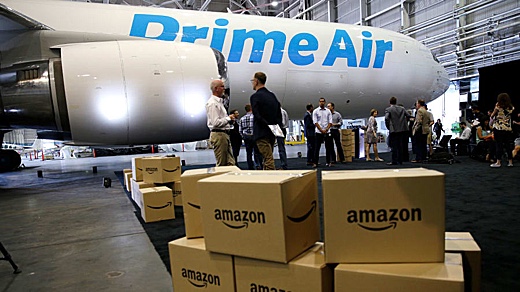
Image above: Preparations for roll-out of single day Amazon Prime delivery service in 2019. From (https://www.cnbc.com/2019/06/03/amazon-starts-to-roll-out-free-one-day-delivery-for-prime-members.html).

IB Publisher's note: This is not something to panic over, but it is something to be aware of. China will become desperate as economy as corona virus spreads and economy tanks. They will become desperate.] 

Ending the limited quarantine and falsely proclaiming China safe for visitors and business travelers will only re-introduce the virus to workplaces and infect foreigners.

China faces an inescapably fatal dilemma: to save its economy from collapse, China's leadership must end the quarantines soon and declare China "safe for travel and open for business" to the rest of the world.

But since 5+ million people left Wuhan to go home for New Years, dispersing throughout China, the virus has likely spread to small cities, towns and remote villages with few if any coronavirus test kits and few medical facilities to administer the tests multiple times to confirm the diagnosis. (It can take multiple tests to confirm the diagnosis, as the first test can be positive and the second test negative.)

As a result, Chinese authorities cannot possibly know how many people already have the virus in small-town / rural China or how many asymptomatic carriers caught the virus from people who left Wuhan. They also cannot possibly know how many people with symptoms are avoiding the official dragnet by hiding at home.

No data doesn't mean no virus.

If the virus has already been dispersed throughout China by asymptomatic carriers who left Wuhan without realizing they were infected with the pathogen, then regardless of whatever official assurances may be announced in the coming days/weeks, it won't be safe for foreigners to travel in China nor will it be safe for Chinese workers to return to factories, markets, etc.

But if China doesn't "open for business" with unrestricted travel soon, its economy will suffer calamitous declines as fragile mountains of debt and leverage collapse and supply chain disruptions push global corporations to find permanent alternatives elsewhere.

Here's the fatal dilemma: maintaining the quarantine long enough to truly contain it (which requires extending it to the entire country) will be fatal to China's economy.

But ending the limited quarantine and falsely proclaiming China safe for visitors and business travelers will only re-introduce the virus to workplaces and infect foreigners who will return home as asymptomatic carriers, spreading the virus in their home nations.

Falsely declaring China safe will endanger everyone credulous enough to believe Chinese officials, and destroy whatever thin shreds of credibility China may yet have in the global economy and community. That will set off chains of causality that will destroy China's economy just as surely as a three-month nationwide quarantine.

Who will be foolish enough to believe anything Chinese officials proclaim after foreigners who accepted the false assurances of safety return home with the coronavirus?

Anyone planning to receive goods via air freight from China might want to digest this report:

Persistence of coronaviruses on inanimate surfaces and its inactivation with biocidal agents Endemic human coronaviruses (HCoV) can persist on inanimate surfaces like metal, glass or plastic for up to 9 days.

Air freight takes 12 to 24 hours, add another few hours for packaging, handling and last-mile delivery and that leaves 6+ days for the virus to spread to anyone who touches goods handled by an symptomatic carrier. 

Maybe the odds of catching the virus via surfaces are low, but maybe not. No one knows, including anyone rash enough to claim that the risk is negligible.

.

Nurse flew with Ebola symptom

SUBHEAD: Amber Vinson, 2nd nurse from Dallas to be infected, flew to and from Cleveland.

By Alan Horowitz on 15 October 2014 for Huffington Post -
(http://www.huffingtonpost.com/2014/10/15/amber-vinson-cdc-ebola_n_5993486.html)


Image above: Photo of the three people diagnosed with Ebola from Texas Health Presbyterian Hospital; (l-r) Thomas Eric Duncan (deseased), nurse Nina Pham and nurse Amber Joy Vinson. CDC let Vinson fly from Cleveland to Dallas with low grade fever later determined to be from Ebola. From (http://www.11alive.com/story/news/nation-now/2014/10/15/ebola-nurse-amber-joy-vinson-flew-plan-wedding/17313413/).

[IB Publisher's note: "Brownie You're Doing A Heck Of A Job", George W. Bush to FEMA head. It is beginning to look like the CDC (Center for Disease Control) is handling the Ebola outbreak in 2014 as badly as FEMA (Federal Emergency Management Agency) handled Hurricane Katrina in 2005, and the EPA (Environmental Protection Agency) handled BP oil spill in 2010. ]

A Dallas nurse who took a commercial flight from Cleveland hours before reporting symptoms of Ebola says that the Center for Disease Control and Prevention told her it was okay to fly.
Amber Vinson helped treat Thomas Eric Duncan, the Liberian man who died in Dallas of the Ebola virus earlier this month. On Wednesday, the CDC announced that she had contracted the virus as well.

The CDC also revealed that she had taken a flight to Dallas on Monday, though it said that it was extremely unlikely that any other passengers were exposed.

Vinson told CBS Dallas Fort Worth that she was feeling ill before boarding her flight. She had a low grade fever, but she said that officials told her it was okay to get on the plane. Vinson told CBS that she called the CDC several times with concerns.

is only contagious when a patient is symptomatic. Vinson's 99.5 degrees Fahrenheit fever wasn't high enough to be considered a symptom.

The CDC confirmed to FOX 4 News that they gave Vinson the green light to fly. "Vinson was not told that she could not fly," a government spokesperson told NBC News.

Vinson's comments contradict remarks made earlier today by CDC Director Tom Freiden, who said that she never should have gotten on the plane.

On Wednesday night, a letter from Frontier Airlines CEO Dave Siegel to airline employees claimed that the CDC had notified the airline that Vinson may have had symptoms while on the flight, the Denver Channel reported. "At 1:55 p.m. MDT (Wednesday) Frontier was notified by the CDC that the passenger may have been symptomatic earlier than initially suspected; including the possibility of possessing symptoms while onboard the flight," the letter said.

This would conflict with CDC's earlier statement that she didn't have symptoms of the illness while she was on the flight and didn't start showing symptoms until Tuesday.

After Vinson reported symptoms of Ebola on Tuesday, she was placed in isolation. On Wednesday, she was transported to Emory Hospital in Atlanta, where she will continue to receive treatment. She is in stable condition.

The 29-year-old nurse is the second person to contract Ebola in the United States. The first was Nina Pham, who is also a nurse at Texas Health Presbyterian Hospital Dallas, where Duncan was being treated. Duncan is the first person to have died of Ebola in the United States.

The CDC is trying to locate the 132 passengers that were on the Frontier Airlines flight 1143 with Vinson to determine their potential risk of Ebola. On Wednesday night, an official said that a Fort Worth family with a child had been isolated after a member of the family boarded a Frontier airline with Vinson, according to NBC DFW's Brian Curtis.

After a scheduled trip to Denver, Frontier Airlines said that the plane that Vinson flew on was taken out of service. The seat covers and carpeting are to be replaced, the crew placed on paid leave, according to Marc Stewart of KMGH.


Frontier plane flew 5 more times

SUBHEAD: Carrier completed five more flights after carrying Ebola stricken nurse from Cleveland to Dallas.

By Hugo Martin & Dan Weinkel on 15 October 2014 for LA Times -
(http://www.latimes.com/business/la-fi-frontier-airline-ebola-patient-20141015-story.html)


Image above: The Frontier Airlines plane that Amber Vinson flew from Cleveland to Dallas on Monday, rests at a terminal at Cleveland Hopkins International Airport, Wednesday, October 15, 2104. From original article.

The Frontier Airlines jet that carried a Dallas healthcare worker diagnosed with Ebola made five additional flights after her trip before it was taken out of service, according to a flight-monitoring website.

Denver-based Frontier said in a statement that it grounded the plane immediately after the carrier was notified late Tuesday night by the Centers for Disease Control and Prevention about the Ebola patient.

Flight 1143, on which the woman flew from Cleveland to Dallas/Fort Worth, was the last trip of the day Monday for the Airbus A320.

But Tuesday morning the plane was flown back to Cleveland and then to Fort Lauderdale, Fla., back to Cleveland and then to Atlanta and finally back to Cleveland again, according to Daniel Baker, chief executive of the flight-monitoring site Flightaware.com.

He said his data did not include any passenger manifests, so he could not tell how many total passengers flew on the plane Tuesday.

The passenger "exhibited no symptoms or sign of illness while on Flight 1143, according to the crew," Frontier said.

The plane went through a routine but "thorough" cleaning Monday night, Frontier said. Airline industry experts said routine overnight cleaning includes wiping down tray tables, vacuuming carpet and disinfecting restrooms.

The healthcare worker also had flown to Cleveland from Dallas three days earlier on Frontier Flight 1142, the airline reported.

An official with the union that represents Frontier pilots said members were so concerned about possible exposure to the deadly virus that they began reaching out to doctors and other experts Wednesday for information about Ebola.


The airline said it was working with the CDC to contact all 132 passengers on the Monday flight that carried the Ebola patient.

Frontier could not be reached to confirm the FlightAware data, and it was unclear whether passengers on the additional flights were being contacted.

“It seems like it’s not that big of a risk, but it’s pretty scary,” said the union official, who asked to remain anonymous because he was not authorized to speak for the group.

The union official also said that Frontier sent pilots information Wednesday morning outlining the cleaning procedures the carrier was using to make sure the disease did not spread.

In response to the news that another Ebola patient had flown on a commercial flight, the union that represents 60,000 flight attendants on 19 airlines is asking the CDC to monitor and care for the four flight attendants who were on the Frontier flight from Cleveland to Dallas/Fort Worth.

The Assocciation. of Flight Attendants “will continue to press that crew members are regularly monitored and provided with any additional resources that may be required,” the group said.

The Ebola scare prompted the union last week to call for better measures to protect flight attendants from exposure to the deadly virus.

The group's international president, Sara Nelson, suggested that flight attendants are being asked to do too much in the fight against Ebola.

"We are not, however, professional healthcare providers and our members have neither the extensive training nor the specialized personal protective equipment required for handling an Ebola patient," she said in a statement.

Amber Joy Vinson of Dallas, traveled by air on October 13th, the day before she first reported symptoms.
Meanwhile, the trade group for the nation’s largest airlines said carriers were working with federal heath officials “to ensure we are doing all we can to protect the well-being of our passengers, our crew members and the American public.”

Airlines for America, whose members do not include Frontier, said its airlines are all equipped with “universal precautions kits” that include gloves, masks, aprons and biological waste bags to clean up any medical spill or accident on a plane.

Earlier this month, United Airlines was rushing to contact passengers who flew on two flights that carried a Liberian man infected with Ebola from Brussels to Washington, D.C., and then to Dallas.

The Ebola-stricken healthcare worker who flew on Frontier had been treating the Liberian man, Thomas Eric Duncan, who has since died.

The latest scare has forced some air travelers to think twice about flying.

“It is very scary and my travel is now very, very limited,” Bruce Remick of Hollywood said. “I prefer Skype conferencing.”

Airline-industry stock prices have taken a beating in recent weeks, with some analysts blaming the Ebola scare.

On Wednesday, stocks of Delta Air Lines and United Airlines fell more than 1%. A New York Stock Exchange index of airline stock is down 11.57% over the last month. Frontier is privately held.


.