Showing posts with label Food Forest. Show all posts

Blackfeet back to traditional foods

SUBHEAD: Native American youth are learning to integrate local foods back into their daily lives.

By J. Gabriel Ware on 6 Jujne 2017 for Yes Magazine -
(http://www.yesmagazine.org/people-power/blackfeet-researcher-leads-her-tribe-back-to-traditional-foods-20170606)
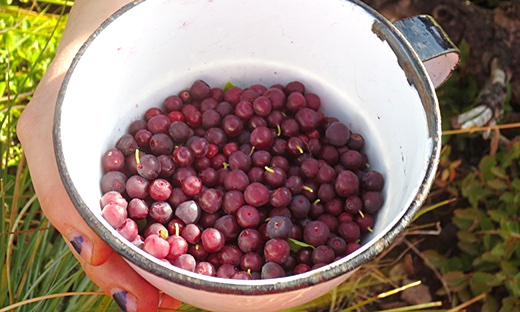

Image above: A cup of freshly picked huckleberries. Photo by Abaki Beck. From original article.

Researcher Abaki Beck, 23, has vivid childhood memories of helping her mother, grandmothers, and aunts pick traditional foods and medicines on the Blackfeet Nation in northwest Montana. Because her great-grandmother passed down her vast knowledge of the tribe’s traditions, Beck learned the importance of eating these foods at an early age.

Well before white settlers colonized their land, Blackfeet Nation members used more than 200 types of plants for food and remedies. But forced assimilation and reliance on the U.S. government for food adversely shifted most nations’ diets from whole foods to industrialized processed foods and eroded tribal health.

More than 80 percent of American Indian and Alaska Native adults are overweight or obese, and half of American Indian children are predicted to develop Type 2 diabetes in their lifetimes, according to the Indian Health Clinical Reporting system.

Beck, who has a degree in American studies and has researched the impacts of settler-colonialism on Blackfeet youth suicide, hopes to change those health disparities.

Her report, published in May, “Ahwahsiin: Traditional Ecological Knowledge and Contemporary Food Sovereignty on the Blackfeet Reservation” (ahwahsiin translates to “the land where we get our food”), features oral history interviews with nine Blackfeet elders who discussed the nation’s traditional foods and the health issues connected to a modern American diet.

A 2016 survey —the Blackfeet Nation has approximately 17,000 members—found that one of the most cited barriers in accessing traditional or local foods was lack of knowledge.

“Our people survived genocide in part because of [traditional] foods and medicines,” Beck says. “And because our elders are passing away and global warming is changing how our environment functions, now is a significant time to capture elders’ knowledge and our own community’s history.”

Beck partnered with Saokio Heritage, a community-based and volunteer-run organization on Blackfeet. The report was funded by a $10,000 grant from the First Nations Development Institute and is available on the organization’s website.

Many of the traditional foods, plants, and teas are still available on the reservation, and some are even sold in health food stores, Beck says, so younger tribal members can learn to integrate them into their daily lives.


Image above: Blackfeet Elders Angeline Wall and Bernadette Wall collect roots on the Blackfeet Reservation. From original article.

For example, traditional medicine like willow bark or blue root can replace Tylenol, and bison or venison can replace fatty beef. Local berries can either become a traditional berry soup or be mixed into other recipes like pancakes, muffins, and smoothies.

“Some Westernized foods and medicines are not best for tribal people,” says Carolyn Angus-Hornbuckle, director of public health policy and programs at the National Indian Health Board. “These health disparities are happening throughout Indian Country, and we could see positive health impacts if Blackfeet chose to share Beck’s report and their knowledge with other communities.”

Most scholarly research reports are concealed behind paywalls and easily accessible by only those in academia, but Beck removed that barrier for the Blackfeet people by making her report available for free.

Danielle Antelope, a 21-year-old Blackfeet Community College student who helped Beck conduct the interviews, grew up eating chicken patties, cheeseburgers, and tater tots for dinner.

“We never ate vegetables,” Antelope says. “My mom was a single mom, so she wanted to make sure we were full when she fed us, but we didn’t think about the nutritional aspect of what were we eating.”

“I wish I had known of our traditional ways of eating when I was younger,” she adds. “I didn’t really learn about eating healthy in school, either.”

Efforts to promote food sovereignty throughout Indian Country have included youth education, community gardening, and economic development. But because there are hundreds of distinct tribes—with different needs and systems of food, government, and regulation—approaches to tackling the health disparities vary greatly, Beck says.

Even though “health disparities on the Blackfeet Reservation [are] too broad to be solved by one report,” Beck says, she’s confident that awareness is part of the solution.

.
Permaculture in Hawaii

SUBHEAD: Permaculture works to keep the birds, insects, soil and surrounding nature content and ourselves fed.

By Juan Wilson on 26 April 2017 for Island Breath -
(http://islandbreath.blogspot.com/2017/04/permaculture-in-hawaii.html)


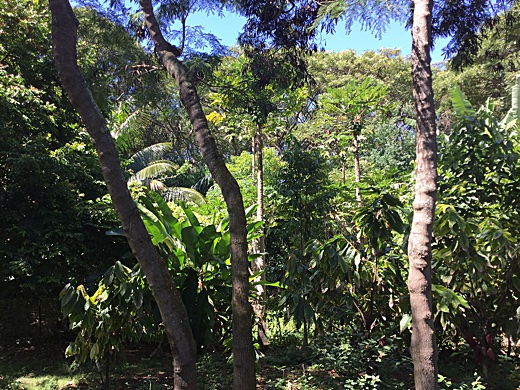
Image above: We at IslandBreath have attempted to do permaculture. Photo from our backyard efforts at creating a "food forest" that we have named "Akea Aina".  In this image are cacao, starfruit, avocado, papaya, cassava, coconut, breadfruit, banana, and mango. Photo by Juan Wilson.

Akea Aina consists of about 1.5 acres of land - a third of it is our property, a third rented from the Robinson family and another third is on Hawaiian public land.

The photo above show haole koa ("false" koa) trees in foreground. They are early adopters in yards on Hanapepe Valley but few people have let haole koa grow so large as they are usually considered weed trees.

Haole koa are hard and heavy wood good for fires and they are good nitrogen fixers. They provide light shade that sun-delicate plants can grow under. Beneath them are a row of cacao trees with fruit.

To the left and right of this photo are breadfruit trees and cassava. Beyond what you can see are beehives.

In the background, from the left is a starfruit tree, coconut, mango, papaya, avocado and more. That's only a small sample of what can be grown on a small farm.

Below is a brief video survey of permaculture efforts in Hawaii on various islands. By "permaculture" we mean intentional living arrangements on land that produces food and fertile land as a foundation of healthy local flora and fauna. This way of life means living "in nature".

That implies sustainable self sufficiency in food, soil, water and energy.      

Mokupuni o Hawaii
Introduction to the permaculture training programs offered at the  La'akea community on the Big Island, with teacher Tracy Matfin. Get a look at La'akea uses permaculture principles.


Video above: Permaculture Education Programs - La'akea, Hawaii in 2011. From (https://youtu.be/-XgpTaAfb7Q).

Mokupuni o Maui
Fruition Permaculture Design as he gives us a tour of Laulima Farm in lush Kipahulu, Maui, Hawaii. Jesse Krebs discusses the key permaculture design features of this beautiful tropical farm.


Video above: Fruit-based Veganic Permaculture on Maui in 2013. From (https://youtu.be/zG2JuTvq5e8).

Mokupuni o Molokai
SustAINAble Molokai and Geoff Lawton of the Permaculture Research Institute of America and of PRI Australia. We now have strategies to heal the land by slowing the course of water.


Video above: Heal the land, Harvest water, Grow food security on Molokai in 2013. From (https://youtu.be/P2Lp8YmJaag).

Mokupuni o Oahu
Growing your own food and being self sufficient is one of the best ways to give power back to the people and live in harmony with nature.


Video above: Permaculture with Paul Izak in Hawaii on Oahu in 2012. From (https://youtu.be/_WHG3NJEq90).

Mokupuni o Kauai
Paul Massey, the Director Regeneration Botanical Gardens gives a concise definition of what Kauai Food Forest is all about.


Video above: Permaculture in Kauai Part 2 in 2013. From (https://youtu.be/5pJrw9QuCB0).

There is no doubt in our minds that these methods of "farming" are the way to go here in Hawaii. It works to keep the birds, insects, soil and surrounding nature content and ourselves fed.

.

Ecovillage Rescuing Los Angeles

SUBHEAD: They transformed it into a traffic-calmed and car-restricted promenade with fruit trees.

By Albert Bates on 26 March 2017 for The Great Change -
(http://peaksurfer.blogspot.com/2017/03/rescuing-los-angeles.html)


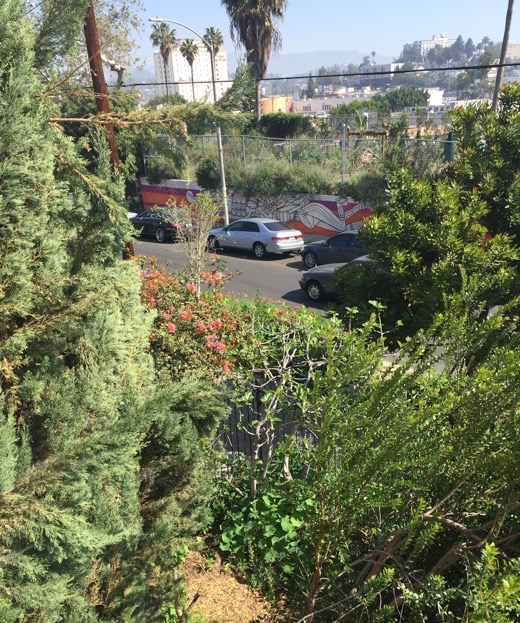
Image above: View from site of the Ecovillage in Los Angeles. From original article.

In the concrete desert that is downtown Los Angeles we were blessed to find a green oasis at the corner of Vermont and 1st Avenues known as Los Angeles Eco-Village (LAEV).

How we can use our hard wiring to communicate to the herd that it is time to veer off from a race towards the cliff’s edge which most don’t yet see?

LAEV has taken a two-block area of random residents and small storefront businesses, alleys and churches and transformed it into a traffic-calmed and car-restricted promenade with fruit trees, mosaic tables and cob benches built around larger canopy trees, verge gardens, interior courtyards and attractive outdoor classrooms.

It has created attractive residences affordable to lower income people, stores and kiosks selling products and services made or provided by neighbors.

It has converted large apartment complexes to low income, ethnically diverse cooperative housing, and is transforming four-plex garages to 3 or 4 story mixed use development with retail, offices, and super affordable “tiny” housing, with small ecological footprint and no parking.

It created California's first bicycle kitchen (starting literally from the kitchen in an apartment house) — a way of cooperatively building, sharing and maintaining bicycles and the skill-set that goes with that.

A recent purchase of an abandoned building and vacant lot on the corner of Vermont Avenue will allow them to create People Street Plaza with two parklets and an enclosed bike corral, a solar arbor for small electric neighborhood plug-in vehicles and pedal hybrids, plus metered parking and expanded city repair functions at two intersections.

Next year the ecovillage plans to eliminate sidewalks and parking lanes on north side of White House Place and install an urban organic working farm/food forest.

In the future they would like to acquire 5 four-plexed apartment houses on White House Place to ensure permanent affordability for 80 to 120% of poverty-level income if existing/future qualifying residents will commit to going car-free within a specified time, and providing convenient car share options.

They would power these new homes by installing neighborhood solar PV over the school parking lot. Beyond 2030, when the parking lot is no longer needed, they would create an urban farm.

More ambitious, and requiring more city approvals, are plans to acquire and retire the auto repair shops, raze them and reopen the concreted-over hot springs, Bimini Baths, that were overtaken by sprawl and pavement almost a century earlier.

They'd like to open a center for therapeutic and recreation and to offer affordable housing for healers (so they can charge lower rates for lower income residents).

They'd like to bring back the trolley service to the tracks that used to carry bath patrons to and from other parts of the city. For the immediate future, a vegan cafĂ© and outdoor garden is planned to replace the auto repair shops. 

Much of this will be accomplished by local residents, using a Cooperative Resources & Services Project (CRSP) Ecological Revolving Loan Fund (ELF) which has the potential to generate about $2.5 million every three to six month period.

Imagine, for a moment, all cities transformed from the bottom up in this fashion. LAEV does not plan to produce all its own food, water, power and other needs from within its two-block area, but it could. Instead, it encourages doing some of that while also participating in cooperatives that join together the products and services of other parts of the city.

Once upon a time the founder of permaculture, Bill Mollison, was asked how cities could become sustainable. He responded that it was only by providing for all their needs within their boundaries.

Los Angeles, even now, at 5000 persons per square mile, could do this. But then, like LAEV, it would need to take another step and begin the process of producing food, fiber and energy while progressively withdrawing carbon from the atmosphere.

Ecovillages similar to LAEV — The Farm, Earthaven, Findhorn, ZEGG and Seiben Linden — have already demonstrated their ability to net sequester more than their own carbon in order to reverse climate change, even while implementing the UN’s 17 Sustainable Development Goals, using a combination of for-profit and non-profit social enterprises and a holistic, deliberative approach.

Over the past few years they have risen still another step and are embarked, with Global Ecovillage Network, Gaia University and Gaia Education, upon a process of building curricula and the cadre of trained instructors that will carry the work to a global scale.

This core idea, brought by ecovillages at the cutting edge of an historic shift, is part of the British Commonwealth's new Regenerative Development to Reverse Climate Change strategy announced at COP-22. It is also allied with the Chinese Two Mountain Policy we described here last December.

Ecovillages are like a shadow world government. They are not top-down electoral, C3I or Deep State puppeteers; they are grass roots, spontaneous, semi-autonomous networked infiltrators. Their weapons are not Death Stars or enslaving financial schemes but viral memes spread by new media, art and gardening.

They run on the energy and creativity of youth. They are a bullet train on a return track back out of the Anthropocene.

What is needed now, today, is exactly that sort of low cost, rapidly deployed, hugely scalable approach to reversing human misery, ecological destruction and climate change that will find apolitical social acceptance, quickly, without the requirement of carbon taxes or offset markets that only serve to line the pockets of the obscenely obtuse.

Indeed, to scale quickly, it should use tested, off-the-shelf technology, be antifragile, employ lots of young entrepreneurs, and provide a sensible return benefit for those in the older generations who hazard their limited time and resources to assist.

The adoption process for carbon-sequestering economies could benefit from the ideas Malcolm Gladwell expressed in The Tipping Point: How Small Things Make a Difference (2000).

Gladwell argued that the ability of viruses (whether diseases or ideas) to spread quickly, and universally, depends on their ability to be attractive and sympathetic. They need to be able to cross cultures, genders, age groups, and races.

Gladwell pointed to three elements that cause epidemics to spread, and said these same elements are fundamental to any large-scale social change. They are:
  1. The Law of the Few — some people spread disease (and ideas) better than others.
  2. The Stickiness Factor — the potency of viruses (or ideas and actions) to become universal. Ideas and actions to reverse climate change need to continue evolving and draw in people from around the world. The greater context of our climate dilemma suggests that if a favorable human tipping point is to occur, it needs to be able to cross cultures and to be sticky across all those differences.
  3. The Power of Context — the conditions under which the change is considered tend to either reinforce the change or thwart its spread. Commitment is not enough. The committed have to act, and share their commitment with others.
If a cultural tipping point is required, the tools most associated with cultural evolution should be employed. These include artistic movements (visual arts, performance, music, etc.), fashion (attraction to styles), and celebrity endorsements, among others.

Humans evolved as herd animals and we constantly signal to each other our affiliations, tastes and choices. Tapping into this natural process allows memes to propagate when stickiness and context cohere.

This leads us to an examination of the concept of style. What is it in the human genome that makes us such dedicated followers of fashion? Likely it is hard wired by an evolutionary choice our species made several million years back.

We hairless apes are more like army ants, gray wolves, dolphins, lions, mongooses and spotted hyenas than jaguars, frogs and horse flies. We are pack hunters.

Herd behavior has a defensive purpose, too. Witness zebras crossing a river full of crocodiles or a young buffalo calf being stalked by wolves. Some will be picked off, but most will survive.

We continuously signal to others in our herd that we are with them. We are part. We are in this tribe. We seek tribe approval, acceptance, respect. We may do this the way birds do, with colorful plumage, or the way horses do, with speed and agility. A necktie or a pants suit are forms of that signaling. A sports car is another.

How can we use our hard wiring to communicate to the herd that it is time to veer off from a race towards the cliff’s edge that most of our group most don’t yet see?

We need to make the change in direction fashionable.

For many if not most, the need to survive is ever present. To Westerners captured by the meme of money, their fragility can be measured by the number of digits left of the decimal point in their bank accounts, real estate valuations or securities portfolios, or by the (thin) thread of an enduring job with health benefits.

Standing at the edge of the Seneca Cliff, all of those indica are profoundly perilous routes forward.

Is it possible to break the fantasy of citizens of industrialized countries — that our jobs can continue to provide a magic elixir to meet our needs and debts? Difficult. Not impossible, just difficult.

Greed and familiarity cushion against sensibility. In other cultures, survival is bound by the timing and amount of rains needed for good crops, or the attractiveness of a female to acquire a supportive mate, or the fighting skills and tools for a warrior to dominate. But these also have a dark side.

Given how essential to survival rain, a mate, or fighting skills may be, they are also powerful drivers of aberrant behavior, like the magical belief that if we dance and pray that rain will come, or that anyone who can act the part of ruthless, selfish seducer can attract wealth, power or handsome mates.

That is all going to change, and quickly. Either that or we will all be extinct, and soon. If you want to get in on the change sooner, and avoid the hardship of late adoption, look into joining an ecovillage.

There is one trend afoot that few have seemed to notice. In the two-thirds world trade and commerce have always been dominated by nimble opportunists who see niches, swoop in and exploit them, and move on when the niche is no longer productive.

This independent spirit runs against the grain of wage slavery and so harsh sanctions like the withholding of health care and the destruction of public education have been used like cudgels to beat “employees” back into their roles as cogs in the machine.

So it was that Columbus destroyed the unsuited-as-slaves Taino and Arawak, or Francisco de Toledo instituted the mita system to compel Quechua and Yanacona encomienda to work the silver mines of PotosĂ­.

Today, the tuned-in, spirited youth force of the world has undergone an evolutionary shift from encomiendista to free-agent. They want to be social impact entrepreneurs, not cubicle rats — blackmail-style benefits be damned. That instinctual shift provides the fuel to ignite the ecovillage revolution.

[Author's note: This post is part of an ongoing series we're calling The Power Zone Manifesto. We post to The Great Change on Sunday mornings and 24 to 48 hours earlier for the benefit of donors to our Patreon page.]

.

Forest Farms

SUBHEAD: Along with providing food, farms can heal forests — or even make them.

By Staff on 16 August 2016 for Grist Magazine -
(http://grist.org/sponsored/how-farms-can-heal-a-forest-or-even-make-them/)


Image above: Ariel photo of food forest developed on property in Hawi, in north Kohala on the Big Island of Hawaii. From (http://www.hawaiilife.com/articles/2014/02/farm-properties-hawi-north-kohala/).

Let’s admit it, guys: Trees are pretty awesome. They’re nature’s air conditioners, they’re hella pretty to look at, and they’re really efficient carbon sinks.

And, it turns out, when they come together to form a forest, trees gain the superpower of living pretty much forever. (The Amazon forest — what’s left of it, that is — has been breathing for about 55 million years, and it’s not even the most ancient on the planet.) The forest ecosystem — bugs, soil, logs dead or alive, roots, shrubs, creepers, vines, trees, and all — is one hell of a long-term polyamorous relationship.

So here’s an idea: What if everything in that long-living ecosystem were edible? What if the entire forest were an agricultural system?


That’s a real thing, and it’s called forest farming, or agroforestry. The idea behind it is simple: Cultivating useful food or medicinal crops in forests while maintaining the trees’ health. Not to get all hipster-technical on you, but this is an example of “integrated permaculture,” wherein humans adapt farming practices to mimic or reside within a natural ecosystem. The goal is a productive, sustainable agricultural system that’s as diverse, resilient, and stable as our natural ones.

Happily, this idea has been around for millennia, in the form of Kerala’s home gardens, Mexico’s family orchards, and even ancient Mayan gardens. Forest farms are “probably the world’s oldest and most resilient agrosystem,” writes Douglas John McConnell, author of The Forest Farms of Kandy.

Less happily, agricultural industrialization in the 20th century introduced monocultures: Vast stretches of ruler-edged rows of wheat stalks, or corn, or tea shrubs — gobbling up tons of synthetic chemicals — became the status quo. Forests were space-intensive nuisances to be razed. The age-old belief that we’d benefit more from working with an ecosystem, rather than being masters of it, faded.

But forest farming is on the way back.

In the 1980s, farmer and naturalist Robert Hart, inspired by Keralan and Japanese garden systems, adapted the principles of tropical forest gardens and applied them to temperate climes. In his smallholding in Shropshire, England, the man nurtured a mind-boggling array of edibles: apple and pears, grapes and kiwi fruits, blackcurrants and gooseberries, and herbs and salad vegetables.

“Obviously, few of us are in a position to restore the forests,” he wrote. “But tens of millions of us have gardens, or access to open spaces such as industrial wastelands, where trees can be planted. And if full advantage can be taken of the potentialities that are available even in heavily built-up areas, new ‘city forests’ can arise.”

In general, the theory goes, a forest comprises seven integral layers, each of which can be used for crop production. If we pick the right elements for each layer, and let forests do what they’re best at (you know, living long and prospering), a food-filled Garden of Eden might be within grasp.

For example, the canopy — the forest’s top layer — could consist of fruit and nut trees. The “shrub layer” would include fruit bushes such as raspberries and blueberries. Perennial vegetables like kale belong to the “herbaceous layer” gang.

Edible roots and tubers like potatoes and yams form the magnificently named “rhizosphere,” or “underground layer.” Integrating animals into the system with rotational pasturing sequesters carbon in the soil, helping reverse climate change, as well as creating a more sustainable — and natural — forest ecosystem.

There are two general tenets of forest farming: cultivating a garden that mimics a forest, a la Hart’s smallholding and Seattle’s Beacon Hill Food Forest, or growing crops in a natural forest.

Wellspring Forest Farm is an example of the latter. In upstate New York’s forests, farmer and trained ecologist Steve Gabriel cultivates a selection of food crops that pretty much resemble a holiday dinner at Gran’s: shiitake, oyster, red wine cap and lion’s mane mushrooms; duck eggs and pastured lamb; maple and elderberry syrups.

The native trees earn their keep by attracting natural predators as pest control, providing shade for the dark-dwelling fungi, and feeding animals with a constant supply of bugs and grass cover.

In return, the crops compensate trees by building soil, preserving water quality and run-off, and adding biodiversity to the indigenous demographic. The farm restores and protects the forest ecosystem, and vice-versa. Talk about long-term #relationshipgoals.

Indeed, the best long-term relationships require lots of TLC, which is probably why not everyone has jumped onto the forest garden bandwagon just yet.

“The biggest challenge with forestry and making decisions is that a lot of those consequences of your actions, you’re not even going to see in your lifetime,” says Gabriel. “And it really humbles you really quickly. You’re making decisions for the next person down the line.”

All this talk about the future leads us to — ta-da! — climate change.

“Climate change has a much more detrimental impact on monoculture,” says Selena Ahmed, a sustainable food researcher who has spent six years studying sustainable tea plantations in China. She advocates for a “climate smart” agriculture system that can take the heat of a changing climate: droughts, floods, extreme heat or cold, increased forest fires.

According to Ahmed, such a system essentially combines elements like diversified cropping, chemical-free soil and pest management, and efficient use of water. Sounds a lot like the tenets of forest farming.

In a tea plantation in West Bengal, for example, two acres of virgin forest are retained for every acre of tea — ensuring a rich, stable environment for battered tea shrubs.

And the success of that plantation is kind of a green, polite “up yours” to monocultures everywhere. In a world where the weather’s turning increasingly wacky, having farms and forests that can take — and mitigate — the heat sounds like a bandwagon we can hop on.

If you are passionate about sustainability, and are looking for a once-in-a-lifetime experience, apply now to spend a semester studying with ISDSI in Thailand.

Working directly with local communities, students work with small-scale organic farmers, backpack into remote tribal villages to learn about forest ecology, and sea kayak and skin dive the islands of Southern Thailand to study coral reefs and mangroves.


.

The Gift of the Maya

SUBHEAD: The Maya forest garden holds a hidden-in-plain-sight way through our present crises.

By Alan Bates on 26 July 2015 for The Great Change -
(http://peaksurfer.blogspot.co.uk/2015/07/the-gift-of-maya.html)


Image above: A perilous tightrope walk to sustainability. Fore ground is a painting by Michael Whelan titled "Edgwalker". A mashup background of Mayan civilization has been inserted. From original article.

It takes a bit of time for the elegance of a food forest to emerge, something on the order of decades. Strolling the garden through the morning mist in a hot Tennessee summer, we tried to remember what this landscape looked like 21 years ago, when we moved to this site, set up our yurt and started in on our little corner of paradise.

What we see today does not remotely resemble what was here then. Then there was a wire-fenced, stony horse paddock in a re-emerging poplar forest. The deep soil tilth now is blanketed in thick vines, their giant leaves hiding pumpkins, squashes and melons. Bamboo cathedrals twined with akebia and passionfruit arch 70 feet (20 meters) over a duck pond next to our cob henhouse. As we let out our poultry for their daily bug chase, bullfrogs croak and leap away. A snapping turtle submerges beneath the mat of duckweed and hyacinths at the water's edge.

All around us figs, peaches, apples, pears, blueberries, cranberries, cherries, plums and persimmons bend down boughs under the weight of their fruit, rabbits stealing out to grab a windfall and then hop back to cover, while high up in the oaks, beech, butternuts and hickories, squirrel forest wardens check the progress of their winter larder.

All this complexity, shrouded in mist and glistening in dew, would not be called orderly by farmers trained in Ag schools or raised in a tradition of straight rows and powerful machines with air-conditioned cabs. They can pump food from the earth the way you would pump barrels of oil, but not without depleting reserves accumulated over eons. As they pour on chemicals, the genetically monocultured crops gradually but inexorably lose nutrient density and attract predators.

Our general health as a society reflects that loss and malaise. Family treasures are squandered on biotech voodoo and Roundup potions in the pursuit of a false paradigm of technological progress, but the escalating fixes are unable to stem the tide of biological entropy. And all the while, just beyond the fences, magical weeds of awesome power dance in anticipation of the invaders' surrender and patiently await the return of their lost domain.

We have been reading The Maya Forest Garden by Anabel Ford and Ronald Nigh. It tells the tale of a civilization that weathered many climate changes, foreign conquests and failed attempts at cultural genocide. That civilization is still there today, after 8,000 years. There are more children born and raised in families today whose first language is a Mayan dialect than during the Classic period 1400 years ago.

When the first two-leggeds arrived in Mesoamerica over 10,000 years ago, the region was cool and arid – akin to the Great Plains of central Canada. Over the next 2,000 years, as the Hemisphere continued to emerge from the great Ice Age, Mesoamerica became a warm and wet tropical region, reaching an early heating peak during the Holocene Thermal Maximum before settling back to the wet tropics we find there today.

Ford and Nigh disagree with popular myths told by historians of rapacious city-states that denuded their landscape to bake lime for painting temples and then starved. They write:
The Maya and their ancestors have been living in this region for more than 10,000 years. Why would they cut down the forest that was their garden? Even after concerted efforts by governments and private interests to convert forest to pasture over the past half of the twentieth century, and after development schemes to introduce commercial annual monocrops into the perennial polycultivated croplands, and in spite of global trade agreements that have jeopardized the smallholder, the Maya forest has lived to tell the tale.

It is important to understand that the developed European culture views agriculture and forests as incompatible. That idea is embedded in our understanding of "arable" [Latin: to plow] and in the Malthusian view that agricultural lands are finite, based on the medieval concept of "assart," the act of converting forest into arable land.

To evaluate ancient land use, we must conjure a world without the plow, without cattle or horses, where work in the fields was accomplished by hand, and where transport was on foot.
According to Ford and Nigh, the Maya forest garden was not just an indelible feature that withstood the rise and fall of successive empires, but holds, in its ramblings and roots, a hidden-in-plain-sight way through our present crises.
We argue that conservation of the Maya forest must engage the traditional farmer, whose skills and knowledge created – and continue to maintain – the forest and its culture.
Land use changed over time based on social constraints. In ancient times, smallholders who produced a variety of goods and services from the forest were at times compelled to increase production to pay taxes and to feed the elites and their armies. This process continues today. Greater demands for exports from the forest require denser populations, because working hilly terrain without machines or animals requires hands and feet.

Today it may imply imported labor, a form of economic slavery not much different than in the Classic Maya era. To the extent that human labor for cultivation and transportation has been replaced with fossil energy, the requirements for human slaves have diminished.

One barrel of oil has 5.7 million BTUs of energy, or 1700 kWh. An average adult can, in hard labor, generate 0.6 kWh/day. That's 11 years of human labor packed into each barrel of oil. Put another way, fifty dollars currently buys you eleven petroleum slaves working year-round at hard labor. What would those slaves cost if they were human? Ten thousand dollars? Half a million dollars? It depends on where you get them and what tasks they perform for you.

Thanks to petroslavery, we have higher wages, higher profits, really cheap products and more people doing little to nothing. The average USAnian uses 60 barrels per year (or equivalent coal, gasoline and fracked gas) or roughly 660 fossil slaves standing at the beck and call of each and every citizen.

Those numbers are quite a bit less in the Mayan world today, but nonetheless significant, and growing. Farmers don't have to carry corn and mangos to the city on their backs, although no one has yet found a way to machine-harvest cacao or spray-pollinate vanilla vines.

Nonetheless, extraction costs for fossil fuels are rising -- 17% per year for the past 10 years. That drives up energy costs and as that price goes up, its like having to pay your slaves. Profits decline, and some slaves get laid off.

As we lose our energy slaves, will we go back to sending our army to snatch human slaves from weaker or less militaristic neighbors? The Classic Maya were something like that. With cheap slave energy gained by conquest they paved roads and built pyramids.

Many historians assume they overran their resources or had a slave revolt, but Ford and Nigh have eliminated ecocide, because food resources never diminished. Slavery has its limits and the Maya's slaves may have reached theirs.

Misleading assumptions about Mayan ecological demise, and climate over 10,000 years, came from paleoclimatic reconstructions based on lake sediments and pollen counts. Ford and Nigh point out that the pollen data emphasize windborne pollen, and yet, in the tropics, all but about 2 percent of plants are pollenated by bees, birds, bats and butterflies.

Ford and Nigh picked up clues from ramon trees and grassland forbs, which were better indicators of the milpa cycle. While climate perturbations, sometimes severe, occurred repeatedly, the heaviest climate changes came in the Early Holocene, before the appearance of the Maya. The milpa system evolved in that era, as proof of concept for climate-resilient agriculture.
The Maya resource system, based on the milpa forest garden cycle of the past and present, adapts to extreme conditions by moderating the impacts of deluges and managing land cover against drought. The system was resilient under conditions of change, and the climatic stability of the Classic promoted the rise of the Maya civilization.
Ford and Nigh conclude that the Classic Era, while it was not without impact -- evidenced by high phosphorus lake sediment loading and diminishing soil quality -- did not end from an environmental collapse. And yet, 1100 years ago, the Empire broke down and retreated back into the jungle. Civic centers gradually depopulated and rural farms resumed their ubiquity. Soil quality began to improve and runoff to decrease.

The Maya did not disappear, they dispersed. Having little to interest outside invaders, the last of their strongholds, at Nojpeten, was not conquered by the Spanish until 1697
, on the Ides of March. (In ancient Greece, that date also marked Pharmakos, which involved beating an old man dressed in animal skins and driving him from the city. History may not repeat, but it rhymes.)

When the human slavery system ended, it was not replaced by machine or animal slaves (they had neither). It was replaced with tree crops – vegetable slaves --  toiling without complaint, providing myriad household and ecological services, and asking only the occasional tender loving care. Skills that could glean the most from any terrain were passed generation to generation down to the present.

In the Cartesian view of the world everything is separated into chemicals, physical properties, or energy systems. The quantum entanglement of the real world is much less simple. It took a few thousand years for humans to find harmony with their environment and to co-evolve the comfortable Holocene climate, as much a product of human respect for the limits of the natural world as of galactic and planetary cycles.

No doubt some shaman warned a Neolithic hunting party not to slay the last mastodon, but they didn't listen, and we got an Ice Age, or worse, agriculture.

Once the original instructions were forgotten, thanks in no small measure to electric lights, television and the internet, the Holocene weave began unraveling. Biodiversity and soil fertility plummeted, population skyrocketed, and the popular culture of idle elite tilted to the kinky, bloodthirsty and perverse. If this sounds like the Maya, that would not be far wrong, but we are speaking of the times we live in. We have lost our way.

The Maya forest shows us a way home, should we choose to take it.

This past Thursday, NASA senior scientist James Hansen and 17 co-authors published a paper, “Ice melt, sea level rise and superstorms: evidence from paleoclimate data, climate modeling, and modern observations that 2°C global warming is highly dangerous,” in the Atmospheric Chemistry and Physics discussion group. The paper noted that despite repeated warnings for more than 25 years, global greenhouse gas emissions continue to increase and fossil fuels remain the primary energy source.
"The argument is made that it is economically and morally responsible to continue fossil fuel use for the sake of raising living standards, with expectation that humanity can adapt to climate change and find ways to minimize effects via advanced technologies," the paper says. " We suggest that a strategic approach relying on adaptation to such consequences is unacceptable to most of humanity…."
Specifically, the authors, making an end run around lengthy peer review in order to address delegates who will gather at the UN climate summit in Paris in December, point out that even if the UN denouement is extraordinarily successful and achieves its 2-degree target, civilization will not avert catastrophe.

As Natalia Shakhova, a professor at the University Alaska Fairbanks, told Dahr Jamail of Truthout  last January, the transition from the methane being frozen in the permafrost, either on land or in the shallow continental shelves, "is not gradual. When it comes to phase transition, it appears to be a relatively short, jump-like transformation from one state of the process to another state. The difference between the two states is like the difference between a closed valve and an open valve. This kind of a release is like the unsealing of an over-pressurized pipeline."

Shakhova has been warning for years that a 50-gigaton "burp" of methane from thawing Arctic permafrost beneath the East Siberian sea is "highly possible at anytime." That would be the equivalent of 1,000 gigatons of carbon dioxide (GtCO2), three thousand times what is released from the Siberian shelf in an average year. Humans have released approximately 1,475 GtCO2 since 1850 from fossil fuel burning and land use changes. Ninety percent of that was absorbed by the ocean; some frozen in ocean sediments as clathrates.

The Permian mass extinction of approximately 95 percent of all species on the planet 250 million years ago was triggered by a massive lava flow in an area of Siberia that led to an increase in global temperatures of 6 degrees Celsius. The lava caused the melting of frozen methane deposits under the seas. Released into the atmosphere, the Permian methane "burp" caused temperatures to skyrocket.

Hansen's group warns that is not too late to avert a similar fate this time, but it will take more than reducing carbon emissions.
Rapid transition to abundant affordable carbon-free electricity is the core requirement, as that would also permit production of net-zero-carbon liquid fuels from electricity. The rate at which CO2 emissions must be reduced is about 6%/yr to reach 350 ppm atmospheric CO2 by about 2100, under the assumption that improved agricultural and forestry practices could sequester 100 GtC.
Actually, we know that improved agricultural and forestry practices can sequester on the order of 10 GtC annually, and could return the atmosphere and oceans to pre-industrial greenhouse chemistries (250 ppmv CO2e) by 2100 if scaled rapidly. We know that from studying, among other clues, the Maya forest.

Ford and Nigh conclude:
If we take these real human and ecological costs into account and systematically compare them to the intensive Maya milpa, we find that milpa is neither primitive nor unproductive and is positive for human health and the environment. Food produced by the milpa is of high quality, as it is based on the natural fertility maintained in the forest garden cycle, where regenerated woodlands continually restore minerals and organic matter.
High biodiversity assures that pesticides are unnecessary and all wastes are recycled in the field. Water is managed by the conservation of vegetation and by the infiltration of rainwater stored in the soil. A healthy and natural relationship is fostered for animals that are attracted to the secondary vegetation of the milpa forest garden, resulting in a kind of semi-domestication based on the landscape.

Dependence on fossil fuels is nonexistent, and far from contributing to greenhouse gas emissions, the Maya milpa creates a long-term store of carbon in the soil.

Significantly, the milpa and its diversity provide a livelihood for farm families and a food surplus for local markets.

Yet milpa agroforestry seems to violate the master narrative of our times: the incessant march of progress from hunter-gatherer to complex sedentary agriculture. The Eurocentric vision assumes that Western civilization is the pinnacle of human progress and that disappearing cultures can only aspire to emulate it.

Not only in the popular mind but also in the view of scientists, politicians, and technicians, it is capitalist industrial agriculture that is the unquestioned standard of production; all previously existing forms are, in this view, ready to be replaced.

We must vindicate the milpa forest garden and similarly sophisticated systems of human ecology that are native to their place. Their intricacy, subtlety, and contribution to our environmental balances are critical to our future.
The gift of the Maya, at least some of them, is to never have forgotten. The gift of Anabel Ford and Ronald Nigh, and James Hansen, after rigorous lifetimes in this arcane scientific pursuit, is the retelling of that story to a world audience.

.