Testimony against General Plan

SUBHEAD: Kauai Planing Department's last public meeting on General Plan Update faced stiff winds.

By Juan Wilson on 14 June 2017 for Island Breath -
(http://islandbreath.blogspot.com/2017/06/testimony-against-general-plan.html)
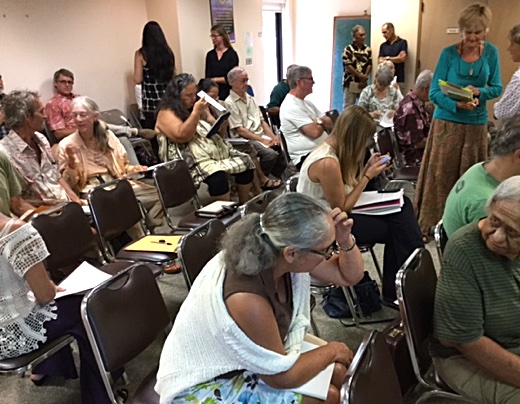

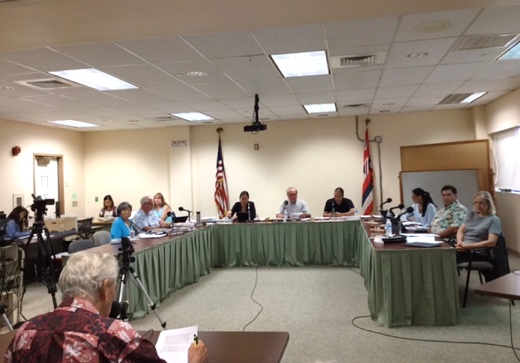
Image above: Some members of the public that came to witness and give testimony to Kauai Planning Commission waiting for meeting to begin. Photo by Juan Wilson.

The current Kauai General Plan was completed in 1999 was to guide development between 2000 and 2020. It is still in force and better represented the will of the people of Kauai better than the current effort to date.

Public meetings on the update of the General Plan have been going on for over a year. 

Yesterday was the last opportunity for the public to present testimony to the Kauai Planning Board on the General Plan Update to guide changes and development on the island from 2020-2040.

The Planning Commission Meeting
This was a long full day meeting. Several items were on the agenda before the Kauai General Plan Update was discussed and testimony was taken.

When the subject finally came up none of the members of the public that testified spoke in favor of the General Plan Update as presented.

Notable testimony was given by:

Joann Yukimura, Kauai Council Member,  focused on the westside and specifically the problems with the massive increase in development in the Hanapepe-Eleele area that could triple the population of this still rural area. The Plan's stated goals are in conflict with the actual community plans aggressive growth. Note: To read a PDF of Joann's full printed testimony click here (http://www.islandbreath.org/2017Year/06/170614testimony.pdf). File is 4.8 megabytes.

Ken Taylor, citizen activist, noted that the 1971 long term plan for infrastructure improvements to meet expected population growth was never implemented but now, almost 50 years later we have the population expected but not the infrastucture.

Judy Dalton, Chair of Kauai Sierra Club Group, identified the uncontrolled expansion of tourism with the accompanied increase of traffic, accommodation requirements, overburdening recreational resources as an increasing problem.

Rupert Rowe, President of the Hui Malama O Kaneiolouma Heiau, spoke of the need for solving our waste management before accepting a General Plan designed for a doubling of our population. Our current landfill is far past its approved size and no other site has been acceptable.

My verbal testimony, with some variation this the written version was as follows:
My name is Juan Wilson. I live in Hanapepe Valley and have practiced architecture and planning for over 40 years.

I have been attending the Hanapepe-Eleele Community Association meetings for more than a year. I have provided planning and mapping services in their effort to improve the 2020 Kauai General Plan Update. I fully support our association’s recommended changes to the plan and urge you to incorporate that effort.

My experience informs me that the 2000 Kauai General Plan, had it been followed, would have resulted in a better situation than the one we find ourselves in today. Due to community demand, the motto of that plan was “Keep it Rural”.

Since then residents have lost access to much of the rural recreational opportunities that once were abundant. There are many closed gates.

The General Plan Update especially increases urbanization in the Kapaa and Hanapepe communities. The already unacceptable traffic snarl in Kapaa-Wailua will only become worse.

Population of the Hanapepe-Eleele area will likely triple with the build-out of this plan. Today there are only three stop lights west of the Laui Valley, but many more new westside traffic lights can be expected. We will get three new stoplights in Eleele alone with current county sponsored Lima Ola project.

As explained to me by Deputy Planning Director Hull at the Waimea Open House in December 2016, the only rationale the Planning Department has used to justify this planned response  to a “population explosion” is estimate that “natural” population will increase 1% to 2% compounded over the next few decades.

My response is that it would be much cheaper and more desirable to reduce the rate growth rather than build out suburban solution to accommodate it. The means could be through education, encouragement, incentives and rewards.

Are we not clever enough to bend the arc of growth lower than one or two percent? Benefits are that smaller families are statistically are better educated, do better financially and thus can spend more time, energy and money on each child.

Is the Planning Department certain we have so little self control that we must destroy the Kauai’s charm, culture, and landscape to accommodate unborn hoards of suburbanites? 

Image above: Members of the Kauai Planning Commission. From left to right - Glenda Nogami-Streufert, Sean Mahoney, unidentified staff, Vice Chair Roy Ho, Deputy Planning Director Ka'aina Hull, Commissioner Heather Ahuna, Commissioner Wade Lord and Commissioner Donna Apisa. Photo by Juan Wilson.

To keep things clear Kauai has a Planning Department and Planning Commission.

The Kauai Planning Department
The department's webpage states (http://www.kauai.gov/Planning):
The Planning Department advises the Mayor, Planning Commission, and the County Council on planning and land use matters for the County of Kauai. The Department is also responsible for the administration and enforcement of the Zoning and Subdivision Ordinances, as well as the County's planning program, which includes long-range and regulatory policy documents like the General Plan and Comprehensive Zoning Ordinances.
The Planning Director is Michael Dahilig. Dalilig formerly worked for Hawaii State Senator Shimabukuro and, from what I can tell, has no expertise or professional training in planning.

The Deputy Planning Director is Ka'aina Hull is a Planner and appears to be running the department's actual planning.The Planning Department Director appears to be simply a political appointment.Commissioners an

The Kauai Planning Commission
The commission's webpage says (http://www.kauai.gov/Government/Boards-and-Commissions/Planning-Commission):
The Planning Commission meets twice a month to hold public hearings on zoning and land use permits and applications, as well as render decisions on these matters. 
It is made up of seven members of the public appointed by the mayor and approved by the Council. It's responsibility is to ensure the community is served by the actions of the Planning Department. Here again, the Planning Commission members are political appointments with no necessary expertise in planning.

The current commission members are:
Chair Kimo Keawe
Vice Chair Roy Ho
Commissioner Heather Ahuna
Commissioner Donna Apisa
Commissioner Wade Lord
Commissioner Sean Mahoney
Commissioner Glenda Nogami-Streufert,
The Chair, Kimo Keawe was not present at this meeting. This Planning Board meeting is largely managed by the Deputy Planning Director and his staff. 

So much for Kauai's future.

See also:
Ea O Ka Aina: Okay given to destroy Paradise 6/12/17
Ea O Ka Aina: Kauai Nui Kuapapa 5/14/1
Ea O Ka Aina: Find and Limit Ourselves 2/17/17
Ea O Ka Aina: Kauai General Plan open house 12/8/16
Ea O Ka Aina: Reject the Kauai General Plan update 11/30/16
Ea O Ka Aina: Kauai County "Keep Kauai Rural!" 11/11/16
Ea O Ka Aina: General Plan Update  9/4/16
Ea O Ka Aina: Will developers write Kapaa's future? 5/7/16
Ea O Ka Aina: Planet Kaauai 2/26/16
Ea O Ka Aina: Kauai Plan disappoints 12/9/15
Ea O Ka Aina: Potash King's Palace 6/24/10
Island Breath: Kauai Districts as Townships 3/27/08
Island Breath: Sustainability & Growth 4/19/05
Island Breath: Kauai Parks Master Plan - Puolo Point 10/7/04
Island Breath: Kauai Zoning 5/15/04
.

Can we create a durable future?

SUBHEAD: We build buildings now as if they will be abandoned or torn down in a few decades.

By Kurt Cobb on 11 June 2017 for Resoruce Insights -
(http://resourceinsights.blogspot.com/2017/06/can-we-create-durable-future.html)


Image above: The Roman Colosseum today, almost two millennia  after it was built. From (http://www.abc.net.au/news/2015-03-10/the-colosseum/6292532).

It is hard to imagine anyone today building something as durable as the Roman Colosseum. Most of the damage we see to the 2,000 year-old stadium comes from two earthquakes and the persistent looting of its marble, stone and brass infrastructure by humans using them for other building projects.

Were it not for these unfortunate depredations, the Colosseum might be largely intact today.

We pen fantasies about the durability of our culture in science fiction novels, television programs and movies set hundreds and even thousands of years from now. By then we humans will supposedly be moving with magical ease at speeds greater than light, zipping through the known universe aided by voice-command convenience (or maybe even thought-comand convenience).

But our age seems to be populated by buildings and cultural artifacts that are designed for impermanence. It's not that we are technically incapable of making things that are durable when we want to, especially when it feeds our desire to turn science fiction into fact.

NASA's Mars Rovers launched in 2003 were designed for a mission of 90 Martian solar days. The Spirit rover operated until 2010. The Opportunity rover is still operating.

We have even more impressive longevity from the Voyager 1 and Voyager 2 space probes sent in 1977 to study the outer planets, that is, Jupiter, Saturn, Uranus and Neptune. Both spacecraft were designed for 5-year lifetimes and both are still working after almost 40 years.

Voyager 1 has reached interstellar space where it continues to send back data. Voyager 2 will join it in two or three years. NASA expects to continue to receive data for another decade or so from both.

On Earth we would consider such durability to be over-engineering, too costly for our purposes. We build computers to be obsolete in less than 2 years.

We build shopping malls, office parks and other commercial and industrial buildings with the idea that they will be abandoned or torn down in perhaps two or three decades.

I am reminded of a New Yorker cartoon in which a developer looking at a model of his newly commissioned building remarks:
"Great design, but when it comes time, a bitch to implode."
Nothing lasts forever. And, a society that has no dynamism, that does not change with changing circumstances, cannot survive.

But it is we who are creating the change that we have to adapt to. It is we humans who are causing climate change. It is we humans who are causing rapid depletion of soil, water and energy resources. It is we humans who are increasing our environmental footprint in sheer numbers and in consumption per person.

We've initiated a feedback loop that has no end--except catastrophe. What would more durable arrangements look like? If we turn to those arrangements that have withstood the test of time, we have a starting point:
  1. Small units of governance. The city of Rome has been continuously inhabited for more than 2,500 years. The Roman Empire, for all its durability, came and went even as the city lived on.

  2.  Small-scale agriculture and craft. Agriculturally based villages with craft industry have thousands of years behind them. This way of living is being crushed by modern industrial farming and its need for ever increasing scale. But the local food movement and the desire of many to know where their food comes from have breathed new life into small-scale farming.

  3. Trade in luxury goods. Some exotic and valuable items have long been traded across large distances because a particular climate is suitable for certain produce, for example, tea or coffee--or the know-how and infrastructure is well-developed, silk from China, for example. What this point implies is that necessities are better produced closer to home to ensure a continuous and adequate supply.

  4. Locations favorable to agriculture and navigation. It should be no surprise that many of the world's most important and long-lived cities are ports. Water has been historically a primary mode of transport. It is also, of course, essential to prosperous agriculture, either from adequate rains or from flowing rivers that can be diverted for irrigation.
All of these will seem obvious to anyone who has thought about the topic, sometimes through the lens of what is called "relocalization." In its simplest form this merely means returning the production of daily necessities closer to where we live.

That seems straightforward enough; but the complex webs of trade and logistics we now have that bring us those necessities will be difficult to abandon.

For those wanting to build more durable arrangements, this implies building them alongside the global system we have now. (It does NOT, however, mean abandoning the knowledge we have gained in the industrial age, but rather using it more wisely to attain our goals.)

Building a relocalized system may seem unduly duplicative and wasteful.

And, it will be until it isn't, that is, until the global system stops serving our needs. In many ways that system already has stopped serving us if you count as one of our needs the desire to build a durable human culture that can thrive far into the future.

The fantasy of a space-faring society has us fixated on an ever evolving technological future that asks us to abandon one set of gadgets for another almost continuously--all premised on the availability of unlimited resources and a climate crisis that somehow won't turn out to be a crisis.

Few people are even contemplating the need to build a durable society because few imagine ever needing one.

We humans like the novelty afforded to us by our rapidly changing society. The world of information and communications technology has brought that novelty to us in addictive oversupply through ever more powerful cellphones and other electronic devices.

What strikes me about this supposed novelty is its overwhelming sameness. It seems like novelty largely because new participants appear. But it is actually monotony itself because the stories we are told are as relentlessly interchangeable as they are shallow.

The durable society is not a dull society. It is rather a deeper society.

We get to spend more time with the very landscape of our lives--the people, the buildings, the everyday objects, and the activities--than the frantic pace of the electronic message now allows us.

The slow food movement is one expression of this desire for deeper engagement.

That deeper engagement is really the foundation of a durable future. It should come as no surprise then that it is difficult to build a durable future in a world that people don't have time to understand...with others they don't really know.

Kurt Cobb is an author, speaker, and columnist focusing on energy and the environment. He has been a regular contributor to the Energy Voices section of The Christian Science Monitor and is author of the peak-oil-themed novel Prelude.  He maintains a blog called Resource Insights and can be contacted at kurtcobb2001@yahoo.com.

.

Things to Come

SUBHEAD: Budweiser-gulping, oxycontin addled masses in the boring wastelands of our ruined drive-in Utopia.

By James Kunslter on 12 June 2017 for Kunstler.com -
(http://kunstler.com/clusterfuck-nation/7771/)


Image above: Poster for the movie "Things to Come" based on H. G. Wells 1933 book presenting the century after the Great Depression. A description of the opening of the film "The year is 1940. News boys hold broadsheets declaring “WAR STORM BREWING” and “WORLD ON THE BRINK OF WAR.” John Cabal reads the rumors of war, and is disheartened. He is sure that if war comes, it will mean the end of civilization as it is known." From (https://themotionpictures.net/2016/05/19/things-to-come-1936/).

As our politicos creep deeper into a legalistic wilderness hunting for phantoms of Russian collusion, nobody pays attention to the most dangerous force in American life: the unraveling financialization of the economy.

Financialization is what happens when the people-in-charge “create” colossal sums of “money” out of nothing — by issuing loans, a.k.a. debt — and then cream off stupendous profits from the asset bubbles, interest rate arbitrages, and other opportunities for swindling that the artificial wealth presents.

It was a kind of magic trick that produced monuments of concentrated personal wealth for a few and left the rest of the population drowning in obligations from a stolen future. The future is now upon us.

Financialization expressed itself in other interesting ways, for instance the amazing renovation of New York City (Brooklyn especially). It didn’t happen just because Generation X was repulsed by the boring suburbs it grew up in and longed for a life of artisanal cocktails.

It happened because financialization concentrated immense wealth geographically in the very few places where its activities took place — not just New York but San Francisco, Washington, and Boston — and could support luxuries like craft food and brews.

Quite a bit of that wealth was extracted from asset-stripping the rest of America where financialization was absent, kind of a national distress sale of the fly-over places and the people in them.

That dynamic, of course, produced the phenomenon of President Donald Trump, the distilled essence of all the economic distress “out there” and the rage it entailed.

The people of Ohio, Indiana, and Wisconsin were left holding a big bag of nothing and they certainly noticed what had been done to them, though they had no idea what to do about it, except maybe try to escape the moment-by-moment pain of their ruined lives with powerful drugs.

And then, a champion presented himself, and promised to bring back the dimly remembered wonder years of post-war well-being — even though the world had changed utterly — and the poor suckers fell for it.

Not to mention the fact that his opponent — the avaricious Hillary, with her hundreds of millions in ill-gotten wealth — was a very avatar of the financialization that had turned their lives to shit. And then the woman called them “a basket of deplorables” for noticing what had happened to them.

And now the rather pathetic false promises of President Trump, the whole "Make America Great Again" thing, is unraveling at exactly the same time that the financialized economy is entering its moment of final catastrophic phase-change.

The monuments to wealth — especially the stock and bond portfolios and the presumed value of real estate investments — will surrender to a process you might call price-discovery-from-Hell, revealing their worth to be somewhere between little and nothing.

The accumulated monstrous debts of persons, corporations, and sovereign societies, will be suddenly, shockingly, absolutely, and self-evidently unpayable, and the securities represented by them will be sucked into the kind of vortices of time/space depicted in movies about mummies and astronauts.

And all of a sudden the avatars of that wealth will see their lives turn to shit just like moiling, Budweiser-gulping, oxycontin-addled deplorables in the flat, boring, parking lot wastelands of our ruined drive-in Utopia saw their lives rendered into a brown-and-yellow slurry draining clockwise down the toilet of history.

Nobody in power in this country is paying attention to how close we are to that epic moment — at least, they’re not talking about it. If the possibility of all that even occupies some remote corner of their brains, they surely don’t know how to prepare the citizenry for it, or what to do about it.

The truth is that societies respond emergently to major crises like the imminent unraveling of our financialized economy, often in disorderly and surprising ways.

I suppose we’ll just have to watch the nauseating spectacle play out, and in the meantime enjoy the Russian collusion melodrama for whatever it’s worth — probably more than a ticket to Wonder Woman or the new Tom Cruise Mummy movie.


Image above: Buffalo super Sabres fan Ken Johnson holds the ultimate tailgate party on the hood of his 1989 Ford Pinto. As you can see the car often catches fire. He drove in from Rochester for the game. He is cooking chicken wings on a shovel, does bacon on a saw and grills cheese sandwiches on a rake. From (http://www.gettyimages.com/detail/news-photo/buffalo-ny-super-sabres-fan-ken-johnson-holds-the-ultimate-news-photo/164999650#buffalo-nysuper-sabres-fan-ken-johnson-holds-the-ultimate-tailgate-picture-id164999650).

.

KIUC aims at 100% renewables

SUBHEAD: The islands of Ta‘ū and Kauai are part of a bold solar plus battery experiment.

By Henry Curtis on 10 June 2017 for Ililani Media -
(http://www.ililani.media/2017/06/kiuc-moving-rapidly-towards-100.html)


Image above: A solar array partnership between KIUC, Solr City and Tesla. From (https://www.theverge.com/2017/3/8/14854858/tesla-solar-hawaii-kauai-kiuc-powerpack-battery-generator).

Ta‘ū is the easternmost volcanic island of the Samoan Islands and has a population of 600. The island switched from one hundred percent reliance on diesel generators to one hundred percent reliance on solar panels and batteries.

The system consists of 5,328 solar panels with 1.4 megawatts of solar generation capacity, and 60 Tesla Powerpacks. The battery storage system can be recharged in seven hours, and can power the island for three days.

Kauai Island Utility Cooperative (KIUC) generated more than 90 percent of its electricity from fossil fuels in 2011. Kauai’s two main fossil fuel power plants are the 96.5 MW Port Allen Generation Station and the 27.5 MW Kapaia Power Station.

Kauai currently has sufficient solar to provide almost all of its electricity demand during peak solar periods. Additional solar requires energy storage in order to be able to use the solar in the evening and at night.

Tesla built a 13-megawatt solar energy system consisting of 54,978 photovoltaic panels, combined with a 52 megawatt-hours (MWh) energy storage system consisting of 272 Powerpacks.

The system is located on 50 acres owned by Grove Farm, near Lihue. Tesla will sell electricity to KIUC at 13.9 cents per kilowatt-hour (KWh) for 20 years. The system went on-line in March, 2017.

KIUC adopted a Strategic Plan Update 2016-2030 on January 31, 2017.

“Renewables have increased from six percent of sales in 2007 to 37 percent in 2016. KIUC is rapidly closing in on reaching the 70 percent renewable level by 2030.”

There are 3,500 rooftop solar systems with a capacity of 21 megawatts.

“KIUC has either built or collaborated with third parties on three industrial scale solar projects, including Anahola (12 megawatts), Koloa (12 megawatts), and Port Allen (6 megawatts).

Three smaller privately owned solar arrays in Waimea, Omao and Kapaa contribute 1.6 megawatts total.

Currently under construction is a 13-megawatt solar array with battery storage capability adjacent to the Kapaia Power Station. This project – a partnership with Solar City and Tesla - is the first of its size in the nation.”

“KIUC’s renewable portfolio also includes hydroelectric systems at Wainiha, Waiahi, Kalāheo, Olokele and Waimea/Kekaha, generating a combined total of 10 megawatts to the grid.

A 6-megawatt system is under construction on Gay and Robinson land, and under consideration is an additional project that would combine solar and hydro in a pumped storage system, which could produce 25 megawatts at full capacity.”

“In 2016, Green Energy began operating its 7-megawatt biomass plant just outside Lihue. The plant provides 12 percent of Kauai’s power, and is one of the first plants of its kind in this country: burning wood chips from invasive species and from locally grown trees.”

“In 2016, on some individual days, KIUC derives 97 percent of its energy from renewable sources, including 77 percent from solar. On the average clear day, with solar at or close to full potential, all but one of KIUC’s diesel generators can shut down.”

KIUC plans to develop the 8.3-MW Puu Opae pumped-storage hydro project. A five-mile underground pipeline will connect two ponds on Kauai’s west side. The project recently advanced, with the settlement of a water dispute.

Earthjustice, on behalf of Poai Wai Ola: the West Kaua'i Watershed Alliance, filed a petition with the Commission on Water Resource Management (Water Commission; CWRM) in 2013, seeking to revise the minimum flow in the Waimea River and its tributaries. The complaint also stated that some of the diverted water was being wasted.

The parties involved in the proceedings were the Hawaii Agribusiness Development Corporation, Kekaha Agriculture Association, Kauai Island Utility Cooperative, the Department of Hawaiian Homelands and Po’ai Wai Ola.

The Water Commission approved a mediated agreement on April 18.

Waimea River water flow will increase from 16 million gallons per day to around 25 million gallons per day. The Department of Hawaiian Homelands will receive 6.903 million gallons a day from the Kokee Streams for homesteading purposes.

“All streams will be allowed to run from the mountain to the sea and no diversion will ever be a total diversion again.”

“The ditch systems owned by the State of Hawaii's Agribusiness Development Corporation (ADC), and currently operated by the Kekaha Agricultural Association (KAA), will continue to be maintained to allow for both present and future uses.”

“Kauai Island Utility Cooperative (KIUC) will be allowed to complete due diligence on a set of energy projects supported by the Kokee Ditch System, and, if the energy projects are built, will receive from the Kokee ditch system a rolling average of 11 mgd to support both (1) the Puu Opae project and (2) DHHL's water needs under any water reservation the Commission may grant to DHHL.”

See also:
Ea O Ka Aina: Solar power one island at a time 11/24/16
Ea O Ka Aina: Renewables - the new Fracking? 2/10/16
Ea O Ka Aina: Failing to live off the grid 1/3/16
Ea O Ka Aina: How sustainable is Solar PV? 4/26/15
Ea O Ka Aina: Our Renewable Future 1/21/15
Ea O Ka Aina: Kicking tie KIUC habit 5/1/14
Ea O Ka Aina: Caron Crash - Solar Dawn 3/19/14
Ea O Ka Aina: Go Nuclear or Go Native 10/20/14
Ea O Ka Aina: CIUK > KIUC 5/8/12
Ea O Ka Aina: The Alternative Energy Matrix 2/8/12
Ea O Ka Aina: Chinese say PV to beat coal 8/17/11
Ea O Ka Aina: Off-Grid Night Lighting 8/14/09
Island Breath: Dealing With Chaos 10/7/08
.

How do humans change course?

SUBHEAD: Degrowth is denounced as ecofascism that forces victims to sacrifice their God-given freedoms.

By Susan Paulson on 7 June 2017 for Degrowth.org -
(https://www.degrowth.info/en/2017/06/how-do-we-humans-change-course/)


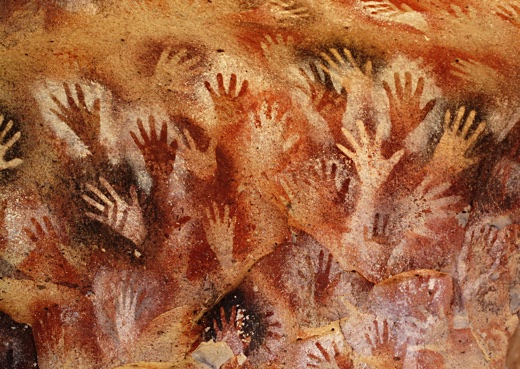
Image above: Ten thousand year old cave paintings of hand silhouettes in Argentina's Cueva de las Manos. From (http://www.goneforwords.com/2011/03/cueva-de-las-manos/).

Anthropological thoughts on degrowth

Degrowth energizes and interconnects remarkably heterodox thinking and surprisingly heterogeneous action. To advance dialogue among diverse pathways, a recent Journal of Political Ecology issue on “Degrowth, Culture and Power” joins studies of 15 initiatives to forge worlds that prioritize well-being, equity and sustainability rather than expansion.

My introduction to that issue explores innovative science and activism, north and south; the paradox of much information and little transformation; and new modes for producing knowledge and value.

This essay summarizes its encouraging attention to change in habitual practices through which skills, perspectives, denials and desires are viscerally embodied, and in sociocultural systems that govern those practices and make them meaningful.

Proponents and critics of degrowth agree that simple contraction of current economies would be disastrous. What we need is not just quantitative decrease in production and consumption, but radical transformation that re-establishes livelihoods, relationships and politics around new values and goals.

What cultural forms can foster positive and equitable degrowth? What features can mitigate and distribute hardships of change? Who answers these questions? And how?

Scholars learn from activists in the Global South

Efforts to question growth and to visualize alternatives have pushed scholars beyond the bounds of mainstream natural and social sciences into engagement with social, political and religious activism, among other modes of enquiry.

Many learn from livelihoods and actors outside of academia, on pathways including Buen vivir (Latin America), Ecological Swaraj and Radical Ecological Democracy (India), Ubuntu (South Africa) and Gross National Happiness (Bhutan).
 
If climate crisis has a silver lining, it may be the power to provoke residents of high-GDP high-emission countries to question the portrayal of their own societies as “developed",  in the sense of full-grown, perfected, complete.

That new humility opens doors to learn from the global south, including decolonizing visions that interweave struggles against political and cultural domination with alternatives to expansionist economies.

Some of these visions are communicated in Mahatma Gandhi’s message “live simply so others may simply live,” in Via Campesina’s aim of “food sovereignty” and in the Yasuni cry “leave the oil in the soil.”

Sociocultural systems support small initiatives to make big impacts

What can enable small initiatives to catalyze the changes necessary for downscaling global societal metabolism in ways that enhance human-environment well-being?

Scholars have rightly identified the need to establish supportive conditions via new economic institutions, political processes and scientific practices.

In his encyclical letter On Care for our Common Home, Pope Francis exhorts: “Many things have to change course, but it is we human beings above all who need to change.”

So I focus here on sociocultural systems (economic, kinship, gender and others) that produce differentiated human bodies, complete with skills, visions and desires, including appetites for consumption.

Habitual participation in urban cooperatives, whaling traditions, community gardens, local currencies, timebanks, khat chewing, transition towns, religious communities and ecovillages, among others, leads some people to adapt lifeways that use less material and energy.

Loss of employment, economic recession, and collapse of industries and ecosystems sometimes lead to similar outcomes.

Aside from ecological impacts, we draw attention to the transformative role such participation plays in the continual becoming of participants as social actors and moral beings, and in the practices and relations that co-produce new generations of humans and future socio-ecosystems.
 
Karen Foster (2017) probes the power of a culturally-embedded work ethic to produce people who face difficulty acting, and even being, outside of a productivist paradigm.

Workers she interviewed in Atlantic Canada, like many in other contexts, have learned to be decent people according to moral codes in which virtuous behavior is epitomized by long hours of hard work in contrast to the dissolute laziness of leisure.

The primacy of paid work in constituting dignified identities constrains laborers’ ability to question economic systems in which they participate.

However, in shrinking rural economies where jobs can be elusive, Foster searches for clues about how communities reorient toward perceiving paid work as one means to moral ends, rather than an end in itself, or a definition of self.

Gendered bodies and identities serve the evolving growth machine

In several Latin American contexts, I have been seeking to understand men’s participation in economic practices and relations that seem to exploit their own human resources and undermine their socio-ecosystems (Paulson 2013, 2015).

Two features of prevailing gender norms stand out: first is a symbolic binary that associates masculinity with paid “productive work,” in contrast to unpaid “reproductive work” construed as feminine and as inferior; and second are constructions of subordinate masculinities in which manliness is measured by one’s capacity to perform brutally hard labor in uncomfortable conditions, and virility is displayed by taking risks, and by exercising and enduring violence.

These norms did not come from the Garden of Eden.

Over generations, different kinds of policies and propaganda have influenced the adaptation of gender and kinship systems to produce bodies and identities that serve the evolving growth machine.

Fruit of these historical processes is evident today in the millions of low-paid men who perform dangerous and painful work necessary for the expansion of industries that degrade ecosystems and exacerbate climate change: mining, logging, petroleum and agroindustry.

During recent interviews in Ecuador and Mexico, dozens of men told me about physical and emotional hardships they had experienced in efforts to meet expectations of manhood. Some also described efforts through which they are trying to change norms that have constrained their own horizons.

By adapting their personal practices and interactions, and by adjusting the expectations they communicate for others, some working men are consciously trying to raise sons and daughters capable of following—or even forging—a wider range of paths.

These observations shed light on the puzzle of why scientific evidence of negative impacts of growth has provoked so little consequential change.

By appealing to individual reason, scientists and policy-makers disregard systems of culture and power through which identities and values are viscerally incorporated.

Efforts to curb the wave of extractivism ravaging Latin American environments, for example, will need to promote changes in the systems that (re)produce human resources in the form of tough men suitable for use in toxic and violent environments.

Our studies suggest that individuals’ ability and willingness to moderate their involvement in expansionist practices and institutions involves more than rational decision-making; it may be nurtured—or constrained—through other kinds of human experience, particularly bodily action and interaction.

Commoning practices produce different forms of physicality and subjectivity

As living organisms dwell in landscapes and taskscapes, their habitual biosocial interactions influence processes of mutual becoming.

Some modes of dwelling in today’s world produce subjectivities that repress acknowledgement of and resist response to signs of degradation and inequity. Others cultivate sensitivities.

In rural Brazil, Jon DeVore (2017) describes daily practices in which individuals nurture and protect specific springs and trees, practices that—over time—contribute to the (re)production of shared water sources and forests, and the (re)production of relationships.

Joshua Lockyer (2017) describes commoning practices through which people have collaborated over decades to continually build Dancing Rabbit ecovillage; in the process, they produce different forms of physicality and subjectivity, expressed today in relationships and decision-making more sensitive to impacts on other people and other nature.

Via muscular consciousness and neuroplasticity we humans continually produce ourselves and our new generations. Large and small adjustments to habits of thought, action and interaction, work in mysterious ways toward institutional and paradigmatic change.

Testimonies recorded by Emma McGuirk (2017) among timebankers in New Zealand show that habitual participation in what seem like menial transactions has led to deeper transformation including increased energy invested in networks of solidarity and friendship.

Via biophysical and psychosocial habits developed through timebanking, people not only adapt themselves, they also create and experiment with small-scale networks, while contributing to prefigurative modes that lay foundations for future world-making.

What changes humans?

In the short run, then, my voluntary shift from a jet-setting lifestyle toward lower-impact living has little chance of slowing the global growth machine.

However, my new habits will definitely alter the ways in which I become human each day forward, thereby influencing environments and processes through which family members, students, colleagues and others around me continually become human.

Producing new kinds of people and relationships is fundamental to any great transition.

It is dangerously ingenuous, however, to think about change as merely a function of individual volition. Material conditions and power relations—embodied and environmental—variously circumscribe each of our abilities to change course, as do worldviews, assumptions and ideologies.

Such dynamics replace the question of “how do we humans change?” with “what changes humans?”

Countries around the world show abrupt upswings in behavioral trends ranging from fuel consumption to obesity, signaling that some powerful forces have been working to change modes of being human at precipitous speed.

With US data from late 20th century, economist Juliet Schor (1993, 1999) charts remarkably steep average increases in hours worked for pay, in material goods consumed, and in personal debt.

She also points to legislation, policies and advertisements that worked to impel adoption of personal habits and values that would be instrumental to exponential growth.

Modern markets misrepresented as timeless mechanisms

Despite these astounding transformations, actors who are privileged by today’s status quo—and many who are exploited or marginalized—protest that it is neither ethical nor feasible to try to change human behavior or attitudes: “You’re never going to convince people to produce and consume less!”

Degrowth is vehemently denounced as ecofascism: ideologically-driven imposition that would force unwilling victims to sacrifice their God-given freedoms and to betray innate self-interests.

Growth, in contrast, is perceived as apolitical and impartial; modern markets, in particular, appear as timeless mechanisms through which all humans freely organize livelihoods and establish value. This perception is fostered by cultural and scientific narratives attributing an insatiable drive to increase production and consumption to human biology.

Featured myths include the innately rational Homo economicus maximizing utility for individual gain; an inherent human propensity to truck and barter avowed by Adam Smith; and that “selfish gene” that makes each of us crave control over resources and strive to take more than our share, condemning to tragedy any attempts at commons management.

Capitalocene instead of Anthropocene

Even climate change is portrayed as a result of human evolution! Teleological narratives surrounding the Anthropocene are encouraged by scholars such as Steffen, Crutzen and McNeill (2007: 614) who write: “the first use of fire by our bipedal ancestors, belonging to the genus Homo erectus, occurred a couple of million years ago.”

And “The mastery of fire by our ancestors provided humankind with a powerful monopolistic tool unavailable to other species, that put us firmly on the long path towards the Anthropocene.”

Putting extraordinary recent trends into deeper (pre)historical and broader cultural context reveals the absurdity of claims that ancient evolutionary traits inexorably led Homo sapiens to destroy earth systems.

It also challenges the misleading message that this new era was provoked by humanity as a whole (the Anthropos), rather than by one group acting in and through a historically specific sociocultural system. Scholars fighting for a more accurate characterization insist that the era be called the “Eurocene” or the “Capitalocene.”

Human survival lies in our capacity for symbolic thought and communication

Glimpses of many possible modes of existence—with myriad sources of richness and pleasure—widen horizons for building unprecedented futures. They do so by liberating us from the fiction that human behaviors currently instrumental to growth are biologically determined universals.

However, there is something about human biology that is relevant to this conversation. Compared to other species interacting in the earth’s ecosystems, individual humans are not particularly strong, quick, tough, spikey or poisonous.

The survival of Homo sapiens lies in our biophysical capacity for symbolic thought and communication that enables groups of humans to collaboratively develop sociocultural systems that survive the individual organism, and that shape the production of new generations of humans, their habits and their habitats.

These uniquely human systems take the form of languages, religions, economies, sciences, kinship and gender systems, among others
.
New theoretical approaches to change shift attention away from individual decision-making and toward systems through which socialized humans and socio-ecological worlds are (re)produced.

That shift brings attention to communities around the world who are already managing and adapting these most fundamental common resources in ways that can support equitable and pleasurable degrowth.

• Susan Paulson spent many years in Latin America, researching and teaching about ways in which gender, class and ethnoracial systems interact with biophysical environments, influencing the development of bodies, landscapes and ecosystems (including humans). 
.

Okay given to destroy Paradise

SUBHEAD: Hokua Place in Kapaa is part of the transformation of Kauai into Maui on its way to Oahu.

By Gabriela Taylor on 8 June 2017 in Island Breath -
(http://islandbreath.blogspot.com/2017/06/okay-given-to-destroy-paradise.html)


Image above: Pedestrians negotiate heavy traffic on Kuhio Highway on east side of Kauai. Photo by Dennis Fujimoto. From (http://thegardenisland.com/news/local/govt-and-politics/no-quick-fix-in-sight/article_231bd83a-ce09-11e4-8a79-5bcc80de101c.html).

[IB Publisher's note: Gabriel had this article published in the Garden Island News.]

After receiving hundreds of public testimonies against approval for “Urban” up zoning of 97 acres behind Kapaa Middle School, called Hokua Place, Planning Commissioners, unfortunately overturned the sensible decision of the Planning Dept. (PD) to keep the land zoned “Agriculture (AG.)”.

By the time we reached the fourth iteration of the Draft General Plan, it was assigned yet another zoning category, "Neighborhood General", which is really "Urban Light" in disguise.

Additionally, Kapaa would change from the destination “Small” to a “Large Town Place Type”.
This means that up to 780 dwellings at Hokua Place would be built in an overly congested area, where traffic jams are common. See: General Plan Update website: http://www.plankauai.gov.

A friend just told me that he got stuck in gridlock when vehicles in the traffic circle came to a standstill for15 minutes. Add about 1500 cars generated from Hokua Place to that route and you have perpetual gridlock.

If that isn’t disaster enough, imagine Kuhio Highway when 2,500 cars will be added to the Kapaa Crawl by three, already approved, hotels ready to go up in the Wailua corridor: Two will be behind Longs, plus the one at the site of the old Coco Palms.

If it’s approved, our precious island home would soon become another Maui. I read letters in TGI and also hear from visitors who won’t return to Kauai because of the debilitating traffic.

Reasons For Stopping Hokua Place Development
  1. Drowning in Traffic? The only road construction the state has slated for the next couple of years in the Kapaa area is an additional lane on the mauka side of Kuhio Highway between the Bypass Rd. and traffic light in front of Coco Palms.

    Yes, there’s long line of south bound daytime traffic backed up against that light now. But don’t forget that an equal jam of north bound traffic, inches through Wailua and Kapaa, in the afternoon.

    The county also has given the green light to build more housing in Kapahi and promote retail commerce, as well. Initially, the PD said that most housing would be focused in Lihue where plans are to permit residents to build an ADU next to their homes. Sadly, they abandoned plans to spare Kapaa from overdevelopment, despite traffic and diminishing quality of life.

    Affordable Housing a Hoax? I recently learned that the huge Subdivision under construction at the cutoff from the highway to Hanamaulu Town, has no affordable housing.
  2. Affordable Housing was mandated by law in 2008 to be at least 30% of new subdivisions. But guess what? Not one affordable tract has been built on Kauai since then. Even 30% is a joke when you find out that 70% of dwellings are way outside the range of what locals can afford. And to hammer that home, please note that the Median Home price on Kauai is $730,000.

    That explains why 45% of Kauai homes are purchased by mainlanders or foreigners. If up zoned, Hokua Place buildout would have to include 234 affordable multifamily dwellings and the remaining would be 546 single houses. Who will buy those homes priced from $650.000 to Learn more $950,000? Clearly, such homes will attract more mainlanders and foreigners here.
     
  3. Hokua Place negates food sustainability. Ag. land is meant to grow food, not houses. Given buildings, pavement and GMO fields on Kauai, agricultural production land opportunities are slowly eroding. It’s clear that with 90% of our food imported here, we must grow much more food to become sustainable.
WHAT:
Last Public Hearing for Planning Commission re General Plan Update (for the next 20 yrs).

WHEN:
Tuesday the 13th June 13, at 9am

WHERE:
Kauai County Building Meeting Room 2A/2B (adjacent to the DMV)
4444 Rice Street in Lihue, Kauai, Hawaii

DEADLINES:
I implore you to help save our rural life style. Please come with written testimony (12 copies) presented to the Planning Commission hearing  on Tuesday June 13th, or email your testimony to Kauai Planning Department by Monday June 12th. noon.

Email address for testimony is plankauai@kauai.gov.

If we let developers suck the soul out of this tiny island where nature is our treasure, we have have not only failed our children, but we have failed Kauai. Let’s stop Hokua Place as well as stop any permitting of additional resorts on Kauai, and make Affordable Housing a priority. Enough is enough! See you Tuesday at the hearing!

See also:
Ea O Ka Aina: Kauai Nui Kuapapa 5/14/17
Ea O Ka Aina: Occupying the Coco Palms 3/30/17
Ea O Ka Aina: Kauai County "Keep it Rural" 11/17/16
Ea O Ka Aina: Kauai General Plan Update 9/3/16
Ea O Ka Aina: Will developers write Kapaa’s future? 5/6/16 
Ea O Ka Aina: Kauai Plan Disappoints 12/9/15
Ea O Ka Aina: Hokua Place comment deadline 5/28/15
Ea O Ka Aina: Coco Palms good to go 3/11/15
Ea O Ka Aina: Lihue Loss of Vision 9/5/14
Ea O Ka Aina: Tax Donkey Purgatory - Lima Ola 7/18/14
Ea O Ka Aina: Annals of pure bullshit - Coco Palms 6/22/14 
Ea O Ka Aina: Coco Palms Travesty 8/10/13  
Ea O Ka Aina: Review 2000-2020 Kauai General Plan 4/2/09
Island Breath: Kauai Sustainable Land Use Plan 11/1/07
Island Breath: LEGS Sustainability Conference 10/13/07
Existing Kauai County General Plan 2000-2020 1999
.

Eat less - Live longer

SUBHEAD: The secret to a long healthy life is to seriously reduce caloric intake of food.

By Alex Riley on 1 June 2017 for The BBC -
(http://www.bbc.com/future/story/20170601-the-secret-to-a-long-and-healthy-life-eat-less)


Image above: The Dinner Box Strategy - McDonald's profits from selling an insane amount of food For $9.99.From (http://www.businessinsider.com/mcdonalds-dinner-box-strategy-2014-6).

Permanently cutting the daily calories you consume may turn out to have a profound effect on your future life, according to some tantalising scientific studies.

In a restaurant setting sometime in the not-too distant future, a man and a woman are on their first date. After the initial nerves subside, all is going well.

The man is 33, he says, has been single for most of those years, and, although he doesn’t mention it, knows he is looking to settle down and have a family. The woman replies that she is 52, has been married, divorced, and has children in their early 20s. He had no idea – she looked his age, or younger.

This is a dream of Julie Mattison from the National Institute on Ageing (NIA) in the United States. She envisions a time when chronological age ticks by with every year, but biological age can be set to a different timer, where elderly doesn’t mean what it does now.

It sounds far-fetched, but our society has already made great strides towards that goal, thanks to advances in medicine and improvements in healthy living. In 2014, for instance, the United States Health Interview Survey reported that 16% of people aged between 50 and 64 were impaired every day with chronic illness. Three decades earlier that number was 23%.

In other words, as well as benefiting from longer lifespans, we are also experiencing longer “healthspans” – and the latter is proving to be even more malleable. To paraphrase and update a speech from John F Kennedy given at the first White House Conference on Ageing in 1961, life can indeed be added to years, rather than just years added to life.

Healthspan is proving to be even more malleable than lifespan. 


So, what do we need to do to enhance the length and quality of our lives even more? Researchers worldwide are pursuing various ideas, but for Mattison and colleagues, the answer is a simple change in diet.

They believe that the key to a better old age may be to reduce the amount of food on our plates, via an approach called “calorie restriction”. This diet goes further than cutting back on fatty foods from time-to-time; it’s about making gradual and careful reductions in portion size permanently.

Since the early 1930s, a 30% reduction in the amount of food consumed per day has been linked to longer, more active lives in worms, flies, rats, mice, and monkeys. Across the animal kingdom, in other words, calorie restriction has proven the best remedy for the ravages of life. And it’s possible that humans have just as much to gain.

The idea that what a person eats influences their health no doubt predates any historical accounts that remain today. But, as is often the case for any scientific discipline, the first detailed accounts come from Ancient Greece.

Hippocrates, one of the first physicians to claim diseases were natural and not supernatural, observed that many ailments were associated with gluttony; obese Greeks tended to die younger than slim Greeks, that was clear and written down on papyrus.

Spreading from this epicentre of science, these ideas were adopted and adapted over the centuries. And at the end of the 15th Century, Alvise Cornaro, an infirm aristocrat from a small village near Venice in Italy, turned the prevailing wisdom on its head, and on himself.

If indulgence was harmful, would dietary asceticism be helpful? To find out, Cornaro, aged 40, ate only 350g (12oz) of food per day, roughly 1000 calories according to recent estimates. He ate bread, panatela or broth, and eggs.

For meat he chose veal, goat, beef, partridge, thrush, and any poultry that was available. He bought fish caught from the local rivers.

Restricted in amount but not variety, Cornaro claimed to have achieved “perfect health” up until his death more than 40 years later.

Although he changed his birthdate as he aged, claiming that he had reached his 98th year, it is thought that he was around 84 when he died – still an impressive feat in the 16th Century, a time when 50 or 60 years old was considered elderly.

In 1591, his grandson published his posthumous three-volume tome entitled “Discourses on the Sober Life,” pushing dietary restriction into the mainstream, and redefining ageing itself.

With an additional boost of health into the evening of life, the elderly, in full possession of their mental capacities, would be able to put decades of amassed knowledge to good use, Carnaro claimed. With his diet, beauty became the aged, not the youthful.

Cornaro was an interesting man but his findings are not to be taken as fact by any branch of science. Even if he was true to his word and did not suffer ill health for nearly half a century, which seems unlikely, he was a case study of one – not representative of humans as a whole.

But since a foundational study in 1935 in white rats, a dietary restriction of between 30-50% has been shown to extend lifespan, delaying death from age-related disorders and disease. Of course, what works for a rat or any other laboratory organism might not work for a human.

Long-term trials, following humans from early adulthood to death, are a rarity. “I don’t see a human study of longevity as something that would be a fundable research programme,” says Mattison. “Even if you start humans at 40 or 50 years old, you’re still looking at potentially 40 or 50 more years [of study].”

Plus, she adds, ensuring that extraneous factors – exercise, smoking, medical treatments, mental wellbeing – don’t influence the trial’s end results is near impossible for our socially and culturally complex species.

That’s why, in the late 1980s, two independent long-term trials – one at NIA and the other at the University of Wisconsin – were set up to study calorie restriction and ageing in Rhesus monkeys. Not only do we share 93% of our DNA with these primates, we age in the same way too.

Slowly, after middle age (around 15 years in Rhesus monkeys) the back starts to hunch, the skin and muscles start to sag, and, where it still grows, hair goes from gingery brown to grey. The similarities go deeper.

In these primates, the occurrence of cancer, diabetes, and heart disease increases in frequency and severity with age. “They’re an excellent model to study ageing,” says Rozalyn Anderson, a gerontologist from the University of Wisconsin.


Image above: A young rhesus monkey eats while riding the back of its mother. From original article.

Sherman is the oldest Rhesus monkey ever recorded, nearly 20 years older than the average lifespan for his species in captivity 

And they’re easy to control. Fed with specially made biscuits, the diets of the 76 monkeys at the University of Wisconsin and the 121 at NIA are tailored to their age, weight, and natural appetite.

All monkeys receive the full complement of nutrients and minerals that their bodies crave. It’s just that half of the monkeys, the calorie restricted (or CR) group, eat 30% less.

They are far from malnourished or starving. Take Sherman, a 43-year-old monkey from NIA. Mattison says that since being placed on the CR diet in 1987, aged 16, Sherman hasn’t shown any overt signs of hunger that are well characterised in his species.

Sherman is the oldest Rhesus monkey ever recorded, nearly 20 years older than the average lifespan for his species in captivity. As younger monkeys were developing diseases and dying, he seemed to be immune to ageing. Even into his 30s he would have been considered an old monkey, but he didn’t look or act like one.

The same is true, to varying extents, for the rest of his experimental troop at NIA. “We have a lower incidence of diabetes, and lower incidence of cancer in the CR groups,” says Mattison. In 2009, the University of Wisconsin trial published similarly spectacular results.

Not only did their CR monkeys look remarkably younger – with more hair, less sag, and brown instead of grey – than monkeys that were fed a standard diet, they were healthier on the inside too, free from pathology. Cancers, such as the common intestinal adenocarcinoma, were reduced by over 50%.

The risk of heart disease was similarly halved. And while 11 of the ad libitum (“at one’s pleasure,” in Latin) monkeys developed diabetes and five exhibited signs that they were pre-diabetic, the blood glucose regulation seemed healthy in all CR monkeys. For them, diabetes wasn’t a thing.

Overall, only 13% of the monkeys in the CR group had died of age-related causes in 20 years. In the ad libitum group, 37% had died, nearly three times as many. In an update study from the University of Wisconsin in 2014, this percentage remained stable.

The results show that ageing itself is a reasonable target for clinical intervention and medical treatment – Rozalyn Anderson 


“We have demonstrated that ageing can be manipulated in primates,” says Anderson. “It kind of gets glossed over because it’s obvious, but conceptually that’s hugely important; it means that ageing itself is a reasonable target for clinical intervention and medical treatment.”

If ageing can be delayed, in other words, all of the diseases associated with it will follow suit. “Going after each disease one at a time isn’t going to significantly extend lifespan for people because they’ll die of something else,” says Anderson. “If you cured all cancers, you wouldn’t offset death due to cardiovascular disease, or dementia, or diabetes-associated disorders. Whereas if you go after ageing you can offset the lot in one go.”

Eating less certainly seemed to help the monkeys, but calorie restriction is much tougher for people out in the real world. For one, our access to regular, high-calorie meals is now easier than ever; with companies like Deliveroo and UberEats, there is no longer a need to walk to the restaurant anymore. And two, gaining weight simply comes more naturally to some people.

“There’s a huge genetic component to all of this and its much harder work for some people than it is for others to stay trim,” says Anderson. “We all know someone who can eat an entire cake and nothing happens, they look the exact same. And then someone else walks past a table with a cake on it and they have to go up a pant size.”

Ideally, the amount and types of food we eat should be tailored to who we are – our genetic predisposition to gaining weight, how we metabolise sugars, how we store fat, and other physiological fluxes that are beyond the scope of scientific instruction at the moment, and perhaps forever.

But a predisposition to obesity can be used as a guide to life choices rather than an inevitability. “I personally have a genetic history of obesity running through my family, and I practice a flexible form of caloric restriction,” says Susan Roberts a dietary scientist at Tufts University in Boston.

“I keep my BMI at 22, and [have calculated] that that requires eating 80% of what I would eat if my BMI was at 30 like every other member of my family.”

Roberts stresses that it isn’t hard – she follows her own weight management programme using a tool called iDiet to help her eat less but avoid feeling hungry or deprived of enjoyment. If this wasn’t possible, she adds, she wouldn’t practise calorie restriction.

Not only has Roberts seen the problems of obesity first-hand in her family, she knows the benefits of CR better than most. For over 10 years she has been a leading scientist in the Comprehensive Assessment of Long-Term Effects of Reducing Intake of Energy trial, also known as Calerie.

Over two years, 218 healthy men and women aged between 21 and 50 years were split into two groups.  In one, people were allowed to eat as they normally would (ad libitum), while the other ate 25% less (CR). Both had health checks every six months.

Unlike in the Rhesus monkey trials, tests over two years can’t determine whether CR reduces or delays age-related diseases. There simply isn’t enough time for their development. But the Calerie trials tested for the next best thing: the early biological signs of heart disease, cancer, and diabetes.

Published in 2015, the results after two years were very positive. In the blood of calorie-restricted people, the ratio of “good” cholesterol to “bad” cholesterol had increased, molecules associated with tumour formation – called tumour necrosis factors (TNFs) – were reduced by around 25%, and levels of insulin resistance, a sure sign of diabetes, fell by nearly 40% compared to people who ate their normal diets. Overall, the blood’s pressure was lower.

Significant health benefits may be garnered in an already healthy body, but further trials are needed.

Admittedly, some benefits may come from weight-loss. Earlier trials from Calerie had included people that were obese as well as those with a healthy body mass index (BMI) of 25 or below, and slimming down would have certainly improved the welfare of the heavier participants.

“One thing that’s been very clear for a long time is that being overweight or obese is bad for you,” says Roberts. Diseases and disorders previously thought to be age-associated diseases are now popping up in the obese population, she adds.

But the latest results suggested that significant health benefits can be garnered in an already healthy body – a person who isn’t underweight or obese. That is, someone whose BMI lies between 18.5 and 25.

Despite these results, evidence from further trials will be needed before someone with an already healthy BMI should be advised to reduce their calorie intake. (And anyone wanting to change their diet would be advised to consult a medical professional beforehand.)

In the meantime, the scientists will be hoping that their rhesus macaques may help us to understand exactly why calories restriction may have these effects. With nearly 30 years of data on lives and deaths, and blood and tissue samples, from nearly 200 monkeys, the work at NIA and the University of Wisconsin aim to shine a light into the black box of calorie restriction, illuminating just how it delays ageing.

With less food, is the metabolism forced to be more efficient with what it has? Is there a common molecular switch regulating ageing that is turned on (or off) with fewer calories? Or is there an as of yet unknown mechanism underpinning our lives and deaths? The importance of monkeys like Sherman far outspans their lives.


Image above: Old and obese people finding pleasure at an ice cream store. From original article.

Calorie restriction may be one of the most promising avenues for improving health and how long it lasts in our live.

Answers to such questions might be long in coming. “If I cloned 10 of myself and we all worked furiously, I don’t think we’d have it solved,” says Anderson. “The biology is inordinately complicated.”

It’s a worthwhile undertaking – understand how CR works and other treatments could then be used to target that specific part of our biology. Ageing could be treated directly, that is, without the need of calorie restriction. “And I think that’s really the golden ticket,” says Anderson.

Although lacking a neat explanation, calorie restriction is one of the most promising avenues for improving health and how long it lasts in our lives. “There was nothing in what we saw that made us think caloric restriction doesn’t work in people,” says Roberts, from the Calerie trial.

And, unlike drug-based treatments, it doesn’t come with a long list of possible side effects. “Our people were not hungrier, their mood was fine, their sexual function was fine. We looked pretty hard for bad things and didn’t find them,” says Roberts.

One expected issue was a slight decrease in bone density that is often tied to gradual weight loss, says Roberts. But as a precaution, volunteers were provided with small calcium supplements throughout the trial.

Even with such promising findings, “this [the Calerie trial] is the first study of its kind, and I don’t think that any of us would feel confident in saying, ‘okay, we’re going to recommend this to everyone in the world,’” says Roberts.

“But it’s a really exciting prospect. I think that delaying the progression of chronic diseases is something that everyone can get behind and get excited about, because nobody wants to live life with one of those.”

.

Growing better bush beans

SUBHEAD: Advice for germinating, planting and growing better runner, or snap beans.

By Kristen Duever on 9 June 2017 for Off Grid News -
(http://www.offthegridnews.com/survival-gardening-2/6-secrets-to-growing-better-bush-beans/)


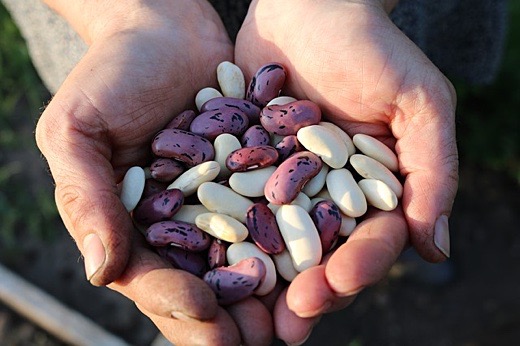
Image above: A handful of bush, or runner beans. From original article.

Also known as snap beans for their distinct “snapping” sound when ripe, bush beans are the most popular home-grown beans for novice and expert gardeners alike. They also are easy to grow.

As an added bonus, these plants tend to ripen all at once, which means you’ll have a large number of beans and you won’t have to keep guessing if the plant is going to produce. This can make it easier to freeze or can the vegetables.

Interested in giving bush beans a try in your garden this summer? Follow these tips:

1. Make sure it’s warm
Beans love warm – even hot — weather. While they can grow in poor soil conditions, they cannot grow when it’s cold or the region is still experiencing frost at night.

If you jumped the gun and planted before it was warm enough, that doesn’t mean the crop is ruined, but beans planted in cold soil just don’t grow as fast; it also makes them prone to rot or various diseases found in soil.

2. Soak the seeds
If you are looking for an even faster turnaround time, try placing the seeds in water overnight before planting. The seeds will swell up with water and they’ll be ready to germinate, meaning you will get your beans even faster.

3. Water, water, water
Beans grow better with a good water supply, but they don’t do so well when the soil is too wet or doesn’t drain properly. To ensure the soil drains properly and your beans don’t rot, use organic material, like compost, before you plant the beans. After the plants have started sprouting, allow them to dry out – just a bit – before watering again.

4. Place them close together
Unlike other plants, bush beans can be planted close together, without impact to the growing process. When the bean plants begin to sprout, they will form a canopy of shade over the soil, keeping it cool. That then will deter weeds from growing, which ultimately will provide you with a much better crop.

5. Pick a new spot
Gardeners who have grown beans for years often will recommend not growing beans in the same spot two seasons in a row. Beans are very vulnerable to soil-borne diseases, so crop rotation helps. You also will stop the formation of diseases.

6. Get the weeds out
Bean plants tend to have shallow roots when compared to weeds, which means they won’t get the nutrients from the soil when weeds have deeper roots and hog all the nutrients. For this reason, it is recommended to keep your bean garden well-weeded so the plants stay healthy and will produce.


Video above: A video about germinating, planting and growing runner beans. From (https://youtu.be/zUeJH3_qesk).

See also:
Ea O Ka Aina: Open Source Seeds 5/2/17

.

Blackfeet back to traditional foods

SUBHEAD: Native American youth are learning to integrate local foods back into their daily lives.

By J. Gabriel Ware on 6 Jujne 2017 for Yes Magazine -
(http://www.yesmagazine.org/people-power/blackfeet-researcher-leads-her-tribe-back-to-traditional-foods-20170606)


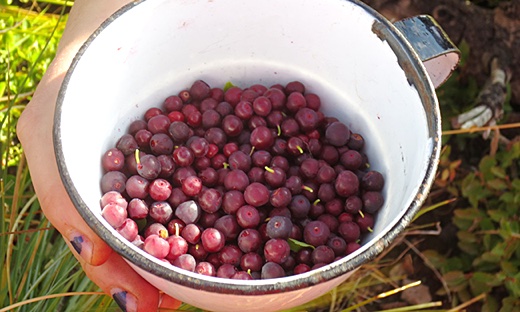
Image above: A cup of freshly picked huckleberries. Photo by Abaki Beck. From original article.

Researcher Abaki Beck, 23, has vivid childhood memories of helping her mother, grandmothers, and aunts pick traditional foods and medicines on the Blackfeet Nation in northwest Montana. Because her great-grandmother passed down her vast knowledge of the tribe’s traditions, Beck learned the importance of eating these foods at an early age.

Well before white settlers colonized their land, Blackfeet Nation members used more than 200 types of plants for food and remedies. But forced assimilation and reliance on the U.S. government for food adversely shifted most nations’ diets from whole foods to industrialized processed foods and eroded tribal health.

More than 80 percent of American Indian and Alaska Native adults are overweight or obese, and half of American Indian children are predicted to develop Type 2 diabetes in their lifetimes, according to the Indian Health Clinical Reporting system.

Beck, who has a degree in American studies and has researched the impacts of settler-colonialism on Blackfeet youth suicide, hopes to change those health disparities.

Her report, published in May, “Ahwahsiin: Traditional Ecological Knowledge and Contemporary Food Sovereignty on the Blackfeet Reservation” (ahwahsiin translates to “the land where we get our food”), features oral history interviews with nine Blackfeet elders who discussed the nation’s traditional foods and the health issues connected to a modern American diet.

A 2016 survey —the Blackfeet Nation has approximately 17,000 members—found that one of the most cited barriers in accessing traditional or local foods was lack of knowledge.

“Our people survived genocide in part because of [traditional] foods and medicines,” Beck says. “And because our elders are passing away and global warming is changing how our environment functions, now is a significant time to capture elders’ knowledge and our own community’s history.”

Beck partnered with Saokio Heritage, a community-based and volunteer-run organization on Blackfeet. The report was funded by a $10,000 grant from the First Nations Development Institute and is available on the organization’s website.

Many of the traditional foods, plants, and teas are still available on the reservation, and some are even sold in health food stores, Beck says, so younger tribal members can learn to integrate them into their daily lives.


Image above: Blackfeet Elders Angeline Wall and Bernadette Wall collect roots on the Blackfeet Reservation. From original article.

For example, traditional medicine like willow bark or blue root can replace Tylenol, and bison or venison can replace fatty beef. Local berries can either become a traditional berry soup or be mixed into other recipes like pancakes, muffins, and smoothies.

“Some Westernized foods and medicines are not best for tribal people,” says Carolyn Angus-Hornbuckle, director of public health policy and programs at the National Indian Health Board. “These health disparities are happening throughout Indian Country, and we could see positive health impacts if Blackfeet chose to share Beck’s report and their knowledge with other communities.”

Most scholarly research reports are concealed behind paywalls and easily accessible by only those in academia, but Beck removed that barrier for the Blackfeet people by making her report available for free.

Danielle Antelope, a 21-year-old Blackfeet Community College student who helped Beck conduct the interviews, grew up eating chicken patties, cheeseburgers, and tater tots for dinner.

“We never ate vegetables,” Antelope says. “My mom was a single mom, so she wanted to make sure we were full when she fed us, but we didn’t think about the nutritional aspect of what were we eating.”

“I wish I had known of our traditional ways of eating when I was younger,” she adds. “I didn’t really learn about eating healthy in school, either.”

Efforts to promote food sovereignty throughout Indian Country have included youth education, community gardening, and economic development. But because there are hundreds of distinct tribes—with different needs and systems of food, government, and regulation—approaches to tackling the health disparities vary greatly, Beck says.

Even though “health disparities on the Blackfeet Reservation [are] too broad to be solved by one report,” Beck says, she’s confident that awareness is part of the solution.

.

Twilight of American freedom

SUBHEAD: We have entered a new regime without justice. It’s called the American police state.

By John Whitehead on 5 June 2017 for the Rutherford Institute-
(https://www.rutherford.org/publications_resources/john_whiteheads_commentary/twilight_of_the_courts_the_elusive_search_for_justice_in_the_american_polic)


Image above: Scott Simons speaks through a bullhorn during a protest about the police shooting of Dillon Taylor in Salt Lake City, Monday, August 18, 2014. Simons is the father of Kelly Simons who was shot and killed by police in 2013. Photo by Salt Lake Tribune. From (http://www.wnd.com/2014/08/black-cop-kills-white-man-media-hide-race/).
“As nightfall does not come at once, neither does oppression. In both instances, there is a twilight when everything remains seemingly unchanged. And it is in such twilight that we all must be most aware of change in the air – however slight – lest we become unwitting victims of the darkness.”—Supreme Court Justice William O. Douglas
As the U.S. Supreme Court’s ruling in County of Los Angeles vs. Mendez makes clear, Americans can no longer rely on the courts to mete out justice.

Continuing its disturbing trend of siding with police in cases of excessive use of force, a unanimous Court declared that police should not be held liable for recklessly firing 15 times into a shack where a homeless couple—Angel and Jennifer Mendez—was sleeping.

Understandably, the Mendezes were startled by the intruders, so much so that Angel was holding his BB gun, which he used to shoot rats, in defense.

Despite the fact that police barged into the Mendez’s backyard shack without a search warrant and without announcing their presence and fired 15 shots at the couple, who suffered significant injuries (Angel Mendez suffered numerous gunshot wounds, one of which required the amputation of his right leg below the knee, and his wife Jennifer was shot in the back), the Court once again gave the police a “get out of jail free” card.

Unfortunately, we’ve been traveling this dangerous road for a long time now.

In the police state being erected around us, the police and other government agents can probe, poke, pinch, taser, search, seize, strip and generally manhandle anyone they see fit in almost any circumstance, all with the general blessing of the courts.

Whether it’s police officers breaking through people’s front doors and shooting them dead in their homes or strip searching motorists on the side of the road, these instances of abuse are continually validated by a judicial system that kowtows to virtually every police demand, no matter how unjust, no matter how in opposition to the Constitution.

These are the hallmarks of the emerging American police state: where police officers, no longer mere servants of the people entrusted with keeping the peace, are part of an elite ruling class dependent on keeping the masses corralled, under control, and treated like suspects and enemies rather than citizens.

While the First Amendment—which gives us a voice—is being muzzled, the Fourth Amendment—which protects us from being bullied, badgered, beaten, broken and spied on by government agents—is being disemboweled.

A review of critical court rulings over the past decade or so, including some ominous ones by the U.S. Supreme Court, reveals a startling and steady trend towards pro-police state rulings by an institution concerned more with establishing order and protecting the ruling class and government agents than with upholding the rights enshrined in the Constitution.
As I make clear in my book Battlefield America: The War on the American People, we are dealing with a nationwide epidemic of court-sanctioned police violence carried out against individuals posing little or no real threat, who are nevertheless subjected to such excessive police force as to end up maimed or killed.

When all is said and done, what these assorted court rulings add up to is a disconcerting government mindset that interprets the Constitution one way for the elite—government entities, the police, corporations and the wealthy—and uses a second measure altogether for the underclasses—that is, you and me.

.