SUBHEAD: For Aborigines healing from trauma is a cultural and spiritual process tied to land.
By B. Williamson, J. Weir & V. Cavanagh on 23 Jan 2020 in Yes! -
(https://www.yesmagazine.org/environment/2020/01/23/australia-bushfire-aboriginal/)
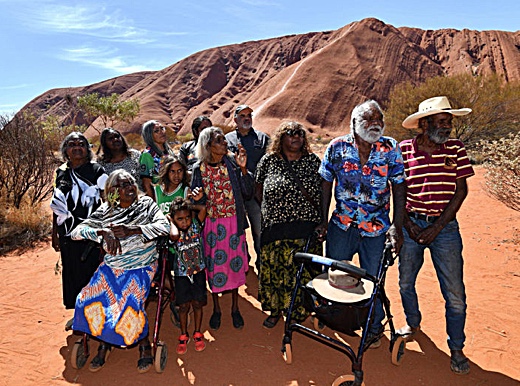
Image above: Group of Australian aborigines who practice land management. From original article.
How do you support people forever attached to a landscape after an inferno tears through their homelands: decimating native food sources, burning through ancient scarred trees, and destroying ancestral and totemic plants and animals?
The fact is, the experience of Aboriginal peoples in the fire crisis engulfing much of Australia is vastly different from that of non-Indigenous peoples.
Colonial legacies of eradication, dispossession, assimilation, and racism continue to affect the lived realities of Aboriginal peoples. Added to this is the widespread exclusion of our peoples from accessing and managing traditional homelands. These factors compound the trauma of these unprecedented fires.
As Australia picks up the pieces from these fires, it’s more important than ever to understand the unique grief that Aboriginal peoples experience. Only through this understanding can effective strategies be put in place to support our communities to recover.
While many instances of colonial trauma were inflicted upon Aboriginal peoples—including the removal of children and the suppression of culture, ceremony, and language—dispossession of Country remains paramount. Dispossessing people of their lands is a hallmark of colonization.
Australian laws have changed to partially return Aboriginal peoples’ lands and waters, and Aboriginal people have made their best efforts to advocate for more effective management of Country. But despite this, most of our peoples have been consigned to the margins in managing our homelands.
Aboriginal people have watched on and been ignored as homelands have been mismanaged and neglected.
Oliver Costello is chief executive of Firesticks Alliance, an Indigenous-led network that aims to reinvigorate cultural burning. As he puts it:
Since colonization, many Indigenous people have been removed from their land, and their cultural fire management practices have been constrained by authorities, informed by Western views of fire and land management.
In this way, settler-colonialism is not historical, but a lived experience. And the growing reality of climate change adds to these anxieties.
It’s also important to recognize that our people grieve not only for our communities, but for our nonhuman relations. Aboriginal peoples’ cultural identity comes from the land.
As such, Aboriginal cultural lives and livelihoods continue to be tied to the land, including landscape features such as waterholes, valleys, and mountains, as well as native animals and plants.
The decimation caused by the fires deeply affects the existence of Aboriginal peoples and, in the most severely hit areas, threatens Aboriginal groups as distinct cultural beings attached to the land. As The Guardian’s Indigenous affairs editor Lorena Allam recently wrote:
Like you, I’ve watched in anguish and horror as fire lays waste to precious Yuin land, taking everything with it—lives, homes, animals, trees—but for First Nations people, it is also burning up our memories, our sacred places, all the things which make us who we are.
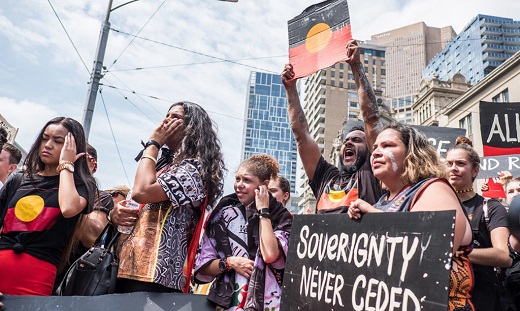
Image above: native Australians protest in support of their sovereignty. From original article.
For Aboriginal people then, who live with the trauma of dispossession and neglect and now, the trauma of catastrophic fire, our grief is immeasurably different from that of non-Indigenous people.
But an examination of research and commentary in this area reveals how poorly non-Indigenous Australia (and indeed, the international field of community recovery) understands the needs of Aboriginal people.
The definition of “community” is not explicitly addressed, and thus is taken as a single socio-cultural group of people.
But research in Australia and overseas has demonstrated that for Aboriginal people, healing from trauma—whether historical or contemporary—is a cultural and spiritual process, and inherently tied to land.
The culture-neutral standpoint in community recovery research as yet does not acknowledge these differences. Without considering the historical, political, and cultural contexts that continue to define the lives of Aboriginal peoples, responses to the crisis may be inadequate and inappropriate.
Experts consider these resilience traits as integral for communities to survive and recover from natural disasters.
In this way, the resilience of Aboriginal communities fashioned through centuries of colonization, coupled with adequate support, means Aboriginal communities in fire-affected areas are well placed to not only recover, but to do so quickly.
This is a salient lesson for agencies and other non-government organizations entrusted to lead the disaster recovery process.
The community characteristics that enable effective and timely community recovery, such as close social links and shared histories, already exist in the Aboriginal communities affected.
It’s important to note this isn’t “special treatment.” Instead, it recognizes that policy and practice must be fit-for-purpose and, at the very least, not do further harm.
If agencies and non-government organizations responsible for leading the recovery from these fires aren’t well-prepared, they risk inflicting new trauma on Aboriginal communities.
The National Disability Insurance Agency offers an example of how to engage with Aboriginal people in culturally sensitive ways. This includes thinking about Country, culture, and community, and working with each community’s values and customs to establish respectful, trusting relationships.
The new bushfire recovery agency must use a similar strategy. This would acknowledge both the historical experiences of Aboriginal peoples and our inherent strengths as communities that have not only survived, but remain connected to our homelands.
In this way, perhaps the bushfire crisis might have some positive longer-term outcomes, opening new doors to collaboration with Aboriginal people, drawing on our strengths and values, and prioritizing our unique interests.
.
By B. Williamson, J. Weir & V. Cavanagh on 23 Jan 2020 in Yes! -
(https://www.yesmagazine.org/environment/2020/01/23/australia-bushfire-aboriginal/)
Image above: Group of Australian aborigines who practice land management. From original article.
How do you support people forever attached to a landscape after an inferno tears through their homelands: decimating native food sources, burning through ancient scarred trees, and destroying ancestral and totemic plants and animals?
The fact is, the experience of Aboriginal peoples in the fire crisis engulfing much of Australia is vastly different from that of non-Indigenous peoples.
Colonial legacies of eradication, dispossession, assimilation, and racism continue to affect the lived realities of Aboriginal peoples. Added to this is the widespread exclusion of our peoples from accessing and managing traditional homelands. These factors compound the trauma of these unprecedented fires.
As Australia picks up the pieces from these fires, it’s more important than ever to understand the unique grief that Aboriginal peoples experience. Only through this understanding can effective strategies be put in place to support our communities to recover.
Perpetual grief
Aboriginal peoples live with a sense of perpetual grief. It stems from the as-yet-unresolved matter of the invasion and subsequent colonization of our homelands.While many instances of colonial trauma were inflicted upon Aboriginal peoples—including the removal of children and the suppression of culture, ceremony, and language—dispossession of Country remains paramount. Dispossessing people of their lands is a hallmark of colonization.
Australian laws have changed to partially return Aboriginal peoples’ lands and waters, and Aboriginal people have made their best efforts to advocate for more effective management of Country. But despite this, most of our peoples have been consigned to the margins in managing our homelands.
Aboriginal people have watched on and been ignored as homelands have been mismanaged and neglected.
Oliver Costello is chief executive of Firesticks Alliance, an Indigenous-led network that aims to reinvigorate cultural burning. As he puts it:
Since colonization, many Indigenous people have been removed from their land, and their cultural fire management practices have been constrained by authorities, informed by Western views of fire and land management.
In this way, settler-colonialism is not historical, but a lived experience. And the growing reality of climate change adds to these anxieties.
It’s also important to recognize that our people grieve not only for our communities, but for our nonhuman relations. Aboriginal peoples’ cultural identity comes from the land.
As such, Aboriginal cultural lives and livelihoods continue to be tied to the land, including landscape features such as waterholes, valleys, and mountains, as well as native animals and plants.
The decimation caused by the fires deeply affects the existence of Aboriginal peoples and, in the most severely hit areas, threatens Aboriginal groups as distinct cultural beings attached to the land. As The Guardian’s Indigenous affairs editor Lorena Allam recently wrote:
Like you, I’ve watched in anguish and horror as fire lays waste to precious Yuin land, taking everything with it—lives, homes, animals, trees—but for First Nations people, it is also burning up our memories, our sacred places, all the things which make us who we are.
Image above: native Australians protest in support of their sovereignty. From original article.
For Aboriginal people then, who live with the trauma of dispossession and neglect and now, the trauma of catastrophic fire, our grief is immeasurably different from that of non-Indigenous people.
Bushfire recovery must consider culture
As we come to terms with the fires’ devastation, Australia must turn its gaze to recovery. The field of community recovery offers valuable insights into how groups of people can come together and move forward after disasters.But an examination of research and commentary in this area reveals how poorly non-Indigenous Australia (and indeed, the international field of community recovery) understands the needs of Aboriginal people.
The definition of “community” is not explicitly addressed, and thus is taken as a single socio-cultural group of people.
But research in Australia and overseas has demonstrated that for Aboriginal people, healing from trauma—whether historical or contemporary—is a cultural and spiritual process, and inherently tied to land.
The culture-neutral standpoint in community recovery research as yet does not acknowledge these differences. Without considering the historical, political, and cultural contexts that continue to define the lives of Aboriginal peoples, responses to the crisis may be inadequate and inappropriate.
Resilience in the face of ongoing trauma
The long-term effects of colonization has meant Aboriginal communities are (for better or worse) accustomed to living with catastrophic changes to their societies and lands, adjusting and adapting to keep functioning.Experts consider these resilience traits as integral for communities to survive and recover from natural disasters.
In this way, the resilience of Aboriginal communities fashioned through centuries of colonization, coupled with adequate support, means Aboriginal communities in fire-affected areas are well placed to not only recover, but to do so quickly.
This is a salient lesson for agencies and other non-government organizations entrusted to lead the disaster recovery process.
The community characteristics that enable effective and timely community recovery, such as close social links and shared histories, already exist in the Aboriginal communities affected.
Moving forward
The agency in charge of leading the recovery in bushfire-affected areas must begin respectfully and appropriately. And they must be equipped with the basic knowledge of our peoples’ different circumstances.It’s important to note this isn’t “special treatment.” Instead, it recognizes that policy and practice must be fit-for-purpose and, at the very least, not do further harm.
If agencies and non-government organizations responsible for leading the recovery from these fires aren’t well-prepared, they risk inflicting new trauma on Aboriginal communities.
The National Disability Insurance Agency offers an example of how to engage with Aboriginal people in culturally sensitive ways. This includes thinking about Country, culture, and community, and working with each community’s values and customs to establish respectful, trusting relationships.
The new bushfire recovery agency must use a similar strategy. This would acknowledge both the historical experiences of Aboriginal peoples and our inherent strengths as communities that have not only survived, but remain connected to our homelands.
In this way, perhaps the bushfire crisis might have some positive longer-term outcomes, opening new doors to collaboration with Aboriginal people, drawing on our strengths and values, and prioritizing our unique interests.
.