Showing posts with label Drought. Show all posts

High Plains Climate Change

SUBHEAD: ‘Flash drought’ could devastate half the High Plains wheat harvest this year.

By Eric Holthaus on 1 August 2017 for Grist -
(http://grist.org/food/flash-drought-could-devastate-half-the-high-plains-wheat-harvest/)
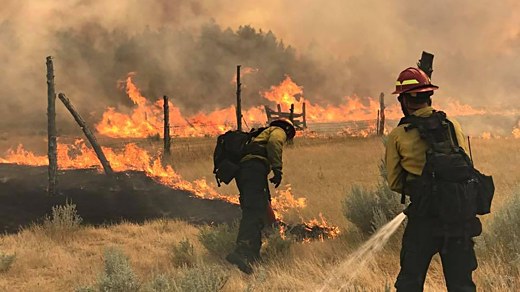

Image above: Firemen fighting the recent Bridge Coulee Fire in the High Plains.Photo by Bureau of land. From original article.

It’s peak hurricane season, but the nation’s worst weather disaster right now is raging on the High Plains.

An intense drought has quickly gripped much of the Dakotas and parts of Montana this summer, catching farmers and ranchers off-guard. The multi-agency U.S. Drought Monitor recently upgraded the drought to “exceptional,” its highest severity level, matching the intensity of the California drought at its peak.

The Associated Press says the dry conditions are “laying waste to crops and searing pasture and hay land” in America’s new wheat belt, with some longtime farmers and ranchers calling it the worst of their lifetimes. Unfortunately, this kind of came-out-of-nowhere drought could become a lot less rare in the future.

“The damage and the destruction is just unimaginable,” Montana resident Sarah Swanson told Grist. “It’s unlike anything we’ve seen in decades.”

Rainfall across the affected region has been less than half of normal since late April, when this year’s growing season began. In parts of Montana’s Missouri River basin, which is the drought’s epicenter, rainfall has been less than a quarter of normal — which equals the driest growing season in recorded history for some communities.

“It’s devastating,” says Tanja Fransen, a meteorologist at the National Weather Service’s office in Glasgow, Montana. Just six years removed from 2011, one of the region’s wettest years on record, eastern Montana is now enduring one of its driest.

“We’re at the bottom of the barrel,” Fransen says. “For many areas, it’s the worst we’ve seen in 100 years.”

 
In a matter of weeks, the area of Montana in drought conditions has expanded eightfold. U.S. Drought Monitor

Wheat production worries

The drought already has far-reaching effects. In eastern Montana, America’s current-largest wildfire continues to smolder; the 422-square-mile Lodgepole complex fire is one-third the size of Rhode Island. It’s Montana’s largest fire since 1910.

Across the state, 17 other large fires are also spreading. “We haven’t even hit our normal peak fire season yet,” Fransen says.

Recently, as the climate has warmed and crop suitability has shifted, the Dakotas and Montana have surpassed Kansas as the most important wheat-growing region in the country. The High Plains is now a supplier of staple grain for the entire world. According to recent field surveys, more than half of this year’s harvest may already be lost.

The economic impact of the drought and related fires may exceed $1 billion across the multi-state region by the time the rains return. Donations of hay for beleaguered farmers and ranchers have come in from as far away as West Virginia.

Farmers in the region are also worried because the Trump administration has targeted a key federal crop insurance program for hefty cuts. The governors of North Dakota, South Dakota, and Montana have all declared states of emergency to speed aid and open some normally protected areas for livestock grazing.


Abnormally dry conditions now cover 100 percent of South Dakota. U.S. Drought Monitor

It came out of nowhere

Droughts are often thought of as creeping, slow-motion disasters. They usually don’t grab headlines like hurricane landfalls, even though they represent the costliest weather-related catastrophe worldwide.

But this drought is an anomaly, a “flash drought.” It essentially came from nowhere. It didn’t exist just three months ago.

The frequency of these rapid-onset droughts is expected to increase as the planet warms. A recent study focusing on China found that flash droughts more than doubled in frequency there between 1979 and 2010.

Droughts like these are closely linked to climate change. As temperatures rise, abnormally dry conditions across the western United States are already becoming more common and more intense. And as evaporation rates speed up, rainfall becomes more erratic, and spring snowmelt dries up earlier each year.

Future summers in North Dakota are expected to be even hotter and drier, on par with the present-day weather of south Texas.

Taking heavy losses

On Whitney Klasna’s ranch in Lambert, Montana, the spring rains “just didn’t come this year.” Klasna has already seen 60 to 80 percent crop losses in her fields, and now she’s making calculations about which of her cattle she can afford to save. She and her crew are working to drill an additional water well and install a pipeline to keep as many alive as possible.

Now they’re worried that, if the rains do come, they’ll lead to flash flooding; the ground has essentially been transformed into concrete.

Klasna calls the drought a “perfect storm of bad luck” and expects its impacts to last for years.


The drought in western North Dakota is now just as severe as California’s was at its peak. U.S. Drought Monitor

Further west, near where the Lodgepole complex is burning, Sarah Swanson runs a John Deere dealership, one of the biggest businesses in her community. She hears heartbreaking stories from across the region, with many farmers and ranchers working together to fight the fire with their own equipment.


“Right now, I don’t think anybody has time to feel scared,” Swanson says. “I think the emotions will probably start once they have time to get the fire out in a week or two.”

Last week, Swanson wrote a personal letter to Interior Secretary Ryan Zinke, a Montana native, asking him to ease grazing restrictions on a nearby wildlife refuge. Two days later, he did so.

“We’ll be able to continue on,” Swanson says. “I wish I could say that for all the Main Street businesses in eastern Montana, but I don’t think I can. The effects are already being felt by restaurants and retail shops and gas stations, and there will be some that can’t sustain this.”
.

Carbon Clock Countdown

SUBHEAD: The planet has just one year until the carbon budget for global temperatures surpass 1.5ºC of warming.

By Nika Knight on 11 January 2017 for Common Dreams -
(http://www.commondreams.org/news/2017/01/10/ticking-carbon-clock-warns-we-have-one-year-avert-climate-catastrophe)


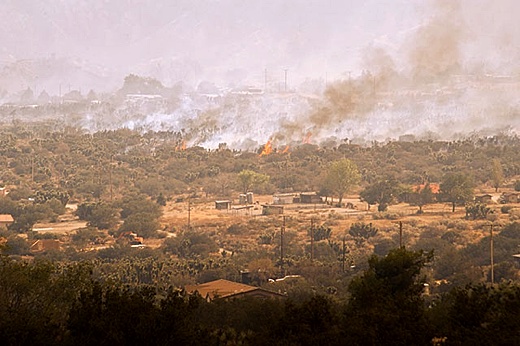
Image above: A series of enduring droughts in East Africa has already caused widespread deaths, malnutrition, and fueled the migration of refugees to Europe. As the planet warms, more extreme conditions are imminent. Photo by Save the Children. From original article.

Our window of time to act on climate may be shrinking even faster than previously thought.

We may only have one year remaining before we lock in 1.5ºC of warming—the ideal goal outlined in the Paris climate agreement—after which we’ll see catastrophic and irreversible climate shifts, many experts have warned.

That’s according to the ticking carbon budget clock created by the Mercator Research Institute on Global Commons and Climate Change (MCC). The clock’s countdown now shows that only one year is left in the world’s carbon budget before the planet heats up more than 1.5º over pre-industrial temperatures.

That's under the most pessimistic calculations. According to the most optimistic prediction, we have four years to kick our carbon habit and avert 1.5º of warming.

And to limit warming to 2ºC—the limit agreed upon in the Paris climate accord—we have nine years to act under the most pessimistic scenario, and 23 years to act under the most optimistic.

"So far, there is no track record for reducing emissions globally," explained Fabian Löhe, spokesperson for MCC, in an email to Common Dreams. "Instead, greenhouse gas emissions have been rising at a faster pace during the last decade than previously—despite growing awareness and political action across the globe.

Once we have exhausted the carbon budget, every ton of CO2 that is released by cars, buildings, or industrial plants would need to be compensated for during the 21st century by removing the CO2 from the atmosphere again.

Generating such 'negative emissions' is even more challenging and we do not know today at which scale we might be able to do that."

(Climate activists and environmentalists have also long warned of the potential negative consequences of geoengineering and other carbon capture schemes, as Common Dreams has reported.)

"Hence, the clock shows that time is running out: it is not enough to act sometime in the future, but it is necessary to implement more ambitious climate policies already in the very short-term," Löhe added.

"Take all of the most difficult features of individual pathways to 2ºC—like fast and ambitious climate action in all countries of the world, the full availability of all required emissions reduction and carbon removal technologies, as well as aggressive energy demand reductions across the globe—the feasibility of which were so heatedly debated prior to Paris," Löhe said. "This gives you an idea of the challenge associated with the more ambitious 1.5°C goal."

.

Climate Chaos

SUBHEAD: As the North Pole melts in November and wildfires rage Across USA well into winter.

By Dahr Jamail on 12 December 2016 for Truth Out -
(http://www.truth-out.org/news/item/38689-as-north-pole-melts-in-november-wildfires-rage-across-us-well-into-winter)


Image above: Flames along the south side of California State Route 138 in Phelan, California, on August 17, 2016. As climate disruption intensifies, wildfires will be burning well into winter. Photo by Andrew Cullen for The New York Times. From original article.

This is the first anthropogenic climate disruption (ACD) dispatch to be written since the election, which heralded the arrival of a president-elect who will become the only western leader who is an ACD denier.

While President Obama remained clearly in the pocket of the fossil fuel industry, with his unwillingness to take the radical actions necessary to mitigate (if even nominally) the already-dire impacts of ACD, he was, at least, willing to admit we live in a crisis never seen before.

As if underscoring the specter of Trump -- and Obama's failure to take appropriate measures, as the proverbial Titanic gurgles ever downward -- the Arctic has been especially warm over the last few weeks. During the second half of November, temperatures at the North Pole were a shocking 36 degrees warmer than normal.

During a time when winter usually sets in and the Arctic sea ice freezes up, ice has been melting instead of freezing. Temperatures in late November were akin to what they normally are at the end of August.

It was Gaia sending yet another unmistakable message, and it was profound enough that Bob Henson with the WeatherUnderground said, "There are weather and climate records, and then there are truly exceptional events that leave all others in the dust. Such has been the case across Earth's high latitudes during this last quarter of 2016."

For perspective, add 36 degrees to whatever your weather is right now, wherever you are. How normal is that? Think about how plants and animals in your area would or wouldn't adapt to that. What would happen to your food and water supply?

To give you another idea of how dramatically things have already changed in the Arctic as the region is in the midst of an ecological disintegration, Captain Cook's records of the region from 1778 reveal a literally different world. His expedition was stopped from sailing north of the Bering Strait by "ice which was as compact as a Wall and seemed to be ten or twelve feet high at least," according to the captain's journal.

In continued attempts to sail further north, Cook's ships followed this ice edge all the way to Siberia, but to no avail.

Meanwhile, back in the 21st century, longtime climate scientists are emphasizing that we're currently seeing an unprecedented situation.

Two days after it was revealed that temperatures at the North Pole were 36 degrees above normal, Walt Meier, a research scientist with the Cryospheric Sciences Laboratory at NASA's Goddard Space Flight Center, who has tracked sea ice data going back to 1979, announced, "It looks like, since the beginning of October, that for the first time we are seeing both the Arctic and Antarctic sea ice running at record low levels."

According to a recent report by the World Meteorological Organization, Earth is now on track to hit 1.2 degrees Celsius hotter than preindustrial temperatures before the end of this year.

According to the recently released annual "Emissions Gap Report" from the UN's Environmental Program (UNEP), current Paris Climate Agreement emissions cuts will still result in 3.5C of planetary warming by 2100. "Current commitments will reduce emissions by no more than a third of the levels required by 2030 to avert disaster," two UNEP leaders warned in the report's introduction.

Recently published research in a prestigious scientific journal shows that ACD is likely already progressing so rapidly that scientists are warning it could well already be "game over." Because the research shows that Earth's climate could be far more sensitive to greenhouse gases than previously believed, they are warning of a temperature rise that is on the "apocalyptic side of bad:" more than 7C within one lifetime from now.

Less importantly, but still shocking and useful to consider (especially since plenty of people seem to believe economics are more important than a habitable planet): Another recent report estimates that the world economy will lose $12 trillion due to ACD damages alone.

A recent report in Bloomberg News lays out the fact that Americans around the US (Florida, Louisiana, East Coast island areas, Alaska, etc.) are already being forced to move due to ACD impacts like storms, erosion and rising seas.

Meanwhile, the global immigration crisis caused by ACD continues apace. A recent report shows that global military leaders have warned of an "unimaginable" global refugee crisis if business as usual persists, and, of course, there is no real sign of it abating.

Brig. Gen. Stephen Cheney, a member of the US Department of State's foreign affairs policy board and CEO of the American Security Project, said, "We're already seeing migration of large numbers of people around the world because of food scarcity, water insecurity and extreme weather, and this is set to become the new normal."

An example of this within the US comes in the form of record-setting wildfires that have been burning across vast swaths of the southeast well into November. You'll find more on this below in the "Fire" section, but it's crucial to note that one of the wildfires scorching Tennessee is the largest in a century, and perhaps in the history of record-keeping. At least a dozen people have died across the southeast from the November wildfires, which are continuing to burn at the time of this writing.

The overview of the oceans continues to grow ever more bleak.

A recent report indicates that ocean life is literally suffocating from low oxygen levels caused by ACD. The report shows that oceans, coastal seas, estuaries, and many rivers and lakes are experiencing dramatic declines in dissolved oxygen levels, and this phenomenon is occurring at a global level now.

As a whole, 2016 has been bleak news for anyone interested in the future of the planet. The World Meteorological Organization recently announced that this year is already "very likely" to be the world's warmest ever. 2015 was the previous hottest year on record, and at that time it was the hottest year since record-keeping began.

Earth
Die-offs of planetary flora and fauna continue to increase in scope and frequency.
A recent report revealed how rising sea levels are pushing saltwater further into US wetlands across the coastal southeast, as well as along parts of the east coast, killing trees from Florida all the way up to New Jersey.

Meanwhile in California, a US Forest Service official recently called the ongoing die-off of what is now over 100 million trees there "unprecedented," and blamed the brunt of it on the ongoing ACD-fueled drought afflicting that state.

Similarly, a recent study published in the journal Global Change Biology showed that yellow cedars in Alaska and British Columbia, trees that can live for 1,000 years, are now dying off over vast areas due to warming from ACD.

Trees across 1,500 square miles are now undergoing a die-off linked directly to ACD, and the forecast for them is grim, since approximately half of the forested area that is currently considered suitable for the yellow cedars will no longer be so by 2100 due to ongoing temperature rise and shifting of winter precipitation from snow to rainfall.

Another disturbing report showed that the world has hundreds of millions fewer birds than it did just a few decades ago, thanks to ACD impacts, dwindling habitat, hunters and pollution.

In the Arctic region of Russia, more than 80,000 reindeer have died as a result of retreating Arctic sea ice.

In a massive new study in the journal Nature, scores of international authors have documented a climate "feedback loop" that they say will likely make ACD considerably worse in upcoming decades. The study addresses the soil-carbon loop in the climate system, which deals primarily with Earth's soils.

Soils store a massive amount of carbon in their plants, and the roots of plants that have lived and died there. Scientists have long since warned that as warming increases, microorganisms living in soils would naturally respond by increasing their respiration rates, a process that then releases more CO2 or methane into the atmosphere. The new study shows that this process is already happening.

Water
As usual, the impacts of ACD across the planet are the most pronounced and obvious in the watery realms (which are increasingly losing their water).

A recently published study showed that, due to dramatically changed vegetation across the Mediterranean region, Spain could be a desert by the year 2100.

Across Africa, ongoing drought is destabilizing countries as it persists. It is the worst drought in 35 years, and has left more than 21 million people in need of food assistance. Unfortunately, yet not surprisingly, the United Nation's Special Envoy Macharia Kamau told journalists in Mozambique recently, "The crisis has yet to peak."

Drought continues plaguing large sections of China. In one region, China's largest freshwater lake is rapidly turning into prairie, as it has neared low-level lines nearly two months earlier than it has done historically.

Meanwhile in Bolivia, President Evo Morales has told people to "prepare for the worst" as the small Andean Mountain country is wracked by a historic drought. Reservoirs that supply water to Bolivia's largest city are now nearly empty.

The drought is primarily fueled by vanishing glaciers across the country, which are a key supplier of water during the dry season. Of course, the glaciers are melting away at record rates due primarily to ACD.

Closer to home, in Utah, recent NASA satellite imagery reveals that the Great Salt Lake is drying up rapidly, as five years of drought have seen the lake's area decrease by 40 percent.

Meanwhile, yet another study was published recently tying US western states' record low snowpack to ACD.

The climate has warmed so much in Canada, that the city of Montreal has invested $7.3 million to save its ice skating rinks. Incredibly, the money will be used to buy refrigerated ice skating rinks.

Looking further north, Russia, China and other countries are rapidly stepping up plans to exploit melting Arctic sea ice by making preparations for their large cargo ships to use the soon-to-be new shipping lanes. Once shipping begins, it will only be a matter of time before the inevitable environmental disasters start to occur in the Arctic.

In Antarctica things continue to worsen, as odd rifts in the middle of the ice shelf of that continent's Pine Island Glacier might be a sign of a new mechanism that could lead to that glacier's collapse, as well as the collapse of other glaciers.

Sea level rise continues apace. A recently published study shows us that ACD is set to cause the most rapid of sea level rise ever experienced in human history, which will make it challenging, to say the least, for megacities on the coasts to adapt. So far, several island and coastal towns facing sea level rise in the far north have had to relocate entirely.

On that note, the first female head of a Pacific Island nation, Hilda Heine of the Marshall Islands, recently told the press that ACD is a "matter of life and death" for her country.

Lastly in this section, a sign of things to come: In the wake of Hurricane Matthew, the town of Nichols, South Carolina was damaged so heavily by flooding that it is an open question as to whether it will be rebuilt at all.

Fire
Wildfires across the US continued to burn far into November, another sign of how far along we are, in terms of ACD impacts. Increasingly, there is no longer a contained wildfire "season," as the planet continues to warm apace.

From the southern US all the way up to New England, November saw fires burning across the country.

Meteorologist Stu Ostro spoke of "surreal" smoke across Atlanta, Georgia; while in Chattanooga, Tennessee hundreds of people were hospitalized from smoke inhalation, while air quality alerts were issued across the Carolinas and Georgia.

By late November, thousands of firefighters had mobilized to fight fires across the southeast, an area that rarely sees wildfires beyond the end of summer. At least 15 major wildfires across the region had, at the time of this writing, burned in excess of 15,500 acres -- including more than 15,000 acres in Great Smoky Mountains National Park -- and have led to several deaths.
Also in November, wildfires were burning across parts of New York, North Dakota and New Hampshire as well.
Welcome to the future of the US, where wildfires will be burning well into winter.

Air
Temperature records across the planet continue to be set at a record pace.

In the US, November saw several stunning examples of this. The mile-high city of Denver, Colorado saw 78 degrees well into November, while Dallas, Texas saw 88 degrees in the middle of that month.
As aforementioned, the Arctic saw stunningly warm temperatures in November, when one day in the latter part of that month several locations saw temperatures spike well over 36 degrees above average.

Meanwhile, global "weirding" continues, as a recent study showed that the polar vortex is shifting due to ACD, which means winters in eastern North America will be longer. The polar vortex is a zone of frigid air that encircles the Arctic and makes its presence known the most during the winter months.

Also in the Arctic, as that region warms, another recently published study showed that more ancient diseases that were buried deep in the permafrost will be released, posing increasing threats to humans and wildlife. Last summer, anthrax killed a 12-year-old boy in a remote area of Siberia, and at least 20 others in Siberia were diagnosed with the disease. (Twenty may not seem like a large number, but bear in mind that this is an extremely lightly populated area.) Scientists are expressing concern over the fact that infectious microorganisms are now emerging from their deep freeze as permafrost across the entire Arctic continues to melt at unprecedented rates.

Lastly, and quite alarmingly, another recent study showed that the planet is far more sensitive to greenhouse gas levels than previously believed. It showed that climate models are likely underestimating how sensitive the planet is, due to the fact that the greenhouse effect will be amplified the more temperatures increase.

This means the pace of ACD is about to accelerate.

Denial and Reality
Almost needless to say, the most important act of denial over the last month was the US electing an ACD denier into the highest office in the country. President-elect Trump now actively threatens to pull the US out of the Paris climate agreements, eviscerate the EPA and appoint fossil-fuel loyalists into key government positions.

Trump has already said he will strip NASA's Earth Science Division, which conducts vast arrays of studies around ACD and its ongoing impacts across the planet, of funding. A member of Trump's cabal is calling the move a crackdown on "politicized science."

Steve Bannon, who has emerged as Trump's chief strategist, has extreme views on many subjects, including ACD, which he calls an elaborate hoax. He refers to renewable energy as "a scam." Bannon is known for helping influence Trump's "views" on ACD and has called environmentalists "greentards" and "totally fucking wrong on climate change."

As is now well known, Trump has claimed that ACD is a "Chinese hoax." Inconveniently for Trump, during the recent UN Climate Summit in Morocco, China's vice foreign minister, Liu Zhenmin, told reporters that Trump is wrong to have accused China of portraying ACD as a "hoax."

 "Look at the history of climate change negotiations, in fact [they were] launched in the late '80s under the administration of Republican President Reagan and George Bush, supported by the United Nations Intergovernmental Panel on Climate Change (IPCC)," Liu told reporters, according to Bloomberg and reports from within the Chinese media.

The Republican Party, which continues to remain the only major political party on the planet that denies the reality of ACD, continues to be funded, backed and heavily controlled by the fossil fuel industry, hence its denial of ACD in order to protect profit-making.

Meanwhile, there is more news on the reality front than is even possible to keep up with.

The government of Australia's New South Wales recently unveiled a plan by which it aims to reach zero CO2 emissions by the year 2050 in order to work towards mitigating the worsening impacts of ACD as best as it can. It will do so primarily by making a concerted effort to shift over to renewable energies and increase battery storage capacity.

On a sobering note, a recently published study showed that the average American is responsible for melting 538 square feet of Arctic summer sea ice each year.

The UN's World Meteorological Organization announced in November that the past five years were the hottest ever on record, and that greenhouse gas emissions have increased the risks of extreme weather events by as much as tenfold.

Disturbingly, a recently published study that surveyed more than 250 different plants and animals found that their ability to adapt to changes in rainfall and temperature cannot keep pace with ACD-generated changes in their environments. In short, this means that the climate is changing "too fast" for species, according to the report.

Not that validation from fossil fuel companies is necessary to confirm the reality of ACD, but it is indeed nice to have. On November 1, Simon Henry, the chief financial officer for Shell, the world's second-largest oil company, said demand for oil will begin dropping permanently in the next five to 15 years, according to an article in World Oil. He went on to admit that his company will focus on making money by focusing on natural gas and renewable energy.

To conclude this month's dispatch, it's worth quoting the UN, which in November provided a very apocalyptic vision of the future of ACD, painting a picture of a changed world filled with famine, war and disease.

 "We will grieve over the avoidable human tragedy; the growing numbers of climate refugees hit by hunger, poverty, illness and conflict will be a constant reminder of our failure to deliver," the UN warned, via its Environment Program. The UNEP released a report that predicted the Earth's temperature is already set to increase by up to 3.4C (above the preindustrial temperature baseline) by 2100. This temperature change should take at least tens of thousands of years to occur naturally, but will have been attained by humans in just a little over two centuries.

It is worth remembering that the rapidly increasing global temperature has consistently outpaced even the worst-case predictions by the UN. Predictions of warming that reaches 8C by 2100 have not been uncommon, with some predictions reaching 12C. Bear in mind that humans have never lived on a 3.5C-warmed planet.

 • Dahr Jamail, a Truthout staff reporter, is the author of The Will to Resist: Soldiers Who Refuse to Fight in Iraq and Afghanistan (Haymarket Books, 2009), and Beyond the Green Zone: Dispatches From an Unembedded Journalist in Occupied Iraq (Haymarket Books, 2007). Jamail reported from Iraq for more than a year, as well as from Lebanon, Syria, Jordan and Turkey over the last 10 years, and has won the Martha Gellhorn Award for Investigative Journalism, among other awards.
His third book, The Mass Destruction of Iraq: Why It Is Happening, and Who Is Responsible, co-written with William Rivers Pitt, is available now on Amazon. HE is also the author of the book, The End of Ice, forthcoming from The New Press. He lives and works in Washington State.

.

Protecting Country

SUBHEAD: Organization Seed explained to banks impact to Aboriginal communities if mining projects went ahead.

By Staff on 2 September 2016 for Future Perfect -
(http://www.goethe.de/ins/cz/prj/fup/en15848645.htm)


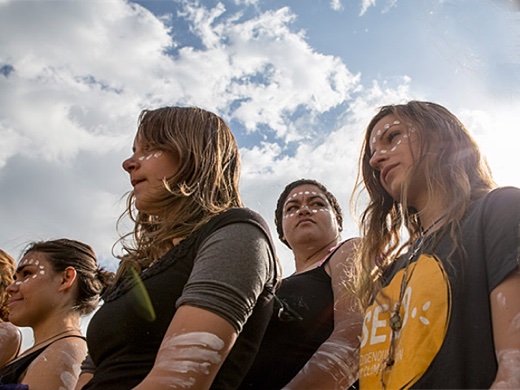
Image above: Seed co-founder Larissa Baldwin at center. From original article.

Climate change affects everyone — but not everyone evenly. If nothing is done to stop the impact of climate change, some of the oldest living cultures in the world could die out. An all-Indigenous youth activist group in Australia has risen to the challenge. 

When Larissa Baldwin first heard about Australia’s first youth summit for climate change activists, she thought she had found her people. She bought a ticket, planned which talks and workshops to attend, then travelled down to Brisbane for PowerShift 2011.

“When I walked through the doors and looked around the foyer, I nearly just walked straight back out again. I couldn’t see anyone like me. It was a sea of white.”

Larissa is an Aboriginal woman of the Bundjalung nation, one of over 500 nations that make up present day Australia. “I took a seat at the back of the room. But before the opening speech had finished, I was out of there.”

But Larissa’s mark on climate activism didn’t end that day. Rather than turn her back on the group that organised the summit, the Australian Youth Climate Coalition (AYCC), she joined them.

Larissa volunteered with the AYCC to help coordinate PowerShift 2013 and make sure there were more ‘black fellas’ like her in the room. It was at PowerShift2013 that AYCC agreed it needed more than a handful of Aboriginal voices: it needed an exclusive sister organisation run for and by young Aboriginal activists.

And so, Seed, Australia’s first all-Indigenous youth climate network, was founded and Larissa was appointed National Co-Director.

Planting the seed for a movement
Larissa, now 29, studied a combined degree in Media Communications and Health Science at Queensland University of Technology, and after graduating was appointed Communications Relations Officer at the Stronger, Smarter Institute, an organisation that promoted Indigenous leadership in schools around Australia.

Larissa’s Co-Director is 22-year-old Amelia Telford who is also a Bundjalung woman. Amelia turned down a placement to study at UNSW Medical School to take up the reigns at Seed. “When I learnt that climate change was not only affecting the places I loved, but also people and our cultural heritage, I knew I had something to do about it,” says Amelia.

When the pair founded Seed, they made clear, “We want Aboriginal people to be able to continue to live on country.” Aboriginal people use ‘country’ to refer to the traditions of the region where an Aboriginal person lives or where their ancestors came from. Climate change is threatening the ancient way of life for Aboriginal people.

Bush fires now flare nearly all year round, draughts are more frequent, and floods are more catastrophic. And the 7,000 people who live in the Torres Strait Islands – between Australia’s north coast and the South of Papua New Guina – already have to reckon with rising sea levels.

“It's not a new concept that our people are the first environmentalists or the first conservationists," says Amelia. “It's always been a part of our culture and a part of who we are.”

How does Seed sprout change?
More than half of all Aboriginal and Torres Strait Islander people are under 25. And with young Aboriginal activists right across Australia joining the network, Seed is continuing to grow.

Today, Seed employs a staff of 15 across fundraising, campaigning and an education team that tours high schools. But the network’s real power are thousands of volunteers across Australia, including in remote Indigenous communities. Among them are around 100 core volunteers who commit regular hours.

Seed teaches young Aboriginal people how to organize a demonstration, run a campaign, stage a media stunt, and start conversations about the need to act on the climate crisis. The organization’s effect branches out much further than climate activism, however.

“Seed doesn’t have the capacity to work on every issue facing young Aboriginal people,” says Larissa. “That’s why we make sure the training we deliver is transferable. If they can learn the skills to make change, they can use these skills to tackle: aboriginal youth suicide, housing issues, Aboriginal health, land rights, you name it.”


With so many abstract numbers and with its distant consequences, climate change can be hard to grasp and easy to dismiss. “Talking about the science of climate change is a really ‘white’ way of tackling climate change,” says Larissa Baldwin. “It doesn’t really work in Aboriginal communities where there’s a lower level education base and English might be someone’s fourth or fifth language.”

Larissa has a grasp of her native language, Widjabul, but there are around 150 Indigenous languages spoken throughout Australia.

“So we don’t talk about ‘climate change’, we talk about ‘protecting country’. And when you talk to Aboriginal people about it, they start listing off all these things that are impacts of climate change. We don’t have to convince them that climate change is real. They live on country. They see what most Australians don’t.”

Going out on a limb
Larissa says Seed learns a lot from AYCC, but many of the tactics the Australian Youth Climate Coalition use don’t work in Aboriginal communities. Just last year, for instance, AYCC’s campaign Dump Your Bank tried to persuade people to change banks if their bank was funding the expansion of fossil fuel mining. However, a lot of people in Aboriginal communities are on basics cards (social welfare) so they can’t move their money.

So Seed took a different approach. “We sent an email to 5,000 employees at all the major banks. We explained what it would mean to Aboriginal communities if mining projects went ahead on our land – mining projects funded by their employer.

We included a survey so we could gauge what bank employees cared about and the responses were incredible: there were people willing to quit their jobs if their banks didn’t stop funding the mines.

The banks couldn’t ignore their own employees, so they issued statements saying they would not fund the mines. That was a really successful campaign.”

 Seed is funded entirely by donations, including small cash donations, monthly donors, and major private donations. It is a founding principal of the organization to not accept any corporate or government sponsorship. This way they are free to put pressure wherever it’s needed.

Ancient roots, not holes in the ground
Australia is one of the world’s largest exporters of fossil fuels. Larissa argues that Australia’s mining industry is not just the source of carbon emissions, but it is also a site of structural racism. “We reject that the only way for Aboriginal communities to gain economic advantage is to sell off our land to these companies.

And the only government investment that goes into our communities is earmarked for mining. We think that’s wrong. Mining is what people end up doing when they don’t have options.” To Seed, the climate crisis is also an opportunity to create a more just and sustainable world.

Larissa spoke in Borroloola in the Gulf of Carpentaria recently. “We ran some workshops around employment options with the local people. Education and eco-tourism were the biggest interest areas we identified.” She went on, “The reason we are so well received in Aboriginal communities like Borroloola is because we never go in there trying to get something out of people.

We don’t actively discourage Aboriginal people from working in the mines or signing land use agreements.

We just try to make sure they have the knowledge to make the best choice. We go there to inform, to empower people to make their own choices.”


.

Global warming and wildfires

SUBHEAD: Forecast is for hotter-than-normal temps for the next three months for “every square inch” of the country.

By  Nika Knight on 28 July 2016 for for Counter Currents -
(http://www.countercurrents.org/2016/07/28/scorching-global-temps-astound-climate-scientists/)


Image above: Southern California’s years-long drought has resulted in one of the “most extreme” wildfires the region has ever seen. Photo by Nick Ut. From original article.

Record global heat in the first half of 2016 has caught climate scientists off-guard, reportsThompson Reuters Foundation.


“What concerns me most is that we didn’t anticipate these temperature jumps,” David Carlson, director of the World Meteorological Organization’s (WMO) climate research program, told Thompson Reuters Foundation late Monday. “We predicted moderate warmth for 2016, but nothing like the temperature rises we’ve seen.”

“Massive temperature hikes, but also extreme events like floodings, have become the new normal,” Carlson added. “The ice melt rates recorded in the first half of 2016, for example—we don’t usually see those until later in the year.”

Indeed, extreme weather events are currently wreaking havoc around the world.

In Southern California, firefighters are battling one of the “most extreme” fires the region has ever seen. The so-called sand fire had consumed 38,346 acres as of Wednesday morning and forced the evacuations of 10,000 homes, and one person has died.

Meteorologist Eric Holthaus reported on the unusual fire last Friday in Pacific Standard:
The fire, which started as a small brush fire along the side of Highway 14 near Santa Clarita, California, on Friday, quickly spread out of control under weather conditions that were nearly ideal for explosive growth. The fire doubled in size overnight on Friday, and then doubled again during the day on Saturday.

“The fire behavior was some of the most extreme I’ve seen in the Los Angeles area in my career,” says Stuart Palley, a wildfire photographer based in Southern California. “The fire was running all over the place. … It was incredible to see.” There were multiple reports of flames 50 to 100 feet high on Saturday, which is unusual for fires in the region.
Time-lapse footage filmed on July 23 showed the fire’s tall flames and rapid growth:


Video above:  Time-lapse of the SandFire from backyard of Mo Sab on 7/23/16. From (https://youtu.be/-h1gEDHX5N0).


“Since late 2011,” Holthaus explained, “Los Angeles County has missed out on about three years’ worth of rain. Simply put: Extreme weather and climate conditions have helped produce this fire’s extreme behavior.”

The fire is an omen of things to come, according to Holthaus: “Even if rainfall amounts don’t change in the future, drought and wildfire severity likely will because warmer temperatures are more efficient at evaporating what little moisture does fall. That, according to scientists, means California’s risk of a mega-drought — spanning decades or more — is, or will be soon, the highest it’s been in millennia.”

As University of California professor Anthony LeRoy Westerling wrote Tuesday in theGuardian: “A changing climate is transforming our landscape, and fire is one of the tools it uses. Expect to see more of it, in more places, as temperatures rise.”

Meanwhile, in India’s northeast, Reuters reported Tuesday that over 1.2 million people “have been hit by floods which have submerged hundreds of villages, inundated large swathes of farmland and damaged roads, bridges and telecommunications services, local authorities said on Tuesday.”

Reuters added that nearly 90,000 people are currently being housed in 220 relief camps.

“Incessant monsoon rains in the tea and oil-rich state of Assam have forced the burgeoning Brahmaputra river and its tributaries to burst their banks—affecting more than half of the region’s 32 districts,” the wire service reported.

Local officials also told the media that “more than 60 percent of region’s famed Kaziranga National Park, home to two-thirds of the world’s endangered one-horned rhinoceroses, is also under water, leaving the animals more vulnerable to poaching.”

An unusually heavy monsoon season has also devastated communities in northern China,AFP reported Monday, with nearly 300 dead or missing and hundreds of thousands displaced after catastrophic flooding hit the region.

And in Iraq, temperatures last week reached such unprecedented heights that a chef literally fried an egg on the sidewalk.

Stateside, the heat dome continues to inflict scorching summer temperatures across the country. In one Arizona locale, for example, meteorologists are predicting a scorching high temperature on Wednesday of 114° Fahrenheit.

One Arizona resident posted a videoTuesday desperately asking people to pray for the state as it faces more hot weather. “It is still six billion degrees,” the resident lamented. “Lord, we need you.”

Yet there appears to be little relief in sight: for the first time ever, USA Today reported Tuesday, the U.S. federal government’s climate prediction center is forecasting hotter-than-normal temperatures for the next three months for “every square inch” of the country.

.

Dow offers new "burndown" herbicide

SUBHEAD: BigAg.com welcomes GMOs, herbicides and global warming drought for profits.

By Staff on 7 July 2016 for BigAg.com - 
(http://www.bigag.com/topics/ag-news/dow-launches-soybean-burndown-herbicide/)


Image above: Marestail "weed" growing up through GMO soybeans. From original article.

[IB Publisher's note: Somehow I got an email inviting me to visit the www.BigAg.com website. It seems that the site is pro GMO and pro Global Warming. Read below and think of these catastrophes as opportunities.] 

Earlier this year, we reported that Marestail was an early concern for growers.  Now that growing season is approaching its half way point growers are looking at soybean fields to find unwanted marestail plants competing with their crops.  While marestail is not new to Midwest growers, herbicide-resistant marestail continues to spread.  This is making it hard to control with glyphosate (RoundUp) alone.

CropLife Magazine is reporting that pending registration; Elevore herbicide will provide accurate control of many glyphosate- and ALS-resistant weeds which include marestail up to 8 inches tall.  This herbicide is expected to control and suppress costly and high-anxiety weeds when applied as part of a grower’s burndown program before planting.

Elevore contains Arylex active, a new Group 4 growth regulator herbicide developed by Dow AgroSciences. Arylex works to control weeds from the inside out to provide thorough control of labeled weeds.

In field trials conducted by Dow AgroSciences, Elevore tank-mixed with 2,4-D (50% of ingredient of Agent Orange) delivered 97% control of glyphosate-resistant marestail when applied in a pre-plant burndown program.

Left abandoned, marestail can grow and consume a soybean field.  According to Michigan State University, an estimated 83% of soybean yield is lost from 105 marestail plants per 10 square feet.  According to Jeff Ellis, Ph.D., field scientist at Dow AgroSciences, he says that it’s important to control marestail early, before soybean plants begin to emerge, for maximum yield potential at the end of the season.

Once Elevore is registered, it will be labeled for application with commonly used residual and burndown tank-mix partners, including glyphosate and 2,4-D, up to 14 days before planting soybeans in the Midwest.  Registration for Elevore is expected in 2017.

For more information from DOW, go to ElevoreHerbicide.com.


Upside of Climate Change
SUBHEAD: Will drought be the Silver Bullet for corn prices in 2016?

By Tim Marquis on 6 July 2016 for BigAg.com -
(http://www.bigag.com/topics/row-crop/will-drought-be-silver-bullet-corn-prices-2016/)


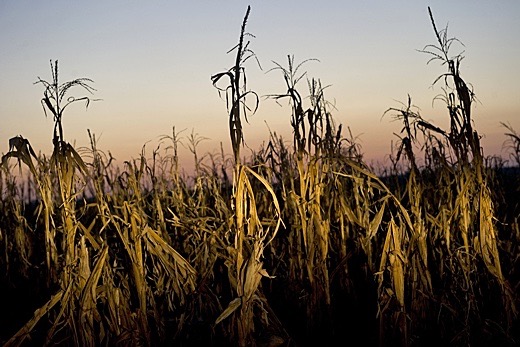
Image above: Corn stalks damaged by drought are seen on a farm near Oakland City, Ind., on 15 August 2013. From (http://usnews.nbcnews.com/_news/2013/01/04/16355471-drought-still-grips-corn-belt-dry-winter-adds-to-farmers-fears).

[BigAg Editor's note: Tim Marquis, head of Agriculture Solutions at Weather Decision Technologies (WDT) discusses the current and upcoming weather and how it has been affecting the growers and their crops.]

The USDA report that broke on June 30th brought with it bad news for growers; the 3rd largest crop ever planted and with it came a sharp decline in commodity prices. Growers are now hoping that a large scale drought will allow for prices to rally. However, growers are looking for the rally in all the wrong places.

I’ve seen a lot of tweets about the lack of rainfall in parts of Southern Iowa, eastern Nebraska and Kansas, and western South Dakota from growers. Everyone is hoping that drought impacts the crop, just not their fields so that prices may rise and they can take advantage of it. Many are hoping we have a summer like 2012.

A lot of growers are hoping for a 2012 type year in regards to drought. Comparing the 2012 Drought Monitor issued at the same time as this week’s, growers can hope for a drought, but this is not the forecast.

Whenever you wish for a forecast we call that “wishcasting” in the meteorological world. The facts don’t support the case for a large scale drought to hit. We are in much better shape this year than in 2012. In 2012, we saw 72% of the country in at least some form of drought at the same time. This year, only 43% of the country is in some form of drought.

More importantly, in 2012, 30% of the country was in a moderate to severe drought which was spread out over a large area compared to just 5% of the country this year and most of it is isolated to California.

We’re entering the part of the year where the Corn Belt receives large amounts of rainfall from squall lines.  Last weekend it rained in Eastern Kansas and Missouri, where a stalled front produced widespread heavy rain which is typical of this time of year.

The longer range forecast, for July into August, is for warmer than normal temperatures across a widespread area.

It's rare, but agronomists may get a year where we can directly monitor the effect heat is going to have on the crop without drought over a large area.

All the more reason that this year, companies that serve agronomists and growers need to have access to high-resolution field level weather. Temperature, precipitation, and potential evapotranspiration are going to need to be monitored to identify areas that will have both heat and lack of rainfall, as well as which areas may just have high heat; especially during pollination.

The weather is going to vary strongly this year, especially with precipitation, but understanding where these areas are, can lead to better management practices.

For instance, growers who irrigate can mitigate heat stress during the R1 stage by applying a .2-.4" pass over their fields.  Growers who don’t have irrigation need to pay close attention to nitrogen and phosphorous levels, and implement a fertility management program, as this can also mitigate the effect heat will have on the crop.

Are you feeling the effects of a drought or close to it? Post your thoughts in the forum!


About BigAg.com
 (http://www.bigag.com/about-us/)

The first of its kind – BigAg.com is a community-based website geared specifically toward producers with large commercial farming operations. It’s a place for anyone involved in production agriculture or large-scale operations to read articles relevant to their fields, learn about and discuss topics in our forum, interact with and learn from our social community of other Big Ag farmers as well as search for equipment – all on one site!

Fastline Publications launched the Big Ag catalog in 2011. This specialized catalog is delivered only to large-acre producers and features larger equipment and products necessary to run commercial operations. Readers love their Big Ag, but they want more. In response, Fastline developed BigAg.com. The Big Ag print catalog and online community strive toward the same goal of providing large-acre farmers the information they need to optimize their operation.

The term Big Ag means different things to different people. We aim to gather information from the best in the industry. We are proud of our Big Ag producers and the work they do to feed and fuel America and the world. We hope that BigAg.com provides information and a platform to help strengthen the Big Ag community.

.

A Soil Pilgrimage

SUBHEAD: Organic farming is the answer to drought and climate change and disintegration of civilization.

By Vandana Shiva on 15 October 2015 for The Asian Age -
(http://www.asianage.com/columnists/soil-pilgrimage-994)


Image above: Vandana Shive on "A soul Pigtimage". From (http://seedfreedom.info/campaign/terra-viva-our-soil-our-commons-our-future/).

Organic farming is the answer to drought and climate change. If we do not respect the soil and if we do not recommit ourselves to ahimsa, we can rapidly disintegrate as a civilization.

[Ashisma: circa 1875 - Without injury - Sanskrit,"a" without, and "himsa" injury]

I have just returned from a soil pilgrimage undertaken to celebrate the International Year of Soil and renew our commitment to a non-violent relationship with the earth, the soil and our society. On October 2, we started the pilgrimage from Bapu Kutir at Sevagram Ashram, Maharashtra.

My fellow pilgrims were those who have contributed over half-a-century of their lives to build the organic movement — Andre Leu, president of International Federation of Organic Agricultural Movements (IFOAM), Ronnie Cummins, director of the Organic Consumers Association (OCA) of the United States, and Will Allen, a professor and long-time organic farmer.

At Mahatma Gandhi’s hut, we took a pledge to stop the violence to the soil through chemical fertilisers and poisons and promote organic farming as ahimsa kheti. We dedicated ourselves to a transition from a violent, chemical, industrial agriculture that is destroying soil fertility and trapping farmers in debt through high-cost seeds and chemicals.

Vidarbha, for example, has emerged as the epicenter of debt-induced farmers’ suicides. It is also the region with the highest acreage of genetically modified organism (GMO) Bt cotton. Fields of non-Bt, native cotton — which is totally pest and weed-free — gives more yields than Bt cotton.

The Bt fields are being doused in pesticides because of pest outbreaks, since Bt is failing as a tool to control pests. Bt cotton fields are also being sprayed with Monsanto’s Roundup, a known carcinogen to control weeds.

There is no regulation of the poisons being used. Most of the GMO cotton seed is being blended and labelled for sale as vegetable oil. We are being fed GMO cotton seed oil, even though GMOs are not allowed in food in India. And while toxic oils spread without regulation, the new food safety rules have shut down the ghani (virgin oil press) that sold healthy and safe oils like flax, groundnut, sesame and mustard.

The oilcake is being fed to our cows. Those who kill others in the name of cow protection are silent on the fight against the toxic giants who are poisoning our “gau mata”.

The pilgrimage concluded at the Agriculture College, Indore, which started as Albert Howard’s institute on organic farming that contributed to the famous Indore process of composting.

Mahatma Gandhi came to know of the Indore process when he visited London to attend the Round Table Conference. Gandhi and Howard have shown that we can have a peaceful and respectful relationship with the soil and with each other.

Howard was sent to India in 1905 by the British Empire to introduce chemical farming. When he arrived, he found the soils were fertile and there were no pests in the fields. He decided to make the Indian peasant his professor and wrote the book An Agricultural Testament, known as the bible of organic farming.

Organic farming is the original example of “Make in India”. Howard’s book helped spread the organic movement to the US through the Rodale Institute and to the UK through the Soil Association, finding its way to far corners of the world.

The soil pilgrimage was our expression of gratitude to sources of organic farming in India — our fertile and generous land and Mother Earth that have sustained us for millennia.

Ecological and regenerative agriculture is based on recycling organic matter, and hence recycling nutrients. It is based on the Law of Return — giving nutrients back to the soil. As Howard wrote in The Soil and Health: “Taking without giving is a robbery of the soil and a banditry; a particularly mean form of banditry, because it involves the robbing of future generations which are not here to defend themselves.”

In taking care of the soil, we also produce more food on less land. Fertile soils are the sustainable answer to food and nutrition security. Organic agriculture is the only real answer to climate change.

The air pollution that has built up in the atmosphere is roughly 400 parts per million (ppm) carbon dioxide today. This is the reason for the greenhouse effect and climate chaos, including temperature rise. To cap the rise of temperature at two degrees centigrade, we need to reduce the carbon build up in the air to 350 ppm.

There is a need to reduce emissions and phase out fossil fuels, but it also requires reducing the stocks of excess carbon from the atmosphere and putting it back into the soil where it belongs. Here, organic, regenerative agriculture offers us the way out.

In the process, it also addresses food insecurity and hunger, reverses desertification, creates livelihood security by creating ecological security, and, therefore, creates the path to peace.

Above all, it allows a transition from the violent paradigm, structures and systems of capitalist patriarchy to the non-violent paradigm, structures and systems based on ahimsa, which include the well being of all.

Organic farming is the answer to drought and climate change. It is also a peace solution. If we do not respect the soil and our cultural diversity and if we do not collectively recommit ourselves to ahimsa, we can rapidly disintegrate as a civilization.

For me, organic agriculture is the dharma that sows the seeds of peace and prosperity for all. It helps us break out of the vicious cycle of violence and degeneration, and create virtuous cycles based on non-violence and regeneration.

Just as humus in soil binds soil particles and prevents soil erosion, it also binds the society and prevents violence and social disintegration. Since humus provides food, livelihood, water and climate security, it also contributes to peace.

Just as wet straw cannot be put on fire by a matchstick, communities that are secure cannot be put on fire by violent elements feeding on insecurity created by an economic model that is killing swadeshi and is only designed for global economic powers to extract what they want.

In taking care of the soil, we reclaim our humanity. Our future is inseparable from the future of the earth. It is no accident that the word human has its roots in humus — soil in Latin. And Adam, the first human in Abrahamanic traditions, is derived from Adamus, soil in Hebrew.

Mahatma Gandhi wrote: “To forget how to dig the earth and tend the soil is to forget ourselves.”

We must never forget that ahimsa must be the basis of our relationship with the earth and each other.

.

Beyond Resilience

SUBHEAD: As Climate Change creates "new normals" mitigation and adjustments will have to be made.

By Courtney White on 23 July 2015 for the Carbon Pilgrim -
(https://carbonpilgrim.wordpress.com/2015/07/14/beyond-resilience/)


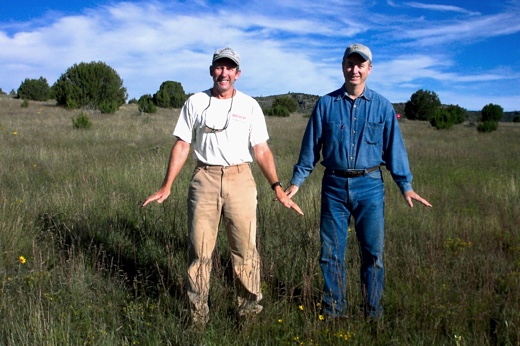
Image above: Photo of the abundant and diverse grasses that returned to the Cañon Bonita ranch. Mike Reardon on the left. From original article.

Restoring land to health means trying to return it to something like normal ecological conditions. But what if the definition of normal changes in the meantime?

An ecosystem’s capacity to absorb a shock, such as a drought, flood, or forest fire, and then bounce back as quickly as possible is called resilience. Since it’s a critical part of ecosystem health, ecologists have made a big effort to understand what constitutes “normal” conditions in order to help a system be as resilient as possible, especially if the shock has been caused by humans, such as overgrazing by cattle.

But what if a system’s definition of normal changes? What if a region’s annual precipitation dropped by half—and stayed there? Or when the rains did fall, they came as unusually large flood events or at the wrong time of year? What does resilience mean in this context?

It’s not an abstract question. Under climate change, scientists tell us, we’ll be experiencing all manner of new normals. For restoration purposes, this means we need to search the management toolbox for practices that go beyond short-term resilience and allow an ecosystem to endure long-term deviations from normal conditions.

What would those practices be? Mike Reardon has an idea.

Since the late 1990s, Reardon has used a wide variety of land restoration tools on his family’s 6500-acre Cañon Bonita Ranch, located in northeastern New Mexico. These tools include tree removal, brush clearing, prescribed fire, planned grazing, erosion control, riparian restoration, water harvesting, dam building, and ranch road repair—all in service of restoring ecological health to the land after decades of mismanagement by previous landowners.

Reardon’s overall goal is to support a multitude of diverse wildlife on the property and his work has been highly effective in this regard. Today, however, he faces a new challenge: How do you maintain forward progress when prolonged drought limits the use of certain tools?

In 1997, an expert with the USDA’s Natural Resources Conservation Service told Reardon that there were “too many trees” on his ranch. This was news to Reardon, who lives in Albuquerque and readily admits to being a novice about land health when he began managing the ranch. Too many piñon and juniper trees, the expert said, meant a reduced amount of open, grassy habitat for wildlife. In the past, nature corrected this situation with periodic, lightning-sparked wildfires that would thin out the trees, allowing the land to bounce back with perennial grasses.

However, a century of fire suppression by landowners and cooperating agencies across the region, coupled with poor livestock management, eventually eliminated the land’s grass cover, resulting in widespread tree encroachment.

To reverse this situation, Reardon focused first on reducing the density of piñon and juniper trees on the ranch. His original tools were handheld loppers and a chainsaw. Then came a spin trimmer, a front-end loader, and a Bobcat skid-steer. Next, Reardon hired a professional woodcutting crew from Mexico. To date, nearly three thousand acres have been cleared on the ranch, though some stands of trees were left for wildlife.

Next, during the years when grass (and rain) was abundant, Reardon alternated the use of two other tools to further reinvigorate the grasslands: prescribed fire and planned grazing. With the assistance of neighbors and fire experts, Reardon has completed two controlled burns, ten years apart, which effectively suppressed tree seedlings.

Reardon also employed the tool of high-density, short-duration grazing by cattle during the vegetative dormant season (December through March). This “living fire” recycles old grass into cattle manure, which helps to build grass cover.

All three tools worked. Grass came back with a flourish, teaching Reardon an important lesson.
“I learned that bare ground was enemy number one,” Reardon said, “so I do everything I can to get grass to grow. And not just any grass, I want perennials and I want as much diversity as possible.”

The next job for the resilience toolbox was water. In order to create more surface water for wildlife to drink, as well as grow a year-round supply of nutritious food, twelve earthen dams and four metal tanks (with windmills) were repaired, modified, or constructed across the ranch. He also implemented a five-phase wetland and riparian restoration project that employed many of the innovative practices pioneered by specialists Bill Zeedyk and Craig Sponholtz.

They designed and implemented treatments for a two-mile stretch of Cañon Bonito Creek, which ran through the center of the ranch. Their goals were to decrease stream bank erosion and downcutting and to raise the water table. They also wanted to reconnect the creek to its floodplain in order to re-wet adjoining wet meadows and increase the amount of live water.

They also hoped to increase forage species, including wetland vegetation, and increase cover for wildlife. There was even a plan to harvest water from ranch roads using a variety of techniques, including redesigned road crossings and water-harvesting rock structures in canyon side channels.

Reardon also implemented a detailed monitoring program on the ranch in order to see how changes were progressing. This included vegetation and bare-ground monitoring, moisture data collection, wildlife population surveys, and photographic documentation, including sixty photo points along Cañon Bonito creek alone.

The message of the monitoring data was clear: conditions were improving. Under Reardon’s management, the ranch progressed from a monoculture of blue grama grass to hosting a diversity of more than 55 different grass species. Dry springs began to flow again and wildlife populations shot up by a factor of ten.

Despite a drying trend that began in 2002, deer, elk, and wild turkey populations continued to rise and things seemed to be returning to normal. It looked like Reardon had succeeded in rebuilding resilience on the ranch.

Except the definition of normal was changing. The drought, for example, went on and on—and still goes on.

Today, year-round water in the Cañon Bonito creek is rare, though there is still a steady trickle in the spring area. A relict population of ponderosa pines is dying, along with piñon and juniper trees. Small populations of perennial grasses, previously restored, are now dying as well. And wildlife populations are in decline—wild turkey populations have dropped by 75 percent. As for the land management toolbox—persistent drought means that prescribed fire is off the table and grazing by cattle is limited to selected areas of the ranch.

Reardon has learned the hard way that getting “beyond resilience” is easier said than done.
On the good news front, there is still plenty of ground cover holding the soil in place, capturing “airmail topsoil,” as Reardon puts it, during local dust storms, as well as any raindrop that falls from the sky.

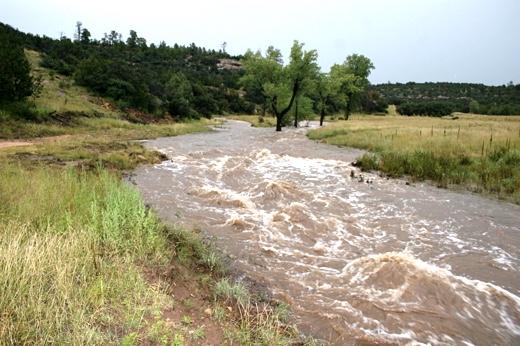
The wetland and riparian restoration work have kept the ground moist where otherwise it might have gone dry. It also helps to dissipate the destructive forces of unusually big flood events, such as one the ranch endured on September 2013, when nearly five inches fell in a matter of hours. Thanks to all the vegetation that had grown along the stream banks, the effects of that flood were not nearly as devastating as they would have been otherwise.


Image above: Here’s a photo of the new normal of big flood events on the ranch. From original article.

For Reardon, the whole experience points to important lessons learned for the new normals of hotter, drier conditions and chaotic moisture events.

“Use your time effectively,” he said, “focus on sweet spots, have a plan, pull together a diverse group of supporters and professionals, be willing to listen and learn, trust the data, be willing to admit mistakes, be proactive, become land literate, and get ready for the next storm—dust, rain, snow, whatever Mother Nature brings. It will rain again!”

Sage words as we move deeper into the twenty-first century!

• Courtney White is a former archaeologist and Sierra Club activist, Courtney dropped out of the 'conflict industry' in 1997 to co-found The Quivira Coalition, a nonprofit dedicated to building bridges between ranchers, conservationists, public land managers, scientists and others around the idea of land health. This is a chapter from his forthcoming book 2% Solutions for the Planet to be published by Chelsea Green in October. See: http://www.chelseagreen.com/two-percent-solutions-for-the-planet]


.

California's Water Inequality

SUBHEAD: Rich Californians balk at limits, ‘We’re not all equal when it comes to water’

By Bib Kuznia on 13 June 2015 for Washington Post -
(http://www.washingtonpost.com/national/rich-californians-youll-have-to-pry-the-hoses-from-our-cold-dead-hands/2015/06/13/fac6f998-0e39-11e5-9726-49d6fa26a8c6_story.html?hpid=z5)


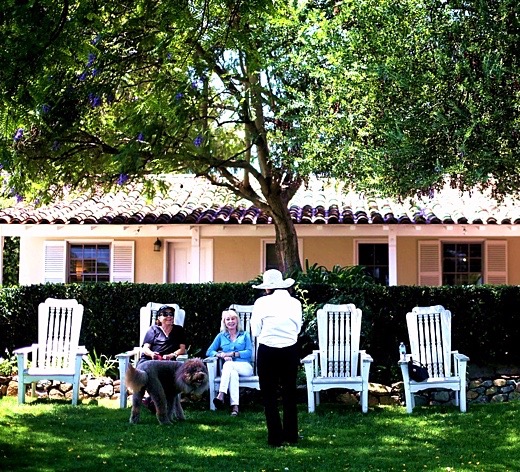
Image above: Visitors on the lawn at the Inn at Rancho Santa Fe. (Sandy Huffaker/The Washington Post). From original article.

Drought or no drought, Steve Yuhas resents the idea that it is somehow shameful to be a water hog. If you can pay for it, he argues, you should get your water.

People “should not be forced to live on property with brown lawns, golf on brown courses or apologize for wanting their gardens to be beautiful,” Yuhas fumed recently on social media. “We pay significant property taxes based on where we live,” he added in an interview. “And, no, we’re not all equal when it comes to water.”


Yuhas lives in the ultra-wealthy enclave of Rancho Santa Fe, a bucolic Southern California hamlet of ranches, gated communities and country clubs that guzzles five times more water per capita than the statewide average. In April, after Gov. Jerry Brown (D) called for a 25 percent reduction in water use, consumption in Rancho Santa Fe went up by 9 percent.

[Striking photos of a dried-out California]

But a moment of truth is at hand for Yuhas and his neighbors, and all of California will be watching: On July 1, for the first time in its 92-year history, Rancho Santa Fe will be subject to water rationing.

 “It’s no longer a ‘You can only water on these days’ ” situation, said Jessica Parks, spokeswoman for the Santa Fe Irrigation District, which provides water service to Rancho Santa Fe and other parts of San Diego County. “It’s now more of a ‘This is the amount of water you get within this billing period. And if you go over that, there will be high penalties.’ ”

So far, the community’s 3,100 residents have not felt the wrath of the water police. Authorities have issued only three citations for violations of a first round of rather mild water restrictions announced last fall.

In a place where the median income is $189,000, where PGA legend Phil Mickelson once requested a separate water meter for his chipping greens, where financier Ralph Whitworth last month paid the Rolling Stones $2 million to play at a local bar, the fine, at $100, was less than intimidating.

All that is about to change, however. Under the new rules, each household will be assigned an essential allotment for basic indoor needs. Any additional usage — sprinklers, fountains, swimming pools — must be slashed by nearly half for the district to meet state-mandated targets.

Residents who exceed their allotment could see their already sky-high water bills triple. And for ultra-wealthy customers undeterred by financial penalties, the district reserves the right to install flow restrictors — quarter-size disks that make it difficult to, say, shower and do a load of laundry at the same time.

In extreme cases, the district could shut off the tap altogether.

The restrictions are among the toughest in the state, and residents of Rancho Santa Fe are feeling aggrieved.

“I think we’re being overly penalized, and we’re certainly being overly scrutinized by the world,” said Gay Butler, an interior designer out for a trail ride on her show horse, Bear. She said her water bill averages about $800 a month.

“It angers me because people aren’t looking at the overall picture,” Butler said. “What are we supposed to do, just have dirt around our house on four acres?”

Rancho Santa Fe residents are hardly the only Californians facing a water crackdown. On Friday, the state said it would impose sharp cutbacks on senior water rights dating back to the Gold Rush for the first time in four decades, a move that primarily hits farmers. And starting this month, all of California’s 400-plus water districts are under orders to reduce flow by at least 8 percent from 2013 levels.

Top water users such as Rancho Santa Fe are required to cut consumption by 36 percent. Other areas in the 36-percent crosshairs include much of the Central Valley, a farming region that runs up the middle of the state, and Orange County, a ritzy Republican stronghold between San Diego and Los Angeles.

“I call it the war on suburbia,” said Brett Barbre, who lives in the Orange County community of Yorba City, another exceptionally wealthy Zip code.

Barbre sits on the 37-member board of directors of the Metropolitan Water District of Southern California, a huge water wholesaler serving 17 million customers. He is fond of referring to his watering hose with Charlton Heston’s famous quote about guns: “They’ll have to pry it from my cold, dead hands.”

“California used to be the land of opportunity and freedom,” Barbre said. “It’s slowly becoming the land of one group telling everybody else how they think everybody should live their lives.”
Jurgen Gramckow, a sod farmer north of Los Angeles in Ventura County, agrees. He likens the freedom to buy water to the freedom to buy gasoline.

“Some people have a Prius; others have a Suburban,” Gramckow said. “Once the water goes through the meter, it’s yours.”

Yuhas, who hosts a conservative talk-radio show, abhors the culture of “drought-shaming” that has developed here since the drought began four years ago, especially the aerial shots of lavish lawns targeted for derision on the local TV news.

“I’m a conservative, so this is strange, but I defend Barbra Streisand’s right to have a green lawn,” said Yuhas, who splits his time between Rancho Santa Fe and Los Angeles. “When we bought, we didn’t plan on getting a place that looks like we’re living in an African savanna.”

Others are embarrassed by such defiance. Parks of the Sante Fe Irrigation District said she was mortified when the report came out earlier this month showing that Rancho Santa Fe had increased its water use — the only community in the region to do so.

“I kind of take it personally,” she said last week as she toured the community in an SUV bearing the water district’s logo.

Parks said she doesn’t know exactly what happened, but she has heard rumors that some people jacked up their water use in a misguided attempt to increase their baseline before rationing kicks in. With sprinkler restrictions already in place, she said the dynamic between local gardeners and her small team of enforcers is getting interesting.

“Everyone seems now to know what our cars look like,” she said. In Fairbanks Ranch, a gated community, “whenever one of our trucks go in, the gardeners all seem to call each other — text-message each other — to let them know that we’ve arrived. So then all of a sudden we see water kind of draining off the property but no sprinklers on.”

Because the restrictions that took effect in September didn’t register, the district further tightened the screws this month. Sprinkler days were reduced from three a week to two, while car-washing and garden fountains were banned altogether.

Holly Manion, a real estate agent who has lived on the Ranch, as it’s often called, for most of her 62 years, supports the restrictions. Although Manion cherishes the landscape of manicured lawns and burbling fountains that has long defined the Ranch, she thinks the drought requires a new way of life that emphasizes water conservation.

“Just take a drive around the area. You’ll see lakes low, rivers dry and hillsides parched,” Manion said, adding that she is appalled by people who tolerate leaking sprinklers and the resulting cascades of wasted water.

“There are people, they aren’t being responsible,” she said. “They’re just thinking of their own lives.”
Ann Boon, president of the Rancho Santa Fe Association, insists that most residents are taking the drought seriously. She said she was shocked by the reported 9 percent increase, arguing that it “must be some anomaly.”

“Everybody has been trying to cut back,” she said.


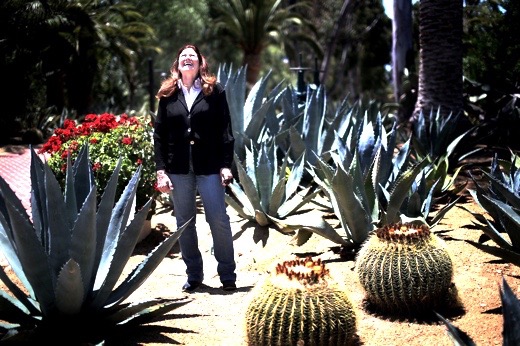
Image above: Resident Holly Manion has drought-resistant plants in her yard. (Sandy Huffaker/The Washington Post). From original article.

For example, many Rancho Santa Fe residents have enthusiastically embraced drought-tolerant landscaping. Manion took advantage of a rebate to rip out much of the turf on her three-acre property and replace it with succulents and decomposed-granite pathways. She left only a small patch of grass for her two dogs to play on.

“It makes me happy when I look at it, because it’s thriving,” she said.

Butler said she, too, is replacing grass with drought-friendly native landscaping on her four acres, at a cost of nearly $80,000. (She’ll get a rebate for about $12,000.) But she came to the decision grudgingly, she said. And she defends the amount of water she and her neighbors need for their vast estates.

“You could put 20 houses on my property, and they’d have families of at least four. In my house, there is only two of us,” Butler said. So “they’d be using a hell of a lot more water than we’re using.”

Rancho Santa Fe resident Randy Woods was feeling burdened by his lush landscape and opted to downsize. The 60-something chief executive of a biotech company moved a year ago from a two-acre estate — replete with two waterfalls, two Jacuzzis, a swimming pool and an orchard — to a condo in the tiny core of town known as “the Village.”

Woods said some of his friends would like to do the same, largely to cut down on their bloated water bills. But they have encountered an unforeseen obstacle, he said: The drought has dampened demand for large estates in San ­Diego County.

Woods said his girlfriend is among those struggling to sell. Her home boasts a yard designed by Kate Sessions, a well-known landscape architect and botanist who died in 1940. But now, the rare palm tree specimens, the secret garden and the turret-shaped hedges are a liability rather than a selling point.

Another friend, Woods said, has seen the value of his nine-acre plot plummet from $30 million to $22 million.

As for Woods, his monthly water bill has shriveled from $500 to around $50.

“My friends,” he said, “are all jealous.”


.