Showing posts with label Slavery. Show all posts

Coddling of white male capitalists

SUBHEAD: Privileged white-supremacist patriarchal Americanized men extract wealth from all else.

By Robert Jensen on 5 March 2016 in Resilience -
(http://www.resilience.org/stories/2016-03-08/the-coddling-of-the-capitalist-white-supremacist-patriarchal-american-mind)
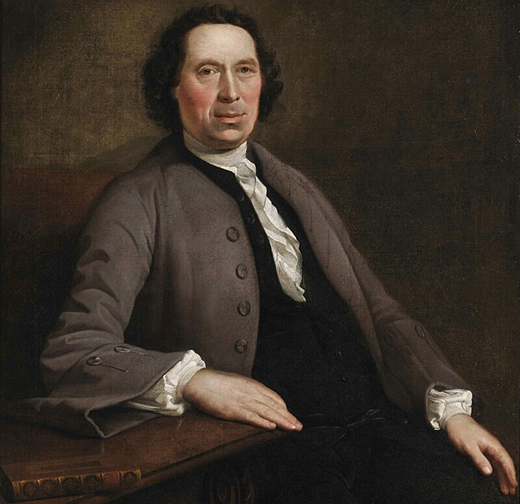

Image above: An 18th century "Portrait of a Gentleman" unsigned in the style of the Anglo American School. From (http://www.skinnerinc.com/auctions/2598B/lots/207).

[Author's note: This is an edited version of a talk given to Common Ground for Texans in Austin, TX, March 5, 2016.]

To avoid being conned, politically and intellectually, it’s important to examine how a debate is framed and what ideology is advanced by that framing. What is the scope of the question? How was the direction of the inquiry decided? Who set the boundaries of the conversation?

Let’s ask those questions in regard to the contemporary conversation in the United States about allegedly dangerous trends on college campuses concerning “political correctness,” “microaggressions,” and “trigger warnings.”

A spirited public discussion of these issues was touched off most recently by an article in The Atlantic magazine titled “The Coddling of the American Mind.” I want to challenge the framing and ideology of that article, and of the dominant culture, by suggesting a better title would be “The Coddling of the Capitalist, White-Supremacist, Patriarchal American Mind.”

CAPITALIST
Educators are right to be concerned about non-rational or anti-intellectual factors that can shut down the conversation in a classroom; emotion and politics can impede open inquiry.

Let’s use that as a definition of political correctness — a narrowing of the scope of inquiry, especially to avoid certain controversial ideas out of a fear of offending someone, falling out of step with peers, or being disciplined by authorities.

There is one academic unit on most every campus where political correctness severely limits students and undermines the quality of intellectual work: The business school.

I have been teaching at the University of Texas at Austin for 24 years, and I ask students from the business school how often in their classes they are asked to challenge, or presented with a challenge of, capitalism.

The answer typically is “never.” Despite the many trenchant critiques of capitalism, the easily demonstrated failures of the system, and experiments with alternatives, it appears that the word “business” in “business school” actually means “business as it is narrowly defined in capitalism.” This limit, policed with an efficiency that Stalin would envy, is so routine that even in the sectors of a business school where one might assume challenges are welcome, such as courses on ethics or social responsibility, serious critiques are rarely presented.

Another troubling example of this ideological subordination to capitalism comes in most economics departments.

While there are challenges to capitalism allowed at some schools — those departments typically are described as “heterodox,” which implies that most economics departments are “orthodox,” a term most often used to describe adherence to religious doctrine — most economics curricula embrace neo-classical economics, which simply means the doctrines of contemporary capitalism.

Once again, the critiques, failures, and alternatives are ignored or sidelined.

Let’s pause to ponder the consequences of this narrow approach to the crucial question of how we produce, distribute, and consume goods and services.

One of the key problems facing the human species — I would say the central problem — is that a high-energy/high-technology world is undermining the capacity of the ecosphere to sustain large-scale human societies, and that a continued pursuit of “growth” on a finite planet will intensify the multiple, cascading ecological crises that are unfolding around us. In other words, modern mass-consumption capitalism is ecocidal.

Some economists recognize this and have for several decades been advocating “ecological economics,” an approach based on the notion that the laws of physics and chemistry (let’s call that “reality”) trump the theories of economists (let’s call that “the theories of economists”).

Ecological economics is reality-based.

One might think that all of economics, a field that likes to think of itself as a science, would embrace real scientific principles.

One might assume that ecological economics would be a synonym for “economics for rational economists.”

Instead, it is a small subfield that is routinely ignored within the discipline.

Why would this reality-denial strategy be dominant? Because of the coddling of the capitalist mind. Capitalists apparently are so emotionally fragile and intellectually limited, that any challenge to orthodoxy feels like aggression and threatens to trigger a breakdown.

Why do we coddle capitalists? Capitalists apparently have considerable influence, perhaps because the concentration of wealth in the system allows the wealthiest capitalists to have disproportionate influence in politics through campaign contributions and in education through philanthropy.

One of the renegades, Richard Norgaard, marks the non-rational quality of orthodox economics with the phrase “the Church of Economism,” describing the contemporary economy as “the world’s greatest faith-based organization” that “replaces belief in God’s control over human destiny with the belief that markets control our fate.”

Norgaard, a central figure in ecological economics, points out that some honest economists have acknowledged the religious nature of their discipline, including Frank Knight, one of the founders of the neo-liberal Chicago school of economics, who in a 1932 article wrote:
The point is that the “principles” by which a society or a group lives in tolerable harmony are essentially religious. The essential nature of a religious principle is that not merely is it immoral to oppose it, but to ask what it is, is morally identical with denial and attack.

There must be ultimates, and they must be religious, in economics as anywhere else, if one has anything to say touching conduct or social policy in a practical way. Man is a believing animal and to few, if any, is it given to criticize the foundations of belief “intelligently.

Certainly the large general [economics] courses should be prevented from raising any question about objectivity, but should assume the objectivity of the slogans they inculcate, as a sacred feature of the system.
Political correctness is real, and the most intellectually sanitized spaces on most campuses — the business school and economics department — encourage us to roll the dice of the future of the planet based on non-rational doctrines that are more theologically than empirically based. That is a cause for concern.

WHITE SUPREMACIST
From the class politics that define the modern university, let’s turn to race, where most of the debate has been focused the past year, and start with a definition of microaggressions:
the everyday verbal, nonverbal, and environmental slights, snubs, or insults, whether intentional or unintentional, which communicate hostile, derogatory, or negative messages to target persons based solely upon their marginalized group membership. In many cases, these hidden messages may invalidate the group identity or experiential reality of target persons, demean them on a personal or group level, communicate they are lesser human beings, suggest they do not belong with the majority group, threaten and intimidate, or relegate them to inferior status and treatment.
I am not part of any identifiable marginalized groups, but I’ve spoken with many students at UT and other universities in my 24 years of teaching, and I’ve read a lot about these issues, and all this evidence leads me to conclude that microaggressions are real and often have a negative effect on students, though there is considerable individual variation in non-white students’ reactions. So, what training and/or policies should a university implement to deal with this problem?

Before we get to that question, let’s ask where microaggressions come from. In matters of race, they are a product of white supremacy, the ideological system that for 500 years has shaped the domination of the world by Europe and its offshoots, such as the United States.

White supremacy is obviously a part of our history, but there is considerable debate about how relevant that ideological system is to contemporary life.

This debate goes on at the University of Texas at Austin, where for several decades students, faculty, and community members have called for the removal of statues of Confederate officials, which have been met by spirited defenses of those public monuments.

The statue of Jefferson Davis, the president of the Confederacy, was finally removed this past summer, but statues of Robert E. Lee (leader of the Confederate Army), Albert Sidney Johnston (a Confederate officer) and John Reagan (postmaster general for the Confederacy) still stand.

Public monuments to one of the most morally depraved political units in modern history remain on the UT campus to this day.

UT is, of course, in Texas, where many people celebrated the election to the presidency of sort-of native son George W. Bush, who once joked that his success proved that “C students: You too, can be president,” reflecting his less than stellar academic record, suggesting that his admission to Yale and Harvard universities for undergraduate and master’s degrees might have been based more on family connections than on merit.

Many of the same people who raise no objection to such legacy admissions will claim that UT is admitting black and brown students who are unqualified and that this policy is unfair and/or a threat to the integrity of higher education.

More nuanced defenses of this white-supremacist ideology (“it’s about heritage, not hate” in the case of the statues, or “we should live in a meritocracy” in the case of affirmative action) have in recent years given way to more overt racist rhetoric and images, no doubt sparked in large part by the election of a black president (who, because he is black, is deemed illegitimate by some) and an economic malaise (which is easier for some to blame on immigrants than on the people who capture a disproportionate share of the country’s wealth).

So, we have mainstream institutions that find it hard to remove symbols of white supremacy from prominent positions, let alone deal with the deeper ideological manifestations, let alone deal with the material realities of racialized disparities in wealth and power.

And we see a resurgence of conservative political forces that are comfortable with more overt expressions of white supremacy.

In that context, should we ask whether some non-white students are too sensitive about microaggressions? Sure, that’s a reasonable question, but it might help to think more about the context first.

Why does the contemporary United States, liberal and conservative, find it so hard to come to terms with white supremacy? A quick review of our history helps clarify that. We know that there would be no United States if not for the nearly complete extermination of indigenous people by Europeans, the first American holocaust, an extermination program justified by the ideology of white supremacy.

We know that the United States’ move into the industrial era was supported by cheap cotton, which provided the raw material for the textile mills of New England and a commodity for sale abroad to generate capital, and that the slave system that made that possible — another crime of holocaust proportions — was justified by the ideology of white supremacy.

American dominance of the world has intensified after WWII in part because of the use of military forces in the Third World, also producing holocaust levels of death and destruction, and such wars are easier to sell when the people being killed are not white (think about terms such as gook and raghead).

There would be no country called the United States, nor would it likely be the wealthiest country in the history of the world, without these racist and/or racialized crimes. It’s not hard to see why we don’t deal with the question honestly. How does a country come to terms with the reality that its prosperity is built on such extermination, exploitation, and empire?

So far, we have avoided that reckoning, and much of white America seems determined to continue that avoidance strategy.

Should we be coddling the white-supremacist mind?

PATRIARCHAL
The contemporary debate about campus politics also has intersected with concerns about gender, including the use of trigger warnings which alert students that a reading, video, or lecture may contain material that could cause emotional distress. The mental health of rape victims/survivors was one of the first concerns that gave rise to trigger warnings.

So, let’s talk about the reality of rape.
Rape is a vastly underreported crime; most women who are raped do not go to law enforcement agencies, and therefore crime statistics tell us little about the prevalence of rape.

But the feminist movement’s activism against men’s violence led to research based on women’s experiences rather than on crime reporting, and those studies have found varying rape rates.

On a global scale, 30% of women over the age of 15 have experienced “intimate partner violence,” defined as physical, sexual, or emotional violence, based on data from 81 countries. The rate in North America is 21%. For many years, anti-rape activists in the United States quoted the statistic that one in three girls is sexually abused and that 38% of the women reported sexual abuse before age 18.

A recent review of the data by well-respected researchers concluded that in the United States, at least one of every six women has been raped at some time in her life, a figure that is now widely accepted.

Much of this sexual violence is directed at young people; in the National Violence against Women Survey, slightly more than half of the 14.8% of women who reported being raped said it happened before age eighteen.

Those statistics address acts that meet the legal definition of rape, but women and girls face a much broader range of what we can call “sexual intrusions,” sexual acts that they do not request and do not want but experience regularly — sexually corrosive messages and calls, sexual taunting on the streets, sexual harassment in schools and workplaces, coercive sexual pressure in dating, sexual assault, and violence that is sexualized.

In public lectures on these issues, I list these categories and women’s heads nod, an affirmation of the routine nature of men’s intrusions into their daily lives.

To drive home the point, I sometimes tell audiences that I have just completed an extensive longitudinal study on the subject and found that the percentage of women in the United States who have experienced some form of sexual intrusion is exactly 100%.

Women understand the dark humor — no study is necessary to confirm something so routine.

If we describe rape as “sexually invasive dehumanization” to capture the distinctive nature of the crime, then let’s ask this painful question: How much of everyday life do women experience as sexually invasive dehumanization on some level? Even more challenging, why does this situation continue even when the feminist movement has made progress on other fronts?

The answer requires us to confront patriarchy, the system of institutionalized male dominance, in which men continue to use sex and violence to control women, a strategy not only widespread in everyday life but celebrated in the routine sexual objectification and exploitation of women in mass media and the sex industries of prostitution, pornography, and stripping.

How does a society come to terms with inequality woven so deeply into the fabric of everyday life? We can’t expect to advance a challenge to patriarchy by coddling the patriarchal mind.

CONCLUSION
I have spent his entire adult life working as either a journalist or a professor; I have both principled and practical reasons for caring about freedom of expression and academic freedom. I also have been on the receiving end of attempts to limit the scope of debate because of arguments I’ve made that have challenged the conventional wisdom of both conservatives and liberals.

My antiwar writing after 9/11 led to a phone/letter campaign to get me fired, and more recently my critiques of the ideology underlying the transgender movement have led to protests of public lectures I’ve given.

In my career, I have observed the routine way that serious challenges to concentrated wealth and power are marginalized in academic life. I also have witnessed exchanges in which accusations about class/race/gender oppression are hurled without supporting evidence and potentially productive exchanges are cut off by people who think that invoking jargon ends an argument.

A phrase such as “check your privilege” can be an important reminder that people from dominant groups should think about how unearned status can limit our understanding of power dynamics, but it also can turn into a cliché that shuts down conversation.

So, my remarks today are not intended to ignore the difficult struggles on campuses over questions of intellectual openness and honesty.
  • When does merely offensive speech becomes oppressive?
  • When should one person’s freedom of expression, no matter how offensive, be defended and when does a pattern of abusive expression clearly undermine the ability of others to participate fully in a classroom discussion?
  • How do we encourage challenges to widely accepted theories and doctrines?
  • How do we model civil, respectful intellectual debate when those debates are not merely academic but have serious effects on participants in the debate?
  • When should we offer students some kind of shield from the corrosive aspects of contemporary culture and when is it important for all of us to face the worst of the culture?
My remarks are intended to suggest that any discussion of how to approach these issues should first contend with the systems and structures of power that create the hierarchy, inequality, and violence at the heart of these struggles.

After nearly three decades in academic life, I am more aware than ever of how difficult it is to resolve these questions and how easy it is for all of us to feel overly confident about our own conclusions.

Still, I am confident that crafting intellectually defensible policies requires us to never stray too far from the reality of those systems and structures of power.

.
The side of the living

SOURCE: Ray Songtree (rayupdates@hushmail.com)
SUBHEAD: We are those who are on the side of the living. And we are going to win.

By Derrick Jensen on 23 July 2015 for the Ecologist -
(http://www.theecologist.org/green_green_living/2905572/we_are_those_who_are_on_the_side_of_the_living_and_we_are_going_to_win.html)


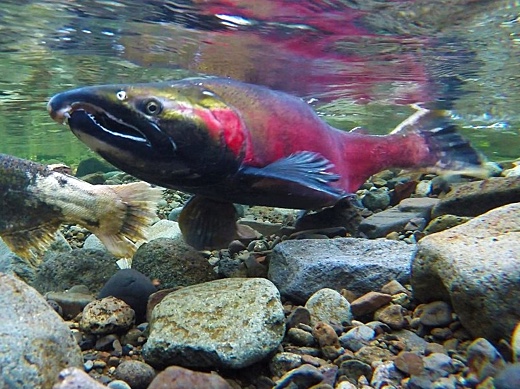
Image above: "We are people who no longer hope salmon survive, but will do whatever it takes to stop their extinction". From original article.

Who are we? We are the people who are ready to fight back, writes Derrick Jensen. The people who no longer live in hope that the Earth will be saved, but in the certainty that we will save her. We are activists, survivors, lovers and fighters. And we say: the destruction will stop.

We are people who do not resign ourselves to the fate we are so often told is inevitable.

We are people who refuse to continue as slaves. We are people who are remembering how to be human beings. We are people who are ready to take back our own lives, and to defend our lives and the lives of those we love, including the land.

We are people who are at long last ready and willing to fight back. We are people who know in our bones the truth of Robert E. Lee's statement, "We must decide between the risk of action versus the positive loss of inaction." We are people who are ready to take the offensive, or support those people who do.

We are survivors. We have survived domestic violence. We have survived racism, and we have survived sexism. We have survived industrial schooling, and we have survived the industrial economy. We have survived television. We have survived the toxification of our total environment.

And we are ready to fight back
We are lovers, lovers of the land, lovers of each other, lovers of our own bodies, including our emotions. We love. We hate. We feel joy, despair, sorrow, outrage, happiness, anger. And we are ready to fight back.

We are the oppressed. We are prisoners, family farmers, animal liberators, women, children, American Indians, blacks, Mexicans, poor whites, Asians, people of the Third World, the indigenous. We are parents, and we are childless. We are those who hate our jobs, we are the unemployed, and we are those who want no jobs. And we are ready to fight back.

We are those who have listened long with love and sorrow, and who now with their permission speak for salmon, redwoods, rivers, voles, spotted owls. We speak for the bison, the sturgeon, the manatee, the shark.

We speak for the soil, for the wind, for the snow, for the ice caps. We speak for the phytoplankton, and we speak for the insects. We speak with voices that are no more and no less than the wind moving in and out of our bodies, over our vocal cords. We speak for our homes, and for our neighbors, and we will be heard. They will be heard. And we are ready to fight back.

We are activists. We are teachers. We are students. We are workers in strawberry fields. We are visual artists. We are small business owners. We are construction workers. We are genetic engineers. We are librarians. We are bioweapons specialists. We are ex-navy SEALS.

We are demolitions experts. We are hackers. We are clerks at Wal-Mart. We are prisoners. We are single mothers. We are punks. We are fishermen. We are hunters. We are those who oppose hunting. We are writers. We are killers. We are former loggers. We are saboteurs. We are nurses. We are farmers. We are great-grandmothers. We are attorneys. We are ex-cons. And we are ready to fight back.

We are in Los Angeles, Detroit, Boston, New York. We are in St. Louis and we are in Asheville, North Carolina. We are in St. Petersburg and we are in Seattle. We are in tiny towns in Montana and we are in southern Mexico. We are in Canada and we are in Korea. We are in China, India, Australia. We are in the Congo and in Tanzania. We are in Macedonia, Austria, Denmark, Finland. And we are ready to fight back.

And we are going to win
We are people who have realized that unless it is stopped, civilization will kill everything on the planet. We are people who have realized that civilization is guided by an urge to destroy, and we are people who have realized that civilization is not reformable.

We are people who have learned the lessons of those who have tried to make treaties with those who are killing the planet, and we are people who, with all the world at stake, are finally ready to fight back.

We are people who no longer hope that civilization will stop killing the planet, but will do whatever it takes to stop it. We are people who no longer hope salmon survive, but will do whatever it takes to stop their extinction. We are people who say the same for bison, prairie dogs, desert tortoises, whales, dolphins, lions, great apes, rhinos. We do not hope. We act. And we are ready to fight back.

We are people who understand deep within our bodies that fear is the belief that we have something left to lose, and with all the world at stake we are ready to fight back.

We are people who are putting those who would kill the world we love on notice. You must stop. Now. You will stop. Hear this as you have never heard anything before. You will stop. We are ready to fight back.

And we are going to win
We are those who will never forget that the Jews who participated in the Warsaw Ghetto Uprising had a higher rate of survival than those who went along.

We are those who are on the side of the living, and we are going to win.

.

TPP Slave Problem

SUBHEAD: Obama's Trans-Pacific Partnership is tangled in the intricate web of Malaysia's human trafficking problem.

By Laura Barron-Lopez on 30 May 2015 for Huffington Post -
(http://www.huffingtonpost.com/2015/05/30/malaysia-slavery-trade_n_7472682.html)


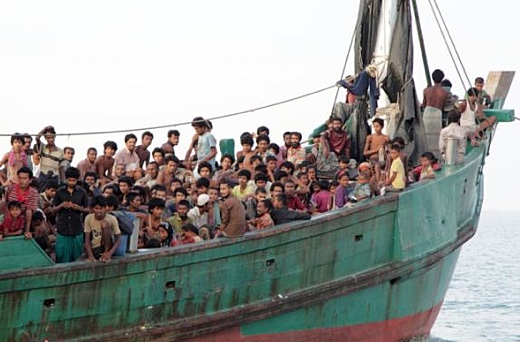
Image above: Migrants sit on their boat as they wait to be rescued by Acehnese fishermen on the sea off East Aceh, Indonesia, Wednesday, May 20, 2015. From original article.

President Barack Obama's push for legislation that would enable the U.S. to strike a major trade deal with 11 other countries has gotten tangled in a debate over Malaysia's record on slave labor, throwing up a last-minute legislative obstacle.

Inconveniently for backers of the trade deal, a full-blown humanitarian crisis is erupting in Malaysia, Thailand, Indonesia and Myanmar, directly connected to the region's reliance on human trafficking in industries as varied as electronics manufacturing, fishing and prostitution.

Last year, Malaysia and Thailand joined North Korea and Saudi Arabia on the State Department’s list of countries that are the worst offenders in forced labor and human trafficking -- formally known as a tier 3 designation. One year later, little has changed, though the importance of the tier 3 designation has surged as a result of the trade debate. the U.S. Senate last week passed legislation declaring that no country that engages in slave labor, such as Malaysia, can be a part of the trade deal.

As Malaysia angles for membership in a historic international trade deal of epic scope, it is facing increased scrutiny for its human rights record, yet doing little to change the facts on the ground.

In April, U.S. Ambassador Joseph Yun criticized Malaysia’s lack of progress on human trafficking. “The most obvious area is prosecution. Is there enough prosecution [of offenders] considering the incidence of trafficking?” Yun said, suggesting that such prosecutions were inexcusably rare.

This month, more than 139 grave sites were discovered, along with 28 suspected human trafficking camps in the far north of Malaysia, near the Thai border. Multiple bodies were found in each site, leading Malaysian authorities to estimate the number of dead to be well above 100.
With Malaysia finding itself engulfed in a migrant crisis, the United Nations has called on it to help rescue tens of thousands of Rohingya Muslims stranded at sea and in jungle concentration camps. Malaysia has not only refused, but has rebuffed even seriously participating in discussions. Meanwhile, a top Malaysian minister has said that despite the U.S. Senate's legislation, his government is sure it will be allowed into the Trans-Pacific Partnership trade deal, which may explain Malaysia's lack of interest in addressing the human trafficking crisis.
According to Malay Mail Online:

US news website Huffington Post reported Friday that while the White House is on the verge of securing the fast-track approval it needs to push ahead with the long-delayed free-trade deal, a US senator has succeeded in inserting a provision that would bar his country from entering agreements with countries officially viewed as engaging in slavery, which includes Malaysia.
“Regarding our Tier 3 position on human trafficking, this could be resolved if a Tier 3 country is seen to be taking concrete steps to implement recommendations in the Trafficking in Persons report,” Malaysia Minister Datuk Seri Mustapa Mohamed told the paper, referring to the State Department’s trafficking report. The White House has pushed for a modification of the Senate bill that mirrors the policy described by Mohamed, meaning revised language in a future House bill could allow Malaysia, or a tier 3 nation, into trade deals if they craft a plan to address human trafficking.
But the task of watering down the slavery language is made more challenging by the exploding humanitarian catastrophe, which couldn't come at a worse time for trade deal negotiators, who have argued that the Trans-Pacific Partnership, in the words of Obama, will be "the most progressive trade deal in history."

While that's a low bar, the active participation of a country that so blatantly participates in the slave trade calls that claim into question. American workers argue that they will face downward wage pressure from competition from Southeast Asian countries, and the fact that some of those workers will not be paid at all, but rather will be forced to work for free, only feeds those suspicions.

How did Malaysia get to this point? For the past four years, it has been on the State Department’s tier 2 watch list, and over the last seven has been ranked a tier 3 human trafficking nation three times.

The lack of consequences is just one explanation for Malaysia's apathetic response to the crisis. Perhaps more to the point, trafficking is an integral part of the nation's political economy, fed by surrounding countries.

The majority of the persecuted Rohingya are fleeing from Myanmar to neighboring nations of Thailand, Malaysia, and Indonesia. Further exacerbating the issue, Thailand cracked down on land-based migrant routes earlier this year, forcing smugglers to traffic people by sea, pushing even more to Malaysia.

Additionally, foreign workers typically migrate willingly to Malaysia from other Asian nations, according to the State Department annual report on human trafficking. Those countries include Indonesia, Bangladesh, Nepal and Thailand. A number of the migrants, the State Department report says, “subsequently encounter forced labor or debt bondage at the hands of their employers, employment agents, or informal labor recruiters.”

On top of that, the Malaysian government began a policy in 2013 that “places the burden of paying immigration and employment authorization fees on foreign workers,” rather than employers, making workers more susceptible to debt bondage. To make matters worse, employers in agriculture, construction, textile factories, and other domestic work throughout Malaysia routinely confiscate foreign workers' passports and other immigration documents, making it impossible for them to leave the country, and very difficult to find other work if they want to stay. Most workers aren't allowed to travel within Malaysia without immigration documents.

Immigration officials also contribute to the problem. “Press reports continued to accuse some immigration officials of facilitating smuggling, including the transportation of trafficking victims,” the State Department’s report says.

Such press reports include detailed investigations by Reuters revealing that the Thai navy is one key link in the chain of smugglers exploiting Rohingya Muslims. After interviewing smugglers and dozens of survivors who migrated via boat, Reuters found Thai naval personnel had worked with smugglers to profit from asylum seekers. (The Thai navy subsequently filed defamation charges against two journalists; the journalists won a Pulitzer Prize.)

Still, the State Department notes the Malaysian government “did not report any investigations, prosecutions, or convictions of government employees complicit in human trafficking,” despite multiple reports alleging such involvement.
.

Which side are you on?

SUBHEAD: It's a cry from the future, a mournful plea begging us to capture this moment. Can you hear it? Will you hear it?

By Mickey Z. on 16 August 2013 for World News Trust -
(http://worldnewstrust.com/which-side-are-you-on-mickey-z)


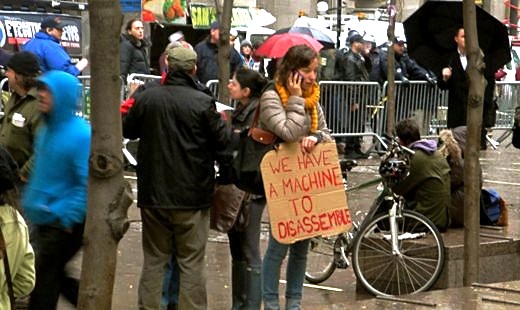
Image above: Girl on cell phone holding sign in city downtown that reads "We have a Machine to Disassemble" From original article by Mickey Z.
"There came a time when the risk to remain tight in the bud was more painful than the risk it took to blossom."

- Anais Nin
How much more are we willing to tolerate before we take direct action?

What is our personal pain threshold?

When will we decide that we are less afraid of the State than of living on a planet without trees, without drinkable water, without arable land, without a hint of justice?


In the name of inspiring answers, I'll say ssssshhhhhhh…

Silence your cell phones, your TVs, silence the noise in your head... and just listen. Listen carefully. Can you hear it?

It's a cry from the future, a mournful plea begging us to capture this moment. Can you hear it? Will you hear it? Or have you gotten so accustomed to losing that you choose instead to cover your ears, bury your head -- finding endless excuses and myriad methods to ignore and/or discredit the efforts being made?

Listen again. Listen closer. This is our last, best chance... and what you hear is nothing less than the call to global revolution. How will you answer?

Another world is possible…
There was a time when human slavery was believed too deeply entrenched in American culture to ever be abolished. But the movement to end this "peculiar institution" was made up of individuals willing to recognize that some things in life are bigger than any of us.

Whether they literally risked their lives by rescuing slaves and running the Underground Railroad or played a role by sewing clothes or blankets for escaped slaves or lending financial support or handing out pamphlets or even writing books like Uncle Tom’s Cabin, the effort needed every single one of these brave humans doing their part -- small or large.

File under: Tactics, diversity of.

What seems impossible and irreversible today can similarly be addressed when we're willing to wake up and do the hard work… when we’re willing to stop making excuses for the reprehensible leaders (sic) -- both political and corporate -- who profit from our complacency.

Suggestion #1:
The next time you’re about zone out to a Will & Grace re-run, why not do some deep contemplation instead? Take a good, long look into your heart and an even longer look at the choices you make all day, every day -- not from place of guilt and shame but with a sense of revelation.

Ask yourself if your behavior is in line with your values. Accept the challenge to be better a human being, a more responsible earthling.

Nothing will change until we change our minds but it takes courage to perform self-examination. It takes courage to accept everything you know just might be wrong. For the record, it takes far more courage to do this than to willingly enlist to be paid to wage illegal and immoral wars.

It's not the volunteer mercenaries in places like Afghanistan who are fighting for our freedom. It's activists -- all across the globe.

Risk imperfection
In the name of solidarity, I beseech you to rise above your urge to critique, your need to be right, your fear of the unknown… and just listen.

It's not about purity.

It's not about who did what or said what first.

It's not about following a predetermined game plan.

It's not about waiting for the ideal time to jump on board.

It's a fuckin' revolution -- in the name of all life on earth -- so shrug off the excuses and get involved.

We need a planet with far fewer reasons to grieve and far more reasons to celebrate… and the good news is that there’s a growing celebration meeting down at the corner of Empathy & Anger and what we’re planning is nothing less than a global jailbreak.

Those in the anti-slavery movement I mentioned above recognized that some things in life are bigger than any of us. Well, today, the entire planet is enslaved… to profit-seeking, landbase-consuming corporations and the corrupt politicians they own (yes, including the vaunted Pope of Hope).

Thankfully, this generation’s abolitionists are beginning to take a stand and create change.

Not ask for change, create change.

And they need your support. They need you.

Now.

Sure, participating in sustained direct action is not a popular choice. It could put us at odds with our friends, family, and community. It could jeopardize our careers. It could even lead to direct conflict with the notorious Blue Bloc.

Scary stuff, indeed.

But, as a thought experiment, ask yourself this: What frightens you more, being judged by your neighbors for getting busted for disorderly conduct or comprehending that 80 percent of the world's forests and 90 percent of the large fish in the ocean are already gone?

There are good reasons to be afraid. There are better reasons to be bold.

Could it be we’re afraid of learning that much of what we've been taught is no longer or never was relevant? Are we afraid to open our hearts and minds and start caring like we've never cared before? Maybe, just maybe, we're afraid of ourselves and of what were capable of accomplishing.

Maybe Marianne Williamson is correct when she suggests: "Our deepest fear is not that we are inadequate. Our deepest fear is that we are powerful beyond measure."

Make no mistake, we will be asked by future generations what we did during this momentous time of human struggle. Let’s make sure we can honestly reply: “I did my part to leave the planet much better off than how I found it.”

Suggestion #2: 
Silence the sirens of archaic archetypes, open your mind to new configurations, and heed the call of the future. I promise it'll be a lot more fun that you ever imagined.

It's time to blossom, comrades. It’s now or never.

Even with all the fear, pain, dread, and uncertainty we may (or may not) experience while blossoming, remaining tight in the bud is no longer an option… for us or for the planet.

Just leap and the net may appear…

• Mickey Z. is the author of 11 books, most recently the novel Darker Shade of Green. Until the laws are changed or the power runs out, he can be found on an obscure website called Facebook. Anyone wishing to support his activist efforts can do so by making a donation here.

.

To Forgive or Not

SUBHEAD: That is part of prospering in a new non-growth, resilient, self-reliant and sustainable economy.

By Juan Wilson on 3 April 2013 for Island Breath -
(http://islandbreath.blogspot.com/2013/04/to-forvive-or-not.html)


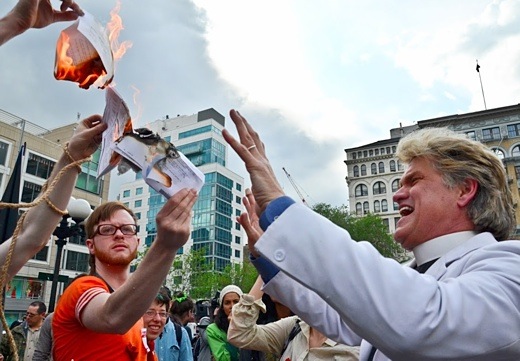
Image above: Reverend Billy presides as Doug B. declare a debt jubilee by burning his 312K student loan papers in celebration of all Student Debt in Union Square, NYC. Photo by Erik McGregor. From (https://plus.google.com/photos/117565483290592467431/albums/5735541146467941377/5735541146841710642).

The world is in a financial pickle. The global industrial system that has dominated our economies for almost two centuries has hit the limits of the planets resources. This should be no surprise to anyone because the system was predicated on the assumption of growth - growing population, larger occupation of the natural landscape; increasing use of raw material; burning more fuel for energy; more consumption per person and greater profits.

It's the American Dream!
Dick Cheney was actually speaking for more than just Americans when he made the vow that keeping our energy cheap (by conquering the Middle East and as a result keeping the American Dream alive) was a non-negotiable posture.  Well, look how well that turned out.

There is no amount of US military presence that can make oil cheap, or get the world growth machine humming again... and that's the good news.

The only thing that has kept the guise of prosperity going since America hit its peak energy production back in the early 1970's has been a combination of three elements:
  1. Consumer consumption of imported goods paid for by credit available from financializing suburban sprawl.
  2. The military dominance we have spending more than the rest of the world on weapons systems.
  3. The dollar used as the world currency because of the size of our economy and because oil is traded in dollars.
Kablooey!
Well number one blew up in 2007. Twenty trillion dollars into the housing bubble hole has not fixed that problem. So much for financialization.

Number two was soured by our continuing poor military showing in the Middle East  resulting is a less stable friendly region. So much for cheap energy.

Number three is coming shortly as the BRICS (Brazil, Russia, India, China as well as Indonesia, South Africa etc) are setting up a new World Order with another World Bank not using the dollar to do international trade.

America as we know it is screwed. So is Europe. The Eurozone fiasco has its wheels coming off the cart in Cypress as the mask is removed and we see that the Euro banksters are as willing to eat their own as the American Too Big To Fail (TBTF).

We certainly threw enough mortgage holders to the lions. Now we are creating a generation of college loan debt slaves living with mom and dad and working at Burger King for minimum wage. 

What to do!
Ben Bernanke isnow singing a two note tune. Keep interest rates at 0% and buy US debt at a rate of $85-billion a month in treasury notes. That's the equivalent of producing 425,000 suburban mortgage financing at $200,000 a pop every month. Who needs the housing industry, or for that matter any industry if you can invent that much money out of the void.

At this point in our effort to fill that yawning maw of debt as even as we dig it deeper we must come toa conclusion. We are never going to pay it off. Even we could, it take the value of more than all the resources in the world. We will have to destroy the planet to break even. Not a good deal.  However, there is a suggestion that some have made, but only a few have tried.

Getting rid of all the debt!
If the debt cannot be paid back there are two ways to go about that.

One way to get rid of debt id to refuse to pay it. That is to go bankrupt. That was one option back in 2008 as the TBTF banks came a begging. We could have told them to go to hell, but we were too scared of the consequences so it goes on. Iceland didn't take that route.

When the financial crunch came it took the hit by letting its TBTF institutions do just that - FAIL! They recovered rather quickly. We had hoped Cypress was going to go that same way with the Euro. But, like us, they were terrified of the heights they had climbed to. The way down was to fearful. So they soaked their bank depositors for $5 billion to get a temporary bailout of twice that in more EuroDebt. Bankruptcy isn't for everyone.

The other way to eliminate debt is to forgive it. Just tell whoever owes you money that you know cannot be repaid that they don't have to pay it back.

There have been some efforts in the US to aid those buried in mortgage and student loan debt. The Mortgage Forgiveness Debt Relief Act of 2007 was extended to 2013 and The Student Loan Fairness Act was meant to give relief. But these are pennies on the dollar of the debts we face as a nation.

Forgive me Father for I have sinned!
What if we faced the music as a nation and simply forgave all debt? That would be your student loan, your mortgage; tour car payment; your credit cards. It would also include all town; county; state and national debts.

We'd start over fresh. You'd be able to keep your stuff - the house, car, computer, TV etc. But you would have to subtract from your avail money all the deby you once owed. In other words if you had $300 in your checking account, and you owed $3,000 on your car your checking account would be reduced to zero. Under such a regimen most people would wind up with a punch of stuff, no debt and no money.

What would you do then? Would there be any changes in the way things worked. You betcha!

The Great Debt Jubilee!
By either refusing to pay debt (bankrupcy) or being relieved of debt (forgiven) takes from the imaginary world of money just that much "wealth" out of the system. If we reset the debt clock to zero we will be free of its yoke, but we will be impoverished.

That has already happened. We've been running on fumes and our children's future for some time.  At least after a total debt jubilee we will have to admit that we have already been impoverished. And the sooner the better. Let's stop the failure of industrial machine before it stops us.

We cannot keep papering over the cracks in the foundation. The sooner we accept our new status as "what we have is what we will have" and that we will live with a whole lot less than we once expected the sooner we can get going in the new reality.

We will then know that what little we have is precious and comes from hard work. That is part of prospering in a new non-growth, resilient, self-reliant and sustainable economy.

.

A Time for Sublime Madness

SUBHEAD: It is only those who can retreat into the imagination who uncover the physical and psychological strength to resist.

By Chris Hedges on 21 January 2013 for TruthDig.com -
(http://www.truthdig.com/report/item/a_time_for_sublime_madness_20130120/)


Image above: Detail of "The Teaching of the Flying Drum". Oil on cancas, 2010, by Mark Bryan. From (http://www.artofmarkbryan.com/Teachings_Flying_Drum.html).

The planet we have assaulted will convulse with fury. The senseless greed of limitless capitalist expansion will implode the global economy. The decimation of civil liberties, carried out in the name of fighting terror, will shackle us to an interconnected security and surveillance state that stretches from Moscow to Istanbul to New York.

To endure what lies ahead we will have to harness the human imagination. It was the human imagination that permitted African-Americans during slavery and the Jim Crow era to transcend their physical condition. It was the human imagination that sustained Sitting Bull and Black Elk as their land was seized and their cultures were broken. And it was the human imagination that allowed the survivors in the Nazi death camps to retain the power of the sacred.

It is the imagination that makes possible transcendence. Chants, work songs, spirituals, the blues, poetry, dance and art converged under slavery to nourish and sustain this imagination. These were the forces that, as Ralph Ellison wrote, “we had in place of freedom.” The oppressed would be the first—for they know their fate—to admit that on a rational level such a notion is absurd, but they also know that it is only through the imagination that they survive. Jewish inmates in Auschwitz reportedly put God on trial for the Holocaust and then condemned God to death. A rabbi stood after the verdict to lead the evening prayers.

African-Americans and Native Americans, for centuries, had little control over their destinies. Forces of bigotry and violence kept them subjugated by whites. Suffering, for the oppressed, was tangible. Death was a constant companion. And it was only their imagination, as William Faulkner noted at the end of “The Sound and the Fury,” that permitted them—unlike the novel’s white Compson family—to “endure.”

The theologian James H. Cone captures this in his masterpiece “The Cross and the Lynching Tree.” Cone says that for oppressed blacks the cross was a “paradoxical religious symbol because it inverts the world’s value system with the news that hope comes by way of defeat, that suffering and death do not have the last word, that the last shall be first and the first last.” Cone continues:
That God could “make a way out of no way” in Jesus’ cross was truly absurd to the intellect, yet profoundly real in the souls of black folk. Enslaved blacks who first heard the gospel message seized on the power of the cross. Christ crucified manifested God’s loving and liberating presence in the contradictions of black life—that transcendent presence in the lives of black Christians that empowered them to believe that ultimately, in God’s eschatological future, they would not be defeated by the “troubles of this world,” no matter how great and painful their suffering. Believing this paradox, this absurd claim of faith, was only possible in humility and repentance. There was no place for the proud and the mighty, for people who think that God called them to rule over others. The cross was God’s critique of power—white power—with powerless love, snatching victory out of defeat.
Reinhold Niebuhr, as Cone points out in his book, labeled this capacity to defy the forces of repression “a sublime madness in the soul.” Niebuhr wrote that “nothing but madness will do battle with malignant power and ‘spiritual wickedness in high places.’ ” This sublime madness, as Niebuhr understood, is dangerous, but it is vital. Without it, “truth is obscured.” And Niebuhr also knew that traditional liberalism was a useless force in moments of extremity. Liberalism, Niebuhr said, “lacks the spirit of enthusiasm, not to say fanaticism, which is so necessary to move the world out of its beaten tracks. It is too intellectual and too little emotional to be an efficient force in history.”

Niebuhr’s “sublime madness” permits the rest of us to view the possibilities of a world otherwise seen only by the visionary, the artist and the madman. And it permits us to fight for these possibilities. The prophets in the Hebrew Bible had this sublime madness. The words of the Hebrew prophets, as Abraham Heschel wrote, were “a scream in the night. While the world is at ease and asleep, the prophet feels the blast from heaven.”

Primo Levi in his memoir “Survival in Auschwitz” tells of teaching Italian to another inmate, Jean Samuel, in exchange for lessons in French. Levi recites to Samuel from memory Canto XXVI of Dante’s “The Inferno.” It is the story of Ulysses’ final voyage.

“He has received the message,” Levi writes, “he has felt that it has to do with him, that it has to do with all men who toil, and with us in particular.” Levi goes on. “It is vitally necessary and urgent that he listen, that he understand … before it is too late; tomorrow he or I might be dead, or we might never see each other again.”

The poet Leon Staff wrote from the Warsaw ghetto: “Even more than bread we now need poetry, in a time when it seems that it is not needed at all.”

It is only those who can retreat into the imagination, and through their imagination can minister to the suffering of those around them, who uncover the physical and psychological strength to resist.

[T]he people noticed that Crazy Horse was queerer than ever,” Black Elk said in remembering the final days of the wars against the Indians. He went on to say of the great Sioux warrior: “He hardly ever stayed in the camp. People would find him out alone in the cold, and they would ask him to come home with them. He would not come, but sometimes he would tell the people what to do. People wondered if he ate anything at all.

Once my father found him out alone like that, and he said to my father: ‘Uncle, you have noticed me the way I act. But do not worry; there are caves and holes for me to live in, and out here the spirits may help me. I am making plans for the good of my people.’ ”

Homer, Dante, Beethoven, Melville, Dostoevsky, Proust, Joyce, W.H. Auden, Emily Dickinson and James Baldwin, along with artists such as the sculptor David Smith, the photographer Diane Arbus and the blues musician Charley Patton, all had it. It is the sublime madness that lets one sing, as bluesman Ishman Bracey did in Hinds County, Miss., “I’ve been down so long, Lawd, down don’t worry me.” And yet in the mists of the imagination also lies the certainty of divine justice:
I feel my hell a-risin’, a-risin’ every day;
Someday it’ll burst this levee and wash the whole wide world away.
Shakespeare’s greatest heroes and heroines—Prospero, Anthony, Juliet, Viola, Rosalind, Hamlet, Cordelia and Lear—all have this sublime madness. As Theseus says in “A Midsummer Night’s Dream”:
Lovers and madmen have such seething brains,
Such shaping fantasies, that apprehend
More than cool reason ever comprehends.
The lunatic, the lover, and the poet
Are of imagination all compact.
“Ultimately, the artist and the revolutionary function as they function, and pay whatever dues they must pay behind it because they are both possessed by a vision, and they do not so much follow this vision as find themselves driven by it,” wrote James Baldwin. “Otherwise, they could never endure, much less embrace, the lives they are compelled to lead.”

.

Bernanke & Draghi are dangerous

SUBHEAD: The ECB inspired rally comes at an unbearable cost that will have to be paid some day soon.  

By Charles Hugh Smith on 26 July 2012 for Of Two Minds -  
(http://charleshughsmith.blogspot.co.uk/2012/07/bernanke-and-draghi-are-dangerous.html)

 
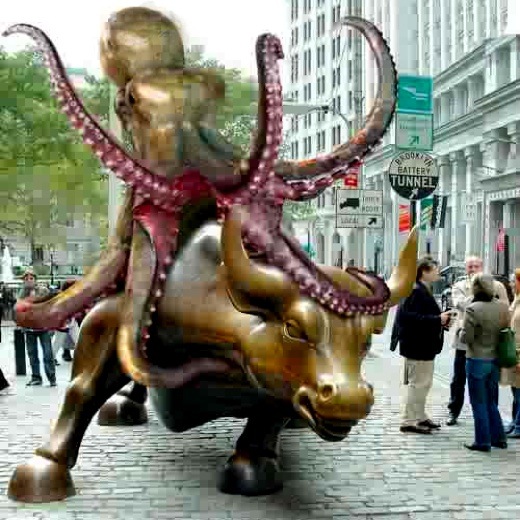
Image above: The vampire squid rides the stock market bull. From (http://blueinthebluegrass.blogspot.com/2011/11/octopi-they-are-97-percent.html).

"The world's most powerful investment bank is a great vampire squid wrapped around the face of humanity, relentlessly jamming its blood funnel into anything that smells like money”
- Matt Taibbi, profiling on investment bank Goldman Sachs for Rolling Stone
What is being sacrificed to maintain the euro and the E.U./U.S. banking cartel? Everything of value: liberty, democracy and sovereignty.

Today we present the culmination of the previous entries ( Global Crisis: the Convergence of Marx, Orwell and Kafka and Are You Loving Your Servitude Yet?): A brief commentary by longtime correspondent Harun I. on Mario Draghi's market-moving statement:

“Within our mandate, the ECB is ready to do whatever it takes to preserve the euro. And believe me, it will be enough."

Nice, Mr. Draghi, but at what cost? And who will ultimately bear this cost? It is already far beyond the measure of mere money; democracy, truth and sovereignty have all been destroyed to prop up the central bankers' Status Quo. We can presume Mr. Bernanke and the Federal Reserve are in on the propaganda campaign, and so we need to examine the words and promises of these two central bankers, as well as what they have not said. Is talking about printing money as good as actually printing money? It would seem so. Is promising to "do whatever it takes" as good as actually doing whatever it takes? Once again, it seems so; global markets leaped at the "news" that the financial Status Quo was going to be "saved" yet again. What if it is beyond saving? What if the cost in treasure, blood, liberty, sovereignty and truth is not worth the 'saving" of a broken, unsustainable, corrupted, parasitic, predatory system? Do we get to choose, or are we just passengers on the train as the central bankers accelerate toward the chasm ahead?

Here is Harun's commentary:
Words have meaning and people should choose them carefully. Nigel Farage commented that what he saw in the faces of EU officials was "madness". We should not underestimate his assessment. At some point these individuals have to be viewed as dangerous. If we peer beyond terms such as QE, printing money out of thin air, stimulate, etc, and understand their effect, they begin to appear not so benign.

What if central bank officials came out and said, "We are going to raise your taxes", or "we are going to reduce your purchasing power", or, down to its essential point, "we are going to take money out of your pocket"? We know that there would be an uproar.
So, what did Draghi just say? He said he is willing to destroy the purchasing power of the Euro in order to save it. But let's go deeper than that. These people are willing to see countries rip themselves apart, property destroyed, and most importantly, people dying, to preserve some frivolous ideology called the Euro. If on the other hand this is about maintaining the power of the elite, it is much worse, because if this were the case then we are seeing an attempt at totalitarian rule by what you call the "stateless state".

But of course, the markets cheered. At least that is how it is interpreted. I interpret it as people reacting to prevent the confiscation of their purchasing power by someone they cannot un-elect.

Who elected Draghi and endowed him the authority to tell Europeans that they will suffer and die before the Euro? How much violence is ready to be endured and how many lives is the EU body willing to sacrifice upon the alter of the Euro or any monetary system?
Not one official has declared that they will "do whatever needed" to preserve liberty, democracy and sovereignty. Does this imply the Euro has a higher priority? Does the end of the Euro or the present monetary system mean the sun will stop spinning and all of its planets will be sent hurtling through the cosmos? The callousness and detachment from reality in an effort to save a nonessential thing makes them dangerous. The more desperate they become the more dangerous they become.

If just one of them would publicly muse aloud that perhaps a mistake has been made, and perhaps a rethink of the structure of the EU is appropriate, I would feel better. But they are willing to confiscate your labor through monetary chicanery, deny liberty, destroy democracy, ignore sovereignty, and even witness violence and death, not just in Europe but in the US as well, to maintain a system that is horribly and irrevocably broken.

Lastly, much is being made over whether the German Constitutional Court will ratify the ESM. The German High Court is wasting its time or willfully participating in a charade. A fund that will be used to bailout the very people who must provide funds to the fund is as ridiculous as this sentence sounds. Mind you that the countries that are suppose to provide funding to the ESM must borrow to do so and then must turn around and borrow from the ESM, effectively borrowing the same non-money twice -- at interest.

(If the money is "borrowed" from the ECB, which has no "money" and then "borrowed" from the ESM, the ESM will not owe a debt to the ECB. Therefore, the sovereign will owe a debt to the ESM and the ECB.)
All that has really been accomplished over the past hundred years is the establishment of elaborate transfer mechanisms, each destroying wealth one order of a magnitude faster than the previous.

I never thought I would witness such collective madness. But the worst part is that it is anything but benign, and, it is only just beginning


Our Future of Debt Slavery - Part 3

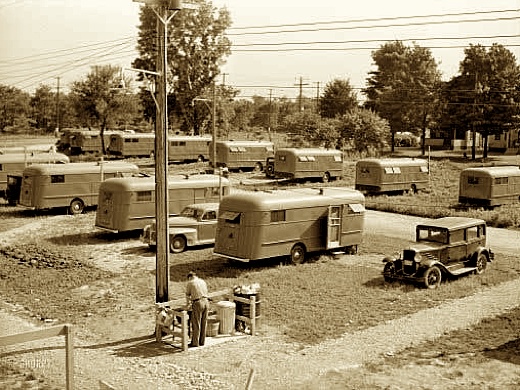
SUBHEAD: The time may come when many of us are forced to either fight for our freedom or learn to live with our chains. By Ashvin Pandurangi on 22 February 2012 for Automatic Earth - (http://theautomaticearth.org/Finance/our-depraved-future-of-debt-slavery-part-iii.html) Image above: June 1941 Erie County, Pennsylvania. "Each group of ten trailers in the FSA camp at Erie has a trailer service unit, water faucet, slop sink, and garbage pail". From original article.

There have been many forms of “debt slavery” throughout history, and almost everyone is chained to the oppressive financial, corporatist system now in one way or another. Although, this fact has not even remotely sunk in for millions of people who, unfortunately, have absolutely no clue how bad it can get. The real issue here, however, is not necessarily what people will have to do to survive the upcoming storms. Rather, it is what they will be forced to do to remain a functioning part of the system under threat of excessive monetary punishment, physical confinement or violence to them and/or those close to them. So, one must be financially/coercively attached to the system to be a “debt slave”.

If you are allowed to voluntarily downsize your living standards and retain some freedom of movement/action, then you are not really a slave. And that's not meant to demean the existential struggle of the chronically unemployed and/or homeless people living on the streets or in the subway, whose numbers are bound to increase and many of whom will die of sickness, cold and hunger, but it's hard to say that they are “attached” to our economic system of complicity and coerced participation. The most obvious way this slavish attachment forms is through personal debts/obligations.

That’s why it’s very important to pay off your mortgage(s), car loans, student loans, outstanding balances on past bills, etc., throw away your credit cards and generally avoid taking on debt at all costs. However, that is not a panacea for avoiding debt slavery by any means. One reason is that, as mentioned in Part I, creditors and third party debt collectors may literally conjure up debts for people who never agreed to take on those debts, by failing to account for payments, illegally jacking up interest rates, retro-actively inserting penalty clauses and other similar tactics. Or, they may simply doctor up brand new “contracts” that never existed.

The U.S. financial industry and government “regulators”, at both the federal and state level, have already taken the first steps towards such practices through the illegal transfer of mortgage titles in the MERS system and the “robosigning” of fraudulent loan documents by law firms employed by the major banks, which sought to “prove” ownership of such titles and therefore the right to foreclose. Once these illegal foreclosures came to the mainstream public’s attention, the federal government launched a sham investigation and effectively forced state attorney generals and prosecutors to go along with a tiny and symbolic settlement, which will primarily be funded by taxpayer money.

Jose Suarez explores this issue for the Huffington Post and brings up some key points:

Banks Take It Easy, While Miami Struggles Against Foreclosures

However, the settlement will only help a small percentage of the millions of Americans who still are deeply underwater on their mortgages. Victims of fraudulent foreclosure robo-signings look to receive only about $2,000 in compensation.

That amount is paltry compared to the amount of pain, desperation, and despair of millions of Americans, and so many Floridians, dangling precariously at the unlikely mercy of banks and their improper, illegal foreclosure processes. $2,000 wouldn't even come close to covering moving expenses or the "first, last and security deposits" for folks forced to downsize from their own homes to rentals.

Another highly troubling aspect of the settlement is the potential spike in new foreclosures predicted by various real estate and financial industry analysts. The banks were delaying foreclosing on great numbers of homes until details of the settlement were finalized. They may not power up the illegal "robo-signing" machines again, but they are now clear to fire out the foreclose notices.

This is the buzz I hear from real estate professionals in South Florida these days. While it certainly has a big impact on their day-to-day business, a bigger question is: How will these trends affect the momentum of the overall economy? The tentative recovery has yet to reach a large portion of the individuals hit first and hardest by the recession; these residents, in particular, are still struggling mightily -- and yet another downturn could be exponentially catastrophic for many of these families.

The settlement frees the banks from any potential civil charges from the 49 states, though individuals can try to sue (in the chance you had the time and resources), and federal and state officials may wish to pursue criminal charges against the banks. But don't bet on the latter, unless you're interested in "wrist slaps." Snug relationships between so many politicians and big businesses, especially the banks, are telling.

This settlement essentially gives the banks free license to go on a rampage of financial harassment and foreclosure without any interference from state governments. That’s why it was noted in Part II that traditional protections found in contract law have been rendered completely worthless for the vast majority of people on this planet, including all but the wealthiest individuals in the West. These protections were rooted in decades of British common law that developed through judicial precedents during the so-called “Enlightenment” era. They offered the average white male citizen a way to protect himself from having to make payments or perform under a contract if it was generally secured in one of the following ways:

1) Duress (economic or physical) – i.e. You are put in a position, physically or monetarily, in which you have no other choice but to agree to the terms of a contract.

2) Fraud/misrepresentation – i.e. You agree to the terms of a contract based on a material misrepresentation or omission of facts.

3) Unconscionability – i.e. You are a disadvantaged party (very asymmetrical knowledge of the business) to a contract which contains extremely unfair terms on its face.

If a court established one of these situations to exist in any given case, then the complaining party had a right to void the contract. The problem for victimized debtors now is that the legal system only performs this protective function well when the economy is growing and wealthy private interests can claim an increasingly large share of the pie despite these common law hurdles-turned-artifacts. In an era of widespread economic contraction and deleveraging by consumers and businesses, the large private interests will instead seek to extract value through the seizing of assets (“foreclosure” implies a legitimate process) and the subjugation of distressed debtors.

Human labor, after all, is simply a form of energy that can be applied to various inputs and productive processes, including the harvesting of other energy sources and the development of infrastructure necessary for large-scale societies. Most middle to upper-middle class Americans have forgotten all about the labor expended and the lives lost by their not-so-distant ancestors in the course of such work. Yet, they may very well be forced into laying railway tracks and mining coal or constructing/repairing roads, highways, bridges and canals in the near future. College and graduate students steeped in debt who are expecting cushy office jobs that no longer exist will find out they have effectively been sold into slavery by their system of “education”.

At a time when the net energy returns afforded by the extraction of fossil fuels is quickly disappearing, the industrial corporate elites will once again rely on what can only be called “slave labor” to perpetuate a system of large-scale exploitation and wealth extraction. This time these pools of labor will not only be confined to minority groups or third world countries, and we will all find out just how little control we have over our own lives and our own bodies. When faced with the threat of arbitrary imprisonment and/or being stripped of all your earthly possessions, it will be very difficult to resist making a deal of debt servitude with the Devil.

Where can any of these people turn to for relief or protection? Can they seek help from their local police departments or court systems? Traditionally, those have been potential avenues for at least a modicum of justice. Soon, however, even these institutions will be well into the process of being privatized in the name of “fiscal responsibility” and “market efficiency”, which is really code for corporate control over all facets of the modern state. Wealthy corporate conglomerates will not only have seized the “power of the purse”, but also the state’s dispute resolution mechanisms and its monopoly to use coercion and violence in pursuit of vaguely-defined goals.

When a sizeable portion of the police force in any major city is trained, armed and managed by private security firms such as Erik Prince’s Blackwater (now known as… Academi), we may find it rather difficult to defend our homes, assets, friends and families from the wrath of our financial oppressors. They will be our creditors and debt collectors, as well as our judges, juries and executioners. One does not only become a debt slave by being underwater on private debts, though.

As we are clearly seeing in the Eurozone periphery, external public debts that are in the process of being redeemed through austerity and “structural reform” can be a force equally capable of enslavement. If you are any worker, taxpayer and/or retiree living in the shadows of the wealthiest members of society, then you are rapidly losing your freedom as I write these words. Your savings and disposable incomes are being run down to pay the salaries and bonuses of corporate executives and directors, while your democratic elections have taken an indefinite leave of absence and your government will be confronting your resistance with steel cages and the barrel of a gun.

At the same time, the Eurozone crisis perhaps offers us some signs of hope, albeit ones that are few and far between. First and foremost is the fact that the process of systemic credit collapse in our highly inter-connected environment can occur at a pace that is not necessarily capable of being out-paced by those who seek to take full advantage of it, or in ways that are completely unexpected by them. We see this revealed in the repeated inability of the IMF, EU and ECB (and their corporate masters) to come up with policies that will keep Greece in the monetary union and prevent contagion from spreading to other peripheral markets.

It is also true that extensive systems of slavery can only sustain themselves with a certain amount of complicity and passive acceptance within the population. When it is a clear majority of people in a given location, rather than a minority, who are being pushed into slavery, there will most certainly be forceful pockets of resistance and the slave masters will require the slaves’ help to squash these movements. Indeed, that is exactly what we saw in European countries occupied by Nazi Germany, and even then many of the resistance movements made significant headway towards unlocking their peoples’ chains.

The slave masters will especially require the unwavering support of civil servants tasked with carrying out orders of oppression from above. In Greece, we recently witnessed the country’s largest police union issue a statement of its intention to refuse to continue aiding the elites in the enslavement of the Greek people, and even threatened to issue symbolic arrest warrants for Troika officials stationed in the country. It is not hard to imagine similar occurrences in Portugal, Spain, Italy and even Ireland, as their policemen and women are squeezed of pensions and salaries, and forced to face the reality of their role as slaves to the system.

Closer to the “core”, there were also acts of defiance in Brussels, Belgium by firefighters who sprayed foam from their hoses onto central streets and government buildings. In a separate display, these protesting firefighters also hosed down the Prime Minister’s office and the police units protecting it. Perhaps we can expect these pockets of official resistance to grow larger over time and act as a barrier between the corporatist slave masters and the populations they seek to enslave. Which then begs the question - what will the military forces of Westerns countries do? Will they remain a cohesive, unified force that carries out orders as they have been for many years now, or will pockets of resistance materialize within their ranks as well?

It is a mistake to assume that the men and women in the U.S. military, for example, are guaranteed to bring slavery and death to their own people when they are commanded to. As USA Today reported, people who actively work for the military donate more to Ron Paul’s campaign more than any other candidate, and he is certainly not someone known for advocating imperialism and oppressive government authority. That reflects an attitude that is anything but closed-minded and uncritical of current policy trends. So, while the global population’s future of debt slavery is a very real and ongoing threat, there are also reasons to believe it may not sustain itself for very long.

Then again, the number of slaves is growing by the day and the time may come when many of us are forced to either fight for our freedom or learn to live with our chains. These are obviously very serious issues and very serious possibilities. It is no longer acceptable for anyone to pretend that the concept of systemic slavery in the developed, “civilized” world has been relegated to the history books. It took the upheaval of the Great Depression and the Second World War to truly rid the U.S. of its enslavement of African Americans only 60-70 years ago. What will it take for the indebted masses now? And is anyone really willing to find out?

See also: Ea O Ka Aina: Our Future of Debt Slavery - Part 1 2/26/12 Ea O Ka Aina: Our Future of Debt Slavery - Part 2 2/27/12 .

Our Future Debt Slavery - Part 2

SUBHEAD: People could be forced into peonage contracts by creditors or 3rd party debt collectors.  

By Ashvin Pandurani on 26 February 2012 for Automatic Earth - 
(http://theautomaticearth.org/Finance/our-depraved-future-of-debt-slavery-part-ii.html)

 
Image above: John and Louise Dyson, aged Farm Security Administration borrowers. Mr. Dyson was born into slavery over eighty years ago. Mrs. Dyson is the mother of fifteen children. From original article.
 
"Debt" has been used as a means of slavery throughout human history, in ancient societies dating as far back as thousands of years ago, such as those in Mesopotamia, Egypt, North/South America, etc. Debtors in these societies would be forced to relinquish their crops, land, freedom and even their wives and children to satisfy unpaid debts. Such extravagant periods of debt creation often culminated in the necessity for systemic debt forgiveness (or "Jubilee") by the decree of chiefs, emperors and kings to simply maintain some sense of social order [see Debt: The First 5000 years].

However, the decree of the all-powerful ruler no longer exists in these traditional forms, in which the rulers and landed aristocracy could easily maintain their power through force even after all lower classes’ debts were wiped out. Instead, our modern network of nation-states requires a continuous level of economic and financial coercion to exert discipline and maintain the status quo relationships of wealth, power and dominance [see The Debt-Dollar Discipline].

As explained in Our Depraved Future of Debt Slavery (Part I), our global society is facing conditions of systemic dependency, greed and malice very similar to those which existed in the American South of the late 19th century, which created a system of slavery for blacks just as ruthless as that which existed before the Civil War. The modern industrial and financial elites cannot tolerate any policies of systemic debt forgiveness, since almost all of their wealth is invested in instruments tied to those debts (including the underlying currencies).

At the same time, they cannot continue extracting surplus value when large segments of the developed world’s population remain saturated with debt, which acts to suppress aggregate demand for goods, services and capital investment. In order to continue making profits, then, they must have extensive access to very cheap labor and fixed capital inputs. They must transform the consuming classes of the first world into indentured servants and slaves through already established channels of financial and political oppression, and also pick up productive assets for "pennies on the dollar".

Last time, we looked at one obvious way in which the modern slave state has been forming – the rise of the privatized prison-industrial complex which has become a venue for detaining ever-larger numbers of people in the poorest and most socially manipulated classes of our society, such as low-level drug users and dealers. These prisoners provide a constant stream of enslaved labor to wealthy corporate interests, just like the convict leasing system of the late 19th and early 20th centuries used primarily for African-Americans.

Vast amounts of money and resources are devoted by state and federal government agencies towards maintaining a perpetual "war on drugs" that merely reinforces the very profitable industry of drug addiction, use, trafficking, punishment and imprisonment in a vicious cycle. More recently, though, we have managed to manufacture another perpetual threat/response paradigm which provides the justification for modern enslavement – the "war on terror".

Everyone should now be aware of the argument that the National Defense Authorization Act (NDAA) allows the U.S. federal government, in coordination with the U.S. military, state governments and a sprawling intelligence network, to indefinitely detain any person in any place, including U.S. citizens, suspected of participating in or aiding “terrorist activities” without any due process of law (such as formal charges and trials).

Without getting into disputes over legal interpretations of the Act or its constitutionality, it is still undisputed that this type of legislation, which is in the company of such notables as the Patriot Act, represents a clear trend towards suppressing domestic dissent and expediting the mechanisms of incarceration. When peoples of a society are burdened with vast amounts of unpayable debts, it is predictable that they will eventually protest against those debts in whatever ways they can, ranging from intentional defaults to physical resistance.

Just look at Greece, where the people are being forced to take on more external debts (with interest) through their government as these debts become increasingly difficult to pay back, and while the benefits all run to a small group of elites. They are made to suffer through brutal austerity so that they can stay in debt, just like the recidivist drug addict stays in the prison system. Inevitably, such a state of affairs leads to violent riots and protests by the masses, which, in turn, lead to violent reactions by the state, which then feed back into more violence by the people.

It is a symptom of debt slavery that has plagued societies for centuries and has even led some of them to outlaw the issuance of interest-bearing debt altogether. As stated before, though, such a path does not compute for the powerful creditors and their beneficiaries today, which is why the last thing the Eurocrats will discuss at their now weekly Summits is a policy of systemic debt forgiveness (the PSI deal does not even come close to counting). Even the Troika itself has admitted that Greece’s debt/GDP could very well remain at 160% for the next decade despite bailouts, austerity and “voluntary” debt swaps.

If you woke up tomorrow and were told that many of the Greek protestors/rioters, along with lower class tax evaders/debtors, were now being indiscriminately and indefinitely detained without judicial process and that uniformed soldiers and tanks were being deployed to the streets of Athens, would you be very surprised? I’d hazard a guess that most people who follow the news wouldn’t be, but they would still call you a fanatical nutcase if you suggested anything similar could happen in America, the "land of the free".

That is despite the fact that our private and public debt (per capita) situation is worse than that of Greece, and our level of unchecked executive authority is much, much worse. In the post-Reconstruction south, state laws were re-written and federal laws were ignored when it came to increasing the levels of incarceration and debt servitude (peonage) among blacks. Today, federal laws have all but usurped the police powers reserved to the states under the 10th amendment and become the primary mechanisms of enslavement.

Michael Barnholden’s book, Reading the Riot Act: A Brief History of Rioting in Vancouver, explains how the original “Riot Act” passed by the British Parliament in 1714 has been put into effect since that time, and how it is still active law in Canada. The act gave enormous amounts of discretion to the executive arm of government in identifying and detaining “rioters”. In his review of the book, Max Sartin points to the socioeconomic premise underlying the Riot Act that was insightfully indentified by Barnholden.
The Rain Review of Books

"All of the riots, from those characterized by racism to those attributed to drunkenness at sporting events, are said by Barnholden to have a connecting thread in the exploitation inherent to the capitalist economy and the need of the ruling class to garner the consent of its subjects when possible or their submission by force when necessary. The legal definition of a riot and its presentation by the media are functional to the interests of the ruling elite, at the expense of the working class, including the unemployed and prisoners.

Barnholden frames the question in terms of human rights versus property rights, damage to property taking precedence over harm to human beings. The author’s concept of human rights isn’t defined in the book, leaving open the question of whether such rights, or the very idea of rights itself may be just another legal technicality, like the definition of a riot, subject to the whims of those in power.

Barnholden himself points out that "a job is the only guarantee within capitalist society of the basic human rights of food and shelter, and there is no right to that". But he also describes a paycheque as an element of coercion. Employment under a manager is exploitive and oppressive, but it’s the only way to achieve certain basic necessities of life, which as human beings we supposedly have a right to access. But we have no right to employment (which is also "wage slavery") and so our most basic rights become meaningless."

Barnholden gets to the root of why economic coercion under a capitalist system can easily turn into outright slavery, enforced by the corporatist state. There is absolutely no reason why the Riot Act in its most subjective form cannot once again be adopted by the U.S. and other Western nations as an additional means to threaten an increasingly distrustful population with incarceration, and to carry out that threat when necessary. In fact, current trends suggest this is exactly what will happen.

The protections afforded U.S citizens in their Constitution against arbitrary oppression by the federal government have been undermined in just about every way possible since 9/11. That is indeed a scary reversal from the post-Civil War era, because it means that state and local governments are helpless to protect their own citizens from federal encroachment.

This is especially true at a time when state governments are also wading deep in pools of stale debt, and must sell out their citizens to get temporary financial aid, which first makes its way into political pockets and then straight to the major banks.

The indefinite detentions of the West in modern times began under the Authorization of the Use of Military Force (AUMF), enacted before the invasion of Afghanistan, but now the NDAA has put Congress’ official stamp of approval on the very broad interpretation that was afforded the AUMF by the Bush Administration. The federal courts (including the Supreme Court) have been extremely reluctant to challenge any of these unconstitutional executive powers, and indeed have sanctioned them in many cases.

With that legal framework for the federal and state executive branches in mind, it’s not hard to see how people could eventually be forced into peonage contracts by their private creditors or third party debt collectors.

The truth is that both traditional contract law concepts such as "fraud/misrepresentation", "economic/physical duress", "unconscionability", etc., which sought to protect disadvantaged parties from exploitation, and Constitutional protections against the ex-post revision of private contracts have been thrown into the trash bin of history.

In the final part of this series, we will see how legally enforced contracts of debt servitude could become a defining feature of developed world populations in the near future. Indeed, the concept has already been deeply planted across the Western world in very important ways.

This will be a means of maintaining a system of debt slavery without literally imprisoning all debtors. However, none of these outcomes are guaranteed to be sustained over time, and so we will also explore why these populations may ultimately be able to shape their own futures, free from the burden of perpetual indebtedness.

See also:
Ea O Ka Aina: Our Future of Debt Slavery - Part 1 2/26/12
Ea O Ka Aina: Our Future of Debt Slavery - Part 3 2/28/12
.