Showing posts with label Power. Show all posts

World after the COVID-19 Pandemic

SUBHEAD: The pandemic will changes the world. Here are the thoughts of several global thinkers.

By contributors to Foreign Policy Magazine on 20 March 2020 -
(https://foreignpolicy.com/2020/03/20/world-order-after-coroanvirus-pandemic/)
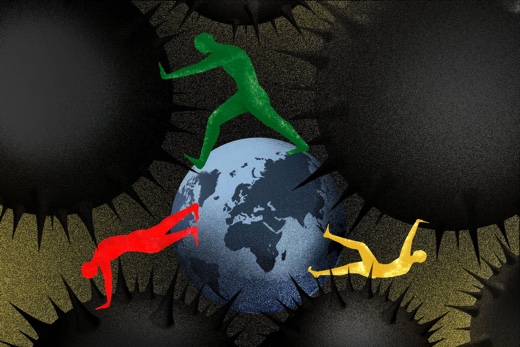

Image above: Illustration of fight against 2019 Novel Coronavirus pandemic. From original article.

Like the fall of the Berlin Wall or the collapse of Lehman Brothers, the coronavirus pandemic is a world-shattering event whose far-ranging consequences we can only begin to imagine today.

This much is certain: Just as this disease has shattered lives, disrupted markets and exposed the competence (or lack thereof) of governments, it will lead to permanent shifts in political and economic power in ways that will become apparent only later.

To help us make sense of the ground shifting beneath our feet as this crisis unfolds, Foreign Policy asked 12 leading thinkers from around the world to weigh in with their predictions for the global order after the pandemic.


A World Less Open, Prosperous, and Free

By Stephen M. Walt

The pandemic will strengthen the state and reinforce nationalism. Governments of all types will adopt emergency measures to manage the crisis, and many will be loath to relinquish these new powers when the crisis is over.

COVID-19 will also accelerate the shift in power and influence from West to East. South Korea and Singapore have responded best, and China has reacted well after its early mistakes. The response in Europe and America has been slow and haphazard by comparison, further tarnishing the aura of the Western “brand.”

What won’t change is the fundamentally conflictive nature of world politics.

Previous plagues—including the influenza epidemic of 1918-1919—did not end great-power rivalry nor usher in a new era of global cooperation. Neither will COVID-19. We will see a further retreat from hyperglobalization, as citizens look to national governments to protect them and as states and firms seek to reduce future vulnerabilities.

In short, COVID-19 will create a world that is less open, less prosperous, and less free. It did not have to be this way, but the combination of a deadly virus, inadequate planning, and incompetent leadership has placed humanity on a new and worrisome path.


The End of Globalization as We Know It

By Robin Niblett

The coronavirus pandemic could be the straw that breaks the camel’s back of economic globalization.

China’s growing economic and military power had already provoked a bipartisan determination in the United States to decouple China from U.S.-sourced high technology and intellectual property and try to force allies to follow suit.

Increasing public and political pressure to meet carbon emissions reduction targets had already called into question many companies’ reliance on long-distance supply chains. Now, COVID-19 is forcing governments, companies, and societies to strengthen their capacity to cope with extended periods of economic self-isolation.

It seems highly unlikely in this context that the world will return to the idea of mutually beneficial globalization that defined the early 21st century. And without the incentive to protect the shared gains from global economic integration, the architecture of global economic governance established in the 20th century will quickly atrophy.

It will then take enormous self-discipline for political leaders to sustain international cooperation and not retreat into overt geopolitical competition.

Proving to their citizens that they can manage the COVID-19 crisis will buy leaders some political capital. But those who fail will find it hard to resist the temptation to blame others for their failure.


A More China-Centric Globalization

By Kishore Mahbubani

The COVID-19 pandemic will not fundamentally alter global economic directions. It will only accelerate a change that had already begun: a move away from U.S.-centric globalization to a more China-centric globalization.

Why will this trend continue? The American population has lost faith in globalization and international trade. Free trade agreements are toxic, with or without U.S. President Donald Trump. By contrast, China has not lost faith.

Why not?

There are deeper historical reasons. Chinese leaders now know well that China’s century of humiliation from 1842 to 1949 was a result of its own complacency and a futile effort by its leaders to cut it off from the world. By contrast, the past few decades of economic resurgence were a result of global engagement.

The Chinese people have also experienced an explosion of cultural confidence. They believe they can compete anywhere.

Consequently, as I document in my new book, Has China Won?, the United States has two choices. If its primary goal is to maintain global primacy, it will have to engage in a zero-sum geopolitical contest, politically and economically, with China.

However, if the goal of the United States is to improve the well-being of the American people—whose social condition has deteriorated—it should cooperate with China. Wiser counsel would suggest that cooperation would be the better choice. However, given the toxic U.S. political environment toward China, wiser counsel may not prevail.


Democracies Will Come out of Their Shell

By G. John Ikenberry

In the short term, the crisis will give fuel to all the various camps in the Western grand strategy debate. The nationalists and anti-globalists, the China hawks, and even the liberal internationalists will all see new evidence for the urgency of their views.

Given the economic damage and social collapse that is unfolding, it is hard to see anything other than a reinforcement of the movement toward nationalism, great-power rivalry, strategic decoupling, and the like.

But just like in the 1930s and ’40s, there might also be a slower-evolving countercurrent, a sort of hardheaded internationalism similar to the one that Franklin D. Roosevelt and a few other statesmen began to articulate before and during the war. The 1930s collapse of the world economy showed how connected modern societies were and how vulnerable they were to what FDR called contagion.

The United States was less threatened by other great powers than by the deep forces—and Dr. Jekyll and Mr. Hyde character—of modernity. What FDR and other internationalists conjured was a postwar order that would rebuild an open system with new forms of protection and capacities to manage interdependence.

The United States couldn’t simply hide within its borders, but to operate in an open postwar order required the building of a global infrastructure of multilateral cooperation.

So the United States and other Western democracies might travel through this same sequence of reactions driven by a cascading sense of vulnerability; the response might be more nationalist at first, but over the longer term, the democracies will come out of their shells to find a new type of pragmatic and protective internationalism.


Lower Profits, but More Stability

By Shannon K. O’Neil

COVID-19 is undermining the basic tenets of global manufacturing. Companies will now rethink and shrink the multistep, multicountry supply chains that dominate production today.

Global supply chains were already coming under fire—economically, due to rising Chinese labor costs, U.S. President Donald Trump’s trade war, and advances in robotics, automation, and 3D printing, as well as politically, due to real and perceived job losses, especially in mature economies.

COVID-19 has now broken many of these links: Factory closings in afflicted areas have left other manufacturers—as well as hospitals, pharmacies, supermarkets, and retail stores—bereft of inventories and products.

On the other side of the pandemic, more companies will demand to know more about where their supplies come from and will trade off efficiency for redundancy. Governments will intervene as well, forcing what they consider strategic industries to have domestic backup plans and reserves. Profitability will fall, but supply stability should rise.


This Pandemic Can Serve a Useful Purpose

By Shivshankar Menon

It is early days yet, but three things seem apparent. First, the coronavirus pandemic will change our politics, both within states and between them. It is to the power of government that societies—even libertarians—have turned.

Government’s relative success in overcoming the pandemic and its economic effects will exacerbate or diminish security issues and the recent polarization within societies

Either way, government is back. Experience so far shows that authoritarians or populists are no better at handling the pandemic. Indeed, the countries that responded early and successfully, such as Korea and Taiwan, have been democracies—not those run by populist or authoritarian leaders.

Secondly, this is not yet the end of an interconnected world. The pandemic itself is proof of our interdependence.

But in all polities, there is already a turning inward, a search for autonomy and control of one’s own fate. We are headed for a poorer, meaner, and smaller world.

Finally, there are signs of hope and good sense. India took the initiative to convene a video conference of all South Asian leaders to craft a common regional response to the threat. If the pandemic shocks us into recognizing our real interest in cooperating multilaterally on the big global issues facing us, it will have served a useful purpose.


American Power Will Need a New Strategy

By Joseph S. Nye, Jr.

In 2017, U.S. President Donald Trump announced a new national security strategy that focuses on great-power competition. COVID-19 shows this strategy to be inadequate. Even if the United States prevails as a great power, it cannot protect its security by acting alone.

As Richard Danzig summarized the problem in 2018: “Twenty-first century technologies are global not just in their distribution, but also in their consequences.

Pathogens, AI systems, computer viruses, and radiation that others may accidentally release could become as much our problem as theirs. Agreed reporting systems, shared controls, common contingency plans, norms, and treaties must be pursued as means of moderating our numerous mutual risks.”

On transnational threats like COVID-19 and climate change, it is not enough to think of American power over other nations. The key to success is also learning the importance of power with others. Every country puts its national interest first; the important question is how broadly or narrowly this interest is defined. COVID-19 shows we are failing to adjust our strategy to this new world.


The History of COVID-19 Will Be Written by the Victors

By John Allen

As it has always been, history will be written by the “victors” of the COVID-19 crisis. Every nation, and increasingly every individual, is experiencing the societal strain of this disease in new and powerful ways.

Inevitably, those nations that persevere—both by virtue of their unique political and economic systems, as well as from a public health perspective—will claim success over those who experience a different, more devastating outcome.

To some, this will appear as a great and definitive triumph for democracy, multilateralism, and universal health care. To others, it will showcase the clear “benefits” of decisive, authoritarian rule.

Either way, this crisis will reshuffle the international power structure in ways we can only begin to imagine. COVID-19 will continue to depress economic activity and increase tension between countries.

Over the long term, the pandemic will likely significantly reduce the productive capacity of the global economy, especially if businesses close and individuals detach from the labor force. This risk of dislocation is especially great for developing nations and others with a large share of economically vulnerable workers.

The international system will, in turn, come under great pressure, resulting in instability and widespread conflict within and across countries.


A Dramatic New Stage in Global Capitalism

By Laurie Garrett

The fundamental shock to the world’s financial and economic system is the recognition that global supply chains and distribution networks are deeply vulnerable to disruption. The coronavirus pandemic will therefore not only have long-lasting economic effects, but lead to a more fundamental change.

Globalization allowed companies to farm out manufacturing all over the world and deliver their products to markets on a just-in-time basis, bypassing the costs of warehousing. Inventories that sat on shelves for more than a few days were considered market failures

Supply had to be sourced and shipped on a carefully orchestrated, global level. COVID-19 has proven that pathogens can not only infect people but poison the entire just-in-time system.

Given the scale of financial market losses the world has experienced since February, companies are likely to come out of this pandemic decidedly gun-shy about the just-in-time model and about globally dispersed production.

The result could be a dramatic new stage in global capitalism, in which supply chains are brought closer to home and filled with redundancies to protect against future disruption. That may cut into companies’ near-term profits but render the entire system more resilient.


More Failed States

By Richard N. Haass

Permanent is not a word I am fond of, as little or nothing is, but I would think the coronavirus crisis will ​at least for a few years lead most governments ​to turn inward, focusing on what takes place within their borders rather than ​on what happens beyond them.

I anticipate greater moves toward selective self-sufficiency (and, as a result, decoupling) given supply chain vulnerability; even greater opposition to large-scale immigration; and a reduced ​willingness or commitment to tackle regional or global problems (including climate change) given the perceived need to dedicate resources to rebuild at home and deal with economic consequences of the crisis​.
I would expect many countries will have difficulty recovering from the crisis, with state weakness and failed states becoming an even more prevalent feature of the world. The crisis will likely contribute to the ongoing deterioration of Sino-American relations and the weakening of European integration.

On the positive side, we should see some modest strengthening of global public health governance. But overall, a crisis rooted in globalization will weaken rather than add to the world’s willingness and ability to deal with it.


The United States Has Failed the Leadership Test

By Kori Schake


The United States will no longer be seen as an international leader because of its government’s narrow self-interest and bungling incompetence.

The global effects of this pandemic could have been greatly attenuated by having international organizations provide more and earlier information, which would have given governments time to prepare and direct resources to where they’re most needed.

This is something the United States could have organized, showing that while it is self-interested, it is not solely self-interested. Washington has failed the leadership test, and the world is worse off for it.


In Every Country, We See the Power of the Human Spirit

By Nicholas Burns

The COVID-19 pandemic is the greatest global crisis of this century. Its depth and scale are enormous. The public health crisis threatens each of the 7.8 billion people on Earth. The financial and economic crisis could exceed in its impact the Great Recession of 2008-2009.

Each crisis alone could provide a seismic shock that permanently changes the international system and balance of power as we know it.

To date, international collaboration has been woefully insufficient. If the United States and China, the world’s most powerful countries, cannot put aside their war of words over which of them is responsible for the crisis and lead more effectively, both countries’ credibility may be significantly diminished.

If the European Union cannot provide more targeted assistance to its 500 million citizens, national governments might take back more power from Brussels in the future. In the United States, what is most at stake is the ability of the federal government to provide effective measures to stem the crisis.

In every country, however, there are many examples of the power of the human spirit—of doctors, nurses, political leaders, and ordinary citizens demonstrating resilience, effectiveness, and leadership. That provides hope that men and women around the world can prevail in response to this extraordinary challenge.

Sweet and fitting to die for country

SUBHEAD: “Dulce et Decorum est” - Xenophobia, racism, patriotism and collapse are leading us towards WWIII.

By Alexander Aston on 25 July 2019 in The Automatic Earth -
(https://www.theautomaticearth.com/2019/07/dulce-et-decorum-est/)


Image above: Results in Lebanon of America's long fought Middle East Warn continue. In the future this could be Miami. From (https://moderndiplomacy.eu/2018/03/23/the-coming-long-planned-middle-east-war/).
“Dulce et Decorum est” is a poem written by Wilfred Owen during World War I, and published posthumously in 1920. The Latin title is taken from Ode 3.2 of the Roman poet Horace and means “it is sweet and fitting …”. It is followed there by “pro patria mori”, which means “to die for one’s country”.

“The muffled tongue of Big Ben tolled nine by the clock as the cortege left the palace, but on history’s clock it was sunset, and the sun of the old world was setting in a dying blaze of splendour never to be seen again.”
– Barbara W. Tuchman, The Guns of August
If you have not read Barbara Tuchman’s The Guns of August you should do so, it is one of the great, accessible works of history. Tuchman details with great clarity the diplomatic failures, miscalculations and political logics that ensnared the imperial powers of Europe into the cataclysm of the Great War.

It was the book that Kennedy drew upon when navigating the Cuban missile crisis. Just over a century since the guns fell silent in Europe, and nearly fifty years since nuclear holocaust was averted, the world is teetering on what might very well be the largest regional, potentially global, conflict since the second world war.

The United States is a warfare economy, its primary export is violence and it is through violence that it creates the demand for its products.

The markets of the Empire are the failed states, grinding civil conflicts, escalating regional tensions and human immiseration created by gun-boat diplomacy. In true entrepreneurial spirit, the United States has repeatedly overestimated its abilities to control the course of events and underestimated the complexities of a market predicated on violence.

However, since the beginning of the twenty-first century the American Imperium has proven itself as incompetent as it is vicious. After nearly two decades of intensifying conflicts, a fundamentally broken global economy and a dysfunctional political system, Washington has turned feral, lashing out against decline.

The points of instability in the global system are various and growing, and the only geo-political logics that the Imperium appears to be operating under are threats, coercion, and violence. It is at this moment, with the most erratic president in the country’s history, surrounded by some of the most extreme neo-conservative voices, that the United States has been belligerently stumbling across the globe.

In the past few months we have witnessed a surrealistic reimagining of the Latin American coup, the medieval melodrama of Canadian vassals taking a royal hostage from the Middle Kingdom and British buccaneers’ privateering off the coast of Gibraltar. The Imperial system is in a paroxysm of incoherent but sustained aggression.

It has long been clear that if another Great War were to emerge, it would likely begin in the Middle East. Just over a century later, we have found ourselves amidst another July crisis of escalating military and diplomatic confrontations. European modernity immolated itself in the Balkans though miscalculation, overconfidence and the prisoners dilemma of national prestige.

The conditions of the contemporary Middle East are no less volatile than those of Europe when the Austro-Hungarian Empire decided to attack Serbia. If anything, conditions are far more complex in a region entangled with allegiances and enmities that transgress and supersede the national borders imposed in the wake of the first world war.

The United States’ withdrawal from the JCPOA and the stated aim of reducing Iranian oil exports to zero has enforced a zero-sum logic between the American Imperium and Persia. With each move and counter move the two countries are further entangled into the dynamics of a conflict.

Much like the run up to July 28th 1914, tanker seizures, drone shoot downs, sanctions, military deployments and general bellicosity reinforce the rational of the opposing sides and make it harder to back down without losing face and appearing weak.

Due to the asymmetry of the two powers the Iranians have the fewest options for de-escalation while the American establishment perceives the least incentive. This dynamic is further exacerbated by major regional powers agitating for a conflict they believe they will benefit from.

Indeed, the slide to war might be inexorable at this point, the momentum of historical causality may have already exceeded the abilities of those in power to control.

Czar Nicholas and Kaiser Wilhelm were cousins that desperately wanted to avoid war and were nonetheless impotent to avert disaster. There is nowhere near such intimacy, communication and motivation in our current context.

If war with Iran erupts, the Pax Americana will come to an end and humanity will fully enter a new historical epoch. The most unlikely scenario is an easy victory for the United States, yet even this outcome will only exacerbate the decline of the Empire. The other great powers would expedite their exit from the dollar system and drastically increase investment into the means to counter American hegemony.

Likewise, victory would further reinforce Washington’s hubris, generating more serious challenges to the Imperial order and making the US prone to take on even bigger fights. Ironically, easy military success would almost assure the outbreak of a third world war in the long-term.


War with Iran would likely ignite violence in Israel-Palestine, Lebanon and Iraq, re-energise and expand the ongoing wars in Syria and Yemen as well as generate sectarian violence and domestic insurgencies across the Middle East.

Under such conditions regional actors would likely utilise a dramatically intensifying conflict as cover for their own agendas, for example with a renewed Turkish assault on the Syrian Kurds. The conditions for rapid escalation are extremely high in which non-linear dynamics could easily take hold and quickly outstrip any attempts to maintain control of the situation.

Pyrrhic victory for either side is the most likely outcome, making the parallels to the Great War all the more salient. Global conflagration is a possibility, but with “luck” the fighting could be contained to the region. Nonetheless, amplified refugee crises, supply chain disruptions and immense geopolitical realignments will cascade out of such an event.

Undoubtedly, there would be concerted efforts to abandon the dollar system as quickly as possible. Furthermore, rapid increases in the price of oil would all but grind the global economy to a halt within a matter of months, tipping citizenries already saturated with private debt into financial crises.

Furthermore, the entanglement of the military-industrial complex, the petrodollar reserve currency system and the omni-bubble generated by quantitative easing has left the Empire systemically fragile.

Particularly, the bubble in non-conventional fuels precipitated by QE, depressed oil prices with scaled down exploration, R&D and maintenance makes the possibility of a self-reinforcing collapse in the American energy and financial systems extremely plausible. It is a Gordian knot which war with Persia would leave in fetters.

The most likely long-term outcome of a war with Iran would be the economic isolation and political fragmentation of the United States. What is assured is that whatever world results it will not look anything like the world since 1945.

The first world war collapsed the European world system, dynasties that had persisted for centuries were left in ruins and the surviving great powers crippled by the overwhelming expenditures of blood and treasure. We are on the precipice of another such moment. The American world system is fundamentally dependent upon the relationship between warfare, energy dominance and debt.

Conflict is required to maintain control of the energy markets which prop up a financialised economy. A dynamic that puts the nation deeper in hock while amplifying resistance to financial vassalage.

Losing energy dominance undermines the country’s reserve currency status and weakens the Empires ability to generate the debt necessary to sustain the warfare economy.

Likewise, the system of national and international debt peonage parasitizes global populations to work against their own best interests. This fuels resentment and resistance which further drives the warfare economy. It is, in the inimitably American expression, a “self-licking ice cream cone.”

On August 3rd 1914, one week into the war, the British Foreign Secretary Edward Grey famously remarked that “the lamps are going out across Europe and we shall not see them relit in our lifetime.”

At the beginning of the twenty-first century, we face similar, terrifying prospects. Indeed, we could witness the collapse of democratic societies for a very long time to come. If we have any hope of averting calamity we need to generate loud opposition to imperialist warfare.

This does not mean some hackneyed anti-war movement based on past glories and the parochialism of domestic politics, but earnest effort to find common cause in resisting the insanity of those that seek profit in our collective suffering.

This means working with people that we have very deep disagreements with by respecting our mutual opposition to the masters of war. It also means serious commitment to strategies such as tax and debt strikes as expressions of non-consent as well as other peaceful means of direct action.

Indeed, it is from a place of agreement that we can potentially rebuild civil discourse and renew our trust in the ability of democratic institutions to mediate our quarrels. Perhaps it is too late to change course, but how sweet and fitting it is to face madness with dignity.

“What is the cause of historical events? Power. What is power? …power is a word the meaning of which we do not understand. ”
“Kings are the slaves of history.”
– Tolstoy, War and Peace
.

An Ending

SUBHEAD: Our farm, like many of our US farms and towns, is in the grip of an extended cold spell.

By Brian Miller on 31 December 2017 for Winged Elm Farm -
(http://www.wingedelmfarm.com/blog/2017/12/31/an-ending/)


Image above: Canton Minnesota Amish farm in winter snow. From (http://www.desertphotorestoration.com/gallery/v/farm/CantonMinn.jpg.html).

The initial thrill that comes with an ice storm and a loss of power faded a bit the morning the temperature bottomed out at 3 degrees.

Delores the sow had dragged the heater out of her water trough for the fifth time, the pond ice for the cattle and horse had to be broken every few hours, and a young ewe and her newborn had to be rescued after lambing in a far corner of the wind-blown sheep pasture and relocated to the shelter of a barn stall.

Still, the domestic pleasure of coming into a cozy house heated by a woodstove to sip a hot cup of tea is not to be dismissed.

Traditionally we built our houses to meet the demands of our climates, a grass hut if you lived on a tropical isle or a house with connected barn if you lived in New England. Older houses in Louisiana, when I was growing up, were typically built a couple of feet off the ground. It was a good model for a warm climate.

The open space underneath kept the house cooler in the warmer months (most of the year), and the elevation protected against the occasional flooding. Freezes, like the big one in 1940 my dad recalled, were rare.

And given that most plumbing was limited to the kitchen, freeze damage to the house was minimal.

Infrastructure was on my mind this past week here in East Tennessee. After a week of temperatures barely budging above freezing, we had an ice storm.

The storm caused our farm to lose power. Then the temperatures plummeted to low single digits. Thankfully, we had a generator to run the refrigerator, well pump and a few essential electrical circuits.

A Jotul woodstove helped keep the house a comfortable 60 degrees. Another generator at the barn kept a variety of water tanks heated for the sheep, chickens, goose, cattle and horse.

Today, our houses are designed to accommodate the additional “essentials” that just a generation ago were not needed nor even available.

The electricity to keep the modern house functioning is a relatively new concept in human culture. The boundary line of what is essential has shifted. Shelter, heat, food and water now share demand with internet, smartphone, cable TV and microwave.

Older forms of infrastructure had built-in resilience: barns carefully constructed to hold heat, with hay mows above to ease the feeding of livestock in poor weather; deep in-ground cisterns to provide fresh water for the farm; houses designed to facilitate warmth in the winter or coolness in the summer—smart, low-tech designs that we have pushed aside with the assumption that the power grid will now take care of us.

Over the years Cindy and I have discussed converting our farm to an off-the-grid power system. Each time, though, we found the costs to be prohibitive.

But this week, after a few days without power, as we scrambled to keep up with our needs, it occurred to me: off-the-grid is easy; it is our modern needs that are complicated, the prohibitive factor, the stumbling block, the real expense.

Those old houses in south Louisiana worked year in, year out because they had very little modern infrastructure to protect. Working under the house insulating each individual pipe before the ice storm, I was overwhelmed by how much plumbing is needed in our small house just to furnish us water on demand.

Hot and cold pipes to the kitchen and the two bathrooms, the hot water heater and the washer/dryer—a complexity of plumbing requiring protection from the elements, so that it might protect us from the elements.

Driving into town late in the week, I saw dozens of downed trees, limbs still balancing on utility lines, brush pushed to the edges of the road.

As I looked at the miles of power lines and telephone lines, our true vulnerability was evident. It was not the loss of electrical power that we feared but the loss of a certain status that comes with our modern life, a status of predictability.

Off-the-grid literature is typically geared towards finding ways around the commercial power source, yet retaining the modern conveniences. As we watered and fed our sheep, as lambs were born this week without regard to the temperature or the state of our utilities, I thought about the Amish.

While many of us were without power, were they concerned with an inability to update their Facebook pages, charge their cell phones, keep their freezers going, stay warm with their electric furnaces?

 Did they feel powerless? Somehow I doubt it.

The complexity of this modern life, the infrastructure that maintains it, is hardwired for disruption.

Our system and our expectations for what it must provide are such that losing power is a form of powerlessness. That in itself seems a form of slavery. Which is why there is, for me, always that bit of anarchic joy in an emergency, an unshackling from the system.

Though that uncertain joy is accompanied by relief when the master comes home and power is restored.
.

Alaska turning to microgrids

SUBHEAD: In remote rural communities renewable energy is increasingly providing power.

By David W. Shaw on 6 March 2017 for Ensia -
(https://ensia.com/features/alaska-renewable-energy/)


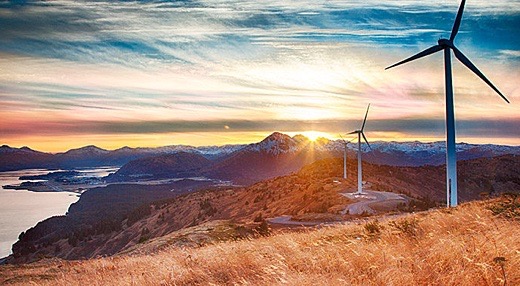
Image above: Wind power feeding electric microgrid in rural Alaska. Photo by Adina Preston. From original article.

I flew into Unalakleet, Alaska, on a late fall day. With about 700 people, Unalakleet is large by rural Alaska standards and serves as a regional hub. The village is located on a sandy spit of land where a clear river meets the turbid water of the Bering Sea. Out the plane window the sun shone bright, glittering off the wind-tossed whitecaps of the sea.

To the east, the rolling Nulato Hills, clad in autumn foliage, provided a picturesque backdrop. As the small plane banked for our approach, a row of wind turbines appeared atop a ridge. Installed in 2009 they are among the numerous renewable power installations that have popped up across rural Alaska in the past decade.

In more accessible parts of the planet, renewable energy is often embraced as a tool for reducing the threat of climate change and installed in spite of, rather than due to financial considerations. In Alaska, however, says Piper Foster Wilder, deputy director of the Renewable Energy Alaska Project, or REAP, “Economics, not the environment, are driving the shift to renewables.”

That’s not to say these remote villages in Alaska aren’t dealing with environmental challenges. Of course they are. In fact, the far north is warming at more than twice the rate of the rest of the planet. Permafrost is melting and as the ground thaws, it causes instability beneath the foundations of buildings and oceans and rivers encroach, eroding shorelines.

 Coastal villages, once protected for much of the year by shore-fast sea ice, are increasingly exposed to storms and flooding as that ice recedes, even causing some communities to begin moving to safer, inland locations.

But, in many remote Alaskan villages, the cost of electricity is the highest in the nation, reaching a wallet-emptying US$1 per kilowatt-hour in some communities (the national average is US$0.12/kwh). The price is due to the cost of hauling fossil fuels (primarily diesel) by plane or barge to these remote areas.

For example, the western half of Alaska, where Unalakleet lies, has no highways, no railroad tracks, no power lines. In that big country, the distances between the few scattered communities are daunting. If power can be generated using local renewables, the up-front cost is almost always worth it.

“We are up to 99.7 percent renewable energy,” says Lloyd Shanley, power generation manager at Kodiak Electric Association, Inc., which provides electricity to the area around the town of Kodiak (population 6,400) on Kodiak Island off the southwestern coast of the Alaska Peninsula.

The primary source of KEA’s power is an alpine lake that lies in the mountains above town. With a little creative engineering, KEA ran a penstock from the lake’s steep outflow stream, channeling the water into a turbine system that contributes about 80 percent of the community’s power needs. An additional 20 percent comes from a handful of wind turbines on the ridges around town.

“Our conversion to renewables has resulted in no increased cost to consumers in nearly 20 years,” Shanley says, a statistic that few communities, regardless of location, can claim.

“Kodiak should be a template,” says Wilder, but that template needs an asterisk. “The town there benefits from its topography, which allows the very successful use of small-scale hydro and wind. But every community has an abundance of some resource.”

For many villages on Alaska’s long, exposed coast, that resource is wind.

The turbines I saw from my plane window as I descended into Unalakleet have a capacity of up to 600 kilowatts of power, enough to offset the consumption of tens of thousands of gallons of diesel over the course of a year. Across Alaska, similar projects are popping up.

A map of renewable power projects on the REAP website shows wind turbine icons up and down the state’s coast. Gambell, Savoonga, Nome, Wales, Shaktoolik, Emmonak, Chevak and more than a dozen other villages have embraced wind-generated power. Indeed wind turbines surrounding Alaska’s villages are so common as to no longer be remarkable.

What is remarkable is that these small, remote, economically challenged communities have successfully integrated renewable energy into their existing, diesel-based power grids with more success than just about anywhere else in the world. Remarkable indeed, and also a lesson to be applied elsewhere.

Some 1.2 billion people on the planet do not currently have access to electricity. And there’s a lot these people can learn from Alaska. “Microgrids, not large-scale power generation, will be the most effective way to provide electricity to those still unconnected,” Wilder says.

Microgrids are essentially small power grids customized for single communities. In the case of rural Alaska, existing generator-based grids were modified to include renewables, but developing a microgrid from scratch makes the inclusion of renewable power sources easier.

Unlike large, centralized systems that rely on enormous power plants, microgrids provide power to small geographic areas. Ideally, their power sources, like the wind blowing across the hills of Unalakleet or Kodiak’s alpine lake, take advantage of locally abundant renewables.

Often, when people envision expanding the use of renewables to communities in need, they think of expansive solar farms, rows of wind turbines and large-scale hydro projects, but as Wilder points out, there is no one-size-fits-all solution. While she emphasizes efficiency first, other decisions depend on the community.

“The first thing we address in a community is efficiency,” she says. “Then we work on the power grid and last consider the best sources of power.” That allows the integration of renewables to take into account the resources and challenges of each community.

Every community, whether it’s an Arctic village or a small town in Bangladesh, is unique, and there are no formulaic solutions.

Whether turbines spinning in the cold wind of Alaska’s coast or the precipitous streams of Kodiak, electric generation and delivery systems work best when they are adapted to the communities they serve.

.

Indian Point Nuclear Accident

SUBHEAD:  Operator unable to prevent its highly radioactive coolant from leaking into groundwater.

By Admin on 26 February 2016 for ENE News -
(http://enenews.com/uncontrollable-radioactive-flow-coming-nuclear-plant-nyc-actual-releases-trillions-times-higher-reported-during-latest-leak-cracks-multiple-spent-fuel-pools-intense-investigation-underway-be)


[IB Publisher's note: Emphasis below provided by ENE News Admin. Indian Point Nuclear Plant provides about one quarter of the regions electrical power and includes New York City. There is no politically or economically acceptable way to shut it down - at this time.]


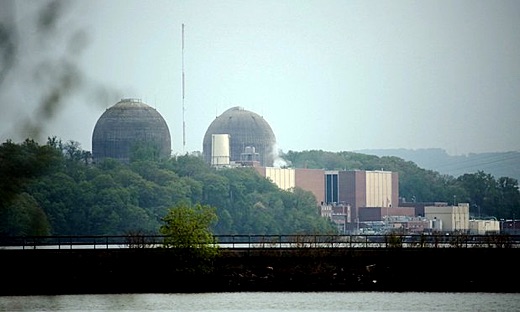
Image above: Smoke rises from the Indian Point Energy Center in Buchanan, New York, where last May an explosion and fire led to thousands of gallons of transformer fluid being released into the Hudson river. Photograph by Ricky Flores/AP. From (http://www.theguardian.com/us-news/2015/may/11/indian-point-nuclear-reactor-shut-down-blast-fire)


Inhabitat  on 26 February 2016
No matter where you live, “uncontrollable radioactive flow” is not a phrase that you want to hear in relation to your local water source … According to the Huffington Post’s report, for more than a decade, the Indian Point plant has been unable to prevent its highly radioactive reactor and spent fuel pool coolant from leaking into groundwater routes that eventually lead into the Hudson River. Entergy, the operator of the plant, seems to zero in solely on tritium… The most recent leak, however, according to an assessment by the New York Department of State as part of its Coastal Zone Management Assessment, contains a variety of radioactive elements such as strontium-90, cesium-137, cobalt-60, and nickel-63 in addition to tritium…

 Huffington Post on 15 February 2016
For more than a decade, it has been impossible for operators of the Indian Point nuclear power plant to stop highly radioactive reactor and spent fuel pool coolant from leaking into the groundwater and migrating to the Hudson River… there is no indication that the company has developed the ability to prevent the latest uncontrolled leaks from following the underground waterway into the Hudson. And because the river is a tidal estuary flowing as much as 20 miles above and below the nuclear site, radioactive contaminants may be sucked into the drinking water systems of several river towns… Entergy representatives declined to comment on planned and unplanned radioactive discharges into the environment. The sequence of events leading to leaks of radioactive liquids from Indian Point 2 is the subject of an intense investigation… to determine how the leak occurred and whether or not it can be stopped… In the past, the Coastal Zone Management report states, “radioactive releases have been detected at the Indian Point facility from cracks in two different spent fuel pools. Leaks of radioactive liquids from the Indian Point 2 spent fuel pools have reached the Hudson River”…

See also: CBS: Radiation leak "getting worse" at nuclear plant near NYC -- Levels increase over 120,000%, almost 15 million pCi/L -- Governor: "Extremely disconcerting" -- Expert: I don't think they know where it's coming from -- Radioactive Antimony now being detected (VIDEO)
Watch a local news broadcast on the most recent leak here


Previous Reports on Indian Point

SUBHEAD: Indian Point Plant contaminates the Hudson River with uncontrollable radioactive flow.


NY Daily News 11 February, 2016
 Cuomo to launch probe into troubled Indian Point power plant as radioactive leak gets worse — The amount of radioactive tritium leaking from the Indian Point nuclear power plant is growing, officials said… New samples from groundwater monitoring wells show 80% higher concentrations of tritium compared with when the leak was first reported Saturday… Wednesday, [Cuomo] ordered a more sweeping investigation… “Last week the company reported alarming levels of radioactivity at three monitoring wells, with one well’s radioactivity increasing nearly 65,000%,” Cuomo said… “The news just keeps getting worse,” said Paul Gallay, president of the watchdog group Riverkeeper.

The Journal News 11 February 2016
Tritium levels reported last week were the ‘highest that they’ve seen to date‘ at the plant

WAMC 11 February 2016  
Tritium Levels Spike In Groundwater… Additional testing has turned up higher levels of radioactive tritium in groundwater than what was reported last week at the Indian Point nuclear power plant… One reading showed an 80 percent increase in tritium levels over the 65,000 percent increase initially reported… [An NRC spokesman said] “So given the migration of that water, we would expect those to continue to go up for a period of time… Our specialist inspector will be there… tasked with trying to better understand exactly what happened”…

Associated Press 10 February 2016
New testing has shown that the amount of tritium in the groundwater below the Indian Point power plant in Buchanan, New York, is about 740 times the amount allowed in drinking water… Entergy Corp., which operates the plant at the edge of the Hudson River, said Wednesday that the latest samples from monitoring wells found tritium at a level of 14.8 million picocuries per liter [up from 12,300 pCi/L, a 120,000% increase]. The [EPA] has set a limit of no more than 20,000 picocuries per liter in drinking water… [C]ritics of nuclear plants said the mere fact of the leak’s occurrence is cause for concern, partly because investigators had yet to pinpoint how it happened. “There a leak somewhere, and I don’t think they know where it is,” said Arnold Gundersen, a nuclear engineer and former industry executive… Gundersen said he was concerned that other, potentially more problematic elements could also have leaked out… [Indian Point spokesman Jerry Nappi] said testing had also found elevated levels of antimony, at about 5,500 picocuries per liter… “It’s like an old car ready to fall apart“… said Assemblyman Tom Abinanti…

Reuters 10 Feb  2016: Entergy said it continues to look for the source of the tritium leak

CBSNY/AP 10 February 2016
The radioactive water leak at the Indian Point Nuclear power plant is getting worse. Gov. Andrew Cuomo said in a statement Wednesday that the level of radioactive tritium-contaminated water that leaked into the groundwater at the nuclear facility has increased by 80 percent since last week’s initial report… Cuomo called it “extremely disconcerting.” “Today, I have further directed that the three agencies integrate their investigations to thoroughly explore whether the operational problems that are suspected to have caused the uptick in unexpected outages of the plant may also be causing the leak of radioactive water into the environment”… the New York governor said.

WAMC 10 February 2016
Additional testing has turned up even higher levels of radioactive tritium than what was reported last week…

Watch FOX 5 NY’s broadcast here

.

Nuclear Bombs & Nuclear Power

SUBHEAD: Nuclear bombs and nuclear power are part of the same insane business model - Money and Death!

By Jim Hickey on 10 August 2015 for Sermcap -
(http://www.sermcap.org/?p=634)


Image above: In the foreground cooling towers emit vapor at a nuclear power plant in Grohnde, Germany. In the background a France's thermonuclear test in French Polynesia code named Licorne. Mash-up by Juan Wilson.

[IB Publisher's note: Yes this is a rant and a screed. Our opinion is that the idea that "worker power" will come to play in saving the day is naive. Those that still have jobs are anesthetized with beer, sugar and jumbo TV screens. However, Japan just restarted the first nuclear power plant since Fukushima and the Republicans are busy today trying to throw the negotiated nuclear deal with Iran out the window. Considering the level of worldwide madness on the issue of nuclear power and nuclear weapons - and humanity's continued march to self destruction, we will publish this fervent message.] 

I’ve written about Hiroshima in general for forty odd years, and I’ve composed something tangible for every annual commemoration of the bombing for plus or minus a decade-and-a-half.

Thus, again, I proffer ideas about this event and the even more egregious slaughter that followed three days hence at Nagasaki.

I can offer evidence for all that follows. That data, and those citations and links and sources, make a persuasive, perhaps a dispositive, case for all that follows below.

However, I’m not bothering this year to provide citations or links or other connections to that material, except to refer anyone interested to items that I have been composing for lo these many years about all of this.

Instead, here I am—as old as the hills, a veritable representation of Father Time, who appears again, Cassandra-like, asking for attention on which human survival depends—with a relatively brief listing of conclusions about what Hiroshima means for, what it implies about, and what it portends for the human condition.

The hundreds of thousands—overwhelmingly, women and children and elderly, non-combatants—whom United States action incinerated in 1945, and the plus or minus tens-of-millions—a much more varied demographic—who have subsequently expired as a result of the subsequent iterations of the Uranium economy and the Modern Nuclear Project might if nothing else appreciate our considering such anniversaries as this one as an opportunity to reflect both on making human survival more likely rather than less likely, and on facilitating rather than precluding human thriving.
 
The dead call us to account. They beg for our attention. The words of a translation that I’ve done of Sadako Kirihara‘s poem, “New Life,” articulates this point:
Her promise is the one we live by still.
Even in the fires of hell, as life’s blood seeps away,
We will bring forth new life, even unto death.
A birth to tie ourselves to Earth even as we go,
Life is our vow; life is our will.
My advice is that folks pay attention, but I’m not attached to advising such. People can do whatever they like. The following five conclusions are merely a tiny sample of critical or at minimum useful deductions about Hiroshima’s impact or significance.

However, they do represent far-reaching or even central judgments in regard to Hiroshima’s influence on Homo Sapiens’ problems and prospects.

FIRST
the innovation and enterprise and work of nuclear research and development have always been near the top of the agenda of monopoly capital. This extends from well before the ‘discovery’ of radioactivity and the actual structure of the atom.

Whether one examines Germany or England or Japan, the elevation of scientific inquiry and expertise, and the delving of electromagnetism in particular, have sought to turn the nature of nature to the purposes of profit.

The names of the principle-investigators in different cases end up reading like a who’s who of nuclear history—from Farraday to Teller, from Einstein to Thompson, from Curie to Soddy, from Becquerel to Szilard, from Fermi to Heisenberg.

Moreover, these people themselves, as in the case of ‘Lord Kelvin’ or Frederick Soddy, or their backers and funders, were central actors in the monopolization and financialization of capital’s ruling dynamic.

Those who picked up the tab for the increasingly expensive devices that the likes of Lawrence Livermore and Ernest Rutherford and others dreamed of building always represented vast wealth and even plutocracy.

The Rockefeller interests’ ubiquitous presence on the subatomic research scene, Ernest Solvay’s family’s ongoing imprimatur in these matters, and the presence of other multi-billionaire financiers such as Alfred Loomis and Alexander Sachs among the ‘hobbyists’ who effected the Modern Nuclear Project altogether demonstrate this conjunction between the bourgeois stratosphere and the revelation of colossal ‘energy-potential’ from the atom and its components.

SECOND
The Manhattan Project, which in and of itself is another irrefutable agglomeration of evidence in support of the first point, had as its primary purpose the creation of mass-murder devices to serve the geopolitical and imperial agendas of the monopoly capital puppeteers who ‘paid the piper’ all along the path to apprehending these fundamental energies of existence.

This is not some ‘conspiracy theory,’ but is an unmistakable “conspiracy fact” as the redoubtable if not completely ‘respectable’ Michael Rupert put the case.

Moreover, the connection between an interest in nature’s energy stores, the electromagnetic spectrum, and a bomb ‘destructive enough to make war unthinkable’ rests at the root of the entire process of investigation. Thompson’s work makes this clear in general.

Both Frederic Soddy’s Interpretation of Radium and the Nobelist’s famed early twentieth century lecture circuit made this point crystal clear. No particle physicist was unaware of the implication of e = mc-Squared.

Not only did scientists and businessmen apprise themselves explicitly of this connection between the EMS and weapons of unimaginable lethality, but writers and other artists all along narrated this scenario, decades in advance of the creation of the aptly named Manhattan Engineering District.

Frank Stockton’s The Great War Syndicate, H.G. Wells’ The World Set Free, Eric Ambler’s The Dark Frontier, and Robert Heinlein’s Solution Unsatisfactory are just a sampling of the yarns—that none of them are literary gems is beside the point—that ‘scoop’ the ‘great secret’ of nuclear weapons by periods of a few years to nearly a century.

Returning to the Manhattan Project itself, the decision to use the weapons twice against civilians had three essential rationale.  The first was to make sure that both enriched Uranium and Plutonium actually worked as ‘fuel’ for mass murder.

he second was to conduct an experiment in how much damage the given ‘yield’ of these weapons would do to relatively undamaged urban environments.  The third was to intimidate the Soviet Union and threaten annihilation to Reds with the temerity to resist U.S. hegemony in Europe and elsewhere.  Neither did the deployment of these engines of annihilation end the war, nor was that their purpose.

THIRD
From the tellingly named Atomic Energy Commission to the more prosaic and propagandistic appellation of the Department of Energy, the Modern Nuclear Project’s primary purpose has been both the same as number two and the more political economic end of providing hundreds of billions of dollars of taxpayer money to exclusively monopoly-level enterprises that exist to create weapons of mass destruction.

This phenomenon is now worldwide, despite the U.S.’s retaining its position as ‘first among equals’ in its particular embodiments of Departments of Hydrogen Bombs. To this day, plus-or-minus fifty percent of DOE funding is for one aspect or another of matters nuclear.

An inevitable offshoot of this now ten-to-fifteen trillion dollar ‘project,’ which does not even include the massive ‘investments’ in energy production from fission and fusion, is that literally everything else in the nature of social development falls by the wayside, except for other developments with similar promise to financial monopoly and imperial predominance.

Thus, despite almost half a century of predictions that the Modern Nuclear Project would inevitably collapse under its own weight—of inefficiency, genocide, and police state guardianship, it has instead gained strength and continues to be the fantasy child of the likes of Bill Gates, Paul Allen, George Soros, and others of the erstwhile ‘progressive’ billionaires, about whom Ralph Nader only half jokingly quipped;
"Only the Super Rich Can Save Us."

FOURTH

In the final analysis, ‘civilian’ nuclear power and ‘military’ nuclear weapons—a la the early Atomic Energy Commission—are indistinguishable: nuclear power guarantees nuclear weapons, and nuclear weapons make inevitable forays into power production.

France may be the best example of this assertion, or the United States, but not only is Israel—at once a protégé of both France and the Yanks—absolute proof of the case, but also the entire imbroglio around Iran’s ‘nuclear plans’ further demonstrates the contention.

Wherever one looks in the nuclear sphere, this conjunction is immutable. For decades, Japan seemed an exception to the rule, along perhaps with Korea, but both are angling for their own arsenals of megadeath now, as is Brazil, and of course, India, Pakistan, Britain, China, and Russia long ago verified that this notion is, at a minimum, hard to rebut.

History, if one is willing to examine its annals, provides still further substantiation of this case. Atoms for Peace was, as J. Robert Oppenheimer pointed out and Jimmy Carter’s managerial legerdemain at DOE illustrated further, a public relations stunt in support of nuclear weapons.

From the Tennessee Valley Authority to utility and technology monopolies’ restless insistence on more and bigger reactor projects, as well as more and ‘smaller’ reactor projects, the entire ‘Nuclear Fool Cycle stream is replete with militarized applications, from mining surveys that explore for Uranium or Thorium deposits to Depleted Uranium’s now ubiquitous and insidious presence in Army ordnance around the planet.

FIFTH
Capitalism’s continuation guarantees continued nuclear weapons protocols; therefore, remaining committed to capitalism guarantees either extinguishing anything like human society’s viability or an extinction of humankind altogether.

The increasing impoverishment of social justice and economic democracy are ‘unfortunate byproducts’ of the Uranium Economy’s continued pride of place in plutocratic fantasy. The destruction of the human condition is, given time and tide, an absolute certainty if the Uranium Economy and the Modern Nuclear Project continue to hold sway.

ANTIDOTE
To an extent paradoxically, and in another way of thinking quite naturally, the only antidote to this stranglehold on our mutual future is the rise of worker power. Capital—whatever strains or splits have riven different sectors or nations or cliques—has ultimately always deferred to the ‘necessity’ of an ongoing extension of fission and fusion research and the primacy of such investment strategies.

A clear implication of this line of reasoning concerns the issue of power, of social heft and capacity. Obviously, poverty, prisons, chauvinistic ethnocentrism, eviscerated education, and half a hundred other problems absolutely demand attention and focus.

However, if survival matters, what contextualizes and conjoins all of these single issues, including this hideous morass of death in the nuclear sphere, is how working people can come to exercise power in the world.

Otherwise, whether we live long enough to snuff ourselves out in one heated rush or expire from one version or another of a ‘death from a thousand cuts,’ none of our specific concerns will ever amount to more than ‘academic interest’ or ‘passionate desire.’

In any event, this essay deals with Hiroshima, Nagasaki, and their ongoing relevance. The trigger for the decimation or even the annihilation of human society and its seven billion current cousins could come from India and Pakistan; from Israel and Iran; from North and South Korea; from Europe, the U.S., and Russia via Ukrainian or multiple other flashpoints; or from the U.S. and China as a result of various bones of contention.

The ecocidal events that could follow from such engagement is not, moment by moment, very likely, nor are the sorts of alternate routes to human extinction high-probability scenarios.

However, as any gambler or statistician or wise observer of events knows, given enough throws of the dice, every possible outcome—even those that are at any given point exceedingly implausible—will occur: without exception.

Therefore, if the conjunction of nuclear-armed nations continues, eventually our kind of creatures will simply no longer exist on this planet, at least under any set of circumstances that we would assess as humane.

A summary of all this rumination could fit a shtick such as the following. It could serve as a stand-up routine in the right hands.
“So everybody, howdy!

Man do we live in interesting times, or what? I mean, no doubt about it, we could live like Solomonic kings. There’s plenty of stuff to provide every person with that level of food and income and housing and so on.

Or we could keep on keeping on the way that we are. In that case, eventually, again beyond the shadow of any doubt whatsoever, either we will kill almost all people, or we will instead murder everyone, down to the last child, woman, or man who currently draws breath.

That’s the choice that we now face. We will continue to confront this pair of alternatives until one of two things happen: either we get rid of the nuclear death sentence, or we or our offspring will bear witness to carrying out this population-wide execution.
The way that things now stand, the obvious assessment of our mutual selection is clear. ‘Hmmm! Live like royalty or commit mass collective suicide? I mean, what a no brainer! Let’s kill each other and party, party, party!’”
Life has imitated art. We are embodying the words of Tom Lehrer’s songs, “So Long Mom, I’m Off to Drop the Bomb!” and “We’ll All Go Together When We Go.” At least, this will prove so unless we wake up, all too likely very soon.

As John Hershey wrote at the end of Hiroshima,
“What has kept the world safe from the bomb since 1945 has not been deterrence, in the sense of fear of specific weapons, so much as it’s been memory. The memory of what happened at Hiroshima. …(And now, as the years unfold), the (survivor’s) memory, like the world’s, (i)s getting spotty.”
See also:
Ea O Ka Aina: Nuclear Wasteland 8/6/15
Ea O Ka Aina: Nuclear is not alternative energy 8/3/15
Ea O Ka Aina: Fukushima disaster will continue 7/21/15
Ea O Ka Aina: Fukushima - the end of atomic power  3/15/15

Ea O Ka Aina: Go Nuclear or Go Native 10/20/14
.

Nuclear is not alternative energy

SUBHEAD: Obama's final Clean Power Plan drops support for existing nuclear plants.

By Jeff McMahhon on 3 August 2015 for Forbes -
(http://www.forbes.com/sites/jeffmcmahon/2015/08/03/final-clean-power-plan-drops-support-for-existing-nuclear-plants/)


Image above: The aging Indian Point Nuclear Power Plant on the banks of the Hudson River upstream from NYC. Photo by Don Emmert for AFP/Getty Images. From original article.

The final version of President Obama’s Clean Power Plan does not include aid to existing nuclear power plants at risk of closing because they can’t compete with cheaper natural gas and renewables—a list that includes some of the nation’s most controversial reactors, including Indian Point and Three Mile Island.

In the draft version, EPA had proposed allowing states to count 6 percent of existing nuclear generation toward their clean energy goals, a provision designed to rescue the 6 percent of nuclear capacity considered at risk.

“On further consideration, we believe it is inappropriate to base the BSER (Best System of Emission Reduction) on elements that will not reduce CO2 emissions from affected electric generating units below current levels,” EPA states in the final rule.

“Existing nuclear generation helps make existing CO2 emissions lower than they would otherwise be, but will not further lower CO2 emissions below current levels. Accordingly… the EPA is not finalizing preservation of generation from existing nuclear capacity as a component of the BSER.”

Accordingly,  states will not be able to meet their clean energy goals by extending the licenses of existing nuclear plants.

The revised rule does have some good news for nuclear utilities:
Older nuclear plants can only help states meet their goals though uprates that would have to be approved by the Nuclear Regulatory Commission during license extensions.
Quite a few at-risk reactors are operated by Exelon Corp, owner of the nation’s largest nuclear fleet, which has been lobbying for renewed government support. When I contacted him this afternoon, Exelon spokesman Paul Elsberg said the company had not had sufficient time to review the final version of the Clean Power Plan to comment:
“It’s obviously something Exelon is examining closely Exelon has long supported efforts to reduce carbon and other dangerous air emissions from the power sector while maintaining reliable and affordable energy for our customers. We are evaluating EPA’s final rule and look forward to continuing to engage with EPA, states and all stakeholders on the most cost effective means to achieve targeted greenhouse gas reductions.”
Entergy, owner of the Indian Point Energy Center near New York City and two other reactors considered at risk said this:
“The U.S. EPA’s final Clean Power Plan is complex, and it will take time for Entergy to conduct its full analysis,” Entergy said in a prepared statement sent by spokeswoman Kay Jones. The statement says Entergy continues to be concerned about he legality of EPA’s approach, and it’s analysis will include ”the impact on the nation’s existing nuclear fleet, which in 2014 comprised nearly 61 percent of U.S. emissions-free generation.”
In 2013, Morningstar identified six nuclear plants that could be next to shut down because of economic conditions:
  1. Indian Point, NY, owned by Entergy
  2. Ginna, NY, Exelon
  3. Fitzpatrick, NY, Entergy
  4. Three Mile Island, PA, Exelon
  5. Davis Beese, OH, FirstEnergy
  6. Pilgrim, MA, Entergy
Exelon has also identified its Byron, Quad Cities, and Clinton plants in Illinois as at risk and has campaigned against tax credits for wind energy.

The nuclear industry had campaigned for stronger support for nuclear power in the Clean Power Plan.

American Nuclear Society President Brady Raap argued that the draft rule ”almost completely discounts the clean energy contributions of current nuclear energy facilities, while penalizing states that have new plants under construction.”

ANS took it as a good sign when EPA Administrator Gina McCarthy said EPA would reconsider the rule’s treatment of nuclear.


Whisper of the Shutoff Valve

SUBHEAD: Outside that narrowing circle of elites the number of economic nonpersons will grow steadily - one shutoff notice at a time.

By John Michael Greer on 6 May 2015 for Archdruid Report - 
(http://thearchdruidreport.blogspot.com/2015/05/the-whisper-of-shutoff-valve.html)


Image above: Detroit home site without water to fight fires. From article claiming it is a human right to be able to access clean water wherever it is available (http://www.forwardprogressives.com/detroit-water-shut-violation-human-rights/).

Last week’s post on the impending decline and fall of the internet fielded a great many responses. That was no surprise, to be sure; nor was I startled in the least to find that many of them rejected the thesis of the post with some heat. Contemporary pop culture’s strident insistence that technological progress is a clock that never runs backwards made such counterclaims inevitable.

Still, it’s always educational to watch the arguments fielded to prop up the increasingly shaky edifice of the modern mythology of progress, and the last week was no exception. A response I found particularly interesting from that standpoint appeared on one of the many online venues where Archdruid Report posts appear.

One of the commenters insisted that my post should be rejected out of hand as mere doom and gloom; after all, he pointed out, it was ridiculous for me to suggest that fifty years from now, a majority of the population of the United States might be without reliable electricity or running water.

I’ve made the same prediction here and elsewhere a good many times. Each time, most of my readers or listeners seem to have taken it as a piece of sheer rhetorical hyperbole. The electrical grid and the assorted systems that send potable water flowing out of faucets are so basic to the rituals of everyday life in today’s America that their continued presence is taken for granted

At most, it’s conceivable that individuals might choose not to connect to them; there’s a certain amount of talk about off-grid living here and there in the alternative media, for example. That people who want these things might not have access to them, though, is pretty much unthinkable.

Meanwhile, in Detroit and Baltimore, tens of thousands of residents are in the process of losing their access to water and electricity.

The situation in both cities is much the same, and there’s every reason to think that identical headlines will shortly appear in reference to other cities around the nation. Not that many decades ago, Detroit and Baltimore were important industrial centers with thriving economies. Along with more than a hundred other cities in America’s Rust Belt, they were thrown under the bus with the first wave of industrial offshoring in the 1970s.

The situation for both cities has only gotten worse since that time, as the United States completed its long transition from a manufacturing economy producing goods and services to a bubble economy that mostly produces unpayable IOUs.

These days, the middle-class families whose tax payments propped up the expansive urban systems of an earlier day have long since moved out of town. Most of the remaining residents are poor, and the ongoing redistribution of wealth in America toward the very rich and away from everyone else has driven down the income of the urban poor to the point that many of them can no longer afford to pay their water and power bills.

City utilities in Detroit and Baltimore have been sufficiently sensitive to political pressures that large-scale utility shutoffs have been delayed, but shifts in the political climate in both cities are bringing the delays to an end; water bills have increased steadily, more and more people have been unable to pay them, and the result is as predictable as it is brutal.

The debate over the Detroit and Baltimore shutoffs has followed the usual pattern, as one side wallows in bash-the-poor rhetoric while the other side insists plaintively that access to utilities is a human right. Neither side seems to be interested in talking about the broader context in which these disputes take shape. There are two aspects to that broader context, and it’s a tossup which is the more threatening.

The first aspect is the failure of the US economy to recover in any meaningful sense from the financial crisis of 2008. Now of course politicians from Obama on down have gone overtime grandstanding about the alleged recovery we’re in. I invite any of my readers who bought into that rhetoric to try the following simple experiment.

Go to your favorite internet search engine and look up how much the fracking industry has added to the US gross domestic product each year from 2009 to 2014. Now subtract that figure from the US gross domestic product for each of those years, and see how much growth there’s actually been in the rest of the economy since the real estate bubble imploded.

What you’ll find, if you take the time to do that, is that the rest of the US economy has been flat on its back gasping for air for the last five years.

What makes this even more problematic, as I’ve noted in several previous posts here, is that the great fracking boom about which we’ve heard so much for the last five years was never actually the game-changing energy revolution its promoters claimed; it was simply another installment in the series of speculative bubbles that has largely replaced constructive economic activity in this country over the last two decades or so.

What’s more, it’s not the only bubble currently being blown, and it may not even be the largest.

We’ve also got a second tech-stock bubble, with money-losing internet corporations racking up absurd valuations in the stock market while they burn through millions of dollars of venture capital.

We’ve got a student loan bubble, in which billions of dollars of loans that will never be paid back have been bundled, packaged, and sold to investors just like all those no-doc mortgages were a decade ago; car loans are getting the same treatment; the real estate market is fizzing again in many urban areas as investors pile into another round of lavishly marketed property investments. Well, I could go on for some time.

It’s entirely possible that if all the bubble activity were to be subtracted from the last five years or so of GDP, the result would show an economy in freefall.

Certainly that’s the impression that emerges if you take the time to check out those economic statistics that aren’t being systematically jiggered by the US government for PR purposes.

The number of long-term unemployed in America is at an all-time high; roads, bridges, and other basic infrastructure is falling to pieces; measurements of US public health—generally considered a good proxy for the real economic condition of the population—are well below those of other industrial countries, heading toward Third World levels

Abandoned shopping malls litter the landscape while major retailers announce more than 6000 store closures. These are not things you see in an era of economic expansion, or even one of relative stability; they’re markers of decline.

The utility shutoffs in Detroit and Baltimore are further symptoms of the same broad process of economic unraveling. It’s true, as pundits in the media have been insisting since the story broke, that utilities get shut off for nonpayment of bills all the time. It’s equally true that shutting off the water supply of 20,000 or 30,000 people all at once is pretty much unprecedented.

Both cities, please note, have had very large populations of poor people for many decades now.

Those who like to blame a “culture of poverty” for the tangled relationship between US governments and the American poor, and of course that trope has been rehashed by some of the pundits just mentioned, haven’t yet gotten around to explaining how the culture of poverty all at once inspired tens of thousands of people who had been paying their utility bills to stop doing so.

There are plenty of good reasons, after all, why poor people who used to pay their bills can’t do so any more. Standard business models in the United States used to take it for granted that the best way to run the staffing dimensions of any company, large or small, was to have as many full-time positions as possible and to use raises and other practical incentives to encourage employees who were good at their jobs to stay with the company.

That approach has been increasingly unfashionable in today’s America, partly due to perverse regulatory incentives that penalize employers for offering full-time positions, partly to the emergence of attitudes in corner offices that treat employees as just another commodity. (I doubt it’s any kind of accident that most corporations nowadays refer to their employment offices as “human resource departments.” What do you do with a resource? You exploit it.)

These days, most of the jobs available to the poor are part-time, pay very little, and include nasty little clawbacks in the form of requirements that employees pay out of pocket for uniforms, equipment, and other things that employers used to provide as a matter of course.

Meanwhile housing prices and rents are rising well above their post-2008 dip, and a great many other necessities are becoming more costly—inflation may be under control, or so the official statistics say, but anyone who’s been shopping at the same grocery store for the last eight years knows perfectly well that prices kept on rising anyway.

So you’ve got falling incomes running up against rising costs for food, rent, and utilities, among other things. In the resulting collision, something’s got to give, and for tens of thousands of poor Detroiters and Baltimoreans, what gave first was the ability to keep current on their water bills. Expect to see the same story playing out across the country as more people on the bottom of the income pyramid find themselves in the same situation.

What you won’t hear in the media, though it’s visible enough if you know where to look and are willing to do so, is that people above the bottom of the income pyramid are also losing ground, being forced down toward economic nonpersonhood. From the middle classes down, everyone’s losing ground.

That process doesn’t continue any further than the middle class, to be sure. It’s been pointed out repeatedly that over the last four decades or so, the distribution of wealth in America has skewed further and further out of balance, with the top 20% of incomes taking a larger and larger share at the expense of everybody else.

That’s an important factor in bringing about the collision just described. Some thinkers on the radical fringes of American society, which is the only place in the US you can talk about such things these days, have argued that the raw greed of the well-to-do is the sole reason why so many people lower down the ladder are being pushed further down still.

Scapegoating rhetoric of that sort is always comforting, because it holds out the promise—theoretically, if not practically—that something can be done about the situation. If only the thieving rich could be lined up against a convenient brick wall and removed from the equation in the time-honored fashion, the logic goes, people in Detroit and Baltimore could afford to pay their water bills!

I suspect we’ll hear such claims increasingly often as the years pass and more and more Americans find their access to familiar comforts and necessities slipping away. Simple answers are always popular in such times, not least when the people being scapegoated go as far out of their way to make themselves good targets for such exercises as the American rich have done in recent decades.

John Kenneth Galbraith’s equation of the current US political and economic elite with the French aristocracy on the eve of revolution rings even more true than it did when he wrote it back in 1992, in the pages of The Culture of Contentment.

The unthinking extravagances, the casual dismissal of the last shreds of noblesse oblige, the obsessive pursuit of personal advantages and private feuds without the least thought of the potential consequences, the bland inability to recognize that the power, privilege, wealth, and sheer survival of the aristocracy depended on the system the aristocrats themselves were destabilizing by their actions—it’s all there, complete with sprawling overpriced mansions that could just about double for Versailles.

The urban mobs that played so large a role back in 1789 are warming up for their performances as I write these words; the only thing left to complete the picture is a few tumbrils and a guillotine, and those will doubtless arrive on cue.

The senility of the current US elite, as noted in a previous post here, is a massive political fact in today’s America. Still, it’s not the only factor in play here. Previous generations of wealthy Americans recognized without too much difficulty that their power, prosperity, and survival depended on the willingness of the rest of the population to put up with their antics.

Several times already in America’s history, elite groups have allied with populist forces to push through reforms that sharply weakened the power of the wealthy elite, because they recognized that the alternative was a social explosion even more destructive to the system on which elite power depends.

I suppose it’s possible that the people currently occupying the upper ranks of the political and economic pyramid in today’s America are just that much more stupid than their equivalents in the Jacksonian, Progressive, and New Deal eras. Still, there’s at least one other explanation to hand, and it’s the second of the two threatening contextual issues mentioned earlier.

Until the nineteenth century, fresh running water piped into homes for everyday use was purely an affectation of the very rich in a few very wealthy and technologically adept societies. Sewer pipes to take dirty water and human wastes out of the house belonged in the same category.

This wasn’t because nobody knew how plumbing works—the Romans had competent plumbers, for example, and water faucets and flush toilets were to be found in Roman mansions of the imperial age. The reason those same things weren’t found in every Roman house was economic, not technical.

Behind that economic issue lay an ecological reality. White’s Law, one of the foundational principles of human ecology, states that economic development is a function of energy per capita.

For a society before the industrial age, the Roman Empire had an impressive amount of energy per capita to expend; control over the agricultural economy of the Mediterranean basin, modest inputs from sunlight, water and wind, and a thriving slave industry fed by the expansion of Roman military power all fed into the capacity of Roman society to develop itself economically and technically.

That’s why rich Romans had running water and iced drinks in summer, while their equivalents in ancient Greece a few centuries earlier had to make do without either one.

Fossil fuels gave industrial civilization a supply of energy many orders of magnitude greater than any previous human civilization has had—a supply vast enough that the difference remains huge even after the vast expansion of population that followed the industrial revolution. There was, however, a catch—or, more precisely, two catches.

To begin with, fossil fuels are finite, nonrenewable resources; no matter how much handwaving is employed in the attempt to obscure this point—and whatever else might be in short supply these days, that sort of handwaving is not—every barrel of oil, ton of coal, or cubic foot of natural gas that’s burnt takes the world one step closer to the point at which there will be no economically extractable reserves of oil, coal, or natural gas at all.

That’s catch #1. Catch #2 is subtler, and considerably more dangerous. Oil, coal, and natural gas don’t leap out of the ground on command. They have to be extracted and processed, and this takes energy.

Companies in the fossil fuel industries have always targeted the deposits that cost less to extract and process, for obvious economic reasons. What this means, though, is that over time, a larger and larger fraction of the energy yield of oil, coal, and natural gas has to be put right back into extracting and processing oil, coal, and natural gas—and this leaves less and less for all other uses.

That’s the vise that’s tightening around the American economy these days. The great fracking boom, to the extent that it wasn’t simply one more speculative gimmick aimed at the pocketbooks of chumps, was an attempt to make up for the ongoing decline of America’s conventional oilfields by going after oil that was far more expensive to extract.

The fact that none of the companies at the heart of the fracking boom ever turned a profit, even when oil brought more than $100 a barrel, gives some sense of just how costly shale oil is to get out of the ground. The financial cost of extraction, though, is a proxy for the energy cost of extraction—the amount of energy, and of the products of energy, that had to be thrown into the task of getting a little extra oil out of marginal source rock.

Energy needed to extract energy, again, can’t be used for any other purpose. It doesn’t contribute to the energy surplus that makes economic development possible. As the energy industry itself takes a bigger bite out of each year’s energy production, every other economic activity loses part of the fuel that makes it run.

That, in turn, is the core reason why the American economy is on the ropes, America’s infrastructure is falling to bits—and Americans in Detroit and Baltimore are facing a transition to Third World conditions, without electricity or running water.

I suspect, for what it’s worth, that the shutoff notices being mailed to tens of thousands of poor families in those two cities are a good working model for the way that industrial civilization itself will wind down. It won’t be sudden; for decades to come, there will still be people who have access to what Americans today consider the ordinary necessities and comforts of everyday life; there will just be fewer of them each year.

Outside that narrowing circle, the number of economic nonpersons will grow steadily, one shutoff notice at a time.

As I’ve pointed out in previous posts, the line of fracture between the senile elite and what Arnold Toynbee called the internal proletariat—the people who live within a failing civilization’s borders but receive essentially none of its benefits—eventually opens into a chasm that swallows what’s left of the civilization.

Sometimes the tectonic processes that pull the chasm open are hard to miss, but there are times when they’re a good deal more difficult to sense in action, and this is one of these latter times. Listen to the whisper of the shutoff valve, and you’ll hear tens of thousands of Americans being cut off from basic services the rest of us, for the time being, still take for granted.

.