Showing posts with label Blacks. Show all posts

The myth of "White Safety"

SUBHEAD: Stats on violent deaths shows that people are safer living in diverse places - especially white people.

By Mike Males on 22 August for Truth Out -
(http://www.truth-out.org/news/item/41684-the-myth-of-white-safety)
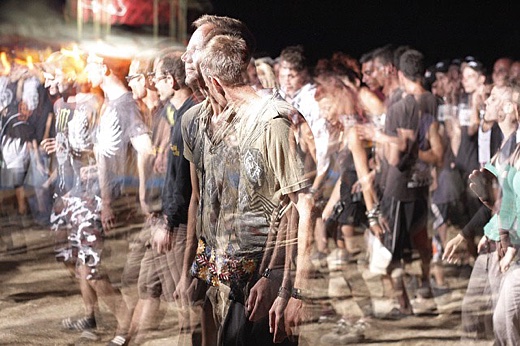

Image above: Photo illustration of white crowd. From original article.

The latest manifestation of white Americans' open racial animosity, from the election of President Donald Trump to the recent violence in Charlottesville and the emboldened rhetoric of white nationalists since then, suggests continued anxiety that research indicates is grounded in an overriding fear of non-whites.

But new data show that fear is irrational.

While white people tend to feel safer when they dominate the population, and feel threatened by the visible presence of other races, they actually are safer in racially diverse communities.

Trump's voters -- nearly 90 percent of whom are white and average $72,000 in median family income -- were often motivated by anxiety over increasing diversity and "racial resentment," especially toward "illegal" immigrants. Trump stoked his constituents' fears associating immigrants with violence and drugs, claiming they kill "innocent American(s)" abetted by liberal, immigrant-friendly sanctuary cities that "breed crime."

Trump's demagoguery resonates because it comes amid one of the most dramatic public health declines on record: the fall in recent decades of middle-aged whites' from America's safest demographic to its most endangered today.

From 1990 to 2015, deaths of whites 40-64 from drug overdoses rose from 3,000 to 22,000, suicides rose from 9,000 to 19,000, and total violent deaths rose from 24,000 to 58,000.

According to Princeton University economist Angus Deaton, there is correlative evidence that Donald Trump is doing very well in the same areas that are hardest hit by this decline. "…I think it is pretty clear that Mr. Trump has locked into this group of people who are feeling a lot of distress one way or another," Deaton said in an interview with Politico.

They are stressing, overdosing, and dying violently at rates surpassing less-advantaged non-white, younger, and poorer cohorts. And their worst death trends and levels are in predominantly white communities.

Centers for Disease Control mortality data show that whites are actually safer in racially diverse areas -- not only from violent deaths in general but specifically from guns, drugs, and suicides.


Image above: Chart of violent deaths in various percentages of whites and other races. Source is Center for Disease Control 2015 data from 3,097 counties on homicides, suicides, accidents and overdoses. From original article.

There's irony in many Americans' long association of danger with mean downtown streets, and their association of safety with leafy suburban cul-de-sacs and rural lanes.

Consider the city Trump and others often identify with rampant violence: Chicago. It is true that African Americans and Latinos have high homicide rates in the city and surrounding Cook County. However, whites there are much safer, with homicide rates less than half the national average.

The same is especially true of whites in New York City, Los Angeles, San Francisco, Washington, D.C., Philadelphia, Seattle, Columbus, and other large "sanctuary cities," where local policies seek to shield immigrants from federal persecution. whites living in and around diverse sanctuary cities are substantially less likely to die from violent death than anywhere else.

Fear-based white flight from "dangerous" cities to the "safety" of suburbs and small towns -- as their urban cores and schools became more racially diverse -- actually increased the odds that whites who fled would die violently.

Conservative politics of white-dominated areas seems to play a role.

The white-safety-in-white-numbers myth can be seen as emanating from a narrative of racial superiority.

A 2016 study found whites "living in racially isolated communities with worse health outcomes" is "one of the strongest predictors of Trump support." Isolation reinforces the sense of white grievance and siege mentality connected to high levels of racial anxiety many Trump voters seem to feel.

Deaton refers to this wave of grievance and anxiety as "white rage." It manifests in various reactions, he says, from support for far-right political candidates to "deaths of despair."

As middle-aged whites, stressed by socio-economic challenges, were most in need of health care such as mental health counseling, domestic violence and addiction services, budget cuts fueled by conservatives' anti-tax, anti-government politics were slashing these programs. These cuts not only eliminated vital services in predominantly White rural conservative places, they muted local alarms of just how serious White distress was becoming.

Conversely, the more progressive voting patterns of racially diverse, mostly urban residents sustained many vital services that may have helped mitigate the opiate and suicide epidemics in places like New York City and coastal California. Those whites more comfortable among diverse populations also may be less vulnerable to stresses over changing racial demographics. In New York City and urban California, for example, whites have had more time to adjust to their growing minority status.

And there's this. The white-safety-in-white-numbers myth can be seen as emanating from a narrative of racial superiority: whites are safer around other whites than around people of color because whites are better people.

Facts to the contrary may not change self-flattering prejudices. But, over time, mundane pocketbook issues might. A New York Federal Reserve Bank analysis shows the most robust economic futures lie in " areas that are less residentially segregated by race or income," favoring higher-quality schools and community cohesion.

Of course, continued analysis of the new violent deaths data is required. But, during this time of confronting whites' fears, it helps to understand that moving toward communities of diversity, integration, and multicultural environments -- and the progressive social policies that often accompany them -- may benefit whites in terms of both actual physical safety and economic well-being.

This piece was reprinted by Truthout with permission or license. It may not be reproduced in any form without permission or license from the source.

See also:
White Supremacy in the Age of Trump By Keri Leigh Merritt

• Mike Males is a senior researcher at the Center on Juvenile and Criminal Justice, San Francisco, and content director for YouthFacts.org. He taught sociology at the University of California, Santa Cruz, and has authored numerous journal articles, op-eds and four books on youth issues. He can be reached at mmales@earthlink.net.

.

Trouble with the King's english

SUBHEAD: What ever language you speak should be spoken with some mastery and art. 

By Juan Wilson on 2 November 2015 for Island Breaeth -
(http://www.countercurrents.org/irwin021115.htm)


Image above: Graphic for Cab Calloway's "Are You Hip to the Jive" record set with 22 tracks.  From (http://region5.herbzinser08.com/dir/index.php/blog28/hydrocarbon-gasoline-asks-carbon-black).

I read the two articles below this morning with some amusement. Jerome Irwin and James Kunstler are both correct in thinking that using English without some mastery of grammar, vocabulary and pronunciation leads to weakened ability to communicate as well as think clearly. In Irwin's example it is the drunken slur of Australian whites, and in Kunslter's case it is the jive street talk of American blacks.

The mastery out English language leads to higher education, professional accreditation, solid employment. The lack thereof leads not only to fuzzy thinking, but poverty.

However, neither Irwin or Kunstler address issue of any cultural or social advantages to those populations that speak a dialect. Nor due they evaluate in any depth the culture identity of those who speak a dialect. Both the Briritish whites originally exiled to Australia and the African blacks brought to slavery in America have been   "associated with "violent criminality and other anti-social behaviors."

Both the Australian criminals and African blacks had a reason to have their own "secret" language.

Another point not mentioned is that other languages than English describe other realities for other cultures. Those who identify as Americans here in Hawaii often complain about Pigeon English spoken by Polynesians and their descendants.

A bit like Spanglish,  Pigeon English is a mixture of English and another language - here in Hawaii that language would be Hawaiian.

The Hawaiian culture was one carried by the spoken word - without a written language.  It was a rich culture that mastered sailing the Pacific Ocean a millennium before English the speaking British and Americans.

That meant that all their culture as well as technology was carried through the spoken word - navigation, engineering, agricultural practice, etc. The Polynesians thrived on the Pacific Ocean islands for centuries without bringing on the level of destruction we see today.

The little I know of the Hawaiian language has shown me that every word seems to have several meanings even in context, thus mixing the profane with the spiritual and the serious with the amusing.

It does pay to know your own language and speak it with some mastery and art.


Linguistic Attack In Australia

SUBHEAD: Linguistic and Cultural Diversity Under Attack in Australia

By Jerome Irwin on 2 November 201 for Counter Culture -
(http://www.countercurrents.org/irwin021115.htm)

Dean Frenkel – a singer, voice coach and public speaking-communication lecturer at Melbourne Australia’s Victoria University – is on the hot seat for a controversial theory he recently put forth (“Australia, we need to talk about the way we speak”, The Age, October 26th, 2015).

The gist of Frenkel’s theory is that the by now infamous “G’Day Mate” drawl, that has come to embody the essence of Australian culture, is actually nothing more than a ‘lazy’ accent caused by the ‘alcoholic state’ of Australia’s heavy rum-drinking early settlers who regularly got drunk together on their new-found Down Under continent.

According to the laments of Frenkel, this original drunk-induced linguistic trait has since been passed down from generation to generation by all those descendants who, whether drunk or sober, have unknowingly added an alcoholic slur to the fact that they only use two-thirds of their mouth to speak and hence has become part of the Aussie national speech pattern.

Frankel contends that consequent sweeping effects have occurred as a result: poor communications is evident among all sectors of Australian society; a gaping hole in rhetorical training has been created in the Australian educational system; a subsequent diminishment has occurred in critical thought-processes, problem-solving, judgment and poor speech skills that have led to a lack of confidence and the internalization of emotions and thoughts that have contributed to difficulties in relationships, loneliness and stalled development.

In short, Frenkel’s theories hold that Australia’s linguistic accents, moulded by booze, have led to a general inarticulateness among the people as a result.

By contrast, Frenkel holds up the example of the ancient history of Australia’s aboriginal peoples spoken word and storytelling abilities that otherwise artfully uses rhetoric as an integral part of the recounting of the Australian Dreamtime to pass on to each generation their special spiritual and survival knowledge.

He contends that Australia’s western-centric civilization has instead created a “dumbing down” of speech in Australia that has “created holes in our education system that reflects holes in our culture.” Frankel declares, “Australia, It is time to take our beer goggles off. It’s no longer acceptable to be smarter than we sound.”

Yet whether Frenkel, as essentially a singer and voice coach, is qualified to theorize on such sweeping historical-sociological-psychological matters is a bone of contention.

In 2011, Aidan Wilson, a PHD graduate student at the University of Melbourne, challenged Frenkel’s qualifications to assess Australian politician’s qualities based upon their accents (“Beware of speech experts bearing science”, Crikey, Nov 2, 2011 & Oct 29th, 2015). At the time, this spawned a language blog debate between the two. (“A Reply from Dean Frenkel”, Crikey, Nov 7th, 2011).

Yet a far more important question exists behind such professed theories.

Is the ultimate objective in Australia, or wherever else in the world, to eventually get the entire world’s populace to speak in some uniform, standardized, sanitized “General Australian”, “General American”, or “General Whatever” way?

The obvious continuing mass disappearances of regional accents worldwide, and the negative attitudes of lower social class status and inferior traits that are often attributed to regional accents, symbolize what is a constant attempt by certain controlling forces in the world who are intent upon constantly reducing or utterly eliminating all such cultural human uniqueness or biological diversity on the planet.

During the 19th & 20th centuries, in Australia in particular, the attempt was made by still others to perpetuate an inferior cultural mentality in the people in relationship to their original British origins. Those who ever attempted to excel in whatever endeavour were shown resentment or ridicule with such pejorative terms as, “stop trying to be a tall poppy” or “you’re just another Plastic Brit.”

From the very beginning of the literary arts, Australian writers were decried as mere plagiarists of some Rudyard Kipling or Robbie Burns.

In 1950, A.A. Phillips, the Melbourne critic and social commentator, coined the term “cultural cringe” to describe the post-colonial literary arts in Australia as being deficient when compared to the work of their British and European counterparts.

Back then, Australia was being made out to be synonymous with failure, just as theorists like Frenkel now attempt to reduce Australian’s speech patterns down to the level of the hard-drinking drunkards of Australia’s early colonial days.

Apparently, as some would have us believe, the only way that Australian’s now can build themselves up in the eyes of the world, and especially in the ears of elocution experts like Frenkel who speak the British mother tongue, is to learn to pronounce proper “King’s English”. Is the intended net effect to encourage Australian’s to once again redefine their cultural heritage not only as convict stained but now as drunken stained?


Good Little Maoists

SUBHEAD:American education does not put enough emphasis on teaching standard spoken English.

By James Kunstler on 2 November 2015 for Kunstler.com - 
(http://kunstler.com/clusterfuck-nation/good-little-maoists/)


Image above: From ().

ometimes societies just go batshit crazy. For ten years, 1966 to 1976, China slid into the chaotic maw of Mao Zedong’s “cultural revolution.” 

A youth army called the Red Guard was given license to terrorize authorities all over the nation — teachers, scientists, government officials, really just about anyone in charge of anything. They destroyed lives and families and killed quite a few of their victims. 

They paralyzed the country with their persecutions against “bourgeois elements” and “capitalist roaders,” reaching as deep into the top leadership as Deng Xiaoping, who was paraded in public wearing a dunce-cap, but eventually was able to put an end to all the insanity after Mao’s death.

America’s own cultural revolution has worked differently. It was mostly limited to the hermetically-sealed hot-house world of the universities, where new species of hierophants and mystagogues were busy constructing a crypto-political dogma aimed at redefining status arrangements among the various diverse ethnic and sexual “multi-cultures” of the land.

There is no American Mao, but there are millions of good little Maoists all over America bent on persecuting anyone who departs from a party line that now dominates the bubble of campus life. It’s a weird home-grown mixture of Puritan witch-hunting, racial paranoia, and sexual hysteria, and it comes loaded with a lexicon of jargon — “micro-aggression,” “trigger warnings,” “speech codes,” etc — designed to enforce uniformity in thinking, and to punish departures from it.

At a moment in history when the US is beset by epochal problems of economy, energy, ecology, and foreign relations, campus life is preoccupied with handwringing over the hurt feelings of every imaginable ethnic and sexual group and just as earnestly with the suppression of ideological trespassers who don’t go along with the program of exorcisms. 

A comprehensive history of this unfortunate campaign has yet to be written, but by the time it is, higher education may lie in ruins. It is already burdened and beset by the unintended consequences of the financial racketeering so pervasive across American life these days. But in promoting the official suppression of ideas, it is really committing intellectual suicide, disgracing its mission to civilized life.

I had my own brush with this evil empire last week when I gave a talk at Boston College, a general briefing on the progress of long emergency. The audience was sparse. It was pouring rain. The World Series was on TV. People are not so interested in these issues since the Federal Reserve saved the world with free money, and what I had to say did not include anything on race, gender, and white privilege.

However, after the talk, I went out for dinner with four faculty members and one friend-of-faculty. Three of them were English profs. One was an urban planner and one was an ecology prof. All of the English profs were specialists in race, gender, and privilege. Imagine that. You’d think that the college was a little overloaded there, but it speaks for the current academic obsessive-compulsive neurosis with these matters. 

Anyway, on the way to restaurant I was chatting in the car with one of the English profs about a particular angle on race, since this was his focus and he tended to view things through that lens. The discussion continued at the dinner table and this is what ensued on the Internet (an email to me the next morning):  On Oct 29, 2015, at 4:37 PM, Rhonda Frederick wrote:


Jim—
This is what I posted on my social medias, am sharing with you and your agent.

Yesterday, novelist/journalist James Howard Kunstler was invited to give a talk at BC (see his bio at http://www.bc.edu/offices/lowellhs/calendar.html#1028).

At the post-talk dinner, he said “the great problem facing African Americans is that they aren’t taught proper English, and that … academics are too preoccupied with privilege and political correctness to admit this obvious fact.”

No black people (I presume he used “African American” when he meant “black”) were present at the dinner. I was not at the dinner, but two of my friends/colleagues were; I trust their recollections implicitly.

Whether Kunstler was using stereotypes about black people to be provocative, or whether he believed the ignorance he spouted, my response is the same: I cannot allow this kind of ignorance into my space and I am not the one to cast what he said as a “teachable moment.” I do think there should be a BC response to this, as the university paid his honorarium and for his meal.

Here’s some contact information for anyone interested in sharing your thoughts on how BC should spend its money:

Lowell Humanities Series at Boston College (http://www.bc.edu/offices/lowellhs/about.html)


Rhonda—

That is not quite what I said.

I said that teaching black Americans how to speak English correctly ought to be the most important mission of primary and secondary education for blacks in order for them to function successfully in our economy. Moreover, I said that anyone mounting an argument against this was hurting the very people they pretend to help.

I stand by those statements.

Your attempt at Stalinist thought policing is emblematic of something terribly wrong in higher education, especially since you were not present.

James Howard Kunstler
“It’s All Good”


So I was subjected to attempted character assassination via social media by this Rhonda Frederick person — faculty or student, she did not say — who admits to not having been present at the incident in question. This is the new fashion in academia: slander by Twitter and Facebook. It is fully supported by the faculty and administration. While they have been super-busy constructing speech codes and sex protocols, it seems they haven’t had any time for establishing ethical norms in the use of the Internet. 

As it happened, I offered to come back and publically debate my statements about the benefits of teaching spoken English to black primary and secondary students — they’d have to pay me, of course — but received no reply on that from Rhonda Frederick. I also received no reply from James Smith (smithbt@bc.edu), director of the Lowell Lecture Series, when I emailed my objection to being vilified on the Web by his colleague.

Now, as to the substance of what I said to this table of college professors. I’ve written before in books and blogs about the issue of spoken English and the black underclass, but for the record I will try to summarize some of my thoughts about it (trigger warning).

True, there are various dialects of English among us, but it must be obvious that they have different merits and disadvantages. There is such a thing as standard grammatical English. It evolves over generations, for sure, but it shows a certain conservative stability, like the rule of law. It tends to be spoken by educated people and by people in authority. 

This implies people in power, of course, people who run things, but also people at large in the professions (medicine, engineering, etc.) and the arenas of business and government. Standard grammatical English tends to be higher status because competence in it tends to confer the benefits of higher living standards.

It also must be self-evident that there is such a thing as a black English dialect in America. With perhaps a few lingering regional differences, it is remarkably uniform from Miami, Florida, to Rochester, New York, to Fresno, California. It prevails among the so-called black underclass, the cohort that continues to struggle economically. 

Despite its verve and inventiveness, this black dialect tends to confer low status and lower standards of living on those who speak it. In popular mythology and culture, it is associated with violent criminality and other anti-social behaviors. If you don’t believe this, turn on HBO sometime.

I argue that black people who seek to succeed socially and economically would benefit from learning to speak standard grammatical English, not solely because it is associated with higher status and living standards, but because proficiency with grammar, tenses, and a rich vocabulary helps people think better. 

After all, if you employ only the present tense in all your doings and dealings, how would you truly understand the difference between now, tomorrow, and yesterday? I submit that it becomes problematical. You may not be able to show up on time, among other things.

Some of my auditors have argued that “code switching” allows black Americans to easily turn back and forth for convenience between two modes of speech, black and “white” (i.e standard grammatical English). I’d argue that this is not as common as it is made out to be. 

Not everybody has the skill of entertainer Dave Chapelle, a master amateur linguist (whose parents were both college professors).

It’s my opinion that American primary and secondary education does not put enough emphasis on teaching standard spoken English to those deficient in it. The pedagogues have been hectored and browbeaten by the hierophants in higher ed not to press the matter. It is not regarded as important (probably because the task seems too painful and embarrassing and may hurt some feelings). The results are plain to see: academic failure among black Americans. (Not total but broad.) 

Instead, we concoct endless excuses to explain this failure and the related economic failures, the favorite by far being “structural racism” (despite having elected a black president who speaks standard grammatical English).

Now to the touchier question as to why this is. After all, other ethnic groups in America are eager to fully participate in the national life. For example, I gave a talk to a large honors freshman class at Rutgers University a year ago. 

Due to the current demographics of New Jersey, the class was overwhelming composed of Indian (Asian, that is) youngsters, many of them as dark-skinned as Americans of African ancestry. They had uniformly opted to speak standard grammatical English. 

They were all succeeding academically (it was an honors class, after all). They were on a trajectory to succeed in adult life. What does this suggest? To me it says that maybe some behavioral choices are better than others and the color of your skin is not the primary determinant in the matter.

Here’s what I think has happened to get us where we are today (second trigger warning). I think the civil rights victories of the mid 1960s generated enormous anxiety among black Americans, who were thereby invited to participate more fully in the national life after many generations of hardship and abuse. (If you argue that this was not the sum, substance, and intention of the Voting Rights Act and Public Accommodations Act of 1964-65, then you are being disingenuous.) 

However, they were not comfortable with the prospect of assimilating into the mainstream culture of the day. They either didn’t believe in it, or feared it, or despised it, or worried about being able to perform in it.

Many would attribute this anxiety to the legacy of slavery. Can a people get over a particular historical injury? American blacks are not the only group traumatized by circumstance. 

When do you decide to move forward? Or do you nurse a grievance forever? Anyway, it was not a coincidence that in the mid 1960s a new wave of black separatist avatars arose around the time of the civil rights legislative victories. Malcolm X, Stokely Charmichael, the Black Panthers, to name a few. 

That was the moment when much of the black population slid into what has become essentially an oppositional culture, determined to remain separate. Language is part of that picture.

The diversity cult of the day is a smokescreen to disguise this fundamental fact of American life: much of black America has simply opted out. They don’t want to assimilate into a common culture — so common culture has been deemed dispensable by the confounded keepers of the common culture’s flame, the university faculty. 

Much of black America doesn’t want to play along with the speech, manners, rules, or laws of whatever remains of that common culture after its systematic disassembly by the professors, the deans, and their handmaidens in progressive politics — heedless of the damage to the basic social contract. We remain very much a house divided, as Lincoln put it, and he could see clearly what the consequences would be.

Is it racist to try to air these abiding quandaries in the public arena? Apparently so. And why is that? Because of the awful embarrassment of political progressives over the disappointing outcome of the civil rights project. 

Black news pundits such as Charles Blow of The New York Times constantly call for “an honest conversation about race,” but they don’t mean it. Any public intellectual who ventures to start that conversation is automatically branded a racist. 

Hey, I couldn’t even have a conversation at a private dinner on the merits of speaking standard English with three college professors whose life-work centers on race. They had a melt-down and used a proxy (who wasn’t even there) to slander me on the Internet.

They are cowards and I am their enemy.
.

The War Comes Home

SUBHEAD: A Five-Step guide to the police repression of protest from Ferguson to Baltimore and beyond.

Intro by Tom Engelhard on 5 May 2015 for Tom Dispatch -
(http://www.tomdispatch.com/post/175991/tomgram%3A_michael_gould-wartofsky%2C_the_new_age_of_counterinsurgency_policing/)


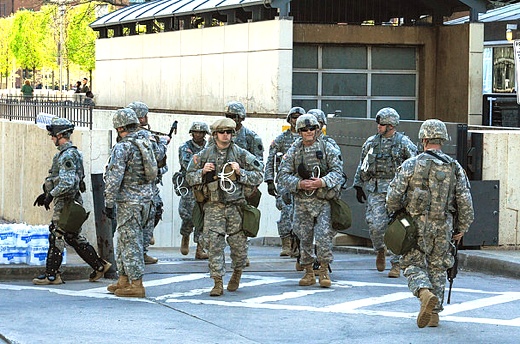
Image above: Maryland National Guard. Members of the Maryland National Guard’s 175th Infantry Regiment patrol on East Pratt Street at the Inner Harbor to protect Baltimore citizens April 28, 2015. After a violent gathering the previous night, Governor Larry Hogan issued a state of emergency and activated the National Guard. Photo credit: Staff Sgt. Michael Davis Jr., Maryland National Guard Public Affairs Office. From (http://worldnewstrust.com/the-wars-come-home-michael-gould-wartofsky).

Introduction by Tom Engelhard on 5 May 2015 for Tom Dispatch - 

In the part of Baltimore hardest hit by the recent riots and arson, more than a third of families live in poverty, median income is $24,000, the unemployment rate is over 50%, some areas burnt out in the riots of 1968 have never been rebuilt, incarceration rates are sky high, 33% of the homes are vacant (thanks to an ongoing foreclosure crisis), and water service is being shut off for people who can’t afford to pay rising water rates.  Residents, mainly black, live in what is really an unofficially segregated, hollowed-out Rust Belt city that just happens to be located on the East Coast.

As Max Blumenthal pointed out when the city’s mayor started denouncing “outside agitators,” more than 70% of Baltimore’s police force lives beyond the city limits, at least 10% of them out-of-state.

The Baltimore PD is also notorious for its brutality, for the numbers of (black) residents it seems to gun down, and for its give-not-an-inch “broken windows” policing policies.  In a city that is 62% black and 28% white, police officers are still 46% white and 80% outsiders heading into neighborhoods that are almost totally black.  Unlike the residents of such neighborhoods, Baltimore’s police lack for little.

Thanks in part to Pentagon and other government programs, the force is armed to the teeth in the increasingly military fashion that has become the post-9/11 state of things (and that TomDispatch has been covering since 2004.)  It acts as if it were, that is, an occupying army, not a neighborhood protector.  In this sense, “community policing” is now a joke in the U.S.

When the CVS stores go up in flames and local stores are looted, politicians denounce what’s happened and demand an instant return to law and order, while calling on police departments to wear body cameras and rethink their attitudes.  But there’s another reality that has to be faced.  Give some credit to Hillary Clinton.

In her recent speech on the police killings of black men from Ferguson to Baltimore, she included this single on-the-mark sentence: “We can start [building on what works] by making sure that federal funds for state and local law enforcement are used to bolster best practices, rather than to buy weapons of war that have no place on our streets.”

 Put another way, you can’t arm and militarize the police, as both the Pentagon and the Department of Homeland Security have been doing since 9/11, and send them into impoverished communities as if for war, sporting a mind-set from the global war on terror, without getting what you’ve functionally wished for.  In a sense, in the arms race that is America today, you might say that you are what you “carry.”

Among the illusions of our age, there’s this: the idea that the U.S. can fight wars in whatever fashion it pleases, year after year, in distant lands without changing our society as well.  In fact, those wars have been coming home for a long time in myriad ways, and never more obviously than with American police forces and their practices.

It’s not just that the police (and SWAT units) are now filled with vets from the war on terror, or that they are armed with weaponry directly off its battlefields, but that the mentality that has made those wars such disasters has come home with the troops and weaponry.

As Michael Gould-Wartofsky, author of the new book The Occupiers: The Making of the 99 Percent Movement, suggests, thoroughly militarized, surveillance-heavy forces are bringing counterinsurgency thinking from Iraq and Afghanistan back to this country.  The record of such thinking abroad brings to mind a question first raised by State Department whistleblower Peter Van Buren about Washington’s new war in Iraq: What could possibly go wrong?


The Wars Come Home


By Michael Gould-Wartofsky on 5 May 2015 or Tom Dispatch -
 
Last week, as Baltimore braced for renewed protests over the death of Freddie Gray, the Baltimore Police Department (BPD) prepared for battle. With state-of-the-art surveillance of local teenagers’ Twitter feeds, law enforcement had learned that a group of high school students was planning to march on the Mondawmin Mall. In response, the BPD did what any self-respecting police department in post-9/11 America would do: it declared war on the protesters.

Over the course of 24 hours, which would see economically devastated parts of Baltimore erupt in open rebellion, city and state police would deploy everything from a drone and a “military counter attack vehicle” known as a Bearcat to SWAT teams armed with assault rifles, shotguns loaded with lead pellets, barricade projectiles filled with tear gas, and military-style smoke grenades.

The BPD also came equipped with “Hailstorm” or “Stingray” technology, developed in America’s distant war zones to conduct wireless surveillance of enemy communications.  This would allow officers to force cell phones to connect to it, to collect mobile data, and to jam cell signals within a one-mile radius.

“Up and down the East Coast since 9/11, our region has armed itself for that type of emergency,” said Baltimore Mayor Stephanie Rawlings-Blake.  She was defending her police department’s acquisition of this type of military technology under the Department of Defense’s now infamous 1033 Program.

It sends used weaponry and other equipment from the battlefields of the country’s global war on terror directly to local police departments across the country. “But it’s very unusual,” Mayor Rawlings-Blake added, “that it would be used against your own citizens.”

It is, in fact, no longer unusual but predictable for peacefully protesting citizens to face military-grade weaponry and paramilitary-style tactics, as the counterinsurgency school of protest policing has become the new normal in our homeland security state. Its techniques and technologies have come a long way in the years since Occupy Wall Street (and even in the months since the first protests kicked off in response to the killing of Michael Brown in Ferguson, Missouri).

Here, then, is a step-by-step guide, based on the latest developments in the security sector, on how to police a protest movement in the new age of domestic counterinsurgency.

1. Equate Dissidents With Domestic Terrorists.
Since 2012, law enforcement and intelligence agencies have repeatedly sought to link street activism with domestic terrorism and radical activists to “violent extremists.”

For instance, one memo from the Department of Homeland Security (DHS) Office of Intelligence and Analysis attempted to tie events in Ferguson last year to recruitment efforts by the Islamic State in Iraq and Syria (ISIS): “Although at this time, violence in Ferguson has largely subsided... radical Islamists [have] used social media to urge others... to conduct Jihad.” A separate arm of DHS, the Threat Management Division, issued an ominous warning around the same time:

“Currently there is no indication that protests are expected to become violent. However, current civil unrest associated with the incident in Ferguson, MO, presents the potential for civil disobedience... Absent a specific actionable threat, you should refer to the list of suspicious activity indicators in identifying and mitigating threats. Some of these behavioral indicators may be constitutionally protected activities.”

Earlier this year, amid the fallout from the refusal of a grand jury to indict a police officer in the Eric Garner “chokehold” death, New York City Police Department (NYPD) Commissioner Bill Bratton proposed the creation of a new special ops unit he called the Strategic Response Group.  It was to be “designed for dealing with events like our recent protests, or incidents like Mumbai or what just happened in Paris.”

The group would be “equipped and trained in ways that our normal patrol officers are not,” and outfitted “with the long rifles and machine guns.” Though Bratton, facing a public outcry, later walked his statement back, his conflation of events involving unarmed protesters and armed militants was clearly no coincidence.

In recent years, the war on dissent has hit ever closer to home, with police departments importing some of the practices first pioneered in counterterrorism operations overseas.

One of these is the use of “black sites” for the temporary disappearance and detention of political dissidents. Anti-war activists learned this lesson firsthand during May 2012 protests against the North American Treaty Organization (NATO) Summit in Chicago, when nine demonstrators were arrested by the police and transported to a warehouse in Homan Square.

Three would be held incommunicado for nearly 24 hours, shackled to a bench and kept in a wire cage before being charged with material support for terrorism, conspiracy to commit terrorism, and possession of incendiary devices -- devices constructed with the assistance of undercover officers in what turned out to be an elaborate act of entrapment in the run-up to the NATO Summit.

2. Arm the Police With “Less-Lethal” Weapons (which can actually create more lethal situations).
Under the 1033 Program, more than 460,000 pieces of “controlled property” -- that is, military-grade weaponry and other equipment -- have been transferred from the Pentagon to local police departments since 1997. That includes 92,442 small arms, 44,275 night-vision devices, 5,235 light armored cars, 617 tank-like vehicles, and some 616 aircraft. More than 78,000 such transfers were reported for 2013 alone.

As the White House admitted in a recent report, programs like 1033 “do not necessarily foster or require civil rights/civil liberties training,” and “generally lack mechanisms to hold [law enforcement] accountable for the misuse or misapplication of equipment.”

The DHS has an even more expansive mandate to deliver the militarized goods to local law enforcement by way of its Homeland Security Grant Program (HSGP). In 2014 alone, the HSGP gave out over $1 billion in grant funding, with special provisions for “high-threat, high-density urban areas.” The list of DHS-authorized equipment provided to local police departments includes everything from Bearcats and helicopters to battle dress uniforms, body armor, ballistic helmets, and shields.

Other agencies, like the Bureau of Justice Assistance (the funding arm of the Department of Justice), dole out hundreds of millions of dollars annually to police departments -- about 10% of which goes toward controlled equipment like armored vehicles, explosive devices, firearms, and “less-lethal” weapons like tear gas and TASERs.

This scenario has made for some lucrative investment opportunities. In the wake of the Baltimore riots, TASER International has seen its stock price spike.  One market report noted that as “unrest spreads [and] as these issues continue to boil to the surface, investors are betting that will lead to more sales and profits.”

After all, the market for less-lethal weapons alone is expected to more than double in the next five years, while the broader market for what are now called “homeland security products” is projected to grow to more than $107 billion by the year 2020.

Today, private arms developers are perfecting a new generation of “less-lethal” weapons: that is, weapons designed to incapacitate their targets but with a lower likelihood of fatalities. The latest model is known as the “Bozo bullet” for reportedly looking like a clown’s nose, and is currently undergoing its first test run in -- you guessed it -- Ferguson.

 It would allow the police to repurpose their service weapons at will, docking the “Bozo” on the barrel of a normal handgun to deliver a “less-lethal” payload. But critics argue that, by disarming the ordinary bullet of its psychological impact, such equipment will encourage police officers to reach for their guns more quickly and so serve to make the use of force more likely.

Meanwhile, peace officers in the thick of recent protests seem to be reaching for those guns ever more quickly, no matter how lethal the payload. At a December demonstration in downtown Oakland, California, an undercover officer was, for instance, photographed pointing a pistol at unarmed demonstrators. At a February march in Manhattan, a Port Authority officer was caught on video cocking a shotgun and asking protesters, “Are you scared?”

In Los Angeles last summer, an officer with the Federal Protective Service, an agency of the Department of Homeland Security tasked with policing federal government facilities, admitted to actually opening fire with a handgun on a truck full of pro-Palestinian protesters.

3. Wage Wave Warfare.
Long-range acoustic devices (LRADs), also known as “sound cannons,” have been on American streets in times of protest since the Republican National Convention in 2004. Though the machine is capable of transmitting tones that can cause excruciating pain, until recently, its use against civilians had been limited to communicating police orders at a distance.

That changed last year, when the LRAD’s “sound deterrent feature” -- originally designed for military use against “enemy combatants” in the Persian Gulf -- was deployed as an “area denial device” against protesters, first in the streets of Ferguson, then in the streets of Manhattan.

The sound cannon works as a form of wave warfare, concentrating and directing acoustic energy at a volume of up to 152 decibels. Even the NYPD’s own Disorder Control Unit has acknowledged that it can “propel piercing sound at higher levels than are considered safe to human ears.” It can also cause those subjected to it permanent hearing damage.

And this is just considered a beginning in what might be thought of as the domestic sensory wars.  Novel forms of wave warfare are currently under development by the Pentagon’s Joint Non-Lethal Weapons Program.

One such innovation, known as “Active Denial Technology,” works much like a microwave oven -- with the waves directed at the skin of a target to produce an “intolerable heating sensation.” A more portable version of this technology, branded the Assault Intervention System and sold by defense contractor Raytheon, has already been made available for domestic deployment in Los Angeles County.

Another innovation, known as “Skunk,” is a type of stink bomb that has been described by those in the know as an irresistible combination of “dead animal and human excrement.” In response to recent urban uprisings, police departments across the country are reported to be eagerly stockpiling the stuff.

“We’ve provided some Skunk for the law enforcement agencies in Ferguson,” says Stephen Rust, program manager at a Maryland-based company that manufactures the malodorant. “I’m going to be able to drill [a target] with a round while I put him in the dirt. I can mark him with Skunk and he will be easy to locate when the crowd disperses.”

4. Replace Humans with Robots and Predictive Technology.
Increasingly, law enforcement is moving to replace human “deterrence” with robotic versions of the same -- remotely piloted aircraft, remotely operated vehicles, and other robotic platforms are to become domestic standbys in support of police surveillance missions and SWAT operations.

Such platforms have been deployed, on the ground and in the air domestically, to conduct routine surveillance of protest activity, while in other countries they are already being weaponized with pepper spray and other projectiles.

From 2012 to 2014, the Federal Aviation Administration considered requests from at least 19 police and sheriff’s departments, as well as National Guard units in nine states, to fly drones in domestic airspace. The Los Angeles Police Department (LAPD) recently acquired two Draganflyer X6 drones for use during large protests and other “tactical events.”

And while the NYPD has refused to release any documents on its own drone program, officials have stated that they are “supportive of the concept of drones, not only for police but for public safety in general,” and that they are currently looking into “what’s on the market, what’s available.”

Support for such surveillance is on the rise. DHS has made millions of dollars available annually for “forward-looking” police forces to procure the latest robotic systems, along with “software upgrades, engine upgrades, arms, drive systems, range extenders, trailers, etc.” Also included is “surveillance/detection” equipment in which drone technology may be integrated with audiovisual systems and with “optics capable of use in long-range, sometimes long-term, observation."

In recent years, a new frontier has opened up with the advent of “predictive policing” (or “PredPol,” in industry parlance), which aims to use big data and complex algorithms to forecast when and where a crime is likely to be committed, and who might be a likely culprit.

The practice started out as a project of the Army Research Office (a centralized science laboratory under the purview of the Pentagon), was converted to civilian use by Bill Bratton during his tenure as commissioner of the LAPD, and has since spread to over 150 departments nationwide.

Take the NYPD. In the immediate aftermath of the Occupy protests, the department entered into an unprecedented partnership with Microsoft to develop a predictive policing technology known as the Domain Awareness System. It “aggregates and analyzes existing public safety data streams in real time,” drawn from thousands of closed-circuit television cameras, license plate readers, and criminal history databases, and is intended to give intelligence analysts “a comprehensive view of potential threats.”

Though we don’t yet know the extent to which it has been deployed during protests, we do know that Domain Awareness Systems have been popping up in protest hubs around the country, including Baltimore, Chicago, and Oakland.

5. Make “Friends” and “Follow” People.
Considered “open source intelligence” (or “OSINT”), social media networks like Twitter, Facebook, Instagram, and YouTube have proven veritable gold mines for intelligence analysts attempting to track protest events in real time. They have also provided police detectives with a rationale to question individual protesters about their political activities.

Just last week, we learned that amid the protests in New York City following the acquittal of the officers who killed Eric Garner, at least 11 arrestees were interrogated in this manner prior to their release from police headquarters, including several who were asked explicitly about their online activities on social media sites.

As Deputy Commissioner Lawrence Byrne tells it, when detectives started seeing threats on social media, “The Detective Bureau began a process of interviewing defendants arrested during the protests... in an attempt to obtain information about the specific acts... as well as the general threat environment relating to such acts.”

Since 2012, the NYPD’s Intelligence Division has officially encouraged its employees to engage in “catfishing” on social media sites “for investigative or research purposes,” which, with the permission of police brass, may include “investigations involving political activity.” Increasingly, such catfishing has become common practice among police and private security forces nationwide.

In Bloomington, Minnesota, for example, intelligence analysts working for the Mall of America’s Risk Assessment and Mitigation unit and in conjunction with members of the local Joint Terrorism Task Force (a collaborative intelligence operation anchored by the FBI) reportedly used fake Facebook accounts to build dossiers on at least 10 area activists.

This was ahead of a protest on police accountability (or the lack of it) slated to take place on Mall of America property.

The Department of Homeland Security, for its part, continues to develop its Media Monitoring Capability to impressive effect, “leveraging news stories, media reports and postings on social media sites... for operationally relevant data, information, analysis, and imagery” including “partisan or agenda-driven sites” as well as those that “reflect adversely on DHS.”

Many of the nation’s “fusion centers,” set up in the aftermath of 9/11 to encourage collaboration among intelligence agencies, have partnered with social media sites to monitor Occupy-style activism. “Such websites can provide crucial information during civil unrest,” notes Dale Peet, a veteran of Michigan’s statewide fusion center and now an employee of SAS, a private firm that performs social media analytics for the state.

And that’s only a beginning when it comes to social media surveillance.  Its future is already being written in the labs of the Intelligence Advanced Research Projects Activity (IARPA), the national intelligence community’s blue-skies research arm. One recent project seeks to match online and offline “behavioral indicators,” including “ideology or worldview.”

Another extracts geolocation information from posts, photos, and videos that users might prefer to keep private. Yet another, known as Open Source Indicators, analyzes social media data to “anticipate and/or detect significant societal events, such as political crises [and] riots.” The project’s goal, in the words of its true believers, is ultimately to “beat the news,” giving the government new leverage over alleged enemies of the state.

What we are seeing in the dark corners of cyberspace is of a piece with what we are seeing in the streets of our cities: the leading edge of a new age of domestic counterinsurgency. From black sites to Bearcats, sound cannons to stink bombs, drones to data mining, the component parts of a new police counterinsurgency program are being assembled with remarkable speed. While the basic architecture of this program has been in place ever since 9/11, it is being built up in new and ever more sophisticated ways.

The point of all of this: to keep an eye on our posts and tweets, intimidate protesters before they hit the streets, pen them in on those streets, and ensure that they pay a heavy price for exercising their right to assemble and speak. The message is loud and clear in twenty-first-century America: protest at your peril.

• Michael Gould-Wartofsky is the author of the new book, The Occupiers: The Making of the 99 Percent Movement (Oxford University Press). He is a PhD candidate in Sociology at New York University. His writing has appeared in the Washington Post, the Nation, Salon, and Jacobin, along with TomDispatch, and his research has been featured on PBS and NPR. To go to his website, click here. Follow him at @mgouldwartofsky.

.