Showing posts with label Rebellion. Show all posts

Defense contractors fought NoDAPL

SUBHEAD: DAPL Company hired "War on Terror" defense contractors to suppress Native American uprising.

By Lauren McCauley on 27 May 2017 for Common Dreams -
(https://www.commondreams.org/news/2017/05/27/dapl-company-hired-war-terror-contractors-suppress-native-uprising)
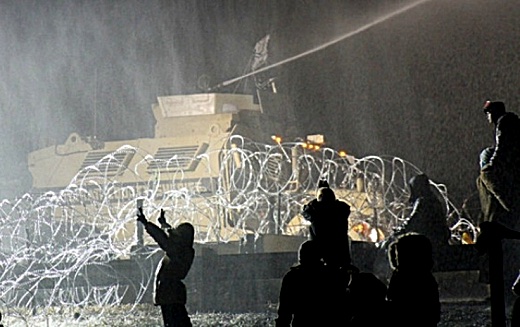

Image above:The Morton County Sheriff's Department deployed a military tank and sprayed peaceful protesters with a water cannon amid below-freezing temperatures on November 20, 2016. Photo byDark Sevier. From original article.

Leaked docs reveal the collusion between local police forces, pipeline company, and defense contractors as they executed 'military-style counterterrorism measures' to suppress the water protectors.

The years-long, Indigenous-led fight against the Dakota Access Pipeline (DAPL) briefly captured the nation's attention last fall as images of peaceful resisters being sprayed with water canons and surrounded by police in tanks and other military-grade equipment were spread widely, fueling global outrage and a fierce protest movement against the oil pipeline.

Now that the pipeline is operational and already leaking, internal documents obtained by The Intercept and reported on Saturday reveal the deep collusion between local police forces, the pipeline company, and defense contractors as they executed "military-style counterterrorism measures" to suppress the water protectors.

TigerSwan, described as a "shadowy international mercenary and security firm" that "originated as a U.S. military and State Department contractor helping to execute the global war on terror," was hired by Energy Transfer Partners to spearhead "a multifaceted private security operation characterized by sweeping and invasive surveillance of protesters," The Intercept wrote.

Reportedly, one of TigerSwan's contractors leaked 100 internal documents to reporters Alleen Brown, Will Parrish, and Alice Speri, who were able to assemble roughly 1,000 more via public records requests.

The trove paints a damning picture of the police response to the Indigenous-led effort to block construction of the pipeline on sacred, treaty land and is a shocking example of how anti-terrorist rhetoric and tactics could be applied to any uprising the government would like to suppress.
According to the reporting:
Internal TigerSwan communications describe the movement as "an ideologically driven insurgency with a strong religious component" and compare the anti-pipeline water protectors to jihadist fighters. One report, dated February 27, 2017, states that since the movement "generally followed the jihadist insurgency model while active, we can expect the individuals who fought for and supported it to follow a post-insurgency model after its collapse." Drawing comparisons with post-Soviet Afghanistan, the report warns, "While we can expect to see the continued spread of the anti-DAPL diaspora...aggressive intelligence preparation of the battlefield and active coordination between intelligence and security elements are now a proven method of defeating pipeline insurgencies."
"As policing continues to be militarized and state legislatures around the country pass laws criminalizing protest," Brown, Parrish, and Speri write, "the fact that a private security firm retained by a Fortune 500 oil and gas company coordinated its efforts with local, state, and federal law enforcement to undermine the protest movement has profoundly anti-democratic implications."

Indeed, in the wake of the 2016 election, Republican legislatures in at least 19 states introduced various anti-protest laws, many with a deliberate nod to the uprising in North Dakota.

Not only that, but Morton County Sheriff Kyle Kirchmeier, who oversaw the police response to the DAPL resistance, has been advising other law enforcement on how to deal with protests and demonstrations.

Indeed, the documents reportedly show that Energy Transfer Partners has "continued to retain TigerSwan," despite the fact that the anti-DAPL camps have disbanded. The security firm continues to produce so-called situation reports that document "the threat of growing activism around other pipeline projects across the country."

These reports include "intelligence on upcoming protests," information gleaned from social media, and "extensive evidence of aerial surveillance and radio eavesdropping, as well as infiltration of camps and activist circles."

In some cases, persons "of interest" were even tracked when they crossed over state lines.

What's more, the documents obtained via open records requests include "communications among agents from the FBI, the Department of Homeland Security, the U.S. Justice Department, the Marshals Service, and the Bureau of Indian Affairs, as well as state and local police," that reveals interagency collusion and information sharing on the anti-DAPL protesters.

Read the extensive reporting and several published documents at The Intercept.


.

No moderate rebels in Syria

SUBHEAD: Tulsi Gabbard has destroyed America's Deep State narrative on Syrian rebels and need for war.

By Michael Krieger on 28 February 2016 for Liberty Blitzkrieg -
(https://libertyblitzkrieg.com/2017/02/28/there-are-no-moderate-rebels-tulsi-gabbard-destroys-the-deep-states-syria-narrative/)


Image above: Photo of Tulsi Gabbard posing with Syrian women during her trip to that country. From (http://www.veteransnewsnow.com/2017/01/27/1013730-congresswoman-tulsi-gabbard-interviewed-after-her-trip-to-syria/).

Tulsi Gabbard has continued to impress ever since she came on the national scene last year with her courageous and very public support for Bernie Sanders in the rigged Democratic primary.

Most recently, shecontinued to demonstrate her knowledge of geopolitics and willingness to stand up to America’s unelected government, aka the Deep State, in a recent interview with CNN’s Jake Taper.

Note, the clip is about a month old, but important to watch if you haven’t. 


Video above: On 1/26/17 CNN’s Jake Tapper was crushed by Tulsi Gabbard, ‘Why is US supporting Al Qaeda? From (https://youtu.be/zE3jbbhB0eA).

If the Democrats have any hope of becoming a decent opposition party which not only resists the worst of Trump, but also rejects the perverted neoliberal/Deep State ideology currently embraced by establishment Dems, Tulsi Gabbard will have to play a key role.

As I highlighted in last February’s post, It’s Not Just the GOP – The Democratic Party is Also Imploding:

A rising star within the Democratic ranks, Rep. Tulsi Gabbard of Hawaii, cut herself off from the party’s establishment by resigning from her post as vice-chairman of the Democratic National Committee and endorsing Bernie Sanders for president.

Her position with the DNC required her to stay neutral in the primaries, but she said that “the stakes are too high.” She announced her decision on Sunday on NBC’s “Meet the Press,” and made a video where she explained her reasoning.

Gabbard, an Iraq war veteran, said she knows the cost of war firsthand. “I know how important it is that our commander-in-chief has the sound judgment required to know when to use America’s military power—and when not to use that power.”The importance of this move cannot be understated.

In no uncertain terms, this gesture publicly exposes the weakness of the “Clinton brand.” She clearly isn’t afraid of Hillary or of any repercussions from the Democratic Party elite, a fact that is underscored by the fact she came out with her endorsement after he got pummeled in South Carolina.
But let’s take a step back and think about this in the even bigger picture.

You don’t get to Congress by being a political imbecile. On the surface, this move looks like career suicide, particularly since Hillary is probably about to clinch the nomination. Recall, Rep. Gabbard didn’t merely endorse Sanders after a bruising loss in South Carolina, she stepped down from her official position with the DNC to do so.

This isn’t merely a statement, it’s the equivalent of dropping a neutron bomb on the Democratic establishment. So why did she do it?

While I think she genuinely agrees with Sanders on key issues, the reason she came out so aggressively is because she sees the writing on the wall. She’s playing the long game, and in the long game, Hillary Clinton represents a discredited and failed status quo, while Bernie Sanders represents a push toward the paradigm level change that will define the future.

When it comes to the Democrats, we need to see a lot less Pelosi and Schumer, and a lot more Gabbard.

See also:
Ea O Ka Aina: Ms Gabbard goes to Syria 1/29/17
Ea O Ka Aina: Tulsi and Bernie 3/11/16
Ea O Ka Aina: Gabbard endorses Sanders 2/29/16
Ea O Ka Aina: Tulsi Gabbard on Syria 11/1/15
Ea O Ka Aina: Tulsi Gabbard Interview 11/14/12

 .

California threat to cutoff $ to DC

SUBHEAD: State studying suspending money to Washington after Trump threatens sanctuary cities.

By Tyler Durden on 31 January 2017 for Zero Hedge -
(http://www.zerohedge.com/news/2017-01-28/california-threatens-cut-funds-washington)


Image above: Map of USA showing net donor states to federal revenue versus subsidized states. From original article.

[IB Publisher's note:  Map at bottom of article show the final Electoral College count. It is interesting to me that the Trump support came largely from states that are net receivers of federal tax dollars and the the states that went for Clinton are large net donor state to federal coffers. The "Clinton" states actually support the "Trump" states. Somewhere in there is a strategy for the future.]


With secession threats looming, the state of California is reportedly studying ways to suspend financial transfers to Washington after the Trump administration threatened to withhold federal money from sanctuary cities.

With California counties among the Top 10 who stand to lose tax-payer funding for providing sanctuary to illegal immigrants...


Image abovce: Chart of funds at risk in sanctuary cities. From original article.


KPIX5 reports that officials are looking for money that flows through Sacramento to the federal government that could be used to offset the potential loss of billions of dollars’ worth of federal funds if President Trump makes good on his threat to punish cities and states that don’t cooperate with federal agents’ requests to turn over undocumented immigrants, a senior government source in Sacramento said.

The federal funds pay for a variety of state and local programs from law enforcement to homeless shelters.
“California could very well become an organized non-payer,” said Willie Brown, Jr, a former speaker of the state Assembly in an interview recorded Friday for KPIX 5’s Sunday morning news.

“They could recommend non-compliance with the federal tax code.”
California is among a handful of so-called “donor states,” which pay more in taxes to the federal Treasury than they receive in government funding.


Image above: Map of USA showing final Electoral College results. From (http://www.businessinsider.com/final-electoral-college-map-trump-clinton-2016-11)


.

State Department seniors quit

SUBHEAD: Most of senior staff of US State Department quit Trump Administration.

By Josh Rogin on 26 January 2017 for Washington Post - 
(https://www.washingtonpost.com/news/josh-rogin/wp/2017/01/26/the-state-departments-entire-senior-management-team-just-resigned/)


Image above: Tillerson making a fist during his Senate committee hearing. From (https://www.thesun.co.uk/news/2713072/rex-tillerson-donald-trump-secretary-of-state-managers-quit-on-mass/).

Secretary of State Rex Tillerson’s job running the State Department just got considerably more difficult. The entire senior level of management officials resigned Wednesday, part of an ongoing mass exodus of senior foreign service officers who don’t want to stick around for the Trump era.

Tillerson was actually inside the State Department’s headquarters in Foggy Bottom on Wednesday, taking meetings and getting the lay of the land. I reported Wednesday morning that the Trump team was narrowing its search for his No. 2, and that it was looking to replace the State Department’s long-serving undersecretary for management, Patrick Kennedy. Kennedy, who has been in that job for nine years, was actively involved in the transition and was angling to keep that job under Tillerson, three State Department officials told me.

Then suddenly on Wednesday afternoon, Kennedy and three of his top officials resigned unexpectedly, four State Department officials confirmed.

Assistant Secretary of State for Administration Joyce Anne Barr, Assistant Secretary of State for Consular Affairs Michele Bond and Ambassador Gentry O. Smith, director of the Office of Foreign Missions, followed him out the door. All are career foreign service officers who have served under both Republican and Democratic administrations.

Kennedy will retire from the foreign service at the end of the month, officials said. The other officials could be given assignments elsewhere in the foreign service.

In addition, Assistant Secretary of State for Diplomatic Security Gregory Starr retired Jan. 20, and the director of the Bureau of Overseas Building Operations, Lydia Muniz, departed the same day. That amounts to a near-complete housecleaning of all the senior officials that deal with managing the State Department, its overseas posts and its people.

“It’s the single biggest simultaneous departure of institutional memory that anyone can remember, and that’s incredibly difficult to replicate,” said David Wade, who served as State Department chief of staff under Secretary of State John Kerry. “Department expertise in security, management, administrative and consular positions in particular are very difficult to replicate and particularly difficult to find in the private sector.”

Several senior foreign service officers in the State Department’s regional bureaus have also left their posts or resigned since the election. But the emptying of leadership in the management bureaus is more disruptive because those offices need to be led by people who know the department and have experience running its complicated bureaucracies. There’s no easy way to replace that via the private sector, said Wade.

“Diplomatic security, consular affairs, there’s just not a corollary that exists outside the department, and you can least afford a learning curve in these areas where issues can quickly become matters of life and death,” he said. “The muscle memory is critical. These retirements are a big loss. They leave a void. These are very difficult people to replace.”

Whether Kennedy left on his own volition or was pushed out by the incoming Trump team is a matter of dispute inside the department. Just days before he resigned, Kennedy was taking on more responsibility inside the department and working closely with the transition. His departure was a surprise to other State Department officials who were working with him.

One senior State Department official who responded to my requests for comment said that all the officials had previously submitted their letters of resignation, as was required for all positions that are appointed by the president and that require confirmation by the Senate, known as PAS positions.

“No officer accepts a PAS position with the expectation that it is unlimited. And all officers understand that the President may choose to replace them at any time,” this official said. “These officers have served admirably and well. Their departure offers a moment to consider their accomplishments and thank them for their service. These are the patterns and rhythms of the career service.”

Ambassador Richard Boucher, who served as State Department spokesman for Colin Powell and Condoleezza Rice, said that while there’s always a lot of turnover around the time a new administration takes office, traditionally senior officials work with the new team to see who should stay on in their roles and what other jobs might be available. But that’s not what happened this time.

The officials who manage the building and thousands of overseas diplomatic posts are charged with taking care of Americans overseas and protecting U.S. diplomats risking their lives abroad. The career foreign service officers are crucial to those functions as well as to implementing the new president’s agenda, whatever it may be, Boucher said.

“You don’t run foreign policy by making statements, you run it with thousands of people working to implement programs every day,” Boucher said. “To undercut that is to undercut the institution.”

By itself, the sudden departure of the State Department’s entire senior management team is disruptive enough. But in the context of a president who railed against the U.S. foreign policy establishment during his campaign and secretary of state with no government experience, the vacancies are much more concerning.


.

Romans invented Jesus Christ

SUBHEAD: This Messiah urged turn-the-other-cheek pacifism and encouraged Jews to 'give onto Caesar'.

By Ray Gilmore on 8 October 2013 for PRweb -
(http://uk.prweb.com/releases/2013/10/prweb11201273.htm)

[IB Publisher's note: This thesis in this article has been pretty well trashed by Richard Carrier's analysis. See (http://freethoughtblogs.com/carrier/archives/4664) or (http://islandbreath.blogspot.com/2013/10/atwills-cranked-up-jesus.html).]


Image above: Detail of Salvadore Dali's 1954 painting of the crucifixion of Christ titled "Corpus Hypercubus". From (http://en.wikipedia.org/wiki/Crucifixion_%28Corpus_Hypercubus%29).

American Biblical scholar Joseph Atwill will be appearing before the British public for the first time in London on the 19th of October to present a controversial new discovery: ancient confessions recently uncovered now prove, according to Atwill, that the New Testament was written by first-century Roman aristocrats and that they fabricated the entire story of Jesus Christ. His presentation will be part of a one-day symposium entitled "Covert Messiah" at Conway Hall in Holborn (full details can be found at http://www.covertmessiah.com).

Although to many scholars his theory seems outlandish, and is sure to upset some believers, Atwill regards his evidence as conclusive and is confident its acceptance is only a matter of time. "I present my work with some ambivalence, as I do not want to directly cause Christians any harm," he acknowledges, "but this is important for our culture. Alert citizens need to know the truth about our past so we can understand how and why governments create false histories and false gods. They often do it to obtain a social order that is against the best interests of the common people."

Atwill asserts that Christianity did not really begin as a religion, but a sophisticated government project, a kind of propaganda exercise used to pacify the subjects of the Roman Empire. "Jewish sects in Palestine at the time, who were waiting for a prophesied warrior Messiah, were a constant source of violent insurrection during the first century," he explains.
"When the Romans had exhausted conventional means of quashing rebellion, they switched to psychological warfare. They surmised that the way to stop the spread of zealous Jewish missionary activity was to create a competing belief system. That's when the 'peaceful' Messiah story was invented. Instead of inspiring warfare, this Messiah urged turn-the-other-cheek pacifism and encouraged Jews to 'give onto Caesar' and pay their taxes to Rome."
Was Jesus based on a real person from history? "The short answer is no," Atwill insists, "in fact he may be the only fictional character in literature whose entire life story can be traced to other sources. Once those sources are all laid bare, there's simply nothing left."

Atwill's most intriguing discovery came to him while he was studying "Wars of the Jews" by Josephus [the only surviving first-person historical account of first-century Judea] alongside the New Testament. "I started to notice a sequence of parallels between the two texts," he recounts.

"Although it's been recognized by Christian scholars for centuries that the prophesies of Jesus appear to be fulfilled by what Josephus wrote about in the First Jewish-Roman war, I was seeing dozens more. 
What seems to have eluded many scholars is that the sequence of events and locations of Jesus ministry are more or less the same as the sequence of events and locations of the military campaign of [Emperor] Titus Flavius as described by Josephus.

This is clear evidence of a deliberately constructed pattern. The biography of Jesus is actually constructed, tip to stern, on prior stories, but especially on the biography of a Roman Caesar."
How could this go unnoticed in the most scrutinised books of all time? "Many of the parallels are conceptual or poetic, so they aren't all immediately obvious. After all, the authors did not want the average believer to see what they were doing, but they did want the alert reader to see it.

An educated Roman in the ruling class would probably have recognised the literary game being played." Atwill maintains he can demonstrate that "the Roman Caesars left us a kind of puzzle literature that was meant to be solved by future generations, and the solution to that puzzle is 'We invented Jesus Christ, and we're proud of it.'"

Is this the beginning of the end of Christianity? "Probably not," grants Atwill, "but what my work has done is give permission to many of those ready to leave the religion to make a clean break. We've got the evidence now to show exactly where the story of Jesus came from.

Although Christianity can be a comfort to some, it can also be very damaging and repressive, an insidious form of mind control that has led to blind acceptance of serfdom, poverty, and war throughout history. To this day, especially in the United States, it is used to create support for war in the Middle East."

Atwill encourages skeptics to challenge him at Conway Hall, where after the presentations there is likely to be a lively Q&A session. Joining Mr.Atwill will be fellow scholar Kenneth Humphreys, author of the book "Jesus Never Existed."

Further information can be found at http://www.covertmessiah.com.

About Joseph Atwill: Joseph Atwill is the author of the best-selling book "Caesar's Messiah" and its upcoming sequel "The Single Strand."

.

War in Gezi Park

SUBHEAD: The Turkish police no longer were trying to get people to disperse - they were torturing them.

By Brian Felson on 16 June 2013 for Boing Boing-
(http://boingboing.net/2013/06/16/from-gezi-park.html#more-236618)


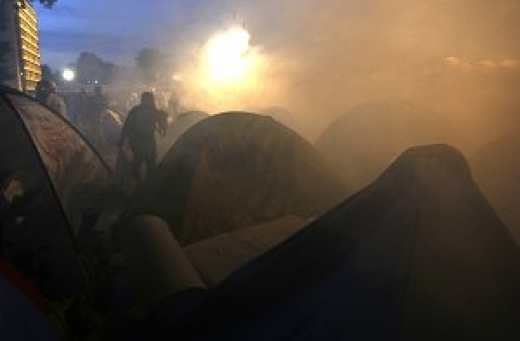
Image above: A protester runs through tents covered by tear gas in Gezi park in Istanbul's Taksim square June 15, 2013. Turkish riot police stormed a central Istanbul park on Saturday firing tear gas and water cannon to evict hundreds of anti-government protesters, hours after an ultimatum from Prime Minister Tayyip Erdogan. From original article - more images there.

I've been attending the Gezi Park protests since arriving in Turkey on June 6.

Thousands of people have camped at the park in Taksim Square, traditionally a gathering place for all kinds of meetings and protests, to prevent Prime Minister ErdoÄŸan from razing the park to remove the place of assembly and erase some of the last green space in Istanbul to turn it into an Ottoman barracks shopping mall. 

On the morning of the 11th, the protesters in the park were peaceful; in Taksim Square below, they were throwing fireworks and rocks and it was being responded to with tear gas and sonic booms and water canon blasts.

By nightfall, the square was becoming filled with people coming home from work, and at 7:30PM, the police gassed the square, driving the protesters into the park. I retreated into the center of the park, at which point the police completely surrounded the park, so that nobody could leave. Then they gassed the whole park.

People were passing out, puking, crying, and nobody was able to breathe or see. The police no longer were trying to get people to disperse - they were torturing them. They even gassed the ambulances outside waiting to carry away the injured protesters.

Although I was gassed several times, the final assault was so thorough that there was nowhere to go to get breathable air. In addition to the burning in my eyes and mouth, it felt like drowning.

But the crazy thing is that even after all that, I've become addicted to going to Gezi Park. Maybe it's the sense of community and purpose there - with free food, cigarettes, music, accommodations, books, education, and healthcare.

Maybe it's the joyous, resilient mood of the Turks - who, the second the gas attacks stopped, were cheering and applauding the fact that they held their ground, even while people were gagging and vomiting and it was bleak and horrible. Maybe it's because in the protests, the biggest cultural differences and partisan conflicts are forgotten, as arch political enemies and rival soccer teams are joined together in song, arm around arm.

Maybe it's because it's a rare opportunity for genuine, protracted conversation and interaction between people from all walks of life - rather than the small, unrepresentative group of looters and thugs as Erdogan characterized, the "capulcus" came from all classes, ages, political parties, and sexual orientations.

And maybe it's that I find it surreal to be walking around yesterday's battle zone as if it were a movie or stage set. But probably the real reason I keep coming back, even after being tear gassed and hearing Erdogan's "final warning" to the protestors, is that there's probably nothing more emblematic of the human condition than to be dancing in the street with a gas mask around your neck.
.

Pentagon's war against us

SUBHEAD: NSA Prism is motivated in part by fears that environmental and energy disasters could spur anti-government activism.

By Chris Hedges on 15 June 2013 for Truth Dig -
(http://www.truthdig.com/eartotheground/item/the_pentagons_preparations_for_war_against_us_20130615/)


Image above: Scene from the Terminator with drones, operated by SkyNet, hunting down the last few rebel humans in America. From (http://ascendingstarseed.wordpress.com/2011/12/11/policing-the-herd-domestic-drones-for-domestic-terrorists/).

A score of recent defense department and other official documents warn that climate change, energy shocks and economic crisis could trigger waves of civil unrest. The understanding seems to explain the proliferation of security and surveillance programs over the last decade.

The preparation makes sense from the perspective of governments (four of which—the U.K., Canada, Australia and New Zealand—appear to have been granted access to data collected by the NSA spying program disclosed in recent weeks, as members of an international intelligence alliance known as “Five Eyes”). The world can unravel in at least three different ways. If and when it does, those in power will want the means to keep their grip. Truthdig columnist Chris Hedges has been warning us about this for a while now.

One legal military document grants extraordinary powers to intervene in a domestic “emergency” or “civil disturbance” outside of White House approval. A 2006 National Security Strategy brief warned that “Environmental destruction, whether caused by human behavior or cataclysmic mega-disasters … may overwhelm the capacity of local authorities to respond, and may even overtax national militaries, requiring a larger international response.”

Two years later, the defense department’s Army Modernization Strategy described a soon-to-arrive “era of persistent conflict” due to competition for “depleting natural resources and overseas markets” fueling “future resource wars over water, food and energy,” and predicting a resurgence of “anti-government and radical ideologies that potentially threaten government stability.”

That same year, a report by the U.S. Army’s Strategic Studies Institute warned that a series of domestic crises could initiate large-scale civil unrest. “Under the most extreme circumstances,” the report showed, Department of Defense action “might include use of military force against hostile groups inside the United States. Further, Dod would be, by necessity, an essential enabling hub for the continuity of political authority in a multi-state or nationwide civil conflict or disturbance.” Around the same time, the Pentagon began developing a force of 20,000 troops who would be on hand to respond to “domestic catastrophes” and civil unrest.

Of course there’s money in this game too. Speaking before employees of Booz Allen Hamilton, the defense contractor that formerly employed NSA whistle-blower Edward Snowden, Lt Col. Mark Elfendahl, then chief of the Joint and Army Concepts Division, in 2010 described preparations for fighting in the homeland as a way to legitimize the U.S. military budget.

Also in 2010, the Army’s annual Unified Quest program—a yearly conference to determine how war should be waged in the future—voiced expectations that “ecological disasters and a weak economy” would fuel migration to urban areas, increasing social tensions within the United States and between “resource-starved nations.”

The tragic irony here is that the U.S. government’s foreign and domestic policies have created and continue to create the conditions of violent unrest that both honest social critics and war officials are expecting.

Nafeez Ahmed, the Guardian contributor who deserves great credit for compiling excerpts from these documents for the public, concluded his article on the subject by saying: “The Pentagon knows that environmental, economic and other crises could provoke widespread public anger toward government and corporations in coming years. The revelations on the NSA’s global surveillance programmes are just the latest indication that as business as usual creates instability at home and abroad, and as disillusionment with the status quo escalates, Western publics are being increasingly viewed as potential enemies that must be policed by the state.”

The point is driven home in the examples of the targeting of domestic activist groups, by government and private industry in cooperation, below.

—Posted by Alexander Reed Kelly.

The Guardian:
It is therefore not surprising that the increasing privatisation of intelligence has coincided with the proliferation of domestic surveillance operations against political activists, particularly those linked to environmental and social justice protest groups.

Department of Homeland Security documents released in April prove a “systematic effort” by the agency “to surveil and disrupt peaceful demonstrations” linked to Occupy Wall Street, according to the Partnership for Civil Justice Fund (PCJF).

Similarly, FBI documents confirmed “a strategic partnership between the FBI, the Department of Homeland Security and the private sector” designed to produce intelligence on behalf of “the corporate security community.” A PCJF spokesperson remarked that the documents show “federal agencies functioning as a de facto intelligence arm of Wall Street and Corporate America.”

In particular, domestic surveillance has systematically targeted peaceful environment activists including anti-fracking activists across the US, such as the Gas Drilling Awareness Coalition, Rising Tide North America, the People’s Oil & Gas Collaborative, and Greenpeace.

... A University of Bath study ... based on confidential sources, found that a whole range of corporations - such as McDonald’s, Nestle and the oil major Shell, “use covert methods to gather intelligence on activist groups, counter criticism of their strategies and practices, and evade accountability.”


DOD braces for climate & energy shocks

By Nafeez Ahmed on 14 June 2013 for the Guardian - (http://www.guardian.co.uk/environment/earth-insight/2013/jun/14/climate-change-energy-shocks-nsa-prism)

Top secret US National Security Agency (NSA) documents disclosed by the Guardian have shocked the world with revelations of a comprehensive US-based surveillance system with direct access to Facebook, Apple, Google, Microsoft and other tech giants. New Zealand court records suggest that data harvested by the NSA's Prism system has been fed into the Five Eyes intelligence alliance whose members also include the UK, Canada, Australia and New Zealand.

But why have Western security agencies developed such an unprecedented capacity to spy on their own domestic populations? Since the 2008 economic crash, security agencies have increasingly spied on political activists, especially environmental groups, on behalf of corporate interests. This activity is linked to the last decade of US defence planning, which has been increasingly concerned by the risk of civil unrest at home triggered by catastrophic events linked to climate change, energy shocks or economic crisis - or all three.

Just last month, unilateral changes to US military laws formally granted the Pentagon extraordinary powers to intervene in a domestic "emergency" or "civil disturbance":
"Federal military commanders have the authority, in extraordinary emergency circumstances where prior authorization by the President is impossible and duly constituted local authorities are unable to control the situation, to engage temporarily in activities that are necessary to quell large-scale, unexpected civil disturbances."
Other documents show that the "extraordinary emergencies" the Pentagon is worried about include a range of environmental and related disasters.

In 2006, the US National Security Strategy warned that:
"Environmental destruction, whether caused by human behavior or cataclysmic mega-disasters such as floods, hurricanes, earthquakes, or tsunamis. Problems of this scope may overwhelm the capacity of local authorities to respond, and may even overtax national militaries, requiring a larger international response."
Two years later, the Department of Defense's (DoD) Army Modernisation Strategy described the arrival of a new "era of persistent conflict" due to competition for "depleting natural resources and overseas markets" fuelling "future resource wars over water, food and energy." The report predicted a resurgence of:
"... anti-government and radical ideologies that potentially threaten government stability."
In the same year, a report by the US Army's Strategic Studies Institute warned that a series of domestic crises could provoke large-scale civil unrest. The path to "disruptive domestic shock" could include traditional threats such as deployment of WMDs, alongside "catastrophic natural and human disasters" or "pervasive public health emergencies" coinciding with "unforeseen economic collapse." Such crises could lead to "loss of functioning political and legal order" leading to "purposeful domestic resistance or insurgency...
"DoD might be forced by circumstances to put its broad resources at the disposal of civil authorities to contain and reverse violent threats to domestic tranquility. Under the most extreme circumstances, this might include use of military force against hostile groups inside the United States. Further, DoD would be, by necessity, an essential enabling hub for the continuity of political authority in a multi-state or nationwide civil conflict or disturbance."
That year, the Pentagon had begun developing a 20,000 strong troop force who would be on-hand to respond to "domestic catastrophes" and civil unrest - the programme was reportedly based on a 2005 homeland security strategy which emphasised "preparing for multiple, simultaneous mass casualty incidents."

The following year, a US Army-funded RAND Corp study called for a US force presence specifically to deal with civil unrest.

Such fears were further solidified in a detailed 2010 study by the US Joint Forces Command - designed to inform "joint concept development and experimentation throughout the Department of Defense" - setting out the US military's definitive vision for future trends and potential global threats. Climate change, the study said, would lead to increased risk of:
"... tsunamis, typhoons, hurricanes, tornadoes, earthquakes and other natural catastrophes... Furthermore, if such a catastrophe occurs within the United States itself - particularly when the nation's economy is in a fragile state or where US military bases or key civilian infrastructure are broadly affected - the damage to US security could be considerable."
The study also warned of a possible shortfall in global oil output by 2015:

"A severe energy crunch is inevitable without a massive expansion of production and refining capacity. While it is difficult to predict precisely what economic, political, and strategic effects such a shortfall might produce, it surely would reduce the prospects for growth in both the developing and developed worlds. Such an economic slowdown would exacerbate other unresolved tensions."
That year the DoD's Quadrennial Defense Review seconded such concerns, while recognising that "climate change, energy security, and economic stability are inextricably linked."

Also in 2010, the Pentagon ran war games to explore the implications of "large scale economic breakdown" in the US impacting on food supplies and other essential services, as well as how to maintain "domestic order amid civil unrest."

Speaking about the group's conclusions at giant US defence contractor Booz Allen Hamilton's conference facility in Virginia, Lt Col. Mark Elfendahl - then chief of the Joint and Army Concepts Division - highlighted homeland operations as a way to legitimise the US military budget:
"An increased focus on domestic activities might be a way of justifying whatever Army force structure the country can still afford."
Two months earlier, Elfendahl explained in a DoD roundtable that future planning was needed:
"Because technology is changing so rapidly, because there's so much uncertainty in the world, both economically and politically, and because the threats are so adaptive and networked, because they live within the populations in many cases."
The 2010 exercises were part of the US Army's annual Unified Quest programme which more recently, based on expert input from across the Pentagon, has explored the prospect that "ecological disasters and a weak economy" (as the "recovery won't take root until 2020") will fuel migration to urban areas, ramping up social tensions in the US homeland as well as within and between "resource-starved nations."

NSA whistleblower Edward Snowden was a computer systems administrator for Booz Allen Hamilton, where he directly handled the NSA's IT systems, including the Prism surveillance system. According to Booz Allen's 2011 Annual Report, the corporation has overseen Unified Quest "for more than a decade" to help "military and civilian leaders envision the future."

The latest war games, the report reveals, focused on "detailed, realistic scenarios with hypothetical 'roads to crisis'", including "homeland operations" resulting from "a high-magnitude natural disaster" among other scenarios, in the context of:
"... converging global trends [which] may change the current security landscape and future operating environment... At the end of the two-day event, senior leaders were better prepared to understand new required capabilities and force design requirements to make homeland operations more effective."
It is therefore not surprising that the increasing privatisation of intelligence has coincided with the proliferation of domestic surveillance operations against political activists, particularly those linked to environmental and social justice protest groups.

Department of Homeland Security documents released in April prove a "systematic effort" by the agency "to surveil and disrupt peaceful demonstrations" linked to Occupy Wall Street, according to the Partnership for Civil Justice Fund (PCJF).

Similarly, FBI documents confirmed "a strategic partnership between the FBI, the Department of Homeland Security and the private sector" designed to produce intelligence on behalf of "the corporate security community." A PCJF spokesperson remarked that the documents show "federal agencies functioning as a de facto intelligence arm of Wall Street and Corporate America."

In particular, domestic surveillance has systematically targeted peaceful environment activists including anti-fracking activists across the US, such as the Gas Drilling Awareness Coalition, Rising Tide North America, the People's Oil & Gas Collaborative, and Greenpeace. Similar trends are at play in the UK, where the case of undercover policeman Mark Kennedy revealed the extent of the state's involvement in monitoring the environmental direct action movement.

A University of Bath study citing the Kennedy case, and based on confidential sources, found that a whole range of corporations - such as McDonald's, Nestle and the oil major Shell, "use covert methods to gather intelligence on activist groups, counter criticism of their strategies and practices, and evade accountability."

Indeed, Kennedy's case was just the tip of the iceberg - internal police documents obtained by the Guardian in 2009 revealed that environment activists had been routinely categorised as "domestic extremists" targeting "national infrastructure" as part of a wider strategy tracking protest groups and protestors.

Superintendent Steve Pearl, then head of the National Extremism Tactical Coordination Unit (Nectu), confirmed at that time how his unit worked with thousands of companies in the private sector. Nectu, according to Pearl, was set up by the Home Office because it was "getting really pressured by big business - pharmaceuticals in particular, and the banks." He added that environmental protestors were being brought "more on the radar." The programme continues today, despite police acknowledgements that environmentalists have not been involved in "violent acts."

The Pentagon knows that environmental, economic and other crises could provoke widespread public anger toward government and corporations in coming years. The revelations on the NSA's global surveillance programmes are just the latest indication that as business as usual creates instability at home and abroad, and as disillusionment with the status quo escalates, Western publics are being increasingly viewed as potential enemies that must be policed by the state.

• Dr Nafeez Ahmed is executive director of the Institute for Policy Research & Development and author of A User's Guide to the Crisis of Civilisation: And How to Save It among other books. Follow him on Twitter @nafeezahmed
.

The Luddite Rebellion

SUBHEAD: The 200th anniversary (from 1811-1813 to 2011-2013) of the original rebellion against modern industrialism.

By Chellis Glendinning on 11 November 2012 for Culture Change -
(http://www.culturechange.org/cms/content/view/861/1/)


Image above: Child labor in 19th century industrialism in Macon, Georgia. Some boys and girls were so small they had to climb up onto the spinning frame to mend broken threads and to put back the empty bobbins. Photo by Lewis W. Hine. From (http://www.tumblr.com/tagged/lewis-hine?before=1345988741).

The years 2011-2013 mark the 200th anniversary of the Luddite Rebellion that began in England with protests against the enclosure movement in the late 1700’s and peaked with the machine-smashing endeavors of village weavers in 1811-1813. The effort was so threatening to the powers-that-could-see-profit-a’comin’ that they amassed more troops to fight the uprising than were mobilized against Napoleon. In the end the government murdered, imprisoned, or sent the activists to Australia –- and transformed the word “Luddite” into an anti-progress jab and a put-down with connotations of ridiculousness.

Native peoples in earlier centuries were stymied when they tried to talk about the European conquest; their pre-Columbian vocabularies had no words to describe such a battering. And it’s like that again. You and I can only peg together language to describe the invasion overwhelming our bodies, psyches, and cultures by technology. And that assault, taken together with the economic/political institutions that fuel it, is swiftly diminishing life’s future on this Earth.

Back in the 1980’s and ‘90’s, I thought I had a few words. I was part of a society of activists and thinkers collaborating to refurbish the analysis of technology that the original resisters against industrialism, the Luddites, had initiated. We were a lively collection of folks from countries all over the world. Theodore Roszak. Kirkpatrick Sale. Vandana Shiva. John Mohawk. Gustavo Esteva.

Stephanie Mills. Helena Norberg-Hodge. Langdon Winner. Godfrey Reggio. David Suzuki. Jerry Mander. Chet Bowers. Beth Burrows. Satish Kumar. Charlene Spretnak. Sigmund Kvaloy. Susan Griffin. Teddy Goldsmith. Now, we knew how to talk. Sitting together around conference tables at five-day meetings that boasted such titles as “Mega-technology and Development” and “Mega-technology and Economic Globalization,” we proclaimed that the “new technologies that were coming” would wreak a havoc grander in scale than even the industrial revolution had wrought.

But what were we expecting? It wouldn’t affect us? Did we think we would go on meeting in luscious locations to spin our theories? Write a white paper or two? Give a rally speech? Hang on to our land lines?

I’ll be frank: we didn’t think anything. We couldn’t. We had no way to imagine. No vision. No words other than “supercomputer,” “satellite communications,” “genetic engineering,” “transnational corporation.”

And so that cadre of stellar minds fell through the unforeseen cracks that gashed open when tectonic plates of political / economic / technological proportion clanked apart like iron. Most got a computer and a cell phone. Some landed the grant monies they were seeking and clicked into the focus of a more manageable pursuit. And more than one insisted that, for strategic purposes, we not speak of technology any more. And then that ever-so-brightly rising star of resistance -- paralleling one that had begun two centuries before during a comparable siege -- shot into a glorious sky, only to burn away.

Plutonium pit. Packbot. Prostate cancer. Broken back. Brain tumor. Beached whales. Wasting elk. Whiplash. WiMAX. iPod. Oil tanker. Iraq. The biggest shopping mall on the planet. The tallest skyscraper. Scrape. Save. Spend. Crave. Credit card. Debit card. Macromind. Multiple sclerosis. Melting ice.

The concerned will rave about war, poverty, oil depletion, and climate upheaval – as well they should. Some venture to name racism, capitalism, empire; cruelty and greed can be high on the list. But technology’s role in shaping these same tragedies handily slips from the perceptual gaze. Despite all and still, the notion of technological development is linked in the popular mind to “progress,” “advancement,” “evolution.”
And fear.

“I WANT MY MAMMOGRAM!” shrieks a radio listener like a child. The tantrum occurs on a talk show during my 1990 book tour for When Technology Wounds. Also like a child, the woman carries zero awareness of likely precedents to her susceptibility to breast cancer: like synthetic hormones and pesticides. Or the radiation from last year’s mammogram.

The inherent disjuncture of mass society does not propagate the kind of thinking that would unify the parts of the whole. It severs instead. It fragments. It scatters – and lays ground for engaging and defending only one fragment at a time.


“I am a Luddite!” Such was the scandalous proclamation Wendell Berry bellowed at the first official gathering of our new generation of technology critics. San Francisco was the place, 1993 the year.

For the time, the statement was heretical. Since the rebellion (and demise) of the original Luddites at the launch of the industrial revolution some 180 years earlier, this new wave had been constrained by an intellectual context forged by the winners of the earlier conflict: the term “Luddite” had been made into a dirty word, a put-down, a brazen denigration.

Everyone burst with laughter –- Wendell was, as always, preposterously right-on -– and everyone breathed in relief. A deep-seated taboo had irretrievably been broken: without further excuse we were going to be who we were. To boot, our work -- which up until that moment had been conducted solo -- could move forward enriched by interaction among a worthy collection of hearts and minds.
A small flurry of activity followed.

Well, OK: our actions got swept up in the onrush of media attention the Unabomber was getting. In 1995, in an attempt to bargain with mail-bombing Ted Kaczynski, the New York Times and Washington Post published his manifesto, “Industrial Society and Its Future.” Fortuitously, Kirk’s Rebels against the Future rode this event like a wrangler on a small bull and, in the process, gave readers a glimpse into the long-repressed details of Luddite history. The Jacques Ellul Society was born, named for the French sociologist who had so brilliantly critiqued technological society.

 One of our group, biologist Martha Crouch, quit the university in protest against its collaboration with biotech corporations. Others took on the fight against bio-specting in Yellowstone National Park. A few stalwart researchers tried to reveal the negative impacts threatened by the entry of computers into education.

 Stephanie, Kirk, and I regaled a standing-room-only audience in New York City with our theatrical performance Interview with a Luddite, and we all spoke copiously on the radio.

At the same time other thinkers and activists –- alternative-technology inventors, Native and land-based peoples favoring traditional livelihoods, monkey-wrenchers, anarchists, and modern rebels against the future –- were challenging technology with their own words and acts. Some dedicated anarchists tore down high-voltage power lines in the American West and liberated lab animals from science experiments; environmentalists draped tall buildings with pro-Earth banners; and a group of simple-living advocates in Ohio put out a hand-set magazine called Plain and threw gatherings for contemporary Luddites, to which they exhorted everyone to travel on foot, buggy, or train.

The upshot: the proclamation “I am a Luddite” re-entered the vernacular. And none too soon, we suspected.


What we were referring to as the “new technologies” in the early ‘90s have by now facilitated not only the emergence of a global economic order whose means and goals are corporate dominion, ecological ransacking, and mass consumption; they have infused our very rhythms, thought patterns, and identities. Indeed, the upheavals we are enduring are equal in scope and magnitude to those that swept through the early-19th century.

Then: the destruction of the commons. The break-up of village life, wild spaces, the family. The separation of work from meaning, city from country, luxury from misery. The creation of slums. Child labor. Environmental illness. Theories of progress, inevitability, utilitarianism, laissez faire. The budding of rebellious but deeply conservative thoughts in the work of Keats, Shelley, Lord Byron, Charles Dickens. The melding of machine with discontent, radical politics with rusticity, hope with passion.

Today: global warming, climate upheaval, economic collapse. The microwaving of the planet. The demise of the last wild places left. The exhaustion of oil reserves. The rise of the richest class of individuals in history -– with a parallel fall in quality of life for everyone else. Environmental refugees. Species extinctions. Build-up of nuclear, biological, and electromagnetic weaponry. The continuation of rebellious but deeply conservative thoughts. The melding of cyberspace with violence, radical politics with marginalism, passion with desperation.

And is not today’s world that teeters so precariously on its cliff of demise the extension of economic and social patterns that were made painfully evident some two centuries ago? Is not the resistance mounted by courageous bands of weavers, foresters, and villagers in Europe and the United States -– and the systemic analysis they offered -- as relevant now as they once were?

My presence at the 1993 gathering of contemporary Luddites began three decades before in a lecture hall at U.C. Berkeley. It was in Professor Allen Temko’s class on the history of the city that I first encountered the ideas of Lewis Mumford.


My God! When I read his words, I had to stop every three or four paragraphs and breathe just to contain my excitement. His aim was to merge the intellectual with the passionate, the lofty with the earthy –- and this he did. To the hilt. Born in 1895 and growing up at a time when Americans were swelling with pride over the streamlined possibilities of mass mechanistic society, when “science” and “democracy” appeared to be ushering in a permanent era of peace and prosperity, he pierced through the veneer to reveal the deepest patterns of a civilization in trouble.

What stunned –- and inspired -- me was his sweep of vision.

Mumford asserted against all prevailing belief that the centerpiece of the cult of “progress” -- technology -- did not lie at the dividing line between our animal ancestry and the first sparks of human consciousness; art, music, ritual, and language did.[i] “I have taken life itself to be the primary phenomenon, and creativity, rather than ‘the conquest of nature,’” he wrote, “as the ultimate criterion of man’s biological and cultural success.”[ii]

In his two-part ‘Myth of the Machine’ series, Mumford described progress as “a scientifically dressed up justification” for practices the ruling classes had used since the time of the pharaohs to congeal and perpetrate power.[iii] He identified the Megamachine as the central theme of Western society: a social construction built upon absolutism, centralization, mechanization, regimentation, militarism, genocide, biocide, spectacle, and alienation – with attendant loss of the very qualities the species had developed through evolution: autonomy, human scale, spontaneity, diversity, communalism, and participation.

Displaying a moral indignation that bucked the overarching assumptions of the times, he spoke of the potency of the Megamachine’s grasp upon the popular mind: “The wonder is … that the hopeful dream has remained alive for so long, for some of its original luminosity still dazzles and blinds the eyes of many of our contemporaries who continue to pursue the same archaic fantasies.”[iv]

And he fortuitously foretold that a “dominant minority” -– the masters of technology and accumulated wealth –- would create “a uniform, all-enveloping, super-planetary structure, designed for automatic operation,” just as he described every-day citizens as “cut off from their own resources for living, feel(ing) no tie with the outer world unless they are constantly receiving information, direction, stimulation, and sedation from a central, external source.”[v]

My own grasp of the dynamics of such a Megamachine was thrust forward by industrial medicine’s perpetration of birth control. After two years of suffering chronic yeast infections from the imbalances generated by synthetic hormones, a physician at Congressional hearings in 1970 rattled the myelin off my nerves with his proclamation that The Pill was “the largest experiment” foisted upon unsuspecting human beings in the history of medicine.

Being a victim of medical technology came with some poignancy: I was the great-granddaughter of the founder of the Cleveland Clinic and haled from a family whose members had given their lives to the healing profession. But my suspicion of allopathic medicine was not yet as deeply rooted as it would become; still seeking the quick fix, I replaced my packet of chemicals with the latest pharmaceutical do-dad: the Dalkon Shield Intrauterine Device. And sure enough, with an already depressed immune system from The Pill, I contracted pelvic inflammatory disease.

By the time, in the late 1970’s, I met Jerry Mander in the cafés of San Francisco’s North Beach and launched into his Four Arguments for the Elimination of Television, I was fertile for the all-encompassing analysis he had focused upon a single technology.

Too, there had been the vision. It had come as a flash when I was taking time off from the intensity of anti-war protest in Berkeley to work on a maple sugar farm in Vermont. The year was 1970; Earth Day was on the horizon. But more crucial to me, Paul Ehrlich’s article in the September 1969 issue of Ramparts magazine -- “Eco-Catastrophe: The End of the Ocean”[vi] -- had jolted my notion of the future.
“THE OCEANS,” the cover art proclaimed on a marble headstone inscribed for the Earth’s seas:
Born: Circa 3,500,000,000 B.C.
Died: 1979 A.D.[vii]
On the farm marvelous insights pushed through the icy drudgery of digging winter ditches, a by-product of physical work I surmise, as if to bring color to black-and-white thoughts. Most often it was a feeling of awe that grew up in me like a crocus through snow. This time though, the insight was a moving picture that took over my inner world: citizens storming factories.

I didn’t yet harbor consciousness of the dysfunction of the whole of mass society -- and yet the kind of mass protest we had engaged in to stop the Vietnam War had morphed to a prophecy of what might be required to stop destruction by technology. Just as my reproductive organs were wracked with disturbances from technical interventions, I was catching glimpses of what would unfold as the historical textures of my lifetime.

The template that would become mine had been delivered: the personal is political.
 ___________________
[i] Lewis Mumford, Technics and Civilization. NY: Harcourt Brace, 1934.
[ii] Lewis Mumford, The Myth of the Machine: The Pentagon of Power. NY: Harcourt Brace Jovanovich, 1970, preface.
[iii] Lewis Mumford, “Prologue to our Time,” The New Yorker, March 10, 1975, p.45.
[iv] Lewis Mumford, The Myth of the Machine: The Pentagon of Power, p. 7.
[v] Lewis Mumford, The Myth of the Machine: The Pentagon of Power, p. 352, Ill. 14-15 (between pp. 180-181).
[vi] Paul Ehrlich, “Eco-Catastrophe: The End of the Ocean,” Ramparts, Vol. 8 No. 3, September 1969, pp. 24-28.
[vii] Jeffrey Gholson, cover photograph, Ramparts, September 1969.


Originally "published" on ludditeluddite1812 as Part I, “I am a Luddite”

The other parts:
II: a ritual for despair
III: technology heroes
IV: hitting bottom
V: like dropping the atom bomb
VI: in the realm of the unconscious
VII: technology is political
VIII: interview with a luddite
IX: fear and loathing in los alamos
X: more fear and loathing
XI: jacques ellul didn’t see it coming because it ...
XII: whipped into wireless
XIII: no there there
XIV: dead zero
XV: technology and democracy
XVI: the cropper lads for me!
XVII: the feast of life
XVIII: valiant activists, all

Read prior reports on Culture Change by Chellis Glendinning such as The Problems With Smart Grids: Dumb and Dangerous written with Blake Levitt, 22 March 2011

• Chellis Glendinning is a technology critic in the tradition of the Luddites, Lewis Mumford, and Jacques Ellul -- and one of the original members of the Jacques Ellul Society (1992-1998). She is a psychotherapist specializing in the treatment of traumatic stress and the author of five books. Off the Map: An Expedition Deep into Empire and the Global Economy and Chiva: A Village Takes on the Global Heroin Trade. Both won the U.S. National Federation of Press Women Book Award, in 2000 and 2006 respectively. She now lives in Bolivia and is working on a novel, Objects, about the spiritual energies that emanate from artifacts crafted for/used in social revolutions. Her website is chellisglendinning.org

.

America bullies Koreans

SOURCE: Koohan Paik (kosherkimchee@yahoo.com)
SUBHEAD: US complicit in current abuse of Jeju islanders as well as massacre of 30,000 residents 64 years ago.  

By Ann Wright on 4 April 2012 for Op-Ed News -
(http://www.opednews.com/articles/64-years-later-in-Second-by-Ann-Wright-120404-507.html)


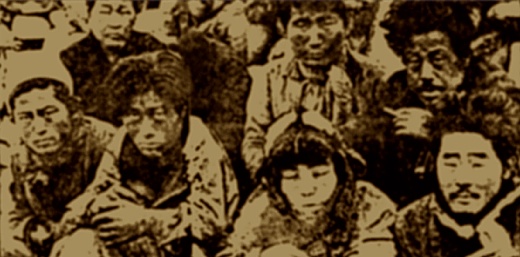
Image above: Jeju island "rebels" awaiting execution in May 1948 for pushing Korean unification. From (en.wikipedia.org/wiki/Jeju_Uprising).
 
President Obama, like President Bush, has a penchant for identifying areas of the world for America's special attention. In the 2002 State of the Union message, Bush used the phrase "Axis of Evil" to signal where America's military might was to be focused in the next years. Afghans, Iraqis and Iranians know that bad things happen for areas of the world singled out for America's special attention.

On the peninsula where North Korea, Bush's other "Axis of Evil" country is located, Obama has declared the Asia-Pacific region as its special area of interest for the next decade and bad things are already happening.

Last week President Obama met in "democratic" South Korea to discuss "non-democratic" North Korea. Yet, while Obama was in South Korea, some very undemocratic actions were perpetrated on behalf of America's Pacific military strategy by members of the South Korean government toward South Korean citizens, and even American citizens.

These citizen activists have been protesting America's Missile Defense System and a provocative new naval base in South Korea for ships carrying the American Aegis missile that brings the American missile system very close to America's latest "enemy" -- China.

As governments and militaries are wont to do, just because they can, they choose beautiful areas in which to locate their bases -- and Jeju Island is no exception. Designated as a world heritage site with six unique biospheres, including endangered species of marine life and the world famous women free divers who harvest marine life, it is a tropical volcanic island, also known, ironically, as the Island of Peace.

 Despite its special natural beauty, Gureombi, the unique 1.2 kilometer-long basalt volcanic rock formed by lava flowing into the sea and rocks rising from the seabed, at the village of Gangjeong was selected to be blown up in order to build the naval base.

South Korean Activists Attempt to Stop Naval Base Construction
For five years, South Korean activists have been protesting the designation of Guroembi as the site of the new naval base. The South Korean police and military actions against their own citizens have gotten progressively heavy-handed and brutal. Hundreds have been arrested over the years including many Catholic priests and nuns who travel on peace flights from the mainland.

Last week, police broke arms of activists who had locked arms inside PCV pipes, beat up activists and threw them from kayaks.Today, on April 3 in Gangjeong, the citizen struggle against the construction of the base continued.

Nine Presbyterian pastors were arrested for breaking through the fence at the construction site in the early morning. The tent set up by 80 Catholic priests and nuns for their mass was demolished by police. A candlelight vigil was held in Jeju city on the 64th anniversary of the April 3 massacre in which 30,000 Jeju Island citizens were killed. Pastors are still engaged in a sit-in at the gate of the naval base site.

International Activists Deported from South Korea
As the South Korean government gets more fearful of the international publicity of their actions, they are deporting international activists and denying entry to South Korea to other activists.

Two weeks ago, three members of Veterans for Peace, Elliot Adams, Tarak Kauff and Mike Hastie were put back on airplanes that had brought them to South Korea. Kauff, who served in South Korea with the US Army, said, "I served in the Second Infantry Division in Korea defending the people from North Korea, I come back again to defend the people and now I am pushed off into a no-man's land."

Japanese activist Ryuji Yagi was denied entry on March 31. UK Trident Plowshares activist Angie Zelter was deported after being on Jeju Island for several days.

US Complicit in Massacre of 30,000 Jeju Island residents in past
The South Korean police crackdown on dissent against construction of the naval base on Jeju, which has never had a military base before, reminds residents of the island of the notorious government crackdown on dissent in 1948 when the South Korean military was sent by the US installed leader of the new country of South Korea, right-wing Syngman Rhee, to Jeju island to squash islanders who were demanding the reunification of Korea and who were objecting to the partition of Korea. In one year, the Seoul government's military and national police hunted down and murdered over 30,000 persons, nearly 15 percent of the island's population.

The U.S. was the occupying power during the systematic murder program, now known as the April 3 Massacre, and did nothing to stop the massacre. In 2005, Roh Moo-hyun, then South Korea's president, finally apologized for the South Korean government's massacre of the people of Jeju Island and designated Jeju as an "Island of World Peace."

Today, people of Jeju Island remember vividly America's complicity 64 years ago in the April 3, 1948 massacre as they again challenge U.S. latest military strategy of the Missile Defense System which is resulting in another massacre -- that of the natural wonders on their island.  

Boycott Samsung- Contractor that is Destroying the World Heritage Site
An International boycott campaign is developing against Samsung, the giant corporate conglomerate that is one of the major contractors destroying the Jeju ecosystems in order to build the naval base. An international call to pressure the London Summer Olympics to drop Samsung as a sponsor of the Olympic Games may become a major component of the boycott action. .

Occupy - Embrace what you are!

SUBHEAD: The Occupy movement can light a fire of human beauty, and human love amidst the sterility of this world. By John Duffy on 21 December 2011 for Grow Food Raise Hell - (http://growfoodraisehell.tumblr.com/post/14572070695/occupy-embrace-what-you-are) Image above: Police arrest a protester on New York's Brooklyn Bridge on Saturday, Oct. 1, 2011, during a march by Occupy Wall Street. From (http://abcnews.go.com/US/occupy-wall-street-protesters-americans/story?id=14652698#.TvtzUEpfW2A). Since the beginning of the Occupy Wall Street protests in New York City and around the US and the globe, there has been a constancy of criticism coming from the entrenched establishment and its would-be supporters. It’s easy enough to ignore the banality and mindlessness of the critiques coming from this camp—critiques aimed at the supposèd lack of direction amongst Occupiers, or their supposed lack of employment, or their supposed lack of hygiene. What is frustrating is the sideline coaching from non-participants who think themselves far too clever to get involved, but who nonetheless feel they know the exact direction and focus that the movement must take. It surprises me that Occupy Wall Street’s original impetus somehow slides over, under, and around the attention of those who proclaim to know what would be best for it. It surprises me more when Occupy participants miss the obvious reality of what I believe their movement is, so I will say it plainly here: Occupy Wall Street and its sister protests around the world are a cultural resistance. It is forgivable to observe the name “Occupy Wall Street,” to see that the original protesters planted themselves as close to the heart of the financial death cult as the enforcement arm of the state would allow, and to arrive at the conclusion that all Occupy efforts are a reaction to monetary malfeasance, both public and private. However, it is clear with even a cursory study of the class demographics and ideological spectrum present that Occupy Movement groups are resisting a broader cultural meme—of which the recent fiduciary debauchery on Wall Street and in Washington is but one outgrowth. Occupy protests have targeted everything from Goldman Sachs and Bank of America’s recent abundance of criminality, to homelessness, the degradation of the environment, the corporate influence in politics, the toxicity of the food supply, foreign wars, domestic repression, foreclosures, Wal-Mart, big Pharma, etc, ad nauseam. This plethora of targets, this seemingly endless hit list, is not as the critics smugly proclaim: a lack of focus or meandering of thought. Rather, it is an acknowledgment of the greater cultural malaise. The challenge of focus for Occupy protests is not necessarily one of targets or tactics. Though strategic maneuvering of their members to the pinch points and bottle necks of the dominant culture is a conversation of constant necessity, more pressing is the discovery of the poisonous heart of the dominant culture. What is the common thread which grafts together the banks, the oil companies, the degradation of the planet’s ecosystems, the drugging of children, the indefinite detention of “terror suspects,” and the imprisonment of non-violent drug possessors? To me, it seems clear that the dominant culture is a culture of domination. The dominant culture, that is — the culture of industrial civilization, that is — our culture — is a culture that rests on a foundation of violence, exploitation, slavery, and brutality. In the privileged West, it is harder to see this than in, say, the Niger Delta, the Brazilian rain forests, or in the sweatshops of Asia. To be sure, the barbarity of our culture is present domestically, but as most modern, “civilized” people have lost connectivity with the natural world, they likely don’t see their city, suburb, or local shopping mall as an exploitation of the land. Further, they take little notice of the flowers, the salamanders, the moths, or any of the over two hundred species which go extinct every day on Earth, including those who forever exit their own communities. Somehow, the exported violence of the tar sands mining operations in Alberta Canada, the Pacific or Atlantic garbage “islands,” or the petroleum wastes of Azerbaijan or newly liberated Iraq remain invisible to those who benefit from these graveyards the most. Perhaps you don’t see the congruity between environmental destruction and the revolving door that exists between government and finance. Perhaps you don’t see ours as a culture of domination, of violence, of exploitation. Let’s look at it another way. This culture is one in which it is not only acceptable, but celebrated, to destroy life for profit. Indeed, the only way to profit, the only way to generate material “wealth,” is by killing. A tree doesn’t become lumber unless you cut it down. Cows don’t become McBurger filling until they have been executed (and of course, tortured). Even humans don’t become laborers until they have been enclosed into a capitalist marketplace, off of and separate from the land, where they must choose between labor and starvation. Thus there is a price tag hung around the neck of every living thing. Since the only laudable goal according to cultural dogma is the accumulation of excess capital, it is axiomatic that this culture will cut down more trees every year, drag more and bigger nets across the ocean floor every year, lay more concrete every year, burn more petroleum every year, in a never ending quest to convert the living planet into the abstract object of our insane festishizations: money. Though it may be a bit heavy for some, it must be stated; capitalism is reaching its endgame. The growth requirement which capitalism has built into itself is now colliding headlong with the limits of the natural world, which provides all of the raw stock required by industry. Like an organism undergoing ketosis, the system is beginning to devour itself for sustenance. Governments create imaginary capital to patch over privately created black holes of debt, while financial institutions feast on the accumulated “wealth” of the poorer strata of western society by mechanisms like foreclosure, stagnant wages, increasing tuitions, increasing interest payments, layoffs, and every other conceivable and now commonplace “austerity measure.” It is this amalgam of symptoms of collapse that the people of the “first” world are now experiencing. Of course, these first-worlders have lived on the backs of exploited peoples, animals, and land bases for generations, all too happy to consume to their heart’s content in a drunken orgy of self-righteous hedonism. (In their defense, the masters of capital did scar these people at birth with the brand of consumption, bombarding them day and night with self defeating advertisements and a ceaseless campaign of pro-authoritarian, anti-life propaganda.) This monstrous architecture has not only built into an impossible growth requirement, but also a series of premises concerning the validity of hierarchy. This is a culture of domination. Our culture regularly promotes and lauds the violence committed by armies and police against civilians. It regularly promotes and lauds violence committed by men against women and children. It regularly promotes and lauds the violence committed by humans against animals, against plants, against water, soil, and air. This culture reviles any violence in the reverse direction. Violence may not flow up the hierarchy without being met by immense over-pressures of force. Those at the top and their mercenary defenders will not allow their status to be questioned, let alone challenged. Hence, we witness the unfounded violence so far committed against Occupy protesters, despite their near uniform docile behavior. Now that the maw of imperial capitalism is fixing itself upon the white people of the first world, now that a future of more luxury and entitlement is not a guarantee, there is a revelation to the true nature of the culture appearing to those willing to see it. The chant “banks got bailed out, we got sold out” rings of this dawning truth. The system isn’t here for you—you are here for it. You are to turn your cog, move your little piece of the machine, keep it marching, keep it killing, and the moment you become a net drain on the architecture of this society, you find your place in the cast iron furnace next to the felled redwood, the poisoned aquifer, and the Bangladeshi slave. You will be chewed up and spit out like the expendable component that you are. It’s no longer just the exotic foreigners in some far away land who are getting in the way of profit, now it is you. Now it’s your family, your co-workers, your town that stands between a corporation and black ink on the bottom line. This is the intellectual hurdle before the Occupy Movement. Do they dare shine a light on the built-in flaws of capitalism? Do they dare indict long held “self evident truths,” and stand united behind the idea that another world truly is possible? Themselves organized in an egalitarian, horizontal fashion, making decisions by consensus and demanding respect for all participants—do Occupy Movements dare recognize their anarchism, and move forward with stolid conviction that it is not merely a handful of nasty players they are fighting, not merely a corrupt electoral process, but toxic imaginings of power and right in the minds of the masters, and indeed, in the minds of all men born into the belly of this twisted device? At the moment, many Occupy groups and members will hold up their hands and soften their voices to meekly proclaim, “Now, I’m not against capitalism or rich people,” instead hiding behind a desire for “financial fairness.” The problem is that one cannot, with full education on the topic, simultaneously believe in capitalism and financial fairness. Volumes on this issue have been written by men smarter and more articulate than myself, so I will spare the reader an extrapolation on this topic, hopefully sufficing to say that the logic of capitalism dictates that were one man capable of accumulating the capital to do so, he could buy all of the land in the world. Any logic that leads to that conclusion is not logic at all, and must be abandoned by all sane people. If the Occupy Movement, fearful of public opinion, fearful of poll numbers and the manufactured and implanted concerns of fence-sitters, decides not to move forward and proudly adopt that theirs is truly a rejection of the dominant culture, it will stagnate. As this culture has made a mess of all of its participants psychologically and emotionally, it is folly to fear the misguided notions of non-participating members of the culture, especially at such an early stage of our collective activism. On the other hand, if the Occupy Movement recognizes its true heart, embraces its foundational disdain for the culture at large, and follows through with whatever manifests from that heartbreak and that need, it has a chance to do something incredible: to inspire. To inspire true revolt in the hearts of all people. To inspire an outpouring of collective sympathy, a great sigh from a worldwide population subjugated for lifetimes upon lifetimes. The Occupy Protest Movement and all of its congruent revolutions around the world have in their hands, if they have the courage to use it, the ability to inspire one last flare up of human fire, human beauty, and human love a world of hastening emotional sterility. It is from this rage and awe burning in the guts of man, that freedom, peace, and communion are born. Yet at this moment, a brave new world dawns. The empires of the world are increasing the scale of their violence as they scrape and claw for dominion of the remaining global hydrocarbon reserves. Capitalist institutions, including nations themselves, cannibalize one and other for survival. A shadow of tyranny and fascism is creeping forth, extinguishing the last remnants of freedom people have, and in this dark hour, I implore the Occupy protesters, of which I am a dedicated one: bring light, in what is otherwise a truly blackened future without us. • John Duffy is an artist, activist, and voice of the Grow Food, Raise Hell podcast. He currently resides in Austin, Texas. .

Volcom - A common future?

SUBHEAD: A mystery shared between a local teen from Hanamaulu and a young Amish buggy driver in the Northeast.

 By Juan Wilson on 16 September 2011 for Island Breath - 
  (http://islandbreath.blogspot.com/2011/09/volcom-common-future.html)

 
Image above: My Chevy S-10 pickup sporting mysterious logo. Photo by Juan Wilson.

I recently bought a 1988 S-10 extended cab pickup truck to replace by well-worn 1987 Toyota 4x4 pick-up. The previous owner was a really nice kid, of about 19, who lived down in Hanamaulu. He had cleaned it up and tricked it out. After a new hedders and a paint job he installed a 2000 watt bass speaker and added tinted windows and some decals.

Thankfully the speaker wasn't part of the deal. It took up much of the extended cab. I probably would have lost consciousness had I actually used it while driving. I did get the decals, however. One I had seen on many vehicles on Kauai was without words or fine print. It was shaped like a spearhead with facets. I vaguely thought it had something to do with Hawaiian culture, or surfing, but really had no clue.

Then I saw a photo on Boing Boing (http://boingboing.net/2011/09/15/amish-buggy-decals.html) about Amish buggy decals and was surprised to see my truck decal sported on the "caution" reflector on the back end of a buggy. Whoa!
 

Image above: A Amish buggy with same mysterious logo. From (http://boingboing.net/2011/09/15/amish-buggy-decals.html).

 I came to Kauai from western New York state in an area where there are a lot of Amish farms. It was not unusual there for the local hardware stores to sell buggy hardware and for the county roads to sport caution signs for Amish buggy traffic. The teens among the Amish have a few wild oats to sew before entering their religion and adulthood.

I knew them to sneak calls from public phones in nearby small towns. I had heard there boomboxes coming from parked buggies in the state forest. They would even join in regional music festivals poorly disguised as "Englishers". These were youth capable of "breaking bad", and flaunting authority. And now I was displaying that I shared this attitude with them as well as youth here on an isolated island in the Pacific Ocean. I had to find the source of this iconic symbol.

Well, I could have asked anybody under 40 and they would likely know, but I took my quest to the internet. I googled "diamond shaped logo" for clip-art among images. The reward was "Volcom logo vs Roc Nation logo" (http://mteelove.wordpress.com/2011/04/02/jay-z-being-sued-over-diamond-logo/). Volcom it was.


Image above: Volcom (left) sues Roc Nation (right) over logo trademark infringement. From (http://mteelove.wordpress.com/2011/04/02/jay-z-being-sued-over-diamond-logo).

The Volcom is a company that sells surfboarding, skateboarding and snowboarding clothing, through its website. It is apparently trying to be relevant to young adults by appealing to many interests. There site index touts "Shop", Happs", "Team", "Aart", "Girls", "Music", "Events", "Blogs". Under blogs the first item is "Sustainability". And I quote:
"Building a sustainable future, day by day. The New Future looks a lot different than today’s future. It is Cleaner, more Conscious, more Renewable, more Efficient, more Regenerative, more Sustainable and Less Impactful.
We’ll continue to work towards incorporating New Future thinking into all aspects of our business and we ask that you do your part in helping us build a future that we can proudly pass on to all generations to come."
Volcom is trying to involve its fans with the ocean front cleanup efforts of Surfrider Foundation (http://newfuture.volcom.com/featured-surfrider-foundation-emerald-coast-needs-your-support/), but one cannot forget this is a company that is primarily selling fossil fuel based synthetic fabric boardware to kids. I don't know how many of the Amish that like the decal have a clue about that, but I discovered some Amish have gotten a bit rebellious .  

Mark Frauenfelder, a Boing Boing contributor saw the buggy decal story and submitted the photo below of mugshots of some young Amish men arrested for defying authorities by refusing to display the required orange reflective triangular caution sign on the back of their buggies. The moral: Obey, Consume and Prosper!

 
Image above: Troublesome Amish youth defying authorities. From (http://boingboing.net/2011/09/15/mugshots-of-amish-who-wont-put-orange-triangles-on-their-buggies.html).


 .