
SUBHEAD: Get over despair. The big problems won't be fixed. A planetary adjustment is at hand.
By Chris Jordan on 17 October 2018 for Huffington Post -
(https://www.huffingtonpost.com/entry/despair-environment-politics_us_5bc5d910e4b0a8f17ee5d240)
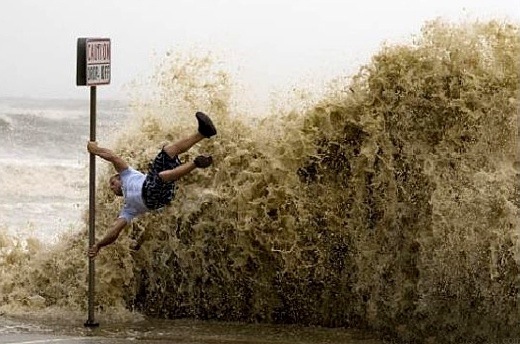
Image above: Man hanging onto "Caution" sign as braking storm wave breaks. From internet.
[IB Publisher's note: My advise to the author of this piece... Get over the despair. The big problems won't be fixed. A planetary adjustment is at hand. There is much work to be done by the survivors. Some places will be much safer than others. If you are not in one, find such a spot. Abandon your dependence on "The System" to a degree you never imagined (ditch the car, the grid, discount retailing and the information cloud as soon as possible. Hunker down with people you trust and can work or trade with. Entertain each other until the new dawn. P.S. This is the 7,000th post to this blog. Where does the time go?]
Like all of you, I pay close daily attention to the increasingly grotesque environmental and political shitshow we are witnessing unfold before our astonished eyes. The question is how to respond.
I have never at the same time felt such a strong desire to make a positive difference and less empowered to do so.
In my own psyche, something has shifted on a foundational level.
Most conversations now, even among my wisest and most engaged friends, lead down familiar rabbit holes that end in shrugged shoulders, dumb jokes that mask disempowerment and worn out memes about “solutions” that are infinitesimal in proportion to the scale of the problems.
Ask young people what two words most characterize our future and the response is as instant as it is ubiquitous: “We’re fucked.”
The most relevant internet comment people seem to be able to muster is “vote,” which raises a whole separate conversation, but the crux for me is, “Of course ― and what else?” Politics is an increasing disaster that can be seen as both a cause and a symptom.
I try to step back to a meta-perspective in the hope of achieving a clearer-headed view, but the wide-angle picture becomes even more chaotic. The panopticon turns out to be a Halloween hall of mirrors.
And in this space I find myself steeped in the familiar feeling of dread that I had before going to Midway Island to photograph dead albatrosses whose stomachs are filled with plastic.
To take the next step forward, I know I must face something dark that lies inside of myself, but I can’t quite make out what it is ― something so taken for granted that I don’t see it, like the water we swim in, right in front of our nose but invisible.
Yet its presence is just strong enough to swing the needle of my internal compass in its direction.
The abyss I went to encounter on Midway was grief, which at the time I knew little about and thought was the scariest feeling there is to bear.
Now the form of a new monster emerges through the mist, a hundred times more frightening than grief, a lurking layer in the psyche that possesses the horrible power to drain individual and collective life force. It carries such strong cultural taboos that even naming it risks a kind of social suicide.
But I can no longer deny its residency in my consciousness, like a new roommate who showed up uninvited and now sleeps in my bed next to me and walks with me everywhere I go. I wonder if it accompanies you too. It is that state of mind we call despair.
On uttering the awful term, I realize I know barely anything about it. In my 14 years of individual and group therapy, I don’t recall any of the therapists or clients ever mentioning it, and I have rarely if ever read anything about it or heard discussion of it.
One thing I can observe about it right away is, in the same way I was grief averse, I am exponentially more despair averse. Admitting despair feels like surrendering the game for lost. An abhorrent kind of giving up seems to lie at its core.
At least grief expresses itself in the cathartic flow of tears, with the possibility of moving through to the other side.
Despair presents as an existential energy sink, like bleeding from an artery, a black hole that if approached pulls inescapably toward implosion and emotional collapse.
Acknowledging despair may amplify it, but denying it may feed it even more. The unconscious defense mechanism is avoidance:
Keep up a hopeful facade, say something positive, focus on trivia, talk about solutions, point to some small evidence of improvement somewhere, quote a self-help one-liner, any old cliche will do.
I wonder what it would mean to allow for some measure of despair as a natural response to the ever more fucked-up realities of our world.
Can despair be held and contained as a natural human experience alongside fear, anger, rage, grief, joy, beauty and love?
Or does it somehow diminish or cancel out everything else?
Perhaps there is something empowering and transformative that comes from standing in despair’s crucible.
Given we may create the very depression we fear by holding despair at bay, I want to know what happens if we take the risk of looking all the way into that darkness.
Let us consider the possibility that there may be value in exploring the territory of despair together, embracing it not as an exercise in negativity or capitulation but as a liberating doorway we can step through toward the healing of our relationship with each other and the world.
.
By Chris Jordan on 17 October 2018 for Huffington Post -
(https://www.huffingtonpost.com/entry/despair-environment-politics_us_5bc5d910e4b0a8f17ee5d240)
Image above: Man hanging onto "Caution" sign as braking storm wave breaks. From internet.
[IB Publisher's note: My advise to the author of this piece... Get over the despair. The big problems won't be fixed. A planetary adjustment is at hand. There is much work to be done by the survivors. Some places will be much safer than others. If you are not in one, find such a spot. Abandon your dependence on "The System" to a degree you never imagined (ditch the car, the grid, discount retailing and the information cloud as soon as possible. Hunker down with people you trust and can work or trade with. Entertain each other until the new dawn. P.S. This is the 7,000th post to this blog. Where does the time go?]
Like all of you, I pay close daily attention to the increasingly grotesque environmental and political shitshow we are witnessing unfold before our astonished eyes. The question is how to respond.
I have never at the same time felt such a strong desire to make a positive difference and less empowered to do so.
In my own psyche, something has shifted on a foundational level.
Most conversations now, even among my wisest and most engaged friends, lead down familiar rabbit holes that end in shrugged shoulders, dumb jokes that mask disempowerment and worn out memes about “solutions” that are infinitesimal in proportion to the scale of the problems.
Ask young people what two words most characterize our future and the response is as instant as it is ubiquitous: “We’re fucked.”
The most relevant internet comment people seem to be able to muster is “vote,” which raises a whole separate conversation, but the crux for me is, “Of course ― and what else?” Politics is an increasing disaster that can be seen as both a cause and a symptom.
I try to step back to a meta-perspective in the hope of achieving a clearer-headed view, but the wide-angle picture becomes even more chaotic. The panopticon turns out to be a Halloween hall of mirrors.
And in this space I find myself steeped in the familiar feeling of dread that I had before going to Midway Island to photograph dead albatrosses whose stomachs are filled with plastic.
To take the next step forward, I know I must face something dark that lies inside of myself, but I can’t quite make out what it is ― something so taken for granted that I don’t see it, like the water we swim in, right in front of our nose but invisible.
Yet its presence is just strong enough to swing the needle of my internal compass in its direction.
The abyss I went to encounter on Midway was grief, which at the time I knew little about and thought was the scariest feeling there is to bear.
Now the form of a new monster emerges through the mist, a hundred times more frightening than grief, a lurking layer in the psyche that possesses the horrible power to drain individual and collective life force. It carries such strong cultural taboos that even naming it risks a kind of social suicide.
But I can no longer deny its residency in my consciousness, like a new roommate who showed up uninvited and now sleeps in my bed next to me and walks with me everywhere I go. I wonder if it accompanies you too. It is that state of mind we call despair.
On uttering the awful term, I realize I know barely anything about it. In my 14 years of individual and group therapy, I don’t recall any of the therapists or clients ever mentioning it, and I have rarely if ever read anything about it or heard discussion of it.
One thing I can observe about it right away is, in the same way I was grief averse, I am exponentially more despair averse. Admitting despair feels like surrendering the game for lost. An abhorrent kind of giving up seems to lie at its core.
At least grief expresses itself in the cathartic flow of tears, with the possibility of moving through to the other side.
Despair presents as an existential energy sink, like bleeding from an artery, a black hole that if approached pulls inescapably toward implosion and emotional collapse.
Acknowledging despair may amplify it, but denying it may feed it even more. The unconscious defense mechanism is avoidance:
Keep up a hopeful facade, say something positive, focus on trivia, talk about solutions, point to some small evidence of improvement somewhere, quote a self-help one-liner, any old cliche will do.
I wonder what it would mean to allow for some measure of despair as a natural response to the ever more fucked-up realities of our world.
Can despair be held and contained as a natural human experience alongside fear, anger, rage, grief, joy, beauty and love?
Or does it somehow diminish or cancel out everything else?
Perhaps there is something empowering and transformative that comes from standing in despair’s crucible.
Given we may create the very depression we fear by holding despair at bay, I want to know what happens if we take the risk of looking all the way into that darkness.
Let us consider the possibility that there may be value in exploring the territory of despair together, embracing it not as an exercise in negativity or capitulation but as a liberating doorway we can step through toward the healing of our relationship with each other and the world.
.


