Showing posts with label Gift Economy. Show all posts

Permaculture in Hawaii

SUBHEAD: Permaculture works to keep the birds, insects, soil and surrounding nature content and ourselves fed.

By Juan Wilson on 26 April 2017 for Island Breath -
(http://islandbreath.blogspot.com/2017/04/permaculture-in-hawaii.html)


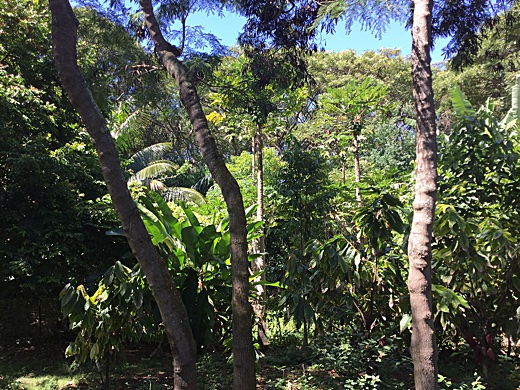
Image above: We at IslandBreath have attempted to do permaculture. Photo from our backyard efforts at creating a "food forest" that we have named "Akea Aina".  In this image are cacao, starfruit, avocado, papaya, cassava, coconut, breadfruit, banana, and mango. Photo by Juan Wilson.

Akea Aina consists of about 1.5 acres of land - a third of it is our property, a third rented from the Robinson family and another third is on Hawaiian public land.

The photo above show haole koa ("false" koa) trees in foreground. They are early adopters in yards on Hanapepe Valley but few people have let haole koa grow so large as they are usually considered weed trees.

Haole koa are hard and heavy wood good for fires and they are good nitrogen fixers. They provide light shade that sun-delicate plants can grow under. Beneath them are a row of cacao trees with fruit.

To the left and right of this photo are breadfruit trees and cassava. Beyond what you can see are beehives.

In the background, from the left is a starfruit tree, coconut, mango, papaya, avocado and more. That's only a small sample of what can be grown on a small farm.

Below is a brief video survey of permaculture efforts in Hawaii on various islands. By "permaculture" we mean intentional living arrangements on land that produces food and fertile land as a foundation of healthy local flora and fauna. This way of life means living "in nature".

That implies sustainable self sufficiency in food, soil, water and energy.      

Mokupuni o Hawaii
Introduction to the permaculture training programs offered at the  La'akea community on the Big Island, with teacher Tracy Matfin. Get a look at La'akea uses permaculture principles.


Video above: Permaculture Education Programs - La'akea, Hawaii in 2011. From (https://youtu.be/-XgpTaAfb7Q).

Mokupuni o Maui
Fruition Permaculture Design as he gives us a tour of Laulima Farm in lush Kipahulu, Maui, Hawaii. Jesse Krebs discusses the key permaculture design features of this beautiful tropical farm.


Video above: Fruit-based Veganic Permaculture on Maui in 2013. From (https://youtu.be/zG2JuTvq5e8).

Mokupuni o Molokai
SustAINAble Molokai and Geoff Lawton of the Permaculture Research Institute of America and of PRI Australia. We now have strategies to heal the land by slowing the course of water.


Video above: Heal the land, Harvest water, Grow food security on Molokai in 2013. From (https://youtu.be/P2Lp8YmJaag).

Mokupuni o Oahu
Growing your own food and being self sufficient is one of the best ways to give power back to the people and live in harmony with nature.


Video above: Permaculture with Paul Izak in Hawaii on Oahu in 2012. From (https://youtu.be/_WHG3NJEq90).

Mokupuni o Kauai
Paul Massey, the Director Regeneration Botanical Gardens gives a concise definition of what Kauai Food Forest is all about.


Video above: Permaculture in Kauai Part 2 in 2013. From (https://youtu.be/5pJrw9QuCB0).

There is no doubt in our minds that these methods of "farming" are the way to go here in Hawaii. It works to keep the birds, insects, soil and surrounding nature content and ourselves fed.

.

Abundance Circle • Story Connective

SUBHEAD: A volunteer effort to share the abundance of food between individual growers and gatherers.

By Rebecca Rhapsody on 23 April 2017 for Story Connective -
(https://storyconnective.podbean.com/)


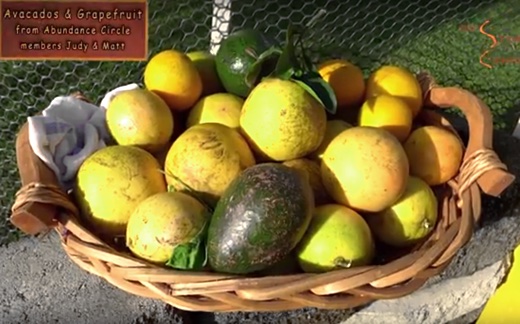
Image above: Avacados and grapefruit offered by Judy and Matt sharing extra produce with to Abundance Circle on Maui through Vicki Levin. Still frame from video below by Story Connection.

Vicki Levin is a champion of locally grown food and community. She gathers up excess food produced by her friends' and neighbors' gardens and distributes it among them all.

It's called the Abundance Circle.

For example, when one member of the Abundance Circle has too many ripe oranges from their tree for their own household, they contribute the extra fruit to the Abundance Circle.

Vicki collects everyone's excess produce and distributes it to the group. In this way, the person contributing the excess oranges will get sunflower sprouts, kale, bananas, & more from the extra produce other Abundance Circle members give... free of charge!

It's not a trade and it's not a barter. Even when a member's garden doesn't have anything to give for a time, they still receive. Everyone just contributes whatever they have excess of to the Circle Abundance, and everyone benefits. Vicki's dream is for everyone to have even a small garden in their backyard.


Video above: Interview with Vicki Levin by Rebecca Rhapsody about the Abundance Circle on Maui. From (https://youtu.be/HD-j7VgKetI).

VIDEO CREDITS:
Interview
Rebecca Rhapsody at StoryConnective.org

Audio and video production
Loxley Clovis at StoryConnective.org

Ukulele score and performance
Rebecca Rhapsody at StoryConnective.org

Story Connective art and logo by
Sarai Stricklin SaraiStricklin.com

SPECIAL THANKS TO:
Vicki Levin and her Abundance Circle members

Artwork ‘Makamaluohonaokalani’
Marilyn Kahalewai at Kumukahi.org

Moku and Ahupuaa map of Maui 'Mokupuni O Maui"
Juan Wilson at IslandBreath.org

SHARING AND SUPPORT: 
If you support Story Connective's 501(c)(3) mission and vision of bringing stories of resilience and possibilities to the world and would like to help our project, there are many ways you can help us.

Share this with video friends, family, coworkers. Like us at Facebook.com/StoryConnective

Subscribe to our YouTube Channel at https://www.youtube.com/channel/UCDb41I_NpEhN-_ciTLOGt7A

Subscribe to our podcast feed: https://storyconnective.podbean.com/ using the Podbean app (for all devices), iTunes (Apple devices), & Google Play Music (Android devices)

Stay tuned to Story Connective on YouTube and the Story Connective podcast for more on this series: Re-envision Maui.

Fiscal Sponsor of Story Connection is ELLSSA – a non profit committed to Empowering individuals to take care of the future. Learn more about at www.ellssa.org

The Story Connective is listener and viewer supported. Support our crowdfunded project at https://www.Patreon.com/Storyconnective or by using the "Be a patron" button on your Podbean podcast app.

FAIR USE:
The purpose of this video is for non-profit education, news and commentary.

CREATIVE COMMONS LICENSE:
Attribution-ShareAlike
2.5 Generic (CC BY-SA 2.5)

.

The Solution Space - Part 5

SUBHEAD: Focusing on solution space for our ways forward will be inexpensive, small-scale, simple, low-energy, and community-based initiatives.

[IB Publisher's note: This is one of a five part series on the boundaries of the Solution Space in which our future lives can take place.] 

By Nicole Foss on 19 August 2015 for the Automatic Earth -
(http://www.theautomaticearth.com/2015/08/the-boundaries-and-future-of-solution-space-part-5/)


Image above: A woman sells Mayan textiles in market in Chickicastenango, Lake Atitlan, Gautimala. From (http://www.travellingbackflip.com/blog/single-page-blog/article/lake-atitlan.html).

PART 5
Working with natural systems in the Solution Space
To use the word ‘solution’ is perhaps misleading, since it could be said to imply that circumstances exist which could allow us to continue business as usual, and this is not, in fact, the case. A crunch period cannot be avoided. We face an intractable predicament, and the consequences of overshoot are going to manifest no matter what we do.

However, while we may not be able to prevent this from occurring, we can mitigate the impact and lay the foundation for a fundamentally different and more workable way of being in the world.

Acknowledging the non-negotiable allows us to avoid beating our heads against a brick wall, freeing us to focus on that which we can either influence or change, and acknowledging the limits within which we must operate, even in these areas, allows us to act far more effectively without wasting scarce resources on fantasies.

There are plenty of actions which can be taken, but those with potential for building a viable future will be inexpensive, small-scale, simple, low-energy, community-based initiatives. It will be important to work with natural systems in accordance with permaculture principles, rather than in opposition to them as currently do so comprehensively.

The First Phase
We require viable ways forward across different timeframes, first to navigate the rapid-onset acute crisis which the bursting of a financial bubble will pitch us into, and then to reboot our global operating system into a form less reminiscent of a planet-killing ponzi scheme. The various limits we face do not manifest all at the same time, and so to some extent can be navigated sequentially.

The first phase of our constrained future, which will be primarily financial and social, will occur before the onset of energy supply difficulties for instance. Some initiatives are of particular value at specific times, and other have general value across timescales.

Moving into financial contraction is going to feel like having the rug pulled out from under our feet, and all the assumptions upon which we have based our lives invalidated all at once. Preparing in advance can make all the difference to the impact of such an event. At an individual level, it is important to avoid holding debt and to hold cash on hand.

It is also very useful to have prepared in advance by developing practical skills, obtaining control over the essentials of one’s own existence where possible and being located in an auspicious place. Human skills such as mediation and organizational ability will be very useful for calming inevitable social tensions.

Working Together
However, community initiatives will have far greater impact than individual actions. The most effective paths will be those we choose to walk with others, as even in times when effective organizational scale is falling, it does not fall far enough to make acting individually the most adaptive strategy.

Even in contractionary times, cooperation is not only possible, but vital. In the absence of lost institutional trust, it must occur within networks of genuine interpersonal trust, and these are of necessity small. Building such networks in advance of crisis is exceptionally important, as they are very much more difficult to construct after the fact, when we will be facing an unforgiving social atmosphere.

Cohesive communities will act together in times of crisis, and will be able to offer significant support to each other. The path dependency aspect is important – the state we find ourselves in when crisis hits will be a major determinant of how it plays out in a given area. Anything people come together to do will build social capital and relationships of trust, which are the foundation of society.

Community gardens, perma-blitzes (permaculture garden make-overs), maker-spaces, time-banks, savings pools, local currency initiatives, community hub developments, skills training programs, asset mapping and contingency planning are but a few of the possibilities for bringing people together.

Essential functions can be reclaimed locally, providing for far greater local self-sufficiency potential. The existence of locally-focused businesses, with local supply chains and local distribution networks for supplying essential goods and services will be a major advantage, hence establishing these in advance will be highly adaptive.

Choosing to form them as cooperatives is likely to increase their resilience to external shocks as risks are shared. Where they can function at least partially through alternative trading arrangements, or as part of a local currency network, they can be even more beneficial.

Trading Arrangements
Alternative trading arrangements are a particularly important component of local self-sufficiency during times of financial crisis, as they are able to mitigate the acute state of liquidity crunch which will be creating artificial scarcity. Implementing alternative means of trading will allow a much larger proportion of economic activity to survive, and this will allow many more people to be able to provide for themselves and their families.

This in turn creates much greater social stability. Alternative currencies in particular are already being relied on in the countries at the forefront of financial crisis, which already find themselves facing liquidity shortage.

It is by no means necessary to wait until crisis hits before establishing such systems. Indeed they can have considerable value locally even in stable times. Since they only constitute money in one area, and, being fiat currencies, must necessarily operate within the trust horizon, they help to retain purchasing power locally, rather than allowing it to drain away continually.

Once well established, alternative currencies can go from being parallel systems to being the major form of liquidity available locally.

Local Government 
Beyond a close-knit community, it will be very helpful to have an informed layer of local government, as this confers the potential for a top-down/bottom-up partnership between local government and the grass roots.

Local government is capable of removing barriers to people looking after themselves, assisting with the propagation of successful grass roots initiatives and acting facilitate adaptive responses with the resources at its disposal, even though these will be for more limited than currently.

Contingency planning in advance for the distribution of scarce local resources would be wise. With the trust horizons drawing inwards, local government may be the largest scale of governance still lying within it, and therefore still effective. It operates at a far more human scale than larger political structures, and is far more likely to have the potential for transparency, accountability and reflexive learning.

That is not to say local government is necessarily endowed with these qualities at present. The odds of it becoming so will increase if informed and public spirited individuals get involved in local government as soon as possible, rather than setting their sights on regional or national government.

Presiding over contraction will, however, be a thankless task, as constituents will tend to blame those in power for the fact that the pie is shrinking.

The job will be a delicate balancing act under very trying circumstances as the fabric of society becomes tattered and torn, but as difficult as it will be, it will remain essential, and getting it right can make a very substantial difference.

Higher levels of government may currently appear to be the relevant seats of power, but are far less likely to be as important in a period of crisis as their response time is far too slow. It is possible that higher levels of government may temporarily be involved in useful rationing programmes, but beyond a certain point, the most important initiatives in practice are likely to be those profoundly local.

National governments are more likely to generate additional problems rather than solutions, as they crack down on angry populations during an on-going loss of political legitimacy.

Regional Economy
Given the fragility of trade in the future we are facing, programs of import substitution could be useful, if there would be time to implement them before financial crisis deepens too substantially for the necessary larger-scale organizational capacity to function.

Being able to provide for the essentials, without having to rely on vulnerable international supply chains, is extremely beneficial, and food sovereignty is particular is critical.

Once trade withers, we will once again see tremendous regional disparities of fortune, based on differing local circumstances. It would be wise to research in advance what one’s own local circumstances are likely to be, in order to work out in advance how one might live within local limits.

Getting expectations aligned with what reality can hope to deliver is a major part of adaptation without unnecessary stress.


In the longer term, we can expect to move through economic depression into some form of relative recovery, although we may see large scale conflict first, and will not, in any case, see a return to present circumstances.

We will instead be adapting to the age of limits, mostly in an ad hoc manner due to on-going instability and consequent inability to plan for the long term.

The Bubble Bursts
The bursting of a bubble on the scale of the one we have experienced has far reaching consequences that are likely to be felt for decades at least. In addition, our current condition of extreme carrying capacity overshoot means that we will actively be tightening our own limits, even as the population declines, by further cannibalizing remaining natural capital.

The operating system reboot which could lead to relative recovery would involve the restoration of some level of trust in the financial system, following the elimination of the huge mass of excess claims to underlying real wealth, and very likely the subsequent destabliization of a currency hyperinflation some years later (timeframe location dependent).

We are very likely to see financial innovation, which is nothing more than another name for ponzi scheme, banned for a very long time, and likely the creation of money as interest bearing debt as well.
 
Humanity is in the habit of locking the door after the horse has bolted, so to speak, only restoring financial regulatory controls once it is too late. Once restored, regulations requiring plain vanilla finance will probably persist until  we have once again had time to forget the inevitable consequences of laissez faire. This will be measured in generations.

A New Smaller World
The small-scale initiatives which we need to navigate the crunch period could be scaled up as trust is slowly re-established. The speed at which this might happen, and the scale that might eventually be workable, are unclear, but it is not likely to be a rapid process, and scale is likely to remain small relative to today.

Society will be lower-energy and therefore significantly simpler by then, with far smaller concentrations of population.

While some fossil fuels will no doubt be used for essential functions for quite some time to come, the majority of society will be excluded from what remains of the hydrocarbon age. We will likely have renewable energy systems, but not in the form of photovoltaic panels and high-tech electricity systems.

Diffuse renewable energy can give us thermal energy, or motive power, or the ability to store energy as compressed air, all relatively simply, but at that point it will not be a technological civilization.

We are heading for a profoundly humbling experience, to put it mildly. Technological man is not the demigod he supposed himself to be, but merely the beneficiary of a fortuitous energy bonanza which temporarily allowed him to turn dreams into reality.

We would do well, if we could summon up sufficient humility in advance, to learn from the simple and elegant technologies of the distant past, which we have largely discarded or forgotten.

We could also learn from present day places already constrained by limits – places which already operate simply and on a shoe-sting budget both in terms of money and energy. It takes practice to learn to function without the structural dependencies we have constructed for ourselves, and the sooner we begin the learning curve, the better off we will be.

In the meantime, focusing on solution space for our ways forward would save us from countless blind alleys.

See also:
Ea O Ka Aina: The Solution Space - Part 1 8/15/15
The cost of capital will be high and solutions which need it will lie outside solution space.
Ea O Ka Aina: The Solution Space - Part 2  8/16/15
If solutions depend on a cooperation at large scale, they will not be part of solution space.
Ea O Ka Aina: The Solution Space - Part 3 8/17/15
Proposed solutions which depend on energy-intensivity will lie outside of solution space. 
Ea O Ka Aina: The Solution Space - Part 4 8/18/15
Lower consumption will be imposed on us. Our choice will be how we choose to face it.
Ea O Ka Aina: The Solution Space - Part 5 8/19/15
The ways forward will be inexpensive, small-scale, simple, low-energy, community-based.

. .

The Hoard of the Nibelungs

SUBHEAD: Money is so central to current notions of economics that getting by without it is all but unthinkable.

By John Michael Greer on 12 November 2014 for the Archdruid Report -
(http://thearchdruidreport.blogspot.com/2014/11/dark-age-america-hoard-of-nibelungs.html)
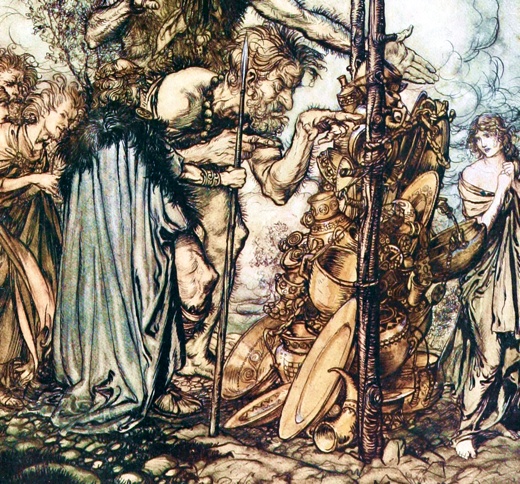

Image above: Nibelung dwarf about to seize the gold of a Rhineland maid. An illustration by Arthur Rackham (in 1910) for an English translation of the lyrics "Rhine Gold", an opera composed by Richard Wagner based on old German folklore.  From (http://thegentlemanangler.com/historic-tales/rhine-gold-with-illustrations-by-arthur-rackham/1185/).

Of all the differences that separate the feudal economy sketched out in last week’s post from the market economy most of us inhabit today, the one that tends to throw people for a loop most effectively is the near-total absence of money in everyday medieval life.

Money is so central to current notions of economics that getting by without it is all but unthinkable these days. 

The fact—and of course it is a fact—that the vast majority of human societies, complex civilizations among them, have gotten by just fine without money of any kind barely registers in our collective imagination.

One source of this curious blindness, I’ve come to think, is the way that the logic of money is presented to students in school. Those of my readers who sat through an Economics 101 class will no doubt recall the sort of narrative that inevitably pops up in textbooks when this point is raised.

You have, let’s say, a pig farmer who has bad teeth, but the only dentist in the village is Jewish, so the pig farmer can’t simply swap pork chops and bacon for dental work.

Barter might be an option, but according to the usual textbook narrative, that would end up requiring some sort of complicated multiparty deal whereby the pig farmer gives pork to the carpenter, who builds a garage for the auto repairman, who fixes the hairdresser’s car, and eventually things get back around to the dentist.

Once money enters the picture, by contrast, the pig farmer sells bacon and pork chops to all and sundry, uses the proceeds to pay the dentist, and everyone’s happy. Right?

Well, maybe. Let’s stop right there for a moment, and take a look at the presuppositions hardwired into this little story. First of all, the narrative assumes that participants have a single rigidly defined economic role: the pig farmer can only raise pigs, the dentist can only fix teeth, and so on.

Furthermore, it assumes that participants can’t anticipate needs and adapt to them: even though he knows the only dentist in town is Jewish, the pig farmer can’t do the logical thing and start raising lambs for Passover on the side, or what have you.

Finally, the narrative assumes that participants can only interact economically through market exchanges: there are no other options for meeting needs for goods and services, no other way to arrange exchanges between people other than market transactions driven by the law of supply and demand.

Even in modern industrial societies, these three presuppositions are rarely true. I happen to know several pig farmers, for example, and none of them are so hyperspecialized that their contributions to economic exchanges are limited to pork products; garden truck, fresh eggs, venison, moonshine, and a good many other things could come into the equation as well.

For that matter, outside the bizarre feedlot landscape of industrial agriculture, mixed farms raising a variety of crops and livestock are far more resilient than single-crop farms, and thus considerably more common in societies that haven’t shoved every economic activity into the procrustean bed of the money economy.

As for the second point raised above, the law of supply and demand works just as effectively in a barter economy as in a money economy, and successful participants are always on the lookout for a good or service that’s in short supply relative to potential demand, and so can be bartered with advantage.

It’s no accident that traditional village economies tend to be exquisitely adapted to produce exactly that mix of goods and services the inhabitants of the village need and want.

Finally, of course, there are many ways of handling the production and distribution of goods and services without engaging in market exchanges.

The household economy, in which members of each household produce goods and services that they themselves consume, is the foundation of economic activity in most human societies, and still accounted for the majority of economic value produced in the United States until not much more than a century ago.

The gift economy, in which members of a community give their excess production to other members of the same community in the expectation that the gift will be reciprocated, is immensely common; so is the feudal economy delineated in last week’s post, with its systematic exclusion of market forces from the economic sphere. There are others, plenty of them, and none of them require money at all.

Thus the logic behind money pretty clearly isn’t what the textbook story claims it is. That doesn’t mean that there’s no logic to it at all; what it means is that nobody wants to talk about what it is that money is actually meant to do.

Fortunately, we’ve discussed the relevant issues in last week’s post, so I can sum up the matter here in a single sentence: the point of money is that it makes intermediation easy.

Intermediation, for those of my readers who weren’t paying attention last week, is the process by which other people insert themselves between the producer and the consumer of any good or service, and take a cut of the proceeds of the transaction.

That’s very easy to do in a money economy, because—as we all know from personal experience—the intermediaries can simply charge fees for whatever service they claim to provide, and then cash in those fees for whatever goods and services they happen to want.

Imagine, by way of contrast, the predicament of an intermediary who wanted to insert himself into, and take a cut out of, a money-free transaction between the pig farmer and the dentist.

We’ll suppose that the arrangement the two of them have worked out is that the pig farmer raises enough lambs each year that all the Jewish families in town can have a proper Passover seder, the dentist takes care of the dental needs of the pig farmer and his family, and the other families in the Jewish community work things out with the dentist in exchange for their lambs—a type of arrangement, half barter and half gift economy, that’s tolerably common in close-knit communities.

Intermediation works by taking a cut from each transaction. The cut may be described as a tax, a fee, an interest payment, a service charge, or what have you, but it amounts to the same thing: whenever money changes hands, part of it gets siphoned off for the benefit of the intermediaries involved in the transaction. The same thing can be done in some money-free transactions, but not all.

Our intermediary might be able to demand a certain amount of meat from each Passover lamb, or require the pig farmer to raise one lamb for the intermediary per six lambs raised for the local Jewish families, though this assumes that he either likes lamb chops or can swap the lamb to someone else for something he wants.

What on earth, though, is he going to do to take a cut from the dentist’s side of the transaction?  

 There wouldn’t be much point in demanding one tooth out of every six the dentist extracts, for example, and requiring the dentist to fill one of the intermediary’s teeth for every twenty other teeth he fills would be awkward at best—what if the intermediary doesn’t happen to need any teeth filled this year?

What’s more, once intermediation is reduced to such crassly physical terms, it’s hard to pretend that it’s anything but a parasitic relationship that benefits the intermediary at everyone else’s expense.

What makes intermediation seem to make sense in a money economy is that money is the primary intermediation. Money is a system of arbitrary tokens used to facilitate exchange, but it’s also a good deal more than that. It’s the framework of laws, institutions, and power relationships that creates the tokens, defines their official value, and mandates that they be used for certain classes of economic exchange.

Once the use of money is required for any purpose, the people who control the framework—whether those people are government officials, bankers, or what have you—get to decide the terms on which everyone else gets access to money, which amounts to effective control over everyone else. That is to say, they become the primary intermediaries, and every other intermediation depends on them and the money system they control.

This is why, to cite only one example, British colonial administrators in Africa imposed a house tax on the native population, even though the cost of administering and collecting the tax was more than the revenue the tax brought in.

By requiring the tax to be paid in money rather than in kind, the colonial government forced the natives to participate in the money economy, on terms that were of course set by the colonial administration and British business interests.

The money economy is the basis on which nearly all other forms of intermediation rest, and forcing the native peoples to work for money instead of allowing them to meet their economic needs in some less easily exploited fashion was an essential part of the mechanism that pumped wealth out of the colonies for Britain’s benefit.

Watch the way that the money economy has insinuated itself into every dimension of modern life in an industrial society and you’ve got a ringside seat from which to observe the metastasis of intermediation in recent decades.

Where money goes, intermediation follows:  that’s one of the unmentionable realities of political economy, the science that Adam Smith actually founded, but was gutted, stuffed, and mounted on the wall—turned, that is, into the contemporary pseudoscience of economics—once it became painfully clear just what kind of trouble got stirred up when people got to talking about the implications of the links between political power and economic wealth.

There’s another side to the metastasis just mentioned, though, and it has to do with the habits of thought that the money economy both requires and reinforces. At the heart of the entire system of money is the concept of abstract value, the idea that goods and services share a common, objective attribute called “value” that can be gauged according to the one-dimensional measurement of price.

 It’s an astonishingly complex concept, and so needs unpacking here. Philosophers generally recognize a crucial distinction between facts and values; there are various ways of distinguishing them, but the one that matters for our present purposes is that facts are collective and values are individual.

Consider the statement “it rained here last night.” Given agreed-upon definitions of “here” and “last night,” that’s a factual statement; all those who stood outside last night in the town where I live and looked up at the sky got raindrops on their faces. In the strict sense of the word, facts are objective—that is, they deal with the properties of objects of perception, such as raindrops and nights.

Values, by contrast, are subjective—that is, they deal with the properties of perceiving subjects, such as people who look up at the sky and notice wetness on their faces.

One person is annoyed by the rain, another is pleased, another is completely indifferent to it, and these value judgments are irreducibly personal; it’s not that the rain is annoying, pleasant, or indifferent, it’s the individuals who are affected in these ways. Nor are these personal valuations easy to sort out along a linear scale without drastic distortion.

The human experience of value is a richly multidimensional thing; even in a language as poorly furnished with descriptive terms for emotion as English is, there are countless shades of meaning available for talking about positive valuations, and at least as many more for negative ones.

From that vast universe of human experience, the concept of abstract value extracts a single variable—“how much will you give for it?”—and reduces the answer to a numerical scale denominated in dollars and cents or the local equivalent.

Like any other act of reductive abstraction, it has its uses, but the benefits of any such act always have to be measured against the blind spots generated by reductive modes of thinking, and the consequences of that induced blindness must either be guarded against or paid in full. The latter is far and away the more common of the two, and it’s certainly the option that modern industrial society has enthusiastically chosen.

Those of my readers who want to see the blindness just mentioned in full spate need only turn to any of the popular cornucopian economic theorists of our time.

The fond and fatuous insistence that resource depletion can’t possibly be a problem, because investing additional capital will inevitably turn up new supplies—precisely the same logic, by the way, that appears in the legendary utterance “I can’t be overdrawn, I still have checks left!”—unfolds precisely from the flattening out of qualitative value into quantitative price just discussed. 

The habit of reducing every kind of value to bare price is profitable in a money economy, since it facilitates ignoring every variable that might get in the way of making money off  transactions; unfortunately it misses a minor but crucial fact, which is that the laws of physics and ecology trump the laws of economics, and can neither be bribed nor bought.

The contemporary fixation on abstract value isn’t limited to economists and those who believe them, nor is its potential for catastrophic consequences.

I’m thinking here specifically of those people who have grasped the fact that industrial civilization is picking up speed on the downslope of its decline, but whose main response to it consists of trying to find some way to stash away as much abstract value as possible now, so that it will be available to them in some prospective post-collapse society.

Far more often than not, gold plays a central role in that strategy, though there are a variety of less popular vehicles that play starring roles the same sort of plan.

Now of course it was probably inevitable in a consumer society like ours that even the downfall of industrial civilization would be turned promptly into yet another reason to go shopping. Still, there’s another difficulty here, and that’s that the same strategy has been tried before, many times, in the last years of other civilizations. There’s an ample body of historical evidence that can be used to see just how well it works. The short form? Don’t go there.

It so happens, for example, that in there among the sagas and songs of early medieval Europe are a handful that deal with historical events in the years right after the fall of Rome: the Nibelungenlied, Beowulf, the oldest strata of Norse saga, and some others.

Now of course all these started out as oral traditions, and finally found their way into written form centuries after the events they chronicle, when their compilers had no way to check their facts; they also include plenty of folktale and myth, as oral traditions generally do.

Still, they describe events and social customs that have been confirmed by surviving records and archeological evidence, and offer one of the best glimpses we’ve got into the lived experience of descent into a dark age.

Precious metals played an important part in the political economy of that age—no surprises there, as the Roman world had a precious-metal currency, and since banks had not been invented yet, portable objects of gold and silver were the most common way that the Roman world’s well-off classes stashed their personal wealth.

As the western empire foundered in the fifth century CE and its market economy came apart, hoarding precious metals became standard practice, and rural villas, the doomsteads of the day, popped up all over.

When archeologists excavate those villas, they routinely find evidence that they were looted and burnt when the empire fell, and tolerably often the archeologists or a hobbyist with a metal detector has located the buried stash of precious metals somewhere nearby, an expressive reminder of just how much benefit that store of abstract wealth actually provided to its owner.

That’s the same story you get from all the old legends: when treasure turns up, a lot of people are about to die. The Volsunga saga and the Nibelungenlied, for example, are versions of the same story, based on dim memories of events in the Rhine valley in the century or so after Rome’s fall.

The primary plot engine of those events is a hoard of the usual late Roman kind,  which passes from hand to hand by way of murder, torture, treachery, vengeance, and the extermination of entire dynasties.

For that matter, when Beowulf dies after slaying his dragon, and his people discover that the dragon was guarding a treasure, do they rejoice?

Not at all; they take it for granted that the kings and warriors of every neighboring kingdom are going to come and slaughter them to get it—and in fact that’s what happens. That’s business as usual in a dark age society.

The problem with stockpiling gold on the brink of a dark age is thus simply another dimension, if a more extreme one, of the broader problem with intermediation. It bears remembering that gold is not wealth; it’s simply a durable form of money, and thus, like every other form of money, an arbitrary token embodying a claim to real wealth—that is, goods and services—that other people produce.

If the goods and services aren’t available, a basement safe full of gold coins won’t change that fact, and if the people who have the goods and services need them more than they want gold, the same is true.

Even if the goods and services are to be had, if everyone with gold is bidding for the same diminished supply, that gold isn’t going to buy anything close to what it does today. What’s more, tokens of abstract value have another disadvantage in a society where the rule of law has broken down: they attract violence the way a dead rat draws flies.

The fetish for stockpiling gold has always struck me, in fact, as the best possible proof that most of the people who think they are preparing for total social collapse haven’t actually thought the matter through, and considered the conditions that will obtain after the rubble stops bouncing.

Let’s say industrial civilization comes apart, quickly or slowly, and you have gold.  In that case, either you spend it to purchase goods and services after the collapse, or you don’t.

If you do, everyone in your vicinity will soon know that you have gold, the rule of law no longer discourages people from killing you and taking it in the best Nibelungenlied fashion, and sooner or later you’ll run out of ammo. If you don’t, what good will the gold do you?

The era when Nibelungenlied conditions apply—when, for example, armed gangs move from one doomstead to another, annihilating the people holed up there, living for a while on what they find, and then moving on to the next, or when local governments round up the families of those believed to have gold and torture them to death, starting with the children, until someone breaks—is a common stage of dark ages.

It’s a self-terminating one, since sooner or later the available supply of precious metals or other carriers of abstract wealth are spread thin across the available supply of warlords.

This can take anything up to a century or two before we reach the stage commemorated in the Anglo-Saxon poem “The Seafarer:” Nearon nú cyningas ne cáseras, ne goldgiefan swylce iú wáeron (No more are there kings or caesars or gold-givers as once there were).

That’s when things begin settling down and the sort of feudal arrangement sketched out in last week’s post begins to emerge, when money and the market play little role in most people’s lives and labor and land become the foundation of a new, impoverished, but relatively stable society where the rule of law again becomes a reality.

None of us living today will see that period arrive, but it’s good to know where the process is headed. We’ll discuss the practical implications of that knowledge in a future post.

.

The hidden value of gardens

SUBHEAD: Much of the community economy is invisible to the market discovery of price/value.

By Charles Hugh Smith on 13 September 2014 fot Of Two Minds -
(http://www.oftwominds.com/blogsept14/hidden-gardens9-14.html)


Image above: A potato plant, flowering beneath the scarlet runner green bean trellis. From original article.

Long-time readers know I tend to see the big issues of our era in small things. For example, I see capitalism's primary flaw--the market's inability to value whatever markets cannot price--in our society's blindness to the full value of vegetable gardens.

An example of capitalism's inability to value what cannot be priced by the market's supply-demand mechanism is the loss of the wild fisheries, for example, blue-fin tuna. The market can price the last wild blue-fin tuna caught, but it cannot price the loss to the sea's food chain and web of life, nor the eventual costs of this loss to humanity. As a result of this ontological defect, we cannot possibly make fully informed or wise decisions based solely on the market value of things.

If we rely on the market to value a vegetable garden, we would weigh the garden's harvest and calculate the wholesale value of the vegetables, or perhaps the price that could be fetched for the veggies at a local farmer's market.

Let's say the market determines the "value" of the garden's output at $200. If we calculate the hours of labor needed to maintain the garden and harvest the output, this appears to be a very low return on the investment of labor (time) and capital (seeds, soil, water, compost, etc.)

But does this market-calculated value truly capture all the value intrinsic to a thriving garden? Even the most superficial survey of the spectrum of value created by a garden would find that the market captured almost nothing of a garden's true value.

Just off the top of my head, here is what a garden generates in non-market value:

-- A soothing green oasis that offers visitors immediate health benefits: lower bood pressure, calming the mind, re-establishing a connection to the natural world, etc.

-- A natural gathering place for those living nearby. A rooftop garden, for example, becomes a magnet for residents of the building, even if they express no interest in raising vegetables.

-- A source of meaning and pride for those caring for the garden

-- An irreplaceable "classroom" for learning about interactive, dynamic systems, biology, ecosystems, insects, pollinators, soil, micro-organisms

-- A source of inspiration for culinary education, art projects and other expressions of creativity and beauty

-- A workplace where participants can learn perseverance, a work ethic, how to nurture natural processes, etc.

-- An opportunity to learn the social skills of sharing and working with others

-- A healing place for people who have never had little experience with the natural world and with the healing powers of caring for something other than one's own narrow self-interest

-- A natural rallying point to form a community out of disparate individuals or deepen the bonds between neighbors

-- The joys of harvesting fresh, organic vegetables

These ten sources of value unrecognized by supply-demand pricing of marketable output do not capture the full value of a vegetable garden, but they reveal how much of what I call the community economy is invisible to market discovery of price/value. How do we value such things? Certainly not just on their market value.

.

12th Kauai Seed & Plant Exchange

SUBHEAD: A fun community event with live music and food too, highly recommended!

By Blake Drolsen on 21 September 2013 in Island Breath -
(http://islandbreath.blogspot.com/2013/09/12th-kauai-seed-plant-exchange.html)


Image above: Poster created to promote this From ().

WHAT:
12th Biannual Kauai Community Seed and Plant Exchange

WHEN:
Sunday, September 22nd, 2013 from Noon to 5:00pm

WHERE:
Kalihiwai Food Forest & Community Garden
Wai Koa Plantation
Kalihiwai Ridge
Kahiliholo Road (one half mile)

CONTACT:
Phone: (808) 652 - 4118
We wanted to remind everyone  that the 12th Biannual Kauai Community Seed and Plant Exchange is this coming Sunday, starting at Noon, going till 5pm.  This is a great community event and is a great way to get a head start on your fall planting with seeds and cuttings provided by the community, all for free!

Fun community event with live music and food too, highly recommended!

It will take place at the Kalihiwai Food Forest & Community Garden, one half mile up Kahiliholo Road at Wai Koa Plantation, on Kalihiwai Ridge.

For more information.... Call 652 - 4118 or go to http://ribg.org/rbg/?p=1654

Hope to see you there!  Come by the GMO-Free Kaua'i table and say hello.

Voices From the Trees
By Staff at Regenerations International Botanical Garden
(http://ribg.org/rbg/?p=1654)

The 12th Biannual Kauai Community Seed & Plant Exchange will be celebrated on Sunday, September 22nd from noon ‘til 5pm at the Kalihiwai Food Forest & Community Garden, one half mile up Kahiliholo Road at Wai Koa Plantation, on Kalihiwai Ridge, Halele`a. Aloha `āina, music, food, and a wealth of seeds and plants will be enjoyed by all.

Kauai is leading the way toward food self-sufficiency by establishing a community food forest near Kilauea. This 2 acre project is only 9 months old, but has already developed an overhead canopy and is producing an inspiring variety of fruits, veggies, and root crops.

Dozens of volunteers have contributed their ideas and hard work to create this food ecosystem. The project is a creative experiment in community solution-making and the inherent balance and resilience of natural ecosystems.

The experiences that people have had developing and caring for the forest have already been life-changing, and the exchange will feature several food foresters speaking about their personal journeys into a new relationship with the land and each other. Tours of the forest, explaining the various methods and plants used, will be offered by members of the Food Forest Stewardship Circle.

Regenerations Botanical Garden, which organizes the event, is also proud to introduce the public to the new site of its permanent headquarters, located adjacent to the food forest and community garden.

The 2 acre Regenerations Seed Center will be a simple yet comprehensive facility for growing, processing, storing, and distributing island adapted crops and other essential biodiversity for remediating and enhancing natural agricultural ecosystems.

The Center will be designed and built with permaculture principles and methodology, providing many opportunities for creative hands-on learning. Once complete, the Center will be a regional training destination for seed production and stewardship of plant and soil resources by local communities.

Early check-in of plant material begins at 12 noon. Those bringing seeds and plants are requested to bring only GMO-free, pest-free, non-invasive material. Participants will fill out a label that identifies the type of seed or plant they are donating, its qualities, and location where it was grown. All seeds and plants will be given freely or traded.

The exchange will take place after the 2pm blessing. Speakers will begin at approximately 3 pm, followed by music by Malama Pono Allstars. Everyone is encouraged to attend; even if you have no plants or seeds to give away, there will be plenty to receive and share. Please leave your doggy friends at home. To find out more or for volunteer opportunities visit ribg.org or call 652-4118.

This event is the result of a remarkable collaboration by many Kau`i individuals and organizations, including Regenerations Botanical Garden and Kauai Community Seed Bank, GMO-Free Kauai, Malama Kauai, The Sanctuary of LUBOF, Food Forest Stewardship Circle, Kalihiwai Community Gardeners, KKCR Kauai Community Radio, Akamai Backyard, Heaven on Earth Starts, Kauai Beekeepers Association, and `Ohana o Kauai.

CONTACT:
Jill Richardson
PO Box 1137,  Kilauea, HI 96754-1137
Phone (808) 652-4118
jr@ribg.org
Regenerations Botanical Garden
www.ribg.org

See also:
Ea O Ka Aina: 4th Seed & Plant Exchange 9/28/09
Ea O Ka Aina: 3rd Seed & Plant Exchange 2/21/09
Island Breath: 2nd Seed & Plant Exchange 9/15/08
Island Breath: 1st Seed & Plant Exchange 2/28/08


.

Universal Basic Income

SUBHEAD: A brief overview of a support for intelligent economies, quality of life and a caring society.

By Anne Ryan on 17 April 2013 for Feasta.org -
(http://www.feasta.org/2013/04/17/universal-basic-income-a-support-for-intelligent-economies-quality-of-life-and-a-caring-society/)


Image above: Free coffee and doughnuts for the unemployed in the depression. From (http://thecivicarena.org/2013/01/03/was-jesus-a-socialist-or-a-capitalist-4-its-not-fair/free-coffee-doughnuts-and-soup-for-the-unemployed/).

Introduction
The system for social security as it has developed in Ireland and many other European countries is not working. It was designed for a different era, to provide income security for the relatively small numbers of people who became temporarily unemployed from standard jobs. Efforts to patch it up in response to new needs have been piecemeal.

On the other hand, some EU countries, such as Italy and Greece, have no social security system in place. We need a proactive new system, building on the old system’s principles of security and social solidarity, but far more inclusive. Basic financial security should be a right for all members of society. A system that could achieve this is universal basic income, sometimes called a citizens’ income or dividend, and referred to as basic income in this short introductory paper.

Basic income is a regular and unconditional distribution of money by the state to every member of society, whether they engage in paid work or not. Basic income is always tax-free and it replaces social welfare payments, child benefit and the state pension as we currently know them. It also extends to all those who currently receive no income from the state. Ideally, a basic income would be sufficient for each person to have a frugal but decent lifestyle without supplementary income from paid work.

Basic income would bring into the security net all those not served by the current system: casual and short-contract workers who get no or limited sick pay, holiday pay or pension rights; self-employed people and business owners; those doing valuable unpaid work, including care, which adds value to society and economy. Basic income would increase everybody’s capacity to cope with financial shocks and uncertainties and would improve general quality of life, while supporting many different kinds of work, with or without pay.

Currently, those receiving welfare are badly served by the system: if they take paid work, especially low-paid or temporary, they often lose out financially, in a ‘benefits trap’. With basic income, there would always be a financial incentive for people to earn a taxable income, should a job be available. Employers would also welcome the ending of the benefits trap.

For those in sporadic or seasonal employment, a basic income would eliminate the need to sign on and off and the payment delays that often occur. The possibilities for welfare fraud would be minimised, with everyone playing by the same rules in a simpler system. This would also eliminate the current bureaucracy and intrusive scrutiny of claimants’ circumstances.

Advantages to business
Running a business would be a different kind of experience. The income from it would be a top-up to a basic income. This would be a boost to existing businesses. It would also free people to try out business ideas, and the businesses would be viable as long as they made some small profit. They might even be able to carry losses for a short time while the business got established. There would be no harm done if the business failed, because the people involved would have their UBI to fall back on. It would also allow social entrepreneurs, who are not motivated by profit, to thrive. It would be a particularly good support for cooperative and partnership ventures.

It is often difficult in the present climate for small businesses to act ethically and survive. Fair trade is not always as profitable as so-called free trade. A UBI, by providing basic financial security for self-employed people and all involved in a business, would help truly ethical businesses to survive.

A basic income would also allow businesses to run a natural life cycle, fulfil a purpose and then die off naturally. Businesses that are successful often reach all their potential customers, serve them well, and then go out of business because their market has been saturated. They have cycles, like everything else in nature. However, in the modern growth mindset, a business is not regarded as successful unless it is constantly expanding; we find it hard to accept that businesses come to an end. A basic income would also mean that businesses that don’t want to grow can function at the same size for a long period.

A basic income would allow for the enforced closing of businesses (of any size) that are socially or ecologically harmful, such as weapons producers or big polluters. With their basic incomes to provide basic financial security, if a business was threatened with such closure, owners and employees could work (together or separately) to devise an alternative plan for the company. At the same time, all workers have financial security and greatly increased individual choices.

Basic income is a necessary part of any coherent state strategy for fostering private-sector business and entrepreneurship in the future. By providing basic securities for those wishing to start a business, it would create a supporting scaffold on which enterprise, creativity and inventiveness can flourish.

Employees
All employees would get increased bargaining power (individual and collective) within their jobs, because they would not be reliant on income from work to supply basic needs. Those who were dissatisfied with their type of work or with their work conditions would have better chances to negotiate other ways to live and work.

Young people
Young people, who currently face a very precarious future, would have much more meaningful choices and possibilities available if they had a basic income. Pressures to emigrate for financial reasons would be reduced. Basic financial security opens up possibilities for creativity, employment, entrepreneurial and educational pursuits and voluntary work.

Low-paid work
Basic income would make low-paid work more financially viable than at present, since the pay would be a top-up to the basic income. A great deal of caring, artistic and political work is low-paid, but of direct social benefit. If a low-paid job were also dead-end work, a person would have a genuine exit possibility. Anybody, in any kind of paid work (high- or low-paid), who considered the work to be personally, socially or environmentally harmful, would have improved choices about staying or going.

A shorter work-hours culture

Basic income would also make shorter hours in paid work financially viable for greater numbers of workers. If more people chose shorter hours of paid work, this would create employment opportunities for others. There is a growing body of evidence that working shorter hours on the job has environmental benefits, since stressed workers in a hurry consume more high-carbon goods and services. Personal health and wellbeing, time for family, household, community and civic engagement also benefit when people are less engaged with the demands of ‘full time’ jobs.

Government would ideally support this by legislating for practical changes in administration and taxation practices, to make things easier and simpler for employers. They should not be penalised and should ideally be rewarded for taking on more employees, working shorter hours.
 

Paying for basic income
It is possible to pay for basic income in Ireland, with our existing revenue system. It would replace almost all existing social welfare provisions (top-ups would be put in place for people with special needs), so the amount currently spent on welfare is immediately available. Employers would make a social-resources payment, to replace the present employer’s PRSI. The rest would come from an increase in income tax, which would be paid on all personal income over and above the UBI.i

Talk of increased income tax generates strong reactions, usually negative. But most people ignore the fact that the extra revenue taken in tax would be returned as UBI. In other words, the extra tax we would pay to finance basic income would be offset by the UBI received.

The income-tax source of funding is the simplest and most do-able right now. But ultimately, there is a need for a fairer tax code, more compatible with goals of sustainability and resilience. Such a tax code would keep taxes on labour low and charge high taxes (or economic rent) on resource use. Site- and land-value taxes would be an excellent start. There is also a need for democratic monetary reform, a shift to treating money as a social resource and a public good. And there is a need to start creating regional currencies and local currency commons.ii There is also the possibility of part-funding a global basic income through the Cap and Share or Cap and Dividend frameworks.iii
The important point for now, however, is that any Irish government making a priority of basic financial security for all could afford to introduce it.

Savings would arise from eliminating the bureaucracy of the present social security system. With better quality of life, thre would be less demand on public services such as hospitals, courts, mental health services and prisons.
Conclusion

Basic income would undoubtedly financially benefit some people more than others. Those who would benefit most are the most vulnerable in the current work-welfare system: people doing valuable unpaid work, including care, political and social activism and all kinds of cutting-edge pioneering projects. It would also help those caught in the ‘benefits trap’, people in precarious employment, the self-employed and young people. It would give people financial support to avoid high-carbon and other polluting and damaging work, and to devise low-carbon lifestyles. It would increase the contribution made by those who are already very well off. But if the well-off did fall on hard times, the basic income would provide basic financial support, without welfare applications or delays.

Basic income is not a panacea; it will not solve all our social, ecological or debt problems, nor does it claim to. But it creates the conditions for creative solutions, rather than blocking them, as much of our present social security system does. It is an immediate injection of liquidity into the ‘real economy’ of everyday goods and services and it is an essential investment in a resilient and positive future for all. It would work best if combined with a fairer tax code, especially site- and land-value taxes, and accompanied by democratic monetary reform and the creation of diversity in local and regional currencies. But even standing alone, it would release many talents and energies that are constrained by the present work-money system.

The social inclusion and care for each other that underpins basic income would foster solidarity and tolerance and reduce the resentment, divisiveness and cynicism that can occur when people experience wildly different levels of security. Increased social inclusion creates conditions for greater civic participation and deeper democracy. It deflates the claims of far-right groups, who play on the fears and insecurity of populations, and claim that their undemocratic methods can provide a better life. With basic income, the state functions to pre-distribute money, it provides a basic security at the broad parameters of society and economy and allows unlimited creativity and diversity in the ways people choose to live and work.
Get involved

There is an active international basic income network (BIEN) on all continents. Visit the international website at http://www.basicincome.org/bien/
The Irish network is one of the oldest affiliates and has recently launched a website at www.basicincomeireland.com.
You can find many resources and links on the various websites.
The European Citizens Initiative for an Unconditional Basic Income is a campaign to collect one million signatures to call on the European Commission to encourage cooperation between the Member States to explore Unconditional Basic Income (UBI) as a tool to improve their respective social security systems.

Please visit their site and sign their petition at: http://basicincome2013.eu.
 

Endnotes
i. Seán Healy, Michelle Murphy, Seán Ward, and Brigid Reynolds (2012) ‘Basic Income Why and How in Difficult Times: Financing a BI in Ireland’, paper presented to BIEN (Basic Income Earth Network) Congress, Munich, Sept 14th. http://www.bien2012.de/sites/default/files/paper_253_en.pdf
ii. Emer Ó Siochrú (2012) (ed) The Fair Tax. London: Shepheard-Walwyn
Feasta Liquidity Network http://www.feasta.org/documents/liquidity_network/2009_liquidity_network.html
Margrit Kennedy (2013) Occupy Money: Creating an Economy Where Everybody Wins. London: New Society.
Mary Mellor (2010) The Future of Money: From Financial Crisis to Public Resource. London: Pluto
Prosper Australia (2012) http://www.youtube.com/watch?v=bnznB2g_La0
Smart Taxes, www.smarttaxes.org
Sensible Money, www.sensiblemoney.ie
Positive Money, www.positivemoney.co.uk
iii. http://www.capandshare.org/
http://www.ilsr.org/instead-cap-and-trade-cap-and-dividend/
.

11th Biannual Seed-Plant Exchange

SUBHEAD: Regenerations Botanical  Garden presents the Kauai Community Seed & Plant Exchange.

By Juan Wilson on 5 March 2013 for Island Breath -
(http://islandbreath.blogspot.com/2013/03/11th-biannual-seed-plant-exchange.html)


Image above: Detail of poster for 11th Annual Kauai Community Seed & Plant Exchange. Clikc to enlarge for print.

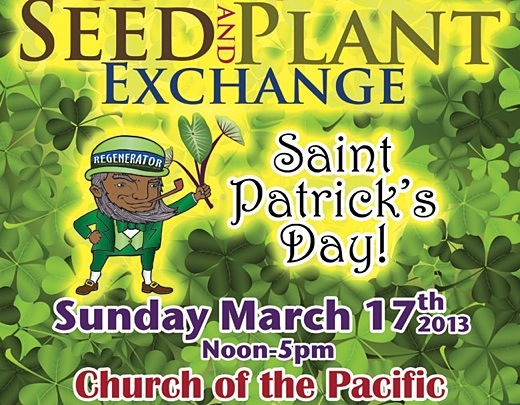
Kaua`i gardeners and planters are invited to get lucky at the 11th bi- annual Seed and Plant Exchange this St Patricks Day. This free event is on March 17th from 12-5 pm at the Church of the Pacific in Princeville. Please bring GMO free, pest free, non-invasive seeds, cuttings and plants to share with others.

WHAT:
Bring and take free seeds and plants at this community exchange.

WHEN:
Saint Patrick's Day
Sunday, March 17th, 2013
from noon to 5:00pm

WHERE:
Church of the Pacific
5-4280 Kuhio Highway
Princeville, Kauai, Hawaii

SCHEDULE:
Registration Noon-1:45pm
Pule (prayer) 2:00pm
Keynote 3-4:00pm
"Shoulders of Our Ancestors" by seedsman Forest Shomer

ALSO:
Live music and All Kauai Luau

CONTACT:
Jill Richardson
PO Box 1137,  Kilauea, HI 96754-1137
Phone (808) 652-4118
jr@ribg.org
Regenerations Botanical Garden
 www.ribg.org

See also:
Ea O Ka Aina: 4th Seed & Plant Exchange 9/28/09
Ea O Ka Aina: 3rd Seed & Plant Exchange 2/21/09
Island Breath: 2nd Seed & Plant Exchange 9/15/08
Island Breath: 1st Seed & Plant Exchange 2/28/08

.

Free Taro in Waimea

SUBHEAD: Today, 1/11 3-6pm, there will be a free taro giveaway in Waimea between Ishihara's and the Shell station.

By Phoebe Eng on 11 January 2013 for Island Breath -
(http://islandbreath.blogspot.com/2013/01/free-taro-in-waimea.html)


Image above: Serial view of Waimea Valley taro patches near Menehune Road. From (http://www.flickr.com/photos/inter-island_helicopters/3858782606/).

If you haven't heard the news yet, Ka Piko o Waimea (the wonderful group of young Waimea Valley "next generation" leaders that wanted very much to run the Makaweli Poi mill) will be GIVING AWAY FREE taro today, 3-6 pm, at the open area between Ishihara and Shell in Waimea town!

Come pick up your bag of taro and ask your friends to come--

This is a community and outreach event where you can meet and talk story with Ka Piko leaders and board members, hear more about their "taro culture" vision, and find ways to support their work.

These young leaders really stepped up to the plate in their recent dealings with OHA. Let's help them by coming to their taro giveaway, even for a few minutes, and showing support for a next generation of west side cultural leaders.

Should be fun too!

.

Sacred Economics

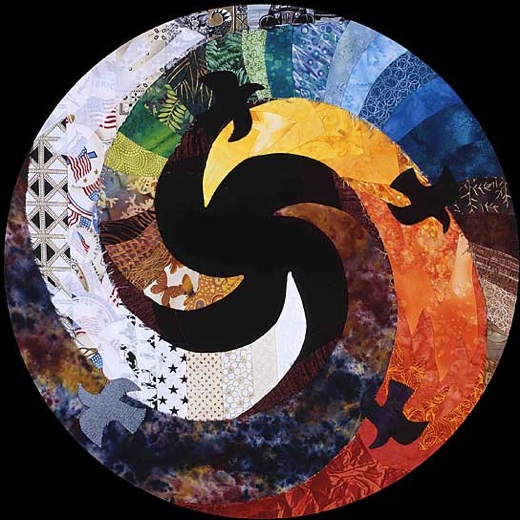
SUBHEAD: Charles Eisenstein wants to devalue your money to save our economy... as a gift economy. By Erik Curren on 15 August 2012 for Transition Voice - (http://transitionvoice.com/2012/08/charles-eisenstein-wants-to-devalue-your-money-to-save-the-economy/) Image above: "Passion of the Earth #7 Abundance" fabric image by Melanie Weidner. From (http://blog.naver.com/PostView.nhn?blogId=purple_gem&logNo=56638674&redirect=Dlog&widgetTypeCall=true).

Imagine if you had a warehouse full of bread that would go stale in three days. You’d want to get rid of it as quickly as possible. Of course, you wouldn’t try to sell it at premium prices. Instead, you’d want to hold a liquidation sale. Or, maybe even not go through the bother of trying to sell it at all — just give it away. In that way, you’d earn both gratitude and favors that you could call in later. In a sense, giving away all your bread would become an investment in social capital.

Or, consider the linguist who asked an indigenous hunter from Brazil’s Piraha tribe why, when he felled some big game, he threw a big feast, letting his guests eat up all the meat in one orgy of indulgence, instead of thriftily drying the meat to save it for the future? In response, the hunter laughed and replied, “I store meat in the belly of my brother.”

Charles Eisenstein, author of Sacred Economics: Money, Gift, and Society in the Age of Transition, told me these two stories in a recent interview as a way to illustrate how wealth can reside in human relationships rather than merely be stored up goods or in their proxy — money.

Nature and relationships

The last two centuries stand out from the rest of human history for the dominance of money as a medium of exchange. “Most of our ancestors didn’t use money very much, not for food, shelter, clothing, or entertainment. All these were done by people helping each other out in the family or extended family,” Eisenstein told me.

In the past, only a small part of the population, mostly merchants, handled money on a regular basis. Now, nearly everybody needs money just to buy daily necessities.

Ever since the Industrial Revolution, the marketplace has expanded from a sideshow into the world economy’s main event. ”The monetized realm has grown, converting nature into products and relationships into paid services until there’s almost nothing left to convert anymore,” Eisenstein told me.

We can’t cut down more forests or increase the fish catch. What’s less recognized is that the social space to convert relationships into services has almost reached its peak too. We pay for almost everything, even the most intimate things, like cooking meals. People hardly sing anymore — we pay for our entertainment. There’s almost no community left, community being a group of people who share gifts. You look at your neighbor driving out of his garage in his car and you might say hi, but behind that there’s a view that you don’t need each other.

Aside from the anomie and alienation this creates for people, the problem is that peak nature and peak relationships are together slowing growth and starving the economy.

Our economy cannot function without growth because most money is not printed by governments, as people usually imagine, but is instead loaned into existence by central banks and commercial lenders, who can loan out ten dollars or more for every dollar they’re required to have in their vaults. In effect, then, a lender creates new money with every loan.

And the whole point of making loans is to earn interest for the lender.

But for the borrower, interest obliges her to pay back more than she borrowed. And to earn the money to pay back the principal plus accumulated interest, the borrower will need to create goods and services. Multiply that out across the whole economy, and it becomes an imperative for economic growth.

“Without growth, debt increases faster than income and wealth and the whole system crashes. Before that, you get polarization of wealth income and unemployment,” Eisenstein said, aptly describing today’s plutocratic rule by the top 1%.

So, since all national currencies, whether the dollar or the Euro or the Yuan, allow lenders to earn interest, the whole economy becomes addicted to economic growth. As long as we continue to let banks create our money through their loans, we’ll all have to keep creating more goods and services, thus despoiling the Earth and exploiting each other just to stay above water.

If we don’t, we’ll all wind up like Greece.

Like inflation, only better?

Financial elites have done well indoctrinating the ordinary citizen about the dangers of inflation, with stories of the horrors of double-digit price increases under Ford and Carter or hyperinflation in 1920s Germany or 2000s Zimbabwe.

Today, it’s hard to imagine that many ordinary Americans in the late nineteenth century, especially farmers, actually clamored for more inflation as a way to reduce the burden of their debts. That’s why their champion, populist William Jennings Bryan, famously denounced inflation-resistant hard currency as a “Cross of Gold.”

Like a modern-day Bryan, Eisenstein wants money to decline in value. But for him, it’s as much about saving the Earth from predatory economic growth as it is about saving the farm from the bank.

“The problem with money is this growth imperative that converts everything into itself. And we’re reaching the peak of that,” Eisenstein explained. “It’s not about ‘sustainable growth,’ which is an oxymoron. And it’s not about finding some way to keep the growth system working. It’s about reclaiming life from money. It doesn’t mean eliminating all money but instead taking back certain realms, the natural and social commons, away from money.”

And to do that, Eisenstein proposes a new-and-improved kind of money: negative-interest currency. Essentially, it would be money that spoils.

With today’s money, you can hoard it in a CD and just sit back and watch the interest compound. That encourages rich people to hoard money. But with negative-interest currency, any saved money would depreciate at a fixed rate, perhaps 2% annually, unless it were lent out (at no interest) to start new businesses or pay for something else useful. Built-in depreciation would discourage hoarding by creating a hot-potato effect, where people want to get money out of their hands as soon as possible before it starts to lose value. As Eisenstein explained to me:

Negative interest is a different kind of money system. For example, it could involve a liquidity tax or charge on reserves in the Fed or central bank system. If banks hold onto their money as they do today, their money would slowly shrink in value. So would your checking account. So it gives you an incentive to lend your money, even at zero interest. Thus, you can have money circulate without an imperative for growth…It amounts to a slow-motion debt forgiveness, kind of like inflation in that it works to the benefit of debtors and against the interest of creditors. For those of us living paycheck-to-paycheck, it would have little effect except to help us to pay back debts more easily.

But if you want money that goes down in value, doesn’t inflation already do that?

With today’s real inflation rate closer to 8% rather than the official 2% or 3% claimed by the Consumer Price Index on the one hand, and loan interest rates near zero on the other, it might seem like the US dollar has already become a negative-interest currency.

The difference between inflation and demurrage is complex, but the best simple explanation I could find was from the fine folks at Wikipedia: “Both inflation and demurrage reduce the purchasing power of money held over time, but demurrage does so through fixed, regular fees while inflation does so through expansion of the money supply through the actions of a central monetary authority distributing the new issue of currency.”

In other words, the US dollar inflates unpredictably under the influence of the Fed and the big banks acting in their own interests, while a local currency with demurrage is under local control and managed predictably to boost the local economy.

Neither a shitty deal nor a New Deal

By intentionally putting the brakes on economic growth, negative-interest money might discourage the kind of Wall Street speculation that crashed the economy in 2008, which was summed up so aptly by Senator Carl Levin (D-MI) quoting an internal Goldman Sachs memo that frankly assessed one particular bad investment the firm was pushing on its clients: “A shitty deal.”

After the last big banking collapse, during the Depression, a so-called demurrage currency was actually tried in the blighted and heavily indebted town of Wörgl, Austria from 1932-33 to create what Eisenstein called an “economic miracle” that other areas sought to emulate.

These included dozens of towns in the United States that had already printed emergency local scrip to keep their economies moving during forced bank holidays. According to Eisenstein, some communities were preparing to follow a plan for local no-interest currencies from economist Irving Fisher. But as part of the New Deal compromise with the big banks who feared that Fisher’s plan would take power out of the hands of Wall Street, in 1933 President Roosevelt outlawed all local currencies and instead offered a massive, centralized program of public works.

As in the 1930s, today rich people and corporations are hoarding massive amounts of savings — more than $3 trillion – waiting for an opportunity to earn higher returns in the future. At the same time, small businesses and working families remain starved for capital. To break this logjam, Eisenstein thinks that now is the right time for localities to start printing their own interest-free money with depreciation built right in.

The powers-that-be continue to tell us that recovery is just around the corner. But fewer and fewer Americans are comforted by these hollow assurances, which for Eisenstein, represents a failure of the magic power of the elites over the people.

“The Fed cutting rates doesn’t seem to work anymore. When magic stops working it means the substructure of agreements, the deep myths underlying the interpretation of symbols are wearing thin.”

Walking away from Rome

If enough localities opted out of the dollar zone by starting their own local currencies, then pretty soon Wall Street and Washington could just be talking to each other with nobody else listening. The rest of us would be too busy trying to keep our money circulating in our own towns.

But there is a sticking point. If a negative-interest currency encourages us to spend rather than save, how can we be sure consumers will spend their money only on things that are good for people and the planet? What’s to keep people from continuing to buy SUVs or Walmart clothes from sweatshops in China?

There’s another rub. If bankers and the president shut down local currencies in the thirties, why will today’s banksters and their captured president be any more willing to let American communities print demurrage money that would allow them to defect from the growth economy?

“The elites can barely hold it together right now. Stuff they would’ve happily squashed a generation or two ago is now just passing beneath their notice, partially from the dynamic of complex systems, which, as they get more complex also get harder to maintain,” Eisenstein told me.

Each investment in additional complexity gives you diminishing returns and eventually zero returns and then things fall apart. The elites can’t be bothered to squash everything. Also, the shift towards an ecological consciousness is happening everywhere, even among the elite…They’re having personal crises, they’re quitting their jobs, they’re defecting or else they’re just not really enthusiastic about doing what they’re supposed to do. And sometimes they’ll allow something they really shouldn’t allow if they want to maximize central control.

Interested? Learn more by watching the video teaser for Sacred Economics.

Video above: "Sacred Economics" with Charles Eisenstein. From (http://youtu.be/EEZkQv25uEs). .