Showing posts with label Work. Show all posts

Life after economic growth

SUBHEAD: We are remembering how to build a world in which there will be time for music.

By Shaun Chamberland on 15 November 2018 for Tikkun -
(https://www.tikkun.org/nextgen/the-sequel-life-after-economic-growth)


Image above: From ().

As Simon Mont wrote in Tikkun’s recent issue on the New Economy, “capitalism is collapsing under the weight of itself, and it’s not pretty.”[i]

Our globalised world finds itself caught on the horns of a seemingly impossible dilemma – either cease growing, and so collapse the economy on which we all depend, or continue to grow until we overwhelm and destroy the ecosystems on which we all depend.

As my late mentor, the historian and economist David Fleming, put it,
It is certain that there are no simple answers to this—none that could be proposed without proposing at the same time a transformation in the whole of the way we think, work and order our lives.[ii]
And yet, faced with this fundamental systemic conundrum, our leaders hold tight to their simple answer – growth.  Having worked supporting people with drug addiction for several years, it is hard to escape the parallels to the more tragic cases.  The dire consequences of our choices are piling ever higher around us, threatening the very continuation of our lives and those around us.

And the response is to double down on the current path and turn a blind eye – to sink deeper into denial.  It is just too difficult, too brave, to undergo that dark night of the soul – to admit the problem, to seek a new paradigm.

So we hear it over and over – we must keep growth high, keep unemployment low.  Donald Trump’s recent Twitter boast that U.S. GDP growth (4.2%) was higher than unemployment (3.9%) for the first time in over a century was both inaccurate and bizarre, but it betrays his allegiance to these numbers.
And of course, he is far from alone.  All his peers are junkies too.

Most people – even most economists – never question the desirability of these measures, as if mastery of them could somehow heal an economy so violently contrary to our human instincts and desires that it leaves epidemics of depression, loneliness and suicide everywhere it goes.  That sparks not only economic and environmental devastation, but cultural and spiritual annihilation.

As if there were not something deeper, something larger, going on here.
~~~
So let’s step back for a minute.  First, “keep unemployment low”.  The appeal is easy to see, but what’s really going on here?

Consider the great economist John Maynard Keynes’ prediction, in 1930, that by the year 2000 the onward march of technology would lead to an average 15 hour working week in countries like the U.S. and U.K.  Naturally he saw this as progress – not a doom-laden prophecy of mass unemployment – and this fact begins to expose the inherent contradiction in the aim of maximising employment.

What economists see as wastefully underutilised ‘spare labour’ is what most of us might call spare time—time enjoyed outside the formal economy—a welcome part of a life well lived rather than a ‘problem of unemployment.’[iii]

Of course, modern life is not noted for the utopian, leisurely daily routines enjoyed by the bulk of the population.

 So why was Keynes wrong?  Certainly not because the rate of technological advance over the past century failed to live up to his expectations.  No, rather because our economic paradigm literally makes widely-shared leisure time impossible.

To see why, Fleming invites us to take a further step back.  He notes the startlingly extensive holidays (five months of each year, in some places) achieved in medieval Europe.  How were the good folk of the Middle Ages able to enjoy so much more leisure time than we are in our technologically-advanced society?  He explains,
In a competitive market economy a large amount of roughly equally-shared leisure time – say, a three-day working week, or less – is hard to sustain, because any individuals who decide to instead work a full week can produce for a lower price (by working longer hours than the competition they can produce a greater quantity of goods and services, and thus earn the same wage by selling each one more cheaply).
These more competitive people would then be fully employed, and would put the more leisurely out of business completely. This is what puts the grim into reality.[iv]
So in an economy like ours, a technological advance that doubles the amount of useful work a person can do in a day becomes a problem rather than a benefit. It tends to put half the workers out of work, turning them into a potential drain on the state (or simply leaving them destitute).

In theory all the workers could just work half-time and still produce all that is needed, as Keynes predicted, and as is promised all over again by today’s latest wave of automation techno-utopians.[v]

But in practice workers are often afraid of having their pay cut, or losing their jobs to a stranger who is willing to work longer hours.

In the absence of a sense of community or mutual trust, and having been taught to seek their security in a wage, people instead compete against each other for the right to perform the pointless tasks that anthropologist David Graeber memorably characterised as “bullshit jobs.”[vi]
 
Meanwhile, governments see that the only way to keep unemployment from rising to the point where the system breaks down is through endless economic growth, which thus becomes a non-negotiable obligation – a dogma.  Ah, here’s our second simple imperative, “keep growth high”…

The problem here is elementary, brutal math.  Economists tell us that 2-3% growth annually, give or take, is necessary to stop avoid recession or depression.  Arithmetic tells us that if something grows at 2% a year, it will double in size in 35 years.  At 3% a year it will double in 24 years.  At Trump’s claimed 4.2%?  17 years.
~~~
Can we seriously imagine our world in just two or three decades with twice the economic activity – twice the oil extraction, twice the intensive agriculture, twice the manufacturing, twice the pollution?

And then in two or three more decades doubling again, to four times the size of today’s economy…  Even superabundance like that of the natural world cannot indefinitely support an exponentially growing parasite.[vii]

It’s a remarkably straightforward point; just arithmetic.  And yet it remains respected mainstream opinion that we should just keep growing, quietly crossing our fingers that somehow Nature – the economy upon which all others depend – will defy both physics and math and continue to bail us out forever.  As Fleming put it,
Civilisations self-destruct anyway, but it is reasonable to ask whether they have done so before with such enthusiasm, in obedience to such an acutely absurd superstition, while claiming with such insistence that they were beyond being seduced by the irrational promises of religion.[viii]
In this context, then, it’s no surprise to be hearing increasingly shrill, desperate alarm from scientists around the world as they observe the natural world crumbling under the impossible, ever-growing pressure.

As I write, the latest report announced that 60% of mammals, birds, fish and reptiles have been annihilated since 1970.  Put starkly, most of the wild nature that was here fifty years ago is gone.  And still we seek to grow the human economy, and cheer when that growth accelerates.[ix]

Similarly, the inherently conservative Intergovernmental Panel on Climate Change released their Global Warming of 1.5ºC report, which makes it abundantly clear that the unfolding physical realities studied by climate science are dramatically outpacing the policies notionally intended to address them.

They find that we must halve emissions in the next twelve years, and so feel forced to call for “rapid and far-reaching … unprecedented” transformation in the economy.[x]

Hence it has become impossible to be simultaneously realistic about both the political climate and the science of climate.  The two stubbornly refuse to reconcile, so we are forced to decide which carries more weight, and then be profoundly unrealistic about the other.

To take present policy seriously demands a total rejection of the science.  To take the science seriously demands a total rejection of the policy on the table.  And so grassroots movements like the Extinction Rebellion and Climate Mobilization are emerging – the realists of a larger reality.

They recognise that the dominant politico-economic paradigm leads to nothing but a literal dead end.  We are on the cusp of a fundamental shift, for better or worse – either we change direction or we end up where we are headed.
~~~
It’s interesting then that a change of direction is exactly what electorates have been voting for, or at least trying to.  Globalisation and neoliberalism are not only destroying our collective future, but have also all-but-destroyed the present for many, as the neofeudalism termed ‘austerity’ continues to bite.

The common factor behind unexpected election results like Trump in the US, Brexit and Corbyn in the UK and Bolsonaro in Brazil appears to be desperate rejection of the establishment and the status quo.

Unfortunately, in such times, when more and more people are struggling to support their families, and losing faith in the dominant stories of what is important, the far right has a track record of providing simple answers.  It is important to remember that fascists like Mussolini and Hitler didn’t only consolidate power on the basis of lies and fear—they also raised wages, addressed unemployment and improved working conditions.

To effectively challenge the drift into fascism, then, we need to present an alternative politico-economic vision that can restore identity, pride and economic well-being. We need to tell a beautiful story of how we will make the future better for the desperate, rather than a fearful one.  To provide a grounded, compelling alternative to a future I have no desire to live through.

This is what Fleming devoted his life to developing.  Fifty years ago he saw the central dilemma of our times approaching, and devoted his life to facing the inevitable question – what might a life-sustaining, nourishing economy look like, after the impending end of economic growth?
This culminated in his posthumous 2016 book Surviving the Future: Culture, Carnival and Capital in the Aftermath of the Market Economy.

Therein, he reminds us of just how unusual today’s ‘ordinary’ is, and how profoundly unrealistic it is to pin our hopes on market capitalism – an economic system that has existed for less than 1% of recorded history and is already not only destroying its own foundations, but those of life on Earth.  In his words,
The Great Transformation has already happened. It was the revolution in politics, economics and society that came with the market economy, and which hit its stride in Britain in the late eighteenth century.

Most of human history had been bred, fed and watered by another sort of economy, but the market has replaced, as far as possible, the social capital of reciprocal obligation, loyalties, authority structures, culture and traditions with exchange, price and the impersonal principles of economics.[xi]
This historical context is critical.  The New Economy that we need is, in many ways, the Old Economy.  It is time to rediscover the ways human beings related to each other for hundreds of thousands of years before we were ripped into isolation by the brief historical anomaly of market capitalism, into which all of us alive today happened to be born.  As Mont put it:
[The New Economy] is a groundswell to relying on a memory harbored in our hearts to make real a vision of humans returning to deep relationships with earth, spirit, and each other, that is constantly evolving and changing, while staying acutely cognizant of the fact that we must relearn how to keep ourselves alive without capitalism and extraction.[xii]
Fleming took that dear memory harbored in our hearts and wrote it large across the page.  “We know what we need to do,” he writes, “We need to build the sequel, to draw on inspiration which has lain dormant, like the seed beneath the snow.”
~~~
His sparkling, tantalising writing has become a touch-stone for thousands of communities around the world who are putting it into practice, with his startling seven-point protocol for an economics based in trust, loyalty and local diversity one of the key factors in the birth of the now-global Transition Towns movement.

Drawing on the work of the likes of Edgar Cahn, Fleming provides the radical but historically-proven sequel to today’s capitalism: focusing neither on the growth nor de-growth of the market economy, but on huge expansion of the ‘informal’ or non-monetary economy—the ‘core economy’ that keeps our society alive, even today.  This is the economy of what we love: of the things we naturally do when not otherwise compelled, of music, play, family, volunteering, activism, friendship and home.

Refreshingly – uniquely perhaps, among modern economists – he argues that the key to sustaining a post-growth economy is culture and community.  Those extensive holidays of former times were far from a product of laziness.  Rather they were, in an important sense, what men and women lived for.  ‘Spare time’ spent in feasting, performing, collaborating and merrymaking together formed the basis of communal bonding, membership and trust.  As one of his readers put it – when productivity improves, “in our system you have a problem; in Fleming’s system you have a party.”

These shared cultural ties then bind people together in cooperation, support and solidarity, the essential foundations for the communities which have thrived throughout history in the absence of economic growth or full-time employment.  As Fleming writes,
The [future] economy will depend for its existence on a deep foundation in culture. It is possible to live without it, but only for a time, like holding your breath under water.[xiii]
This is a key lesson for our organising and our community work.  With its rare blend of charm and rigour, Fleming’s writing reminds us that nurturing the core economy back to health – getting to know people, enjoying time together and helping to provide for each other’s basic needs – is not merely some quaint and obsolete sharing longing, but an absolute practical priority.

Over the past couple of centuries, this core economy has been much weakened, as the ever-growing stresses of precarious employment and rising prices have left people with less time and energy for friends, family and fun.

But as we in communities around the world spend our days relearning how to seek our security in each other rather than in money, we notice that the unfolding collapse of the omnicidal growth economy becomes less something to fear, and more something to celebrate.

We think less about what we might stand to lose and far more about the joys we had already lost and are slowly learning to regain, together.  At long last we are remembering how to build a world in which, as David put it, “there will be time for music.”


[i] Mont, S. (2018). Introduction to the next economy. Tikkun, Volume 33, Number 3:16-17.
[ii] Fleming, D. (2016). Surviving the Future: Culture, Carnival and Capital in the Aftermath of the Market Economy (p. 129). White River Junction, VT: Chelsea Green Publishing.
[iii] Keynes, J. M. (1930). Economic Possibilities for our Grandchildren.  Available at: http://www.econ.yale.edu/smith/econ116a/keynes1.pdf
[iv] Fleming, D. (2016). Surviving the Future: Culture, Carnival and Capital in the Aftermath of the Market Economy (p. 75). White River Junction, VT: Chelsea Green Publishing.
[v] These claims have a long history.  The Democratic Review, impressed by the new technologies, predicted in 1853 that by 1900, “men and women will then have no harassing cares or laborious duties to fulfil.  Machinery will perform all work – automata will direct them.  The only task of the human race will be to make love, study and be happy”.
[vi] Graeber, D. (2013). On the Phenomenon of Bullshit Jobs: A Work Rant. STRIKE!, Issue 3.  Available at: http://strikemag.org/bullshit-jobs
[vii] In the words of Prof. Albert Bartlett, “The greatest shortcoming of the human race is our inability to understand the exponential function.”  His legendary ‘Arithmetic, Population and Energy’ lecture is one of the most important ever recorded and widely available online, e.g. at: https://www.albartlett.org/presentations/arithmetic_population_energy.html
[viii] Fleming, D. (2016). Surviving the Future: Culture, Carnival and Capital in the Aftermath of the Market Economy (p. 180). White River Junction, VT: Chelsea Green Publishing.
[ix] WWF (2018). Living Planet Report – 2018: Aiming Higher. Grooten, M. and Almond, R.E.A. (Eds). Gland, Switzerland.
[x] IPCC (2018). Global Warming of 1.5ºC, Summary for Policymakers (p.21).  Available at: http://report.ipcc.ch/sr15/pdf/sr15_spm_final.pdf
[xi] Fleming, D. (2016). Surviving the Future: Culture, Carnival and Capital in the Aftermath of the Market Economy (p. 179). White River Junction, VT: Chelsea Green Publishing.
[xii] Mont, S. (2018). Introduction to the next economy. Tikkun, Volume 33, Number 3:16-17.
[xiii] Fleming, D. (2016). Surviving the Future: Culture, Carnival and Capital in the Aftermath of the Market Economy (p. 40). White River Junction, VT: Chelsea Green Publishing.

Shaun Chamberlin  authored the Transition movement’s second book, The Transition Timeline, and has served as both chair of the Ecological Land Co-operative and a director of Global Justice Now.  He is the executive producer of 2019 film The Sequel: What Will Follow Our Troubled Civilisation? and editor of several books, including David Fleming’s posthumous Lean Logic and Surviving the Future.  His website is www.darkoptimism.org

.

Pulling back from the blog

SUBHEAD: After more than 7,000 articles posted on this website it may be the right time to lay down the "pen".

By Juan Wilson on 25 August 2017 for Island Breath -
(http://islandbreath.blogspot.com/2017/08/pulling-back-from-blog.html)


Image above: Screen shot of front page of IslandBreath.org website.

[IB Piblisher's note: It's been a week without a post to this block. Note that below I didn't say there would never be another post, but that I needed to pull back. We talked about "pulling back". Putting up two or three articles a day meant spending most of every morning working the blog - and that is not counting research time finding or coming up with articles of interest. So we will be posting irregularly starting September 1st, 2017.]

We've been practicing  online activism since the early 1990's. Back in rural upstate New York as The Gobbler (first in print and then online) and in 2000-2001 on Maui as the Kihei Watchdog (in print and online).

Since 2004 we've been publishing Island Breath from Kauai. In 2009 we joined the blogging community with Ea O Ka Aina that shares its posts on IslandBreath. Yeah, I know, it sounds unwieldy. The Ea O Ka Aina  blog now has 6,808 postings. This may be the last.

Why end this effort? For two primary reasons.

One: I've been spending my mornings doing this for hours. I usually start after breakfast and go until around 10:30am but that sometimes means going until near noon. It's a lot of time that could be spent doing homesteading chores that keep piling up.

Two: Readership has been falling slowly for the last four years. The peak readership was mid 2012 with 613,700 page views. The last complete year (2016) had 187,761 page views. This year will be less than that.

Back in 2010 we had five editorial contributors: Juan Wilson, David Ward, Linda Pascatore, Brad Parsons and Jonathan Jay. That year we hit our most prolific level of output that averaged over three articles a day.

Probably the most impact we had on a controversial issue was pushback on the Hawaii Superferry, a scheme to test and operate a badly designed littoral combat ship for the Navy.

Our coverage began with an article by Judy Dalton in July of 2004 "There Are More Problems than Just the Added Traffic" (http://www.islandbreath.org/2004Year/02-growth/growth13SuperFerry.html). Our coverage of that issue produced hundreds of articles over the years until the ferry service was cancelled.

We have engaged on many controversial issues, most recently on the terrible Kauai General Plan Update that will lead us to suburban sprawl and greater dependence on mainland food and consumerism. We have dealt with the themes of dealing with Peak Oil and Climate Change.

But they has not been our first order of business. Since reading James Kunstler's "The Long Emergency" our personal focus has been acquiring the knowledge, skill and equipment to become more self reliant and less dependent on large scale systems.

Unfortunately not enough people have woken to deal the existential threats we face... at least not enough or fast enough.

The economic bubble is ripe for bursting. many observers we respect think that things are really about to unwind.  Before this year is over that deflation will take with it the current delivery system of vital services that provide energy, credit and food. We hope you have alternatives and are practicing using them now.

If there seems a valid need to address upcoming issues "I'll be bock", but in the meantime I'm going out to the garden.

See also:
Ea O Ka Aina: Ebbing the Blog  5/10/14
 I was reminded by a comment below by Familia Tober-Zambrano of a previous attempt to drop working on the blog every day. One forgets. I guess at some point "I'll be bock!"

 
.

Lay a hand on something

SUBHEAD: Because the Boss Man is right around the corner and coming on fast, and he sounds pissed.

By Brian Miller on 6 August 2017 for Winged Elm Farm -
(http://www.wingedelmfarm.com/blog/2017/08/06/lay-a-hand-on-something/)


Image above: A father and son review their work together. From (http://www.dailymail.co.uk/news/article-3829996/Why-s-fun-dad-mum-Mothers-enjoy-parenting-hard-work-fathers.html).

The old black man told me, “Lay a hand on something when the Boss Man comes around.” I was spending my summer between seventh and eighth grade stripping and waxing floors at the church my family attended, and it was my first real job.

The boss who was supervising me, had come around a corner and found me idly staring into space.

What may have seemed like cynical advice to offer a 12-year-old boy was actually meant as a well-intended reminder that we should stay focused on our work.

Throughout my high school years, summers were spent working construction jobs in the Louisiana swelter. I can’t say I was a towering example of the ideal worker, but both early jobs helped me build the muscle memory of an ethic that prepared me to enter into and navigate through adulthood.

It is an ethic that seems sadly out of fashion these days. As a culture, we seem to have slid into a pattern of expecting less and less from our children, both physically and intellectually, and allowing them to remain children for longer and longer.

Likewise, if my observations from years in the bookstore business are any indicator, the dominant genre of books read by adults now is the category of Young Adult.

In my career and on the farm, I have worked with many young people embarking on their first job, and it is increasingly hard to find new workers (and I’ll extend that range up into their late 20s) who have ever done any type of work.

Most have zero muscle memory for what is required to be responsible and productive either in the workplace or as citizens.

That undeveloped set of skills carries over into what are supposed to be the “responsible years”: how does a person learn, without having experienced work, to make independent decisions, take orders, discern truth from fiction, stay focused and busy, develop the stamina to play a constructive part in a culture over many decades?

Disciplined work habits established early on affect all aspects of our culture, from school and the workplace to the arts and civic sphere.

That there is a drift backwards into adolescence that pervades our culture — whether it’s reading cartoonish literature designed for an underdeveloped mind or a political sphere that is dominated by…well, let’s not go there — is extremely alarming.

Now, all this fretting may be the special preserve of a man who just this week will reach his mid-fifties, but I do worry what this downward spiral means for our culture, for our species.

I continue to be haunted by a work I read recently, “Ends of the World,” a science history of deep time and the cycles of extinctions on our planet.

For me, the book serves to highlight both our insignificance and the childish hubris of our species that imperils our brief reign here.

While it may not allow us to avert a crisis, it just may be time to return to the practice of “laying a hand on something.” Because the Boss Man is right around the corner and coming on fast, and he sounds pissed.

.

Millennials become "De" Generation

SUBHEAD: De-Growth and De-Industrialization and embracing a non consumer life for one's happiness.

By Charles Hugh Smith on 13 April 2017 for Of Two Minds -
(http://www.oftwominds.com/blogapr17/millennials-halfx4-17.html)


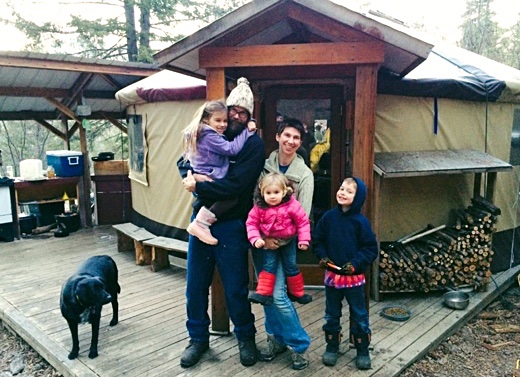
Image above: Ester Emery and Nich Fouch with family living off-grid where its cold in winter. From (http://estheremery.com/meet-esther/).

[IB Publisher's note: See part one of this line of thought here Ea O Ka Aina: Millennials abandoning Suburbia]

Where's the growth going to come from as the dominant generation makes less, borrows less, spends less, saves more and turns away from long commutes, malls and suburban living and abandons the worship of private vehicles?

If anything defined the postwar economy between 1946 and 1999, it was the exodus of the middle class from cities to suburbs and the glorification of what Jim Kunstler calls Happy Motoring: freeways, cars and trucks, ten lanes of private vehicles, the vast majority of which are transporting one person.

The build-out of suburbia drove growth for decades: millions of new suburban homes, miles of new freeways, sprawling shopping malls, and tens of millions of new autos, trucks, and SUVs, transforming one-car households into three vehicle households. Then there was all the furnishings for those expansive new homes, and the credit necessary to fund the homes, vehicles, furnishings, etc.

Now the Millennial generation is turning its back on both of these bedrock engines of growth. As various metrics reveal, the Millennials are fine with taking Uber to work, buying their shoes from Zappos (return them if they don't fit, no problem), and making whatever tradeoffs are necessary to live in urban cores.

Simply put, the natural progression of this generation is away from suburban malls, suburban home ownership and the car-centric commuter lifestyle that goes with suburban homeownership.

Saddled with insanely high student debt loads imposed by the rapaciously predatory higher education cartel, Millennials avoid additional debt like the plague. Millennials have relatively high savings rates. As for a lifetime of penury to service debt--hey, they already have that, thanks to their "I borrowed $100,000 and all I got was this worthless college degree" student loans.

Consider the secondary effects of these trend changes. If Millennials are earning less and already carrying heavy debt loads, who is going to buy the Baby Boom's millions of pricey suburban McMansions. The answer might be "no one."

If vehicle sales decline, all the secondary auto-related sales decline, too. Auto insurance, for example.

Furnishing a small expensive urban flat requires a lot less furnishings than a 3,000 square foot suburban house. What happens to sales of big dining sets and backyard furniture?

As retail malls die, property taxes, sales taxes and payroll taxes decline, too. Many cheerlead the notion of repurposed commercial space, but uses such as community college classes pay a lot less per square foot than retail did, and generate little in the way of sales and payroll taxes.

Financial losses will also mount. Valuations and property taxes will decline, and commercial real estate loans based on nose-bleed valuations and high retail lease rates will go south, triggering significant financial-sector losses.

Retail is already shrinking fast. Look at the store closings--the 2017 number already exceeds the post-financial crisis surge in 2008:

Where's the growth going to come from as the dominant generation makes less, borrows less, spends less, saves more and turns away from long commutes, malls and suburban living and abandons the worship of private vehicles? Toss in the convergence of technology (i.e. a mobile phone does everything) and the answer is growth is being replaced by DeGrowth.


Video above: A TEDx Talk "De" trends by "De-Generation" engaging De-Growth. From (https://youtu.be/y395J6W6i1E).

The "De" Generation (DeGrowth) (8:26)


.

The curse of the modern office

SUBHEAD: The sustainable image of the information age is a product of office work, hiding the true nature of office work.

By Kris De Decker on 22 November 2016 for Low Tech Magazine -
(http://www.lowtechmagazine.com/2016/11/the-curse-of-the-modern-office.html)


Image above: Financial District, Downtown Toronto. Photo by Paul Dex at Wikipedia Commons. From original article.

These days, it's rather easy to define an "office worker": it's someone who sits in front of a computer screen for most of the working day, often in a space where others are doing the same, but sometimes alone in a "home office" or with a few others in a "shared office". In earlier times, many office workers were used not for their knowledge or intelligence, but for the mere objective capacity of their brains to store and process information.

For example, "computers" were office workers who made endless calculations with the help of mechanical calculating machines. This category of office workers has become comparatively less important, because inanimate computers have taken over many of their jobs. Most office workers -- so-called "knowledge workers" -- are now paid to actually think and be creative.

There's a big chance that you are one of them. Roughly 70% of those in employment in industrial nations now have office jobs. The share of office workers in the total workforce has increased continuously throughout the twentieth century.

For example, in the USA, the information sector employed 13% of workers in 1900, about 40% of workers in 1950, and more than 60% of workers in 2000. [1][2]

The spectacular and so far unstoppable growth in the number of office workers is believed to have led to a so-called information society, an idea popularised by Fritz Machlup in his 1962 book The Production of Knowledge in the United States, and since then repeated by many others. [3]

Downtown chicagoImage above: Downtown Chicago. Photo by Charles Voogd at Wikipedia Commons. From original article.

Interestingly, there's no agreement as to what an information society actually is, but the most widely accepted definition is a society where more than half of the labour force engages in informational activities and where more than half of the GNP is generated from informational goods and services.

Some say that the information society is characterized by the use of modern IT equipment, but that does not explain the growth of office work during the first half of the twentieth century. Others have argued that there is a transition from an economy based on material goods to one based on knowledge. Their claim is that this shift from the "industrial society" to the "information society" would make the economy less resource intensive. [3][4]

Indeed, unlike workers in manufacturing, service or agricultural industries, office workers don't really produce anything besides paper documents, electronic files, and a lot of chatter during formal and informal meetings.

However, the rise of office work has not lowered the use of resources, on the contrary. For one thing, supporters of the sustainable information society ignore the fact that we have moved most of our manufacturing industries (and our waste) to low wage countries.

We are producing and consuming more material goods than ever before, but the energy use of these activities has vanished from national energy statistics. Second, modern office work has itself become a large and rapidly growing consumer of energy and resources.

The Energy Footprint of Office Work

The energy use of office work consists of multiple components: the energy use of the building itself (office equipment, heating, cooling and lighting), the energy used for commuting to and from the office, and the energy used by the communications networks that office work depends on. It also includes people who are not working in the office but who plug in their laptops in a place outside the office, which is also lighted, heated or cooled.

As far as I could find out, nobody has ever tried to calculate the energy footprint of office work, taking all these components into account. We know more or less how much energy is used by commuting and telecommunication, but we don't know how much of that is due to office work.

Most information is available for the energy use of office buildings -- the icons of today's global knowledge economy. However, even in this case information is limited because most national statistics do not distinguish between different types of commercial buildings.

The main exception is the US Commercial Buildings Energy Consumption Survey (CBECS), which is undertaken since 1979 and is the most comprehensive dataset of its type in the world. It further categorises offices into administrative or professional offices (such as real estate sales offices and university administration buildings), government offices (such as state agencies and city halls), banks and financial offices, and health service administrative centers. [5]

Moscow business districtImage above: Moscow International Business Center. Picture: Wikipedia Commons. From original article.

The modern, American-style office building -- a design increasingly copied all over the world -- is an insult to sustainability. Per square metre of floorspace, US office buildings are twice as energy-intensive as US residential buildings (which are no examples of energy efficiency either). [5-10]

In 2003, the most recent year for which a detailed analysis of office buildings was presented (published in 2010), there were 824,000 office buildings in the USA, which consumed 300 trillion Btu of heat and 719 trillion Btu of electricity. [8]

The electricity use alone corresponds to 210 TWh, which equals a quarter of total US electricity produced by nuclear power in 2015 (797 Twh with 99 reactors). In other words, the US needs 25 atomic reactors to power its office buildings. [11][12] From 2003 to 2012, the number of US office buildings grew by more than 20%. [5]

How Did we Get Here?
The US office building, which appeared with the arrival of the Industrial Revolution, was initially quite energy efficient. From the 1880s until the 1930s, sunlight was the principal means of illuminating the workplace and the most important factor in setting the dimensions and layout of the standard office building in the US. According to the NYC-based Skyscraper Museum:
"Rentability depended on large windows and high ceilings that allowed daylight to reach as deeply as possible into the interior. The distance from exterior windows to the corridor wall was never more than 28 feet (8.5 m), which was the depth some daylight penetrated. Ceilings were at least 10 to 12 feet (3 - 3.65 m) in height, and windows were as big as possible without being too heavy to open, generally about 4 to 5 feet (1.2 - 1.5 m) wide and 6 to 8 feet (1.8 - 2.4 m) high. If the office was subdivided, partitions were made of translucent glass to transmit light." [13]
Many office buildings had window accomodating H-, T-, and L-shaped footprints to encourage natural lighting, ventilation, and cooling. This changed after the introduction of fluorescent light bulbs and air conditioning. Produced at an affordable price in the late 1930s, fluorescent lighting provided high levels of illumination without excessive heat and cost.

The first fully air-conditioned American office buildings appeared around the 1930s. The combination of artificial lighting and air-conditioning made it possible to design office space much deeper than the old standard of 28 feet. Light courts and high ceilings were ditched, and office buildings were reconceived as massive cubes -- which were much cheaper to build and which maximised floor space. [13][14]

Air-conditioning also enabled the most characteristic feature of the modern office building: its glazed façade. From the 1950s onwards, under the influence of Modernist architecture, glass came to dominate in America -- early examples of this trend are the Lever Building (1952) and the Seagram building (1958).

The US Modernist office building, a cube with a steel skeleton and glass curtain walls, is essentially a massive greenhouse that would be unbearable for most of the year without artificial cooling. Because glazed façades don't insulate well, energy use for heating is also high. In spite of all the glass, most US office buildings require artificial lighting throughout the day because many office workers are too far from a window to receive enough natural light.

Canary wharf londonImage above: Canary Wharf, London. Photo by David Iliff at Wikipedia Commons. From original article.

The arrival of electric office equipment from the 1950s onwards further increased energy use. According to the CEBECS survey, "more computers, dedicated servers, printers, and photocopiers were used in office buildings than in any other type of commercial building".

According to the latest analysis, concerning the year 2003, American office buildings were using 27.6 million computers, 11.6 million printers, 2.1 million photocopiers, and 2.5 million dedicated servers. In addition to electricity consumed directly, this electronic equipment requires additional cooling, humidity control, and/or ventilation that also increase energy use. [5, 8]


While heating was the main energy use in pre-1950s office buildings, today cooling, lighting and electronic equipment (all operated by electricity), use 70% of all energy on-site. Note that this ratio doesn't include the energy that is lost during the generation and distribution of electricity. Depending on how electricity is produced, energy use at the source can be up to three times higher than on-site. Assuming thermal generation of electricity (coal or natural gas), the average US office building consumes up to twice as much energy for electricity than for heating.

Cultural Differences
Technology alone, however, does not explain the rise of the typical air-conditioned office building, nor its high energy use today. Although fluorescent light bulbs and air conditioning soon became available in Europe, the all-glass, cube-like office building remained for a long time a uniquely North American phenomenon. In the 1920s, office work in the USA came under the influence of Frederick Taylor's 'Scientific Managament'. Time and motion studies, which had been carried out in factories since the 1880s, were now applied to office work as well. Men with stopwatches recorded the actions of (mostly female) employees with the aim of improving labour productivity.

Taylor's ideas were translated into office design through the concept of large, open floor spaces with an orderly arrangement of desks, all facing the direction of the supervisor. Private office rooms were abolished. By the late 1940s, American offices resembled factories in their appearance and methods. Although Taylorism left its mark on European offices, it was taken up with less enthusiasm and faced more resistance rooted in tradition than in the US. In the 1960s and 1970s, the Europeans rejected the application of Taylorist principles to office work more strongly, and developed their own type of office building. British office expert Frank Duffy calls it the "social democratic" office. [15, 16]

The curse of the modern office la defenseImage above: La Défense, Paris. Wikipedia Commons. From original article.

These buildings, "groundscrapers" rather than "skyscrapers", were designed like small cities, cut into separate "houses" that are united by internal "streets" or "squares". They were built with corridors and spacious rooms on either side, all naturally lit and ventilated, with employees working next to a window.

The social democratic office building focuses on user comfort, a consequence of the fact that office workers in Europe, unlike those in the USA, obtained the right to form democratically elected workers' councils that could participate in organisational decision making. The UK, with its more American style of business, embraced the US approach in the 1980s. [15, 16]

An important difference between the "social democratic" office building and the "Taylorist" US/UK office building is that the first is usually owner-occupied, while the latter is generally a speculative building: It is built or refurbished to provide a return on investment, and rented by the room or floor.

The speculative model is gaining ground: over the last two decades, US/UK-style office buildings have finally started spreading all over Europe, and beyond. Roughly 50% of new office buildings under construction in France and Germany -- the largest European markets outside the UK -- are now speculative buildings, roughly double their share in the 1980s. [15][18]

This is bad news, because speculative office buildings exclude lower energy alternatives and raise energy use. First, in order to maximize the return on investment, they are usually designed as square or rectangular buildings with deep floor plans and low ceilings, and built as high as planning regimes allow. Naturally lit and cooled buildings require a more horizontal build and higher ceilings, both aspects that conflict with maximizing floorspace. Second, those who design speculative office buildings don't know who will occupy the finished spaces, which leads to an over-provision of services.

"Developers and letting agents focus on the 'needs' of the most demanding tenants, and hence what is required for an office to be marketable to any tenant", write the authors of a recent study that looks into the energy demand of UK office buildings -- and concludes that 92% of such buildings are over-provisioned. Lighting, cooling and heating systems are attuned to unrealistic occupancy rates and are consequently producing more light, heat and cold than is necessary. [19][20]

The Promise of Remote Working
If the high energy use of office work is questioned at all, it's usually followed by the proposal to work outside the office building. At least since the 1980s, home working has been touted as a trend with potential environmental benefits.

Alvin Toffler's The Third Wave (1980) predicted that in the near future it would no longer be necessary to build offices because computers would enable people to work anywhere they wanted. In 1984, when personal computers had become common equipment in offices, Frank Duffy stated that "many office buildings quite suddenly are becoming obsolete". [15]

Obviously, no such thing happened: in spite of the personal computer, there are now more office buildings than ever before. However, the utopian vision of a radically changed work environment is still among us.

Since the arrival of mobile phones, portable computers and the internet in the 1990s, the focus has shifted to "remote" or "agile" working, which includes working at home but also on the road and in so-called third places: coffee shops, libraries or co-working offices. [20]

These concepts suggest that offices will become meeting places for 'nomadic' employees equipped with mobile phones and laptops, how the office will become a more diverse and informal environment, or how in the near future offices may no longer be necessary because we can work anywhere and at any time. [15] According to a 2014 consultancy report:
"The term 'office' will become obsolete in the coming years. The modern workplace evolves into more of a shared workspace with flexible working arrangements that acts as more of a hub for workers on the go than an official place of work. The vast majority of jobs in most organisations can be accomplished from virtually any PC or mobile device, from just about anywhere". [21]
Frank Duffy, building further upon his 1980s predictions, writes in Work and the City (2008):
"The development of the knowledge economy and achievement of sustainability will both be made possible by the power of information technology... Office work can be carried out anywhere... In the knowledge economy more and more businesses, both large and small, will be operated as networks, depending at least as much on virtual communications as on face-to-face interactions. Networked organisations do not need to operate, manage or define themselves within conventional categories of workplaces or conventional working hours." [16]
Does it Matter Where We Work?
On the face of it, more people working outside the office has obvious potential for energy savings. Home workers don't have to travel to and from the office, which can save energy -- after all, commuting has also become energy-intensive since the democratisation of the car in the 1950s. Furthermore, home office workers tend to use less energy for heating, cooling and lighting than they do in the office, a finding that corresponds with the fact that office buildings consume double the energy per square metre of floorspace compared to residential homes. [22]

However, there are many ways in which the environmental advantages of remote working can disappear or become disadvantages. First, remote workers make use of the same office equipment, the same data centers and the same internet and phone infrastructure as people working in an office -- and these are now the main drivers behind the increasing energy use of office buildings.

In fact, a networked office would surely increase energy use by communication services, because face-to-face meetings at the office are replaced and complemented by virtual meetings and other forms of electronic communication.

In Work and the City, Frank Duffy recalls his participation in a videoconferencing talk, expressing his awe for the quality of the experience. What he doesn't seem to realise, is that the Cisco Telepresence system that he was using requires between 1 and 3 kW of power (and 200W in standby) at either side [25], plus the energy use of routing and switching all those data through the network infrastructure.

FrankfurtImage above: Frankfurt, Germany. Wikipedia Commons. From original article.

Second, if work is done not at home but in third places, people might actually increase their energy use for transport when they visit different working spaces during the day. They might work from home in the morning and drive to the office in the afternoon, or they might go to the office in morning and to a co-working space later in the day.

Likewise, if organizations shorten the distance between the office and the office worker by inviting them to work in shared spaces closer to their home, employees might actually decide to go live further away from their new working space, and keep the same time budget for commuting. [20]

Third, for an employee working at home, on the road, or in a third place, the heating, cooling and lighting of that alternative workspace is now often an extra load because his or her now empty space in the office is still being heated, cooled and lit. In most cases, today's home and remote workers occasion additional energy consumption. [22]

This problem is recognized by the supporters of remote working, who stress that office buildings have to adapt to the new reality of the networked office by reducing floorspace and increasing the occupancy rates. This can happen through "hot-desking", sharing a smaller amount of desks between office workers who decide not to work at home -- and hope that not everybody will show up at the same time.

Noel Cass, who investigates energy demand in offices for the UK's Demand Centre at Lancaster University, has his doubts about this approach:
"Hot-desking" requires the depersonalisation of the desk, as if it was a coffee bar or a library, and that's easier said than done. Internet companies such as Google and Yahoo, who pioneered hot-desking arrangements and whose productivity is the rationale behind this trend, have gone back to giving each employee their personal space. In fact, these companies not only left behind the "non-territorial" office, they also have recognised that productivity is best secured by physical co-presence, discouraging telecommuting.

Office spaces now tend to be conceptualised as a 'destination' with increasing amenities on the job, in an effort to attract and retain talent and encourage them to spend more time there. Examples are domestic-like interiors, gym facilities, indoor swimming pools, dry cleaners, or dentists on site. So, who knows, instead of working at home, the future could be living at the office. Obviously, increasing amenities at the office might negate the energy savings obtained by fewer and shared office desks. [20]
In sum, office work will always include buildings, commuting, office equipment and a communication infrastructure. The focus on the location of office work -- at home, in the office, or elsewhere -- conceals the real cause that impacts energy use: the high energy use of all its components.

Lujiazui shanghaiImage above: Lujiazui, Shanghai. Photo byPatrick Fischer at Wikipedia Commons. From original article.

If the commute happens, or could happen, by walking, biking, or taking a commuter train, instead of by car, the energy use advantage of working at home would be zero or insignificant. Similarly, if an office building is designed in such a way that it can be naturally lit and cooled, like in the old days, working from home would not save energy for cooling and lighting.

Finally, the use of low energy office equipment and a low energy internet infrastructure would lower the energy use regardless of where people are working. In short, for energy use it doesn't matter so much where office work happens. What really matters is what happens at these places and in between them.


How Much Office Work Do We Need?

In his 1986 book The Control Revolution, James Beniger states that there is a tight relationship between the volume and speed of energy conversion and material processing in an industrial system on the one hand, and the importance of bureaucratic organisation and information processing, in other words, office work, on the other hand:
Innovation in matter and energy processing create the need for further innovation in information processing and communication -- an increased need for control. Until the nineteenth century, the extraction of resources, even in the largest and most developed national economies, were still carried out with processing speeds enhanced only slightly by draft animals and wind and water power.

So long as the energy used to process and move material throughputs did not much exceed that of human labor, individual workers could provide the information processing required for its control. The Industrial Revolution sped up society's entire material processing system, thereby precipitating a crisis of control.

As the crisis in control spread through the material economy, it inspired a continuing stream of innovations in control technology -- a steady development of organisational, information-processing, and communication technology that lags industrialisation by perhaps 10 to 20 years. By the 1930s, the crisis of control had been largely contained. [1]
Although Beniger makes no reference whatsoever to sustainability issues, what he suggests here is another strategy to lower the energy use of office work: reduce the demand for it. If office work depends on the material and energy throughput in the industrial system, it follows that reducing this throughput will lower the need for office work.

A slower, low energy, and more low-tech industrial system would decrease the need for control and thus for office work. An economy with smaller organizations operating more locally, would need less office work.

CTBA MadridImage above: Cuatro Torres Business Area, Madrid. Photo by Xauxa Hakan Svensson at Wikipedia Commons. From original article.

By the 1900s, all management techniques and office tools that would be used for the next 70 years had been invented. James Beniger was not impressed by the arrival of the digital computer, which was becoming ubiquitous in offices when he wrote his book:
Contrary to prevailing views, which locate the origins of the information society in WWII or in the commercial development of television or computers, the basic societal transformation from industrial to information society had been essentially completed by the late 1930s.

Microprocessing and computer technology, contrary to currently fashionable opinion, do not represent a new force recently unleashed on an unprepared society but merely the most recent installment in the continuing development of the control revolution.

Energy utilization, processing speeds, and control technologies have continued to co-evolve in a positive spiral, advances in any one factor causing, or at least enabling, improvements in the other two. Furthermore, information processes and flows need themselves to be controlled, so that informational technologies must continue to be applied at higher and higher layers of control -- certainly an ironic twist to the control revolution. [1]
Our so-called information economy mainly serves to manage an ever faster, larger and more complex production and consumption system, of which we have only outsourced the manufacturing part. Consequently, without the information economy -- without the office -- the industrial system would collapse.

Without the industrial system, there would be no need for the information society or the office -- in fact, office work could be like it was before 1850, when the biggest bank in the US was run by just three people with a quill. [1]

The sustainable image of the information society -- as contrasted to the dirty image of the industrial society -- is built on an obsession with dividing energy use into different statistical categories, fiddling around with figures on electronic calculating tools. In other words, it's a product of office work, hiding the true nature of office work.

This article was written for The Demand Centre, one of six academic research centres funded by the Research Councils UK to address "End Use Energy Demand Reduction". This article is a shortened version of the original piece, which is on Demand's website. The Demand Centre focuses on the use of energy as part of accomplishing social practices at home, at work and in moving around. It investigates how energy demand is shaped by material infrastructures and institutional arrangements, and how these systems reproduce interpretations of normal and acceptable ways of life.
.

Meaningful Work

SUBHEAD: After logging they grinned and drove away. Another job well done but without ceremony.

By Brian Miller on 19 October 2015 for Winged Elm Farm -
(http://www.wingedelmfarm.com/blog/2015/10/18/meaningful-work/)


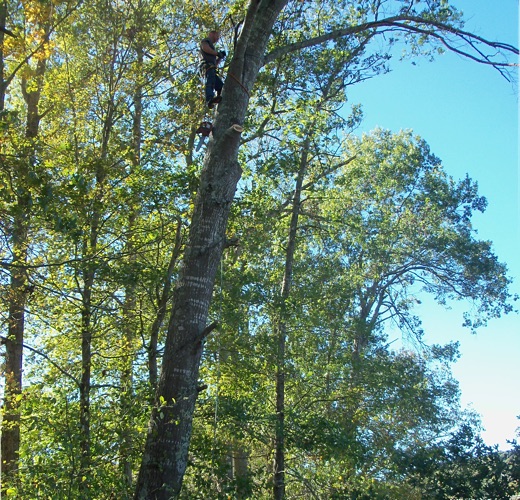
Image above: Man high in tree set to cut down large branches. From original article.

Bush-hogging the hill pasture in preparation for winter, I came across a large buck with an impressive antler spread. He leapt in front of the tractor, then bounded over a fence into a neighbor’s field, which, unbeknownst to him, was a no-kill farm, a safe zone where he could, if he only stayed put, live out his entire life without danger.

I then watched him run across the field and jump another fence, and he was gone. Another circuit around the hill and I saw a couple of trucks pull up at the farm. I headed down and greeted the men arriving to cut down four massive trees alongside our drive.

The trees, one white and three red oaks, needed to be felled expertly to avoid nearby power lines and a neighbor’s house. The men had to climb 60 feet and, from an eagle’s perch, drop the limbs.

Once the upper limbs were cut, they laid the trunks across the drive and cut them into 10-foot-long sawlogs. Ultimately, the largest logs will be milled into lumber, the crowns mulched, the limbs cut into firewood, the stumps drilled and plugged with oyster mushroom spawn. Logging 007

Dancing high above the ground with running chainsaws is dangerous work, but it was done with real purpose, joy, and competence, something that seems at odds with the lethargy of many young men I encounter. It’s a lethargy that seems endemic: man-boys extending their adolescence well into adulthood, living at home, gliding into their thirties without experiencing responsibility.

Not so long ago 80 percent of American high schools offered vocational training. But in just a 20-year span those totals were reversed, including at our own rural school. Now boys (and girls, too) enter biological adulthood without getting any practical schooling in crafts that formerly allowed them to earn a living and, more importantly, self-respect.

The fallout from this lack of preparation for honorable and satisfying work: Young men like my neighbor who drive 40 miles to Knoxville to work in a call center, selling jewelry to elderly women.

For reasons not fully understood, we continue to entertain the idea that all youth are destined for college. Without any statistical evidence, I’d still hazard a guess that the average electrician, plumber, or surveyor out-earns a significant portion of college grads.

My gut feeling that self-worth comes from tangible outcomes, whether raising livestock, felling trees, or wiring a barn, is backed up by personal experience — my own father’s landscape, for example, where a lifetime as a construction engineer allows him daily to see the evidence of an industrious life.

Matthew Crawford echoes the same sentiment in his insightful book Shop Class as Soulcraft:
“The satisfaction of manifesting oneself concretely in the world through manual competence has been known to make a man quiet and easy. He can simply point: the building stands, the car now runs, the lights are on. Boasting is what a boy does, because he has no real effect on the world.”

Should the young men fed into our current system, one that devalues particular competence and focused physical activity, descend into a lifetime of malaise and meaningless boasting, it will not come as a surprise. Nor will there be any surprise should those rural young men who find employment in crafts, trades, or farming have a stronger sense of purpose and self-worth.

As the day ended, the cutting crew got in their pickups. They grinned, waved, and drove away. Another job well done but without ceremony.

.

Acquire Skills - Not Credentials

SUBHEAD: It is remarkably easy to exit a university with a degree and essentially no practical real-world skills.

By Charles Hugh Smith on 12 August 2015 for Of Two Minds -
(http://charleshughsmith.blogspot.co.uk/2015/08/acquire-skills-not-credentials.html)


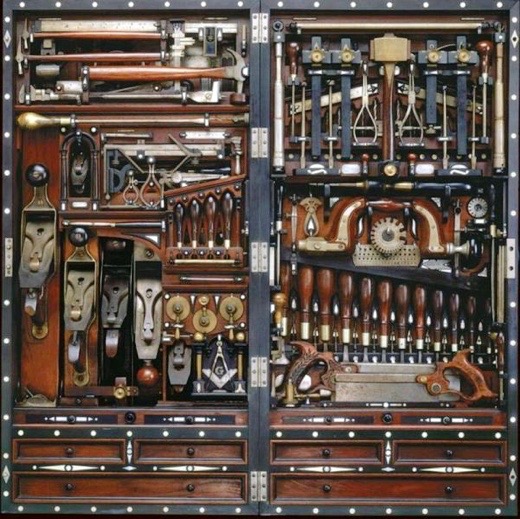
Image above: An elegant chest of manual woodworking tools. From (https://mihafarynu.wordpress.com/2012/09/08/basic-tool-kit-for-your-first-wood-furniture-project/).

Don't rely on the declining value of credentialing signals - demonstrate you have the skills. My recent conversation with Max Keiser on Summer Solutions (25:45) included three bits of advice:
  1. Stop financializing the human experience
  2. Acquire skills, not credentials
  3. Vote with your feet 
Today's topic is acquire skills, not credentials. I have written two books on this topic:
Get a Job, Build a Real Career and Defy a Bewildering Economy
and
The Nearly Free University and the Emerging Economy: The Revolution in Higher Education.

There is a place for credentials that act as an entry key to a profession: a dental hygiene credential, passing the bar exam, etc. 

But outside these licensed professions, credentials such as four-year college degrees are fundamentally signals: they don't actually authenticate real-world skills, they simply signal that the holder of the credential completed the coursework.

It is remarkably easy to exit a university with a degree and essentially no practical real-world skills of the sort employers want and need.

That's the problem with the signaling value of credentials: in a competitive economy, employers don't want to gamble that the signal in a credential has value, they want evidence of real-world skills, i.e. the ability to profitably solve problems.

That's the problem with signaling: some signals might be noise. Employers don't want a signal, they want hard evidence of skills.

It is assumed that successfully navigating the institutional processes of higher education will impart professional working skills: showing up on time, performing as promised, being accountable, and so on.

This assumption is false: performing well in institutions of higher learning has no correlation to performance in the workplace. This is the conclusion that Google reached after crunching reams of data.

Lazlo Bock, senior vice president of people operations at Google, made the following comments in an interview published by the New York Times in June 2013:
“One of the things we’ve seen from all our data crunching is that G.P.A.’s (grade point averages) are worthless as a criteria for hiring, and test scores are worthless. Google famously used to ask everyone for a transcript and G.P.A.’s and test scores, but we don’t anymore.... We found that they don’t predict anything. 
What’s interesting is the proportion of people without any college education at Google has increased over time as well. So we have teams where you have 14 percent of the team made up of people who’ve never gone to college.” 
Doing well in college—earning high test scores and grades—has no measurable correlation with being an effective worker or manager. This is incontrovertible evidence that the entire higher education system is detached from the real economy: excelling in higher education has no discernible correlation to real-world skills or performance.

If the higher education system does not explicitly teach these skills, students will not learn them, even if they excel in fulfilling the criteria of higher education.

The ultimate purpose of skills is to profitably solve problems. Problem-solving has become a cliché of sorts, and so we need to ask, what set of skills is required to profitably solve problems?

The set of necessary skills divides into two categories: hard skills in specific technologies and crafts and soft skills that enable ownership of tasks and projects, systematic application of creativity and critical thinking, and professional standards of collaboration and conduct.

These two sets of skills are essential parts of human and social capital. The ultimate purpose of education is to learn how to acquire human and social capital, and the ultimate purpose of human and social capital is mastery of the skills needed to profitably solve problems.

Problem-solving and accountability have been generalized to the point that we need to specify what they actually mean. In my terminology, they mean taking ownership of tasks and projects, i.e. accepting sole responsibility in the same manner as an owner.

Hard skills in the STEM subjects (science, technology, engineering and math) are no longer enough: professional collaboration skills are increasingly essential even in workplaces that demand engineering and scientific proficiency.

The soft skills of collaboration, adaptability, creativity, entrepreneurism and professional accountability are core skills in every sector of the emerging economy.

Soft skills are not learned by osmosis or magic; they must be learned as systematically as hard skills.
The skills needed to establish and maintain a livelihood in the emerging economy are the abilities to:
  1. Learn challenging new material over one’s entire productive life
  2. Creatively apply newly-mastered knowledge and skills to a variety of fields
  3. Be adaptable in all work environments
  4. Apply a full spectrum of entrepreneurial skills to any task
  5. Work collaboratively and effectively with others, both in person and remotely
  6. Be professional, responsible and accountable in all work environments
  7. Continually build human and social capital
  8. Possess a practical working knowledge of financial and project management 
If we step back and consider the abilities needed to succeed in the emerging economy, we marvel that anyone believes the prevailing (but unspoken) assumption that coursework in the conventional fields of language, history, science and the humanities magically instills these essential skills in students who regurgitate factory-model coursework.

Rather than rely on the same signals everyone else has, accredit yourself. Don't rely on the declining value of credentialing signals: demonstrate you have the skills.

I wrote Get a Job, Build a Real Career to explain how to acquire high-demand skills and accredit these skills yourself.

.

Hawaii premier of Shift Change

SUBHEAD: When many are disillusioned with big business, employee ownership offers real solutions.

By Fred Dente on 5 June 2013 in Island Breath -
(http://islandbreath.blogspot.com/2013/06/hawaii-premier-of-shift-change.html)


Image above: Still image from movie Shift Change.

WHAT:
New film tells the stories of employee-owned businesses that compete successfully in today’s economy while providing secure, dignified jobs in democratic workplaces. Free Admission.

WHERE:
The Children of the Land, Kapaa, Kauai

WHEN:
Thursday June 20th, 2013 at 6:30pm - 10pm.

CONTACT:
Fred Dente
Phone 808-6512815   
Email: koikoi1@hawaii.rr.com

SPONSER:
The event is presented by Kauai Alliance for Peace and Social Justice,


Video above: Trailer for Shift Change - 7 minutes. From (http://vimeo.com/38342677).

The highly anticipated new documentary, SHIFT CHANGE, will have its Hawaii premiere in Kapaa on June 20, 2013.

At a time when many are disillusioned with big banks, big business, and growing inequity in the United States, employee ownership offers real solutions for workers and communities.

SHIFT CHANGE visits thriving cooperative businesses in the U.S. and Spain; sharing on-the-ground experiences, lessons, and observations from the worker-owners on the front lines of the new economy.

SHIFT CHANGE filmmakers Melissa Young and Mark Dworkin gained unprecedented access to the world's oldest and largest network of worker cooperatives in Mondragon—in the Basque Country of Spain—where 60% of local residents are employee-owners. With high job security and competitive salaries, the Basque Country boasts half the unemployment rate of the rest of Spain, and the Mondragon Corporation is the country's 10th largest.

SHIFT CHANGE explores many of Mondragon's diverse production facilities; along with its network of cooperative infrastructure, education, and social services agencies, highlighting the qualities that have helped to drive Mondragon's business success while also perpetuating the democratic, socially responsible, community-oriented principles upon which it was founded.
Here in the U.S. where a long decline in manufacturing and a brutal economic crisis have led to millions of Americans being thrown out of work—many are looking to Mondragon as a model. Worker-owned businesses are on the rise, with hundreds of coops in the U.S. today, representing thousands of individual worker/owners.

SHIFT CHANGE highlights some of the vibrant worker-owned companies across the nation: from bakeries to solar energy to manufacturing and engineering. Through in-depth interviews with worker-owners, attendance at coop meetings, and visits to the factory floor, the film conveys the promise that these businesses offer to reinvent our failing economy, provide a pathway to long term stability, and nurture a more egalitarian way of life.

Businesses featured in SHIFT CHANGE include the Bay Area's Arizmendi Bakery Association—inspired by the Mondragon model and comprised of six cooperative bakeries and a development and support collective—and the non-profit Women's Action to Gain Economic Security (W.A.G.E.S), an Oakland-based organization dedicated to promoting the economic and social well being of low-income women through cooperative business ownership.


Online: www.shiftchange.org  
Facebook: www.facebook.com/shiftchangemovie

See also:
Ea O Ka Aina: Economy Under a New Management 3/1/13
.

The Future of Work

SUBHEAD: New technology will destroy more jobs than it creates. That may be an opportunity for positive change.  

By Charles Hugh Smith on 3 September 2012 for Of 2 Minds - 
  (http://charleshughsmith.blogspot.co.uk/2012/09/labor-day-2012-future-of-work.html)

 
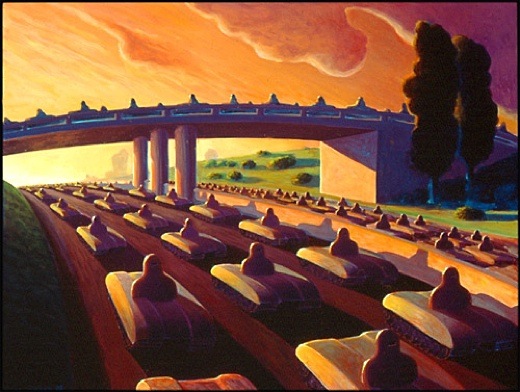
Image above: Painting "The Ride Home" by Mark Bryan, 2005. From (http://www.artofmarkbryan.com/ride_home.html).
 
Technology and the Web are destroying far more jobs than they create. We will need to develop a "Third Way" based on community rather than the Market or the State to adapt to this reality.
What better day to ponder the future of work than Labor Day? Long-time correspondent Robert Z. recently shared an essay on just this topic entitled Understanding the 'New' Economy. The underlying political and financial assumption of the Status Quo is that technology will ultimately create more jobs than it destroys. Bob's insightful essay disputes that assumption:

Over the past 15 years, the global economy has experienced structural changes to a degree not seen in nearly 150 years. Put simply, the Industrial Revolution of the 1800s has given way to a post-industrial economy. In this post-industrial economy, technology has now evolved to the point where it destroys more jobs than it creates. Still, most people are Luddites to some extent. Human nature is to resist dramatic change, either actively or passively, until we have no other choice.
If you don’t believe that, just listen to our presidential candidates. Both Mitt Romney and Barack Obama will give us happy talk about maintaining entitlement benefits (e.g., Medicare and Medicaid) that cannot possibly be sustained. They will talk about energy self-sufficiency. They will talk about creating jobs. They will tell us that we can somehow ‘grow’ our way out of our economic distress.
But neither candidate will admit that technology now destroys more jobs than it creates, because to do so would be to commit political suicide. The fact is that none of the happy talk will ever come true. Instead, the Federal Government, with the tacit approval of both major political parties, continues to run trillion-dollar-plus deficits year after year in a futile attempt to spend our way out of our economic problems and to sustain an economic model that cannot be sustained.
Those who believe that bringing manufacturing back to the US will also bring back jobs are trying to fight a war that has already been fought and lost. Why? The answer is technology. It’s actually a fairly simple process now to bring production of many items back to the US, simply because of automation and robotics. A factory filled with robots can operate 24 hours a day, 7 days a week, 52 weeks a year, so long as the raw material inputs keep flowing into the factory. Robots don’t take breaks, don’t make mistakes, don’t call in sick, don’t take vacations, don’t require expensive health insurance, and don’t receive paychecks.
A fully automated robotic manufacturing facility might require only 100 workers, while a traditional assembly line facility might utilize 3,000 workers. That’s a huge difference in the number of jobs. The simple fact is that most of the lost manufacturing jobs are never coming back. What about all the marketing, administrative, accounting, and IT jobs that we think can’t be outsourced or automated? Well, retail enterprises now tailor any number of special offers directly to individual customers by mining data from reward programs.
That doesn’t take an expensive ad budget or a huge marketing department, since it’s all automated. Have you ever noticed that most of the advertising you see while you surf the Web is tailored to things you might be interested in buying? That’s all automated – huge numbers of marketing professionals are just not needed. In the accounting world, ‘lean accounting’ attempts to streamline accounting processes and eliminate accounting inefficiencies.
A byproduct of ‘lean accounting’ is often greater use of technology and a significant reduction in the number of accountants and accounting clerks. In the IT (Information Technology) sector, computer algorithms for high-frequency stock trading (HFT) have become so complex that specialized software now writes new HFT programs and algorithms. That reduces job opportunities for programmers.
The net result of all these examples is not job creation. It’s job destruction. How about government jobs and government-related jobs? Well, think about the US defense budget. It’s a huge example. We surely do not need as many tanks and fighter jets as we used to, now that we have remote-controlled drones to do many of the jobs required. And with the availability of these drones, we might not need as many aircraft carriers, ships, or military personnel either. What about the Post Office? Do we really need daily mail service in an electronic world?
The point is that as we let go of old methodologies, whether in the private sector or in government, huge numbers of jobs simply disappear. As a society, we need to admit that ‘free-market’ capitalism is not going to bring back these lost jobs. Thanks to technology, society is capable of meeting basic human needs (food, clothing, shelter, transportation) with far fewer workers percentage-wise than were needed in the past. But as a society, we also need to admit that socialistic solutions won’t work either, simply because human nature is to take care of ourselves and our families first.
Once we have provided for ourselves and our families, very few of us are both willing and able to provide for every stranger that might knock on our door seeking assistance. As a nation, we must at some point address any number of major economic issues, including the massive overhang of debt (public and private) that cannot possibly be repaid and demands for future entitlement payments that cannot possibly be met. As a society, we ought to admit that we cannot borrow our way to prosperity. Unless interest rates are zero forever and creditors are willing to forego scheduled repayments forever, borrowing our way to prosperity is a mathematical impossibility.
One point is certain. Even if we find the political will to deal with the mathematics of our economic problems, we will never find long-term solutions to our economic issues until we recognize the profound economic changes wrought by technological advances. This is especially true with respect to our traditional view of a job and a paycheck. While it is true that new opportunities will always exist, these opportunities may not be as plentiful as the jobs of the past once were.
And these opportunities will generally require more advanced skills than many of the jobs of the past. Technology has fundamentally changed the nature of paying work, and it is also one of the major economic issues of our time. About the author: Bob Z., of Vancouver, Washington, is a Corporate Finance executive who retired in 2007 from an upper management position with a Fortune 500 corporation.

Thank you, Bob, for your forthright appraisal of technology and jobs. The decline in labor's share of the GDP (gross national product) is sobering. Here are some other points to consider:

  1. The build-out of a new technology creates a large but temporary number of jobs. This has been the case for some time: the construction of the railroads created a jobs boom that soon disappeared in a financial bust as rail was over-built and profits were non-existent for many of the extraneous or duplicate lines. Telephony and telecom followed similar arcs, and did the build-out of the Internet infrastructure.
  2. Technology maturation leads to diminishing return on labor as incremental advances in productivity are capital-intensive. Semiconductor manufacturing is a good example; fabrication facilities (fabs) cost upwards of $2 billion each even as the number of workers need to operate the fab declines. Profit margins on many high-technology products are razor-thin, flat-screen displays being a prime example, and diminishing margins further pressure labor costs.
  3. Software is leading the next-generation industrial revolution, automating many tasks that were considered "safe" from automation. As Bob pointed out, this includes securities trading and accounting. (I would add tax preparation for the majority of tax situations.) Can the law, academia and government remain immune? Unlikely.
  4. Although few dare contemplate this, the low-hanging fruit of technology may have already been plucked. Take healthcare as an example: antibiotics and vaccines virtually eliminated many diseases at a very low cost per dose (though some diseases are coming back due to unvaccinated host populations and bacterial adaptation). Antibiotics are "one size fits all" technologies: they act basically the same on every target bacteria and in every host.

    Compare that universality to the spectrum of individual responses to cancer treatments and other medications: one size does not fit all, and many of the most profitable drugs of the past few decades treated symptoms, not the underlying illness. It is increasingly clear that there is no "magic pill" that kills all cancers, or even specific cancers in all patients. Lifestyle diseases such as diabetes appear impervious to "magic bullet" cures, as the causal factors of the disease are complex. The same can be said of diseases of aging and environmental factors. In other words, the notion that tens of billions of dollars in high-tech research will yield "one size fits all" low-cost treatments of complex diseases has been shown to be problematic, and very possibly a fantasy.
  5. The Internet is destroying vast income streams that once supported tens of thousands of jobs in industries from finance to music. Craigslist has gutted the once-immense income stream from newspapers, and web-based marketing has shredded print-media advert page counts. Global competition and pressure to maintain profits and margins relentlessly drive enterprises to slash payrolls.
  6. As I have discussed here many times over the years, the rising costs of taxes, benefits and regulations have squeezed small businesses. In response, many small companies rely on automation and software to perform tasks that until recently required a human worker.

Those small businesses that cannot prosper via technology are going under, and the risks posed by ever-higher costs have raised entry barriers to starting a small business. These trends are visible in this chart:


The array of web-based tools available to entrepreneurs now is astonishing. Why take on the risks of hiring people when you can do the work yourself with low-cost web tools and software? For many small enterprises, that is the only way to survive.

Advanced societies face a dilemma that cannot be solved by more debt or more technology: how to distribute not just the output of the economy, but the work and responsibility so that everyone has an opportunity to contribute and earn their keep.

Those who have plowed through my books know that I see community as the only viable way forward. Many aspects of human life cannot be turned into a "market opportunity," nor can they be taken over by the insolvent central-planning Central State. Paying people to stay home and rot is not a solution, but neither is paying people more than they produce in competitive markets.

There is a "Third Way," but we've lost the skills and infrastructure required. Of the three elements of civil society, the Market and the State have crowded out Community. We either re-discover the labor-value of community or we devolve further into a potentially "death spiral" social and financial instability.