Showing posts with label Gig Economy. Show all posts

Millennials become "De" Generation

SUBHEAD: De-Growth and De-Industrialization and embracing a non consumer life for one's happiness.

By Charles Hugh Smith on 13 April 2017 for Of Two Minds -
(http://www.oftwominds.com/blogapr17/millennials-halfx4-17.html)
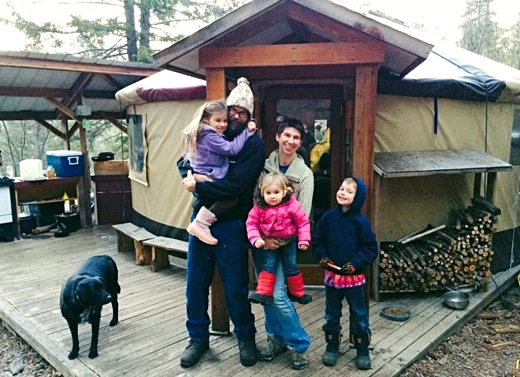

Image above: Ester Emery and Nich Fouch with family living off-grid where its cold in winter. From (http://estheremery.com/meet-esther/).

[IB Publisher's note: See part one of this line of thought here Ea O Ka Aina: Millennials abandoning Suburbia]

Where's the growth going to come from as the dominant generation makes less, borrows less, spends less, saves more and turns away from long commutes, malls and suburban living and abandons the worship of private vehicles?

If anything defined the postwar economy between 1946 and 1999, it was the exodus of the middle class from cities to suburbs and the glorification of what Jim Kunstler calls Happy Motoring: freeways, cars and trucks, ten lanes of private vehicles, the vast majority of which are transporting one person.

The build-out of suburbia drove growth for decades: millions of new suburban homes, miles of new freeways, sprawling shopping malls, and tens of millions of new autos, trucks, and SUVs, transforming one-car households into three vehicle households. Then there was all the furnishings for those expansive new homes, and the credit necessary to fund the homes, vehicles, furnishings, etc.

Now the Millennial generation is turning its back on both of these bedrock engines of growth. As various metrics reveal, the Millennials are fine with taking Uber to work, buying their shoes from Zappos (return them if they don't fit, no problem), and making whatever tradeoffs are necessary to live in urban cores.

Simply put, the natural progression of this generation is away from suburban malls, suburban home ownership and the car-centric commuter lifestyle that goes with suburban homeownership.

Saddled with insanely high student debt loads imposed by the rapaciously predatory higher education cartel, Millennials avoid additional debt like the plague. Millennials have relatively high savings rates. As for a lifetime of penury to service debt--hey, they already have that, thanks to their "I borrowed $100,000 and all I got was this worthless college degree" student loans.

Consider the secondary effects of these trend changes. If Millennials are earning less and already carrying heavy debt loads, who is going to buy the Baby Boom's millions of pricey suburban McMansions. The answer might be "no one."

If vehicle sales decline, all the secondary auto-related sales decline, too. Auto insurance, for example.

Furnishing a small expensive urban flat requires a lot less furnishings than a 3,000 square foot suburban house. What happens to sales of big dining sets and backyard furniture?

As retail malls die, property taxes, sales taxes and payroll taxes decline, too. Many cheerlead the notion of repurposed commercial space, but uses such as community college classes pay a lot less per square foot than retail did, and generate little in the way of sales and payroll taxes.

Financial losses will also mount. Valuations and property taxes will decline, and commercial real estate loans based on nose-bleed valuations and high retail lease rates will go south, triggering significant financial-sector losses.

Retail is already shrinking fast. Look at the store closings--the 2017 number already exceeds the post-financial crisis surge in 2008:

Where's the growth going to come from as the dominant generation makes less, borrows less, spends less, saves more and turns away from long commutes, malls and suburban living and abandons the worship of private vehicles? Toss in the convergence of technology (i.e. a mobile phone does everything) and the answer is growth is being replaced by DeGrowth.


Video above: A TEDx Talk "De" trends by "De-Generation" engaging De-Growth. From (https://youtu.be/y395J6W6i1E).

The "De" Generation (DeGrowth) (8:26)


.

Millennials abandoning suburbia

SUBHEAD: A generation is turning its back on suburban sprawl and automobiles for homesteading.

By Charles Hugh Smith on 13 April 2017 for Of Two Minds -
(http://www.oftwominds.com/blogapr17/millennials-halfx4-17.html)


Image above: Millennials are embracing gardening like no recent generation. From (http://thechronicleherald.ca/homesnews/1440355-millennials-on-the-hunt-for-outdoor-spaces).

Real solutions have two parts: changes in values and operational changes in habits and processes. Many Millennials are homesteading, buying affordable homes and building community.

While it's certainly good sport to mock "snowflakes," not all Millennials are snowflakes. Many are homesteading, buying affordable homes and building communities that get stuff done.

I discuss these trends with Drew Sample, who is living them in Ohio. ( hear a 60-second excerpt or listen to the full podcast on Drew's site.)

Although the mainstream media focuses on bubble-priced Left and Right coast homes costing hundreds of thousands of dollars, there are perfectly serviceable houses that can be had for $50,000 or less elsewhere in America. Drew just bought one, and rather than go through a bank for the mortgage, he arranged (with the help of a real estate attorney) for a family member to put up the mortgage.

This arrangement is win-win: the family member earns a much higher return on the cash than a savings account or equivalent, the loan is secured by the property, and Drew cuts out the bank/lender.

It may surprise those who only read media accounts of Millennials living in their parents' basement playing videogames, many of the Millennials in Drew's "tribe" are growing food via homesteading.

This is arguably a global trend, as the short video below from Japan reveals.

An increasing number of Japanese Millennials are abandoning the high-cost, long work hours life in big cities for a rural lifestyle that is described as "half farmer, half X," with X being whatever part-time work generates the modest incomes needed to sustain the village lifestyle.

I recently watched a Japanese TV program (Soko ga Japan is the name of the series) profiling the young residents of a Japanese farming village. Each household pays $200 or $250 per month for a spacious old house and adjoining farm plot.

This is roughly 10% of what the households were paying for cramping flats in Tokyo. One of the homes is an expansive 200-year old farm house which the young tenant has fixed up to host informal gatherings for those interested in the village community.

Drew reports his mortgage is a bit over $300/month. Including property taxes and homeowner's insurance, the basic cost of ownership is roughly half what neighboring homes are renting for.

So what is X, the other source of income? Raising animals and high-value vegetables that can be sold to restaurants is one source, but many of the young homesteaders continue to do the work they did in the city, only remotely: graphic design, illustration, IT (information technology), translation, etc.

This is an example of what I call the Mobile Creative class, the non-age specific class of people who have broken free of Corporate-State wage-slave serfdom by cobbling together multiple income streams doing work they care about, and radically slashing their cost of living to enable this freedom to do meaningful work.

America's Nine Classes: The New Class Hierarchy (April 29, 2014)

The New Class: Mobile Creatives (May 1, 2014)

The Nitty-Gritty of Financial Independence: The Self-Employed Mobile Creative (February 8, 2017)

I describe how to fashion a mobile creative work life and income in my book Get a Job, Build a Real Career and Defy a Bewildering Economy.

When people say they want solutions, they're actually seeking only a specific kind of solution, one that leaves everything they have now intact but guarantees them more of something: more security, more healthcare, more education, more money, etc., but at no cost or inconvenience to themselves.

Anything that fits these parameters isn't a solution; it's magic. Magical thinking and magical fixes are endlessly appealing precisely because they don't require us to change anything or work at anything outside our comfort zone.

In the real world, solutions change core values and processes. If they don't, they're not real solutions.

Fake fixes come in various types: cosmetic band-aids, alleviation of the symptoms while the disease continues unchecked, public-relations relabeling of the problem so it appears to go away via semantic trickery, and so on.

The credit-card fueled shopping-spree of suburban malls is dying for a variety of structural/systemic reasons. Embracing that as the only model we have is to choose extinction.

.

Farmers’ markets play a vital role

SUBHEAD: Both the DIY economy and farmers markets to continue flourishing as will need for sustainability.

By Daniel Matthews on 29 September 2016 for Sustainable Food Trust -
(http://sustainablefoodtrust.org/articles/farmers-markets-america/)


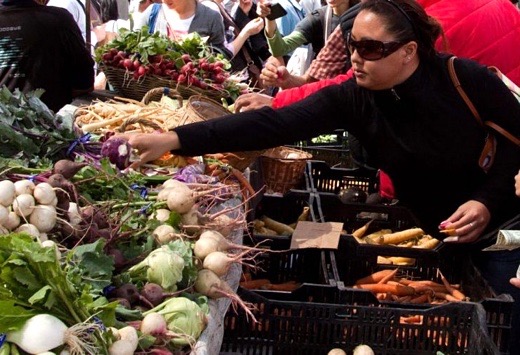
Image above: Fresh organic vegetables offered at local farmers' market. From original article.

Drive across America today, and there’s one thing you’re guaranteed to see more of: farmers’ markets. The USDA reports the number of registered farmers’ markets increased by 2.3% from 2015 to 2016—and that’s just the ones listed in the National Farmers Market Directory.

This increase wasn’t necessarily expected. In 2015, Treehugger author Margaret Badore speculated as to whether US farmers’ markets had hit their peak. From 2013 to 2014, the growth rate was only 1.5 percent. But after that, the number of markets continued to grow, instead of stagnating. What is driving this growth? The answer can be found in the broader state of economic affairs in the US.

Sustainability and the DIY Community
There’s increasing demand for organic foods and ethical business practices, reflecting a growing engagement with sustainability. According to Sustainable Table, more consumers are considering the “environmental, health and social consequences of industrial food production”; as a result, organic acreage is increasing at an annual rate of 15%.

In terms of demand, the USDA’s Organic Market Overview shows the market for organic food is continuing to show double-digit growth. In 2015, sales reached $37 billion, up 12 percent from 2014. And farms that conduct direct-to-consumer (DTC) sales at farmers markets, Community Supported Agricultural programs, and other outlets are more likely to stay in business than those that don’t.

Small local farms maintain their profitability, in part, through DTC sales of organic foods in a growing market. These farms spend less on land and equipment than large farms, and are able to get a good Return On Investment (ROI) through organic food sales. Simply put, organics fetch a high price because of high demand.

Most vendors at the market are part of a Do-It-Yourself (DIY) community that adds jobs to the economy. In 2015, Bloomberg reported a surprising statistic: the DIY economy had added 370,000 jobs, marking an increase of 1 million more self-employed workers in the first four months of the year. According to the Pew Research Center, three out of ten US jobs are held by the self-employed and their employees. In the agriculture sector, around 81 percent of the workforce consists of self-employed farmers and the workers they employ. The USDA’s report on the Farm Labor Survey reveals that, on average, the number of people employed by farms increased between 2007 and 2012. This was in contrast to “nonfarm employment”, which, according to the USDA, went down in this period because of the 2007-2009 recession.

Farmers exemplify a traditional form of self-employment as business owners, but another part of the picture is the self-employed worker in the ‘gig economy’. More and more Americans—particularly Millennials—are choosing to do contract work, taking on ‘gigs’ for a temporary period of time. This new gig economy has a technological twist, with workers using apps and websites that connect them to on-demand work. Think Uber, the ride-sharing service that uses a mobile app to connect drivers and riders.

The best estimate of the gig economy’s growth, reported by the Bureau of Labor Statistics, is that “nonemployers” under the “Other” category created one million jobs between 2003 and 2013. That’s more than any other sector. The self-employed in this case are short-term contract workers. They’re freelancers, independent consultants, people who work odd jobs. The Census Bureau defines the gig worker as a “self-employed individual operating a very small, unincorporated business with no paid employees.”

Just as farmers’ markets and CSAs don’t rely on distribution through centralised supermarkets, gig workers, by definition, don’t rely on a single location and employer for their source of income. The increase in self-employment and contract work are both moves away from centralisation, and growth in self-employment and ‘gig’ work is one of the primary economic catalysts feeding the increase in farmers markets.

Behind all this is the great enabler of our interconnected moment—new technologies.

Technology at the Farmers’ Market
When you go to a farmers’ market, one thing you may notice is that nearly every merchant accepts credit cards. That’s a far cry from an old-school market where people barter, trade or pay in cash.

This is, of course, smart business in the modern world. According to Square’s guide on how to accept credit card payments, people spend 12 to 18% more when they use a credit card instead of cash. At the farmers market I frequent in my hometown, all the merchants have a mobile payment device attached to their phones.

It’s no surprise that the growth of both the DIY community and farmers’ markets, parallels the growth of mobile payment and the smartphone market. With big players like Apple and Paypal in the mix, the mobile payment industry is expected to hit $189 billion by 2019, a growth of 154% from 2014. Many purchases from small merchants wouldn’t be possible without the huge mobile payment industry. There may be an irony, or worse, a paradox here in the dependency on technologies developed by huge corporate entities like Apple.

Smartphones have had an inarguable environmental impact that a sustainable farmer may not want to be associated with. But they have become an integral part of our business practices, especially so in micro and small businesses in developing countries. They increase the economic viability of small sole traders and the self-employed, enabling the vendor to cast a wider net for commerce
.
The benefits of mobile payments in farmers’ markets are enough to overlook any irony in their use.

The Benefits of Farmers’ Markets
Farmers’ markets provide an important array of benefits to local communities, as the Farmers Market Coalition’s infographic details.

Farmers’ markets return money to local economies, while a high percentage of profits from corporate ‘chain’ stores go elsewhere. Walmart, for one, has been implicated by Oxfam in the tax haven scandal that came to light following the Panama Papers leak. That means Walmart is not paying taxes on the profits it makes from grocery purchases. Some vendors make all their income from farmers’ markets. 

As the Coalition points out, “Locally owned retailers, such as farmers’ markets, return more than three times as much of their sales to the local economy. They hire nearly five times more people than non-local vendors. Workers hired by local farmers that use sustainable farming practices (such as crop rotation and cover crops) receive an education in good agro-ecological farming practice. Down the line, that means more farm start-ups and more entrepreneurial investment.

Impoverished families can use food stamps at the market, meaning the $18.8 million of SNAP cash from 2014 went right back into local taxpayer pockets. Fresh sustainable produce means better health and lower obesity rates for poorer families. Helping people to feed themselves better will place less of a burden on the health care system, lowering medical bills for poor families that can barely afford health insurance.

Additionally, there’s no doubt as to the sustainability benefits of farmers’ markets. According to the Farmers Market Coalition, which cites unpublished raw data from a survey of direct market farmers, the local and regional produce you’ll find at farmers’ markets travels about twenty-seven times less distance than “conventionally-sourced” produce. Further, 81% of these farmers use farming practices that reduce waste and promote soil health, such as on-site composting. And three out of four farmers follow practices “consistent with organic standards”.

These sustainability practices in turn benefit the consumer. According to Scientific American, soil depletion and “intensive agricultural methods” lessen the nutrient content in produce. According to authors Roddy Scheer and Doug Moss, “Those who want to get the most nutritious fruits and vegetables should buy regularly from local organic farmers.”

Bringing it home
As calls for sustainability keep escalating, expect both the DIY economy and farmers markets to continue flourishing. Can we expect complete decentralisation and the demise of supermarkets? It’s a long shot. But we can expect farmers markets and small farms to keep bringing organic foods closer to our homes, giving us more opportunities to support them.

.