Showing posts with label Employment. Show all posts

Young men and imaginary worlds

SUBHEAD: For many men the gaming universe is more enjoyable than the real world.

By Mike Shedlock on 17 July 2017 for Mish Talk -
(https://mishtalk.com/2017/07/17/another-reason-men-dont-work-imaginary-world-more-enjoyable-than-the-real-world/)


Image above: Detail if illustration of the hero characters from the top 70 video games of all time. From (http://www.slayerment.com/top-video-game-songs-all-time).

President Trump, like President Obama before him, point out the low unemployment rate as a measure of success.

What they don’t point out are masses of people on welfare via fraudulent disabilities, people in school wasting money in dead-end retraining exercises, people who have simply given up looking for a job, and people in forced retirement needing Social Security payments to survive.

A team of researchers from Princeton, the University of Chicago, and the University of Rochester discusses another class of individuals who are not working but are not counted as unemployed: People, primarily young men who are addicted to games. For such individuals, games provide a fantasy world that is far more enjoyable than the real world.


Please consider their report on Leisure Luxuries and the Labor Supply of Young Men.
Between 2000 and 2015, market hours worked fell by 203 hours per year (12 percent) for younger men ages 21-30, compared to a decline of 163 hours per year (8 percent) for men ages 31-55.

These declines started prior to the Great Recession, accelerated sharply during the recession, and have rebounded only modestly since. We use a variety of data sources to document that the hours decline was particularly pronounced for younger men.

Not only have hours fallen, but there is a large and growing segment of this population that appears detached from the labor market: 15 percent of younger men, excluding full-time students, worked zero weeks over the prior year as of 2016. The comparable number in 2000 was only 8 percent.

A natural question is how these younger men support themselves given their decline in earnings. We document that 67 percent of non-employed younger men lived with a parent or close relative in 2015, compared to 46 percent in 2000.

One avenue to gauge how younger men perceive their fortunes is to use survey data on happiness. In this spirit, we complement the patterns in hours, wages, and consumption with data on life satisfaction from the General Social Survey.

We find that younger men reported increased happiness during the 2000s, despite stagnant wages, declining employment rates and increased propensity to live with parents/relatives. This contrasts sharply with older men, whose satisfaction clearly fell, tracking their decline in employment.

See also:

 http://www.theonion.com/video/warcraft-sequel-lets-gamers-play-a-character-playi-14240


Island Breath: Man's Nintendo Memories 6/14/08
Island Breath: California imitates GTA 10/25/07
Island Breath: Virtual World & Apocalypse 12/19/05
.

A Roof, a Skill, a Market

SUBHEAD: Nubian Vault construction provides an economy based on local source of wealth.

By John Thakara on 8 October 2016 for Thackara.com -
(http://thackara.com/place-bioregion/a-roof-a-skill-a-market/#more-7249)


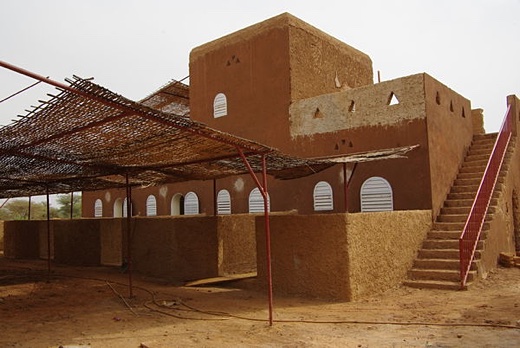
Image above: A nearly finished building using construction techniques outlined. From original article.

[IB Editor's note: Bioreginal construction techniques can provide skills, shelter, income and self reliance. It does not require extractive industrialism and long lines of shipping materials. Here on Kauai it would mean building with local materials such as driftwood, lava rock, palm fronds and other materials, including those used historically by Hawaiians. Learning and applying such knowledge would provide many potential jobs.]

“Beware the scale trap”.  In a Letter To Philanthropists Parker Mitchell,  a former CEO of Engineers Without Borders in Canada, advised potential donors that “scale is important, but don’t rush it. Most good ideas take time – to iron out the details, to bring down the costs, to be tested in different environments”. Organic demand-driven scale will happen in time, but it takes patience to find the right elements of a solution.

These lessons are exemplified by The Nubian Vault Association (AVN). With a mission is to serve the one hundred million people living in the Sahel region of West Africa who are either homeless, or live precariously in short-life structures, AVN has spent 16-years, on the ground, developing a multi-dimensional approach that works.

AVN’s pioneering work will be presented this week at the finals of the Place By Design competition at SXSWeco.  Rather than a celebration of the past, it will share a  challenge with the whole social impact community: What’s the best way to grow faster – a lot faster – without wrecking a system that has worked well so far?

“No wood, no iron – we build with the earth”

One hundred million people are living precariously in the Sahel region of West Africa. Deserts are spreading, the bush timber they once used to build homes is no longer available; as a result they are forced to use imported wood and corrugated iron to build houses.

These modern materials have poor insulation properties, are unhealthy and uncomfortable to live with, and cost cash to purchase that many poor families simply don’t have.

The traditional development model is either to give people money or, in social impact design projects, to treat the situation as a production challenge.

The Nubian Vault Association has evolved a quite different approach: the long-term, muti-dimensional cultivation of living local economies based on three kinds of value: a roof, a skill, and a market.


Image above: An occupied home employing Nubian Vault Construction. From original article.

The roof in question is inspired by a building type, the nubian vault, invented by  Egyptians 3,500 years ago. Adapted for today’s conditions, these vaulted earth roofs are built with locally-made adobe bricks whose raw materials are free and locally available.

Because nubian vault structures contain no wood, or iron, they are affordable, ecological, and – with their excellent thermal properties – comfortable.

They are also durable: AVN houses built more than fifteen years ago are still in daily use and can be expected to last 50 years or more. This compares with an average life expectancy of 7 – 10 years for a house with a corrugated iron roof and thin concrete block walls.

Skills are created as the cohort of masons trained by AVN grows. Since 2000, more than 440 masons have been trained, and a growing cohort of apprentices is following in their steps by learning and working on new sites. This transmission of know-how between master and apprentice is at the core of AVN’s approach.

AVN has evolved a nuanced approach to the creation of self-sustaining local markets They begin with a demonstration project – for a small mosque, perhaps – and then recruit a dynamic and confident individual to be their ‘ambassador’.  He or she looks for new customers among up within a 100km radius of the demonstration project.

New customers, as they are found, are connected with a mason.

Unlike many architecture-for-good efforts, AVN does not build homes for local people, and has not donated lent them money to do so. On the contrary: new clients usually participate in the construction of their own house and pay the masons directly. AVN’s core objective is to create autonomous local markets that do not depend on external inputs of cash.

AVN supports this process with advice on the recruitment of local apprentices, and helps with the logistics and planning of the first construction sites in new markets.

Its local teams also organise two to three day congresses at the start and end of each construction season to which all NV masons are invited. They swap experiences and tips, make contacts, and network. AVN also provides training workshops on  skills needed to run a small business and become a successful entrepreneur.

Right now, a large proportion of new customers are found by the builders themselves.“It’s like priming a pump”, explains AVN co-founder Thomas Granier; “our work expands on the famous saying: we teach a man to fish; we teach him how to mend the nets; we teach him how to sell the fish”.

In the language of impact and outputs, AVN’s record is impressive: Masons trained through AVN’s Program have built more than 2,000 homes and other structures for their clients. More than 800 villages contain at least one nubian vault, and AVN  offices have been opened  in Benin, Burkina Faso, Ghana, Mali and Senegal.

Looking ahead, progress, for Granier and his team progress,  is not like ramping up production in a factory. Although the number of new buildings completed has been growing at an impressive 25% a year – that rate would mean the completion of just 200,000 buildings by 2040. Probably ten times that number are needed.

A growth rate of 35% would multiply that number by six – to 1,200,000 buildings – which gets a lot closer to the scale of the need. But how?

Thre are no easy precedents to learn from. As Tom de Blasis points out in an interesting new book called Leap Dialogues, only a handful of programmes have been succssful at the million-plus scale: vacinnations for measles and rubella; anti-malarial bed nets; mobile phones; and micro-finance. None of these is comparable to building houses.

AVN therefore needs to develop an operation that works at a system scale. It needs to figure out what factors determine the readiness of an area to become self-sufficient – its ‘market-readiness’?  And to achieve that, it must decide what kind of platform it must become if it is to enable the exponential growth of its approach.

Funding is important, of course. It can take AVN staff several months to research and write a grant application. They must wait more months for a decision to be made. And once they have the go-ahead, it takes more time to ramp up activities.

This heavy back-office work diverts energy from
 AVN’s most important work: curating the exchange of value among multiple actors in diverse and changing contexts.

In sixteen years so far, AVN has fostered working relationships between actors in different domains. local, regional and national public authorities; international donors; civil society actors such as NGOs; and so on. The diversity of agendas and cutures invoved in one programme is mind-boggling.

During this process, system conditions on the ground have continued to change; AVN must adapt continuously in an environment shaped by changing demographics, migration, armed conflict, and climate change.

In traditional development projects, with their clearly defined vendors and suppliers, a legacy support infrastructure exists: laws, business models, financial management systems.

AVN, in the absence of a legacy support system, proceeds on the basis of sensitively  cultivated trust.
A new kind of business model is needed to support this kind of complex long-term system-shaping work.


.

Advantages of self employment

SUBHEAD: Working for yourself provides avenues of wealth-building that are not available to employees.

By Charles Hugh Smith on 25 OCtober 2016 for Of Two Minds -
(http://www.oftwominds.com/blogoct16/SE-overhead10-16.html)


Image above: Wilbur Wright working in the Wright brother's bicycle shop in Dayton Ohio in 1897 at age thirty. From (https://www.bowhunting.com/blog/2013/07/29/creating-a-home-bow-shop/).

There are still opportunities to not just earn a wage, but the overhead, profit and capital skimmed by global corporations.

So how can someone earning $15 an hour as an employee get ahead? The short answer is: they can't. One worker earning $15/hour will struggle to get ahead, which I define as building capital that generates an income stream.

A family with four adults working full-time at $15 an hour with benefits can get ahead; together, they're earning $60/hour plus another $40/hour in benefits. Assuming they live under one roof and live frugally, their combined earnings of $100/hour will enable investing in income-producing capital.

There is another path to getting ahead: self-employment. Working for yourself isn't for everyone, but it does provide two avenues of wealth-building that are not available to employees: overhead and capital accumulation.

Consider a typical Corporate employee, and what the company charges customers for their time. The corporation charges the customer $100 an hour for the employee and pays the employee $20 an hour.

The other $80 an hour goes to the corporation for labor overhead (Social Security, healthcare, pension /401K contribution, workers compensation insurance, etc.), general overhead (office, vehicles, accounting, Internet, phones, etc.) and profit.

Now consider the self-employed person who charges $70 an hour for the same work. The customer not only gets a 30% discount, they get someone who is motivated to do the job well enough to earn a referral or renewal of the contract.

The self-employed worker has $50/hour for overhead and hopefully some profit. The corporate employee earning $20/hour has to pay for his/her own vehicle, Internet service, etc. out of his/her wage.

The self-employed person pays the business-related expenses for vehicles, tools, Internet and phone service, accounting, home office, healthcare and other overhead expenses with pre-tax income--the $50 an hour he/she earns above and beyond the $20/hour wage.

The self-employed worker is also constantly investing in the capital of his/her enterprise. Capital comes in many forms: new tools, skills, contacts, collaborators/ subcontractors-- all the many variations of intellectual, social and human capital that create value.

In the corporate/employee setting, the corporation captures much or most of the employees' capital accumulation. The self-employed worker captures 100% of all capital accumulated.

Over a decade, this accumulated capital generates wealth that is unavailable to employees of corporations or the state. If we compare wealthy people with everyone else, what we notice is the wealthy own businesses and have very little debt, while everyone else owns very little productive capital while being burdened with plenty of debt.

Is it easy to be self-employed / start a new enterprise? No, it isn't. If anything, it's become more difficult in an era of corporate/ cartel dominance and regulatory capture.

But there are still opportunities to not just earn a wage, but the overhead, profit and capital skimmed by global corporations. Entrepreneurial success ultimately flows not from just from specific skills but from the eight essential skills that anyone can develop--skills I describe in Get a Job, Build a Real Career and Defy a Bewildering Economy.

Let's face it--lots of stuff no longer works very well. As costs rise, globalization supplies defective, pirated parts, and fewer people care due to burn-out, more and more of everyday life falls into the category of "no longer works very well."

Every one of those things that no longer works well offers an opportunity for a self-motivated person to fix someone else's problem-- and not just for a wage, but for the overhead, profit and accumulated capital that is currently skimmed by global corporations.

.