Showing posts with label Hunger. Show all posts

Between pesticides and bee deaths

SUBHEAD: Federal scientists have reported harassment when their work conflicts with agribusiness interests.
 
By Raynard Loki on 5 May 2015 for Alternet -
(http://www.alternet.org/environment/usda-silencing-its-own-scientists-bee-killing-pesticide-research)
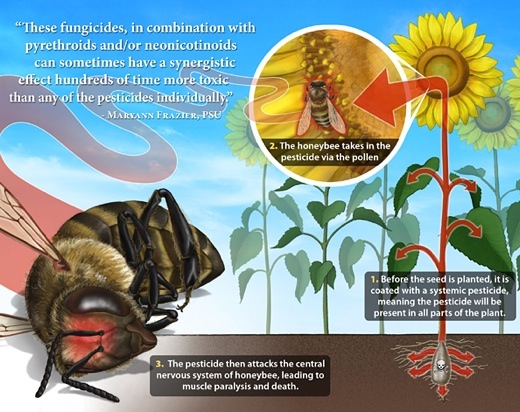

Image above: Illustration by Tony Links of neonicotinoid poisoning of bee. From (http://www.tonylinka.com/scientific/neonicotinoids.html).

Following reports that scientists at the United States Department of Agriculture are being harrassed and their research on bee-killing pesticides is being censored or suppressed, a broad coalition of farmers, environmentalists, fisheries and food-safety organizations urged an investigation in a May 5 letter sent to Phyllis K. Fong, USDA Inspector General.

"The possibility that the USDA is prioritizing the interests of the chemical industry over those of the American public is unacceptable," states the letter, which was signed by more than 25 citizens' groups concerned that a forthcoming report by the White House Task Force on Pollinator Health, which is co-chaired by the USDA, will be compromised.

The signatories include the American Bird Conservancy, Avaaz, Center for Biological Diversity, Center for Food Safety, Farmworkers Association of Florida, Food and Water Watch, Friends of the Earth, Green America, Organic Consumers Association and Sierra Club.

"It is imperative that the American people can trust that their government and its employees are serving their constituents and not the profits of private companies," they wrote. "All of the research that the USDA conducts must maintain scientific integrity and transparency to ensure it is guiding sound policy decisions."

The research in question centers on neonicotinoids, a nicotine-like class of insecticides that impair the neurological systems of insects and which studies have linked to die-offs of bees and monarch butterflies—two key pollinators—as well as birds.

Neonicotinoids have been strongly linked to honey-bee colony collapse disorder (CCD), a syndrome first observed in Germany that has been blamed for massive bee population declines across the globe. In 2013, certain neonicotinoids were banned by the European Union and a few non-EU nations.

The global food system relies on bees to pollinate at least 30 percent of the world's crops. Bees are responsible for pollinating a host of American crops, from apples and almonds to cantaloupes and cucumbers, impacting $15 billion a year in U.S. crops.

In March, Public Employees for Environmental Responsibility (PEER), an environmental activist group supporting local, state and federal researchers, filed a legal petition with the USDA seeking new rules meant to increase the job protection for government scientists and citing censorship and harassment. At least 10 USDA scientists have come under fire for research into farm chemical safety that conflicts with the interests of the agribusiness sector, according to PEER executive director Jeff Ruch.

"They have very little in the way of legal rights and have career paths that are extremely vulnerable," he said. He said the scientific work under scrutiny is the research into the effects of neonicotinoids and glyphosate, the key ingredient in Monsanto's popular Roundup herbicide, which the World Health Organization recently concluded likely causes cancer.

"Your words are changed, your papers are censored or edited or you are not allowed to submit them at all," a senior scientist at the USDA's Agricultural Research Service told Reuters.

“Censorship and harassment poison good science and good policy,” said Lori Ann Burd, environmental health director at the Center for Biological Diversity. "There’s no question that neonicotinoids are killing bees, and it’s long past time for our government to take action.

The European Union has already banned neonicotinoids. The reports that USDA is harassing and suppressing its scientists for doing their jobs instead of using their findings to protect our pollinators are extremely disturbing."

“How can the American public expect USDA to develop a federal strategy that will protect bees instead of pesticide industry profits if it is harassing and suppressing its own scientists for conducting research that runs counter to industry claims?" said Tiffany Finck-Haynes, food futures campaigner with Friends of the Earth.

In April 2014, the group released “Follow the Honey: 7 ways pesticide companies are spinning the bee crisis to protect profits,” a report documenting the deceptive tactics used by agrochemical companies to deflect blame from their chemicals to pollinator declines and stall governmental regulation on neonicotinoids.

The companies named in the report include U.S.-based Monsanto, Switzerland-based Syngenta and Germany-based Bayer, which patented the first commercial neonicotinoid, Imidacloprid, the world's most widely used insecticide.

"If USDA wants to employ a kill-the-messenger approach," said Finck-Haynes, "it will only delay critical action to address the bee crisis that threatens our nation’s food supply."

"It is imperative that the American people can trust that their government and its employees are serving their constituents and not the profits of private companies," they wrote. "All of the research that the USDA conducts must maintain scientific integrity and transparency to ensure it is guiding sound policy decisions."

The research in question centers on neonicotinoids, a nicotine-like class of insecticides that impair the neurological systems of insects and which studies have linked to die-offs of bees and monarch butterflies—two key pollinators—as well as birds. Neonicotinoids have been strongly linked to honey-bee colony collapse disorder (CCD), a syndrome first observed in Germany that has been blamed for massive bee population declines across the globe. In 2013, certain neonicotinoids were banned by the European Union and a few non-EU nations.

The global food system relies on bees to pollinate at least 30 percent of the world's crops. Bees are responsible for pollinating a host of American crops, from apples and almonds to cantaloupes and cucumbers, impacting $15 billion a year in U.S. crops.

In March, Public Employees for Environmental Responsibility (PEER), an environmental activist group supporting local, state and federal researchers, filed a legal petition with the USDA seeking new rules meant to increase the job protection for government scientists and citing censorship and harassment. At least 10 USDA scientists have come under fire for research into farm chemical safety that conflicts with the interests of the agribusiness sector, according to PEER executive director Jeff Ruch.

"They have very little in the way of legal rights and have career paths that are extremely vulnerable," he said. He said the scientific work under scrutiny is the research into the effects of neonicotinoids and glyphosate, the key ingredient in Monsanto's popular Roundup herbicide, which the World Health Organization recently concluded likely causes cancer.

"Your words are changed, your papers are censored or edited or you are not allowed to submit them at all," a senior scientist at the USDA's Agricultural Research Service told Reuters.

“Censorship and harassment poison good science and good policy,” said Lori Ann Burd, environmental health director at the Center for Biological Diversity. "There’s no question that neonicotinoids are killing bees, and it’s long past time for our government to take action. T

he European Union has already banned neonicotinoids. The reports that USDA is harassing and suppressing its scientists for doing their jobs instead of using their findings to protect our pollinators are extremely disturbing."

“How can the American public expect USDA to develop a federal strategy that will protect bees instead of pesticide industry profits if it is harassing and suppressing its own scientists for conducting research that runs counter to industry claims?" said Tiffany Finck-Haynes, food futures campaigner with Friends of the Earth.

In April 2014, the group released “Follow the Honey: 7 ways pesticide companies are spinning the bee crisis to protect profits,” a report documenting the deceptive tactics used by agrochemical companies to deflect blame from their chemicals to pollinator declines and stall governmental regulation on neonicotinoids.

The companies named in the report include U.S.-based Monsanto, Switzerland-based Syngenta and Germany-based Bayer, which patented the first commercial neonicotinoid, Imidacloprid, the world's most widely used insecticide.

"If USDA wants to employ a kill-the-messenger approach," said Finck-Haynes, "it will only delay critical action to address the bee crisis that threatens our nation’s food supply."

"It is imperative that the American people can trust that their government and its employees are serving their constituents and not the profits of private companies," they wrote. "All of the research that the USDA conducts must maintain scientific integrity and transparency to ensure it is guiding sound policy decisions."

The research in question centers on neonicotinoids, a nicotine-like class of insecticides that impair the neurological systems of insects and which studies have linked to die-offs of bees and monarch butterflies—two key pollinators—as well as birds.

Neonicotinoids have been strongly linked to honey-bee colony collapse disorder (CCD), a syndrome first observed in Germany that has been blamed for massive bee population declines across the globe. In 2013, certain neonicotinoids were banned by the European Union and a few non-EU nations.

The global food system relies on bees to pollinate at least 30 percent of the world's crops. Bees are responsible for pollinating a host of American crops, from apples and almonds to cantaloupes and cucumbers, impacting $15 billion a year in U.S. crops.

In March, Public Employees for Environmental Responsibility (PEER), an environmental activist group supporting local, state and federal researchers, filed a legal petition with the USDA seeking new rules meant to increase the job protection for government scientists and citing censorship and harassment.

At least 10 USDA scientists have come under fire for research into farm chemical safety that conflicts with the interests of the agribusiness sector, according to PEER executive director Jeff Ruch.

"They have very little in the way of legal rights and have career paths that are extremely vulnerable," he said. He said the scientific work under scrutiny is the research into the effects of neonicotinoids and glyphosate, the key ingredient in Monsanto's popular Roundup herbicide, which the World Health Organization recently concluded likely causes cancer.

"Your words are changed, your papers are censored or edited or you are not allowed to submit them at all," a senior scientist at the USDA's Agricultural Research Service told Reuters.

“Censorship and harassment poison good science and good policy,” said Lori Ann Burd, environmental health director at the Center for Biological Diversity. "There’s no question that neonicotinoids are killing bees, and it’s long past time for our government to take action. The European Union has already banned neonicotinoids.

The reports that USDA is harassing and suppressing its scientists for doing their jobs instead of using their findings to protect our pollinators are extremely disturbing."

“How can the American public expect USDA to develop a federal strategy that will protect bees instead of pesticide industry profits if it is harassing and suppressing its own scientists for conducting research that runs counter to industry claims?" said Tiffany Finck-Haynes, food futures campaigner with Friends of the Earth.

In April 2014, the group released “Follow the Honey: 7 ways pesticide companies are spinning the bee crisis to protect profits,” a report documenting the deceptive tactics used by agrochemical companies to deflect blame from their chemicals to pollinator declines and stall governmental regulation on neonicotinoids.

 The companies named in the report include U.S.-based Monsanto, Switzerland-based Syngenta and Germany-based Bayer, which patented the first commercial neonicotinoid, Imidacloprid, the world's most widely used insecticide.

"If USDA wants to employ a kill-the-messenger approach," said Finck-Haynes, "it will only delay critical action to address the bee crisis that threatens our nation’s food supply."

.

To save Future live in Present

SUBHEAD: “The kingdom of heaven is at hand” because, if not at hand, it is nowhere.

By Wendell Barry on 23 March 2015 for Yes Magazine -
(http://www.yesmagazine.org/issues/together-with-earth/wendell-berry-climate-change-future-present)


Image above: Turning around from the 13th and Webster intersection where the Ameritrade Park sign is, you will see the third largest mural in the nation. The gigantic painting of Omaha's past, present, and future covers the east side of the Energy Systems Building. From (http://www.beepbeep.org/4delos/archives/2010/06/meg-saligmans-fertile-ground.html).

This excerpt consists of two numbered parts. The first was written in 2013 and the second in 2014.

I. [2013]

So far as I am concerned, the future has no narrative. The future does not exist until it has become the past. To a very limited extent, prediction has worked. The sun, so far, has set and risen as we have expected it to do. And the world, I suppose, will predictably end, but all of its predicted deadlines, so far, have been wrong.

The End of Something—history, the novel, Christianity, the human race, the world—has long been an irresistible subject. Many of the things predicted to end have so far continued, evidently to the embarrassment of none of the predictors.

The future has been equally, and relatedly, an irresistible subject. How can so many people of certified intelligence have written so many pages on a subject about which nobody knows anything? Perhaps we need a book— in case we don’t already have one—on the end of the future.

None of us knows the future. Fairly predictably, we are going to be surprised by it. That is why “Take...no thought for the morrow...” is such excellent advice. Taking thought for the morrow is, fairly predictably, a waste of time.

I have noticed, for example, that most of the bad possibilities I have worried about have never happened.

And so I have taken care to worry about all the bad possibilities. I could think of, in order to keep them from happening. Some of my scientific friends will call this a superstition, but if I did not forestall so many calamities, who did?

However, after so much good work, even I must concede that by taking thought for the morrow we have invested, and wasted, a lot of effort in preparing for morrows that never came. Also by taking thought for the morrow we repeatedly burden today with undoing the damage and waste of false expectations—and so delaying our confrontation with the actuality that today has brought.

The question, of course, will come: If we take no thought for the morrow, how will we be prepared for the morrow?
I am not an accredited interpreter of Scripture, but taking thought for the morrow is a waste of time, I believe, because all we can do to prepare rightly for tomorrow is to do the right thing today.

The passage continues: “for the morrow shall take thought for the things of itself. Sufficient unto the day is the evil thereof.” The evil of the day, as we know, enters into it from the past. And so the first right thing we must do today is to take thought of our history. We must act daily as critics of history so as to prevent, so far as we can, the evils of yesterday from infecting today.

Another right thing we must do today is to appreciate the day itself and all that is good in it. This also is sound biblical advice, but good sense and good manners tell us the same. To fail to enjoy the good things that are enjoyable is impoverishing and ungrateful.

The one other right thing we must do today is to provide against want. Here the difference between “prediction” and “provision” is crucial.

To predict is to foretell, as if we know what is going to happen. Prediction often applies to unprecedented events: human-caused climate change, the end of the world, etc. Prediction is “futurology.”

To provide, literally, is to see ahead. But in common usage it is to look ahead. Our ordinary, daily understanding seems to have accepted long ago that our capacity to see ahead is feeble. The sense of “provision” and “providing” comes from the past, and is informed by precedent.

Provision informs us that on a critical day—St. Patrick’s Day, or in a certain phase of the moon, or when the time has come and the ground is ready—the right thing to do is plant potatoes. We don’t do this because we have predicted a bountiful harvest; history warns us against that.

We plant potatoes because history informs us that hunger is possible, and we must do what we can to provide against it. We know from the past only that, if we plant potatoes today, the harvest might be bountiful, but we can’t be sure, and so provision requires us to think today also of a diversity of food crops.

What we must not do in our efforts of provision is to waste or permanently destroy anything of value. History informs us that the things we waste or destroy today may be needed on the morrow. This obviously prohibits the “creative destruction” of the industrialists and industrial economists, who think that evil is permissible today for the sake of greater good tomorrow. There is no rational argument for compromise with soil erosion or toxic pollution.

For me—and most people are like me in this respect—“climate change” is an issue of faith; I must either trust or distrust the scientific experts who predict the future of the climate. I know from my experience, from the memories of my elders, from certain features of my home landscape, from reading history, that over the last 150 years or so the weather has changed and is changing. I know without doubt that to change is the nature of weather.

Just so, I know from as many reasons that the alleged causes of climate change—waste and pollution—are wrong. The right thing to do today, as always, is to stop, or start stopping, our habit of wasting and poisoning the good and beautiful things of the world, which once were called “divine gifts” and now are called “natural resources.”

I always suppose that experts may be wrong. But even if they are wrong about the alleged human causes of climate change, we have nothing to lose, and much to gain, by trusting them.

Even so, we are not dummies, and we can see that for all of us to stop, or start stopping, our waste and destruction today would be difficult. And so we chase our thoughts off into the morrow where we can resign ourselves to “the end of life as we know it” and come to rest, or start devising heroic methods and technologies for coping with a changed climate. The technologies will help, if not us, then the corporations that will sell them to us at a profit.

I have let the preceding paragraph rest for two days to see if I think it is fair. I think it is fair. As evidence, I will mention only that, while the theme of climate change grows ever more famous and fearful, land abuse is growing worse, noticed by almost nobody.

A steady stream of poisons is flowing from our croplands into the air and water. The land itself continues to flow or blow away, and in some places erosion is getting worse. High grain prices are now pushing soybeans and corn onto more and more sloping land, and “no-till” technology does not prevent erosion on continuously cropped grainfields.

Climate change, supposedly, is recent. It is apocalyptic, “big news,” and the certified smart people all are talking about it, thinking about it, getting ready to deal with it in the future.

Land abuse, by contrast, is ancient as well as contemporary. There is nothing futurological about it. It has been happening a long time, it is still happening, and it is getting worse. Most people have not heard of it. Most people would not know it if they saw it.

The laws for conservation of land in use were set forth by Sir Albert Howard in the middle of the last century. They were nature’s laws, he said, and he was right. Those laws are the basis of the 50-Year Farm Bill, which outlines a program of work that can be started now, which would help with climate change, but which needs to be done anyhow.

Millions of environmentalists and wilderness preservers are dependably worried about climate change. But they are not conversant with nature’s laws, they know and care nothing about land use, and they have never heard of Albert Howard or the 50-Year Farm Bill.

II. [2014]

If we understand that Nature can be an economic asset, a help and ally, to those who obey her laws, then we can see that she can help us now. There is work to do now that will make us her friends, and we will worry less about the future. We can begin backing out of the future into the present, where we are alive, where we belong. To the extent that we have moved out of the future, we also have moved out of “the environment” into the actual places where we actually are living.

If, on the contrary, we have our minds set in the future, where we are sure that climate change is going to play hell with the environment, we have entered into a convergence of abstractions that makes it difficult to think or do anything in particular. If we think the future damage of climate change to the environment is a big problem only solvable by a big solution, then thinking or doing something in particular becomes more difficult, perhaps impossible.

It is true that changes in governmental policy, if the changes were made according to the right principles, would have to be rated as big solutions. Such big solutions surely would help, and a number of times I have tramped the streets to promote them, but just as surely they would fail if not accompanied by small solutions.

And here we come to the reassuring difference between changes in policy and changes in principle. The needed policy changes, though addressed to present evils, wait upon the future, and so are presently nonexistent. But changes in principle can be made now, by so few as just one of us.

Changes in principle, carried into practice, are necessarily small changes made at home by one of us or a few of us. Innumerable small solutions emerge as the changed principles are adapted to unique lives in unique small places. Such small solutions do not wait upon the future. Insofar as they are possible now, exist now, are actual and exemplary now, they give hope. Hope, I concede, is for the future.

Our nature seems to require us to hope that our life and the world’s life will continue into the future. Even so, the future offers no validation of this hope. That validation is to be found only in the knowledge, the history, the good work, and the good examples that are now at hand.

There is in fact much at hand and in reach that is good, useful, encouraging, and full of promise, although we seem less and less inclined to attend to or value what is at hand. We are always ready to set aside our present life, even our present happiness, to peruse the menu of future exterminations. If the future is threatened by the present, which it undoubtedly is, then the present is more threatened, and often is annihilated, by the future.

“Oh, oh, oh,” cry the funerary experts, looking ahead through their black veils. “Life as we know it soon will end. If the governments don’t stop us, we’re going to destroy the world. The time is coming when we will have to do something to save the world. The time is coming when it will be too late to save the world. Oh, oh, oh.” If that is the way our minds are afflicted, we and our world are dead already.

The present is going by and we are not in it. Maybe when the present is past, we will enjoy sitting in dark rooms and looking at pictures of it, even as the present keeps arriving in our absence.

Or maybe we could give up saving the world and start to live savingly in it. If using less energy would be a good idea for the future, that is because it is a good idea. The government could enforce such a saving by rationing fuels, citing the many good reasons, as it did during World War II.

If the government should do something so sensible, I would respect it much more than I do. But to wish for good sense from the government only displaces good sense into the future, where it is of no use to anybody and is soon overcome by prophesies of doom.

On the contrary, so few as just one of us can save energy right now by self-control, careful thought, and remembering the lost virtue of frugality. Spending less, burning less, traveling less may be a relief. A cooler, slower life may make us happier, more present to ourselves, and to others who need us to be present.

Because of such rewards, a large problem may be effectively addressed by the many small solutions that, after all, are necessary, no matter what the government might do. The government might even do the right thing at last by imitating the people.

In this essay and elsewhere, I have advocated for the 50-Year Farm Bill, another big solution I am doing my best to promote, but not because it will be good in or for the future. I am for it because it is good now, according to present understanding of present needs. I know that it is good now because its principles are now satisfactorily practiced by many (though not nearly enough) farmers.

Only the present good is good. It is the presence of good—good work, good thoughts, good acts, good places—by which we know that the present does not have to be a nightmare of the future. “The kingdom of heaven is at hand” because, if not at hand, it is nowhere.


.

Can GMOs help feed the world?

SUBHEAD: Not if activists succeed in making the genetic modification of food politically unsustainable.

By Madeline Ostrander on 19 August 2014 for The Nation -
(http://www.thenation.com/article/180988/can-gmos-help-feed-hot-and-hungry-world)


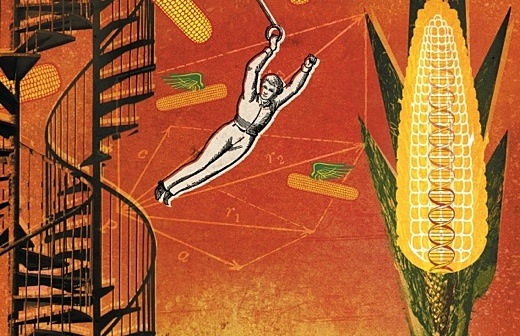
Image above: Illustration by Tim Robinson from original article.

[IB Editor's note: The real question is; Should we be planning feeding on 9.5 billion people in the near term future? it is more important that conventional (GMO-fertilized-pesticide sprayed) agriculture embrace organic farming than organic farmers embrace GMO crops] 

Eduardo Blumwald’s genetically modified plants don’t look much like “Frankenfood.” Filling four modest greenhouses in a concrete lot behind Blumwald’s laboratory at the University of California, Davis, the tiny seedlings, spiky grasses, alfalfa, and peanut and rice plants in plastic terracotta-colored pots look exactly like the ordinary varieties from which he and his fellow researchers created them. Blumwald’s lab lies just ten miles from Monsanto’s 90,000-square-foot vegetable seed building, a glassy edifice larger than the hangar for a 747.

The Monsanto facility is one of the largest centers in the world for plant breeding and genetic engineering. But in the fourteen years that Blumwald, a professor of cell biology, has worked here studying the DNA of crop plants, he has hardly ever spoken to anyone from Monsanto.

Blue-eyed and round-faced, with a lilting Argentinian accent, Blumwald grows exasperated when he talks about the so-called “Big Ag” companies, which he says have been arrogant in dealing with the public, contributing to a distrust of biotech research. But he also doesn’t appreciate the activists who’ve been challenging not only the Monsantos of the world but the entire field of genetic engineering.

“You want to penalize the multinationals; I have no problem with that,” he tells me in his office at the university’s plant biology building. “But because of your political stance against multinationals, you are going to condemn maybe the only viable solution we have for our future? It’s wrong—absolutely wrong.”

Blumwald means the hot future that we expect by 2050—when a world population of 9.5 billion people will scramble to put food on the table, while at least thirty-seven separate countries face extreme water crises. Blumwald thinks that part of the answer is to genetically engineer crops that can better withstand drought, and so he and his researchers are scouring the world for varieties of fruits, vegetables and some basic staples—rice, millet, wheat, maize—that grow well without much water.

Then, using a device called a “gene gun,” which inserts DNA on microscopic gold particles, or a soil bacterium capable of changing plant genes, they alter or silence parts of the plant’s genome, adjusting how and when the plant makes the hormones that let it know when to grow and when to wither. The researchers say the methods are more precise and much faster than developing new plant varieties by conventional breeding, which can take decades.

When I tour the rows of rice and peanuts with one of Blumwald’s assistants, a postdoctoral researcher from Madrid, the air in the greenhouse is soupy. About two dozen researchers work in Blumwald’s lab, many of them from hot parts of the world with swelling populations, including Brazil, China and the United Arab Emirates. In the greenhouse, the researchers force the rice to cope with heat and deprive it of water just as it’s about to set seed.

So far, the genetically altered rice is outperforming the natural kind—given less moisture, the non-engineered rice browns and wilts, but the new plant survives. Blumwald’s goal is to create crops that won’t keel over as quickly when things get hot, dry and stressful—plants that will improve the odds that a farmer can produce food even in a drought.

In about forty years, relentless dry spells may be more frequent across the Southwest, say climate scientists, and California may have more dry years like this one, in which a drought has crippled the agricultural sector. But the state, one of the most fiercely contested battlegrounds in a worldwide fight over the use of genetically modified organisms (GMOs), isn’t the most inviting home for research like Blumwald’s.

Since the 1980s, activists here have run a series of campaigns to require the labeling of GM products and an outright ban on GMO cultivation. Blumwald says the controversy over GMOs has made it more difficult to pursue his research and obtain funding.

And even if his GM plants could be an important part of the solution to climate change, they may never make their way into the hands of commercial farmers. Who will invest in his plants, test them in the field and market them if they attract boycotts, protests and lawsuits that make business difficult and consumers skittish?

Many biotech researchers and agronomists argue that a combination of bad will generated by Big Ag and misdirected public outrage is stifling important technological advances in agriculture—innovations that could help prevent famine, fight crop diseases and cope with climate change. But countless activists disagree. The Organic Consumers Association, a nonprofit agricultural watchdog group, says genetic engineering will never deliver on promises to feed a growing population and isn’t a trustworthy technology.

“The dirty secret of the biotech industry is, after thirty years, they haven’t done anything for consumers,” said Andrew Kimbrell, the founder and executive director of the Center for Food Safety, in a speech at a national heirloom-seed fair in Santa Rosa, California. “No better taste, no more nutrition, zero benefits,” and a number of “potential risks.”

Over the past several years, the political fight over GMOs has become supercharged, and much of the controversy has been driven by a distrust of big business—and of any of the novel biotechnologies it might produce.

“The same corporations that brought us DDT and Agent Orange now want to deny us our right to know what’s in our food,” argued California Right to Know during a 2012 campaign that brought together a coalition of organic farmers, environmental organizations, grassroots groups like Moms Advocating Sustainability, and companies like Clif Bar and Dr. Bronner’s Magic Soaps.

Two years ago, this coalition attempted to pass a statewide referendum that would have required the labeling of food containing GMOs. The anti-GMO activists were vastly outspent: Monsanto alone invested $8 million in efforts to defeat the measure. But the pro-labeling campaign helped launch a movement.

This year alone, a series of similar initiatives have been proposed in twenty states, according to the Center for Food Safety; this past April, Vermont became the first state to pass a GMO labeling law. The Grocery Manufacturers Association and several other trade groups have filed a lawsuit to overturn it.

The California campaign’s messages were a jab at Monsanto, in part. Since the 1940s, the company has been manufacturing and selling chemicals, including DDT, the now-banned herbicide that contributed to the near-extinction of bald eagles in the twentieth century. In the 1960s, the company distributed a brochure mocking Rachel Carson’s seminal work, Silent Spring, the book that first brought widespread public attention to the dangers of pesticides and launched the modern environmental movement.

Around the same time, Monsanto was producing Agent Orange, the chemical weapon used to strip vegetation in Vietnam war zones—and later linked to birth defects and cancers there and in the United States.

In 1997, Monsanto partly reinvented itself, transferring most of its chemical business to a company called Pharmacia, which later became part of Pfizer. Today, the only chemicals that Monsanto produces are agricultural, including Roundup, an herbicide that the company invented in 1970.

It has marketed genetically modified seed since the 1990s; its premier products, among the most common GM crops on the market, are “Roundup Ready”—varieties of soybeans, corn, alfalfa, cotton, canola and sugar beets whose DNA has been modified to keep them from dying when doused with Roundup. In the big grain-growing regions of the United States, such as the Midwest, Roundup Ready is the industry standard. As a result, Roundup, which also goes by the chemical name glyphosate, is the most commonly used herbicide in the country.

Because the DNA of Monsanto’s GM plants is patented, the company has enormous control over the US food system. It has brought 145 suits against American farmers for patent infringement—i.e., for intentionally or, according to at least one farmer, accidentally (since grain DNA travels along with pollen in the wind) growing Monsanto’s GM varieties without paying for them.

The explosion of the Roundup Ready market may have environmental upsides. One biotech researcher I spoke with noted that the use of Roundup Ready seed has reduced reliance on even more toxic agricultural chemicals, and US Department of Agriculture data concur.

Roundup is considered more benign than many herbicides: it tends not to linger in the soil and is sometimes used even in places like nature preserves to beat back aggressive weeds. But few chemicals intended to poison plants or pests are entirely harm-free, and new research indicates that Roundup could be more damaging than previously thought: it may contribute to miscarriages and interfere with fetal development.

And around the country, weeds that are resistant to Roundup are proliferating. Dow Agrosciences, a division of Dow Chemical and another major player in agribusiness, is about to release a new generation of genetically modified crops that tolerate a more powerful and persistent herbicide—2,4-D, a potential neurotoxin.

According to Robert Fraley, Monsanto’s chief technology officer and executive vice president, his company has been studying the impacts of climate change since 2006. But it has created only one line of GM plants designed to deal with environmental stress—a type of corn called DroughtGard.

Like Blumwald’s plants, DroughtGard doesn’t die back as quickly when the weather is dry, though the mechanism driving this trait is different: it relies on inserting bacterial DNA into the plant. In field trials in the Great Plains, DroughtGard performed modestly better than other varieties of corn. Monsanto has now made it available commercially to farmers, and China has approved the seed for import.

But even if such technologies prove useful in mitigating the impacts of climate change, Monsanto’s tarnished history, heavy-handed dealings with the public, lawsuits, and sheer size and might have made it a favorite villain. To a certain segment of the public, everything that Monsanto does is suspect, and genetic engineering looks like a strategy for pushing the company’s brand of herbicides and manipulating the food economy—not a way to a feed a world in crisis.

It can be easy to forget that genetic engineering has an existence and a history beyond Big Ag. Monsanto’s website credits Robert Fraley, then a researcher for the company, with producing the first GM plant in 1982, but there were at least three other institutions working simultaneously—two universities in the United States and one in Belgium—to grow the first plants with spliced genes that year.

In the decades since, scores of university researchers, small research and development ventures and even a few nonprofits have used genetic engineering to try to stop diseases from decimating citrus plants, create mustard plants that can clean up toxins from mining and industrial sites, and grow food that can better survive in heat, drought, flooding, freezing and other extreme weather conditions that may get worse in the next several decades.

But almost none of these plants have ever made it beyond a field-testing stage. As of 2010, though 260 genetically engineered traits have been tested in seventy-seven different “specialty crops” (foods that are less profitable and produced on a smaller scale than field corn, cotton, soy, wheat and rice), just four varieties—including insecticide-resistant sweet corn, disease-resistant papaya and squash, and an ornamental purple carnation—are on the market, according to a review by Jamie Miller and Kent Bradford, researchers with the Seed Biotechnology Center at UC Davis.

That’s nothing near the scope of innovation one would need to confront a problem as vast as climate change or famine.

When I spoke with Bradford, he blamed anti-GMO activists, in part, for making R&D difficult: “Those groups have driven all of the biotechnology work into the companies they hate,” he said. “They’ve made it impossible for anybody else by raising a stink. Even if the regulatory bars don’t seem so high, [activist groups] will sue.” Only big companies like Monsanto can afford the legal and regulatory costs to test GM varieties and bring them to market, Bradford argues.

Neither biotech researchers nor GMO opponents think the current regulatory process is working well. Anti-GMO groups insist that the Food and Drug Administration’s approval process is too opaque and leaves GMO testing in the hands of food companies. Biotech researchers counter that, in practice, the FDA insists on exhaustive and expensive testing far beyond what has been required for any other kind of food crop, even though years of research suggest that the technology of genetic engineering is safe.

The American Association for the Advancement of Science, for example, has announced that “foods containing ingredients from [GM] crops pose no greater risk than the same foods made from crops modified by conventional plant breeding.” Bradford and others insist that it doesn’t make scientific sense to single out GM crops for special testing when other, far less precise methods of crop development—including blasting plants with radiation—aren’t subject to such rigorous scrutiny.

The high cost of GMO field-testing may explain why the only genetically modified crops that have made it to market are, in the words of environmental scientist Jonathan Foley, “very disappointing” and “come with some big problems.”

“GMO efforts may have started off with good intentions to improve food security,” Foley wrote in a column in the science magazine Ensia in February, “but they ended up in crops that were better at improving profits.”

Whether Blumwald’s plants—or the hundreds of other GM crops designed to be disease- or climate-change-resistant or otherwise useful in feeding the world—ever make it to farm fields may depend a lot on whether food activists, the public and policy-makers can be persuaded that the technology is able to produce worthwhile results.

The heart of one GMO battle is roughly fifty miles west of Blumwald’s lab, in Sonoma County—a land of wineries, towering redwood groves poised at the edge of rocky coastal cliffs, and some of the most innovative organic agriculture in the country.

Much of the opposition to GMOs here has come from organic farmers, partly out of fear that their crops will be tainted by cross-pollination by GM varieties. Under organic certification rules, farmers aren’t allowed to grow GMOs, and their customers often refuse to eat GM food.

In March 2004, Mendocino County, just north of Sonoma, became the first jurisdiction in the nation to pass a law regulating GM plants, making it illegal to “propagate, cultivate, raise, or grow” them, in order to stop what it called “genetic pollution”; Marin County, to the south, passed a similar ordinance the following November. A grassroots group in Sonoma County is now actively pushing for a countywide ban on GMOs.

Here, on a plot of forest in the tiny unincorporated town of Occidental, several longtime environmental activists run a center for sustainable agriculture research in a cluster of yurts and wood cabins that form an intentional community called the Occidental Arts and Ecology Center (OAEC). Its leader, Dave Henson, co-founded Californians for GE-Free Agriculture, a coalition that ran campaigns against GMOs between 2002 and 2008. But when I asked him how he felt about genetic engineering, his answer surprised me.

“If this is public research at a university, I think we will see some really interesting potential solutions with recombinant DNA that could show all kinds of benefits in health and agriculture and other things,” he said. “So baby and bathwater are separate.” Henson added that he’s even guest-lectured to classrooms of biotechnology graduate students at UC Berkeley.

When I described Blumwald’s research, however, Henson was skeptical. “The biotech solution is to change out one variety of one crop with another single variety that’s somehow more adapted by genetic engineering,” he said, while the approach to climate change, drought and other related issues “should be about the whole farm system.”

And that’s the major area of disagreement between food activists and the farm industry: people like Henson believe the entire system of modern agriculture needs a radical makeover to rely less on fossil fuels, irrigation, and the chemical fertilizers and weed killers that are fouling water sources from the Great Lakes to the Mississippi. Tweaking a gene won’t fix all that, Henson argues: “The solution has got to be a return to a more sustainable, soil-focused agriculture.”

Five years ago, Henson, OAEC, and several other groups and individuals involved with the GE-Free coalition partnered with organic and family farmers to form a new organization, the California Climate and Agriculture Network (CalCAN). Their intent was to involve farmers in California’s new climate-change law, the most comprehensive policy on global warming in the country.

At the time, the group was also responding to Monsanto. “It was informed by the advertising campaign that Monsanto was doing…around its development of GMO crops that they claimed would respond to a number of [environmental] issues,” says Renata Brillinger, who now heads the group.

In 2008 and 2009, Monsanto placed ads in publications like The New Yorker and The Atlantic Monthly and on the radio program Marketplace arguing that its biotech seeds would be necessary to feed the world’s burgeoning population. “We saw a need for other solutions,” Brillinger adds.

Today, CalCAN has no formal position on GMOs, but simply says that it wants, in Brillinger’s words, “shovel-ready” solutions to deal with the drought right now. Most of these are about managing soil. Rich, organic soil—the kind that can be developed by using manure and compost more and tilling less—holds water better than poor soil. In a drought, plants grown in rich soil are less thirsty; in a deluge, such soil absorbs and slows the flow of water, thereby decreasing flooding and erosion.

Organic matter is also high in carbon, and storing it in the soil keeps it out of the atmosphere, helping to address the problem of climate change itself. CalCAN has focused on statewide policy, including efforts to wring funding from the California budget to promote soil- and water-conservation practices and climate-change strategies for farmers. To Brillinger, GMO research looks costly and difficult; managing the soil is immediate, cheap and much easier.
 
Down the road, in Sebastapol, I found a small organic farm that made this convincing. Paul Kaiser drove up to meet me in front of his barn in a small green tractor, then walked me through the densely planted rows spanning his two acres of crop fields, filled with roughly 150 varieties of vegetables.

“We earn over $100,000 per crop acre per year,” he says. (By contrast, the average revenue from an acre of California cabbages or cucumbers in 2012 was about $6,000 to $8,000, according to the state’s Department of Food and Agriculture.) Kaiser credits his soil-management practices for his financial success.

Before farming, he worked in agroforestry, restoring fields in the tropics that were so overgrazed they could barely grow grass. To Kaiser, the question of engineering any single plant is unimportant compared with a larger picture involving soil, water, bees, and the various other insects and birds that can thrive on an organic farm and provide natural pest control. Kaiser supports the ban in Sonoma County: “Unless we can prove that a GMO crop is fully safe and beneficial to everything that it touches—the pollinators, the soil it’s grown in, the watershed and our body—we shouldn’t be using it,” he says.

At its core, nothing about the science of gene splicing precludes good soil management and other sustainable practices. Pamela Ronald, a UC Davis plant pathology professor, and her husband Raoul Adamchak, a farmer and former board president of the group California Certified Organic Farmers, insist that it’s not only possible but necessary to combine techniques like soil conservation with genetic engineering.

They’ve also written a book on the subject called Tomorrow’s Table.

Ronald argues that those who object to GMOs are focused on the wrong questions: “It would make a lot more sense to evaluate all crops and all farming practices based on whether they are sustainable, not on the process of developing the seed. We know that the process itself is no more risky than any other kind of genetic process.” GM crops will never be a silver bullet, she adds, and we can’t confront a food crisis without also dealing with the other shortcomings of large-scale agriculture.

Even so, genetic modification does offer help, and in a crisis, even a small fix can be worth a lot. Ronald and her colleague, David MacKill, used a combination of genetic engineering and plant breeding to create a variety of rice that can withstand the flooding that has inundated much of Bangladesh and India and devastated the rice fields, a disaster made worse by climate change. Last year, the rice was grown by 4 million farmers.

Ronald doesn’t point fingers at any one party for the public relations difficulties faced by biotech researchers. But she does note that the solution to a world food crisis won’t emerge only in the lab: “There seems to be a communication gap between organic and conventional farmers, as well as between consumers and scientists. It is time to close that gap,” she and Adamchak conclude in Tomorrow’s Table. “Science and good farming alone will not be sufficient.”

See also:
Ea O Ka Aina: Breaking Free from Factory Farms 3/30/11
Madeline Ostrander interview with farmer Joe Salatin

.

Will breadfruit solve world hunger?

SUBHEAD: The good news is that many places near people suffering from hunger can grow breadfruit.  

By Matthew Lucas & Diane Ragone in June 2012 in ArcView News - 
(http://www.esri.com/news/arcnews/summer12articles/will-breadfruit-solve-the-world-hunger-crisis.html)

 
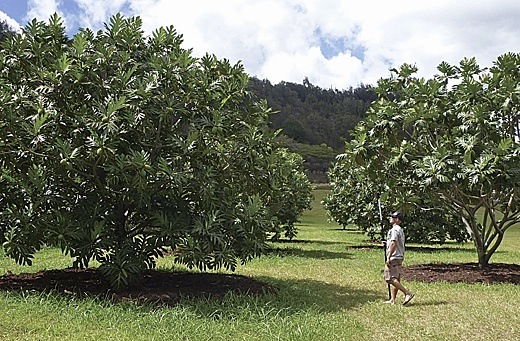
Image above: Different varieties of breadfruit are conserved in the world's largest collection of breadfruit at the Breadfruit Institute in Hawaii.

A map can be a powerful visual tool, but can a map help solve world hunger, rejuvenate agricultural soil, and prevent mosquito-borne infections? Can a map help slow global warming and spur sustainable economic development in tropical regions around the world? Perhaps a map alone can't do these things, but a map can help display the real potential of a very special tree, the breadfruit.

Breadfruit (Artocarpus altilis) is a tropical tree originally from Papua New Guinea with a rich and storied history. This starchy staple crop has been grown in the Pacific for close to 3,000 years and was first introduced to other tropical regions more than 200 years ago. The trees are easy to grow and thrive under a wide range of ecological conditions, producing abundant, nutritious food for decades without the labor, fertilizer, and chemicals used to grow field crops.

These multipurpose trees improve soil conditions and protect watersheds while providing food, timber, and animal feed. All parts of the tree are used—even the male flowers, which are dried and burned to repel mosquitoes. Because of its multiple uses and long, productive, low-maintenance life, breadfruit was spread throughout the tropical Pacific by intrepid voyagers. Hawaii is one of the many island chains where breadfruit, or ulu in Hawaiian, was cultivated as a major staple. It is fitting that now Hawaii is home to the headquarters of an organization devoted to promoting the conservation and use of breadfruit for food and reforestation around the world.

The Breadfruit Institute, within the nonprofit National Tropical Botanical Garden (NTBG), is a major center for the tree's conservation and research of more than 120 varieties from throughout the Pacific, making it the world's largest repository of breadfruit. As a result of this work, the institute has received requests from numerous countries seeking quality breadfruit varieties for tree-planting projects. To address this need, the Breadfruit Institute has developed innovative propagation methods, making it possible to produce and ship thousands, or even millions, of breadfruit plants anywhere in the world.

These breadfruit tree-planting projects can help alleviate hunger and support sustainable agriculture, agroforestry, and income generation. Most of the world's one billion hungry people live in the tropics—the same region where breadfruit can be grown. However, as Dr. Diane Ragone, author and director of the Breadfruit Institute, has learned, stating these facts and illustrating them are two very different things. A strong realization is made when a person sees the data from the United Nations Food and Agriculture Organization global map on world hunger coupled with a map showing areas suitable for growing breadfruit.

It was originally this type of powerful visual aid Ragone wanted when she began working with NTBG's GIS coordinator and coauthor Matthew Lucas. To create such a map, Lucas began by constructing a model within ArcGIS using WorldClim 30-second resolution global raster datasets of interpolated climate conditions compiled from the past 50 years (Hijmans et al. 2005). With the GIS, monthly rainfall and temperature data was condensed into total annual rainfall, mean annual temperature, and minimum and maximum annual temperature. Then, the annual climate data was reclassified.

 
Image above: Map of world showing zones of "best" and "suitable" growing conditions for breadfruit as well as Hunger map is based on the 2011 Global Hunger Index score displayed per country. From (http://ntbg.org/breadfruit/resources/#1160).

"Suitable" and "best" ranges of rainfall and temperature were identified after referring to the breadfruit profile written by Ragone for Traditional Trees of Pacific Islands (Elevitch 2006). The best ranges in mean temperature and rainfall were given a value of 2, whereas suitable conditions were given a value of 1; conditions that were deemed too low or high were given a value of -10. ArcGIS was used to combine all the reclassified climate datasets.

The final output resulted in a global dataset that now displayed areas deemed unsuitable for growing breadfruit as < 0, areas assumed suitable with a value of < 4 and > 0, and best areas with a value of 4. This data was displayed in combination with 2011 Global Hunger Index scores entered into a vector dataset of countries. The resultant map helps the viewer see the real potential breadfruit development could have for tropical regions.

With this new visual aid completed, Ragone and Josh Schneider, cofounder of Cultivaris/Global Breadfruit, a horticultural partner that propagates breadfruit trees for global distribution, attended the World Food Prize symposium in October 2011. The breadfruit suitability map was shared with Calestous Juma, professor of the practice of international development and director of the Science, Technology, and Globalization Project at the Belfer Center for Science and International Affairs at the Harvard Kennedy School. Juma has extensive experience and contacts in Africa.

The map was also shared with the former president of Nigeria, Olusegun Obasanjo. It was at Obasanjo's invitation that Schneider visited Nigeria and met with government officials and researchers to discuss breadfruit planting projects. Due to the relatively fine scale (1 km) of the original datasets, a more detailed map of Nigeria showing areas suitable for growing breadfruit, along with roads and cities, was an invaluable tool during discussions.

The World Food Prize meeting also spurred other similar country-specific maps that have been created and shared with organizations and individuals working in Haiti, Ghana, Jamaica, Central America, and China. The maps provide government officials, foundations, and potential donors with clear information about the potential of breadfruit in specific areas. The maps have spurred the question, What other countries are best suited for growing breadfruit? ArcGIS was used to combine the breadfruit suitability data with a vector layer of country borders. This not only resulted in a list of countries that could possibly grow breadfruit but also made it easy to identify and rank the amount of area each country has that is suitable and best for growing breadfruit.

It became clear that this map, the data, and the ArcGIS methodology used to construct it provided not only a powerful visual aid but also a useful research tool. Armed with these maps and the information they convey, Lucas and Ragone are continuing to pair what has been learned about breadfruit cultivation with ArcGIS to help understand and display future breadfruit potential. They are currently working on a climate change analysis that uses predicted climate datasets of various future climate models and scenarios in an attempt to quantify areas that would have the highest likelihood of sustainable breadfruit development. They are also working on publishing an online map displaying global breadfruit growing potential. Finally, it is the hope of the Breadfruit Institute and NTBG that future breadfruit development will be expanded and that ArcGIS will help guide potential breadfruit-growing countries in planning and implementing planting projects of this very special tree.
 

About the Authors
 Matthew Lucas is the GIS coordinator for the Conservation Department at the National Tropical Botanical Garden. As a graduate of the University of Hawaii, Hilo, Department of Geography, Lucas hails from a conservation background where he uses models and maps to guide more efficient decision making and problem solving.

Diane Ragone, PhD, is director of the Breadfruit Institute at the National Tropical Botanical Garden. She is an authority on the conservation and use of breadfruit and has conducted horticultural and ethnobotanical studies in more than 50 islands in Micronesia, Polynesia, and Melanesia.
For more information about the Breadfruit Institute and NTBG, visit www.ntbg.org/breadfruit.

To help support the work of the institute and breadfruit tree-planting projects, visit ntbg.org/breadfruit/donate/plantatree.php. For more information on Global Breadfruit and how you can help, visit www.globalbreadfruit.com.

Citations

Hijmans, R. J., S. E. Cameron, J. L. Parra, P. G. Jones, and A. Jarvis (2005). "Very High Resolution Interpolated Climate Surfaces for Global Land Areas." International Journal of Climatology 25:1965–1978.
Ragone, D. (2006). "Artocarpus altilis (breadfruit)." In Traditional Trees of Pacific Islands. Elevitch, C. R. (ed). Holualoa, HI: Permanent Agroforestry Resources, 85–100. Available at www.traditionaltree.org.
Von Grebmer, K., M. Torero, T. Olofinbiyi, et al. (2011). "2011 Global Hunger Index: The Challenge of Hunger: Taming Price Spikes and Excessive Food Price Volatility." International Food Policy Research Institute, Bonn. Available at www.ifpri.org/sites/default/files/publications/ghi11.pdf [PDF].
See also: Ea O Ka Aina: Trees that Feed 4/25/12 Ea O Ka Aina: Plant a Breadfruit Tree 3/31/10 Ea O Ka Aina: Breadfruit Recipe Experiments 11/15/09 Ea O Ka Aina: Get out your `ulu! 7/14/09 Island Breath: Ulu - The Breadfruit Tree 12/31/06
.