Showing posts with label Mortality. Show all posts

It's all temporary

SUBHEAD: Media and the devices that present content are transient like everything else. Get used to it.

By Juan Wilson on 13 March 2017 for Island Breath -
(http://islandbreath.blogspot.com/2017/03/its-all-temporary.html)


Image above: Photo of obsolete and/or broken technologies I keep on a windowsill to remind me of the transience of media reality. Photo by Juan Wilson.

The last few weeks I've been trying to replay some video tapes I shot in the years between 1997 and 2007. In that decade I was using Sony Hi8 Digital video camera. I had about almost a hundred hours plus of recordings. My kids, my wife's kids, living in Panama NY, visiting Panama Central America. Living on Maui, renting a house on the Big Island, moving to Kauai, etc.

Problem was my older SonyHi8 was dead and the newer Digital Hi8 wasn't tracking the tape well. I went to Ebay and found  an "as good as new" digital Hi8. It tore three tapes in half. I returned it and went back to my newer Hi8. After lots of coaxing I got it to go and have been able to view a few of the tapes.

Bottom line. You cannot go back very far relying on digital recordings or records of your life to be there when you want them in the future.

I have kept libraries of records from various digital technologies going back to the 1960's and unless I get a special pass for the "Old Digital Devices section of the Smithsonian Museum I will likely never see or hear the content of those libraries.

For example, in the late 1960's I was studying architecture at the Cooper Union in New York. They had a new computer center that took up two classrooms that ran Digital Equipment Corporation (DEC) state of the art PDP-8 computer. It compiled programs and read data off punch cards and would type the results on a 17" wide chain driven impact printer.

A classmate, Ralph Lerner and I wrote structural engineering programs in Fortran IV and could calculate structural engineering stresses on various frames by punching cards describing loads and their arrangement on the frame. The impact printer would draw the frame and note results of calculations.

I have a library of all the programs Ralph and I wrote. They have weathered the 50 years but I have no DEC computer to compile programs and run data cards through. In fact DEC corporation, once number the number two to IBM, no longer exists. I will never see those programs run again.

Later, in the early 1980s working in the field of architecture at Davis Brody & Associates I used DEC VAX-11 computer. The VAX was the first widely used 32-bit minicomputer.

The VAX-11 was capable of running serious Computer Aided Design software. Davis-Brody had a version of G3, the program designed for General Electric to do engineering drawings for such things as nuclear power plants.

Our first workstation cost $250,000. AutoCad today costs about 1% of that today.

I still have DEC 1" compact tapes that contain the G3 program and the macro-programs we developed specifically for architecture. Those tapes will never see a VAX-11 again.

I also have 5.25" floppies from PC computers as well as 3.5" floppies used by Amiga and Macintosh machines. I even have an bunch of 100mb ZIP discs. None of these will be spun up.

I won't go into the various other formats for work and entertainment I have kept remnants of, but the list goes on.

What has worked of all those decades? Reel-to-reel and LP records. Machines to play those media are still being manufactured. I think the most durable recording technology in my lifetime has been the cassette audio tape. I have several hundred that go back to the early 1970s and they still sound fresh. I think that's in part because I recorded most on high-end tapes.

It is getting harder to find cassette tape recorders, but they are still available. If you want to hear your tapes into the future get a good one like the Tascam CC-222 mk IV.

I received a CC0-222 from my wife Linda for my 70th birthday two years ago. It's a wonderful machine - a high end cassette that will dub a tape to CD or a CD to tape. The later path might be in order after you read the article below on CD disintegration.


Your CD's are rotting

SUBHEAD: Certifying a CD-ROM did not place any requirement on the chemical or physical stability of the disc.

By Cory Doctorow on 11 March 2017 for Boing Boing -
(http://boingboing.net/2017/03/11/bitrot.html)


Image above: A CD of questionable veracity. From original article.

In 2009, the Library of Congress commissioned a research report into the degradation of CD-ROMs in storage as a way of assessing the integrity of the media in its collection: the news isn't pretty.

The standards for certifying a CD-ROM did not "place any requirement on the chemical or physical stability of the disc," so depending on the manufacturer and process, the discs you've put away on shelves may have wildly different material properties.

The study involved taking a trove of discarded/duplicate CD-ROMs from the LoC's collection and subjecting them to "accelerated aging" processes to see how many errors emerged as the media aged. Keeping discs dry and cool helped reduce error rates, but even so there's a lot of bitrot there.

One thing that's happened since this study is an acceleration in the plunging costs of online storage -- HDDs and SSDs -- and cloud services, which are all "live" media, regulated by microcontrollers that continuously poll their storage media for degradation, marking off sectors as bad when they turn and copying their data to still-good sectors before it becomes unreadable.

This is a major difference between today's state of affairs and the long, awkward adolescence of mass storage, when keeping all your data online was prohibitively expensive, which meant that some fraction of your archives would end up on offline/nearline media, from tapes to CDs to Zip and Jazz and floppy discs.

All media is subject to entropy, but offline/nearline media is not easily hedged against the Second Law of Thermodynamics with measures like continuous scheduled offsite backups and continuous defect-scanning.
The results of this study show that individual CD-ROM life expectancies in a large collection such as that held by the Library of Congress can be expected to cover a wide range. In addition, the BLER degradation rate of individual discs will be dependant on the environmental conditions to which the disc is exposed. Selecting optimal conditions for temperature and relative humidity in facilities where compact discs are stored can be expected to have a significant impact on service life.

Other factors not covered in this study, such as handling, labeling, and exposure to certain materials or chemicals, also affect service life and must be considered as part of a comprehensive approach to preserving digital information on compact disc media.
The test population selected for this experiment was extremely diverse; representing discs constructed using different materials, from different manufacturers and record labels.

Although the selected discs covered a relatively limited period of manufacture the wide distribution of life expectancies demonstrates the effect of these varied construction parameters on disc life. 10% of the discs failed at an estimated life of less than 25 years, including 6 discs (5%) that failed too early to obtain meaningful data or a meaningful lifetime estimate. 23 discs (16%) had insufficient increase in errors during the test, and thus, had infinite lifetimes, by the standards of the ISO test method. These results illustrate why it is so difficult to make broad generalizations about the lifetime of optical media.

The Library of Congress plans to conduct analyses of the material composition of selected discs from both this study and the on-going Natural Aging Study to look for trends in failure modes as they relate to the chemistry of the disc. An understanding of these failure modes can help in identifying discs that are prone to early failure so that the data can be transferred to more stable media before they reach end-of-life.
COMPACT DISC SERVICE LIFE: AN INVESTIGATION OF THE ESTIMATED SERVICE LIFE OF PRERECORDED COMPACT DISCS (CD-ROM) [Chandru J. Shahani, Michele H. Youket and Norman Weberg/Library of Congress]

.

Farm Generation

SUBHEAD: This year, mud season presents my family with the chance to pull together more closely than ever.

By Shannon Hayes on 8 April 2015 for Yes Magazine -
(http://www.yesmagazine.org/happiness/farm-generation-simple-life)


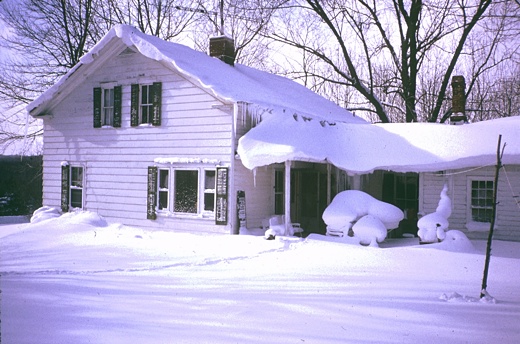
Image above: IB Publisher's note: This old place in Chautauqua County NY my family called simply "The Farm". It was my mother's mother's place. After my mother lived there I did. I took this picture in early 1989. My children own it now, but decided not to live there. To tough a life, too lonely, too far away from everything. When this snow melts it will be mud.  We all knew "Mud" was the season between Winter and Spring lasting from  late February to early May. It was not unusual to have snow on the cherry blossoms on Mother's Day. Photo by Juan Wilson.

I take a tentative step on the woodland trail I've been breaking in all winter. The snow is too soft today. I sink to my knees. Sighing, I call to the dogs. We abandon the woods and sludge instead through the muddy driveway and out to the road for our morning walk.

As I step out onto the road, I dodge the thawing dog poops that had been hidden for months by gently falling blankets of white. The snow banks are dirty. The ground slurps as I traverse it.

We call this mud season, and it seems only fitting that my family should choose this time of year to begin working on our farm transition plan. In other words my parents are getting older and it’s time we start planning exactly how they’ll hand the farm off. They bought the land in 1979, and Bob and I joined 20 years later. After being in business for 36 years, mud, slush, dirty snow, and dog bombs seem a fitting landscape as we begin this process.

Mom and I signed up to take a farm transition class together at our local extension office. We thought it would get us off on the right foot. We've been spending every Wednesday afternoon down there for the past few weeks. I don’t think we knew what we were in for. This simple life that we are trying to ensure for her and dad, for Bob and me, and for our children, is turning out to be anything but simple.

Thoughts of the garden, plans for lambing season, and even the present reality of boiling sap are replaced with flinty explanations of things like living wills, disability planning, cash flow spreadsheets, and financial scorecards.

I make my way down the road with the dogs, trying to wrap my head around these issues. Nikki, my biggest dog, dashes off into the woods for a minute. He returns triumphant with a skull from some fallen wild animal. He tries to bring it along on our jaunt, but soon seems to grow tired of carrying it. The other two dogs and I stop and wait for him to decide what to do.

He looks around. The snow banks on the roadside are too high for him to climb up and hide it in a field. The driveway is too far back now to leave it there.

Finally, he comes to a decision. He drops it on the side of the road. Then he pisses on it before moving on. The whole macabre scene seems to wrap up my feelings. My parents have put their lives and souls into our family farm.

And now, to segue in a new generation and safeguard all that they’re done, we make plans for their deaths. Then we piss on their agrarian remains to claim them as ours. It all seems so unfair to them.

And as for me, it seems equally unfair. For 41 years, I’ve been the farmer’s daughter. I have supported them by my presence. The farm has been theirs, my job has been to fill in the interstices—manage markets, come up with supplemental ventures to support my family, work in the cutting room, help with the website, and take care of customers. They are the leaders. I am only their support.

But now, we must make a shift, whether we want to or not, if we intend to keep taking care of the land and supporting our customers.

And just as we must endure the ugliness of mud season in order to find spring, our family must face head-on all the ugliness in our business. We must confront our communication barriers, our emotional hot buttons, our accounting errors, our management mistakes, our miscalculations.

We must plan for mom and dad’s death, and the ability of the farm to live on in their absence. We must plan for Bob’s and my death, and the ability of Saoirse and Ula carry it all forward, should they so choose.

At this moment, I envy anyone who does not face managing a farm inheritance. I envy anyone who can inherit something as simple as money. I envy anyone who can inherit nothing, walking into the future with only memories.

But I have to face it. As the snow recedes, it exposes bit by bit our mistakes from the previous year, and the things that need fixing—the boards that need nailing, the ground that needs raking, the fence lines that need tightening. Like lush summer, or glorious fall, or restful winter, it comes every year. It is not a surprise.

And once we’ve shuddered at the bitter elixir of hard truths that it shows us, we know what to do. We pick up the rake, the hammer, the pliers. We pull on our gloves, walk out into the sunshine, and face whatever it is that we must fix.

The seasons will turn. We will have another growing season. We will have another resting season. And then mud season will come around again.

In a lifetime of farming, I have learned this much. Mud season is as important as summer growth. It is the chance to rebuild, redesign, and repair.

And the way to get through it is to get up each morning and stare it in the face, do what the day will allow, go to sleep at night, then get up and do it again the next morning. Victory will not be found in one glorious maneuver. It is slowly uncovered through daily toil, through commitment to process.

I turn at the bottom of the road and call the dogs to me for our climb back up the mountain. As we retrace our steps, the dogs find the skull that Nikki marked.

Each of them takes a turn carrying it the rest of the way home, a prize for the pack, brought about through teamwork. I laugh at their antics. With a light heart, I go back inside, take off my boots, and get back to work.

This year, mud season presents my family with the chance to pull together more closely than ever.

If we can work through it, there will be more maple syrup, more honey, more wild apples for the cider press, more grapes on the vine, more spring lambs, more wool blankets, more chicken dinners, more burgers on the grill, more days laughing with customers, and more hot summer afternoons by the pond…for many years to come.

.

Time & Tide

SUBHEAD: They wait for no man - or for anything else. Produce - Consume - Collapse - Repeat  

By Mary Logan on 26 June 2012 for A Prosperous Way Down -  
(http://prosperouswaydown.com/time-tides-wait-for-no-man/?utm_source=rss&utm_medium=rss&utm_campaign=time-tides-wait-for-no-man)


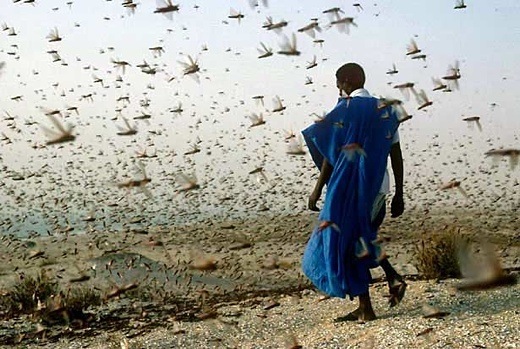
 Image above: Locusts swarming in Africa. From (http://wisdomofthewest.blogspot.com/2008/05/some-swarms.html).
 
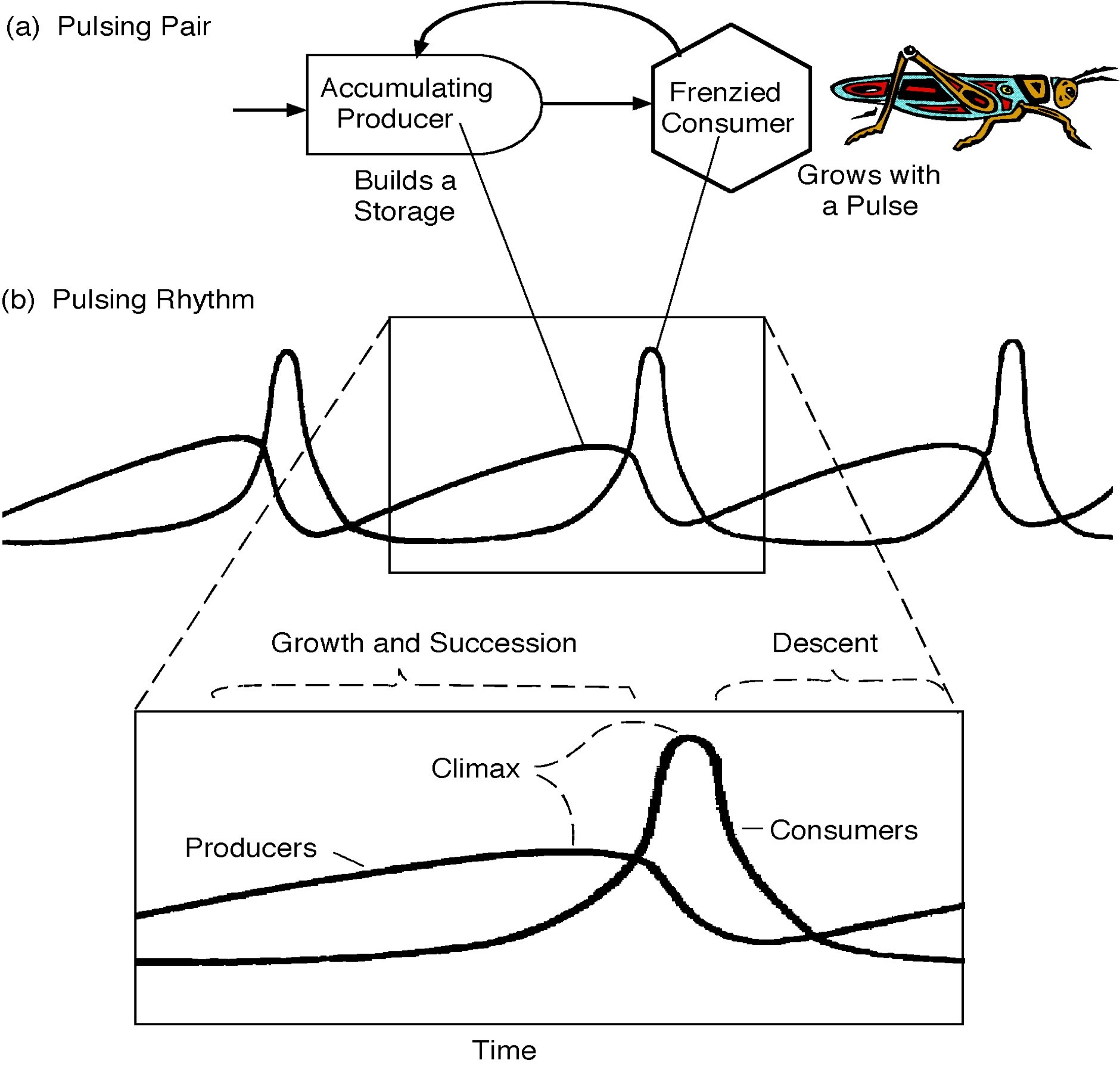
A century of studies in ecology, and in many other fields from molecules to stars, shows that systems don’t level off for long. They pulse. Apparently the pattern that maximizes power on each scale in the long run is a pulsed consumption of mature structures that resets succession to repeat again. There are many mechanisms, such as epidemic insects eating a forest, regular fires in grasslands, locusts in the desert, volcanic eruptions in geologic succession, oscillating chemical reactions, and exploding stars in the cosmos. Systems that develop pulsing mechanisms prevail. The figure above includes the downturn for reset that follows ecological climax. In the long run there is no steady state (Odum, 2007, p. 54).


Image above: Illustration of locust population boom and bust from (http://prosperouswaydown.com/principles-of-self-organization/energy-hierarchy/pulsing-paradigm/).
 
The aspect of resilience and panarchy that is most novel and significant concerns the “back-loop” phase when resisting structures and institutions start to break down or transform, releasing the chance for a renewed system to emerge. The many ecosystem examples are matched by many business examples where technology shapes products from sneakers, to automobiles, to electrical appliances.
At that moment, novelty that had been simmering in the background can emerge and be stimulated. And new associations begin to develop among previously separate innovations. The big influence comes from discoveries that, at that time, emerge from people’s local experiments at small scales, discoveries that can emerge at times of big change, to trigger bigger changes at large scales. That process highlights the keys for the future (Holling, 2009).

As a follow up to Dave Tilley’s article on renewable rhythms, and in celebration of summer solstice, I would like to discuss the idea that fossil fuels have allowed us to suppress or even ignore pulses of Nature and our own biorhythms. We have adopted artificial pulses of industrial production and consumption with attempts to create continuous growth.

Fossil fuels allow us to create a seamlessly, climate-controlled, homogenous monoculture that blurs night into day, and summer into winter. It even homogenizes trends, with everything always improving and going up without a break in the action. This separates us from Nature and creates the impression of invincibility. How does this invisibility present in our dominant culture, and what does it mean as our culture transitions into descent?

Up here in Alaska, the annual pulses are so great that it is hard to escape the reminders. Summer solstice is a special time in Alaska. In Anchorage, the number of daylight hours at solstice peaks at 18 ½ hours. Solstice is a reminder that the days are now getting shorter, and that we need to get a move on with things we plan to accomplish during the summer.

We begin to get 70 degree + days. The vegetables start to produce in the garden. Local markets are full of produce. It is a time of plenty, and comfort, and celebration. Picnics and potlucks abound. After solstice, the urge to go-go-go accelerates for some. Alaskans catch and put away salmon, and by late August the smell of high bush cranberry gives me a sense of restless urgency reflected in outings of berry picking and restless hikes in the high country. The Alaska State Fair in late August demonstrates the power of our summer sun and the prowess of our farmers. Brief fall colors, fall rut, and waning daylight bring the promise of winter. Seasonal pulses in Alaska are big, and there is no steady state. Excess light switches to not enough light very quickly, at a rate of over 5 minutes a day, and moods shift and behaviors change with the seasons.

Historically, seasonal pulses have been symbols of growth, fertility of death in multiple cultures. Older medieval cultures connected melancholy with a complex set of moral, religious, and emotional symbols and associations that created cultural order out of the seasons, and was even treated as a mark of distinction in 16th century Europe (Harrison, 2004). The seasons were connected to human behavior, moods, and rich symbolism regarding life and death in a number of cultures.

Winter was a season for rest, regeneration, and reflection. In the arctic and subarctic, Scandinavians and Alaska Native peoples have a much longer culture of adaptation to long winters than the dominant American culture, and they are much better adapted to the changes in light and the long winters. Diet adaptations to physical changes due to inadequate light include cod liver oil for Scandinavians and a diet of fish and muktuk for Alaska Natives. Calendars were oriented towards harvest, and seasonal harvest celebrations such as Thanksgiving and Christmas celebrated and honored seasonal changes with feasts, candlelight and storytelling. Stuhlmiller (1998) tried to explore Seasonal Affective Disorder (SAD) in Norway, and found that Norwegians did not medicalize their seasons, and considered the behavioral changes that come with the seasons as normal.
Norwegians’ seasonal experiences are embedded in a tradition of specific activities and attitudes, which precluded viewing seasonal change as a potential disorder as some Americans do. Scandinavians accept a certain amount of moodiness and insomnia as a normal seasonal adaptation, for example, and treat it with the cultural adaptation of exercising outdoors in the winter. The joke that Norwegians are born with skis on their feet is accompanied by a “palpable peer pressure to go out in the woods fairly frequently otherwise one is not really Norwegian . . . . If you go on a skiing trip through Norwegian nature, you are a good person. The moral undertone is there and cannot be ignored” (Reed & Rothenberg, 1993, p. 21, in Stuhlmiller (1998)).
Some of that expectation can be seen in Alaska, as some cultural exchange with Scandinavia has occurred. Some of my friends nod in approval when I describe skiing activities outdoors in the winter. Our American fossil-fuel based culture not only smooths out the pulses using fossil fuel means, it medicalizes natural conditions such as seasonal adaptation, demanding that we SAD light our behavioral changes, or medicate them with antidepressants.

Is it prosperity to burn the midnight oil to finish work late into the night, in opposition to our nature? Do we then burn SAD lights or take pills in order to medicate our lack of adaptation to the seasons? Is sadness adaptive in some way, or must we always be happy? I have friends who can’t sleep in our sunlit summers without special darkening shades, eye-shades, and sleep medications. The sleep medications become addicting and can cause rebound phenomena, creating worse insomnia than originally experienced. And shift work is known to cause a number of physical disorders due to the alteration in biorhythms. Our industrial society creates unnatural patterns requiring unnatural treatment with strong medications. On our recent bike trip, headlamps were unnecessary. We naturally fell into rhythms of day and night without watches, alarms, or other digital reminders of sleep/wake aids (oh, except for the coffee).

Fossil fuels allow us to ignore in part the natural lunar, solar, and water driven pulses. Schedules shift from solar/lunar to corporate/quarterly or business weekly/commercial or even political/every four years. In the winter, we light up the night, and create many large heated spaces to carry on activities such as indoor tennis that are perhaps better suited to summer. We ship summer fruits and vegetables from the other hemisphere, or we grow them with the assistance of fossil fuels.

We go to great lengths to clear roads of snow, and cart off the excess to large snow dumps so that we don’t have to modify our winter behaviors in any way. School is morphing into a year-round schedule, without attention to the seasonal calendar. Hot climates are made cool, and cold climates are heated to a homogenous, standard 70 degrees. We control floods and we irrigate droughts. Advanced weather forecasting allows us to safely flee hurricanes and hunker down in tornados or blizzards. We create ski slopes and water parks in the desert, and transmit a mall-oriented homogenous consumer culture to just about everywhere, at least in America. Music, language, food, and culture become uniform to the point of blandness.

The general pace of life is different, too. Just in time supply chains supply our every need whenever we want, quickly and efficiently. Behaviors are transmitted globally via the Internet, causing loss of languages and globalization of corporate culture. The internet also smooths diurnal pulses, creating a never-ending stream of information, extended work days due to connectivity, and no down time/rest/leisure from information streams and digital excess. Speech patterns are rapid and courtesies may be dispensed with in crowded urban settings in comparison to slower, rural cultures.

We escape winter by vacationing thousands of miles away from home, avoiding hardships that might build relationships that could foster community cohesion. We rejoice in uniformity in cruise and jet travel. Fossil fuels have allowed us to live in large populations in places like Phoenix, Dubai and Anchorage using adaptations that allow us to exert high tech control over Nature. Historically, small populations of Alaska Native peoples migrated seasonally in order to adapt to low energy ecosystems with extreme pulses of weather. Now we just apply a dose of fossil fuels to our pulses and smooth them out. One can even wonder at our obsessive focus on climate as a symbolic failure in being able to control the weather.

So what does the importance of pulsing mean in adaptation to descent? Relocalization will mean reinvigoration of regional differences. Alaska will lose its box stores and malls, and will re-acquire local markets, diversified zoning, and better adaptations to winter that are not based on fossil fuels. Places will start to look different economically, socially, culturally, and perhaps also biologically. People who cannot adapt will migrate away or suffer or perhaps die. Areas that were historically sparsely populated due to low resources may lose their populations.

For example, the aged and the young in some of our extreme urban environments such as Las Vegas, Phoenix and Anchorage who are dependent on electricity for cooling and heating will need to adapt in one way or another. As fossil fuels wane, we can adapt by recognizing and following natural pulses and responding to periods of growth, harvest, and regeneration appropriately.

Pulsing does not mean “end to growth” or “steady state” which is what is most often proposed as the alternative to growth. If our pulses stop, we are dead. What goes up must come down. Looking at a pulse and seeing only steady state is either optimistic cognitive dissonance or a bargaining stance of viewing the pulse through a narrow time window where Wile E. Coyote never has to fall. Natural ecosystems are organized around pulses of sun, rain, tides, wind, and storms. Pulses help to mediate predator-prey and host-parasite relationships, and may prevent overgrowth in systems by resetting feedback loops. These paired pulsing populations help to keep populations healthy. Pulsing maximizes power and is adaptive.

With the smoothing of nature’s pulses in industrial society comes complex bureaucratic structure that resists change. Forest fire tinder is allowed to accumulate for fear of fires, and we suppress wildfires because of overpopulated landscapes and the loss of natural ecosystems that would have absorbed these larger pulses from nature. We combat natural cycles such as spruce bark beetles. We channelize rivers to control for flood, and support unsustainable building of houses in floodplains and on barrier islands. We create just-in-time round the clock systems of operation that lack resilience.

We are intolerant of hardship and increasingly resistant to change, which creates more pressure on the existing system. Steady states are not adaptive—all systems pulse. Attempting to circumvent pulsing from systems prevents regeneration, lowers productivity, and creates rigidity and a lack of system responsiveness. We have incrementally added so much complexity while suppressing nature’s rhythms that we are vulnerable at all scales to the impact of large disorganizing societal pulses. Every move that we make towards more centralized, corporate control eliminates competitors and diversity. A system that promotes more and more growth creates overshoot that will be hard to dismantle without collapse.

Perhaps the most important meaning of the change that is required is the emotional acceptance of our renewed loss of control over Nature as complexity wanes in a lower-energy world. The control we have over our culture and the complexity that comes with it has created an obsessive fear of loss of control along with increasing intolerance for change. Our industrial society denies ecological and cultural roots of our behaviors, assigning biochemical causes alone to our behaviors, thus medicalizing what may be normal adaptive behaviors. Since we are separate from Nature, ecological connections and causation are denied. Many previous cultures used the image of the ouroboros snake to represent the cycle of life and the renewal that is necessary to sustain it. The All is One.

The end is the beginning–here is our chance for cultural evolution in our rebirth as we shed our old skins and rise anew. We’ve slid a long way from old cultural values that helped us to live sustainably within nature. We need a new compass to steer by for the dislocation that is to come. Chaucer was right, time and tides wait for no man. We need to regain and honor the rhythm of time and tides in new relocalized agrarian systems. Living in Nature’s pulsing paradigm will be messier, more diverse, less uniform, and more exciting.

Bring it on.

.

Life & Death of Gaia

SUBHEAD: So, we must learn to live with the flow of the Earth's cycles. For that, we must know a little chemistry.  

By Ugo Bardi on 21 May 2012 for Casandra's Legacy - 
  (http://cassandralegacy.blogspot.it/2012/05/great-chemical-reaction-life-and-death.html)

 
Image above: Photo of a valley on Earth where Gaia is robust. From original article.

Good evening everyone and it is very nice to be here today. You know, every time I give a talk I try to say something different - otherwise it would be boring for me and, perhaps, for you, too. So, this time I thought I could do something closer to what's my job. After all, I teach chemistry. So, shouldn't I teach you a little bit of chemistry? Then, I thought that I could start by presenting to you a chemical reaction. Here it is:
Well, after you give speeches for a while, you become somewhat telepathic. So, I know what you are thinking. Yes: I can read your minds and I know that this slide is making you happy; isn't it? By the way, the exit door is down there. Maybe you can scream something like "I forgot to turn off the gas stove!" as you run away. Well, nobody is running away and that's nice. I said that I know what you are thinking and it is true - without exaggerating, of course! You are thinking that chemical reactions are boring. And I agree with you: chemical reactions are very boring. I can tell you that: I studied chemistry, I teach chemistry, I've been working in chemistry for all my life. I should know!

So, why do chemists like the things that they hate - so to say? Are they masochist or what? Well, no. Maybe I am asking you to believe something a little too extreme, but let me tell you something: chemistry is not boring! Chemistry is fascinating, it is interesting, it is even fun. And chemical reactions are not what chemistry is about. Chemical reactions are just a shorthand that hides the really interesting things. If you look at the symbols, well, it is boring. If you look at what the symbols describe, if you look inside, well it is not the same. It may be an interesting story, as I was saying it may be fun, it may be fascinating.

You know, when I was a freshman in chemistry, I had to attend chemistry labs. There were many nice girls in my class and they were all wearing lab coats in the lab - not exactly sexy as garments. But that was just the outside: what was fascinating was the inside! So, I hope today that I could show you that the specific reaction that I am showing to you today is hiding something hugely interesting. It is called "silicate weathering" and is the basis of life on Earth.

The way I have written it, it is very simplified - it is much more complex than that. But we can take it in this form in order to understand it. If that reaction were not running all the time on our planet, I wouldn't be here, you wouldn't be here and not even those nice looking girls that I met during my time as a student would ever have existed. Nothing alive on this planet would exist. The entity we call "Gaia" would not exist. Let me explain. What do we mean exactly with "Gaia"? I think the best I can do is to show you an image.


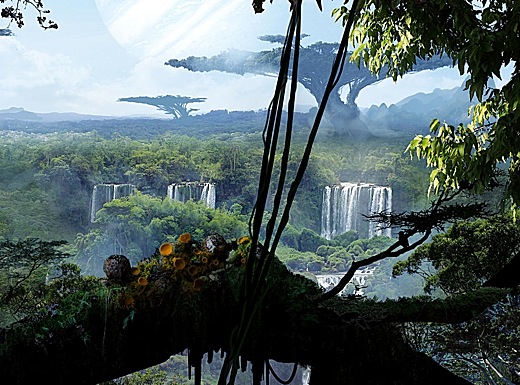
Image above: Detail of rendering of the planet Pandora. From (http://cassandralegacy.blogspot.it/2012/05/great-chemical-reaction-life-and-death.html).

I am sure you recognize what this is; it is "Pandora" from the film "Avatar." Now, we can say that Pandora is a sort of an Earth on steroids. It is lush, it is full of life, full of creatures: dragons, monsters, waterfalls, trees, mountains, clouds; all that. Of course, Pandora is a fantasy world; but we are discovering plenty of new words in the Galaxy; many are about the same size of the Earth and at the right distance from their suns; so they could well host organic life similar to ours - like Pandora does in the Avatar movie.

We can't say for sure if such words exist, but one thing we can say is that - if they exist - the reaction I was showing to you before must be running on there. A world without that silicate weathering reaction running is like Mars or Venus. No silicate weathering reaction, no life. Let me explain: in order for life to exist, there have to be some materials that make it exist. There has to be oxygen to breathe, for instance. But, even more important than oxygen is a special molecule that we call carbon dioxide and that we write as CO2, pronounced see-oh-two.

 You know that carbon dioxide is what plants use to carry on photosynthesis, which is what keeps alive everything on this planet. If Pandora is so lush and beautiful, it has to have CO2 in the atmosphere, just as our Earth does. Plants make CO2 react with hydrogen extracted from water and out of this reaction they create all organic matter which is then be used to make living beings. In a sense, CO2 is Gaia's food, it is also Gaia's blood, Gaia's lymph and more. But, then, if CO2 is Gaia's food, there is a problem. CO2 is a reactive molecule and here is where the reaction I wrote kicks in:
You see that this reaction contains carbon dioxide; CO2, on the left side. And you see that this CO2 react with something written as "CaSiO3" which I can read as "calcium silicate". Now, the reaction (keep in mind that it is very simplified) says that carbon dioxide reacts with the silicates of the crust to create carbonates (CaCO3) and silica (SiO2). So, a gas, carbon dioxide, reacts with rocks to create more rocks. And, if it has to create these rocks, the carbon which once formed CO2 becomes carbonate, which is solid. Let me show you:

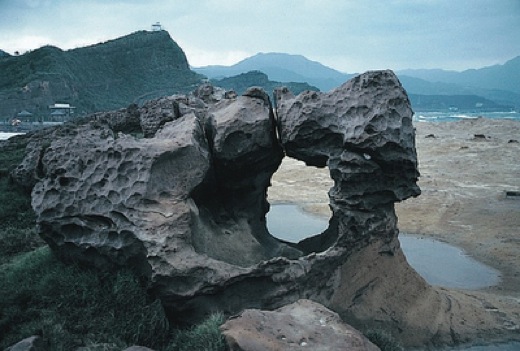
Image above: Photo of weathered rock in a place where Gaia is not robust. From original article.

This is a weathered rock somewhere. See? CO2 reacts with the rock and corrodes it. In doing so, CO2 disappears. Clearly, it is a very slow process. You don't see rocks being washed away by rain, unless you are willing to wait for a very, very long time. How long? Well, we are talking of geological times; millions of years, but that's not what we are worried about. The question is; if CO2 is consumed by the reaction, how long would it take for the atmosphere to lose all of it? (and note that plants would start dying much before CO2 were to disappear completely).

 On this point, there is an answer that you can find in Robert Berner's 2001 book which has a rather impressive title "The carbon cycle of the phanerozoic". Berner says that all the CO2 in the Earth's atmosphere would be consumed by the weathering reaction in about ten thousand years. In part, it would be replaced by CO2 degassing from the oceans, but even that source would be exhausted in about 300,000 years. These numbers are, of course, just orders of magnitude but for what we are concerned here, the uncertainty doesn't matter much.

Life on Earth has been going on for more than three billion years and there must have been CO2 in the atmosphere all this time. No CO2, no life. There is no escape to that. So, you see that we arrived to a paradox. The weathering reaction should have consumed all the CO2 in the atmosphere long ago but there is still plenty of it; enough, at least, to keep photosynthesis going and with it all life on Earth. But paradoxes are almost always pathways to understanding deeper truths and this one is no exception. Let's go back (once more!) to the weathering reaction:
You probably remember from what you studied in high school that chemical reactions never go fully in one direction. They can go both ways and often they are in an equilibrium condition in which reactants and products remain in constant concentrations. And you may remember that there are conditions that can shift the equilibrium from one direction to another. About the weathering reaction, we said that it goes from left to right, as you can see from the picture of the weathered rock seen before. But, if we could make the reaction go from right to left, then the carbonates decompose and become a source of CO2. If that were possible, we'd have a way to bring CO2 back in the atmosphere.
How could that happen? Well, another thing that you surely learned in high school is that the equilibrium of a chemical reaction depends on temperature. There are good reasons based on thermodynamics that say that a solid compound decomposes at high temperatures. That's what happens to carbonates, provided that you can reach temperatures of the order of several hundred degrees Celsius - possibly over a thousand. Now, where can you find these temperatures on Earth?
Very easy: look at your feet.

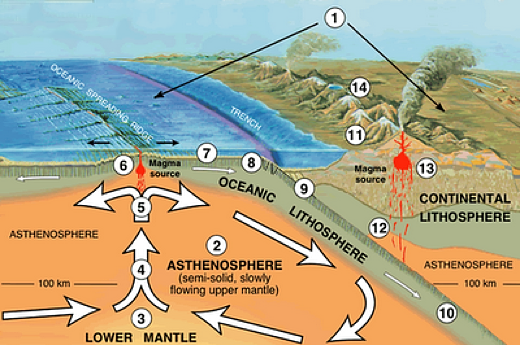
Think of making a hole of a few tens of kilometers and there you are. You find an area of the Earth called the "mantle" which is semi-molten rock composed mainly of silicates, but also carbonates. Here is the structure of the inside of our planet as we know it today.
You have to go deep down, but eventually you reach temperatures which decompose the carbonates. Now, if carbonates were to reach those depth, they would be decomposed into CO2 that would then degassed out by volcanoes, geysers, hot springs, all that. That's exactly what happens in the great CO2 cycle that goes under the name of "plate tectonics". Here is it:

Image above: Illustration explaining plate tectonics. From original article.

 Let me explain a little this image. It shows how the ocean floor moves and is gradually pushed inside the depths of the Earth in a process called "subduction". Everything that stands on the ocean floor is destined, eventually, to disappear into the mantle. But this is also a cycle, you can see in the figure how material from the mantle is pushed up to the surface to form new ocean floor at those regions which are called "mid-ocean ridges". A very slow process, it takes tens of millions of years for a piece of rock that surfaces at the mid ocean ridge to go back to the mantle. But it does occur. Now, this is also the CO2 cycle.

You see, we said that the reaction of carbon dioxides with silicates produces carbonates. These carbonates end up on the ocean floor, often in the form of the shells of dead marine organisms. And the final result is that this carbonate is pushed into the mantle - where it is hot enough to decompose it into oxide and CO2. Then, the CO2 returns to the atmosphere in the form of volcanic eruptions. The beautiful thing of all this is that the cycle is that it is the "control knob" of the Earth's surface temperature. Really, the CO2 cycle is a thermostat that keeps the Earth not too warm and not too cold; just right. It has been doing that for billions of years.

As a thermostat, it must be said that it has not always functioned so well: we have had ice ages and those hot periods called sometimes "planetary hothouses". But, on the whole, the Earth's temperature has always remained within the limits that make life possible. Otherwise, we won't be here. So, how does the thermostat work? First of all, you know that CO2 is a "greenhouse gas". It traps the heat emitted by the Earth's surface acting a little like a blanket that keeps the planet warm. So, the more CO2 there is, the more we expect the Earth to be warm. As a consequence, the temperature can be regulated by controlling the concentration of CO2 in the atmosphere. But how can that be done? Well, there is the trick: the speed of chemical reactions depends on temperature. It is true also for the silicate weathering reaction:
High temperatures make the reaction go faster. So, if the Earth's becomes warmer, then there is more CO2 consumed and that reduces the temperature because the concentration of CO2 goes down - and remember that it is a greenhouse gas! The opposite takes place if the Earth becomes cooler - the reaction slows down, the CO2 concentration increases because of all those volcanoes and, in the end, the temperature returns to the previous values. See?

Simple and effective. Of course, as I said, the control is far from perfect. It involves times of the order of millions of years, so it takes a huge time lapse for the planet to recover from a perturbation. For instance, a huge volcanic eruption took place some 250 million years ago in Siberia. It emitted so much CO2 that the resulting increase in temperatures almost killed all life on Earth. The silicate weathering reaction, eventually, absorbed all that CO2 and brought temperatures back to more acceptable values for the biosphere. But it took millions of years. So, if we look at the temperature record, we see that it oscillates and that shouldn't surprise us too much. Here are the data we have for the past 550 million years or so, the period we call "Phanerozoic":


As I said, the regulation is not perfect, but the fact that temperatures oscillate around a constant value tells us that there is a regulation ongoing. You see, the point is that the planet badly needs that regulation, because the sun's irradiation is far from being constant. It increases of about 10% every billion years because of reasons that have to do with the evolution of stars. So, in a period of half a billion years, as the Phanerozoic, we'd expect the planetary temperature to go up as the result of the sun becoming more and more bright. Instead, we don't see it.

What we see, instead, is a gradual reduction of the concentration of CO2. Yes, it is irregular, but there is no doubt that the concentration of CO2 has gone down, on the average, during the past half billion years. And if we make a little calculation that takes into account the increase in solar luminosity (you can find it in Berner's book) we can see that the numbers do click together. The variation of CO2 concentration is what has kept the Earth not too warm and not too cold, just right, during the geological past.

Now, I guess you are asking yourselves what's going to happen in the future. As you surely noted, the CO2 concentration has been going down and continues to do so (apart from human intervention in terms of burning fossil fuels, but that's not part of the regulation system). Eventually, we'll arrive to a point where the system can't reduce the concentration any more. Yes, and before we arrive to that point, there won't be enough CO2 for plant photosynthesis. And without photosynthesis, there can't be any life on Earth - everything must die. That's indeed the ultimate destiny of the Earth's biosphere. Of Gaia, if you like.

If Gaia is a living being then, as all living beings, it must die. It will be a slow process - very slow by human standards. But it is going to happen. In the simulation below, by Franck and others, you can see the slow winding down of the biosphere which should become extinct a billion and a half years from now. You see also that vertebrates should disappear much earlier, perhaps in less than a billion years And here is the ultimate destiny of the Earth.

To be sterilized by the sun as it becomes more and more bright. The oceans will evaporate and - eventually - the surface will melt under the tremendous heat. That is, clearly, a far away future. Maybe, by then, our descendants, if there will be any, will have found another place to live, around another star or somewhere in the galaxy.

But our main concerns are not about such a remote future. Our main concern is that even the near future may give to our close descendants, a lot of problems with the Earth's temperature. The problem is that we have been tinkering with the thermostat without understanding exactly what we were doing. And we have been emitting into the atmosphere a large amount of gases which had been removed from the atmosphere as part of the regulating mechanism. Gases which had been stored underground in the form of what we call "fossil fuels": coal, oil, and natural gas. The perturbation made to the system is very large and extremely rapid if compared with anything that has occurred in the past history of Earth.


You probably have seen this picture and it is very, very worrisome. The fact is that such high CO2 concentrations have never occurred on Earth during the past few millions of years. When we had such concentrations, tens or hundreds of millions of years ago, the sun was less hot than it is now and, nevertheless, the Earth was a much warmer place than it is today.

We might be able to adapt to a much warmer planet, but the process wouldn't be painless. Just think that the melting of the continental icecaps would submerge all of our coastal cities. We can't hope that the silicate thermostat will save us from CO2 caused warming. This reaction
is damn slow by our standards. It will, eventually, remove from the atmosphere the CO2 we have emitted, but it will take tens of thousands of years, at the very least. Look at these simulations by Dave Archer and you see what the problem is:


See? part of the CO2 we have emitted in the atmosphere will still be there in 40,000 years from now. Actually, it will stay there much longer. So, you see how important it is the reaction that I showed to you. The silicate weathering reaction is what keeps "Gaia" alive - better said, it is Gaia.

And don't make the mistake of thinking that Gaia is a goddess and that, somehow, she cares about us. No, it is more correct to say that Gaia doesn't give a damn about us - which is what you'd expect from a chemical reaction, after all. It is us who have been tampering with this chemical reaction and it will be us who will have to face the consequences. In the end, we can't hope to force the planet to do what we want it to do.

So, we must learn to live with the flow of the Earth's cycles. For that, we must know a little chemistry.

 My idea today was to show to you a bit of this chemistry. But more than chemistry, we must learn our limits, otherwise we won't survive for long. This is our Earth, not a fantasy planet, let's try to keep it the way we found it.

 .

Why Homeschool?

SUBHEAD: It's not just the Quality of the time with my child. The Quantity matters a lot. By Jennifer Hartley on 20 April 2012 for nature Bats Last - (http://guymcpherson.com/2012/04/why-homeschool/) Image above: Illustration of mother and daughter at home knitting. By F. Sands Bruner, 1946. From (http://www.corbisimages.com/stock-photo/rights-managed/42-18132368/calendar-illustration-of-mother-and-daughter-knitting).

A year ago, Guy invited me to write about my educational philosophy-in-progress and said he would post it on Nature Bats Last. I have been thinking about this invitation and dithering ever since (until now). The invitation gave me much to chew on: how exactly would I go about articulating such a complex thing? Why ARE we homeschooling? The dithering has happened, no doubt, out of fear of judgment and my own perfectionist tendencies.

I had the great pleasure of meeting Guy in person at the Village Church in Cummington, Massachusetts, where he gave a talk. It was bracing to go through the facts, once again, of our collective predicament (climate-wise, energy-wise, killing-the-planet-wise), and to circle around again to the same conclusions: We denizens of Civilization are in for a rough ride in short order. And those of other species, or humans not living in the heart of Empire, have already paid far too great a price for the depredations of Civilization’s greedy hands.

However, what struck me with particular force was not so much the content of Guy’s talk. It was his courage. In the face of being branded with all sorts of unpalatable names, he is willing to take a strong moral stand on behalf of his convictions and throw down a challenge to his readers and listeners: What will you do? How will you respond? How will you not respond?

I decided that the least I could do was make a firm commitment to writing about why we are homeschooling, in the hope that it might provide a speck of inspiration or assumption-questioning to others.

The more I think about why we’re homeschooling, the more I realize it’s tied to why we do anything at all. Underlying values and motivations are threaded through every realm of our lives, not just how one “schools” one’s children, so I hope that those who are not parents or whose children go to school will still have something to glean from this.

A brief caveat: I recognize that there are many different circumstances and beliefs that people are grappling with, and that questioning the architecture of how lives are organized tends to be a hot button issue. My intent is not to sit in judgment, but describe my own process of determining values, assessing our family’s circumstances, and acting accordingly.

I hope that this will be the first essay of several that I write on the topic.

Reason #1 I’m Homeschooling: Time with my kid.

When my daughter was born in 2007, I was a couple years past my “End of Suburbia” moment (as Rob Hopkins has put it) (also known as the crisis period of realizing, holy crap, peak oil is happening, climate catastrophe is happening, we are all screwed, head for the hills, etc.). I have had occasions to grapple with my own mortality, not only during full-on TEOTWAWKI freak-outs, but at various periods in my life. On top of that, my baby’s birth was terrifying and there was concern that she would not be born alive, so I was given a head-start on grappling with her mortality as well. The reality, of course, is that we all end up dead, and we often don’t know how much life we have left. So let’s just plunge into this topic with an existential crisis, shall we?

I believe that this degree of mortality consciousness can be a double-edged sword; in its darkest aspects, it can be wholly debilitating and lead straight to catatonic depression. On the other hand, it can be a huge gift, this knowing that death is coming: We had better make the most of the life we have.

So what does this have to do with homeschooling? A lot, in our family.

While I’m alive, what kind of person do I want to be? What kind of person do I want to encourage my child to be? I want us to be connected. I want us to give and receive love. I want us to show kindness and compassion. I want us to be curious, creative, resilient beings. There is so much I want for both of us.

Most of all, I want us to enjoy each other’s company, while we’re alive. We don’t know how long we have. If I’m attempting to be realistic, based on all the reading and critical thinking I’ve done, I know that the likelihood of us living “long” lives is low. I don’t even know how to define a “long” life at this point. How long is long enough? We don’t get to choose. We especially don’t get to choose when there are so many lethal forces that are out of our control. We can try to prepare durable living arrangements (to use Guy’s words) as much as possible, and we’re certainly in the midst of doing that. I hope we live long, happy lives. But my pragmatic self still insists, “Make life as good as possible, right now, because it could be short.” This doesn’t preclude preparing for a longer life, but it does maintain a constant awareness of mortality.

Enjoying each other’s company, while we’re alive, necessarily means spending time together. I don’t think I have to spend every waking moment with my child; in fact, I think having some space to be alone or with other people is very important. It’s a matter of degree. But the fact remains that if we want to enjoy our relationship, time is an essential ingredient. I’m not sure I really buy the concept of “quality time” — that is, that it’s only the quality of the time spent together, rather than the amount, that counts. That feels like a justification of the manic pace of industrial culture, an excuse on the part of the institutional overlords. I think quantity of time still counts, as well as quality. I don’t intend this to demean people who are enmeshed in the voracious demands of the current economy and culture, who might like to have more time with their kids but feel that they have little choice in the matter. Almost everyone I know is enmeshed in those demands.

By not sending my child to school, there is a lot more time for us to be together. There’s also a lot more opportunity for us to engage with one another and with friends and the community at large. There is time to go outside. There is time to cook together. There is plenty of time to focus on things we both love, like music and reading. There is time to go to the library. We still have ample time with friends of all ages. We have time to learn at a pace that feels comfortable. I get to witness all of this astonishing growth in my child. I feel so lucky that I get to be on this life adventure with one of my favorite people in the world. I feel lucky that in the face of a dire future, my daughter and I are solidifying our bond through shared learning and daily joy.

There is so much more to say on this topic, but I will end here for now.

• Jennifer Hartley is a homeschooling mother, radical homemaker, permaculturally-inspired gardener, and local food activist. She was a founding board member of the non-profit Grow Food Northampton, and lives on a budding, quarter-acre homestead with her family in western Massachusetts. She is also a former reference librarian and still gets excited about connecting people with resources and ideas, helping people evaluate information, and collecting scads of books. These days she and her daughter can be found biking around town, harvesting violets and sprinkling them on salads, reading like mad, inventing songs, attending skillshares at Owl and Raven, studying chicken coop designs, and finding learning opportunities under every rock (literally).

.