Showing posts with label Bike Path. Show all posts

Please step out of the vehicle!

SUBHEAD: It's for your own health, safety and sanity. You can't say you haven't been warned.

By Juan Wilson on 3 March 2015 for Island Breath -
(http://islandbreath.blogspot.com/2015/03/please-step-out-of-vehicle.html)
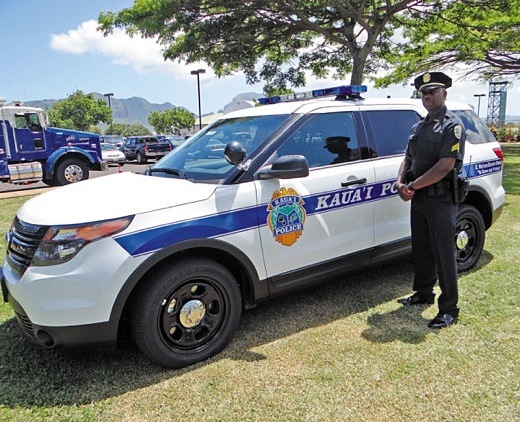

Image above: Kauai Police Department’s Sgt. Roderick Green stands with one of the new Ford Explorer Police Interceptor Utility vehicles. From (http://thegardenisland.com/kpd-car-jpg/image_a19f6118-c8f2-11e2-86c8-0019bb2963f4.html).

Last week I attended a meeting with some of the members of a Kauai group of a national environmental organization. The group does good work for the community as well as provide services for the island and its visitors.

Much of the in-house work of the group has been adapted to work done at home and through telecommunications. This saves greatly on fuel burned in order get from Hanalei and Hanapepe just to sit and the same room and talk.

However, every so often we do get together for meetings when needed. The meeting was set for 11:00am at a unit of the Waipouli Beach Resort opposite the Kapaa Safeway. I began my trip from Hanapepe Valley with over an hour set for traveling time. Thus began my tribulation. 

Highway Blues
There is only one way around the island - the Kaumualii and Kuhio Highways that link up in Lihue.   They were crowded all the way from the Westside to the Eastside of the island. Some of it was normal Kauai traffic but I also had to pass a nasty accident between Tree Tunnel Road and Halfway Bridge.

If you are familiar with  in that area you might have noticed there is a "Bike Lane" marked with signs going west from Puhi. It mysteriously disappears before you get to Knudsen Gap with a cryptic sign that simply reads "Bike Lane Ends". What bike lane merely ends in the middle of nowhere?

I think this "Bike Lane Ends" is due to the fact that the bridges over the stream crossings along much of the Southside after Halfway Bridge were built in the 1930's when the vehicular traffic on Kauai was so light that oncoming traffic was a rarity.

Back then one-lane bridges were acceptable. From 1911 until the late 1938 the main highway over the Hanapepe River was a one-lane bridge.

Now those one-lane bridges over the Route 50 on the Southside are deathtraps to pedestrians and bikers, if two trucks are passing one another while you are on one of those bridges. Between the stone wall of the bridge and the side of a speeding truck there is hardly the room for a wobbly bike handle bar.

Several years ago my wife Linda and I were driving west on this section of road and came across a couple with three young children on bikes as they were approaching the "Bike Lane Ends" sign. They kept going and Linda and I worried about their safety.
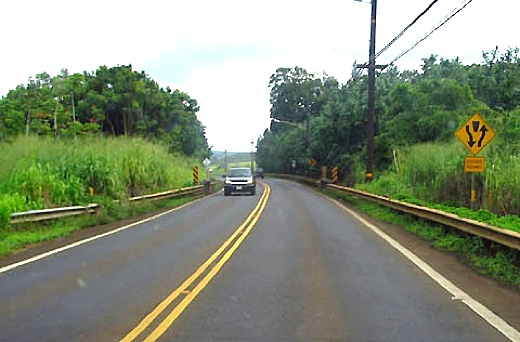


Image above: Approaching the "Tree Tunnel" Road from the west. Note stone bridge over stream ahead with no margin for bikes or pedestrians. (http://islandbreath.org/2005Year/a05-01-access/0501-13KauaiBikeways.html)

Accident Along the Highway
As I passed the Tree Tunnel Road going east there were cones in the road diverting traffic around a tree trimming operation that was working on the side of the road going westbound. Traffic slowed to a crawl. But the traffic was not alleviated once past the tree trimming trucks. There were more cones behind the trucks diverting westbound traffic toward the east-bound traffic so as to avoid the tree trimming. Ahead of me were flashing lights. Two cop cars and a fire truck were there. Also an ambulance with a empty stretcher.

East of the ambulance a single new model car was parked on the verge with a caved in grill. Behind the ambulance I could just see the outstretched arms of the victim. It seemed the paramedics were still working to stabilize the victim before transfer to the stretcher.

What seems to have happened was a cyclist followed the line of cones and was clipped from behind by the car with the bent grill. A did not see a twisted bike, but I figure someone walking would have stayed outside of the cones and avoided the traffic until they got to the tree trimming.  

More Different Bike Path
If the state and county had any interest in cycling they would change their priorities entirely. At a fraction of the cost per mile of their current "Bike Path"construction plans, they could make much of the island accessible for bikes. They would simply add a relatively cheap bike crossing bridge on the sides of the 1930 deathtrap they call bridges now along the southern leg of Route 50. I have not counted them but my sense it it may be as few as a dozen such crossings.

On the Southside this would open Koloa, Poipu, and Kukuiula to cyclists as well as be the first phase of a gateway to the whole Westside. Once past Kalaheo riders could take the lovely Rt 540 bypass down to Old Hanapepe Town. Beyond this, biking is fairly easy.
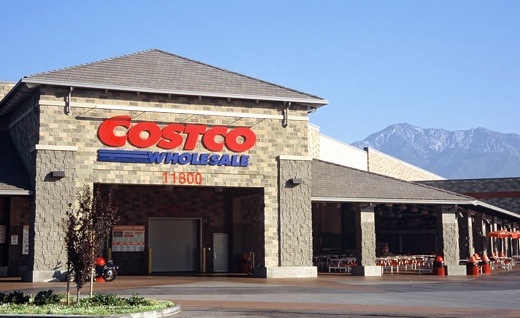

Image above: Does this Costco look familiar? The corner entrance, the food court on the right hand, the mountain in the background?  No it's not Puhi, but Costco Rancho Cucamonga. From (http://www.fuscoe.com/portfolio-items/costco-wholesale/).

Continuing Down the Road
The traffic was solid past halfway Bridge and into Puhi.  There a large new shopping plaza is arising in what was recently an open field opposite the Chiefess Kamakahelei, Middle School and the YMCA of Kauai Fitness Center. Both of those were fields in recent years too. Nearby is the Home Depot and Costco (which replaced a public park). The effect of all this is architectural chaos and suburban sprawl.

What was once open space on either side of the road is morphing into the southern California hell of Rancho Cucamonga.

The road goes on in a river of rental cars and commuters through the new (five years in the making) highway widening passing the Kukui Grove Mall, on past the Walmart and beyond.

I know, I know... this is what progress means. More time in your car's air conditioning, listening to an $800 dollar sound system while you checking your iPhone's text messages. At least you're getting some hard earned "me time".

But I digress.

Counter Intuitive Counter Flow
Once past the Walmart and Lihue we're into the chute of traffic cones that define the Counter Flow Lane between Hanamaulu and Kapaa. Every weekday northbound Route 50 is reduced to a single narrow lane by the placement by hand of thousands of OSHA orange traffic cones that allow two lane traffic south for the rush hour for half the day. I forgot the cost for this daily service that requires two trucks and a crew of eight.

Along the way we come to the next hurdle -  the traffic pile up once over the Wailua River of people trying to access Kaumoo Road and one of the largest areas of residential development on the island. This bottleneck is right where some idiots want to rebuild the Coco Palms Hotel. It was a bad idea when it was built over a Hawaiian cultural site and graveyard in 1953 and it's a worse idea now.

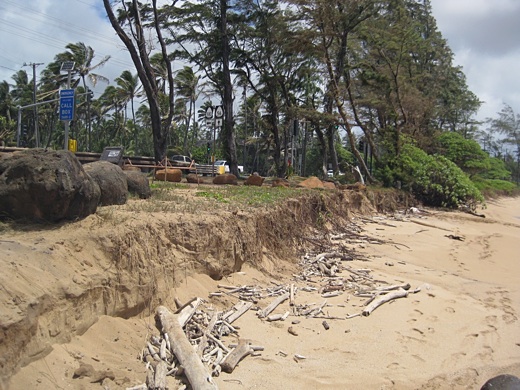
Climate change driven global warming will make this spot untenable in not much more than a generation. We have already seen the ocean cut away the beach right to the edge of the highway in 2012. (see http://islandbreath.blogspot.com/2012/08/wailua-beach-under-water.html and http://islandbreath.blogspot.com/2012/06/wailua-beach-erosion.html and http://islandbreath.blogspot.com/2012/12/wailua-beach-elephant-path.html). Some kind of passage across the  Coco Palms site may be the only way to to keep the north and south sides of the island connected.
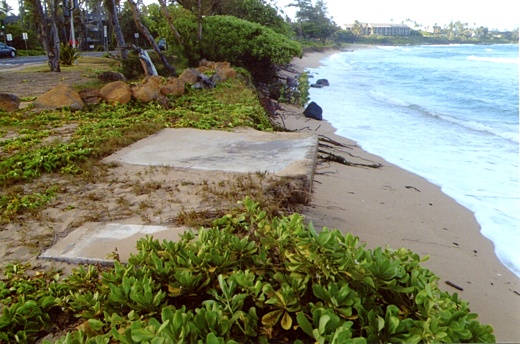

Image above: Wailua Beach in 2012 with erosion taking out the life guard stand and endangering the highway. From (http://islandbreath.blogspot.com/2012/06/wailua-beach-erosion.html).

The Last Leg
Soon we are on to what was once called the Royal Coconut Coast. A 100 acres of coconut tree orchards were spread out on both sides of the Kuhio Highway. Over decades it has been picked apart by development. The Coconut Marketplace was one of the earliest big modernizations. It is now an almost abandoned shopping area with a few tourist traps. Most recently a gigantic Longs Drugs plaza was built blacktopping acres of coconut trees. More is planned. A few scraggly patches of palms still stand. Even that will be gone soon.

Then we crawl through traffic to Waipouli. Sprawl is dense here. Large supermarket anchored plazas (Foodland and Safeway) sit side by side. In the Waipouli Shopping Plaza where the Safeway is sits the now abandoned old Long's Drug store and a variety of low traffic store fronts.

Deep in this plaza was once a beautiful inner court that featured a waterfall behind a lava lock stage facing a lawn with a stream leading past a koi pond next to an artist's gallery.  Papaya's Health Food Store faces that courtyard and had tables and umbrellas for people to eat and rest in a cool quiet space away from the highway. It was truly a place of refuge on the suburbanized Eastside of Kauai.

Now waterfall, the stream the grass and the pond and gallery are gone. It was all  blacktopped over for additional parking that were requested by struggling retailers.

Across the street from the Waipouli Shopping Plaza was once about ten acres of undeveloped beachfront property with low dunes rimmed with ironwood trees. A field of grasses and bushes came all the way to the highway.

This was my destination. But it was not a field any more. It is now the recently opened Waipouli Beach Resort. It's also provides residences and vacation rentals.
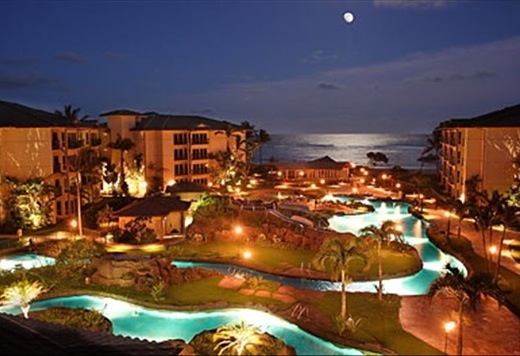

Image above: Nighttime under the stars at theWaipouli Beach Resort. Tropical Elegance of Surf, Sun & Sushi equals Livin'the Dream!" From (http://www.vrbo.com/122141).

The meeting I was going to was to take place - in a top floor suite of the Waipouli Beach Resort. This one was one of the projects our group had fought so hard to stop in 2005 and 2006. (see http://islandbreath.org/2005Year/a05-02-growth/0502-08badplanning.html and http://islandbreath.org/2006Year/02-development/0602-07CocoPalms2.html)

I had never been on this site after construction. After the meeting I went on a walking tour around the grounds. The buildings are dense and as tall as legally allowed. They cluster around one of these amusement park styled pools that go on forever with slides and coves and even sport an artificial beach. I finally crossed the Eastside bike path along the ocean shore.

The developers of the Waipouli Beach Resort tried to force it mauka to go along the highway instead of along the shore. They lost that battle but their landscaping kind of hints that you are trespassing if you are in front of their beach.

But strangely that beach was empty. The swimming there is not good. It requires crossing a long shallow jagged reef.

Even so, you'd think that if you were at a "beach resort" you might try at least try sunning on the shore for a while. But no. Everybody was at the pool. It was safer and you can get a drink and a hamburger poolside. Who even needs a beach at a beach resort?

Some background
I guess I'm spoiled by having driven on Kauai for over a year in 1971-72. Back then there were no traffic lights at intersections of public roads. There were yellow warning lights on public roads that were occasionally turned on at harvest time when cane haul trucks crossed public roads loaded with sugarcane going to the mill.

Today the mills are dormant and much of the island is denied via the cane haul roads by padlocked gates. But back in the day the public had access to the streams, waterfalls, and forests of the plantations if it wasn't harvest time. Back then you could enter plantation property to park and then hike into all kinds of wonderful places. Not any more.

One after another those special mauka (inland) places have been denied -  Ooiki Falls in Hanapepe Valley; Waipahee Slippery Slide, Kealia; Kipu Falls, near Puhi...

...That is unless you have paid a hefty fee for a ride in an off-road-vehicle across tough terrain, or on a zip line through the trees, or in an inner-tube down a ditch.

Those old places for recreation will be lost to people on Kauai until the credit card wielding tourists don't come by the thousands anymore and the GMO companies fade back to the mainland.


.
Movies on Hawaiian culture

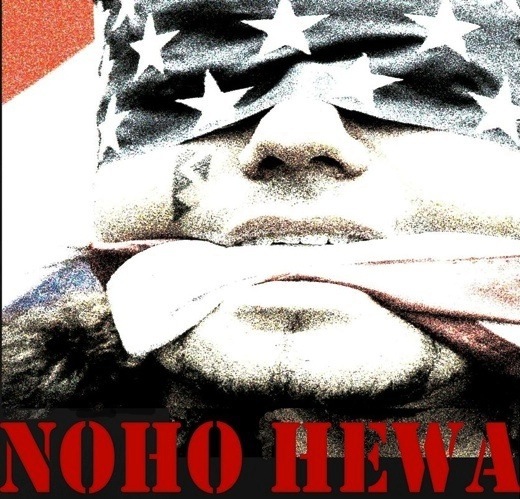
SUBHEAD: Free movie showings of "Strong Voices, Passionate Hearts" and "Noho Hewa" Friday, March 8th Kapaa Library at 6:30pm.

By Ray Catania on 26 February 2013 for Island Breath - 
(http://islandbreath.blogspot.com/2013/02/movies-on-hawaiian-culture.html


Image above: From ().

WHAT:
"Strong Voices, Passionate Hearts"
Kauai Community Youth speak out against Governor Abercrombie's PLDC (Public Land Development Corporation) at the Mayor's office.

"Noho Hewa"
How US Military and Corporations like Walmart destroy Kanaka Maoli sacred sites. Discussion to follow movies.

There will also be a Photo Display of Wailua Beach erosion and shoreline destruction caused by the Mayor's Bike Path.

WHEN:
 Friday, March 8th, 6:30pm to 9:30pm

WHERE:
Kapaa Public Library
1464 Kuhio Hwy
Kapaa, HI 96746

CONTACT:
For more information, call Ray Catania, 634-2737
or James Alalem at 635-0835

"Strong Voices and Passionate Hearts" is about Kauai's youth speaking out against the Public Land Development Corporation at the Mayor's office.  Also a photo display of the Wailua Beach desecration by the bike path will also be shared. 

"Noho Hewa" received the Hawaii International Film Festival's highest award in the documentary film category, the Halekulani Golden Orchid award for Best Documentary. Noho Hewa connects the military occupation of Hawaii to the fraudulence of statehood, the Akaka Bill, homelessness, desecration and more. Featured interviews: Haunani-Kay Trask, Kaleikoa Kaeo, Noenoe Silva, Keanu Sai, J Kehaulani, Kauanui and others. For more information about the film, go to the Noho Hewa website, http://www.nohohewa.com/

 Noho Hewa film review from Big Island Weekly 
http://www.bigislandweekly.com/articles/2009/02/11/read/news/news03.txt
Ethnic cleansing isn't just something that they do physically to people, it's something that happens in the mind." This was said by Haunani-Kay Trask in an onscreen interview in the documentary "Noho Hewa." Haunani goes on to say that ethnic cleansing establishes within a people's mind-set that "You have no place to live. You do not have a home, so you do not exist." 

This manao (thought) is what Anne Keala Kelly is trying to capture in her first feature length documentary, "Noho Hewa." Jan. 17 marked the 116th anniversary of the overthrow and continued occupation of the Kingdom of Hawai'i. 

"Noho Hewa: The Wrongful Occupation of Hawai'i" inspires and educates its audience on the struggles facing modern Hawaiians. It was presented in its unfinished version at the University of Hawai'i at Hilo Performing Arts Center on Jan. 17 as part of the University of Hawai'i at Hilo Ho'olaulea. 

According to Kelly, the film connects the military occupation of Hawai'i to the fraudulence of statehood, the Akaka Bill, homelessness, desecration and more. It includes onscreen interviews with Trask, Kaleikoa Kaeo, Noenoe Silva, Keanu Sai, J. Kehaulani Kauanui and others. It has taken Kelly five and a half years so far to get the film to its present state. She said: "If I get funding, I can finish it in a couple of months. If I don't, well, I don't even want to talk about it. 

I would need about a little more than $15,000 to finish the project." Kelly is putting a time limit on completing the film. She would like to finish the project by spring. "I can't do it anymore. This is a Gorilla movie, and so far I have worked for free. I need to take care of myself and move on to a project that will pay," she said. 

When asked why she had started the project Kelly replied, "As a journalist these are the same issues I saw coming up over and over again for Hawaiians." According to Kelly, a Gorilla documentary is usually a short project for public access programming, where she would only have a week, no money, nothing but a camera and some tape. "So I'm going to try and go for it, and try and get some manao and put it out, project it out, so that people get into the politics of things and get activated." Kelly said she could set up onscreen interviews and ask the interviewees a set of questions. 

The rest, according to Kelly, was kind of blind. She said, "I never knew what was going to happen -- I just was going after it with a camera, and it was never planned, always improvised. I wouldn't have done it if I didn't have the journalism background. After years of reporting I knew who might say what. So then, I would maybe shadow so and so, because he might do this. It's all fresh and it's all raw, not planned." She started off working with just a few activists focusing mostly on the Striker Brigade. Two years into that project, she realized, "I was never going to be able to finish that film. 

There were lots of reasons, political mainly, so I had to just move on and find a way to pull the same issues into one space." Kelly grew up around the Hawaiian movement. She said, "I was 12-years-old the first time I heard the word sovereignty. I remember how I felt the first time I heard the word. I felt it strong in me. I didn't even know what sovereignty meant." Viewers had strong reactions to the film. 

A citizen from the Czech Republic had a hard time holding back tears as the film ended. She was filled with sorrow after seeing what has become of a peaceful, friendly culture. During Q & A the Czech citizen spoke of how her own homeland is facing similar military occupational issues. She said the film inspired her to help her own homeland conquer its battles. 

An Alaskan Native, also inspired by the film, asked Kelly where to go to get more information so that he could share it with his friends. He wanted to help "spread the word." Kelly hopes that after seeing the film the audiences just take the time to do something, anything. "I hope that people take the time to consider the many things that are crushing Hawaiians from the spiritual to the physical to the physiological to the economics to the cultural. 

Our people are inundated from every direction. I hope Hawaiians and non-Hawaiians go away knowing that this is a terrible hewa (wrong) in multiple ways but also come out on the other end and know that they are supposed to do something to help, 

At least not make it worse with their opala or bad behavior, at least not make it worse for us, cause we Hawaiians have to really talk to each other and figure out how do we try to move together in a direction that's going to reverse the trend of these things you see in the film." "Noho Hewa" is the winner of the 2008 Hawai'i International Film Festival and Halekulani Golden Orchid Award for best Documentary. 

 "Noho Hewa" was not the only vehicle for education on Jan. 17. Simultaneous to Kelly's first showing of the film, Big Island residents were holding signs once again at the Borders parking lot in Hilo to let the public know that it is not OK to take any more from the Hawaiians, as so much has already been taken from them. The controversy covered in "Noho Hewa" has reached the youth of the Big Island. They are, as Hawaiian activist Skippy Ioane would say, "agitated and activated." They are taking a stand for the Hewa that has been done to their people. Keli'i Ioane, a 16-year-old junior at Kamehameha Schools Hawai'i Campus, son of activist Skippy Ioane, feels that it is his kuleana (responsibility) to do something about the Hewa. 

When Keli'i was asked why he was holding signs he said: "I believe that Ceded Lands belong to Hawaiians and not the people of Hawai'i. I feel that the lack of resources available to Hawaiians is all too evident in Hawai'i. 

I'm holding signs to fight the further loss of our inheritance, also to make people aware. I believe it's very important for the youth to be out here, because if we get started now we might be more successful than the previous generations."
.

Wailua arrest Aftermath

SUBHEAD: We were arrested for trying to protect the Mahuapu'uone Heiau where they're building the bikepath.

By Ray Catania & James Alalem on 26 February 2013 in Island Breath -
(http://islandbreath.blogspot.com/2013/02/wailua-arrest-aftermath.html)


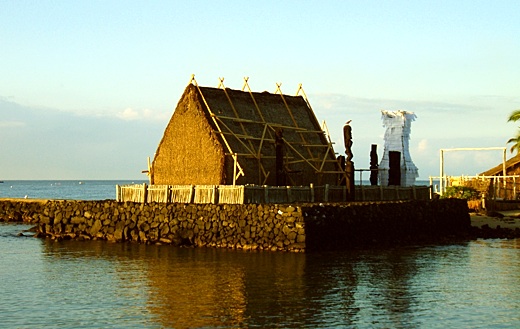
Image above: Photo of the Ahuena Heiau at dawn, in Kailua Kona on the Big Island.  It was reconstructed by King Kamehameha the Great between 1812-1813, and is on the register of National Historic Landmarks as one of the most important of Hawaii's historic sites. From (http://www.robynbuntin.com/ItemDetail.aspx?ProductID=2140).

Our peacefull action on Wailua Beach on February 6, 2013 to prtect the sacredness of this shoreline, and specifically the Mahuapu'uone Heiau, resulted in our arrest and being charged with "obstructing government operations".

We were told by both Kaikor management and the KPD officers this was being done for our safety, in which we responded, "what about the safety of this sacred site and the protection of the Hawaiian culture which benefits everyone?"

We hold nothing against the construction crews of Kaikor, Petersen and Pacific Concrete.  Some of them express to us they understood the erosion that could hapen and the sacredness of the beach and the heiau area.

Kaikor workers told us, especially as being local people from Kauai, that they didn't want to wreck the ahu or altar and that someone else would have to deal with it.

They showed us nothing but real aloha and no harsh words or gestures were exchanged between us.  As working people ourselves, we understand where they are coming from and they are just trying to support their families.

The arresting KPD officers and those that booked and fingerprinted us in the station, also showed us the same respect.  For this we thank them as well.

Mayor Carvalho stated in a news release after our arrests that he was "very dismayed".  Actually, the Mayor and his closest bike path supporters like Tom Noyes, Tim Bynum and Doug Haigh should be very embarrassed for the desecration that they have unleashed on our precious Wailua Beach.

For more information about this issue, contact:
James Alalem
PO Box 510107, Kealia
635-0835
 
Ray Catania
4215 Kole Place, Puhi
634-2737
may11nineteen71@gmail.com


.

Arrests at Wailua Beach Path

SUBHEAD: James Alalem and Ray Catania were arrested defending Hawaiian culture at site of Wailua Bike Path.

Reported by Sharon Goodwin on 6 February 2013 in Island Braeth -
(http://islandbreath.blogspot.com/2013/02/arrests-at-wailua-beach-path.html)


Image above: James Alalem dislplaying typical stone that was used to mark the outline of a body at a burial site. From (http://islandbreath.blogspot.com/2012/07/wailua-burial-site-conviction.html).

This morning at about 8:20am on February 6th, 2013, James Alalem and Ray Catania were arrested by Kauai County Police at the site of the bike path that is under construction on the dune of Wailua Beach north of the Wailua River, on Kauai.

They were arrested after the management of the construction contractor called police and indicated that the site was being blocked by demonstrators. After their arrest they were taken to Kauai Police headquarters.

Ray and James have put their bodies on the line for some time in trying to protect burial sites in an area that has many sacred places in Hawaiian culture.


Image above: Ray Catania stands next to siting of Wailua Bike Path demonstrating how close the surfbreak is to highway. It used to be about 190'. From ().

See also:
Ea O Ka Aina: Leading by Bad Example 1/28/13
Ea O Ka Aina: Wailua Beach Under Water 8/26/12
Ea O Ka Aina: Wailua Burial Site Conviction 7/19/12
Ea O Ka Aina: Wailua Beach Erosion 6/13/12

.

Leading by bad example

SUBHEAD: Why is Kauai County hellbent on this expensive, destructive and foolhardy course? And what will it take to stop this madness.

By Joan Conrow on 28 January 2013 for Kauai Eclectic -
(http://kauaieclectic.blogspot.com/2013/01/musings-bad-example.html)


Image above: Wailua Beach in 1981 looking south, when the beach was much wider. From original article.

The county is proceeding with construction of the concrete Path at Wailua Beach even though its special management area (SMA) permit for the project has expired.

The SMA permit for the section of the path between Lydgate and Lihi parks was approved in 2007, with the condition that “Applicant shall commence construction of the proposed project within 2 years from the date of Planning Commission approval of this Special Management Area permit, and complete construction within 4 years.”

Now an ordinary person would read that as construction should have begun by 2009 and be pau by 2011, which it wasn't. The county, however, is saying no, that language means 2 + 4, or six years to complete. So what? Is the county now going to give every other developer similar latitude?

Further, the permit was approved when the plan was for a boardwalk on the beach. The design has been changed substantially to a concrete path alongside the highway, which should have triggered another review by the Planning Commission. But the last thing the county wants is to reopen the public process.

Instead, it's setting a terrible example by building public infrastructure too close to the ocean through use of a shoreline setback variance. It's also armoring the coastline through its use of concrete — please don't tell me a concrete foot path attached to a 3.5-foot thick wall isn't a seawall — and intensive vegetation.

At least, it sure sounds like intensive vegetation, when you consider they're spending $4,000 on beach heliotrope and another $4,000 on hala, all in 25-gallon pots. No quantity is specified, which would make it awfully hard to determine whether the supplier actually fulfilled the contract. Another $10,000 is allocated for 1-gallon pots of naupaka, again with no quantity specified.

Then there's $15,000 for grass seed that is apparently mixed with gold dust at that price in addition to $6,000 for hydromulch seeding. Though why we would want to put a chemical concoction that close to the ocean is beyond me.

Take a gander through the rest of the budget. (Scroll to the end of the document.) Some $584,000 is being spent on concrete, and $145,000 for reinforcing steel. That's to make sure if you hit that wall with your car, it's guaranteed to be a big smashup. Another $230,000 is budgeted for rock facing on the concrete wall. Additionally, $42,500 is earmarked for cops and other traffic controls, with $25,000 allocated for archaeological monitoring. The pavement markers are $8,000, though it's hard to know exactly what we're paying for, as again, no specific quantities are listed.

Some $13,000 is budgeted for signs alone – gee, who would've thought a mile marker sign cost $1,500?

Which makes me wonder how much the sign cost that was put up right in the middle of Kuhio Highway — and run over within a day — advising motorists of the new crosswalk that's been installed between Kawaihau and Hauaala roads, one of the most congested sections in Kapaa. The crosswalk was painted so people could get from the Kawaihau spur, which is not yet pau, to the coastal Path.

Yet for some reason the county says, no, we can't possibly have the Path crossing the highway at either Safeway or Kuamoo Road, both of which have crosswalks and traffic signals. What's up with that? Like so much of the Path "planning," it's all rather ad hoc and opaque.

Meanwhile, a reader sent a photo showing how broad Wailua Beach was in 1981. The county keeps claiming it's accreting — a fancy word for growing — but we all know it hasn't been this wide for decades.

Two questions remain: why are Mayor Bernard Carvalho Jr., Lenny Rapozo, Doug Haigh and Thomas Noyes hellbent on this expensive, destructive and foolhardy course? And what will it take to stop this madness before it's too late for what's left of Wailua Beach?

.

Wailua Bike Path Rolls Out

SUBHEAD: Construction crew preparing the beach for removable concrete slab multi-use path.

By -
(http://thegardenisland.com/news/local/wailua-multi-use-path-rolls-out/article_5a1f6f9c-564a-11e2-a416-001a4bcf887a.html)


Image above: Construction workers started laying down the first portion of the multi-use path by Wailua Beach Wednesday night before public meeting on issue. From original article.

[IB Editor's Note: It seems they began this construction even before the public meeting to determine its future. What a surprise!]

After years of controversy, construction of the Wailua Beach portion of the Ke Ala Hele Makalae, or “the path that goes along the coast,” began Wednesday night. The current work will lay the ground for the actual path construction, which starts next week.

“I want to acknowledge everyone that met with us over the years and expressed their feelings and concerns about the path alignment along Wailua Beach,” Mayor Bernard Carvalho Jr. said. “We took what was said and weighed it heavily into our decision-making as we have always considered the preservation and protection of the Hawaiian host culture of utmost importance.”

Construction workers will be doing temporary restriping of the highway and placing safety barriers until Jan. 11, when installation of the path is scheduled to begin, according to county officials. Construction is supposed to be finished by March 29. Then, from April 1 to 5, workers will re-stripe Kuhio Highway by Wailua Beach permanently.

As of right now, a night crew is doing the work, but this could change next week, according to county spokeswoman Beth Tokioka.

Carvalho said the administration has made numerous adjustments because of the “important conversations with the community,” in line with the county’s promise to deal with the emotional side of the issue or project first.

“After all of the study and all of the community dialogue, we believe it is time to move forward to link the Lydgate portion of the path through the Wailua Beach corridor in a way that is environmentally sound and culturally sensitive,” he said.

For the last few weeks, the administration has been running an ad in different local print media, warning that for the next three months there may be periodic closures between 9 a.m. and 3 p.m. of the makai lane of Kuhio Highway by Wailua Beach.

On Dec. 29, the administration sent a press release, stating that a recently released report by the U.S. Army Corps of Engineers indicates that the coastal path between Kuamo‘o and Papaloa roads will not significantly alter shoreline erosion in the area.

“The report noted that the Wailua shoreline has an annual accretion rate of approximately 3.5 inches,” the release states.

The Army Corps’ Civil Works Branch concluded that the makai edge of the path is at a sufficient distance from the shoreline, according to the release. Additionally, the report states that the proposed concrete slabs do not present the same impacts to coastal erosion in the same way as typical protection structures do.

“The latest report from the Corps of Engineers reinforces our belief that we have planned appropriately for the short- and long-term shoreline trends in Wailua,” Carvalho said in the release.

In the press release, Carvalho praised the county Public Works Department, the state Department of Transportation and the County Attorney’s Office for their “extensive due diligence” that has ensures that the path will be “environmentally sound” built and in a “culturally sensitive manner.”

‘Removable’ slabs
The latest plans for the path at Wailua are for “removable” concrete slabs, each weighing approximately 15,000 pounds, the average weight of an adult male African elephant. County officials said they decided on “removable” sections for the path after a recent periodic erosion in Wailua, which took most of the beach sand and placed it elsewhere. In the last few months, the sand has been slowly returning to Wailua Beach.

County officials said that prior to coming up with final plans, the administration had many discussions with Native Hawaiian leaders, representatives of state and federal agencies, experts in coastal land use and cultural archaeology, as well as a broad cross-section of the community.

Carvalho requested additional archaeological testing in the summer of 2011, even thought this was not required, to ensure minimal disruption of cultural resources in the area. No traditional Hawaiian or historic artifacts, cultural deposits or cultural resources were found during the investigation, according to the administration.

Kaua‘i County Council Chair Jay Furfaro has requested for today’s council meeting, starting at 8:30 a.m., the presence of County Engineer Larry Dill, Parks and Recreation Director Lenny Rapozo and Planning Department Director Michael Dahilig.

The meeting’s agenda includes discussion on the actual scope of work for construction, review of approved federal, state and county permits and a memorandum from Ruby Pap, Coastal Land Use Extension Agent at the University of Hawai‘i.

At around 12:30 p.m., the council is scheduled to break for lunch. An hour later, the council is scheduled to reconvene and hear from Dill a report on the construction delays of the path at Papaloa Road, immediately north of Wailua Beach. Construction there was delayed for months, apparently due to a mistake on the concrete level. This discussion is supposed to be followed by a consultation with the county attorney behind closed doors on the circumstances that caused the delay, corrective measures and associated costs.

See also:
Ea O Ka Aina: Wailua Beach & Bike Path 1/2/13
Ea O Ka Aina: Wailua Beach Elephant Path  12/22/12
Ea O Ka Aina: Wailua Bike Path Consideration 12/10/12
Ea O Ka Aina: Bike path still on Wailua Beach 1/25/10
Ea O Ka Aina: Bike Path should be here 12/6/09
Ea O Ka Aina: No Path on Wailua Beach 9/17/09
.

Wailua Beach & Bike Path

SUBHEAD: An important meeting on the fate of the Bike Path plan along disappearing Wailua Beach.

By Judy Dalton on 2 January 2013 in Island Breath -
(http://islandbreath.blogspot.com/2013/01/wailua-beach-bike-path.html)


Image above: Traffic along the Kuhio Highway is not far from the spray of breaking surf today. When the Bike path along the beach was suggested the blacktop was over 150 feet from the shorebreak. From Judy Dalton.

WHAT:
Special County Council Meeting on Bike Path at Wailua Beach.

WHERE:
Historic County Building on Rice Street in Lihue.

WHEN:
Part 1 - 8:30AM-12:30PM on January 4th 2013.
Part 2 - 1:30PM TO 3:00PM on January 4th 2013

A path that goes along the coast may sound like a nice idea. But is it really a good idea for Wailua Beach if it means that the County's concrete multi-use bike path along the upper portion of the beach will likely cause irreversible environmental and cultural damage?

REGARDING COUNTY COUNCIL 
Please come to the Special County Council meeting this Friday, January 4 at the Historic County Building on Rice Street from 8:30AM-12:30PM about the concrete bike path project at Wailua Beach, followed by another meeting about the path on Papaloa Road, which connects to Wailua Beach from the north, from 1:30PM TO 3PM.

You will have an opportunity to have your voice heard in what may be the last chance to protect and preserve Wailua Beach. If unable to come, please send your testimony to:

EMAIL:
councilmembers@kauai.gov

It’s recommended that you write to them even if you’re sure you’ll be there.

Please share this information with people you know who care about our beaches.


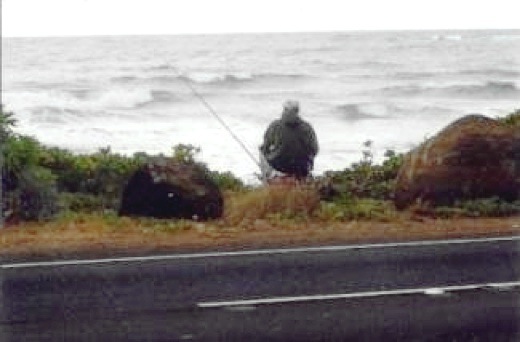
Image above: A man fishing in the ocean at Wailua Beach sitting on the shoulder of the road. From Judy Dalton.

REGARDING COUNTY MAYOR 
Also, Mayor Carvalho, in his position of authority, can determine the fate of Wailua Beach. Would you please contact Mayor Carvalho who has the authority to stop the project? See attached letter at the end of this email if you want Wailua Beach to survive into the future.

Will you please respectfully ask him to put an immediate hold on the project and to consider other options?

EMAIL:
mayor@kauai.gov  
MAIL:
Mayor Bernard J. Carvahlo,Jr.
4444 Rice St., Suite 235
Lihue, HI 96766
PHONE:
808-241-4900
FAX:
808-241-6877


Video above: Watch a HOIKE video produced in November with local residents speaking from a cultural and environmental perspective about the path project for Wailua Beach. From (vp.telvue.com/player?height=390&id=T01393&noplaylistskin=1&video=139340&width=520).


REGARDING ARMY CORPS
The Army Corps of Engineering recently announced ".. the proposed path will not significantly alter shoreline erosion trends at Wailua Beach." which doesn't exactly translate to an approval of the project.

They also mentioned that they made their decision based on photographs sent them by the County's Department of Public Works.

The Army Corps report acknowledged the erosion at Wailua Beach and its consequences stating:
"Using the January 2008 shoreline, the 1975 shoreline is eroded back by as much as 150 feet from the 2008 shoreline position."

“…the concrete slabs could be threatened by undermining if the shoreline erodes along the oceanside edge of the bike path.”

"...As shoreline erosion approaches the seaward edge of the bike path, the sand below the concrete slabs would be allowed to erode from underneath…"

The Army Corps suggested that the County evaluate the cost-effectiveness of the project considering the operating and maintenance costs involved with the path, stating:
"Though there currently appears to be a sufficient width of beach fronting the oceanside edge of the proposed bike path alignment, this does not preclude future episodic erosion events from severely eroding the shoreline. If this were to occur, the proposed course of action by DPW would be to remove the bike path until the beach recovers. There is historical evidence that the shoreline could erode to the extent that this maintenance action may be required. Because of this, the operations and maintenance costs along with the project construction costs should be evaluated to determine the cost effectiveness of the current removable concrete bike path alternative”.
With fast-approaching tsunamis and hurricanes would there be time to dispatch heavy machinery to remove the slabs and haul away? What is the plan for dealing with 1,500 pound concrete slabs that may scatter onto the highway from high wave events which could block emergency vehicles?

SOME BACKGROUND  
The highway along Wailua Beach was built on a sand dune, so everything seaward (makai) of the highway is the upper dune. That would place the concrete path directly on Wailua Beach, considered by Native Hawaiians to be one of the most sacred, historically, and culturally significant places in the Hawaiian Islands.

High wave action over the past several years - and most notably during the past year - has  significantly eroded and narrowed Wailua Beach. It is along the upper part of the beach that the concrete path is to be built - as close as 12 feet from the recent high water mark in some areas. The lava rock wall will be taken down and the path would be built on the makai side of where
it once stood.

The very process of building the path, taking out trees, using heavy construction equipment excavating through sand and boulders to install the many "removable" 1,500-pound, 8-feet wide, 10-feet long, 18-inch deep concrete slabs would compromise the integrity of the fragile beach. It would undermine the structural foundation of the already unstable beach, risking collapse and accelerated erosion of the beach rim.

Interfering with natural processes of these fragile coastal dunes by installing the concrete path (essentially a beach-hardening device) can cause erosion to increase. Predicted sea level rise due to climate change magnifies the concerns of placing development on beaches. It’s critical to the stability of the highway to leave the beach intact and undisturbed. Further de-stabilization of the beach would put not only the path but the highway at risk, creating the need to build a beach-destroying seawall to fortify the remnants. Wailua Beach would face the same fate as one-fourth of the beaches on Oahu - permanent loss.

Read about the effects of hardened shorelines in the recently published book Living on the Shores of Hawai’i: http://www.uhpress.hawaii.edu/books/fletcherLivingIntro.pdf

A readily achievable and sustainable alternative is to locate the path on the makai lane of the existing highway when the fourth already-planned highway lane on the Coco Palms Hotel is added to widen the highway. By reducing the lanes from 11 feet to 10 feet wide (the same width of many freeway lanes on Oahu) an 8-feet wide path could be created on the existing pavement including a protective traffic barrier.

In the meantime, there is already bike and pedestrian access between the north and south ends of Wailua Beach. Pedestrians can enjoy walking on the beach. Cyclists can walk their bikes along the existing highway shoulder from one end to the other in 7 minutes. There is no need to build a 1.9 million-dollar concrete path that could be cost-prohibitive to maintain, that would create safety hazards during storm and high wave events, and that would have harmful environmental and cultural consequences when there is an existing transit access.

The alternatives outlined above would be protective of the coastal environment and respectful of Native Hawaiian cultural values by keeping the path off the beach. It would meet the objectives for the multi-use path while avoiding any cultural impacts, environmental disturbances, or irreversible consequences, preserving the natural state of the beach and the already-existing, perpetual access.

See also:
Ea O Ka Aina: Wailua Beach Elephant Path  12/22/12
Ea O Ka Aina: Wailua Bike Path Consideration 12/10/12
Ea O Ka Aina: Bike path still on Wailua Beach 1/25/10
Ea O Ka Aina: Bike Path should be here 12/6/09
Ea O Ka Aina: No Path on Wailua Beach 9/17/09

.

Wailua Beach "Elephant Path"

SUBHEAD: The proposed Bikepath will disturb ancient Hawaiian burial sites and will be subject to erosion, increasing storms and rising ocean.

By Ray Catania on 22 December 2012 for Island Breath -
(http://islandbreath.blogspot.com/2012/12/wailua-beach-elephant-path.html)


Image above: BEFORE - September 2009 graphic simulation rendering by proponents of bike path route over a beach that no longer exists. From (http://islandbreath.blogspot.com/2009/09/paths-plan-not-cut-in-stone.html).


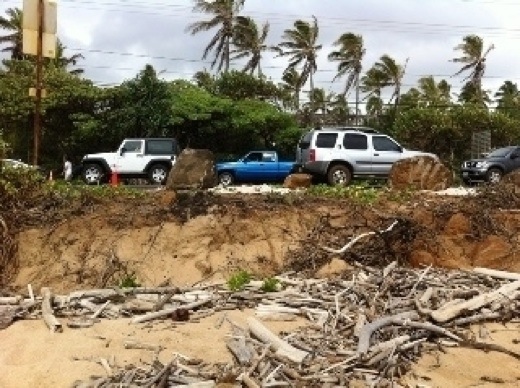
Image above: AFTER - June 2012 photo of area where bike path is proposed. From (http://islandbreath.blogspot.com/2012/06/wailua-beach-erosion.html)


[Editor's Note: Years ago, viable alternate routes for the bike path were proposed (see article links below), but the County and State have stubbornly stuck to the beach plan.  Recent erosion and rising shorelines have made this a ridiculous course of action.  Island Breath supports a bike path, but not one on the iwi, or on the beach.]

As volunteer caretakers of the Wailua Heiau system under the guidance of Uncle Joe Manini, we are adamantly opposed to the building of a bikepath on Wailua Beach or even "mauka of it" as the Mayor's administration falsely claims. Wailua Beach is an extremely sacred place where Kauai's first people landed and later buried their ancestors to return back to the sea from where they came. Their iwi (bones) have turned into vital sand that rings this beautiful beach.

No one has the right to use this area for recreational transport. We can remember the Mayor's meeting on the bikepath a few years ago at the Convention Hall, the planner showing slides on the path, excitedly saying that areas of it reminded him of beachfront California. Opportunistic newcomers intent on making a buck off of Kauai should stop trying to transport their ideas of what socalled "paradise" is to our islands.

Why is our Mayor so helibent on building this path? Is he trying to develop it as a free amenity for eastside hotels and as part of a grand resurrection of the Coco Palms resort he so desires, a creation that sits smack dab in a dangerous tsunami zone? The planned Waipouli bikepath "C and D" will also destroy 19 burial sites that front the shoreline where the County Planning Department has given the permission to build 3 more timeshare hotels. Wailua Beach alone will cost taxpayers more than $1.9 million federal dollars, money that path supporters don't want to lose in other words it's all about the money.

Western materialist culture is stuck on the idea of "my personal right to go anywhere I please" especially if one has the financial power and influence to do so. This selfish thinking has got to stop when it comes to the destruction of Kanaka sacred places. It's not a racial thing it's everyone's responsibility to respect the culture of Hawaii's first people. All the chanting and the parading of cultural practitioners that the Mayor's office has conjured up to support this development, can't coverup the greed involved and the environmental imbalance that will be created.

Each so called "removable concrete" slab will be 10 feet by 8 feet and up to 1.5 feet deep. This will be laid over part of the beach and each will weigh about 15,000 pounds, and be as heavy as an elephant. It's now safe to call this tragedy "the Elephant Path". The path's route will arrogantly bypass the County's Ordinance 887 which states that there should be no shoreline development under the 40 foot high water mark. Chip Fletcher with Hawaii Sea Grant said during a Kauai County Council meeting on December 9, 2010 that, "With the ocean rising as it is right now, with lots of erosion going on with global warming it makes no sense to build close to the ocean".

Our County government should be more concerned about shoreline dynamics and erosion as well as rising sea levels due to global warming and how it will affect Kuhio Highway in the near future.

Some culturally insensitive proponents for the Wailua Beach path remind us of folks that would belligerently walk into our homes with their dirty shoes on.

• Contact Ray Catania at (808) 635-0835 or email mayllnineteen7l@gmaii.com

See also:
Ea O Ka Aina: Wailua Bike Path Consideration 12/10/12
Ea O Ka Aina: Bike Path should be here 12/6/09
Ea O Ka Aina: No Path on Wailua Beach 9/17/09
.

Wailua Bike Path Consideration

SUBHEAD: A letter on the Eastside bike bath at Wailua Beach that the Garden Island would not publish.

By Kip Goodwin on 10 December 2012 in Island Breath -
(http://islandbreath.blogspot.com/2012/12/wailua-bike-path-consideration.html)


Image above: Current Wailua Beach erosion close to Kuhio Highway in front of abandoned Coco Palms hotel at Kuamoo Road. From (kas123@hawaii.rr.com).

[Author's note: After 9 days, 2 letters and email correspondence with the publisher, TGI has not printed this. On Sunday 12/9 they printed a press release from the mayor's office, disguised as a news story, "Ke Ala Hele Makalae rolling along". The referenced Council meeting has been on local government access tv every day since the 11/28 meeting. Kip]

The November 28th County Council meeting included a communication from Council member Kipukai Kuali`i to provide an update on recent extreme erosion at Wailua Beach and whether a proposed concrete multi use path on the beach should be relocated or scaled down.

The session featured a competition of photographs with photos taken by community members showing the washed away south parking lot last June and subsequent encroachment to within a few feet of Kuhio Highway. Other photos taken by Parks and Recreation Director Lennie Rapozo and Council Chair Jay Furfaro showed more recent sand accretion.

Whe public testimony was taken, six people expressed their disillusionment and disgust that the government is once again poised to pave over ground that is sacred to them in favor of development, this time in the piko of Hawai`i culture. Some said their traditional practices in that area are being threatened. Others said that memory of places is any indigenous culture's connection to the past and the culture suffers a slow death when that memory is severed. Others came forward to explain that beaches are dynamic in ways not fully understood and that static structures like the concrete slab path have proven to encourage beach loss.

Council Chair Furfaro shared that Coco Palms permits expire in January. An opportunity to obtain a strip of land for the path to go mauka, or for the highway to shift mauka, could arise in the ensuing planning process.

Council member Dickie Chang proposed a four foot wide crushed coral path makai the highway that can be walked in seven minutes, connecting multi use paths at the north and south ends of the beach. Information signs would describe Kaua`i's aloha for Wailuanuiaho`ano and commitment to preserving Kaua`i's fragile shore.

There was a proposal to narrow the traffic lanes, as was done on the H1 on Oahu, so highway and path can all go on the existing asphalt.

  These are sensible solutions. The beach environment is protected. There is a measure of respect for Kanaka Maoli. Taxpayers don't spend $1.9 Million that Building Division Chief Doug Haigh said is the cost. The makai lane won't be closed for three months. Since most path users are just out for a few hours of recreation it will have liitle impact on them. Bicycle riders who want to traverse the Wailua corridor can feel good about themselves for making a small sacrifice.

The photos taken over a four month period and shown at the 11/28 meeting represent a nanosecond in the history of sand movement at Wailua. Drawing hoped for conclusions from them to justify allowing this project is gambling with public funds. The Council and the Mayor should acknowledge that sea level rise and extreme weather events are already measured and recorded facts. Responsible civic leaders worldwide are formulating plans to retreat public infrastructure from the shore, not build closer.

Council Chair Furfaro said that Council rules and the Christmas break will almost certainly prevent the path issue from coming before the Council until January. Mr. Haigh said re- striping the highway is scheduled to begin right after New Year and the concrete slabs to go down starting Jan. 11. Kaua`i citizens have the right to expect that Director Rapozo and Chief Haigh will delay the start up and not obligate the taxpayer financially in the fabrication of path materials until options offered by Council members have been considered and questions asked of them by the Council have received satisfactory response.

.

Wailua Beach Under Water

SUBHEAD: A break in the ability to move traffic back and forth over the Wailua River would cut the island in two.

 By Juan Wilson on 26 August 2012 for Island Breath -  
(http://islandbreath.blogspot.com/2012/08/wailua-beach-under-water.html)

 
 Image above: A hole at the edge of Kuhio Highway opposite the Coco Palms hotel has started to appear in the vicinity where the waves are undermining an ironwood tree. From (http://thegardenisland.com/news/local/people-see-the-changing-face-of-wailua-beach/article_9614b31a-ecfd-11e1-bccc-001a4bcf887a.html).

There is a shoreline crisis at the mouth of the Wailua River. It may be part of a cyclical event but there are inevitable forces that point to a deteriorating situation at this critical point of traffic circulation that the whole island of Kauai depends on. Over the last several years the state Department of Transportation and the County of Kauai have spent tens pf millions of dollars to "fix" the traffic problems and add a bike path amenity.

The widening of the cane haul bridge over the river cost $29 million alone. Those investments may be a total loss in the next decade. The beach has eroded dramatically and now threatens the highway. The planned bike path between the highway and the beach may be unbuildable. Unfortunately, the huge amount of energy and fortune spent to widen the Kuhio Highway should never have been spent so close to the ocean. In a Garden Island News article on 8/22/12 titled "The Changing Face of Wailua Beach", it was reported:
Ruby Pap, the Coastal Land Use Extension Agent for the University of Hawaii Sea Grant College Program, stated;

“In the case of Wailua Beach, the long-term trend is accretion rather than erosion. Accretion means the beach has been growing over time. However, shoreline position is highly variable or episodic, which means there have been extreme episodic erosion events followed by a return of the beach.”
She noted erosion has approached the road in the past (April 1975).
“The recent erosion, which is hopefully temporary, could be explained by the strong and consistent trades we’ve had recently. The Northeast trade swell could have driven sand to the south toward the river mouth.”
She said this is an area that should be closely monitored to see if and when the beach comes back.
The TGI article went on to quote Dr. Chuck Blay, a geologist, naturalist and educator with The Edge of Kauai Investigations wrote;
“The situation at Wailua would have little to do with dredging of the river.”
Blay said the shoreline is changing and will change significantly over the next 100 years with probably as much as a meter of sea level rise.
The tendency will be for the beaches to retreat landward as the water level rises and if such retreat is blocked by shoreline development such as sea walls, revetments, harbor developments, etc., then the beach will erode with the sand going somewhere else.
The facts on the ground are a fast dramatic erosion of the Wailua Beach endangering the existing highway and likely precluding the construction of a beach bike trail. As usual the state DOT was looking in the rear view mirror in its decades old plan to double up on the width of highways throughout Hawaii. Needless to say they did not see Peak Oil or Climate Change coming. They saw merely a steady growth of traffic as being business as usual.

Had they been looking forward in time they would have looked to realign the Kuhio Highway mauka (away from the sea). This is difficult in the area of the Wailua River, but is going to be inevitable in the decades ahead. Complicating the issue is the rich cultural history of the Wailua area. The variety of sacred Hawaiian site is daunting. A quick study reveals a possible future alignment. This plan is only meant to get a conversation going. I realize there are many legitimate concerns raised by such a proposal.


Image above: New mauka alignment of Kuhio Highway by Juan Wilson. Click to enlarge.

From south to north the new highway alignment would veer inland about halfway between the two access points on Leho Drive that are the entrances to Lydgate State Park. This would mean only the southern entrance to Lydgate would exist in the future and it would be the access to the park as well as the Aston Beach Resort Hotel and Smith's Marina. The highway would go mauka of the Malae Heiau and onto an elevated bridge that would pass 20' over the eastern end of the Smith's Marina.

The elevated bridge would then cross the Wailua River and be about a quarter of a mile long. The bridge would ramp down just west of the public kayak launch area to meet a new intersection with Kuamoo Road. Let's hope the engineering of such a solution would include plans light rail and non vehicular traffic as well. Past the intersection the new Kuhio Highway would parallel mauka of the Coco Palms Lagoon to align with (and take the place of) Apana Road. There it would create a new intersection with Haleilio Road.

Beyond Haleilio Road the Kuhio Highway would follow the existing cane road to the north and veer back to the current alignment of the highway before reaching the Kapaa Bypass intersection. This scheme would move the highway back about 650 feet from its present position next to the surfbreak, but that might conceivably be enough for the next century. However, even if it could pass through the gauntlet regulations and reviews would anybody have a line on $100 million in highway funds to get her done?

The worst case scenario is when the area where Kuamoo Road meets the Kuhio Highway is awash in the ocean. The resulting break in the ability to move traffic back and forth over the Wailua River would cut the island in two. Without a year round harbor or commercial airport on the east or north side of Kauai everywhere north of the Wailua River will be truly isolated from the rest of the island. Another set of problems are occurring along Kekaha Beach. They are now sandbagging along the highway inland of where the lifeguard station used to be. A new alignment of the Kaumualii Highway needs to be studied now. Global Warming is real. Global Warming has begun.

 See also:
Ea O Ka Aina: Wailua Beach Erosion 6/13/12 .

Wailua Beach Erosion

SUBHEAD: Wailua Beach is backed against a new highway and eroding quickly. Should we jam in a bike path?  

By James Alalem & Ray Catania on 13 June 2012 in TGI -
(http://thegardenisland.com/news/opinion/mailbag/letters-for-wednesday-june/article_055bd342-b519-11e1-bf44-001a4bcf887a.html)


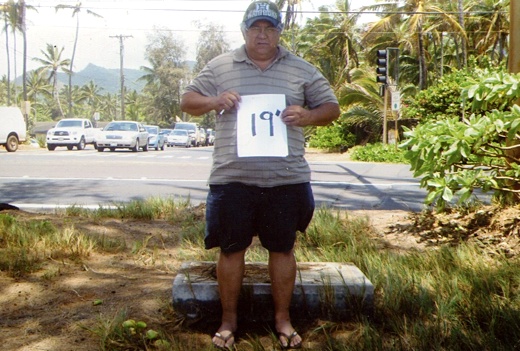
Image above: Ray Catania stands at concrete DOT electrical box controlling traffic signals at the intersection of Kuamoo Road and the newly widened Kuhio Highway and Wailua Bridge.

The Wailua Beach bike path supporters had better take notice on the latest shoreline erosion that is taking place on the beach today. This is where the path is supposed to pass.

The recent coastal surges that have happened in late May and early June have now broken through the county’s own 40-foot shoreline setback ordinance.

The electrical box fronting the Kuamoo Road intersection and the adjoining educational stand is now closer to the shoreline less than 19 feet from the crumbling sand dune.


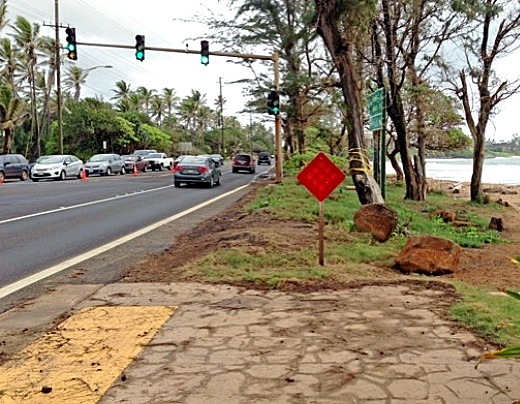
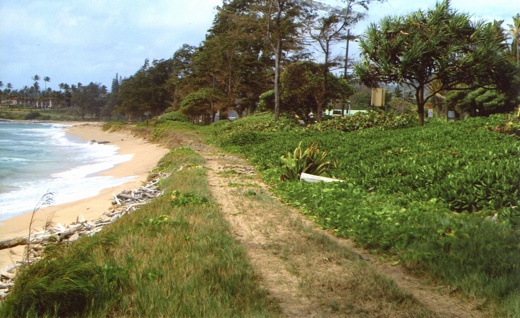
Image above: This photo from late May, 2012, is the sand path that went the whole length of the beach through a wide band of vegetation above the shoreline. Already much of Wailua Beach was in the ocean.


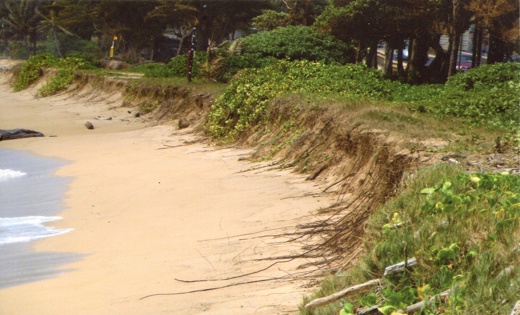
Image above: This is what was left of the same path in early June of 2012. Now much of that path is in the ocean.

Much of the planned bike path is now much less than 40 feet from the new high water mark. The sand path is crumbling and now developing cracks and water rivulets.

Image above. This is photo from late May, 2012, is of the concrete foundation for what was a beach-side lifeguard stand. In front of this station used to be sandlot volleyball court that is now in the ocean.

Image above: The ocean swirls over and past the life station foundation in this photo from early June 2012.

The concrete lifeguard base and the former volleyball sandlot, along with boundary boulders from the makeshift parking lot, have now fallen into the surge.

The “big bucks” spent so far on the Wailua Beach path and the cement path being built behind Kintaro would have been much better spent on hiring our youth for park cleanup and restoration this summer.

The Wailua Beach bike path is nothing more than a free ride for the tourist industry, a boondoggle for the corps of bike renters popping up in Wailua and a twisted view of paradise for some well-heeled newcomers who don’t understand protecting and leaving our Wailua Beach shoreline as-is.
Mayor Carvalho, stop this foolishness now.

[IB Editor's note: The section of Kuhio Highway between the south shore of the Wailua River past Kuamoo Road to Paploa Road is the most critical circulation problem on Kauai. 

A fortune was recently spent to widen the Kuhio Highway and Wailua Bridge as part of a solution to Kauai's worst traffic bottleneck between the two largest population centers on the island. The ocean may ruin this once in a lifetime investment in a matter of a few years. 


The only way to maintain reliable vehicular traffic around Kauai some decades into the future would have been to rebuild the highway and Wailua bridge crossing further inland impossible politically. From our point of view the bike and pedestrian path crossing of the river is the least of our worries. That's doable with county resources. 

What we might not have in the future is a highway crossing in the current location that can support multiple lanes of cement trucks and semi-tractor-trailers without driving them through the surf.]

Race - bicycle vs plane

SUBHEAD: Cyclists beat an Jet Blue airplane in a race across Los Angeles.  

By Stephan Messenger on 18 July 2011 for TreeHugger -  
(http://www.treehugger.com/files/2011/07/cyclists-beat-airplane-in-a-race-across-los-angeles.php)

 
Image above: Interior of typical Jet Blue plane with a TV on every seat. From (http://www.aviationexplorer.com/jet_blue_airways.htm).

Carmageddon may have come and gone without causing too much chaos on in car-driven city of Los Angeles, but that's not to say there were no winners resulting from the closing of a busy 10-mile stretch of freeway over the weekend. In response to one airline's offer of ridiculously low fares to fly over LA this weekend, a group of cyclists challenged an airplane to a race to see which vehicle actually offers the better deal. And, perhaps ironically, the best adjective to describe the outcome is to say the zero-emissions travelers handily 'smoked' their polluting competition.

The challengers in the unique race were six bicyclists from the cycling organization Wolfpack Hustle going head to head with a blogger aboard a JetBlue flight to see who could make it from Burbank to Long Beach the quickest. Only somewhat surprisingly, the spry pedal-powered transport beat out the airplane, with more than enough time to spare. The team of cyclists managed to finish the 40 mile journey in just over an hour and a half.

A report from the Los Angeles Times has the details on the cyclists' resounding victory:
The cyclists and a blogger aboard the JetBlue flight left at 10:50 a.m. from the same intersection in North Hollywood -- with the blogger having to drive to the airport, arriving an hour before the 12:20 p.m. flight, then catching a ride to the aquarium in Long Beach, the finish line. The plane had just taken off when the cyclists arrived.

Offering such low a price for intercity airline tickets must have seemed like a great idea for JetBlue's marketing team -- a way to promote their trips in leu of easy road travel -- but in a surprising twist, bikes have proven the better mode of transport. Note: Video below includes advertisement.

Video above: LA 405 closing opportunity for a bike vs plane race. From (http://losangeles.cbslocal.com/2011/07/16/cyclists-in-burbank-beat-jetblue-to-long-beach).  

.

Police Block Public Access

SOURCE: Kimo Rosen (jrsensei@hotmail.com)
SUBHEAD: Kimo Rosen has been harassed by Kauai police for using public trail to cross DLNR
land in Kapaa.

  Image above: Two of three KPD officers that were on hand for warning. All together they were officer Basuel - badge #472, Murita - badge #470, amd Baumung - badge # 428. All photos by Kimo Rosen.  

By Kimo Rosen on 7 July 2010 for Island Breath -
(http://islandbreath.blogspot.com/2010/07/police-block-public-access.html)

For those of you who follow my blog I have not heard back from the Kauai Police Chief Daryl Perry concerning the local police harassing me, I am therefore going viral and want as many people as humanly possible to know of this abuse. Enough is enough.

There is a new youth center that is being renovated behind Mahelona hospital, it is the old Civic Duty Center. Many of our local police have donated their efforts to renovating this project. Near it runs a trail through public land managed by the Department of Land & Natural Resouces (DLNR).

 
Image above: Trail alternative to Kawaihau Road near new youth center.

Many people have been using the trail, since Kawaihau Road is a safety hazard to walk or bike on with no appropriate shoulder or sidewalk. In fact the little dirt on the side of the road is massively littered with broken glass. I know one senior citizen male who has been using this trail for 21 years for his shopping needs in Kapa'a.

The whole drama started because Lt. Michael Contrades ordered his volunteers to block the trail-head behind the new KPAL youth center being renovated by local police. This trail has been used by school, avid bikers, joggers, walkers, and anyone wanting to avoid walking Kawaihau Road between Kuhio Highway and Mahelona Hospital. Kawauihau Road in that section has no shoulder and is a suicide walk or bike ride with many blind spots, the little dirt on the side is littered with broken glass.

  
Image above: Police blockage of DLNR trailhead.

Last week the local police blocked the trail-head which leads to the DLNR property, the police were asked to remove the debris and they did, making the trail accessible again with a "no camping sign," not a no trespassing sign. I had asked Marvin Mikasa at the local Lihue DLNR if this was legal, he said it's not actually a designated trail in the system but he knows many people have been using it for years. After Mr. Mikasa saw my photos of the trail head blockage on 6-21-10, he emailed them to Honolulu.

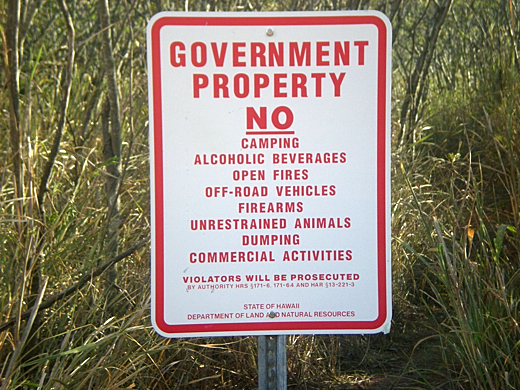
It was the Honolulu office of DLNR that ordered the police to not block the trail-head and to remove all the debris that was blocking it. A new sign has been put up on the DLNR property. It specifies no camping, but nowhere does it say no trespassing or access across the parcel. Since the DLNR has posted "No Camping" signs, but not no trespass signs, as I understand they don't encourage people to use the trail but know of it's popular usage with the safety hazards of Kawaihau Road.

  
Image above is the new "No Camping" sign.

It is my feeling that because I contacted the DLNR that Lt. Contrades didn't like that, hence the harassment of ordering three squad cars, 3 officers and 2 video camera's to deliver a warning of no trespass taking close to one hour. Note they can't do anything about the trail itself, but they have posted signs in front of their building that say no trespass, they are cheap ace hardware type signs, I would photograph them but the cops are out working now and if I am seen within 25 yards of the facility I have been threatened with arrest.

The clincher, you need to go through the youth center area to access the trail. You can still access the trail from the bottom of Kawaihau Road, just don't go through to the top. On Friday July 2, 2010 at approximately 9:00 A.M. 3 police officers and three squad cars come to my residence to give me a warning of trespass that I have been seen walking my bike on this trail. I ask why does it take 3 officers and 3 squad cars to deliver a warning to a peaceful senior?

I also ask them to put down their two video camera's and they refused, I therefore get out my video camera and filmed the three officers harassing me. I am embarrassed as all my neighbors peer through their curtains looking at 3 squad cars parked in front of my residence. There's murderer's and drug dealers out there on the first major county furlough where they are short officers and they send 3 of them to harass and bully me for close to one hour.

They wanted me to sign the warning, I refused... Many other people are using this trail, why I am the only one being harassed. Below are videos I shot of the police actions at my home. Does what transpired seem to require three police officers, two squad cars all the equipment and an hour's time on the first county furlough Friday? Couldn't our police force have a higher priority target?

 
Video above: Part One of KPD vs Rosen. From (http://www.youtube.com/watch?v=H6FFa6JIqDk )


Video above: Part Two of KPD vs Rosen. From(http://www.youtube.com/watch?v=5No4_KlbOQQ)

I am publicly asking KPD for an apology in writing signed by the appropriate command in charge and to make a safe alternative avail to all who have been using this trail. Every day I cannot use that trail is another day I am putting my life at risk by having to resort to use Kawaihau Road and the steep trail. I am asking Kauai Mayor Carvalho to help me. I am being singled out and harassed. I do not know why a senior citizen who has many medical problems is being given such a hard time?

See also:
Ea O Ka Aina: Hands Across the Sand Westside 6/27/10

  .

Bike Path is for Bikes

SUBHEAD: Words matter. "Bike Path" -> "Dog Path". And when words change so can facts related to them.

By Andy Parx on 10 May 2010 in Parx News Daily -  
(http://parxnewsdaily.blogspot.com/2010/05/enhance-this.html)

  Image above: Professional dog walkers take over public path in Buenos Aires, Argentina in 2007. From (http://www.cybercentric1.com/Buenos_Aires_Argentina_April-2007.htm).  

It’s all part of the way the “big lie” works. Just this morning, as if designed to give us a lead-in to how the coastal “bike path” became a “shared use” or “multi use path”, Ian Lind quoted a Mike Middlesworth article at Truthout.org, explaining how the media plays its part:
"The oligarchy that owns and runs our government and controls our mass media has learned Goebbels’s lesson well: A lie unanswered is a lie believed – more so if the lie is repeated, over and over again. Accordingly, a successful propaganda campaign must accomplish two essential and coordinated tasks: (a) tell the lies, and (b) see to it that they are not effectively refuted. The six media conglomerates that now control most of the US media accomplished both tasks supremely well."
So it’s no surprise that the somewhat clueless Leo Azambuja led his latest article on the bill that will no doubt be passed this Wednesday- after what he called “a long day of contrasting testimony from both sides of the dog-path issue” (emphasis added) last week, by saying: The question of whether the county should allow dogs on the shared-use path has carried on for several months...

But why not? He has bought into the same big lie that any number of genuinely confused constituents have swallowed after being bombarded with propaganda by any number of “don’t confuse me with the facts”, misinformed misanthropes who insist that it’s not a bike path but one for any and all uses... even uses that make bicycling so dangerous to all as to make it all but impossible. The fact is that the path originated through $40 million dollars of federal monies distributed by the state called Transpiration Enhancement (TE) funds.

The funds are specifically to be used for one of 12 activates acceding to 23 U.S.C. 101(a)(35), the most common being bike paths that provide for, well, transportation enhancement. TE funds require a 20% match from the recipients. In our case that 20% came from donated lands the biggest portion of which, until recently, came from the Kealia Kai “gift” of coastal lands between Kealia and Kuna Bay (aka Donkey Beach).

The matter almost came to litigation when Attorney Bill Sweeney, representing several condos in Wailua that were slated to have the path run between their complexes and the ocean, threatened suit causing the county to move the path behind the condos. Here’s the pertinent part of what he wrote at the time in convincing the county to change the route of the path lest they be sued for misusing the TE funds, according to administration testimony before the county council:
Transportation Enhancement (TE) Must Relate to Surface Transportation. It is questionable whether the shoreline path relates to surface transportation and not recreation as required by applicable law. Each transportation enhancement (TE) project must relate to surface transportation and meet one of the 12 eligible activities [23 U.S.C. 101(a)(35)]. Applicable federal regulation clearly indicates that TE funds cannot be used to fund bike & pedestrian facilities that are solely for recreational use.
According to the language under 23 USC 217(1), "No bicycle project may be carried out under this section unless the Secretary has determined that such bicycle project will be principally for transportation, rather than recreation purposes". Public support for modifying the pristine beach along the shoreline path with a concrete path or boardwalk is likely based on their misconception that the path will provide recreational opportunities.
For example, in several articles in the The Garden Island Lester Chang reported as follows: December 22, 2003: "The entire project would greatly enhance recreational needs in the Kawaihau District, the largest population area on the island, county officials have said." March 6, 2004: "The entire project is intended to enhance recreational opportunities in the Kawaihau District, which boasts the largest population of the island." (Emphasis added)
The State of Hawai`i and Kauai County must justify the shoreline on the basis of primarily benefiting transportation and not for recreational purposes. The Inland Roadways route (Alternative 2) and the Canal Path route (Alternative 3) more clearly satisfy the objective of enhancing transportation in that they have a closer relationship to Kuhio Highway and are more likely to serve a transportation purpose. As discussed, the Inland Roadways route (Alternative 2) and the Canal Path route (Alternative 3) also avoid potential significant environmental, archeological and ecological concerns.
The number of examples and quotes have increased exponentially over the years, now numbering in the dozens from the newspaper and no doubt hundreds in minutes from county meetings. And now, with the evolution of "bike path" to "shared use path" to "dog path", the proof is in the pudding... or piddling as it were. No one, despite dozens of requests- including a formal letter from then Councilperson Shaylene Iseri Carvalho to the state DOT just before she left office- has ever produced a determination from the federal secretary of transportation.

 Some have gone as far as to claim that there never were any TE funds. But a simple visit to the county public works department will turn up the paperwork, as Building Division Chief Doug Hague will provide and attest to. This weekend after reading in the announcement of the reelection bid of “shared use path” proponent Tim Bynum that he “wrote the initial funding proposal that started the shared-use coastal path project and continues to support its expansion” we asked him to explain and he confirmed that the $2.5 million in his proposal for the Lydgate Kamalani "Bridge", a maintenance shed and part of the path- as well as the other $40 million- came from TE funds. So what?

Well the addition of dogs to the strollers, kids roller-skating, people in wheelchairs and any number of future cat and even turtle walkers on the path (as has been discussed in council sessions) it has been said that it is now simply unsafe to have bicycles there - especially those using the path for 30 mph “transportation”- and perhaps we should move to ban bikes. Banning bikes from a transportation-use bike path would seem pretty absurd. But when you call it a shared or muli-use path, well, anything goes doesn’t it? We’re sure some troll will comment that we’re wrong. But then again that’s how the big lie works.  

.

Bikepath still on Wailua Beach

SUBHEAD: The fact is, the proposed new alignment is NOT shifted from the beach; it would STILL be on the sands of Wailua Beach.

By  Judy Dalton on 25 January 2010 for Island Breath -
(http://islandbreath.blogspot.com/2010/01/bikepath-still-on-wailua-beach.html)

 
Image above: Photo illustrating Beach and Highway constriction from Joan Conroe's article mentioned below.

If it's not clear to you where the new alignment for the bike path is proposed to be located, you're not the only one. Saturday's (1/16) TGI headline of "Mayor Shifting Path from Beach to Highway" (http://kauaiworld.com/articles/2010/01/16/news/kauai_news/doc4b516af0bf44d961795100.txt) was misleading because of the county's press release was misleading, stating, "the proposed alignment for the Wailua Beach section will be shifted from the beach to the right-of-way on the makai (seaward) side of Kuhio Highway." The fact is, the proposed alignment is NOT shifted from the beach; it would STILL be on the sands of Wailua Beach.

The latest version of the bike path would put a 10 feet wide concrete path, 18" deep directly on top of the sand dunes starting from the sandy shoulder of the highwy going makai. Trees and vegetation cover the sand dunes here, vital to the beach's ability to protect itself against erosion.

Please read journalist Joan Conrow's insightful article "Every Picture Tells a Story" (http://kauaieclectic.blogspot.com/2010/01/musings-every-picture-tells-story.html). Every picture tells a story, so after seeing this one, and then taking my own visit, with tape measure in hand, to Wailua Beach yesterday, it appears that Mayor Carvalho didn’t actually “get smart” and move the bike path off the beach, as I asserted in my last post, but “got slick” instead.

 It is important to send a statement to the county today (1/25) asking them to please keep the path off the beach. Email comments to: csimao@kauai.gov by 4:30pm Jan 25. There's a very viable option to keeping if off the beach - on the scenic, peaceful, and safe existing canal road behind Coco Palms.

Since it's one of 3 choices already included in the Environmental Assessment, there should be no delay to the overall project and the price would be lower than beach alternate routes. (The beach route connects to the canal route, crossing the highway near Kintaro's by creating a new traffic light.) By choosing the alternate mauka route the beach would be spared from development and protected.

Although the county press release states that “the proposed alignment for the Wailua Beach section will be shifted from the beach to the right-of-way on the makai side of Kuhio Highway,” it’s quite clear from this photo and my own observation that the path won’t actually run along the shoulder of the road, as most assumed and The Garden Island headline proclaimed. Yes, the route is a little bit farther mauka (inland) than the boardwalk was originally planned, but it’s still on the beach. In fact, now it’s right on the dunes, where most burials traditionally are.

If you have any doubt that’s the beach, let’s remember that the rock wall was built to keep ocean debris from washing onto the road. So nice try Bernard, right down to making the announcement on a Friday afternoon prior to a three-day weekend the traditional time for putting a spin on news you don’t want followed too closely.

Andy Parx, in his inimitable style, nails it with the title of his blog "Another Steaming Pile on the Bike Path" (http://parxnewsdaily.blogspot.com/2010/01/another-steaming-pile-on-bike-path.html)