Showing posts with label Gaia. Show all posts

Gaia's Response to Us

SUBHEAD: The Earth is not dying, Gaia is just reacting to our mistakes.

By Erik Assadournian on 20 December 2020 for Gaianism.org -
(http://gaianism.org/gaia-is-responding-to-our-actions-will-we-act-differently-in-time/)


Image above: One of the earliest images of the whole Earth from 29,000 miles into space taken from NASA Appolo 17 spaceship on way to Moon. It was titled the Blue Marble and and is one of the most reproduced images in history. (https://en.wikipedia.org/wiki/The_Blue_Marble).

So often we hear the phrase ‘save the world’ or the ‘save our planet.’ We may even use it. But sometime back in my career someone wise corrected that, explaining that the planet is not dying but changing—and through that change many species, including our own, will probably die. But the Earth, in all likelihood, will not die.

But to say the Earth is changing, just as to say it is dying, is passive, like, saying ‘Oops, too bad, we were born on a sick old planet—just our bad luck.’

No, Gaia is responding. Responding to our actions. Whatever metaphors you want to use here, feel free: You want to make Gaia into a finely-balanced aquarium filled with exotic fish, and us a wild child dropping soap in the tank to ‘clean’ it

You want to make Gaia a partner suffering from domestic abuse who finally lashes out on us, her abuser, after years of mistreatment? You want to make Gaia a complex planetary system that holds heat from space with a thin coating of co2, a layer that has increased to a level not seen in 23 million years, higher than even three million years ago when global temperatures were 2 degrees C warmer and sea levels were 15-25 meters higher? While the last isn’t artful, it is accurate.

Gaia is responding. To the altered conditions we have unleashed—with our profligate burning of fossil fuels, our cutting down of forests and ravaging of oceans, and our sheer numbers (us and our pets and livestock).

Amazingly, I don’t see us correcting course any time soon.

This past year, in response to the coronavirus pandemic, we shut down large parts of our economy. And so far an additional 1.7 million people have died from COVID. Each and every death is a tragedy. But guess what? Atmospheric concentrations of co2 increased this past year, hitting yet another record (though at this point every year is a record as long as it keeps going up).

That’s pretty amazing. Air travel declined dramatically and is currently 46% lower than in 2019. Road travel in the US declined 11 percent compared with last year. Many businesses were shuttered and will never come back, particularly restaurants. 

But we kept eating, kept making things (after a brief pause) and perhaps even more things to fill consumer demand for novelties while stuck at home (from appliances to backyard patio sets),** plus, all the personal protective equipment (129 billion masks a month!), vaccines, and the equipment needed to deliver them (see, for example, the current boon in freezers and dry ice).

If anything, this year of pandemic, of urgent antiracism protests and prodemocracy demonstrations (not just in the US but countries like Belarus), and of endless Trumpian shenanigans and stoking of conflict and partisanship have crippled the climate movement.

Online protests don’t draw eyes—especially when there are half a dozen other crises to report on every day (including climate-driven ones like raging fires and a record hurricane season). And while groups like Fridays for the Future and the Extinction Rebellion have remained active, the smaller actions they’ve taken have gotten much less attention.

This past week, my wife, son, and I watched I am Greta. It was certainly a moving film, exploring how Greta Thunberg went from one individual striking, alone, in front of the Swedish parliament building for the climate, to sparking a global climate movement to becoming a symbol—both of youthful leadership and truth-telling as well as a vilified figure for those on the right, even receiving death threats.

And thus Greta has also become a symbol of this whole polarized nightmare. Climate change is a threat to our existence, but truly effective action (meaning economic degrowth and daunting levels of cultural change) is a threat to “our way of life” (i.e. the dominant consumer-capitalist paradigm). 

And thus, as viewers see in one scene, Thunburg argues passionately for action in front of the European Economic and Social Committee and Jean-Claude Juncker (president of the European Commission at the time) responds by saying that they’re working “to harmonize all flushes across all toilets in Europe,” which will help save water and energy. You could see the palpable contempt on Thunberg’s face.

Deep down I was hoping my son, 8.5, would say to me let’s start going to the Middletown Town Hall each Friday to strike. I’d be up for that. I want to do that. But I want him to lead that. I don’t want to ‘use’ him, like in an uncomfortably funny scene in the Dutch show Rita where parents make their daughter lead a school climate strike in order to get a book deal.

But the majority of kids, nej, the majority of all people do not want to spend their days protesting. They simply want to enjoy their lives.

But Gaia is responding. To our carbon-intensive life-enjoyment processes. And if we don’t try something different, perhaps partaking in “good trouble”, we’re gonna be in great trouble.

Carbon March to DC

Back in late 2008 (12 long years ago), I shared a proposal with some of the leaders of the climate movement at the time. It was a proposal to organize people from around the United States to walk to Washington,*** taking several months, building the energy and media attention as smaller groups merged into bigger ones and neared the capital, and then blockading major entryways into the city until the new president, Barack Obama, and the Congress felt compelled to respond. 

Note, this was before Occupy Wall Street and XR but absolutely not a new idea—I took it directly from Gandhi’s Salt March to Dandi mixed with Ukraine’s Orange Revolution and other non-violent actions (as you can read here).**** I got some generic positive comments, like Greta at the European Commission, but nothing more. 

And considering I had a cushy job at a sustainability think tank, and had just been invited to direct a new book (on consumerism and cultural change my passion), I didn’t push very hard. Especially as everyone else seemed so optimistic that, under the new president, we’d deal with climate change.

But we didn’t. And I should have pushed harder. And I should now. But even now, as the crisis is upon us (not a looming threat any longer), when I have a young son who will inherit this mess, I find myself hesitating at the idea of putting life on hold and risking life and liberty. 

Sure, in part it’s because I have a child, though old enough to walk with me now (and he’d probably get a kick out of walking from Connecticut to DC, where we used to live). And partly it’s because I’m conflicted about whether it’s simply too late to stop the climate unraveling (see the postscript below). But if I’m honest, it’s also because I’m too comfortable.

Yet, without sustained and consistent pressure, Biden’s climate policy, especially with a divided Congress, will not be enough nor will the Green New Deal that activists are advocating for and mostly consists of unsustainable techno-fixes instead of returning to live within Earth’s limits. No country is currently doing enough, as yet more research shows. Do we just accept that and prepare for collapse as best we can or do we fight, risking our freedom, safety, and comfort for that?

Perhaps the Carbon March is not a good idea (though I admit I still really like it, post-pandemic) but we certainly need to expand, support, and deepen efforts of groups like XR and Fridays for the Future, particularly in the United States, where climate protests have taken a back seat to issues that feel more pressing (and frankly have never gotten enough attention or energy here). 

Of course, we need to address racism, COVID, inequality, growing far-right extremism, and gun violence, as well, but if we don’t find a way to fold climate change into the mix, or even fold all of these into an intersectionalist environmentalist framework—then we’re toast, and, as the world burns, all the social gains fought for over the past two centuries will go up in flames with it.

Postscript: To Fight or Adapt? Or Both?

Taking on one other dimension of this, there is a new divide growing between those still trying to ‘save the world’ (aka stop runaway climate change and the mass die off of life including people), and those who simply think it’s too late, and that the best we can do is prepare for the inevitable transition ahead. This latter community, perhaps best represented by The Deep Adaptation Forum, may be right. But that doesn’t mean we can throw in the towel. 

Every part per million of co2 in the atmosphere is going to make things worse (in a non-linear kind of way). Yes, we need those working on preparing for the transition (in both direct ways, like the Transition Town Movement, and deeper ways, including, I’d argue cultivating an ecocentric spirituality that can help us get through the horrors ahead with our humanity intact), because a post-growth future—one wracked by a never-ending series of disasters—is coming soon to a theater near all of us. But we also need those slowing down this march to collapse (especially as after a point, adaptation is impossible).

This is the ideal, though: the actions we take in one realm would also help in the other. For example, a months-long march to Washington to press for climate solutions would also build social capital, engage communities around the country, teach participants to live simply (and get used to living with less), and rediscover basic skills like cooking (for their cadre of marchers). 

This might subtly do a lot to get us ready for the degrowth/collapsed reality ahead. And cultivating an ecospirituality that strongly encourages its adherents to be engaged politically and socially (especially in ways that help normalize degrowth) would also support both realms. 

Ultimately, with the scope of change needed, it does not much matter if you devote yourself to deep adaptation or to slowing the collapse—both are essential and both are part of our bigger collective struggle. The only thing we cannot afford is no corrective action at all.

Notes:

*Then again, as James Lovelock has noted, Gaia is older than Gi once was. There is a point when the strain of switching states could end all life on Earth and thus Gaia. And of course, like all beings, it is inevitable that Gaia will one day die, the sun’s growing heat and finite life guarantee that. But I have faith that Lynn Margulis is right in that the bacteria deep in the Earth will spread out and create new variations to fill in the empty niches of the new hot world humanity unleashes, starting another cycle of life.

**And factoring in hoarding, we may have even consumed more household goods and food (though it is feasible that this increase might have been offset by food waste avoided from eating at restaurants).

***Due to the nature of this journey, many of the participants would be students and elders (retirees) supported by the communities with food and shelter and attention as they passed through.

****I was inspired to write this after listening to Wendell Berry speak, telling his audience of environmental journalists that the time for “symbolic” civil disobedience was over (in 2008). By that he meant short-term actions that were designed for media attention but did not really disrupt anything in any sustained way that would force a serious response.

 
.

The Wreckage We Leave

SUBHEAD: Nature was hobbled and tripped, chewed up and carted away … gone in the blink of a geologic instant.

By Brian Miller on 1 April 2018 for Winged Elm Farm -
(http://www.wingedelmfarm.com/blog/2018/04/01/the-wreckage-we-leave-a-memorial-for-that-which-is-no-more/)


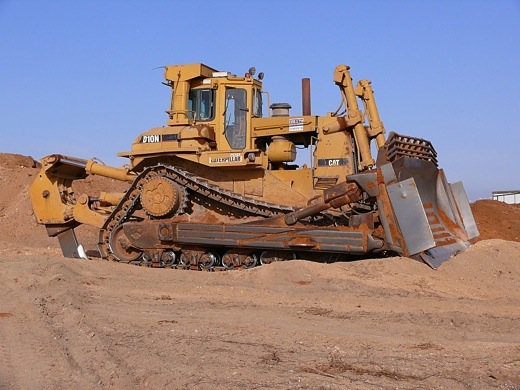
Image above: A Catepillar D10 bulldozer on a patch of bare Earth.  From (http://www.resilience.org/stories/2018-04-02/the-wreckage-we-leave-a-memorial-for-that-which-is-no-more/).

A memorial to that which is no more. 

The hawk floats in over the valley with eyes sharply focused for any movement. It’s a ritual performed more out of habit than hoped-for consequence, above this once-teeming feeding ground that is no longer. How does the raptor fathom a clear-cut and soil-stripped landscape?

The accipiter’s ancestors have hunted this very ridge and creek for tens of millions of years, but it is now forced to move on by an interloper on a bulldozer. With wings thus clipped, it spirals out of sight and into the past.

Who gave us the right?


Where there were turtles, snakes, foxes, opossums, raccoons; nests with birds of every manner, from titmice to owls; groundhogs, deer, skunks, even kids who waded and swam in the water — they are gone now.

Where there was topsoil, rich with earthworms and nutrients, and assorted species of insect and mammalian life — they are gone. Where there was any life in the creek winding through this valley that depended on a healthy ecosystem above its banks, it is gone.

Trees? Gone. Loam, clay, and rock? Gone.

A ridge called by any familiar name? It too is now gone.

Who gave them the right?

Ownership. A quaint term for destruction. That such a right should be asserted by a creature whose lifespan is a mere four-score years, over a wedge of land and ridge formed three-hundred million years in the past — a claim of judge, jury, and executioner for this province nestled between the Cumberland Plateau and the Appalachian Mountains — is pure hubris.

Able to survive and prosper through four million, sixty-two thousand, five hundred lifespans of one single human, this valley, this self-sustaining microcosm, was unable to outlast the machine. It was hobbled and tripped, chewed up and carted away … gone in the blink of a geologic instant.

This right, this wreckage, we leave behind.


[IB Publisher's note: An "accipiter" is a genus of hawk with family members like the "goshawk" and "sparrowhawk"]
  

.

The Archipelago of Hope

SUBHEAD: The “complete rebirth on the land” becomes a real option for all communities facing climate change.

By Nich Triolo on 28 November 2017 for Orion Magazine -
(https://orionmagazine.org/2017/11/eight-questions-author-gleb-raygorodetsky-archipelago-hope/)


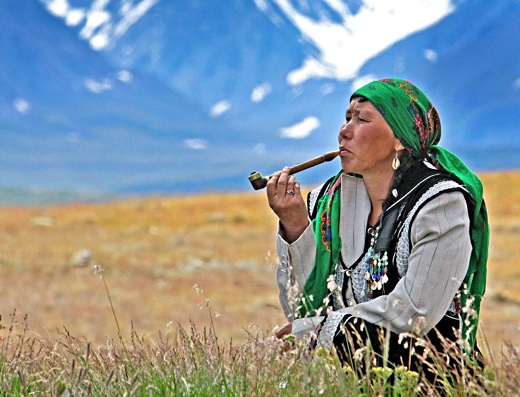
Image above: On sacred Ukok Plateau, Maria Amanchina, a traditional Altai shaman and healer, lights a pipe to send her prayers with the smoke to the Sky, the Land, and the Spirit of Altai. From original article.

To celebrate the recent launch of an important and relevant new book, The Archipelago of Hope, I reached out to its author, Gleb Raygorodetsky, to learn more.

Born and raised in a small village on the Bering Sea coast of Kamchatka Peninsula, USSR, Gleb immigrated to the United States in 1988. He made his way from New York City to Fairbanks, Alaska, where he continued his studies in wildlife biology.

Since then, Gleb has traversed the Americas, from Canada’s Beaufort Sea to the Brazilian Amazon, from the Andes to the shores of Lake Superior, living with Indigenous peoples as diverse as Aleut fur seal hunters, Amazonian Caboclos pirarucu fishermen, and the Gwich’in caribou hunters.

After earning his PhD in ecology, evolution and environmental biology, he continued working with Indigenous groups around the world. Gleb has written and contributed to books and scientific articles on Indigenous issues, traditional knowledge, and conservation in both English and Russian.

He wrote Gwich’in Words about the Landa book on the Indigenous ecological knowledge of Gwich’in people in the Northwest Territories. He has also written popular articles on Indigenous and environmental issues for various magazines.

Gleb is a co-founder of Conversations with the Earth (CWE)—an Indigenous-led multimedia initiative that amplifies Indigenous voices in the discourse on climate change.

1) Your recent book is called The Archipelago of Hope. Can you give us a synopsis on what the book is about and how the word “archipelago” made it into the title? 

The Indigenous communities and their traditional territories are the islands of biocultural diversity in the ever-rising sea of development and urbanization. The Archipelago of Hope takes readers on a journey to explore the inextricable links between Indigenous cultures and their lands, and how they form the foundation for climate change resilience around the world.

Indigenous peoples have a millennia-long track record of maintaining intimate relationships with the natural world, which has nourished their communities and sustained their cultures. This is the track record that they have maintained despite formidable odds, including multiple “izations”—colonization, Christianization, sedentarization, and globalization.

What makes Indigenous communities indispensible in the search for climate change solutions is that their ancestral territories are the “living laboratories,” where the traditional practices and understanding of nature meet modern technology and scientific insights, generating new knowledge critical for developing relevant climate change responses.

2) You are an expert in the field of “biocultural diversity” conservation. Can you define this field and tell us how you entered into this sort of work?

In recent years, a number of integrative disciplines—systems science, resilience science, ecosystem health, ethnoecology, deep ecology, Gaia Theory, and others—have sought ways to advance our understanding of the relationships between people and nature, incorporating insights from both the biological and social sciences as well as Indigenous knowledge.

Various organizations working on biodiversity conservation, cultural preservation, and sustainable development are increasingly relying on such holistic approaches in their work. Out of all these approaches, biocultural diversity has particularly resonated with me.

Biocultural diversity is a product of millennia of coevolutionary relationships between humans and their surroundings, when people rely on their environment for survival while adapting to and modifying it.


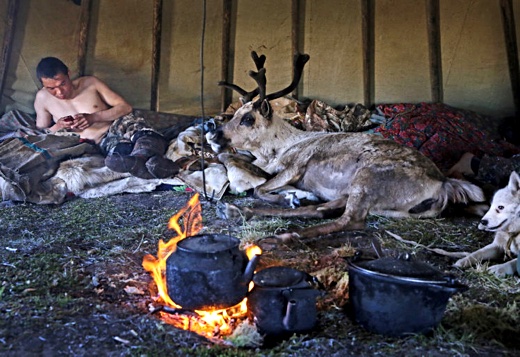
Image above: Inside a Nenets herders’ traditional tent, Gosha Khudi is taking a break from his daily chores and checks text messages on his cell phone. A young reindeer doe, a survivor of the 2013–2014 “rain-on-snow” extreme weather event, hides from mosquitos. From original article.

3) Can you explain Traditional Ecological Knowledge (TEK), and how it’s being used (or not) when making important climate and environmental policy today? 

TEK is the cumulative body of knowledge, practices, and beliefs about the relationships between people, other living beings, and their environment, handed down through generations through oral and hands-on transmission.

It provides valid and practical information about various ecological processes including, for example, daily movements of animals, their seasonal distribution, and multi-year changes in abundance.

TEK-based monitoring allows for timely detection of environmental changes, and development of appropriate community responses that help maintain the integrity of local social-ecological systems.

Until recently, TEK has been largely ignored, but increasingly it has been recognized for its important contributions to such fields as wildlife conservation, land use planning, environmental monitoring, and human wellbeing.

New emerging frameworks, such as Multiple Evidence Based approach, creates a platform for an equitable knowledge co-production. By focusing on the complementarity of diverse knowledge systems based on both Indigenous and scientific knowledge systems, this leads to better decision-making on multiple scales. 


4) What are some takeaway lessons you learned while immersed in Indigenous communities to discuss such global challenges as climate change?

All of the Indigenous peoples featured in the book are intimately aware of the web of relationships that sustains them and their traditional territories.

The interdependence of animate and inanimate, spiritual and physical, past and future, rights and responsibilities, traditional knowledge and science, are fundamentally important for sustaining our planet’s biocultural diversity.

Despite everything the modern world has thrown at them, the Indigenous peoples I profiled have found ways to persevere and even thrive, by keeping their links to the land and other living beings.

What makes these Indigenous communities resilient is that their stewardship of the land is based on Respect, Reciprocity, and Reverence (3Rs) to each other, their neighbors, and the Earth.

Traditional territories of Indigenous peoples continue to support the majority of the earth’s remaining biological and cultural diversity, intact forests, undammed rivers, and ecosystem services, which are fundamental for regulating the climate.

Recognizing Indigenous peoples’ inherent rights to fulfill the responsibilities of looking after their traditional territories—the obligations they inherited from their ancestors—is a prerequisite for sustaining the resilience of these places.

5) What’s next?

My hope is that The Archipelago of Hope becomes more than just words on paper, that it turns into flagstones on a road to healing, reconciliation, and positive transformation.

I am working with my long-term partners to create outreach program and a community-focused traveling exhibition program that would enable Indigenous community members to share their own stories with one another, their neighbors, decision-makers, and the broader global community.

We are also establishing “The Archipelago of Hope Indigenous Resilience Fund,” so that any profits earned from the book sales, as well as any donations to the projects profiled in the book, can go directly to the relevant communities, their representative organizations, or their partners.

So that eventually, in the words of my friend and teacher Tero Mustonen, the “complete rebirth on the land” becomes a real option for all communities facing climate change.


Video above: Promotional video for "Archipelago of Hope: Wisdom and Resilience from the Edge of Climate Change". From original article (https://youtu.be/yx0WbK5pDdg).

Visit the Official Website.
Explore Facebook, and Twitter.
Listen to WNYC Studios feature.
Read an excerpt from the book at Cultural Survival.
.

River given human rights

SUBHEAD: A New Zealand river has Human Rights. Now will modern law come to its senses?

By David Korten on 7 July 2017 for Yes Magazine -
(http://www.yesmagazine.org/people-power/a-new-zealand-river-has-human-rights-now-will-modern-law-come-to-its-senses-20170707)


Image above: Maori men paddle the river in traditional craft. Photo  by Hagan Hopkins. From original article.

Humanity is slowly reawakening to the simple logic that Mother Earth’s rights must come first.

Our system of law has the rights issue exactly backward. But humanity is slowly reawakening to the simple logic that Mother Earth’s rights must come before human rights.

It was a stunning breakthrough in a rights issue that could be a crucial step toward ensuring a human future. In March, New Zealand passed the Te Awa Tupua Bill making New Zealand’s Whanganui River the first river in the world to hold the same legal rights, responsibilities, and liabilities as a human person. For the Maori people, it was the culmination of a 140-year struggle to gain recognition of the river as an ancestor of the tribe.

The victory quickly had a major consequence far beyond New Zealand’s borders.

Only two weeks later, citing the New Zealand law as precedent, a court in the northern Indian state of Uttarakhand gave the Ganges River and its main tributary, the Yamuna River, the status of living human entities. Henceforth, polluting or damaging these rivers will be a legal equivalent to harming a person.

I learned of New Zealand’s breakthrough from my longtime friend and colleague Shannon Biggs, executive director of Movement Rights and co-founder of the Global Alliance for the Rights of Nature.

Biggs and her Movement Rights co-founder, Pennie Opal Plant, traveled to New Zealand last November as guests of the Maori to learn and share with the world the lessons of their historic victory. Biggs further elaborates those lessons in her report published in Earth Island Journal.

Humanity is slowly reawakening to the essential truth that nature—the living Earth—is the source of human existence and is essential to our nurture. It is simple logic that the needs of Mother Earth must come before ours.

That, in turn, implies that Earth’s rights must come even before human rights.
This logic has sweeping implications for a modern system of law that gives corporations more rights than people and nature no rights at all. Just as our human existence depends on the health and well-being of a living Earth, the existence of corporations depends on the health and well-being of human society.

So at its foundation, modern law has the rights issue exactly backward.

Significant as New Zealand’s action is, it represents only a first step in an essential rethinking and restructuring of a system of law crafted by the rulers of an Imperial Civilization to secure their own power and privilege.

In our transition from Imperial Civilization to Ecological Civilization, we have much to learn from indigenous people as humanity’s elders—keepers of our human memory of a time when we saw ourselves clearly as part of nature.

Earth cared for us, and we cared for her. We organized around the rivers, forests, and prairies. We depended on them for our means of living. We honored them as our ancestors. This was a time when no one had yet invented an exclusive claim or right to own, destroy, or sell a portion of nature’s territory in disregard of the present or future needs of others.

Living in balance with nature came easily when our dependence was self-evident. Now that, despite our technological sophistication, we have reached and exceeded the limits of Earth’s capacity, shouldn’t our dependence once again be self-evident?

Perhaps the anomalies created by giving a river the rights and liabilities of a living person will force us to rethink and revise the foundational principles of modern law. What is the river’s liability to a person whose lands it floods or the swimmer it drowns? How are the seemingly intractable conflicts between legally proclaimed territorial rights of nature, humans, and corporations to be resolved?

My thanks to the Maori people who persevered to compel us all to address these essential questions.
The system is ill-suited to the needs of an Ecological Civilization that is expected to meet the needs of all in a balanced, co-productive relationship with a living Earth.


.

Beyond Wetiko Agriculture

SUBHEAD: Saving our soil by supporting the microorganisms that are the foundation of life.

By Tom Newmark & Steven Farrell on 15 March 2017 for Common Dreamsd -
(http://www.commondreams.org/views/2017/03/15/beyond-wetiko-agriculture-saving-ourselves-soil)


Image above: Genetically modified pesticide sprayed monocrop farmed with large machines by corporate agribusiness. From original article.

How much longer do you hope to live? How long do you hope your children or grandchildren will live?  Do you think you or your loved ones will live 60 more years? If so, you’ll be around to witness the end of food production on the planet.  Unless, that is, we become conscious of the crisis and evolve.

According to a recent United Nations FAO report, due to human ecological malfeasance we have only 60 harvests left on this wasting planet.

That’s it: 60 more years of food and then the industrial agribusiness frenzy is over. And it might actually be far worse: the just-issued report of the Environmental Audit Committee of the British House of Commons warned that "Some of the most productive agricultural land in England is at risk of becoming unprofitable within a generation through soil erosion and loss of carbon, and the natural environment will be seriously harmed." Indeed, in some places it’s already happening.

Food systems around the world are breaking down, and the resulting food shortages have led to wars and revolutions. Starving people are risking everything as they flee to areas where there is still food. Why is this happening?

Why would humans destroy the very soils that have long sustained civilizations?  The First Peoples of North America have an explanation for this form of suicide: the wetiko psychosis. Wetiko, also known by some First Peoples as wendingo, is a cannibalistic spirit that devours the flesh of humans or, ecologically, eats the flesh of Mother Earth.

Like all memetic thought-forms, wetiko is transferred from person-to-person or through larger cultural forces through values, beliefs, ideologies, behaviors and practices.

The wetiko psychosis, then, is the mental derangement that leads our species to consume life-giving soils, and some will say that the psychosis is caused by spirit possession.

Others might say it’s caused by governments under the control of indifferent corporations that enslave and crush the spirits of the free. And others might say its the result of clever marketing or meme warfare.

But it’s the wetiko psychosis we’re seeing: the diagnosis is clear.

Just like families that suffer with deranged family members, the family of life on this planet suffers from our collective wetiko psychosis.

Eighty percent of life, as measured by the biomass of all organisms alive today, finds their home in the soil. Earthworms, nematodes, fungi, protozoa, bacteria, and more work together to create a "soil food web" that delivers water and essential nutrients to the plants that we see growing atop the land.

They form the life bridge between the inert chemistry of the planet and the biological processes that make Earth a living planet—that make our planet Gaia.

Wetiko-deranged humans, however, rip apart and poison the soil food web—dismantle the life bridge—thereby diminishing the complexity and vitality of the nutrient-delivery system. Want to see what that looks like?

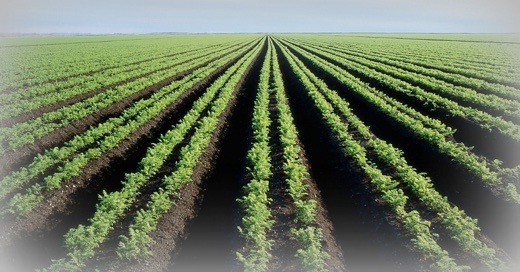
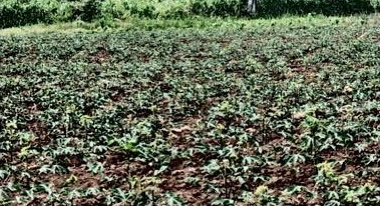
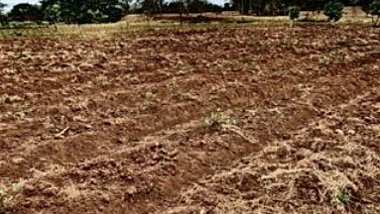
Consider these two photos, taken by the authors on the same day in a field near their farm in Costa Rica.

These two fields were part of an experiment comparing industrial/chemical agriculture with regenerative agriculture.

The fields were planted side-by-side with the same crop—cassava—and the fields were essentially identical at the start of the trial. Same starting soil, same geography, same farmers, same crop, same water, and same sunlight.

At the time of planting an unprecedented drought hit the region: even though the test sites were in a rainforest region, there was no rain for six weeks.

As the photos reflect, one field survived while the other suffered massive plant death.

Photo above: Regenerative cassava field during a drought. From original article.

Photo above: Conventional cassava field during a drought. From original article.

The field that survived was the regenerative field, so neither chemicals nor pesticides were applied to it. The other field—the dead zone—was treated with agrochemicals in accordance with agricultural best practices in Costa Rica.

As the drought occurred immediately after planting the first crop in the experiment, we could not attribute the failure in the dead zone to diminished soil organic matter.

If anything, the dead zone started with slightly better soils, and even slightly better populations of soil microorganisms.

After the chemicals were applied, however, the microorganism populations in the dead zone—both bacteria and protozoa—plummeted, while in the regenerative site those microorganism populations rose.

Those were the only differences between the fields, and it appears that the health of the soil food web in the regenerative field was enough to protect plant life during the severe drought.

Drought is the new normal. Farmers must contend with increasing and unprecedented weather extremes caused by climate change. We need all the help we can get, and the unseen trillions of microorganisms in a healthy field are there to help us weather the storm and to rebuild damaged soils.

This can only happen once we see the forces of wetiko at work and dismantle its root cause in our culture, in our communities, in our governments, in our corporations, in our relationship to the Earth, and of course, in ourselves.

This essay is a part of the Seeing Wetiko series in partnership with The Rules, a global network of activists, writers, researchers, coders, farmers and others focused on addressing the root causes of inequality, poverty and climate change.

.

Climate Chaos

SUBHEAD: As the North Pole melts in November and wildfires rage Across USA well into winter.

By Dahr Jamail on 12 December 2016 for Truth Out -
(http://www.truth-out.org/news/item/38689-as-north-pole-melts-in-november-wildfires-rage-across-us-well-into-winter)


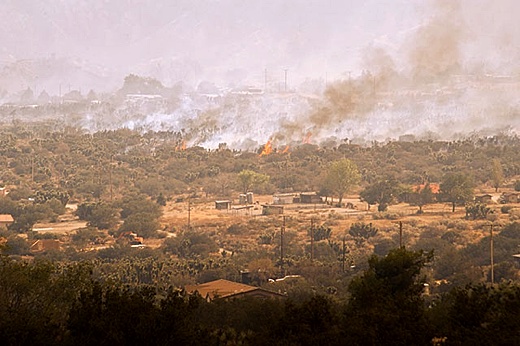
Image above: Flames along the south side of California State Route 138 in Phelan, California, on August 17, 2016. As climate disruption intensifies, wildfires will be burning well into winter. Photo by Andrew Cullen for The New York Times. From original article.

This is the first anthropogenic climate disruption (ACD) dispatch to be written since the election, which heralded the arrival of a president-elect who will become the only western leader who is an ACD denier.

While President Obama remained clearly in the pocket of the fossil fuel industry, with his unwillingness to take the radical actions necessary to mitigate (if even nominally) the already-dire impacts of ACD, he was, at least, willing to admit we live in a crisis never seen before.

As if underscoring the specter of Trump -- and Obama's failure to take appropriate measures, as the proverbial Titanic gurgles ever downward -- the Arctic has been especially warm over the last few weeks. During the second half of November, temperatures at the North Pole were a shocking 36 degrees warmer than normal.

During a time when winter usually sets in and the Arctic sea ice freezes up, ice has been melting instead of freezing. Temperatures in late November were akin to what they normally are at the end of August.

It was Gaia sending yet another unmistakable message, and it was profound enough that Bob Henson with the WeatherUnderground said, "There are weather and climate records, and then there are truly exceptional events that leave all others in the dust. Such has been the case across Earth's high latitudes during this last quarter of 2016."

For perspective, add 36 degrees to whatever your weather is right now, wherever you are. How normal is that? Think about how plants and animals in your area would or wouldn't adapt to that. What would happen to your food and water supply?

To give you another idea of how dramatically things have already changed in the Arctic as the region is in the midst of an ecological disintegration, Captain Cook's records of the region from 1778 reveal a literally different world. His expedition was stopped from sailing north of the Bering Strait by "ice which was as compact as a Wall and seemed to be ten or twelve feet high at least," according to the captain's journal.

In continued attempts to sail further north, Cook's ships followed this ice edge all the way to Siberia, but to no avail.

Meanwhile, back in the 21st century, longtime climate scientists are emphasizing that we're currently seeing an unprecedented situation.

Two days after it was revealed that temperatures at the North Pole were 36 degrees above normal, Walt Meier, a research scientist with the Cryospheric Sciences Laboratory at NASA's Goddard Space Flight Center, who has tracked sea ice data going back to 1979, announced, "It looks like, since the beginning of October, that for the first time we are seeing both the Arctic and Antarctic sea ice running at record low levels."

According to a recent report by the World Meteorological Organization, Earth is now on track to hit 1.2 degrees Celsius hotter than preindustrial temperatures before the end of this year.

According to the recently released annual "Emissions Gap Report" from the UN's Environmental Program (UNEP), current Paris Climate Agreement emissions cuts will still result in 3.5C of planetary warming by 2100. "Current commitments will reduce emissions by no more than a third of the levels required by 2030 to avert disaster," two UNEP leaders warned in the report's introduction.

Recently published research in a prestigious scientific journal shows that ACD is likely already progressing so rapidly that scientists are warning it could well already be "game over." Because the research shows that Earth's climate could be far more sensitive to greenhouse gases than previously believed, they are warning of a temperature rise that is on the "apocalyptic side of bad:" more than 7C within one lifetime from now.

Less importantly, but still shocking and useful to consider (especially since plenty of people seem to believe economics are more important than a habitable planet): Another recent report estimates that the world economy will lose $12 trillion due to ACD damages alone.

A recent report in Bloomberg News lays out the fact that Americans around the US (Florida, Louisiana, East Coast island areas, Alaska, etc.) are already being forced to move due to ACD impacts like storms, erosion and rising seas.

Meanwhile, the global immigration crisis caused by ACD continues apace. A recent report shows that global military leaders have warned of an "unimaginable" global refugee crisis if business as usual persists, and, of course, there is no real sign of it abating.

Brig. Gen. Stephen Cheney, a member of the US Department of State's foreign affairs policy board and CEO of the American Security Project, said, "We're already seeing migration of large numbers of people around the world because of food scarcity, water insecurity and extreme weather, and this is set to become the new normal."

An example of this within the US comes in the form of record-setting wildfires that have been burning across vast swaths of the southeast well into November. You'll find more on this below in the "Fire" section, but it's crucial to note that one of the wildfires scorching Tennessee is the largest in a century, and perhaps in the history of record-keeping. At least a dozen people have died across the southeast from the November wildfires, which are continuing to burn at the time of this writing.

The overview of the oceans continues to grow ever more bleak.

A recent report indicates that ocean life is literally suffocating from low oxygen levels caused by ACD. The report shows that oceans, coastal seas, estuaries, and many rivers and lakes are experiencing dramatic declines in dissolved oxygen levels, and this phenomenon is occurring at a global level now.

As a whole, 2016 has been bleak news for anyone interested in the future of the planet. The World Meteorological Organization recently announced that this year is already "very likely" to be the world's warmest ever. 2015 was the previous hottest year on record, and at that time it was the hottest year since record-keeping began.

Earth
Die-offs of planetary flora and fauna continue to increase in scope and frequency.
A recent report revealed how rising sea levels are pushing saltwater further into US wetlands across the coastal southeast, as well as along parts of the east coast, killing trees from Florida all the way up to New Jersey.

Meanwhile in California, a US Forest Service official recently called the ongoing die-off of what is now over 100 million trees there "unprecedented," and blamed the brunt of it on the ongoing ACD-fueled drought afflicting that state.

Similarly, a recent study published in the journal Global Change Biology showed that yellow cedars in Alaska and British Columbia, trees that can live for 1,000 years, are now dying off over vast areas due to warming from ACD.

Trees across 1,500 square miles are now undergoing a die-off linked directly to ACD, and the forecast for them is grim, since approximately half of the forested area that is currently considered suitable for the yellow cedars will no longer be so by 2100 due to ongoing temperature rise and shifting of winter precipitation from snow to rainfall.

Another disturbing report showed that the world has hundreds of millions fewer birds than it did just a few decades ago, thanks to ACD impacts, dwindling habitat, hunters and pollution.

In the Arctic region of Russia, more than 80,000 reindeer have died as a result of retreating Arctic sea ice.

In a massive new study in the journal Nature, scores of international authors have documented a climate "feedback loop" that they say will likely make ACD considerably worse in upcoming decades. The study addresses the soil-carbon loop in the climate system, which deals primarily with Earth's soils.

Soils store a massive amount of carbon in their plants, and the roots of plants that have lived and died there. Scientists have long since warned that as warming increases, microorganisms living in soils would naturally respond by increasing their respiration rates, a process that then releases more CO2 or methane into the atmosphere. The new study shows that this process is already happening.

Water
As usual, the impacts of ACD across the planet are the most pronounced and obvious in the watery realms (which are increasingly losing their water).

A recently published study showed that, due to dramatically changed vegetation across the Mediterranean region, Spain could be a desert by the year 2100.

Across Africa, ongoing drought is destabilizing countries as it persists. It is the worst drought in 35 years, and has left more than 21 million people in need of food assistance. Unfortunately, yet not surprisingly, the United Nation's Special Envoy Macharia Kamau told journalists in Mozambique recently, "The crisis has yet to peak."

Drought continues plaguing large sections of China. In one region, China's largest freshwater lake is rapidly turning into prairie, as it has neared low-level lines nearly two months earlier than it has done historically.

Meanwhile in Bolivia, President Evo Morales has told people to "prepare for the worst" as the small Andean Mountain country is wracked by a historic drought. Reservoirs that supply water to Bolivia's largest city are now nearly empty.

The drought is primarily fueled by vanishing glaciers across the country, which are a key supplier of water during the dry season. Of course, the glaciers are melting away at record rates due primarily to ACD.

Closer to home, in Utah, recent NASA satellite imagery reveals that the Great Salt Lake is drying up rapidly, as five years of drought have seen the lake's area decrease by 40 percent.

Meanwhile, yet another study was published recently tying US western states' record low snowpack to ACD.

The climate has warmed so much in Canada, that the city of Montreal has invested $7.3 million to save its ice skating rinks. Incredibly, the money will be used to buy refrigerated ice skating rinks.

Looking further north, Russia, China and other countries are rapidly stepping up plans to exploit melting Arctic sea ice by making preparations for their large cargo ships to use the soon-to-be new shipping lanes. Once shipping begins, it will only be a matter of time before the inevitable environmental disasters start to occur in the Arctic.

In Antarctica things continue to worsen, as odd rifts in the middle of the ice shelf of that continent's Pine Island Glacier might be a sign of a new mechanism that could lead to that glacier's collapse, as well as the collapse of other glaciers.

Sea level rise continues apace. A recently published study shows us that ACD is set to cause the most rapid of sea level rise ever experienced in human history, which will make it challenging, to say the least, for megacities on the coasts to adapt. So far, several island and coastal towns facing sea level rise in the far north have had to relocate entirely.

On that note, the first female head of a Pacific Island nation, Hilda Heine of the Marshall Islands, recently told the press that ACD is a "matter of life and death" for her country.

Lastly in this section, a sign of things to come: In the wake of Hurricane Matthew, the town of Nichols, South Carolina was damaged so heavily by flooding that it is an open question as to whether it will be rebuilt at all.

Fire
Wildfires across the US continued to burn far into November, another sign of how far along we are, in terms of ACD impacts. Increasingly, there is no longer a contained wildfire "season," as the planet continues to warm apace.

From the southern US all the way up to New England, November saw fires burning across the country.

Meteorologist Stu Ostro spoke of "surreal" smoke across Atlanta, Georgia; while in Chattanooga, Tennessee hundreds of people were hospitalized from smoke inhalation, while air quality alerts were issued across the Carolinas and Georgia.

By late November, thousands of firefighters had mobilized to fight fires across the southeast, an area that rarely sees wildfires beyond the end of summer. At least 15 major wildfires across the region had, at the time of this writing, burned in excess of 15,500 acres -- including more than 15,000 acres in Great Smoky Mountains National Park -- and have led to several deaths.
Also in November, wildfires were burning across parts of New York, North Dakota and New Hampshire as well.
Welcome to the future of the US, where wildfires will be burning well into winter.

Air
Temperature records across the planet continue to be set at a record pace.

In the US, November saw several stunning examples of this. The mile-high city of Denver, Colorado saw 78 degrees well into November, while Dallas, Texas saw 88 degrees in the middle of that month.
As aforementioned, the Arctic saw stunningly warm temperatures in November, when one day in the latter part of that month several locations saw temperatures spike well over 36 degrees above average.

Meanwhile, global "weirding" continues, as a recent study showed that the polar vortex is shifting due to ACD, which means winters in eastern North America will be longer. The polar vortex is a zone of frigid air that encircles the Arctic and makes its presence known the most during the winter months.

Also in the Arctic, as that region warms, another recently published study showed that more ancient diseases that were buried deep in the permafrost will be released, posing increasing threats to humans and wildlife. Last summer, anthrax killed a 12-year-old boy in a remote area of Siberia, and at least 20 others in Siberia were diagnosed with the disease. (Twenty may not seem like a large number, but bear in mind that this is an extremely lightly populated area.) Scientists are expressing concern over the fact that infectious microorganisms are now emerging from their deep freeze as permafrost across the entire Arctic continues to melt at unprecedented rates.

Lastly, and quite alarmingly, another recent study showed that the planet is far more sensitive to greenhouse gas levels than previously believed. It showed that climate models are likely underestimating how sensitive the planet is, due to the fact that the greenhouse effect will be amplified the more temperatures increase.

This means the pace of ACD is about to accelerate.

Denial and Reality
Almost needless to say, the most important act of denial over the last month was the US electing an ACD denier into the highest office in the country. President-elect Trump now actively threatens to pull the US out of the Paris climate agreements, eviscerate the EPA and appoint fossil-fuel loyalists into key government positions.

Trump has already said he will strip NASA's Earth Science Division, which conducts vast arrays of studies around ACD and its ongoing impacts across the planet, of funding. A member of Trump's cabal is calling the move a crackdown on "politicized science."

Steve Bannon, who has emerged as Trump's chief strategist, has extreme views on many subjects, including ACD, which he calls an elaborate hoax. He refers to renewable energy as "a scam." Bannon is known for helping influence Trump's "views" on ACD and has called environmentalists "greentards" and "totally fucking wrong on climate change."

As is now well known, Trump has claimed that ACD is a "Chinese hoax." Inconveniently for Trump, during the recent UN Climate Summit in Morocco, China's vice foreign minister, Liu Zhenmin, told reporters that Trump is wrong to have accused China of portraying ACD as a "hoax."

 "Look at the history of climate change negotiations, in fact [they were] launched in the late '80s under the administration of Republican President Reagan and George Bush, supported by the United Nations Intergovernmental Panel on Climate Change (IPCC)," Liu told reporters, according to Bloomberg and reports from within the Chinese media.

The Republican Party, which continues to remain the only major political party on the planet that denies the reality of ACD, continues to be funded, backed and heavily controlled by the fossil fuel industry, hence its denial of ACD in order to protect profit-making.

Meanwhile, there is more news on the reality front than is even possible to keep up with.

The government of Australia's New South Wales recently unveiled a plan by which it aims to reach zero CO2 emissions by the year 2050 in order to work towards mitigating the worsening impacts of ACD as best as it can. It will do so primarily by making a concerted effort to shift over to renewable energies and increase battery storage capacity.

On a sobering note, a recently published study showed that the average American is responsible for melting 538 square feet of Arctic summer sea ice each year.

The UN's World Meteorological Organization announced in November that the past five years were the hottest ever on record, and that greenhouse gas emissions have increased the risks of extreme weather events by as much as tenfold.

Disturbingly, a recently published study that surveyed more than 250 different plants and animals found that their ability to adapt to changes in rainfall and temperature cannot keep pace with ACD-generated changes in their environments. In short, this means that the climate is changing "too fast" for species, according to the report.

Not that validation from fossil fuel companies is necessary to confirm the reality of ACD, but it is indeed nice to have. On November 1, Simon Henry, the chief financial officer for Shell, the world's second-largest oil company, said demand for oil will begin dropping permanently in the next five to 15 years, according to an article in World Oil. He went on to admit that his company will focus on making money by focusing on natural gas and renewable energy.

To conclude this month's dispatch, it's worth quoting the UN, which in November provided a very apocalyptic vision of the future of ACD, painting a picture of a changed world filled with famine, war and disease.

 "We will grieve over the avoidable human tragedy; the growing numbers of climate refugees hit by hunger, poverty, illness and conflict will be a constant reminder of our failure to deliver," the UN warned, via its Environment Program. The UNEP released a report that predicted the Earth's temperature is already set to increase by up to 3.4C (above the preindustrial temperature baseline) by 2100. This temperature change should take at least tens of thousands of years to occur naturally, but will have been attained by humans in just a little over two centuries.

It is worth remembering that the rapidly increasing global temperature has consistently outpaced even the worst-case predictions by the UN. Predictions of warming that reaches 8C by 2100 have not been uncommon, with some predictions reaching 12C. Bear in mind that humans have never lived on a 3.5C-warmed planet.

 • Dahr Jamail, a Truthout staff reporter, is the author of The Will to Resist: Soldiers Who Refuse to Fight in Iraq and Afghanistan (Haymarket Books, 2009), and Beyond the Green Zone: Dispatches From an Unembedded Journalist in Occupied Iraq (Haymarket Books, 2007). Jamail reported from Iraq for more than a year, as well as from Lebanon, Syria, Jordan and Turkey over the last 10 years, and has won the Martha Gellhorn Award for Investigative Journalism, among other awards.
His third book, The Mass Destruction of Iraq: Why It Is Happening, and Who Is Responsible, co-written with William Rivers Pitt, is available now on Amazon. HE is also the author of the book, The End of Ice, forthcoming from The New Press. He lives and works in Washington State.

.

Can Bolivia leave capitalism's vice?

SUBHEAD: Despite the constitution guaranteeing rights for indigenous people and Mother Earth, those policies are not implemented.

By Chris Williams & Marcela Olivera on 28 January 2015 for Truthout -
(http://truth-out.org/news/item/28778-can-bolivia-shatter-the-vise-of-capitalism)
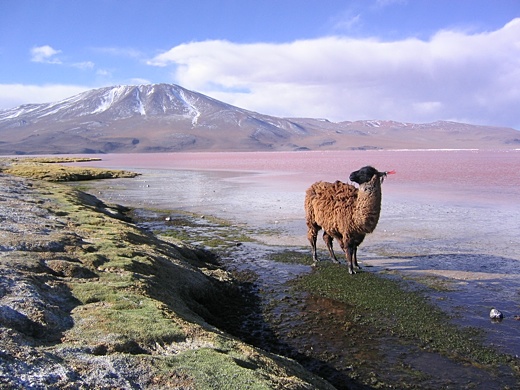

Image above: A llama on the shore of La Laguna Coloradain Potosi, Bolivia. From (http://www.peacecorpsconnect.org/2010/05/commnews-052310/llama_en_la_laguna_colorada_potosi_bolivia/).

As through so much of its history, the small Andean nation of Bolivia sits at the center of a whirlwind of political, social and climatological questions. Arguably, no other country thus far in the 21st century raises the question of an "exit strategy" from neoliberal capitalism more concretely, and with greater possibility and hope, than Bolivia.

That hope is expressed specifically in the ruling party, MAS, or Movement Toward Socialism. The country's leader, former coca farmer and union organizer Evo Morales - South America's first indigenous leader since pre-colonial times - was overwhelmingly elected to his third term of office in 2014.

Morales has broadly popularized the Quechua term pachamama, which denotes a full commitment to ecological sustainability, and public hopes remain high that he'll guide the country toward realizing that principle.

Bolivia has seen impressive and consistent economic growth since Morales' first election victory in 2006, including the establishment of government programs to alleviate poverty and attain the social equity goals promised in his campaign. However, this growth has primarily rested on an expanded and intensified exploitation of the country's natural resources, principally from fossil fuel production, mining, and the growth of large-scale, mono-crop agriculture and manufacturing.

This economic growth has also created what the Bolivian non-governmental organization CEDLA (Centro de Estudios Para el Desarrollo Laboral y Agrario) calls the rise of a new bourgeoisie comprised of Santa Cruz agriculture producers, traders from the west of the country and small mining producers. The Bolivian government also believes that a new class is emerging, and will become Bolivia's new dominant group. Carlos Arce, researcher from CEDLA, says in an article in the Bolivian press:
A new type of entrepreneur has emerged from the popular classes. These emerging strata are mostly traders and are also present in the cooperative sectors, especially in mining. This new type of entrepreneur saves more and has a more austere mentality, in the classical Weberian sense. Within the state, representatives of this strata interface with middle-class intellectuals and other sectors of society, seeking to build alliances with small urban and rural producers that respond to the prerogatives of the market.
The so-called "plural economy" institutionalized by the government recognizes the state, communitarian, private and cooperative forms of economic organization. It also puts the state in direct control of the plans for economic development. In other words, the Bolivian people are the owners of the natural resources, but it is the state that administers and industrializes these natural resources.

In Arce's view, the government exalts this new "emerging bourgeoisie." The government's program of a plural economy "facilitates the alliance of these market-driven sectors with key sectors of international capital. This opens the door to transnational corporations and makes permanent their presence."

In December 2014, the Financial Times reported on the rise of a new indigenous bourgeoisie in El Alto, less constrained by older cultural ties of thrift, and striving for greater wealth, more ostentatious luxury buildings and opulent traditional clothing.

On the other hand, while many journalists and analysts have focused on the accomplishments of the Morales' government, few have looked at the state of the labor force, unions and labor conditions. Research by local organizations shows that finding secure employment has become very difficult.

According to the Bolivian Labor Ministry's own data just 30 percent of the labor force in Bolivia has a secure and formal job, with almost 70 percent working in the informal sector. These workers have no employment security, which makes people more dependent on welfare protections and programs that have become more elaborate and extensive in recent years.

Bolivia's geography is very diverse: The verdant and tropical Amazonian lowlands give way to the austere beauty of the highlands and snow-capped peaks of the Andes that ring the capital, La Paz. Bolivian elevations range from 130 to 6,000 meters above sea level dividing the country into three distinct geographical areas: the high plateau, the Andean valleys and the eastern lowlands.

Given all of these factors, Bolivia offers a case study on the impact of climate change, people's resistance to exploitation and racist oppression, and the potential for genuine change from below.

Much of that resistance was formed in response to centuries of relentless extraction of the country's minerals, semi-precious and precious metals, and guano. Following the privatization of Bolivia's public airline, train system and electric utility, in 1999, the government sold the water and sanitation system of Cochabamba to a transnational consortium.

Over the following five months, mass demonstrations and violent confrontations with the police and military forced the government to cancel the contract and keep the water supply in public hands. This popular struggle for public control of water became recognized worldwide as the Cochabamba Water War.

According to Oscar Olivera, a former union leader and one of the main organizers of the water wars, the successful reversal of privatization of the city's water through an organizational and political alliance of urban workers, campesinos and environmentalists follows a 500-year-old tradition.

"There is a history of permanent resistance of the whole people of Bolivia, especially the indigenous people," Olivera said. Today, "the fight is not against the Spanish conquerors, but against the international corporations that are taking our water, land and air."

More contemporarily, since 2006, the number of conflicts over natural resource extraction and refining, road building and pipeline construction, and forest and water use have all steadily grown under Morales. As a 2013 University of Gothenburg study points out:
There is an increasing gap between, on the one hand, the radical but often very vague provisions for communitarian and proactive environmental management in the new Constitution and the Law of Mother Earth, and, on the other hand, the heavy investments made by the Bolivian state in natural resource extraction and infrastructure development at very high environmental costs. It seems likely that the type of clashes between social movements and the government as the one around TIPNIS [Indigenous Territory Isiboro Secure National Park] will continue to grow unless this gap is narrowed.
Marco Gandarillas Gonzáles, the Cochabamba director of the information and documentation organization Centro de Documentación e Información Bolivia (CEDIB), concurs. "It's an historical intensity of extraction," Gonzáles told Truthout. "Never has mining been as intensive as it is now. Not even during Spanish rule. In the last 10 years, we have exported more silver than in 300 years as a Spanish colony."

Exports of gold are now 8,000 kilograms per year, which means a record use of mercury (15,000 tons per year), cyanide and other toxic substances to separate gold from its ore.

In an interview with Jeffrey Webber in 2014, chief of the cabinet of the Bolivian Ministry of Economics and Public Finance Maria Nela Prada Tejada was straightforward in acknowledging that the MAS project was to "take advantage of the possibility of growth through the exploitation of natural resources, with the state capturing the surplus and redistributing it to social programs and to other economic sectors that generate employment."

Bolivia has significant natural resource wealth, sustainable management of which is, perhaps, Morales' largest challenge. The country was once home to the Spanish crown's richest silver and gold mine, at Potosí, and one of the world's most lucrative tin mines.

Now, 500 years later, Bolivia still contains two of the largest active silver mines in the world, at San Cristóbal and San Bartolomé. In Potosí, one mountain alone annually releases into the surrounding waterways an estimated 161 tons of zinc, 157 tons of iron, more than two tons of arsenic and scores of other toxic minerals, such as cadmium and lead.

Bolivia became a landlocked country when it lost land to Chile in the 1800s, in a war fomented and orchestrated by Britain, in order to secure access to guano: an essential ingredient needed to replenish the fading fertility of British soils, prior to the invention of the Haber-Bosch process for the manufacture of nitrogenous fertilizer.

In the east, at Mutún, lies one of the largest future iron ore mines, which first India and now China are financing for development. Half the world's reserves of lithium (not currently exploited) sit high up in the otherworldly, surreal salt deposits of Salar de Uyuni. After Venezuela, Bolivia has the largest gas reserves in South America.

Coveted by foreign and domestic elites over the generations, ruthless extraction of Bolivia's bountiful natural resources has concentrated the natural and social wealth of the country in a small group at the top of society, and exposed Bolivians to an extreme degree of imperial intrigue and attempted subjugation.

First at the hands of Spain, then Britain, and more recently the United States and World Bank-inspired structural adjustment programs, Bolivians have been rewarded with a succession of dictatorships, extreme concentration of land ownership (despite redistribution after the 1952 revolution and some land reform under Morales, which is stuck today), poverty and extensive environmental contamination of their air, soil and water.

The historical and ongoing cost of environmental degradation is estimated to account for more than 6 percent of Bolivian GDP. All of this has laid the groundwork for the growth of massive social, labor and indigenous unrest and the rise of the social movements at the turn of the 21st century, on the back of which Morales was elected and re-elected to power.

Yet now, another threat has emerged of particular concern to a country that bears little responsibility for causing it: anthropogenic climate change. From a climate perspective, even if average global warming is kept to 2 degrees Celsius (and we are currently on track for 4), regions in the middle of continents, such as Bolivia, will warm appreciably more than coastal regions.

Furthermore, based on data from the Alps and Rocky Mountains, there will be more warming at higher altitudes: between 1.5 and two times greater warming than at lower elevations.

With 12 distinct ecological regions, Bolivia is one of the most biologically diverse countries in the world. The changes in elevation, along with vastly different rainfall patterns from alternate sides of the Andes, create micro-climates that have aided the evolution of a large number of species indigenous to Bolivia.

In addition, the agricultural practices of Bolivian farmers have supported a diverse array of plant varieties. For example, in stark contrast to monoculture farming, several hundred different varieties of potato are grown in the Bolivian Andes, as a resilient subsistence food by 200,000 small-scale farmers.

This is all threatened by a warming climate. Because more humidity accompanies warmer air, more extreme water-related events, such as the 2014 flooding of the low-lying savanna in the department of Beni, are likely to occur with increasing frequency. Meanwhile, as some areas become wetter, the altiplano (the high plains between the Andes mountains) will become even drier.

People in high elevation areas such as the cities of El Alto and La Paz will become more dependent on melting snowpack from glaciers and mountain lakes, even as these water sources gradually diminish: Bolivia is losing all its glaciers below 5,400 meters. Flooding will be followed by drought.
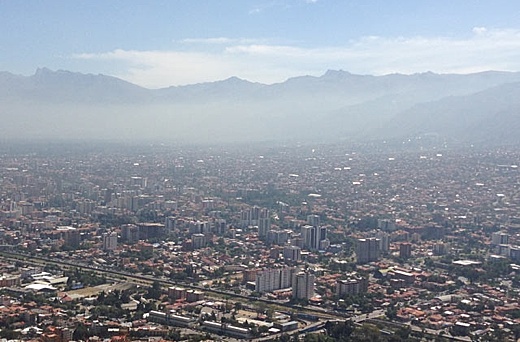

Image above: The highly visible haze of air pollution from cars and industry over the capital La Paz, Bolivia, has been compared unfavorably to air pollution in China. Photo: Chris Williams from original article.

The contradictions of the Morales years are encapsulated by community leader Rigoberto Rios Miranda, a farmer and local council leader from Chacaquinta, a community near the village of Laja, in the high plains above El Alto. Rios Miranda - who remembers a childhood in the 1950s when indigenous people were not allowed in the main square in La Paz, a time before the city of El Alto (now home to 1 million people) existed - is unequivocal in his praise for "the only president in my lifetime who has changed my life."

While he tells the story of how El Alto fought the military of deposed former president Gonzalo Sánchez de Lozada "with slingshots, stones and sticks," he also notes that he no longer knows how his community can grow food - potatoes, wheat and quinoa - because "it now rains at all different times, and it's drier for longer. This place did not used to be as hot as it is now. It's becoming like Cochabamba."

Rios Miranda is categorical in his conviction that "under Evo, everything is different," including his ability as an indigenous person to have a say in politics and be accepted in the new plurinational state because Morales has focused so much on changing the constitution to provide more government funds, projects and jobs for ordinary Bolivians.

One thing that has not changed during the almost 10 years of Morales' rule, however, is the state of the Pallina River, which runs through Rios Miranda's farmland. Where Rios Miranda used to catch frogs and fish as a young man is visibly polluted, and he must keep his animals from drinking from it. The single water treatment plant in El Alto, which was never designed for the kind of industrial effluent that flows unchecked from the tanneries, factories and clandestine slaughterhouses, is completely inadequate.

And so the poisoned, alternately bright green, orange and red foaming water that flows through Rios Miranda's land eventually reaches Lake Titicaca, where, according to Iván Marcelo Castillo, a worker for the Bolivian Environmental Defense Fund, who hails from a village between La Paz and Lake Titicaca, it's responsible for contaminating 35 communities.

Of the river, Rios Miranda said, "We believe even our grandchildren will drink contaminated water." A round trip by donkey to Laja for water takes two hours, but he now has a government-provided standpipe, which the community shares, and has hopes for electricity and gas soon.

Where he once had a bull and plough, there is now a tractor to rent by the hour for the community, and milk to sell in El Alto. Meanwhile, large numbers of people in Cochabamba continue to lack potable water, basic sewage treatment is almost entirely absent, and the Rio Rocha that flows through the city is as contaminated and polluted as the Pallina River.

In an example of how interconnected ecosystems are with climate, higher average temperatures will lead to an increase in evaporation, causing soils to dry out. In turn, drier soils will increase erosion and loss of topsoil, an effect that will be compounded by two other effects of a warmer climate.

More rain, falling more intensely, in shorter time periods, will exacerbate soil erosion, as will higher wind speeds caused by extra energy held in the atmosphere.

These effects in turn will increase the likelihood of wildfires on forest land, though rapid deforestation for the expansion of agribusiness, primarily soya, is occurring in many lowland areas of Bolivia.

One might think that the ability to grow crops higher up the sides of mountains that don't freeze as often could be a positive change. However, Bolivian farmers have long known how to minimize risk due to rainfall variability and temperature gradients, by farming in different ways at different altitudes.

The altiplano has traditionally been suited to the grazing of llama and alpaca only; somewhat lower, there's terraced agriculture based on cold and drought-resistant crops such as quinoa (which also has a high tolerance to higher frequency solar radiation); while lower down still, some crops such as maize are able to grow.

But this stable, interconnected and resilient form of integrated farming practices is threatened by warmer temperatures, as agriculture has been moving up mountainsides: 200 meters over the last 30 years. Hence, as grazing becomes more restricted and difficult, conflicts are emerging between herders and farmers.

Furthermore, the pre-Incan altiplano staple food, chuño, made from freeze-dried potatoes that remain edible for several years, is threatened because nighttime temperatures are not falling below freezing for long enough or with the same regularity.

Without land redistribution, smaller and smaller plots of land, which dominate the highlands, force peasant farmers to over exploit their lands, intensifying soil degradation and erosion. Systematic and significant land reform would almost certainly reignite the fight between MAS and the right-wing, racist landholders in and around Santa Cruz, where the largest landholdings are concentrated.

For a relatively small country of 10 million people to harbor the hopes and dreams of tens of millions of people who want to see a different world is no small feat. Nor is it one to be casually dismissed because it might not currently resemble what we imagine a process of deep social change would look like. The indigenous concept of buen vivir, or vivir bien, enshrined in the new constitutions of both Bolivia and Ecuador, is usually translated as "good living" or "living well," but that's a very inaccurate translation, according to Uruguayan scholar Eduardo Gudynas. Gudynas says: "These are not equivalents at all.

With buen vivir, the subject of wellbeing is not [about the] individual, but the individual in the social context of their community and in a unique environmental situation."

In other words, the term derives from a collective identity that considers nature a subject of history intertwined with human history. To paraphrase Marx, human history is natural history, and vice versa. As Gudynas argues, vivir bien "is equally influenced by Western critiques [of capitalism] over the last 30 years, especially from the field of feminist thought and environmentalism . . . It certainly doesn't require a return to some sort of indigenous, pre-Colombian past."

The social movements, political parties and activists who brought Morales to power continually question the environmental sustainability for which Morales is seen as a standard bearer of optimism and rhetorical opposition to capitalism's anti-ecological heart by those outside the country.

Outside of Bolivia, many on the left uncritically absorb Morales' oratorical opposition to capitalism's ecologically destructive and socially divisive modus operandi.

However, the social movements, political parties and activists who created the conditions for him to come to power, continue to question his actual commitment to environmental sustainability and social justice.

For example, in contrast with this international image, Morales announced in early 2014 that Bolivia had ambitions to build a nuclear power plant, stating, "Bolivia cannot remain excluded from this technology, which belongs to all humankind."

He seems to disregard that a giant, centralized nuclear power plant, with all the dangers and expense that would entail, is hardly the answer to the energy needs of Bolivia, let alone respectful of the rights of Mother Earth. One only need ask the still suffering people of Fukushima for the most recent evidence of that.

In another example, Bolivian feminists and activists are asking, with so much concern expressed for the rights of Mother Earth, where is the concern for the rights of actual women and mothers?
Women are routinely degraded in both the language of government officials and their policies. Morales and other elected officials continuously make sexist statements that have inspired the women's sectors to organize protests and mobilizations against these statements and actions.

During the 2011 conflict with indigenous communities created by the government building a highway through the autonomous Indigenous Territory Isiboro Secure National Park (TIPNIS), Morales appealed to the cocaleros who live near that territory to make the indigenous woman there fall in love with them and discourage their opposition to the highway.

 Morales said, "If I had time, I would make them fall in love with me and convince them. So, young men, you have instructions from the president to conquer the Trinitarian Yuracarés colleagues so they will not oppose the construction of the road."

These comments reflect the dominant attitude toward women from the current administration. The Morales government, appearing to honor public opinion on this matter, recently enacted a law criminalizing the serious problem in Bolivia of political violence against women and has put more government funding toward child care.

However, it remains illegal to have an abortion in Bolivia, depriving women of their right to reproductive choice, and several clear cases of violence against women perpetrated by MAS party members or government officials have been ignored. In addition, little has been done to develop legislation favorable to the LGBT community.

As women's oppression is a bedrock foundational requirement for the successful operation of capitalism, a basic expectation of any government or leader claiming to represent a move away from capitalism, and toward socialism and respect for pachamama, must address these issues.

For all of Morales' rhetorical championing of buen vivir, Gudynas believes that the MAS government instead operates more along the lines of a new form of Keynesian neoliberalism, or what he calls "neo-extractivismo," whereby a percentage of increased revenue from extraction is used by the state to help alleviate poverty - while increasing the power of the state:
The state seeks to capture a bigger share of the rents derived, and to use it to fund social programmes and redistributive policies. This helps legitimize extractivismo and silence its critics, with those opposing it portrayed as working against the national interest.
Extractivismo comes to be seen as the fundamental driver of growth, providing the resources to combat poverty. This growth model conflicts with other notions of development, such as those associated with 'buen vivir' or 'vivir bien' in countries like Ecuador and Bolivia.
Morales' government has tried to solve the contradictions inherent in property ownership of public goods such as oil, gas, water and electricity through a state-led process that some have called nationalization, but which, in fact, is more a favorable renegotiation of contracts with the oil and gas companies already operating in the country and the statalization of other sources.

Which is to say, that the state is intruding into new areas of the economy and life of Bolivians in a more vigorous manner, which is a larger feature of the Morales regime than any extensive nationalization of significant sectors of the economy.

In May 2014, Truthout spoke with Alfredo Viscarra, the former union leader at ELFEC, Empresa de Luz y Fuerza Eléctrica Cochabamba, the electricity company in Cochabamba for 35 years. After ELFEC was forcibly "nationalized" by the Morales administration, Alfredo said:
We never thought that the government was going to statalize the electricity company because the phone cooperative and the electricity workers were its owners. On May Day they took away our company through a decree. We, the workers, nationalized the company. In just one night, they occupied the company with soldiers like during the worst dictatorship and they kicked us out of there.
The electricity company in Cochabamba was privatized in the 1990s. The US company that owned it, PPL Corp, a US utility based in Allentown, Pennsylvania, which had many concessions across Latin America, decided to leave. Once the company put its assets on the market, the workers, who had already bought 5 percent of the shares in the company in 1995, decided to buy another 35 percent.

So, at this point, 300 workers had purchased a total of 40 percent of the company using their severance benefits. The rest of the company (60 percent) was acquired in 1998 by the phone cooperative Comteco, the local phone company that today has more than 200,000 members in the region.

After it came to power, the Morales government declared its intention to nationalize the so-called "strategically important" companies and, in 2010, it continued prior nationalizations of oil and gas when it nationalized ELFEC. The government appointed three arbitrators to oversee the process.

These arbitrators declared that the existing worker and cooperative ownership was acquired illegally. As the elected workers' representative and president of ELFEC, Viscarra refused to hand over control of the utility unless the workforce was compensated for its original severance-payment outlay and ownership.

Although he has been placed under house arrest for the last two and a half years, and threatened with imprisonment, Viscarra has held firm to his convictions that although he agrees the Bolivian government has the right to nationalize the company, it must compensate the workers who are running it and are part owners.

Nationalization implies that the state takes over, with or without compensation, privately run corporations so as to run them as services for the people, rather than for-profit businesses, thus diverting cash from private investors toward the government treasury and social programs to address inequity in society and for the common good. Nationalization in Bolivia, however, is more complex than this definition implies.

While the Bolivian government has taken controlling stakes in the oil and gas sector, not a single foreign fossil fuel corporation has left Bolivia. While the Morales government is taking a larger percentage of royalties from Bolivia's abundant gas fields, the increases in commodity prices and gas production for export have more than compensated the private corporations.

Hence, though the Bolivian treasury is much healthier, fossil fuel corporations operating in Bolivia are making about as much money now as they were before "nationalization," as Morales has in practice maintained an investor-friendly climate. Indeed, the small worker and management-owned electricity company ELFEC is much more worthy of the term "nationalization" (without compensation to the workers), than the giant fossil fuel corporations.

Viscarra has been unable to leave his apartment for two and half years - even to visit his family - and is presently in a judicial limbo. He remains under house arrest, without definitive evidence against him, but with no idea whether he will be freed, put on trial or gain knowledge of what his future holds.

Public Sectors International and several unions in Bolivia have mobilized in support of Viscarra, starting a defense campaign and writing letters to the government of Bolivia demanding that he be released immediately. His imprisonment is a stain on the government of Bolivia and represents a direct attack on the self-organization of workers and trade union rights.

When a country with a left-wing president elected through an outpouring of popular outrage and self-mobilization receives fulsome praise for its economic policies from the neoliberal bastion of the World Bank - and imprisons a workers' leader, to boot - it is fair to assume that not all is playing out according to the hopes of the popular movement.

However, our skepticism must dig deeper than an argument about whether the debate over "extractivismo" is necessary given the history, and economic and social power of a deeply impoverished, small Latin American country, or whether the Morales government has done all it can to reduce poverty, inequality and racism. That's because Morales doesn't have complete freedom to act. There are real constraints in the shape of international capital, class consciousness in Bolivia, the strength of the domestic right wing, and the economically and technologically impoverished state of the country.

When Lenin and the Bolsheviks instituted war communism during the civil war, and later the New Economic Policy, they were hardly in line with Marxist theory, but policies were in many ways pushed on the Soviet government by the parlous state of the economy and the devastation of the civil war. An honest assessment is, therefore, not simply a balance sheet of pros and cons totted up on a spreadsheet of left versus right.

At the same time, several sectors and former allies of Morales maintain an independent position critical of the government, emphasizing that, despite a change in official rhetoric, and some welcome redistribution of wealth, Morales' policies are practically the same as his predecessors' with respect to natural resource extraction. That extraction continues to be the foundation for the country's financial stability, and it comes with attacks on grassroots self-organization when that organizing contradicts Bolivian state policy.

A deeper analysis of the evolution of the Morales government requires examining the evolving social dynamics within the country, and whether the government is concentrating power in the hands of the state, or, conversely, trusting the people who brought it to power. A true economic shift would require placing the power to make economic and political decisions more frequently and obviously in the people's hands, even as particular policies may be inadequate in the immediate sense and subject to practical and political limits.

Additionally, a real move toward socialism would require definitively shifting away from the capitalist pathway of intensified human and planetary exploitation and showing the world that a different road out of poverty and inequality is possible. This would mean not just redistributing some of the wealth gained from exports of natural gas, mining and industry, but fundamentally reordering the country's social and political priorities.

There is too much at stake not to pose the question: Is this what people imagining a different world are fighting for? Perhaps not as an end result, but does the Bolivian model headed by Morales offer a template for a step along the path toward more comprehensive and fundamental social change? Or will only a resumption of social unrest at a higher and more sustained level be required before MAS actually prioritizes the goals it advertises? Or, further, will wholly new political formations and parties be required?

The role of the state in Bolivia - and, really, everywhere - looms large for those of us fighting for a different world, as Mike Geddes wrote in 2010:
In the period since 2000 Bolivia has successfully overthrown a neoliberal regime and begun to build new institutions and policies, especially a re-founded state that is less alienated from the mass of the population than the neoliberal capitalist state. Clearly this is still a project under construction, but it raises the wider issue, important far beyond Bolivia, as to whether and how the capitalist state can be reshaped as part of the building of that 'other world' which is so necessary. What would such a state look like? How would it function?
The new Bolivian constitution, alongside radical initiatives elsewhere in Latin America, from the Zapatistas' alternative local state structures in Chiapas, Mexico, to the Venezuelan communal councils, may help to take such questions forward.
In light of more recent developments, from the increasing eruption of new protests in Bolivia to the Ecuadorian government's backtracking on previous commitments to environmental sustainability under Rafael Correa, Geddes' assessment of a re-founded state seems overly optimistic.
Raquel Gutierrez wrote in 2011 that people had other hopes when electing Morales and MAS to government:
The electoral victory gave Morales and his administration the right to govern. However, for many people, the massive electoral support for Evo and his political party MAS signified, above all, the possibility of expanding and consolidating communitarian-popular power.
In Bolivia, especially between 2006 and 2008, people expressed that they wanted to take charge of public affairs according to other logics - much more direct, horizontal and on smaller scales - that would allow communities, and by connection, the nation, to reappropriate the common wealth that had been stolen by multinationals and their domestic allies.
As the anarchist writer Carlos Crespo, a professor at the Center for Superior Studies at the Universidad Mayor de San Simón and a strong critic of Morales and a state-implemented road to change, told Truthout, "We have lost an opportunity for something based on our self-organization and self-management. There are a lot of examples of self-management in the country, with the campesinos and with the water committees. The water committees [or] irrigators are complete self-management. All these things can be used [as examples of ways in which] to reorganize society."

However, localized self-management, without broader coordination, is entirely inadequate for an effectively functioning, equitable and ecological society. Therefore, it also seems necessary to establish some form of broader organization, coordinated across different sectors and localities: a bottom-up, centralized, democratically elected body that can plan and coordinate the reconstruction of society. This body would function, essentially, as a state controlled by the people.

Even if we limit the conversation to a fully functioning city of 1 million, such as Cochabamba, where water, sanitation, electricity, health care, education and food are equally accessible to all, while minimizing waste, it would require considerable coordination between all sectors of society, including those living in the surrounding countryside, where the food and water would come from. In line with that view, as Marco Gandarillas Gonzáles of CEDIB said:
There is a problem with the current Bolivian economic model. Because we export the minerals and we import the tools to get them. That we need to consider these two things so that we can have a mining policy that is relevant. We are not industrializing and using the minerals that we are digging out of the ground. We have to keep the reserves and keep some of them underground. And there needs to be multilateral talks with other countries, like Congo and Colombia, so that we can make planned arrangements for what is needed - coltan etc.
In other words, this project even goes beyond a people-centered, state body: The process needs to be international.

Will the Morales government continue down its developmentalist, neo-extractivist pathway? Or can Bolivians create their own government, responsive to the needs of the people? As labor leader Oscar Olivera remarked in an interview this year, "We thought that having Evo Morales in government would change things. And many things have changed.

But we know now that not enough has changed. The people do not decide; the government decides.

Despite the constitution guaranteeing rights for indigenous people and Mother Earth, those policies are not implemented; they are just words."

Olivera emphasizes that the struggle against the privatization of water in Cochabamba was not, at root, about water. Rather, it was about the political question of "who decides." For Olivera, "that's why the struggle transcended Bolivia and had international resonance."

Just because the state apparatus that now controls Bolivia's water (and so many other priorities) has mass support for its social programs doesn't diminish the need for organization by the people in their own interests. It does, however, require a new type of struggle. "This is much more difficult than [organizing] against Gonzalo Sánchez de Lozada or a military or neoliberal government," Olivera said.

"Evo is not like Sánchez de Lozada; he is a brother and a friend, for his other achievements. So, it is much more difficult to organize the people." Nevertheless, because the struggle over control of the water supply remains intimately connected to the political struggle, it is "therefore, about the survival of humanity."

These are all important lessons for the success of future struggles: As more and more people all over the world are seeing the need for "system change," we need to know what is required to achieve it. In that sense, Bolivia offers us the most concrete and useful lessons yet about what might work and what we must be wary of.

According to Olivera, the people won in Cochabamba because of two things: an all-encompassing cosmo-vision based on indigenous values of reciprocity and solidarity, and organization and coordination at every level.

That is to say, what was present was a dramatically different vision for a radically reordered world that went far beyond reforming current institutions, allied with the kind of broad and deep working-class self-organization required to bring about that vision.

Therefore, not only should we aspire to a profoundly reorganized and different world - one that is based on cooperation, not competition; and real democracy and production for need, not profit - but we should also build strong, democratic and transparent organizations so that the voices of the people are represented at every level of decision-making.

This brings us to how those of us outside Bolivia yearning for fundamental, revolutionary social change can support Bolivians struggling for this vision. The arguments made by Lenin and Trotsky in the early 1920s - that the young Soviet Union could not possibly survive without aid from a similarly revolutionary, but more advanced country such as Germany, and would degenerate quickly without outside help - offer an approximate analogy to the situation in Bolivia.

The best form of solidarity we can show to Bolivians still struggling for buen vivir is to forge a more powerful movement of resistance to our own leaders, in the United States and elsewhere. We must also seek to emulate Bolivia's example by pursuing freedom from capitalism and the freedom to decide our own future, collectively and democratically, sometimes through mass uprisings against our governments.

"We cannot put our hopes for a better future in the hands of the government," Olivera said, summing up the lessons of Bolivia's water wars. "What the people want and need for their future and how to achieve it must be decided and managed by the people.

It comes from below and outside; it should not be the province of those who sit at the top of and inside the government apparatus. Like water, this life-sustaining process must be transparent and in motion."

.