Showing posts with label Solutions. Show all posts

What's omitted in IPCC report

SUBHEAD: The scariest thing about the IPCC Report — it’s the watered down, consensus version.

By Jon Queally on 9 October 2018 for Common Dreams -
(https://www.commondreams.org/news/2018/10/09/whats-not-latest-terrifying-ipcc-report-much-much-much-more-terrifying-new-research)

 
Image above: A burned truck and structures are seen at the Butte Fire on September 13, 2015 near San Andreas, California. California governor Jerry Brown has declared a state of emergency in Amador and Calaveras counties where the 100-square-mile wildfire has burned scores of structures so far and is threatening 6,400 in the historic Gold Country of the Sierra Nevada foothills.Photo by David McNew. From original article.

If the latest warnings contained in Monday's report by the Intergovernmental Panel on Climate Change (IPCC)—which included pronouncements that the world has less than twelve years to drastically alter course to avoid the worst impacts of human-caused global warming and that nothing less than keeping all fossil fuels in the ground is the solution to avoid future calamities—have you at all frightened or despondent, experts responding to the report have a potentially unwelcome message for your already over-burdened heart and mind:
It's very likely even worse than you're being told.
After the report's publication there were headlines like: "We have 12 years to act on climate change before the world as we know it is lost. How much more urgent can it get?" and "Science pronounces its verdict: World to be doomed at 2°C, less dangerous at 1.5°C" and "A major new climate report slams the door on wishful thinking."

But as Jamie Henn, co-founder and the program director for the international climate group 350.org, stated in a tweet on Tuesday, the "scariest thing about the IPCC Report" is the fact that "it's the watered down, consensus version. The latest science is much, much, much more terrifying."

Henn was actually responding to Penn State University climate scientist Michael Mann who was pushing back against those criticizing the IPCC report as too "alarmist" in its declarations and warnings.

"If anything," Professor Mann declared, "it is the opposite. Once again, with their latest report, they have been overly conservative (ie. erring on the side of understating/underestimating the problem.)"

This is very possibly true and there is much scientific data and argument backing this up.

As Henn and Mann both indicate, the IPCC report is based on the consensus view of the hundreds of scientists who make up the IPCC – and its been consistently true that some of the most recent (and increasingly worrying) scientific findings have not yet found enough support to make it into these major reports which rely on near-unanimous agreement.

According to Durwood Zaelke, founder of the Institute for Governance and Sustainable Development, speaking to The Guardian in the wake of the latest IPCC report, it "fails to focus on the weakest link in the climate chain: the self-reinforcing feedbacks which, if allowed to continue, will accelerate warming and risk cascading climate tipping points and runaway warming."

In August, as Common Dreams reported, research published by Johan Rockström and his colleagues at the Stockholm Resilience Centre in Sweden found that it is precisely these feedback loops and tipping points that should most frighten and concern humanity.

While nascent and not conclusive in its findings—two of the reasons you won't find it referenced in the IPCC report—the study warned that humanity may be just 1°C away from creating a series of dynamic feedback loops that could push the world into a climate scenario not seen since the dawn of the Helocene Period, nearly 12,000 years ago.

Quoted in Tuesday's Guardian article about the dangers of ignoring potential tipping points, Nobel prize laureate Mario Molina, who shared the award for chemistry in 1995 for his work on ozone depletion, said:
"The IPCC report demonstrates that it is still possible to keep the climate relatively safe, provided we muster an unprecedented level of cooperation, extraordinary speed and heroic scale of action. But even with its description of the increasing impacts that lie ahead, the IPCC understates a key risk: that self-reinforcing feedback loops could push the climate system into chaos before we have time to tame our energy system, and the other sources of climate pollution."

The purpose of recognizing the terrifying predictions is not to instill fear, however, climate campaigners and advocates for bold solutions say.

In a paper authored last year—titled Leading the Public into Emergency Mode: A New Strategy for the Climate Movement—Margaret Klein Salamon writes that while a World War II-style mobilization is necessary to achieve the kind emission cuts and energy transformation that science now mandates, understanding the stakes does not necessarily mean being debilitated by that knowledge.

In an op-ed for Common Dreams, she argued "that intense, but not paralyzing, fear combined with maximum hope can actually lead people and groups into a state of peak performance.

We can rise to the challenge of our time and dedicate ourselves to become heroic messengers and change-makers."

And as Rajiv Sicora, senior manager of research for The Leap, wrote to his group's supporters in an email on Tuesday:
"This is not the time to turn away, whether in fear or in active denial of the facts. This is a time to use our fear as fuel: because the report also makes clear that the worst effects of global warming can still be prevented, and the urgency of transformative change should excite and empower all of us who are fighting for justice anyway."


.

Convert Freezer into Fridge

SUBHEAD: Solar power couldn't run the conventional fridge, but converting a bin freezer worked. 

By Kendra on 23 September 2014 for New Life on a Homestead -
(https://www.newlifeonahomestead.com/convert-chest-freezer-to-fridge-solar/)


Image above: A typical low cost small bin freezer. From original article.

[IB Publisher's note: We are facing the same problem with our 16 cubic foot refrigerator - it's not efficient enough to run on the the batteries charged by our solar PV system. We are looking to convert a 10 cubic foot freezer into a refrigeration unit and live with the inconvenience of organizing and searching the bin for its contents. We'll let you know how that goes.]

Why Would We Want a Chest Fridge?
\In the months before purchasing our solar kit, we took measurements of how much power each of our appliances pulls using a Kill A Watt Meter.

After plugging our fridge into the meter for several days, we were able to determine that our upright unit was pulling about 2.25 kWh/day. With a solar system that will only produce 4-6 kW/day (assuming sunny days and clear skies), we had to find a way to reduce the load our fridge required.

I did a lot of research online, reading solar forums to find out what other people were doing for refrigeration off the grid. Many people use propane or gas refrigerators, but we didn’t want to have to depend on buying fuels to keep a fridge running.

Some people recommend solar refrigerators, but with the smallest models starting out at around $700, this option was way out of our price range. A more primitive alternative is using a Zeer Pot, but we really need something more practical than that for our everyday needs.

And then I came across something that sounded too good to be true:

Converting a chest freezer… a regular ol’ chest freezer… into a super energy efficient fridge.

Surely it would be complicated. There would be re-wiring and all sorts of complicated electrical modifications. Right?

Actually, not at all. It’s as simple as an extra plug. But I’ll get to the technical stuff in a minute.

One of the best things about a chest fridge is that they require just a fraction of the energy an upright model uses. Think about it. Cold air sinks. So when you open an upright fridge, all of that cold air you’ve paid to produce falls right out of the fridge at your feet, which in turn causes it to run more often. But with a chest fridge that cold air just sinks back down into the unit, requiring less energy to keep it cool. That’s why grocery stores like to use chest fridges.

Even if you don’t have any plans for going off the grid, you might want to consider the benefits of replacing your upright fridge/freezer with chest units simply for the energy savings.

Switching to a chest fridge isn’t for everyone. There are definite drawbacks to a system like this, which we’ll talk about later. But for us, it was a perfect and affordable option to use alongside our solar kit.


Step One: Finding The Right Freezer

When shopping for a chest freezer to convert to a fridge, find the smallest unit to accommodate your needs. Generally, the smaller the freezer the less energy it will require.

We found a 6.8 cu. ft. Magic Chef freezer for $80 on Craigslist. It’ll fit an 8×13 casserole dish down in the bottom, so there’s plenty of room to store leftovers or make-ahead meals. Although this unit isn’t Energy Star rated, it was comparable. Before deciding on a purchase, do some research into how much energy it uses compared to other models of equal size.

The amount of watts it uses as a freezer will be different from what it’ll use once converted to a fridge, but by comparing models you can at least get an idea of whether it uses more energy than necessary or if it’s pretty energy efficient from the get-go.

To figure out how many watts a freezer pulls, you’ll need to use the formula: Amps x Volts = Watts.

There should be a plate or sticker somewhere on the freezer that tells you how many amps and volts your freezer uses.
Just for reference, our freezer breaks down like this:
2.0 Amps x 115 V = 230 Watts, or .23 kW (1 kW = 1000 Watts).
This tells us approximately how many watts the unit uses per hour.
After converting the freezer to a fridge, our unit was pulling .68 kWh/day. Once we loaded it up with food the chest fridge is now reading about .51 kWh/day. That’s less than a quarter of the energy our upright fridge used!
If you get a used chest freezer, make sure everything is in good working order, and
ask about the last time the freon was topped offscratch that, but do make sure there isn’t a leak in the line.

fridge freezer

Step Two: Controlling The Temperature

Once you’ve found a chest freezer the next step is to convert it to a fridge. The easiest way to do that is to purchase a Johnson Controls Freezer Temperature Controller. We got ours for about $50 on Amazon.

With this device, there is no re-wiring or complicated configuring whatsoever. It’s as simple as a plug.

Here’s how it works…

Plug your freezer into the controller. Plug the controller into the wall outlet. Set the thermostat on the controller to a good temperature for refrigeration (we’ve got ours on 32*). Place the copper prong in the freezer, feeding the copper wire underneath the lid. The temperature in the box will raise to the new thermostat’s setting, and your unit will automatically go from being a freezer to a fridge. Easy enough?

freezer fridge

We mounted the controller to the wall behind the chest fridge. You can see the copper wire leading into the fridge from the back side. It just slips right underneath the lid. My husband also mounted a power strip with timers for our chest fridge and freezer, so we can control how often they come on when our solar is low on power.

chest fridge

Here’s the inside of the fridge before it’s filled. You can see the copper wire and probe in the center of the fridge. We try to keep it hanging around the middle of the fridge to keep the temperature consistent. If the probe is closer to the top of the fridge, it may read warmer air causing the unit to cool down unnecessarily.

fridge probe

I try to keep the prong from touching the wall of the fridge. Not sure if that matters, but it seems like a good idea.

chest fridge

A refrigerator thermometer helps us make sure it’s staying at the right temperature.

Getting Used To A Chest Fridge


chest fridge

Once I had sufficiently emptied our upright fridge/freezer, I was ready to move what remained to the new solar powered chest fridge. I was shocked by how much space was being taken up in our fridge by stuff that didn’t even require refrigeration.

I’m still working my way through the condiments and canned goods (I had like six jellies open in the fridge… yikes!), but when it comes down to the basics, we really only need the fridge for dairy products, a few condiments, leftovers, and more delicate produce such as leafy greens.

Down in the bottom of the fridge I put a milk crate to hold condiments and things we don’t use that often. Over time, condensation builds up in the bottom of the fridge and it needs to be soaked up. Having all of the loose jars up out of the water and in one easy-to-remove container makes cleanup a little easier.

chest fridge

I’ve used two freezer baskets to take advantage of the space at the top of the fridge. In these I put the stuff we use most often. I’ve found that having our leftovers right on top where they can’t get lost has really helped me use them up, where as before they would often get pushed to the back of the fridge and forgotten.

Having two baskets is a good use of the space, but it isn’t as practical as I’d like. To get to anything below, we have to remove one of the baskets first. Ideally, we would just slide one basket to either side to reach the bottom.

Frugal Kiwi has an excellent post on Organizing Your Chest Refrigerator, in which she shares some fantastic ideas for making the most of your space while still allowing access to the bottom of the fridge. I’d love to make shelves like her husband made, eventually.

But what about a freezer?

Yes, we still have a freezer. Instead of having an upright fridge/freezer AND a chest freezer (which is what we had before), we’ve consolidated all of our frozen foods into the one chest freezer. The chest freezer by itself pulls about 1kWh/day, which we can support with the solar panels alongside the chest fridge.

Drawbacks

Yes, there are trade-offs when switching from an upright to a chest fridge. Here are a few I’ve discovered so far…

Convenience– Obviously, having to move stuff to reach down into the fridge is a little less convenient than we’re used to. But honestly, it really hasn’t been too much trouble.

Condensation– The fridge does accumulate water in the bottom from condensation. About once a week I pull everything out of the fridge and dry it up with a towel.

No Instant Filtered Water– With our upright fridge, the kids were used to helping themselves to cold, filtered water straight from the fridge door. Now they have to get water from the kitchen faucet, ’cause it’s too far down for them to reach into the bottom of the fridge. I’d like to get a Berkey or other beverage dispenser to fill with ice water to keep on the kitchen counter so that it’s easier for the children to fill their cups whenever they need to.
No Ice Maker– Of course, we don’t have an automatic ice maker now either, so it’s back to the old fashioned ice cube trays. Which works just fine.

Space– Having a chest fridge and a chest freezer definitely requires more floor space than an upright model. This may be a deal breaker for you. We have chosen to be unconventional (imagine that!) and move our chest fridge and freezer into the master bathroom, which is on the north side of the house and stays the coolest.

We had to sacrifice the garden tub, but honestly we probably wouldn’t have used it anymore anyways since we’ll have to be more conservative with our water usage. (Now I get to figure out the best way to fill the empty space where our fridge used to be in the kitchen.)
With a little adjusting it really hasn’t been difficult to get over these minor inconveniences. In our opinion, it has definitely been worth the trade.

Total Cost

The total setup cost to us was about $130 for a fridge that now runs on solar power, which we quickly made back by selling our upright fridge. Your cost will depend on the deal you can find on a chest freezer, plus about $50 for the thermostat controller.

Refrigerators generally don’t cost that much to run for a year, especially newer more efficient models. But when your power is limited and every watt adds up in a big way, converting a chest freezer to a fridge is a great way to significantly reduce your household energy load.
.

Tales of History are a Dead End Road

SUBHEAD: Solution? How most of villagers lived and thought in, let’s say, 1914 is a good start.

By Patrick Noble on 20 June 2018 for Feasta -
(http://www.feasta.org/2018/06/20/the-tales-of-history-are-a-dead-end-road/)


Image above: "Landscape" by Russian painter Ilya Mashkov in 1914. From original article and (https://www.wikiart.org/en/ilya-mashkov/landscape-1914).

[IB Publisher's note: FEASTA is the Foundation for the Economics of Sustainability.]

Culture is what people do. It decays when people stop culturing. Changing a culture means changing what we do.

Often, that will need a step by step transition as we negotiate obstacles. Even though we follow some backward meanders, the river may flow on.

But there are some transitionary illusions – convenient untruths, which are not obstacles to be overcome, but dead-end roads to be avoided.

In those cases, we must turn back and begin again.
Dead-end roads (or stagnant backwaters) can be paved (or punted) with the best intentions – often because we are focused on singularly-important things, such as energy-use, pesticides, human rights…

We applaud solar panels on the buildings of a retail park, or the rising quantity of organic and fairly-traded produce in the super market swamp. But retail parks and super markets were created by and are maintained by fossil fuel.

Greening such infrastructures gives them an illusory credence. It satisfies complacent images of social justices, green energy and regenerative farming. But what came with oil must go with oil. However green we strive to make them the retail park and super market remain vast and stagnant backwaters.

We lazily mined those millions of years of sequestered photosynthesis. Now we must live by singular seasons as they pass. The thing about natural limits, is that they have shape – taste, scent, sound, mass, energy, volume, chronology… We can give them meaning, and if we know them truly, they can gain beauty.

Buying organic produce (for instance) in a super market defers a large part of cultural creation to infrastructures, which we cannot see, or taste. Those green market signals are not signs to a better future but delusive advertisements to the virtues of a dead-end road.


Just as the flow of money directly relates to the flow of energy, so does the flow of cultural effects. As the flow of fossil energy diminishes, so we must return to human sized spending power with human-size imprints.

Returning to just human size brings culture round us like a shawl. We can wear it – a durable vestment died with both personal and community colours.

We can divest from identity levelling, but powerful provisions of oil. They are, in any case much too large to fit. Of course, much of what we do is not measured by GDP, needs no fossil fuel and has no monetary value.

Nevertheless, it may be vital to the functioning of any measurable economic activity. As we leave oil in the ground and as oil infrastructures evaporate those unpaid activities of parenthood, home-making, cooking, gardening, story-telling, singing, dancing… will remain untouched and can swell as the consumption of piped entertainment recedes.

The culture we created by fossil fuel is no longer possible. Most of our choices have become dead-end roads. A 2% increase in GDP is more or less, a 2% increase in green-house gas emissions.

GDP could be just as accurately named GDCC – Gross Domestic Climate Change.
If culture is what we do, what do we do next?

Some difficulties emerge, because we are social partners to existing infrastructures. There will be some backward meanders (infrastructures don’t exist until we find or make them) and many dead-end roads.

We exist as a social species. Our identities are parts of the whole. When cultures break, they break identity. To heal ourselves, we’d heal the culture. But cultures evolve from deeper commons and may resist time-bound manipulation.

Alienated, we seek artificial, or imagined fraternity. Fraternity? – Where is the sexless alternative?

I cannot find a word – so it is with wider culture – its evolution and revolutions. Revolutions are usually temporal and unsatisfactory. Yet we do need a powerful, all-embracing, sexless equivalent to fraternity.

If cultures place evenly-sexed roots in the soil which feeds them, then a more balanced and so durable ethics can evolve.

That is how new commons emerge. In removing our dependency on the strata of fossilised years we become intensely dependent on local resources and on each other.

Since we need an utter revolution in the ways we live and think today, those commons must evolve quickly… How most of us lived and thought in, let’s say, 1914 is a good start.

Breaking connections to dead-end roads may mean both breaking and healing hearts. Broken cultures break hearts, but then healing hearts heal cultures. And with regards to quickly evolved commons, inherited commons lie neglected and dormant – awaiting resuscitation – somewhere very like the some-when of 1914.

Nostalgia is an answer – what has been could be. Within the nostalgic vision, deeper and essential commons survive, which could not be manufactured by reason and thin air. And they are familiar. The once and future life comes ready-made with poets, musicians, painters, familiar voices…

Once the nostalgic vision is adopted, circumstance will force pragmatic change and new artistry may sing for what newly surrounds it. The nostalgic vision provides a landing ground for the first footstep (the last flight!) – and one which can be communally understood.

Time, and the contrary physics of 2018 will change it – but we can embark with genuine ancestry.

Where do we find a coherent model for a life without fossil fuels? For most of us in the developed world, it is not a case of greening how we live, but of abandoning it.

Many of our infrastructures cannot be greened. They must be evacuated. We shall be refugees and foragers making the best of what we find. Why not pick up what is deeply familiar?

Why not revive how our grand, or great grandparents lived – untouched by subliminal advertisers, or shadily-financed political punditry – sequestered from time, yet beside the same spring of deepest commons, which flow between all generations?

Are you ashamed to step backwards? Why? – The paths we’ve communally taken have been misdirected. It is natural to retrace those bad steps to the first solid ground and then begin again – first-footing into new times – not with last year’s embers, but with the last durable; the last possible embers to ignite a future without fossil fuels.

Look – here’s where we traded, once upon a time – from ports on every mile of coastline – the last cutters, schooners, brigs… – pinnacle of thousands of years of evolutionary marine architecture. Coal evoked new designs, which have been short-lived – scarcely-tried – just a hundred and a score years old, because they embarked to a backwater of no return.

If we retrace our steps to 1914, when the last schooner was built in Porthmadog, we shall know where to begin with sea trade. Those futuristic-looking aerofoils on today’s (ill-fated) oil designs are futile – a reluctance to change how we live – just like solar panels in a retail park, or organic produce in a super market.

To be sure, we have new knowledge of aerofoils and hull design from amateur racing dinghies and keel boats. But still, we begin in 1914 when there remained a fragmented, but still working sail-trade. Then we can adapt what we’ve found with the advantages of that new knowledge.

In 1914, living canal and river networks flowed to the sea. Coastal communities were also connected to each other by sea. That shore-hopping trade has vanished today.

What’s more boats of fifty to two hundred tons, had recently been built in small ports and on beaches all around Britain by the communities which financed, sailed and traded with them – without advice from corporation, government or bank. Yes, by 1914 we find sail’s twilight years.

That’s why I alight there, in a time still depicted by remembered anecdotes within modern families and communities, yet when the total domination of fossil fuel had not yet been completed.

It seems to me, that our schooner may be a paradigm for everything. Let’s keep 1914 as a destination, (conveniently forgetting the contemporary idiocies of the powers). The same acreage of arable land was easily farmed without either coal or oil.

We had the steam plough at some headlands and a few small towing tractors, but their influence was insignificant. Traction was largely man, horse, ox and wind powered (though for machinery – milling and so on – steam and oil engines were already replacing wind, water and horse power). Major cities were ringed with market gardens…

Let’s consider crop yield – in 1914 average UK wheat yield was 1.01 tons per acre and in 2017, 3.36 tons per acre (Defra). It is a mistake to think that massive increase is derived from a similar increase in artificial fertilisers, pesticides, fungicides, herbicides and growth regulators.

Since modern organic farmers often achieve 3 tons per acre (we have done so ourselves on an upland farm), we can see that the greatest contribution to yield has been selective, in-line, plant breeding – an advantage I propose to keep as I step forwards from 1914.

In any case, true yield is output, minus input – so that when we subtract the massive inputs of today, (their finite material, mass, manufacture, and distribution) we end with a yield which is probably much like that of 1914.

When was peak phosphate?

Of course, organic yield depends on a proper rotation – so reducing it, if we add that increased acreage. However, organic methods must maintain an optimum mass of soil fauna (biomass), while continuous cropping continually reduces it.

We must add the negative of lost soil fauna to those inputs – or we can say, lost soil fauna is equivalent to lost acreage.

So, as we retrace our arable steps to 1914, using modern seed varieties, we begin with the considerable advantage of a possible 3 tons per acre in rotated fields, which can continue growing that same yield from that same fertility. Small birds will continue their songs and Summer air will be loud with flies, bugs and bees.

Of course, those regenerative courses in arable rotation will provide other good things – if we like eggs, milk, butter, cream, meat… However, in the UK much of today’s and 1914’s permanent pasturelands will prove more beneficial, to both economy and ecology (and photosynthesis) as forest.

Today, in 2018 futile inputs are destroying the ecosystems on which all cultures depend. They are also shrinking soil biomass – that is the capacity to grow future crops. If we shrink soil biomass, we shrink all the connections of a web in which Man is one very small part. For instance, soil fauna and atmospheric CO.2 are intimately connected…

Starting from 1914 and stepping into the future, we’ll find an abundance of market gardens and orchards close to cities and towns.

Their labour requirement can be almost entirely human, with horse and cart to auction and street market – or in the case of London – barge along Thames, or Lea – along which the night soils are discretely returned.

The market garden model is a better one than the field-scale vegetables and seasonal slave-labour of today. Our eco-modernist is polemical with population. I also – egalitarian, involved, ingenious (oil has no ingenuity) people will re-populate the land!

The horse will need her share of acreage but (along with forestation) will happily replace a part of that surfeit of sheep and cattle.

My nostalgia is circumspect. By 1914, enclosure and dispossession were complete. The dispossessed had migrated to the factory gate, or to the New World, or had been starved and evaporated from the map of Earth.

Sheep had replaced people in marginal lands and uplands, the mass slaughter of innocent young men was about to begin and only wealthy men held right to the ballot.

Women over thirty would have to wait until 1918 to hold voting rights along with men over twenty-one who had paid less than £10 annual rent.

Six out of seven males, and all women, held no voting rights in UK (then called Great Britain) until 1918.

I bequeath no virtues to our journey’s beginning but suggest that from 1914 a road to the future is possible – cyclic infrastructures, though decayed, are in place for revival.

Coal-fired suburbia was already spreading along rail routes from major cities. Yet for all but the suburban office worker, both work and pleasure were within easy walking distance.

The trades congregated in town and village centres. Local produce appeared in season, mostly by horse and cart, in grocers, green grocers and butchers’ shops and in street markets and fairs.

The majority of those businesses were family run and many of them descended though generations of skill and cultural tradition. Those businesses and those cultural traditions and the network of connections between them, were the economy.

Neither government, nor corporation had much part in it – only to fill the tea caddy, collect taxes (for war) and deny the vote to most.

Church and chapel, meeting house, theatre, concert hall, pub and tea-room made other connections. Though on occasion, authority passed by on his high, dark horse, to the prudent doffing of caps, while land agent and factor swept in for the gathering of rent, they played no part in production. Their business was violence and consumption.

The rural poor had it harder, because they were more isolated and conspicuous to that violence. To keep a roof, one had to be deferential to the gentry.

My partner’s great uncle was spotted taking a pheasant. He hid in a muck heap and with family help, made the passage from Liverpool to America – to escape the “justice” of an Australian penal colony. That was a story of many.

There’s a problem with the telling of history… and so also with how we’d like to make history. Still today, books are written, documentaries made, and classrooms taught – how kings, politicians, treaties, wars, generals and strategic marriages steered the passages of time.

We talk of fake news, but what if all our history lessons are fake? What if to attain that B.A. we must propagate nonsense? What if our whole modern narrative is fake and if people everywhere come to see the deception?

What is true news? – events in the making of culture and with that news, the possibility of an exited renaissance. Culture is what people do in spite of the powers. Kings, lords, lairds, squires (for UK) and corporate executives do nothing but extract various forms of rent and non-distributive taxes.

Culture is what people do who make things, grow things, maintain things, share and gossip about things – that is people who both physically and spiritually are the culture.

Culture is a living, pulsing, evolving thing. Yet how food was grown; how houses, bridges, roads, canals, harbours, ships, cathedrals… were built – how scarcity and surplus were exchanged – is invisible to historians, but for footnotes.

History has been the accumulated praise recitations of court bards. The cattle raid of Troy was made an epic adventure, in which even the gods participated. The shining walls of Ilium are celebrated as a symbol for a great, though soon to be fallen power.

But they were not – they were made by the dexterity, ingenuity and complex social fabric of unrecorded generations of busy people.

Hector and Achilles, like Napoleon and Wellington, could scarcely tie their shoe laces, let alone contribute to a culture. Ah – you say, but we all have roles and one role – one small part of the whole – is that of leader.

Right, I concede (a little) – but where is the record of the larger part whose lives have been coerced and parasitized by our celebrated elites and then hidden from posterity’s view by their academic, journalistic, or bardic sycophants?

The thing is, those history books lead us on another dead-end road. Because of them, we lobby governments, petition corporations and strike imitative, pugilistic attitudes. NGOs propose that to make history, we must behave like the history books and engage with the powers.

But look at their shoe laces!

Why seek to change what has, and can have, no creative power in the hope that it will mysteriously gain creativity by our instruction? We neglect our own parts in the evolution of culture by asking the powerful, who have not the means, (or attention span) to create a culture for us.

The culture which created climate change was not created by leaders. It was created by ordinary people, who did not pay attention to how they were led.

Corporations and governments have not the skill to create climate change – to find and extract those sedimentary layers of fossilised lives – to devise pistons, cylinders, cranks and wheels – to understand compression and ignition – even to understand how money can be either put to work, or put to destruction…

The powers have no thought of farming techniques, or of building ships to trade scarcity with surplus. They watch, preen and extract. Of course, there is fluidity – ordinary creative people can become extractive and powerful people can become creative – but nevertheless the pattern remains.

If we make a community in the woods, it will evolve leadership. Perhaps leadership is an essential part of human cultures – part of an inherited pattern of social behaviour. We have benign and malign leadership, so when we lobby the powers, we lobby for the benignity.

But lobbying for social change is futile, since we, the lobbyists are the physics of the society that must change. Governance is abstract, people are real.

Climate change, trashed resources and cascading ecosystems are real and have been caused by real, ordinary people. Only ordinary people can pull back from that destruction.

Ordinary people can achieve what no government can achieve – the evaporation of the super market, the end of aviation and the death of the family car. Perhaps a pied piper (leader) can call us away, but unless we do walk away, nothing will happen.

I say we recede into familiar community histories to the first sight of solid ground and then set out again from that original wrong turning to a dead-end road – which is where we stand now. We stand in super markets, jet the globe and polish our cars. Only we can stop doing so.

We prevaricate to suggest that we must first ask the powers to ask (or compel) us to stop. We cut out personal guilt and paste it on the powers.

But we (principally we) are guilty. It is comic to propose that governments should impose a carbon tax before we can stop burning it ourselves.

It is tragic that we remain loyal to an entirely oil-powered super market to change it for the better by market signals, when our own town centre decays because of our absence. It is both tragic and comic to petition against that third runway, as we simultaneously book a business, or holiday flight.

We created the super market, the airline and the family car – we built, maintained and paid for them – and we populate them – thronging a dead-end road. What can a leader do? She can do nothing.

We must do everything, because we did everything. I own some shares in those four hundred and twelve parts per million of atmospheric carbon dioxide.

.

The oil industry's soft underbelly

SUBHEAD: The upcoming Seneca Collapse will be demand side, and not supply side driven.

By Ugo Bardi on 19 November 2017 for Cassandra's Legacy -
(http://cassandralegacy.blogspot.com/2017/11/the-soft-belly-of-oil-industry-upcoming.html)


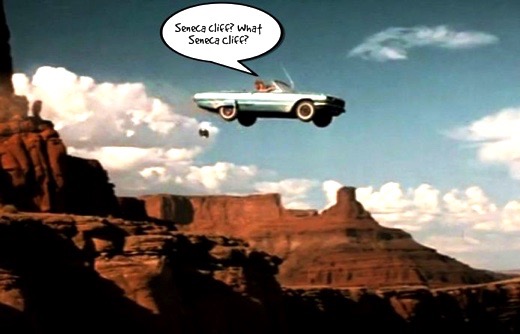
Image above: "Seneca Cliff? What Seneca Cliff?" scene from 1991 movie "Thelma and Louise" From (http://thesenecatrap.blogspot.com/2017/05/seneca-cliff-what-seneca-cliff.html).

Dear colleagues, we are having an interesting discussion on how to stop climate change and I think I could add some thoughts of mine on the basis of my recent work that I published in the form of the book titled "The Seneca Effect".

The problem we have been discussing is how to limit emissions and we saw that it needs to be done fast and even drastically if we want to avoid the worse effects of climate change. Obviously, it is not easy. (image from Skeptical Science)

Most of what has been said today was based on a "top-down" approach, which I may also describe as supply-limiting. That is, we are speaking of a carbon tax, of emission limits, and the like; measures that governments should take in order to limit the production of fossil fuels. I don't have to tell you that it is an effort that has been ongoing for several years and yet emissions keep growing. It doesn't seem to work

So, can we take the opposite approach? That is, look at the demand side in a "bottom-up" approach?

To discuss this point, let me introduce the concept of the "Seneca Effect" or the "Seneca Cliff." Here is the shape of the Seneca curve.

You know that I use the term of "Seneca Effect" taking inspiration from something that the Roman philosopher Seneca said long ago; "growth is sluggish but ruin is rapid". And you see how the curve looks like the projections for emission reductions we have been seeing here.

So, the question is, what causes the collapse we see in the Seneca Curve in complex systems?

Well, we can use system dynamics to model the collapse and we know it is not a "top-down" effect, nobody from outside forces the system to collapse. It is a very general phenomenon caused by the interactions of the various elements that compose the system which cooperate to bring it down. And that's a trick that can be exploited: as I say in my book, "The Seneca Effect", collapse is not a bug, it is a feature.

Let me see to explain it using the oil industry as an example: see the figure drawn on the board.

Now, you see the segmented line I drew, it keeps going up. It is what the oil companies expect for the future. Their projections, by Exxon for instance, say this: given sufficient investments, we can keep growing the oil production for a number of years, maybe a decade or more.

That's what they have been doing; despite various dire warnings, the oil industry has been able to keep production growing. It is true that conventional oil ("crude") peaked at some moment between 2005 and 2010, but it didn't really decline. Then, the production of "all liquids" kept growing by exploiting other sources such as shale oil.

Of course, the problem is that if the industry continues to make an all-out effort to increase, or at least maintain, production, all we were saying about the need of reducing emissions goes out of the smokestack. Forget about keeping warming below 2 degrees. It would be a disaster.

But look at the Seneca curve in the graph. It would generate more or less the kind of rapidly declining production curve we need for our future survival

The oil industry doesn't predict anything like that, but it is vulnerable, very vulnerable. The industry has a "soft belly:" the collapse of the demand. That is, we don't need governments to enact draconian regulations: if the market for a product disappears, then the industry producing it will disappear. Can it happen? Yes, it can.

The key point of the oil industry's vulnerability is in the need of large investments to keep the whole thing moving. Facing increasing production costs, they have been able to survive by growing and exploiting economies of scale. This has been possible because investors thought they were investing in a growing industry.

But things have been changing and the market of the oil industry is at risk. Consider that typically a good 50% of the oil industry production is gasoline. To this, you may add about 20% of diesel fuel and the result is that some 70% of the output of the industry is for internal combustion engines used for transportation.

So far, this has been a growing market, but the electric transportation revolution is coming, and not just that. There is a whole systemic change under the concept of "Transportation as a Service" (TAAS). The combination of the diffusion of electric vehicles and the optimization of the system may rapidly reduce the demand for gasoline and diesel fuel.

We don't need a large reduction in the demand for transportation fuels to generate a spiral of decline for the oil industry.

Less demand means less production, less production means the loss of economies of scale, and the loss of the economies of scale means higher costs that translate into higher prices which also depress the demand. And so it goes until it reaches the bottom.

As Lucius Annaeus Seneca said, long ago, "ruin is rapid". And the ruin of the oil industry is not a bad thing for the earth's ecosystem and for us all.

See also:
The Seneca Effect book published
(http://thesenecatrap.blogspot.com/2017/08/the-seneca-effect-published.html/)

Ea O Ka Aina: Can airlines be saved? 11/1/17
Ea O Ka Aina: American way of life is negotiable 5/31/17
Ea O Ka Aina: Ecovillage Rescuing Los Angeles 3/27/17

.

Are we Doomed?

SUBHEAD: For those considering the reality of it, threats of doom or promises of utopia are distractions.

By Richard Heinberg on 27 July 2017 for Post Carbon Institute -
(http://www.postcarbon.org/are-we-doomed-lets-have-a-conversation/)


Image above: Product artwork for video game "Doom II: Hell on Earth".  From (https://thexknights.wordpress.com/2015/04/26/the-games-that-changed-us-part-1/).

My most recent essay, in which I discussed a highly publicized controversy over the efficacy of plans for a comprehensive transition to an all-renewable energy future, garnered some strong responses. “If you are right,” one Facebook commenter opined, “we are doomed.

Fortunately you are not right.” (The commenter didn’t explain why.) What had I said to provoke an expectation of cataclysmic oblivion?

Simply that there is probably no technically and financially feasible energy pathway to enable those of us in highly industrialized countries to maintain current levels of energy usage very far into the future.

My piece happened to be published right around the same time New York Magazine released a controversial article titled “The Uninhabitable Earth,” in which author David Wallace Wells portrayed a dire future if the most pessimistic climate change models turn to reality. “It is, I promise, worse than you think,” wrote Wells.

“If your anxiety about global warming is dominated by fears of sea-level rise, you are barely scratching the surface of what terrors are possible, even within the lifetime of a teenager today.”

Wells’s article drew rebukes from—of all people—climate scientists, who pointed out a few factual errors, but also insisted that scaring the public just doesn’t help.

“Importantly, fear does not motivate,” responded Michael Mann with Susan Joy Hassol and Tom Toles, “and appealing to it is often counter-productive as it tends to distance people from the problem, leading them to disengage, doubt and even dismiss it.”

It’s true: apocalyptic warnings don’t move most people. Or, rather, they move most people away from the source of discomfort, so they simply tune out. But it’s also true that people feel a sense of deep, unacknowledged unease when they are fed “solutions” that they instinctively know are false or insufficient.

Others came to Wells’s defense. Margaret Klein Salamon, a clinical psychologist and founder of the climate action group The Climate Mobilization, which advocates for starting a “World War II-scale” emergency mobilization to convert from fossil fuels, writes;
“It is OK, indeed imperative, to tell the whole, frightening story. . . . [I]t’s the job of those of us trying to protect humanity and restore a safe climate to tell the truth about the climate crisis and help people process and channel their own feelings—not to preemptively try to manage and constrain those feelings.”
So: Are we doomed if we can’t maintain current and growing energy levels? And are we doomed anyway due to now-inevitable impacts of climate change?

First, the good news. With regard to energy, we should keep in mind the fact that today’s Americans use roughly twice as much per capita as their great-grandparents did in 1925. While people in that era enjoyed less mobility and fewer options for entertainment and communication than we do today, they nevertheless managed to survive and even thrive.

And we now have the ability to provide many services (such as lighting) far more efficiently, so it should be possible to reduce per-capita energy usage dramatically while still maintaining a lifestyle that would be considered more than satisfactory by members of previous generations and by people in many parts of the world today.

And reducing energy usage would make a whole raft of problems—climate change, resource depletion, the challenge of transitioning to renewable energy sources—much easier to solve.

The main good news with regard to climate change that I can point to (as I did in an essay posted in June) is that economically recoverable fossil fuel reserves are consistent only with lower-emissions climate change scenarios.

As BP and other credible sources for coal, oil, and natural gas reserves figures show, and as more and more researchers are pointing out, the worst-case climate scenarios associated with “business as usual” levels of carbon emissions are in fact unrealistic.

Now, the bad news. While we could live perfectly well with less energy, that’s not what the managers of our economy want. They want growth. Our entire economy is structured to require constant, compounded growth of GDP, and for all practical purposes raising the GDP means using more energy. While fringe economists and environmentalists have for years been proposing ways to back away from our growth addiction (for example, by using alternative economic indices such as Gross National Happiness), none of these proposals has been put into widespread effect. As things now stand, if growth falters the economy crashes.

There’s bad climate news as well: even with current levels of atmospheric greenhouse gases, we’re seeing unacceptable and worsening impacts—raging fires, soaring heat levels, and melting icecaps.

And there are hints that self-reinforcing feedbacks maybe kicking in: an example is the release of large amounts of methane from thawing tundra and oceanic hydrates, which could lead to a short-term but steep spike in warming.

Also, no one is sure if current metrics of climate sensitivity (used to estimate the response of the global climate system to a given level of forcing) are accurate, or whether the climate is actually more sensitive than we have assumed. There’s some worrisome evidence the latter is case.

But let’s step back a bit. If we’re interested in signs of impending global crisis, there’s no need to stop with just these two global challenges. The world is losing 25 billion tons of topsoil a year due to current industrial agricultural practices; if we don’t deal with that issue, civilization will still crash even if we do manage to ace our energy and climate test.

Humanity is also over-using fresh water: ancient aquifers are depleting, while other water sources are being polluted. If we don’t deal with our water crisis, we still crash.

Species are going extinct at a thousand times the pre-industrial rate; if we don’t deal with the biodiversity dilemma, we still crash. Then there are social and economic problems that could cause nations to crumble even if we manage to protect the environment; this threat category includes the menaces of over-reliance on debt and increasing economic inequality.

If we attack each of these problems piecemeal with technological fixes (for example, with desalination technology to solve the water crisis or geo-engineering to stabilize the climate) we may still crash because our techno-fixes are likely to have unintended consequences, as all technological interventions do.

Anyway, the likelihood of successfully identifying and deploying all the needed fixes in time is vanishingly small.

Many problems are converging at once because society is a complex system, and the challenges we have been discussing are aspects of a systemic crisis. A useful way to frame an integrated understanding of the 21st century survival challenge is this: we humans have overshot Earth’s long-term carrying capacity for our species.

We’ve been able to do this due to a temporary subsidy of cheap, bountiful energy from fossil fuels, which enabled us to stretch nature’s limits and to support a far larger overall population than would otherwise be possible.

But now we are starting to see supply constraints for those fuels, just as the side effects of burning enormous amounts of coal, oil, and natural gas are also coming into view.

Meanwhile, using cheap energy to expand resource-extractive and waste-generating economic processes is leading to biodiversity loss; the depletion of soil, water, and minerals; and environmental pollution of many kinds. Just decarbonizing energy, while necessary, doesn’t adequately deal with systemic overshoot.

Only a reduction of population and overall resource consumption, along with a rapid reduction in our reliance on fossil fuels and a redesign of industrial systems, can do that.

Economic inequality is a systemic problem too. As we’ve grown our economy, those who were in position to invest in industrial expansion or to loan money to others have reaped the majority of the rewards, while those who got by through selling their time and labor (or whose common cultural heritage was simply appropriated by industrialists) have fallen behind.

There’s no technological fix for inequality; dealing with it will require redesigning our economic system and redistributing wealth. Those in wealthy nations would, on average, have to adjust their living standards downward.

Now, can we do all of this without a crash? Probably not. Indeed, many economists would regard the medicine (population reduction, a decline in per-capita energy use, and economic redistribution) as worse than whatever aspects of the disease they are willing to acknowledge.

Environmentalists and human rights advocates would disagree. Which is to say, there’s really no way out. Whether we stick with business as usual, or attempt a dramatic multi-pronged intervention, our current “normal” way of life is toast.

Accepting that a crash is more or less inevitable is a big step, psychologically speaking. I call this toxic knowledge: one cannot “un-know” that the current world system hangs by a thread, and this understanding can lead to depression.

In some ways, the systemic crisis we face is analogous to the individual existential crisis of life and death, which we each have to confront eventually. Some willfully ignore their own mortality for as long as possible; others grasp at a belief in the afterlife.

Still others seek to create meaning and purpose by making a positive difference in the lives of those around them with whatever time they have. Such efforts don’t alter the inevitability of death; however, contributing to one’s community appears to enhance well-being in many ways beyond that of merely prolonging life.

But is a crash the same as doom?

Not necessarily. Our best hope at this point would seem to be a controlled crash that enables partial recovery at a lower level of population and resource use, and that therefore doesn’t lead to complete and utter oblivion (human extinction or close to it).

Among those who understand the systemic nature of our problems, the controlled crash option is the subject of what may be the most interesting and important conversation that’s taking place on the planet just now. But only informed people who have gotten over denial and self-delusion are part of it.

This discussion started in the 1970s, though I wasn’t part of it then; I joined a couple of decades later. There is no formal membership; the conversation takes place through and among a patchwork of small organizations and scattered individuals.

They don’t all know each other and there is no secret handshake. Some have publicly adopted the stance that a global crash is inevitable; most soft-pedal that message on their organizational websites but are privately plenty worried.

During the course of the conversation so far, two (not mutually exclusive) strategies have emerged.

The first strategy envisions convincing the managers and power holders of the world to invest in a no-regrets insurance plan. Some systems thinkers who understand our linked global crises are offering to come up with a back-pocket checklist for policy makers, for moments when financial or environmental crisis hits: how, under such circumstances, might the managerial elite be able to prevent, say, a stock market crash from triggering food, energy, and social crises as well?

A set of back-up plans wouldn’t require detailed knowledge of when or how crisis will erupt. It wouldn’t even require much of a systemic understanding of global overshoot. It would simply require willingness on the part of societal power holders to agree that there are real or potential threats to global order, and to accept the offer of help.

At the moment, those pursuing this strategy are working mostly covertly, for reasons that are not hard to discern.

The second strategy consists of working within communities to build more societal resilience from the ground up. It is easier to get traction with friends and neighbors than with global power holders, and it’s within communities that political decisions are made closest to where the impact is felt.

My own organization, Post Carbon Institute, has chosen to pursue this strategy via a series of books, the Community Resilience Guides; the “Think Resilience” video series; and our forthcoming compendium, The Community Resilience Reader.

Rob Hopkins, who originated the Transition Towns movement, has been perhaps the most public, eloquent, and upbeat proponent of the local resilience strategy, but there are countless others scattered across the globe.

Somehow, the work of resilience building (whether top-down or bottom-up) must focus not just on maintaining supplies of food, water, energy, and other basic necessities, but also on sustaining social cohesion—a culture of understanding, tolerance, and inquiry—during times of great stress.

While it’s true that people tend to pull together in remarkable ways during wars and natural disasters, sustained hard times can lead to scapegoating and worse.

Most people are not party to the conversation, not aware that it is happening, and unaware even that such a conversation is warranted. Among those who are worried about the state of the world, most are content to pursue or support efforts to keep crises from occurring by working via political parties, religious organizations, or non-profit advocacy orgs on issues such as climate change, food security, and economic inequality.

There is also a small but rapidly growing segment of society that feels disempowered as the era of economic growth wanes, and that views society’s power holders as evil and corrupt.

These dispossessed—whether followers of ISIS or Infowars—would prefer to “shake things up,” even to the point of bringing society to destruction, rather than suffer the continuation of the status quo. Unfortunately, this last group may have the easiest path of all.

By comparison, the number of those involved in the conversation is exceedingly small, countable probably in the hundreds of thousands, certainly not millions. Can we succeed? It depends on how one defines “success”—as the ability to maintain, for a little longer, an inherently unsustainable global industrial system? Or as the practical reduction in likely suffering on the part of the survivors of the eventual crash?

A related query one often hears after environmental lectures is, Are we doing enough? If “Enough” means “enough to avert a system crash,” then the answer is no: it’s unlikely that anyone can deliver that outcome now. The question should be, What can we do—not to save a way of life that is unsalvageable, but to make a difference to the people and other species in harm’s way?

This is not a conversation about the long-term trajectory of human cultural evolution, though that’s an interesting subject for speculation. Assuming there are survivors, what will human society look like following the crises ensuing from climate change and the end of fossil fuels and capitalism?

David Fleming’s Surviving the Future and John Michael Greer’s The Ecotechnic Future offer useful thoughts in this regard.

My own view is that it’s hard for us to envision what comes next because our imaginations are bounded by the reality we have known. What awaits will likely be as far removed from from modern industrial urban life as Iron-Age agrarian empires were from hunting-and-gathering bands.

We are approaching one of history’s great discontinuities. The best we can do under the circumstances is to get our priorities and values straight (protect the vulnerable, preserve the best of what we have collectively achieved, and live a life that’s worthy) and put one foot in front of the other.

The conversation I’m pointing to here is about fairly short-term actions. And it doesn’t lend itself to building a big movement. For that, you need villains to blame and promises of revived national or tribal glory.

For those engaged in the conversation, there’s only hard work and the satisfaction of honestly facing our predicament with an attitude of curiosity, engagement, and compassion. For us, threats of doom or promises of utopia are distractions or cop-outs.

Only those drawn to the conversation by temperament and education are likely to take it up. Advertising may not work. But having a few more hands on deck, and a few more resources to work with, can only help.

.

Permaculture Cool Lab

SUBHEAD: Is it possible that technology as simple as an Easy Bake Oven can reverse climate change?

By Albert Bates on 2 April 2017 for The Great Change -
(http://peaksurfer.blogspot.co.uk/2017/04/the-cool-lab.html)


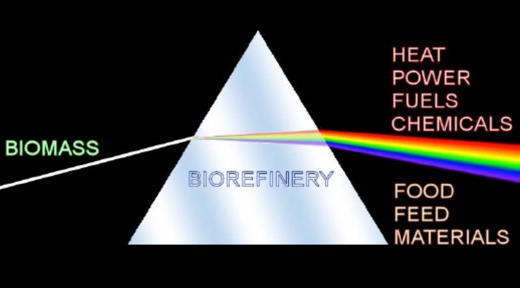
Image above: Illustration of "biorefinery" concept that can be applied to utilization of bamboo forestry. From original article.

[IB Publisher's note: The "Cool Lab" technology that Albert Bates describes in this article includes ideas from holistic thinking, permaculture, and technologies like biochar that could transform agriculture and our use of technology, and be the solution to Global Warming, Climate Change and our own extinction. Get on board!]

In Permaculture the first stage of any design is protracted observation. What does a biological system have in over-abundance? What is scarce? How will it restore balance? What are the obstacles?

Let us say that an impoverished village in Haiti risks being carried away by mudslides that follow brush fires where the forest has been cut down to supply wood for shelter and cooking.

What things are scarce? In no particular order:
  • food
  • water 
  • cooking fuel 
  • secure shelter
  • energy
  • productive employment
  • biodiversity soil 
  • birth control 
  • health care
What things are over-abundant?
  • mud
  • deforestation
  • rain
  • hurricanes
  • earthquakes
  • unemployed people
  • superstition
  • resentment
  • mosquitoes
  • climate change
Lets see which of these things we can match up and cancel out. What we are about to describe is a carbon cascade.

The hillside needs to be planted with vegetation. It is especially important that the hilltops be forested.


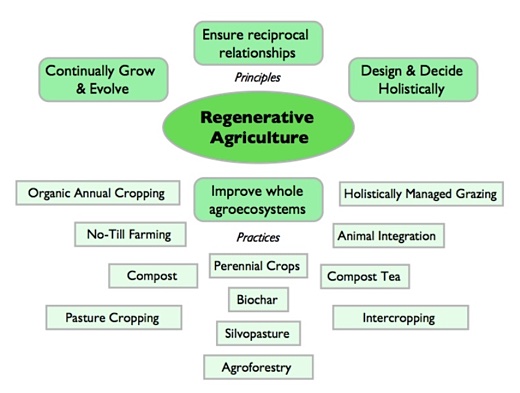
Image above:Principles and techniques Refenerative Agriculture to improve whole agroecosystems. From original article.

A keyline analysis will show us where water wants to go when it rains, and how best it can be held high in the landscape and directed both to subsurface flows and to dam storage for uses in the dry season. Alley cropping along the contours follows hand-cut swales (or machine cut where financial capital  substitutes for social capital).

The berms are planted with successional understory (in this tropical example, pineapple, cassava, ginger, allspice, coffee and medicinal herbs), mid-level canopy banana, papaya, moringa, cacao, mulberry, tree legumes of mimosa, cassia, and pea subfamilies, chaya, climbing vines such as vanilla, dioscorea, cucumber, chocho and pasaflora, and eventual overstory of coconut, jackfruit, breadfruit, breadnut, ramon, samwood, mahogany, cedar, bamboo, peach palm, etc.

Between the alleys are seeded perennials such as callalu, okra, sorghum, and supergrasses like kernza (Thinopyrum intermedium), sunn hemp (Crotalaria juncea), pennisitum and pearl millet hybrids (Tembo), brassica napus, amaranth, etc., as well as familiar food crops such as maize, rice, yam and beans, where soils and water supply are well suited.

As much as possible, the planting process can be accompanied by biofertilizers having a high percentage of finely pulverized biochar, activated indigenous microorganisms, some immediate food for those microbes (such as composted food wastes and manures), and minerals keyed to redress local soil deficiencies.

If these biofertilizers are not immediately available for the first plantings, they can always be added later, as a byproduct of the early harvests.
 
Water in storage on the hillsides is edge-planted with Acoris, a plant that inoculates the water with a mosquito-larvae destroying resin. As the Acoris matures, pools and dams progress from being mosquito generating to mosquito decimating.

In the lowlands, water that overflows from catchments above is directed into chinampas, constructed wetlands composed of alternating islands and channels and rotating between aerobic (horizontal and vertical flow reedbeds) and anaerobic (settling lagoons) seeded with aquatic and semi-aquatic plants (taro, Chinese water spinach, lotus, azola, wild rice) and freshwater fish (aquaculture).

Acoris for mosquito control can also be planted here, but the fish do most of that work already, so the plant is only needed in mudflats and places fish cannot go.

The appearance of this microbiome also augurs the reappearance of frogs, peepers, lizards, dragonflies, water birds, bats, turtles, and forest mammals who venture to the water’s edge to drink.

Within the first season, the hillside mud problem is erased, deforestation is reversed, and food scarcity begins to be alleviated from the fast-yielding varieties of annuals, perennials and fish.

Productive employment can expand this system as much as available land permits, even on relatively steep hillsides. Resentment diminishes, and with it, superstition.

Within the village a regenerative, biological energy system arrives to replace the fossil fuel (diesel electric) grid-based source that previously had supplied electricity only intermittently, occasionally dimming lights and frying phone chargers and boom boxes.

This system consists of a biomass furnace, running on the woody wastes from coppice (the moringa, jackfruit and cassava plantation), coconut, rice or other shell crops, pelletized supergrasses and other biomass after food harvest or extraction of leaf protein, vitamins and useful fiber.

The loading dock at the biorefinery receives raw materials second-harvested from the farms.

Leaves of tropical legumes (Leucaena Zeucocephala, Vigna unguiculata, Clitoria ternatea, Desmodium distortum, Psophocarpus tetragonolobus, Macroptilium lathyroides, Phaseolus calcaratus, Brassica napus, and Manihot esculenta, for instance) are taken by conveyor and chopped into 2-cm pieces, soaked in 2-percent sodium metabisulfite, disintegrated in a hammer mill and pressed in a single-screw press.

The expressed juice is heated with steam (produced by the furnace) and protein coagulum collected, centrifuged, and pressed, then spread in a thin layer on glass plates and dried in an air-filtered, dehumidified room. It is then collected as a powder and containerized to be used or sold as a feed supplement.

At its most basic level, high-protein, high-quality leaf protein fractionation is simple. Production is geared to consumption by farm animals to remove some of the food safety, preservation and storage concerns.

Later improvements can produce dried leaf extracts for human consumption but higher capital costs are incurred and clean-room protocols by workers become essential.

Following leaf-protein extraction, the dried mash from the press is used as a feedstock for the furnace, where it joins other dried agricultural wastes: coppice wood, prunings, bamboo thinnings, pallets, cardboard boxes, coconut coir, nut and rice husks, etc.

All of this is pyrolyzed, the heat captured to run both the leaf protein process and produce electricity, and co-products (fractionated volatile gases, wood vinegar) drawn off before the final product — high quality biochar — remains.

The biochar is quenched (preferably with urine because that adds a 30% fertility gain), pulverized, and charged (blended with microbe-rich aerobic compost) to make a potent “cool” biofertilizer.

Alternatively, it is kept at food-grade and sold as a dry product for use as a food supplement, animal feed probiotic, water filtration medium or deodorizer. At less-than-food-grade it can be used as a litter amendment to reduce smells in animal enclosures, improve the fermentation of silage, or go into a variety of natural building materials — paints, dyes, plasters, wallboard and bricks.

And it can always become biofertilizer, even after undergoing one or more of these other uses.

Styrofoam “clamshell” food containers, which are ubiquitous from take-out restaurants and shops in the cities and often wind up just floating away on ocean currents, never to be destroyed, are collected and brought to the biorefinery.

There they go into an acetone bath and the dissolved liquid blended with low-grade biochar and poured into molds to dry. The resulting hard resin is mold-proof, waterproof, non-degradable, lightweight and durable.

Depending on the dies and molds, it can become a whole range of products — roofing tile, caulk, surfboards, fishing boats, life-vests, doors, bicycles, and ice chests.


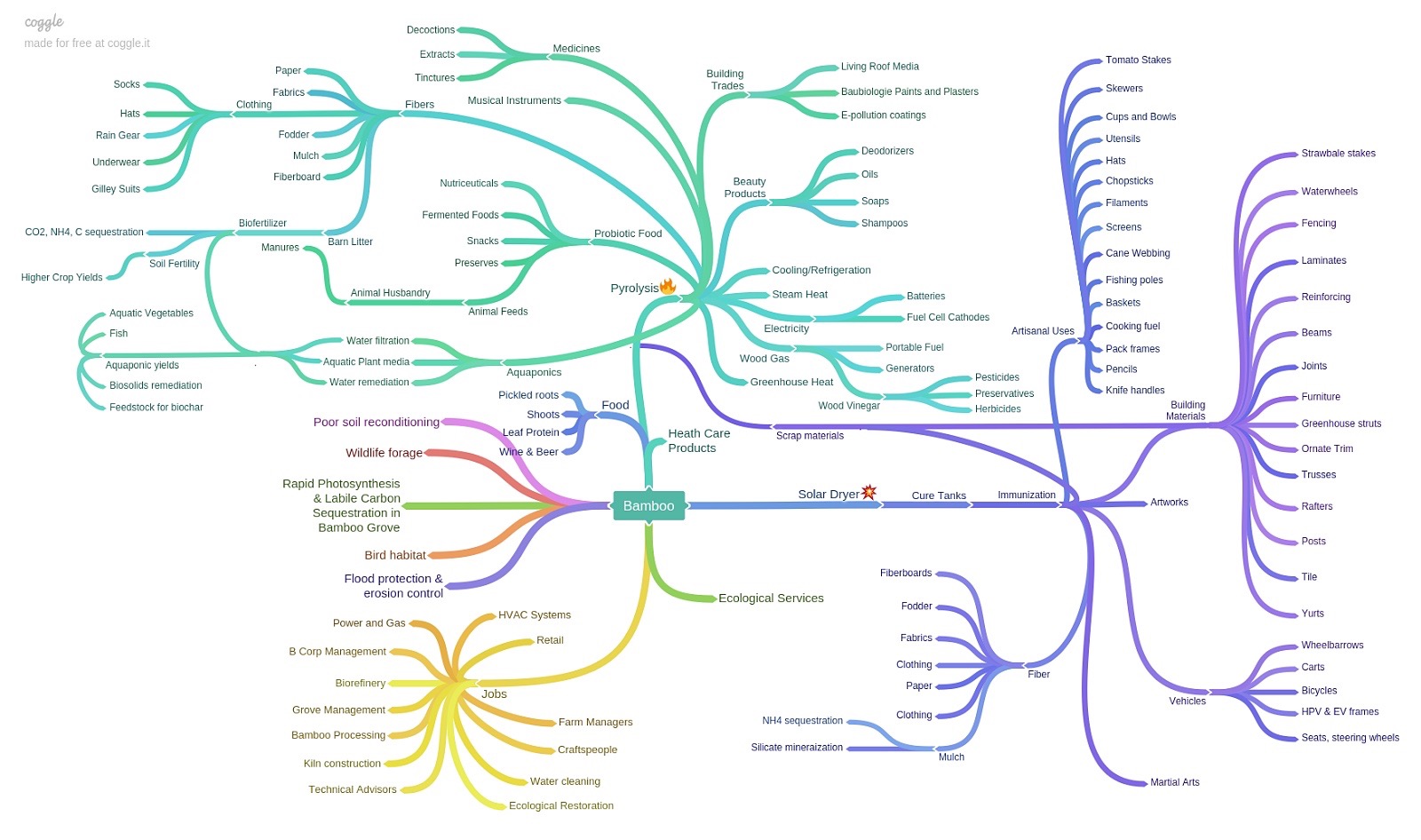
http://www.islandbreath.org/2017Year/04/170405bamboobig.jpg
Image above: Detail of the network of uses of bamboo in a regenerative agroecosystem. Click for the whole enlarged image. From original article.

If there is a surge in demand for a particular product — refrigerator deodorizers or animal feed supplements, for instance — or there is a surplus of some particular feedstock — bamboo knocked down by a storm — the biorefinery can shift its production pattern to take advantage immediately.

This  system sequesters more carbon than it emits, so we call it “cool.” By adding biochar, mineral rich compost, and microorganisms to the poor soils, we can jump-start soil productivity and boost farm productivity.

The gains in those alley-cropped contours will be anywhere from 40-percent to 400-percent vegetative growth, depending on the type of plants and the quality of the soils (poor soils will produce higher performance gains than good soils).

The same can be said for fish and livestock fed the leaf-protein and biochar nutriceuticals.

Let us pause here just a moment. Step back and take a look at the big picture. What is really being increased here is not so much village-scale well-being as photosynthesis. How are the greenhouse gases that are causing climate catastrophe — principally CO2, CH4 and N2O — to be removed from the atmosphere?

Mainly, although not exclusively, they will be removed by photosynthesis. The more of Earth’s surface that can be brought to bear on that task, the sooner the vital balance that harbors life on this tiny blue rock in space can be restored and the crisis ended.

Poultry can free-range the alleys to benefit of both plants and animals. Grazers can be moved through rotational cells that take advantage of water impoundments and high quality supergrasses. Fed nutrient-dense supplements with biochar, fish, poultry and grazing animals all grow faster and healthier without antibiotics or hormones, and deposit long-lived biochar back into the earth for long term carbon storage and soil fertility.

Growing nutrient-dense, no-till, organic food and perennial fibers on these marginal lands, using bioenergy and biofertilizers, creates a new, circular bioeconomy.  There is no such thing as waste. Nothing need leave the system, but what does is not raw material or pollution — representing the depleting wealth of the land — but high value byproducts — providing return on social capital invested. Waste becomes an orphaned verb.

Transportation presents an energetic challenge in the post-petroleum world. Nearly all modern forms of transportation evolved in an era of cheap net energy and diminish in economic viability when costed on renewable sources and life cycles.

Gone will be diesel-powered semi-tractor-trailers and locomotives. There could be new generations of electrified tow-paths for barges and gondolas, mag-lev rail and other innovations, but these costly innovations will be fragile in an era marked by overpopulation, resource constraints, climate chaos and economic contraction and likely will not provide a stable foundation for commerce in most places. Returning will be sail and animal powered transport.

If taken to maximum scale (rotationally planting an area the size of India each year and installing Cool Labs in every village), at a capital cost of $10000 to $15000 per hectare, the price would tally up to approximately 2% of the price of the fairy dust BECCS (Biomass Energy with Carbon Capture and Storage) conversion favored by geoengineers stuck in the fossil industrial paradigm.

Moreover, while BECCS represents continuing cost and is fraught with risk from plantation biomass crops — possibly genetically engineered and carrying along the can of worms that opens up — hazardously supplanting forested, multi-diverse, self-regenerating ecosystems.

The Cool Lab alternative represents antifragile synergies of local conservation communities, continuous and adaptive profits, and continuous gains in ecological health, stability and wealth.

Can the conversion be done in time? In contrast to the 45-year gradual expansion of soybean cropping from the early 1960s to reach 200 Mha today, this system offers five times the protein per area farmed while providing a far greater, and more immediate, returns on investment.

When one considers the rapid growth of renewable energy in the past decade, consider this: an energy producing Cool Lab costs one-seventh the capital as hydro, wind or solar and runs entirely on “wastes” that would otherwise be destined to add greenhouse gases to the atmosphere but are now intercepted and neutralized.

Cool Labs use the existing financial and technological landscape of the world today and simply change the way products are produced in order to heal the earth, balance carbon, and make more real wealth for more people more quickly.

Does this hold a hazard in the form of perpetuating wealth inequality, militarism and hegemony by the “taker” class? Yes it does. However, in the post-petroleum era, relocalization of economies is inevitable, and with relocalization comes local control over shared destinies.

Cool Labs represent circular economies that are inherently leveling.

Each lab adapts to needs and available resources and can flex to provide more or less of a particular kind of benefit and tailor fuels to available feedstocks and labor options. The number of cascades possible is limited only by the imagination and each year we conceive of more. We are at the dawn of a new kind of lean, clean, nature-centered economy.

This system can turn almost any human settlement into an ecovillage, although the criteria for what defines ecovillage must necessary include a few more elements than merely having a Cool Lab or permacultural support systems.

Ecovillages are based on a cohesive worldview, an abiding respect for the ecological integrity of your home biome, a circular local economy and a culture of peace and mutual respect. Depending on your starting point for each of these elements, bringing all of them into harmony can take time and effort.

The energy and food production system using mixed-aged, mixed-species forest, wetland and marine ecosystems we’ve outlined, taken to scale on the world’s available marginal land (not productive farmland or developed areas) could restore the fertility of those soils and waters while sequestering carbon from the atmosphere at the average rate of 17 PgC/yr after getting established.

To get back to the Holocene we need to return atmospheric carbon to pre-industrial range, around 260 ppm. The system just described, at full scale, could do that within about 50 years, taking into account the oceans’ CO2 outgassing feedback.

Village scale Cool Labs could achieve the cumulative storage of 667 gigatons of legacy carbon required to bring atmospheric carbon back to pre-industrial levels in the lifetimes of the majority of people now living. Were nations to collectively phase out fossil fuels as quickly as called for in the Paris Agreement, restabilization of the climate would be achieved sooner.

Recovering one percentage point of soil organic matter means that around 27 long tons of organic matter per hectare would enter the soil and remain there. Because around two thirds of organic matter added to agricultural soils will be decomposed by soil organisms and plants and given back to the atmosphere, in order to add permanently 27 tons, a total of 81 tons of organic matter per hectare would be needed. This cannot be done quickly or it just washes or evaporates away. A slow process is required.

An example of how this could play out in Haiti or anywhere else can be seen in the Loess Plateau of Northern China where fertile soils were overworked until they had to be abandoned. At the time of abandonment organic carbon concentrations had dropped to under 3 percent.

Thirty years later Loess soils had regained concentrations of 6 percent by natural processes. If natural restoration were accelerated by amending soil carbon in both metabolizable forms (such as crop litter and manures) and recalcitrant forms (such as biochar), the potential to increase soil carbon in a few decades could be raised to 10 percent or greater. This could happen virtually anywhere.

A farm that switches to organic, animal powered no-tillage methods can sequester 1 to 4 tons of organic matter per acre per year. By employing perennial polycultures, rotated pastures of grazing animals, trees and wild plant strips, that amount can be doubled or tripled.

Harvard professor Thomas Goreau writes:
Current rates of carbon farming at typical current levels would take thousands of years to draw down the dangerous excess CO2, but state of the art methods of soil carbon sequestration could draw it down in as little as decades if the percentage of long lived carbon is raised to as little as about 10%.
If the recuperation of soil carbon became a central goal of agricultural policies worldwide, it would be possible and reasonable to set as an initial goal the sequestration of one half ton per acre-year (1.5 t/ha-y or 500 grams per m2/y), comparable to the 4 pour 1000 program (4 grams per kg of soil) proposed by the French delegation at COP-21.

Carbon stored in the world’s soils and living biomass provides additional benefits beyond sequestration. As soil conditions improve, erosion and pests decline and the land comes back into balance.

Farming this way globally could sequester about 8 percent of the current total annual human-made emissions of 10 petagrams of carbon (PgC).

However, the fertility gains (equivalent to more than all of current global fertilizer production) would mean that chemical fertilizers could be (and should be) eliminated where carbon farming is practiced.

By reducing emissions of nitrous oxide from fertilizer (equivalent to approximately 8 percent annual human-made greenhouse gases) and the transportation and energy impacts of fertilizer production, we shave another 1 percent off global emissions.

But let’s keep going. If organic waste is returned to agricultural soils in the form of compost, then methane and CO2 emissions from its current destinations to landfills and wastewater (equivalent to 3.6 percent of man-made emissions) could be significantly reduced. Even a modest start, such as by elevating the soil carbon content of existing farmed soils by 0.4 percent, would have the potential to offset global greenhouse gas emissions by approximately 20 percent per year.

If biochar is added to the compost, we can quickly get to 100 percent, and then 120 percent. That is when it starts to matter.

After 10 years, we can increase progressively the reincorporation of organic matter into soils. By mid-21st century, we could increase the total world reservoir of carbon in the soil by two percentage points, and possibly more. In this way it is conceivable to restore our soil carbon reservoir to 10 percent, as Goreau argues. Because the system works best in poor soils, and because it eventually creates its own hydrological cycles, it can even re-green and reforest sandy deserts.

Are we doomed to Near Term Human Extinction?

Not yet. While there are still wild cards waiting to be played, what we have outlined shows a complete escape from our present trajectory. Is it possible that technology no more complicated than an Easy Bake Oven — and that pays for itself — can reverse climate change?


Image above: Photo of Chinese model of a Cool Lab rotary oven. From original article.

The rotary oven pictured above gasifies waste rice husks at the rate of 2.5 tons per hour. Thirty-five percent of that weight is transformed into biochar.

Half of the rest, as pyrogas, is extracted for useful synthetic compounds that replace petrochemicals.

The other half of that gas is used to co-generate 1.6 megawatts of electricity from this half-million-dollar biorefinery. It could also be refined into a liquid substitute for gasoline.

The Chinese government has invested heavily to develop this technology, and the wares they are producing are now the most efficient and lowest cost in the world. They will pour another $40 million into advanced biochar research this year.

Chinese Cool Lab reactors have been sold to 20 countries, including Haiti. In Senegal there is a prototype that has been continuously operating for 8 years.

In Egypt, the biochar made by their Chinese reactor is producing organic cabbages from the sandy shore of the Suez Canal. We witnessed a similar effect in the infertile clay soil beside the Asian Biochar Centre in Nanjing.

This we know: we can achieve faster and more well-rounded human development within the carrying capacity of the Earth. Will we? Who decides?

.

Dallas more inspired than Honolulu

SUBHEAD: Cottages for homeless people in Dallas will save taxpayers about $1.3 million.

By Eleanor Goldberg on 20 August 2015 for Huffington Post -
(http://www.huffingtonpost.com/entry/cottages-for-homeless-will-save-dallas-taxpayers-about-13-million_55d4bc9ce4b0ab468d9f5765)


Image above: Artchitect's rendering of site for cottages intended for chronically homeless in Dallas. From original article.

Dallas seems to have taken a cue from its neighbors in Houston on how to effectively tackle, and put an end to, chronic homelessness.

Starting November, 50 chronically homeless individuals in Dallas will each move into their own cottages in a complex that comes with green recreational space, solar energy and rainwater collection, among other green features, according to the Corporation for Supportive Housing. Residents will also have access to skills training and mental and physical health services, the Dallas Morning News reported.

In addition to giving homeless people a fresh start, the program will also save taxpayers a significant amount of funds.

A homeless person who cycles through the prison system and emergency health services typically costs the county about $40,000 a year, Keith Ackerman, executive director of Cottages at Hickory Crossing, told HuffPost. This innovative housing program will bring those costs down to less than $13,000.

That means about $1.3 million in total savings for taxpayers.
While locals will likely feel elated, the drastic figures aren’t anything new.

Numerous studies have found that “housing first,” which involves giving homeless people homes and then addressing their health and unemployment issues, is efficient and cost-effective.

Since 2012, for example, a similar housing initiative in Charlotte has saved the city $2.4 million in medical costs alone.

Moore Place, a Charlotte nonprofit, houses homeless people in its 85-unit complex and also provides its clients with a team of social workers, therapists, nurses and psychologists.

Houston announced in June that it was able to end chronic veteran homelessness by bringing together a number of local agencies to house 3,650 veterans over the course of three years.
Currently, the homeless population in Dallas is holding steady.

On a single night in January, there were 3,141 homeless people, an increase of 1 percent from last year, according to the Metro Dallas Homeless Alliance.

After six years of planning and development, the $8.2 million project broke ground in April, according to the Dallas Morning News.

The initiative partnered with a number of groups, including CSH, which provided a $50,000 grant and a $50,000 loan, according to the group.

The group has invited the public to get involved by purchasing items at Target to furnish the cottages and volunteering to serve as greeters to help the residents get settled.

The development won the AIA Dallas Design Award in the unbuilt category for its plans to foster a healing environment.

“This just makes sense,” Ron Stretcher, director of the Dallas County Criminal Justice Department, told the Dallas Morning News. “Everyone deserves a place to stay; we’re only as strong as the least among us. But even if you don’t subscribe to that, it’s cheaper to do this than to cycle them through the prisons and the jails and the emergency rooms.”


.