
SUBHEAD: The upcoming Seneca Collapse will be demand side, and not supply side driven.
By Ugo Bardi on 19 November 2017 for Cassandra's Legacy -
(http://cassandralegacy.blogspot.com/2017/11/the-soft-belly-of-oil-industry-upcoming.html)
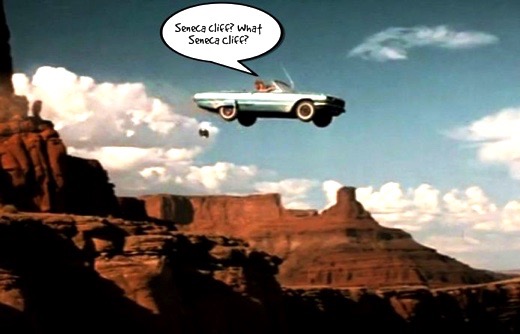
Image above: "Seneca Cliff? What Seneca Cliff?" scene from 1991 movie "Thelma and Louise" From (http://thesenecatrap.blogspot.com/2017/05/seneca-cliff-what-seneca-cliff.html).
Dear colleagues, we are having an interesting discussion on how to stop climate change and I think I could add some thoughts of mine on the basis of my recent work that I published in the form of the book titled "The Seneca Effect".
The problem we have been discussing is how to limit emissions and we saw that it needs to be done fast and even drastically if we want to avoid the worse effects of climate change. Obviously, it is not easy. (image from Skeptical Science)
Most of what has been said today was based on a "top-down" approach, which I may also describe as supply-limiting. That is, we are speaking of a carbon tax, of emission limits, and the like; measures that governments should take in order to limit the production of fossil fuels. I don't have to tell you that it is an effort that has been ongoing for several years and yet emissions keep growing. It doesn't seem to work
So, can we take the opposite approach? That is, look at the demand side in a "bottom-up" approach?
To discuss this point, let me introduce the concept of the "Seneca Effect" or the "Seneca Cliff." Here is the shape of the Seneca curve.
You know that I use the term of "Seneca Effect" taking inspiration from something that the Roman philosopher Seneca said long ago; "growth is sluggish but ruin is rapid". And you see how the curve looks like the projections for emission reductions we have been seeing here.
So, the question is, what causes the collapse we see in the Seneca Curve in complex systems?
Well, we can use system dynamics to model the collapse and we know it is not a "top-down" effect, nobody from outside forces the system to collapse. It is a very general phenomenon caused by the interactions of the various elements that compose the system which cooperate to bring it down. And that's a trick that can be exploited: as I say in my book, "The Seneca Effect", collapse is not a bug, it is a feature.
Let me see to explain it using the oil industry as an example: see the figure drawn on the board.
Now, you see the segmented line I drew, it keeps going up. It is what the oil companies expect for the future. Their projections, by Exxon for instance, say this: given sufficient investments, we can keep growing the oil production for a number of years, maybe a decade or more.
That's what they have been doing; despite various dire warnings, the oil industry has been able to keep production growing. It is true that conventional oil ("crude") peaked at some moment between 2005 and 2010, but it didn't really decline. Then, the production of "all liquids" kept growing by exploiting other sources such as shale oil.
Of course, the problem is that if the industry continues to make an all-out effort to increase, or at least maintain, production, all we were saying about the need of reducing emissions goes out of the smokestack. Forget about keeping warming below 2 degrees. It would be a disaster.
But look at the Seneca curve in the graph. It would generate more or less the kind of rapidly declining production curve we need for our future survival
The oil industry doesn't predict anything like that, but it is vulnerable, very vulnerable. The industry has a "soft belly:" the collapse of the demand. That is, we don't need governments to enact draconian regulations: if the market for a product disappears, then the industry producing it will disappear. Can it happen? Yes, it can.
The key point of the oil industry's vulnerability is in the need of large investments to keep the whole thing moving. Facing increasing production costs, they have been able to survive by growing and exploiting economies of scale. This has been possible because investors thought they were investing in a growing industry.
But things have been changing and the market of the oil industry is at risk. Consider that typically a good 50% of the oil industry production is gasoline. To this, you may add about 20% of diesel fuel and the result is that some 70% of the output of the industry is for internal combustion engines used for transportation.
So far, this has been a growing market, but the electric transportation revolution is coming, and not just that. There is a whole systemic change under the concept of "Transportation as a Service" (TAAS). The combination of the diffusion of electric vehicles and the optimization of the system may rapidly reduce the demand for gasoline and diesel fuel.
We don't need a large reduction in the demand for transportation fuels to generate a spiral of decline for the oil industry.
Less demand means less production, less production means the loss of economies of scale, and the loss of the economies of scale means higher costs that translate into higher prices which also depress the demand. And so it goes until it reaches the bottom.
As Lucius Annaeus Seneca said, long ago, "ruin is rapid". And the ruin of the oil industry is not a bad thing for the earth's ecosystem and for us all.
See also:
The Seneca Effect book published
(http://thesenecatrap.blogspot.com/2017/08/the-seneca-effect-published.html/)
Ea O Ka Aina: Can airlines be saved? 11/1/17
Ea O Ka Aina: American way of life is negotiable 5/31/17
Ea O Ka Aina: Ecovillage Rescuing Los Angeles 3/27/17
.
By Ugo Bardi on 19 November 2017 for Cassandra's Legacy -
(http://cassandralegacy.blogspot.com/2017/11/the-soft-belly-of-oil-industry-upcoming.html)
Image above: "Seneca Cliff? What Seneca Cliff?" scene from 1991 movie "Thelma and Louise" From (http://thesenecatrap.blogspot.com/2017/05/seneca-cliff-what-seneca-cliff.html).
Dear colleagues, we are having an interesting discussion on how to stop climate change and I think I could add some thoughts of mine on the basis of my recent work that I published in the form of the book titled "The Seneca Effect".
The problem we have been discussing is how to limit emissions and we saw that it needs to be done fast and even drastically if we want to avoid the worse effects of climate change. Obviously, it is not easy. (image from Skeptical Science)
Most of what has been said today was based on a "top-down" approach, which I may also describe as supply-limiting. That is, we are speaking of a carbon tax, of emission limits, and the like; measures that governments should take in order to limit the production of fossil fuels. I don't have to tell you that it is an effort that has been ongoing for several years and yet emissions keep growing. It doesn't seem to work
So, can we take the opposite approach? That is, look at the demand side in a "bottom-up" approach?
To discuss this point, let me introduce the concept of the "Seneca Effect" or the "Seneca Cliff." Here is the shape of the Seneca curve.
You know that I use the term of "Seneca Effect" taking inspiration from something that the Roman philosopher Seneca said long ago; "growth is sluggish but ruin is rapid". And you see how the curve looks like the projections for emission reductions we have been seeing here.
So, the question is, what causes the collapse we see in the Seneca Curve in complex systems?
Well, we can use system dynamics to model the collapse and we know it is not a "top-down" effect, nobody from outside forces the system to collapse. It is a very general phenomenon caused by the interactions of the various elements that compose the system which cooperate to bring it down. And that's a trick that can be exploited: as I say in my book, "The Seneca Effect", collapse is not a bug, it is a feature.
Let me see to explain it using the oil industry as an example: see the figure drawn on the board.
Now, you see the segmented line I drew, it keeps going up. It is what the oil companies expect for the future. Their projections, by Exxon for instance, say this: given sufficient investments, we can keep growing the oil production for a number of years, maybe a decade or more.
That's what they have been doing; despite various dire warnings, the oil industry has been able to keep production growing. It is true that conventional oil ("crude") peaked at some moment between 2005 and 2010, but it didn't really decline. Then, the production of "all liquids" kept growing by exploiting other sources such as shale oil.
Of course, the problem is that if the industry continues to make an all-out effort to increase, or at least maintain, production, all we were saying about the need of reducing emissions goes out of the smokestack. Forget about keeping warming below 2 degrees. It would be a disaster.
But look at the Seneca curve in the graph. It would generate more or less the kind of rapidly declining production curve we need for our future survival
The oil industry doesn't predict anything like that, but it is vulnerable, very vulnerable. The industry has a "soft belly:" the collapse of the demand. That is, we don't need governments to enact draconian regulations: if the market for a product disappears, then the industry producing it will disappear. Can it happen? Yes, it can.
The key point of the oil industry's vulnerability is in the need of large investments to keep the whole thing moving. Facing increasing production costs, they have been able to survive by growing and exploiting economies of scale. This has been possible because investors thought they were investing in a growing industry.
But things have been changing and the market of the oil industry is at risk. Consider that typically a good 50% of the oil industry production is gasoline. To this, you may add about 20% of diesel fuel and the result is that some 70% of the output of the industry is for internal combustion engines used for transportation.
So far, this has been a growing market, but the electric transportation revolution is coming, and not just that. There is a whole systemic change under the concept of "Transportation as a Service" (TAAS). The combination of the diffusion of electric vehicles and the optimization of the system may rapidly reduce the demand for gasoline and diesel fuel.
We don't need a large reduction in the demand for transportation fuels to generate a spiral of decline for the oil industry.
Less demand means less production, less production means the loss of economies of scale, and the loss of the economies of scale means higher costs that translate into higher prices which also depress the demand. And so it goes until it reaches the bottom.
As Lucius Annaeus Seneca said, long ago, "ruin is rapid". And the ruin of the oil industry is not a bad thing for the earth's ecosystem and for us all.
See also:
The Seneca Effect book published
(http://thesenecatrap.blogspot.com/2017/08/the-seneca-effect-published.html/)
Ea O Ka Aina: Can airlines be saved? 11/1/17
Ea O Ka Aina: American way of life is negotiable 5/31/17
Ea O Ka Aina: Ecovillage Rescuing Los Angeles 3/27/17
.
