Showing posts with label Animals. Show all posts

Gorillas in our midst

SUBHEAD: Two videos that feature the nature of gorilla and human contact in the jungle.

By Juan Wilson on 24 April 2017 for Island Breath -
(http://islandbreath.blogspot.com/2017/04/gorillas-in-our-midst.html)


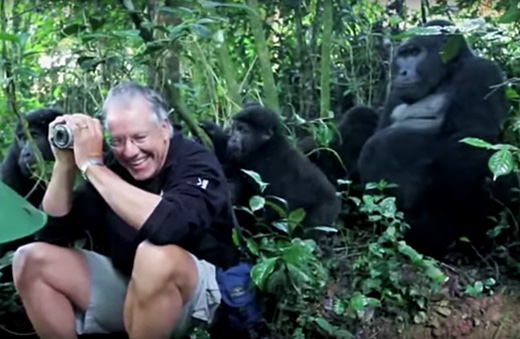
Image above: A family of apes spends some moments with a man. Still frame from 2011 video below.

Once and a while I just screw around on YouTube and find something that is for me compelling. By that I don't mean such categories as "Supertanker Disasters" of "World's Biggest Tsunamis"... although I have seen a share of those.

What I did find was friendly contact between wild gorillas and humans. It's not all poaching and hunting and eating them. It seems that a human can have a relationship with our cousins if we are willing to submit to their will.

Below are two examples:


Video above: December 2010 - Man reunites with gorilla he has not seen for five years. From (https://youtu.be/nEUlUfhQbNw).


Video above: July 2015 - a gorilla remembers a girl he had not seen for 12 years. From (https://youtu.be/Xarwk2d5Jm8).

.

Octopus - Deep Intellect, Soul, Alien

SUBHEAD: "Deep Intellect" was an article that led to the book "The Soul of an Octopus".

By Sy Montgonery on 24 October 2011 for Orion Magazine  -
(https://orionmagazine.org/article/deep-intellect/)
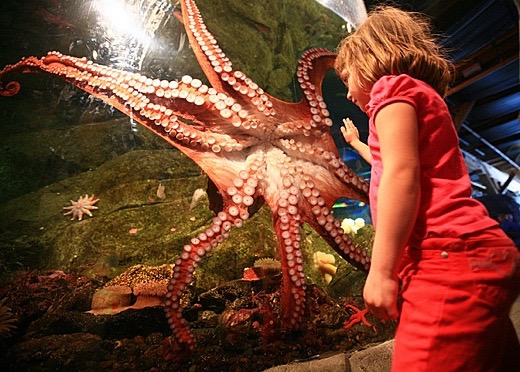

Image above: A young girl and giant pacific octopus meet at the Seattle Aquarium. Photo by Lazlo. From (https://www.wired.com/2011/11/strange-mind-stranger-brain-of-the-octopus/).

On an unseasonably warm day in the middle of March, I traveled from New Hampshire to the moist, dim sanctuary of the New England Aquarium, hoping to touch an alternate reality. I came to meet Athena, the aquarium’s forty-pound, five-foot-long, two-and-a-half-year-old giant Pacific octopus.

For me, it was a momentous occasion. I have always loved octopuses.

No sci-fi alien is so startlingly strange. Here is someone who, even if she grows to one hundred pounds and stretches more than eight feet long, could still squeeze her boneless body through an opening the size of an orange; an animal whose eight arms are covered with thousands of suckers that taste as well as feel; a mollusk with a beak like a parrot and venom like a snake and a tongue covered with teeth; a creature who can shape-shift, change color, and squirt ink.

But most intriguing of all, recent research indicates that octopuses are remarkably intelligent.

Many times I have stood mesmerized by an aquarium tank, wondering, as I stared into the horizontal pupils of an octopus’s large, prominent eyes, if she was staring back at me — and if so, what was she thinking?

Not long ago, a question like this would have seemed foolish, if not crazy. How can an octopus know anything, much less form an opinion?

Octopuses are, after all, “only” invertebrates — they don’t even belong with the insects, some of whom, like dragonflies and dung beetles, at least seem to show some smarts. Octopuses are classified within the invertebrates in the mollusk family, and many mollusks, like clams, have no brain.

Only recently have scientists accorded chimpanzees, so closely related to humans we can share blood transfusions, the dignity of having a mind.

But now, increasingly, researchers who study octopuses are convinced that these boneless, alien animals — creatures whose ancestors diverged from the lineage that would lead to ours roughly 500 to 700 million years ago — have developed intelligence, emotions, and individual personalities. Their findings are challenging our understanding of consciousness itself.

I had always longed to meet an octopus. Now was my chance: senior aquarist Scott Dowd arranged an introduction. In a back room, he would open the top of Athena’s tank. If she consented, I could touch her.

The heavy lid covering her tank separated our two worlds. One world was mine and yours, the reality of air and land, where we lumber through life governed by a backbone and constrained by jointed limbs and gravity.

The other world was hers, the reality of a nearly gelatinous being breathing water and moving weightlessly through it. We think of our world as the “real” one, but Athena’s is realer still: after all, most of the world is ocean, and most animals live there. Regardless of whether they live on land or water, more than 95 percent of all animals are invertebrates, like Athena.

The moment the lid was off, we reached for each other. She had already oozed from the far corner of her lair, where she had been hiding, to the top of the tank to investigate her visitor. Her eight arms boiled up, twisting, slippery, to meet mine. I plunged both my arms elbow deep into the fifty-seven-degree water.

Athena’s melon-sized head bobbed to the surface. Her left eye (octopuses have one dominant eye like humans have a dominant hand) swiveled in its socket to meet mine. “She’s looking at you,” Dowd said.

As we gazed into each other’s eyes, Athena encircled my arms with hers, latching on with first dozens, then hundreds of her sensitive, dexterous suckers. Each arm has more than two hundred of them. The famous naturalist and explorer William Beebe found the touch of the octopus repulsive. “I have always a struggle before I can make my hands do their duty and seize a tentacle,” he confessed.

But to me, Athena’s suckers felt like an alien’s kiss — at once a probe and a caress. Although an octopus can taste with all of its skin, in the suckers both taste and touch are exquisitely developed.

Athena was tasting me and feeling me at once, knowing my skin, and possibly the blood and bone beneath, in a way I could never fathom.

When I stroked her soft head with my fingertips, she changed color beneath my touch, her ruby-flecked skin going white and smooth. This, I learned, is a sign of a relaxed octopus. An agitated giant Pacific octopus turns red, its skin gets pimply, and it erects two papillae over the eyes, which some divers say look like horns. One name for the species is “devil fish.”

With sharp, parrotlike beaks, octopuses can bite, and most have neurotoxic, flesh-dissolving venom. The pressure from an octopus’s suckers can tear flesh (one scientist calculated that to break the hold of the suckers of the much smaller common octopus would require a quarter ton of force). One volunteer who interacted with an octopus left the aquarium with arms covered in red hickeys.

Occasionally an octopus takes a dislike to someone. One of Athena’s predecessors at the aquarium, Truman, felt this way about a female volunteer. Using his funnel, the siphon near the side of the head used to jet through the sea, Truman would shoot a soaking stream of salt water at this young woman whenever he got a chance.

Later, she quit her volunteer position for college. But when she returned to visit several months later, Truman, who hadn’t squirted anyone in the meanwhile, took one look at her and instantly soaked her again.

Athena was remarkably gentle with me — even as she began to transfer her grip from her smaller, outer suckers to the larger ones. She seemed to be slowly but steadily pulling me into her tank. Had it been big enough to accommodate my body, I would have gone in willingly. But at this point, I asked Dowd if perhaps I should try to detach from some of the suckers. With his help, Athena and I pulled gently apart.

I was honored that she appeared comfortable with me. But what did she know about me that informed her opinion? When Athena looked into my eyes, what was she thinking?

While Alexa Warburton was researching her senior thesis at Middlebury College’s newly created octopus lab, “every day,” she said, “was a disaster.”

She was working with two species: the California two-spot, with a head the size of a clementine, and the smaller, Florida species, Octopus joubini. Her objective was to study the octopuses’ behavior in a T-shaped maze. But her study subjects were constantly thwarting her.

The first problem was keeping the octopuses alive. The four-hundred-gallon tank was divided into separate compartments for each animal. But even though students hammered in dividers, the octopuses found ways to dig beneath them — and eat each other.

Or they’d mate, which is equally lethal.

Octopuses die after mating and laying eggs, but first they go senile, acting like a person with dementia. “They swim loop-the-loop in the tank, they look all googly-eyed, they won’t look you in the eye or attack prey,” Warburton said. One senile octopus crawled out of the tank, squeezed into a crack in the wall, dried up, and died.

It seemed to Warburton that some of the octopuses were purposely uncooperative. To run the T-maze, the pre-veterinary student had to scoop an animal from its tank with a net and transfer it to a bucket. With bucket firmly covered, octopus and researcher would take the elevator down to the room with the maze.

Some octopuses did not like being removed from their tanks. They would hide. They would squeeze into a corner where they couldn’t be pried out. They would hold on to some object with their arms and not let go.

Some would let themselves be captured, only to use the net as a trampoline. They’d leap off the mesh and onto the floor — and then run for it. Yes, run. “You’d chase them under the tank, back and forth, like you were chasing a cat,” Warburton said. “It’s so weird!”

Octopuses in captivity actually escape their watery enclosures with alarming frequency. While on the move, they have been discovered on carpets, along bookshelves, in a teapot, and inside the aquarium tanks of other fish — upon whom they have usually been dining.

Even though the Middlebury octopuses were disaster prone, Warburton liked certain individuals very much. Some, she said, “would lift their arms out of the water like dogs jump up to greet you.” Though in their research papers the students refer to each octopus by a number, the students named them all.

One of the joubini was such a problem they named her The Bitch. “Catching her for the maze always took twenty minutes,” Warburton said. “She’d grip onto something and not let go. Once she got stuck in a filter and we couldn’t get her out. It was awful!”

Then there was Wendy. Warburton used Wendy as part of her thesis presentation, a formal event that was videotaped. First Wendy squirted salt water at her, drenching her nice suit. Then, as Warburton tried to show how octopuses use the T-maze, Wendy scurried to the bottom of the tank and hid in the sand.

Warburton says the whole debacle occurred because the octopus realized in advance what was going to happen. “Wendy,” she said, “just didn’t feel like being caught in the net.”

Data from Warburton’s experiments showed that the California two-spots quickly learned which side of a T-maze offered a terra-cotta pot to hide in. But Warburton learned far more than her experiments revealed. “Science,” she says, “can only say so much. I know they watched me. I know they sometimes followed me.

But they are so different from anything we normally study. How do you prove the intelligence of someone so different?”

Measuring the minds of other creatures is a perplexing problem. One yardstick scientists use is brain size, since humans have big brains. But size doesn’t always match smarts. As is well known in electronics, anything can be miniaturized.

Small brain size was the evidence once used to argue that birds were stupid — before some birds were proven intelligent enough to compose music, invent dance steps, ask questions, and do math.

Octopuses have the largest brains of any invertebrate. Athena’s is the size of a walnut — as big as the brain of the famous African gray parrot, Alex, who learned to use more than one hundred spoken words meaningfully. That’s proportionally bigger than the brains of most of the largest dinosaurs.

Another measure of intelligence: you can count neurons. The common octopus has about 130 million of them in its brain. A human has 100 billion. But this is where things get weird. Three-fifths of an octopus’s neurons are not in the brain; they’re in its arms.

“It is as if each arm has a mind of its own,” says Peter Godfrey-Smith, a diver, professor of philosophy at the Graduate Center of the City University of New York, and an admirer of octopuses.

For example, researchers who cut off an octopus’s arm (which the octopus can regrow) discovered that not only does the arm crawl away on its own, but if the arm meets a food item, it seizes it — and tries to pass it to where the mouth would be if the arm were still connected to its body.

“Meeting an octopus,” writes Godfrey-Smith, “is like meeting an intelligent alien.” Their intelligence sometimes even involves changing colors and shapes.

One video online shows a mimic octopus alternately morphing into a flatfish, several sea snakes, and a lionfish by changing color, altering the texture of its skin, and shifting the position of its body. Another video shows an octopus materializing from a clump of algae. Its skin exactly matches the algae from which it seems to bloom — until it swims away.

For its color palette, the octopus uses three layers of three different types of cells near the skin’s surface. The deepest layer passively reflects background light. The topmost may contain the colors yellow, red, brown, and black.

The middle layer shows an array of glittering blues, greens, and golds. But how does an octopus decide what animal to mimic, what colors to turn? Scientists have no idea, especially given that octopuses are likely colorblind.

But new evidence suggests a breathtaking possibility. Woods Hole Marine Biological Laboratory and University of Washington researchers found that the skin of the cuttlefish Sepia officinalis, a color-changing cousin of octopuses, contains gene sequences usually expressed only in the light-sensing retina of the eye. In other words, cephalopods — octopuses, cuttlefish, and squid — may be able to see with their skin.

The American philosopher Thomas Nagel once wrote a famous paper titled “What Is It Like to Be a Bat?” Bats can see with sound. Like dolphins, they can locate their prey using echoes.

Nagel concluded it was impossible to know what it’s like to be a bat. And a bat is a fellow mammal like us — not someone who tastes with its suckers, sees with its skin, and whose severed arms can wander about, each with a mind of its own. Nevertheless, there are researchers still working diligently to understand what it’s like to be an octopus.

Jennifer Mather spent most of her time in Bermuda floating facedown on the surface of the water at the edge of the sea. Breathing through a snorkel, she was watching Octopus vulgaris — the common octopus. Although indeed common (they are found in tropical and temperate waters worldwide), at the time of her study in the mid-1980s, “nobody knew what they were doing.”

In a relay with other students from six-thirty in the morning till six-thirty at night, Mather worked to find out. Sometimes she’d see an octopus hunting. A hunting expedition could take five minutes or three hours. The octopus would capture something, inject it with venom, and carry it home to eat.

“Home,” Mather found, is where octopuses spend most of their time.

A home, or den, which an octopus may occupy only a few days before switching to a new one, is a place where the shell-less octopus can safely hide: a hole in a rock, a discarded shell, or a cubbyhole in a sunken ship. One species, the Pacific red octopus, particularly likes to den in stubby, brown, glass beer bottles.

One octopus Mather was watching had just returned home and was cleaning the front of the den with its arms. Then, suddenly, it left the den, crawled a meter away, picked up one particular rock and placed the rock in front of the den.

Two minutes later, the octopus ventured forth to select a second rock. Then it chose a third. Attaching suckers to all the rocks, the octopus carried the load home, slid through the den opening, and carefully arranged the three objects in front. Then it went to sleep. What the octopus was thinking seemed obvious: “Three rocks are enough. Good night!”

The scene has stayed with Mather. The octopus “must have had some concept,” she said, “of what it wanted to make itself feel safe enough to go to sleep.” And the octopus knew how to get what it wanted: by employing foresight, planning — and perhaps even tool use.

Mather is the lead author of Octopus: The Ocean’s Intelligent Invertebrate, which includes observations of octopuses who dismantle Lego sets and open screw-top jars. Coauthor Roland Anderson reports that octopuses even learned to open the childproof caps on Extra Strength Tylenol pill bottles — a feat that eludes many humans with university degrees.

In another experiment, Anderson gave octopuses plastic pill bottles painted different shades and with different textures to see which evoked more interest. Usually each octopus would grasp a bottle to see if it were edible and then cast it off.

But to his astonishment, Anderson saw one of the octopuses doing something striking: she was blowing carefully modulated jets of water from her funnel to send the bottle to the other end of her aquarium, where the water flow sent it back to her. She repeated the action twenty times.

By the eighteenth time, Anderson was already on the phone with Mather with the news: “She’s bouncing the ball!”

This octopus wasn’t the only one to use the bottle as a toy. Another octopus in the study also shot water at the bottle, sending it back and forth across the water’s surface, rather than circling the tank. Anderson’s observations were reported in the Journal of Comparative Psychology. “This fit all the criteria for play behavior,” said Anderson. “Only intelligent animals play — animals like crows and chimps, dogs and humans.”

Aquarists who care for octopuses feel that not only can these animals play with toys, but they may need to play with toys. An Octopus Enrichment Handbook has been developed by Cincinnati’s Newport Aquarium, with ideas of how to keep these creatures entertained. One suggestion is to hide food inside Mr. Potato Head and let your octopus dismantle it.

At the Seattle Aquarium, giant Pacific octopuses play with a baseball-sized plastic ball that can be screwed together by twisting the two halves. Sometimes the mollusks screw the halves back together after eating the prey inside.

At the New England Aquarium, it took an engineer who worked on the design of cubic zirconium to devise a puzzle worthy of a brain like Athena’s. Wilson Menashi, who began volunteering at the aquarium weekly after retiring from the Arthur D. Little Corporation sixteen years ago, devised a series of three Plexiglas cubes, each with a different latch.

The smallest cube has a sliding latch that twists to lock down, like the bolt on a horse stall. Aquarist Bill Murphy puts a crab inside the clear cube and leaves the lid open. Later he lets the octopus lift open the lid. Finally he locks the lid, and invariably the octopus figures out how to open it.

Next he locks the first cube within a second one. The new latch slides counterclockwise to catch on a bracket. The third box is the largest, with two different locks: a bolt that slides into position to lock down, and a second one like a lever arm, sealing the lid much like the top of an old-fashioned glass canning jar.

All the octopuses Murphy has known learned fast. They typically master a box within two or three once-a-week tries. “Once they ‘get it,'” he says, “they can open it very fast” — within three or four minutes. But each may use a different strategy.

George, a calm octopus, opened the boxes methodically. The impetuous Gwenevere squeezed the second-largest box so hard she broke it, leaving a hole two inches wide. Truman, Murphy said, was “an opportunist.” One day, inside the smaller of the two boxes, Murphy put two crabs, who started to fight. Truman was too excited to bother with locks.

He poured his seven-foot-long body through the two-inch crack Gwenevere had made, and visitors looked into his exhibit to find the giant octopus squeezed, suckers flattened, into the tiny space between the walls of the fourteen-cubic-inch box outside and the six-cubic-inch one inside it. Truman stayed inside half an hour. He never opened the inner box — probably he was too cramped.

Three weeks after I had first met Athena, I returned to the aquarium to meet the man who had designed the cubes. Menashi, a quiet grandfather with a dark moustache, volunteers every Tuesday. “He has a real way with octopuses,” Dowd and Murphy told me. I was eager to see how Athena behaved with him.

Murphy opened the lid of her tank, and Athena rose to the surface eagerly. A bucket with a handful of fish sat nearby. Did she rise so eagerly sensing the food? Or was it the sight of her friend that attracted her? “She knows me,” Menashi answered softly.

Anderson’s experiments with giant Pacific octopuses in Seattle prove Menashi is right. The study exposed eight octopuses to two unfamiliar humans, dressed identically in blue aquarium shirts. One person consistently fed a particular octopus, and another always touched it with a bristly stick.

Within a week, at first sight of the people, most octopuses moved toward the feeders and away from the irritators, at whom they occasionally aimed their water-shooting funnels.

Upon seeing Menashi, Athena reached up gently and grasped his hands and arms. She flipped upside down, and he placed a capelin in some of the suckers near her mouth, at the center of her arms. The fish vanished. After she had eaten, Athena floated in the tank upside down, like a puppy asking for a belly rub. Her arms twisted lazily.

I took one in my hand to feel the suckers — did that arm know it had hold of a different person than the other arms did? Her grip felt calm, relaxed. With me, earlier, she seemed playful, exploratory, excited. The way she held Menashi with her suckers seemed to me like the way a long-married couple holds hands at the movies.

I leaned over the tank to look again into her eyes, and she bobbed up to return my gaze. “She has eyelids like a person does,” Menashi said. He gently slid his hand near one of her eyes, causing her to slowly wink.

Biologists have long noted the similarities between the eyes of an octopus and the eyes of a human.

Canadian zoologist N. J. Berrill called it “the single most startling feature of the whole animal kingdom” that these organs are nearly identical: both animals’ eyes have transparent corneas, regulate light with iris diaphragms, and focus lenses with a ring of muscle.

Scientists are currently debating whether we and octopuses evolved eyes separately, or whether a common ancestor had the makings of the eye. But intelligence is another matter. “The same thing that got them their smarts isn’t the same thing that got us our smarts,” says Mather, “because our two ancestors didn’t have any smarts.” Half a billion years ago, the brainiest thing on the planet had only a few neurons. Octopus and human intelligence evolved independently.

“Octopuses,” writes philosopher Godfrey-Smith, “are a separate experiment in the evolution of the mind.” And that, he feels, is what makes the study of the octopus mind so philosophically interesting.

The octopus mind and the human mind probably evolved for different reasons. Humans — like other vertebrates whose intelligence we recognize (parrots, elephants, and whales) — are long-lived, social beings. Most scientists agree that an important event that drove the flowering of our intelligence was when our ancestors began to live in social groups.

 Decoding and developing the many subtle relationships among our fellows, and keeping track of these changing relationships over the course of the many decades of a typical human lifespan, was surely a major force shaping our minds.

But octopuses are neither long-lived nor social. Athena, to my sorrow, may live only a few more months — the natural lifespan of a giant Pacific octopus is only three years. If the aquarium added another octopus to her tank, one might eat the other. Except to mate, most octopuses have little to do with others of their kind.

So why is the octopus so intelligent? What is its mind for? Mather thinks she has the answer. She believes the event driving the octopus toward intelligence was the loss of the ancestral shell. Losing the shell freed the octopus for mobility. Now they didn’t need to wait for food to find them; they could hunt like tigers.

And while most octopuses love crab best, they hunt and eat dozens of other species — each of which demands a different hunting strategy. Each animal you hunt may demand a different skill set: Will you camouflage yourself for a stalk-and-ambush attack? Shoot through the sea for a fast chase? Or crawl out of the water to capture escaping prey?

Losing the protective shell was a trade-off. Just about anything big enough to eat an octopus will do so. Each species of predator also demands a different evasion strategy — from flashing warning coloration if your attacker is vulnerable to venom, to changing color and shape to camouflage, to fortifying the door to your home with rocks.

Such intelligence is not always evident in the laboratory. “In the lab, you give the animals this situation, and they react,” points out Mather.

But in the wild, “the octopus is actively discovering his environment, not waiting for it to hit him. The animal makes the decision to go out and get information, figures out how to get the information, gathers it, uses it, stores it. This has a great deal to do with consciousness.”

So what does it feel like to be an octopus? Philosopher Godfrey-Smith has given this a great deal of thought, especially when he meets octopuses and their relatives, giant cuttlefish, on dives in his native Australia. “They come forward and look at you.

They reach out to touch you with their arms,” he said. “It’s remarkable how little is known about them . . . but I could see it turning out that we have to change the way we think of the nature of the mind itself to take into account minds with less of a centralized self.”

“I think consciousness comes in different flavors,” agrees Mather. “Some may have consciousness in a way we may not be able to imagine.”

In May, I visited Athena a third time. I wanted to see if she recognized me. But how could I tell? Scott Dowd opened the top of her tank for me. Athena had been in a back corner but floated immediately to the top, arms outstretched, upside down.

This time I offered her only one arm. I had injured a knee and, feeling wobbly, used my right hand to steady me while I stood on the stool to lean over the tank. Athena in turn gripped me with only one of her arms, and very few of her suckers. Her hold on me was remarkably gentle.

I was struck by this, since Murphy and others had first described Athena’s personality to me as “feisty.” “They earn their names,” Murphy had told me. Athena is named for the Greek goddess of wisdom, war, and strategy. She is not usually a laid-back octopus, like George had been. “Athena could pull you into the tank,” Murphy had warned. “She’s curious about what you are.”

Was she less curious now? Did she remember me? I was disappointed that she did not bob her head up to look at me. But perhaps she didn’t need to. She may have known from the taste of my skin who I was. But why was this feisty octopus hanging in front of me in the water, upside down?

Then I thought I might know what she wanted from me. She was begging. Dowd asked around and learned that Athena hadn’t eaten in a couple of days, then allowed me the thrilling privilege of handing her a capelin.

Perhaps I had understood something basic about what it felt like to be Athena at that moment: she was hungry. I handed a fish to one of her larger suckers, and she began to move it toward her mouth. But soon she brought more arms to the task, and covered the fish with many suckers — as if she were licking her fingers, savoring the meal.

A week after I last visited Athena, I was shocked to receive this e-mail from Scott Dowd: “Sorry to write with some sad news. Athena appears to be in her final days, or even hours. She will live on, though, through your conveyance.” Later that same day, Dowd wrote to tell me that she had died. To my surprise, I found myself in tears.

Why such sorrow? I had understood from the start that octopuses don’t live very long. I also knew that while Athena did seem to recognize me,

 I was not by any means her special friend. But she was very significant to me, both as an individual and as a representative from her octopodan world. She had given me a great gift: a deeper understanding of what it means to think, to feel, and to know. I was eager to meet more of her kind.

And so, it was with some excitement that I read this e-mail from Dowd a few weeks later: “There is a young pup octopus headed to Boston from the Pacific Northwest. Come shake hands (x8) when you can.”

This article, along with other landmark Orion essays about our connection to the animal world, are collected in a new anthology, Animals & People. Order your copy here. The article also became the basis for the author’s 2015 book, The Soul of an Octopus. See excerpt below.


 Excerpt from The Soul of an Octopus


By Sy Montgonery on 1 July 2015 for SyMontgonemery.com  -
(http://symontgomery.com/the-soul-of-an-octopus-excerpt/)


Image above: Sy Montgomery strokes octopus Athena. From (https://www.azpm.org/s/37601-finding-the-soul-of-an-octopus-and-who-killed-vincent-van-gogh/).

On a rare, warm day in mid-March, when back in New Hampshire the snow was melting into mud, and in Boston, everyone else was strolling along the harbor or sitting on benches licking ice cream cones, I quit the blessed sunlight for the moist, dim sanctuary of the New England Aquarium. I had a date with a giant Pacific octopus.

Her name was Athena, but I didn’t know that then. I knew little about octopuses—not even that the correct plural is not octopi, as I had always believed (it turns out you can’t put a Latin ending—i—on a word derived from the Greek, like octopus).

But what I did know intrigued me. Here is an animal that has venom like a snake, a beak like a parrot, and ink like an old-fashioned pen. It can weigh as much as a man and stretch as long as a car, yet can pour its baggy, boneless body through an opening the size of an orange. It can change color and shape. It can taste with its skin. Most fascinating of all, I had read that octopuses are smart.

This bore out what scant experience I had already had; like many who visit octopuses in public aquaria, I’ve often had the feeling the octopus I was watching was watching me back, with an interest as keen as my own.

How could that be? It’s hard to find an animal more unlike a human than an octopus. They have no bones. They breathe water. Their bodies aren’t organized like ours. We go: head, body, limbs. They go: body, head, limbs. Their mouths are in their armpits—or, if you prefer to liken their arms to our lower, instead of upper, extremities, between their legs. Their appendages are covered with suckers, a structure for which no mammal has any analog.

And not only are octopuses on the opposite side of the great vertebral divide that separates the backboned creatures like mammals, birds, reptiles, amphibians, and fish from everything else; they are classed within the invertebrates as mollusks, like slugs and snails and clams, animals who are not particularly renowned for their intellect. Clams don’t even have brains.

The lineage that would lead to octopuses and the one leading to humans separated more than half a billion years ago. Was it possible, I wondered, to touch another mind on the other side of that divide?
Octopuses represent the great mystery of the Other.

They seem completely alien, and yet their world—the ocean—comprises far more of the earth (70 percent of its surface area; more than 90 percent of its habitable space) than the land.

Most animals on this planet live in the ocean. And most of them are invertebrates like Athena.
That was why I wanted to meet the octopus. I wanted to touch an alternate reality. I wanted to explore a different kind consciousness, if such a thing exists. What is it like to be an octopus? Is it anything like being a human? Is it even possible to know?

So when the aquarium’s director of public relations, Tony LaCasse, met me in the lobby, and offered to introduce me to Athena, I felt like a privileged visitor to another world.

But what I began to discover that day, after half a century of life on this earth, and much of it as a naturalist, was my own, sweet, blue planet—a world breathtakingly alien, startling and wondrous, a world in which I would at last feel fully at home.
***
Tony tells me that Athena’s lead keeper, senior aquarist Bill Murphy, isn’t in. My heart sinks; not just anyone can open up the octopus tank, and that’s for good reason. A giant Pacific octopus—the largest of the world’s 250 or so octopus species—can easily overpower a person. Just one of a big male’s three-inch-diameter suckers can lift 30 pounds, and a giant Pacific has 1600 of them.

Also, octopuses can bite, and they can inject a neurotoxic venom, as well as saliva with the ability to dissolve flesh. Worst of all, they can take the opportunity of an open tank to escape, and an escaped octopus is a big problem for both the octopus and the aquarium.

Happily, Tony finds another senior aquarist who is familiar with octopus to help me. Scott Dowd, a big guy in his early 40s with a silvery beard and twinkling blue eyes, is the senior aquarist for the Freshwater Gallery down the hall from Cold Marine, where Athena lives.

Scott first came to the aquarium in diapers on its opening day, June 20, 1969, and basically never left. He knows almost every animal in the aquarium personally.

Athena, Scott explains, is about two and a half years old, and weighs about 40 pounds. He lifts the heavy lid covering her tank. I mount the three short steps of a small moveable stair and lean over to see. She stretches about five feet long. Her head–by ‘head,’ I mean both the actual head and the mantle, or body, because that’s where we mammals expect an animal’s head to be— is about the size of a small watermelon. “Or at least a honeydew,” says Scott, staying with the fruit theme.

“When she first came, it was the size of a grapefruit.” The giant Pacific octopus is one of the fastest-growing animals on the planet. Hatching from an egg the size of a grain of rice, one can grow both longer and heavier than a man in three years.

By the time Scott has propped the tank cover open, Athena has already oozed from the far corner of her 560-gallon tank to investigate us. Still holding to the corner with two arms, she unfurls the others, red with excitement, and reaches to the surface. Her white suckers face up, like a person extending a palm for a handshake.

 “May I touch her?” I ask Scott. “Sure,” he says. I take off my wrist watch, remove my scarf, roll up my sleeves and plunge both arms elbow-deep into the shockingly cold, 47-degree F. water.

Twisting, gelatinous, her arms boil up from the water, reaching for mine. Instantly both my hands and forearms are engulfed with dozens of soft, questing suckers.

It occurred to me later that not everyone would like this. The naturalist and explorer William Beebe found the touch of the octopus repulsive. “I have always a struggle before I can make my hands do their duty and seize a tentacle,” he confessed.

Victor Hugo imagined such an event an unmitigated horror leading to certain doom. “The spectre lies upon you; the tiger can only devour you; the devil-fish, horrible, sucks your life blood away,” Hugo wrote in Toilers of the Sea.

“The muscles swell, the fibres of the body are contorted, the skin cracks under the loathsome oppression, the blood spurts out and mingles horribly with the lymph of the monster, which clings to the victim with innumerable hideous mouths….”

Fear of the octopus lies deep in the human psyche. “No animal is more savage in causing the death of man in the water,” Pliny the Elder wrote in Naturalis Historia, circa AD 79, “for it struggles with him by coiling round him and it swallows him with sucker-cups and drags him asunder…”

But Athena’s suction is gentle, though insistent. It pulls me like an alien’s kiss. Her melon-sized head bobs to the surface, and her left eye—octopuses have a dominant eye, as people have dominant hands—swivels in its socket to meet mine. Her black pupil is a fat hypen in a pearly globe. Its expression reminds me of the look in the eyes of paintings of Hindu gods and goddesses—serene, all-knowing, heavy with wisdom stretching back beyond time.

“She’s looking right at you,” Scott says.

As I hold her lidless, silvery gaze, I instinctively reach to touch her head. “Supple as leather, tough as steel, cold as night,” Hugo wrote of the octopus’ flesh; but to my surprise, her head is silky, and softer than custard. Her skin is flecked with ruby and silver, a night sky reflected on the wine-dark sea. As I stroke her with my fingertips, her skin goes white beneath my touch. Later, I learn this is the color of a relaxed octopus; in cuttlefish, close relatives of octopus, females turn white when they encounter a fellow female, someone who they need not fight or flee.

It is possible, I later learn, that Athena, in fact, knows I am a female. Though octopuses can taste with all their bodies, this sense is most exquisitely developed in the suckers. Hers is an exceptionally intimate embrace: she is at once touching and tasting my skin, and possibly the muscle, bone and blood beneath. Female octopuses, like us, possess estrogen; she could be tasting and recognizing mine. Though we have only just met, Athena already knows me in a way no being has known me before.

And she seems curious to know more—as curious about me as I am about her. Slowly, she is transferring her grip on me from the smaller, outer suckers at the tips of her arms to the larger, stronger ones, nearer her head. I am now bent at a 90 degree angle, folded like a half-open book, as I stand on the little stepstool. I realize what is happening: she is pulling me steadily into her tank.
How happily I would go with her! But alas, I know I would not fit. Her lair is beneath a rocky overhang, into which she can flow like water, but I cannot, constrained as I am by bones and joints.

 The water in her tank would come to chest-height on me, if I were standing up; but the way she is pulling me, I would instead be upside down, head first in the water, and soon facing the limitations of my air-hungry lungs. I ask Scott if I should try to detach from her grip. Gently he pulls us apart, her suckers making popping sounds like small plungers as my skin is released.
"Diving deeper than Jules Verne ever dreamed, The Soul of an Octopus is a page-turning adventure that will leave you breathless. Has science ever been this deliciously hallucinatory? Boneless and beautiful, the characters here are not only big-hearted, they're multi-hearted, as well as smart, charming, affectionate...and, of course, ambidextrous. If there is a Mother Nature, her name is Sy Montgomery."
—Vicki Constantine Croke, author of the New York Times bestselling book Elephant Company
Sources recommended by Sy Montgomery include:

Kingdom of the Octopus, by Frank W. Lane. Pyramid Publications: New York, 1962. Thrilling details. Some of the science is now outdated, but the historical accounts are fabulous. My copy cost seventy-five cents when published; the book is now out of print but findable.

Kraken: The Curious, Exciting and Slightly Disturbing Science of Squid, by Wendy Williams. Abrams: New York, 2011. Highly readable accounts of octopuses and their close relatives, the squid, by a respected popular science writer.

Octopus: The Ocean's Intelligent Invertebrate, by Jennifer Mather, Roland C. Anderson, and James B. Wood. Timber Press: Portland, 2010. This is surely the most comprehensive scientific overview available, written by the top experts in the field for a lay audience. Lively and readable.
.
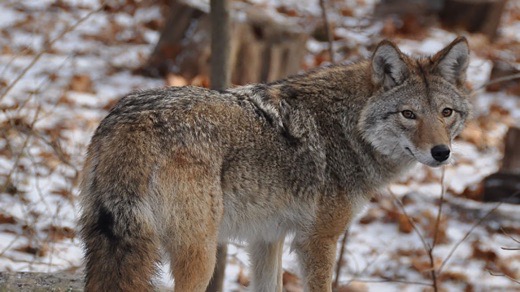
Introducing the Coywolf

SUBHEAD: The coywolf is a new animal species is evolving right before our eyes in America.

By Travis Gettys on 30 OCtober 2015 in alterNet -
(http://www.alternet.org/culture/new-species-evolving-right-our-eyes-ultra-successful-mix-wolves-coyotes-and-dogs-0)


Image above: A coywolf in the wild. From PBS trailer below.

A new species combining wolves, coyotes and dogs is evolving before scientists’ eyes in the eastern United States. The coywolf now numbers in the millions, according to research.

Wolves faced with a diminishing number of potential mates are lowering their standards and mating with other, similar species, reported The Economist.

The interbreeding began up to 200 years ago, as European settlers pushed into southern Ontario, clearing the wolf's habitat for farming and killing a large number of the wolf families who lived there. This also allowed coyotes to spread from the prairies, and the farmers brought dogs into the region.

Over time, wolves began mating with their new, genetically similar neighbors. The resulting offspring — which has been called the eastern coyote, or to some, the coywolf — now number in the millions, according to researchers at North Carolina State University.

Interspecies-bred animals are typically less vigorous than their parents, the Economist reported, if the offspring survive at all. That’s not the case with the wolf-coyote-dog hybrid, which has developed into a sum greater than the whole of its parts.

At about 55 pounds, the hybrid animal is about twice as heavy as a standard coyote, and its larger jaws, faster legs and muscular body allows it to take down small deer and even hunt moose in packs in both open terrain and dense woodland.

An analysis of 437 hybrid animals found that coyote DNA dominates its genetic makeup, with about one-tenth of its DNA from dogs, usually larger dogs such as Doberman pinschers and German shepherds, and a quarter from wolves.

The animal’s cry starts out as a deep-pitched wolf howl that morphs into higher-pitched yipping, like a coyote.


Image above: Trailer from PBS video about coywolf at (http://kcpt.org/science/meet-the-coywolf-on-nature/).

The coywolf's dog DNA may carry an additional advantage. Some scientists think the hybrid animal is able to adapt to city life — which neither coyotes or wolves have managed to do — because its dog ancestry allows it to tolerate people and noise. Coywolves have spread into some of the nation’s largest cities, including New York, Boston and Washington.

The interbreeding allows the animal to diversify its diet and eat discarded food, along with rodents and smaller mammals, including cats, and they have evolved to become nocturnal to avoid humans.
Some of the animals are also smart enough to learn to look both ways before crossing roads.

Not all researchers agree the coywolf is a distinct species, arguing that one species does not
interbreed with another, although the hybrid’s existence raises the question of whether wolves and coyotes are distinct species in the first place.

But scientists who have studied the animal say the mixing of genes has been much faster, extensive and transformational than anyone had noticed until fairly recently.

“[This] amazing contemporary evolution story [is] happening right underneath our nose,” said Roland Kays, a researcher at North Carolina State.


.

Beyond Resilience

SUBHEAD: As Climate Change creates "new normals" mitigation and adjustments will have to be made.

By Courtney White on 23 July 2015 for the Carbon Pilgrim -
(https://carbonpilgrim.wordpress.com/2015/07/14/beyond-resilience/)


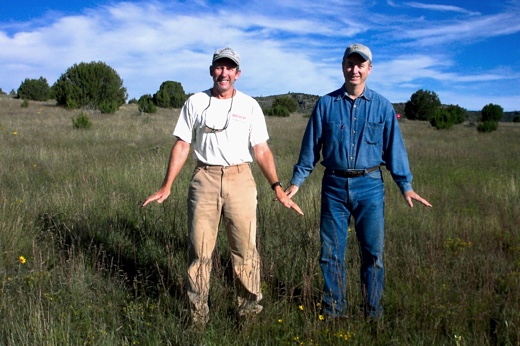
Image above: Photo of the abundant and diverse grasses that returned to the Cañon Bonita ranch. Mike Reardon on the left. From original article.

Restoring land to health means trying to return it to something like normal ecological conditions. But what if the definition of normal changes in the meantime?

An ecosystem’s capacity to absorb a shock, such as a drought, flood, or forest fire, and then bounce back as quickly as possible is called resilience. Since it’s a critical part of ecosystem health, ecologists have made a big effort to understand what constitutes “normal” conditions in order to help a system be as resilient as possible, especially if the shock has been caused by humans, such as overgrazing by cattle.

But what if a system’s definition of normal changes? What if a region’s annual precipitation dropped by half—and stayed there? Or when the rains did fall, they came as unusually large flood events or at the wrong time of year? What does resilience mean in this context?

It’s not an abstract question. Under climate change, scientists tell us, we’ll be experiencing all manner of new normals. For restoration purposes, this means we need to search the management toolbox for practices that go beyond short-term resilience and allow an ecosystem to endure long-term deviations from normal conditions.

What would those practices be? Mike Reardon has an idea.

Since the late 1990s, Reardon has used a wide variety of land restoration tools on his family’s 6500-acre Cañon Bonita Ranch, located in northeastern New Mexico. These tools include tree removal, brush clearing, prescribed fire, planned grazing, erosion control, riparian restoration, water harvesting, dam building, and ranch road repair—all in service of restoring ecological health to the land after decades of mismanagement by previous landowners.

Reardon’s overall goal is to support a multitude of diverse wildlife on the property and his work has been highly effective in this regard. Today, however, he faces a new challenge: How do you maintain forward progress when prolonged drought limits the use of certain tools?

In 1997, an expert with the USDA’s Natural Resources Conservation Service told Reardon that there were “too many trees” on his ranch. This was news to Reardon, who lives in Albuquerque and readily admits to being a novice about land health when he began managing the ranch. Too many piñon and juniper trees, the expert said, meant a reduced amount of open, grassy habitat for wildlife. In the past, nature corrected this situation with periodic, lightning-sparked wildfires that would thin out the trees, allowing the land to bounce back with perennial grasses.

However, a century of fire suppression by landowners and cooperating agencies across the region, coupled with poor livestock management, eventually eliminated the land’s grass cover, resulting in widespread tree encroachment.

To reverse this situation, Reardon focused first on reducing the density of piñon and juniper trees on the ranch. His original tools were handheld loppers and a chainsaw. Then came a spin trimmer, a front-end loader, and a Bobcat skid-steer. Next, Reardon hired a professional woodcutting crew from Mexico. To date, nearly three thousand acres have been cleared on the ranch, though some stands of trees were left for wildlife.

Next, during the years when grass (and rain) was abundant, Reardon alternated the use of two other tools to further reinvigorate the grasslands: prescribed fire and planned grazing. With the assistance of neighbors and fire experts, Reardon has completed two controlled burns, ten years apart, which effectively suppressed tree seedlings.

Reardon also employed the tool of high-density, short-duration grazing by cattle during the vegetative dormant season (December through March). This “living fire” recycles old grass into cattle manure, which helps to build grass cover.

All three tools worked. Grass came back with a flourish, teaching Reardon an important lesson.
“I learned that bare ground was enemy number one,” Reardon said, “so I do everything I can to get grass to grow. And not just any grass, I want perennials and I want as much diversity as possible.”

The next job for the resilience toolbox was water. In order to create more surface water for wildlife to drink, as well as grow a year-round supply of nutritious food, twelve earthen dams and four metal tanks (with windmills) were repaired, modified, or constructed across the ranch. He also implemented a five-phase wetland and riparian restoration project that employed many of the innovative practices pioneered by specialists Bill Zeedyk and Craig Sponholtz.

They designed and implemented treatments for a two-mile stretch of Cañon Bonito Creek, which ran through the center of the ranch. Their goals were to decrease stream bank erosion and downcutting and to raise the water table. They also wanted to reconnect the creek to its floodplain in order to re-wet adjoining wet meadows and increase the amount of live water.

They also hoped to increase forage species, including wetland vegetation, and increase cover for wildlife. There was even a plan to harvest water from ranch roads using a variety of techniques, including redesigned road crossings and water-harvesting rock structures in canyon side channels.

Reardon also implemented a detailed monitoring program on the ranch in order to see how changes were progressing. This included vegetation and bare-ground monitoring, moisture data collection, wildlife population surveys, and photographic documentation, including sixty photo points along Cañon Bonito creek alone.

The message of the monitoring data was clear: conditions were improving. Under Reardon’s management, the ranch progressed from a monoculture of blue grama grass to hosting a diversity of more than 55 different grass species. Dry springs began to flow again and wildlife populations shot up by a factor of ten.

Despite a drying trend that began in 2002, deer, elk, and wild turkey populations continued to rise and things seemed to be returning to normal. It looked like Reardon had succeeded in rebuilding resilience on the ranch.

Except the definition of normal was changing. The drought, for example, went on and on—and still goes on.

Today, year-round water in the Cañon Bonito creek is rare, though there is still a steady trickle in the spring area. A relict population of ponderosa pines is dying, along with piñon and juniper trees. Small populations of perennial grasses, previously restored, are now dying as well. And wildlife populations are in decline—wild turkey populations have dropped by 75 percent. As for the land management toolbox—persistent drought means that prescribed fire is off the table and grazing by cattle is limited to selected areas of the ranch.

Reardon has learned the hard way that getting “beyond resilience” is easier said than done.
On the good news front, there is still plenty of ground cover holding the soil in place, capturing “airmail topsoil,” as Reardon puts it, during local dust storms, as well as any raindrop that falls from the sky.

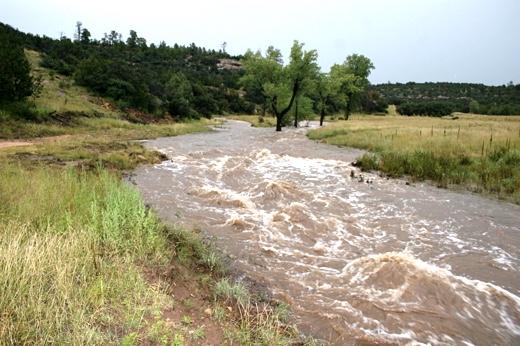
The wetland and riparian restoration work have kept the ground moist where otherwise it might have gone dry. It also helps to dissipate the destructive forces of unusually big flood events, such as one the ranch endured on September 2013, when nearly five inches fell in a matter of hours. Thanks to all the vegetation that had grown along the stream banks, the effects of that flood were not nearly as devastating as they would have been otherwise.


Image above: Here’s a photo of the new normal of big flood events on the ranch. From original article.

For Reardon, the whole experience points to important lessons learned for the new normals of hotter, drier conditions and chaotic moisture events.

“Use your time effectively,” he said, “focus on sweet spots, have a plan, pull together a diverse group of supporters and professionals, be willing to listen and learn, trust the data, be willing to admit mistakes, be proactive, become land literate, and get ready for the next storm—dust, rain, snow, whatever Mother Nature brings. It will rain again!”

Sage words as we move deeper into the twenty-first century!

• Courtney White is a former archaeologist and Sierra Club activist, Courtney dropped out of the 'conflict industry' in 1997 to co-found The Quivira Coalition, a nonprofit dedicated to building bridges between ranchers, conservationists, public land managers, scientists and others around the idea of land health. This is a chapter from his forthcoming book 2% Solutions for the Planet to be published by Chelsea Green in October. See: http://www.chelseagreen.com/two-percent-solutions-for-the-planet]


.

Half wildlife gone missing

SUBHEAD: We all live on a finite planet and its time we started acting within those limits.

By Eliene Augenbraun on 30 September 2014 for CBS News -
(http://www.cbsnews.com/news/world-wildlife-fund-wwf-half-the-worlds-biodiversity-gone-over-last-40-years/)


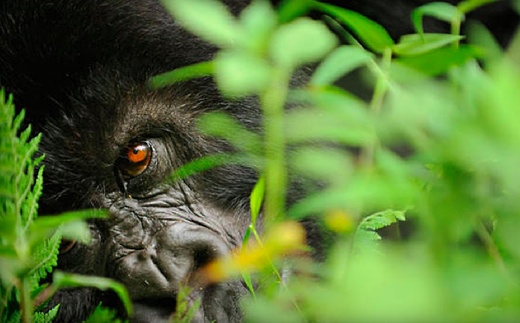
Image above: A mountain gorilla in Rwanda. The World Wildlife Fund (WWF) warns that increased human activity and oil extraction in Rwanda's Virunga National Park could lead to habitat degradation, leaving the gorilla population more vulnerable to poaching. From original article.

The world has lost 52 percent of its biodiversity since 1970, the World Wildlife Fund (WWF) announced in a study released today on the state of our planet.

According to the Living Planet Report 2014, "the number of mammals, birds, reptiles, amphibians and fish across the globe is, on average, about half the size it was 40 years ago. This is a much bigger decrease than has been reported previously, as a result of a new methodology which aims to be more representative of global biodiversity.

Scientists studied trends in more than 10,000 populations of 3,038 mammal, bird, reptile, amphibian and fish species and calculated a "Living Planet Index" (LPI) that measures the health of species in various environments and regions. While the LPI in temperate regions declined by a worrisome 36 percent from 1970 to 2010, in tropical climates the index dropped 56 percent. Latin American biodiversity took the biggest hit globally, plummeting 83 percent.

Jon Hoekstra, chief scientist at WWF, broke it down another way: "39 percent of terrestrial wildlife gone, 39 percent of marine wildlife gone, 76 percent of freshwater wildlife gone -- all in the past 40 years."

The toll was greatest in low-income countries. High-income countries showed a 10 percent increase in biodiversity. However, less affluent parts of the world more than cancelled that out. Middle-income countries lost 18 percent of their wildlife populations, while low-income countries showed a 58 percent decline.

And the bad news does not end there.

WWF reports that the global human population already exceeds our planet's biocapacity -- the amount of biologically productive land and sea that is available to produce the resources we rely on for food, fuel, building and other needs, and that is needed to absorb the amount of carbon dioxide we generate. Indeed, it would take the equivalent of 1.5 Earths of biocapacity to meet our current demands, the report says.

The problem may get worse as more of the world adopts or aspires to the levels of consumption common in richer countries. "If all people on the planet had the Footprint of the average resident of Qatar, we would need 4.8 planets," the report says. "If we lived the lifestyle of a typical resident of the USA, we would need 3.9 planets.

The Global Footprint Network, a WWF partner, calculates the balance between each country's demand and capacity to arrive at a figure it calls the Ecological Footprint. In an email to CBS News, Hoekstra explained that the Footprint relies on publicly available data and is generated for each nation annually. The findings are expressed in units called global hectares, a measurement of land with the average level of biological productivity. The planet currently has a biocapacity of 1.7 global hectares per person; the Footprint exceeded that level in 91 out of 152 countries studied.

Worldwide, our Ecological Footprint decreased by 3 percent between 2008 and 2009, mostly due to a lower demand for fossil fuels, WWF reports. However, the latest figures available from 2010 show the Footprint resuming an upward trend.

Just two countries account for a third of the the world's total Ecological Footprint: China, at 19 percent, and the United States, with nearly 14 percent.

Contribution of countries with the highest per capita Global Footprint. The Footprint takes into account: carbon, fishing grounds, cropland, built-up land, forest and grazing products.
Global Footprint Network, 2014
"High-income countries use five times the ecological resources of low-income countries, but low income countries are suffering the greatest ecosystem losses," Keya Chatterjee, WWF's senior director of footprint said in a press release. "In effect, wealthy nations are outsourcing resource depletion."

To counteract these trends, WWF recommends a number of steps: focusing more on sustainable development, using resources more efficiently, incorporating environmental factors into measures of economic growth, and increasing efforts to protect natural habitats around the world.

Carter Roberts, president and CEO of WWF, warned, "We're gradually destroying our planet's ability to support our way of life. But we already have the knowledge and tools to avoid the worst predictions. We all live on a finite planet and its time we started acting within those limits."

.

Frankenfish Green Light

SUBHEAD:  Bad procedure for the regulation of genetically engineered food animals is being set by GE Salmon.

By Jill Richardson on 19 March 2013 for PR Watch -
(http://www.prwatch.org/news/2013/03/12027/fda-ready-approve-frankenfish-despite-fishy-science)


Image above: Vendor Taho Kakutania playfully encourages tourist Anne Moral to kiss a coho salmon at the Pike Place Fish Market Monday, Sept. 20, 2010, in Seattle. From (http://www.csmonitor.com/USA/Latest-News-Wires/2010/0920/Frankenfish-modified-salmon-considered-for-approval-in-US).

Some day soon, you might dig into a plate of salmon without knowing that the fish you are eating was genetically engineered. The so-called AquAdvantage salmon, a salmon genetically engineered to grow faster than normal salmon, just moved one step closer to legalization. If so, it will be the first genetically engineered (GE) animal allowed for consumption in the United States.

Thus, every part of the regulatory process related to the GE salmon sets a precedent for all future GE animals in the United States -- and so far, according to experts, that precedent is a sloppy, inadequate one.

What Is AquAdvantage Salmon?

To create the GE salmon, the Boston-based public company AquaBounty Technologies inserted DNA from another salmon species and an eel-like fish into the genome of an Atlantic salmon. The new genes make the GE salmon produce growth hormone all year round instead of just for three months a year as they normally would. This helps them grow to market size in 16 to 18 months instead of the usual 30 months required for an Atlantic salmon.

To prevent any GE salmon from escaping into the wild, surviving, and reproducing there, AquaBounty will only produce female GE salmon, each with three sets of DNA instead of the normal two. Triploids, as organisms with three sets of DNA are called, are infertile.

Therefore, producing only female, triploid GE fish should provide two mechanisms of preventing reproduction should any fish escape into the wild. (Obviously, it takes a bit of scientific tinkering to create an all-female triploid fish population and the process used to do this might make your stomach turn.)

AquaBounty will produce salmon eggs in Prince Edward Island, Canada. Then it will transport them to an inland facility in Panama, where it will grow the fish, harvest, and process them. The firm claims no live fish will ever enter the United States.

How Are GE Animals Regulated?

The next question one might ask is how the federal government goes about deciding whether or not a GE animal should be allowed in our food supply. Under a 1980s decision, written by anti-regulation ideologues in the Reagan and Bush I era before any GE foods -- plants or animals -- were ready for commercialization, the government decided that no new laws were needed to regulate GE plants or animals. This decision is called "the Coordinated Framework for the Regulation of Biotechnology," or the Coordinated Framework for short.

Whereas the European Union debated the regulation of GE foods and drafted new laws to address issues such as safety, traceability, allergenicity and environmental impacts, the U.S. never passed any new laws specific to GE animals or had the kind of public debate passing a new law would require.

Instead, they decided to regulate GE animals as "animal drugs," using laws that are not well-suited to the unique, complex issues posed by GE animals. Specifically, the government considers the extra DNA added to the GE animals as the "animal drug."

New Animal Drugs are regulated by the Food and Drug Administration, and they receive input from the Veterinary Medicine Advisory Committee (VMAC) -- a committee mostly made up of veterinarians, not genetic engineering experts.

When a new animal drug is approved, it is only approved for production in a specific facility. Therefore, if you invent a new pill for cats, you submit data on its production in a specific facility, and you receive approval to produce it only in that facility. If you decide to build eight more factories because your drug is so popular, you must go back to the FDA to receive approval for the eight new facilities.

2010: Sloppy Science on Trial

Back in 2010, the FDA took the first steps to approve AquaBounty's application to produce the GE salmon. It released a draft Environmental Assessment (EA) and several hundred pages of safety testing data from experiments performed by AquaBounty on the GE salmon. Then it gave the public a mere two weeks to comment on the data, and it convened VMAC to advise it on the GE salmon.

For watchdog groups, this was the first signal that something was, well, fishy. Consumers Union senior scientist Michael Hansen excoriated the safety data as "sloppy," "misleading," and "woefully inadequate."

In addition to using small sample sizes and culling deformed fish and thus skewing the data, AquaBounty only provided data gathered in its Prince Edward Island facility, where it will produce GE salmon eggs. But, by law, it must also provide data from its Panama facility, where it will grow the salmon to full size.

The VMAC committee didn't give a resounding approval either. The New York Times summarized their findings, saying, "While a genetically engineered salmon is almost certainly safe to eat, the government should pursue a more rigorous analysis of the fish's possible health effects and environmental impact." However, the committee only advises the FDA, and its decisions are not binding.

2012: FDA Readies Its Rubber Stamp

Following the VMAC meeting and a second, public meeting on labeling issues surrounding the GE salmon, the FDA went silent. Over the next two years, it quietly examined the public comments and the input from the VMAC committee. But despite VMAC's suggestion for a more rigorous analysis, the FDA moved the application one step closer to approval without really addressing the gaping holes in the AquaBounty's science.

In May of 2012, it produced an ever-so-slightly improved Environmental Assessment (EA) compared to the original draft it made public in 2010, and a preliminary "Finding of No Significant Impact" (FONSI).

The preliminary FONSI and draft EA were not made public until they were published in the Federal Register on December 26, 2012. At that point, the FDA began a 60-day period in which the public could review its findings and submit comments.

What happened between 2010 and 2012 to improve our confidence that the GE salmon is safe for human consumption and for the environment? Nothing. There's no new data whatsoever. The only changes are a few minor additions to the EA -- certainly not enough to inspire confidence that the government heard the critiques made in 2010 and addressed them.

After a group of Senators led by Mark Begich (D-AK) sent the FDA a letter asking for a 60-day extension to the comment period, the FDA agreed to take comments until April 26, 2013.

What's Fishy About the GE Salmon?

"There are still unanswered safety and nutritional questions and the quality of the data that was submitted to the FDA was the worst stuff I've ever seen submitted for a GMO. There's stuff there that couldn't make it through a high school science class," reflected Hansen in early 2013, after reviewing the newly released documents.

Almost laughing, Hansen remarks on the obvious flaws in AquaBounty's scientific justification of the fish's safety, saying, "That's not science, that's a joke!" Becoming more serious, he adds, "There's allergenicity questions and other health questions. It shouldn't be approved. They don't have any data to show that it's safe."

"There are environmental issues as well," Hansen continues. "Not so much in Panama, but on Prince Edward Island. That's where they're going to producing eggs. Guess what, to produce eggs, you've gotta have fertile adults." Before the wild Atlantic salmon population was decimated, the waters around Prince Edward Island was salmon habitat. An escaped GE fish could easily thrive there. "Yet," adds Hansen, "they conclude that even if they get out the water's too cold!"

In an interview with Flash in the Pan, environmental risk scientist Anne Kapuscinski also criticized the FDA's process. Back in the 1990s, she authored the reports on how to perform environmental risk assessment. But, by 2007, her 1990s publications were so out of date that she led a team of scientists to write an updated book on the subject. Despite the updated scientific methods, the FDA opted to use the old, outdated methods from the 1990s to conduct its environmental risk assessment on the GE salmon.

The 2007 publication was rigorously peer reviewed by reviewers from around the world. Yet, the FDA ignored it. Kapuscinski calls their methods unscientific, adding that if the FDA were a student who submitted this report for a grade, it would fail. "Students would get into serious trouble if they were citing really old methods, and there had been huge advances in the methods since then and they ignored that. That would be a reason to fail them."

She submitted comments back in 2010, but says, "it looks like either they didn't read our comments or they just decided to ignore them." She points out that the Panama facility that AquaBounty will use to grow the fish out of is not large enough for a commercial venture. "It's at a scale to show proof of concept of the commercial viability of this," she said. "Once the company scales up to selling millions and millions of eggs, the fish will be farmed by producers with all kinds of facilities."

Those facilities might not be as well protected as the one in Panama. Unless the FDA brings its risk assessment methods up to date, we have no adequate, scientific assurance that GE salmon won't escape into the wild.

Next Steps

Despite the scientific questions, there's no sign that the FDA will overturn its preliminary decision to allow commercialization of the GE salmon. The best Michael Hansen is hoping for at this point is a requirement that the GE salmon -- one legalized -- will be labeled as genetically engineered. He calls this "an outside chance."

Unfortunately, as Hansen notes, "This is to set a precedent. If they let the GE salmon go through, why would any other company that wants to get a genetically engineered animal through bother" producing rigorous, scientifically valid data to prove its product's safety?

If you don't want to see GE salmon in your local supermarket in as little as a few years, you can take action. The FDA is accepting public comments until April 26, 2013. You can write your own message and submit it at Regulations.gov or you can join Food and Water Watch's campaign against the GE salmon here. You can also write your representatives to let them know your point of view.

See also:
Ea O Ka Aina: USDA funds GM Salmon 11/12/11

.

Town moves to save tigers

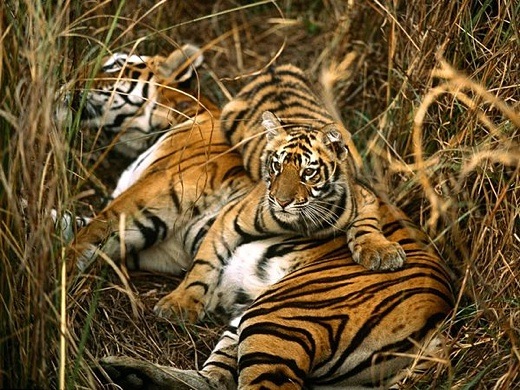
SUBHEAD: Entire village in India relocates to make more room For tiger habitat. By stephen Messenger on 16 February 2012 for TreeHugger - (http://www.treehugger.com/natural-sciences/entire-indian-village-relocates-sake-tigers.html) Image above: A Bengal tiger and her cub rest in tall grass. From (http://animals.nationalgeographic.com/animals/mammals/bengal-tiger/).

It's no secret that most human-animal conflicts don't end well for wildlife -- but in a rare show of interspecies hospitality, an entire community in India has decided to relocate in order to make room for big cats in need of some extra space. Last week, all 350 residents of Umri, a village in an important wildlife preserve in the northern region of Sariska, packed up their things and moved to a new, less ecologically sensitive locale nearby, and all for the sake of securing a bit of space for a rapidly dwindling tiger population.

Over the course of a century of encroaching development in India, the nation's once thriving tigers numbers have been reduced by over 98 percent. In recent decades, the establishment of protected zones, like the Sariska Tiger Reserve, have enabled the species to avoid extinction for now. The tiger's long-term survival, however, may depend on a reversal of trends -- by letting the wilderness reclaim some of the land it lost to humans.

According to the BBC, Umri is actually the second village to relocate entirely on account of helping tigers. And, in the coming years, four other communities are likely to follow, but they aren't without incentive.

The villagers are compensated with land, cash and livestock worth up to 1 million rupees ($20,000) and relocated to the nearest cultivable plots outside the reserve, Rajasthan's chief wildlife warden AC Chaubey told the BBC.

No matter the cost, conservationists believe that relocating villages in the tiger's habitat could help bolster their numbers -- and the help is much needed. From an estimated population of 100,000 at the turn of last century, a 2011 census reveals that a mere 1,700 are still exist in the wilds of India.

.

Cow to be slaughtered is safe

SUBHEAD: Initially billed for slaughter, six-year-old Yvonne broke free from farm and retreated to the woods. [Editor's note: It looks like while Yvonne was away from home she might have taken steroids and began a path to transgender transformation. Either that or Der Spiegel's translation from German thinks a steer is a "cow".] By Staff on 2 September 2011 for Der Spiegel - (http://www.spiegel.de/international/zeitgeist/0,1518,784066,00.html) Image above: Cow Yvonne resisting her final capture. From original article.

For months she eluded hunters, animal activists and the media, but Yvonne the runaway cow has now finally been captured. The fugitive didn't give up her freedom without putting up some resistance, though. Her performance was so spirited that she's now being compared to a Spanish bull.

Yvonne the fugitive cow has been captured, but not without a fight. It took two tranquilizer shots and some serious wrangling to get the feisty cow into a transport vehicle.

"She acted very aggressively," veterinarian and former director of Munich's Hellabrunn Zoo, Henning Wiesner, told news agency DAPD. A normal cow would have been easily led away after just one shot, he explained.

"She has the qualities of a Spanish Toro," he added.

After the tranquilizers, Yvonne made a scene by charging a tractor, which was followed by some additional pushing and shoving from her captors. She was ultimately wrangled into an animal transporter and taken to the Gut Aiderbichl animal rescue farm in Deggendorf, where she will likely live out the rest of her days.

Initially billed for slaughter, six-year-old Yvonne broke free from an Aschau farm on May 24 and retreated to the woods in the Upper Bavarian district of Mühldorf am Inn. The district authority soon declared the cow to be a traffic danger, authorizing officials to shoot her. However, concerned animal activists stepped in to try and save Yvonne, purchasing her from her owner and joining the search to find her.

Bound, But Not Broken

During their quest to capture Yvonne the Gut Aiderbichl rescuers unsuccessfully tried using helicopters with heat-seeking cameras, her sister Waltraud and even a handsome ox named Ernst to lure her from the woods. With each failed attempt Yvonne gained popularity during the slow news cycle of the summer months, even earning herself a few Facebook fan pages. Adding to her allure, those who spotted Yvonne reported that her months on the lam had transformed her from an ordinary dairy cow to a shaggy, buffalo-like woodland beast.

The wily bovine outsmarted her pursuers so many times that last week district officials gave up, suspending the permit to shoot her and asking that the animal "not be disturbed in its current habitat," though Gut Aiderbichl rescuers still hoped to find her before the cold winter months set in.

Her freedom was short-lived. On Tuesday Yvonne was spotted in a meadow near Stefanskirchen where a number of calves were being kept. The farmer, whose find won him a €10,000 ($14,500) reward put up by tabloid daily Bild, informed Gut Aiderbichl on Thursday. By the time everyone arrived it was too dark to proceed, but Yvonne was captured -- with some hefty resistance -- around dawn on Friday morning.

"I'm happy it went so well," head of the Gut Aiderbichl rescue farm search team, Hans Wintersteller, told German news agency DAPD on the way to Yvonne's new home in Deggendorf.

There she will be greeted by her sister Waltraud and son Friesi, also purchased by the rescue farm, which is home to horses, dogs, chimpanzees and other cattle.

"The whole family is waiting for her," Wintersteller said.

.

Reindeer on Psychedelics

SUBHEAD: Scientist claims reindeer, and other animals get high on magic mushrooms.

By Staff on 23 December 2010 from Huffington Post - (http://www.huffingtonpost.com/2010/12/23/reindeer-magic-mushrooms_n_801006.html)

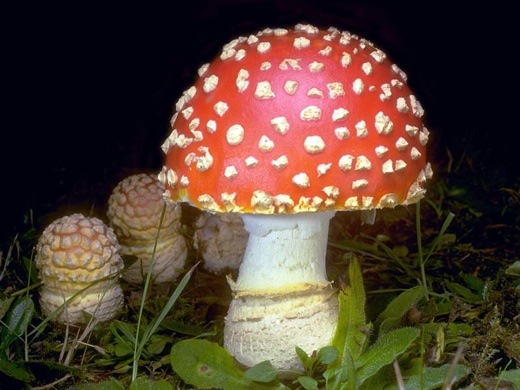
Image above: Amanita muscaria - it is one of the most potent psychedelic mushrooms known. From (http://www.myspace.com/wasted187/blog/519966483).

Turns out the myth of flying reindeer might not be that far from the truth: According to a piece in Pharmaceutical Journal by scientist Andrew Haynes, they (along with other animals) sometimes deliberately eat hallucinogenic fungi in order to amuse themselves during long winters.

The Sun reports:

Haynes believes reindeer deliberately seek out the mushrooms to escape the monotony of dreary long winters.

Writing in the respected Pharmaceutical Journal, Mr Haynes said: "They have a desire to experience altered states of consciousness.

"For humans a common side-effect of mushrooms is the feeling of flying, so it's interesting the legend about Santa's reindeer is they can fly."

He also said herdsmen drink the reindeer's urine to get high themselves.

In a slightly less appetizing tidbit, Haynes went on to say that herdsmen have been known to drink their own reindeer's urine in an effort to catch a buzz themselves.

.

Unwanted animals in your garden

SUBHEAD: The ecological approach that ought to guide your work as a green wizard.
Image above: A caterpillar devouring leaves in a garden. From (http://chiquibaylon.net/2009/11/garden-pests/). By John Michael Greer on 22 September 2010 in Archdruid Report - (http://thearchdruidreport.blogspot.com/2010/09/animals-iii-unwanted.html) In the sort of imaginary world where candy canes grow on trees and financial crises caused by too much debt can be solved by adding even more debt, the only animals a backyard gardener would ever have to deal with would either be small livestock who keep the refrigerator full, or helpful critters from the surrounding ecology who come fluttering or slithering in on cue to pollinate plants, turn plant matter into compost, and generally make themselves useful to the garden and the gardener. Alas, we don’t live in such a world, and if you have a backyard garden, you’ll be dealing with plenty of other animals whose goal in life is to eat the food you grow before you can get to it. Call them the Unwanted. If that sounds like the title of a second-rate Western, that’s not wholly inappropriate, because most American gardeners seem to think of them in terms borrowed from Hollywood cowboy flicks: your garden is the inevitable happy but helpless Western town, the animals we’re discussing are the black-hatted bandits, and you’re the gunslinger with the tin star on your shirt who stands there in the middle of Main Street waiting for the baddies to show up, with both hands hovering over the grips of your six-sprayers. Popular though the image is, it’s not a useful approach to managing a garden ecosystem. The idea that you ought to control unwanted animals by squirting poisons all over everything may not be the dumbest notion in circulation these days, but it’s arguably pretty close; a healthy garden, remember, is one with a diverse population of living things in balance, and the toxic compounds too many gardeners like to spray all over everything are just as deadly to bees and other helpful creatures as they are to the ones you think you need to get rid of. Most of them aren’t exactly healthy for you, either, and dumping poisons on your own food supply is not generally considered to be a bright move. For that matter, it’s not even an effective way to get rid of the critters you don’t want. It’s important to understand why this is the case, because it points up a crucial difference between the unhelpfully mechanistic approach that governs so many activities in contemporary industrial society, on the one hand, and the ecological approach that ought to guide your work as a green wizard, on the other. Imagine, then, a big field full of a single crop, sprayed regularly with a chemical poison to keep some insect or other from dining on that crop. In ecological terms, what do you have? What you have is a perfect environment for any insect that can learn to live with the chemical poison. That insect is looking at an abundant food supply, helpfully guarded by a chemical “predator” that will take out other insects who would otherwise compete for the same food supply. Offer evolution a chance like that, and it won’t be slow to take you up on the offer – which is why losses to insect pests for most crops in the US have risen to levels not far below those that were standard before chemical pesticides came on the market, even though most pesticides are being used at or above their maximum safe dosage per acre. It doesn’t help any that nearly all chemical pesticides are single chemical compounds, each of which interferes with the biochemistry of its intended target in one and only one way. The fetish for chemical purity that runs through so much modern technology has many downsides, and this is one of them. Plants that have evolved chemical defenses against insect predators use as many as a couple of hundred substances that attack an insect’s biochemistry at many different points, an approach that makes it extremely difficult for ordinary random mutations in the insect population to work around them. Rely on a single compound with a single chemical pathway, though, and you make things easy for evolution; one mutation in the right place is all that’s needed, and sooner or later the luck of the draw will go in the insect’s favor. The same bad habit, interestingly enough, lies behind the explosion of antibiotic-resistant bacteria in recent years. Any given antibiotic relies on a single effective substance with a single impact on the bacteria it’s supposed to combat; even the sort of antibiotic cocktail used so often nowadays has only two or three active ingredients. Compare that to St. John’s wort (Hypericum perforatum), which is best known these days as an antidepressive but had a much bigger role in traditional Western herbal medicine as a medicine for wounds, and contains dozens of antibacterial compounds – hypericin, rottlerins, xanthones, procyanins, resins, oils, and more. It’s precisely this complexity that makes it impossible for microbes to evolve resistance to herbal treatments. Crusaders on their way to the Holy Land used to take a wineskin, stuff it with St. John’s wort flowers, and fill the skin with olive oil; by the time they got to where the fighting was, the oil was blood red, and they used it to dress sword wounds to keep them from festering in the not exactly sterile conditions of a twelfth-century military camp. American laws being what they are, I would probably get in trouble for practicing medicine without a license if I encouraged you to consider herbal remedies such as St. John’s word for infection, or even recommended that you read such excellent books on the subject as Stephen Harrod Buhner’s Herbal Antibiotics, so of course I’ll do no such thing. The same logic, though, can be applied with a good deal less risk of legal trouble to a backyard garden. Instead of trying to get rid of unwanted creatures in your garden by the simple-minded and easily circumvented approach of a single poison, you need to change the environment so that it no longer encourages the Unwanted to hang around. That isn’t as easy as squirting poison all over everything; it requires you to learn about the life cycle and environmental needs of each of the creatures you intend to discourage, and to figure out ways to deprive them of things they need, make your garden welcoming to things that eat them, irritate, annoy, and frustrate the living daylights out of them until they throw up their forelimbs in despair and go bother someone else. Sometimes a few simple things will do the trick. One classic way to keep raccoons from eating your sweet corn before you get to it, for example, is to intercrop the corn with some vining plant that will twine all around the cornstalks. Raccoons hate unstable footing, and the tangled, sliding mess of vines you’ll get around your corn will often annoy them enough that they’ll settle for the contents of your neighbor’s garbage can instead. Combine that trick with other methods of making life annoying for raccoons – for example, raccoons detest baby powder, and this can be sprinkled liberally on corn ears and leaves to make them leave corn alone – and barriers of the sort raccoons can’t easily get past – for example, once the silks have turned brown and pollination is over, you can cover individual ears with old knee-high stockings held on with rubber bands, and – and the fellow in the bandit mask isn’t likely to bother your corn much. Some insects, similarly, can be dealt with by the simple expedient of physically removing them. On a large farm this would be a herculean task, to be sure, but in a small intensive garden, it becomes workable. Japanese beetles, for example, can be handpicked off your vegetables; do it first thing in the morning, when they’re still groggy, and put a tarp on the ground under the vegetables to catch those that fall off. In effect, you become an additional predator of Japanese beetles, and put enough pressure on their population to keep it from getting out of control. In much the same way, one very effective way to limit the number of slugs in your garden is to find the places they like to hide in the daytime and remove these, except for one nice convenient board left flat on the ground in the middle of the garden. Every day, go out and gather up all the slugs that have hidden under the board, and feed them to your chickens, who will be delighted by the treat. (Those gardeners who lack chickens can drop the slugs into a pail of salted water.) Do this regularly and you’ll keep the slug population of most gardens down to the point that damage to plants is minor at best. Not all problems with the creatures who want to eat your vegetables, or for that matter your animals, can be solved that easily. Any gardener worth his or her salt has a couple of good books on pest control, and takes the time to learn as much as possible about the habits and weaknesses of insects, mammals and birds who have to be controlled if you’re going to get food out of your garden. A few good over-the-fence conversations with local gardeners can also clue you in to methods that have been evolved locally. A garden notebook, kept up to date with notes on what works and what doesn’t, is another valuable resource. Perhaps the most important resource, though, is the awareness that in planting and tending a garden you’re working with an ecosystem, not running a machine. Machines require purity; ecosystems thrive on diversity, which is the opposite of purity. This means that you should have many different crops growing in your garden at any given time, and they should be intercropped rather than grown in nice neat blocks, so that an insect or a plant disease that gets started on one plant can’t simply hop to the next one. It means that you should be prepared to use a series of partial deterrents when something that likes to eat your vegetables gets out of balance with the system, rather than attempting a knockout blow that may just knock out something you need. It also means that you need to accept that a certain number of your plants are going to get sampled by other living things, and concentrate on keeping that number within acceptable limits, rather than trying to drop it to zero. You may not want raccoons and slugs in your garden, but they play necessary roles in the wider ecosystem, and as a green wizard – rather than a poison-toting sprayslinger – your job is to learn to work with that wider system in ways that work for all concerned. Resources Two excellent books on keeping your vegetables safe from your rivals are Rhonda Massingham Hart’s Bugs, Slugs, and Other Thugs and Helen and John Philbrick’s The Bug Book. Most organic gardening books also contain useful hints on keeping the Unwanted at bay, while books on raising small livestock such as chickens and rabbits almost always discuss ways to keep predators from dining on your animals before you do.