Showing posts with label USDA. Show all posts

Executive Order pushes pesticides

SUBHEAD: We can’t allow the protections we depend on for clean water, clean air, and safe food to be gutted.

By Staff on 26 April 2017 for Center for Food Safety -
(http://salsa3.salsalabs.com/o/1881/t/0/blastContent.jsp?email_blast_KEY=1370269)
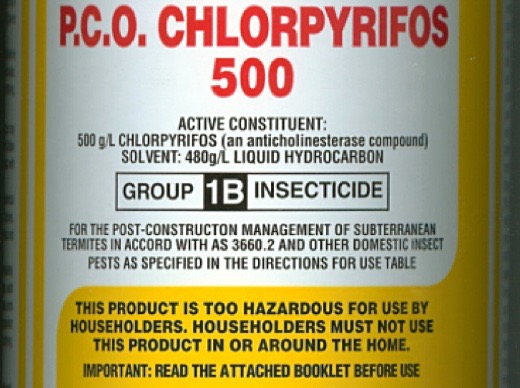

Image above: Photo detail of can of Dow Chemical's chlorpyrifos pesticide distributed by David Gray Co. with warning: "This product is too hazardous for use by householders. Householders must not use this product in or around the home." From (http://www.fertilisersdirect.com.au/pco-chlorpyrifos-1l.html).
 
The hits to our food, farms, and environment just keep coming.
Just hours ago, President Trump signed a new Executive Order, this time specifically on agriculture, directing the Secretary of Agriculture to undertake a 180-day review to “identify and eliminate" what Trump says are "unnecessary regulations”.1

The Presidential Order also creates a new task force to recommend eliminating food and agriculture legislation, policies, and regulations that might hinder the profit-making of “agribusiness.”

What kind of regulations are they looking at? Well, the details are slim, but what is there doesn’t look good. We know that regulations regarding the oversight, production, and export of genetically engineered crops are high on the list.2

The Executive Order also seems to push for faster and/or easier approvals for pesticides and biotech crops, pushing biotech crops abroad to ease export market access, easing the privatization of scarce public water resources for corporate gain, and opening public lands up to mining, farming, ranching and other activities that don’t belong on our public lands.3

We know that Agribusiness has Trump’s ear. He picked Sonny Perdue, one of Big Ag’s own, for his USDA Secretary.

And this week, the Associated Press dropped a bombshell:
Dow Chemical gave $1,000,000 to Trump’s inauguration fund, and the chemical giant is now urging the Environmental Protection Agency (EPA) to set aside its findings on chlorpyrifos and three other pesticides that federal scientists from several agencies found were harmful to endangered species and human health.4
Trump’s EPA also just green-lighted Dow’s new “Enlist Duo” genetically engineered crops, resistant to 2,4-D, part of the Vietnam Era Agent Orange pesticide.

In January, then President-elect Trump sat down chemical giant Bayer’s CEO Werner Baumann and Monsanto’s CEO Hugh Grant at Trump Tower and had a “productive meeting” on “the future of the agriculture industry” and the pending merger between the two companies.

Combined, President Trump, EPA Administrator Pruitt, and newly confirmed USDA Secretary Perdue have received millions of dollars from Big Ag and chemical companies.

We can’t allow the protections we depend on for clean water, clean air, and safe food to be gutted by the new administration and the corporations which have purchased great influence over the President and his policies.

Trump needs to hear from you – add your name  to petition

1. http://www.nydailynews.com/newswires/news/national/latest-trump-aims-ease-farming-regulations-article-1.3099884
2. https://www.politicopro.com/tech/whiteboard/2017/04/perdue-to-chair-trumps-task-force-on-rural-america-086691
3. https://www.whitehouse.gov/the-press-office/2017/04/25/presidential-executive-order-promoting-agriculture-and-rural-prosperity
4. http://bigstory.ap.org/article/a29073ecef9b4841b2e6cca07202bb67/ap-exclusive-pesticide-maker-tries-scrap-risk-study

.

Is being anti GMO anti science?

SUBHEAD: And more importantly, are the arguments for the safety of GMO "science" really scientific? 

By Curt Kobb on 24 July 2016 for Resource Insights -
(http://resourceinsights.blogspot.com/2016/07/are-you-anti-science-if-you-dont-like.html)


Image above: Discerning safety of an apple. Go for the 94750 barcode. From (http://healingulcerativecolitis.com/recommended-diet-for-colitis/dangers-of-gmos/).

It's all the rage to call people who oppose the cultivation of genetically engineered crops anti-science. But if science is an open enterprise, then it should welcome discussion and challenges to any prevailing idea.

We should, however, remember that in this case genetic engineering of crops is not merely a scientific enterprise; it's big business. A lot of people have a lot to lose if the public rejects genetically engineered foods, often referred to as genetically modified organisms (GMOs). We are not by any measure in the preliminary phases of this technology. We are not considering it or calmly debating it before its release. We have long since been launched into an uncontrolled mass experiment, the results of which are unknown.

Knowledge is admittedly a double-edged sword. One might argue that any scientific advance brings risks. I would agree. Understanding nuclear fission and then nuclear fusion led to the atomic bomb and then the hydrogen bomb.

More than 30 years ago millions of people across the world flocked to the nuclear freeze movement out of fear that newly elected American president Ronald Reagan would seek a nuclear buildup and a confrontation with the Soviet Union. Were these millions anti-scientific or the voice of reason?

Nuclear discoveries also led to the widespread application of nuclear fission as a source of heat for electricity generating plants, the dangers of which have most recently been on display at the Fukushima Daiichi power plant in Japan. The results of our grand nuclear experiment are ongoing.

Opposition to practical applications of scientific discoveries cannot willy nilly be labeled anti-science. We now know how to clone humans, but so far, human society has chosen to prohibit this use of cloning.

One does not have to be anti-science to mount a reasoned case for such a prohibition. The American Association for the Advancement of Science opposes reproductive cloning, while supporting stem cell research and research on therapeutic cloning (the production of replacement tissues for humans).

The vast majority of those who want GMO foods labeled or their cultivation banned do not advocate an end to genetic research. They are not anti-scientific. They have legitimate concerns about the safety of crops derived from a specific application of this research, both for humans and for the broader environment.

Let's see if the arguments used to label those who oppose GMOs as anti-science make sense.

1. Lots of scientists endorse the safety and promise of GMOs.
This argument was most recently trotted out as a petition directed at Greenpeace, asking the organization to cease its opposition to GMOs and more specifically to what is called Golden Rice, a rice that produces its own Vitamin A. (Vitamin A deficiency remains a problem in parts of Asia).

It is understandable that those involved in a political debate over the regulation and even prohibition of GMOs will seek visible shows of support from others who are like-minded. This is part of the persuasion process.

But does this prove that those who oppose GMOs are anti-science? More to the point, are scientists who question the safety of GMOs anti-science even as they continue their scientific research?

We must be careful to distinguish research designed merely to understand the workings of the physical world from an endorsement of specific applications of our knowledge to products and practices. There is a big difference between science and applied science.

This is where the problem of what a friend of mine calls the Midgley Effect arises. Thomas Midgley Jr. was a renown American chemist in the first half of the 20th century. He was asked to find compounds that could be added to gasoline to reduce "knocking" in engines (which can cause damage). Midgley's solution was tetraethyllead which became the basis for leaded gasoline.

Midgley assured the public that leaded gasoline was safe. In fact, Midgley was given the prestigious William H. Nichols Medal by the American Chemical Society in 1923 for his breakthrough. Despite concerns about the release of lead into the environment and deaths at a pilot plant, the U.S. Surgeon General and the U.S. Public Health Service both concluded that there was no evidence that leaded gasoline would cause human health problems. Thus, yet another uncontrolled mass experiment began with humans as the subjects.

Only unrelated research on the age of the Earth revealed abnormally high levels of lead in the environment which interfered with such age calculations and led to concerns about leaded gasoline--which, of course, was eventually banned.

But Midgley's work on chlorofluorocarbons (CFCs) as refrigerants was probably even more significant. At the time existing refrigerants--fluids that circulate in refrigerators and draw heat away from their interiors--were corrosive or flammable. The industry wanted something that wasn't either.

Midgley's solution was a set of inert compounds that would easily vaporize and recondense called chlorofluorocarbons and that eventually went by the trade name Freon.

Nonflammable, noncorrosive, nontoxic to humans and able to circulate in refrigerators for years, even decades without breaking down, his discovery found wide application in refrigeration and eventually air conditioning. So safe were CFCs deemed that they were used in aerosol spray cans and even asthma inhalers.

For his work on CFCs Midgley received another award, the Perkin Medal from the Society of Chemical Industry in 1937.

If chemist F. Sherwood Rowland had not asked in the early 1970s where CFCs go once they are released, we might now be living without the better part of the Earth's ozone layer.

 His work alerted the world that CFCs were indeed quite long-lived as advertised, were making their way continuously to the Earth's ozone layer and were systematically destroying it. Without the ozone layer much greater ultraviolet radiation would hit the Earth and endanger all living things. CFCs were ultimately banned by the Montreal Protocol.

Shall we consider the scientist who discovered the deleterious effect of CFCs on the ozone layer anti-science? Shall we consider the geochemist who discovered the widespread dissemination of lead in the environment that was linked to leaded gasoline anti-science?

Of course not. Pointing out potential and actual dangers of a specific application of scientific research in not anti-science at all.

In these cases we must remember that lots of people who called themselves scientists assured us that leaded gasoline and CFCs were safe. But, they were wrong, grievously wrong. And, we must remember that it took decades to uncover the widespread damage being done by both.

The U.S. Food and Drug Administration (FDA) long ago ruled that GMO foods are "substantially equivalent" to their non-GMO counterparts and therefore do NOT require any testing. Those supporting the widespread dissemination of GMOs could be very wrong as well. There isn't enough information to know what the ultimate results will be for human and animal health.

What is more interesting is that the authors of the petition mentioned above have essentially admitted that we are doing an uncontrolled experiment on humans (because governments required no controlled studies). They write:
But the science telling us GM [genetically modified] crops and foods are safe has been confirmed by vast experience. Humans have eaten hundreds of billions of GM based meals in the past 20 years without a single case of any problems resulting from GM.
The petition writers, of course, do not adduce any evidence that there has not been a single case of a problem with genetically engineered foods. They merely assert it. I would hazard a guess that they did not do an exhaustive survey to find any cases.

This leads us to the second claim that is supposed to prove that somebody is anti-science if he or she opposes GMOs.

2. There is no evidence that GMOs are harmful.
Anecdotal evidence and even some scientific studies suggest that GMOs may be harmful in one or more these three categories. Even if that evidence is valid, it begs the question, How harmful? Do the supposed benefits of GMOs outweigh any alleged or actual harm?

The problem with engaging assertion number 2 above is that it is an inversion of responsibility. The GMO industry and its supporters assume that it is the responsibility of the public to discover any harm and to document it sufficiently to prove that harm.

But the real responsibility ought to lie with the industry. Typically, the way this is done is that the government requires studies under controlled conditions to establish the safety of a product. Individual consumers and independent researchers don't have the financial and technical resources to do this.

If the industry wants to warrant that GMOs are safe for human consumption, it should have to follow protocols designed for novel products which it wants to introduce into the human body. These protocols are generally reserved for new drugs. But some scientists in the FDA suggested that just such protocols would be necessary to assure that GMOs are safe before their release to the public. (They were overruled.)

The industry assures us that GMOs are not novel. After all, the FDA ruled that GMOs are "substantially equivalent." On that basis all patents for GMOs crops would be invalid since they are not novel. But it is precisely based on the novelty of specific genetic alterations of plants that the GMO companies have successfully obtained patents on their products.

If GMO plants are indeed novel as the companies insist when they go to the patent office, then they ought to be obliged to prove they are safe under established protocols for novel products designed for human consumption.

Don't let the industry get away with this inversion of responsibility. Can the industry really make the claim that those who oppose GMOs because the foods derived form them are not properly tested are anti-science? Isn't the industry really anti-science for opposing the testing of novel foods in the same way the drug companies are obliged to test novel compounds? Isn't the industry being anti-science by claiming that GMOs are not novel? (Maybe that's just straight out lying.)

There is a third claim that is supposed to demonstrate that those who oppose GMOs are both anti-science and ignorant.

3. GMO crops are no more risky than crops by crossbreeding.
This is a clever argument indeed. For it tries to get the listener to accept the equivalence of the two types of genetic alteration. But they are not equivalent. And, the key reason is not the one cited most often by GMO critics, namely transgene splicing, the splicing of genes from completely different categories (from a fish to a tomato to cite a real example).

While it's theoretically possible for such gene transfers to take place in nature, they are highly unlikely. (How often is a fish in the wild going to come into contact with a tomato?)

What is more important is that humans have ample experience with crossbreeding. The fact that humans are still here in the numbers that they are testifies to the safety of crossbreeding which has been practiced for a very long time.

This does not testify to safety in every instance, but to safety in general. Historically, crossbred plants are tested in small areas to see whether thrive and to see how they interact with other plants. These small experiments keep any mistakes contained.

GMO crops on the other hand are poorly tested[1] and then introduced practically worldwide within a few years. If there is a hidden adverse interaction with the environment, we will be subject to worldwide effects before we are aware. Those effects might take years to become apparent. And, it might take us years to trace those effects to GMO crops. The adverse environmental effects of GMOs will not be contained. There will be no small mistakes.

Since our experience with GMOs is limited, there has been very little time to discover unintended consequences. The fact that GMO crops to date have not produced catastrophic systemic failures in farm fields or in the surrounding environment does not prove that the next new GMO crop won't produce such a failure or that existing GMO crops under some as yet unencountered situation won't produce such failures.

Now, here's the key point: Because we cannot from experience judge the risks of GMOs to the broader environment (as we can with crossbreeding), and we cannot anticipate all the interactions between GMOs and the environment, THERE IS A NONZERO RISK OF SYSTEMIC CATASTROPHE, namely, worldwide crop failure or systemic ruination of adjacent ecosystems.

The proponents will say that the risk of such systemic effects is small. But it does not matter how small that risk is if we intend to keep subjecting the environment to novel crop genes. If the risk is nonzero and we metaphorically pull the gene gun trigger enough times, we will eventually create systemic ruin.

We are playing a game of Russian roulette with the many genetic engineering techniques we are now employing. Techniques which have a nonzero risk of creating systemic ruin should be banned. Ruin is too great a price to pay no matter how big the perceived benefits are (and the supposed benefits of GMOs are hotly disputed).

The foregoing discussion is really a reiteration of something I've covered before based on the work of risk expert Nassim Nicholas Taleb. Taleb explains why the precautionary principle should apply to GMOs.

Perhaps risk is not the purview of the pure scientist. But it certainly must be the purview of the applied scientist. To misunderstand risk in the worldwide dissemination of genetically novel crops is to set oneself up to be the next Thomas Midgley and to risk the lives and livelihoods of millions, even billions of people based on a mere feeling that what one is doing is low risk.


[1] The U.S. Department of Agriculture (USDA) requires field testing of GMO plants to determine whether they have the potential to harm other plants. The genetic contamination of non-GMO plants (through the exchange of pollen) which is prevalent worldwide seems of little concern to the USDA which seems not to regard this as a harm to other plants. This is particularly a problem for organic growers who are forbidden to use GMO crops and those conventional growers seeking non-GMO verification of their crops.

The FDA regulates as a pesticide any GMO plant which produces its own pesticide (as many of them do) and determines whether ingesting that pesticide in the amounts in the plant poses a hazard to human health--not particularly appetizing. A summary of these regulations can be found on p. 4 of this document.

Kurt Cobb is an author, speaker, and columnist focusing on energy and the environment. He is a regular contributor to the Energy Voices section of The Christian Science Monitor and author of the peak-oil-themed novel Prelude. In addition, he has written columns for the Paris-based science news site Scitizen, and his work has been featured on Energy Bulletin (now Resilience.org), The Oil Drum, OilPrice.com, Econ Matters, Peak Oil Review, 321energy, Common Dreams, Le Monde Diplomatique and many other sites. He maintains a blog called Resource Insights and can be contacted at kurtcobb2001@yahoo.com.

.

Clinton's GMO buddy Vilsack

SUBHEAD: Hillary has vetted Vilsack and is preparing public for GMO flack as Vise Presidential pick.

By Michael Shooltz & Juan Wilson on 20 July 2016 in Island Breath -
(http://islandbreath.blogspot.com/2016/07/clinton-favors-gmo-vilsack.html)


Image above: USDA head "Vilesack" met with Monsanto to discuss advances for 2016. From (http://naturalsociety.com/agriculture-secretary-tom-vilsack-meets-with-monsanto-to-discuss-agricultural-advances-for-2016/).

The current USDA head Thomas Vilsack is said to be Hillary Clinton's top choice for Vice President.

This is a guy who was voted "Governor of the Year" in 2001 by the GMO Industry when he was governor of Iowa. See (https://www.bio.org/media/press-release/iowas-vilsack-named-bio-governor-year).

As head of the USDA he has been a steadfast talking head for Monsanto and and the biotechnology-pesticide industry.

Under Vilsack's watch the US Department of Agriculture has been purchasing massive amounts assault rifles and ammunition. One might ask themselves why the USDA needs 7,000 assault rifles and over 300,000 rounds of ammunition. (http://modernfarmer.com/2014/09/usda-buying-submachine-guns/)

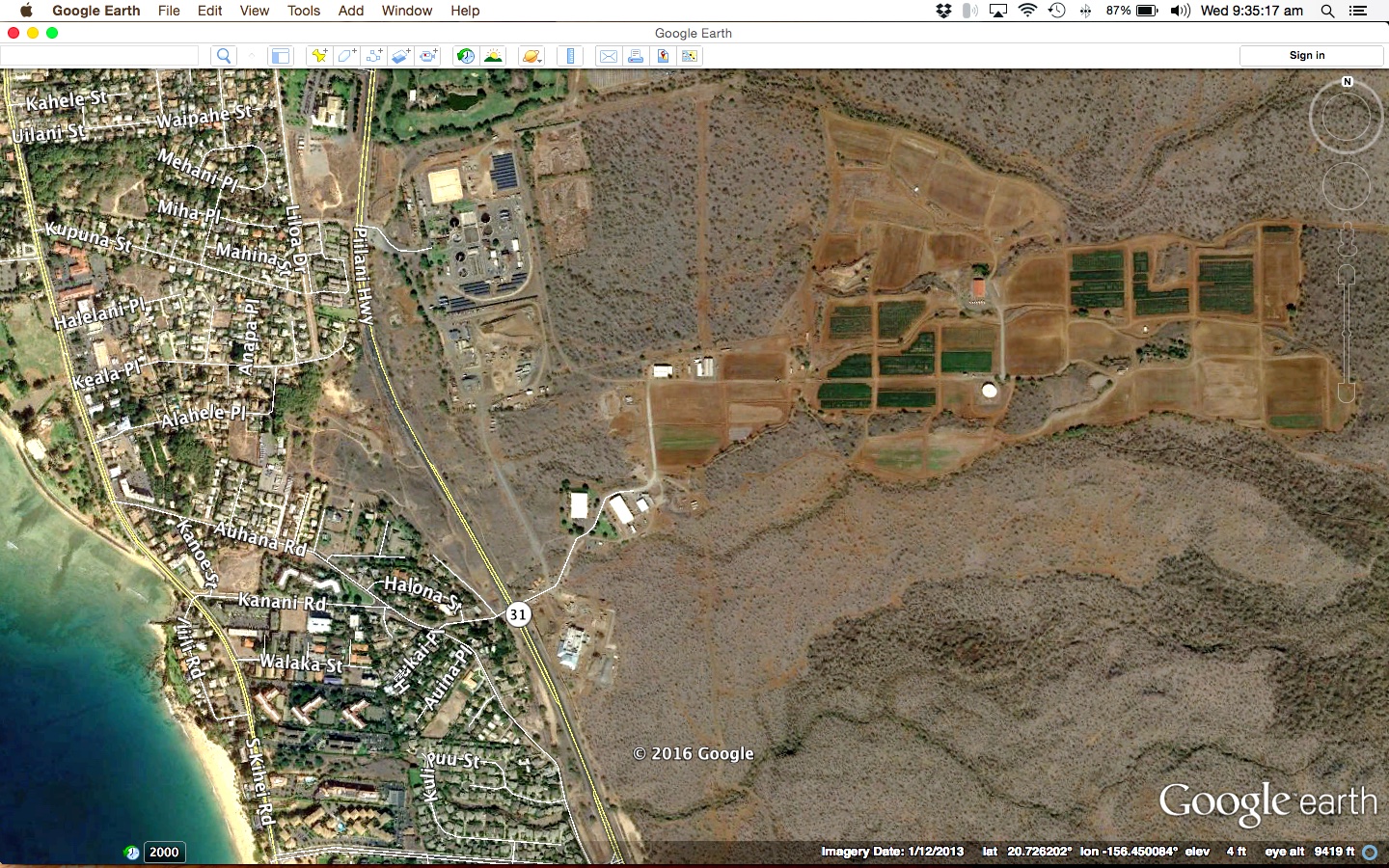
Under Vilsack, the USDA financed the massive new police headquarters on Maui in 2012, located at the front driveway of the 300 acre Monsanto Seed Farm in South Kihei at Piʻilani Promenade.

http://www.islandbreath.org/2016Year/07/160720googleearthbig.jpg
Image above: Overview of Kihei Police Station and Monsanto Headquarters. Click to see larger overview. From GoogleEarth.

Since when does the USDA finance the construction of Police Stations? See (USDA $17 million loan  to Maui County for Kihei  Police Station). Obviously, Monsanto wanted to have a fortress with armed guards protecting its offices and crop fields paid for by the public. Moreover,they wanted their site close to housing, shopping, schools and the best beaches on Maui.

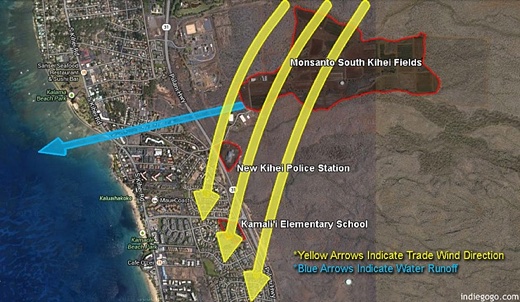
Only trouble is the trade winds blow the dust of the dry uplands down into a densely populated area of Kihei and the runoff from the fields goes into the ocean at the nearby beaches.


Image above: Map of Monsanto area in Kihei, Maui. Red - Monsanto GMO fields, Police Station and Elementary School; Yellow - tradewind dust; Blue - GMO field runoff. From (http://www.mauigoodness.com/2014/10/20/hawaii-fight-gmos/).

Paired with Clinton (whose former law firm represents Monsanto),  Monsanto and friends would have the White House locked snugly in their pocket.
I continue to pray that somehow Bernie Sanders ends up our next President. Please join me in that prayer - Micahel Shooltz

I don't think there is any chance for Bernie, but Jill Stein in on the ballot in Hawaii for the Green Party - Juan Wilson
See also:
Ea O Ka Aina: Clinton's banking buddy Kaine 7/21/16
 .

USDA clears way for GE mushrooms

SUBHEAD: A new CRISPR gene-editing technology doesn't seem to bother our federal food regulator.

By Steve Hoffman on 10 May 2016 for Alternet -
(http://www.alternet.org/food/gmo-mushroom-waved-through-usda-potentially-opening-floodgates-wave-frankenfoods)


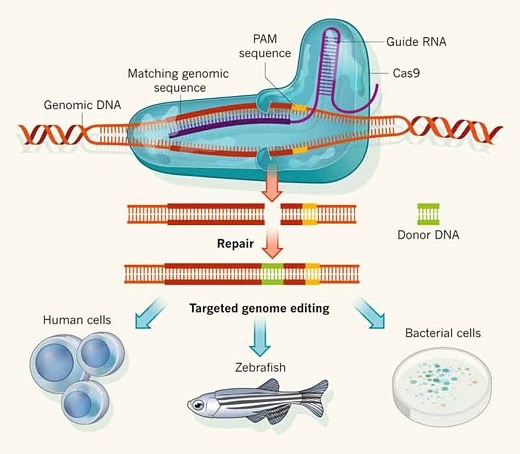
Image above: Diagram of Cas9 and CRISPR gene sequencing technology. From (http://mvresnovae.com/science/witnessing-gene-cutting-in-action/).

Repeat after me: Clustered Regularly Interspaced Short Palindromic Repeats.

That’s CRISPR, a new GE technology that uses an enzyme, Cas9, to cut, edit or remove genes from targeted region of a plant’s DNA. Because it doesn’t involve transgenics, i.e. inserting genes from foreign species into an animal or plant, foods produced in this manner just received a free pass from the U.S. Department of Agriculture to be sold into the marketplace.

In an April 2016 letter to Penn State researcher Yinong Yang, USDA informed the associate professor of plant pathology that his new patent-pending, non-browning mushroom, created via CRISPR technology, would not require USDA approval.

“The notification apparently clears the way for the potential commercial development of the mushroom, which is the first CRISPR-Cas9 gene-edited crop deemed to require no regulatory review by USDA,” reported Chuck Gill in Penn State News.

Why does this anti-browning mushroom not require USDA regulation? ”Our genome-edited mushroom has small deletions in a specific gene but contains no foreign DNA integration in its genome," said Yang. "Therefore, we believed that there was no scientifically valid basis to conclude that the CRISPR-edited mushroom is a regulated article based on the definition described in the regulations."

The USDA ruling could open the door for many genetically engineered crops developed using CRISPR-Cas9 technology, said Penn State. In fact, just days after USDA's notification regarding Yang's anti-browning mushroom, the agency announced that a CRISPR-Cas9-edited corn variety developed by DuPont Pioneer also will not be subject to the same USDA regulations as traditional GMOs.

In response to Pioneer's "Regulated Article Letter of Inquiry," about the new GE corn product, the USDA said it does not consider the CRISPR corn "as regulated by USDA Biotechnology Regulatory Services," reported Business Insider.

Not so fast, cautions Michael Hansen, senior scientist for Consumers Union. Just because USDA says CRISPR needs no regulation, the U.S. Food and Drug Administration, which uses the international CODEX definition of “modern biotechnology,” would “clearly include” the new Penn State CRISPR mushroom, says Hansen.

“The biotechnology industry will be trying to argue to USDA that these newer techniques are more "precise and accurate" than older GE techniques and should require even less, or no scrutiny,” he says. “Thus, the issue of what definition to use for GE is a crucial one,” Hansen points out.

“The government does realize that there is a disconnect between USDA and EPA and FDA about what the definition of genetic engineering is, and that is part of the reason why it is in the process of reviewing the Coordinated Framework for the Regulation of Biotechnology,” Hansen says. “Thus, the last sentence in USDA’s letter to Dr. Yang at Penn State would say, ‘Please be advised that your white button mushroom variety described in your letter may still be subject to other regulatory authorities such as FDA or EPA.’”

Yang does plan to submit data about the CRISPR mushroom to the FDA as a precaution before introducing the crop to the market, he says. While FDA clearance is not technically required, Yang told Science News, “We’re not just going to start marketing these mushrooms without FDA approval.”

Gary Ruskin, co-director of the advocacy group U.S. Right to Know, told Fusion on April 25 that the organization’s concerns about genetically engineered food crops extend to Penn State’s new CRISPR mushroom.

“What are the unknowns about CRISPR generally, and in particular, in its application in this mushroom?” he asked. “Regulators should determine whether there are off-target effects. Consumers have the right to know what’s in our food.”

In Europe, however, where anti-GMO advocates have strongly opposed CRISPR, Urs Niggli, director of the Swiss Research Institute of Organic Agriculture (FiBL) was recently quoted in the German newspaper Taz that CRISPR may be different from traditional GMO technologies and could alleviate some concerns groups like FiBL have with older gene-editing techniques.

His comments have since been subject to much interpretation and criticism among both pro- and anti-GMO circles.

While biotech proponents claim that CRISPR has much to offer, Nature reported in June 2015 that scientists are worried that the field's fast pace leaves little time for addressing ethical and safety concerns. The issue was thrust into the spotlight in April 2015, when news media reported that scientists had used CRISPR technology to engineer human embryos.

 The embryos they used were unable to result in a live birth. Nature reported that the news generated heated debate over whether and how CRISPR should be used to make heritable changes to the human genome.

Some scientists want to see more studies that probe whether the technique generates stray and potentially risky genome edits; others worry that edited organisms could disrupt entire ecosystems, Nature reported.

.

Cuba’s agriculture at risk

SUBHEAD: Cuba's low energy, sustainable agriculture practice is at risk with thawing of relations with US (Monsanto, DowDupont, etc.)

By Miguel Altieri on 25 March 2016 for The Conversation-
(https://theconversation.com/cubas-sustainable-agriculture-at-risk-in-u-s-thaw-56773)


Image above: Organic farm in Alamar, Cuba. Photo by Melanie Lukesh Reed. From original article.

President Obama’s trip to Cuba this week accelerated the warming of U.S.-Cuban relations. Many people in both countries believe that normalizing relations will spur investment that can help Cuba develop its economy and improve life for its citizens.

But in agriculture, U.S. investment could cause harm instead.

For the past 35 years I have studied agroecology in most countries in Central and South America.

Agroecology is an approach to farming that developed in the late 1970s in Latin America as a reaction against the top-down, technology-intensive and environmentally destructive strategy that characterizes modern industrial agriculture. It encourages local production by small-scale farmers, using sustainable strategies and combining Western knowledge with traditional expertise.

Cuba took this approach out of necessity when its economic partner, the Soviet bloc, dissolved in the early 1990s. As a result, Cuban farming has become a leading example of ecological agriculture.

But if relations with U.S. agribusiness companies are not managed carefully, Cuba could revert to an industrial approach that relies on mechanization, transgenic crops and agrochemicals, rolling back the revolutionary gains that its campesinos have achieved.

The shift to peasant agroecology

For several decades after Cuba’s 1959 revolution, socialist bloc countries accounted for nearly all of its foreign trade.

The government devoted 30 percent of agricultural land to sugarcane for export, while importing 57 percent of Cuba’s food supply. Farmers relied on tractors, massive amounts of pesticide and fertilizer inputs, all supplied by Soviet bloc countries. By the 1980s agricultural pests were increasing, soil quality was degrading and yields of some key crops like rice had begun to decline.

When Cuban trade with the Soviet bloc ended in the early 1990s, food production collapsed due to the loss of imported fertilizers, pesticides, tractors and petroleum. The situation was so bad that Cuba posted the worst growth in per capita food production in all of Latin America and the Caribbean.
But then farmers started adopting agroecological techniques, with support from Cuban scientists.

Thousands of oxen replaced tractors that could not function due to lack of petroleum and spare parts. Farmers substituted green manures for chemical fertilizers and artisanally produced biopesticides for insecticides. At the same time, Cuban policymakers adopted a range of agrarian reform and decentralization policies that encouraged forms of production where groups of farmers grow and market their produce collectively.


Image above: Havana vegetable market. Photo by Julia Dorofeeva. From original article.

As Cuba reoriented its agriculture to depend less on imported chemical inputs and imported equipment, food production rebounded. From 1996 though 2005, per capita food production in Cuba increased by 4.2 percent yearly during a period when production was stagnant across Latin America and the Caribbean.

In the mid-2000s, the Ministry of Agriculture dismantled all “inefficient state companies” and government-owned farms, endorsed the creation of 2,600 new small urban and suburban farms, and allowed farming on some three million hectares of unused state lands.
Urban gardens, which first sprang up during the economic crisis of the early 1990s, have developed into an important food source.

Today Cuba has 383,000 urban farms, covering 50,000 hectares of otherwise unused land and producing more than 1.5 million tons of vegetables. The most productive urban farms yield up to 20 kg of food per square meter, the highest rate in the world, using no synthetic chemicals. Urban farms supply 50 to 70 percent or more of all the fresh vegetables consumed in cities such as Havana and Villa Clara.

The risks of opening up

Now Cuba’s agriculture system is under increasing pressure to deliver harvests for export and for Cuba’s burgeoning tourist markets. Part of the production is shifting away from feeding local and regional markets, and increasingly focusing on feeding tourists and producing organic tropical products for export.

President Obama hopes to open the door for U.S. businesses to sell goods to Cuba. In Havana last Monday during Obama’s visit, U.S. Agriculture Secretary Tom Vilsack signed an agreement with his Cuban counterpart, Agriculture Minister Gustavo Rodriguez Rollero, to promote sharing of ideas and research.

“U.S. producers are eager to help meet Cuba’s need for healthy, safe, nutritious food,” Vilsack said. The U.S. Agriculture Coalition for Cuba, which was launched in 2014 to lobby for an end to the U.S.-Cuba trade embargo, includes more than 100 agricultural companies and trade groups. Analysts estimate that U.S. agricultural exports to Cuba could reach US$1.2 billion if remaining regulations are relaxed and trade barriers are lifted, a market that U.S. agribusiness wants to capture.


Image above: Agriculture Secretary Tom Vilsack and Alabama Congresswoman Terri Sewell tour a Havana farmers' market, November 2015. Photo by USDA. From original article.

[IB Publisher's note: "As Iowa Governor, Tom Vilsack ()above) was a leading advocate for Monsanto, genetic engineering, and factory farming. President Obama proudly lauded his new Agriculture Secretary for "promoting biotech. Vilsack has, in fact, promoted the most controversial and dangerous forms of agricultural biotechnology, including pharma crops, plants genetically engineered to produce pharmaceuticals. When grown outdoors on farmland, where most pharma crop trials have occurred, pharma crops can easily contaminate conventional and organic varieties." From (https://www.organicconsumers.org/old_articles/usda_watch.php)]


When agribusinesses invest in developing countries, they seek economies of scale. This encourages concentration of land in the hands of a few corporations and standardization of small-scale production systems. In turn, these changes force small farmers off of their lands and lead to the abandonment of local crops and traditional farming ways. The expansion of transgenic crops and agrofuels in Brazil, Paraguay and Bolivia since the 1990s are examples of this process.

If U.S. industrial agriculture expands into Cuba, there is a risk that it could destroy the complex social network of agroecological small farms that more than 300,000 campesinos have built up over the past several decades through farmer-to-farmer horizontal exchanges of knowledge.

This would reduce the diversity of crops that Cuba produces and harm local economies and food security. If large businesses displace small-scale farmers, agriculture will move toward export crops, increasing the ranks of unemployed. There is nothing wrong with small farmers capturing a share of export markets, as long as it does not mean neglecting their roles as local food producers. The Cuban government thus will have to protect campesinos by not importing food products that peasants produce.

Cuba still imports some of its food, including U.S. products such as poultry and soybean meal. Since agricultural sales to Cuba were legalized in 2000, U.S. agricultural exports have totaled about $5 billion. However, yearly sales have fallen from a high of $658 million in 2008 to $300 million in 2014.

U.S. companies would like to regain some of the market share that they have lost to the European Union and Brazil.

There is broad debate over how heavily Cuba relies on imports to feed its population: the U.S. Department of Agriculture estimates that imports make up 60 to 80 percent of Cubans' caloric intake, but other assessments are much lower.

In fact, Cuba has the potential to produce enough food with agroecological methods to feed its 11 million inhabitants. Cuba has about six million hectares of fairly level land and another million gently sloping hectares that can be used for cropping. More than half of this land remains uncultivated, and the productivity of both land and labor, as well as the efficiency of resource use, in the rest of this farm area are still low.

We have calculated that if all peasant farms and cooperatives adopted diversified agroecological designs, Cuba would be able to produce enough to feed its population, supply food to the tourist industry and even export some food to help generate foreign currency.

President Raul Castro has stated that while opening relations with the U.S. has some benefits:
"We will not renounce our ideals of independence and social justice, or surrender even a single one of our principles, or concede a millimeter in the defense of our national sovereignty. We have won this sovereign right with great sacrifices and at the cost of great risks."
Cuba’s small farmers control only 25 percent of the nation’s agricultural land but produce over 65 percent of the country’s food, contributing significantly to the island’s sovereignity. Their agroecological achievements represent a true legacy of Cuba’s revolution.

See also:
Island Breath: How Cuba survived Peak Oil 2/25/06
.

Between pesticides and bee deaths

SUBHEAD: Federal scientists have reported harassment when their work conflicts with agribusiness interests.
 
By Raynard Loki on 5 May 2015 for Alternet -
(http://www.alternet.org/environment/usda-silencing-its-own-scientists-bee-killing-pesticide-research)


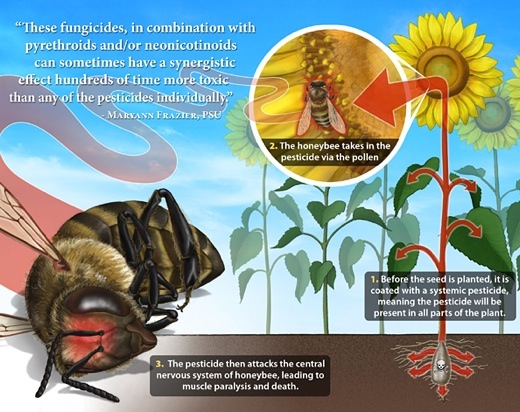
Image above: Illustration by Tony Links of neonicotinoid poisoning of bee. From (http://www.tonylinka.com/scientific/neonicotinoids.html).

Following reports that scientists at the United States Department of Agriculture are being harrassed and their research on bee-killing pesticides is being censored or suppressed, a broad coalition of farmers, environmentalists, fisheries and food-safety organizations urged an investigation in a May 5 letter sent to Phyllis K. Fong, USDA Inspector General.

"The possibility that the USDA is prioritizing the interests of the chemical industry over those of the American public is unacceptable," states the letter, which was signed by more than 25 citizens' groups concerned that a forthcoming report by the White House Task Force on Pollinator Health, which is co-chaired by the USDA, will be compromised.

The signatories include the American Bird Conservancy, Avaaz, Center for Biological Diversity, Center for Food Safety, Farmworkers Association of Florida, Food and Water Watch, Friends of the Earth, Green America, Organic Consumers Association and Sierra Club.

"It is imperative that the American people can trust that their government and its employees are serving their constituents and not the profits of private companies," they wrote. "All of the research that the USDA conducts must maintain scientific integrity and transparency to ensure it is guiding sound policy decisions."

The research in question centers on neonicotinoids, a nicotine-like class of insecticides that impair the neurological systems of insects and which studies have linked to die-offs of bees and monarch butterflies—two key pollinators—as well as birds.

Neonicotinoids have been strongly linked to honey-bee colony collapse disorder (CCD), a syndrome first observed in Germany that has been blamed for massive bee population declines across the globe. In 2013, certain neonicotinoids were banned by the European Union and a few non-EU nations.

The global food system relies on bees to pollinate at least 30 percent of the world's crops. Bees are responsible for pollinating a host of American crops, from apples and almonds to cantaloupes and cucumbers, impacting $15 billion a year in U.S. crops.

In March, Public Employees for Environmental Responsibility (PEER), an environmental activist group supporting local, state and federal researchers, filed a legal petition with the USDA seeking new rules meant to increase the job protection for government scientists and citing censorship and harassment. At least 10 USDA scientists have come under fire for research into farm chemical safety that conflicts with the interests of the agribusiness sector, according to PEER executive director Jeff Ruch.

"They have very little in the way of legal rights and have career paths that are extremely vulnerable," he said. He said the scientific work under scrutiny is the research into the effects of neonicotinoids and glyphosate, the key ingredient in Monsanto's popular Roundup herbicide, which the World Health Organization recently concluded likely causes cancer.

"Your words are changed, your papers are censored or edited or you are not allowed to submit them at all," a senior scientist at the USDA's Agricultural Research Service told Reuters.

“Censorship and harassment poison good science and good policy,” said Lori Ann Burd, environmental health director at the Center for Biological Diversity. "There’s no question that neonicotinoids are killing bees, and it’s long past time for our government to take action.

The European Union has already banned neonicotinoids. The reports that USDA is harassing and suppressing its scientists for doing their jobs instead of using their findings to protect our pollinators are extremely disturbing."

“How can the American public expect USDA to develop a federal strategy that will protect bees instead of pesticide industry profits if it is harassing and suppressing its own scientists for conducting research that runs counter to industry claims?" said Tiffany Finck-Haynes, food futures campaigner with Friends of the Earth.

In April 2014, the group released “Follow the Honey: 7 ways pesticide companies are spinning the bee crisis to protect profits,” a report documenting the deceptive tactics used by agrochemical companies to deflect blame from their chemicals to pollinator declines and stall governmental regulation on neonicotinoids.

The companies named in the report include U.S.-based Monsanto, Switzerland-based Syngenta and Germany-based Bayer, which patented the first commercial neonicotinoid, Imidacloprid, the world's most widely used insecticide.

"If USDA wants to employ a kill-the-messenger approach," said Finck-Haynes, "it will only delay critical action to address the bee crisis that threatens our nation’s food supply."

"It is imperative that the American people can trust that their government and its employees are serving their constituents and not the profits of private companies," they wrote. "All of the research that the USDA conducts must maintain scientific integrity and transparency to ensure it is guiding sound policy decisions."

The research in question centers on neonicotinoids, a nicotine-like class of insecticides that impair the neurological systems of insects and which studies have linked to die-offs of bees and monarch butterflies—two key pollinators—as well as birds. Neonicotinoids have been strongly linked to honey-bee colony collapse disorder (CCD), a syndrome first observed in Germany that has been blamed for massive bee population declines across the globe. In 2013, certain neonicotinoids were banned by the European Union and a few non-EU nations.

The global food system relies on bees to pollinate at least 30 percent of the world's crops. Bees are responsible for pollinating a host of American crops, from apples and almonds to cantaloupes and cucumbers, impacting $15 billion a year in U.S. crops.

In March, Public Employees for Environmental Responsibility (PEER), an environmental activist group supporting local, state and federal researchers, filed a legal petition with the USDA seeking new rules meant to increase the job protection for government scientists and citing censorship and harassment. At least 10 USDA scientists have come under fire for research into farm chemical safety that conflicts with the interests of the agribusiness sector, according to PEER executive director Jeff Ruch.

"They have very little in the way of legal rights and have career paths that are extremely vulnerable," he said. He said the scientific work under scrutiny is the research into the effects of neonicotinoids and glyphosate, the key ingredient in Monsanto's popular Roundup herbicide, which the World Health Organization recently concluded likely causes cancer.

"Your words are changed, your papers are censored or edited or you are not allowed to submit them at all," a senior scientist at the USDA's Agricultural Research Service told Reuters.

“Censorship and harassment poison good science and good policy,” said Lori Ann Burd, environmental health director at the Center for Biological Diversity. "There’s no question that neonicotinoids are killing bees, and it’s long past time for our government to take action. T

he European Union has already banned neonicotinoids. The reports that USDA is harassing and suppressing its scientists for doing their jobs instead of using their findings to protect our pollinators are extremely disturbing."

“How can the American public expect USDA to develop a federal strategy that will protect bees instead of pesticide industry profits if it is harassing and suppressing its own scientists for conducting research that runs counter to industry claims?" said Tiffany Finck-Haynes, food futures campaigner with Friends of the Earth.

In April 2014, the group released “Follow the Honey: 7 ways pesticide companies are spinning the bee crisis to protect profits,” a report documenting the deceptive tactics used by agrochemical companies to deflect blame from their chemicals to pollinator declines and stall governmental regulation on neonicotinoids.

The companies named in the report include U.S.-based Monsanto, Switzerland-based Syngenta and Germany-based Bayer, which patented the first commercial neonicotinoid, Imidacloprid, the world's most widely used insecticide.

"If USDA wants to employ a kill-the-messenger approach," said Finck-Haynes, "it will only delay critical action to address the bee crisis that threatens our nation’s food supply."

"It is imperative that the American people can trust that their government and its employees are serving their constituents and not the profits of private companies," they wrote. "All of the research that the USDA conducts must maintain scientific integrity and transparency to ensure it is guiding sound policy decisions."

The research in question centers on neonicotinoids, a nicotine-like class of insecticides that impair the neurological systems of insects and which studies have linked to die-offs of bees and monarch butterflies—two key pollinators—as well as birds.

Neonicotinoids have been strongly linked to honey-bee colony collapse disorder (CCD), a syndrome first observed in Germany that has been blamed for massive bee population declines across the globe. In 2013, certain neonicotinoids were banned by the European Union and a few non-EU nations.

The global food system relies on bees to pollinate at least 30 percent of the world's crops. Bees are responsible for pollinating a host of American crops, from apples and almonds to cantaloupes and cucumbers, impacting $15 billion a year in U.S. crops.

In March, Public Employees for Environmental Responsibility (PEER), an environmental activist group supporting local, state and federal researchers, filed a legal petition with the USDA seeking new rules meant to increase the job protection for government scientists and citing censorship and harassment.

At least 10 USDA scientists have come under fire for research into farm chemical safety that conflicts with the interests of the agribusiness sector, according to PEER executive director Jeff Ruch.

"They have very little in the way of legal rights and have career paths that are extremely vulnerable," he said. He said the scientific work under scrutiny is the research into the effects of neonicotinoids and glyphosate, the key ingredient in Monsanto's popular Roundup herbicide, which the World Health Organization recently concluded likely causes cancer.

"Your words are changed, your papers are censored or edited or you are not allowed to submit them at all," a senior scientist at the USDA's Agricultural Research Service told Reuters.

“Censorship and harassment poison good science and good policy,” said Lori Ann Burd, environmental health director at the Center for Biological Diversity. "There’s no question that neonicotinoids are killing bees, and it’s long past time for our government to take action. The European Union has already banned neonicotinoids.

The reports that USDA is harassing and suppressing its scientists for doing their jobs instead of using their findings to protect our pollinators are extremely disturbing."

“How can the American public expect USDA to develop a federal strategy that will protect bees instead of pesticide industry profits if it is harassing and suppressing its own scientists for conducting research that runs counter to industry claims?" said Tiffany Finck-Haynes, food futures campaigner with Friends of the Earth.

In April 2014, the group released “Follow the Honey: 7 ways pesticide companies are spinning the bee crisis to protect profits,” a report documenting the deceptive tactics used by agrochemical companies to deflect blame from their chemicals to pollinator declines and stall governmental regulation on neonicotinoids.

 The companies named in the report include U.S.-based Monsanto, Switzerland-based Syngenta and Germany-based Bayer, which patented the first commercial neonicotinoid, Imidacloprid, the world's most widely used insecticide.

"If USDA wants to employ a kill-the-messenger approach," said Finck-Haynes, "it will only delay critical action to address the bee crisis that threatens our nation’s food supply."

.

USDA prepares for H7N9 Bird Flue

SOURCE: Parsons Brad (mauibrad@hotmail.com)
SUBHEAD: Kiss your freerange poultry goodbye! USDA ordering 12 Mobile Modified Atmosphere Killing Trailers.

By Ms X on 13 August 2013 for Pissin' on the Roses -
(http://pissinontheroses.blogspot.com/2013/08/kiss-your-free-range-poultry-goodbye.html)


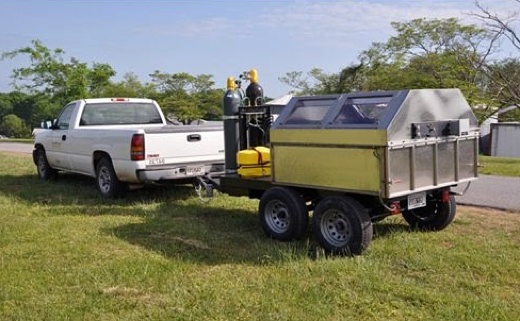
Image above: Portable gas chambers in the form of Mobile Modified Atmosphere Killing (MAK) Trailers that have been specified by the USDA. From original article.

Because of the expected H7N9 Bird Flu pandemic, the USDA is ordering twelve trucks designed to kill small farm poultry; especially those small farms flocks located near large commercial turkey and chicken farms. See (Solicitation Number: AG-6395-S-13-0131)

According to the information provided with the solicitation for these 12 mobile poultry killing trailers:
"The most critical small flocks to depopulate in an outbreak of virulent, potentially zoonotic poultry disease would be those located near large commercial poultry facilities."

"There is need to have on hand the means to depopulate small flocks of poultry in the event of an outbreak of highly pathogenic, possibly zoonotic avian disease. 
These flocks might range from a few birds owned by private individuals for recreational reasons to a few hundred birds kept as a small commercial venture. In many cases, the owner will have an emotional attachment to the birds that goes beyond economic considerations.

The birds may run loose or be confined in pens or cages. In some areas, these flocks may be fairly numerous. They are scattered geographically"


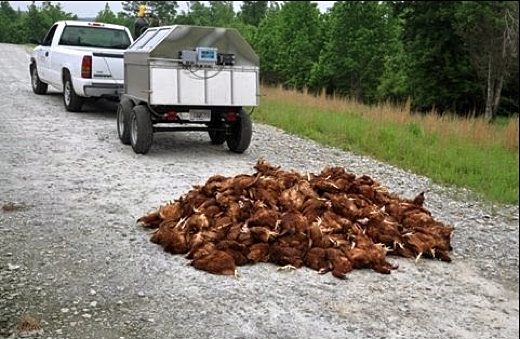
Image above: Flock of chickens executed by MAK and then dumped in road. From original article.

Of course when the government goes in and tries to take over an industry by engaging in wholesale small farm poultry slaughter they have to provide some sort of payout to the farmers.

In that regard, the USDA's Centers for Epidemiology and Animal Health (CEAH) has released a procurement to seek "specific production and financial parameters associated with commercial poultry production: broilers, turkeys, table egg layers, broiler breeders, and turkey breeders."

It appears as if they are trying to understand the entire industry and supply chain, almost as-if they were going to try and nationalize it in response to a H7N9 Bird Flu Pandemic. See (Solicitation Number: AG-6395-S-13-0099).


Video above: From (http://youtu.be/K2z0XcCCElo)
.

Frankenfish Green Light

SUBHEAD:  Bad procedure for the regulation of genetically engineered food animals is being set by GE Salmon.

By Jill Richardson on 19 March 2013 for PR Watch -
(http://www.prwatch.org/news/2013/03/12027/fda-ready-approve-frankenfish-despite-fishy-science)


Image above: Vendor Taho Kakutania playfully encourages tourist Anne Moral to kiss a coho salmon at the Pike Place Fish Market Monday, Sept. 20, 2010, in Seattle. From (http://www.csmonitor.com/USA/Latest-News-Wires/2010/0920/Frankenfish-modified-salmon-considered-for-approval-in-US).

Some day soon, you might dig into a plate of salmon without knowing that the fish you are eating was genetically engineered. The so-called AquAdvantage salmon, a salmon genetically engineered to grow faster than normal salmon, just moved one step closer to legalization. If so, it will be the first genetically engineered (GE) animal allowed for consumption in the United States.

Thus, every part of the regulatory process related to the GE salmon sets a precedent for all future GE animals in the United States -- and so far, according to experts, that precedent is a sloppy, inadequate one.

What Is AquAdvantage Salmon?

To create the GE salmon, the Boston-based public company AquaBounty Technologies inserted DNA from another salmon species and an eel-like fish into the genome of an Atlantic salmon. The new genes make the GE salmon produce growth hormone all year round instead of just for three months a year as they normally would. This helps them grow to market size in 16 to 18 months instead of the usual 30 months required for an Atlantic salmon.

To prevent any GE salmon from escaping into the wild, surviving, and reproducing there, AquaBounty will only produce female GE salmon, each with three sets of DNA instead of the normal two. Triploids, as organisms with three sets of DNA are called, are infertile.

Therefore, producing only female, triploid GE fish should provide two mechanisms of preventing reproduction should any fish escape into the wild. (Obviously, it takes a bit of scientific tinkering to create an all-female triploid fish population and the process used to do this might make your stomach turn.)

AquaBounty will produce salmon eggs in Prince Edward Island, Canada. Then it will transport them to an inland facility in Panama, where it will grow the fish, harvest, and process them. The firm claims no live fish will ever enter the United States.

How Are GE Animals Regulated?

The next question one might ask is how the federal government goes about deciding whether or not a GE animal should be allowed in our food supply. Under a 1980s decision, written by anti-regulation ideologues in the Reagan and Bush I era before any GE foods -- plants or animals -- were ready for commercialization, the government decided that no new laws were needed to regulate GE plants or animals. This decision is called "the Coordinated Framework for the Regulation of Biotechnology," or the Coordinated Framework for short.

Whereas the European Union debated the regulation of GE foods and drafted new laws to address issues such as safety, traceability, allergenicity and environmental impacts, the U.S. never passed any new laws specific to GE animals or had the kind of public debate passing a new law would require.

Instead, they decided to regulate GE animals as "animal drugs," using laws that are not well-suited to the unique, complex issues posed by GE animals. Specifically, the government considers the extra DNA added to the GE animals as the "animal drug."

New Animal Drugs are regulated by the Food and Drug Administration, and they receive input from the Veterinary Medicine Advisory Committee (VMAC) -- a committee mostly made up of veterinarians, not genetic engineering experts.

When a new animal drug is approved, it is only approved for production in a specific facility. Therefore, if you invent a new pill for cats, you submit data on its production in a specific facility, and you receive approval to produce it only in that facility. If you decide to build eight more factories because your drug is so popular, you must go back to the FDA to receive approval for the eight new facilities.

2010: Sloppy Science on Trial

Back in 2010, the FDA took the first steps to approve AquaBounty's application to produce the GE salmon. It released a draft Environmental Assessment (EA) and several hundred pages of safety testing data from experiments performed by AquaBounty on the GE salmon. Then it gave the public a mere two weeks to comment on the data, and it convened VMAC to advise it on the GE salmon.

For watchdog groups, this was the first signal that something was, well, fishy. Consumers Union senior scientist Michael Hansen excoriated the safety data as "sloppy," "misleading," and "woefully inadequate."

In addition to using small sample sizes and culling deformed fish and thus skewing the data, AquaBounty only provided data gathered in its Prince Edward Island facility, where it will produce GE salmon eggs. But, by law, it must also provide data from its Panama facility, where it will grow the salmon to full size.

The VMAC committee didn't give a resounding approval either. The New York Times summarized their findings, saying, "While a genetically engineered salmon is almost certainly safe to eat, the government should pursue a more rigorous analysis of the fish's possible health effects and environmental impact." However, the committee only advises the FDA, and its decisions are not binding.

2012: FDA Readies Its Rubber Stamp

Following the VMAC meeting and a second, public meeting on labeling issues surrounding the GE salmon, the FDA went silent. Over the next two years, it quietly examined the public comments and the input from the VMAC committee. But despite VMAC's suggestion for a more rigorous analysis, the FDA moved the application one step closer to approval without really addressing the gaping holes in the AquaBounty's science.

In May of 2012, it produced an ever-so-slightly improved Environmental Assessment (EA) compared to the original draft it made public in 2010, and a preliminary "Finding of No Significant Impact" (FONSI).

The preliminary FONSI and draft EA were not made public until they were published in the Federal Register on December 26, 2012. At that point, the FDA began a 60-day period in which the public could review its findings and submit comments.

What happened between 2010 and 2012 to improve our confidence that the GE salmon is safe for human consumption and for the environment? Nothing. There's no new data whatsoever. The only changes are a few minor additions to the EA -- certainly not enough to inspire confidence that the government heard the critiques made in 2010 and addressed them.

After a group of Senators led by Mark Begich (D-AK) sent the FDA a letter asking for a 60-day extension to the comment period, the FDA agreed to take comments until April 26, 2013.

What's Fishy About the GE Salmon?

"There are still unanswered safety and nutritional questions and the quality of the data that was submitted to the FDA was the worst stuff I've ever seen submitted for a GMO. There's stuff there that couldn't make it through a high school science class," reflected Hansen in early 2013, after reviewing the newly released documents.

Almost laughing, Hansen remarks on the obvious flaws in AquaBounty's scientific justification of the fish's safety, saying, "That's not science, that's a joke!" Becoming more serious, he adds, "There's allergenicity questions and other health questions. It shouldn't be approved. They don't have any data to show that it's safe."

"There are environmental issues as well," Hansen continues. "Not so much in Panama, but on Prince Edward Island. That's where they're going to producing eggs. Guess what, to produce eggs, you've gotta have fertile adults." Before the wild Atlantic salmon population was decimated, the waters around Prince Edward Island was salmon habitat. An escaped GE fish could easily thrive there. "Yet," adds Hansen, "they conclude that even if they get out the water's too cold!"

In an interview with Flash in the Pan, environmental risk scientist Anne Kapuscinski also criticized the FDA's process. Back in the 1990s, she authored the reports on how to perform environmental risk assessment. But, by 2007, her 1990s publications were so out of date that she led a team of scientists to write an updated book on the subject. Despite the updated scientific methods, the FDA opted to use the old, outdated methods from the 1990s to conduct its environmental risk assessment on the GE salmon.

The 2007 publication was rigorously peer reviewed by reviewers from around the world. Yet, the FDA ignored it. Kapuscinski calls their methods unscientific, adding that if the FDA were a student who submitted this report for a grade, it would fail. "Students would get into serious trouble if they were citing really old methods, and there had been huge advances in the methods since then and they ignored that. That would be a reason to fail them."

She submitted comments back in 2010, but says, "it looks like either they didn't read our comments or they just decided to ignore them." She points out that the Panama facility that AquaBounty will use to grow the fish out of is not large enough for a commercial venture. "It's at a scale to show proof of concept of the commercial viability of this," she said. "Once the company scales up to selling millions and millions of eggs, the fish will be farmed by producers with all kinds of facilities."

Those facilities might not be as well protected as the one in Panama. Unless the FDA brings its risk assessment methods up to date, we have no adequate, scientific assurance that GE salmon won't escape into the wild.

Next Steps

Despite the scientific questions, there's no sign that the FDA will overturn its preliminary decision to allow commercialization of the GE salmon. The best Michael Hansen is hoping for at this point is a requirement that the GE salmon -- one legalized -- will be labeled as genetically engineered. He calls this "an outside chance."

Unfortunately, as Hansen notes, "This is to set a precedent. If they let the GE salmon go through, why would any other company that wants to get a genetically engineered animal through bother" producing rigorous, scientifically valid data to prove its product's safety?

If you don't want to see GE salmon in your local supermarket in as little as a few years, you can take action. The FDA is accepting public comments until April 26, 2013. You can write your own message and submit it at Regulations.gov or you can join Food and Water Watch's campaign against the GE salmon here. You can also write your representatives to let them know your point of view.

See also:
Ea O Ka Aina: USDA funds GM Salmon 11/12/11

.