Showing posts with label Lobbyists. Show all posts

Obama's final TPP push

SUBHEAD: As public resistance mounts, the TPP is becoming the 2016 election's "third rail".

By Deirdre Fulton on 20 August 2016 for Common Dreams -
(http://www.commondreams.org/news/2016/08/20/resistance-mounts-tpp-becoming-2016-elections-third-rail)
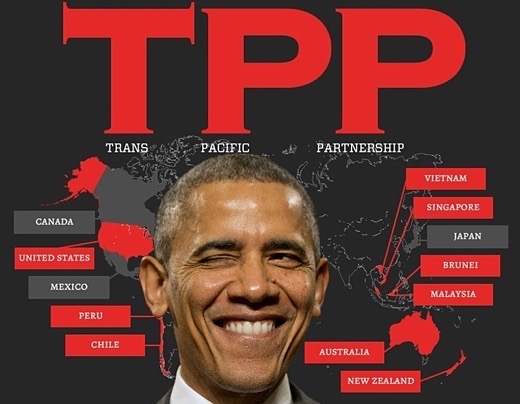

Image above: Illustration mashup of Obama and chart of TPP participants. From (http://beforeitsnews.com/opinion-conservative/2016/02/obama-signs-trans-pacific-partnership-3100956.html).

As the White House prepares for its final "all-out push" to pass the Trans Pacific Partnership (TPP) during the upcoming lame-duck session of Congress, lawmakers on both sides of the political aisle are being made vulnerable due to growing opposition to the controversial, corporate-friendly trade deal.

"[I]n 2016," the Guardian reported on Saturday, "America's faltering faith in free trade has become the most sensitive controversy in D.C."

Yet President Barack Obama "has refused to give up," wrote Guardian journalists Dan Roberts and Ryan Felton, despite the fact that the 12-nation TPP "suddenly faces a wall of political opposition among lawmakers who had, not long ago, nearly set the giant deal in stone."
The Huffington Post reported Thursday:
In the past month alone, 12 Republican House members who voted to approve fast-track authority for trade agreements have announced their opposition to the TPP, including Rep. Charles Boustany (R-La.), a Senate candidate in Louisiana and the chairman of the Friends of the TPP congressional caucus. In the Senate, Rob Portman (R-Ohio) and Pat Toomey (R-Pa.), ardent free-traders facing tough reelection battles, have announced their opposition to the deal.
Not only are "[v]ulnerable Senate Republicans are starting to side with Donald Trump (and Democrats) by opposing President Obama's signature trade deal," as the Washington Post reported Thursday, but once-supportive Dems are also poised to jump ship.

To that end, in a column this week, Campaign for America's Future blogger Dave Johnson listed for readers "28 House Democrat targets...who—in spite of opposition from most Democrats and hundreds of labor, consumer, LGBT, health, human rights, faith, democracy and other civil organizations—voted for the 'fast-track' trade promotion authority (TPA) bill that 'greased the skids' for the TPP by setting up rigged rules that will help TPP pass."

Of the list that includes Reps. Debbie Wasserman Schultz (Fla.), Jared Polis (Colo.), and Ron Kind (Wis.), Johnson wrote: "Let's get them on the record before the election about whether they will vote for TPP after the election."

Also on the list is Rep. Gerry Connolly (D-Va.), from whom the Communication Workers of America is reportedly withholding its endorsement due to his support for the TPP.

In an op-ed published Saturday at The Hill, Center for Economic and Policy Research co-director Mark Weisbrot identifies another "special group of Representatives who can swing this vote"—"the actual lame-ducks, i.e., those who will be in office only until Jan. 3. It depends partly on how many lose their election on Nov. 8, but the average number of representatives who left after the last three elections was about 80."

Weisbrot explains:
Most of these people will be looking for a job, preferably one that can pay them more than $1 million a year. From the data provided by OpenSecrets.org, we can estimate that about a quarter of these people will become lobbyists. (An additional number will work for firms that are clients of lobbyists).

So there you have it: It is all about corruption, and this is about as unadulterated as corruption gets in our hallowed democracy, other than literal cash under a literal table.

These are the people whom Obama needs to pass this agreement, and the window between Nov. 9 and Jan. 3 is the only time that they are available to sell their votes to future employers without any personal political consequences whatsoever. The only time that the electorate can be rendered so completely irrelevant, if Obama can pull this off.

But that is still a big "if," because we still have elections, and Obama has to consider what his campaign to pass the TPP will do to the Democratic Party—or at least he should. On the other side, he has most likely gotten the message that a failure to go all-out for the TPP would cause some big money to shift from the Democratic Party to the Republicans.

The most powerful corporations in the country, as well as many actors in the "national security state," want this agreement very badly. It is a coalition of everybody who is anybody.

Except for the people.
In turn, some progressives are urging Democratic presidential nominee Hillary Clinton to publicly call on Obama and Democratic leadership not to hold a lame-duck vote on the trade deal. Especially in the wake of this week's appointment of TPP backer Ken Salazar to head her transition team, to do so would be "the perfect way for Clinton to restore liberal confidence in her on the issue of trade," reporter Daniel Marans wrote at the Huffington Post.

"If she were to do that, it would put to rest once and for all any uncertainty about her position ― and more importantly ensure that this agreement that she says is bad for the country does not become law," Lori Wallach, director of Public Citizen’s Global Trade Watch, told Marans.

Meanwhile, the Rock Against the TPP tour continues to make stops in U.S. cities, with acclaimed hip-hop artist Talib Kweli, actress Evangeline Lilly, and Sierra Club executive director Michael Brune all making appearances at Friday's event in Seattle.
The tour stops Saturday in Portland, Oregon.
.
Sham GMO labeling vote passes

SUBHEAD: It is a non-labeling bill disguised as a labeling bill - a legislative embarrassment.

By Nadia Prupis on 7 July 2016 for Common Dreams -
(http://www.commondreams.org/news/2016/07/07/sham-gmo-bill-advances-senate-amid-widespread-opposition)


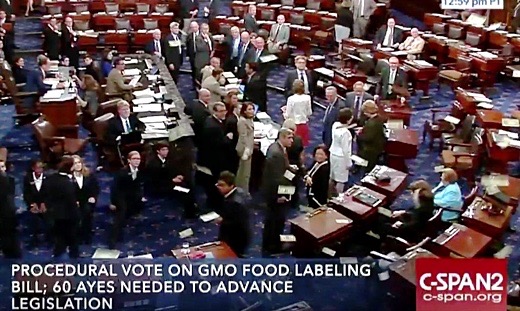
Image above: Money is thrown on the Senate floor during the GMO cloture vote to protest back-room dealings between senators and biotech lobbyists. Screenshot from C-SPAN2 coverage.

Despite opposition from consumer advocacy groups, a controversial bill on the labeling of genetically modified (GM or GMO) food passed a cloture vote in the U.S. Senate on Wednesday, even as critics warned the legislation is needlessly complicated and bends to the agriculture lobby interests.
The bill passed 65-32. The roll call is here.

The so-called "compromise" bill, introduced in June by Sens. Debbie Stabenow (D-Mich.) and Pat Roberts (R-Kan.), allows food companies to label GMOs by using codes, symbols, or packaging language.

Critics slammed the bill's sponsors for negotiating the legislation behind closed doors, accusing Stabenow and Roberts, among others, of being in Big Ag's pocket. According to an analysis of OpenSecrets.org data by the group Organic Consumers Association (OCA), supporters of the bill received more than twice as much money in campaign donations from companies like Monsanto than opponents.

Ahead of the vote Wednesday, OCA activists disrupted the Senate session to dump $2,000 on the chamber floor to protest the back-room dealings.

In addition to being confusing, the bill discriminates against certain consumers, including low-income, minority, rural, and elderly populations, by allowing food companies to use QR codes that require being scanned by smartphones, the Center for Food Safety (CFS) said on Wednesday.

"It is deeply disturbing that a majority in the Senate would support a bill that openly discriminates against America's low income, rural and elderly populations. This denies them their right to know simply because they are not able to afford or have access to smartphones," said CFS executive director Andrew Kimbrell.

"The bill itself is poorly drafted and would exempt many and perhaps most current genetically engineered foods from labeling. It was written behind closed doors between a handful of Senators and the big chemical and food companies. It is a non-labeling bill disguised as a labeling bill, a sham and a legislative embarrassment."

Opponents also noted that the bill simply goes against public opinion, with recent polls showing that more than 90 percent of Americans want GMO labeling on their food. If the bill passes into law, it will nullify state-level labeling efforts, such as the historic Vermont law that requires companies to use explicit language on their packages.

Wenonah Hauter, executive director of the environmental advocacy group Food & Water Watch, wrote in a blog post on Wednesday:
This is a slap in the face for all of the advocates that have worked hard to pass state-level measures because they believe strongly that labels should be transparent, and people should have the choice to decide whether or not they purchase and consume foods with genetically engineered ingredients. The majority of Americans support labeling for GMOs and will hold their elected officials accountable for stripping away this transparency.

If this bill becomes law, the industry wins what are essentially voluntary requirements under this GMO labeling "compromise," which does not mandate recalls, penalties or fines for noncompliance with the incredibly weak requirements of the bill that will likely leave many GMO ingredients exempt from any labeling requirements. And the bill gives companies the option to use discriminatory QR codes that require a smartphone to access basic information about the food on store shelves.
The bill is expected to get final approval in the Senate as early as this week. The U.S. House of Representatives will also have to pass its own version of the legislation before the Senate bill can become law. Hauter called on President Barack Obama not to sign it if it reaches his desk.

Ahead of Wednesday's vote, Vermont's Sen. Bernie Sanders (I) tweeted to the Senate Committee on Agriculture, Nutrition and Forestry—where Stabenow is a ranking member:

. You can find my response here:

See also:
Ea O Ka Aina: GMO labeling Flimflam 7/1/16
Ea O Ka Aina: Fight over sham GMO Labeling 6/30/16
Ea O Ka Aina: Whole Foods and Monsanto partners 6/29/16

.

State GMO Flunkies

SUBHEAD:  A 'pre-emption' bill to take away authority the counties have to regulate bio-tech pesticides and GMOs.

By Shannon Ruudolph on 11 January 2014 in Island Brearh -
(http://islandbreath.blogspot.com/2014/01/state-gmo-flunkies.html)


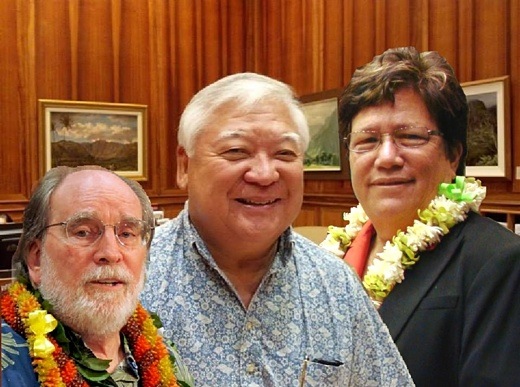
Image above: Mashup of Hawaii Governor Niel Abercrombie, Ag. Comm. Chair Senator Clarence Nishihara and Senator Malama Soloman working on legislation to pre-empt county regulations to protect the public from agrochemical GMO-pesticides. Click to embiggen.

Aloha!

Let your Hawaii State Represeentatives and Senators know this is unacceptable! NOW!
Please Share!!!

Clarence Nishihara
phone: 808-586-6879
sennishihara@capitol.hawaii.gov

Malama Soloman
phone: 808-586-7335

sensolomon@capitol.hawaii.gov

State Senators
sens@capitol.hawaii.gov

State Represenetaivers
reps@capitol.hawaii.gov 

From Hawaii Council Member, Margaret Wille
"Malama Solomon and or Senate Ag Committee Chair Nishihara are introducing a 'pre-emption' bill to take away any/all authority the counties may have to regulate the bio-tech industry/GMOs. She said she gave it to the AG to review the language."
PLEASE HELP OUR WATCHDOGS AT THE CAPITOL! WE NEED THEM!!!

See more here: http://www.indiegogo.com/projects/protect-hawaii-fund-gmo-ground-zero-community-organization-for-policy-change

See also:
Ea O Ka Aina: Dow - DuPont - Syngenta sue Kauai 1/11/14


.

Non-labeling of GMO food

SUBHEAD: Industry’s secret plan for a GMO (non)-labeling law through Grocery Manufacturing Association.

By Nathanael Johnson on 8 January 2014 for Grist  -
(http://grist.org/food/food-industrys-secret-plan-for-a-gmo-non-labeling-law/)


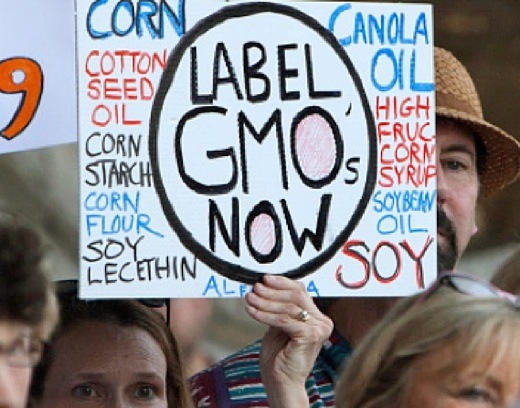
Image above: Demonstration in support of labeling GMOs in Connecticut. From original article.

The captains of the food industry have decided it’s time for a federal GMO-labeling law. Specifically, they’re aiming for a labeling law that doesn’t actually require labeling at all — but does pre-empt all of the more stringent labeling laws now making their way through state legislatures. In other words, they want a voluntary-labeling law that stops states from enacting anything else. (Yes, food makers can already voluntarily label their products as non-GM.)

This story comes from Politico, where Jenny Hopkinson and Helena Bottemiller Evich got their hands on a leaked description of the proposed law.

This isn’t exactly a surprise — it’s precisely what the Grocery Manufacturing Association had planned to do. And there’s no telling yet whether politicians have an appetite for this law.

Scott Faber, vice president of government affairs for the Environmental Working Group, told Politco it doesn’t have a chance.
“Every lobbyist in this town can name the dozen senators who would read the Bible backwards before this would become law, and that’s what’s so striking,” said Faber, a former GMA lobbyist. “A far better course would be for industry to come to the table” and work with consumers to gain the disclosure of more information on their products.
Catch that tidbit? Faber used to work for the grocers’ association; now he’s campaigning against them. Plus, he’s got a pretty good point.

This isn’t about the food industry creating transparency that would be meaningful to their customers. It’s about the food industry protecting itself from the burden of complying with various different state laws.

See also:
Ea O Ka Aina: GMO Bill Attacked 9/24/13
Ea O Ka Aina: GMO Bill 2491 passes 6-1 10/16/13
Ea O Ka Aina: Passage of Bill 2491 10/17/13
Ea O Ka Aina: Kauai Mayor vetoes GMO Bill 2491 10/31/13
Ea O Ka Aina: Hooser pulls rabbit from hat 11/15/13
Ea O Ka Aina: Bill 2491 Veto Overide Passes 11/16/13

.

Abercrombie caves on Shawn Smith

SORCE: Hope Kallai (lokahipath2@live.com)
SUBHEAD: There was significant public concern over Smith being nominated to the BLNR because of his favorable ties to development.

By Nathan Eagle on 30 October 2013 for Civil Beat -
(http://hawaii.news.blogs.civilbeat.com/post/65571862830/governors-land-board-appointment-withdraws-over)

[IB Publisher's note:This is another win for Kauai. Perhaps Abercrombie is beginning to hear the voice of Kauai.]


Image above: The Senate Water and Land Committee meets, 30 October 2013. From original article.

Gov. Neil Abercrombie has withdrawn his appointment of Kauai developer Shawn Smith to the state Board of Land and Natural Resources.

Sen. Malama Solomon made the announcement at the beginning of a Senate Water and Land Committee hearing Wednesday.

William Aila, chair of the Department of Land and Natural Resources, said after the meeting that Smith withdrew himself midday Wednesday. When asked why, he said Smith “referred to the process as being challenging.”

Smith is the general manager of the Kauai real estate company Falko Partners. His company is in the process of selling 357 acres in Kilauea for $70 million.

Despite its ag zoning, the property is being developed as a luxury housing subdivision.

It’s common practice in Hawaii to build subdivisions on ag land due to loopholes in state land use laws. People can plant a few mango trees, for instance, and call the home a “farm dwelling.”

Still, there was significant public concern over Smith being nominated to the BLNR because of his favorable ties to development. Abercrombie defended the nomination, which Aila said took a year to come to this point.

The decision to withdraw the nomination restarts the search process, although the governor has the option of appointing an interim board member.


Shawn Smith nomination criticized

SUBHEAD:  Nominee to Board of Land and Natural Resources draws criticism on development,

By Anita Hofschneifer on 28 October 2013 for Civil beat -
(http://www.civilbeat.com/articles/2013/10/28/20258-governors-nominee-to-board-of-land-and-natural-resources-draws-criticism/)


Image above: Plan of  Kahuaina Plantation Subdivision promoted on Agricultural Land on Kaai by Shawn Smith. From original article.

Neil Abercrombie asks lawmakers to confirm dozens of appointees to state boards and committees during the special session this week, he's facing resistance over a nomination to replace a member of the state Board of Land and Natural Resources, which votes on land leases and new rules governing natural resources.

Some county and state officials worry that appointing Shawn Smith, who is the general manager of the Kauai real estate company Falko Partners, would send the wrong message about land use in Hawaii.

The criticism centers around Kahuaina Plantation, a 357-acre stretch of land on Kauai that Falko Partners is in the process of selling for $70 million. The beachfront property is zoned for agriculture, but the company is marketing it as a luxury housing subdivision.

Marketing materials for the property boast of the potential for 80 exclusive homes along a secluded coastline with a clubhouse and other amenities.

Critics of the project say it’s yet another example of how agricultural land is being depleted in Hawaii in favor of homes for the wealthy.

State law says that land zoned for agriculture may have “farm dwellings” — defined as “a single-family dwelling located on and used in connection with a farm." Clusters of single-family farm dwellings are permitted "within agricultural parks developed by the State, or where agricultural activity provides income to the family occupying the dwelling.”

Opponents of the project say that the proposed homes don’t quite make the cut.

“[Appointing Smith] is sending such a strong message to the counties that it’s okay for you to be approving luxury home subdivisions on agricultural land,” said Sen. Laura Thielen, a Democrat from Kailua. “And under the law, it’s not okay.”

The governor defended his decision on Monday to nominate Smith.

"The real estate experience and knowledge Mr. Smith has acquired as general manager of Falko Partners will add a practical perspective to the issues that regularly come before the Board," Abercrombie said in a statement. He noted that Smith has been serving as an interim member since June and that large landowners and their employees have served well on the board in the past.

Smith said it took his company from 2004 until 2010 to gain approval for Kahuaina Plantation from the Kauai County Planning Commission.

“Everything was done right to the letter of the law and it took a lot of money to do it right,” Smith said.

He doesn’t expect the development project to come before the state Board of Land and Natural Resources, but said he would recuse himself from any decision if it did.

The Kahuaina Plantation includes a 17-acre organic farm, a nursery and an albatross sanctuary, Smith said. But, he added, the soil on the rest of the property isn’t rated well for farming.

Kauai Councilman Gary Hooser described the property as having only “token agriculture.”

“It’s not really for farms, it’s for luxury homes,” he said. “There’s no question at all that this project violated the spirit, principle and intent of the state constitution.”

Hawaii’s constitution requires the state to “conserve and protect agricultural lands, promote diversified agriculture, increase agricultural self-sufficiency and assure the availability of agriculturally suitable lands.”

Dee Crowell, Kauai County’s deputy planning director, said it’s not unusual for the county to approve subdivisions on agricultural land, and that the Kahuaina Plantation property followed the law.

“Subdivisions are pretty cut and dry: you meet the requirements, you get the approval,” Crowell explained.

“If they don’t like the law, they should change it," he said. "They're the lawmakers."

.

Trouble for Monsanto Protection Act

SUBHEAD: US Congress Agriculture Committee is considering repeal of the Monsanto Protection Act - aka the Farmer Assurance Provision.

By Ryan Grim 6 June 2013 for Huffington Post -
(http://www.huffingtonpost.com/2013/06/06/monsanto-protection-act-debbie-stabenow_n_3396615.html)


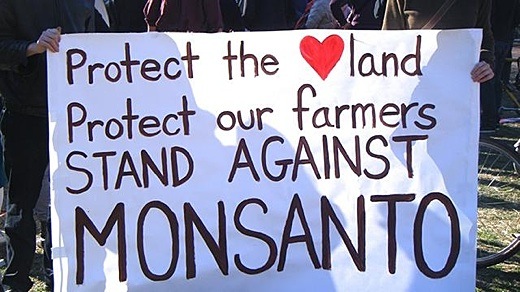
Image above: Demonstration in March of 2013 against Monsanto Protection Act. From (http://green-mom.com/topics/nutrition/monsanto-protection-act-protecting-who-or-what.html#.UbDnjeuisq8).

Sen. Debbie Stabenow (D-Mich.), the chairwoman of the Agriculture Committee, pledged to oppose the extension of the so-called the Monsanto Protection Act, a victory for advocates who have been pressing for its repeal.

Stabenow made her pledge in a conversation with Sen. Jeff Merkley (D-Ore.), who has been pushing the Senate to vote on an amendment to the farm bill that would repeal the provision. That vote was blocked by Sen. Roy Blunt (R-Mo.) and on Thursday morning the Senate voted to end debate and move to final passage.

When two senators have a pre-arranged public conversation on the Senate floor, it's known as a colloquy and is typically the bow that ties up a deal struck beforehand. While Merkley was unable to get a repeal vote, the colloquy is a significant win for him, with Stabenow promising she will oppose any attempt to extend the Monsanto Protection Act in backroom negotiations.

Monsanto is a global seed and herbicide company that specializes in genetically modified crops. The MPA prevents judges from enforcing injunctions on genetically modified seeds even if they are deemed unsafe. Monsanto has argued that it is unfair to single the company out in the nickname for the law, which is technically known as the Farmer Assurance Provision, when other major agribusiness players also support it.

The measure was originally enacted into law by being inserted into an unrelated spending bill and is set to expire later this year. "The Monsanto Protection Act refers to a policy rider the House slipped into the recently passed continuing resolution and sent over to the Senate," Merkley noted on the floor. "Because of the time-urgent consideration of this must-pass legislation -- necessary to avert a government shutdown -- this policy rider slipped through without examination or debate."

"I wish to assure my friend that I think it would be inappropriate for that language to be adopted in a conference committee or otherwise adopted in a manner designed to bypass open debate in the relevant committees and this chamber," Stabenow told Merkley. "I will do my best to oppose any effort to add this kind of extension in the conference committee on this farm bill or to otherwise extend it without appropriate legislative examination."

In an interview with The Huffington Post, Blunt made the case for the MPA, arguing that the measure aimed to protect farmers who had already purchased seeds that were later deemed unsafe. "I was raised -- my mom and dad were dairy farmers -- once you've made a decision to plant a crop for that year, you can't go back and undo that decision," he said. Requiring Monsanto or other seed companies to compensate the farmer for lost income wasn't a viable strategy, he said, if the seeds had previously been okayed before the court ruling. "You can't sue them for selling a crop that the federal government said is okay to plant," he said.

The measure enables the secretary of the Department of Agriculture to block a judicial injunction and allow the planting of a seed. The USDA, he said, called the provision redundant. "All that did was repeat authority that the secretary in a hearing the other day ... said he already had," Blunt said. "And it didn't require the secretary to do anything that the secretary thought was the wrong thing to do. Which is one of the reasons I thought it was fine."


Merkley's repeal effort saw an outpouring of grassroots support, and a petition announced by his office quickly garnered more than 100,000 signatures. A petition put out by Food Democracy Now, which organized a protest at the White House shortly after the MPA became law in March, similarly picked up a quick 100,000 signatures, and a petition pushed by CREDO Action, an online progressive group with some three million members, did the same.

"That's big for us, the fact that it went from zero to 100,000 just in 24 hours," Becky Bond, the head of CREDO, told HuffPost at the time. "People are really passionate about this issue. A lot of the time people feel helpless with regard to corporate decisions ... The fact that there's someone in the Senate who's fighting for this is exciting to people and they're eager to get their names on it."

Read the exchange between Merkley and Stabenow above, or read the transcript below:
Mr. MERKLEY.
Madam President, I rise to talk about an issue that is important to many Oregonians, section 735 of the continuing resolution, also known as the Monsanto Protection Act. I appreciate this opportunity to engage in a dialog about it with Senator Stabenow, who, as the chair of the committee, is doing a magnificent job of guiding this farm bill through the Senate.

The Monsanto Protection Act refers to a policy rider the House slipped into the recently passed continuing resolution and sent over to the Senate. Because of the time-urgent consideration of this must-pass legislation--necessary to avert a government shutdown--this policy rider slipped through without examination or debate.

That outcome is unfortunate and unacceptable because the content of the policy rider is nothing short of astounding. It allows the unrestricted sale and planting of new variants of genetically modified seeds that a court ruled have not been properly examined for their effect on other farmers, the environment, and human health.

The impact on other farmers can be significant. The current situation in Oregon of GMO wheat escaping a field test--resulting in several nations suspending the import of white wheat from the United States--underscores the fact that poorly regulated GMO cultivation can pose a significant threat to farmers who are not cultivating GMO crops.

Equally troubling to the policy rider's allowance of unrestricted sale and planting of GMO seeds is the fact that the Monsanto Protection Act instructs the seed producers to ignore a ruling of the court, thereby raising profound questions about the constitutional separation of powers and the ability of our courts to hold agencies accountable.

Moreover, while there is undoubtedly some difference in this legislative body on the wisdom of the core policy, there should be outrage on all sides about the manner in which this policy rider was adopted. I have certainly heard that outrage from my constituents in Oregon. They have come to my town halls to protest, and more than 2,200 have written to me.

In an accountable and transparent legislative system, the Monsanto Protection Act would have had to be considered by the Agriculture Committee, complete with testimony by relevant parties. If the committee had approved the act, there would have been a subsequent opportunity to debate it on the floor of this Chamber. Complete transparency with a full opportunity for the public to weigh in is essential.

Since these features of an accountable and transparent legislative system were not honored and because I think the policy itself is unacceptable, I have offered an amendment to the farm bill which would repeal this rider in its entirety. To this point, my efforts to introduce that amendment have been objected to, and it takes unanimous consent. This type of rider has no place in an appropriations bill to fund the Federal Government, and a bill that interferes with our system of checks and balances should never have become law.

Ms. STABENOW. 
Madam President, I absolutely understand Senator Merkley's concerns about the issue and the concerns of many people about this issue. There has been a long-running understanding that we should not be legislating on appropriations, and I share the concern of my colleague that the Agriculture Committee and other appropriate committees didn't have an opportunity to engage in this debate.

As the Senator from Oregon knows, this language was included in the continuing resolution, the bill that funds the government, and that bill will expire on September 30 of this year. I agree with my colleague; we should not extend that provision through the appropriations process. We should have the same type of full and transparent process that both Senator Merkley and I have talked about today.

I wish to assure my friend that I think it would be inappropriate for that language to be adopted in a conference committee or otherwise adopted in a manner designed to bypass open debate in the relevant committees and this Chamber.

I will do my best to oppose any effort to add this kind of extension in the conference committee on this farm bill or to otherwise extend it without appropriate legislative examination.

Mr. MERKLEY.
Madam President, I thank Senator Stabenow. I deeply appreciate the commitment of my colleague to ensure that the Monsanto Protection Act is not tucked into subsequent legislation in a manner that bypasses full committee examination and Senate debate.

The farm bill is extremely important to our Nation. The Senator from Michigan has worked with me to incorporate a number of provisions that are important to the farmers in Oregon, including disaster programs, responding to forest fires, specialty crop research programs, improvements in insurance for organic farmers, and low-cost loans offered through rural electrical co-ops for energy-saving home and business renovations.

It has been a real pleasure to work with Senator Stabenow on those provisions and, again, I thank the Senator for her support for them and for advocating responsible legislative examination of measures such as the Monsanto Protection Act.

Ms. STABENOW. 
Madam President, I thank the Senator from Oregon for his advocacy on so many important policies in this legislation. We worked together closely on forest fires. Senator Merkley and I have been on the phone many times. He wanted to make sure I was aware of what has happened to farmers, homeowners, and landowners in Oregon.

We share a great interest in so many areas as it relates to our organic growers and rural development as well as what is happening in terms of energy efficiency, and, as my friend mentioned, rural electric co-ops.

I thank Senator Merkley for his leadership in many areas, and I look forward to working with the Senator from Oregon as we bring the farm bill to a final vote.

Mr. MERKLEY.
Madam President, again, I thank the chair for her leadership. I know how much she looks forward to the conclusion of this process as we try to enable folks to have various amendments which are appropriate for the farm bill debated on the floor.

.

Monsanto lobbying Congress

SOURCE: Ken Taylor (taylork021@hawaii.rr.com)
SUBHEAD: Monsanto in trouble and using government to stomp on states' rights concerning GMOs.

By Ronnie Cummins on 18 May 2013 for nation of Change -
(http://www.nationofchange.org/genetically-modified-democracy-monsanto-and-congress-move-stomp-states-rights-1368886586)


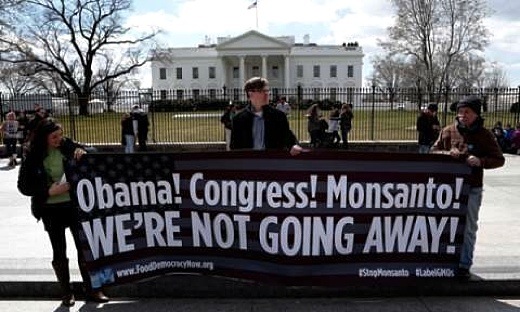
Image above: Demonstration at White House against Obama, Congress, and Monsanto. From original article.

Reliable sources in Washington D.C. have informed the Organic Consumers Association (OCA) that Monsanto has begun secretly lobbying its Congressional allies to attach one or more “Monsanto Riders” or amendments to the 2013 Farm Bill that would preempt or prohibit states from requiring labels on genetically engineered (GE) foods.

In response to this blatant violation of states’ rights to legislate, and consumers’ right to know, the OCA and a nationwide alliance have launched a petition to put every member of Congress on notice: If you support any Farm Bill amendment that would nullify states’ rights to label genetically modified organisms (GMOs), we’ll vote – or throw – you out of office.

On Wednesday, May 15, an amendment to the House version of the Farm Bill, inserted under the guise of protecting interstate commerce, passed out of the House Agricultural Committee. If the King Amendment makes it into the final Farm Bill, it would take away states’ rights to pass laws governing the production or manufacture of any agricultural product, including food and animals raised for food, that is involved in interstate commerce.

The amendment was proposed by Rep. Steve King (R-Iowa), largely in response to a California law stating that by 2015, California will allow only eggs to be sold from hens housed in cages specified by California. But policy analysts emphasize that the amendment, broadly and ambiguously written, could be used to prohibit or preempt any state GMO labeling or food safety law.

Will the King Amendment survive the Senate? No one can be sure, say analysts. However few doubt that Monsanto will give up. We can expect that more amendments and riders will be introduced into the Farm Bill--even if the King Amendment fails—over the next month in an attempt to stop the wave of state GMO labeling laws and initiatives moving forward in states like Washington, Vermont, Maine, Connecticut and others.

Monsanto and the Grocery Manufacturers Association (GMA) have admitted privately that they’ve “lost the battle” to stop GE food labeling at the state level, now that states are aggressively moving forward on labeling laws. On May 14, Maine’s House Ag Committee passed a GMO labeling law. On May 10, the Vermont House passed a labeling bill, 99-42, despite massive lobbying by Monsanto and threats to sue the state. And though Monsanto won a razor-thin victory (51 percent to 49 percent) in a costly, hard fought California GMO labeling ballot initiative last November, biotech and Big Food now realize that Washington State voters will likely pass I-522, an upcoming ballot initiative to label GE foods, on November 5.

If Monsanto can’t stop states from passing laws, then the next step is a national preemptive measure. And all signs point to just such a power grab. Earlier this year, Monsanto slipped its extremely unpopular “Monsanto Protection Act,” an act that gives biotech immunity from federal prosecution for planting illegally approved GE crops, into the 2013 Federal Appropriations Bill. During the June 2012 Farm Bill debate, 73 U.S. Senators voted against the right of states to pass mandatory GE food labeling laws. Emboldened by these votes, and now the House Ag Committee’s vote on the King Amendment, Monsanto has every reason to believe Congress would support a potential nullification of states’ rights to label.

The million-strong OCA and its allies in the organic and natural health movement are warning incumbent Senators and House members, Democrats and Republicans alike, that thousands of health and environmental-minded constituents in their Congressional districts or states will work to recall them or drive them out of office if they fail to heed the will of the people and to respect the time-honored traditions of shared state sovereignty over food labels, food safety laws, and consumers’ right to know.

Trouble in Monsanto Nation

Over the past 20 years Monsanto and the biotech industry, aided and abetted by indentured politicians and corporate agribusiness, have begun seizing control over the global food and farming system, including the legislative, patent, trade, judicial and regulatory bodies that are supposed to safeguard the public interest.

In the U.S., despite mounting evidence of the damage GE crops inflict on human health and the environment, approximately 170 million acres of GE crops, including corn, soybeans, cotton, canola, sugar beets, alfalfa, papaya, and squash, are currently under cultivation. These crops, untested and unlabeled, comprise 41 percent of all cultivated cropland, or 17 percent of all cropland and pastureland combined. According to the GMA, at least 70 percent of non-organic grocery store processed foods contain GMOs. And GE grains and mill byproducts now supply the overwhelming majority of animal feed on the factory farms that supply 90 percent to 95 percent of the meat, eggs and dairy products that Americans consume.

Yet despite their marketplace dominance, record profits and enormous political clout in Washington D.C., Monsanto and the biotech industry are in deep trouble. Evidence is mounting that Monsanto’s top-selling herbicide, Roundup, is a deadly poison, destroying important human gut bacteria and likely contributing to the rapid increase of food allergies and serious human diseases including cancer, autism, neurological disorders , Attention Deficit Hyperactive Disorder (ADHD), dementia, Alzheimer’s, schizophrenia and bipolar disorder. Those most susceptible to poisoning by Monsanto’s Roundup are children and the elderly.

Scientists aren’t the only ones raising new questions about Roundup. Farmers are complaining that they’re being forced to spray more and more chemicals on crops increasingly under siege from a growing army of herbicide-resistant weeds. The situation is so bad that the U.S. Environmental Protection Agency (EPA) just raised the limits of Roundup residue allowed on grains and vegetables to even more dangerous levels. But just in case the EPA someday stops raising the limits, Monsanto, Dow and the biotech industry are working on a new “solution” to the onslaught of herbicide-resistant Superweeds: They’ve applied for approval of a new and highly controversial generation of super toxic herbicide-resistant GE crops, including “Agent Orange” (2,4-D and dicamba-resistant) corn, soybeans and cotton.

As a recent widely-circulated article points out,   
“The use of 2,4-D is not new; it’s actually one of the most widely used herbicides in the world. What is new is that farmers will now ‘carpet bomb’ staple food crops like soy and corn with this chemical at a previously unprecedented scale—just the way glyphosate has been indiscriminately applied as a result of Roundup Ready crops. In fact, if 2,4-D resistant crops receive approval and eventually come to replace Monsanto's failing Roundup-resistant crops as Dow intends, it is likely that billions of pounds will be needed, on top of the already insane levels of Roundup being used (1.6 billion lbs were used in 2007 in the US alone).”
In addition to these Agent Orange crops, an expanded menu of genetically engineered organisms are awaiting approval. Next on the menu?  GE apples, trees, and salmon.

State Labeling Laws: The ‘skull and crossbones’ that terrify Monsanto
Monsanto’s greatest fear isn’t a federal government charged with protecting the health and safety of its citizens. Congress and the White House seem only too happy to oblige the biotech industry’s unquenchable thirst for growth, power and dominance. No, it’s the massive, unstoppable (so far) grassroots movement of Millions Against Monsanto that strikes fear in the heart of the Biotech Bully. U.S. citizens are waking up. They’re demanding labels on genetically engineered foods, similar to those already required in the European Union. They’re calling for serious independent safety-testing of GE crops and animals, both those already approved (especially Monsanto’s Roundup-resistant crops) and those awaiting approval.

The anti-GMO movement has finally figured out, after 20 years of fruitlessly lobbying Congress, the FDA and the White House, that the federal government is not going to require labels on GE foods. Instead the movement has shifted the battleground on GMO labeling from Monsanto and Big Food’s turf in Washington D.C. to the more favorable terrain of state ballot initiatives and state legislative action—publicizing the fact that a state GMO labeling law will have the same marketplace impact as a national labeling law.

State laws spell doom for Monsanto. Companies like Kellogg’s, General Mills, Coca-Cola, Pepsi/Frito-Lay, Dean Foods, Unilever, Con-Agra, Safeway, Wal-Mart and Smuckers are not going to label in just one or two states. Monsanto knows that U.S. food companies will go GMO-free in the entire U.S., rather than admit to consumers that their products contain GMOs.

As Monsanto itself has pointed out, labels on genetically engineered foods are like putting a “skull and crossbones” on food packages. This is why Monsanto and their allies poured $46 million into defeating a California ballot initiative last year that would have required labels on GMO foods. This is why Monsanto has lobbied strenuously in 30 states this year to prevent, or at least delay, state mandatory labeling laws from being passed. This is why Monsanto has threatened to file federal lawsuits against Vermont, Connecticut, Maine and Washington if they dare grant citizens the right to know whether or not their food has been genetically engineered or not.

And this is why Monsanto’s minions are trying to insert amendments or riders into the Farm Bill that will make it nearly impossible, even illegal, for states to pass GMO labeling laws. And there’s nothing to stop them when Congress is filled with pro-biotech cheerleaders who could care less that 90 percent of U.S. consumers want mandatory labels and proper safety testing of genetically engineered crops and foods.

Countering Monsanto’s Final Offensive: Throw the Bums Out!
Only a massive grassroots resistance will deter the U.S. Senate and House from stomping on our rights. Only an unprecedented campaign of public education, petition-gathering and grassroots pressure will be able to convince the ever-more corrupt and indentured politicians in Washington D.C. to back off.

Eighteen state constitutions have century-old provisions for state registered voters to collect petitions and recall state and local officials, forcing them to either resign or stand for reelection. But what very few Americans, and even members of Congress, realize is that 11 states have constitutional provisions to recall U.S. Senators and House of Representative members, as well as state elected officials.

It’s time we exercise the full power of direct democracy, not just state and municipal ballot initiatives. We must continue to support efforts like the current state ballot initiative to label GMOs in Washington state, and county ballot initiatives to ban GMOs, factory farms and other corporate crimes, in the 24 states and hundreds of counties and municipalities where these are allowed. But we also need to use the power we have to recall and throw out of office our out-of-control Congressional Senators and Representatives as well.

If our elected officials in Congress continue to represent Monsanto and big corporations, rather than their constituents, then let’s throw the bums out! If the Washington political Establishment, both Democrats and Republicans, continue to trample on our inalienable constitutional rights and contemptuously disregard the 225-year principle of a shared balance of power between the federal government, the states and local government, then we have no choice but to recall them or throw them out of office.

Please join the nation’s organic consumers and natural health advocates in this strategic battle, the Food Fight of Our Lives. Please join this campaign to save, not only our right to choose what’s in our food, but our basic right to democratic representation and self-determination as well. Sign the petition. Tell your Congressmen and women, especially the 73 incumbents who voted last year to eliminate states rights’ to legislate on GMO labels, and those in the House this week who voted to support the King Amendment that “enough is enough,” “ basta ya.” Power to the People!

• Ronnie Cummins is founder and director of the Organic Consumers Association. Cummins is author of numerous articles and books, including "Genetically Engineered Food: A Self-Defense Guide for Consumers" (Second Revised Edition Marlowe & Company 2004).
.

Beyond Zombie-Environmentalism

SUBHEAD: An attempt to manage the environment beyond elected officials, appointed regulators, and lobbyists.

By David Bollier on 1 May 2013 for Bollier.org -
(http://bollier.org/blog/beyond-zombie-environmentalism-great-lakes-commons)


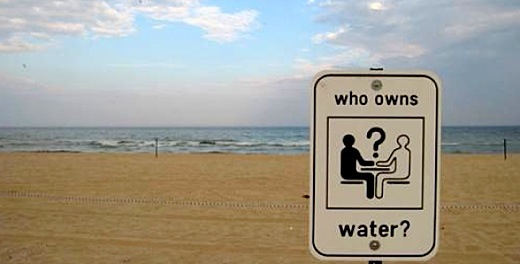
Image above: "Who owns water" sign on the beach of the Great Lakes. From original article.

It’s been said that the fate of any great movement is to be cannibalized by the mainstream or to die. I’d like to suggest two others paths: zombiehood and courageous re-invention.

Zombiehood is a mode of living death in which people mindlessly repeat old advocacy forms that clearly aren’t working. This is the fate of much environmentalism today – a professionalized, bureaucratized sector that is afraid of taking risks, innovating or defying respectable opinion.

It is refreshing, therefore, to recognize a notable departure from zombie-environmentalism, the Great Lakes Commons, a new cross-border grassroots campaign catalyzed by On the Commons to establish the Great Lakes as a commons. Here is a bold idea with the nerve and intelligence to strike off in some new, experimental directions without any assurance that it’s all going to turn out.

For the past 40 years, environmental activists have looked to legislatures, regulators and international treaties to “solve the problem.” Guess what? It’s not working. Governments are too corrupt, corporate-dominated, bureaucratic or just plain stalemated. The Great Lakes Commons is an attempt to launch a new narrative and activist strategy based on some very different assumptions. It’s trying to organize people in new ways, through commoning, and to imagine new forms of governance that will actually protect the Great Lakes. It doesn’t just want to raise money and collect signatures for petitions. It wants to nurture new types of human relationships with this endangered regional ecosystem.

As the Great Lakes Commons website points out, Great Lakes policies are biased toward private and commercial interests. The political management regimes do not reflect ecological realities. And the people living near the Lakes are treated as bystanders who have little power to affect government decisionmaking. For all these reasons and more, the ecological health of the Great Lakes has deteriorated over the past several decades, and now there are new threats from hydro-fracking, radioactive waste shipments, copper-sulfide mining and invasive species.

The conventional activist response to such a situation is to hold rallies, file lawsuits, give testimony and raise a publicity ruckus. All of these remain vital, yes. But the more elemental problem may be that people have no emotional or personal connections to the Great Lakes. That’s seen as something for “the authorities” to take care of. The project writes: “Stunning, we appear to have forgotten that we too are part of this ecosystem, not outside it, and that our lives and those of future generations depend on the Lakes.”

So the Great Lakes Commons is attempting to re-engage people's inner commitments and establish the Great Lakes as a commons. Mind you, the Great Lakes themselves are not the commons. The commons is that vast natural resource as managed by an active community of stewards committed to developing rules, procedures and ethical norms for managing use of the Lakes effectively. That is the commons.

In other words, the Great Lakes Commons wants to establish new types of governance that precede or complement government. Over time this commons-based governance will surely make new, more forceful and organized demands upon government. But the point is not simply to make government do its job; it is to re-configure the very governance of the Great Lakes by integrating the commons into it.

This means that the usual cast of managers must go beyond the elected officials, appointed regulators, and industry lobbyists and lawyers. In a sense, the commons is a way to reconstitute the bedraggled body politic known as “civil society.” It’s a way for environmental and social justice activists, legal advocates, indigenous leaders, academics, artists, students, municipal staff and others to work together directly and personally to incubate new cultural and management forms. This, and perhaps only this, will be able to break through the corporate-dominated machinery of government and law that elevates the market economy over the ecology.

As I said: A bold departure. Can it work?

The very fact that the Great Lakes Commons breaks with the zombie-logic of conventional environmentalism and plunges into a big zone of uncertainty, may be its most attractive aspect. It is trying something new and ambitious. It is trying to re-imagine governance precisely because the existing structures of governance have failed so miserably. Respectable opinion is too fearful to acknowledge this reality and too anaesthetized or demoralized to imagine alternatives.

The other interesting dimension to the Great Lakes Commons project is its brave alliance with First Nations and Native American peoples who have long histories with the Great Lakes. This is difficult business, the bridging of indigenous knowledge and culture with that of mainstream American political culture. For more than a generation, the standard activist style has been the professional-style public interest group acting as a proxy for citizens as it does battle in Washington, the state capital or the courts. I think that maybe this form of advocacy has reached its limits – or at least, its political efficacy.

Which is why I am encouraged by strategic self-awareness of the Great Lakes Commons:
We created an organizing approach congruent with our vision. A commons requires the leadership of many. So rather than base this effort in one organization or even a coalition, we have intentionally created an open network capable of catalyzing and supporting broad, unlimited and unexpected leadership.

This Initiative is growing. It is not the work of any one organization or group of leaders but of many people in many places. You can become part of this unfolding story, of people who have decided the Lakes are too important to leave up to others. In fact a Great Lakes Commons isn’t possible without you, your voice, ideas and energy. It truly is up to us – us all.

It will be interesting to see how the Great Lakes Commons unfolds and grows in the coming months and years.

.

Facebook "likes" Keystone XL

SUBHEAD: Mark Zuckerberg’s political group funds ads promoting Keystone and ANWR drilling .

By John Upton on 30 April 2013 for Grist Magazine -
(http://grist.org/news/anti-keystone-ads-banned-by-facebook/)


Image above: Detail of haracture of Mark Zuckerberg by Mechaniac.  From (http://mechaniac.deviantart.com/art/Mark-Zuckerberg-207213713).

Activist cell-phone company CREDO tried to run an advertisement on Facebook calling on Facebook’s founder to stop running TV ads that support the proposed Keystone XL pipeline.

Guess whether the social media giant liked that idea.

Facebook quickly rejected the ad, saying it violated its advertising policies.

We told you last week about FWD.US, a political group cofounded by Facebook CEO Mark Zuckerberg to push for immigration reform. One of the group’s subsidiaries is running an ad praising Sen. Lindsey Graham (R-S.C.) in which Graham voices his support for Keystone XL and drilling in the Gulf of Mexico, along with his opposition to “ObamaCare.” The ad is apparently attempting to bolster the lawmaker’s support among conservatives, which is jeopardized by his support of immigration reform. An ad financed by another FWD.US subsidiary supports Sen. Mark Begich (D-Alaska), praising him for pursuing oil drilling in the Arctic National Wildlife Refuge.

But Facebook does not want its billion or so users hearing from its opponents on this issue.

From The Washington Post:
The ad was rejected when CREDO tried to post it to the social network. According to an e-mail the company received from Facebook, the ad violates Facebook policies because it uses Zuckerberg’s image.

Facebook policies do state that it will reject ads that contain Facebook logos, icons or trademarked images in a way that falls outside of its usage guidelines or if the advertisements incorrectly imply the social network has given its “partnership, sponsorship or endorsement” to the ad.

In a statement, Facebook said it generally rejects “ads that contain Mark’s image because — not surprisingly — in our experience those ads tend to be confusing for users, and frequently misleading. Users may click on the ad thinking it is a message from Mark or from Facebook, not understanding that they are actually in an advertisement seeking to take advantage of Mark’s image.”
CREDO isn’t the only group taking to Facebook to object to the Graham and Begich ads. From Politico:
The Sierra Club is taking a similar approach. The environmental group encouraged its members Monday to share a note that says, “Zuckerberg promoting dirty fuels? DISLIKE.”
The critics say they are infuriated that a group backed by Zuckerberg and green-minded venture capitalists like John Doerr could be supporting ads that tout oil drilling.
Meanwhile, Keystone XL opponents are planning a protest today that will be harder for Facebook to simply squash. The protest will be conducted the old-fashioned way, in person, outside of Facebook’s headquarters in Menlo Park, Calif.

Go ahead and post this story on Facebook — the image of the banned advertisement should show up automatically. And let us know in our comment section below whether the Facebook overlords take it down.

• John Upton is a science aficionado and green news junkie who tweets, posts articles to Facebook, and blogs about ecology. He welcomes reader questions, tips, and incoherent rants: johnupton@gmail.com

Facebook likes Drilling in ANWR
SUBHEAD: Mark Zuckerberg’s new political group spending big on ads pupporting Keystone XL and oil drilling in Arctic National Wildlife Refuge.

By Josh Israel & Judd Legum on 26 April 2013 for ThinkProgress - 
(http://thinkprogress.org/immigration/2013/04/26/1925921/mark-zuckerbergs-new-political-group-spending-big-on-ads-supporting-keystone-xl-and-oil-drilling/)

Mark Zuckerberg’s new political group, which bills itself as a bipartisan entity dedicated to passing immigration reform, has spent considerable resources on ads advocating a host of anti-environmental causes — including driling in the Arctic National Wildlife Refuge (ANWR) and constructing the Keystone XL tar sands pipeline.

The umbrella group, co-founded by Facebook’s Zuckerberg, NationBuilder’s co-founder Joe Green, LinkedIn’s Reid Hoffman, Dropbox’s Drew Houston, and others in the tech industry, is called FWD.US. Its initial priority is the passage of a comprehensive immigration reform bill, including enhanced border security, more visas for workers with special skills, and a pathway to citizenship for those living in the U.S. without legal status. Other long-term priorities for the group include education reform and expanded scientific research.

FWD.US is bankrolling two subsidiary organizations to purchase TV ads to advance the overarching agenda — one run by veteran Republican political operatives and one led by Democratic strategists. The GOP-lead group, called Americans For A Conservative Direction, has created an ad in support of Sen. Lindsay Graham (R-SC) which praises him for supporting construction of the Keystone XL pipeline and expanded drilling elsewhere. The ad, which does not mention immigration policy, also attacks Obamacare, “wasteful stimulus spending,” and “seedy Chicago-style politics.” Politico reports the group plans a seven-figure buy with this and other ads.

The other group, called Council for American Job Growth and purportedly intended to appeal to liberals, lauds Sen. Mark Begich (D-AK) for “working to open ANWR to drilling.” The ad also does not mention immigration reform but does highlight Begich’s support of a balanced budget amendment.

The group’s forceful advocacy for expanded drilling and pipeline construction is surprising given Zuckerberg’s public statements about the purpose of the group. In an introductory column, Zuckerberg said that the group would be dedicated to “building the knowledge economy,” which he contrasts to “the economy of the last century… primarily based on natural resources.” Zuckerberg adds, “there are only so many oil fields, and there is only so much wealth that can be created from them for society.”

Both ads appear to be trying to give political cover to vulnerable centrists, in hopes of ensuring their support for major immigration reform — though Graham’s support seems certain as he is a member of the Gang of Eight pushing the measure. But the proposals already enjoy broad popularity among both Republicans and the public overall.

In the past, Zuckerberg has emphasized the importance of moving from dirty fossil fuels to clean renewable energy.
.

Council date with Syngenta

SUBHEAD: The Kauai County Council turns to pro-GMO and anti medical marijuana proponents.

By Andy Parx on 26 March 2013 for Parx Daily News -
(http://parxnewsdaily.blogspot.com/2013/03/now-playing-in-cesspool-near-you.html)


Image above: A spoof of Syngenta styled ad. "How Syngenta poisons people and the environment". Click to enlarge. From (http://mieuxprevenir.blogspot.com/2012/12/how-syngenta-poisons-people-and.html).

Whether it's Syngenta's disinformation campaign about Atrazine, new information about cancer and pesticides, the so-called Monsanto Protection Act recently passed by congress or the state Department of Agriculture’s admission at last week's Kaua`i County Council meeting that they failed to perform a study- one we paid $50,000 for, of the apparent pesticide poisoning of Waimea Elementary School students four years ago and instead accepted the seed-corn industry's claim that it was simply something called "stink-weed" that sent the kids to the hospital, something really, well, stinks about the biotech industry... especially on Kauai.

But you ain't seen nothing yet- just wait until this Wednesday's council meeting when James Pacopac, lobbyist for the county and Syngenta, brings his dog and pony show to town.


According to the agenda for this week's council meeting:
Council Chair Furfaro (is) requesting the presence of Mr. Scott Matsuura, and Mr. James Pacopac, JS Hawaii Consultants, LLC, to provide the Council with an update on the 2013 Legislative Session to include, but not be limited to, the status of the Kauai County, Kauai County Council, and Hawaii State Association of Counties (HSAC) Legislative Packages for 2013.

A recent post by journalist/blogger Ian Lind titled Profiling members of the Honolulu Planning Commission reveals that Pacopac is not only a member of that august body- along with various and sundry developers, bankers and other lobbyists
...but:

Pacopac... is a partner with Scott Matsuura in the lobbying firm of SPJ Consulting LLC.

Pacopac was lobbyist for the Honolulu Board of Water Supply until March 2012. He currently is a registered lobbyist for the County of Kauai, the Kauai Island Utility Cooperative, and Syngenta Crop Protection of GMO fame.

Matsuura and Pacopac have been paid $60,000 for 4 or 5 months worth of work to represent the County of Kauai at the legislature but don't seem to have done much of any lobbying, especially and specifically when it comes to bills that pit the county against the seed-corn industry such as bill SB727 and SB 590. Those bills would take away the county's power to protect the health and safety of its citizens including those who claim they are being poisoned by pesticides used by Syngenta and the rest of the seed-corn industry on the island's westside.

Anyone concerned about whether the county is getting their money's worth or is in fact being scammed by SPJ Consulting's dynamic duo might want to show up Wednesday when, if the agenda is correct, the item will be the first one that will be taken up after a short list of perfunctory items.

And speaking of dog and pony shows, one of the more insanely laughable tag teams will be bringing their anachronistic reefer madness routine back for another commanded-by-no-one appearance.

According to the agenda:
Councilmember (Mel) Rapozo has request(ed) agenda time for a briefing from Keith Kamita, Deputy Director, State of Hawai`i, Department of Public Safety, on the Bills that are currently before the State Legislature relating to the legalization of marijuana.
Folks may remember Kamita as the diabolical yet comical official who thinks the marijuana scourge must be stopped at all cost lest civilization as we know it cease to exist. In lock and goose step with Lieutenant Rapozo, Kamita continues his lost cause to kill one bill that would switch the medical marijuana program from DPW control to that of the Department of Health and of course opposes another to decriminalize small amount of the evil weed.

So prepare some testimony, get some popcorn and join in the fun at the Historic County Building in Lihue on Wednesday March 27 at 8:30am. Or if you really can't make it, catch it live on-line.

Just imagine - people complain there's nothing to do on Kauai but the county brings the circus to town every week. Lions and tigers and bears... oh my, indeed.

.

Jaczko resigns from NRC

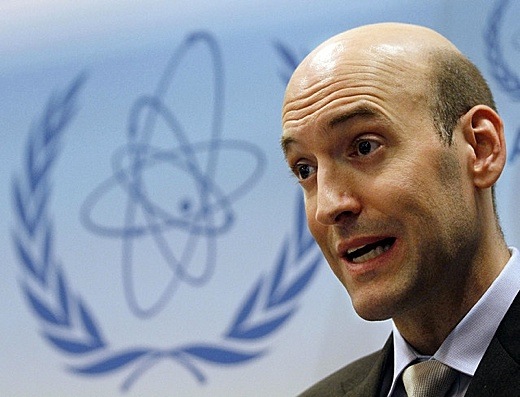
SUBHEAD: Chairman was to interested in safety for those leading the nuclear industry. By Brian Wingfield on 21 May 2012 for Bloomberg News - (http://www.bloomberg.com/news/2012-05-21/gregory-jaczko-resigns-as-chairman-of-nuclear-commission.html) Image above: Gregery Jaczko while chairman of Nyclear Regulatory Commission. From original article.

[IB Editor's note: The nuclear industry stooges on the commission were set on making Jazcko ineffective and ultimately gone (see links below). The succeeded. You can now expect a rush to building more nuclear reactors in America, despite Fukushima.]

U.S. Nuclear Regulatory Commission Chairman Gregory Jaczko said he is resigning, as lawmakers, colleagues and an independent watchdog criticize what they said is a bullying style and mistreatment of female employees.

“This is the appropriate time to continue my efforts to ensure public safety in a different forum,” Jaczko said today in a statement. “My responsibility and commitment to safety will continue to be my paramount priority after I leave the commission and until my successor is confirmed.” In an interview, he said disputes with NRC colleagues weren’t a reason for his decision.

Jaczko, 41, whose term expires in June 2013, has been faulted for his management by other commissioners and in a report by the agency inspector general last year. President Barack Obama intends to nominate a successor soon, Clark Stevens, a White House spokesman, said today in an e-mail.

The new chairman will have to take the lead on a range of nuclear-energy issues including a potential atomic-waste repository at Nevada’s Yucca Mountain, regulations to be adopted in response to Japan’s disaster last year and license extensions for an aging fleet of reactors. The five-member commission this year awarded Southern Co. (SO) and Scana Corp. (SCG) the first U.S. permits to build new reactors in more than 30 years, a decision that Jaczko opposed.

Commissioners’ Disagreements

The decision to resign more than a year before his term ends wasn’t influenced by recent disputes with other commissioners, who said in a letter they had “grave concerns” about his intimidation and bullying of staff.

“Some of those instances of the past six months or so really had nothing to do with my decision,” Jaczko said today in a phone interview. The chairman has denied allegations he verbally abused female employees, as claimed by one commissioner.

Jaczko said he wanted to make his “intentions clear” and give Obama and the Senate enough time to confirm his replacement, he said. NRC commissioners were notified by e-mail earlier today, he said in the interview.

The U.S. nuclear-power industry has differed with Jaczko on how best to achieve safety goals, said Marvin Fertel, chief executive officer of the Nuclear Energy Institute, a Washington- based industry group that includes members such as Progress Energy Inc. (PGN), PG&E Corp. (PCG) and Xcel Energy Inc. (XEL)

Open Lines

“To his credit, we’ve always had open lines of communications and a willingness to respectfully discuss the issues,” especially since the triple-meltdown at Japan’s Fukushima Dai-Ichi plant in March 2011, Fertel said in a statement. The industry wants the White House to name a replacement quickly, he said.

The chairman, who returned last week from a vacation, disclosed his decision to his staff at 10:22 a.m. Washington time, Eliot Brenner, an agency spokesman, said.

Jaczko wants to give Obama “maximum time” to find a successor, Brenner said in an interview at the agency’s headquarters in Rockville, Maryland. Jaczko notified the president in a letter to White House Chief of Staff Jacob Lew, according to Brenner.

Jaczko’s tense relationship with his colleagues was disclosed in an Oct. 13 letter from the four commissioners to the White House complaining that the NRC chairman bullied career staff and attempted to intimidate an independent panel of technical advisers. The letter to then-White House Chief of Staff William Daley was released Dec. 9 by Republicans on the House Oversight and Government Reform Committee. Jaczko denied the allegations.

Ugly Chapter

“The resignation of Chairman Jaczko will close an ugly chapter and allow the Nuclear Regulatory Commission to focus on its mission -- ensuring the safe operations of the nation’s nuclear plants,” Representative Darrell Issa, a California Republican and chairman of the oversight committee investigating the accusations, said in a statement.

Senator James Inhofe, an Oklahoma Republican, said Jaczko made the right decision to step down after “inappropriate behavior” that he said undermined the mission of the agency.

“Throughout his time at the NRC, it was abundantly clear that Chairman Jaczko used his office to undermine the NRC to the point that all four of his fellow commissioners wrote to the President to ask for assistance as a last resort,” Inhofe said in a statement.

Yucca Mountain

Jaczko on April 20 denied allegations that he mistreats female colleagues and said the agency’s inspector general is preparing another report. The watchdog on June 6 in a report said Jaczko improperly ended consideration of a proposed nuclear-waste disposal facility at Yucca Mountain. Jaczko denied any wrongdoing.

Senator Bernie Sanders, a Vermont independent, said Obama must nominate a new NRC chairman who will stand up to industry pressure as he said Jaczko did.

“Chairman Jaczko was subjected to repeated personal attacks made by some of his colleagues and pro-industry advocates in Congress,” Sanders said in a statement.

The Union of Concerned Scientists, an advocate for better oversight of nuclear-power plants, said the resignation robs the agency of a regulator committed to public health and safety.

“Jaczko often took a more cautious approach on plant safety and security than his colleagues,” Edwin Lyman, senior scientist at the Cambridge, Massachusetts, group, said in a statement. “He generally supported larger safety margins in the face of uncertainty.”

Verbal Assault

The NRC chairman, a former aide to Senate Majority Leader Harry Reid, a Nevada Democrat, aimed a “raging verbal assault” at three female agency staff members in separate encounters, NRC Commissioner William Magwood told the House Oversight and Government Reform Committee in December, a charge that the NRC chairman then denied.

“He dedicated his tenure to improving the safety of nuclear energy, and his leadership during the Fukushima nuclear crisis protected millions of Americans,” Reid said in an e- mailed statement.

Jaczko was nominated to the commission by President George W. Bush in 2005. In 2009, President Barack Obama named him chairman of the agency, which regulates safety at 104 commercial nuclear reactors.

Prior to his tenure on the commission, Jaczko worked for Reid in the Senate, for Representative Edward Markey, a Massachusetts Democrat and was an adjunct professor teaching science and policy at Georgetown University. He has a doctorate in physics.

“Greg has led a Sisyphean fight against some of the nuclear industry’s most entrenched opponents of strong, lasting safety regulations, often serving as the lone vote in support of much-needed safety upgrades recommended by the Commission’s safety staff,” Markey said in a statement.

See also: Ea O Ka Aina: Unacceptable radiation in Japan 3/26/12 Ea O Ka Aina: Feds approve first nuke since 1978 2/8/12 Ea O Ka Aina: NRC Chair Jaczko & the Commission 12/29/11 Ea O Ka Aina: Fire & Flood threaten nuke plants 6/28/11 Ea O Ka Aina: Ft. Calhoun Reactor Endangered 6/26/11 .

Chamber of Commerce horrors

SUBHEAD: The gang that couldn't lobby straight or get anything right. By Bill McKibbon on 20 March 2011 for Huffington Post - (http://www.huffingtonpost.com/bill-mckibben/the-gang-that-couldnt-lob_b_839047.html) Image above: Logo of the US Chamber of Commerce with "Wrong Way" sign. By Juan Wilson.

What if I told you I'd found a political group that for a 100 years had managed to be absolutely right on every crucial political issue? A political lodestone, reliably pointing toward true policy north at every moment.

Sorry. But I have something almost as good: a group that manages to always get it wrong. The ultimate pie-in-the-face brigade, the gang that couldn't lobby straight. From the outside, you'd think the U.S. Chamber of Commerce must know what it's doing. It's got a huge building right next to the White House. It spends more money on political campaigning than the Republican and Democratic National Committees combined. It spends more money on lobbying that the next five biggest lobbyists combined. And yet it has an unbroken record of error stretching back almost to its founding. Take the New Deal, which historians have long since credited as saving capitalism in the U.S. FDR was dealing with a nation ruined by Wall Street excess -- a quarter of the country unemployed, Americans starving and hopeless. He gave his first fireside chat of 1935 on April 28, and outlined a legislative program that included Social Security. The next morning, a prominent official of the Chamber of Commerce accused Roosevelt of attempting to 'Sovietize' America; the chamber adopted a resolution "opposing the president's entire legislative package."

Fast forward to the next great challenge for America. FDR, having brought America through the Depression, was trying to deal with Hitler's rise. In the winter of 1941, with the British hard-pressed to hold off the Germans, FDR proposed what came to be called the Lend-Lease program, a way of supplying the allies with materiel they desperately needed.

Only 22% of Americans opposed the Lend Lease program -- they could see who Hitler was - -but that sorry number included the Chamber of Commerce. The lead story in the New York Times for February 6, 1941 began with the ringing statement from the Chamber's president James S . Kemper that "American business men oppose American involvement in any foreign war."

It's not just that this was unpatriotic; it was also plain stupid, since our eventual involvement in that "foreign war" triggered the greatest boom in America's economic history. But it's precisely the kind of blinkered short-sightedness that has led the U.S. Chamber of Commerce astray over and over and over again. They spent the 1950s helping Joe McCarthy root out communists in the trade unions; in the 1960s they urged the Senate to "reject as unnecessary" the idea of Medicare; in the 1980s they campaigned against a "terrible 20" burdensome rules on business, including new licensing requirements for nuclear plants and "various mine safety rules."

As Brad Johnson, at the Center for American Progress, has detailed recently, the U.S. Chamber has opposed virtually every attempt to rein in pollution, from stronger smog standards to a ban on the dumping of hazardous waste. (They're hard at work as well trying to relax restrictions on US corporations bribing foreign governments, not to mention opposing the Lily Leadbetter Fair Pay Act.) If there's a modern equivalent of World War II, of course, it's the fight against global warming. Again a majority of Americans want firm action, because they understand the planet has never faced a bigger challenge -- but that action's been completely blocked in Washington, and the U.S. Chamber is a major reason why. They've lobbied against every effort to cut carbon, going so far as to insist that the EPA should stay out of the fight because, if the planet warmed, "populations can acclimatize via a range of range of behavioral, physiological, and technological adaptations." That is to say, don't ask a handful of coal companies to adapt their business plans, ask all species everywhere to adapt their physiologies. Grow gills, I guess.

There's a reason the U.S. Chamber always gets it wrong: they stand with whoever gives them the most cash (in 2009, 16 companies provided 55% of their budget). That means that they're always on the side of short-term interest; they're clinically, and irremediably, short-sighted. They recently published a list of the states they thought were "best for business," and the results were almost comical -- all their top prospects (Mississippi!) ranked at the very bottom of everything from education to life expectancy.

But that doesn't mean that business is a force for evil. Though the U.S. Chamber claims to represent all of American business, their constituency is really that handful of huge dinosaur companies that would rather lobby than adapt. Around America, the local chambers of commerce are filled with millions of small businesses that in fact do what capitalists are supposed to do: adapt to new conditions, thrive on change, show the nimbleness and dexterity that distinguish them from lumbering monopolies. As Chris Mead, in an excellent history of the local chambers, makes clear, there are a thousand instances where clear-sighted businesspeople understood the future. Who lured the first movie producers to southern California? The LA Chamber, which sent out a promotional brochure in 1907. Why was the Lindbergh's plane called "The Spirit of St. Louis"? Because the St. Louis Chamber of Commerce raised the money -- that was a pretty good call.

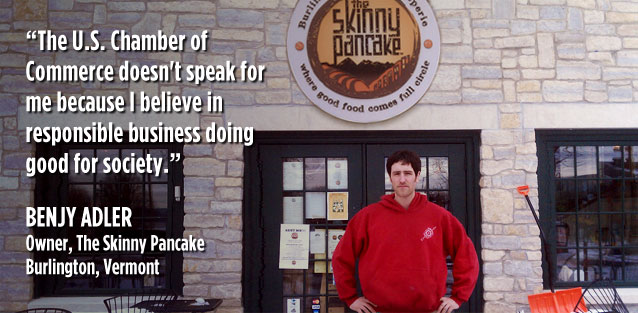
2011-03-22-skinnypancake.jpg

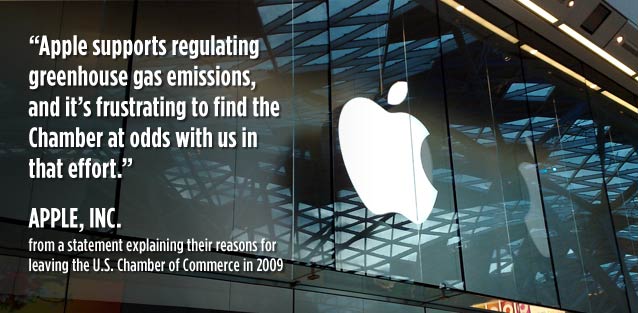
That's why thousands and thousands of American businesses concerned about our energy future have already joined a new campaign, declaring that "The US Chamber Doesn't Speak for Me." They want to draw a line between themselves and the hard-right ideological ineptitude that is the U.S. Chamber. Some of those businesses are tiny -- insurance brokers in southern California, coffee roasters in Georgia, veterinarians in Oklahoma -- and some are enormous. Apple Computer, for instance, which has... a pretty good record of seeing into the future.

2011-03-22-apple.jpg

There's only one reason anyone pays attention to the U.S. Chamber, and that's their gusher of cash. But the Chamber turns 100 next year, and it's just possible that a century of dumb decisions will outweigh even that pile of money. If you're trying to figure out the future, study the U.S. Chamber -- and go as fast as you can in the opposite direction.

.