Showing posts with label HECO. Show all posts

Bad Energy in Hawaii

SUBHEAD: Hawaii Public Utility Commission reality check in post HECO-NextEra merger environment.

By Henry Curtis on 26 May 2016 for Ililani Medoa -
(http://www.ililani.media/2016/05/puc-reality-check-post-heco-nextera.html)


Image above: Hawaiian Electric Industries President and CEO Connie Lau stands with Jim Robo, CEO of NextEra Energy announcing takeover plan in January. From (http://www.bizjournals.com/pacific/news/2016/01/11/nextera-s-purchase-of-hawaiian-electric-won-t.html).

[IB Publisher's note: The PUC and Hawaii Electric Industries have been pulling the state in the wrong direction for some time. Bringing in cut-throat NextEra energy company and importing Liquid Natural Gas (LNG) from fracked wells in British Colombia and Alberta is not a solution to an energy problem but a boondoggle and risk to the environment of Hawaii.]

Bloomberg News announced on May 24 that NextEra Energy Inc.’s proposed $4.3 billion takeover of Hawaiian Electric Industries Inc. is looking increasingly less likely as the company gets a new chance to buy Oncor Electric unit of Energy Future Holdings Corp, the largest power distributor in Texas.

Hawaiian Electric Industries CEO Connie Lau, HEI Chief Financial Officer James Ajello, and the then NextEra Vice Chairman and CFO Moray Dewhurst offered contradictory statements and testimony regarding the $90-95 million breakup fee that NextEra may pay to HEI if the deal is not approved by June 3, and NextEra were to walk away from the deal.

The money would go to HEI and its shareholders, not HECO and its ratepayers.

The breakup language is an extremely complex document written by lawyers.

The Hawaii Public Utilities Commission was widely expected to issue a decision in the late summer or fall of 2016. PUC staff lawyers, economists and accountants are pouring through the 110,000-page record

With the announcement of the potential breakup, the PUC can suspend their analysis for a few weeks to see if the breakup really happens.

During the next few weeks the PUC can put greater effort on two major efforts underway:
  • The evaluation of the HECO Companies Power Supply Improvement Plans (PSIPs) which state alternative plans for the utility between now and 2045.
  • PUC's Distributed Energy Resources (DER) Working Group which is seeking to advise the Commission on ways of increasing rooftop solar penetration, while accounting for interconnection standards, safety, reliability, and rate structures.
The Commission can also focus on the HECO dockets opened in the last six months which have yet to really start.

Issue
Docket
HECO`s Utility-Scale Community-Based Renewable Energy Application
2015-0389
A HECO-designed special time-of-use rate structure for the Department of Education
2015-0410
HECO Companies Demand Response Program
2015-0412
An updated Power Purchase Agreement between HECO and the 200MW AES coal-burning facility in Campbell Industrial Park
2016-0007
HELCO purchase of Hamakua Energy Partners generator
2016-0033
HECO`s proposed $736.0 million Smart Grid (which includes ten inter-related and/or independent subcomponents
2016-0087
HECO`s proposal to import largely fracked Liquefied Natural Gas (LNG) from British Columbia at a cost of $459.3 million
2016-0135
HECO`s request for a waiver from Competitive Bidding for a new Kahe generation facility
2016-0136
HECO`s proposed $859.0 million Kahe Power Plant
2016-0137


The PUC “regulates 1625 entities, which includes all chartered, franchised, certificated, and registered public utility companies that provide electricity, gas, telecommunications, private water and sewage, and motor and water carrier transportation services in the State.”

Earlier this month, Sandwich Isles Communications and Pa Makani LLC, dba Sandwich Isles Wireless filed applications with the PUC to renew their Annual Certification as an Eligible Telecommunications Carrier.

For the past two decades the Hawai`i Department of Hawaiian Home Land has given the politically connected Sandwich Isles, the exclusive rights to provide phone service for new customers on Hawaiian Home Lands.

The Federal Communications Commission provided Sandwich Isles, $830 per customer per month from the Universal Service Fund to subsidize phone service.

Earlier the year Federal Judge Susan Oki Mollway gave Sandwich Isles President Albert S.N. Hee a 46-month sentence for providing “false” salaries to family members, college tuition for his children, family vacations, massages and dozens of other personal expenses. Al Hee is the brother of former State Senator Clayton Hee.


HECO to import Canadian LNG


SUBHEAD: research confirms a link between fracking and almost every large induced earthquake in B.C.

By Henry Curtis on 25 May 2016 for Ililani Medoa -
(http://www.ililani.media/2016/05/heco-proposal-to-import-canadian-lng-is.html)


Image above: A LNG tanker ship at port. From (http://www.marinetraffic.com/en/photos/of/ships/shipid:370522/#forward).

Hawaiian Electric Company has signed a Fuel Supply Agreement with Fortis Hawaii Energy Inc., a subsidiary of Fortis Inc., headquartered in Newfoundland, Canada.

The gas would be exported from their facility on Tilsbury Island in British Columbia.

The facility is about twenty miles north of the U.S. Border and twenty miles south of Vancouver. The deal must be approved by the Public Utilities Commission.

Importing LNG would require a vast infrastructure overhaul. HECO asserted they will need to spend $859 million building the new Kahe generator facility and another $459.3 million on the LNG system.

Ronald Cox, HECO`s Vice President for Power Supply, submitted testimony in the LNG application which stated that the importation of LNG has a double condition, requiring approval of both the HECO-NextEra merger and the Kahe combined cycle facility.

HECO asserted that LNG “burns cleaner,” and it is “the lowest cost alternative for compliance with future environmental regulatory requirements.”

Life of the Land became the first group to file a Motion to Intervene in the proceedings. Their 383-page motion detailed the problems from importing gas from British Columbia.

CBC News reported that the British Columbia Oil and Gas Commission confirmed the 4.4-magnitude earthquake in 2014 was "triggered by fluid injection during hydraulic fracturing," making it one of world's largest earthquakes ever triggered by the controversial fracking process."

Canadian Earthquakes are different from American Earthquakes according to a scientific article in the current issue of Seismological Research Letters, published by the Seismological Society of America.
“In the central United States, most induced seismicity is linked to deep disposal of coproduced wastewater from oil and gas extraction.

In contrast, in western Canada most recent cases of induced seismicity are highly correlated in time and space with hydraulic fracturing, during which fluids are injected under high pressure during well completion to induce localized fracturing of rock.

Furthermore, it appears that the maximum-observed magnitude of events associated with hydraulic fracturing may exceed the predictions of an often-cited relationship between the volume of injected fluid and the maximum expected magnitude.”

Canada’s #1 national newspaper, the Globe and Mail, reported that the report “looked at 12,289 fracking wells and 1,236 waste-water wells in an area along the B.C.-Alberta border.” The regulating agency responded, “the BC Oil and Gas Commission says the research does not raise any safety concerns.”

"There's bad news and good news when it comes to fracking and earthquakes in Western Canada, according to new research from a paper co-authored by a Geological Survey of Canada scientist,: according to CNC News.

"The new research confirms a definitive link between hydraulic fracturing and almost every large induced earthquake recorded in B.C. and Alberta's oil and gas patches since 1985.

In other words, scientists now have evidence that 90 per cent of seismic events over magnitude 3.0 that shook the region were triggered by crews fracking for oil and gas underground."

The Council of Canadian Academies published “Environmental Impacts of Shale Gas Extraction in Canada: The Expert Panel on Harnessing Science and Technology to Understand the Environmental Impacts of Shale Gas Extraction.”

The report was misrepresented in HECO`s application which basically asserted that the analysis found no problem. Actually the 292-page report found a lack of data and analysis.

The report noted that Canada is “the world’s third-largest natural gas producer, fourth-largest exporter, and possessing vast shale gas resources of its own, Canada has a major stake in this new source of energy."

“The Council of Canadian Academies was asked by the federal Minister of Environment to assemble an expert panel to assess the state of knowledge about the impacts of shale gas exploration, extraction, and development in Canada.

In response, the Council recruited a multidisciplinary panel of experts from Canada and the United States to conduct an evidence-based and authoritative assessment supported by relevant and credible peer reviewed research.

As with all Council panels, members were selected for their experience and knowledge, not to represent any particular stakeholder group. The report does not include recommendations, since policy prescription falls outside the Council’s mandate.”

The Report detailed the nature of the shale deposits and the problems that exist.

"The rapid expansion of shale gas development in Canada over the past decade has occurred without a corresponding investment in monitoring and research addressing the impacts on the environment, public health, and communities."

"The primary concerns are the degradation of the quality of groundwater and surface water (including the safe disposal of large volumes of wastewater); the risk of increased greenhouse gas (GHG) emissions (including fugitive methane emissions during and after production), thus exacerbating anthropogenic climate change; disruptive effects on communities and land; and adverse effects on human health.

Other concerns include the local release of air contaminants and the potential for triggering small- to moderate-sized earthquakes in seismically active areas."

"These concerns will vary by region. The shale gas regions of Canada can be found near urban areas in the south and in remote regions in the northwest, presenting a large diversity in their geology, hydrology, land uses, and population density."

"The phrase environmental impacts from shale gas development masks many regional differences that are essential to understanding these impacts.”

The Pembina Institute was formed following the 1981 Lodgepole sour gas accident in Alberta, which killed two people and polluted the air for weeks. A small group of rural Albertans came together to secure tougher regulations for drilling sour gas wells, and later went on to form the Pembina Institute.

"We conclude that natural gas has a role to play in a world that avoids 2°C of warming, but that role is unlikely to materialize unless shaped by strong climate change policies in the jurisdictions that produce and consume the gas. Because these policies are not currently in place, claiming that natural gas, and specifically LNG from BC, is a climate solution is inaccurate."

The British Columbia government believes greenhouse gas “targets for 2020 will be extremely difficult to meet.” Therefore, provincial standards have been abandoned and instead future national standards will apply.

Climate Change News reported earlier this year that “British Columbia’s carbon pollution is going up while five other Canadian provinces are bringing their greenhouse gas emissions down.”
The Convention on Wetlands, called the Ramsar Convention, is an intergovernmental treaty that provides the framework for national action and international cooperation for the conservation and wise use of wetlands and their resources.

Among the 2,240 Ramsar Sites located around the world are Kawai Nui and Hamakua Marsh on Windward O`ahu and the lower Fraser River Delta. The Fortis facility at Delta on Tilsbury Island, British Columbia site is wholly within the lower Fraser River Delta Ramsar site. This site will be expanded to handle exports to Hawai`i.

A report by geoscientist David Hughes asserted that it includes “poisoned water wells, containment ponds that leaked their deadly post-fracking contents into rivers killing fish, and municipal wastewater plants damaged by the industry's corrosive wastewater.”

The report notes fracking occurs in “nearly 90 per cent of all new gas wells in B.C.”

.

NextEra & Heco play the PUC

SOURCE: John Bond (ewabond@gmail.com)
SUBHEAD: Inexplicably, the Hawaii Consumer Advocate has given NextEra an opportunity to file more direct testimony.

By Henry Curtis on 21 August 2015 for Ililani Media -
(http://ililanimedia.blogspot.com/2015/08/salvaging-heco-nextera-train-wreck.html)


Image above: Photo shows signs of degrading concrete at the aging Seabrook power plant in New Hampshire operated by NextEra. They sold off $760 million of hydro-electric power owned by Seabrook upstream of its cooling water reservoir in order to "concentrate" on "areas with greater growth potential." From (http://enformable.com/2012/04/nextera-and-nrc-to-continue-monitoring-asr-degradation-at-seabrook-station-nuclear-power-plant/).

The Hawaii Public Utilities Commission (PUC) is conducting a contested case proceeding involving NextEra's proposed takeover of the Hawaiian Electric Companies (HECO and subsidiaries MECO and HELCO). The Consumer Advocate is by law a party to the proceedings. The Commission also granted party status to twenty nine intervenors, of whom one has withdrawn.

Twenty eight intervenors from all sectors of society submitted direct testimony in the merger proceedings. All of the intervenors asserted that NextEra's bid to takeover HECO is a bad deal as it is currently configured.

The intervenors include three levels of government (federal, state and county) and three utilities (water, gas and electric). The intervenors include a union, environmental and cultural groups, trade groups, and renewable and fossil fuel companies. (See analysis of testimony from Maui County, Hawaii County, Office of Planning, DBEDT, Department of Defense)

The Governor then asserted that the deal was bad. “We are taking the position that the merger as proposed at this point is unacceptable.”

Three weeks later the Consumer Advocate filed their testimony. Almost every news agency concluded that the Consumer Advocate agreed with all other consumers, the deal is bad. This blog asserted that the Consumer Advocate's testimony could be interpreted as laying out the path towards making the deal acceptable. (Consumer Advocate: Hedging their bets regarding the merger)

On August 31 NextEra will file their rebuttal testimony. By law they must restrict their filing to rebutting adversarial testimony. They may not file responses that supports or reinforces friendly testimony. They may not file new direct testimony.

On August 19, 2015, one month after the 28 intervenors filed their direct testimony, one week after the Consumer Advocate filed their direct testimony, and 12 days before NextEra has to file their rebuttal testimony, the Consumer Advocate has given NextEra an opportunity to file more direct testimony.

The Consumer Advocate is proposing a new procedural step, number five.

1
Applicants’ Direct Testimony
2
Intervenors Direct Testimony
3
Consumer Advocate’s Direct Testimony
4
Applicants’ Responsive (Rebuttal) Testimony
5
Applicants’ New Testimony

The Consumer Advocate wants NextEra CEO Jim Robo and Hawaiian Electric Industries CEO Constance "Connie" Lau to become witnesses.

"Mr. Robo possesses knowledge and information that only he can know and possess concerning the circumstances, events, rationale, and reasoning that resulted in NextEra deciding to acquire the Hawaiian Electric Companies.

Consequently, Mr. Robo, through his personal appearance and testimony, would provide information, evidence, and exchanges which are material and relevant to the issues and questions raised by the Commission."

"Constance H. Lau serves as the President and Chief Executive Officer of HEI. In her capacity as President and Chief Executive Officer of HEI, Ms. Lau made critical decisions that resulted in the merger agreement for acquisition of the Hawaiian Electric Companies by NextEra.

Accordingly, Ms. Lau possesses knowledge and information that only she can know and possess concerning the circumstances, events, rationale, and reasoning that resulted in NextEra’s decision to acquire the Hawaiian Electric Companies."

The Consumer Advocate is not asking for the right to file Information Requests upon two people with key knowledge of the proposed merger. Instead they are asking for the right "to take testimony."

"The Consumer Advocate hereby informs the Commission that it has provided written notice ...to James L. Robo and Constance H. Lau indicating the Consumer Advocate’s intent to take testimony by deposition upon oral examination.

The Consumer Advocate notes that the Commission’s rules do not provide specific procedures or guidance related to the taking of depositions, thus ...if the Commission deems necessary, the Consumer Advocate seeks an order requiring that the following individuals be made available for oral deposition."

On the one hand the two witnesses could reinforce what is already known. The deal is bad and should be rejected. But the record already contains tens of thousands of pages that comes to that conclusion. So say 28 intervenors and the Governor. Additional testimony is not needed.

Or the Consumer Advocate could be trying to find a way to salvage the deal.

Historically, in PUC administrative proceedings in which intervenors were permitted into a regulatory proceeding by the PUC, the Consumer Advocate has signed a settlement agreement with the utility prior to the Evidentiary Hearing. The Consumer Advocate and the utility have agreed not to question each others witnesses.

In many of these cases the Consumer Advocate has taken positions that appeared to be more hard-lined than the utility, that is, the utility position is more reasonable.

In this case, Robo and Lau would be entering direct testimony into the record after the deadline for the intervenors to file their testimony. It could either do little or could tilt the playing field against the public and interfere with the due process rights of intervenors.


$1 Billion hit seen for Ratepayers
SUBHEAD: Nextera using cost control gimmick to soak ratepayers in Hew Hampshire.

By Dave Solomon on 13 Janury 2015 for N.H. Union Leader - 
(http://www.unionleader.com/article/20150201/NEWS05/150209956/0/NEWS02)


Image above: NextEra's website's touched-up idyllic shot of their Seakbrook nuclear plant - the same kind of General Electric boiling water reactors that were built at Fukushima Daiichi, Japan and now poisoning the pacific Ocean.


New England ratepayers will soon be on the hook for a new transmission project that could cost as much as $1 billion when all costs are in, with two energy giants competing for the opportunity. In an unusual move for the regulated utility business, one has guaranteed to get the project done within its bid price, or make up the difference.

A decision by the organization that runs the New England power grid, ISO-NE, is due on February 18th, and the lobbying is reaching a fever pitch. New Hampshire and three other New England states recently urged ISO to consider the cost guarantee in its deliberations.

The upcoming decision on the Greater Boston and Southern New Hampshire Reliability Project is being carefully watched in the six-state region. The outcome could do more than decide who gets to build new and much-needed transmission lines, and collect a guaranteed return of about 10 percent in the process.

It could change the way transmission projects are evaluated to the benefit of ratepayers, according to a wide range of voices that have weighed in on the process.

In one corner stands PSNH owner Northeast Utilities, its partner National Grid, and their AC Plan (for alternating current).

In the other corner is the Florida-based challenger, Nextera - an outgrowth of Florida Power and Light - owner of the Seabrook Station nuclear power plant. Nextera has created a subsidiary - New Hampshire Transmission - to develop, build and manage their project, called SeaLink.

The AC Plan calls for new overhead lines in existing rights of way through Tewksbury, Andover and Dracut, Mass., and Pelham, Hudson, Windham and Londonderry; two new underground cables through several Massachusetts communities, including Boston; and upgrades to existing lines.

The SeaLink plan calls for 68 miles of direct current cable running mostly along the ocean floor, from Seabrook Station to the Mystic substation in Everett, Mass., with 18 miles of line on land buried underground and upgrades to existing lines.

Cost analysis in dispute
Whichever project is approved will be deemed necessary for grid reliability and could obtain property by eminent domain if necessary. But neither the AC Plan nor the Sea Link plan require land-taking, as one relies on existing rights of way and the other is under water or underground.

The biggest issue is cost. And on that score, things are not looking so good for the SeaLink proposal. An independent study of both proposals commissioned by ISO was released in November, and concluded the AC Plan would cost $510 million, compared to $770 million for SeaLink. Both require an additional $221 million in upgrades to existing transmission lines.

The ISO decision on such a project can be nuanced by various factors when the cost estimates are fairly close, according to ISO officials, but when the gap is so wide, cost becomes a pre-eminent factor.

In a letter to SeaLink in December, the ISO outlined eight different criteria it could use in evaluating the two projects, but then went on to say, "However, these factors are typically only utilized where costs are comparable. Where there is a significant cost gap, and each project addresses the identified needs, the ISO will normally make its determination ... based on estimated project costs."

The SeaLink team says the consultant's evaluation was flawed - that the AC Plan costs are under-stated and the SeaLink estimate inflated.

New Hampshire Transmission has taken the unusual step of guaranteeing in writing to ISO that it will build the SeaLink project for $679 million, and will take responsibility for every dime over that amount, according to Matt Valle, NHT president.

That's still more than the $510 million estimate for the AC Plan, but the folks at NHT are claiming it's unlikely the AC Plan will come in at that cost, given what they called a history of cost-overruns on transmission projects in New England.

Late last week, they presented ISO with an analysis of power line projects from 2004 through 2012, claiming that 11 projects by NU or National Grid estimated to cost a combined $2.2 billion ended up costing ratepayers $3.9 billion.

Cost-cap called gimmick
Spokesmen for NU and National Grid disputed that analysis. "We have no idea where those NHT numbers come from," they wrote in an email. "NHT has previously made statements and allegations based on their assumptions about our proposed solution that we have shown to be factually incorrect."

Whatever the cost overruns were, the ratepayers took the hit.

As long as regulators deem the costs were "prudent," utilities are free to exceed their estimates by any amount, and the result is reflected in rates. That puts all the risk on ratepayers, and none on the project builders, according to Valle.

"Until we put this offer on the table, customers were bearing the full risk of cost overruns," he said, "which we demonstrate in our analysis happens a lot in New England."

NU spokesman Martin Murray said the NU/National Grid consortium has no plan to put a cost-containment proposal on the table.

"We really think that this so-called cost cap that they have proposed is a gimmick or an artifice to distract from the fact that there is a quarter of a billion dollar price gap between the two sets of solutions," he said. "ISO doesn't have a process by which it can consider that sort of letter."

And that's the rub, according to a wide range of regulators and governmental officials at the local and state level who have weighed in on the process over the past year. (See related story)

"This idea of transmission projects having cost containment is not new in the industry," said Valle. "It's being done in California, New York and in the (13-state) PJM market. Entities are proposing cost-containment and have been selected on that basis. There is no gimmick here."

Michael Harrington, a former Public Utilities commissioner for New Hampshire and now a private energy consultant, has had a behind-the-scenes look at the transmission construction process, which he said is rife with cost overruns. "The estimates are routinely way short of actual costs and there is no penalty," he said. "It's a huge amount of money ... billions of dollars in New England."

.

Klein at UH on HECO

SOURCE: Ed Wagner (ed.j.wagner@gmail.com)
SUBHEAD: Author Naomi Klein delivers inspiring speech at University of Hawaii faulting HECO for blocking solar energy.

By Nathan Eagle on 26 February 2015 for Civil Beat -
(http://www.civilbeat.com/2015/02/renowned-climate-change-author-faults-heco-for-blocking-solar/)


Image above: From (http://www.theguardian.com/books/naomi-klein).

Award-winning journalist Naomi Klein blamed Hawaiian Electric Co. for limiting the progress of solar energy during a motivating speech Thursday evening at the University of Hawaii.

Klein, the author of the New York Times bestseller “The Shock Doctrine: The Rise of Disaster Capitalism,” packed not one but two auditoriums on campus. The overflow crowd watched a live video of her on a giant screen in one room as others watched live in another room.

“The profit motive is getting in the way of the transition that people want here,” Klein said, garnering applause.

She also stressed the need for the state to avoid getting hooked on liquefied natural gas, something HECO and politicians are moving toward despite all the warnings.

Rep. Cynthia Thielen introduced a measure to block LNG, noting the $200 million price tag to switch to a foreign-supplied fuel. Her bill stresses the need to put that money toward renewables, but it never received a hearing in the Legislature before dying this session.

She covered a wide range of topics related to climate change and capitalism during her talk, which wrapped up with a Q&A session. She touted recent successes on the national level, such as President Obama vetoing the Keystone pipeline bill, and the local level, like Maui voters passing a ballot measure to place a moratorium on GMO farming despite seed companies spending millions of dollars to defeat it.

Klein has been serving as the Dai Ho Chun distinguished chair in Arts & Sciences at UH Manoa. Her speech centered on the theme of new book, “This Changes Everything: Capitalism vs. The Climate,” another bestseller.

Her speech is expected to be aired multiple times on Olelo Community Media TV stations.


HECO must be non-profit

By Ed Wagner on 27 February 2015 in Island Breath - 
(http://islandbreath.blogspot.com/2015/02/klein-at-uh-on-heco.html)


Video above: This Changes Everything: Capitalism vs the Climate - Naomi Klein's book trailer. From (https://www.youtube.com/watch?v=WPQI1Lui42c).  Is Earth Fucked? The answer is a resounding YES!

This is what both HECOgate and HARTgate have done to us and will continue to do to us if HECO is not converted to public, non-profit power, and heads rolled at HART and the City Council, and the responsible individuals sent to prison for their crimes against the people and against Mother Earth because of their insatiable lust for and idolatry or worship of money as the sole source of gratification in life.

These people have sold their souls to the devil. The economies of the world and the Earth itself are being destroyed by rampant and uncontrolled capitalism with the goal of money at all costs.

The ratepayers must organize a massive march and rally at the Capitol to stop this madness before it is too late.

Ms. Klein's book should be required reading for the PUC, DCA, Governor, Legislature, Energy Administrator, AG, city and state Ethics Commissioners, Mayor and City Council on all islands and more.

“The profit motive is getting in the way of the transition that people want here,” Klein said, garnering applause.

This is precisely the reason why the HECO monopoly is a very serious threat to state and national security.

http://www.hawaii.edu/calendar/manoa/2015/02/26/25395.html?et_id=33438
http://www.naomiklein.org/main

.

Ugly path for Oahu Rail

SUBHEAD: Plans for past and future railroads on Oahu cuts out community in favor of DOT and HECO.

By John Bond on 30 May 2014 for Kanehili Cultural Hui -
(http://www.hawaiifreepress.com/ArticlesMain/tabid/56/ID/9801/New-AIS-Testimony-Rail-Route-Illegally-Damages-Hawaiian-Cultural-Properties.aspx)


Image above: Rendering of the projected Honolulu Rail station at King and University by an unnamed architect. From (http://www.honolulutraffic.com/enviro1.htm).

Numerous groups and organizations submitted comments and testimony on the 22 mile Honolulu Rail Archaeological Impact Statement (AIS) to the State Historic Preservation Division (SHPD) to meet the May 30th Deadline. The new AIS comment period had been extended because of last year's Hawaii Supreme Court ruling that the rail AIS cannot be done in phases or segments.

The previous 2009 AIS omitted a great deal of valid cultural information, many groups were not consulted, and data was skewed to fit a 'rush-to-begin-building-the-rail' agenda, rather than any attempt at honest historic and cultural preservation. The law finally caught up with them.

In his ruling, Federal Judge Wallace Tashima made a special point of noting his concern about the identification of Traditional Cultural Properties (TCPs) along the HART rail route. It was later made clear in recent HART meetings that TCP's include all cultures, not just native Hawaiian, as per federal law.

HART is required to also adhere to Department of Transportation Act of 1966 special provision - Section 4(f) - which stipulates that US DOT agencies-including the Federal Transit Administration (FTA), cannot approve the use of land from wildlife and waterfowl refuges or public or private historical sites unless both of the following conditions apply:
  • There is no feasible and prudent alternative.
  • The action includes all possible planning to minimize harm to the property resulting from use.
Hawaiian Cultural Practitioner Mike Lee, along with Hawaii Thousand Friends, submitted approximately 800 pages of detailed comment and testimony on the the HART Rail AIS covering the entire 22 mile route. This package included maps, photographs, emails with many agencies (HART, SHPD, DLNR, BLNR, Oahu Burial Council, HCDA, etc.) that go back nearly a decade, as well as news articles, historic research and citations, legal documents and filings, native Hawaiian rights, the Clean Water Act, and much more.

A key issue for Lee is the identification of the ancient coral reef limestone along the Oahu shoreline known as Karst, which connects volcanic mountain lava tube water to the shoreline Karst reef water systems. These water springs feed a shoreline ecosystem and was how ancient Hawaiians managed their fish ponds. The Karst was also of very high spiritual importance to ancient Hawaiians and used for sacred burials, such as downtown Honolulu on the grounds of I'olani Palace where there is an ancient Karst burial cave.

"I wanted them to know that I wasn't just making this up ten minutes ago" said Lee. "I am a Konohikist- I believe in the ecological management and protection of our very important natural island water systems. Protecting our Wahi Kapu sites is also very important to me."

Lee's testimony concerns identification and protection of important Hawaiian cultural sites along the rail route, including wahi pana (sacred sites) and wahi kapu (sacred burial areas) and their inclusion into a TCP (Traditional Cultural Properties) that would make sure these special sites, caves, caverns, springs, ponds and water systems are preserved and not contaminated during rail construction.

Also included were photographs of Kawaiaha'o Church which is a graphic example of early Karst limestone block construction. The church and surrounding walls are made of rough ancient reef from the shoreline and ancient sea shells and marine organisms can be clearly seen. The church is also located on the site of an important ancient Karst spring. Nearby I'olani Palace and the royal guard barracks are also constructed from Karst limestone blocks from the shoreline.

In addition, Kanehili Cultural Hui also submitted another approximately 250 pages of detailed comment and testimony on the the HART Rail AIS- primarily concerned with the Honouliuli-Ewa area and the documentation of previously unidentified Traditional Cultural Properties (TCP), Ewa Historic Districts, Ewa Dec 7, 1941 Battlefield Area and an outline for a Honouliuli-Ewa Cultural Landscape Report.

Many current or former Ewa Village residents helped by supplying historic documents, maps, photos and oral histories. The Kanehili Hui name comes from the original Hawaiian name for the Honouliuli-Ewa area and is mentioned by Hawaiian goddess Hi'iaka in her famous and often quoted chants when she traveled through the Ewa Plains area aprroximately 1000 years ago.

The Kanehili Cultural Hui 501-c-3 non-profit community organization is concerned with the entire cultural history of the area- from ancient times to modern times.

A key focus of the Kanehili Cultural Hui report and testimony was on the 1825 Malden Trails (ancient Hawaiian Trails- believed to have possibly been originally constructed by very early Tahitian arrivals to Kanehili) which played a major role in the Hawaiian cultural history of the Honouliuli-Ewa area, and which was entirely left out of the HART Rail AIS.

The fixed guideway and stations directly overlay the 1825 trails as well as the Kalo'i Karst waterway that flows to the Ewa shoreline.

Also of major importance is the identification and location of the Leina a ka Uhane, a sacred spiritual leaping off place for souls returning to the ancient homeland of Tahiti. This is a National Register eligible TCP, yet HART and the SHPD administrator has continuously tried to minimize the importance and geographic area of this TCP as well as apparently intentionally misidentify its location, despite the error being brought to their attention several times since last year.

The previous Rail AIS also failed in many ways to adequately document important Honouliuli-Ewa cultural sites such as the greater Ewa Plantation and railway network that was the largest private railway in Hawaii. The Oahu Railway that served Honouliuli-Ewa plantation railway was chartered under King David Kalakaua.

A Cultural Landscape Report (CLR) is the primary report that documents the history, significance and treatment of a cultural landscape. A CLR evaluates the history and integrity of the landscape including any changes to its geographical context, features, materials,and use.


HCDA ignores Community
SUBHEAD: Kalaeloa HCDA project in Ewa is 100% Developer Driven and 0% Community Oriented.

By John Bond on 30 May 2014 for Kanehili Cultural Hui - 
(http://islandbreath.blogspot.com/2014/05/ugly-path-for-oahu-rail.html


Image above: The Hawaiian Rail Society operates the only railroad museum on Oahu in  Ewa. From (http://www.honolulutraffic.com/enviro1.htm).

So the Hawaii Hawaii Community Development Authority (HCDA) runs away from promised local community briefing. Too much explaining to do having missed so MANY neighborhood boards meetings!

National Register Hawaiian sites and Ewa Battlefield IMPACTED by HCDA-HECO industrial power line without any community involvement or Environmental Assessment comments (by design of course).

Prison is against HCDA Master Plan. Power line is against Kalaleoa Master Plan, City Design rules, historic Hawaiian Railway faces decimation.

HCDA almost never tell the boards ANYTHING until the community hears about it as a done deal in the news. Local political reps have no idea what is really going on but love touting big local CIP projects in news letters...

State Highway will destroy historic Hawaiian Railway operations. Feds say it cannot be built as planned, but HCDA, State Reps, DOT and City Reps remain intentionally clueless and DEAF. None of them want to know what the local community thinks- just hand out newsletters and leave.

Usual HCDA tactics to not tell the community what is going on and avoiding the community neighborhood board process to break Federal NRHP and NEPA law for insider HCDA developers. Only option are LAWSUITS? Who cares, tax-payers pay for them ANYWAY!

$15 Million North South Road being rammed through by HCDA and State DOT despite opposition by Hawaiian Railway Society. Local reps remain completely confused and clueless about the important issues involved.(Their only role are photo ops and handing out community certificates?)

Local reps are completely confused about what Environmental Assessment and Power Line HCDA is actually paying HECO to put in (and WHY). They keep referring to 2011 project because HCDA has never told anyone about the 2014 project that has been kept SECRET (unless you know where to look) to prevent community comments. (HCDA only wants DEVELOPER comments...)

Important Hawaiian sites being bulldozed for HCDA PV farm but all is hushed up...This is the Wild West Oahu where historic, cultural and environmental laws don't apply...


.

Attack against Hermina Morita

SUBHEAD: Governor Neil Abercrombie plays politics with Hawaii electric monopoly and PUC future. 

By Henry Curtis on 11 March 2014 for Ililani Media -
(http://ililanimedia.blogspot.com/2014/03/the-attack-against-hermina-morita.html)


Image above: One of two cabins owned by Morita that are for rent in Hanalei Valley. From (http://www.flipkey.com/hanalei-cottage-rentals/p326827/).

  • Probe targets Hanalei B&B: PUC chair’s North Shore vacation spot built in protected wetlands. (The Garden Island, March 11, 2014)
  • Targeted Enforcement Is this targeting of Morita a political hit? (KauaiEclectic, March 11, 2014)

Hermina “Mina” Morita was elected to the State House in 1996. In her re-election campaign in 1998 the Honolulu Star Bulletin described her as “a staunch environmentalist and opponent of commercial boating in the Hanalei River.”

From 1999 to 2011 Morita chaired the House Energy and Environmental Protection Committee.

In 2011 Governor Abercrombie appointed Mina Morita as Chair of the Public Utilities Commission; to serve out the last three years of Les Kondo’s six year term.

In 2008 Hanalei River boatyard owner Mike Sheehan reportedly filed an “anonymous” complaint against Lance Laney and his wife Hermina Morita.

On August 20, 2013 Gov. Neil Abercrombie appointed Patricia W. Sheehan, the ex-wife and current business partner of Mike Sheehan to the Hawaiian Homes Commission.

In October 2013 Honolulu attorney Les Iczkovitz, representing unnamed Hanalei residents, wrote a letter to Gov. Neil Abercrombie and DLNR Director William Aila, regarding whether Lance Laney and his wife Hermina Morita were engaged in illegal affairs.

“If Ms. Morita and Mr. Laney actually built an illegal second residence, in the middle of a wetland on their property, without proper permits, so close to Hanalei River, one might suspect that this illegal building may have contributed to the 1995 flood event, and the ongoing breaching of the stream bank,” Iczkovitz wrote.

In a December 16, 2013 letter, William Aila wrote a letter to Mr. and Mrs. Laney which outlined the state’s allegations.

Starting in December Mike Sheehan sent out email blasts accusing Morita and Laney of operating an “illegal B&B.”

KauaiEclectic blogger Joan Conrow wrote that the anonymous complaint to DLNR probably came from Mike Sheehan.

On January 3, 2014 DLNR sent a certified letter to Laney and Morita in which they were notified of the violation.

In January rumors began to circulate about Morita not being reappointed to the Public Utilities Commission.

On January 22, 2014 Ililani Media, backed by four independent sources, broke the story that Governor Abercrombie had decided not to reappoint Hermina Morita to the Public Utilities Commission for a term ending in June 2020.

On January 22, 2014 Ililani Media wrote a column about the career of Hermina "Mina" Morita.

In early February Hermina Morita began to confide in people that the Governor had decided to give her the position of Director of the Office of Environmental Quality Control (OEQC).

On February 22, 2014 Civil Beat became the second media outlet to write that Morita was not going to be reappointed to the PUC.

“Word has it that Mina was offered the ‘soft landing’ of running the Office of Environmental Quality Control if she agreed to step down as PUC chair. But when Mina declined, Rep. Jessica Wooley was sent instead to the political version of Siberia and another way was found to tighten the screws on Mina,” according to KauaiEclectic blogger Joan Conrow.

On February 24, 2014 Babes Against Biotech announced on their Facebook page that Governor Abercrombie had decided to appoint State Representative Jessica Wooley to be head of the Office of Environmental Quality Control (OEQC).

On March 6, 2014 the Governor confirmed the Babes Against Biotech announcement with the issuance of a press release announcing that Jessica Wooley would be the new OEQC Director.

As KauaiEclectic pointed out, operating an illegal Transient Vacation Rental (TVR) unit was not a concern when Morita was first appointed PUC Chair, nor when the Governor named Mike Wilson to the Hawaii Supreme Court.

Furthermore, there are several major illegal rental units on conservation land in Haena and other areas near Hanalei that are also not being targeted.

KauaiEclectic wrote, “It looks like Kauai's Mina Morita, chair of the Public Utilities Commission, is the target of a political hit.”

According to The Garden Island, the complaint against Morita and Laney will be brought before the BLNR at their March 28, 2014 hearing.


Image above: The other of two cabins owned by Morita that are for rent in Hanalei Valley. From (http://www.flipkey.com/hanalei-cottage-rentals/p326827/).

From the cottage rental website comes this:

The Hanalei Taro Patch Cottages are located on three acres of land at the end of Ohiki Road in the Hanalei Homesteads. The land is zoned as conservation land and is further designated in the Protective Subzone. There appear to be no other vacation rentals within the Hanalei Homesteads. The units start at $130 per night.
  • Two Secluded cottages nestled in the Serene setting of peaceful Hanalei Valley
  • Total serenity & beauty surround you in these two Hawaiian style cottages: Rainbows, Waterfalls & lush tropical foliage abound
  • Hale Lii & Hale Nui: both studio cottages : large lanais where you can relax sipping a cocktail or morning coffee while gazing at the beauty of the Hanalei mountains
  • Hike Nature Conservation land right outside the cottages
  • Queen beds, kitchens, lovely outside showers, wireless & more

The fabled Hanalei Valley is one of the most revered and treasured of all the valleys on Kauai; a place where the sacred Taro plant has been cultivated for eons. Today still, the Taro is grown and harvested in the valley and these two cottages are the only ones in the valley.

Feel the mana (grace) and beauty of this timeless place; travel back in time to a gentler, slower pace, truly relax.

We have been blessed to live on this land for over 30 years. We now offer our two cottages so that guests may come and experience the beauty and peace of the land. Yet it is only 5 minutes to Hanalei bay and the other gorgeous beaches of Kauai’s North Shore. PUC chairwoman investigated for illegal rental operation - Hawaii News - Honolulu Star-Advertiser

http://www.staradvertiser.com/news/breaking/20140311_PUC_chairwoman_investigated_for_illegal_bed_and_breakfast_operation.html?id=249573021


In 2008 Hanalei River boatyard owner Mike Sheehan reportedly filed an “anonymous” complaint against Lance Laney and his wife Hermina Morita.

On August 20, 2013 Gov. Neil Abercrombie appointed Patricia W. Sheehan, the ex-wife and current business partner of Mike Sheehan to the Hawaiian Homes Commission.

As KauaiEclectic pointed out, operating an illegal Transient Vacation Rental (TVR) unit was not a concern when Morita was first appointed PUC Chair, nor when the Governor named Mike Wilson to the Hawaii Supreme Court.

Furthermore, there are several major illegal rental units on conservation land in Haena and other areas near Hanalei that are also not being targeted.

KauaiEclectic wrote, “It looks like Kauai's Mina Morita, chair of the Public Utilities Commission, is the target of a political hit.”


Neil Abercrombie and Mina Morita
By Ed Wagoner on 17 March 2014 in Island Breath - 
(http://islandbreath.blogspot.com/2014/03/attack-against-hermina-morita.html)

What all this means is that DLNR and the Governor knew about this issue before he appointed her as PUC Chairperson, and the issue was obviously not a big deal or he would not have appointed her.

Now that the Governor is facing public and legislative scrutiny and opposition to his decision to not reappoint her and probably just replace her with a more HECO friendly Chairperson who will rubber stamp whatever HECO wants approved, the issue is suddenly a big deal. It is nothing more that a political fabrication to discredit her in the face of public and legislative support to give him a "way out", an excuse to ignore the support she has been given.

Ms. Morita attended and spoke at a recent Kaneohe Sustainability Conference where she also received support from those in attendance. If the Governor dares not to reappoint her before her term expires on June 30, then he will simply "tighten the noose around his own neck" and pay the price for his inaction on election day.

Some members of the legislature seem to think that she has not done enough to support the people this past year, that she has not been aggressive enough. She could be more aggressive by ending decoupling that is strongly opposed by Hawaii County, was also strongly opposed by former PUC Commissioner and now Executive Director of the state Ethics Commission, Leslie Kondo, and is opposed by ALL ratepayers. Decoupling does nothing for ratepayers but everything for HECO, guaranteeing it a steady stream of profits.

She certainly pissed off the Governor for rejecting HECO's biofuel application with Aina Koa Pono (AKP) not just once, but twice, on Sep. 29, 2011, and Dec. 23, 2013. I'll bet those rejections left the Governor foaming at the mouth for her continued defiance of his orders for her  to protect and support HECO instead of supporting the ratepayers.

She is certainly doing a much better job supporting the ratepayers than the useless, worthless, toothless DCA that supports the HECO monopoly 110% like it did to the bitter end of the HECO-AKP biofuel application in 2011. If it were not for Charlene On Green exposing the fraudulent nature of that application,

I do not believe the PUC would have rejected it. HECO black balled her for daring to speak out against its power on her radio show and tried to push her out of Hawaii. Well guess what, folks, HECO failed. She is stronger and more resilient than Goliath and is getting settled down in Hawaii quite nicely now. She is here to stay.

Let us not forget that Chair Morita's hands are tied behind her back by the very agreement that is at the heart of our breach of public trust lawsuit, the 2008 Lingle-HECO HCEI agreement. Without that agreement, she could be much more aggressive and effective in protecting ratepayers from HECO's abuse of power.

The Governor refuses to rescind that agreement because it protects HECO and gives it carte blanche to do whatever it pleases as a self-regulated monopoly. He unequivocally supports the HECO monopoly instead of the ratepayers.

He ran for Governor on an energy platform on which he called out the company for its abuse of power, and then did nothing the past 4 years to implement any part of the policy. He is in collusion with the monopoly to help it continue fleecing and raping and defrauding the ratepayers every and any way it can. He is not a leader; he is a follower.

I therefore say to you, Governor Abercrombie in particular, and to the legislature AND news media in general, let he who is without sin cast the first stone against Chair Morita's reappointment.

I'll bet many of you, especially you, Governor, have skeletons lurking in your closets ready to be leaked to the press at the appropriate time as a political vendetta by someone who wants to "get even" or just by someone who is fed up with your political shenanigans and wants to blow the whistle on you for the public good.

How about all the "alleged" extortion that I keep hearing about going on behind the scenes by members of the legislature seeking campaign money in return for killing a bill or moving one forward?

If true, then I say, shame on the guilty ones for having such mediocre ethical standards.

A legislative aide on the House side told me by phone last year that the public may think bribery is the problem, but she said no, the real problem is extortion. Perhaps Mr. Kondo would like to begin a state ethical investigation into such allegations. Maybe someone will be willing to come forward as a whistleblower.

In my book of life, ethical standards of many politicians are mediocre at best. Most are in the game for what they can get out of it, not for what they can do to serve the people who elected them. Their motto is: Ask not what we can do for your financial stability, but what you can do for our financial stability.

I think it is time for Ms. Morita to tell her side of the story. How about it Ms. Morita?

The time has come for the Governor to announce her reappointment or suffer the consequences of his inaction on election day.

Let Governor Abercrombie who is without sin cast the first stone against her reappointment.

.

Hawaii utilities fighting customers

SOURCE: Ron Castle (roncastle@sunshineworks.com)
SUBHEAD: “You watch, all these installers are going to go to batteries. HECO has let the genie out of the bottle. 

By Mark Chediak, Christopher Martin on  26 December 2013 for Bloomberg -
(http://www.bloomberg.com/news/2013-12-26/utilities-feeling-rooftop-solar-heat-start-fighting-back.html)


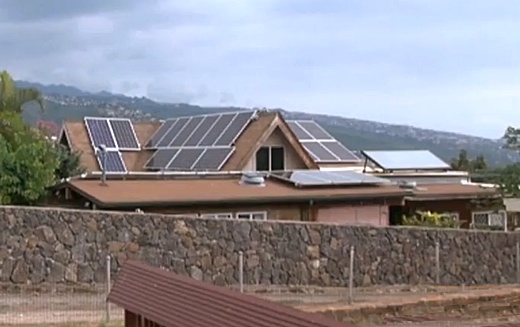
Image above: On a cloudy day in Ewa, Hawaii a house sits fitted with solar voltaic panels. From video in original article.

If you wonder why America’s utilities are rattled by the explosive growth in rooftop solar -- and are pushing back -- William Walker has a story for you.

A flip-flop wearing Walker stands in his driveway pointing to a ubiquitous neighborhood feature – solar panels on the roofs of five of six houses nearby. He lives in Ewa Beach, a development on the sultry leeward coast of the Hawaiian island of Oahu built on land cleared of sugar cane fields.

Shade is scarce and residents here call their homes “hot boxes,” requiring almost round-the-clock air conditioning. Hawaii, which imports pricey oil to power its electricity grid, has the highest utility rates in the nation -- at 37 cents a kilowatt-hour, they’re more than double California and triple the national average.

With bills for 1,600 square foot houses like these running as high as $400 a month, solar is seen as less a green statement than an economic no-brainer given state and federal tax credits for as much as 65 percent of installation costs. Almost every day since Walker and his wife Mi Chong moved in last April, solar installers came rapping on the door, hawking a rooftop system.

They finally bought one: an 18-panel, $35,000 installation producing 5.9 kilowatts of power financed for $305 a month. It would be connected to the grid under a system known as net metering that essentially lets residents deduct the value of their solar-produced electricity from their power bill and even be paid for electricity in excess of that.

Paying for Itself
Walker estimates his bill would have dropped most months to an $18 service charge -- offsetting that $305 loan payment. Anticipating his power bills would continue to rise, he figured the system could pay for itself in as little as five years; his electricity after that would be free.

That is until his utility, a subsidiary of Honolulu-based Hawaiian Electric Industries Inc., told the Walkers they couldn’t connect their system to the grid. They aren’t alone. Solar installers here estimate that hundreds if not thousands of the state’s residents are being put in solar limbo by a virtual moratorium on new connections in many parts of the company’s service area.

America's Power Machine
The reason, according to the Hawaiian Electric Co.: so many Hawaiians are stampeding to solar that circuits may become oversaturated, causing voltage spikes, damaging appliances, electronics and even the utility’s equipment. The company needs more time to study the matter.

The Walkers, who say they got no advance notice of the shutdown, are now paying both their power bill and their monthly rooftop loan. HECO, as the utility is known, recently told them they will eventually be allowed to join the grid without having to pay for expensive equipment upgrades. It still can’t say when.

Profit Motivation
“Everyone is on board with getting solar and HECO has now put up a wall,” Walker said. “The only thing we can see is profit motivation.”

Spurred by a drop in panel prices, robust government subsidies and a technology that no longer appears experimental to mainstream America, rooftop photovoltaic solar is bursting out everywhere. About 200,000 U.S. homes and businesses added rooftop solar in the past two years alone – about 3 gigawatts of power and enough to replace four or five conventionally-sized coal plants.

The U.S. set a single-quarter record with 31,000 residential rooftop installations in the three months through Sept. 30. Solar represented 72 percent of all power added in the U.S. in October.

Connection Slowdown
Utilities, seeing a threat to about $360 billion a year in power sales and a challenge to the hegemony of the conventional grid, are feeling the heat and fighting back. HECO, despite criticism from Hawaii’s solar industry, denies the moratorium is anything more than an honest effort to address the technical challenges of integrating the solar flooding onto its grid.

The slowdown comes in a state where 9 percent of the utility’s residential customers on Oahu are already generating most of their power from the sun and where connections have doubled yearly since 2008.

In California, where solar already powers the equivalent of 626,000 homes, utilities continue to aggressively push for grid fees that would add about $120 a year to rooftop users’ bills and, solar advocates say, slow down solar adoptions.

Similar skirmishes have broken out in as many as a dozen of the 43 states that have adopted net-metering policies as part of their push to promote renewable energy. In Colorado, Xcel Energy Inc. has proposed cutting the payments it makes for excess power generated by customers by about half, because it says higher payouts result in an unfair subsidy to solar users.

Arizona Protesters
It faces a fight from solar advocates who are circulating a petition that has attracted 30,000 signers.

In Arizona, 1,000 protesters last month swarmed the state capital while local and national solar advocates lobbied against an effort by utility Arizona Public Service to impose a $50 monthly fee on new solar adopters. Solar advocates said the charge would have crippled the state’s 10,000-worker solar industry and thwarted the desire of residents to have a choice in the power consumption.

State regulators, after two days of often contentious debate, voted to allow the state’s largest utility to charge customers about $4.90 a month for solar connections after Dec. 31 -- less than 10 percent of what it was asking for.

Falling Short
Don Brandt, chief executive officer of APS and its parent company Pinnacle West Capital Corp., panned the deal, saying that while it nods to the impact that net metering is having on utility operations and revenues, it “falls well short of protecting the interests of the 1 million residential customers who do not have solar panels.”

Lyndon Rive, CEO of SolarCity Corp., said it was “crazy for a utility to charge for services they didn’t deliver.

‘‘Why not tax energy efficient homes, or small homes that consume less than average?’’ said Rive, whose company is the nation’s second-largest rooftop solar installer. ‘‘APS just doesn’t want to lose control.”

The battle is far from over.

On the island of Oahu, HECO is “working really hard” to find a solution to oversaturated circuits caused by the rapid solar rollout, CEO Richard Rosenblum said. The utility’s engineering studies on solar are expected to be done by March, he said.

“We see ourselves as a trailblazer,” said Rosenblum. And one of the problems of being a trailblazer is sometimes the trail is not clear.’’

Republican Representative
Rosenblum pointed to planned HECO grid investments in smart meters and other communications devices he said that will help it speed up and smooth out the embrace of solar going forward.

Representative Cynthia Thielen, a Republican state legislator who has publicly pushed for the utility to liberalize its solar policies, is more than skeptical.

“This is a company with a drenched-in-oil mentality,” said Thielen, who has served in the legislature since 1990. “They’ve fought from day one on renewables. I look at the company as ultimately becoming obsolete unless it changes its practices.”

What’s mind-boggling to many of the stewards of America’s 3,200 utilities is how fast solar has mutated from a fringe power source to a technology being peddled today at outlets like IKEA Group and Home Depot Inc.

Sure, environmental groups like the Sierra Club are aboard. But solar is also being embraced by middle-class home owners like the Walkers, Republican legislators like Thielen and corporations like Wal-Mart Stores Inc., which expects 1,000 of its approximately 4,500 stores to be solar powered by 2020.

Green Tea
A pro-solar group in Georgia consisting of Sierra Club members and Tea Party founders calls itself the Green Tea Coalition.

The fuss might seem overheated based on current numbers -- solar power provides less than 1 percent of the nation’s energy needs. Yet it’s the rapid escalation of solar and the exponential long-term projections for its rollout that caused Fitch Ratings Ltd. in July of this year to warn that the solar juggernaut is “casting a shadow on U.S. utility rate design.”

Moreover, solar’s potential is coming as escalating fossil fuel prices make it competitive -- even without subsidies -- with conventional electricity.

That’s already occurred “at a domestic level in many countries” with some U.S. states like Hawaii and California already at or near parity and others to follow soon, according to an Aug. 8 research report by Citigroup Inc. Parity will only escalate as fossil fuels get more expensive and solar gets cheaper.

Steals Demand
“This dynamic is not being fully appreciated in the power sector,” according to the report, written by a group of analysts including Shahriar Pourreza and Ryan Levine. “Not only does solar steal share of new electricity demand, it parasitically steals demand from previously installed generation, and does at the most valuable ‘peak’ part of the demand curve.”

As for solar’s ultimate potential, California alone could produce 76,000 megawatts of solar power -- more than the state’s total installed capacity in 2012 -- if it deployed all the rooftop solar it has room for, according to data from the Solar Energy Industries Association, a trade group.

All of which makes the fights being played out in Hawaii and Arizona pivotal -- they are certain to set the stage and tone for future battles in other states. And given what’s happened, those future fights may be messy.

Arizona Money
Money poured in to Arizona in the weeks leading up to the November vote by state regulators on the proposed monthly solar charge. APS and its backers spent $3.7 million on an ad campaign while solar advocates mustered $350,000. Lobbyists, hired-gun activists and pollsters all waded into the fray, with ads that took on the appearance of a negative electoral campaign.

A utility-supporting group ran a 30-second television ad comparing California solar companies helping to fund the pro-solar campaign to Solyndra LLC, the Obama-backed solar-panel maker that went bust after defaulting on a $535 million federal stimulus loan guarantee.

Meanwhile, solar supporters used Barry Goldwater Jr., son of deceased Republican Senator Barry Goldwater, in a radio spot that featured the sound of a trumpeting elephant, the symbol of the Republican party, and called on listeners to prevent APS from “trying to kill energy choice.”

When you speak with Jeff Guldner, APS’s senior vice president of customers and regulation, he echoes a familiar and reasonable argument as to why solar users connected to the grid should help pay to maintain it.

Maintenance Bill
A system of generous net metering rules may have made sense at the outset of the solar revolution to get the party started. Now, however, it’s clear that it will have enormous disruptive impacts on APS and other utilities that bear the burden of keeping the grid operating.

“Somebody has to pay for maintenance and upkeep,” Guldner said, and solar users in the current rate structure aren’t doing so.

One problem with those economic arguments is that the politics aren’t yet lining up to support that. People may be fond of Apple Inc., Google Inc. or Walt Disney Inc. but the public doesn’t often love its power supplier -- no power or gas utility appeared on Fortune magazine’s list of the 50 most admired companies in 2013.

Republican and libertarian support for solar is informed by a “don’t tread on me” response to the utility monopoly system, making foes of those that might have been friends. It’s a wing of the pro-solar coalition that no one -- and certainly not the anti-solar crowd -- anticipated.

Unexpected Crowd
Bill Hansen is part of that unexpected pro-solar crowd.

On the warm, blue-sky day when Arizona began two days of hearing on APS’s $50 monthly solar charge, Hansen, a retired 83-year-old former Iowa lawmaker and lifelong Republican, rose at 6 a.m. and made the 35-mile drive from his Sun City home to Phoenix to give the utility and the Arizona Corporation Commission hell.

Hansen, president of the Sun City West Property Owners & Residents Association, represents the retirement community’s 24,000-plus residents, 10 percent of whom have investments in solar-energy companies.

Pro-Solar
He had plenty of company. On the day of the vote, the pro-solar demonstrators vastly outnumbered those who had come to plead the utility’s cause. They were also in a far better mood - - outside, a brass band tooted out standards, a DJ played loud rock music and organizers doled out t-shirts, water bottles and pizza to people holding signs that said “People Power Over Monopoly Power: No to Solar Tax!” and “Solar Works For Arizona.”

Inside, it was clear that APS and its supporters were out of luck. The idea for the $4.90 fee came from the solar side -- and very likely swung the vote.

The charge won’t be enough to cover the utility’s grid costs until their next rate case in 2015, APS’s Guldner said, and will probably require the company to ask for much bigger fees down the road.

“In 2016, that rate increase could be a big one” and the utility will probably win the argument, Guldner said.

Bob Stump, chairman of the Arizona Corporation Commission, said he voted in favor the $4.90 charge because he feared the higher fee sought by APS would have slowed solar development in the state, jeopardizing the ability to produce 15 percent of its power from renewables as required by law.

Fair Outcome
“It’s a fair outcome,” said Stump.

Utilities may be missing out on some big solar positives, said Jigar Shah, head of a consulting company and author of “Creating Climate Wealth.” Solar generation peaks at the hottest time of the day, the time most people switch on their air conditioners, thus taking the strain off conventional power plants when they most need the relief.

Aggregated solar power will also let utilities put off building costly plants and transmission lines, saving investors and ratepayers money, said Shah, the former CEO of SunEdison LLC.

Shah’s advice: get with the program, otherwise utilities are simply inviting people to leave the grid.

“The utilities are playing this wrong, saying you’re with us or against us,” he said. “It’s not the solar industry that’s the problem -- it’s their refusal to recognize the benefits of new technologies.”

Policy decisions are already affecting solar installations. HECO’s moratorium in Hawaii is putting a damper on what had been a booming home-grown solar industry there.

Slowing Down
The fourth quarter is typically the busiest time of the year for solar installers as homeowners rush to take advantage of federal and state tax incentives. Installers can rack up as much as two thirds of their annual sales in the last three months of the year. Instead, solar companies in Hawaii say their revenue has been reduced by half or more compared with the same time last year. Inventory is piling up.

The new restrictions “are slowing things down with no easy solution,” said Leslie Cole-Brooks, executive director of the Hawaii Solar Energy Association. “It’s not good news for the solar industry or for customers who want to invest in solar.”

Order Drop
One of the island’s biggest solar wholesale businesses is run out of a group of drab cinder-block warehouses at the terminus of a narrow, dead end-road near the edge of downtown Honolulu’s Chinatown. Rolf Christ, a German native and the company’s owner and president, has been working in the Hawaii solar industry since 1980.

The past three and a half years have been crazy, he said. Solar sales on Oahu were so robust that Christ has more than quadrupled his warehouse space for R&R Solar Supply to 25,000 square feet from 6,000 square feet. Now, a lot of that space is stuffed with solar modules stacked two-stories high on shipping pallets.

Christ typically orders modules before the fourth quarter. HECO’s moratorium has “pretty much brought the whole industry to a screeching halt,” he said.

“It was the worst time of year to do it,” he said of the policy change. “It was the worst way to do it.”

King Kalakaua
HECO has been around a long time and some, like Thielen, think that may be its problem. It traces its roots to 1881 when Hawaii’s King Kalakaua met Thomas Edison and five years later decided to light his palace with electricity. Its subsidiaries serve 95 percent of the state’s residents, bringing power to Oahu, the Big Island, Maui, Molokai and Lanai.

The issue, according to HECO, is that for about 20 percent of Oahu’s grid there is so much solar connected you can’t add more without further study because of the potential for reliability and safety issues. Solar advocates have said the figure is arbitrary.

Arbitrary or not, it means new solar customers must await engineering studies to determine if they can connect without causing surges that may damage appliances, electronics or utility equipment. Some might have to pay for utility equipment upgrades that could cost thousands of dollars before getting approval to connect.

“This is about safety,” said Scott Seu, HECO vice president for energy resources and operations. “We are so far ahead of the rest of the nation as far as the amount of distributed rooftop solar in our neighborhoods that we are now at points where there are potential safety and operating liability issues.”

Fast Track
The issue of solar saturation is complicated and controversial and both sides in Hawaii have their points, said Michael Coddington, a senior engineer at the National Renewable Energy Laboratory in Golden, Colorado. HECO’s policies on solar connections are “similar to many other states” and could be considered “progressive” relative to the policies of many utilities, he said.

“The utility is following the rules per se,” said Coddington, who co-wrote an NREL study on the matter. On the other hand, if you are a solar photovoltaic developer or customer, “you want the ’fast track’ approach, as detailed impact studies are often costly and time-consuming and could require costly mitigation strategies. I understand the frustration.”

Customers like the Walkers are more than a little frustrated. They see the company as dragging its feet in an effort to stave off a threat to its very business model. And even when they finally get to connect, they wonder if the hassle has been worth it.
 

Driving Us Off
“I feel like they are driving us off the grid,” Mi Chong said.

Phil Undercuffler hopes HECO will drive lots of people off the grid. Then he will sell them batteries.

Battery storage is the holy grail of the off-the-grid crowd. They let users store up excess energy for rainy or cloudy days when solar isn’t working. In theory, you don’t need a power company if you have solar tied to battery storage, especially here. Oahu gets an average of 271 sunny or partly sunny days a year.

Last month, Undercuffler spoke to a standing-room-only audience of more than 100 solar installers in a Honolulu Marriott who came to hear his pitch for battery storage units sold by Outback Power Inc.

The vast majority of HECO solar customers don’t have battery storage; it’s considered too expensive. With the possibility that the moratorium in some sections of Hawaii could go on for two more years, homeowners could make batteries work financially and cut the cord from the utility altogether, said Undercuffler, Outback’s director of product management and strategy.

“You watch, all these installers are going to go to batteries,” said Jeff Davis, a partner in an Oahu company called Kamiyama Solar Electric who is known as the Solar Guy on a local talk radio program. “The utility has opened up the genie bottle.”

See also:
Ea O Ka Aina: KIUC Election Fraud 12/31/13

.