Impact of Lehua rat poisoning

SUBHEAD: Will the aerial rat poison drop endanger Niihauans and the local fisheries?

By Kawai Warren on 7 June 2017 for Island Breath -
(http://islandbreath.blogspot.com/2017/06/impact-of-lehua-rat-poisoning.html)


Image above: North-west coast of Lehua Island in foreground with Niihau Island in background. Photo by Juan Wilson on 7/9/11.

I attended the community meeting for the Environmental Assessment Draft in Kekaha. Their was a handful of fisherman that expressed their concern about the side effects of the rat extermination poison and aerial application.

A day after the meeting, we got word that our comments at the meeting were to "do it quickly".

At the meeting I attended in Kekaha no one supported the aerial drop, because the impact it could have on the fisherman, Niihauians, fish, limu, coral, opihi, a' am a, and ocean ecosystems.

The US Fish and Wildlife Service and the Hawaii Department of Land and Natural Resources (DLNR)  are trying to get this done this summer. Unless the fisherman raise their voices and get the media involved. Check out the article below.

Our fisheries (near shore) on the Westside is all ready impacted by these chemicals Atrazine, bentazon, chlorpyrifos, fipronil, metolachlor, propiconazole, and simozine from Kinikini ditch and second ditch during seasonal flooding.


Image above: GoogleEarth 2011 aerial perspective showing proximity of Lehua and Niihau Islands. Same orientation direction as photo above. Only about 4,000 feet separate the two. Image by Juan Wilson.


The Lehua Aerial Poison Drop

SUBHEAD: A risk that the lethal anticoagulant rodenticides could impact the biologically diverse area.


Image above: Photo of monk seal swimming close to shoreline of Lehua Island in shallow water. Photo by Richard Jarke on 7/9/11.

By Maggie Sergio on 7 June 2017 for Huffington Post - 
(http://www.huffingtonpost.com/entry/5936e141e4b033940169ce56)

In Hawaii, the Department of Land and Natural Resources (DLNR), and U.S Fish and Wildlife Service (USFWS) are planning several rat poison drops via helicopter onto Lehua Island, located approximately 30 miles west of Kauai.

These drops are being fast-tracked for this summer, part of an eradication project for the 284 acre bird sanctuary.

The planned drop is three-quarter of a mile from an important Native Hawaiian community on Niihau. There is risk that the poison pellets (lethal anticoagulant rodenticides) could impact the biologically diverse and important Lehua Crater.

Sources indicate that DLNR and USFWS are pressuring the State Department of Agriculture to grant permission for the poison bait to be dropped right up to the shoreline, which will result in bait entering the marine environment, allowing the toxins to infiltrate and settle in waters frequented by commercial and Native Hawaiian subsistence fishermen.

The agencies will not disclose or estimate the duration or extent of any fishing bans for tour and recreational boats in surrounding waters. The extent of a ban might be of concern to the local fishing and tour boat communities, given that a 942-day fishing ban was recommended after another Island Conservation poison drop on Wake Island in the in 2012.

If given the green light, the poison drops will happen on Lehua this summer, delivering an estimated 8-10 tons of anticoagulant rodenticide. Birds, fish, monk seals, and other wildlife that consume the cereal-based poison bait either directly or indirectly (secondarily) will be affected, and there is risk of contaminating the food web.

Note: the estimated application rate has been calculated from the amount disclosed on a kg/per hectare basis. Pesticide labels were not included in the draft environmental assessments (EA), so it is unclear if the proposed amount to be dropped is within legal limits.

The Failed 2009 Poison Drop Lehua Controversy
This will be the second poisoning of Lehua in the name of “conservation,” after a failed attempt in 2009. The previous drop was highly controversial—dead fish washed up on the neighboring island of Niihau, and a juvenile whale beached itself.

The state of Hawaii claimed the fish die-off and dead whale were “coincidental” and not related in any way to the nearly four tons of rat poison that had been dropped on the island just days earlier.

After researching the failed event in 2009, which included findings in this presentation given at a national pesticides conference, questions remain about what really happened.

Why was there a two month delay in requesting the fish be tested for exposure to the poison?

Since the rodenticide used in 2009, diphacinone, metabolizes quickly, did the delay in testing capture meaningful results? Are the chain of custody documents available for review?

Could ultra-nutrification and de-oxygenating of the waters, due to the cereal component of the poison bait that entered the surrounding ocean, be a contributing reason for the algae bloom, which, officials claimed, was the cause of the fish kill?

Or, could the poison pellets that entered the marine environment have impacted the fish, not enough to kill them, but enough to cause immunosuppression, thereby making the fish more susceptible to the impacts of an algae bloom? These questions have never been addressed by the agencies.

Are Rats a Problem on Lehua? - Not According to the Data
The data provided in both draft EAs (both the state and feds created a draft environmental assessment) does not support that the rodents on Lehua are having a negative impact on the bird life on the island.

All evidence provided is anecdotal, and astonishingly, USFWS has no idea of the size of the rodent population. One could reasonably ask—since this critical piece of data is unknown—why is this project being fast tracked?

The agencies need to respond to these questions: Why is the collateral damage and potential risk to the food web, in addition to putting sustenance and commercial fishermen in jeopardy, worth the risk? How much consideration was truly given to the Native Hawaiian Ni’ihauans in this accelerated operation, aside from conversations set up and/or attended by the owner of Ni’ihau, the Robinson family?

The only evidence of rodent impact to birds included in the state issued EA shows that four eggs from the nest of a wedge tail shearwater showed indication of predation by rats.

As the wedge tailed shearwater is considered to be a species of least concern by the IUCN (with a worldwide population of over 5 million birds), this hardly constitutes a scientifically-based rationale for dropping 8-10 tons of pesticide, threatening the fragile ecosystem, rare reef system, and food chain.

The DLNR and USFWS have yet to respond to public demands for site-based scientific (vs. anecdotal) evidence on the Lehua rat population, bird decline and mortality causation on Lehua, if any, that justifies this large scale poison drop.

Downplaying Risks  - The Selling of Island Eradication Projects
Both EAs issued mispresent environmental risks, and make misleading statements about the lethal and sub-lethal impacts to wildlife poisoned, which are referred to as “non-target species.”

Though the proposed poisons have never been tested on coral reefs, and the impact is completely unknown, the EA makes the puzzling, badly worded statement on page 73 of the federal EA that “there are no data to indicate corals have been impacted by anticoagulant rodenticides from previous eradication projects.”

Since there are no studies which reflect that rodenticide testing on coral reefs has ever been carried out, and long term, ecosystem monitoring is lacking in eradication projects, the above statement made in the EA could be viewed as disingenuous.

I asked Dr. Mourad Gabriel, who has done extensive research on wildlife diseases, including the impacts of rodenticides on wildlife for his thoughts on the statement specific to coral reefs - his response can be found below.
“The lack of data collected on a topic should not imply that a deleterious impact does not occur.” - Mourad W. Gabriel MS, PhD - Executive Director of Integral Ecology Research Center.
Page 51 of the federal EA cites studies from 1977, 1998, and 1999 with respect to birds eating the poison bait and make the following, false claims:
9. To minimize consumption of bait pellets by shorebirds and terrestrial birds, the bait pellets are dyed a green or blue color, which birds appear to prefer less than yellow or red. 10. Bait pellets are formulated large enough that it would be difficult for a small, seed-eating bird to consume the whole pellet.
The video below, from the New Zealand documentary, “Poisoning Paradise – Eco-cide NZ,” is evidence that color and size of the pellets will not deter birds or other animals from eating them. Deaths of birds poisoned during these projects can occur either directly from eating the bait, or secondarily, by consuming poisoned rodents, insects and fish. Video courtesy of Clyde Graf.

Island Eradications - Previous Problems
Information received from a FOIA request filed in 2014 reveals serious ethical issues from previous eradication projects and shows the consequences of what can go wrong.

Rat Island
In October 2008, USFWS and Island Conservation aerially dropped 51 tons of brodifacoum over Rat Island, located in the Aleutian Islands, and then left for eight months. When they returned, over 400 dead birds were collected, including 46 bald eagles.

Note: the total number of poisoned wildlife counted was by no means the total number of animals poisoned, nor was any long term monitoring done to test for sub-lethal impacts.

In the investigation that followed, U.S. Fish & Wildlife Law Enforcement division reported ten illegal actions including exceeding legal application rates mandated by the pesticide label, failure to properly calibrate dispersion equipment and failure to keep accurate records of their pesticide applications.

You can read a copy of the full USFWS law enforcement report here, released as the result of a FOIA request.

After the investigation by USFWS law enforcement, the Ornithological Council issued this scathing report. You can find a copy of it here.

Wake Island
Located in the South Pacific, Wake Island is host to a military base and is under the jurisdiction of the U.S. Air Force. Wake Island was the recipient of an island eradication attempt in 2012, carried out by Island Conservation and USFWS.

While the almost 20 ton rat poison drop failed to kill all the rats, the more serious issues are the internal emails released in response to the 2014 FOIA request. The discussions between USFWS, the USAF and Island Conservation show that after the fish were tested for brodifacoum, a fishing ban was recommended for 942 days.
FYI – note the Wake Atoll brodifacoum results analysis. We have a couple of options. I guess it comes down to how long we want to restrict consumption of fish at Wake. The current recommendation is approximately 942 days. Also with no money [and] furloughs occurring July 8 – end of September, it is unlikely that a sampling project will occur this FY. I’ll keep you in the loop, but thought you’d might like this info for future projects.” - USAF
You can find the entire email exchange containing the details of the fishing ban recommendation here.

While USFWS and the state of Hawaii assert that no final decision has been made, sources indicate that this project is planned for this summer, and that lead state agencies are awaiting approval from the Hawaii Deptartment of Agriculture (Pesticides Division).

It is notable that some of the supporting state agencies for this poison drop are currently facing a federal investigation charging racial discrimination against Hawaii’s native communities in their lack of care in state pesticide regulation.

The Farallon Islands
This is not the first time that helicopter drops of rodenticides have been called into question. In 2013 a planned rodenticide drop of 1.5 tons of brodifacoum over the Farallon Islands National Marine Sanctuary was halted due to public opposition and heavy questioning into Island Conservation’s conflict of interest in authoring the draft environmental impact statement. 

The city of San Francisco closed their strongly worded letter urging USFWS to seek a partner for the risk assessment that did not have a financial interest in the project.

It remains to be seen whether Hawaii’s impacted communities and scientists will demand fuller disclosure and further study from its agencies and sole-source contractor Island Conservation. For it is Kaua’i’s fishing and tourism industries, and local Hawaiian residents that have the most to lose if anything should go wrong.

In 1962, with the publication of “Silent Spring,” Rachel Carson warned us of the influence the pesticide industry has on agriculture. Fifty-five years later, the dominion of the pesticide industry continues, and non-native species has become another market opportunity to exploit.

.

Food, Regeneration and Civilization

SUBHEAD: Corrupt governments and out-of-control corporations degenerating our lives and threatening our future.

By Ronnie Cummins on 28 May 2017 for Organic Transitions -
(https://www.organicconsumers.org/essays/regeneration-next-stage-organic-food-and-farming%E2%80%94and-civilization)


Image above: Ally cropping is a way to carbon capture for soil regeneration. From (http://www.soil-carbon-regeneration.co.uk/carbon-capture-farming/attachment/p1010490/).
Regenerate—to give fresh life or vigor to; to reorganize; to recreate the moral nature; to cause to be born again. (New Webster’s Dictionary, 1997)

When a reporter asked him [Mahatma Gandhi] what he thought of Western civilization, he famously replied: “I think it would be a good idea.”
A growing corps of organic, climate, environmental, social justice and peace activists are promoting a new world-changing paradigm that can potentially save us from global catastrophe. The name of this new paradigm and movement is regenerative agriculture, or more precisely regenerative food, farming and land use.

Regenerative agriculture and land use encompass the traditional and indigenous best practices of organic farming, animal husbandry and environmental conservation. Regeneration puts a central focus on improving soil health and fertility (recarbonizing the soil), increasing biodiversity, and qualitatively enhancing forest health, animal welfare, food nutrition and rural (especially small farmer) prosperity.

The basic menu for a Regeneration Revolution is to unite the world’s 3 billion rural farmers, ranchers and herders with several billion health, environmental and justice-minded consumers to overturn “business as usual” and embark on a global campaign of cooperation, solidarity and regeneration.

According to food activist Vandana Shiva, “Regenerative agriculture provides answers to the soil crisis, the food crisis, the health crisis, the climate crisis, and the crisis of democracy."

So how can regenerative agriculture do all these things: increase soil fertility; maximize crop yields; draw down enough excess carbon from the atmosphere and sequester it in the soils, plants and trees to re-stabilize the climate and restore normal rainfall; increase soil water retention; make food more nutritious; reduce rural poverty; and begin to pacify the world’s hotspots of violence?

First, let’s look at what Michael Pollan, the U.S.’s most influential writer on food and farming, has to say about the miraculous regenerative power of Mother Nature and enhanced photosynthesis:


Consider what happens when the sun shines on a grass plant rooted in the earth. Using that light as a catalyst, the plant takes atmospheric CO2, splits off and releases the oxygen, and synthesizes liquid carbon–sugars, basically.

Some of these sugars go to feed and build the aerial portions of the plant we can see, but a large percentage of this liquid carbon—somewhere between 20 and 40 percent—travels underground, leaking out of the roots and into the soil.

The roots are feeding these sugars to the soil microbes—the bacteria and fungi that inhabit the rhizosphere—in exchange for which those microbes provide various services to the plant...

Now, what had been atmospheric carbon (a problem) has become soil carbon, a solution—and not just to a single problem, but to a great many problems.

Besides taking large amounts of carbon out of the air—tons of it per acre when grasslands [or cropland] are properly managed… that process at the same time adds to the land’s fertility and its capacity to hold water. Which means more and better food for us...

This process of returning atmospheric carbon to the soil works even better when ruminants are added to the mix. Every time a calf or lamb shears a blade of grass, that plant, seeking to rebalance its “root-shoot ratio,” sheds some of its roots. These are then eaten by the worms, nematodes, and microbes—digested by the soil, in effect, and so added to its bank of carbon. This is how soil is created: from the bottom up...

For thousands of years we grew food by depleting soil carbon and, in the last hundred or so, the carbon in fossil fuel as well. But now we know how to grow even more food while at the same time returning carbon and fertility and water to the soil.

A 2015 article in the Guardian summarizes some of the most important practices of regenerative agriculture:

Regenerative agriculture comprises an array of techniques that rebuild soil and, in the process, sequester carbon.

Typically, it uses cover crops and perennials so that bare soil is never exposed, and grazes animals in ways that mimic animals in nature. It also offers ecological benefits far beyond carbon storage: it stops soil erosion, re-mineralizes soil, protects the purity of groundwater and reduces damaging pesticide and fertilizer runoff.”

If you want to understand the basic science and biology of how regenerative agriculture can draw down enough excess carbon from the atmosphere over the next 25 years and store it in our soils and forests (in combination with a 100-percent reduction in fossil fuel emissions) to not only mitigate, but actually reverse global warming, read this article by one of North America’s leading organic farmers, Jack Kittridge.

If you want a general overview of news and articles on regenerative food, farming and land use, you can follow the newsfeed “Cook Organic Not the Planet” by the Organic Consumers Association (OCA), and/or sign up for OCA’s weekly online newsletter (you can subscribe online, or text “Bytes” to 97779.)

You can also visit the Regeneration International website, where you’ll find this list of books on regenerative agriculture.

Solving the soil, health, environmental and climate crises
Without going into extensive detail here (you can read the references above), we need to connect the dots between our soil, public health, environment and climate crises. As the widely-read Mercola newsletter puts it:

Virtually every growing environmental and health problem can be traced back to modern food production. This includes but is not limited to:
  • Food insecurity and malnutrition amid mounting food waste
  • Rising obesity and chronic disease rates despite growing health care outlays
  • Diminishing fresh water supplies
  • Toxic agricultural chemicals polluting air, soil and waterways, thereby threatening the entire food chain from top to bottom
  • Disruption of normal climate and rainfall patterns
Connecting the dots between climate and food
We can’t really solve the climate crisis (and the related soil, environmental, and public health crisis) without simultaneously solving the food and farming crisis. We need to stop putting greenhouse gas pollution into the atmosphere (by moving to 100-percent renewable energy), but we also need to move away from chemical-intensive, energy-intensive food, factory farming and land use, as soon as possible.

Regenerative food and farming has the potential to draw down a critical mass of carbon (200-250 billion tons) from the atmosphere over the next 25 years and store it in our soils and living plants, where it will increase soil fertility, food production and food quality (nutritional density), while re-stabilizing the climate.

The heavy use of pesticides, GMOs, chemical fertilizers and factory-farming by 50 million industrial farmers (mainly in the Global North) is not just poisoning our health and engendering a global epidemic of chronic disease and malnutrition. It’s also destroying our soil, wetlands’ and forests’ natural ability to sequester excess atmospheric carbon into the earth.

The good news is that solar and wind power, and energy conservation are now cheaper than fossil fuels. And most people are starting to understand that organic, grass-fed and freshly-prepared foods are safer and more nutritious than chemical and GMO foods.

The food movement and climate movements must break through our single-issue silos and start to work together. Either we stop Big Coal, Big Oil, fracking, and the mega-pipelines, or climate change will soon morph into climate catastrophe, making it impossible to grow enough food to feed the planet. Every food activist needs to become a climate activist.

On the other hand, every climate activist needs to become a food activist.

Our current system of industrial food, farming and land use, now degenerating 75 percent of all global farmland, is “mining” and decarbonizing the soil, destroying our forests, and releasing 44-57 percent of all climate-destabilizing greenhouse gases (carbon dioxide, methane, nitrous oxide, and black soot) into our already supersaturated atmosphere, while at the same time undermining our health with commoditized, overly processed food.

Solving the crisis of rural poverty, democracy and endless war
Out-of-touch and out-of-control governments of the world now take our tax money and spend $500 billion dollars a year mainly subsidizing 50 million industrial farmers to do the wrong thing.

These farmers routinely over-till, over-graze (or under-graze), monocrop, and pollute the soil and the environment with chemicals and GMOs to produce cheap commodities (corn, soy, wheat, rice, cotton) and cash crops, low-grade processed food and factory-farmed meat and animal products.

Meanwhile 700 million small family farms and herders, comprising the 3 billion people who produce 70 percent of the world’s food on just 25 percent of the world’s acreage, struggle to make ends meet.

If governments can be convinced or forced by the power of the global grassroots to reduce and eventually cut off these $500 billion in annual subsidies to industrial agriculture and Big Food, and instead encourage and reward family farmers and ranchers who improve soil health, biodiversity, animal health and food quality, we can simultaneously reduce global poverty, improve public health, and restore climate stability.

As even the Pentagon now admits, climate change, land degradation (erosion and desertification), and rural poverty are now primary driving forces of sectarian strife and war (and massive waves of refugees) in places like Afghanistan, Iraq, Syria, Yemen, Libya and Somalia. U.S. military intervention in these regions, under the guise of “regime change” or democratization, has only made things worse. This is why every peace activist needs to become a climate and food activist and vice-versa.

Similarly, corrupt, out-of-control governments continue to subsidize fossil fuels to the tune of $5.3 trillion dollars a year, while spending more than $3 trillion dollars annually on weapons, mainly to prop up our global fossil fuel system and overseas empires.

If the global grassroots can reach out to one another, bypassing our corrupt governments, and break down the geographic, linguistic and cultural walls that separate us, we can launch a global Regeneration Revolution—on the scale of the global campaign in World War II against the Nazis.

One thing we the grassroots share in all of the 200 nations of the world is this: We are sick and tired of corrupt governments and out-of-control corporations degenerating our lives and threatening our future.

The Russian people are not our enemies, nor the Chinese, nor the Iranians. The hour is late. The crisis is dire. But we still have time to regenerate our soils, climate, health, economy, foreign policy, and democracy. We still have time to turn things around.

The global Regeneration Movement we need will likely take several decades to reach critical mass and effectiveness.

In spreading the Regeneration message, and building this new Movement at the global grassroots, we must take into account the fact that most regions, nations and people (and in fact many people who are still ignorant of the facts or climate change deniers) will respond more quickly or positively to different aspects or dimensions of our message (i.e. providing jobs; reducing rural and urban poverty and inequality, restoring soil fertility, saving the ocean and marine life, preserving forests, improving nutrition and public health, eliminating hunger and malnutrition, saving biodiversity, restoring animal health and food quality, preserving water, safeguarding Mother Nature or God’s Creation, creating a foundation for peace, democracy, and reconciliation, etc.) rather than to the central life or death message: reversing global warming.

What is important is not that everyone, everywhere immediately agrees 100 percent on all of the specifics of regenerative food, farming and land use—for this is not practical—but rather that we build upon our shared concerns in each community, region, nation and continent.

Through a diversity of messages, frames and campaigns, through connecting the dots between all the burning issues, we will find the strength, numbers, courage and compassion to build the largest grassroots coalition in history—to safeguard our common home, our survival and the survival of the future generations.

• Ronnie Cummins is international director of the Organic Consumers Association and a founding member of Regeneration International.

See also:
Ea O Ka Aina: Regenerative Agriculture Needed 1/10/17
Ea O Ka Aina: Good nutrition begins in the soil 9/2/16
Ea O Ka Aina: A Soil Pilgrimage 10/15/15
Ea O Ka Aina: Soil is the stomach of the plant 4/21/15
Ea O Ka Aina: Grass - Soil - Hope 1/3/14
Ea O Ka Aina: Life Within the Soil 2/23/11
Ea O Ka Aina: Soils, Souls & Fuel 10/11/10
Ea O Ka Aina: The Story of Soil 7/28/10

\

Chicken First Aid

SUBHEAD: Some vital items you better have on hand to support the health of your chickens.


Image above: The hen Dazeywith droopy comb whose owner Natureloover could not save her. From (https://www.backyardchickens.com/threads/i-think-i-have-a-sick-hen-pale-and-droopy-comb.934754/).

By Juan Wilson on 7 June 2017 for Island Breath -
(http://islandbreath.blogspot.com/2017/06/chicken-first-aid.html)

We recently had an older hen pass away. Before she obviously appeared sick we noticed her comb was a little droopy. We've seen this before a few times. Most chickens that have displayed a droopy comb died within a week or so.

The hen Dazey, above, that looked like our chicken before she passed away. Dazey died after muchme effort by her owner, 'Natureloover' to test and treat her. As it turned out Dazey had peritonitis and lymphoma, she ended up losing almost all of her body weight because her food wasn't processing.

But droopy comb can be caused from many things including mites. It is a general sign that something is truly amiss with a chicken.

It is advised to make sure that the hen has not mites on her, and it is recommended worming her with a good broad spectrum wormer that gets more than just roundworm. Look at her stools to make sure there is no blood in them. Avitrol and Wormout gel are both very good. Here is a link: (http://planetpoultry.com.au/15-medications). From (backyardchickens.com/threads/i-think-i-have-a-sick-hen-pale-and-droopy-comb.934754/)

Below are communications between the owner Natureloover, owner of the hen Dazey and another online adviser from BackYardChicken.com

Hello, thank you in advance for any feedback! One of our hens, Dazey, was diagnosed with gastrointestinal infection and was on antibiotics for coccidious. Even though her stool was negative, she had the symptoms.. After nursing her back to health and finishing her antibiotics, we re-introduced her back to the flock. She was doing well, acting normal, very happy to be back home! Her comb was still very dry, but red. At the beginning of her illness, we noticed a single black dot on her comb, and now I am noticing some more, even smaller, dots. But she was still acting normal. Last night my mother gave them some mealworms (one of her favorite treats) and she didn't seem as interested as she normally would be. Not sure what her comb looked like yesterday as I wasn't around, but today it is very dark and droopy. She's eating and drinking normal. Please help!!! I am very worried about my sweet girl!!!

This is a photo of her before moving her back home with her flock.

Naturelooover


Welcome to BackYardChickens.com. How old is she, and where do you live--is it warm with mosquitoes out now, or wintertime? Can you post a picture of her now with the marks and dark comb? Since she had symptoms of an intestinal disease and was treated for cocci, what were her symptoms then? How does her comb feel now and does it empty by morning? What do her droppings look like? Can you try to add vitamins and electrolytes to her water, and add a little plain yogurt to her feed for probiotics (since she was on antibiotics?) Chickens can suffer from so many different illnesses, and they can also have internal laying problems which cause vague symptoms. Her darker comb may be significant that she is not getting enough oxygen to her heart, but pictures would be good.

Eggcessive


We live in NE Florida, warmest days are in the low 80s right now, coldest nights, low 50s. There haven't been a lot of mosquitoes. She will be three in March, we've had her since she was two weeks old. She was weak, had abdominal pain, diarrhea, and no appetite, her crop was soft, tail feathers were down, and she was very tired. Her stool was negative for worms or any parasites. She is very thin and slightly anemic. We gave her electrolytes in her water, I think it helped tremendously. I will add some to her water in the morning. I just went to check on her, and her comb is not as dark as I thought, but is still very unhealthy. It looks as if it has shrunk, it is very droopy, dry, and discolored. Here is a photo, I hope you can get a better visual.

Naturelooover


I am not a vet, but it's possible that she might be suffering from internal laying or egg yolk peritonitis. Whatever the problem, she looks cery ill. Her comb looks dry, and she could have a little peck mark or insect bite. I would try to make her as comfortable as possible, and try to get her to eat and drink. Bits of egg or runa, feed made liquid with water and plain yogurt are food for feeding sick hens. Keep her warm. Poultry NutriDrench or Poultry Cell are good vitamins with iron and minerals plus amino acids. Antibiotics are sometimes given for internal laying problems, but there is not a lot of success in treatment.

Eggcessive


Image above: Dazey displaying advanced droopy comb towards the end of her life. From (https://www.backyardchickens.com/threads/i-think-i-have-a-sick-hen-pale-and-droopy-comb.934754/).


By Jessica W. on 29 May 2017 for Off Grid News -
(http://www.offthegridnews.com/how-to-2/chicken-first-aid-8-vital-items-you-better-have-on-hand/)

Standing at the kitchen counter, early on a Saturday morning, I caught a glimpse of a white blur, closely followed by a large black blur. Turning to look closer, I saw a black dog, not belonging to us, attacking my flock. I lost three to that attack, including our rooster.

Thankfully, one wise hen that was attacked did escape by taking refuge with our farm dog. She had a deep wound under her left wing that healed quite nicely after being cleaned and treated with ointment from our first-aid kit.

From frostbite to predator attacks, our flock has experienced a lot in a few short years. Having a basic first-aid kit — and the knowledge to use it — is essential on the homestead. Chickens will be injured from time to time. Sometimes they hurt each other, sometimes it is a predator attack that can leave them wounded, or perhaps it is just a routine illness.

Below you’ll find a list of basic supplies that any first-aid kit for chickens should have. As always, use caution when using any type of antibiotic or other medication and carefully read the instructions.

1. Disposable gloves
Protect your hands while keeping the wound area free from contaminants by having a supply of disposable gloves readily available. They also prevent infection from spreading and make clean up much easier.

2. Rubbing alcohol
A small bottle of rubbing alcohol is perfect for cleaning wounds.

Be careful not to get the liquid near the bird’s eyes. Hydrogen peroxide also can be used; however, it also kills healthy cells surrounding the wound, so it is best to use it for the initial cleaning.

3. Cornstarch
Cornstarch, styptic powder and Wonder Dust are all useful for stopping bleeding due to broken nails or minor wounds. A small pair of nail clippers to trim broken nails on the spot also should be included to keep them from being further torn.

4. Triple antibiotic ointment
When choosing an antibiotic ointment for your first-aid kit, pick one free of pain-relieving ingredients. The ointment is most useful for preventing infection in wounds and abrasions.

5. Petroleum ointment
Useful as a protectant, petroleum ointment is helpful to fend off frostbite on combs and wattles during extreme cold snaps. It also can be used to treat scaly leg mites. To do this, simply coat the leg with ointment once or twice a week until the leg scales once again lay flat.

6. Blu-Kote
An antiseptic spray, Blu-Kote masks the wound to prevent other hens from pecking at it. It also stops infection and can be used in combination with a triple antibiotic ointment for serious wounds. Carefully spray on affected area as needed. It may take multiple applications each day before the wound has healed sufficiently enough to deter pecking.

7. Oral syringe
For dispensing any liquid medications, an oral syringe is a must. Electrolyte solutions can be easily administered to aid ailing chickens with an oral syringe. For crop issues, specifically a compacted crop, a few drops of a vegetable oil can be given with an oral syringe to loosen and soften the mass, allowing it to pass freely from the crop.

8. Gauze wrap
Occasionally, a wing will be broken and need to be secured. Position the broken wing in a natural position on the bird’s side and wrap the body and wing with gauze to secure it in place. Broken legs can be splinted and wrapped with gauze as well. It is best to isolate the chicken to prevent further injury due to pecking.

Along with these specific supplies, general supplies such as cotton balls, small gauze pads and small scissors are all helpful in emergencies. Keeping all first-aid supplies in a portable kit allows you to easily treat injured chickens on the spot.


.

From Cacao to Chocolate

SUBHEAD: Instructions on harvesting, drying, husking, roasting, grinding and adding ingredients for chocolate.

By Linda Pascatore on 6 June 2017 for Island Breath -
(http://islandbreath.blogspot.com/2017/06/from-cacao-to-chocolate.html) 


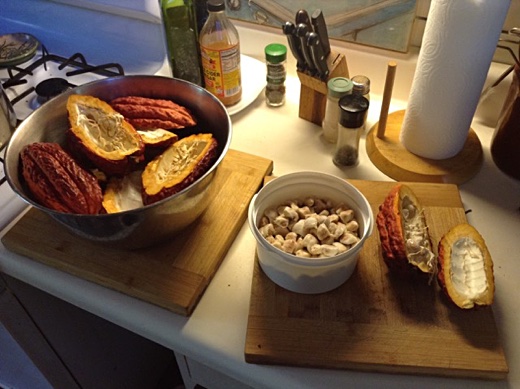
Image above: Picked cacao fruit split and kernels removed for fermenting. Photo by Juan Wilson.

[IB Publisher's note: We are ever grateful for Jo Amsterdam, from Kalaheo, for giving us our first batch of cacao starts long enough ago that we can make chocolate today.]

We now have mature cacao trees, here in Hanapepe Valley on Kauai.  We have been making our own chocolate!  It is a multi-step process, which I will explain below step by step.  For the complete recipe in one place, look towards the end of the article where it is summarized.


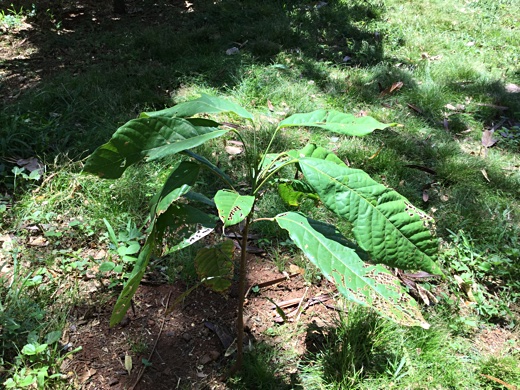
Image above: Cacao treeling in ground after a few months. Photo by Juan Wilson.

About seven years ago, a friend gave us some tiny sprouted cacao beans.  It took almost a year before they were big enough to plant out in the ground.


Image above: Young cacao tree a year later. Photo by Juan Wilson.

The plants grew slowly, but with regular watering, they finally reached ground water. 


Image above: Six years later a ten foot tall cacao tree with its second year of fruit. Photo by Juan Wilson.

Then they took off and grew much quicker.  About seven years from the sprouts, we got our first cacao bean pods. 


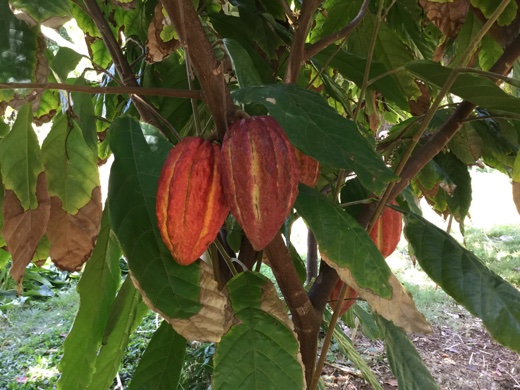
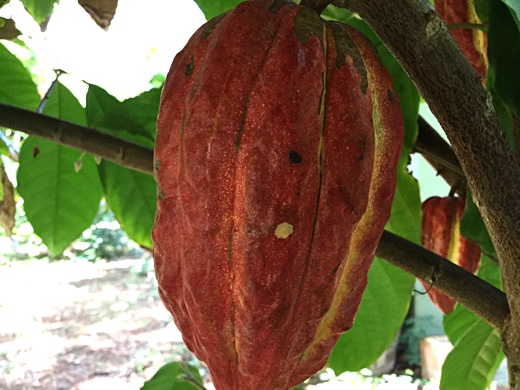
Image above: Mature cacao fruit ready to pick determined by scratching a small spot with a finger nail. If the flesh under the skin is green wait and test later. If yellow-orange the fruit is ready. Photo by Juan Wilson.

There are a variety of different types and colors of cacao.  All of ours start red and turn slightly orange when ripe.  You can tell ours are ripe when you stick a fingernail through the skin, and the inside is a mustard yellow.


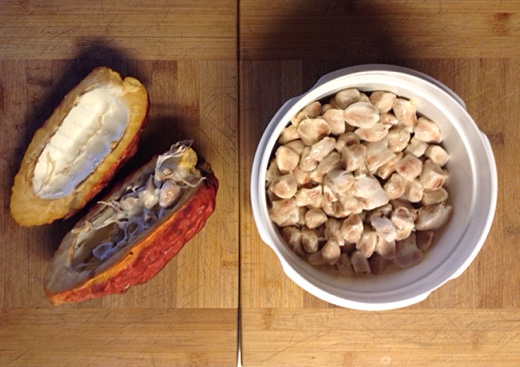
Image above: Split cacao husk cacao husk (left) and split and kernels removed for fermenting (right). Photo by Juan Wilson.

Then we cut through the skin to split the bean and expose the seeds.  We then pull out the seeds.


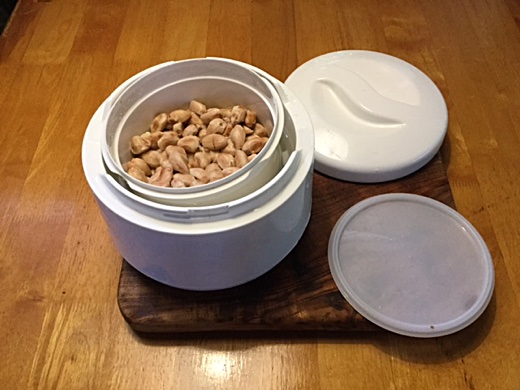
Image above: Fermenting cacao beans require changing hot water in yogurt maker for a week. Photo by Juan Wilson.

We have a non-electric yogurt maker, which operates by adding boiling water to the outer bowl. We use this yogurt maker to ferment the seeds for three or four days. You could also use 2 nesting covered bowls with hot water in the larger, or an electric yogurt maker, or put it in a warm place (don't know if pilot lights exist anymore, but I remember using the one on my old stove for a variety of purposes).


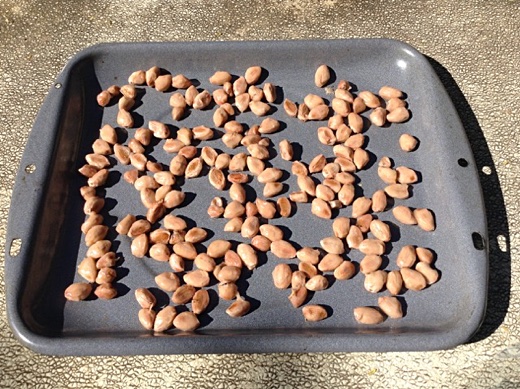
Image above: Fermented cacao beans drying in sun for a week. Photo by Juan Wilson.

After fermenting for 3 or 4 days, spread the beans on a pan and place out to dry in the sun. After 5 or 6 days in the sun (or at least a dry, airy place) the beans will be dried out. 


Image above: Sun dried cacao ready to be roasted in oven. Photo by Juan Wilson.

Then it is time to roast them.  Bake the beans in the oven, for 5 minutes at 350 degrees, then for 10 minutes at 250 degrees.  Don't leave them in the oven while it comes down to 250--take them out after 5 minutes at 350, then wait for your oven to come down to 250, the bake 10 minutes more.  You can go a longer time at one lower temperature, but we found that starting at the higher temp separated the beans more from the skin and made them easier to peel.


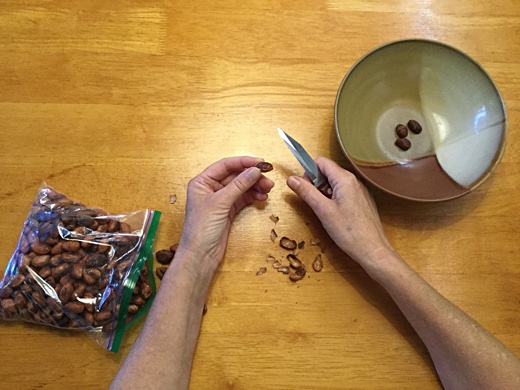
Image above: Peeling roasted cacao of their thin shell with knife and finger nails is a lot of manual work . Photo by Juan Wilson.

After the beans cool, peel off the thin outer skin or husk.  We use a paring knife to break the skin, then peel off to leave the beans shown below.  Some beans will break up, that is no problem as we are going to grind them anyway.  These roasted beans are called nibs.  Some folks like to eat either the raw beans, or the roasted beans, with no other ingredients.  They are flavorful, but rather bitter.


Image above: One half pound of roasted and peeled cacao nibs ready for grinding. Photo by Juan Wilson.

There are different ways to grind the cacao.  You can use a coffee grinder, a food processor, or a mortar and pestle.  We do a little of all three, although that is probably not necessary.  Unless you have commercial equipment, your chocolate will be more grainy and have more texture than chocolate you buy, but we consider the texture part of the charm of making authentic chocolate ourselves.


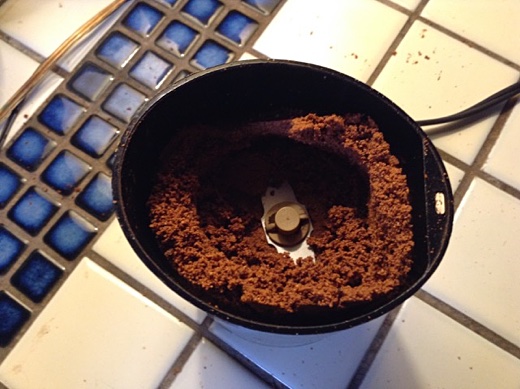
Image above: Ground cacao nibs after being chopped in coffee bean grinder. Photo by Juan Wilson.
We use a small coffee grinder first, to grind the beans until they look like a moist, grainy powder (if your grinder can get them smaller, that is better).


Image above: Coconut oil and baking sugar to be mixed with ground cacao nibs. Photo by Juan Wilson.

We add confectionery sugar, which we also grind first in the coffee grinder.  We have also used can sugar, but it is more difficult to get it to a fine texture.


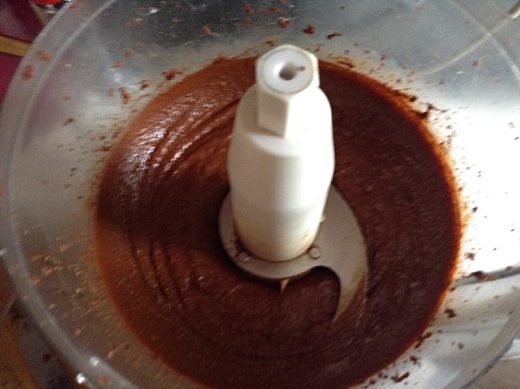
Image above: Ingredients of nibs, oil and sugar blending in food processor.  Photo by Juan Wilson.

Then we put the ground cacao and sugar in the food processor and mix some more.  The last ingredient is coconut oil, which we also add to the food processor and mix.  Some recipes call for cocoa butter, but we did not like the texture or taste--it seemed to result in lighter chocolate instead of the dark 80% cacao we like.


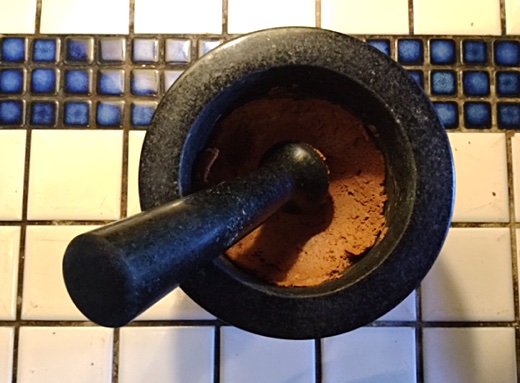
Image above: Smoothing blended ingredients with a mortar and pestle. Photo by Juan Wilson.

Our last step is to warm our pestle in a 200 degree oven, then add the cacao mixture (beans, sugar and coconut oil) to grind it some more. 


Image above: Resulting chocolate mix placed into ice-cube tray to be refrigerated.  Photo by Juan Wilson.

We press the chocolate into an ice cube tray, which makes a good sized piece of chocolate.  When inverted, it is flat on the bottom and rounded on the top.


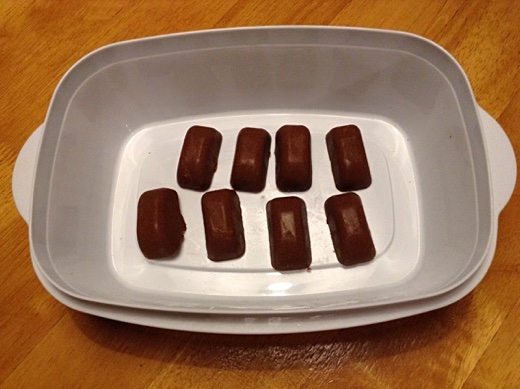
Image above: Half a batch of finished chocolate pieces after removal from ice-tray. Photo by Juan Wilson.

We keep a few pieces out for consumption in the next day or two, and refrigerate the rest.  In a sealed container or plastic bag the chocolate keeps for months in the fridge.

Recipe for making chocolate from cacao beans:

Ingredients:
(this recipe is for 8 cacao pods but you can just keep the proportions and size it up or down)
Makes about 12 ounces of chocolate

8 cacao pods (approximately 8 ounces of roasted beans)
2 ounces of confectionery sugar (for 80% cacao -- can be adjusted to sweeter blend)
2 tablespoons of unrefined coconut oil

Procedure:
Cut open cacao pods and pull out cacao beans.

Place in a yogurt maker and ferment cacao beans for 3 or 4 days.  We use a non-electric yogurt maker and boiling water changed three times per day.  You could use two covered bowls that nest, with boiling water in the larger bowl.

Place fermented cacao beans on a baking plan, and put in the sun for 5 or 6 days.

Bake dried cacao beans for 5 minutes at 350 degrees.  Remove beans and reset oven to 250 degrees, when oven reaches temp, bake for 10 minutes at 250 degrees.

Cool roasted cacao beans and peel.  Use a paring knife to break skin, then peel off thin outer skin or husk.  It is okay if the beans break up, just separate from husk.

Grind cacao beans in a coffee grinder until as smooth as it will get (like moist coarse powder). You may do all the grinding in either a coffee grinder, a food processor, or a mortar and pestle--we use all three).

Separately, grind confectionery sugar until smooth and fine.

Put cacao beans and sugar in food processor, mix some more.

Add coconut oil to beans and sugar, mix some more.

Remove mixture from food processor and put in mortar (warmed in 200 degree oven to mix better)

Mix as long as you like, to make it smoother.

Push cacao mixture into ice cube tray, refrigerate until cool.  You can take out some to serve soon at room temperature, but keep rest refrigerated.   It will keep for months in a sealed container or plastic bag.

Enjoy your chocolate!

We plan to experiment soon making chocolate using just our own honey, and no sugar--we will report the results in an update.

For more info on cacao, go to: https://en.wikipedia.org/wiki/Cocoa_bean


.

World Logistic Center Warehouse

SUBHEAD: What was once orange groves is is becoming a 2,600 acre consumption machine polluting the land. 

By Emma Foehringer Mechant on 30 May 2017 for Grist-
(http://grist.org/justice/no-ones-breathing-easy-in-the-nations-new-megawarehouse-hub/)


Image above: Like the evolution of the Amazon "fulfillment centers" the World Logistic Center, by Highland Fairview, is evolving into 2,600 acre computer warehouse serviced by autonomous diesel trucks. Click to embiggen. From original article and (http://www.highlandfairview.com/wlc.html).

[IB Publisher's note: Not to worry. This phenomena will likely be a short lived one in the service of human beings. The economies of scale will be reversed as industrial collapse engulfs us, and we can go back to the land after looting these behemoths for scrap metal.]

Just a few decades ago, California’s Inland Empire billed itself as “the Orange Empire” for the citrus orchards that fueled its primary industry. Today, many of those groves are gone, and so is the nickname.

The landlocked region of 4 million people an hour east of Los Angeles now sprouts more enormous warehouses (a billion square feet of them) than fruit trees.

Forty percent of the nation’s consumer goods — iPhones, sneakers, and everything available from Amazon — spend time sitting on those warehouse shelves after coming off ships at nearby ports, awaiting delivery to stores and homes.

What was once a mostly rural region finds itself struggling with a high poverty rate and growing population. Residents are plagued by tremendous traffic and air pollution, which recently earned the region an “F” from the American Lung Association.

Those environmental and health concerns will get much worse, advocates say, if the city of Moreno Valley — a town of 200,000 located in the heart of the Inland Empire — builds the largest warehouse project anywhere in the country.

Tom Thornsley is a 60-year-old urban planner who moved to Moreno Valley in 1998, just as the rural-to-warehouse transformation was beginning.

He thought he had chosen wisely, settling in a gray, ranch-style home that sat near a wide-open space zoned for more homes, not warehouses. “I know better than to look at dirt and not check what it would be,” he says.

But after a developer proposed a project in 2012, city officials rezoned that dirt patch next to Thornsley’s house to make it home to one of the world’s largest warehouse complexes.
 
The World Logistics Center, planned by a company called Highland Fairview, would be the largest such facility in the country, covering 2,610 acres — the size of 700 football fields. It would be more than 25 times bigger than the largest warehouse in the United States, a 98-acre hangar operated in Washington by the airplane manufacturer Boeing.

As a planner, Thornsley doesn’t have a problem with industrial development. He’s worked on commercial buildings since 1989.

But the environmental costs of the World Logistics Center are too much for his community, he says, so he’s become a leader in the effort to stop it — an effort that might hinge on next month’s special city council election.


Moreno Valley residents voiced their opposition to the proposed World Logistics Center in May with this sign. The fields in the backgrounds are a portion of the WLC. Click to embiggen. Photo by Los Angeles Times. From (http://www.latimes.com/opinion/editorials/la-ed-0928-world-logistics-center-20150928-story.html).

The World Logistics Center, which is now known locally by the acronym “WLC,” has turned Moreno Valley politics into a bloodsport. Community organizers and environmental groups have fought — in both city hall and the courtroom — to protect residents from the pollution it would cause and save protected species like peregrine falcons and California golden eagles that live in the nearby San Jacinto Wildlife Area.

Once built, warehouses don’t pollute the way that factories and power plants do. But a project the size of the WLC would be a magnet for truck traffic, spewing exhaust on 69,000 estimated daily vehicle* trips in and out of the complex.

In a struggling region, though, the lure of jobs has proven difficult to overcome, despite the public health and quality of life concerns.

“That’s why people are pressing so hard now,” Thornsley says, “to get somebody elected who’s not going to be, in essence, another developer’s puppet.”

Southern California’s two ports are among the deepest on the West Coast, allowing massive ships to dock at Los Angeles and Long Beach.

More than $360 billion worth of goods from production centers in the Asian Pacific were offloaded there in 2014. Warehouses originally crowded around the ports, until Los Angeles could no longer contain the growth.

Demand for more space at cheaper rates pushed development farther east, and the Inland Empire became the hidden purgatory between production and consumption. Only the Philadelphia area currently has more warehouse space, but projects like the WLC would leave that East Coast hub in the dust. Over the past five years, the logistics industry has delivered a quarter of the new jobs in the region.

But the economic boom carries a heavy environmental toll: Diesel trucks zip along the Inland Empire’s roads, carrying cargo to customers and piping particulates into the air. Winds rushing in from the ocean blow added pollution from L.A. and Orange County, which accumulates in the basin bounded to the north and east by mountains.

That makes the Inland Empire one of the unhealthiest places to live in the country. Air pollution leads to higher risk of heart disease, asthma, bronchitis, cancer, and more.

The South Coast Air Basin — which encompasses parts of Orange, Riverside, San Bernadino, and Los Angeles counties — exceeds federal and state requirements for lead and small particulate matter, which can lodge in the lungs.

San Bernardino and Riverside counties, which make up the Inland Empire, ranked first and second, respectively, among the top 25 most ozone-polluted counties in the American Lung Association’s 2016 air quality report.

Low-income neighborhoods and communities of color bear the brunt of this pollution, because they’re often situated near freeways or become sites for warehouses. Moreno Valley’s population is 18 percent African-American and about 54 percent Latino.

In a community where nearly 20 percent of people live in poverty, it’s easy for a big developer to gain support for a project like the World Logistics Center — especially with the promise of 20,000 permanent jobs and $2.5 billion a year added to the local economy.

But the downside includes 14,000 added diesel truck trips per day and a 44 percent increase in the city’s yearly greenhouse gas emissions.

Many warehouse jobs are also low wage, temporary, and unsafe. The facilities rack up a plethora of safety violations, according to California health and safety inspectors, and workers report high levels of injury and illness.

.

Dimming Bulb: Collapse has arrived!

SUBHEAD: Third of the series examining the implications ten years after Peak Oil. 

By RE on 4 June 2017 for Doomstead Diner -
(http://www.doomsteaddiner.net/blog/2017/06/04/dimming-bulb-3-collapse-has-arrived/)


Image above: See the lights, while you can, with a deluxe Las Vegas helicopter night flight with VIP Transportation. From (http://www.5starhelicoptertours.com/agent/las-vegas-night-strip-helicopter-flight/).

Due to my High & Mighty position as a Global Collapse Pundit, I am often asked the question of when precisely will Collapse arrive?  The people who ask me this question all come from 1st World countries.  They are also all reasonably well off with a computer, an internet connection, running water and enough food to eat.

While a few of us are relatively poor retirees, even none of us wants for the basics as of yet.  The Diner doesn't get many readers from the underclass even here in Amerika, much less from the Global Underclass in places like Nigeria, Somalia,Sudan and Yemen.

The fact is, that for more than half the world population, Collapse is in full swing and well underway.  Two key bellweathers of where collapse is now are the areas of Electricity and Food.

In his seminal 1996 paper The Olduvai Theory: Sliding Towards a Post-Industrial Stone Age, Richard Duncan mapped out the trajectory of where we would be as the years passed and fossil fuels became more difficult and expensive to mine up.

Besides powering all our cars and trucks for Happy Motoring and Just-in-Time delivery, the main thing our 1st World lifestyle requires is Electricity, and lots of it on demand, 24/7.

Although electricity can be produced in some "renewable" ways that don't depend on a lot of fossil fuel energy at least directly, most of the global supply of electric power comes from Coal and Natural Gas.

Of the two, Natural Gas is slightly cleaner, but either way when you burn them, CO2 goes up in the atmosphere.  This of course is a problem climatically, but you have an even bigger problem socially and politically if you aren't burning them.

Everything in the society as it has been constructed since Edison invented the Light Bulb in 1879 has depended on electricity to function.

Now, if all the toys like lights, refrigerators big screen TVs etc had been kept to just a few small countries and the rest of the world lived a simple subsistence farming lifestyle, the lucky few with the toys probably could have kept the juice flowing a lot longer.

Unfortunately however, once exposed to all the great toys, EVERYBODY wanted them.  The industrialists also salivated over all the profit to be made selling the toys to everyone.

So, everybody everywhere needed a grid, which the industrialists and their associated banksters extended Credit for "backward" Nation-States all over the globe to build their own power plants and string their own wires.

Now everybody in the country could have a lightbulb to see by and a fridge to keep the food cold.

More than that, the electricity also went to power water pumping stations and sewage treatment plants, so you could pack the Big Shities with even more people who use still more electricity.

This went on all over the globe, until today there isn't a major city or even a medium size town anywhere on the globe that isn't wired for electricity, although many places that are now no longer have enough money to keep the juice flowing.

Where is the electricity going off first? Obviously, in the poorest and most war torn countries across the Middle East and Africa. These days, from Egypt to Tunisia, if they get two hours of electricity a day they are doing good.


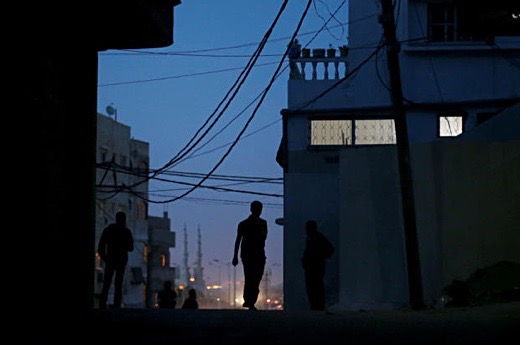
Image above: Young men walk a darkened street in the Middle East. From article below.

Robin Wright wrote a piece for the New Yorker titled "The Lights Are Going Out in the Middle East". She pointed out:
Public fury over rampant outages has sparked protests. In January, in one of the largest demonstrations since Hamas took control in Gaza a decade ago, ten thousand Palestinians, angered by the lack of power during a frigid winter, hurled stones and set tires ablaze outside the electricity company.

Iraq has the world’s fifth-largest oil reserves, but, during the past two years, repeated anti-government demonstrations have erupted over blackouts that are rarely announced in advance and are of indefinite duration.

It’s one issue that unites fractious Sunnis in the west, Shiites in the arid south, and Kurds in the mountainous north. In the midst of Yemen’s complex war, hundreds dared to take to the streets of Aden in February to protest prolonged outages.

In Syria, supporters of President Bashar al-Assad in Latakia, the dynasty’s main stronghold, who had remained loyal for six years of civil war, drew the line over electricity. They staged a protest in January over a cutback to only one hour of power a day.

Over the past eight months, I’ve been struck by people talking less about the prospects of peace, the dangers of ISIS, or President Trump’s intentions in the Middle East than their own exhaustion from the trials of daily life.

Families recounted groggily getting up in the middle of the night when power abruptly comes on in order to do laundry, carry out business transactions on computers, charge phones, or just bathe and flush toilets, until electricity, just as unpredictably, goes off again.
Some families have stopped taking elevators; their terrified children have been stuck too often between floors. Students complained of freezing classrooms in winter, trying to study or write papers without computers, and reading at night by candlelight. The challenges will soon increase with the demands for power—and air-conditioning—surge, as summer temperatures reach a hundred and twenty-five degrees.

The reasons for these outages vary. With the exception of the Gulf states, infrastructure is old or inadequate in many of the twenty-three Arab countries. The region’s disparate wars, past and present, have damaged or destroyed electrical grids.

Some governments, even in Iraq, can’t afford the cost of fueling plants around the clock. Epic corruption has compounded physical challenges. Politicians have delayed or prevented solutions if their cronies don’t get contracts to fuel, maintain, or build power plants.
Now you'll note that at the end of the last paragraph there, the journalist implies that a big part of the problem is "political corruption", but it's really not.  It's simply a lack of money.  These countries at one time were all Oil Exporters, although not on the scale of Saudi Arabia or Kuwait.

As their own supplies of oil have depleted they have become oil importers, except they neither have a sufficient mercantilist model running to bring in enough FOREX to buy oil, and they can't get credit from the international banking cartel to keep buying.

Third World countries are being cut off from the Credit Lifeline, unlike the core countries at the center of credit creation like Britain, Germany and the FSoA.  All these 1st World countries are in just as bad fiscal deficit as the MENA countries, the only difference is they still can get credit and run the deficits even higher.  This works until it doesn't anymore.

Beyond the credit issue is the War problem.  As the countries run out of money, more people become unemployed, biznesses go bankrupt, tax collection drops off the map and goobermint employees are laid off too.  It's the classic deflationary spiral which printing more money doesn't solve, since the notes become increasingly worthless.

For them to be worth anything in FOREX, somebody has to buy their Goobermint Bonds, and that is precisely what is not happening.  So as the society becomes increasingly impoverished, it descends into internecine warfare between factions trying to hold on to or increase their share of the ever shrinking pie.

The warfare ongoing in these nations has knock on effects for the First World Nations still trying to extract energy from some of these places.  To keep the oil flowing outward, they have to run very expensive military operations to at least maintain enough order that oil pipelines aren't sabotaged on a daily basis.

The cost of the operations keeps going up, but the amount of money they can charge the customers for the oil inside their own countries does not keep going up.

Right now they have hit a ceiling around $50/bbl for what they can charge for the oil, and for the most part this is not a profit making price.

So all the corporations involved in Exploration & Production these days are surviving on further extensions of credit from the TBTF banks while at the same time cutting back on their capital expenditures.  This also is a paradigm that can't last.

The other major problem now surfacing is the Food Distribution problem, and again this is hitting the African countries first and hardest.  It's a combination problem of climate change, population overshoot and the warfare which results from those issues.

Currently, the UN lists four countries in extreme danger of famine in the coming year, Nigeria, Sudan, Somalia and Yemen.  They estimate currently there are twenty million people at extreme risk, and I would bet the numbers are a good deal higher than that.


Image above: A child is fed a special formula by her mother at a hospital in Baidoa, Somalia, where drought is causing severe malnourishment. From article below.

Bethan McKernan wrote a piece for the New Independent titled "World faces four famines as Trump plans to slash foreign aid". She pointed out:
This is the iggest humanitarian crisis since World War II' about to engulf 20 million people, UN says, as governments only donate 10 per cent of funds needed for essential aid.

The world is facing a humanitarian crisis bigger than any in living memory, the UN has said, as four countries teeter on the brink of famine.

Twenty million people are at risk of starvation and facing water shortages in Somalia, Nigeria and Yemen, while parts of South Sudan are already officially suffering from famine.  

While the UN said in February that at least $4.4 billion was needed by the end of March to avert a hunger catastrophe across the four nations, the end of the month is fast approaching, and only 10 per cent of the necessary funds have been received from donor governments so far.
It doesn't look too promising that the UN will be able to raise the $4 billion they say is necessary to feed all those hungry mouths, and none of the 1st World countries is too predisposed to handing out food aid when they all currently have problems with their own social welfare programs for food distribution.  Here in the FSoA, there are currently around 45 million people on SNAP Cards at a current cost around $71billion.

The Republicans in charge of Congress will no doubt try to cut this number in order to better fund the Pentagon, but they are not likely to send more money to Somalia.

Far as compassion for all the starving people globally goes in the general population, this also appears to be decreasing, although I don't have statistics to back that up. It is just a general sense I get as I read the collapse blogosphere, in the commentariats generally.

The general attitude is, "It's their own fault for being so stupid and not using Birth Control.  If they were never born, they wouldn't have to die of starvation."  Since they are mostly Black Africans currently starving, this is another reason a large swath of the white population here doesn't care much about the problem.

There are all sorts of social and economic reasons why this problem spiralled out of control, having mainly to do with the production of cheap food through Industrial Agriculture and Endless Greed centered on the idea of Endless Growth, which is not possible on a Finite Planet.

More places on Earth were wired up with each passing year, and more people were bred up with each passing year.  The dependency on fossil fuels to keep this supposedly endless cycle of growth going became ever greater each year, all while this resource was being depleted more each year.

Eventually, an inflexion point had to be hit, and we have hit it.

The thing is, for the relatively comfortable readers of the Doomstead Diner in the First World "Business as Usual" seems to be continuing onward, even if you are a bit poorer than you were last year.

Electricity is still available 24/7 from the grid with only occasional interruptions.  Gas is still available at the pump, and if you are employed you probably can afford to buy it, although you need to be more careful about how much you drive around unless you are a 1%er.

The Rich are still lining up to buy EVs from Elon Musk, even though having a grid to support all electric transportation is out of the question.  The current grid can't be maintained, and upgrading to handle that much throughput would take much thicker cables all across the network.

People carry on though as though this will all go on forever and Scientists & Engineers will solve all the problems with some magical new device.  In other words they believe in Skittle Shitting Unicorns.

That's not going to happen though, so you're back to the question of how long will it take your neighborhood in the England or Germany or America to look like say Egypt does today?  Well, if you go back in time a decade to Egypt in 2007, things were still looking pretty peachy over there, especially in Tourist Traps like Cairo.

Terrorism wasn't too huge a problem and the government of Hosni Mubarak appeared stable.  A decade later today, Egypt is basically a failed state only doing marginally better than places like Somalia and Sudan.  The only reason they're doing as well as they are is because they are in an important strategic location on the Suez Canal and as such get support from the American military.

So a good wild ass guess for how long it will take for the Collapse Level in First World countries to reach the level Egypt is at today is about a decade.

It could be a little shorter, it could be longer.  By then of course, Egypt will be in even WORSE shape, and who might still be left alive in Somalia is an open question.  Highly unlikely to be very many people though.

Over the next decade, the famines will spread and people will die, in numbers far exceeding the twenty million to occur over the next year.  After a while, it's unlikely we will get much reporting about this, and people here won't care much about what they do hear.  They will have their own problems.

See also:
Doomstead Diner: The Dimming Bulb 12/7/14
Doomstead Diner: The Dimming Bulb: Peak Electricity 10/18/15
Ea O Ka Aina: Living through economic collapse 8/28/16


.

The Way

SUBHEAD: Patterns of regenerative thinking augur regenerative patterns of living and the reverse is also true.

By Albert Bates on 4 June 2017 for The Great Transition -
(http://peaksurfer.blogspot.com/2017/06/the-way.html)


Image above: A stone Garden Moongate. From (https://www.pinterest.com/pin/90212798755255527/).

Ten years ago, Brian Eno suggested a word to convey the extreme creativity that groups, places or “scenes” can occasionally generate. The word he came up with is “scenius.” Scenius is like genius, only embedded in a scene rather than in genes.

In a Wired interview  in 2011, Kevin Kelly described the idea this way:
"Really, we should think of ideas as connections,in our brains and among people. Ideas aren’t self-contained things; they’re more like ecologies and networks. They travel in clusters."
Historical examples are the Yosemite rock climbers Camp 4 in the 1930s, Building 20 at MIT, the Algonquin Round Table, Silicon Valley, Soho, Burning Man, the North Beach of the Big Island in the 1950s, Greenwich Village, the Panhandle flats in the Haight in the 1960s, Glastonbury, Akwesasne, the affinity groups at Seabrook, the bioregional congresses, the World Social Fora, the UN climate summits, and the Amazonian Shamanism conferences.

We have been lucky to stumble into a number of those scenes; so many we sometimes wonder if we are Forrest Gump.

Lucky stars have led us to be present at the birth of the Noho loft art and music scene, Vietnam Veterans Against the War and the Winter Soldier hearings, a blithering Nixon at sunrise on the steps of the Lincoln Memorial, the first Earth Day in Central Park, the Longest Walk, the conspiratorial Leningrad public baths on Saturday nights, the bioregional Consejos de Visiones at Meztitla and Condor, sundry Earth Summits, the ecovillager gatherings at Findhorn in 1995 and Istanbul in 1996, Viridian design, the post-millennium peak oil conferences, and the Kinsale College birthing of Transition.

The scenius we are most familiar with, although it encompasses and interpenetrates many of these others, is of course The Farm.

 As one of the longest floating crap games of the past century, it remains a dynamically evolving scene: a creative hub for the world midwives’ conspiracy, the cabal of alternative education advocacy, an incubator for progenitors of cool tech, and lately, a climate-reversal counterdevelopment seeding group, including, but not limited to, we ecovillage, regrarian, permaculture and alt.fuels evangelists.

The geography of scenius is nurtured by several factors that Kelly described:
  • Mutual appreciation — risky moves are applauded by the group, subtlety is appreciated, and friendly competition goads the shy. Scenius can be thought of as the best of peer pressure.
  • Rapid exchange of tools and techniques — as soon as something is invented, it is flaunted and then shared. Ideas flow quickly because they are flowing inside a common language and sensibility.
  • Network effects of success — when a record is broken, a hit happens, or breakthrough erupts, the success is claimed by the entire scene. This empowers the scene to further success.
  • Local tolerance for the novelties — the local “outside” does not push back too hard against the transgressions of the scene. The renegades and mavericks are protected by this buffer zone.
Scenius can erupt almost anywhere, and at different scales: in a corner of a company, in a neighborhood, or in an entire region.

What Brian Eno called scenius, Stephen Gaskin used to call “the juice.” In a paper we delivered to a history conference in Illinois in 1987, we attempted to describe a series of intellectual and technological steps that guided the first 16 years of The Farm, but cautioned that we could not try to fathom how it came into being.

“How juice moves from place to place and time to time would be an interesting exploration,” we said.

Lao Tsu (literally the “Old Boy” because he was born with a small white beard), put these ideas into poetry. We think it silly when we have to take off shoes and give up our toothpaste at the airport, but when Lao Tsu tried to leave China they told him he couldn’t leave until he had written down all he knew.

In the Tao Te Ching, the 72 gems of wisdom left with a border guard, Lao Tsu summarized his findings in order that he be allowed to leave.

The first verse is the Old Boy’s disclaimer: “The Tao that can be told is not the eternal Tao.”
Alan Watts observed that this famous opening line also showed Lao Tsu to be a punster, but you have to understand a bit of Chinese to get it.

“Tao” means the way, or course, of nature, but it also means to speak. So in Chinese, the first character is this:


The first character is “the way.” The next is “can” or “can be.”

The third is again “the way,” but it could also be “spoken”


What Lao Tsu says in one entendre is that he can’t really describe the way, because it is ineffable; if he could describe it then it would not be true. The way that can be spoken is not the way.
In the other entendre Lao Tsu says it cannot be taken as a way. The way that can be “way-ed,” or traveled, is not the way.
"Do you think you can make the world a better place? I do not think you can. It is already perfect."
— Lao Tsu
This is also the point Kelly labored to underscore, which is that scenes, and hence scenius, cannot be created. The best we can hope for is to recognize them when, for whatever extraordinary confluence of good fortune, they seem to arise. And when that happens, the best we can do is to not step on them.

That may be so, but maybe not. Scenius with the grand historicity of a Yosemite Camp 4 cannot be stamped into existence. But the conditions to potentialize scenius can be laid by design. Daniel Wahl, in Designing Regenerative Cultures, provides these basic ingredients:
  • Transformative Innovation
  • Biologically Inspired
  • Living Systems Thinking
  • Health and Resilience
In his forward to Wahl’s book, David Orr offers a nuanced challenge. It is Patricia Scotland’s “And, so?” question.  We have developed an ecosystem of solutions. How do you get this to scale? Holistic design is akin to the core nature of religion, Orr says, “a discipline binding us all together in our stewardship of the Earth as a shared habitat and the underlying assumption to be shared is that we are more worthy together than apart.”

Orr then takes it a step farther. He says the five billion poor, soon to be 7 or 9 billion, must be empowered with free energy, free clean water, free pressed-brick shelters, and free Internet access. In return they will innovate and create infinite wealth with a regenerative aspect. We hear this, and we shudder a bit.

This is also what Bucky Fuller used to say, and many others before and after him. It’s become kind of holy grail   in Silicon Valley or at Burning Man — liberating ideas will liberate masses. It philosophically underpins the UN Sustainable Development Goals — the essence of neoliberalism. But….
If I am worthy then show me the way.
First, the whole modern amusement park ride is scaffolded on cheap, available, abundant energy, soon to be a bygone. Sooner than you imagine, those Microsoft server farms that are allowing you to read this will brown out, flicker, and die. Kevin Kelly again:
A web page relies on perhaps a hundred thousand other inventions, all needed for its birth and continued existence. There is no web page anywhere without the inventions of HTML code, without computer programming, without LEDs or cathode ray tubes, without solid state computer chips, without telephone lines, without long-distance signal repeaters, without electrical generators, without high-speed turbines, without stainless steel, iron smelters, and control of fire. None of these concrete inventions would exist without the elemental inventions of writing, of an alphabet, of hypertext links, of indexes, catalogs, archives, libraries and the scientific method itself. To recapitulate a web page you have to recreate all these other functions. You might as well remake modern society.
Second, imagining seven billion hominids empowered with free everything opens the gates of Hell unless they are restrained from reliving the patterns of their collective past, only worse.

Historically, when provided abundant food and energy the hairless two-leggeds have been as locusts.

Without some countervailing ethic of restraint, should Orr’s wish comes true, this fragile blue orb becomes Easter Island.

Wahl says that which must change is more mental than physical, and in this we are agreed. Lately with the climate march for science, Paul Hawken’s Drawdown tour, and the debate over fake news and science suppression we have been hearing, over and over, people we respect make pledges of allegiance to the gods of science as if they were saying a rosary.

But we know that scientists — and even more-so academics —  are inherently conservative defenders of the rote and two or more steps behind the vanguard.

Who are the vanguard?

Artists like Brian Eno, or the cabal that gathers in a scenius to thrash out the hard truth. Moreover, they then endeavor to actually make the change they've lived go viral.

Patterns of regenerative thinking augur regenerative patterns of living and the reverse is also true: living together or coming together can change your mind or open new frontiers. We have witnessed this phenomenon in ecovillage communities all over the world.

Designing the future — any future beyond mid-century  — requires redesigning a collective consciousness, our psychodemographic. We are already doing this with the hardware gateways to cyberamphibian transits, and with permaculture, ecosystem restoration camps and ecovillages in the non-virtual world.

Ecovillages do it with eco-covenants; social contracts that build all eight forms of capital,  externalizing nothing.

Our travels to Marrakech and Zhejiang last year made clear to us that the role of ecovillages is key. They are a viral carrier — patient zero.

 Don’t be put off by the hippy or elitist veneers of many of the prototypes; those were leading wedge experiments by the fringe-dwelling creatives.  Any change for humanity arrives only after extreme vetting. At that point they become nearly inevitable.

To quote Wahl,
“Sustainability is not a fixed state to reach and then maintain, it is a community-based learning process aimed at increasing the health and resilience of our communities, our bioregional economies, ecosystems, and of the planetary life-support system as a whole.”
We say “nearly inevitable” because there are still countercurrents and eddies that can drown us. There are no guarantees. The odds against success are high.

Feeling the wind at our back, we edge the kite closer to the power zone.
"If you want to be reborn, let yourself die. If you want to be given everything, give everything up."
— Lao Tsu
This post is the last of a series we dubbed The Power Zone Manifesto. It is a series of building blocks that describe our existential climate dilemma and the only possible way to escape it. We’ll continue to post to The Great Change and Medium on Sunday mornings and 24 to 48 hours earlier for the benefit of donors to our Patreon page. If Power Zone makes it to print, our Power-Up Patreon donors will receive an autographed copy..

Saudi Terror Funding

SUBHEAD: 'Sensitive' United Kingdom terror funding inquiry report may never be published.

By Jessica Elgot on 31 May 2017 for the Guardian -
(https://www.theguardian.com/uk-news/2017/may/31/sensitive-uk-terror-funding-inquiry-findings-may-never-be-published-saudi-arabia)


Image above: Theresa May with crown prince Muhammad bin Nayef during her visit to Saudi Arabia in April. From original article.

An investigation into the foreign funding and support of jihadi groups that was authorized by David Cameron may never be published, the Home Office has admitted. That investigation into foreign funding and support of jihadi groups operating in UK is understood to focus on Saudi Arabia.

The inquiry into revenue streams for extremist groups operating in the UK was commissioned by the former prime minister and is thought to focus on Saudi Arabia, which has repeatedly been highlighted by European leaders as a funding source for Islamist jihadis.

The investigation was launched as part of a deal with the Liberal Democrats in exchange for the party supporting the extension of British airstrikes against Islamic State into Syria in December 2015.

Tom Brake, the Lib Dem foreign affairs spokesman, has written to the prime minister asking her to confirm that the investigation will not be shelved.

The Observer reported in January last year that the Home Office’s extremism analysis unit had been directed by Downing Street to investigate overseas funding of extremist groups in the UK, with findings to be shown to Theresa May, then home secretary, and Cameron.

However, 18 months later, the Home Office confirmed the report had not yet been completed and said it would not necessarily be published, calling the contents “very sensitive”.

A decision would be taken “after the election by the next government” about the future of the investigation, a Home Office spokesman said.

In his letter to May, Brake wrote: “As home secretary at the time, your department was one of those leading on the report. Eighteen months later, and following two horrific terrorist attacks by British-born citizens, that report still remains incomplete and unpublished.

“It is no secret that Saudi Arabia in particular provides funding to hundreds of mosques in the UK, espousing a very hardline Wahhabist interpretation of Islam. It is often in these institutions that British extremism takes root.
”
The contents of the report may prove politically as well as legally sensitive. Saudi Arabia, which has been a funding source for fundamentalist Islamist preachers and mosques, was visited by May earlier this year.

Last December, a leaked report from Germany’s federal intelligence service accused several Gulf groups of funding religious schools and radical Salafist preachers in mosques, calling it “a long-term strategy of influence”.

The Lib Dem leader, Tim Farron, said he felt the government had not held up its side of the bargain made ahead of the vote on airstrikes. The report must be published when it was completed, he insisted, despite the Home Office caution that information in the document would be sensitive.

“That short-sighted approach needs to change. It is critical that these extreme, hardline views are confronted head on, and that those who fund them are called out publicly,” he said.

“If the Conservatives are serious about stopping terrorism on our shores, they must stop stalling and reopen investigation into foreign funding of violent extremism in the UK.”

.