Showing posts with label Robots. Show all posts

Walmart patents bee drones

SUBHEAD: Autonomous robotic insects owned by a rapacious soul destroying corporation are not the solution.

By Claire S. Bernish on 18 March 2018 for The Mind Unleashed -
(https://themindunleashed.com/2018/03/walmart-files-patent-for-autonomous-bee-drones.html)


Image above: Illustration of a hypothetical robotic bee. From original article.

With honey bee populations still in peril from one or several of a litany of hotly debated causes — neonicotinoid insecticides, changing climate, and more — Walmart appears to have joined the race for a technological solution to a potential looming disaster, filing a patent for robotic, drone bees earlier this month.

Technically called pollination drones, Business Insider points out, the tiny bee imposters’ capabilities would theoretically include crop pollination — managed remotely through sensors and cameras allowing precision maneuverability between crops and monitor, as well as to monitor that pollination was both sufficient and successful.

CB Insights, credited with first publicizing the patent filed on March 8, surmised Walmart is seeking further control of its supply chain, as the pollinator drones are among six “patents targeting farm automation. The applications propose using drones to identify pests attacking crops, monitor crop damage, spray pesticides, and pollinate crops.”

It continues, “Drones could spray pesticides across a more targeted set of crops, rather than the blanket approach used today. The patent notes that ‘chemical spraying of crops is expensive and may not be looked upon favorably by some consumers.’”

Walmart’s move might thus be considered proactive and positive — although an albeit eerie dystopian commentary on the state of the planet and its ecosystems, or humankind’s unfortunate myopathy — but criticism questions whether funds might be better spent identifying issues facing honey bees and working to conserve and rejuvenate dwindling populations, rather than essentially planning for the worst.

“On top of more practical arguments, such as costs to smaller farms,” Quinn McFrederick, an entomologist at the University of California, Riverside, told NPR, “I would not like to live in a world where bees are replaced by plastic machines. Let’s focus on protecting the biodiversity we still have left.”

McFrederick doesn’t deny the efficacy of drone pollinators, particularly in conjunction with the use of artificial intelligence, but sees the effort heaved at solutions for a problem which has yet to fully develop — without a coincident examination of the root problem — as somewhat misguided.

If bees die out, humans would face a drastically-reduced food landscape — according to Big Think, mirroring similar estimates, around a third of the food humans eat relies on honey bee pollination — and honey bees comprise a paltry 2 percent of all bees.

“Bee deaths have been on the rise, with losses outpacing colonies’ ability to regenerate,” NPR reported last year. “Last year, the U.S. lost 44 percent of all honeybee colonies — a species essential to commercial pollination in this country. Other species of bees have neared mass extinction, including the rusty patch [sic] bumble bee and seven species of Hawaiian yellow-faced bees.”

Even with a slightly lessened decline in recent years, that’s an astoundingly high figure next to the generally-expected 17-percent decline in honey bee populations in a ‘typical’ year, Phys.org noted in 2016, adding that myriad environmental and biological factors likely contribute to colony collapse disorder — even though a solid cause has yet to be fully established.

Robotic bees, pollinator drones, would certainly stave off one of the more pernicious problems facing honey bees in recent years: a mite which acts like a vampire in the tiny insects. Phys.org explains,
“Beekeepers’ biggest challenge today is probably Varroa destructor, an aptly named parasitic mite that we call the vampire of the bee world. Varroa feeds on hemolymph (the insect ‘blood’) of adult and developing honey bees. In the process it transmits pathogens and suppresses bees’ immune response. They are fairly large relative to bees: for perspective, imagine a parasite the size of a dinner plate feeding on you. And individual bees often are hosts to multiple mites.”
Whether single issue as-yet undiscovered or a plethora of damaging factors acting insidiously, the decline of pollinators is a silent if impending doom whose fruition may yet be halted — even if by corporations and private entities like Walmart, whose self-interest in self-preservation in the matter is undeniable.

However, that in itself is a timely caveat for the state of food, wildlife, and the natural order — creating a robotic version of an evolutionary masterpiece bespeaks volumes of humans’ sad penchant for examining problems post mortem — rather than applying forethought..

Evil is now fine for Google

SUBHEAD: The Google corporate code of conduct has been modified. It's no longer "Don't be Evil".

By Jessica Corbett on 21 May 2018 for Common Dreams -
(https://www.commondreams.org/news/2018/05/21/evil-fine-now-google-ditches-dont-be-evil-company-code-conduct)


Image above: Illustration of Google as Evil. From original article.

I guess the cognitive dissonance between working on drone weapons-targeting systems and the quaint notice of 'don't be evil' got too loud at Google.

Is Google finally embracing its evil side?

The company has reportedly stripped from its employee code of conduct a section outlining its longtime unofficial motto, "Don't be evil," provoking a swift reaction on social media: "File under: 'Evil is fine now.'" "Glad this question has been settled!" "Google has finally done what was inevitable—abandoned informal commitment to its founding principle."

When the company restructured in 2015, Alphabet—Google's new parent company—was widely condemned for its watered down replacement, "Do the right thing," but Google's maintained the "Don't be evil" language in its official code of conduct. That all changed "sometime in late April or early May," Gizmodo reported Friday, after reviewing archives on the Wayback Machine.
According to a Wayback Machine archive from April 21, 2018, the related section of the code of conduct read:
"Don't be evil." Googlers generally apply those words to how we serve our users. But "Don't be evil" is much more than that. Yes, it's about providing our users unbiased access to information, focusing on their needs and giving them the best products and services that we can. But it's also about doing the right thing more generally—following the law, acting honorably, and treating co-workers with courtesy and respect.
The Google Code of Conduct is one of the ways we put "Don't be evil" into practice. It's built around the recognition that everything we do in connection with our work at Google will be, and should be, measured against the highest possible standards of ethical business conduct. We set the bar that high for practical as well as aspirational reasons: Our commitment to the highest standards helps us hire great people, build great products, and attract loyal users. Trust and mutual respect among employees and users are the foundation of our success, and they are something we need to earn every day.
So please do read the Code, and follow both its spirit and letter, always bearing in mind that each of us has a personal responsibility to incorporate, and to encourage other Googlers to incorporate, the principles of the Code into our work. And if you have a question or ever think that one of your fellow Googlers or the company as a whole may be falling short of our commitment, don’t be silent. We want—and need—to hear from you.
The updated section, visible as early as May 4, reads:
The Google Code of Conduct is one of the ways we put Google's values into practice. It's built around the recognition that everything we do in connection with our work at Google will be, and should be, measured against the highest possible standards of ethical business conduct. We set the bar that high for practical as well as aspirational reasons: Our commitment to the highest standards helps us hire great people, build great products, and attract loyal users. Respect for our users, for the opportunity, and for each other are foundational to our success, and are something we need to support every day.
So please do read the Code and Google's values, and follow both in spirit and letter, always bearing in mind that each of us has a personal responsibility to incorporate, and to encourage other Googlers to incorporate, the principles of the Code and values into our work. And if you have a question or ever think that one of your fellow Googlers or the company as a whole may be falling short of our commitment, don’t be silent. We want—and need—to hear from you.
"Despite this significant change, Google's code of conduct says it has not been updated since April 5, 2018," Gizmodo noted. Additionally, the last sentence of the code is still "And remember... don't be evil, and if you see something that you think isn't right—speak up!"—but without any further context on the phrase and its history at the company.

Critics of Google have long used the phrase as a rallying cry to challenge practices and policies that strike them as "evil," from concerns about what the company does with users' personal data to its increasing contract wrokg with the U.S. military.

Invoking the longtime motto, a dozen employees recently resigned and some 4,000 have signed on to a petition demanding that Google immediately halt its once-secret work on drones for the Pentagon, which was revealed in a pair of reports published earlier this year. Some critics tied the latest move to the drone program by tweeting:
Mike Rundle: 4:53 AM - May 20, 2018 Google removed “don’t be evil” from its Code of Conduct just in time to work on military grade image recognition ML software for a Pentagon tactical drone program. https://arstechnica.com/gadgets/2018/05/google-employees-resign-in-protest-of-googlepentagon-drone-program/ 
DHH: 3:28 PM - May 18, 2018 Guess the cognitive dissonance between working on drone weapons-targeting systems and the quaint notice of “don’t be evil” got too loud at Google. https://gizmodo.com/google-removes-nearly-all-mentions-of-dont-be-evil-from-1826153393 
The report about Google's apparent decision to ditch the phrase as a foundational corporate principle was followed by a segment on CBS's "60 Minutes" Sunday that sought to answer the question, "How did Google get so big?" and explore the implications of its power, both for users and other tech companies.

As Silicon Valley antitrust lawyer Gary Reback explained, "Google is so dominant in search and search advertising that analysts and venture capitalists in Silicon Valley say it's extremely difficult for startups to get funding if their business model requires them to compete with Google for ad revenue."

"If I were starting out today, I would have no shot of building Yelp. That opportunity has been closed off by Google and their approach," said Yelp founder Jeremy Stoppelman. "Because if you provide great content in one of these categories that is lucrative to Google, and seen as potentially threatening, they will snuff you out."

Beyond the consequences for small and startup businesses in the tech industry, there's also an impact on Google users, and internet users more broadly. As Reback put it: "People tell their search engines things they wouldn't even tell their wives.

I mean, it's a very powerful and yet very intimate technology. And that gives the company that controls it a mind-boggling degree of control over our entire society."


.

Little Google & the Drones

SUBHEAD: No, it is not an old doo-wop group - it is evil incarnate. People designing robots to kill people.

By Tyler Durden on 14 May 2018 for Zero Hedge -
(https://www.zerohedge.com/news/2018-05-14/google-employees-revolt-refuse-work-clandestine-ai-drone-project-pentagon)


Image above: The once applied motto of Google "Don't Be Evil" seems to have been lost in a cloud of money. From (https://www.suasnews.com/2018/04/google-employees-petition-against-project-maven/).

[IB Publisher's note: Google (or more accurately Alphabet Corporation) owns Blogger.com which has hosted IslandBreath website posts since 2008. We will see if we can continue that relationship in the future.] 

Around a dozen Google employees have quit and close to 4,000 have signed a petition over the company's involvement in a controversial military pilot program known as "Project Maven," which will use artificial intelligence to speed up analysis of drone footage.
Project Maven, a fast-moving Pentagon project also known as the Algorithmic Warfare Cross-Functional Team (AWCFT), was established in April 2017. Maven’s stated mission is to “accelerate DoD’s integration of big data and machine learning.” In total, the Defense Department spent $7.4 billion on artificial intelligence-related areas in 2017, the Wall Street Journal reported.

The project’s first assignment was to help the Pentagon efficiently process the deluge of video footage collected daily by its aerial drones—an amount of footage so vast that human analysts can’t keep up. - Gizmodo
Project Maven will use machine learning to identify vehicles and other objects from drone footage - with the ultimate goal of enabling the automated detection and identification of objects in up to 38categories - including the ability to track individuals as they come and go from different locations.
Project Maven’s objective, according to Air Force Lt. Gen. John N.T. “Jack” Shanahan, director for Defense Intelligence for Warfighter Support in the Office of the Undersecretary of Defense for Intelligence, “is to turn the enormous volume of data available to DoD into actionable intelligence and insights." -DoD
The internal revolt began shortly after Google revealed its involvement in the project nearly three months ago.
Some Google employees were outraged that the company would offer resources to the military for surveillance technology involved in drone operations, sources said, while others argued that the project raised important ethical questions about the development and use of machine learning. -Gizmodo
The resigned employees cited a range of frustrations, from ethical concerns over the use of AI in a battlefield setting, to larger concerns over Google's overall political decisions.

The disgruntled ex-employees, apparently unaware that Google was seed-funded by the NSA and CIA, have compiled a master document of personal accounts detailing their decisions to leave, which multiple sources have described to Gizmodo.
The employees who are resigning in protest, several of whom discussed their decision to leave with Gizmodo, say that executives have become less transparent with their workforce about controversial business decisions and seem less interested in listening to workers’ objections than they once did. In the case of Maven, Google is helping the Defense Department implement machine learning to classify images gathered by drones. But some employees believe humans, not algorithms, should be responsible for this sensitive and potentially lethal work—and that Google shouldn’t be involved in military work at all.

Historically, Google has promoted an open culture that encourages employees to challenge and debate product decisions. But some employees feel that their leadership no longer as attentive to their concerns, leaving them to face the fallout. “Over the last couple of months, I’ve been less and less impressed with the response and the way people’s concerns are being treated and listened to,” one employee who resigned said. -Gizmodo
Ironically, the development of Google's original algorithm at Stanford was partly funded by a joint CIA-NSA program in which founder Sergei Brin created a method to quickly mine large amounts of data stored in databases.
“Google founder Mr. Sergey Brin was partly funded by this program while he was a PhD student at Stanford. He together with his advisor Prof. Jeffrey Ullman and my colleague at MITRE, Dr. Chris Clifton [Mitre’s chief scientist in IT], developed the Query Flocks System which produced solutions for mining large amounts of data stored in databases. I remember visiting Stanford with Dr. Rick Steinheiser from the Intelligence Community and Mr. Brin would rush in on roller blades, give his presentation and rush out. In fact the last time we met in September 1998, Mr. Brin demonstrated to us his search engine which became Google soon after.” -Nafeez Ahmed
In their defense of Project Maven, Google notes that their AI won't actually be used to kill anyone (just help the military ID targets to "service"). That isn't good enough for workers and academics opposed to the use of machine learning in a military application.
In addition to the petition circulating inside Google, the Tech Workers Coalition launched a petition in April demanding that Google abandon its work on Maven and that other major tech companies, including IBM and Amazon, refuse to work with the U.S. Defense Department. -Gizmodo
“We can no longer ignore our industry’s and our technologies’ harmful biases, large-scale breaches of trust, and lack of ethical safeguards,” the petition reads. “These are life and death stakes.”

Over 90 academics in AI, ethics and computer science released an open letter on Monday, calling on Google to end its involvement with Project Maven and support an international treaty which would prohibit the use of autonomous weapons systems.
Peter Asaro and Lucy Suchman, two of the authors of the letter, have testified before the United Nations about autonomous weapons; a third author, Lilly Irani, is a professor of science and a former Google employee.
Google’s contributions to Project Maven could accelerate the development of fully autonomous weapons, Suchman told Gizmodo. Although Google is based in the U.S., it has an obligation to protect its global user base that outweighs its alignment with any single nation’s military, she said. -Gizmodo
“If ethical action on the part of tech companies requires consideration of who might benefit from a technology and who might be harmed, then we can say with certainty that no topic deserves more sober reflection—no technology has higher stakes—than algorithms meant to target and kill at a distance and without public accountability,” the letter states. 
“Google has moved into military work without subjecting itself to public debate or deliberation, either domestically or internationally. While Google regularly decides the future of technology without democratic public engagement, its entry into military technologies casts the problems of private control of information infrastructure into high relief.”

We're sure employees have nothing to worry about and their concerns are overblown - as Google's "Don't be evil" motto prevents them from ever participating in some scary program that could kill more innocent people than a Tesla autopilot.

.

The Golden Rule of Technology

SUBHEAD: It's that "Technological Progress" is innovation doesn't solve problems, it creates them.

By Ugo Bardi in 21 December 2017 for Cassandra's Legacy -
(http://cassandralegacy.blogspot.co.uk/2017/12/the-golden-rule-of-technological.html)


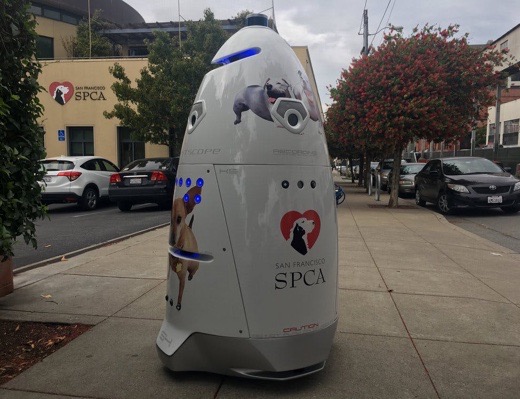
Image above: a KnightsScope security robot patrols around San Francisco Society for the Prevention for Cruelty to Animals to deter homeless people. We guess they are not as valuable as stray dogs. From (https://realfarmacy.com/homeless-robot/).
As the homeless problem continues to surge in San Francisco, an animal advocacy and pet adoption clinic has taken the novel, if dystopian, approach of hiring an autonomous security robot unit to clear out vagrants.

The SPCA (the Society for the Prevention of Cruelty to Animals) deployed a K5 robot manufactured by Knightscope, a Silicon Valley-based robotics company, to help discourage homeless people from erecting tents on the sidewalks and streets near the clinic. Though it has reduced the number of encampments, the robot has drawn overwhelmingly negative reactions from city residents.

Resembling a Whovian Dalek, the K5 security robot moves at around three miles per hour and is equipped with four cameras and an array of lasers, thermal sensors, and GPS. It can be rented for $6 an hour as opposed to the $16/hr a security guard costs.
See that thing up there? It is an autonomous security robot, something that's becoming fashionable nowadays.

Obviously, for every problem, there has to be a technological solution. So, what could go wrong with the idea that the problem of homeless people can be solved by means of security robots? After all, they are not weaponized.... I mean, not yet.

There is something badly wrong with the way we approach what we call "problems" and our naive faith in technology becomes more and more pathetic. And now we are deploying security robots all over the world. Surely a "solution" but it is not so clear what the problem is.

The story of this silly robot made me think of a post that I published a few months ago where I stated what I called "the golden rule of technological innovation: "innovation doesn't solve problems, it creates them". And the more I think about that, the more I think it is true.

Decades of work in research and development taught me this:

Innovation does not solve problems, it creates them. 

Which I could call "the Golden Rule of Technological Innovation." There are so many cases of this law at work that it is hard for me to decide where I should start from. Just think of nuclear energy; do you understand what I mean?

So, I am always amazed at the naive faith of some people who think that more technology will solve the problems created by technology. It just doesn't work like that.

That doesn't mean that technological research is useless; not at all. R&D can normally generate small but useful improvements to existing processes, which is what it is meant to do. But when you deal with breakthroughs, well, it is another kettle of dynamite sticks; so to say.

Most claimed breakthroughs turn out to be scams (cold fusion is a good example) but not all of them. And that leads to the second rule of technological innovation:

Successful innovations are always highly disruptive

You probably know the story of the Polish cavalry charging against the German tanks during WWII. It never happened, but the phrase "fighting tanks with horses" is a good metaphor for what technological breakthroughs can do.

Some innovations impose themselves, literally, by marching over the dead bodies of their opponents.

Even without such extremes, when an innovation becomes a marker of social success, it can diffuse extremely fast. Do you remember the role of status symbol that cell phones played in the 1990s?

Cars are an especially good example of how social factors can affect and amplify the effects of innovation.

I discussed in a previous post on Cassandra's Legacy how cars became the prime marker of social status in the West with the 1950s, becoming the bloated and inefficient objects we know today. They had a remarkable effect on society, creating the gigantic suburbs of today's cities where life without a personal car is nearly impossible.

But the great wheel of technological innovation keeps turning and it is soon going to make individual cars as obsolete as it would be wearing coats made of home-tanned bear skins.

It is, again, the combination of technological innovation and socioeconomic factors creating a disruptive effect. For one thing, private car ownership is rapidly becoming too expensive for the poor.

At the same time, the combination of global positioning systems (GPS), smartphones, and autonomous driving technologies makes it possible a kind of "transportation on demand" or "transportation as a service" (TAAS) that was unthinkable just a decade ago.

Electric cars are especially suitable (although not critically necessary) for this kind of transportation.

In this scheme, all you need to do to get a transportation service is to push a button on your smartphone and the vehicle you requested will silently glide in front of you to take you wherever you want. (*)

The combination of these factors is likely to generate an unstoppable and disruptive social phenomenon. Owning a car will be increasing seen as passé, whereas using the latest TAAS gadgetry will be seen as cool.

People will scramble to get rid of their obsolete, clumsy, and unfashionable cars and TAAS will also play the role of social filter: with the ongoing trends of increasing social inequality, the poor will be able to use it only occasionally or not at all.

The rich, instead, will use it to show that they can and that they have access to credit. Some TAAS services will be exclusive, just as some hotels and resorts are. Some rich people may still own cars as a hobby, but that wouldn't change the trend.

Of course, all that is a vision of the future and the future is always difficult to predict.

But something that we can say about the future is that when changes occur, they occur fast. In this case, the end result of the development of individual TAAS will be the rapid collapse of the automotive industry as we know it: a much smaller number of vehicles will be needed and they won't need to be of the kind that the present autuomotive industry can produce. This phenomenon has been correctly described by "RethinkX," even though still within a paradigm of growth.

In practice, the transition is likely to be even more rapid and brutal than what the RethinkX team propose. For the automotive industry, there applies the metaphor of "fighting tanks with horses."

The demise of the automotive industry is an example of what I called the "Seneca Effect." When some technology or way of life becomes obsolete and unsustainable, it tends to collapse very fast.

Look at the data for the world production of motor vehicles, below (image from Wikipedia). We are getting close to producing a hundred million of them per year.

If the trend continues, during the next ten years we'll have produced a further billion of them. Can you really imagine that it would be possible? There is a Seneca Cliff waiting for the automotive industry.

See also:
Ea O Ka Aina: Robot guard "commits suicide 7/18/17
Ea O Ka Aina: Robot runs over young boy 7/13/16
.

AI already has taken over

SUBHEAD: Artificial Intelligence has taken over in the forms of modern corporate "personhood".

By Jeremy Lent on 30 November 2017 for Patterns of Meaning -
(https://patternsofmeaning.com/2017/11/30/ai-has-already-taken-over-its-called-the-corporation/

http://www.islandbreath.org/2017Year/12/171205bigbladerunner.jpg
Image above: Still frame of a corporate 3D billboard advertisement engaging the protagonist in the movie "Blade Runner 2049". Click to enlarge. From (http://www.slashfilm.com/blade-runner-2049-trailer-breakdown/).

[IB Publisher's note: Have you noticed that humans have all but disappeared from our interactions with corporations - be it the phone company, Amazon, Google, Apple, Microsoft and even local, state and federal government? Should children be trained to be polite to Apple's Siri or Amazon's Alexa? What's next? Obedience?]

Futurists warning about the threats of AI are looking in the wrong place. Humanity is already facing an existential threat from an artificial intelligence we created hundreds of years ago. It’s called the Corporation.

Some of the leading thinkers of our time are unleashing a stream of warnings about the threat of artificial intelligence taking over from humans. Earlier this month, Stephen Hawking predicted it could be “the worst event in the history of our civilization” unless we find a way to control its development.

Billionaire Elon Musk has formed a company to try to keep humans one step ahead of what he sees as an existential AI threat.

The scenario that terrifies them is that, in spite of the best intentions, we might create a force more powerful than all of humanity with a value system that doesn’t necessarily incorporate human welfare.

Once it reaches a critical mass, this force could take over the world, control human activity, and essentially suck all life out of the earth while it optimizes for its own ends.

Prominent futurist Nick Bostrom gives an example of a superintelligence designed with the goal of manufacturing paperclips that transforms the entire earth into one gigantic paperclip manufacturing facility.

These futurists are right to voice their concerns, but they’re missing the fact that humans have already created a force that is well on its way to devouring both humanity and the earth in just the way they fear. It’s called the Corporation.

Corporations “enthroned”

When corporations were first formed back in the seventeenth century, their inventors—just like modern software engineers—acted with what they believed were good intentions. The first corporate charters were simply designed to limit an investor’s liability to the amount of their investment, thus encouraging them to finance risky expeditions to India and Southeast Asia.

However, an unintended consequence soon emerged, known as moral hazard: with the potential upside greater than the downside, reckless behavior ensued, leading to a series of spectacular frauds and a market crash that resulted in corporations being temporarily banned in England in 1720.

Thomas Jefferson and other leaders of the United States, aware of the English experience, were deeply suspicious of corporations, giving them limited charters with tightly constrained powers.

However, during the turmoil of the Civil War, industrialists took advantage of the disarray, leveraging widespread political corruption to expand their influence.

Shortly before his death, Abraham Lincoln lamented what he saw happening with a resounding prophecy: “Corporations have been enthroned … An era of corruption in high places will follow… until wealth is aggregated in a few hands … and the Republic is destroyed.”

Corporations took full advantage of their new-found dominance, influencing state legislatures to issue charters in perpetuity giving them the right to do anything not explicitly prohibited by law.

The tipping point in their path to domination came in 1886 when the Supreme Court designated corporations as “persons” entitled to the protections of the Fourteenth Amendment, which had been passed to give equal rights to former slaves enfranchised after the Civil War.

Since then, corporate dominance has only been further enhanced by law, culminating in the notorious Citizen United case of 2010, which lifted restrictions on political spending by corporations in elections.
Sociopaths with global reach

Corporations, just like a potential runaway AI, have no intrinsic interest in human welfare. They are legal constructions: abstract entities designed with the ultimate goal of maximizing financial returns for their investors above all else.

If corporations were in fact real persons, they would be sociopaths, completely lacking the ability for empathy that is a crucial element of normal human behavior.

Unlike humans, however, corporations are theoretically immortal, cannot be put in prison, and the larger multinationals are not constrained by the laws of any individual country.

With the incalculable advantage of their superhuman powers, corporations have literally taken over the world. They have grown so massive that an astonishing sixty-nine of the largest hundred economies in the world are not nation states but corporate entities.

Corporations have been able to use their transnational powers to dictate their own terms to virtually any country in the world.

As a result of decades of globalization, corporations can exploit the free movement of capital to build factories in nations with the weakest labor unions, or locate polluting plants in countries with lax environmental laws, basing their decisions solely on maximizing returns for their shareholders. Governments compete with each other to make their nations the most attractive for corporate investment.

Corporations wield their vast powers to control the minds of consumers, enthralling them into a state of perpetual consumption.

In the early twentieth century, Paul Bernays, a mastermind of corporate empowerment, boldly stated his game plan as “the conscious and intelligent manipulation of the organized habits and opinions of the masses.” He declared ominously that “those who manipulate this unseen mechanism of society constitute an invisible government that is the true ruling power of this country.”

The sinister words of Wayne Chilicki, chief executive of General Mills, show how Bernays’ vision has been perpetuated: “When it comes to targeting kid consumers, we at General Mills… believe in getting them early and having them for life.”

The result of this corporate takeover of humanity is a world careening out of control, where nature is mercilessly ransacked to extract the raw materials required to increase shareholder value in a vortex of perpetual economic growth, without regard to the quality of human life and with no concern for the welfare of future generations.

Corporate takeover of global governance

Instead of being pilloried for their vast destruction, those who dedicate themselves to their corporate overlords are richly rewarded and elevated to positions of even greater power and prestige.

ExxonMobil, for example, has been exposed as having lied shamelessly about climate change, knowing for decades about its consequences and yet deliberately concealing the facts, thus condemning present and future generations to havoc.

Instead of facing jail time, the CEO during much of this period, Rex Tillerson, is now the U.S. Secretary of State, overseeing the global relationships of the most powerful country in the world.

In fact, the current U.S. cabinet represents the most complete takeover yet of the U.S. government by corporations, with nearly 70% of top administration jobs filled by corporate executives.

In the words of Robert Weissman, president of Public Citizen, “In the Trump administration, auto industry lobbyists are setting transportation policy, Boeing has a top perch at the Department of Defense, Wall Street is in control of financial policy and regulatory agencies, and corporate defense lawyers staff the key positions in the Justice Department.”

Corporations are inserting themselves into international agreements, so they can further their interests even more effectively. At the 2015 World Economic Forum in Davos, a new Global Redesign Initiative set out an agenda for multinational corporations to engage directly in global governance.

The UN’s Sustainable Development Goals, proudly announced in 2015 as a vision to reduce poverty, adopted their approach by inviting corporations to a seat at its table to impact UN policy, while calling for further globalization.

Fossil fuel companies have infiltrated the annual global COP meetings on climate change, ensuring they can compromise any actions that might hurt them, even as the world faces the threat of climate catastrophe.

The takeover of global governance by multinational corporations has permitted them to undermine human welfare everywhere in the pursuit of profit.

Nestlé remorselessly buys control of rural communities’ groundwater reservoirs to sell as bottled water, leaving them to foot the bill for environmental cleanup, with the result that in countries such as Columbia sugary bottled drinks are frequently cheaper than plain water.

As a result of the chemicals sold by global agribusiness companies such as Cargill and Monsanto, it’s been estimated by UN officials that the world’s topsoil can only support about sixty more years of harvests.

In these cases, and countless others like them, humans and the earth alike are mere fodder for the insatiable appetite of an amoral, inhuman intelligence run amok.

There is an alternative

The corporate takeover of humanity is so all-encompassing that it’s difficult to visualize any other possible global system. Alternatives do, however, exist. Around the world, worker-owned cooperatives have demonstrated that they can be as effective as corporations—or more so—without pursuing shareholder wealth as their primary consideration.

The Mondragon cooperative in Spain, with revenues exceeding €12 billion, shows how this form of organization can efficiently scale.

There are also structural changes that can be made to corporations to realign their values system with human welfare. Corporate charters can be amended to optimize for a triple bottom line of social, environmental, and financial outcomes (the so-called “triple Ps” of people, planet, and profit.)

A “beneficial” or B-Corp certification, which holds companies to social and environmental performance standards, is becoming more widely adopted and is now held by over 2,000 corporations in over fifty countries around the world.

Ultimately, if we are stop this force from completely taking over humanity, these alternative approaches need to be codified into our national and international governance. Imagine a world where corporate charters were only granted if they adopted a triple bottom line, and where shareholder lawsuits threatened every time a company broke one of its own social and environmental standards.

Until that happens, it may be that the “worst event in the history of our civilization” is not the future development of modern AI, but the decision by a group of 17th century politicians to unleash the power of the Corporation on an unsuspecting humanity.

.

Averting Apocalypse

SUBHEAD: Advertising controlling the masses can be repurposed in order to liberate humanity. Really!

By Daniel Pinchbeck on 27 July 2017 for Medium -
(https://medium.com/@danielpinchbeck_91351/averting-apocalypse-e43416746fb)


Image above: A polar bear amid melting ice with no place to go. From original article.

[IB Publisher's note: This is a subtly deceptive piece. At one point  Although Pinchbeck makes some important observations on possible future human behavior regarding food and energy production, as well as resetting priorities regarding corporate and financial operations, he still falls into the techno-optimist trap of thinking we are going to avoid ecological collapse through retooling Google, Facebook and Bitcoin.  Pinchbeck writes "...we need new, powerful, abstract goals to orient us and provide ideals for people to rally around. Patriotism, satyagraha, the ideal of a “Master Race” provided such goals for mass movements in the past..."Don't wait for Elon Musk and Jeff Bezos to save you. Get a head start of avoiding apocalypse by turning away from corporations and government for your survival. My thinking is that the future will look more like 1850 than Pinchbeck's 2050.]  

A few weeks ago, New York Magazine published a devastatingly apocalyptic overview of climate predictions. We are on target for a 4 to 8 degrees Celsius warmer climate by 2100, at current rates of CO2 emissions.

We know from past epochs that it could even be worse: In the past, temperatures have shot up as much as ten degrees in a single decade, as feedback loops get engaged. The author David Wallace-Wells is correct when he writes, “No plausible program of emissions reductions alone can prevent climate disaster.”

However, that doesn’t mean that nothing can be done to save our species - and the planet - from approaching cataclysm. In fact, if humanity was to awaken to our current plight and work together, we could transform the Earth in a positive direction that would allow us to thrive here for the long term.

Unfortunately, at the moment most people’s innate response to the looming ecological mega-crisis is to suppress it, avoid it, or freeze like the fabled deer caught in the headlights. It seems too overwhelming to contemplate.

Obviously, we need to find a different way to respond. The problem is that the effort to develop a systemic response and coherent strategy for making this change falls outside of existing categories - public or private sector, left or right, etc.

So what can we do?

First we have to understand what’s possible. I spent the last decade researching and considering what we must do to avert ecological collapse. The results are presented in my new book, How Soon Is Now? (published by Watkins, with introductions from Russell Brand - who calls it “a blueprint for the future” - and Sting).

Let’s imagine ourselves - for a moment - as extraterrestrial observers watching humanity’s current gyrations from the surface of another world. We need to start from such a high level of abstraction before we drill down into the possible solutions in various areas.

From such a distant vantage point, humanity would resemble one gigantic organism that is continuously transforming the surface of the Earth. From the alien perspective, we might seem to be something like rust, or a virus on the face of the Earth.

However, the aliens would realize that this fast-developing species has the capacity for self-reflection and long-term thought.

If or when we become aware of ourselves as a planetary entity - a super-organism in a continuous symbiotic relationship with the ecology of the Earth - we will rethink how we organize ourselves and how we apply our technologies.

We will use our creative powers to replenish and restore the world’s ecosystems while we take care, responsibly, of our human family as one unified whole. Instead of a virus, we might intentionally mutate ourselves to become the Earth’s immune system.

In my book, I defined the three main areas we need to address as our technical infrastructure (energy, agriculture, and industry); the social systems (government and economics); and consciousness (the set of beliefs, values, and ideologies which are imprinted by mass media and education).

We can look at these three areas as gears that turn each other. For instance, when the technology of the Internet developed, it changed collective consciousness and had many influences on our political and economic systems.

Together, the technical infrastructure, social system, and collective consciousness make up our current paradigm - the system we are in now, which is in the process, unfortunately, of annihilating the ecosystems we depend upon for life.

In terms of the technical infrastructure, we know that we need to make a rapid transition to renewable energy - in a decade or two, rather than a half century or more.

We also need to make a transition from industrial and monocultural agriculture back to regenerative farming practices that sequester CO2 in the soil. We need to transition from exploitative industrial processes to what the designer William McDonogue calls “cradle to cradle” manufacturing.

In the short term, we also need to demand a sharp global reduction in CO2 emissions that will, indeed, impact the lifestyles of vast masses of people, above all the wealthy.

The lifestyles of the wealthy are a much bigger problem than overpopulation. It is estimated that 50% of the world’s resources are consumed by the wealthiest 1% of the population.

I know the idea of voluntarily reducing our excesses seems difficult to imagine from where we are now. But I will propose, later on, how this can be accomplished. Similar things have happened before.

The gist of it is that we need to unleash a global marketing campaign that makes use of mass media, social media, and social networks and utilizes the levers of our individual and collective psychology, as effectively as advertising does.

When we look at the technical challenges facing us, we can see they are difficult - but not impossible.
Solar has already reached “grid parity” with fossil fuels. We have developed new methods for storing renewable energy sources (such as the Tesla Power Wall) as well as developing the “Internet of Energy” which will allow individuals and communities to feed energy back to the grid.

One issue is the enormous “sunk costs” of the existing fossil fuel infrastructure - but forfeiting that is better than forfeiting a future for our species.

Such a rapid energy transition is not something that can occur purely through market mechanisms. It would require a melding of public and private interest. Hard as this is to imagine, it has occurred in the past: After the 1941 Pearl Harbor attack, for example, the US shifted all factories to wartime production within a few months.

Production of consumer goods like private cars were stopped. The wealthy were taxed at more than 90% and this capital was used for wartime goals. If this has happened before, such a concerted effort can happen again.

People have to recognize the ecological crisis poses the same level of existential threat as the Nazis did in World War Two. It requires the same level of collective, committed response.

Farming practices must change as drastically as energy production. According to the United Nations, we only have 60 years of harvests left with current industrial farming practices, in any case.

This is because we are depleting the world’s topsoil. Luckily, there are other - in many cases older - forms of farming that replenish and restore topsoil. These include organic farming, no-till farming, and permaculture. These practices also sequester carbon back in the soil - potentially huge amounts of CO2.

We also need a large-scale global reduction on meat eating, as animal agriculture is extremely destructive to the environment. 30% of the Earth’s surface is animal grazing land.

With a reduction or moratorium on meat, we can reforest this surface area, creating carbon sinks.

Reforestation can be accomplished quickly using the latest technologies such as drones to plant trees and Artificial Intelligence to help replicate diverse self-supportive ecosystems.

While it is true that regenerative farming practices require more skilled labor, more people working on farms, as well as smaller farms, this is also not technically impossible or unfeasible.

In fact, we are seeing increasing automation in many fields that will eliminate millions of industrial jobs over the next decades. An interesting question is - what are people supposed to do once all of the old industrial jobs have disappeared?

Retraining people to be custodians and stewards of their local lands, teaching them to grow food, combining the best knowledge from the present and past, could be socially beneficial on many levels.

To accomplish this will also require a shift in the third area I mentioned upfront - our consciousness and ideology, which is imprinted through the media. Essentially, over the last few hundred years, we developed an ideology of one-directional progress and modernization that benefitted corporations and large-scale commercial enterprises.

According to this ideology, the rural areas were boring and stagnant. Mass populations would relocate to cities and people would find it more exciting to work in sweatshops or small factories, as Uber drivers or in marketing firms.

In essence, to make the transition that is now necessary, we need to change our vision of progress once again. People living in healthy multi-generational communities out in nature, working less, growing food, taking care of their local ecosystems - combining the best of modern technology with some aspects of ancient and indigenous cultures - could become a new paradigm for a humane and resilient post post-modernity.

We could actually resettle the rural areas as part of a movement toward decentralized and resilient communities. Resilience will be a necessary virtue in the near-future, as we confront intensifying battering from “super-storms” and other impacts of the ecological crisis. Decentralized communities that can grow their own food and make their own energy are maximally resilient.

Our industrial paradigm must also change drastically from the models of “planned obsolescence” and “conspicuous consumption” that fueled the last centuries of industrialization. It is increasingly obvious that we are living on a planet of finite and limited resources, yet we have constructed a commercialized industrial system that requires constant over-production of disposable goods that poison the environment.

Plastics, for instance, now infiltrate every ecosystem on the planet and concentrate in the fatty tissues of animals, causing hormonal disruptions and cancers. We have been hypnotized and entranced by our own technical powers yet unable to master them and use them wisely. This must now change.

The alternative is that we redesign our systems of industrial manufacturing, over the next decades, so they are close to zero-waste, or even feed back benevolently into the Earth’s ecosystems. While this seems impossible from where we are now, we do have a great model for this - nature itself. Nature is ceaselessly productive and her productions do not harm the biosphere but only add to its fertility and abundance.

In Cradle to Cradle, designer William McDonogue proposes that all of our packaging could be designed so it is compostable and contains seeds. When you eat an ice cream, you bury the wrapper and a little garden grows from it. McDonogue believes we can redesign all of our industrial systems along the same principles.

While this seems difficult to imagine now, we must remember that many things which seemed impossible have, in fact, come to pass. Flying around the planet in a metal tube was impossible - until the Wright Brothers came along.

Forms of plastic are already being developed out of biodegradable and nondestructive materials such as cassava and hemp. “Biomimicry” may also provide many answers. The point is that we need our academies and laboratories to innovate in this direction, and unleash our creative genius on this area, comprehensively.

Tools and gadgets that require rare metals and other minerals - like laptops and Smart Phones - should be designed so that their components can be replaced and recycled. The bylaws of companies must change so they are responsible for their products over the entire course of their lifecycle.

I know it seems difficult, if not impossible, to address these areas in the systemic way I have proposed here. This is because our social systems and ruling ideologies are organized against it. We live in an odd circumstance where we have been indoctrinated and programmed to believe that unreason - irrationality - must triumph.

But social systems as well as ideologies do, in fact, change. Human nature, in itself, is changeable, as Oscar Wilde realized: “The only thing that one really knows about human nature is that it changes. Change is the one quality we can predicate of it.”

If we are going to make a rapid transition to renewable energy over the next decade or two, while we engineer a transition to regenerative agriculture and at the same time redesign our industrial manufacturing processes to minimize waste and mesh with the Earth’s ecology, this will require a deep transformation in our social systems as well as our ruling values and ideologies. It will, also - we must accept - profoundly impact our daily lives and habits.

We will have to change our consumption patterns, reduce our excesses, as well as some of our short-term expectations for the future - both for ourselves and our children.

However, when we fully realize the alternative is a universal collapse and apocalypse that will ruin our children’s future and leave the Earth close to uninhabitable, we can make this choice happily - choosing it as a mission and a destiny.

When we start to respond as a society to the ecological crisis, we may find we enjoy life more. Building new community networks and moving toward resilience will increase our sense of personal satisfaction while ending our feeling of alienation from one another and the Earth as a whole.

One main factor accelerating our rush toward global cataclysm is the underlying design of our economic system.

We can look at corporations as artificial life forms that humans have designed to survive and compete in an artificial game that we also created which we call the stock market.

We gave these artificial life-forms only one prime directive: In order to survive and “win the game,” they must maximize financial profit and shareholder value. This is, therefore, exactly what corporations do - like robots.

If a corporation can only survive and win its game by maximizing financial value, then it naturally must work to overcome anything that stands in the way of that goal. For instance, a corporation must seek to evade environmental restrictions that reduce its profit margins. If the health and diversity of local ecosystems or communities stand in its way, it must break them.

Such an artificial life-form - designed with one purpose only - must also naturally self-select for the most sociopathic character types as it needs CEOs and leaders who have no ethical compunction or concern for externalities.

In this sense, we can’t even blame a company like British Petroleum for despoiling the Gulf of Mexico, to take just one example. Evading restrictions, corrupting governments - that is what corporations have been designed to do.

Similarly, our money system is a design artifact that enforces certain kinds of behavior patterns. A debt-based currency issued by private banks and backed by government loans, money is designed to maximize competition and create artificial scarcity, as well as winners and losers.

The Belgian economist Bernard Lietaer - one of the architects of the Euro - argues that our money system is purely a “Yang” currency supporting masculine ideals of aggression, competition, hoarding, and domination,

In his book The Future of Money, Lietaer looks at the history of monetary systems and finds examples of more balanced societies that also used “Yin” currencies which foster collaboration, community, connection, and sharing.

Lietaer proposes that we could create a global trading currency he names the Terra that would have a “demarrage” charge or negative interest rate. In other words, when you receive a Terra, it has a time stamp on it. It quickly goes down in value as you hold onto it.

Your best option is, thus, to get the currency back into circulation rather than hoarding it. This is one innovative idea that could lead to a less destructive money system. There are many others.

The blockchain - the underlying technology upon which crypto-currencies like Bitcoin, Ether, and Tezos have been built - could provide the new infrastructure for a rapid redesign and reinvention of our financial system.

However, a new financial system can’t simply imitate the same destructive processes and hierarchies of our present system, if we want to interrupt our march toward ecological suicide.

If we want an ecologically sane society, we will need to radically reduce the current extremes of wealth inequality, which create irresponsible attitudes and practices for rich and poor alike.

Blockchain - a transparent accounting ledger that is distributed and decentralized - could also provide the basis for a global direct democracy that scales from the local to the bioregional to the global level.

We could potentially create a truly democratic system where everybody, ultimately, has the equal right to contribute - to debate and decide on our collective future. This may seem scary at first, but alternatives may be even less feasible.

We are seeing new prototypes for collaborative governance developing online in platforms like DemocracyOS and Loomio.

Just as our economic system is a design template from over a century ago, our current political system was largely constructed in the late 18th and early 19th Centuries, when information only moved as fast as horse-and-buggies or schooner ships.

The rate of change was much slower than it is today. In fact, when we look back through history we discover there is an intrinsic relationship between the predominant form of media and the ruling political-economic system.

For instance, we could never have had empires like Rome or Babylon without a written code of laws - without the media technology of writing.

We could never have had the modern nation-state with its liberal democracies and parliaments without the printing press, which made it possible for many people to follow the news of the day and have enough knowledge to vote in elections.

With the Internet, we have a new, profound system of globally interactive communication and it points toward a profound transition in our social, political, and economic infrastructure.

The regressive movements happening now express a tension between the older modes of authoritarian control and the new possibilities and potentials inherent in our new media and communications infrastructure, which points toward the potential for a much deeper level of democratic decision-making, as well as a sharing of wealth and power.

I realize these considerations may seem very abstract to some readers - it may seem a stretch to connect them with our urgent and immediate need to deal with an ecological emergency that threatens our tenure on this planet in the near-term.

However, I believe that all aspects of this crisis are linked together and it is crucial to understand it, as a system. Without the right viewpoint on it, we can’t make the right moves, whether in the short or long term. All of this is explored in my book in greater detail.

So then - let’s return to the somewhat mind-boggling question of how we can approach the multi-dimensional ecological crisis we have brought upon ourselves in the short term and avert what seems to be probable if not inevitable catastrophe? I propose the following as methodology and next steps.

In the next years, we must create a broad-based movement of civil society, globally, that is solution-focused and positive - that recognizes not only the threat of climate change and environmental crisis but also the opportunity this crisis provides us to reinvent our society so it is truly equitable, empathic, and corresponds to our deepest and best impulses individually and collectively.

The problem with organizations like Greenpeace or Bill McKibben’s 350.org, I believe, is the lack of a brilliantly inspiring and redemptive vision for the future. We need a movement that offers a thrilling vision of our future together, particularly for Millennials and even younger people.

In some ways, in fact, our future looks very bright. If we can handle the ecological threat — a big “if” — the prospect of automation combined with a Universal Basic Income could alleviate humanity, as a whole, from degrading work and senseless drudgery. We could liberate the knowledge commons so that people everywhere have unlimited opportunity to learn new skills. The prospect of settling other planets is, also, an exciting one.

I also believe the new paradigm may include an intentionally guided evolution of consciousness as well as an exploration of altered or non-ordinary states of consciousness. While this seems marginal now, it may be important or even crucial for our future.

This is something I have explored in depth in past works - it is too much to unpack here. Personally I am persuaded by the overlay of quantum physics, the Holographic Universe theory of David Bohm, and the mystical traditions of Eastern cultures like Tibet and India.

The melding of ancient mysticism and modern techno-science may turn out to be an extremely important aspect of the transformation taking place.

As science and mysticism converge (even Elon Musk now believes we are living in a kind of simulation similar to what Gnostics spoke about a few thousand years ago), we find that our self-identity, our sense of purpose or meaning, and the way we envision humanity’s place in the universe are all changing.

In any case, the idea that we could orient ourselves positively toward a creative and participatory future could be deeply inspiring - and profoundly different from the ideology of corporate globalization culminating in a technological Singularity where silicon fuses with flesh. There may be many potential future orientations that are valid and valuable.

Some people may fuse with machines while others choose to return to a more agrarian way of life.

I know these ideas seem abstract - but we need new, powerful, abstract goals to orient us and provide ideals for people to rally around.

Patriotism, satyagraha, the ideal of a “Master Race” provided such goals for mass movements in the past. We need new collective myths to support our transition to an emancipated, ecologically regenerative society.

In terms of building a global movement, the marketing pitch would be something like the following:
“Dear Human Family,
We have reached an amazing and critical juncture. On the one hand, we see extraordinary progress happening in many areas. On the other, our rapid evolution over the last centuries has unleashed an ecological crisis that could bring our species to an end or lead to a crash back to a much smaller population. This time happens to be critical.
A beautiful outcome is possible, still, but to get there, we will have to cooperate as never before. We will, also, have to commit to building a future that elevates and enhances our human community as a whole as we care for our threatened ecosystems and seek to repair and reverse the damage we have done.
We can co-create a global society defined by universal abundance within the next 20 to 50 years - probably closer to 20. This would be a world where nobody went hungry and everybody had access to knowledge and ongoing education and job retraining via the Internet, supported by a basic income. But to get to that place we must first undergo a period of transition that will be difficult and challenging - but also, potentially beautiful, if we rise to this occasion. We must understand that individually and collectively, we are on a hero’s journey, a trial by fire.
We know from past epochs that humanity has the capacity to rally when challenged. The United States and Britain rallied to win the Second World War, even though this required tremendous sacrifices for many people. We require the same kind of commitment now. If humanity has accomplished this before, we can again, together.”
The fact that we are more connected than ever before - almost as if the global brain has spontaneously emerged just when we need it most - might mean that new ideas and a new awareness could spread rapidly at the propitious moment.

Imagine, for instance, if Google and Facebook were to put what I just wrote above on their home page. 2 billion people now use Facebook every day. Zuckerberg has recently announced his interest in Universal Basic Income, and proposes that fighting global warming could be a rallying cry for the Millennials.

Google and Facebook - or other social networks that develop through peer-to-peer computing or the blockchain - could be used to warn everybody on Earth that we are confronting the immediate prospect of ecological decimation.

These platforms could be used to give people the necessary information they need to make many changes in their daily lives. Through social tools, groups could be formed that would support millions of people in shifting to vegetarianism, sharing cars and tools and other resources, engaging in voluntary campaigns of bioremediation, ending the unnecessary use of plastics, and so on.

We now have the mapping and geolocating capacities to enhance our efficiencies and support conservation in many areas.

A massive short-term jobs program - something like the WPA in the 1930s - could be unleashed to transition our energy infrastructure to renewables and shift our farming practices to regenerative ones. Many forms of tech innovation are developing rapidly that could be implemented universally.

For instance, vertical farms and massive solar collectors can be built. Urban rooftops can be painted white or gardens put on them to reduce the albedo effect. Biochar is an industrial process that creates energy from biomass while sequestering CO2, ending with a carbon-rich tilth that can enhance topsoil. Industrial Biochar could be scaled up globally.

I tend to believe that to make this deadline, we need a new media network that is global and funded to the same level as FOX or CNN. This network would be laser focused on ecological solutions and pragmatic alternatives.

No problem would be presented just to create fear and anxiety in the viewer’s mind. Every program that presented a problem in the world would also propose actionable steps to solve it. The content would be linked to participatory networks where people could engage immediately in bringing about solutions.

One simple way for a network such as this one to be launched would be for a group of progressive billionaires, realizing the necessity, to come together to contribute the seed capital.

Because many people are currently hypnotized or brainwashed by FOX in particular, this new network would have to make use of similar tropes, repetitive memes, and production values. It could also integrate user-generated content, engaging its audience in a new way.

What I have offered here is a brief overview, indicating both the direction of the change we need to make, and the actionable steps that are required in many areas. I know that most people in the mainstream will immediately reject this plan as impossible. The fact is that nothing is impossible for us, once we set our minds to it.

We certainly don’t know the limits of what we can do - at least until we try with all of our will and courage, and we haven’t done that yet. I also think, considering the scale of the problems, the solutions are likely to be rapidly scalable, growing exponentially once we have found the answers.

For instance, when a community develops that is largely self-sufficient and makes a positive local impact, the templates for how that community governs itself, as well as its daily practices, can be shared and copied widely.

The techniques of television, advertising, and branding that have been used so successfully to dominate and control the mass mind can be repurposed in order to liberate humanity from its delusions. The most important thing to realize is that, despite what doomsayers tell us, our fate still rests in our hands.


.

Tepco robot finds melted core

SOURCE: Norman Leuter (normandlaurie@gmail.com)
SUBHEAD: The melted fuel debris at Fukushima Daiichi Reactor #3 found on floor of containment.

By AP Staff on 22 July 2017 in The Guardian -
(https://www.theguardian.com/environment/2017/jul/23/fukushima-images-show-massive-deposits-thought-to-be-melted-nuclear-fuel)


Image above: Still from robot video. What appears to be bolted caps on corroding pipe valves amidst melted core debris. From original article.

Robot spots suspected debris of melted fuel for first time since 2011 earthquake and tsunami destroyed the plant.

Images captured by an underwater robot on Saturday showed massive deposits believed to be melted nuclear fuel covering the floor of a damaged reactor at Japan’s destroyed Fukushima nuclear plant.

The robot found large amounts of solidified lava-like rocks and lumps in layers as thick as 1m on the bottom inside a main structure called the pedestal that sits underneath the core inside the primary containment vessel of Fukushima’s Unit 3 reactor, said the plant’s operator, Tokyo Electric Power Co.

On Friday, the robot spotted suspected debris of melted fuel for the first time since the 2011 earthquake and tsunami caused multiple meltdowns and destroyed the plant. The three-day investigation of Unit 3 ended on Saturday.


Image above: Still from robot video. What appears to be disintegrating metal over a bed of blackened corium. From original article.

Locating and analysing the fuel debris and damage in each of the plant’s three wrecked reactors is crucial for decommissioning the plant. The search for melted fuel in the two other reactors has so far been unsuccessful because of damage and extremely high radiation levels.

During this week’s probe, cameras mounted on the robot showed extensive damage caused by the core meltdown, with fuel debris mixed with broken reactor parts, suggesting the difficult challenges ahead in the decades-long decommissioning of the plant.

TEPCO spokesman Takahiro Kimoto said it would take time to analyse the debris in the images to figure out removal methods.

See also:
Ea O Ka Aina: Tepco plan to dump tainted water 7/14/17
Ea O Ka Aina: Fukushima Bosses on Trail 6/29/17
Ea O Ka Aina: Stop Fukushima as Olympic venue 5/10/17
Ea O Ka Aina: Continuing Fukushima danger 4/14/17
Ea O Ka Aina: Fukushima worse than ever 2/5/17
Ea O Ka Aina: Fukushima radiation on West Coast 1/13/17
Ea O Ka Aina: Fukushima cleanup cost to double 12/9/16
Ea O Ka Aina: Tokyo damaged by nuclear pellet rain 9/24/16
Ea O Ka Aina: Nuclear Power and Climate Failure 8/24/16
Ea O Ka Aina: High radioactivity in Tokyo 8/22/16
Ea O Ka Aina: Nuclear Blinders 8/18/16
Ea O Ka Aina: Fukushima and Chernobyl 5/29/16
Ea O Ka Aina: Fukushima radiation damages Japan 4/14/16
Ea O Ka Aina: Fukushima's Nuclear Nightmare 3/13/16
Ea O Ka Aina: Fifth Fukushima Anniversary 3/11/16
Green Road Jounral: Balls filled with Uranium, Plutonium 2/19/16
Ea O Ka Aina: Fukushima impacts are ongoing 11/8/15
Ea O Ka Aina: Petroleum and Nuclear Coverups 10/21/15
Ea O Ka Aina: Fukushima Radiation Contamination 10/13/15
Ea O Ka Aina: Radioactive floods damage Japan 9/22/15
Ea O Ka Aina: Fir trees damaged by Fukushima 8/30/15
Ea O Ka Aina: Japan restarts a nuclear plant 8/11/15
Ea O Ka Aina: Fukushima disaster will continue 7/21/15
Ea O Ka Aina: Too many fish in the sea? 6/22/15
Ea O Ka Aina: Fukushima prefecture uninhabitable 6/6/15
Ea O Ka Aina: In case you've forgotten Fukushima 5/27/15
Ea O Ka Aina: Radiation damages top predator bird 4/24/15
Ea O Ka Aina: Fukshima die-offs occurring 4/17/15
Ea O Ka Aina: Fukushima Impact Update 4/13/15
Ea O Ka Aina: Fukushima - the end of atomic power 3/13/15
Ea O Ka Aina: Where is the Fukushima Data? 2/21/15
Ea O Ka Aina: Fuku-Undo 2/4/15
Ea O Ka Aina: Fukushima MOX fuel crossed Pacific 2/4/15
Ea O Ka Aina: Fukushima worst human disaster 1/26/15
Ea O Ka Aina: Japan to kill Pacific Ocean 1/23/15
Ea O Ka Aina: Japan's Environmental Catastrophe 8/25/14
ENE NEws: Nuclear fuel found 15 miles from Tokyo 8/10/14
Ea O Ka Aina: Earthday TPP Fukushima RIMPAC 4/22/14
Ea O Ka Aina: Fukushima Daiichi hot particles 5/30/14
Ea O Ka Aina: Japanese radiation denial 5/12/14
Ea O Ka Aina: Entomb Fukushima Daiichi now 4/6/14
Ea O Ka Aina: Fukushima Disaster 3 Years Old 4/3/14
Ea O Ka Aina: Tsunami, Fukushima and Kauai 3/9/14
Ea O Ka Aina: Japanese contamination 2/16/14
Ea O Ka Aina: Bill for Fukushima monitoring 2/9/14
Ea O Ka Aina: Tepco under reporting of radiation 2/9/14
Ea O Ka Aina: Fukushima Fallout in Alaska 1/25/14
Ea O Ka Aina: Fukushima engineer against nukes 1/17/14
Ea O Ka Aina: California to monitor ocean radiation 1/14/14
Ea O Ka Aina: Demystifying Fukushima Reactor #3 1/1/14
Ea O Ka Aina: US & Japan know criticality brewing 12/29/13
Ea O Ka Aina: Fukushima Forever 12/17/13
Ea O Ka Aina: Brief radiation spike on Kauai 12/27/13
Ea O Ka Aina: USS Ronald Reagan & Fukushima 12/15/13
Ea O Ka Aina: Fukushima Pacific Impact 12/11/13
Ea O Ka Aina: Berkeley and Fukushima health risks 12/10/13
Ea O Ka Aina: Madness engulfs Japan 12/4/13
Ea O Ka Aina: Edo Japan and Fukushima Recovery 11/30/13
Ea O Ka Aina: Reaction to Fukushima is Fascism 11/30/13
Ea O Ka Aina: Radioisotopes in the Northern Pacific 11/22/13
Ea O Ka Aina: Fukushima cleanup in critical phase 11/18/13
Ea O Ka Aina: Fukushima fuel removal to start 11/14/13
Ea O Ka Aina: Fukushima, What me worry? 11/13/13
Ea O Ka Aina: Remove other Fukushina fuel 10/29/13
Ea O Ka Aina: End to Japanese Nuclear Power? 10/3/13
Ea O Ka Aina: Fukushima & Poisoned Fish 10/3/13
Ea O Ka Aina: Fuel Danger at Fukushima 9/27/13
Ea O Ka Aina: Reactor #4 Spent Fuel Pool 9/16/13
Ea O Ka Aina: Fukushima is Not Going Away 9/9/13
Ea O Ka Aina: X-Men like Ice Wall for Fukushima 9/3/13
Ea O Ka Aina: Fukushima House of Horrors 8/21/13
Ea O Ka Aina: Fukushima Apocalypse 8/21/13
Ea O Ka Aina: Fukushima Radioactive Dust 8/20/13
Ea O Ka Aina: Cocooning Fukushima Daiichi 8/16/13
Ea O Ka Aina: Fukushima radiation coverup 8/12/13
Ea O Ka Aina: Leakage at Fukushima an emergency 8/5/13
Ea O Ka Aina: Fukushima burns on and on 7/26/13
Ea O Ka Aina: What the Fukashima? 7/24/13
Ea O Ka Aina: Fukushima Spiking 7/15/13
Ea O Ka Aina: G20 Agenda Item #1 - Fix Fukushima 7/7/13
Ea O Ka Aina: Fukushima and hypothyroid in Hawaii 4/9/13
Ea O Ka Aina: Japan to release radioactive water 2/8/13
Ea O Ka Aina: Fukushima as Roshoman 1/14/13
Ea O Ka Aina: Fukushia Radiation Report 10/24/12
Ea O Ka Aina: Fukushima Fallout 9/14/12
Ea O Ka Aina: Fukushima Unit 4 Danger 7/22/12
Ea O Ka Aina: Fukushima denial & extinction ethics 5/14/12
Ea O Ka Aina: Fukushima worse than Chernobyl 4/24/12
Ea O Ka Aina: Fukushima dangers continue 4/22/12
Ea O Ka Aina: Fukushima children condemned 3/8/12
Ea O Ka Aina: Fukushima fights chain reaction 2/7/12
Ea O Ka Aina: Tepco faking Fukushima fix 12/24/11
Ea O Ka Aina: The Non Battle for Fukushima 11/10/11
Ea O Ka Aina: Fukushima Debris nears Midway 10/14/11
Ea O Ka Aina: Fukushima Radiation Danger 7/10/11
Ea O Ka Aina: Fukushima Abandoned 9/28/11
Ea O Ka Aina: Deadly Radiation at Fukushima 8/3/11
Ea O Ka Aina: Fukushima poisons Japanese food 7/25/11
Ea O Ka Aina: Black Rain in Japan 7/22/11
Ea O Ka Aina: UK PR downplays Fukushima 7/1/11
Ea O Ka Aina: Fukushima #2 & #3 meltdown 5/17/11
Ea O Ka Aina: Fukushima sustained chain reaction 5/3/11
Ea O Ka Aina: Ocean Radioactivity in Fukushima 4/16/11
Ea O Ka Aina: Japan raises nuclear disaster level 4/12/11
Ea O Ka Aina: Fukushima No Go Zone Expanding 4/11/11
Ea O Ka Aina: Fukushima to be Decommissioned 4/8/11
Ea O Ka Aina: Fukushima Poisons Fish 4/6/11
Ea O Ka Aina: Learning from Fukushima 4/4/11
Ea O Ka Aina: Fukushima Leak goes Unplugged 4/3/11
Ea O Ka Aina: Stick a fork in it - It's done! 4/2/11
Ea O Ka Aina: Fukushima reactors reach criticality 3/31/11
Ea O Ka Aina: Fukushima Non-Containment 3/30/11
Ea O Ka Aina: Fukushima Meltdown 3/29/11
Ea O Ka Aina: Fukushima Water Blessing & Curse 3/28/11
.