Unencumbered by the facts…

SUBHEAD: No links were found between Saddam Hussein and Al Qaeda or stockpiles of chemical weapons. 

By Madeleine Burnside on 27 May 2017 for Sanity Papers -
(http://sanitypapers.com/this-weeks-story/unencumbered-by-the-facts/)


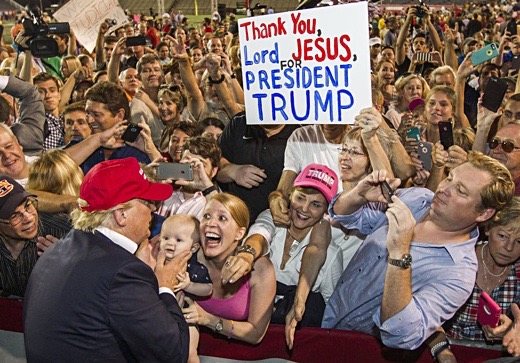
Image above: Trump meets enthusiastic Born Again Christians at political rally in September 2015. From (http://www.npr.org/sections/itsallpolitics/2015/09/13/439833719/true-believer-why-donald-trump-is-the-choice-of-the-religious-right).

Friends often exclaim to me about Donald Trump voters (some of whom are near and dear to them), “Why don’t they see what Trump’s doing? Why don’t they change their minds?” And of course, some people have—probably those who harbored doubts even while voting for him. Yet a solid majority of his base show unwavering loyalty.

Why is that, really?

A friend of mine, who is a member of that devoted base, thought that Trump would do well with the Saudis because he’s done business with them and knows how to make deals with them. My first reaction was scoffery—how could this president do well at anything?

But, out of respect for my friend, I paused to consider his point. I had to say, maybe. Am I so certain about all of my own facts that I can scoff with impunity? It was an interesting seed of doubt that I decided to follow down a few logical rabbit holes.

Back when dinosaurs roamed the earth and I was a graduate student in California, my doctoral advisor was Norman O. Brown, a fascinating, surprising, and sometimes difficult man.

He started out as a classicist, spent World War II as a code-breaker for the OSS (now the CIA), and eventually worked his way out of classics into the study of Freudian psychology, only to become an icon of 1960s thought.

His most revolutionary book, Love’s Body, mingled snippets of his vast learning into a comprehensive meditation on the big questions of life.

Anyway, he would often come to seminars with two books that he was reading under his arm. He instilled in us that we should never draw our opinions from one source, no matter how apparently primary—we needed to look for the other side of the argument.

Sometimes, when this proved elusive, two books on different subjects—here he would smush together the volumes that he had brought with him—might have a “wedding” (his term) that would bring us to an insightful conclusion.

In many ways, we Liberals like to think of this sort of reasoning as part and parcel of our position. We stay open to new ideas. We dip into Fox News or Drudge Report in order to hear from the other side. We work to tolerate people’s differences. We delight in critical thinking.

Or do we?

When my friend suggested that good things might happen from Trump’s visit with the Saudis I, unencumbered by the facts, was ready to make a vigorous counter-argument.

The government of modern-day Saudi Arabia is a subject on which I know very little and, for me, the event was illuminated only by my disdain for all things Trump.

All things, and that’s a lot. Am I actually not receptive to thinking there might be something of value in the man’s effort without fully exploring the issue? Where did my liberal values slip?

I am reading a fascinating book by Jane Mayer, The Dark Side: The Inside Story of How the War on Terror Turned Into a War on American Ideals. It focuses on George Bush’s presidency after 9/11, and his decision to opt out of the Geneva Conventions armed-conflict protocols regarding imprisonment and torture. It’s not for the squeamish.

Mayer’s book also dwells a great deal on how the Bush administration willfully disregarded reports that torture doesn’t work as reliably as empathy-based interrogation techniques—a fact that has been documented since something like the 12th century.

Bush officials also ignored reports that did not presumptively suit or advance their agenda, for example, the fact that no links were ever found between Al Qaeda and Saddam Hussein’s regime, or that Iraqi stockpiles of weapons of mass destruction were effectively non-existent by the end of the 1990s. Why did these people not pay attention or take these findings into account? Why the heck not?

Hmmm…

Another friend, who often has insightful things to say about this blog, sent me to a podcast that had set her thinking—specifically, three episodes from You Are Not So Smart titled “The Backfire Effect.”

They dissect and analyze the phenomenon of fitting the facts to suit one’s preconceived notions or clinging to notions once we’ve established them for ourselves. Why do we do it? Does it serve us in any way? To go deeper: Does it have some sort of evolutionary value?

So there they are: Ostensibly nothing to do with Trump, but I’m reading The Dark Side, listening to “The Backfire Effect,” and thus attending the wedding of two different analyses in a way that would make my wonderful mentor proud.

Here’s the link to the “Backfire Effect - Part One”(https://soundcloud.com/youarenotsosmart/093-the-backfire-effect-part-one) - don’t miss it.

We all need to understand the consequences of our own assumptions if we are ever going to turn this country around in a constructive and lasting way.


.

The so-called "Resistance"

SUBHEAD: What would a real resistance to the complex systemic corruption of America look like? 

By James Kunstler on 29 May 2017 for Kunstler.com -
(http://kunstler.com/clusterfuck-nation/the-so-called-resistance/)


Image above: Left-wing protesters attended an April 29 rally in a "clown bloc," wearing masks to mock their adversaries as Alt-Left  and Alt-Right battle in the streets of Portland. From (http://www.wweek.com/news/2017/05/23/white-supremacists-are-brawling-with-masked-leftists-in-the-portland-streets-homeland-security-is-watching/).

Entropy never sleeps. It works remorselessly to transform things of value into useless, dissipated waste and heat. Complexity stokes it especially as the law of diminishing returns multiplies the wheels of futility spinning down to zero. Hence, the intellectual decay of American life in which spin is everything, anything goes, and nothing matters.

The latest manifestation of this dynamic is the curious movement that styles itself The Resistance, lately adopted by the grotesque handmaiden of the Deep State that the Democratic Party became in the regency of Hillary Clinton.

Its mission is to undo the results of the last national election by claiming that Russia undid it. It pretends to seek the restoration of something — but what? Of dissipated power relations within the Deep State itself?

President Trump is actually taking care of that by turning government management over to his generals and the minions of Goldman Sachs.

The generals are reinvesting in the strategic black hole of our military adventures overseas.

The Goldman Sachs appointees are making Wall Street safe for the continued asset-stripping of the USA. The last time I checked, Hillary’s gang did not oppose either of these endeavors.

The Resistance employs cadres of useful idiots — Black Lives Matter, “undocumented” visitors, “Antifa,” the LGBTQ “community” — to pretend that it stands for social justice, but these are just straw persons fronting a gang devoted only to regaining the levers of “privilege” — which they also pretend to be against.

The Resistance takes its name from the movement in World War Two France that fought the Nazi occupation, thus self-valorizing itself. But the pre-owned styling is just another victory of spin in the public relations nightmare that American political life has become.

It also begs the question: what would a real resistance look like?

First, it would oppose the aforementioned asset-stripping that the US economy has become, the transfer of capital in all its forms — monetary, political, cultural, social — from the dis-employed former middle classes to the tiny, select beneficiaries of financial manipulation.

Note that the things being manipulated — markets, currencies, securities, and interest rates — are increasingly phantom entities that appear to maintain their value only because the high priests of financial authority say that they do.

The shelf-life of that flim-flam approaches its endgame as it self-evidently immiserates the masses and their sheer faith in its recondite promises dwindles away to nothing. A genuine resistance would begin to deconstruct this clerisy and its institutions, namely Too Big To Fail banks and the Federal Reserve.

The best opportunity to accomplish that would have been the early months of Mr. Obama’s turn in the White House, the dark time of the previous financial crash when the damage was fresh and obvious.

But the former president blew that under the influence of high priests Robert Rubin and Larry Summers. And the lower order clerics were allowed run their hoodoo machine flat out in the following eight years.

 Just look at the long chart of the Standard & Poors index. Tragically, this ever-upward arc is now taken to be the normal state of things, and when it fails the implosion will be orders of magnitude more violent than the last time.

One would think that a genuine resistance would also oppose the growing consolidation of power in the now-colossal spying apparatus of the nation — the often averred to “seventeen intel agencies” that show signs of being actively at war against other parts of the government and against citizens themselves.

Hence, the non-stop murmur of allegation about “Russian interference in the election,” going back to the summer of 2016 without either any real evidence, or any clarification of what is actually alleged to have happened.

Another tragic turn is that this fifth column of rogue intel agencies has recruited the major organs of the news to incessantly repeat its allegations until the public accepts the story as established fact rather than just the manufactured story it so far appears to be.

Well, the lives of persons and societies founder on versions of the “reality” they fabricate for their own purposes.

A genuine resistance would show foremost some fidelity to a reality beyond the spin-factories of self-delusion. And it would lead in the hard work of shedding this over-burden of self-multiplying despotisms.

Maybe this Memorial Day is a good moment to question the claims of the so-called resistance, and perhaps patriotically meditate on what the nature of an authentic resistance would be to the ongoing decay of this nation while it is still possible.

.

Germany can no longer rely on USA


SUBHEAD: Germany's Merkel says Trump and Brexit have left Europe with an unsteady alliance.

By Tyler Durden on 28 May 2017 for Zero Hedge -
(http://www.zerohedge.com/news/2017-05-28/watershed-moment-merkel-says-germany-can-no-longer-rely-america)


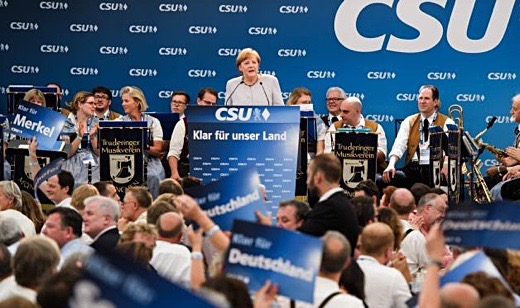
Image above: German Chancellor Merkel speaking at Christian Social Union meeting in Bavaria. From (https://www.welt.de/politik/deutschland/article165008816/Merkel-sieht-in-den-USA-keinen-verlaesslichen-Partner-mehr.html).

After the recent G7 meeting in Itlay and faced with a western alliance divided by Brexit and Donald Trump's presidency, Germany's Merkel said "die zeiten, in denen wir uns auf andere völlig verlassen konnten, sind ein Stück vorbei", or loosely translated "the times in which we could completely depend on others are on the way out" and added that "I've experienced that in the last few days."

Merkel then said that while Germany and Europe would strive to remain on good terms with America and Britain, "we have to fight for our own destiny" and she also said that special emphasis was needed on warm relations between Berlin and newly-elected French President Emmanuel Macron.

Her comments came after Trump said during the G-7 meeting he needed more time to decide if the US would continue backing the Paris climate deal, which has frustrated European diplomats. A subseqent report by Axios, Trump privately told multiple people, including EPA Administrator Scott Pruitt, that "he plans to leave the Paris agreement on climate change" which will likely further infurate his European allies.

During his trip, Trump also echoed his past criticism of NATO allies for failing to meet the defensive alliance's military spending commitment of two percent of GDP.
Observers noted that he neglected to publicly endorse the pact's Article Five, which guarantees that member countries will aid the others they are attacked. The omission was especially striking as he unveiled a memorial to the September 11, 2001 terrorist attacks against the US, the only time the mutual defense clause has been triggered.
On Friday, Trump also described German trade practices as "bad, very bad," in Brussels talks last week, complaining that Europe's largest economy sells too many cars to the US.

Reactions to Merkel's striking comment came pouring in from the likes of Edward Snowden who called her speech an "era-defining moment".

G7 nations shun Trump

SUBHEAD: G7 leaders plow ahead after Trump throws 'Tantrum' over Paris Climate Accord.

By Lauren McCauley on 27 May 2017 for Common Ground -
(https://www.commondreams.org/news/2017/05/27/other-g7-leaders-plow-ahead-after-trump-throws-tantrum-over-climate-accord)


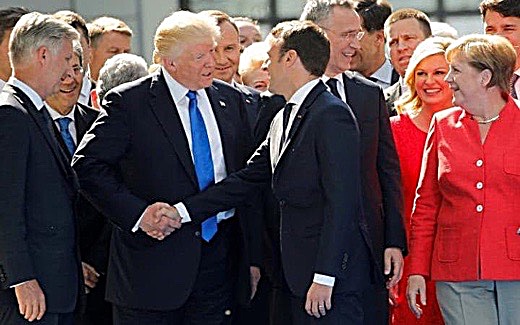
Image above: After pushing his way to the front of the G7 leaders Trump has a "tug of War" handshake with newly elected French President Emmanuel Macron who was trying to avoid the orange clown. From (http://www.unionleader.com/article/20170526/NEWS06/170529490).

In addition to stymying action on fossil fuels, Trump also 'forced the Italian prime minister Paulo Gentiloni to shred plans for an ambitious statement stressing the plight of migrants.

Further isolating the United States as other world powers prepare to take on the crisis of climate change, President Donald Trump refused to commit to the landmark Paris Climate Agreement as the remaining G7 leaders reaffirmed their determination to implement the accord.

In what has been described as an "unusually frank statement," the G7 Taormina Leaders' Communiqué (pdf) released Saturday after the two-day meeting in Sicily, says that the U.S. is "in the process of reviewing its policies on climate change and on the Paris Agreement and thus is not in a position to join the consensus on these topics."

"Understanding this process," the document continues, "the heads of state and of government of Canada, France, Germany, Italy, Japan, and the United Kingdom and the presidents of the European Council and of the European Commission reaffirm their strong commitment to swiftly implement the Paris Agreement."

Meanwhile, Trump took to Twitter to announce that he would "make a final decision on the Paris Accord next week," but it was clear the U.S. president had been a substantial roadblock over the course of the summit.

"The entire discussion about climate was very difficult, if not to say very dissatisfying," German Chancellor Angela Merkel told reporters on Saturday. "There are no indications whether the United States will stay in the Paris Agreement or not."

On those deliberations, The Guardian reported:
During the two-day conclave in Taormina, other leaders repeatedly urged Trump to recognize that as world's second biggest carbon emitter, the U.S. had to show leadership on climate issues.

Leaders warned the U.S. president that he risks a stampede, as others in the 195-nation agreement use American withdrawal from the treaty to reduce their own commitments.

Trump retained the option of pulling out of the treaty altogether or, more likely, scaling back on the specific commitments made by the Obama administration. Obama pledged to cut domestic greenhouse gas emissions 26-28 % below 2005 levels by 2025.
While not surprised, environmental groups expressed dismay over Trump's recalcitrance.
The truncated six-page document (compared with last year's 32-page tome), which outlines the industrialized nations' top priorities, "offered only minimal language on climate change and energy," the Union of Concerned Scientists noted.

Alden Meyer, a leading expert on the United Nation's international climate negotiations process and director of strategy and policy with the organization, said that Trump's "continued waffling on whether to stay in or withdraw from the Paris Agreement made it impossible to reach consensus at the Taormina summit on the need for ambitious climate action."

But, Meyer continues, "he stands in stark isolation, as the leaders from Europe, Canada, and Japan have made it crystal clear they intend to fully implement their national commitments under the Paris Agreement and pursue efforts to decarbonize the global economy."

More concisely, Alex Doukas, senior campaigner at Oil Change International, said: "even though Donald Trump threw a tantrum, the grown-ups in the room ignored him."

However, Doukas did note that the group stopped short of reaffirming their commitment to phase out fossil fuel subsidies by 2025.

"G7 leaders caved in the face fossil fuel cronyism, and were silent on their prior commitment to end fossil fuel subsidies by 2025—despite this language being agreed at the meeting of G7 energy ministers in April," Doukas said.

"Subsidizing fossil fuel companies in the face of rapid climate change is like spraying jet fuel on a burning home. To put out the fire, we must first stop making the problem worse," Doukas continued.

"Ignoring the problem just because fossil fuel industry mascots like Trump demand it is like agreeing to take the warning labels off of cigarettes because they offend Joe Camel. Our leaders must act now to stop burning our tax dollars and stop trashing the climate."

In addition to stymying action on fossil fuels, Trump also reportedly "forced the Italian prime minister Paulo Gentiloni—the summit host—to shred plans for an ambitious statement stressing the plight of migrants was a global rather than regional responsibility," the Guardian reported.

One unnamed European diplomat told the Independent that "[t]here was very strong opposition by the Americans and British who wanted to refocus on security and water down the expansive language on freedom of movement."

Opening up borders was one of the primary demands of the protesters who rallied on the streets of the Italian resort community on Saturday. Thousands of peaceful activists marched and carried signs, that included phrases like "Freedom, not Frontex," referring to the European Union's draconian border control agency.

Instead, the groups settled on language committing to fighting "protectionism" through trade and terrorism, as well as vowing to impose additional sanctions against Russia if warranted.


.

Defense contractors fought NoDAPL

SUBHEAD: DAPL Company hired "War on Terror" defense contractors to suppress Native American uprising.

By Lauren McCauley on 27 May 2017 for Common Dreams -
(https://www.commondreams.org/news/2017/05/27/dapl-company-hired-war-terror-contractors-suppress-native-uprising)


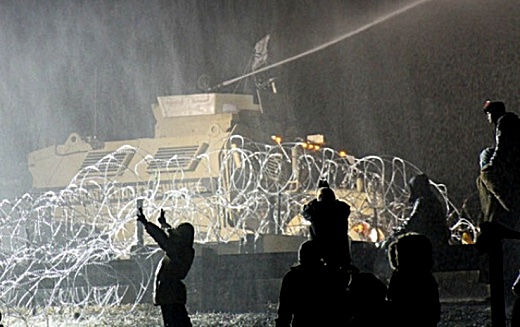
Image above:The Morton County Sheriff's Department deployed a military tank and sprayed peaceful protesters with a water cannon amid below-freezing temperatures on November 20, 2016. Photo byDark Sevier. From original article.

Leaked docs reveal the collusion between local police forces, pipeline company, and defense contractors as they executed 'military-style counterterrorism measures' to suppress the water protectors.

The years-long, Indigenous-led fight against the Dakota Access Pipeline (DAPL) briefly captured the nation's attention last fall as images of peaceful resisters being sprayed with water canons and surrounded by police in tanks and other military-grade equipment were spread widely, fueling global outrage and a fierce protest movement against the oil pipeline.

Now that the pipeline is operational and already leaking, internal documents obtained by The Intercept and reported on Saturday reveal the deep collusion between local police forces, the pipeline company, and defense contractors as they executed "military-style counterterrorism measures" to suppress the water protectors.

TigerSwan, described as a "shadowy international mercenary and security firm" that "originated as a U.S. military and State Department contractor helping to execute the global war on terror," was hired by Energy Transfer Partners to spearhead "a multifaceted private security operation characterized by sweeping and invasive surveillance of protesters," The Intercept wrote.

Reportedly, one of TigerSwan's contractors leaked 100 internal documents to reporters Alleen Brown, Will Parrish, and Alice Speri, who were able to assemble roughly 1,000 more via public records requests.

The trove paints a damning picture of the police response to the Indigenous-led effort to block construction of the pipeline on sacred, treaty land and is a shocking example of how anti-terrorist rhetoric and tactics could be applied to any uprising the government would like to suppress.
According to the reporting:
Internal TigerSwan communications describe the movement as "an ideologically driven insurgency with a strong religious component" and compare the anti-pipeline water protectors to jihadist fighters. One report, dated February 27, 2017, states that since the movement "generally followed the jihadist insurgency model while active, we can expect the individuals who fought for and supported it to follow a post-insurgency model after its collapse." Drawing comparisons with post-Soviet Afghanistan, the report warns, "While we can expect to see the continued spread of the anti-DAPL diaspora...aggressive intelligence preparation of the battlefield and active coordination between intelligence and security elements are now a proven method of defeating pipeline insurgencies."
"As policing continues to be militarized and state legislatures around the country pass laws criminalizing protest," Brown, Parrish, and Speri write, "the fact that a private security firm retained by a Fortune 500 oil and gas company coordinated its efforts with local, state, and federal law enforcement to undermine the protest movement has profoundly anti-democratic implications."

Indeed, in the wake of the 2016 election, Republican legislatures in at least 19 states introduced various anti-protest laws, many with a deliberate nod to the uprising in North Dakota.

Not only that, but Morton County Sheriff Kyle Kirchmeier, who oversaw the police response to the DAPL resistance, has been advising other law enforcement on how to deal with protests and demonstrations.

Indeed, the documents reportedly show that Energy Transfer Partners has "continued to retain TigerSwan," despite the fact that the anti-DAPL camps have disbanded. The security firm continues to produce so-called situation reports that document "the threat of growing activism around other pipeline projects across the country."

These reports include "intelligence on upcoming protests," information gleaned from social media, and "extensive evidence of aerial surveillance and radio eavesdropping, as well as infiltration of camps and activist circles."

In some cases, persons "of interest" were even tracked when they crossed over state lines.

What's more, the documents obtained via open records requests include "communications among agents from the FBI, the Department of Homeland Security, the U.S. Justice Department, the Marshals Service, and the Bureau of Indian Affairs, as well as state and local police," that reveals interagency collusion and information sharing on the anti-DAPL protesters.

Read the extensive reporting and several published documents at The Intercept.


.

Manchester, or Innocence Long Lost

SUBHEAD: An 8-year old child in Manchester, just like one in Mosul or Aleppo, is innocent.

By Raul Ilargi Meijer on 27 May 2017 for the Automatic Earth -
(https://www.theautomaticearth.com/2017/05/manchester-or-innocence-long-lost/)
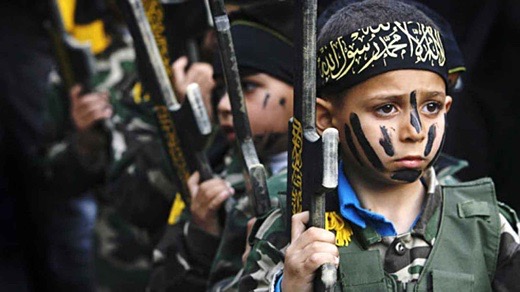

Image above: Mass media propaganda demonizes children in Iran to exhort more violence against our "enemeies". It's all lies. Stop the violence against the Middle East and Islam. It's our kuleana. From (https://themediaexpress.com/2017/03/11/military-training-camps-for-iranian-children-to-prepare-for-jihad/).

[IB Publisher's note: This is a long and detailed piece... certainely longer than most we post on IslandBreath. Raul Ilargi Meijer hits the nail on the head by implicating Western culture with complicity in the atrocity of the endless War on Terrorism.]

There are times when you have to talk about things when it appears most inopportune to do so, because they’re the only times people might listen. Times when people will argue that ‘this is not the right moment’, while in reality it’s the only moment.

A solid 99% of people will have been filled, and rightly so of course, with a mixture of disgust, disbelief and infinite sadness when hearing of yet another attack on civilians in Europe, this one in Manchester. An equally solid 99% will have failed to recognize that while the event was unique for the city of Manchester, it was by no means unique for the world, not even at the time it happened.

Though the footage of parents desperately trying to find their children, and the news that one of the dead was just 8 years old, touches everyone in more or less the same place in our hearts, by far most of us miss out on the next logical step.

In a wider perspective, it is easy to see that parents crying for missing children, and children killed in infancy, is what connects Manchester, and the UK, and Europe, to parents in Syria, Libya, Iraq.

What’s different between these places is not the suffering or the outrage, the mourning or the despair, what’s different is only the location on the map. That and the frequency with which terror is unleashed upon a given population. But just because it happens all the time in other places doesn’t make it more normal or acceptable.

It’s the exact same thing, the exact same experience, and still a vast majority of people don’t, choose not to, feel it as such.

Which is curious when you think about it. In the aftermath of a terror attack, the mother of a missing, maimed or murdered child undergoes the same heartbreak no matter where they are in the world (“I hope the Russians love their children too”). But the empathy, the compassion, is hardly acknowledged in Britain at all, let alone shared.

Not that it couldn’t be. Imagine that our papers and TV channels would tell us, preferably repeatedly, in their reports in the wake of an attack like the one in Manchester how eerily similar the emotions must be to those felt in Aleppo, Homs and many other cities.

That would change our perception enormously. But the media choose not to make the connection, and the people apparently are not capable of doing it themselves.

None of that changes the fact, however, that British lives are not more valuable than Syrian and Libyan ones. Not even when we’ve gotten used to ‘news’ about bombings and drone attacks executed for years now by US-led coalitions, or the images of children drowning when they flee the area because of these attacks.

The overall theme here is that 99.9% of people everywhere in the world are innocent, especially when they are children, but their governments and their societies are not. That doesn’t justify the Manchester attack in any shape or form, it simply lays equal blame and condemnation for western terror attacks in the Middle East and North Africa, perpetrated by the people we elect into power.

 This is something people in the west pay no attention to. It’s easier that way, and besides our media with great enthusiasm pave the way for our collective ignorance, by calling some other group of people ‘terrorists’, which while they’re at it is supposed to justify killing some other mother’s child.

There’s another thing that is also different: they didn’t start. We did. The British and French terrorized the region for many decades, since the 19th century, even way before the Americans joined in.

The presence of oil, and its rising role in our economies, caused them to double down on that terror.
Yes, it’s awkward to talk about this on the eve of a deadly attack, and it’s easy to find arguments and rhetoric that appear to deflect responsibility. But at the same time this truly is the only moment we can hope that anyone will listen. And lest we forget, the UK carries an outsized share of the responsibility in this tragedy, both historically and in the present.

You can say things about the city coming together, or the country coming together, or “not allowing terrorists to affect our way of life”, but perhaps it should instead really be all the mothers who have children missing or dying, wherever they live, coming together. They all see their ways of life affected, and many on a daily basis.

Those mothers in Syria and Libya, who have been through the same hellhole as those in Manchester, are a lot closer to you than the politicians who send out jet fighters to bomb cities in the desert, or sell arms to individuals and organizations to control these cities for their own narrow personal gain, such as the governments of Saudi Arabia and Turkey.

The traumatized mothers in the desert are not your enemies; your enemies are much closer to home. Still, most of you will tend to react to fear and panic by looking for protection in exactly those circles that are least likely to provide it.

The UK government under Theresa May, like those of Tony Blair, Gordon Brown and David Cameron before, is as cynically eager as their predecessors to send bombers into the desert, and sell arms to those living there.

We can illustrate all this with a few bits of news. First, the US-led coalotion, of which the UK is a substantial part, killed more civilians in Syria than at any time since they started bombing the country almost 3 years ago.

They keep saying they don’t target civilians, but to put it mildly they don’t appear to go out of their way not to hit them. For instance, a single attack on Mosul, Iraq in March killed over 105 civilians. ‘Collateral damage’ in these cases, and there are hundreds by now, is a very disrespectful term. Moreover, the files released by Chelsea Manning show US soldiers killing people ‘with impunity’.

US-led air strikes on Syria killed a total of 225 civilians over the past month, a monitor said on Tuesday, the highest 30-day toll since the campaign began in 2014. The Syrian Observatory for Human Rights said the civilian dead between April 23 and May 23 included 44 children and 36 women. The US-led air campaign against the Islamic State jihadist group in Syria began on September 23, 2014. “The past month of operations is the highest civilian toll since the coalition began bombing Syria,” Observatory head Rami Abdel Rahman told AFP. “There has been a very big escalation.” The previous deadliest 30-day period was between February 23 and March 23 this year, when 220 civilians were killed, Abdel Rahman said.
And it’s not as if the British didn’t or couldn’t know what was going on. That was clear as early as 2003, when Tony Blair couldn’t wait to join the Bush coalition to invade Iraq on the false premise of weapons of mass destruction. Before Libya was invaded, which led to Hillary’s disgusting ‘we came we saw he died’, Gaddafi, the one who did die, warned Blair about what would happen. It indeed did, which makes Blair a guilty man.

Muammar Gaddafi warned Tony Blair in two fraught phone conversations in 2011 that his removal from the Libyan leadership would open a space for al-Qaida to seize control of the country and even launch an invasion of Europe. The transcripts of the conversations have been published with Blair’s agreement by the UK foreign affairs select committee, which is conducting an inquiry into the western air campaign that led to the ousting and killing of Gaddafi in October 2011. In the two calls the former British prime minister pleaded with Gaddafi to stand aside or end the violence. The transcripts reveal the gulf in understanding between Gaddafi and the west over what was occurring in his country and the nature of the threat he was facing.

In the first call, at 11.15am on 25 February 2011, Gaddafi gave a warning in part borne out by future events: “They [jihadis] want to control the Mediterranean and then they will attack Europe.” In the second call, at 3.25pm the same day, the Libyan leader said: “We are not fighting them, they are attacking us. I want to tell you the truth. It is not a difficult situation at all. The story is simply this: an organisation has laid down sleeping cells in north Africa. Called the al-Qaida organisation in north Africa … The sleeping cells in Libya are similar to dormant cells in America before 9/11.”

Gaddafi added: “I will have to arm the people and get ready for a fight. Libyan people will die, damage will be on the Med, Europe and the whole world. These armed groups are using the situation [in Libya] as a justification – and we shall fight them.” Three weeks after the calls, a Nato-led coalition that included Britain began bombing raids that led to the overthrow of Gaddafi. He was finally deposed in August and murdered by opponents of his regime in October.
What they are guilty of is no more and no less than Manchester. No hyperbole, but a warning from Blair’s own intelligence services back in 2003. The real weapons of mass destruction were not in Iraq, but in the White House and Downing Street no. 10. The CIA issued warnings similar to this.

Before the 2003 invasion of Iraq led by the U.S. and U.K., he was forcefully and repeatedly warned by Britain’s intelligence services that it would lead to exactly this type of terrorist attack — and he concealed these warnings from the British people, instead claiming the war would reduce the risk of terrorism. We know this because of the Chilcot Report, the seven-year-long British investigation of the Iraq War released in 2016. The report declassifies numerous internal government documents that illustrate the yawning chasm between what Blair was being told in private and his claims in public as he pushed for war.

On February 10, 2003, one month before the war began, the U.K.’s Joint Intelligence Committee — the key advisory body for the British Prime Minister on intelligence matters — issued a white paper titled “International Terrorism: War With Iraq.” It began:

“The threat from Al Qaida will increase at the onset of any military action against Iraq. They will target Coalition forces and other Western interests in the Middle East. Attacks against Western interests elsewhere are also likely, especially in the US and UK, for maximum impact. The worldwide threat from other Islamist terrorist groups and individuals will increase significantly.”

And it concluded much the same way: “Al Qaida and associated groups will continue to represent by far the greatest terrorist threat to Western interests, and that threat will be heightened by military action against Iraq. The broader threat from Islamist terrorists will also increase in the event of war, reflecting intensified anti-US/anti-Western sentiment in the Muslim world, including among Muslim communities in the West.”
Not long behind Blair came David Cameron, a man after Tony’s heart:

European ministers have embarrassed David Cameron by voting to impose an arms embargo on Saudi Arabia on the same day the British prime minister praised the UK for selling “brilliant” arms to the country. Speaking at a BAE Systems factory in Preston, the prime minister said the UK had pushed the sale of Eurofighter Typhoons to countries in the Middle East, including Oman and Saudi Arabia. [..] Cameron’s speech in Preston came at the same time the European Parliament voted to impose an EU-wide ban on arms exports to Saudi Arabia, citing criticism from the UN of its bombing in Yemen.

Asked at the talks how he was helping to export the planes, Cameron said: “With the Typhoon there is an alliance of countries: the Italians, Germans and ourselves. We spend a lot of time trying to work out who is best placed to win these export orders. We’ve got hopefully good news coming from Kuwait. The Italians have been doing a lot of work there. The British have been working very hard in Oman.” The vote will not force EU members to comply with the ban, but will force the government to examine its relationship with Saudi Arabia.

In the last year the British government has sold £3 billion (US$4.18 billion) worth of arms and military kit to the Gulf state, as well as providing training to Saudi forces. A report released by Amnesty International on Friday called the ongoing trade with Saudi Arabia “truly sickening,” and urged governments to attend meetings in Geneva on Monday to discuss the implementation of the Arms Trade Treaty (ATT). The report names the UK, France, Germany, Italy, Montenegro, the Netherlands, Spain, Sweden, Switzerland, Turkey and the US as having issued licenses for arms to Saudi Arabia worth more than £18 billion in 2015.

The arms sold include drones, bombs, torpedoes, rockets and missiles, which have been used by Saudi Arabia and its allies for gross violations of human rights and possible war crimes during aerial and ground attacks in Yemen, the campaign group said. Control Arms Director Anna Macdonald said: “Governments such as the UK and France were leaders in seeking to secure an ATT – and now they are undermining the commitments they made to reduce human suffering by supplying Saudi Arabia with some of the deadliest weapons in the world. It’s truly sickening.”
British MPs from Cameron’s own party didn’t like it either, but what meaning does that have if it takes 5 years to issue a report, and moreover he can simply refuse to give evidence?

David Cameron’s intervention in Libya was carried out with no proper intelligence analysis, drifted into an unannounced goal of regime change and shirked its moral responsibility to help reconstruct the country following the fall of Muammar Gaddafi, according to a scathing report by the foreign affairs select committee. The failures led to the country becoming a failed a state on the verge of all-out civil war, the report adds. The report, the product of a parliamentary equivalent of the Chilcot inquiry into the Iraq war, closely echoes the criticisms widely made of Tony Blair’s intervention in Iraq, and may yet come to be as damaging to Cameron’s foreign policy legacy.

It concurs with Barack Obama’s assessment that the intervention was “a shitshow”, and repeats the US president’s claim that France and Britain lost interest in Libya after Gaddafi was overthrown. Cameron has refused to give evidence to the select committee. In one of his few reflections on his major military intervention, he blamed the Libyan people for failing to take their chance of democracy.

The committee, which has a majority of Conservative members, did not have Chilcot-style access to internal papers, but took voluminous evidence from senior ministers at the time, and other key players such as Blair, the chief of the defence staff, Lord Richards, and leading diplomats. The result of the French, British and US intervention, the report finds, “was political and economic collapse, inter-militia and inter-tribal warfare, humanitarian and migrant crises, widespread human rights violations, the spread of Gaddafi regime weapons across the region and the growth of Isil [Islamic State] in north Africa”.
It seems obvious that if there were an impartial international body with the power to prosecute, Bush, Cheney, Blair, Cameron, Hillary etc. etc. (don’t forget France) would be charged with war crimes. And Obama too: his ‘shitshow’ comment must be seen in light of the ‘we came we saw he died’ comment by Hillary Clinton, his Secretary of State. Think he didn’t know what was happening?

Another person who should be charged is Theresa May, Cameron’s Home Secretary from May 2010 till July 2016, and of course Britain’s present PM, who sells as much weaponry to Saudi Arabia as she possibly can while the Saudi’s are shoving the few Yemeni’s they leave alive back beyond the Stone Age. And then May has the gall to talk about humanitarian aid.

Theresa May has defended her trip to Saudi Arabia, saying its ties with the UK are important for security and prosperity. The prime minister is facing questions about the UK’s support for the Saudi-led coalition which is fighting rebels in neighbouring Yemen. Labour Party leader Jeremy Corbyn said UK-made weapons were contributing to a “humanitarian catastrophe”. [..] Mrs May said humanitarian aid was one of the issues she would be discussing on her trip. “We are concerned about the humanitarian situation – that’s why the UK last year was the fourth largest donor to the Yemen in terms of humanitarian aid – £103m. We will be continuing with that,” she told the BBC.

[..] Mr Corbyn called for the immediate suspension of UK arms exports to Saudi Arabia. He criticised the “dictatorial Saudi monarchy’s shocking human rights record” and said the PM should focus on human rights and international law at the centre of her talks. “The Saudi-led coalition bombing in Yemen, backed by the British government, has left thousands dead, 21 million people in need of humanitarian assistance and three million refugees uprooted from their homes,” he said. “Yemen urgently needs a ceasefire, a political settlement, and food aid, not more bombing.
“British-made weapons are being used in a war which has caused a humanitarian catastrophe.”
The one person who would probably not be in front of such a court is Jeremy Corbyn, opponent of May’s in the June 8 elections. Though there is the issue that he never protested in much stronger terms as an MP. Still, if you have to pick one of the two, what is not obvious?

Theresa May has staunchly defended selling arms to Saudi Arabia despite the country facing accusations of war crimes, insisting close ties “keep people on the streets of Britain safe”. Jeremy Corbyn called on the Prime Minister to halt those sales because of the “humanitarian devastation” caused by a Saudi-led coalition waging war against rebels in Yemen. The Labour leader spoke out after the Parliamentary committee charged with scrutinising arms exports said it was likely that British weapons had been used to violate international law.

The Saudis stand accused of bombing multiple international hospitals run by the charity Médecins Sans Frontières, as well as schools, wedding parties and food factories. In the Commons, Mr Corbyn linked weapons sales to the ongoing refugee crisis, which he said should be Britain’s “number one concern and our number one humanitarian response”.

He added: “That is why I remain concerned that at the heart of this Government’s security strategy is apparently increased arms exports to the very part of the world that most immediately threatens our security.

The British Government continue to sell arms to Saudi Arabia that are being used to commit crimes against humanity in Yemen , as has been clearly detailed by the UN and other independent agencies.”

But, in response, Ms May pointed out she had called on Saudi Arabia to investigate the allegations about Yemen when she met with the kingdom’s deputy crown prince at the recent G20 summit in China. The Prime Minister dismissed Mr Corbyn’s suggestion that “what happened in Saudi Arabia was a threat to the safety of people here in the UK”. Instead, she said: “Actually, what matters is the strength of our relationship with Saudi Arabia. When it comes to counter-terrorism and dealing with terrorism, it is that relationship that has helped to keep people on the streets of Britain safe.”
May’s, and Britain’s, utterly mad stance in this is perhaps best exemplified, in one sentence, by her comments during the speedy trip she made to Turkey, again to sell more arms to an at best highly questionable regime. Why do it, why drag your entire nation through the moral gutter for $100 million or a few billion? The military industrial complex.

Theresa May issued a stern warning to Turkish president Recep Tayyip Erdogan about respecting human rights yesterday as she prepared to sign a £100m fighter jet deal that Downing Street hopes will lead to Britain becoming Turkey’s main defence partner.
And once again, no, none of this justifies the Manchester bombing. Neither a government nor an extremist movement has any right to kill innocent people. But let’s make sure we know that neither does.
There’s another aspect to the story. MI6 had close links to the Libyan community in Manchester.

The British government operated an “open door” policy that allowed Libyan exiles and British-Libyan citizens to join the 2011 uprising that toppled Muammar Gaddafi even though some had been subject to counter-terrorism control orders, Middle East Eye can reveal. Several former rebel fighters now back in the UK told MEE that they had been able to travel to Libya with “no questions asked” as authorities continued to investigate the background of a British-Libyan suicide bomber who killed 22 people in Monday’s attack in Manchester.


Salman Abedi, 22, the British-born son of exiled dissidents who returned to Libya as the revolution against Gaddafi gathered momentum, is also understood to have spent time in the North African country in 2011 and to have returned there on several subsequent occasions. Sources spoken to by MEE suggest that the government facilitated the travel of Libyan exiles and British-Libyan residents and citizens keen to fight against Gaddafi including some who it deemed to pose a potential security threat.

One British citizen with a Libyan background who was placed on a control order – effectively house arrest – because of fears that he would join militant groups in Iraq said he was “shocked” that he was able to travel to Libya in 2011 shortly after his control order was lifted. “I was allowed to go, no questions asked,” said the source. He said he had met several other British-Libyans in London who also had control orders lifted in 2011 as the war against Gaddafi intensified, with the UK, France and the US carrying out air strikes and deploying special forces soldiers in support of the rebels.

“They didn’t have passports, they were looking for fakes or a way to smuggle themselves across,” said the source. But within days of their control orders being lifted, British authorities returned their passports, he said. Many Libyan exiles in the UK with links to the LIFG [Libyan Islamic Fighting Group ] were placed on control orders and subjected to surveillance and monitoring following the rapprochement between the British and Libyan governments sealed by the so-called “Deal in the Desert” between then-British Prime Minister Tony Blair and Gaddafi in 2004.

According to documents retrieved from the ransacked offices of the Libyan intelligence agency following Gaddafi’s fall from power in 2011, British security services cracked down on Libyan dissidents in the UK as part of the deal, as well as assisting in the rendition of two senior LIFG leaders, Abdel Hakim Belhaj and Sami al-Saadi, to Tripoli where they allege they were tortured.
Torture one day, passports the other. Lovely. And it still gets better: MI6 didn’t just have close contacts with Libyans in Manchester, it knew the alleged perpetrator’s family, and used his father multiple times as on operative:

According to Scotland Yard, the attack on the crowd leaving the Ariana Grande concert at Manchester Arena, 22 May, has been perpetrated by Salman Abedi. A bankcard has been conveniently found in the pocket of the mutilated corpse of the ‘terrorist’. This attack is generally interpreted as proof that the United Kingdom is not implicated in international terrorism and that, on the contrary, it is a victim of it.


[..] In 1992, Ramadan Abedi [Salman’s father] was sent back to Libya by Britain’s MI6 and was involved in a British-devised plot to assassinate Muammar Gaddafi. The operation having been readily exposed, he was exfiltrated by MI6 and transferred back to the UK where he obtained political asylum.

He moved in 1999 to Whalley Range (south of Manchester) where there was already resident a small Libyan Islamist community. In 1994, Ramadan Abedi returned again to Libya under MI6’s direction. In late 1995 he is involved in the creation of the Libyan Islamic Fighting Group (LIFG), a local branch of Al-Qaeda, in conjunction with Abdelhakim Belhadj.

The LIFG was then employed by MI6 again to assassinate Gaddafi, for a payoff of £100,000. This operation, which also failed, provoked heated exchanges within British Intelligence, leading to the resignation of one David Shayler. Other former members of the LIFG have also lived at Whalley Range, including Abedi’s friend Abd al-Baset-Azzouz. In 2009, this last joined Al-Qaeda in Pakistan and became a close associate of its chief, Ayman al-Zawahiri. In 2011, al-Baset-Azzouz is active on the ground with the NATO operation against Libya.

On 11 September 2012, he directs the operation against the US Ambassador in Libya, Christopher Stevens, assassinated at Benghazi. He is arrested in Turkey and extradited to the US in December 2014, his trial still pending. Nobody pays attention to the fact that Ramadan Abedi has linked LIFG members to the formation of Al-Qaeda in Iraq and, in 2011, he takes part in MI6’s ‘Arab Spring’ operations, and in LIFG’s role on the ground in support of NATO. In any event, Abedi returned to Libya after the fall of Gaddafi and moves his family there, leaving his older children in the family home at Whalley Range.

According to the former Spanish Prime Minister José Maria Aznar, Abdelhakim Belhadj was involved in the assassinations in Madrid of 11 March 2004. Later, he is secretly arrested in Malaysia by the CIA and transferred to Libya where he is tortured not by Libyan or American functionaries but by MI6 agents. He is finally freed after the accord between Saif al-Islam Gaddafi [Gaddafi’s son] and the jihadists.
Luckily, perhaps the Brits are not that stupid:
Slightly over a half of people in the UK agree that the nation’s involvement in wars abroad has increased the terror threat to the country, a poll out Friday has showed. The survey found that 53% of 7,134 UK adults sampled by YouGov said they believed wars the UK supported or fought were in part responsible for terror attacks at home. [..]

Labour leader Jeremy Corbyn, who made a speech earlier in the day to mark his return to general election campaigning, said UK’s war on terror had not worked. He cited intelligence experts who said foreign wars, including in Libya, threatened the country’s security.
If that is true, Theresa May obviously should have no chance of winning. May can and will try to use the horror of Manchester, and the subsequent pause in the campaign, to strengthen her position in the upcoming election, by playing on people’s fear and making them believe she’s in control.

Even if the very attack itself makes clear that she’s not. The Tories have already attacked Corbyn for saying their policies have failed; it was the wrong time to say that, according to them.

But it’s not. It’s the very best time. This is when people pay attention. And having this discussion doesn’t disrespect the victims of Manchester. If anything, it shows more respect than not having the discussion. Because you want to make sure this doesn’t happen again, neither here nor there. And to achieve that, you have to look at why these things happen.

An 8-year old child in Manchester, just like one in Mosul or Aleppo, is innocent. Yourself, perhaps not so much. The politicians you vote into power, and the media you read and watch to inform you, not a chance. Guilty as hell.

.
The New Socialism

SUBHEAD: Moving beyond concentrated state power to owner operated co-operatives.

By Richard D. Wolf on 27 May 2017 for Truth Out -
(http://www.truth-out.org/opinion/item/40656-the-new-socialism-moving-beyond-concentrated-state-power)


Image above: New Socialism will mean, at least in part, the state's dependence on masses of workers who democratically control worker co-ops. Photo by  Susannah Kay. From original article.

Capitalism as a system is now increasingly challenged. Critics proliferate and steadily deepen their opposition (alongside, of course, the persistence of capitalism's defenders).

Yet capitalism's traditional "other" -- namely, socialism -- has also been widely devalued. It has lost its position as the goal (however variously interpreted) for anti-capitalist social movements. When not simply ignored, socialism (and even more its derivative "communism") is often treated as utterly passé.

When taken seriously, it is mostly a vague rhetorical gesture expressing criticism of the capitalist status quo, not advocacy of a concrete alternative. Socialist parties now mainly support capitalism but with a human face -- i.e. with the social supports and safety nets that their "conservative" counterparts disdain.

Sometimes the advocacy of socialism expresses a systemic rejection of, or opposition to, capitalism.

But even then, the current use of the term "socialism" lacks a clear, concrete definition of what genuinely new economic system it entails.

What exactly differentiates it from and renders it superior both to capitalism and to what "old" socialism used to mean?

To enrich and strengthen anti-capitalism by giving it such a new, definitive goal, we need to revision socialism. On the one hand that means shedding accumulated historical baggage that now undermines and prevents socialism from being a prominent goal of social change.

On the other hand, a revised socialism requires new content that can inspire and motivate. That is now available.

Old socialism's drawn-out demise since the 1970s helped give birth to a new 21st century socialism whose basic contours we can now contrast with old socialism.

The old socialism that evolved across the 19th and 20th centuries eventually settled its many, rich debates by largely agreeing on two basic ways to distinguish itself from capitalism.

Capitalism entailed;
  1. private enterprises to produce goods and services and 
  2. markets as the means to distribute resources and products among enterprises and individuals (workers and consumers).
In contrast, socialism entailed government-owned-and-operated enterprises and government central planning as the distribution system. Both devotees of capitalism and socialism accepted this set of differentiating definitions.

Debates and struggles over capitalism versus socialism then swirled around the relative virtues and flaws of private versus state enterprises and of markets versus planning. The practice of socialism combined criticism of private enterprise and markets with celebration of state enterprise and central planning.

Once socialists had captured state power in the USSR, the People's Republic of China (PRC) and elsewhere, the demands of managing actual economies tilted socialism's focus ever further toward state enterprises and central planning mechanisms.

In perfectly parallel fashion, attacks upon socialism from devotees of capitalism stressed the failures and excesses of state enterprises and planning.

Many of those debates and struggles seemed to be resolved by the collapse of the USSR in 1989 and subsequent changes in Eastern Europe, the PRC and elsewhere. History, the devotees of capitalism crowed, had "proven" the non-viability of socialism, the superiority of capitalism.

They rarely grasped that what had failed was one version of socialism, an early experiment in what it might mean to construct a system beyond capitalism.

Their eagerness to claim that "socialism/communism had failed" conveniently forgot the many similarly "failed" efforts, centuries earlier, to construct capitalism out of a declining European feudalism.

Only after many such failures did changed social conditions enable a general system change to modern capitalism. Why would the same not apply to socialism qua successor to capitalism?

A major task for socialists has been honestly to admit and contend with the limits and failures of the old 19th and 20th century socialism: chiefly, excesses of over-concentrated state power and inadequately transformed production systems.

Old socialism's achievements -- especially rapid industrial development and the remarkable provision of social safety nets -- might be preserved and built upon if its limits and failures were also recognized and overcome.

One emerging and promising new socialism for the 21st century focuses on worker co-ops. Socialism becomes the campaign to establish and build a sizable worker co-op sector within contemporary capitalism.

In worker co-op enterprises, all workers are equal members of a democratically run production operation. They debate and decide what, how and where to produce and how to utilize the net revenues.

Worker co-op enterprises exist alongside traditional capitalist enterprises. They are eligible for and must obtain tax considerations, subsidies and state supports comparable to what capitalist enterprises received throughout capitalism's history. Indeed, in their initial, emergent phase, worker co-ops deserve extra government support so that the worker co-op sector quickly achieves a significant role in the economy.

Until that role is established, people will remain unable to evaluate, compare and weigh in on what mix of capitalist and worker co-op enterprises they wish for their society.

The worker co-op sector of an economy will have to decide what mix of market and planning mechanisms to utilize for the distribution of its resources and products (much as capitalist enterprises always did).

The relationships -- both competitive and cooperative -- between the two sectors of each economy (capitalist and worker co-op) will have to be determined by negotiations between them.

The third member of those negotiations will be the populace as a whole weighing in on what kind of economic system it wants as the partner for its political system.

With a significant worker co-op sector, the state's dependence on enterprises will no longer mean a dependence on a small minority: shareholders and boards of directors who control capitalist enterprises.

Instead it will mean, at least in part, the state's dependence on masses of workers who democratically control worker co-ops. Under such a system, the prospects for genuine (as opposed to merely formal) political democracy are much enhanced over their sorry state today.

Mass working class support made 19th and 20th century socialism -- with its programs of revolutionary or evolutionary/parliamentary seizures of state power -- historically important.

We cannot now expect to mobilize again any equivalent support for a revival of the old socialism. That is because of its limits and failures and also because of the massive, sustained campaigns against it by capitalism's supporters.

However, a new socialism built upon the best achievements of the old plus a new focus on the democratic transformation of the workplace can mobilize mass support now. It is already doing so.

A new socialism for the 21st century would address as well all those in the population who are not in the workforce because of family, age, education, illness, disability or other comparable causes. Systematic supports for them -- qua relatives, friends and neighbors of workforce members -- are as central to a new and better society as is the democratization of the workplace. Indeed, the latter and the former can and would be mutually supportive.

Old socialist parties are mostly fading or imploding, yet at the same time capitalism's deepening difficulties, especially since the global crash of 2008, are everywhere increasing mass opposition to capitalism. What that opposition needs is a new socialism with attractive, basic transformative goals.

What is not wanted is social change that gives power to some far-away government apparatus. The point is rather and finally to transfer power into the hands of the change-making workers themselves.

Power here refers to more than politics. It refers to the social power at the economic base of society, in the workplaces producing the goods and services upon which social life depends.

The French Revolution's slogan -- liberty, equality, fraternity -- was linked to its economic project of displacing feudalism in favor of capitalism. While its economic project succeeded, it failed to realize that slogan.

It turned out, as Marx noted, that capitalism's class division (between employer and employee) blocked that realization. Overcoming such class divisions -- something a worker co-op can do -- is required to take the next great historical step toward liberty, equality and fraternity.   

.

Learning what to make of it

SUBHEAD: I begin to make restitution, to walk the walk after so many years of talking the talk.

By Paul Kingsnorth on 24 May 2017 for Dark Mountain -
(http://dark-mountain.net/blog/learning-what-to-make-of-it/)


Image above: "Small Holding" photograph from original article.

When we win, it’s with small things, and the triumph itself makes us small. What is extraordinary and eternal does not want to be bent by us.
– Rilke
Certain gardens are described as retreats when they are really attacks.
– Ian Hamilton Finlay
The most exciting thing in my life at the moment is a five gallon bucket full of human excrement.

I should explain.

I recently tore the flush toilet out of our family home and replaced it with a compost toilet which I built myself. It is of the most basic variety: essentially, we crap into a big bucket and cover the crap with sawdust, then when the bucket is full I empty the contents onto a compost heap, where it rots down over the course of a year.

At the end of that year, we should have a safe and nutritious compost to use on our fruit trees and bushes, on the fuel coppices of aspen and birch we’ll be planting this winter, and on the small native forest that we are planning to grow here for as long as we are healthy.

It’s a big job, something like this, and undertaking it has made me realize how much effort needs to be put into the most simple things, and that in turn has made me realize why the society I live in has become addicted to paying for complicated things instead, and how this has laid a great big elephant trap for us that we may struggle ever to get out of.

But I’m getting ahead of myself.

The first thing I did was to build a rectangular box out of planks and nails, and the remains of two kitchen cupboard doors which we didn’t need any more. There followed a lot of sanding and planing and painting and varnishing and swearing when things were the wrong length and hinges didn’t fit where they should have done.

This took a few weeks, on and off, but at the end of it I had quite a handsome varnished wooden structure with two shiny blue hinged covers and a toilet seat on top. A five gallon brewing bucket fitted underneath.

Then I had to build a compost heap: two, in fact, so that we could keep an annual cycle of compost from the toilet going. I bought some old pallets from the timber yard up the road and carted them home in my van. That was a couple of days’ work.

After I had finished, I stood back and admired them for about half an hour. I am a writer. I have never been a practical man, or have never believed I am, and I’m still at the stage where successfully completing a practical task fills me with astonishment.

Still, that was the easy bit. Ever tried taking out a flush toilet? It’s a messy job. In the end, a friend came round and devoted an afternoon to helping me to do it. He is a casually practical man, so the job went well. In the aftermath, big chunks of porcelain lay on the grass outside and all that remained in the bathroom was a blocked up outflow pipe and a gash in the lino. In went the compost loo, in went a bucket of sawdust, in went a wall hanging to cover the gaping holes, and voilà: a closed loop system.

The flush toilet, to me, is a worthy metaphor for the civilization I live in. It is convenient, it is easy, it is hygienic and it is wonderfully warm and dry. It is the most luxurious pooing experience known to man. You can do your business and never have to think about what happens next: never have to think about what happens to the feces and urine you have just produced, just as you probably never thought about the origins of the food which created it in the first place.

You can act, if you like, as if you have never produced it at all; as if you were far too civilised to have to engage in such base and primitive behavior. You can sit in the warmth, reading an amusing light-hearted book, then you can simply press a button, and you will never have to deal with your own shit.

What happens to a society that won’t deal with its own shit? It ends up deep in it.

A compost toilet is harder work. First you have to build the toilet and the compost heaps, and then you have to source a regular supply of sawdust or pine needles, which will keep the smells and flies away and give the compost enough bulk on the heap.

Most importantly, you have to empty the bucket when it gets full, which is every few days most of the time. This is the part of the job which really seems to disgust those of my friends and family who can’t understand why I have disposed of a perfectly good toilet and replaced it with something medieval.

But it’s also the part of the job that I enjoy the most. I’ve noticed myself getting almost excited as the bucket approaches being full. Emptying the thing on to the compost heap, covering it with grass, inspecting the progress of the heap so far, cleaning and replacing the bucket, putting a new layer of sawdust in the bottom: would you believe me if I told you this was a satisfying process? Anticipating being able to use the results on my own trees is almost thrilling.

If a flush toilet is a metaphor for a civilization that wants to wash its hands of its own wastes as long as they accumulate somewhere else, then a compost toilet is both a small restitution, and a declaration:
  • I will not turn my back on the consequences of my actions. 
  • I will not hand them over to someone else to deal with. 
  • I will not crap into clean drinking water and flush it down a pipe to be cleaned with industrial chemicals at some sewage plant I have never visited.
I will fertilize my own ground with my own manure, and in doing so I will control an important part of my life in this world, and that control will give me more understanding over it. I will claw something of myself back. Even in the rain, even in winter, I will deal with my own shit.


In 2014, I emigrated. My wife and I moved with our two young children from urban England, where we had always lived, to rural Ireland. We bought ourselves a small bungalow with two and a half acres of land up a quiet lane. It was the culmination of a personal project we’ve been engaged in for more than half a decade: to find a way escape from the urban consumer machine we were both brought up in.

We wanted to live more simply; or perhaps just more starkly, because life here is rarely simple. Our kids were just getting to school age, and the idea of sending them to school to systematically crush their spontaneity and have them taught computer coding so that they could compete in the ‘global race’ made us miserable. We wanted to grow our own food and compost our own shit and educate our own children and make our own jam and take responsibility for our own actions.

This can all sound very cloying. Western middle class people going ‘back to the land’ is a modern cliché, and when we think we are hearing that story we tend to react in a particular way, positive or negative depending on our political or cultural persuasions.

Perhaps I am a cliché, but I’m not especially interested in other people’s expectations. I was brought here by many things, but one of them is a voice that has been whispering in my ear for years, and growing louder for the last few.

This voice tells me that I am one of the luckiest people on Earth. It tells me I am a middle-class man from a country grown fat on centuries of plunder, that I have a university degree, that I go to restaurants and have a laptop computer and an internet connection, and I can publish articles like this in magazines.

In other words, I am somewhere up near the top of the pyramid of human fortune. And that in turn means I am up near the top of the pyramid of human cupidity and destruction which is driving the natural world to the edge.

One of the driving forces in my life is a deep love of nature. If you ask me to explain precisely what I mean by that, or why it has such a grip on me, I won’t be able to. But I could tell you about profound experiences I’ve had in forests and mountains, about the joy that rises in my heart when I see a hawk circle or hear the roar of an untamed river, and the misery that sinks into it if I’m trapped in a city or on a motorway.

I could tell you about the occasional brief glimpses I get into the reality that I am a passing moment in an ancient, beautiful, terrifying whorl of life on a vast unknowable planet; that I am not an observer of it, but a part of its wide flow; that there is no such thing as outside.

This kind of thing is nearly impossible to put down on paper, as you can see. Once upon a time, many millennia ago, I suspect it would have been the default worldview, but today, it is a hard one to live with. The culture that I was born into is systematically dismantling the web of life itself, and as it does so it is dismantling my sense of meaning and many of the things that I love.

My status as a middle-class consumer in a Western industrialised country means that I am part of this problem, whether I want to face up to that or not.

This is what that voice whispered to me, as once it whispered to Rilke: you must change your life. I came here because I can’t justify my complicity any more. I feel a personal duty to live as simply and with as little impact on the rest of nature as I possibly can.

I’ve no interest in extending this duty to anybody else, or in preaching about it or politicising it, or in pretending that I am in any way pure or unsullied or even halfway competent yet at undertaking it. It is just a personal calling.

But perhaps it explains my joy at that full toilet bucket. I feel I am at last starting to do my bit, to make restitution, to walk the walk after so many years of talking the talk. I can’t write or talk about natural beauty, or natural anything, unless I’m trying to do as little damage to it as possible; and at this time in history, that means taking myself away from the heart of the beast. It means stripping back.

It means inconveniencing myself. It means paying attention.

• Dark Mountain co-founder Paul Kingsnorth’s new essay collection, Confessions of a Recovering Environmentalist, was published last month by Faber. It brings together 18 of Paul’s essays from the past decade, along with Uncivilisation, the original manifesto that got the Dark Mountain Project started. This is an excerpt from one of the essays in the book, ‘Learning What to Make of It’ 

.

Waikiki Beach & Ala Wai waters rise

SUBHEAD: King tides have beachgoers dodging waves while the canal nears the top of its retaining wall.

By Emily Cardenall on 25 May 2017 for Civil Beat -
(http://www.civilbeat.org/2017/05/king-tides-are-providing-a-glimpse-of-hawaiis-future/)

Image above: Tourists dodge ocean waves breaking at seaside of Outrigger Hotel in Waikiki. Note tarp and sandbags at left to retain site landscaping. From (http://www.civilbeat.org/2017/05/waikiki-beaches-contract-while-ala-wai-canal-rises/).

Waikiki could get the highest tides in more than on hundred years this weekend,

The combination of high lunar tides, a south swell and ongoing sea level rise is giving Hawaii a preview of what’s to come with climate change.

With record high tides expected through the weekend, Hawaii is getting a preview of what could become the new normal with sea level rise.

The ever-increasing effect of global warming is combining with some of the year’s highest lunar tides and a south swell to produce what are predicted to be the highest ocean levels in 112 years of record-keeping. Volunteers for the University of Hawaii’s Sea Grant College Program are taking to the coasts to document the effects.

A group called Citizen Scientists is working with Sea Grant’s Hawaii and Pacific Islands King Tides Project to take photos of coastlines all over the state to record the effects of rising sea levels.

Matthew Gonser, an extension agent with Sea Grant College who works with the volunteers, said this documentation will help make predictions for what the baseline sea level could look like in the future, among other research endeavors.

He was working with the volunteers in front of the Outrigger Canoe Club in Waikiki on Thursday afternoon.

Predictions from the National Oceanic and Atmospheric Administration have tides rising around 2.4 feet higher than average through the weekend. The average itself has been increasing slowly due to sea level rise tied to climate change, and Gonser said the result over the next couple of days could actually exceed the predictions.


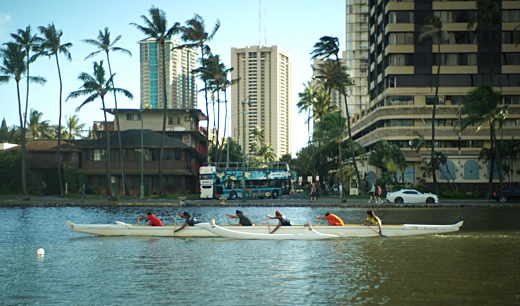
Image above: Paddlers practice on Ala Wai Canal in Waikiki when canal water was within a foot of topping its t=retaining wall. From (http://www.civilbeat.org/2017/05/waikiki-beaches-contract-while-ala-wai-canal-rises/).

May’s king tides mark the third documentation session for the volunteer group. While their photos are important to visualize and track data, the community conversations that follow will be perhaps the most significant result, Gonser said.

“We hope to engage in this conversation — that is actually really difficult to have — about how rising sea levels impact our locale,” he said. “You can’t ignore it.”

Factors are converging to create the epic tides, said Philip Thompson, associate director of the University of Hawaii’s School of Ocean and Earth Science and Technology. They include a recent increase in slow-moving, rotating and churning bodies of water, called ocean eddies, and the lasting effects of the 2015-2016 El Nino.

Meanwhile, climate change is producing rising sea levels with no end in sight.


This poses an issue for the coastal areas in Hawaii, in particular, because washed-out beaches hurt tourism and the environment.

“Maintaining our beaches and nourishing them will be an ongoing struggle,” Thompson said.

The Citizen Scientists also plan to document the next expected king tides June 23-24 and July 21 and 22.


Image above: Flooding on Ahua Street near Keehi Lagoon Beach Park in Honolulu during a king tide Wednesday. From original article.

.

Hawaii's feral chicken "problem"

SUBHEAD: What came first? The chicken or the Whole Foods parking lot in Kailua on Big Island.

By Kristen Downey on 25 May 2017 for Civil Beat -
(http://www.civilbeat.org/2017/05/why-wild-chickens-are-flocking-to-whole-foods-in-kailua/)


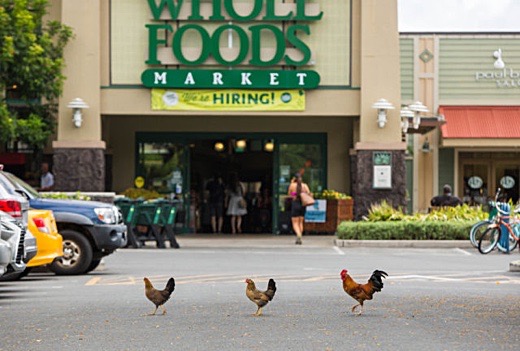
Image above: The Wild chickens are flocking to Whole Foods in Kailua on the Big Island. From original article.

The Kailua Neighborhood Board passed a motion recently asking the city to revise its feral chicken removal program to focus on trapping roosters.

In the past two years, regular customers at the upscale Whole Foods grocery store in Kailua have been noticing an odd phenomenon — more and more feral chickens are roosting in the parking lot.

Whole families of birds –roosters, chickens and chicks– are perching in and under the trees near the entrance to the store, nesting near the area where the shopping carts are stored, and strutting up and down the rows of the parking lot. They’re also crowing. A lot.

Inside the store, a 5-pound, free-range chicken from California costs about $20. Outside, in the blocks surrounding the store, about three dozen are roaming free.

“I don’t remember there ever being chickens like this. Never. Maybe on the Pali, but never like this,” said Amanda Gomez, 29, of Kaneohe, scanning the Whole Foods parking lot. “There are so many moms and babies. They love this area right here.”

Opinions are divided over the feathered newcomers. Some in Kailua admire the birds’ bright plumage and see them as charming wildlife.  Some are irritated by their incessant crowing. Some wonder if they could carry disease and some are growing afraid of them. Some have a live-and-let-live attitude toward the birds.

And some people want the government to get rid of them.

“Are they pests or are they pets?” asked Scot Matayoshi, who serves on the Kailua Neighborhood Board. He has been pushing for the city to trap and remove the birds, particularly the roosters, but said that his effort has been controversial to some people on the board who would prefer the birds be left in peace.

“Whether or not one regards feral chickens as pests is a matter of individual preference,” said Sheila Conant, a professor emerita at University of Hawaii and an expert on Hawaiian birds.

“Having a neighborhood rooster that crows in the middle of the night or very early in the morning could certainly be exasperating. At the moment, I don’t mind the chickens. They can be fun to watch.”

According to the Hawaii Department of Health, the birds don’t present a public health risk.

The federal Centers for Disease Control, however, advises that people who have physical contact with poultry or poultry waste are at risk of salmonella infection. The germs can get on the hands, shoes and clothes of people who have contact with the birds or their saliva or droppings.

Complaints about chickens came up last month at the Kailua Neighborhood Board meeting. Board members passed overwhelmingly a motion asking the city of Honolulu to revise its feral chicken removal program to focus on trapping and removing roosters. They said that would be cheaper than eradicating both males and females.

But Matayoshi said city officials told him they haven’t been able to find a pest removal company that wants to remove the birds. There’s only one company on the islands, Sandwich Isles Pest Solutions in Pearl City, that can be hired to remove bothersome birds, and the city does not have a standing contract with the firm for the work, Matayoshi said.

Harold Scholes, a pest control consultant at Sandwich Isles Pest Solutions, said the company catches and euthanizes unwanted chickens for private clients. For $300 a week and $115 per trip to each site, the company will set up a trap, provide it with bait and water, and remove the animal humanely. He said that other parts of the island, not just Kailua, have seen an increase in feral chickens.

According to Sherilyn Kajiwara, director of the Honolulu customer services department, the  city manages feral chicken issues only on its own property, and only on a case-by-case basis.  Other property owners — whether private owners, the federal government or the state government — are responsible for dealing with their own problems.

But in response to growing calls for action, the city last year added what she called a “fowl response component” into its animal control contract with the Hawaiian Humane Society. The Humane Society began handling the job in January.

“Under the city contract, the HHS will respond to public complaints related to pet fowl nuisances,” Kajiwara said in a statement to Civil Beat. “It does not address feral animals and does not have a fowl eradication component.”

She referred further questions to the Hawaiian Humane Society.

Fines For Nuisance Violations

Suzy Tam, communications director for the Humane Society, said the $80,000 contract for poultry remediation services calls for the Humane Society to respond to “nuisance” complaints. That’s defined as any animal “making noise continuously for ten minutes or intermittently for 30 minutes or more,” and causing a disturbance, or owning an excessive number of animals.

Violations can lead to fines of up to $50 for a first offense and up to $1,000 for further offenses.
She said the Humane Society does not remove nuisance chickens, whether owned or free-roaming.
Tam said the Humane Society has gotten 289 complaints about chickens since late January, with calls coming from all over the island.

She said they have mailed out 83 warning letters and issued six citations to residents with chickens on their properties during that period, but have no way of comparing the numbers to previous years because the contract is new.

Outside Whole Foods in Kailua, there is a whole range of perspectives about the chickens and speculation about where they came from.

Dallas Pabilona, of Hayward, California, a tourist, squealed with laughter when she spotted a cocky rooster strutting in the median in front of her car. She was dismayed to hear that some people want to cull the flock.

“If they weren’t here, where would they live?,” she asked. “This is everybody’s home.”

Bob Beard, the oceanarium manager at the Pacific Beach Hotel and a long-time Kailua resident, on the other hand, scowled at the birds as he sat at an outside dining table near the entrance to Whole Foods, only a few feet from a rooster perching noisily in a tree.

“They’re chickens,” he said. “They do what people like to do. They copulate. I’m surprised there’s not more cats around—there’s a lot of free meat.”
He also thinks they’re dirty.

Michael La Rochelle, 25, a nanny and student, said he called 911 one day this week after spotting a young man trying to catch a large rooster with a kind of lasso. He said Kailua police said they would check it out. When he returned, the man was gone, and the rooster was still the cock of the walk.

La Rochelle said he thought the man was trying to catch the rooster to use it for cock-fighting. “He was going after a rooster,” he said. “If he wanted to eat it, he would pick a chicken.”

Pumehana Piko, who grew up on Molokai and Maui but who has lived on Oahu for 14 years, said she believes the chickens in Kailua have been released or escaped from cockfighting businesses because they seem unusually fierce. Cockfighting is illegal in most parts of the country but is only a misdemeanor in Hawaii, and the events can be popular and well-attended.

“They breed for chickens that are aggressive,” said Piko, 37.  She said people who organize cockfights earn big money from it–$5,000 or $20,000 for a match—and that more people are trying to get into the business.

“You’ll see kids try to grab them for pets or experiment to get them to fight each other,” Piko said.
Pauline Menor-Ozoa, of Kailua, who works in the human resources department at Queen’s Medical Center, also believes the chickens are escapees from cockfighting operations.

“My girls are afraid of them,” she said. “Usually chickens run away, but these follow you and look at you.”

Conant, the bird expert, said she is growing curious about why chickens are proliferating so quickly. In an email to Civil Beat, she said she believes that more people have been raising chickens to get their own fresh eggs, and that when it proves troublesome to care for them, they are releasing them, and they become feral.

“Feral chickens, much like feral cats, can do quite well without assistance (food or shelter) from people,” she said in an email to Civil Beat.

She identified one of the birds at the Kailua Whole Foods as a rooster, and she said his color patterns and the lack of any unusual plumage characteristics, such as feathers on the feet, or an ornate crown of feathers or distinctive markings, make it likely the bird is what is known as a “jungle fowl.” That’s the common name for the wild species from which modern chicken breeds have been developed.
There are more than 200 breeds of chickens, Conant said.

“Once individuals escape and breed on their own, they revert back to the appearance of jungle fowl in very few generations,” she wrote.

Why Kailua? And why Whole Foods? The managers at Whole Foods, as well as their public relations firm, declined repeated requests for comment.

So for now, the question is open. Perhaps the fowl feel particularly safe there.
After all, the chickens only need to cross the road.

On the other side, they get to the Kawainui-Hamakua Marsh Complex, the largest single wetland in the state, a safe haven for birds.

See also:
Ea O Ka Aina: Chicken Odesssy - not from Polynesia 3/18/14
Island Breath: Moa - Red Jungle Fowl 10/31/06

.

Human lineage from Greece?

SUBHEAD: Fossils cast doubt on early human lineage originating in Africa.

By Will Dunham on 23 May 2017 for Ekathimerini.com -
(http://www.ekathimerini.com/218639/article/ekathimerini/news/fossils-cast-doubt-on-human-lineage-originating-in-africa)


Image above: Graecopithecus freybergi lived 7.2 million years ago in the dust-laden savannah of the Athens Basin. This view from Graecopithecus freybergi’ place of discovery, Pyrgos Vassilissis, to the southeast over the plain of Athens and under a reddish cloud of Sahara dust; in the background: Mount Hymettos and Mount Lykabettos. Illustration by Velizar Simeonovski. From (http://www.sci-news.com/othersciences/anthropology/graecopithecus-freybergi-hominin-04888.html).

Fossils from Greece and Bulgaria of an ape-like creature that lived 7.2 million years ago may fundamentally alter the understanding of human origins, casting doubt on the view that the evolutionary lineage that led to people arose in Africa.

Scientists said on Monday the creature, known as Graecopithecus freybergi and known only from a lower jawbone and an isolated tooth, may be the oldest-known member of the human lineage that began after an evolutionary split from the line that led to chimpanzees, our closest cousins.

The jawbone, which included teeth, was unearthed in 1944 in Athens. The premolar was found in south-central Bulgaria in 2009. The researchers examined them using sophisticated new techniques including CT scans and established their age by dating the sedimentary rock in which they were found.

They found dental root development that possessed telltale human characteristics not seen in chimps and their ancestors, placing Graecopithecus within the human lineage, known as hominins. Until now, the oldest-known hominin was Sahelanthropus, which lived 6-7 million years ago in Chad.

The scientific consensus long has been that hominins originated in Africa. Considering the Graecopithecus fossils hail from the Balkans, the eastern Mediterranean may have given rise to the human lineage, the researchers said.

The findings in no way call into question that our species, Homo sapiens, first appeared in Africa about 200,000 years ago and later migrated to other parts of the world, the researchers said.

"Our species evolved in Africa. Our lineage may not have," said paleoanthropologist Madelaine Böhme of Germany's University of Tübingen, adding that the findings "may change radically our understanding of early human/hominin origin."

Homo sapiens is only the latest in a long evolutionary hominin line that began with overwhelmingly ape-like species, followed by a succession of species acquiring more and more human traits over time.

University of Toronto paleoanthropologist David Begun said the possibility that the evolutionary split occurred outside Africa is not incongruent with later hominin species arising there.

"We know that many of the mammals of Africa did in fact originate in Eurasia and dispersed into Africa at around the time Graecopithecus lived," Begun said. "So why not Graecopithecus as well?"

Graecopithecus is a mysterious species because its fossils are so sparse. It was roughly the size of a female chimp and dwelled in a relatively dry mixed woodland-grassland environment, similar to today's African savanna, alongside antelopes, giraffes, rhinos, elephants, hyenas and warthogs.

The findings were published in the journal PLOS ONE.

See also:
Ea O Ka Aina: Evolution becomes Conscious 1/5/13
Ea O Ka Aina: One time Through the Bottleneck 7/21/11
Ea O Ka Aina: Hobbits and Menehunes 5/9/09

.