SUBHEAD: Here on Kauai we are at the epicenter of US military ecocide and and control of the Pacific Ocean.
By Juan Wilson on 18 June 2016 for Island Breath -
(http://islandbreath.blogspot.com/2016/06/oceans4peace-pacific-pivot-talk.html)
Video above: Oceans4Peace Pacific Pivot Panel Discussion approximately 1.5hours. Filmed by Robert Zelkovsky.]. Source (https://youtu.be/Gl1kBS7-_dQ).
[IB Author's note: Below is the written text of the talk I gave (see video above) at the Oceans4Peace presentations and discussion. The evening program as hosted by Gorden Labedz and included;
Technology Effects on Whales - Kalasara Setaysha - Oceans4Peace, The Threats to Coral - Dr. Katherine Muzik - Marine Biologist NTBG, Expansion of US Militarism in the Pacific - Juan Wilson - Kauai Sierra Club]
OCEANS4PEACE PACIFIC PIVOT PRESENTATION
By Juan Wilson
Aloha All,
I am a retired architect/planner and a member of the executive committee of the Kauai Group of the Sierra Club. My wife Linda and I publish IslandBreath.org - an online website focussing on peace, sustainability, and living local.
I'm speaking in place of Koohan Paik who planned to make a presentation on the US military buildup in the Pacific Ocean and the so called "Pacific Pivot". However, she could not be here, as she is in South Korea.
I must say that Koohan works tirelessly on the issues we will speak about tonight. She was the first one that brought to me the importance of the Strategic Islands of of the United States - specifically in the Pacific Ocean. She is knowledgable of the policies and actions the US implements in achieving its imperial goals as well as the impacts they have on local cultures and ecosystems.
Koohan's presentation for our panel discussion before RIMPAC two years ago is pertinent today. In fact it was prescient:
I think it's worth revisiting. She said in part:
In 2014 at during the same panel discussion I said:

Image above: Image above: Map of Hawaiian Range Complex and inset showing it's position within a temporary operating area that is now part of the two-million square mile HIRC (Haweaiian Island Range Compex. From Source: (http://www.nmfs.noaa.gov/pr/pdfs/permits/hrc_bo.pdf) Page 7. Click for larger map with legend.
THAT WAS THEN - THIS IS NOW
A point I would like to make this evening is that what maintains American domination of the Pacific are not the alliances and trade agreements with partner nations. That is not where the real power lies.
The power lies in the strategic military bases we maintain throughout the Pacific that are the muscle that allows those alliances, trade deals and policies to be enforced. And the force that runs through those muscles is delivered by nuclear reactor power and the threat of the use of nuclear weapons.
Nuclear power propels about 100 nuclear submarines and leads 10 nuclear carrier strike groups with access to thousands of state of the art nuclear weapons. During RIMPAC 2016 one of those US Carrier Strike Groups will lead 45 ships and four submarines throughout the Hawaiian Islands.
My case to you tonight is that the United State's domination throughout the Pacific during the last 70 years rests on two foundations of nuclear engineering - Nuclear Reactors and Nuclear Weapons.
According to GlobalSecurity.org the mission of the PMRF is to facilitate Training, Tactics Development, and Test & Evaluations for air, surface, and sub-surface weapons systems and Advanced Technology Systems. (http://www.globalsecurity.org/military/facility/pmrf.htm)
The PMRF will be a crucial asset in coordination, communication, telemetry, intelligence, evaluation, and recording the events during RIMPAC 2016 and any future Pacific War.
The map I brought with me is an update of a map I put together with Koohan to demonstrate aspects of the Pacific Pivot. It shows the the vast area of the Pacific Ocean used for testing, developing and deploying weapons systems. It stretches east-west from the Philippines to California and north-south from Japan to Australia.
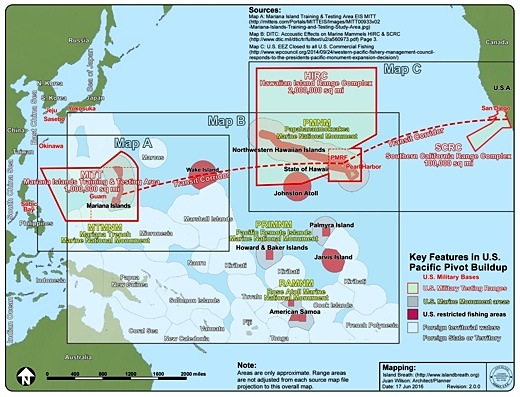
Image above: A overall map of the Pacific Ocean showing the areas under US control and used to develop, test and train military systems and weapons. It also shows the Marine National Monuments and US restricted fishing areas that not only greatly overlap with the military test range, but with the islands used for nuclear weapons testing from the end of World War II to the Cubal Missile Crisis. Click to see full size.
With a red outline the map identifies the boundaries of millions of square miles of range complexes for shooting rockets, testing sonar, exploding ordinance, and other destructive behavior.
There are 2,000,000 square miles of it around the Hawaiian Islands alone for use by RIMPAC 2016 participants.
The map also shows two "Transit Corridors" in dotted red crossing the Pacific from San Diego to Hawaii and from Hawaii over the Marshall Islands all the way to the Mariana Islands.
These corridors are used to test experimental planes, intercontinental missiles and space vehicles. The PMRF is at the center of where these corridors meet.
There are also restricted fishing areas (in red) and Marine National Monument areas (in gray) that surround American controlled Pacific Islands in order to keep people out.
Lynn McNutt is on the Western Pacific Regional Fishery Management Council. Regarding the expansion of the Marine National Monument area around the Northwest Hawaiian Islands she said recently:
Starting in 1946 America, and its allies Britain and France, conducted what in effect was a nuclear war in the Pacific Ocean. This involved detonating over 160 nuclear devises over, near or on islands in the Pacific Ocean This included Bikini Island, Baker Island, Enewetak Atoll, Christmas Island, and Johnston Island (merely 700 miles from Kauai).
The British conducted over 20 nuclear tests in the Central Pacific and Australian territories. (https://www.ctbto.org/nuclear-testing/the-effects-of-nuclear-testing/the-united-kingdomsnuclear-testing-programme/)
The French conducted over 40 nuclear tests in the South Pacific (https://www.ctbto.org/nuclear-testing/the-effects-of-nuclear-testing/frances-nuclear-testing-programme/)
The United States conducted 106 atmospheric and underwater nuclear tests in the Pacific, many of which were of extremely high yield. While the Marshall Islands testing composed an estimated total yield of around 210 million tons of TNT, with the largest being the 15 mega-tons Castle Bravo shot of 1954 which spread considerable nuclear fallout on many of the islands, including several which were inhabited, and some that had not been evacuated. (https://en.wikipedia.org/wiki/Pacific_Proving_Grounds)
The Navy's introduction to Kauai's Barking Sands was in 1956, near the height of the nuclear tests when the Air Force's Bonham Air Force Base granted it a five year revocable license to use 37 acres.
Two years later the Pacific Missile Range Facility was formally established.
The nuclear tests continued.
In 1962 the Navy's PMRF was becoming the principal user of Bonham Air Force Base, and formal negotiations began to transfer the base to the Navy. (http://www.globalsecurity.org/military/facility/pmrf.htm)
Meanwhile, in Wisconsin cows started delivering milk containing Strontium-90 that they ingested from eating grass. The atmospheric testing of hydrogen bombs soon stopped.
In 1964, negotiations were completed, and Bonham Air Force Base officially transferred all its 1,885 acres to the Navy.
By this time, the PMRF had established a chain of stations throughout the Pacific.
Besides Barking Sands and Kokee, several down range stations under the PMRF included: South Point, Hawaii; Midway Island; Wake Island, Eniwetok Atoll; Tern Island; Christmas Island; Canton Island; and the recovery ships, USS Longview and USS Sunnyvale.
In 1967 the Barking Sands Tactical Underwater Range (BARSTUR), and the Makaha Ridge Instrumentation Site, were completed.
(http://www.globalsecurity.org/military/facility/pmrf.htm)
TRIDENTS AND TOMAHAWKS
These facilities were crucial in the development and testing of submarine launched nuclear weapons like the Trident, Tomahawk missiles systems.
The Trident is a high altitude ballistic missile with multiple independently targetable reentry nuclear warheads or MIRVs. The Trident has a 6,000 mile range.
The Tomahawk is a low altitude radar avoiding cruise missile that can follow a flight plan independently.
Beginning in 1968 the Navy built ten Nimitz Class nuclear powered aircraft carriers to lead Strike Groups with the capability of launching nuclear missiles or planes with nuclear bombs to anywhere on Earth.
Beginning in the 1970's a new fleet of nuclear powered submarines designed to replace the older Polaris subs. Eighteen of the Ohio Class and 39 Los Angeles Class are now operational and fitted with either Trident or Tomahawk nuclear missiles.
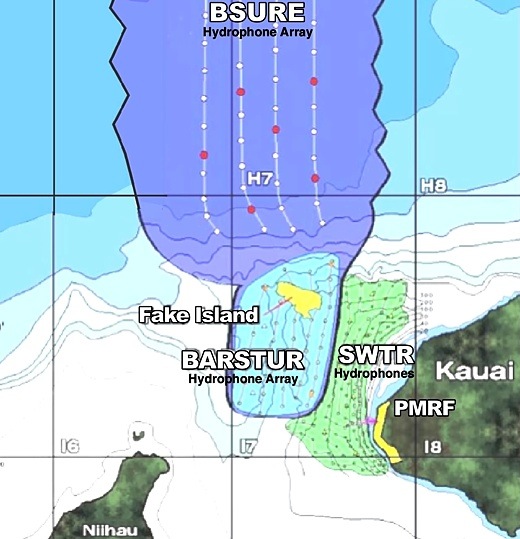
Image above: Partial map from a "industry" handout of the Barking Sands underwater test area. This came from a briefing to military contractors on the features of the PMRF (a key player in RIMPAC 1016 activities) when its BSURE hydrophone array was first added. Note the yellow "Fake Island" in the BARSTUR area. Is this some kind of target simulation? From (http://www.ceros.org/documents/FY10%20Industry%20Day%20Briefings/PMRF_CEROS%20Industry%20Day%2020100930.pdf). Click to see full page larger. Below is back side of this handout.
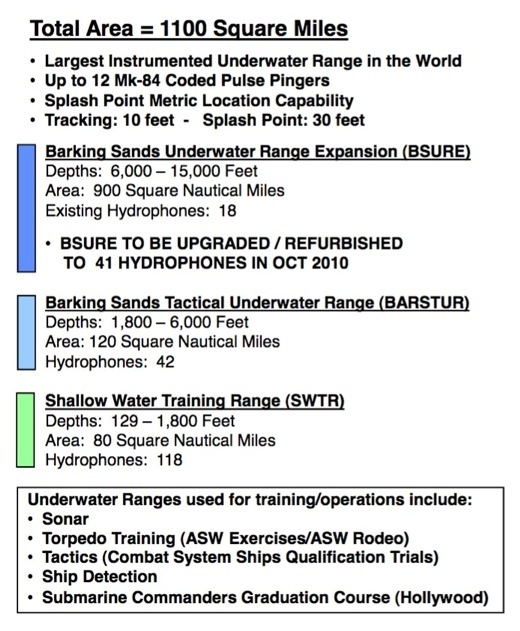
Image above: Partial map of the Barking Sands underwater test area. This came from a briefing to military contractors on the features of the PMRF (a key player in RIMPAC 1016 activities) when its BSURE hydrophone array was first added.
PMRF MISSION ACCOMPLISHED
The PMRF is now the world's largest instrumented, multi-dimensional testing and training range. PMRF is the only range in the world where subsurface, surface, air and space vehicles can operate and be tracked simultaneously.
This capability allows range users extraordinary flexibility in planning and conducting realistic multi-participant, multi-threat freeplay operations to train crews, evaluate tactics, and test weapon systems.
But since nuclear war was found impractical most nuclear activity in recent decades has turned to building nuclear power plants. Asian nuclear power plant building has been aggressive. China, India, Japan, and South Korea have become enthusiastic advocates. (http://www.world-nuclear.org/information-library/country-profiles/others/asias-nuclear-energy-growth.aspx).
Needless to say many US weapons contractors also got involved with the nuclear power industry. American government and corporations pushed nuclear power technology on allies as well as defeated enemies.
In the 1970s, the first light water reactors were built in Japan in cooperation with American companies. These plants were bought from vendors such as General Electric and Westinghouse with contractual work done by Japanese companies. (https://en.wikipedia.org/wiki/Nuclear_power_in_Japan)
A FEW NUCLEAR TECH COMPANIES
General Electric, Westinghouse, Bechtel, Babcock & Wilcox, American Atomics, Nuclear Fuel Services, Boeing, Northrop Grumman, General Dynamics, GenCorp Aerojet, Huntington Ingalls, and Lockheed Martin, Babcock & Wilcox, Bechtel, and Honeywell.
Many of these organizations (and others like Sandia Labs) are still represented here on Kauai at the PMRF. The place is not so much a naval base as it is an industrial park for developing lethal weapon systems managed by guys in navy whites guarded by the private security firm ITT.
The results of their work are nuclear armed fleets which have dominated the Pacific Ocean (and the world) for over half a century with the fear of annihilation of life on Earth. The biannual celebration of this armada of destruction has been RIMPAC.
But that's only half the story
QUESTION: Which came first - the reactor or the bomb? ANSWER: Reactors.
Ex-WWII general and US President Dwight D. Eisenhower proposed that nuclear technology be used for peace instead of war. He proposed the "Atoms for Peace" program that would transform the power of the atom to make electricity. It would also give many large military industrial corporations something to do after 1953 other than wage war. (https://en.wikipedia.org/wiki/Atoms_for_Peace#Legacy)
In the early 1950's it was recognized that the weapons program would require more plutonium than could be furnished by the Atomic Energy Commission (AEC). One suggestion, made by Dr. Charles A. Thomas, then executive vice-president of Monsanto Chemical Company, was to create a dual purpose plutonium reactor, on which could produce plutonium for weapons, and electricity for commercial use (http://www.neis.org/literature/Brochures/weapcon.htm)
Atoms for Peace created the ideological background for the creation of the International Atomic Energy Agency and the Treaty on the Non-Proliferation of Nuclear Weapons, but also gave political cover for the U.S. nuclear weapons build-up, and the backdrop to the Cold War arms race. Under Atoms for Peace related programs the U.S. exported over 25 tons of highly enriched uranium (HEU) to 30 countries, mostly to fuel research reactors, which is now regarded as a proliferation and terrorism risk. (https://en.wikipedia.org/wiki/Atoms_for_Peace#Legacy)
Nuclear reactors are needed to make the material for nuclear weapons and nuclear weapons keep the US in a dominating position throughout the world. In addition, nuclear reactors power the aircraft carriers and nuclear submarines that deliver the nuclear weapons to their targets.
These two engineering disciplines are joined at the hip. One needs the other for survival.
Our former enemy and current ally Japan has suffered from both disciplines.
They, unfortunately, have the distinction of being victims of the two worst nuclear catastrophes in history.
As an enemy, in 1945, Japan suffered having two cities being destroyed by atomic bombs within days of one another.
As an ally Japan is suffering now from worst nuclear meltdown in history - following the March 11th 2011 earthquake and tsunami, there was complete meltdown of three of the six reactors supplied by the General Electric for the Fukushima Daiichi Nuclear Power Plant.
Put in perspective the destruction and radiation sickness caused by the single atomic bomb that landed on Hiroshima was generated with just a few pounds of Uranium 235.
But each of the nuclear reactors that melted down at Fukushima Daiichi had more than 600 pounds of reactor fuel for a total of about 1,800 pounds.
Moreover, in the case of Fukushima Reactor #3 it is reported that, despite regulations, the fuel used was mixed oxide - which is about 7% plutonium. Plutonium is more toxic than uranium for a considerably longer time.
In the 1960s US President Nixon had proposed we build "Breeder Reactors" using the MOX fuel. They were named "Breeders" because they make more refined uranium than they consume from the plutonium.
The Fukushima Daiichi Reactors #1, #2 and #3 had complete meltdowns that included the breaching of their reactor vessels.
More horrifying, the fuel has likely completely burned through the four foot thick concrete slabs of their containment buildings and into the ground.
Ground water passing over the unreachable melted cores are picking up radioactive elements. This is producing about 300 tons of highly radioactive water that enters into the Pacific Ocean everyday.
It is unlikely that this process will not be stopped in the lifetime of anyone in this room.
In the case of reactor #2 there is evidence of a steam explosion tearing apart the reactor vessel. More ominously, in the case of reactor #3 the evidence points to a run away nuclear chain reaction (or criticality) of the MOX fuel.
In effect, the detonation of a plutonium bomb.
Tiny black grains of plutonium were blown into the atmosphere over Japan (including Tokyo) as well as out over the Pacific Ocean on the wind. Plutonium can be carried on the surface of the ocean supported by carbon soot buckyballs.
At the time of the March 11th tsunami the US Carrier Strike Group led by the USS Ronald Reagan was nearby. It was decided the Reagan and elements of the carrier group would provide logistical support.
The ships steamed to the eastern shore of Japan off Fukushima. When the two reactors exploded the Reagan and other ships were swallowed by a radioactive plume of soot, steam and ash that stretched across the ocean from the plant.
Lindsay Cooper, Navy sailor was aboard USS Ronald Reagan during 3/11 rescue operation:
(http://nypost.com/2013/12/22/70-navy-sailors-left-sickened-by-radiation-after-japan-rescue/)
Since 2011 about 400 young healthy service persons from the carrier group have become unexplainably ill. Several have died.
The USS Ronald Reagan was severely contaminated. The Reagan was taken out of service and drydocked for 18 months in Bremerton, Washington in order to be decontaminated.
The ship was back on duty in time to be a flagship for RIMPAC in 2014. After the war games the Reagan was reassigned from San Diego to the strategic forward naval base at Yokosuka, Japan, near Tokyo.
The participants for RIMPAC 2016 include Canada, Chile, China, India, Indonesia, Japan, Malaysia, New Zealand, Norway, Peru, Singapore, South Korea, Tonga, and the United States. It also includes three NATO allies France, Germany, and the Netherlands, (http://www.cpf.navy.mil/rimpac/participants/)
It seems ominous to me that NATO allies are participating in RIMPAC. France, Germany and the Netherlands are NATO members obligated to supporting other NATO nations if attacked. With tensions rising in the South China Seas it seems ill advised to make the Pacific Ocean part of NATO's responsibility.
Does anyone hear remember SEATO? The Southeast Asia Treaty Organization? SEATO was in effect after the Korean War and was used through the Vietnam War era to keep "friendly" nations in the area on the same page. But after America lost the Vietnam War SEATO withered away and was disbanded by 1977.
SEATO, like the North Atlantic Treaty Organization (NATO) committed participants to join in a war if any party were attacked. NATO commits America and its partners to joining in war in Europe against what was the USSR and is now Russia. SEATO was aimed primarily at Red China.
There has been a heating up of Chinese sovereignty claims to the South China Sea with its oil and gas reserves. RIMPAC 2016 may now be morphing into alliance not unlike the now defunct SEATO.
So it is no surprise that RIMPAC 2016 includes so many exSEATO nations and and a Chinese navy observation boat. Maybe it's time to rename it RIMCO.
What are our real strategic priorities?
If it is not obvious yet, but it should be soon. There is only so much more easily obtained conventional energy in the form of gas, oil and coal fossil fuels. These three sources are critical to modern industrial civilization.
• They are crucial for refining steel, aluminum and other metals.
• They are the source material for creating asphalts, plastics, fertilizers, pharmaceuticals, and lubricants.
• They are the source of about 75% of the energy we use.
We now know that burning all the available fossil fuels are causing uncontrollable runaway global warming - with climate change and rising oceans. We are already experiencing the bow waves of those effects.
We must be very judicial in determining what we will do with these resources.
One thing to consider is that without abundant available gas, oil and coal we cannot safely maintain operating the world's almost 500 nuclear power plants. It is likely that without a massive effort - starting now - we will not even be able to safely shut them down. (http://www.nei.org/Knowledge-Center/Nuclear-Statistics/World-Statistics)
There is also the more than 15,000 nuclear warheads in the world that need safe decommissioning. The US has more than 7,000 to deal with. (http://www.ploughshares.org/world-nuclear-stockpile-report?gclid=CNzq1_mmrc0CFYiVfgod1XkK7Q).
WPP IT GOOD
Many may not realize that the only facility for storing nuclear waste in the US is no more. The Waste Isolation Pilot Plant (or WPP) in New Mexico, closed in 2014. That was due an accident that created an uncontrolled plutonium fire.
It seems that before shipping technicians at Los Alamos National Labs packed a 55 gallon steel drum of waste plutonium with the wrong kitty litter (used as a filler) that ignited the fire and incapacitated the plant. Who knew? Atomic scientists?
There is now no place for the US to process and store waste nuclear fuel or weapon.
The most most important thing our blue water Navy could do is find another agenda than turning the Pacific Rim into an ashtray. Perhaps they could find a way to safely put away their nuclear devices while there is still the industrial capability to do it.
And rather than implementing a current plan to turn the PMRF from a research facility into a regular military base further suggestions.
Perhaps the Navy could make a new list of priorities in the Pacific Ocean that could be incorporated into future RIMPAC activities.
For example:
See also:
Ea O Ka Aina: Ocean 4 Peace Events 6/11/16
Ea O Ka Aina: Prepare for RIMPAC 2016 War in Hawaii 5/22/16
Ea O Ka Aina: Navy to "take" millions of mammals 5/17/16
Ea O Ka Aina: US court RIMPAC Impact decision 4/3/15
Ea O Ka Aina: RIMPAC 2014 Impact Postmortem 10/22/1
Ea O Ka Aina: RIMPAC 2014 in Full March 7/16/14
Ea O Ka Aina: 21st Century Energy Wars 7/10/14
Ea O Ka Aina: RIMPAC War on the Ocean 7/3/14
Ea O Ka Aina: Voila - World War Three 7/1/14
Ea O Ka Aina: The Pacific Pivot 6/28/14
Ea O Ka Aina: RIMPAC IMPACT 6/8/14
Ea O Ka Aina: RIMPAC Then and Now 5/16/14
Ea O Ka Aina: Earthday TPP Fukushima RIMPAC 4/22/14
Ea O Ka Aina: The Asian Pivot - An ugly dance 12/5/13
Ea O Ka Aina: Help save Mariana Islands 11/13/13
Ea O Ka Aina: End RimPac destruction of Pacific 11/1/13
Ea O Ka Aina: Moana Nui Confereence 11/1/13
Ea O Ka Aina: Navy to conquer Marianas again 9/3/13
Ea O Ka Aina: Pagan Island beauty threatened 10/26/13
Ea O Ka Aina: Navy license to kill 10/27/12
Ea O Ka Aina: Sleepwalking through destruction 7/16/12
Ea O Ka Aina: Okinawa breathes easier 4/27/12
Ea O Ka Aina: Navy Next-War-Itis 4/13/12
Ea O Ka Aina: America bullies Koreans 4/13/12
Ea O Ka Aina: Despoiling Jeju island coast begins 3/7/12
Ea O Ka Aina: Jeju Islanders protests Navy Base 2/29/12
Ea O Ka Aina: Hawaii - Start of American Empire 2/26/12
Ea O Ka Aina: Korean Island of Peace 2/26/12
Ea O Ka Aina: Military schmoozes Guam & Hawaii 3/17/11
Ea O Ka Aina: In Search of Real Security - One 8/31/10
Ea O Ka Aina: Peace for the Blue Continent 8/10/10
Ea O Ka Aina: Shift in Pacific Power Balance 8/5/10
Ea O Ka Aina: RimPac to expand activities 6/29/10
Ea O Ka Aina: RIMPAC War Games here in July 6/20/10
Ea O Ka Aina: Pacific Resistance to U.S. Military 5/24/10
Ea O Ka Aina: De-colonizing the Pacific 5/21/10
Ea O Ka Aina: RIMPAC to Return in 2010 5/2/10
Ea O Ka Aina: Living at the Tip of the Spear 4/5/10
Ea O Ka Aina: Living at the Tip of the Spear 4/15/10
Ea O Ka Aina: Guam Land Grab 11/30/09
Ea O Ka Aina: Guam as a modern Bikini Atoll 12/25/09
Ea O Ka Aina: GUAM - Another Strategic Island 11/8/09
Ea O Ka Aina: Diego Garcia - Another stolen island 11/6/09
Ea O Ka Aina: DARPA & Super-Cavitation on Kauai 3/24/09
Island Breath: RIMPAC 2008 - Navy fired up in Hawaii 7/2/08
Island Breath: RIMPAC 2008 uses destructive sonar 4/22/08
Island Breath: Navy Plans for the Pacific 9/3/07
Island Breath: Judge restricts sonar off California 08/07/07
Island Breath: RIMPAC 2006 sonar compromise 7/9/06
Island Breath: RIMPAC 2006 - Impact on Ocean 5/23/06
Island Breath: RIMPAC 2004 - Whale strandings on Kauai 9/2/04
Island Breath: PMRF Land Grab 3/15/04
By Juan Wilson on 18 June 2016 for Island Breath -
(http://islandbreath.blogspot.com/2016/06/oceans4peace-pacific-pivot-talk.html)
Video above: Oceans4Peace Pacific Pivot Panel Discussion approximately 1.5hours. Filmed by Robert Zelkovsky.]. Source (https://youtu.be/Gl1kBS7-_dQ).
[IB Author's note: Below is the written text of the talk I gave (see video above) at the Oceans4Peace presentations and discussion. The evening program as hosted by Gorden Labedz and included;
Technology Effects on Whales - Kalasara Setaysha - Oceans4Peace, The Threats to Coral - Dr. Katherine Muzik - Marine Biologist NTBG, Expansion of US Militarism in the Pacific - Juan Wilson - Kauai Sierra Club]
OCEANS4PEACE PACIFIC PIVOT PRESENTATION
By Juan Wilson
Aloha All,
I am a retired architect/planner and a member of the executive committee of the Kauai Group of the Sierra Club. My wife Linda and I publish IslandBreath.org - an online website focussing on peace, sustainability, and living local.
I'm speaking in place of Koohan Paik who planned to make a presentation on the US military buildup in the Pacific Ocean and the so called "Pacific Pivot". However, she could not be here, as she is in South Korea.
I must say that Koohan works tirelessly on the issues we will speak about tonight. She was the first one that brought to me the importance of the Strategic Islands of of the United States - specifically in the Pacific Ocean. She is knowledgable of the policies and actions the US implements in achieving its imperial goals as well as the impacts they have on local cultures and ecosystems.
Koohan's presentation for our panel discussion before RIMPAC two years ago is pertinent today. In fact it was prescient:
I think it's worth revisiting. She said in part:
The U.S. is attempting to stake its claim on the Asia-Pacific region. Hillary Clinton, a huge cheerleader for the militarization, has called the 21st century “America’s Pacific Century.
RIMPAC is only a small piece of a huge, systemized, federal project of destruction called “the Pacific Pivot.” The Pacific Pivot is a plan to reorient the U.S. military away from Europe and the middle-east, and toward the Asia-Pacific region.
We are now in its beginning stages. New bases are being built, new military agreements are being forged with Pacific-rim nations, PMRF is ramping up for more rocket launches, the obnoxious Osprey helicopters are coming to Hawaii; and huge swaths of ocean have been targeted by the Pentagon for continual year-round bombing and detonations.
Our region is now witnessing an acceleration of militarization that resembles all-out war. And from an environmental point of view, it is no different from all-out war, because the training exercises, rife with every kind of explosion imaginable, never stop. Even PMRF Commander Hay bragged how, “Our ability to train like we would actually fight exists here”.
For the natural world, the Pacific Pivot is nothing short of an environmental holocaust. Bio-diverse ecosystems… totaling over three million square miles of supposedly “wild” ocean have been officially set aside to be systematically poisoned, dredged, detonated, torpedoed and bombed into nonexistence -- all in service of “military preparedness.” Over three million square miles of open seas – that’s roughly three-quarters the size of the entire United States of America.
We in Hawaii are at the center of this ecocide. We are not only at the center geographically – we are also at the center of control.
In 2014 at during the same panel discussion I said:
In recent decades several weapon systems have been developed and tested from the PMRF here on Kauai. Those systems include submarine based ballistic missiles with nuclear warheads.
The PMRF is the wheelhouse for many activities of RIMPAC.
Ocean, reefs, beaches, dunes, valleys, plains are strewn with lead and depleted-uranium munitions as well as pollutants such as bilge oil, hydraulic fluid, defoliants, and countless other contaminants used in war - and in war games.
RIMPAC is a demonstration to our "partners" and "enemies" that we will do anything to maintain military control over the vastness of the Pacific Ocean.
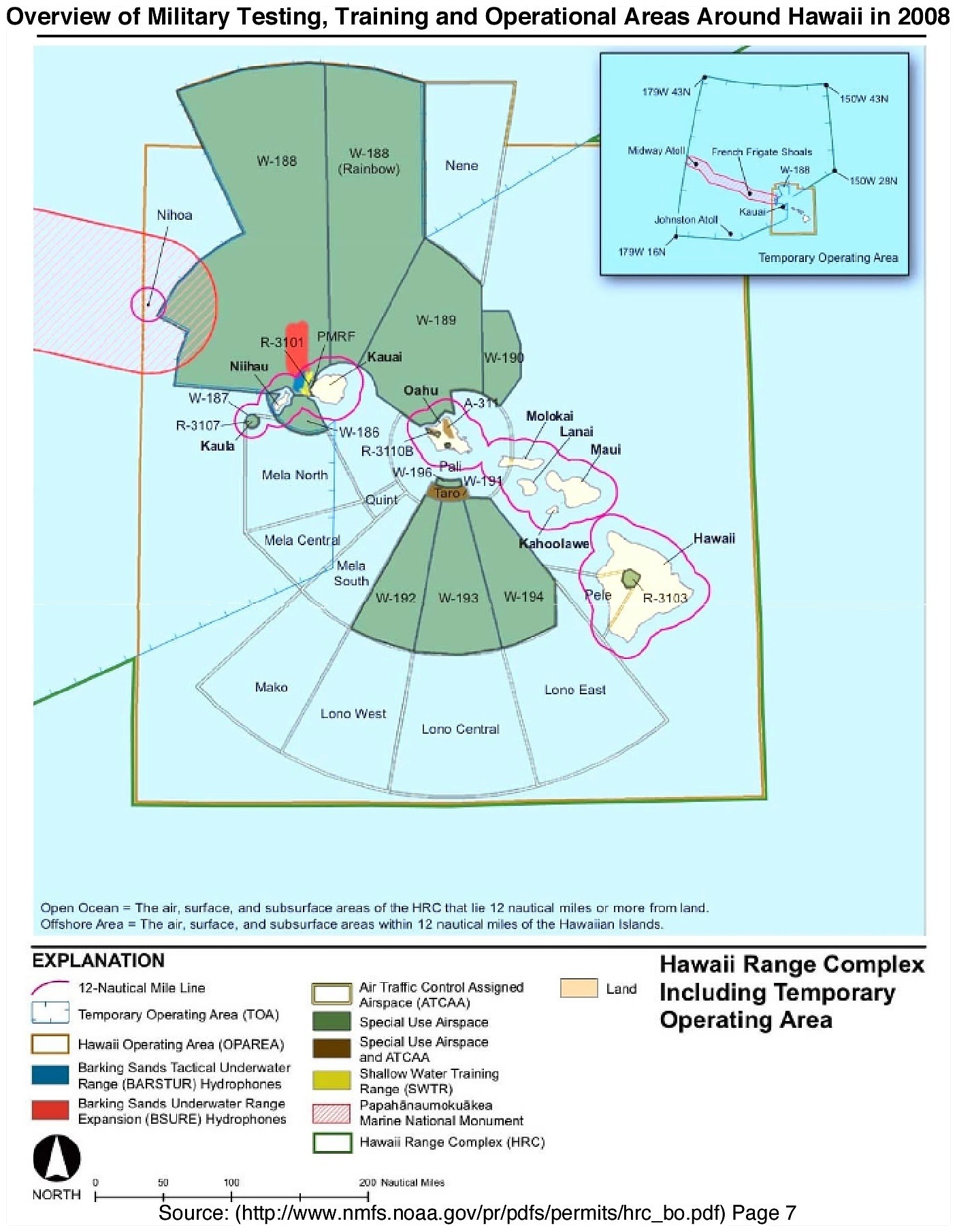
Image above: Image above: Map of Hawaiian Range Complex and inset showing it's position within a temporary operating area that is now part of the two-million square mile HIRC (Haweaiian Island Range Compex. From Source: (http://www.nmfs.noaa.gov/pr/pdfs/permits/hrc_bo.pdf) Page 7. Click for larger map with legend.
THAT WAS THEN - THIS IS NOW
A point I would like to make this evening is that what maintains American domination of the Pacific are not the alliances and trade agreements with partner nations. That is not where the real power lies.
The power lies in the strategic military bases we maintain throughout the Pacific that are the muscle that allows those alliances, trade deals and policies to be enforced. And the force that runs through those muscles is delivered by nuclear reactor power and the threat of the use of nuclear weapons.
Nuclear power propels about 100 nuclear submarines and leads 10 nuclear carrier strike groups with access to thousands of state of the art nuclear weapons. During RIMPAC 2016 one of those US Carrier Strike Groups will lead 45 ships and four submarines throughout the Hawaiian Islands.
My case to you tonight is that the United State's domination throughout the Pacific during the last 70 years rests on two foundations of nuclear engineering - Nuclear Reactors and Nuclear Weapons.
According to GlobalSecurity.org the mission of the PMRF is to facilitate Training, Tactics Development, and Test & Evaluations for air, surface, and sub-surface weapons systems and Advanced Technology Systems. (http://www.globalsecurity.org/military/facility/pmrf.htm)
The PMRF will be a crucial asset in coordination, communication, telemetry, intelligence, evaluation, and recording the events during RIMPAC 2016 and any future Pacific War.
The map I brought with me is an update of a map I put together with Koohan to demonstrate aspects of the Pacific Pivot. It shows the the vast area of the Pacific Ocean used for testing, developing and deploying weapons systems. It stretches east-west from the Philippines to California and north-south from Japan to Australia.
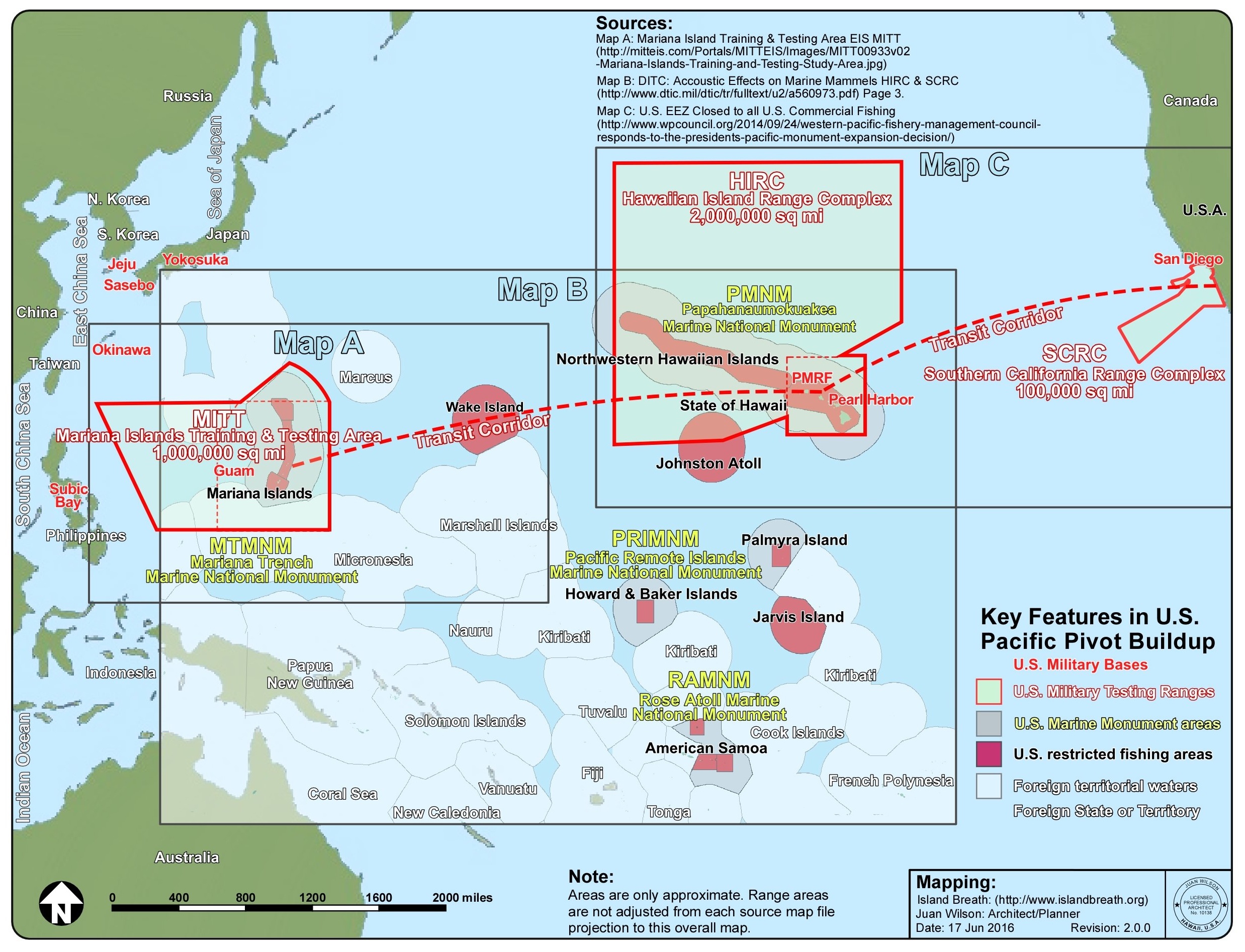
Image above: A overall map of the Pacific Ocean showing the areas under US control and used to develop, test and train military systems and weapons. It also shows the Marine National Monuments and US restricted fishing areas that not only greatly overlap with the military test range, but with the islands used for nuclear weapons testing from the end of World War II to the Cubal Missile Crisis. Click to see full size.
With a red outline the map identifies the boundaries of millions of square miles of range complexes for shooting rockets, testing sonar, exploding ordinance, and other destructive behavior.
There are 2,000,000 square miles of it around the Hawaiian Islands alone for use by RIMPAC 2016 participants.
The map also shows two "Transit Corridors" in dotted red crossing the Pacific from San Diego to Hawaii and from Hawaii over the Marshall Islands all the way to the Mariana Islands.
These corridors are used to test experimental planes, intercontinental missiles and space vehicles. The PMRF is at the center of where these corridors meet.
There are also restricted fishing areas (in red) and Marine National Monument areas (in gray) that surround American controlled Pacific Islands in order to keep people out.
Lynn McNutt is on the Western Pacific Regional Fishery Management Council. Regarding the expansion of the Marine National Monument area around the Northwest Hawaiian Islands she said recently:
"The military is not subject to ANY of the conservation rules, and by allowing them to operate sonar in the Monument area and continue missile launches and at sea training, the conservation rules are meaningless. Recently, the PMRF has been expanding its territorial restrictions on fisherman due to rocket firing and missile testing.MISTREATING THE PACIFIC SINCE WWII
If the proposal that the Marine Monument boundary of the Northwest Hawaiian Island area was expanded to 200 miles out from Nihoa Island, then Niihau and part of Kauai would be off limits to fisherrman, and the boundary line would conveniently come right up to the restricted area around PMRF.
Since there is talk of making PMRF and active military base and since recent test activity took place in an expanded range restriction, fisherman are very concerned that expanded military use will result in further restrictions."
Starting in 1946 America, and its allies Britain and France, conducted what in effect was a nuclear war in the Pacific Ocean. This involved detonating over 160 nuclear devises over, near or on islands in the Pacific Ocean This included Bikini Island, Baker Island, Enewetak Atoll, Christmas Island, and Johnston Island (merely 700 miles from Kauai).
The British conducted over 20 nuclear tests in the Central Pacific and Australian territories. (https://www.ctbto.org/nuclear-testing/the-effects-of-nuclear-testing/the-united-kingdomsnuclear-testing-programme/)
The French conducted over 40 nuclear tests in the South Pacific (https://www.ctbto.org/nuclear-testing/the-effects-of-nuclear-testing/frances-nuclear-testing-programme/)
The United States conducted 106 atmospheric and underwater nuclear tests in the Pacific, many of which were of extremely high yield. While the Marshall Islands testing composed an estimated total yield of around 210 million tons of TNT, with the largest being the 15 mega-tons Castle Bravo shot of 1954 which spread considerable nuclear fallout on many of the islands, including several which were inhabited, and some that had not been evacuated. (https://en.wikipedia.org/wiki/Pacific_Proving_Grounds)
The Navy's introduction to Kauai's Barking Sands was in 1956, near the height of the nuclear tests when the Air Force's Bonham Air Force Base granted it a five year revocable license to use 37 acres.
Two years later the Pacific Missile Range Facility was formally established.
The nuclear tests continued.
In 1962 the Navy's PMRF was becoming the principal user of Bonham Air Force Base, and formal negotiations began to transfer the base to the Navy. (http://www.globalsecurity.org/military/facility/pmrf.htm)
Meanwhile, in Wisconsin cows started delivering milk containing Strontium-90 that they ingested from eating grass. The atmospheric testing of hydrogen bombs soon stopped.
In 1964, negotiations were completed, and Bonham Air Force Base officially transferred all its 1,885 acres to the Navy.
By this time, the PMRF had established a chain of stations throughout the Pacific.
Besides Barking Sands and Kokee, several down range stations under the PMRF included: South Point, Hawaii; Midway Island; Wake Island, Eniwetok Atoll; Tern Island; Christmas Island; Canton Island; and the recovery ships, USS Longview and USS Sunnyvale.
In 1967 the Barking Sands Tactical Underwater Range (BARSTUR), and the Makaha Ridge Instrumentation Site, were completed.
(http://www.globalsecurity.org/military/facility/pmrf.htm)
TRIDENTS AND TOMAHAWKS
These facilities were crucial in the development and testing of submarine launched nuclear weapons like the Trident, Tomahawk missiles systems.
The Trident is a high altitude ballistic missile with multiple independently targetable reentry nuclear warheads or MIRVs. The Trident has a 6,000 mile range.
The Tomahawk is a low altitude radar avoiding cruise missile that can follow a flight plan independently.
Beginning in 1968 the Navy built ten Nimitz Class nuclear powered aircraft carriers to lead Strike Groups with the capability of launching nuclear missiles or planes with nuclear bombs to anywhere on Earth.
Beginning in the 1970's a new fleet of nuclear powered submarines designed to replace the older Polaris subs. Eighteen of the Ohio Class and 39 Los Angeles Class are now operational and fitted with either Trident or Tomahawk nuclear missiles.
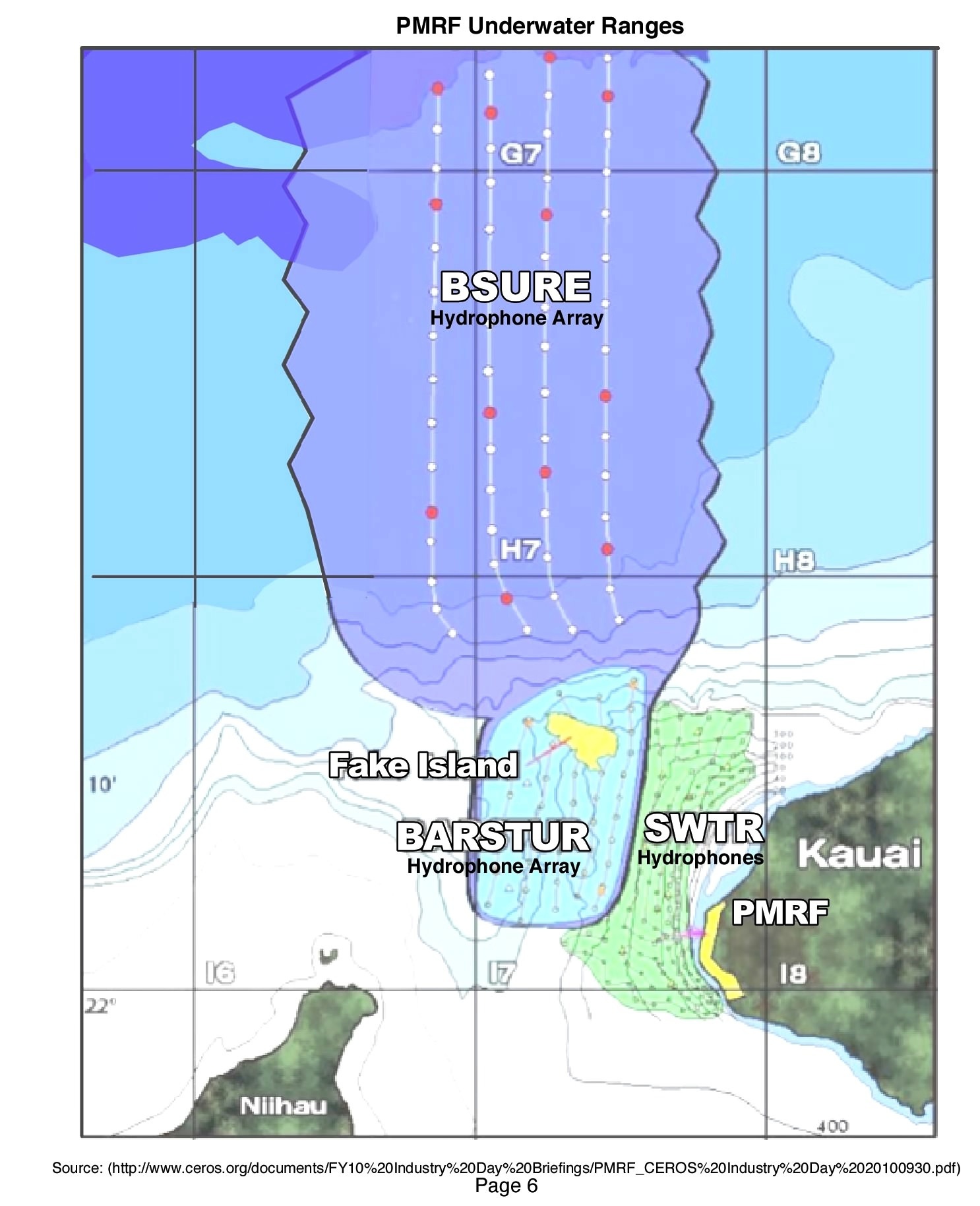
Image above: Partial map from a "industry" handout of the Barking Sands underwater test area. This came from a briefing to military contractors on the features of the PMRF (a key player in RIMPAC 1016 activities) when its BSURE hydrophone array was first added. Note the yellow "Fake Island" in the BARSTUR area. Is this some kind of target simulation? From (http://www.ceros.org/documents/FY10%20Industry%20Day%20Briefings/PMRF_CEROS%20Industry%20Day%2020100930.pdf). Click to see full page larger. Below is back side of this handout.
Image above: Partial map of the Barking Sands underwater test area. This came from a briefing to military contractors on the features of the PMRF (a key player in RIMPAC 1016 activities) when its BSURE hydrophone array was first added.
PMRF MISSION ACCOMPLISHED
The PMRF is now the world's largest instrumented, multi-dimensional testing and training range. PMRF is the only range in the world where subsurface, surface, air and space vehicles can operate and be tracked simultaneously.
This capability allows range users extraordinary flexibility in planning and conducting realistic multi-participant, multi-threat freeplay operations to train crews, evaluate tactics, and test weapon systems.
But since nuclear war was found impractical most nuclear activity in recent decades has turned to building nuclear power plants. Asian nuclear power plant building has been aggressive. China, India, Japan, and South Korea have become enthusiastic advocates. (http://www.world-nuclear.org/information-library/country-profiles/others/asias-nuclear-energy-growth.aspx).
Needless to say many US weapons contractors also got involved with the nuclear power industry. American government and corporations pushed nuclear power technology on allies as well as defeated enemies.
In the 1970s, the first light water reactors were built in Japan in cooperation with American companies. These plants were bought from vendors such as General Electric and Westinghouse with contractual work done by Japanese companies. (https://en.wikipedia.org/wiki/Nuclear_power_in_Japan)
A FEW NUCLEAR TECH COMPANIES
General Electric, Westinghouse, Bechtel, Babcock & Wilcox, American Atomics, Nuclear Fuel Services, Boeing, Northrop Grumman, General Dynamics, GenCorp Aerojet, Huntington Ingalls, and Lockheed Martin, Babcock & Wilcox, Bechtel, and Honeywell.
Many of these organizations (and others like Sandia Labs) are still represented here on Kauai at the PMRF. The place is not so much a naval base as it is an industrial park for developing lethal weapon systems managed by guys in navy whites guarded by the private security firm ITT.
The results of their work are nuclear armed fleets which have dominated the Pacific Ocean (and the world) for over half a century with the fear of annihilation of life on Earth. The biannual celebration of this armada of destruction has been RIMPAC.
But that's only half the story
QUESTION: Which came first - the reactor or the bomb? ANSWER: Reactors.
Ex-WWII general and US President Dwight D. Eisenhower proposed that nuclear technology be used for peace instead of war. He proposed the "Atoms for Peace" program that would transform the power of the atom to make electricity. It would also give many large military industrial corporations something to do after 1953 other than wage war. (https://en.wikipedia.org/wiki/Atoms_for_Peace#Legacy)
In the early 1950's it was recognized that the weapons program would require more plutonium than could be furnished by the Atomic Energy Commission (AEC). One suggestion, made by Dr. Charles A. Thomas, then executive vice-president of Monsanto Chemical Company, was to create a dual purpose plutonium reactor, on which could produce plutonium for weapons, and electricity for commercial use (http://www.neis.org/literature/Brochures/weapcon.htm)
Atoms for Peace created the ideological background for the creation of the International Atomic Energy Agency and the Treaty on the Non-Proliferation of Nuclear Weapons, but also gave political cover for the U.S. nuclear weapons build-up, and the backdrop to the Cold War arms race. Under Atoms for Peace related programs the U.S. exported over 25 tons of highly enriched uranium (HEU) to 30 countries, mostly to fuel research reactors, which is now regarded as a proliferation and terrorism risk. (https://en.wikipedia.org/wiki/Atoms_for_Peace#Legacy)
Nuclear reactors are needed to make the material for nuclear weapons and nuclear weapons keep the US in a dominating position throughout the world. In addition, nuclear reactors power the aircraft carriers and nuclear submarines that deliver the nuclear weapons to their targets.
These two engineering disciplines are joined at the hip. One needs the other for survival.
Our former enemy and current ally Japan has suffered from both disciplines.
They, unfortunately, have the distinction of being victims of the two worst nuclear catastrophes in history.
As an enemy, in 1945, Japan suffered having two cities being destroyed by atomic bombs within days of one another.
As an ally Japan is suffering now from worst nuclear meltdown in history - following the March 11th 2011 earthquake and tsunami, there was complete meltdown of three of the six reactors supplied by the General Electric for the Fukushima Daiichi Nuclear Power Plant.
Put in perspective the destruction and radiation sickness caused by the single atomic bomb that landed on Hiroshima was generated with just a few pounds of Uranium 235.
But each of the nuclear reactors that melted down at Fukushima Daiichi had more than 600 pounds of reactor fuel for a total of about 1,800 pounds.
Moreover, in the case of Fukushima Reactor #3 it is reported that, despite regulations, the fuel used was mixed oxide - which is about 7% plutonium. Plutonium is more toxic than uranium for a considerably longer time.
In the 1960s US President Nixon had proposed we build "Breeder Reactors" using the MOX fuel. They were named "Breeders" because they make more refined uranium than they consume from the plutonium.
The Fukushima Daiichi Reactors #1, #2 and #3 had complete meltdowns that included the breaching of their reactor vessels.
More horrifying, the fuel has likely completely burned through the four foot thick concrete slabs of their containment buildings and into the ground.
Ground water passing over the unreachable melted cores are picking up radioactive elements. This is producing about 300 tons of highly radioactive water that enters into the Pacific Ocean everyday.
It is unlikely that this process will not be stopped in the lifetime of anyone in this room.
In the case of reactor #2 there is evidence of a steam explosion tearing apart the reactor vessel. More ominously, in the case of reactor #3 the evidence points to a run away nuclear chain reaction (or criticality) of the MOX fuel.
In effect, the detonation of a plutonium bomb.
Tiny black grains of plutonium were blown into the atmosphere over Japan (including Tokyo) as well as out over the Pacific Ocean on the wind. Plutonium can be carried on the surface of the ocean supported by carbon soot buckyballs.
At the time of the March 11th tsunami the US Carrier Strike Group led by the USS Ronald Reagan was nearby. It was decided the Reagan and elements of the carrier group would provide logistical support.
The ships steamed to the eastern shore of Japan off Fukushima. When the two reactors exploded the Reagan and other ships were swallowed by a radioactive plume of soot, steam and ash that stretched across the ocean from the plant.
Lindsay Cooper, Navy sailor was aboard USS Ronald Reagan during 3/11 rescue operation:
(http://nypost.com/2013/12/22/70-navy-sailors-left-sickened-by-radiation-after-japan-rescue/)
“I was standing on the flight deck, and we felt this warm gust of air, and, suddenly, it was snowing [...] We joked about it: ‘Hey, it’s radioactive snow! I took pictures and video [...] Japan didn’t want us in port, Korea didn’t want us, Guam turned us away. We floated in the water for two and a half months [until Thailand took them in] “People were suffering from excruciating diarrhea and shitting themselves in the hallways].”On top of that the Reagan had replenished its water tanks that it desalinated for washing cooking and drinking. It did not realize the water contained radioactive elements.
Since 2011 about 400 young healthy service persons from the carrier group have become unexplainably ill. Several have died.
The USS Ronald Reagan was severely contaminated. The Reagan was taken out of service and drydocked for 18 months in Bremerton, Washington in order to be decontaminated.
The ship was back on duty in time to be a flagship for RIMPAC in 2014. After the war games the Reagan was reassigned from San Diego to the strategic forward naval base at Yokosuka, Japan, near Tokyo.
The participants for RIMPAC 2016 include Canada, Chile, China, India, Indonesia, Japan, Malaysia, New Zealand, Norway, Peru, Singapore, South Korea, Tonga, and the United States. It also includes three NATO allies France, Germany, and the Netherlands, (http://www.cpf.navy.mil/rimpac/participants/)
It seems ominous to me that NATO allies are participating in RIMPAC. France, Germany and the Netherlands are NATO members obligated to supporting other NATO nations if attacked. With tensions rising in the South China Seas it seems ill advised to make the Pacific Ocean part of NATO's responsibility.
Does anyone hear remember SEATO? The Southeast Asia Treaty Organization? SEATO was in effect after the Korean War and was used through the Vietnam War era to keep "friendly" nations in the area on the same page. But after America lost the Vietnam War SEATO withered away and was disbanded by 1977.
SEATO, like the North Atlantic Treaty Organization (NATO) committed participants to join in a war if any party were attacked. NATO commits America and its partners to joining in war in Europe against what was the USSR and is now Russia. SEATO was aimed primarily at Red China.
There has been a heating up of Chinese sovereignty claims to the South China Sea with its oil and gas reserves. RIMPAC 2016 may now be morphing into alliance not unlike the now defunct SEATO.
So it is no surprise that RIMPAC 2016 includes so many exSEATO nations and and a Chinese navy observation boat. Maybe it's time to rename it RIMCO.
What are our real strategic priorities?
If it is not obvious yet, but it should be soon. There is only so much more easily obtained conventional energy in the form of gas, oil and coal fossil fuels. These three sources are critical to modern industrial civilization.
• They are crucial for refining steel, aluminum and other metals.
• They are the source material for creating asphalts, plastics, fertilizers, pharmaceuticals, and lubricants.
• They are the source of about 75% of the energy we use.
We now know that burning all the available fossil fuels are causing uncontrollable runaway global warming - with climate change and rising oceans. We are already experiencing the bow waves of those effects.
We must be very judicial in determining what we will do with these resources.
One thing to consider is that without abundant available gas, oil and coal we cannot safely maintain operating the world's almost 500 nuclear power plants. It is likely that without a massive effort - starting now - we will not even be able to safely shut them down. (http://www.nei.org/Knowledge-Center/Nuclear-Statistics/World-Statistics)
There is also the more than 15,000 nuclear warheads in the world that need safe decommissioning. The US has more than 7,000 to deal with. (http://www.ploughshares.org/world-nuclear-stockpile-report?gclid=CNzq1_mmrc0CFYiVfgod1XkK7Q).
WPP IT GOOD
Many may not realize that the only facility for storing nuclear waste in the US is no more. The Waste Isolation Pilot Plant (or WPP) in New Mexico, closed in 2014. That was due an accident that created an uncontrolled plutonium fire.
It seems that before shipping technicians at Los Alamos National Labs packed a 55 gallon steel drum of waste plutonium with the wrong kitty litter (used as a filler) that ignited the fire and incapacitated the plant. Who knew? Atomic scientists?
There is now no place for the US to process and store waste nuclear fuel or weapon.
The most most important thing our blue water Navy could do is find another agenda than turning the Pacific Rim into an ashtray. Perhaps they could find a way to safely put away their nuclear devices while there is still the industrial capability to do it.
And rather than implementing a current plan to turn the PMRF from a research facility into a regular military base further suggestions.
Perhaps the Navy could make a new list of priorities in the Pacific Ocean that could be incorporated into future RIMPAC activities.
For example:
- Tackle the problem of hundreds of tons of highly radioactive water entering the Pacific daily from the Fukushima Nuclear Plant.
- Commit whatever is required to saving ocean reefs from acidification and bleaching.
- Strictly enforce international regulations to keep fisheries sustainable and healthy.
- Take care of the gigantic Pacific gyres of plastic, flotsam and jetsam.
- Rescue Pacific islanders threatened by rising seas due to global warming
See also:
Ea O Ka Aina: Ocean 4 Peace Events 6/11/16
Ea O Ka Aina: Prepare for RIMPAC 2016 War in Hawaii 5/22/16
Ea O Ka Aina: Navy to "take" millions of mammals 5/17/16
Ea O Ka Aina: US court RIMPAC Impact decision 4/3/15
Ea O Ka Aina: RIMPAC 2014 Impact Postmortem 10/22/1
Ea O Ka Aina: RIMPAC 2014 in Full March 7/16/14
Ea O Ka Aina: 21st Century Energy Wars 7/10/14
Ea O Ka Aina: RIMPAC War on the Ocean 7/3/14
Ea O Ka Aina: Voila - World War Three 7/1/14
Ea O Ka Aina: The Pacific Pivot 6/28/14
Ea O Ka Aina: RIMPAC IMPACT 6/8/14
Ea O Ka Aina: RIMPAC Then and Now 5/16/14
Ea O Ka Aina: Earthday TPP Fukushima RIMPAC 4/22/14
Ea O Ka Aina: The Asian Pivot - An ugly dance 12/5/13
Ea O Ka Aina: Help save Mariana Islands 11/13/13
Ea O Ka Aina: End RimPac destruction of Pacific 11/1/13
Ea O Ka Aina: Moana Nui Confereence 11/1/13
Ea O Ka Aina: Navy to conquer Marianas again 9/3/13
Ea O Ka Aina: Pagan Island beauty threatened 10/26/13
Ea O Ka Aina: Navy license to kill 10/27/12
Ea O Ka Aina: Sleepwalking through destruction 7/16/12
Ea O Ka Aina: Okinawa breathes easier 4/27/12
Ea O Ka Aina: Navy Next-War-Itis 4/13/12
Ea O Ka Aina: America bullies Koreans 4/13/12
Ea O Ka Aina: Despoiling Jeju island coast begins 3/7/12
Ea O Ka Aina: Jeju Islanders protests Navy Base 2/29/12
Ea O Ka Aina: Hawaii - Start of American Empire 2/26/12
Ea O Ka Aina: Korean Island of Peace 2/26/12
Ea O Ka Aina: Military schmoozes Guam & Hawaii 3/17/11
Ea O Ka Aina: In Search of Real Security - One 8/31/10
Ea O Ka Aina: Peace for the Blue Continent 8/10/10
Ea O Ka Aina: Shift in Pacific Power Balance 8/5/10
Ea O Ka Aina: RimPac to expand activities 6/29/10
Ea O Ka Aina: RIMPAC War Games here in July 6/20/10
Ea O Ka Aina: Pacific Resistance to U.S. Military 5/24/10
Ea O Ka Aina: De-colonizing the Pacific 5/21/10
Ea O Ka Aina: RIMPAC to Return in 2010 5/2/10
Ea O Ka Aina: Living at the Tip of the Spear 4/5/10
Ea O Ka Aina: Living at the Tip of the Spear 4/15/10
Ea O Ka Aina: Guam Land Grab 11/30/09
Ea O Ka Aina: Guam as a modern Bikini Atoll 12/25/09
Ea O Ka Aina: GUAM - Another Strategic Island 11/8/09
Ea O Ka Aina: Diego Garcia - Another stolen island 11/6/09
Ea O Ka Aina: DARPA & Super-Cavitation on Kauai 3/24/09
Island Breath: RIMPAC 2008 - Navy fired up in Hawaii 7/2/08
Island Breath: RIMPAC 2008 uses destructive sonar 4/22/08
Island Breath: Navy Plans for the Pacific 9/3/07
Island Breath: Judge restricts sonar off California 08/07/07
Island Breath: RIMPAC 2006 sonar compromise 7/9/06
Island Breath: RIMPAC 2006 - Impact on Ocean 5/23/06
Island Breath: RIMPAC 2004 - Whale strandings on Kauai 9/2/04
Island Breath: PMRF Land Grab 3/15/04