BP Energy Outlook 2030

SUBHEAD: This energy forecast report is either an exercise in wish fulfillment, a cynical corporate ploy to maximize profits - or both.

By Kurt Cobb on February 10 2013 for Resource Insights -
(http://www.resourceinsights.blogspot.com/2013/02/bp-energy-outlook-2030-exercise-in-wish.html)


Image above: Detail of photo of defiled BP oil company sign in New York City. From (http://ramblings-fran.blogspot.com/2010/06/shoddy-from-beginning.html).

“Like dreams, statistics are a form of wish fulfillment,” French philosopher Jean Baudrillard once said.  Substitute “forecasts” for the word “statistics,” and you’ll have a good understanding of the public reaction to the recently released BP Energy Outlook 2030.

The psychoanalytic definition of wish fulfillment is “the satisfaction of a desire, a need, or an impulse through a dream or other exercise of the imagination.”

The oil giant’s long-term forecast—really an “exercise of the imagination”—was greeted with a sort of breathless astonishment by the media who took it for a statement of fact concerning the one thing about which we cannot know anything for certain: the future.

My first response to the coverage was: “Well, what did you expect the company to say?” This is the world’s third largest oil company. Of course, its forecast through 2030 is that the world will remain hooked on fossil fuels, particularly oil which, BP tells us, is going to be plentiful despite what those peak oil killjoys are saying.

To admit any near-term limitation would have meant that the company’s business model wasn’t just flawed, but about to be revealed as a sinkhole for long-term investors as its main business winds down. That would have led to an immediate downward valuation in the stock price and a considerable hit to the wealth of the company’s managers due to the effect on their stock options and holdings.

Once again, I say, “Of course, they’re telling everyone they’re optimistic about oil supplies.” And yet, a look at the company’s actual situation ought to lead to a much different conclusion.

BP’s oil and natural gas production combined has declined about 15 percent since 2009. (The linked article is in French, but Google Translate does a pretty good job of rendering it intelligible for those who can’t read the language.) And, it’s not just the 2010 Gulf of Mexico oil spill that’s been plaguing the company. The oil giant’s production is declining in the North Sea, in the United States and in Africa. Even in Central Asia where BP has dominated production in Azerbaijan, it is losing production volume.

Lest you think BP is alone, read to the entire article. ExxonMobil’s conventional crude production is down 27.5 percent since 2007. French oil giant Total’s oil production (reported as crude and natural gas liquids production) declined by 18.8 percent between 2007 and 2011. Among the top four oil companies in the world only Shell seems to have sidestepped the decline for the present.

The strategy for most of the majors now is to replace their reserves with something called “barrels of oil equivalent.” In essence, this means natural gas on an energy equivalent basis. (Approximately 6,000 cubic feet of natural gas contain the same energy as a barrel of oil.) But to admit the ongoing decline in their oil production capacity and then also to admit that there is little chance of turning that trend around would be tantamount to corporate suicide—at least if the objective is to collect the largest possible quarterly bonus and stock options payoff.

But there is something else at work here, namely, the credulity of the media and of public policy makers. It would be easy to ferret out a few facts that would cast serious doubt on BP’s forecast—for example, that world oil production proper has been flat since 2005 despite record prices and record investment in new production. If the record prices and record investment of the last seven years can’t lift world oil production significantly off its current plateau and if the supposedly revolutionary technology that is being deployed can’t either, then what is going to happen between now and 2030 to change things?

So, the explanation for this credulity and the oil industry’s ability to exploit it must lie elsewhere. Here’s my attempt to explain. First, most people don’t know that long-term forecasts are almost useless except as ways to explore various scenarios. The margin of error quickly escalates just a few years out and becomes incalculably large when the forecast is stretched to decades. In fact, previous long-term oil supply forecasts from government and international agencies and from ExxonMobil have been considerably wide of the mark. All of them were too optimistic about supply and wildly low on prices. (This is another one of those facts that would be easy to check.)

And yet, because the forecasts come from official agencies and the industry itself, people believe that these experts can somehow discern the future clearly. Well, clearly they cannot. But, most people never go back to check.

Second, the stability of global society depends entirely on the continuous flow of energy and materials into that society. More particularly, we have now become addicted to uninterrupted growth in those supplies. It is simply unthinkable to most people—even ones in high places who ought to know better—that this growth could come to a halt and indeed go into reverse.

If such a reversal were sustained, the consequences would be outside our experience within that last 150 years which have seen nothing but rapid economic expansion. When something is outside one’s experience, it’s easy to classify it as simply “not possible.”

And so, our system is utterly reliant for its stability on the presumed correctness of optimistic long-term supply forecasts for finite fossil fuels, particularly oil, put out by BP and others. These fuels are the backbone of the world economy supplying more than 80 percent of our energy with oil supplying about a third of the total. We know—we are certain, in fact—that based on previous experience with oil wells, oil fields, and oil-producing countries, worldwide oil production will someday decline. And yet, even with the fabulously faulty record of long-term forecasts, we still put our fate into the hands of self-interested parties who tell us not to worry. We do this because somehow many of us cannot face a future which would require deep structural changes in our lives.

As it turns out, the BP Energy Outlook 2030 is not a statistical or scientific document, but rather a political one. It is not a statement about the way the world is so much as about the way BP wishes it to be over the next 20 years. Naturally, that includes BP continuing as one of the world’s largest and most influential corporations.

In short, the BP Energy Outlook is an exercise in wish fulfillment. The company and many who read its forecast think that if we dress up our wishes in the form of color graphs and charts, those wishes will come true—or possibly they have already come true because BP conveniently tells us so in advance.

Certainly, one of the world’s major oil companies wouldn’t mislead us on a matter as grave as the future of oil, would it?


P.S. For your edification here is the disclaimer on page 2 of the BP Energy Outlook 2030:

This presentation contains forward-looking statements, particularly those regarding global economic growth, population growth, energy consumption, policy support for renewable energies and sources of energy supply. Forward-looking statements involve risks and uncertainties because they relate to events, and depend on circumstances, that will or may occur in the future. Actual outcomes may differ depending on a variety of factors, including product supply, demand and pricing; political stability; general economic conditions; legal and regulatory developments; availability of new technologies; natural disasters and adverse weather conditions; wars and acts of terrorism or sabotage; and other factors discussed elsewhere in this presentation. (emphasis added)
In other words, you shouldn’t really count on any of what you read in the forecast turning out the way BP says it will. It’s boilerplate, I know. But there is more truth to this boilerplate language than the rest of the report. Should we really be basing our energy policy on information this shaky and uncertain? The risks are wildly asymmetrical. If BP is right, then it’s business-as-usual. If they’re overly optimistic then we could be in for a period of turmoil that could destabilize the entire global economic system which will be unprepared for the consequences of a persistent decline in oil supplies. Why? Because BP and other major forecasters told us we don’t have to prepare.

P.P.S. Another astute reader of the Outlook 2030 noticed that at the end of BP’s cheery presentation, the company wrote that if its forecast comes true, we will be faced with a climate catastrophe. The forecast didn’t put it that way; but, that’s the implication of this language:
Carbon emissions from energy use continue to grow, increasing by 26% between 2011 and 2030 (1.2% p.a.). We assume continued tightening in policies to address climate change, yet emissions remain well above the required path to stabilise the concentration of greenhouse gases at the level recommended by scientists (450 ppm).
It turns out then that if the BP forecast comes true, it is actually a doomsday prophecy. Not so cheery after all.
.

Exit From Fairyland

SUBHEAD: Because the most dangerous machine we have to halt is not the digger in the woods, but the one inside our own heads.

By Charlotte Du Cann on 22 January 2013 for her blog -
(http://charlotteducann.blogspot.co.uk/2013/01/earthlines-3-exit-from-fairyland.html)


Image above: Cover art for "Tinkerbell and the Gretest Fairy Rescue"  video. From (http://www.blackfilm.com/read/2010/09/tinker-bell-the-great-fairy-rescue-raven-symone/).

“Have you seen nature spirits?” asked the woman who had come to the reading at my local library. “What do you mean?” I asked, playing for time. Because I knew, of course, exactly what she meant.
Do you believe in fairies children?

In the theatres of England children have been clapping their hands together to save Tinker Bell from death for over a hundred years. But even though I spent my childhood in Kensington Gardens, playing hide and seek around the statue of Peter Pan, I only ever saw trees in trees.
“No, I haven’t,” I replied. But I have seen dragonflies, and bees.”

I have heard the thunderclap of a peacock butterfly as it flew past in the garden, and felt the shocking vibration of a hummingbird as it hovered between my eyes on the mountain. I have walked at night through a field of glow-worms, gone swimming in a sea of phosphorescence and wished upon a shooting star. I have seen a lady orchid gleam like a torch in the dark wood in France. I have heard the valleys of Wales sing like a male voice choir.

On a snowy day among the hoodoos of Utah I heard a pipe playing far below and did not know whether it was a man down there or Kokopelli, as the sound wove around the red rocks like a snake.

I have experienced these things, and felt my heart jump. I have been held too in the spell of theatres and fairytales, and felt the sadness when the show is over and the parade has passed by. I have felt the gloom descend in the small unglamorous rooms of cities, and longed to escape again. Oh, the lights, the lights!

I know now which feelings I trust, and those I have let go.

Miles to go before I sleep

 I’m in the beech woods at the Uncivilisation Festival in the Hampshire downs and Jim Hindle, author of Nine Miles is talking about his experiences during the road protests of the 1990s. As a teenager he spent months living in the canopy of English oak trees nearby, where motorways now cut through the chalky land.
“It was hard,” he said, talking of one oak-clad valley, “not to fall in love with it.”

We are sitting in a circle and the trees around us are hung with slates commemorating the people who defended some of the most beautiful country in England. It’s a theme this year at the third Dark Mountain festival and one that is pulling me, where other debates about poetry and psychology and myth are not. There is an urgency and a poignancy about these stands against the machine of “progress” that feels real, a testimony I need to hear. How far would we go to put our life on the line for life itself?

As road building is now resurfacing (46 major schemes are presently going through the planning process) and forests and mountains and oceans are threatened across the planet, it felt like the key question we needed to ask ourselves, as activists and writers and earth-defenders.

She was our sister, our mother and our lover, he said. It was difficult not to feel what was happening. as the trees and the streams were killed all around them.

I am not knocking wonderland. At night, under the stars at this festival, strange creatures emerge from the woods in the shape of dragons and hares, ravens and stags, to watch the humans as they dance a Brythonic dance around the fire to the music of bagpipe and violin. They are weaving the threads of mythic story into our lives, and we love them for that.

We live in a mundane world of dispiriting statistics and carbon emissions, and the depiction of the earth as an environment and ourselves as an unwanted population, does not speak to the deep ancestral places within us, or with our human hearts.

It’s hard to defend life when it is being quantified by scientists, even those who argue that Gaia is sentient and atoms acts like consciousness. We need the mythos to fully comprehend its complexity. We need the sound of pipes among the stones and trees to feel at home. We need to fall in love with places to belong. What we don’t need is to escape into another heartless realm, ruled by superbeings who consider humans stupid and servile. We need to know what being human requires from us, and how wild nature is intrinsic to that knowledge. What part perception plays in all our liberation.

Breaking open the head

One thing I know: when you shift out of your rational objectifying “left hemisphere” mind, you can see the fabric of the earth through your mythic “right hemisphere”, informed by the feeling of your heart: you can experience beauty and intelligence in the tiniest of flowers and the hugest of mountains. But there are obstacles in the way of this kind of perception. Our ancestors did not see the earth as a motorway view from a car window.

This way of seeing has been systematically flattened by the schools of civilisation, and our desire for other deeper, more resonant dimensions distracted by an entertainment business that has been running for thousands of years.

There are many ancient warnings against humans losing themselves in fairyland, in a deathless world of godlike athletes and fairy princesses, of starlets and enchanted mansions, places where the party never never ends. These realms demand an inhuman perfection from mortal beings and hold us all hostage as we watch their performances transfixed.

But the earth - wavy, wonky, pied, feathered, freckled, slippery – traps no one. It is a place of change and liberation. All empires know this in their own way and strive to keep their human workers caged in a mono-dimensional world, disconnected to its multi-dimensional nature. The shiny shows with their highly-managed emotions are part of this cage. They are a replacement for the true feelings of our hearts.

Nature meanwhile is presented as being something outside ourselves, under control in enclosures, categorised and protected by Science. We are informed by intelligent people, who teach us The Facts, that there is no such thing as “wild” anymore. It’s all gone, they insist, disappearing whole forests, mountain ranges, tigers, glaciers and butterflies with a dismissive wave of the hand.

But of course it is not: the wild is everywhere, penetrating the geometric heaven and hell of the civilised world that feeds on it, like a varroa mite on the back of a honeybee. It exists, even in the stony fabric of the cities, in the flowers between the train tracks, in the rain that slides down the windows, in ourselves - in the encounters we have had with the wild places, in our memories and imaginations. In the rivers and rocks of our bodies, in the wind of our breath and the roar of the oceans in our blood.

Maybe if we had a keener sense of what that means we would be urgently putting ourselves in the way of the machines that cut down and divert the natural beauty world. Maybe we would be less keen to give the trees to gnomes and goblins, and our gardens to devas and instead pay attention to what being human requires of us.

But some of us have run widdershins into the Snow Queen’s realm, lured by the promises of power. We find ourselves trapped on the Lake of Reason. We cannot hear our sister call us, we cannot hear our grandmother’s drum. We have forgotten who our lover is, who we are ourselves. The Queen has frozen our hearts, and we are stuck in squares and pixels, crystallised, haughty, cold, indifferent to all who visit our house. Something needs to crack us open and break the spell. Someone needs to bring us home.

Long shore drift

On Southwold common the circus stands deserted. The pier is empty and the beach awaits the matinee performance, where each day people come to take off their clothes and immerse themselves in sea and sunlight, to touch the wild edge of the kingdom. It is early morning and I am floating like a starfish, moved by currents down the coast, sand martins skimming the surface, a seal swimming below and sometimes appearing, a sleek head looking strangely like my own.

It seems to me in such a moment that the most radical act we can do now is to make ourselves at home on earth – at one with sea and bird and creature - and remember how that feels, and keep remembering. That these brief encounters become our measure, rather than the bright exception in our lives. That instead of secreting them away like a holiday postcard, and consoling ourselves with entertainments, we bring that moving earth-sea feeling into everything we do, that kinship and closeness with all beings into every exchange we have, and most especially within ourselves.

Because the most dangerous machine we have to halt is not the digger in the woods, but the one inside our own heads. And the greatest ally we have in this action lies in our own physical form.

Wavy
Wonky
Dappled
Feathered,
Freckled
Slippery
Warm
Alive.

.

GMO Chump Change

SUBHEAD: For a measly $12,050 NTBG and the KFBRP are pimping for a DuPont/Pioneer in today's paper.

By Joan Conrow on 5 February 2013 for Restoring Mayberry -
(http://restoringmayberry.blogspot.com/2013/02/coppicing-and-pollarding.html)


Image above: Gilbert Peter Kea, Garden Island Resource Conservation & Development president, and Lisa 'Cali' Campton, project coordinator, accept a $7050 grant from Laurie Yoshida, the DuPont Pioneer Communications Manager.  From (http://thegardenisland.com/news/local/biotech-company-gives-grant-to-expand-program-to-help-critically/article_8809727a-6f65-11e2-b02a-001a4bcf887a.html).

 It was bad enough when the keiki at Eleele School were turned into biotech stooges. But it was really tragic to see two conservation groups — National Tropical Botanical Garden and the Kauai Forest Bird Recovery Project — pimping for a chemical company in today's paper.

For a measly $12,050 between them they let themselves be used to make Dupont-Pioneer look good. Ironically, the NTBG program that “benefitted” from the chem company's largess is called the Kokua Aina Youth Initiative. Hey kids, let's help the land with money derived from poisoning it and destroying biodiversity.

I know funding can be hard for nonprofits to come by, but when you take cash from the chemical companies, you're not only legitimizing their operations, you're allowing them to co-opt your good work and good name for their craven purposes. As for Laurie Yoshida, the new DuPont communications manager, well, I suppose there isn't much difference between flacking for Linda Lingle and a company that produces poisons and tweaked seed.

Of course, the chem companies have a lot of extra cash to throw around since they don't pay general excise tax on the estimated $250 million worth of seeds they sell each year. Though Senate Bill 365 was introduced to change that, it hasn't even been scheduled for a hearing.

Meanwhile, some 1,200 people showed up yesterday to testify on HB 174, which would require all foods produced with genetically engineered materials to disclose that fact on the label with bold-faced type. Hawaii Public Radio reports that House Ag Committee Chair Jessica Wooley plans to move the bill forward to the Consumer Protection and Commerce Committee. Tellingly, the Star-Advertiser didn't even cover the hearing, and instead printed an Associated Press report that was a rewrite of the HPR story, without Rep. Wooley's recommendation.

HPR used a great quote from Life of the Land's Henry Curtis:

When did we make a conscious decision in this society to have the companies that developed chemical warfare be in charge of our food supply?

Though chem company reps and their lobbyist, Hawaii Crop Improvement Assn., tried to plant the fear that labeling will increase food costs, here's the real reason why they don't want GMO products labeled: they know that if given a choice, people will not choose GMOs.

Heck, animals don't want it. A friend whose family grows seed corn in the Midwest told me that farmers have observed that deer won't touch the GMO corn fields. “And deer eat anything,” she said. Other farmers reported that their chickens and livestock will refuse GMO feed when given a choice. So what do the “dumb” animals know that we “smart” humans haven't figured out?

Meanwhile, in an attempt to ensure that they are allowed to operate with impunity in Hawaii, the chemical companies got lawmakers to introduce SB590. Though it's phrased to make it sound like it's protecting farmers and ranchers, when you see language like this, you know it's really all about biotech:
“No court, official, public servant, or public employee shall declare any farming operation a nuisance for any reason if the farming operation has been conducted in a manner consistent with generally accepted agricultural and management practices. No law shall be enacted that abridges the right of farmers and ranchers to employ generally accepted agricultural technology, livestock production, and ranching practices."
Though the bill has not yet been scheduled for a hearing, Councilman Jay Furfaro moved to head it off at the pass by submitting testimony objecting to that provision. As he quite rightly notes:
"This statement preempts individual Counties to have little or no recourse to protect our constituents from action done by any and all agricultural businesses or individuals should the health and safety of our communities be compromised."
Which is exactly why the high-polluting industrial ag wants this bill. Jay goes on to write:

I am cautious knowing that much of the “generally accepted agricultural and management practices” involved with the larger biotechnical companies are continuing to evolve and the safety of its practices are called into question.

Go Jay!

What's even sicker is the bill's stated mandate of:
...promoting and fostering an atmosphere of acceptance of all the various forms of agricultural practices and operations that are generally accepted as legitimate and appropriate within our nation.
Pretty pathetic. But then, the nonprofits are already doing that when they pose for newspaper pictures happily taking chump change from the chem companies..

Navy against expansion of sanctuary

SUBHEAD: The US Navy plans for little interruption of its killing of ocean life through its activities in Hawaiian waters.

By Lyn McNutt on 7 February 2013 in Island Breath -
(http://islandbreath.blogspot.com/2013/02/navy-against-expansion-of-sanctuary.html)


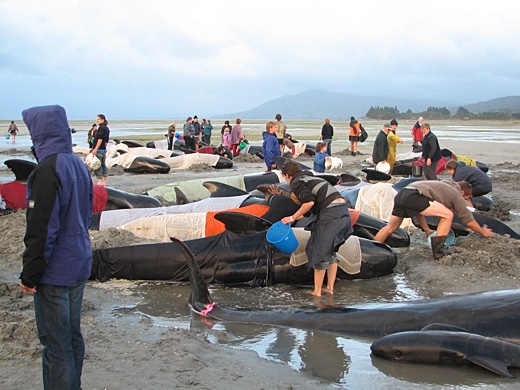
Image above: Rescue efforts in New Zealand after US Navy sonar beaches whales in 2005. Study suggests whales get the bends after being startled by naval sonar. From (http://whalesandwienerdogs.com/blog1/tag/conservation/page/3/).

The Navy has responded to a proposal by Ms. Elia Herman who is Co-Manager of the Hawaiian Islands Humpback Whale National Marine Sanctuary. The sanctuary is managed by the Hawaii Department of Land and Natural Resources and The US National Oceanic & Atmospheric Administration. As stated on the NOAA website:
"The Hawaiian Islands Humpback Whale National Marine Sanctuary, which is jointly managed by the National Oceanic and Atmospheric Administration and the State of Hawai`i, lies within the shallow warm waters surrounding the main Hawaiian Islands and constitutes one of the world's most important humpback whale habitats. Through education, research and resource protection activities, the sanctuary strives to protect humpback whales and their habitat in Hawaii."
The Whale Sanctuary has made a proposal to add additional species besides whales to species to be protected. As a result this accompanies a proposal to modify the sanctuary's boinadries.

Basically the Navy seems to be saying that NOAA has to go back to Congress to make any changes since this Whale Sanctuary was set up for a single species, and it has defined boundaries based on that legislation.

I'm sure their lawyers looked at this, but the legislation does say that the Sanctuary can include other species if it is in the 'national interest', whatever that means.

Ironically, it is the same clause the Navy uses to operate within any sanctuary.

Below is the Navy letter from PDF file: 
February 4, 2013
Ms. Elia Herman
Sanctuary Co-Manager
Department of Land and Natural Resources
Hawaiian Islands Humpback Whale National Marine Sanctuary
1151 Punchbowl Street, Room 330
Honolulu, HI 96813

Dear Ms. Herman,

These comments are submitted in response to the Notice of Intent to Prepare an Environmental Impact Statement and Management Plan for the Hawaiian Islands Humpback Whale National Marine Sanctuary published on January 8, 2013.

On October 15, 2010, initial comments were submitted by this office to Mr. Tom Allen, Management Plan Review Coordinator, Hawaiian Islands Humpback Whale National Marine Sanctuary following the Invitation of Review of Management Plan/Regulations of the Hawaiian Islands Humpback Whale National Marine Sanctuary; Intent to Prepare Draft Environmental Impact Statement and Management Plan; Scoping Meetings, as published in the Federal Register on July 14, 2010, Vol. 75. No. 134.

Those comments responded to the proposal to expand the Hawaiian Islands Humpback Whale National Marine Sanctuary (the sanctuary) as set forth in the Federal Register notice and more fully articulated in "Kohola Connection, The Voice of the Hawaiian Islands Humpback Whale National Marine Sanctuary", Summer 2010, State of the Sanctuary, Management Plan Review Special Edition. The text quoted below is from that document.
"At this time, the sanctuary is proposing that it expand its scope and direction to protect and conserve other living marine resources, in addition to humpback whales and submerged cultural heritage within the sanctuary. The sanctuary is interested in adding one or more of the following resources: Hawaiian monk seals, other whales and dolphins, sea turtles, federally protected coral species, areas of significant habitat, submerged cultural and historic resources." P. 24
The sanctuary will work with communities, private sector and government agencies to determine which activities are compatible with natural resource protection and are suitable to take place within the sanctuary." P. 25

At the outset, we would like to express our appreciation for the sanctuary's continuing recognition that the Navy and DoD are important members of the Hawaii community and significant stakeholders in and beneficiaries of the sanctuary. We have appreciated the opportunity to host annual Advisory Council meetings at Pearl Harbor. We have every expectation that that relationship will only improve and deepen as NOAA continues to move more of its operations and facilities to Ford Island.

We also acknowledge that the sanctuary has maintained consistency with the purposes for which it was created. The sanctuary has protected the humpback whales and their habitat as evidenced by today's abundance of the species. As well, the sanctuary has focused on education and the promotion of and coordination of scientific research on humpback whales. The sanctuary has educated small boat operators in methods to avoid approaching a humpback whale while allowing an active whale watching tourist industry to grow.

That being said, we must express great concern that the sanctuary is considering a boundary expansion, adding resources to be protected beyond those in the original designation, and an expressed intention to determine which activities are suitable to take place within the sanctuary. This threat of restrictions generates concerns especially given the accompanying interest in a larger sanctuary boundary which could adversely affect military training activities across Hawaii.

We do not believe that the sanctuary is proceeding in concert with the law in characterizing this significant modification as a management plan update. As you are aware, Section 304(a) (4) of the National Marine Sanctuaries Act requires that any modification in designation be accomplished by the same procedures in which the initial designation was made. The Hawaiian Islands Humpback Whale National Marine Sanctuary was initially designated by statute and thus any change in designation would require additional legislation. Similar requirements exist for boundary modifications under Section 2305(d) of the Hawaiian Islands National Marine Sanctuary Act.

Thank you in advance for taking these comments into consideration. We look forward to continuing our working relationship. Should you have any additional questions, my point of contact for this matter is Commander Rick McGuire at (808) 474-6389.

S .    A .    WEIKERT
 RADM, CEC, USN
Fleet Civil Engineer
DEPARTMENT OF THE NAVY
COMMANDER UNITED STATES PACIFIC FLEET
250 MAKALAPA DRIVE
PEARL HARBOR, HAWAII 96860-3131

In reply refer to:
5090 Ser N01CE1/0149


Navy sees massive harm, shrugs shoulders


By Zak Smith on 22 June 2012 for Natural Resources Defense Council Staff Blog - 

(http://switchboard.nrdc.org/blogs/zsmith/this_week_in_whales_navy_predi.html)

Earlier this week, I attended a public meeting hosted by the Navy in San Diego on its plan for training and testing activities in Southern California and Hawaii from 2014 to 2019.

The predicted level of carnage from the Navy’s activities over the five-year period is staggering – over 14 million instances of marine mammal take (“take” means any harm that ranges from a significant behavioral impact, like habitat abandonment, to death), including almost 3 million instances of temporary hearing loss, over 5,000 instances of permanent hearing loss, 3,000 lung injuries, and 1,000 deaths.

Unfortunately, the Navy’s astonishing estimation of harm contained in its Draft Environmental Impact Statement did not trigger a corresponding identification and analysis of alternatives or mitigation measure that would in any way significantly reduce the harm to the area’s whales and dolphins. The document tells a story of devastation, offering no pathways for lessening the harm.

         Navy Study Area

While all of the Navy personnel at this particular “meet and greet” were friendly and more than willing to talk about how great the Navy is, I didn’t find any “forest through the trees” comprehension of the magnitude of harm the proposed activities will have on wildlife. There aren’t other government agencies out there proposing activities that will have anywhere near this level of impact on wildlife, much of which is endangered.

The Navy seems very proud of the fact that it has conducted such a “comprehensive” (in its opinion) analysis of impacts. But where’s the pride in its development of alternatives that allow it to achieve its training and testing needs, while dramatically reducing the impact to whales and dolphins?

On the 21st anniversary of Ireland’s declaration that its coastal waters are a sanctuary for whales and dolphins, the Irish Whale and Dolphin Group has called for an extension of Ireland’s whale and dolphin sanctuary to all of Europe. The Irish sanctuary extends up to 200 nautical miles offshore and bans the hunting of whales and dolphins and otherwise raises awareness about Ireland’s marine mammals. According to the Irish Whale and Dolphin Group’s Brendan Price, “The sanctuary declaration was unique in Europe and no EU member stat had made such an unequivocal statement about the importance of their waters for cetaceans.”

Let’s hope the rest of Europe jumps on board.

Making a no-brainer decision, a federal administrative law judge for the Occupational Safety and Health Review Commission said that killer whale trainers “must either remain at a greater distance from them, stand behind a physical barrier or use other devices to keep them safer during performances.” According to the judge, “Once a trainer is in the water with a killer whale that chooses to engage in undesirable behavior, the trainer is at the whale’s mercy. All of the emergency procedures, nets, underwater signals and hand slaps are useless if the whale chooses to ignore them.”

Yeah, they’re called wild animals for a reason. The Judge also cited to a report by the unfortunately named Dr. Duffus, which states, “To be repeatedly held underwater, grasped in the mouth of a rapidly swimming killer whale and to be pursued under and at the surface of the water…. It is not whales playing, or an accident, it is a large carnivorous predator undertaking what thousands of generations of natural selection prepare it for.” In reaching its conclusion that employers, like SeaWorld, must protect their employees when it places them in danger, the Judge rejected SeaWorld’s claim that orca behavior can be predicted with more than 98 percent accuracy, noting that the claim was not based on scientific data.

Scientists are combining data from tagged whales with data on human activities to better manage interactions between whales and humans on the West Coast. The hope is that the data will support management practices that will reduce the number of whales accidentally killed by ship strikes and entanglement from fishing gear. There’s a history of blue whales being killed by ship strikes in Southern California and gray whales have recently been entangled by fishing nets. Mapping out where the whales are and where the human activity is may help shift some of the human activity away from the whales during migration.

.

Ominous Omissions

SUBHEAD: The owner signed an affidavit stating no alterations, improvements, or uses contrary to law were made.

By Joan Conrow on 7 February 2013 for Kauai Eclectic -
(http://kauaieclectic.blogspot.com/2013/02/musings-ominous-omissions.html)


Image above: View from lani of "exclusive private" beach across Wainiha River. From rental ad (http://www.vrbo.com/128547#).

A search of Kauai County documents finds no record of any permits authorizing extensive improvements to a Wainiha vacation rental, including the riverside deck/dock where a Canadian visitor, Mark McLean. drowned on Tuesday.

According to a county press release, McLean “was found face down and unresponsive after jumping from a platform into the shallow water below.”
 
An online advertisement for the Kauai Paradise House transient vacation rental (TVR) suggests:

"Rent a kayak (a local vendor offers 7 days for the price of 5!) and paddle right from the private dock to the private and peaceful white sandy beach, or paddle up the quiet Wainiha River to explore the lush green island."
Of course, we all know there are no private beaches in Hawaii, and that Wainiha River is far from quiet. In fact, the name means “raging waters.”


Image above: Renovated living room of rental house with new flooring, lighting and fan fixtures. From rental ad (http://www.vrbo.com/128547#).
 
But that's not the only eyebrow-raising claim. The ad also states, emphasis added:
"This entirely renovated private oceanfront retreat on the North Shore of Kauai in Wainiha on the edge of Hanalei is perfect for short- or long-term getaways for family or friends seeking luxurious accommodations with breathtaking views.
The Vacation Home: Newly renovated on the stunning blue Pacific Ocean, Kauai Paradise House is a truly unique oceanfront and riverfront property featuring its own private beach, oceanfront views, 3 king-bed suites (the third of which can be converted to 2 twin beds if desired), gourmet kitchen, travertine tile floors, 3 marble bathrooms, great room with entertainment center, covered lanai, lush backyard, and private deck and dock.
 
This sophisticated home with a resort feel boasts thoughtful touches throughout, including Tommy Bahama furniture, luxury linens, dual master suites with king-size beds and walk-in showers, new gourmet kitchen with top-of-the-line stainless-steel appliances
 
(including toaster oven, blender and coffee maker), marble guest bathroom with large walk-in shower, spacious family room with TV and DVD/CD player, high-speed Internet, telephone, TVs and DVDs in every bedroom, gas BBQ on the covered lanai overlooking the deep blue sea, and private oceanfront deck with steps down to your own boat dock."
Sounds pretty flash. Realtor Jane Abramo's current sales listing for the house reiterates the “all new” verbiage:
"Recent upgrades include a new 200 square foot front lanai, expanded 600 square foot covered back lanai with travertine tile, 150 square foot deck above the river, a brand new roof, fresh paint inside and outside, new fencing and tropical landscaping. 
This meticulously renovated private oceanfront retreat on the North Shore of Kauai in Wainiha is perfect for short or long-term getaways for family or friends seeking luxurious accommodations with majestic views. Lovingly refurbished on a private, fenced lot nestled at the edge of the breath-taking Pacific, Kauai Paradise House boasts its own exclusive beach."
[WTF? Exclusive beach?]

Yet a review of real property tax records shows the property as having four bedrooms and two baths, not three suites. And an online search of county building permits shows that aside from the original 1972 construction permit, and some post-Iniki 1993 permits for a fence and minor electrical and plumbing work, there is no record of any permits for these recent upgrades and additions.


Image above: New granite topped kitchen counters and stainless steel fixtures. From rental ad (http://www.vrbo.com/128547#)

So when was this property transformed from a modest hale into a lavish “entirely renovated” vacation rental with a “resort feel” that is now on the market for $2.579 million, after having sold for $1.475 million in 2005? How much of that increased value is due to the TVR permit? And why are the property taxes just $ 2,133.80 per year?

More importantly, why did the county issue a vacation rental permit for this property when its building permits apparently aren't in order? Especially when these substantial improvements were made without complying with federal flood requirements, as is the case with a number of North Shore TVRs.

This is the kind of stuff that slips by when you don't conduct actual site inspections before issuing TVR permits. Yes, that inspection requirement was stricken from the most recent TVR bill, which was introduced by Councilman Tim Bynum and adopted by the Council after the infamous “beer gate.”

Of course, the owner is required to sign a notarized affidavit stating “Building permit number(s) were approved on ____ for all structures on the property and there were no expansions, alterations, improvements, or uses contrary to State and County land use and planning laws.” But how meaningful is that if the county doesn't check? Apparently about as meaningful as the farm dwelling affidavit.

Sadly, it's the visitors who end up suffering from the lack of oversight and full disclosure. In the comments left on the Kauai Paradise House ad, one visitor noted:
"Last, a suggestion; the step from the deck to the river was long, and slippery, especially at low tide. I would suggest one last step or a platform closer to the water.
Another visitor wrote:

We would definitely stay here again, especially when our infant daughter is old enough to go into the river on a floatie too. We put our toddler into her floaties and took her across [the river] to the beach and she loved it"
Meanwhile, the Jan. 12, 2013 Surfrider Kauai Blue Water Task Force report on enterococcus bacterial concentration per 100 ml showed Wainiha River at 173 for single day results and 369.9 for the winter geomean. The geomean should be less than 35, which means this is hardly the place where you'd want your young children to frolic.

So who does bear responsibility for ensuring our visitors are fully informed of the risks they face, and that the houses they rent for their vacations are safe and in full compliance with county laws?

.

The Center Cannot Hold

SUBHEAD: The one-room schoolhouse is much more likely to be an option than the centralized system we have today.

By John Michael Greer on 6 February 2013 for Archdruid Report -
(http://thearchdruidreport.blogspot.com/2013/02/the-center-cannot-hold.html)


Image above: Mill Road Amish one-room-schoolhouse in Lancaster, Pennsylvania. From (http://www.flickr.com/photos/dwmoran/4546839625/in/photostream/lightbox/).

When William Butler Yeats put the phrase I’ve used as the title for this week’s post into the powerful and prescient verses of “The Second Coming,” he had deeper issues in mind than the crisis of power in a declining American empire. Still, the image is anything but irrelevant here; the political evolution of the United States over the last century has concentrated so many of the responsibilities of government in Washington DC that the entire American system is beginning to crack under the strain.

This is admittedly not the way you’ll hear the centralization of power in America discussed by those few voices in our national conversation who discuss it at all. On the one hand are the proponents of centralized power, who insist that leaving any decision at all in the hands of state or local authorities is tantamount to handing it over to their bogeyman du jour—whether that amounts to the bedsheet-bedecked Southern crackers who populate the hate speech of the left, say, or the more diverse gallery of stereotypes that plays a similar role on the right. On the other hand are those who insist that the centralization of power in America is the harbinger of a totalitarian future that will show up George Orwell as an incurable optimist.

I’ve already talked in a number of previous posts about the problems with this sort of thinking, with its flattening out of the complexities of contemporary politics into an opposition between warm fuzzy feelings and cold prickly ones. I’d like, to pursue the point a little further, to offer two unpopular predictions about the future of American government. The first is that the centralization of power in Washington DC has almost certainly reached its peak, and will be reversing in the decades ahead of us. The second is that, although there will inevitably be downsides to that reversal, it will turn out by and large to be an improvement over the system we have today. These predictions unfold from a common logic; both are consequences of the inevitable failure of overcentralized power.

It’s easy to get caught up in abstractions here, and even easier to fall into circular arguments around the functions of political power that attract most of the attention these days—for example, the power to make war. I’ll be getting to this latter a bit further on in this post, but I want to start with a function of government slightly less vexed by misunderstandings. The one I have in mind is education.

In the United States, for a couple of centuries now, the provision of free public education for children has been one of the central functions of government. Until fairly recently, in most of the country, it operated in a distinctive way. Under legal frameworks established by each state, local school districts were organized by the local residents, who also voted to tax themselves to pay the costs of building and running schools. Each district was managed by a school board, elected by the local residents, and had extensive authority over the school district’s operations.

In most parts of the country, school districts weren’t subsets of city, township, or county governments, or answerable to them; they were single-purpose independent governments on a very small scale, loosely supervised by the state and much more closely watched by the local voters. On the state level, a superintendent of schools or a state board of education, elected by the state’s voters, had a modest staff to carry out the very limited duties of oversight and enforcement assigned by the state legislature. On the federal level, a bureaucracy not much larger supervised the state boards of education, and conducted the even more limited duties assigned it by Congress.

Two results of that system deserve notice. First of all, since individual school districts were allowed to set standards, chose textbooks, and manage their own affairs, there was a great deal of diversity in American education. While reading, writing, and ‘rithmetic formed the hard backbone of the school day, and such other standards as history and geography inevitably got a look in as well, what else a given school taught was as varied as local decisions could make them. What the local schools put in the curriculum was up to the school board and, ultimately, to the voters, who could always elect a reform slate to the school board if they didn’t like what was being taught.

Second, the system as a whole gave America a level of public literacy and general education that was second to none in the industrial world, and far surpassed the poor performance of the far more lavishly funded education system the United States has today. In a previous post, I encouraged readers to compare the Lincoln-Douglas debates of 1858 to the debates in our latest presidential contest, and to remember that most of the people who listened attentively to Lincoln and Douglas had what then counted as an eighth-grade education. The comparison has plenty to say about the degeneration of political thinking in modern America, but it has even more to say about the extent to which the decline in public education has left voters unprepared to get past the soundbite level of thinking.

Those of my readers who want an even more cogent example are encouraged to leaf through a high school textbook from before the Second World War. You’ll find that the reading comprehension, reasoning ability, and mathematical skill expected as a matter of course from ninth-graders in 1930 is hard to find among American college graduates today. If you have kids of high school age, spend half an hour comparing the old textbook with the one your children are using today. You might even consider taking the time to work through a few of the assignments in the old textbook yourself.

Plenty of factors have had a role in the dumbing-down process that gave us our current failed system of education, to be sure, but I’d like to suggest that the centralization of power over the nation’s educational system in a few federal bureaucracies played a crucial role. To see how this works, again, a specific example is useful. Let’s imagine a child in an elementary school in Lincoln, Nebraska, who is learning how to read. Ask yourself this: of all the people concerned with her education, which ones are able to help that individual child tackle the daunting task of figuring out how to transform squiggles of ink into words in her mind?

The list is fairly small, and her teacher and her parents belong at the top of it. Below them are a few others: a teacher’s aide if her classroom has one, an older sibling, a friend who has already managed to learn the trick. Everyone else involved is limited to helping these people do their job. Their support can make that job somewhat easier—for example, by making sure that the child has books, by seeing to it that the classroom is safe and clean, and so on—but they can’t teach reading. Each supporting role has supporting roles of its own; thus the district’s purchasing staff, who keep the school stocked with textbooks, depend on textbook publishers and distributors, and so on. Still, the further you go from the child trying to figure out that C-A-T means “cat,” the less effect any action has on her learning process.

Now let’s zoom back 1200 miles or so to Washington DC and the federal Department of Education. It’s a smallish federal bureaucracy, which means that in the last year for which I was able to find statistics, 2011, it spent around $71 billion. Like many other federal bureaucracies, its existence is illegal. I mean that quite literally; the US constitution assigns the federal government a fairly limited range of functions, and “those powers necessary and convenient” to exercise them; by no stretch of the imagination can managing the nation’s public schools be squeezed into those limits. Only the Supreme Court’s embarrassingly supine response to federal power grabs during most of the twentieth century allows the department to exist at all.

So we have a technically illegal bureaucracy running through $71 billion of the taxpayers’ money in a year, which is arguably not a good start. The question I want to raise, though, is this: what can the staff of the Department of Education do that will have any positive impact on that child in the classroom in Lincoln, Nebraska? They can’t teach the child themselves; they can’t fill any of the supporting roles that make it possible for the child to be taught. They’re 1200 miles away, enacting policies that apply to every child in every classroom, irrespective of local conditions, individual needs, or any of the other factors that make teaching a child to read different from stamping out identical zinc bushings.

There are a few—a very few—things that can usefully be done for education at the national level. One of them is to make sure that the child in Lincoln is not denied equal access to education because of her gender, her skin color, or the like. Another is to provide the sort of overall supervision to state boards of education that state boards of education traditionally provided to local school boards. There are a few other things that belong on the same list. All of them can be described, to go back to a set of ideas I sketched out a couple of weeks ago, as measures to maintain the commons.

Public education is a commons. The costs are borne by the community as a whole, while the benefits go to individuals: the children who get educated, the parents who don’t have to carry all the costs of their children’s education, the employers who don’t have to carry all the costs of training employees, and so on. Like any other commons, this one is vulnerable to exploitation when it’s not managed intelligently, and like most commons in today’s America, this one has taken quite a bit of abuse lately, with the usual consequences. What makes this situation interesting, in something like the sense of the apocryphal Chinese proverb, is that the way the commons of public education is being managed has become the principal force wrecking the commons.

The problem here is precisely that of centralization. The research for which economist Elinor Ostrom won her Nobel Prize a few years back showed that, by and large, effective management of a commons is a grassroots affair; those who will be most directly affected by the way the commons is managed are also its best managers. The more distance between the managers and the commons they manage, the more likely failure becomes, because two factors essential to successful management simply aren’t there. The first of them is immediate access to information about how management policies are working, or not working, so that those policies can be adjusted immediately if they go wrong; the second is a personal stake in the outcome, so that the managers have the motivation to recognize when a mistake has been made, rather than allowing the psychology of previous investment to seduce them into pursuing a failed policy right into the ground.

Those two factors don’t function in an overcentralized system. Politicians and bureaucrats don’t get to see the consequences of their failed decisions up close, and they don’t have any motivation to admit that they were wrong and pursue new policies—quite the contrary, in fact. Consider, for example, the impact of the No Child Left Behind (NCLB) Act, pushed through Congress by bipartisan majorities and signed with much hoopla by George W. Bush in 2002. In the name of accountability—a term that in practice means “finding someone to punish”—the NCLB Act requires mandatory standardized testing at specific grade levels, and requires every year’s scores to be higher than the previous year’s, in every school in the nation. Teachers and schools that fail to accomplish this face draconian penalties.

My readers may be interested to know that next year, by law, every child in America must perform at or above grade level. It’s reminiscent of the imaginary town of Lake Wobegon—“where all the children are above average”—except that this is no joke; what’s left of America’s public education system is being shredded by the efforts of teachers and administrators to save their jobs in a collapsing economy, by teaching to the tests and gaming the system, under the pressure of increasingly unreal mandates from Washington DC. Standardized test scores have risen slightly; meaningful measures of literacy, numeracy, and other real-world skills have continued to move raggedly downward, and you can bet that the only response anybody in Washington is going to be willing to discuss is yet another round of federal mandates, most likely even more punitive and less effective than the current set.

Though I’ve used education as an example, nearly every part of American life is pervaded by the same failed logic of overcentralization. Another example? Consider the Obama administration’s giddy pursuit of national security via drone attacks. As currently operated, Predator drones are the ne plus ultra in centralized warfare; each drone attack has to be authorized by Obama himself, the drone is piloted via satellite link from a base in Nevada, and you can apparently sit in the situation room in the White House and watch the whole thing live. Hundreds of people have been blown to kingdom come by these attacks so far, in the name of a war on terror that Obama’s party used to denounce.

Now of course that habit only makes sense if you’re willing to define young children and wedding party attendees as terrorists, which seems a little extreme to me. Leaving that aside, though, there’s a question that needs to be asked: is it working? Since none of the areas under attack are any less full of anti-American insurgents than they have been, and the jihadi movement has been able to expand its war dramatically in recent weeks into Libya and Mali, the answer is pretty clearly no. However technically superlative the drones themselves are, the information that guides them comes via the notoriously static-filled channels of intelligence collection and analysis, and the decision to use them takes place in the even less certain realms of tactics and strategy; nor is it exactly bright, if you want to dissuade people from seeking out Americans and killing them, to go around vaporizing people nearly at random in parts of the world where avenging the murder of a family member is a sacred duty.

In both cases, and plenty of others like them, we have other alternatives, but all of them require the recognition that the best response to a failed policy isn’t a double helping of the same. That recognition is nowhere in our collective conversation at the moment. It would be useful if more of us were to make an effort to put it there, but there’s another factor in play. The center really cannot hold, and as it gives way, a great many of today’s political deadlocks will give way with it.

Eliot Wigginton, the teacher in rural Georgia who founded the Foxfire project and thus offered the rest of us an elegant example of what can happen when a purely local educational venture is given the freedom to flower and bear fruit, used to say that the word “learn” is properly spelled F-A-I-L. That’s a reading lesson worth taking to heart, if only because we’re going to have some world-class chances to make use of it in the years ahead. One of the few good things about really bad policies is that they’re self-limiting; sooner or later, a system that insists on embracing them is going to crash and burn, and once the rubble has stopped bouncing and the smoke clears away, it’s not too hard for the people standing around the crater to recognize that something has gone very wrong. In that period of clarity, it’s possible for a great many changes to be made, especially if there are clear alternatives available and people advocating for them.

In the great crises that ended each of America’s three previous rounds of anacyclosis—in 1776, in 1861, and in 1933—a great many possibilities that had been unattainable due to the gridlocked politics of the previous generation suddenly came within reach. In those past crises, the United States was an expanding nation, geographically, economically, and in terms of its ability to project power in the world; the crisis immediately ahead bids fair to arrive in the early stages of the ensuing contraction. That difference has important effects on the nature of the changes before us.

Centralized power is costly—in money, in energy, in every other kind of resource. Decentralized systems are much cheaper. In the days when the United States was mostly an agrarian society, and the extravagant abundance made possible by a global empire and reckless depletion of natural resources had not yet arrived, the profoundly localized educational system I sketched out earlier was popular because it was affordable. Even a poor community could count on being able to scrape together the political will and the money to establish a school district, even if that meant a one-room schoolhouse with one teacher taking twenty-odd children a day through grades one through eight. That the level of education that routinely came out of such one-room schoolhouses was measurably better than that provided by today’s multimillion-dollar school budgets is just one more irony in the fire.
.

Thoughts on "Resilience"

SUBHEAD: "Resilience" looks like a suburban organic gardening club for those with enough credit score for a new Prius.

By Paula on 4 February 2013 for Mythodrome -
(http://mythodrome.net/thoughts-on-resilience)


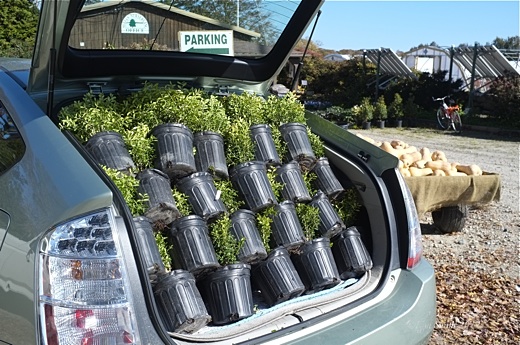
Image above: A Prius loaded with garden plants in Westport CT, hometown of Martha Stewart. From (http://goodmorninggloucester.wordpress.com/2012/10/30/have-prius-can-do).

For the past couple of years a new buzzword has been bubbling through the doomosphere: “resilience.” It’s now become a permanently embedded meme thanks to energybulletin.net changing its domain, and its focus, to resilience.org.

Near as I can tell, “resilience” means exactly the same thing as “transition” within a doomy context: an organic gardening club for rich white people with property, investments, and a comfortable lifestyle to protect. It’s an insular clique that requires everyone be on the same page politically in order to participate. It is based on the European idea of “community,” which is very attractive in theory, but which does’t port well (if at all) to the deeply ingrained American values of individualism and self-reliance.

There are perhaps a dozen or two cities in the US where “resilience” efforts might find an audience, an actual geographic community of like-minded people. For many (most?) people, however, “resilience” looks like hardly more than a suburban organic gardening club for people with a high enough credit score to finance a new Prius.

My biggest beef with “transition,” and now with “resilience,” is that it offers very little to those who do not already have resources to spare. Both concepts assume a pre-existing level of property ownership which needs to be transitioned into low-energy operation, and/or made resilient in the face of deep economic contraction. There isn’t any room here for people who have no property to transition or to make resilient.

Some years ago on my long-defunct e-zine Adaptation, I wrote that individuals would experience the long emergency primarily as financial difficulty; failing to adequately address issues related to money, and income specifically — or to ignore these altogether, as was the case back then — is a setup for community failure. At least a year or two before the housing bubble collapse I wrote that a thriving backyard garden is awesome until you lose your job and get kicked out of your house. I look back now and wonder how many “transition” gardens have been lost to foreclosure.

What needs to be transitioned, made resilient, is not property but income. Economic contraction means purchasing power dries up, whether through deflation (lack of money), inflation or hyperinflation (worthless money). If you have property, dried-up purchasing power means relying on your property for things you’d otherwise buy elsewhere.

If you live hand-to-mouth, you are basically a conduit through which purchasing power flows from your employer to your creditors and suppliers; when the purchasing power flowing through your conduit life becomes insufficient, your creditors take away whatever it is of theirs you’ve been renting and your suppliers stop supplying you with anything. Without property to fall back on, you’re basically fucked.

“Transition” and “resilience” address this problem only marginally, and so will become increasingly irrelevant as the ranks of people with reduced or eliminated incomes grow. Ultimately the only people who will be able to continue with “transition” and “resilience” efforts will be the fabulously wealthy.

Back in the early 00′s, before the “transition” concept took root, collapse/decline was understood primarily as an effect of peak oil. Peak oil meant two things: first, that prices of everything related to and derived from petroleum would become super expensive, thereby driving up prices across the board; and two, that planetary-wide supply chains would collapse, further increasing prices across the board. The obvious response to these twin sledgehammers was relocalization.

Back then, relocalization meant running globalization in reverse. It meant relearning how to make things close to home and re-establishing long decimated supply chains between the city and the hinterlands. It meant lots of cottage industry, neighborhood- and city-level retail markets, even a renaissance of skilled artisanship, repair, and restoration. It meant extricating local economic activity from oil dependence so that it would be adaptive to decline conditions, thereby providing at least some level of income opportunity for everyone in any given locale.

I suppose there is an argument to be made that “adaptive” and “resilient” are the same thing. They aren’t. A thing is resilient only to the degree that it is adaptive. Resilience maintains as long as conditions do not exceed certain parameters. Adaptation is required when conditions exceed resilience’s required parameters. Cockroaches are resilient because they can adapt to almost any conditions. Their adaptative properties are not the result of their resilience; resilient is something their adaptations evolved them to be.

Relocalization never assumed property ownership as a prerequisite to participation. It was open to everyone of any income level, wealth level, or political persuasion. It did not require joining any group or trying to coordinate with people who have differing goals and concerns. All it required was imagination: what can I sell that others in my locale will want to buy, and where can I sell it locally? If I need raw materials, can I get these locally or regionally? If I have absolutely no money to personally build goods to sell, what kind of service can I provide?

My gut instinct is that relocalization got kicked to the curb in favor of first “transition,” and now “resilience,” because it is overtly entrepreneurial and business oriented. I don’t dispute for a minute that business is the Great Evil that got us into our collapse mess in the first place. It would be simply amazing to live in a society where money serves people and not vice-versa, or even in a society where it isn’t necessary at all. Money’s a fucking drag. However, it is a grave mistake to ignore the fact that money is oxygen within our current economic organism. No money causes death just as surely as no oxygen causes death.

“Resilience” is brittle because because it ignores this fundamental reality and thereby creates a faulty process: first, it tries to first divine the future; second, it projects its political desires into that future; third, it tries to determine the parameters within which it will operate based on its divination and projections; fourth, it creates a path from now to then. Quite obviously this process can create nothing resilient. “Transition” proved itself a failure when it tried to apply this process. More of the same isn’t going to prove any more successful.

I submit that the original idea of relocalization in the service of adaptability was far superior. Its process is tried-and-true: first, determine current and foreseeable-future conditions; second, innovate some way to support yourself within these conditions; third, iterate as conditions change. That’s it. Everything else is wide open.

The process is infinitely scalable both up and down and excludes no one on any grounds. This is how adaptation works in nature and, if we are to align ourselves with nature for the long-term survival of the species, it is an excellent breakpoint to extricate ourselves from the idea that we are separate from nature and can plan it, control it, dominate it.

I realize that my protestations about these things fall on deaf ears among those who are into the “transition” and now “resilience” scenes. Nevertheless I find it frustrating that these issues are so thoroughly excluded from the conversations. I do wish those with the bullhorns would pay more attention to the plight and feedback of those outside their propertied, academic circles.
.

Hawaii Fishery Management

SUBHEAD: National Marine Sanctuary Regulations under review do not adequately describe subsistance fishing as practiced in Hawaii.

By Lynn McNutt on 6 February 2013 for Island Breath -
(http://islandbreath.blogspot.com/2013/02/hawaii-fishery-management.html)


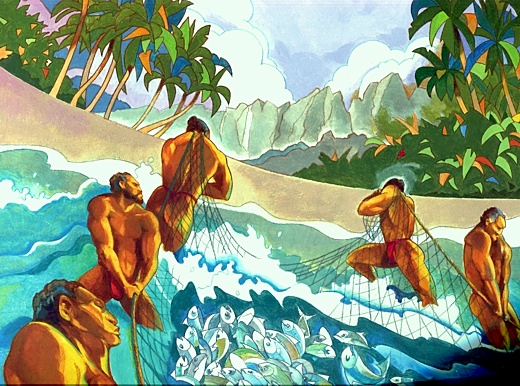
Image above: Image above: Detail of conference poster celebrating the gathering of the net created by Oliver Kinney. From (http://islandbreath.blogspot.com/2010/11/aha-moku-gathering.html).

The current definitions of traditional and subsistence fisheries contained in the National Marine Sanctuary Regulations (under review), do not adequately describe fisheries as practiced in Hawaii, and actually exclude many of the most important cultural and local economic benefits.

 While giving lip serve to the traditional and subsistence categories, the definitions put forward for fisheries only include commercial and recreational categories, unless specifically noted elsewhere. In reading the proposed revisions for this document, I could only find traditional and/or subsistence fishing being acknowledged in the Thunder Bay, MN, Olympic Coast, WA and American Samoan Sanctuaries.

All marine sanctuaries and/or monuments in Hawaii Must include the categories of traditional and subsistence fishing, and not as a subcategory under the definition for either commercial or recreational fisheries, since the activities in Hawaii are neither commercial nor recreational. As part of another regulatory document, WESPAC included a definition of "customary exchange" to cover non-market (commercial) fisheries with local cultural and economic benefits. While I don't like the term "customary exchange" as a replacement for traditional or subsistence fishing, the description of the activities and the local benefits are well described:
"Define customary exchange as the non-market exchange of marine resources between fishermen and community residents, and the residents’ families and friends, for goods, services, and/or social support, for cultural, social, or religious reasons, and may include cost recovery through monetary reimbursements and other means for actual trip expenses (e.g., ice, bait, food, or fuel) that may be necessary to participate in fisheries in the western Pacific."
In writing this new draft of the Sanctuary Management Plan I strongly urge DLNR and NOAA to include true and honest working definitions for traditional and subsistence fishing, recognize these as activities that were in place before the Sanctuary was formed, protect these activities for the people of Hawaii nei in all Sanctuary documents (including the National Marine Sanctuary Regulations), and include these human, cultural and economic aspects in any discussion of 'ecosystem management', as defined below.

The following are definitions of taken from Burroughs (2011, Island Press) in a book entitled "Coastal Governance". I include definitions of "ecosystem governance', "ecosystem-based management" and "ecosystem-based fisheries management". This publication is a textbook used to teach about ecosystem management and coastal governance at the University of Hawaii. In the past, the National Marine Humpback Whale Sanctuary representatives have expressed that they would like to do ecosystem management for Hawaiian Sanctuary waters. However, when describing the approach, it seems to fall more closely within the definition of ecosystem-based fisheries management, not true ecosystem-based management, which includes people, societal mores, and economics.

I urge DLNR to decide if the approach discussed for Hawaii is truly one of ecosystem-based management, or just ecosystem-based fisheries management, In other words, is the approach being proposed truly ecosystem-based management? I do not recommend that DLNR or NOAA follow the ecosystem-based fisheries model. If DLNR and NOAA intend to engage in fisheries management, then, please stop calling the approach ecosystem-based management. They are not the same thing.
Ecosystem Governance: Recognizes the interrelationships among natural (biological, chemical, geological, physical) systems and related social systems and seeks to shape human behavior so that both are sustained using both governmental (law, regulations) and nongovernmental (markets, voluntary organizations, social mores, information) means.

Ecosystem-based Management: Structuring societal behavior in ocean and coastal systems so that humans promote ecosystem health and resilience while allowing sustainable uses of goods and services.

Ecosystem-based fisheries management: Promotion of ecosystem health and resilience rather than single-species management when considering harvest, habitat, predators, and prey of the target species in addition to other interactions.
See also:
Ea O Ka Aina: Net Fishing Restrictions 1/24/13
Ea O Ka Aina: Navy Licenseto Kill 10/9/12
Ea O Ka Aina: Feds Threaten Hawaii Sovereignty 1/31/12

.

Arrests at Wailua Beach Path

SUBHEAD: James Alalem and Ray Catania were arrested defending Hawaiian culture at site of Wailua Bike Path.

Reported by Sharon Goodwin on 6 February 2013 in Island Braeth -
(http://islandbreath.blogspot.com/2013/02/arrests-at-wailua-beach-path.html)


Image above: James Alalem dislplaying typical stone that was used to mark the outline of a body at a burial site. From (http://islandbreath.blogspot.com/2012/07/wailua-burial-site-conviction.html).

This morning at about 8:20am on February 6th, 2013, James Alalem and Ray Catania were arrested by Kauai County Police at the site of the bike path that is under construction on the dune of Wailua Beach north of the Wailua River, on Kauai.

They were arrested after the management of the construction contractor called police and indicated that the site was being blocked by demonstrators. After their arrest they were taken to Kauai Police headquarters.

Ray and James have put their bodies on the line for some time in trying to protect burial sites in an area that has many sacred places in Hawaiian culture.


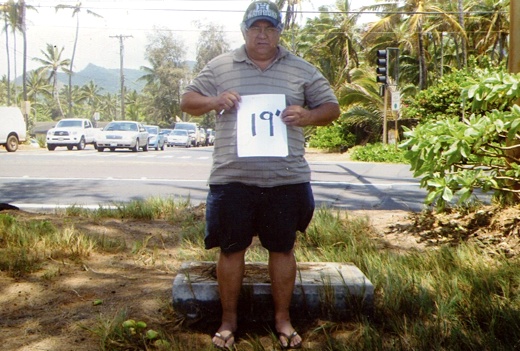
Image above: Ray Catania stands next to siting of Wailua Bike Path demonstrating how close the surfbreak is to highway. It used to be about 190'. From ().

See also:
Ea O Ka Aina: Leading by Bad Example 1/28/13
Ea O Ka Aina: Wailua Beach Under Water 8/26/12
Ea O Ka Aina: Wailua Burial Site Conviction 7/19/12
Ea O Ka Aina: Wailua Beach Erosion 6/13/12

.

Death of Ownership

SUBHEAD: Six dynamics in the destruction of widespread ownership and the creation of a neofeudal society.

By Charles Hugh Smith on 6 February 2013 for Of Two Minds -
(http://www.oftwominds.com/blogfeb13/death-of-ownership2-13.html)


Image above: A man and his castle. World record highest sand (37') castle by Ed Jarrett. From (http://www.dailymail.co.uk/news/article-2002328/Man-beats-record-building-worlds-tallest-sandcastle.html).

The foundation of the neofeudal economy is this: the right of ownership still exists in name, but the actual ownership of political and financial power is concentrated in the hands of a few.

The core of American liberty is widespread private ownership of property. The Founding Fathers were quite clear on the necessity of protecting private ownership from encroachment by a covertly created monarchical Empire or a financial Aristocracy.

Private ownership protected liberty and the distribution of wealth by enabling widespread ownership of "the means of production" (land, tools, intellectual property, enterprises) and home ownership.

Thus the correlation between prosperity, widespread ownership of small businesses and homes and a relatively modest disparity of private wealth. When ownership of property becomes concentrated into a rentier class (i.e. a financial Aristocracy) that is protected by a Monocrat Central State, income disparity shoots up and prosperity is concentrated in the hands of the political and financial Elites.

In other words, the Founding Fathers understood that financial servitude precluded political liberty. Liberty in a neofeudal economy was ultimately liberty in name only.

Why Inequality Matters: The Housing Crisis, The Justice System & Capitalism.

While outright slavery was outlawed, the chains of serfdom were (and are) entirely legal. If you doubt this, please try erasing your student loans in bankruptcy court.

There are a number of complex dynamics in play in the Death of the Ownership Society. I will try to cover them as simply and directly as possible.

Dynamic #1
If a homeowner's real-world equity is effectively zero, then what do they actually own? They own a mortgage, i.e. a promise to pay a debt. As long as they are current on payments, this acts more as a claim on future ownership, i.e. full ownership when the mortgage is paid off, or a long-term lease.

If their equity is 10% of the mortgage, there is no way to extract this equity short of selling the home, and the transactions fees will consume most of the 10%.

What the lender owns is A) a claim on the underlying property and B) the homeowner's income stream, much of which flows to the lender via mortgage payments.

Is this arrangement "widespread ownership" or is it cloaked neofeudalism? In credit bubbles, homeowners appear to benefit as their ownership claim is leveraged by the lender's capital into astounding profits. But alas, credit bubbles never last, and when they pop then the extra debt taken on to play the speculative leverage game remains to be paid.

Dynamic #2
If the mortgage is sliced and diced into tranches and securitized, i.e. bundled into pools of mortgages sold to investors, what happens to the notion of ownership?

Longtime correspondent Jim S. provides the answer: securitization creates a new class of "non-property" that is fraudulent and thus criminal. Jim explains:
The original crime at the front of the securitization process is creating "non-property." The loss of the legal paper trail of title transfers, note transfers, country property transfer registrations in the rapid performance of mortgage securitizations is further sidestepped by focusing attention on the foreclosure procedural irregularities at the end of the process. The creation of "non-property" at the front of the process necessarily creates the additional requirement of additional fraud at the end of the process: foreclosures.

By extending the forgiveness of what should be prosecuted as fraud (what has been deemed mere malfeasance deserving of a picayune civil fine), the Status Quo hid the original crimes of rapid securitization that destroyed the legal status of property. The biggest crime in American History is about to end the process of "sweeping" the original crime under the rug. The crime is the destruction of the legal standing of property, fully at public expense, and its ultimate accumulation in the Executive Branch for "redistributive" disposition, again at the full expense of the public. Dodd/Frank only has extended the efficiency of the complicated process of theft, and further solidified the nature of its very permanence.

The focus on the disappearance of mortgage titles is at the foreclosure end, and not at the front end of the securitization process where the titles disappeared on a system wide basis. Robo-signing is a fraudulent result of the original crime, not recognized or treated as a crime, but as a civil offense worthy of a paltry fine.

The robo-signing settlement will further solidify mortgage securities formation in the future, with civil penalties for malfeasance reduced to a minimized cost of continuing the process.

Though the the Consumer Financial Protection Bureau (CFPB) has been sold as a consumer protection agency, it is fundamentally a rogue agency operated within the Federal Reserve.

The CFPB is mentioned as having undefined scope and extensiveness of powers, immune from real Presidential or Congressional oversight, having essentially full, autonomous power within the Federal Reserve to do what it wants, when it wants, in the full comfort and safety of the Federal Reserve itself. The CFPB can buy, borrow on and take security positions in failing and failed banks. What a deal.

This harks back to a pre-crisis specialty: get rid of supposedly outdated regulation, but create no new limits or powers to keep things from blowing up.

Thank you, Jim, for the clear explanation.

It is clear that Securitization Is Illegal.

Dynamic #3
Economist John Maynard Keynes' concept of a "comprehensive socialisation of investment" has been reduced by the Neo-Keynesian cargo cult to a cartoonish campaign of the Central State to borrow trillions of dollars to prop up its most corrupt and inefficient crony-capitalist cartels and the rentier-class--the financial Aristocracy. Here is Keynes:
I conceive, therefore, that a somewhat comprehensive socialisation of investment will prove the means of securing an approximation to full employment. But beyond this no obvious case is made out for a system of State-Socialism which would embrace most of the economic life of the community.
In this context, we can understand the original purpose of the Federal Housing Administration (FHA) and the other housing-mortgage agencies of Fannie Mae and Freddie Mac as a "somewhat comprehensive socialisation of investment" in housing: a Federal agency underwrote and guaranteed mortgages to individual households to enable widespread ownership of homes. It was not conceived as a "system of State-Socialism," that is, a means for the State to acquire ownership of the nation's housing stock.

Not coincidentally, the rental housing market was dominated by individual investors (Mom and Pop proprietors) in the era before mortgage securitization and the concentration of power in "too big to fail" investment and commercial banks.

Institutional ownership of rental housing was concentrated in the 50+ unit housing sector, less than 1% of the nation's 15 million rental properties. In the 5- to 49-unit sector, individual owners still owned three-fourths of all properties.

The ownership of rental properties was widely dispersed among individual investors.

Dynamic #4
Now we find the Federal mortgage agencies are colluding with private capital to transfer ownership of the Federally guaranteed/owned portion of the nation's housing stock to concentrations of private capital, i.e. the financial Aristocracy.

The details of this wholesale transfer of what amounts to public property to the financial Aristocracy are chilling: in effect, private capital puts a few bucks down and Fannie Mae loans them the rest at zero interest. It also gives them roughly 30% of the rental income for managing the properties, and after the dust of robo-signing has settled, the properties will be transferred to the financial Aristocracy.

What happened to the agency's mission to broaden home ownership? It has been subverted to serve the interests of concentrated private capital.

Michael Olenick: How Fannie Enriches Private Equity Investors at Taxpayer and Homeowner Expense (Naked Capitalism, highly recommended)

Fannie Mae Begins Marketing Foreclosed Homes as Rentals

Structured Sales Transactions (i.e. the bundling and transfer of Fannie Mae owned properties to private capital)

Thanks to the collusion of the Federal Reserve and the Federal mortgage agencies, private capital is gorging on vast blocks of homes:

Blackstone to buy $1 billion worth of Tampa Bay homes for rentals

It’s About Time - JP Morgan To Enter The Housing Slumlord Trade

Dynamic #5
There are effectively two sets of laws in the U.S.: one for the Central State/financial Aristocracy and one for the serfs. From Why Inequality Matters: The Housing Crisis, The Justice System & Capitalism:
One of the central characteristics of highly unequal societies is that two sets of laws develop: One set for the rich and powerful and one set for everyone else. The more unequal societies become, the more easily they accept the unacceptable, and with each unrebuked violation, the powerful actors at the top of the society gain an ever greater sense of entitlement and an ever greater sense that the laws that govern everyone else don’t apply to them. As a result, their behavior becomes increasingly egregious.

Yale’s Robert Dahl, one of the preeminent political scientists of our era, wrote in 2006 in On Political Equality (Yale University Press) of the risks of rising economic inequality, which is inevitably accompanied by political power which also concentrates at the top of the society:

“The unequal accumulation of political resources points to an ominous possibility: political inequalities may be ratcheted up, so to speak, to a level from which they cannot be ratcheted down. The cumulative advantages in power, influence, and authority of the more privileged strata may become so great that .. a majority of ordinary citizens…are simply unable…to overcome the forces of inequality arrayed against them.”
In other words, neofeudal serfdom.

The new road to serfdom runs not through Marxist ownership by the State but the transfer of the nation's assets and wealth by the State to concentrated private capital.

Dynamic #6
The next iteration of this transfer is now clear: blocks of rental homes will be bundled and securitized by Wall Street and sold to investors worldwide. Haven't we seen this before? Only now it's all OK because the creation of "non-property" rentier income streams is now legal, and the Federal government and the Federal Reserve have begun to transfer publicly owned or guaranteed properties to their pals in private capital on a wholesale basis.

From It’s About Time - JP Morgan To Enter The Housing Slumlord Trade:
“It’s hard to find a private-equity firm on the planet that doesn’t have a strategy in this space,” Gary Beasley, chief executive officer at Waypoint Homes, said last week at the American Securitization Forum’s annual conference in Las Vegas. The Oakland, California-based company has bought homes in California, Arizona, Illinois and Georgia.
The foundation of the neofeudal economy is this: the right of ownership still exists in name, but the actual ownership of political and financial power is concentrated in the hands of a few. "Ownership" of a heavily mortgaged home is a simulacrum of ownership when the "owner's" income is diverted to a rentier financial Aristocracy.


.

War, Then & Now

SUBHEAD: Hawaii legislation to allow aerial application of fertilizers, conditioners, insecticides, pesticides, and herbicides.

By Michael Shooltz on 5 February 2013 in Island Breath -
(http://islandbreath.blogspot.com/2013/02/war-then-now.html)


Image above: Aerial spraying of pesticides on corn crop. From (http://heartlandbeat.com/2011/07/it%E2%80%99s-a-bird-no-it%E2%80%99s-a-plane/).

During the Viet Nam war the United States sprayed massive amounts of Agent Orange on the Vietnamese jungles in an effort to kill all living vegetation and eliminate the hiding places and trails used by the Viet Cong. It was very successful in achieving those goals, but also resulted in generations of children being born with horrible deformities. This spraying of Agent Orange, with it's 2-4D chemical component, was considered an Act of War.

Today, here in Hawaii, our legislators, urged on by the chemical companies  (Pioneer, Syngenta, DOW, DuPont, Monsanto) who have invaded our islands, are now promoting the spraying of this same chemical, as well as seventy other pesticides and herbicides upon us and our island. However, our legislators want to call it something else. According to Hawaii SB 590, rather than acknowledging this spraying as an Act of  War, they now would like to call it, "Generally Accepted Farming Practices".

According to SB 590 these acceptable practices include the following:
(4) Ground and aerial seeding and spraying;
(5) The application of fertilizers, conditioners, insecticides, pesticides, & herbicides.
SB 590 goes on to say that anyone who objects to these practices will be considered a "Nuisance", and such "Nuisance Lawsuits" will not be allowed. There are already many here on Kauai who are experiencing the serious health effects of the GMO spraying who have a very different perspective on who and what the real "Nuisances" are here in our islands.

Please be a "Nuisance" now and express your opinions to your elected officials before our legislators, through SB 590, make your right to express and act upon your opinions illegal.

• Michael Shooltz is a Kauai progressive activist writing on behalf of Kauai Rising. Contact at KauaiRising@gmail.com
.