Showing posts with label Sanctuary. Show all posts

Japanese meet their whale kill quota

SUBHEAD: Japanese whaling fleeting has reached their self-allocated slaughter quota of killing 333 minke whales.

By Heather Stimmler on 31 March 2017 in Island Breath -
(http://islandbreath.blogspot.com/2017/03/japanese-meet-their-whale-kill-quota.html)


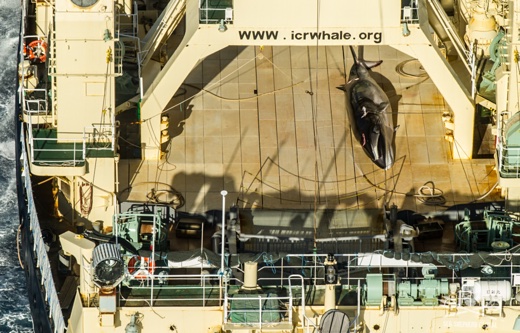
Image above: Murdered minke whale wrapped in tarp on deck of Japanese "research" vessel Nishin Maru photoraphed by Sea Shepherd Global. From (http://news.cision.com/sea-shepherd-global/i/20170115-gl-si-heli-spots-nisshin-maru-and-2-harpoon-ships-04--gnl3690,c2110221).

This season Sea Shepherdreturned to the Southern Ocean on its 11th Whale Defense Campaign, Operation Nemesis, named for the Greek goddess of inescapable justice.

As the Japanese whaling fleet have expanded their hunting grounds and lowered their self-allocated quota, the biggest challenge was to find and stop them before they’ve killed their quota of whales.

Despite our efforts to once again disrupt the slaughter of whales in the Southern Ocean, the Japanese whaling fleeting has reached their self-allocated quota of killing 333 minke whales.

Today Sea Shepherd mourns the loss of these whales. We have called an emergency meeting of the Global Board of Directors in Amsterdam this weekend to review our whale defense strategy in the Southern Ocean, and will release a more detailed statement on Monday morning

We were aware of the challenges from the outset of the campaign – the doubling of the whaling area and the reduced quota that would be easier to reach – but we did our best despite the odds because it was the right thing to do.

And – as usual – we did it without any government support. It is a reminder that the needless slaughter of marine life will continue unless governments stop making hollow statements of disapproval and start taking action to hold Japan accountable.

For further information contact:
Heather Stimmler, Sea Shepherd Global Media Director
E-mail:  heather@seashepherdglobal.org
Tel: +339 7719 7742

For Australia and New Zealand media requests, contact:
Adam Burling, Media Coordinator Sea Shepherd Australia
E-mail: adam@seashepherd.org.au
Tel : +61 409 472 922

More about Operation Nemesis:(http://www.seashepherdglobal.org/nemesis/about-operation-nemesis.html)

Sea Shepherd Global
Sea Shepherd is an international non-profit marine conservation movement using innovative tactics and direct action to defend, conserve and protect the worlds oceans and marine wildlife. Founded by Paul Watson in 1977, today Sea Shepherd is a worldwide movement with independent national and regional entities in over 20 countries.

With the exception of the US-based Sea Shepherd Conservation Society (SSCS), they are united by a common mission through Sea Shepherd Global, based in Amsterdam, which coordinates communications, logistics and a fleet of five ships to cooperate on campaigns around the world.

Sea Shepherd investigates and documents violations of international and national conservation law, and enforces conservation measures where legal authority exists.

See also:
Ea O Ka Aina: Japanese Whale Slaughter 1/15/17
Ea O Ka Aina: Japanese whaling inside sanctuary 12/23/16
Ea O Ka Aina: Sea Shepherd to obstruct Japanese 12/5/16
Ea O Ka Aina: Sea Shepherd Patrols Atlantic 8/9/16
.

California threat to cutoff $ to DC

SUBHEAD: State studying suspending money to Washington after Trump threatens sanctuary cities.

By Tyler Durden on 31 January 2017 for Zero Hedge -
(http://www.zerohedge.com/news/2017-01-28/california-threatens-cut-funds-washington)


Image above: Map of USA showing net donor states to federal revenue versus subsidized states. From original article.

[IB Publisher's note:  Map at bottom of article show the final Electoral College count. It is interesting to me that the Trump support came largely from states that are net receivers of federal tax dollars and the the states that went for Clinton are large net donor state to federal coffers. The "Clinton" states actually support the "Trump" states. Somewhere in there is a strategy for the future.]


With secession threats looming, the state of California is reportedly studying ways to suspend financial transfers to Washington after the Trump administration threatened to withhold federal money from sanctuary cities.

With California counties among the Top 10 who stand to lose tax-payer funding for providing sanctuary to illegal immigrants...


Image abovce: Chart of funds at risk in sanctuary cities. From original article.


KPIX5 reports that officials are looking for money that flows through Sacramento to the federal government that could be used to offset the potential loss of billions of dollars’ worth of federal funds if President Trump makes good on his threat to punish cities and states that don’t cooperate with federal agents’ requests to turn over undocumented immigrants, a senior government source in Sacramento said.

The federal funds pay for a variety of state and local programs from law enforcement to homeless shelters.
“California could very well become an organized non-payer,” said Willie Brown, Jr, a former speaker of the state Assembly in an interview recorded Friday for KPIX 5’s Sunday morning news.

“They could recommend non-compliance with the federal tax code.”
California is among a handful of so-called “donor states,” which pay more in taxes to the federal Treasury than they receive in government funding.


Image above: Map of USA showing final Electoral College results. From (http://www.businessinsider.com/final-electoral-college-map-trump-clinton-2016-11)


.

Japanese whale slaughter

SUBHEAD: Sea Shepherd catches Japanese poaching fleet with dead minke whale in Australian Whale Sanctuary.

By Staff on 15 January 2017 for Sea Shepherd Global -
(http://www.seashepherdglobal.org/news-and-commentary/news/sea-shepherd-catches-japanese-poaching-fleet-with-dead-whale-in-australian-sanctuary.html)


Image above: Slaughtered minke whale on deck of Japanese "research" vessel. From Sea Shepherd.org.

After five weeks of patrolling the Southern Ocean, Sea Shepherd has located the Japanese whale poachers’ factory whaling vessel in the Australian Whale Sanctuary with a dead minke whale on its flensing deck, the first to be documented since the International Court of Justice ruled against their whaling operations in the Antarctic in 2014.

The Nisshin Maru was spotted by the helicopter of Sea Shepherd’s MY Steve Irwin at 12:34AM GMT (11:34AM AEDT) at a position of 64 57.6S - 085 09.6E, within the Australian Whale Sanctuary.

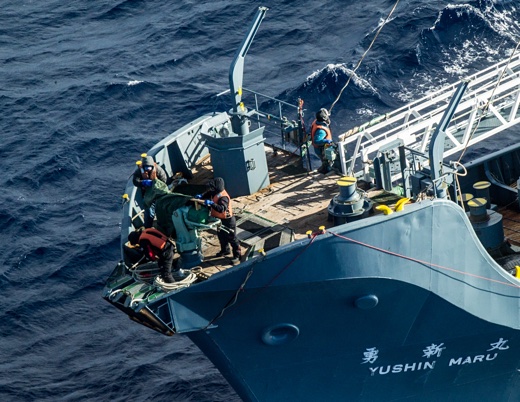
When the helicopter approached, the Nisshin Maru crew scrambled to hide the slaughtered whale with a tarp, while the fleet’s harpoon ships Yushin Maru and Yushin Maru #2 quickly covered their harpoons.  

"The whale killers from the Nisshin Maru were caught red-handed slaughtering whales in the Australian Whale sanctuary,” says Captain Adam Meyerson of the Ocean Warrior, Sea Shepherd’s newest Southern Ocean patrol ship. “The Steve Irwin has shut down their illegal operations and caught them trying to hide the evidence."


Image above: Crew covers harpoon gun with tarp as Sea Shepherd helicopter nears Japanese whale hunting vessel Yushin Maru. From SeaShepherd.org.

These are the first photographs documenting the Japanese whaling fleet’s killing of whales since the International Court of Justice (ICJ) ruled their whaling program illegal in 2014 and the Australian Federal Court found the Japanese whaling industry in contempt for killing protected whales in the Australian Whale Sanctuary.

Sea Shepherd’s discovery of the factory ship and the slaughtered whale comes just a day after Japan’s Prime Minister Shinzo Abe was in Australia on an official state visit.

Jeff Hansen, Managing Director of Sea Shepherd Australia stated, "The lack of action by the Turnbull government while whales are being killed in Australian waters just a day after Japan's Prime Minister was on a state visit in Australia shows that the government has no spine when it comes to protecting the wishes of Australians to defend the Southern Ocean Whale Sanctuary."

Sea Shepherd’s helicopter has relayed the whaling fleet's position to the MY Steve Irwin, now on an intercept course with the factory ship. No more whales will be killed today.

“The fact that the Japanese crew went to cover up their harpoons and the dead minke whale on deck just shows that they know what they’re doing is wrong,” says Captain Wyanda Lublink of the MY Steve Irwin;
“They know they are in contempt of the ruling of the International Court of Justice and the Australian Federal Court. How can the Australian government ignore these actions when the majority of Australians condemn what they are doing?”
About Operation Nemesis
Operation Nemesis is Sea Shepherd’s 11th Antarctic whale defense campaign. In Sea Shepherd’s past ten campaigns over 6,000 whales have been spared the grenade-tipped harpoons of the illegal Japanese whaling fleet. Japan’s so-called “scientific research” program used to justify the killing of whales has been rejected by the International Court of Justice and the International Whaling Commission’s scientific committee. In 2015 the Australian Federal Court fined the Japanese whalers $AU1 million for hunting within an Australian whale sanctuary, however it remains unpaid.

See more here: http://www.seashepherdglobal.org/nemesis/about-operation-nemesis.html

For further information, photos, video footage and interview requests, contact:

Heather Stimmler, Sea Shepherd Global Media Director
E-mail: heather@seashepherdglobal.org
Tel: +339 7719 7742 (EUROPE, GMT+1)

For Australia and New Zealand media requests, contact:
Adam Burling, Media Coordinator Sea Shepherd Australia
E-mail: adam@seashepherd.org.au
Tel : +61 409 472 922 (AUSTRALIA, GMT+11)

.

Hawaiian spinner dolphin restriction

SUBHEAD: NOAA considering a 150 foot buffer zone restricting swimming near dolphins.

By Aja Hannah on 4 January 2017 for Earth Island Journal -
(http://www.earthisland.org/journal/index.php/elist/eListRead/noaa_ban_swimming_spinner_dolphins_hawaii/)


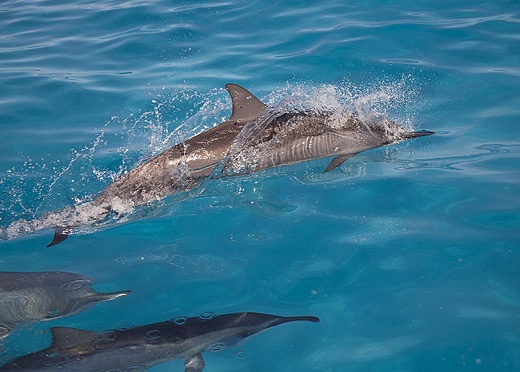
Image above: Spinner dolphins in Hawaii's Papahanaumokuakea Marine National Monument. From original article.

The proposed banned zone is intended to protect marine mammals from over-eager tourists.

[IB Publisher's note: Even 150' may be too close for approaching swimmers. Here on Kauai it is certainly it is too close for tourist filled zodiacs and catamarans that spot a pod of spinners during daylight hours and rouse them for sleep to dance for the tourists. They sail from Hanapepe along the south shore and to the westside and along the Napali Coast.]

Imagine you're sleeping and a friend comes over unannounced. You might hang out for a few hours or you might walk them out. Either way, they eventually leave and you return to bed. You're just getting into that good sleep when another person knocks on the door. Then another and another. All night this continues. Then it happens again the next night. And the night after that.

This is the current problem plaguing the Hawaiian spinner dolphin, one of the smallest dolphin species, well-known for their airborne twisting jumps.

The mainly nocturnal mammals spend their daylight hours resting near the shores of the Hawaiian Islands in shallow waters, but a growing number of tourists, tour companies, and increasing human interaction are impacting the health of the dolphin pods as well as individual dolphins.

In August, National Oceanic and Atmospheric Administration (NOAA) Fisheries proposed a rule that would ban everyone from swimming with Hawaiian spinner dolphins. Under the rule, no one would be allowed get within 50 yards of spinner dolphins by any means. This includes by boat, kayak, paddleboard, swimming, and other type of transportation.

The proposed ban has proven controversial, even among those who agree that spinner dolphins need protections. Hawaii’s economy, of course, is sustained by tourism, and local operators are concerned the ban may negatively impact their business.

At four to seven feet long, Hawaiian spinner dolphins (Stenella longirostris) spend the night hours off Hawaiian shores in search of fish, shrimp, and squid. In the darkness, these mammals track their prey to depths of nearly 1,000 feet, communicate through echolocation, and work cooperatively to herd prey for the catch.

As sunrise arrives, the dolphins return to the shallow coasts to socialize, sleep, and nurse their young until late in the afternoon. Dolphins remain in motion when they sleep: For four to five hours every afternoon, the dolphins will swim slowly back and forth, coming up for air when necessary, while half of their brain sleeps, a unique adaptation for dolphins and whales that are required to control their own breathing at all times.

When a vessel or person approaches a pod, dolphins are interrupted from their sleep — they wake up completely to assess the threat. When this happens repeatedly — as it often does — the dolphins become exhausted, and have less energy for other activities, including responding to threats, hunting, or caring for their young.

According to studies cited in the NOAA Fisheries’ proposal, short term changes in spinner dolphin behavior due to human interference have already been documented in Hawai’i, including a decreased number of individuals sighted in typical resting places. While this is not definitive of a decreased population, it at least means the dolphins have moved from traditional resting grounds.

“Several studies have suggested that spinner dolphins exhibit behaviors outside of their normal resting behaviors in response to human interactions in Hawaii. Disturbed individuals incur an energetic cost,” said Ann Garrett, the assistant regional administrator of NOAA Fisheries. Interactions that cause such behavioral changes qualify as “harassment” of marine mammals under the MMPA.

Spinner dolphin pods can be found off the coasts of Kauai/Niihau, Hawaii (The Big Island), and Oahu and do not interbreed throughout Hawaii’s archipelago. Disturbance of one individual can also disturb the whole pod into relocating and interrupts nursing mothers.

“Long-term studies on dolphins in different parts of the world have documented negative impacts from intense viewing pressure, including population decline, habitat abandonment, and decreased reproductive success,” Garrett added. “The enhanced protections were proposed in response to both identifiable short-term changes in behavior and as a preventative measure,”she said, referring to the proposed 50-yard buffer zone.

Although not listed under the Endangered Species Act, the dolphins are already protected under the MMPA, which makes it illegal to harass, feed, hunt, capture, collect or kill any marine mammal or collect or possess any part of a marine mammal. Harassment includes any pursuit, torment, or annoyance that could injure or disturb marine mammals, including activities that disturb behavioral patterns.

The MMPA is currently implemented in Hawai’i by NOAA Fisheries Office of Law Enforcement, the US Coast Guard, and Hawaii’s Division of Conservation and Resources Enforcement. Maximum penalties for violation of the law include a civil fine of $27,500 or — for criminal penalties — one year in prison and/or a $100,000 fine. Enforcement of the law, however, has been spotty, and most people visiting Hawai’i are unaware of the restrictions.

NOAA Fisheries and partners have also established a certification program, Dolphin SMART, which businesses can join to show their support for the species. Dolphin SMART promotes dolphin conservation by minimizing harassment, and includes a 50-yard distance requirement. Operators wishing to become certified must attend training and participate in responsible advertising, among other criteria.

The proposed 50-yard NOAA rule would enhance and clarify these existing protections for spinner dolphins. Exceptions to the rule would include: people who inadvertently come within 50 yards of a dolphin, as long as they make efforts to move away; vessels that are approached by dolphins, as long as the vessel remains on its course; vessels that cannot safely keep a 50-yard distance when going to or from a port or harbor; and emergency situations when imminent or serious threat must be avoided.

Other alternative rules under consideration include a 100-yard restriction and closure of important daytime habitats to swimmers at certain times of day, including four bays on the Big Island and one on Maui. These measures are unlikely to be adopted at this time, but could be adopted in the future if the 50-yard limit does not provide enough protection.

Hearings for the proposal have drawn more than 300 people from four islands and NOAA Fisheries is still compiling the written comments it received.

Dolphin Discoveries has been in business for 25 years on the Big Island, running swim tours and writing local guidelines on sustainable dolphin swims.

Co-owner of Dolphin Discoveries Kevin Merrill said, “Usually when we get in the water, we just float and the dolphins swim by. We know the dolphins are nocturnal and need to rest. Responsible operators cease at about 11:00 a.m.”

Merrill explained that legal issues and missteps created an excess of boating permits and an oversaturated tour market in Kona, a touristy area on west side of the Big Island. “Because of the way [the local government] issued permits, you have people trying to scratch out a living doing whatever they can. You’ve got all these knuckleheads that don’t understand what they’re doing with the dolphins, but they invested in a boat and have a permit.”

While conducting his tours, Merrill has encountered people driving through the pods at high speeds so that the dolphins will swim and jump at the bow. He’s seen overhand swimming and splashing tourists, which is seen as aggressive behavior by the dolphins.

Tour boats sometimes drive into the middle of pods and have clients drop into the water almost on top of the dolphins. And, of course, some operators continue to conduct swims past the ideal 11:00 a.m. limit, preventing dolphins from sleeping. Voluntary guidelines have been established locally, but there is no law to enforce the guidelines or to penalize the offenders.

Merrill believes the dolphins need protection, but there are better alternatives that would protect both dolphins and local businesses. Instead of banning the entire practice of swimming with dolphins in Hawaii, Merrill would rather see complete closures of critical habitats and time limits on swimming with dolphins made mandatory and enforced by NOAA.

These restrictions would also be easier to patrol than a 50-yard limit, he said, especially considering that the dolphins, tides, and people are constantly in motion. The new rule could put local, responsible operations out of business. “We think there should be local solutions to local problems,” he said.

Merrill also pointed out that captive facilities would be exempt from this the 50-yard ban. As a result, the only way for people to have a close encounter with a dolphin would be in a small tank. There’s the possibility that this would increase demand for captive dolphins.

However, Garrett said the 50-yard rule would level the playing field among businesses.

The pressure for close interactions with spinner dolphins would wane since no operators could legally provide them, she said, and tour operators would develop other alternatives, including wildlife tours that help customers spot the dolphins and other animals from a distance.

Mark Palmer, associate director of the International Marine Mammal Project, a project of Earth Island Institute, is a proponent of the ban. “While there is room for experimentation, in the end the needs of the dolphins are most important.

We may well need to go for swimming closures in areas necessary for dolphin respite,” he said. “I also think the issue is bigger than just the official whale watching tour companies — individual tourists are a problem.”

Because of that, he thinks that close supervision and enforcement by NOAA Fisheries will be required if the rule is passed, and that tourists will still need to be educated on why the dolphins should not be approached.

NOAA expects to make a decision on the proposed rule in late 2017.

.

Japanese whaling inside sanctuary

SUBHEAD: Sea Shepherd intercepts Japanese whaling fleet deep in the Australian Whale Sanctuary

By News Staff on 23 December 2016 for Sea Shepherd Global -
(http://news.cision.com/sea-shepherd-global/r/sea-shepherd-intercepts-japanese-whaling-fleet-deep-in-the-australian-whale-sanctuary,c2156478)


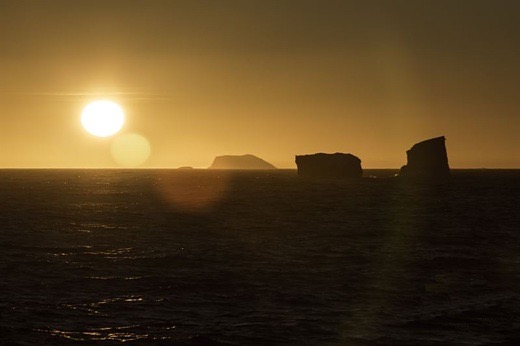
Image above: Sunrise over icebergs from bridge of the Ocean Warrior . From ().

Yesterday at approximately 6:40pm GMT, Sea Shepherd’s patrol vessel the Ocean Warrior intercepted one of the harpoon ships of the Japanese whale-poaching fleet in the Southern Ocean Whale Sanctuary.

"The crews of the Ocean Warrior and the MV Steve Irwin have been battling through thick fog and ice to protect the whales in the Australian whale sanctuary," said Captain Adam Meyerson of the Ocean Warrior. "The Yushin Maru was hiding behind an iceberg and came out on a collision course."

The harpoon ship was located approximately 165 miles northeast of Australia's Casey base, well inside the Australian whale sanctuary (64˚15' S 115˚06' E). Sea Shepherd's vessels are now on the hunt for the centerpiece of the illegal Japanese whaling fleet, the floating slaughterhouse known as the Nisshin Maru.

"Finding one of the hunter killer ships hiding behind an iceberg in a thick fog means that the rest of the fleet is nearby,” says Meyerson. “We all hope to have whaling in the Southern Ocean shut down by Christmas."

In the meantime, foggy weather conditions have made for poor for visibility for the whaling fleet, which is a great sign for the whales.

"While I applaud the work Sea Shepherd are doing locating the Japanese whaling fleet deep inside the Southern Ocean Whale Sanctuary, it is appalling that they are having to do the Australian Government's work for them,” said Australian Greens Senator Peter Whish-Wilson in a statement reacting to the news. “The whales are getting more protection from the weather than from the Australian Government.”

About Operation Nemesis
Operation Nemesis is Sea Shepherd’s 11th Antarctic whale defense campaign. In Sea Shepherd’s past ten campaigns over 6,000 whales have been spared the grenade-tipped harpoons of the illegal Japanese whaling fleet. Japan’s so-called “scientific research” program used to justify the killing of whales has been rejected by the International Court of Justice and the International Whaling Commission’s scientific committee. In 2015 the Australian Federal Court fined the Japanese whalers $AU1 million for hunting within an Australian whale sanctuary, however it remains unpaid.


Image above: Sunrise over icebergs from bridge of the Ocean Warrior . From ().

See more here: http://www.seashepherdglobal.org/nemesis/about-operation-nemesis.html
http://www.seashepherdglobal.org/nemesis/about-operation-nemesis.html
For further information, photos and interview requests, contact:

Heather Stimmler, Sea Shepherd Global Media Director
E-mail: heather@seashepherdglobal.org
Tel: +339 7719 7742 (EUROPE, GMT+1)

For Australia and New Zealand media requests, contact:
Adam Burling, Media Coordinator Sea Shepherd Australia
E-mail: adam@seashepherdglobal.org
Tel : +61 409 472 922 (AUSTRALIA, GMT+11)

.

Miles to Go Before We Sleep

SUBHEAD: I have spent half my life trying to stop or slow down that which now comes onrushing like a wave so tall that it blots out the sun.

By William Pitt on 24 November 2016 for Truth Out -
(http://www.truth-out.org/opinion/item/38515-miles-to-go-before-we-sleep)


Image above: A father and child in a frightening landscape. Viggo Mortensen stars in the 2009 postapocalyptic thriller based on Cormac McCarthy's Pultzer Prize-winning novel "The Road". From (http://adventure.nationalgeographic.com/2009/08/survival/the-road-movie-text).

I took my daughter for a long walk under the low November sun, and it turned into an adventure. We are hedged by deep forest to all points on the compass here in the great granite north, home to deer runs that spider-web the fallen pine needles, ghostly moose like towering mystics in the far field, a family of porcupines, one cat-eating coyote and the occasional ominous bear. Serious stuff.

Before our walk, my daughter was content to contend with the lawn that greens the verge of the dark and deep, but Daddy was with her this day, and that meant pressing the edge.

Over the ancient stone wall we went, into the thicket of pines where she learned to snap off the dead branches lest they claw at her eyes, then deeper, over the moss and the deadfalls laid down by a windstorm and further, into the places where the sun only hints at a kiss, her plowing forward and me always aware of the surround, where true north is, the way back to the house.

She found her favorite place in that secret space: Bifurcated trees. Trees with two, three, four, five full trunks growing up and out of one base like a splayed hand, like a crown. She would find one and crawl into the base, the hollow where all the fingers reached up and out toward the sky.

She stood there timeless, three feet of eternity conducting the energy passing through her, speechless, rigid in bliss. She was in the palm of a living thing, and if she didn't know it, the tree did. I felt it, too. I watched a tree sing to my daughter as she stood in its elder grasp, and she heard it full well.

I am thankful for that.

Thankfulness is a hard dollar to make these days. He Who Shall Not Be Named Here Today hasn't yet taken the oath of office, and already the deep stain of his impending presidency marks us all. It is difficult to locate gratitude in this vortex of shame, confusion, hate and greed, but this is an orderly transition of power, right?

He won, everyone else lost, and never mind the shenanigans from overseas and right down the block. We are in the pipe now, five by five, charging into a future that reeks of the past.

Native Americans are being attacked with "non-lethal" concussion grenades and rubber bullets for protecting their water rights out in North Dakota, all in the lead-up to Thanksgiving -- a holiday which, after all, is about celebrating the United States' "heritage."

A new creature now walks the land, most clearly visible on televisions tuned to "news" networks. No zoologist has labeled it yet, so I just call it the "Yeahbut."

Every time a fascist, a racist or an all-out Nazi is tapped for a Cabinet position in the looming administration, all the apple-polishers on the screen say, "Yeah, but how bad can they really be?" or "Yeah, but that was a long time ago" or "Yeah, but those people don't vote anyway," and we are all a little worse for the wear in the stench of the Yeahbut's passage.

Forgiveness is divine, it is said, but watching the TV people exonerate themselves for the ruin they gleefully foisted upon us in the name of ratings and advertising dollars makes me glad, for their sake, that I am a peaceful man.

I am so tired. I have spent half my life trying to stop or slow down that which now comes onrushing like a wave so tall that it blots out the sun.

Yet I remember my daughter standing in that tree, in her simple glory, and all of it shimmers into shards of purpose, and I am thankful to know I have a few good fights left in me. I am thankful for my good right arm and what I will do within its reach.

I will not be still. I will not be silent. I will volunteer at a food bank to help those who will feel the grind of these coming years most keenly. I will volunteer to be an escort at a women's clinic because my daughter has rights.

I will make it known that my home is a sanctuary for anyone who fears being unjustly thrown out of the country. If they try to run Kobach's registry of Muslims, I will be first in line to sign my name. I will do that, and more.

Through it all, some of me will ever be in the forest with my daughter. I am in a horde of leaves amid the hushed susurrations of wind through evergreens with a little girl who knows nothing of sorrow yet as she stands in a throne of wise bark. I feel the low jolt passing from trunk to her hand to trunk, and I know why I am here.

When next we pass over the ancient stone wall into that sacred shrouded space, I will whisper to her the lines from her favorite bedtime poem:
"The woods are lovely, dark and deep,
but I have promises to keep,
and miles to go before I sleep,
and miles to go before I sleep."
And I will mean it. I am thankful for this small patch upon which I make my stand. This far, no farther, and not one step back. Happy Thanksgiving.

• William Rivers Pitt is a senior editor and lead columnist at Truthout. He is also a New York Times and internationally bestselling author of three books: War on Iraq: What Team Bush Doesn't Want You to Know, The Greatest Sedition Is Silence and House of Ill Repute: Reflections on War, Lies, and America's Ravaged Reputation. His fourth book, The Mass Destruction of Iraq: Why It Is Happening, and Who Is Responsible, co-written with Dahr Jamail, is available now on Amazon. He lives and works in New Hampshire.


Stopping by a Woods on a Snowy Evening
by Robert Frost

Whose woods these are I think I know.
His house is in the village though;
He will not see me stopping here
To watch his woods fill up with snow.

My little horse must think it queer
To stop without a farmhouse near
Between the woods and frozen lake
The darkest evening of the year.

He gives his harness bells a shake
To ask if there is some mistake.
The only other sound’s the sweep
Of easy wind and downy flake.

The woods are lovely, dark and deep,
But I have promises to keep,
And miles to go before I sleep,
And miles to go before I sleep.
.

Navy against expansion of sanctuary

SUBHEAD: The US Navy plans for little interruption of its killing of ocean life through its activities in Hawaiian waters.

By Lyn McNutt on 7 February 2013 in Island Breath -
(http://islandbreath.blogspot.com/2013/02/navy-against-expansion-of-sanctuary.html)


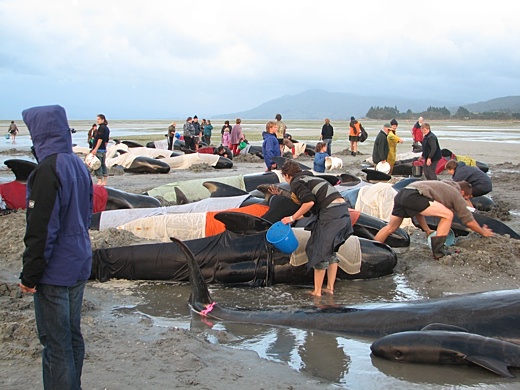
Image above: Rescue efforts in New Zealand after US Navy sonar beaches whales in 2005. Study suggests whales get the bends after being startled by naval sonar. From (http://whalesandwienerdogs.com/blog1/tag/conservation/page/3/).

The Navy has responded to a proposal by Ms. Elia Herman who is Co-Manager of the Hawaiian Islands Humpback Whale National Marine Sanctuary. The sanctuary is managed by the Hawaii Department of Land and Natural Resources and The US National Oceanic & Atmospheric Administration. As stated on the NOAA website:
"The Hawaiian Islands Humpback Whale National Marine Sanctuary, which is jointly managed by the National Oceanic and Atmospheric Administration and the State of Hawai`i, lies within the shallow warm waters surrounding the main Hawaiian Islands and constitutes one of the world's most important humpback whale habitats. Through education, research and resource protection activities, the sanctuary strives to protect humpback whales and their habitat in Hawaii."
The Whale Sanctuary has made a proposal to add additional species besides whales to species to be protected. As a result this accompanies a proposal to modify the sanctuary's boinadries.

Basically the Navy seems to be saying that NOAA has to go back to Congress to make any changes since this Whale Sanctuary was set up for a single species, and it has defined boundaries based on that legislation.

I'm sure their lawyers looked at this, but the legislation does say that the Sanctuary can include other species if it is in the 'national interest', whatever that means.

Ironically, it is the same clause the Navy uses to operate within any sanctuary.

Below is the Navy letter from PDF file
February 4, 2013
Ms. Elia Herman
Sanctuary Co-Manager
Department of Land and Natural Resources
Hawaiian Islands Humpback Whale National Marine Sanctuary
1151 Punchbowl Street, Room 330
Honolulu, HI 96813

Dear Ms. Herman,

These comments are submitted in response to the Notice of Intent to Prepare an Environmental Impact Statement and Management Plan for the Hawaiian Islands Humpback Whale National Marine Sanctuary published on January 8, 2013.

On October 15, 2010, initial comments were submitted by this office to Mr. Tom Allen, Management Plan Review Coordinator, Hawaiian Islands Humpback Whale National Marine Sanctuary following the Invitation of Review of Management Plan/Regulations of the Hawaiian Islands Humpback Whale National Marine Sanctuary; Intent to Prepare Draft Environmental Impact Statement and Management Plan; Scoping Meetings, as published in the Federal Register on July 14, 2010, Vol. 75. No. 134.

Those comments responded to the proposal to expand the Hawaiian Islands Humpback Whale National Marine Sanctuary (the sanctuary) as set forth in the Federal Register notice and more fully articulated in "Kohola Connection, The Voice of the Hawaiian Islands Humpback Whale National Marine Sanctuary", Summer 2010, State of the Sanctuary, Management Plan Review Special Edition. The text quoted below is from that document.
"At this time, the sanctuary is proposing that it expand its scope and direction to protect and conserve other living marine resources, in addition to humpback whales and submerged cultural heritage within the sanctuary. The sanctuary is interested in adding one or more of the following resources: Hawaiian monk seals, other whales and dolphins, sea turtles, federally protected coral species, areas of significant habitat, submerged cultural and historic resources." P. 24
The sanctuary will work with communities, private sector and government agencies to determine which activities are compatible with natural resource protection and are suitable to take place within the sanctuary." P. 25

At the outset, we would like to express our appreciation for the sanctuary's continuing recognition that the Navy and DoD are important members of the Hawaii community and significant stakeholders in and beneficiaries of the sanctuary. We have appreciated the opportunity to host annual Advisory Council meetings at Pearl Harbor. We have every expectation that that relationship will only improve and deepen as NOAA continues to move more of its operations and facilities to Ford Island.

We also acknowledge that the sanctuary has maintained consistency with the purposes for which it was created. The sanctuary has protected the humpback whales and their habitat as evidenced by today's abundance of the species. As well, the sanctuary has focused on education and the promotion of and coordination of scientific research on humpback whales. The sanctuary has educated small boat operators in methods to avoid approaching a humpback whale while allowing an active whale watching tourist industry to grow.

That being said, we must express great concern that the sanctuary is considering a boundary expansion, adding resources to be protected beyond those in the original designation, and an expressed intention to determine which activities are suitable to take place within the sanctuary. This threat of restrictions generates concerns especially given the accompanying interest in a larger sanctuary boundary which could adversely affect military training activities across Hawaii.

We do not believe that the sanctuary is proceeding in concert with the law in characterizing this significant modification as a management plan update. As you are aware, Section 304(a) (4) of the National Marine Sanctuaries Act requires that any modification in designation be accomplished by the same procedures in which the initial designation was made. The Hawaiian Islands Humpback Whale National Marine Sanctuary was initially designated by statute and thus any change in designation would require additional legislation. Similar requirements exist for boundary modifications under Section 2305(d) of the Hawaiian Islands National Marine Sanctuary Act.

Thank you in advance for taking these comments into consideration. We look forward to continuing our working relationship. Should you have any additional questions, my point of contact for this matter is Commander Rick McGuire at (808) 474-6389.

S .    A .    WEIKERT
 RADM, CEC, USN
Fleet Civil Engineer
DEPARTMENT OF THE NAVY
COMMANDER UNITED STATES PACIFIC FLEET
250 MAKALAPA DRIVE
PEARL HARBOR, HAWAII 96860-3131

In reply refer to:
5090 Ser N01CE1/0149


Navy sees massive harm, shrugs shoulders


By Zak Smith on 22 June 2012 for Natural Resources Defense Council Staff Blog - 

(http://switchboard.nrdc.org/blogs/zsmith/this_week_in_whales_navy_predi.html)

Earlier this week, I attended a public meeting hosted by the Navy in San Diego on its plan for training and testing activities in Southern California and Hawaii from 2014 to 2019.

The predicted level of carnage from the Navy’s activities over the five-year period is staggering – over 14 million instances of marine mammal take (“take” means any harm that ranges from a significant behavioral impact, like habitat abandonment, to death), including almost 3 million instances of temporary hearing loss, over 5,000 instances of permanent hearing loss, 3,000 lung injuries, and 1,000 deaths.

Unfortunately, the Navy’s astonishing estimation of harm contained in its Draft Environmental Impact Statement did not trigger a corresponding identification and analysis of alternatives or mitigation measure that would in any way significantly reduce the harm to the area’s whales and dolphins. The document tells a story of devastation, offering no pathways for lessening the harm.

         Navy Study Area

While all of the Navy personnel at this particular “meet and greet” were friendly and more than willing to talk about how great the Navy is, I didn’t find any “forest through the trees” comprehension of the magnitude of harm the proposed activities will have on wildlife. There aren’t other government agencies out there proposing activities that will have anywhere near this level of impact on wildlife, much of which is endangered.

The Navy seems very proud of the fact that it has conducted such a “comprehensive” (in its opinion) analysis of impacts. But where’s the pride in its development of alternatives that allow it to achieve its training and testing needs, while dramatically reducing the impact to whales and dolphins?

On the 21st anniversary of Ireland’s declaration that its coastal waters are a sanctuary for whales and dolphins, the Irish Whale and Dolphin Group has called for an extension of Ireland’s whale and dolphin sanctuary to all of Europe. The Irish sanctuary extends up to 200 nautical miles offshore and bans the hunting of whales and dolphins and otherwise raises awareness about Ireland’s marine mammals. According to the Irish Whale and Dolphin Group’s Brendan Price, “The sanctuary declaration was unique in Europe and no EU member stat had made such an unequivocal statement about the importance of their waters for cetaceans.”

Let’s hope the rest of Europe jumps on board.

Making a no-brainer decision, a federal administrative law judge for the Occupational Safety and Health Review Commission said that killer whale trainers “must either remain at a greater distance from them, stand behind a physical barrier or use other devices to keep them safer during performances.” According to the judge, “Once a trainer is in the water with a killer whale that chooses to engage in undesirable behavior, the trainer is at the whale’s mercy. All of the emergency procedures, nets, underwater signals and hand slaps are useless if the whale chooses to ignore them.”

Yeah, they’re called wild animals for a reason. The Judge also cited to a report by the unfortunately named Dr. Duffus, which states, “To be repeatedly held underwater, grasped in the mouth of a rapidly swimming killer whale and to be pursued under and at the surface of the water…. It is not whales playing, or an accident, it is a large carnivorous predator undertaking what thousands of generations of natural selection prepare it for.” In reaching its conclusion that employers, like SeaWorld, must protect their employees when it places them in danger, the Judge rejected SeaWorld’s claim that orca behavior can be predicted with more than 98 percent accuracy, noting that the claim was not based on scientific data.

Scientists are combining data from tagged whales with data on human activities to better manage interactions between whales and humans on the West Coast. The hope is that the data will support management practices that will reduce the number of whales accidentally killed by ship strikes and entanglement from fishing gear. There’s a history of blue whales being killed by ship strikes in Southern California and gray whales have recently been entangled by fishing nets. Mapping out where the whales are and where the human activity is may help shift some of the human activity away from the whales during migration.

.

Feds Threaten Hawaiian Sovereignty

SOURCE: Ken Taylor (taylork021@hawaii.rr.com)
SUBHEAD: The Whale Sanctuary regulation changes means Hawaiian waters resources are under Federal control.  

By Lyn McNutt on 31 January 2012 in Island Breath -
(http://islandbreath.blogspot.com/2012/02/feds-threaten-hawaiian-sovereignty.html)


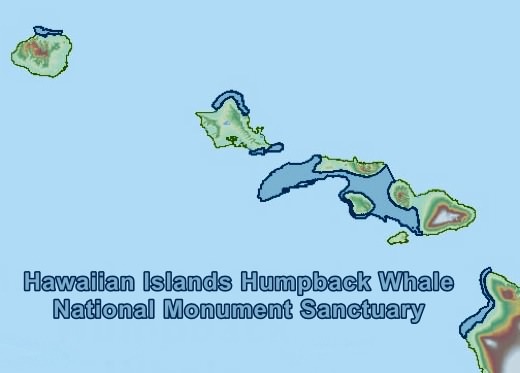
Image above: Detail of map of the waters of the Hawaiian Islands Humpback Whale National Monument Sanctuary.
From (http://sanctuaries.noaa.gov/library/imast_gis.html).

There have been changes proposed to the Humpback Whale Sanctuary that will immensely increase the power of the Federal government in Hawaiian waters, taking away the State's jurisdiction to its own waters. This takes the rights of Hawaiian residents (1.4 M) and places them at the whim of the "American people" in general, some 300-400 Million of them. This is very troubling due to the way that the National Marine Sanctuary Act and the Endangered Species Act function.

People are being lead to believe that Hawaiian peoples' rights will somehow be preserved after these changes, but my experience of how the Federal system of regulatory laws works leads me to believe that expanding any authority of the Federal government within the sanctuary can lead to very undesirable consequences (see review of compact agreement below). Currently Hawaiian Islands Humpback Whale National Monument Sanctuary (HIHWNMS) Act says:
"Sanctuary resource means any humpback whale, or the humpback whale’s habitat within the Sanctuary."
Keep in mind that whales do NOT come here to feed, so they do not compete with native Hawaiian species for resources. This is the proposed change:
"Sanctuary resource means any living or non-living resource of the National Marine Sanctuary that contributes to the conservation, recreational, ecological, historical, research, educational, or aesthetic value of the Sanctuary, including, but not limited to, the substratum of the area of the Sanctuary, other submerged features and the surrounding seabed, carbonate rock, corals and other bottom formations, coralline algae and other marine plants and algae, marine invertebrates, brine-seep biota, phytoplankton, zooplankton, fish, seabirds, sea turtles and other marine reptiles, marine mammals and historical resources."
Please NOTE that there is NO MENTION of subsistence use. In other words. everything will belong to the Feds.
The key wording in the HIHWNMS Act is this:
'The purpose of the regulations in this subpart is to implement the designation of the Hawaiian Islands Humpback Whale National Marine Sanctuary by regulating activities affecting the resources of the Sanctuary"
Therefore under the current definition of "Sanctuary resources", the sanctuary's mandate is limited to "humpback whales or the humpback whale's habitat". Under the ecosystem based management method "resources" means...

EVERYTHING INCLUDING ROCKS, WHAT IS UNDER ROCKS, AND EVERY LIVING THING IN THE WATER AND SEABIRDS ABOVE THE WATER'S SURFACE

...becomes subject to protection and regulation. Please, consider the longterm consequences of this change for the people of Hawaii. With the Federal laws as currently enforced, and the agreements in place, there really is no protection (see below) 

Notes on the Compact Agreement with the State of Hawaii and NOAA 

Please note in the agreement that NOAA, through the Sanctuary Act "has been vested with the jurisdiction and authority to protect and manage the resources of this sanctuary in trust for the People of the United States and is specifically charged with implementation of the policy of the United States". (bold lettering is mine). There is your catch because the policies of the United States may not be consistent with the laws or regulations or needs of the state of Hawaii. This allows NOAA to bring in a whole slew of federal rules and policies INCLUDING the new National Ocean Policy (remember, we have no exemptions or Strategic Plan under that policy---what goes for the Mainland goes for us, too). Section IV (D) States clearly that NOAA and the State will collaborate, but the management of the Sanctuary falls under the laws in the National Marine Sanctuary Act. In Section IV (D) (2) it says that...
"To the extent permitted by law, there shall be mutual agreement regarding enforcement policies and priorities."
The main title of that section indicates that the "law" is the "National Marine Sanctuary Act, the Sanctuary Management Plan, and MOAs, and protocols developed thereunder". ALL of these will trump the State, so beware. The agreement keeps saying that nothing will happen without the signature of the Governor, but when it comes to the Governor proposing changes (section IV (H) it says "...NOAA shall initiate the Federal rule promulgation process required to make revisions requested by the Governor..." Here is where the Endangered Species Act and other federal laws will come in. NOAA consistently "outvoted" the state in the Northwest Hawaiian Islands, and overrode the State's veto of several items related to several different species, the monk seal in particular (V. Alter, Stanford Law School, April 2006, available on request).

 It also does NOT say that fishing will not be regulated (it never mentions subsistence fishing, by the way). It says fishing is currently not included, unless DLNR implements new regulations. So, all they have to do is ask the State... and the State has a dismal record here.

  Also, the National Marine Sanctuary Act says that the Feds have the authority to "take over" if they feel that the State is not enacting laws and regulations that are effective enough. The Endangered Species Act permits the Federal Government to regulate the State's treatment of endangered species.  

So it goes back to the Federal Law trumping State law if there is a conflict in the goals of the Management Plan, and then National Marine Fisheries Service (NMFS) is the agency that will decide what needs to be done, all within the authority of the Sanctuary Act and the Endangered Species Act, under the new National Ocean Policy.

Section IV M gives NMFS oversight of all the resources for the Federal Government in the Sanctuary through "implementation of the management plan" and gives them the authority to "evaluate the effectivenedss of existing management efforts in achieving those abjectives and policies including whether additional measures (e.g. regulations or critical habitat) to protect the humpback whale or its habitat are needed)"

 OK, now substitute the word "monk seal" or "coral" for humpback whale in that sentence, and you will see that NMFS will have the authority to enact anything that they feel necessary under the ESA through the management plan and into the Sanctuary as part of the National Marine Sanctuary Act and this agreement. It also says that NOAA will "fully involve and consult with the State". It does not say that they are obligated to listen to the State. Section IV (A) says that the State doesn't relinquish its right to "title or authority to manage and regulate submerged lands, resources, or activities..." but the next two sections go on to say that the Governor agrees to put state owned lands into the Sanctuary system, and that the Sanctuary Management Plan (and therefore the laws of the Sanctuary Act) will apply throughout the ... "Sanctuary, including the portion of the Sanctuary within the seaward boundary of the State."

MOAs and Compact Agreements with references to external documents are really tricky. I used to run into the same thing with all the Space Station agreements, etc. This Agreement looks OK on the surface, since whales don't compete for resources here. Whales DO NOT EAT while they are here. Keeping this agreement in place and giving the Sanctuary the authority to add additional species that might compete for resources, such as the monk seal, would be a real mistake. They will have to create a new agreement. Stand firm on this.
.

Expand Hawaii Whale Sanctuary

SUBHEAD: Our protected areas do not include many areas heavily used by whales in Hawaii... especially on Kauai and Niihau.


By Diana Labedz on 29 July 2010 for Surfriders Foundation - 
(www.islandbreath.blogspot.com/2010/07/expand-hawaii-whale-sanctuary.html)

 
 Image above: Detail of whale sanctuary areas (dark blue line) set against high humpback whale activity areas (red areas) within study area (yellow area). The lightly dotted area is the 100 fathom isobar (600 foot depth contour). Note Kauai and Niihau are underprotected. Click to enlarge. From Hawaiian Humpback National Marine Sanctuary study of surface sightings 1993-2003. 

The Hawaiian Islands Humpback Whale Marine Sanctuary should be a place where visiting humpback whales and resident whales can feel safe to come and give birth and raise their young. In reality, there is no such safe place here. Even in Hawaiian waters designated as "sanctuary”, there is no protection or enforcement that would make it safe for whales.

The Hawaiian Islands Humpback Whale Marine Sanctuary has been in existence since the early nineties, but it has never included all the areas used by the whales, nor has the sanctuary itself been set up to enact any rules or regulations designed to protect whales. There has been an extended period of public education through the current sanctuary management, but the time has come to put this education into effect and create a real, fully functional sanctuary designed to do what its name implies and protect whales in Hawaiian coastal waters.

 The Hawaiian Islands Humpback Whale Marine Sanctuary is now preparing a Management Plan Review (new strategic plan) and they have asked for public input. We feel strongly that, in addition to continued education, the “new” sanctuary must graduate from being an educational forum to being a real protective entity.

There must be changes to the sanctuary boundaries, management and accountability structure, and to the mission of the sanctuary that will enable us to protect whales and other sea life in Hawaiian coastal waters. The Surfrider Foundation, Kauai chapter along with the newly formed Kohola Mana Ohana has asked that the new strategic plan for the sanctuary include the following recommendations:

 1. Expand the Hawaiian Islands Humpback Whale Marine Sanctuary boundaries to include all whale habitat areas. The sanctuary must include all the areas where whales are known to congregate especially during the mating and birthing season. For instance, the area of Kauai that is designated as a sanctuary is a tiny strip of coast near the Kilauea lighthouse, a small portion of the eastern Kauai habitat. This area does not include any of the documented habitat on the West and South sides of Kauai, nor the Island of Niihau.

  2. Areas within the Hawaiian Sanctuary must include speed limits with enforcement. A major cause of whale death is ship strikes. We propose a 14 knot per hour speed limit during whale season, to reduce risk of whale strikes. To be effective there must be enforcement with consequences of this speed limit within the sanctuaries. There has been a nearly 500% increase in reported whale vessel strikes in Hawaiian waters since reports were tabulated in 1975. Boat speed is clearly a factor in the incidence of collisions, whit about 80% of all strikes occurring with vessels traveling between 10-30 knots. Collisions resulting in severe injury or death are typically caused by boats traveling at 14 knots or higher. 50% of all strikes occur suddenly, with no warning, making it impossible for vessels to take evasive action to avoid collision. Strikes with motorized vehicles are ten times higher than those with sailboats, and 57% of all strikes involve calves or juvenile whales.  

3. There should be noise limits for all Hawaiian sanctuary areas, with no exemptions. Whales navigate by sound; heavy ship traffic and sonar can affect a whale’s ability to survive. For instance, active (noise producing) sonar can be ten thousand times louder than a rocket launch, and sonar has been known to injure marine mammals’ ears. Sonar must not be used during whale season, or in places that include marine mammals that navigate or communicate using sound.  

4. There must be more regulatory collaboration between land and ocean uses, especially regarding pollution that would affect the sanctuary. Pollution from land has a large affect on the marine habitat. Before pollution permits) are issued, the Hawaiian Islands Humpback Whale Marine Sanctuary board must be allowed to comment on all NPDES requests for permits to pollute, with the understanding that there should be no dumping in any sanctuary waters.  

5. Designated areas of the Hawaiian Humpback Whale Sanctuary should not be open to commercial or recreational fishing. Once the boundaries of the sanctuaries are expanded to include the documented whale habitat, we then can begin to protect the end-to-end environment of these coastal marine areas. This approach would allow Hawaii to create its first Marine Protected area (MPA), and undertake local fisheries management. Less than 0.5 percent of the world's oceans are fully protected from extractive or destructive activities. Large, no-take marine reserves have been shown to blunt the effects of excessive commercial fishing by offering a refuge for sea life to breed and spawn, providing for healthier fisheries as the fish swim into surrounding areas, and thus ensuring more resilient coastal economies. Because the ecosystems in ocean reserves are healthier, they are also more resistant to the damage caused by pollution, climate change and a wide range of other development activities.  

6. Fishing nets need to be used cautiously in the Hawaiian sanctuary, with fishermen accountable for retrieving all equipment. Renegade fishing nets are the major known cause of human-related whale deaths. The sanctuary board should recommend programs that reward fish net reporting, and fish nets should be labeled as to their owners.  

7. A rehab center for injured whales needs to be established on Kauai, with an education and research support capability.  

8. The Sanctuary must have a transparent budget, and be accountable for all spending and funding decisions. Currently, it is impossible to see how the Sanctuary budget is spent. It appears that most sanctuary funding is currently spent on education for children. Educational outreach is a good thing, but we have reached a point where we must take next steps to ensure the actual viability of the Hawaiian Islands Humpback Whale Marine Sanctuary Time to put the education to work.

 9. The Board of Directors for the Sanctuaries must be more representative of the entire community. Currently, the Sanctuary Advisory Board includes two members of the Hawaii SuperFerry board and two military personal. There are few scientists, and no environmental experts on the board, and there is no regional representation. (IS THIS TRUE?).  

10. The Advisory Board for the sanctuary should be tasked with creating enforceable policies with rules, and ensure that funding includes effective regulatory oversight. Policies and regulations that have no enforcement will not be effective. The sanctuary education program must include a focus on creating awareness of safe operating procedures in all sanctuary areas. We urge all ocean defenders to become involved in helping to create the next strategic plan for theHawaiian Islands Humpback Whale Marine Sanctuary. The time for action is now. If not us, who? If not now, when? For more information http://groups.google.com/group/cetacean-celebration The Public Scoping Meeting Dates for Kauai  

Lihue on Saturday, August 14 from 9:am to noon
Chiefess Kamabkahelei Middle School Cafeteria 4431 Nuhou Street, Lihue HI 96766
Kilauea on Saturday, August 14 from 4pm to 7pm
Kauaii Christian Academy Library 4000 Kilauea Road, Kilauea, HI 96754

If you cannot attend the meetings you can send written testimony to; Management Plan Review Coordinator Hawaiian Islands Humpback Whale National Marine Sanctuary 6600 Kalanianaole Highway, Suite 301 Honolulu, HI 96825 Fax to (808)397.2650 Email to: hihwmanagementplan@noaa.gov Comments will be accepted through October 16, 2010. Contact the Surfrider Foundation at SurfriderKauai@gmail.com and contact Kohola Mana Ohana at oceanmana@hawaiiantel.net

 • Diana Labebz is a progressive activist living in Kekaha and is a candidate for mayor of Kauai. .