Showing posts with label Philippines. Show all posts

Hold Dear the Lamp Light

SUBHEAD: Our lives when we were young, before the tides rose up and the power went out.

By Jay Ruben Dayrit on 13 December 2016 for Wired Magazine -
(https://www.wired.com/2016/12/jay-dayrit-hold-dear-the-lamp-light/)


Image above: Illustration for story by Kevin Tong. From original article.

The year Jojo and I started eighth grade, the power plant officially cut electricity to two hours a day. We’d already been through years of brownouts, of flickering lights, blinking monitors, older ag drones without artificial neural networks rebooting in their stations and randomly launching to spray the fields again or overfeed the chickens.

So when Public Works & Electric issued a message to all our devices telling us about its irregular hours of operation, no one was surprised. The message was full of obfuscating language, but anyone with a tide chart could spot the correlation.

Anyone driving down the causeway to the airport, past the power plant, could see through its chain-link fence the turbines standing silent, tense as raised shoulders; the grounds swamped in seawater, the ebbing tide dragging out an iridescent Rorschach of petroleum.

A year before, the garbage dump had had to be relocated, a comparatively easier undertaking, after disposable diapers and plastic bottles began washing ashore on what was left of Ant Atoll, which had already lost its status as the premier diving destination for the Chinese.

The imminent blackouts stirred little protest from a population accustomed to making do. Aging water pipes had given rise to improvised cisterns situated at the eaves of every house.

Unreliable supply chains necessitated that we all have competence in maintaining our equipment. Mother Necessity knows how to weld with a zip tie, patch with duct tape, and repurpose a soda can.

Our father took Jojo and me, along with a box of winged beans, bitter melon, and a dozen eggs, over to Bauer’s Hardware. He and Friedrich Bauer had been tennis buddies before the tractor accident. Back then the hospital was even less equipped to handle emergencies, and Friedrich died before he could be medevaced to Guam.

The produce was for Yessica, who had taken over the hardware store. In return, she discounted the Coleman lantern and three bags of charcoal, throwing in a 10-pack of Diamond Strike matches for free. She marveled at how tall Jojo and I had grown but confessed she still couldn’t tell us apart.

Our father placed his hand on my brother’s shoulder. “Joseph here is interested in civil engineering. Alejandro, medicine,” he said, as if we’d come up with these ideas on our own. “They’ll be going to Central Pacific next year.”

Yessica’s smile couldn’t mask the flutter of melancholy in her eyes. Friedrich had graduated from there. Anyone from Micronesia who went to Hawaii for school attended Central Pacific High School.

Its boarding program had gained a reputation for welcoming students from other islands like the Marshalls and Pingelap, lower-lying atolls that had all but disappeared.

When the Office of Insular Affairs renewed the Compact of Free Association for the second time, the penultimate wave of Micronesians arrived in Hawaii, seeking access to better education, jobs, and health care, especially for the blood-borne cancers and autoimmune disorders that were still persistent three generations after nuclear testing.

With that influx into Hawaii came a resurgence of housing and job discrimination, racial tension, and violence.

We’d heard that the faculty at Central Pacific encouraged empathy between Hawaiians and Micronesians, highlighting cultural commonalities like celestial navigation and traditional dances. But the fact that there wasn’t a lot of bullying, we knew, had more to do with safety in numbers.

A few friends who were home for the summer had reassured Jojo and me we’d be OK, because we were Filipinos who sounded American. With our straight hair and lighter skin, we could pass. Still, we were told to learn how to block a punch.

Better yet, learn how to throw one. Jojo and I practiced in our bedroom, aiming for the shoulder, where the sleeves of our T-shirts concealed the bruises that might betray to our parents how we were preparing for high school.

After returning from the hardware store, Jojo and I helped our mother empty the refrigerator, defrost the freezer, and scrape the barbecue grill. She marinated all the meat in soy sauce, calamansi juice, and garlic.

Our father threw pork chops and steaks on the grill, but we all felt decadent eating so much red meat. And our mother worried about gout, to which Filipinos were predisposed. She rattled off the names of five of our uncles back in Pampanga as evidence.

So we gave the excess thawed meat to our neighbors. The house down the road was owned by the hospital and, over the years, was home to a string of American doctors offsetting their excessive student loans by practicing in underserved countries.

Dr. Westlake and Dr. Phan, two female residents who enjoyed throwing cocktail parties, happily accepted the food. Up the road, the McGuires, who were from New Zealand, insisted our generosity was too much. They eventually relented, because our mother refused to take no for an answer.

They had a son our age, Derek, whose company Jojo and I didn’t particularly enjoy. Whenever there was electricity, he’d run through the break in the gardenia hedge that separated our properties and challenge us to new games his parents let him download freely.

He knew our cross-platform visors were a generation older and glitchier, that invariably we’d lose. “I win, again!” Derek would cheer behind his visor.

Jojo and I would remove ours and exchange glances, consoled in knowing an only child needs to feel good about something.

Surely our parents found the rationed power supply inconvenient: driving to the fish market every day, cooking rice over an open flame, taking the clothes off the line so they wouldn’t reek of lighter fluid. But Jojo and I recall the blackouts fondly.

We remember our whole neighborhood, just a scattering of houses along a gravel road, smelling of barbecued chicken and fish. We remember eating grilled corn and eggplant with bagoong.

We remember Auntie Betina arriving for dinner with a Folger’s coffee can of chocolate ­chip cookies she’d somehow managed to bake in the brief window of electricity that day.

We remember pink sunsets stretching across the sky, families in their backyards, laughter carried by the breeze in the waning sunlight. We remember the Coleman lantern, how its mantle, little more than an ashen net the shape of an infant’s sock, cast a steady light against the back of the house. Our shadows, sharp as paper cutouts, slid across the wall as we helped ourselves to seconds.

We took leisurely family walks after dinner. “An evening constitutional,” as our father called it, evoking an era when people said things like that. No porch lights to mark our path, not even the bluish glow of our devices, which we stowed to conserve battery power while the networks were down. The moon illuminated the road well enough.

We stopped to talk to other people strolling after dinner, mostly Filipinos who lived in the neighborhood.

The men crossed their arms atop full bellies, discussing local politics and the precarious economy. The women gossiped about recent expats from the Philippines—who was single, who wasn’t but acted as if they were.

Back home, by the light of the Coleman, our father, who could not be bothered with fiction, read biographies. Our mother read pulpy detective novels. Since the blackouts, she and her friends had started a book exchange that quickly extended beyond the Filipinas to the Americans, the Australians, even the Japanese.

Jojo picked up The Serrano Trilogy again, which he’d attempted to read several times in the past but had always abandoned for his visor and its less challenging entertainment.

Never much of a reader myself, I opted to flip through National Geographic, unfolding maps of faraway places, studying borders that would have to be redrawn sooner than any of us expected.

Before our predicament was overshadowed by the mass evacuations of Shanghai, Amsterdam, and America’s coastal cities to higher ground; before the famine conflicts spilled over from Africa to the Middle East; before Micronesia’s depleted population eventually triggered its economic collapse and the expats, our parents included, retreated to inner regions of their own countries; before all those major catastrophes, we had the blackout years.

Now I hold dear the lamplight and the rustle of paper at our fingertips, our parents reading passages aloud, being together in the darkness.

That first year, Jojo and I came to believe we could easily live without electricity.

But we were children and our beliefs unrealistic, like the plan to relocate the power plant before it and everything else succumbed to the sea.
.

War from Declining Hegemon

SUBHEAD: The Washington-Moscow confrontation in Alepo, Syria  portends to a huge conflagration.

By Chandra Muzaffar on 31 October 2016 for Counter Current - 
(http://www.countercurrents.org/2016/10/31/the-danger-of-war-from-a-declining-hegemon/)


Image above: "Before and After". The Olympia Restaurant, which calls Aleppo home, has published old photos of Aleppo alongside newer photos captured in the same locations after the war began. For more see (http://petapixel.com/2016/08/02/26-photos-show-war-changed-syria/).

Is a war in the making — a Third World War?

If there is much talk about such a possibility, it is mainly because of the tensions between the United States and Russia.

Tensions between the two most powerful nuclear states in the world have never been this high since the end of the Cold War in 1989 and the demise of the Soviet Union in 1991.
There are at least two flash points, one more dangerous than the other.

In Eastern Ukraine, Russian backed rebels will not surrender to the US supported regime in Kiev because they see US control over Ukraine as part of a much larger agenda to expand NATO power to the very borders of Russia. This has been happening for some years now.

But it is the Washington-Moscow confrontation in Alepo, Syria which portends to a huge conflagration. The US is protective of major militant groups such as Al-Nusra which has besieged Eastern Allepo  and is seeking to overthrow the Bashar al-Assad government.

Washington has also set its sight on ‘regime change’ in Damascus ever since the latter’s determined resistance to Israeli occupation of the strategic Golan Heights in Syria from 1967 onwards.

The drive for regime change intensified with the US-Israeli quest for a “new Middle East” following the Anglo-American invasion and occupation of Iraq in 2003. It became more pronounced in 2009 when Bashar al-Assad rejected a proposal to allow a gas pipe-line from Qatar to Europe to pass through his country, a pipe-line which would have reduced Europe’s dependence upon Russia for gas. Russia of course has been a long-standing ally of Syria.

Together with Iran and the Lebanese Hezbollah, it is helping the Syrian government to break the siege of Eastern Allepo and to defeat militants in other parts of Syria.

It is obvious that in both instances, in Ukraine and Syria, the US has not been able to achieve what it wants.

The US has also been stymied in Southeast Asia where its attempt to re-assert its power through its 2010 ‘Pivot to Asia’ policy has suffered a serious setback as a result of the decision of the new president  of the Philippines, Rodrigo Duterte, to pursue an independent foreign policy that no longer adheres blindly to US interests.

At the same time, China continues to expand and enhance its economic strength in Asia and the world through its One Belt One Road (OBOR) projects and the Asia Infrastructure Investment Bank (AIIB) and via its leadership of BRICS.

China’s regional and global economic role is leading to its pronounced presence in security and military matters. As a result of all this, the US’s imperial power has clearly diminished. It is a hegemon in decline.

It is because it is not prepared to accept its decline that some US generals are threatening to demonstrate US’s military might.If a hegemon is a danger to humankind when it is at its pinnacle, it becomes an even greater threat to peace when its power is diminishing. Like a wounded tiger, it becomes even more furious and ferocious.

A new US president may be inclined to give vent to this frustration through an arrogant display of military power.

How can we check such wanton arrogance?  There will be elements in the elite stratum of US society itself who would be opposed to the US going to war.

We saw a bit of this in 2013 when those who were itching to launch military strikes against Syria based upon dubious “evidence” of the government’s use of chemical weapons were thwarted by others with a saner view of the consequences of war. It is also important to observe that none of the US’s major allies in Europe wants a war.

Burdened by severe challenges related to the economy and migration, the governments know that their citizens will reject any move towards war either on the borders of Russia or in Syria and West Asia.

This also suggests that a self-absorbed European citizenry may not have the enthusiasm to mobilise against an imminent war. Let us not forget that it was in European cities from London to Berlin that the biggest demonstrations against the war in Iraq took place in 2003. Anti-war protests will have to be initiated elsewhere this time.

Governments in Moscow and Beijing, in Tehran and Jakarta, in Pretoria and La Paz, should come out openly against war. They should encourage other governments in the Global South and the Global North to denounce any move towards a war that will engulf the whole of humanity.

Citizens all over the world should condemn war through a variety of strategies ranging from signature campaigns and letters to the media to public rallies and street demonstrations.

In this campaign against an imminent war, the media, both conventional and alternative, will have a huge role to play. It is unfortunate that well-known media outlets in the West have supported war in the past. It is time that they atone for their sins!

• Dr. Chandra Muzaffar is the President of the International Movement for a Just World (JUST), Malaysia.

.

Step closer to war with China

SUBHEAD: Furious China summons U.S. Ambassador to slam Obama decision to "Threaten Peace" with warship challenge.

By Tyler Durden on 27 October 2015 for Zero Hedge -
(http://www.zerohedge.com/news/2015-10-27/furious-china-slams-obama-decision-threaten-peace-warship-challenge)

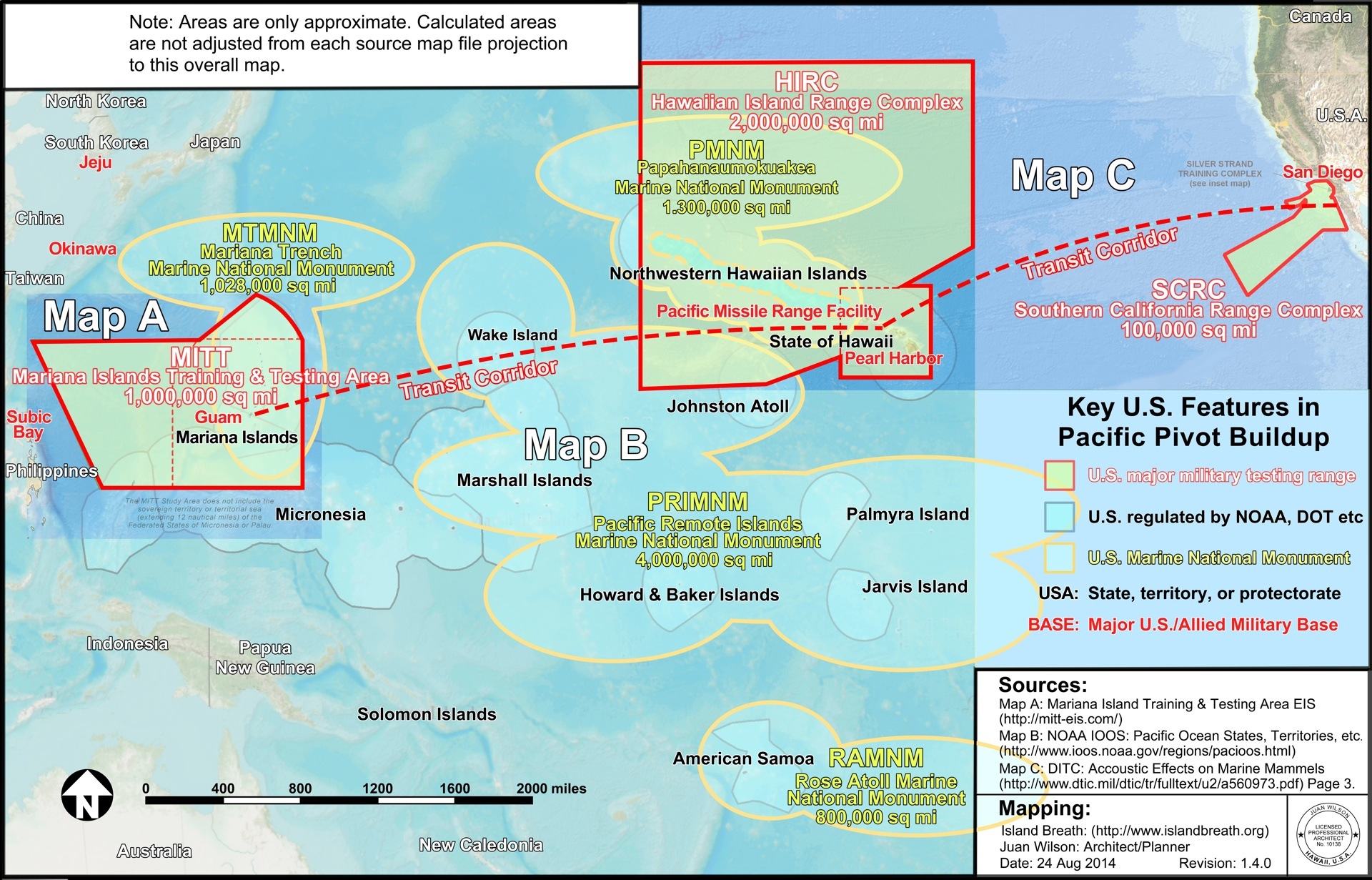
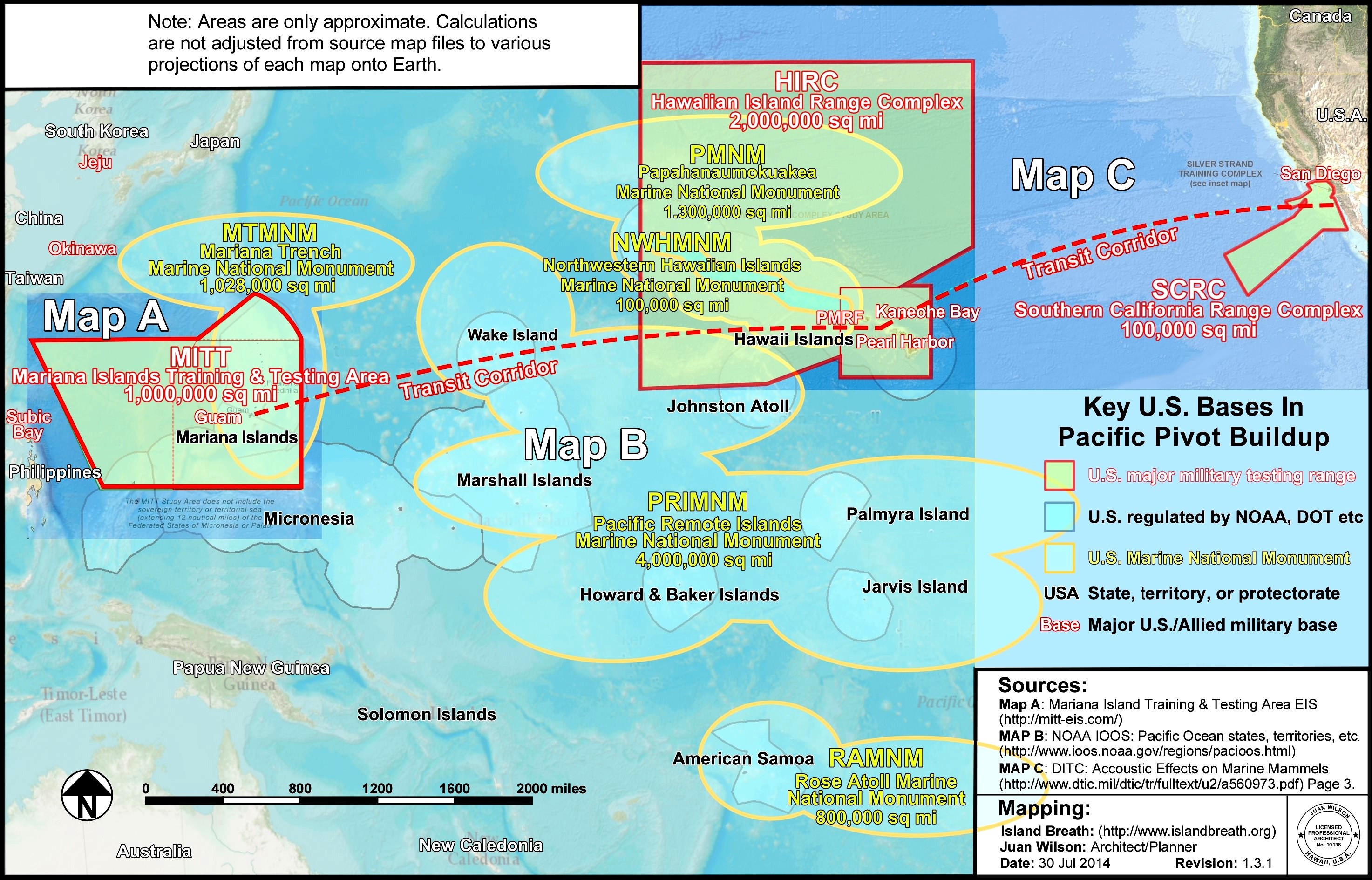
[IB Publisher's note: It is true that this is an imperial expansion into the South China Sea bounded by Vietnam, the Philippines Malaysia, Brunei and of interest also to Japan. However America's is flexing its "Super Power" muscles against China in that part of the world is a bit of imperial stretch for the USA. We have already made claim to much of the Pacific Ocean with out weapons testing/exercise areas and national ocean "monuments" See (http://islandbreath.blogspot.com/2014/10/a-new-colinization-of-pacific.html) and (http://islandbreath.blogspot.com/search/label/Strategic%20Islands). Isn't China entitled to some empire too?]


Image above: USS Lassen in 2001. From (www.navsource.org/archives/05/01082.htm).

Well, the US navy vessel Lassen sailed within 12-nautical miles of Subi Reef and surprisingly, World War III did not break out overnight.

Nine months of tension between Washington and Beijing over the latter’s land reclamation efforts in The South China Sea culminated on Monday with President Obama’s decision to send a guided missile destroyer to China’s man-made military outposts on a “freedom of navigation” exercise. As we put it on Monday evening:
"The ball is now squarely in China's court. The question now is whether Beijing will back down and concede that "sovereignty" somehow means something different with regard to the islands than it does with respect to the mainland or whether Xi will stick to his guns (no pun intended) and take a pot shot at a US destroyer."
In short, some feared that based on recent rhetoric out of Beijing (e.g. the PLA will “stand up and use force”) that China might actually fire upon the US-flagged vessel or at least move to surround it in what might mark the first step on the road to war.

Ultimately, that didn't happen as China apparently decided to take the high road for now and avoid an escalation that might have had far-reaching consequences.


Image above: Map of From (http://globalnation.inquirer.net/125704/ph-govt-makes-impassioned-plea-at-the-hague).

That said, Beijing isn't happy. Here's more from Bloomberg:

China said it will take “all necessary measures” to defend its territory after the U.S. sailed a warship through waters claimed by China in the disputed South China Sea, a move the government in Beijing called a threat to peace and stability in Asia.

“The behavior of the U.S. warship threatened China’s sovereignty and national interest, endangered the safety of the island’s staff and facilities, and harmed the regional peace and stability,” Foreign Ministry spokesman Lu Kang said in a statement today. “The Chinese side expressed its strong discontent and firm opposition.”

The comments came hours after the USS Lassen passed within 12-nautical miles of Subi Reef, an island built by China as a platform to assert its claim to almost 80 percent of one of the world’s busiest waterways. By passing so close to the man-made island, the U.S. is showing it doesn’t recognize that the feature qualifies for a 12-nautical mile territorial zone under international law.

The patrol marks the most direct attempt by the U.S. to challenge China’s territorial claims and comes weeks after President Barack Obama told President Xi Jinping at a Washington summit that the U.S. would enforce freedom of navigation and that China should refrain from militarizing the waterway. 

In a strongly-worded statement, Lu said the USS Lassen had “illegally” entered Chinese waters and that “relevant Chinese departments monitored, shadowed and warned the U.S. ship.” China has “indisputable” sovereignty over the Spratly Islands and surrounding waters, Lu said.

“What the U.S. is doing now will only damage the stability in the South China Sea, and send the wrong message to neighboring nations such as the Philippines and encourage them to take some risky behavior,” said Xu Liping, a professor of Southeast Asian studies at the Chinese Academy of Social Sciences, a government-linked institute.

Image above: Artificial islands, like this one planned to be built by China over Mabini Reef. From (http://www.philstar.com/headlines/2014/06/04/1330967/designs-chinas-planned-base-mabini-reef-surface).

While it's not entirely clear what professor Xu Liping means by "encourage the Philippines to take some risky behavior," it's worth noting that Washington's provocation is in some respects explicity designed to embolden America's regional allies. That is, this isn't going on in Washington's backyard.

This is simply the US responding to calls from its friends in the South Pacific to counter what they view as Chinese aggression by letting Beijing know that Big Brother isn't going to stand for any bullying from the PLA. That gambit appears to have paid off - for the time being.

As for what comes next, Malcolm Davis, an assistant professor in China-Western relations at Bond University on Australia’s Gold Coast tells Bloomberg China could move to set up a no-fly zone:
China may choose to respond without directly challenging U.S. ships with its Navy or coast guard. It could declare an Air Defense Identification Zone over the South China Sea, or speed up the militarization of the area by deploying extra forces, including combat aircraft, to the islands. 

“The ball would then be back in the U.S.’s court,” Davis said. “A Chinese attempt to enforce an ADIZ over the South China Sea would increase tensions with its neighbors, most notably Vietnam, the Philippines and Malaysia, and they would place increasing pressure on Washington not to back down.”
In other words, China doesn't need to fire on a US destroyer to ratchet up the pressure. Beijing can simply continue to do what it's done up until now; that is, militarize the region and essentially dare the US to take action beyond sailing by and waving.

We suspect we'll see plenty of new satellite images over the coming weeks and months which purport to show the extent to which the PLA is beefing up its defenses in the face of unnecessary (not to mention extremely petty) posturing on Washington's part.

http://www.islandbreath.org/2014Year/10/141022uspivotbig.jpg
Image above: Detail of map of Marine Monuments and US Military Range Complexes and major bases in the Pacific claimed by the United States of America. by Juan Wilson produced for Koohan Paik. Click to see entire map. From (http://islandbreath.blogspot.com/2014/06/the-pacific-pivot.html).


.

US military moves in Philippines

SUBHEAD: As the US "Enhances" military cooperation in the Philippines, a complicated relationship is challenged.

By Jon Letman on 29 December 2014 for TruthOut.org -
(http://www.truth-out.org/news/item/28245-as-the-us-enhances-military-cooperation-in-the-philippines-a-complicated-relationship-is-challenged)


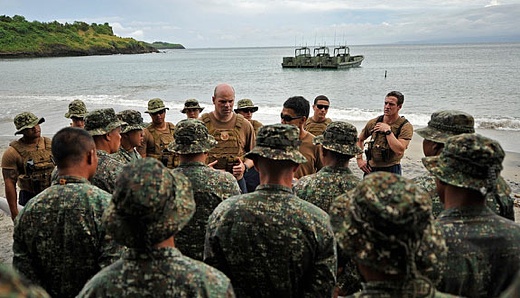
Image above: US forces conduct small boat fundamentals training with Philippine Marine Corps force reconnaissance Marines during Philippine Bilateral Exercise (PHIBLEX) at Philippine Marine Base Ternate, September, 2013. From original article. (Photo: Mass Communications Specialist 2nd Class Gary Granger Jr. / US Navy)

Six months into a new defense agreement designed to "enhance" military ties between the United States and the Philippines, the case of Jennifer Laude is putting strain on a long and complicated alliance. Laude, a transgender Filipina, was found dead on October 11 in a motel room in Olangapo City near the former US naval base at Subic Bay while US forces were on a "liberty" (recreational shore leave) visit.

Witnesses say Laude was seen entering the motel with US Marine Pfc. Joseph Scott Pemberton who was charged with Laude's murder. Pemberton, for whom Philippine authorities have issued an arrest warrant, remains in US custody inside a Philippine military base. Laude's death (she was strangled and drowned in a toilet) has stoked resentment and anger against the US military presence in its former colony.

Despite increased tensions stemming from Laude's death, the US and Philippine governments remain committed to close military ties.

Speaking in April, Philippine President Benigno Aquino III called the United States a "key ally, a strategic partner and a reliable friend of the Philippines" as he marked the signing of a new bilateral executive agreement called the Enhanced Defense Cooperation Agreement (EDCA).

Under the EDCA, the United States gains greater access to Philippine military bases and other "agreed locations" where it can station troops and pre-position aircraft, weapons and other supplies - all without rent or utility fees. According to US Pacific Command (PACOM), the EDCA will facilitate joint training and exercises and help both nations "resist armed attack."

PACOM spokesman Maj. David Eastburn said in an email that "enhanced cooperation" is intended to "improve the readiness and capabilities of the [Armed Forces of the Philippines (AFP)]" and address issues like maritime security awareness, counterterrorism, and humanitarian and disaster relief.
According to Eastburn, in 2014, the United States rotated more than 3,700 military personnel through the Philippines as the two nations conducted 425 "signed activities," the highest number ever for a single year. US forces are station

Speaking from Quezon City, Corazon Valdez-Fabros of the Stop the War Coalition Philippines asked how long "temporary" rotations would last. "It could be six months, a year or more," she said.
In fact, the EDCA includes a provision for its automatic extension at the end of its 10-year term.

Unlike the 1951 Mutual Defense Treaty (MDT) and 1999 Visiting Forces Agreement (VFA), the EDCA did not require ratification by the US or Philippine Senate.

More than two decades after the Philippine Senate refused to renew agreements that would have allowed the US naval base at Subic Bay and Clark Airbase to remain open, the EDCA grants the United States the most flexibility and access to the Philippines since 1992.

"This is very different from the bases we used to have . . . where you knew where foreign military troops were located. [Now] they can be located anywhere under the 'agreed location' provision," Valdez-Fabros said.
Critics of the US military presence call Laude's death the latest affront to Philippine sovereignty and human rights, citing past crimes, pollution and environmental impacts as reasons they want to reduce or end US-Philippine military cooperation.

Regional Instability
Proponents of the EDCA, however, insist on the need for greater military cooperation pointing to China's territorial claims in the disputed Spratly Islands and South China Sea, which is believed to hold significant oil and gas deposits.

In a report for the Center for a New American Security, Richard D. Fisher Jr., a senior fellow on Asian military affairs with the International Assessment and Strategy Center, wrote, "Washington has an interest in making it easier for Manila to acquire excess US fighters, frigates and other weapons systems."

Fisher added, "the US should continue to encourage deeper Philippine strategic engagement . . . to enhance Manila's role in securing this region that is so pivotal to East Asian security."

Renato Reyes Jr., secretary general of Bayan, a Manila-based national social justice organization, disagrees, saying that until US forces leave the Philippines, his nation will remain dependent on the United States and "second-hand military hardware."

"The sooner the US is out of our country, the better for the Philippines," Reyes said.

In response to PACOM claims that enhanced military cooperation will allow the United States to respond more quickly and effectively in offering disaster relief, Reyes says that after the devastating Typhoon Yolanda (Haiyan) in 2013, many countries sent volunteers and assistance. "So why is it that the US is the only country pushing for a military agreement in exchange for so-called humanitarian assistance and disaster response?"

Carlos Conde, a Manila-based researcher with Human Rights Watch (HRW), says a broad section of Philippine society is ambivalent or supportive of closer US-Philippine military ties. "The thing about the US military is that they are actually quite popular . . . This is probably one of the few places in the world where the US military is welcome with open arms," Conde said.

But US-Philippine military cooperation is at its murkiest in the restive southern Philippines where both indigenous Muslim groups and Communist insurgencies have battled with the central Philippine government for decades.

Since 2001, the island of Mindanao and surrounding islands have been part of a so-called second front in the war on terror where the US Joint Special Operations Task Force Philippines operated a shadowy campaign against Islamist groups Jemaah Islamiyah and Abu Sayyaf for more than a decade.

In 2005, The New York Times reported on suspected US drone strikes in the region, and again in a 2012 article, shortly after a report published by the Brookings Institution alleged the use of weaponized drones in the southern Philippines.

In 2013, Philippine media outlets published reports about US efforts to establish a drone base on Mindanao.
According to PACOM, today the United States has "just under 200 personnel" at Camp Navarro on Mindanao, a number it says will decline further in 2015 as the United States shifts to rotational elements.

Shadow Wars
Over the last dozen years, the US military has focused much of its efforts in Mindanao on anti-terrorism training with the AFP. On this ethnically and religiously diverse island, rich in mineral resources like gold, silver, copper, nickel and zinc, foreign mining and plantation operations are known for using the AFP to protect their interests.

"It's no secret in the Philippines, particularly in Mindanao, that the Philippine military acts openly as the security forces of these big companies," HRW's Conde said. The highly militarized state of Mindanao where the US-trained AFP clashes with paramilitary forces causes further resentment of the US military presence.

Victoria Tauli-Corpuz, executive director of the Tebtebba Foundation, a global indigenous rights organization, points to more than 100 mining claims nationwide, many of which overlap with indigenous ancestral lands, setting the stage for conflict between native peoples and resource developers.

"It's so easy to justify the entry of military forces, especially when some indigenous communities are [located] where other armed groups are found," Tauli-Corpuz said.

Conde says the presence of US troops does not improve the human rights situation in Mindanao and may indirectly make it worse. "The US is behaving like an uncle that plays with his nephew, spoils him with toys, but holds no moral authority over him and looks the other way when there's bad behavior."

Zaynab Ampatuan is the executive director of the Moro People's Community Organization for Reform and Empowerment, a human rights and environmental NGO in central Mindanao that is opposed to any US military presence.

"The effects of the heightened military presence by both the US and Philippines leads to sporadic displacements, particularly of women and children," Ampatuan said by email.

She fears the EDCA will perpetuate injustice in Mindanao. "We don't need any military intervention to resolve our local problems here. [It] will mean more evacuations, damage, illiteracy, fear, insecurity and violence . . . not just for Mindanao, but for the entire nation."

.

Voila - World War Three

SUBHEAD: Things are happening at lightning speed over in the region and beware of how the turmoil spreads from one flashpoint to another.

By James Kunstler on 30 June 2014 for Kunstler.com-
(http://kunstler.com/clusterfuck-nation/voila-world-war-three/)


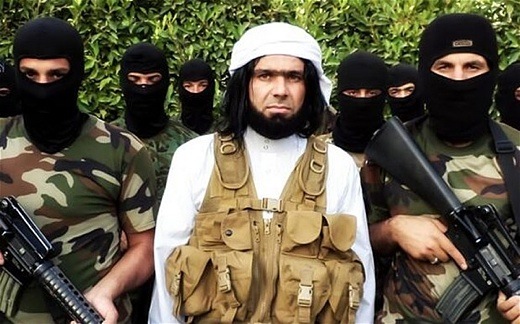
Image above: Shakir Wahiyib is a feared enforcer for ISIS who does not cover up his face in videos of his killings. From (http://www.telegraph.co.uk/news/worldnews/middleeast/iraq/10899901/Iraq-crisis-the-bare-faced-ISIS-executioner-who-spreads-terror-with-his-open-killing.html).

[IB Publisher's note: As the Great Collapse and Peak Everything continue their relentless path the US continues to slip into irrelevancy. We thrash and gnash our teeth we are lossing ground in many foreign landscapes including Eastern Europe, the Middle East and South China Sea. We are seriously challenged by China and Russia and want our hegemony back. It's way late for that.]

Whoever really runs things these days for the semi-mummified royal administration down in Saudi Arabia must be leaving skid-marks in his small-clothes thinking about Abu Bakr al-Baghdadi and his ISIS army of psychopathic killers sweeping hither and thither through what is again being quaintly called “the Levant.”

ISIS just concluded an orgy of crucifixions up in Syria over the weekend, the victims being other Islamic militants who were not radical enough, or who had dallied with US support.

Crucifixion sends an interesting and complex message to various parties around this systemically fracturing globe. It’s a step back from the disabling horror of video beheadings, but it still packs a punch. For the Christian West, it re-awakens a certain central cultural narrative that had gone somnolent there for a century or so. ISIS’s message: If you thought the Romans were bad…. Among the human race, you see, the memories linger.

ISIS has successfully shocked the world over the last two weeks by negating eight years, several trillion dollars, and 4,500 battle deaths in the USA’s endeavor to turn Iraq into an obedient oil dispensary. Now they have gone and announced that their conquests of the moment amount to a Caliphate, that is, an Islamic theocracy.>

In that sense, they are at least out-doing America’s Republican Party, which has been trying to do something similar here from sea to shining sea but finds itself thwarted by hostile blue states on both coasts.

More to the point, the press (another quaint term, I suppose) is not paying any attention whatsoever to what goes down with ISIS and the other states besides Iraq and Syria in the region. I aver to Saudi Arabia especially because Americans seem to regard it as an impregnable bastion against the bloodthirsty craziness spreading over the rest of the Muslim world.

Saudi Arabia is, of course, the keystone of OPEC. Saudi Arabia has had the distinction of remaining stable through all the escalating tumult of recent decades, reliably pumping out its roughly 10 million barrels a day like Bossy the cow in America’s oil import barn.

Or seeming to remain stable, I should say, because the Saud family royal administration of mummified rulers and senile princes looks more and more like a Potemkin monarchy every month. 90-year-old King Abdullah has been rumored to be on life support lo these last two years, his successor brothers already dead and gone, and other powerful Arabian clans with leaders who can walk across a room and speak itching to kick this zombie Saud family off the throne.

To make matters worse, the Sauds have also managed to sponsor much of the organized Sunni terrorism in the region (around the world, really) in their role as the chief enemy of the Shia ­— as represented by the politicized clergy of Iran.

Things are happening at lightning speed over in the region and beware of how the turmoil spreads from one flashpoint to another. This would be an opportunity for ISIS to put the Saud family on the spot regarding the just-announced Caliphate — as in the question: who really calls the shots for this new theocratic kingdom? (Answer: maybe not you, doddering, mummified, America suck-up Saudi Arabia).

What’s more, what happens to the other kingdoms and rickety states in that corner of the world? For instance, Lebanon, which has been a sort of political demolition derby for three decades.

The founder of the group al Qaeda in Iraq (AQI), pre-cursor to ISIS, was the Lebanese Abu Mus‘ab al-Zarqawi — blown up in a USA air strike some years ago. Lebanon has been under the sway of Hezbollah for a decade and Hezbollah is sponsored by Shi’ite Iran, making it an enemy of ISIS. Might ISIS roll westward over Hezbollah now to capture the pearl of the Mediterranean (or what’s left of it) Beirut? I wouldn’t be surprised.

Then there’s Jordan, and it’s youngish King Abdullah, another notorious USA ass-kisser. Those crucifixion photos coming out of Syria must be making him a little loose in the bowels. And, of course, Syria, where this whole thing started, is a smoldering rump-roast of a state. And finally, that bugbear in the bull’s-eye of the old Levant: Israel.

It is miraculous that Israel has managed so far to stay out of the way of this juggernaut. Of course, among its chief enemies are Hezbollah and Hezbollah’s foster father, Iran, which happen to be the enemy of ISIS and, of course, in that part of the world the enemy of my enemy is my ally — though, I’m sorry, it’s rather impossible to imagine Israel getting all chummy with the psychopaths of ISIS.

One thing is a fact: all other things being equal, Israel has the capability of turning any other state or kingdom in the region into an ashtray, if push came to shove. Voila: World War Three.


Ukraine attacks as cease fire ends 

SUBHEAD:  Russian  stressed the need to extend the cease-fire and also establish a reliable mechanism for monitoring it.

By Laura Smith park & Alia Eshchenko on 1 July 2014 for CNN -
(http://www.cnn.com/2014/07/01/world/europe/ukraine-crisis/)


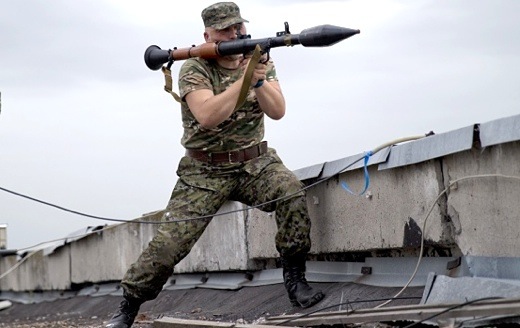
Image above: A pro-Russian rebel prepares to fire a rocket propelled grenade during clashes as they attack a border guard base held by Ukrainian troops. From (http://www.ctvnews.ca/world/russia-calls-un-meeting-to-seek-cease-fire-in-ukraine-1.1849601).

Ukrainian forces began military operations in the east of the country Tuesday, marking a definite end to a unilateral cease-fire that had been in place for 10 days.

The speaker of Ukraine's parliament, Oleksandr Turchynov, told lawmakers the government's "anti-terror operation" against pro-Russia separatists had been "renewed."

Ukrainian armed forces have been conducting "attacks on terrorists' bases and defended posts," he said.

The announcement came hours after Ukrainian President Petro Poroshenko said that his country would not renew a cease-fire with the separatists, vowing instead to "attack and liberate our land."

"Termination of cease-fire is our response to terrorists, insurgents, marauders ... and (those who) deprive people of normal peaceful life," Poroshenko said.

In a statement on his website, Poroshenko congratulated Ukraine's armed forces and border guards for re-establishing control over the checkpoint at Dolzhanskyi, in "the first victory since the restoration of the CTO," a reference to the government's Counterterrorist Operation. He said the armed forces and the State Border Service of Ukraine regained control over the checkpoint and combat engineers removed mines from the checkpoint and adjacent roads.

Violence flared Tuesday in Donetsk, one of the cities at the heart of the separatist unrest.

Interior Minister Arsen Avakov, on his official Facebook page, said that militants had launched an attack on a regional police headquarters building in Donetsk, killing one police officer and badly injuring two more.

Avakov said the police were barricaded inside the building in the city of Donetsk and that the fighting was ongoing.

The Interior Ministry later said three people were seriously injured -- one woman and two special forces policemen. Three others were injured and hospitalized, the ministry said.

Police successfully fought back the attack, the ministry said on its website.

On its website, the Donetsk regional state administration said Ukrainian forces attacked the central part of Kramatorsk from the air and ground. A bus attack in Kramatorsk left four people dead and five others injured. The statement did not say which side in the conflict carried out that attack.

Yuriy Stets, information security head for the National Guard and a parliamentarian, told CNN that the National Guard had regained control of Zakotne, near Slovyansk, and were targeting two other towns.

Cease-fire hopes dashed

The fragile cease-fire expired at midnight Monday, hours after Poroshenko spoke by phone with Russian President Vladimir Putin, German Chancellor Angela Merkel and French President Francois Hollande. Poroshenko also talked on the phone with U.S. Secretary of State John Kerry.

The cease-fire -- agreed on last month amid a volatile political crisis -- raised hopes that Ukraine could be moving back from the brink of full-fledged civil war.

As part of a peace plan, Poroshenko urged the rebels to lay down their arms and engage in talks. He also called for the strengthening of Ukraine-Russia border controls, the freeing of hostages and changes to the constitution to decentralize power.

In his statement, Poroshenko said the militants had failed to take up a "unique opportunity" to support the peace plan and had instead violated the unilateral cease-fire more than 100 times.

Putin, addressing Russian diplomats in Moscow, said he regretted the decision to end the cease-fire.

"Unfortunately, President Poroshenko decided to resume a military operation. I and my EU colleagues could not convince him" of the need to settle the crisis peacefully.

Putin: 'Only on equal terms'

Putin said Russia had been obliged to annex Ukraine's Crimea region in March in order to prevent NATO forces entering, which would have created "a completely different alignment of forces."

He told the diplomats that they would "face growing pressure in defending national interests" and that "the events provoked by the West in Ukraine have become a concentrated political expression of deterrence toward Russia."

Putin also referred to Russia's tense relationship with the United States, suggesting that the current crisis was born of the West's attempts to impose its own way of doing things on the rest of the world.

"Our relationship with the United States is not the best at the moment," he said.

"We have always tried to be predictable partners, handle business on an equal basis, but in return our legal interests were partially ignored and are still ignored. Russian and U.S. contacts have a great meaning for the entire world.

"We are ready for constructive dialogue, but again I emphasize only on equal terms."

Russia's ambassador to the European Union, Vladimir Chizhov, said Tuesday that the refusal to extend the cease-fire is a "negative sign," the Russian Foreign Ministry said on Twitter.

"This makes it even harder to understand the logic of how the confirmation of the so-called 15-point peace plan correlates with the refusal to prolong truce," Chizhov was quoted as saying by state news agency ITAR-Tass.

'Enemies and invaders'

Poroshenko declared in a late-night televised address that the cease-fire was over.

In Kiev's Independence Square, known as Maidan, activists outside the presidential administration building applauded Poroshenko's stance.

"We need only military actions," a priest named Valentyn said in a Reuters interview. "We were forced by those who entered our country as enemies and invaders."

The crisis has its roots in former President Viktor Yanukovych's decision last year to shun a European Union Association Agreement and turn toward Russia instead. The move unleashed deadly strife that led to Yanukovych's ouster, Ukraine's loss of Crimea, and a pro-Russia separatist rebellion. Russia also massed troops along its western border with Ukraine.

The Association Agreement, which will bring closer trade and political ties between Ukraine and Europe, was finally signed by Poroshenko and European leaders last week.

After Monday's phone call, Poroshenko said his goal was peace but insisted it takes the participation of all parties to maintain stability, noting violations of the cease-fire by pro-Russia separatists.

The Ukrainian government "has been completely fulfilling its commitments and unilaterally complying with the ceasefire regime for 10 days and paid dozens of lives for that," he said.

Peace talks were held last week among Ukrainian government officials, pro-Russia separatists from the restive eastern Luhansk and Donetsk regions, Russian officials, and members of the Organization for Security and Cooperation in Europe.

'Bloody truce'

Activist Vadym told Reuters there was no point in continuing the cease-fire.

"There is definitely no need for an extension of the truce," he said. "Because a lot of our boys died during this truce."

Fellow activist Yulia agreed.

"Bloody military actions are better than such bloody truce," she said. "We must put an end to it once and that's all."

A statement from Putin's press office about the call said the Russian President "stressed the need to extend the cease-fire and also establish a reliable mechanism for monitoring" it.


Philippine & US troops at South China Sea

SUBHEAD: More than 200 US and Filipino Marines launched a mock amphibious assault on Monday on an enemy beachfront close to a disputed South China Sea outcrop.

By AFP Staff on 30 June 2014 in Channel News - 
(http://www.channelnewsasia.com/news/asiapacific/philippine-us-troops-hold/1222692.html)


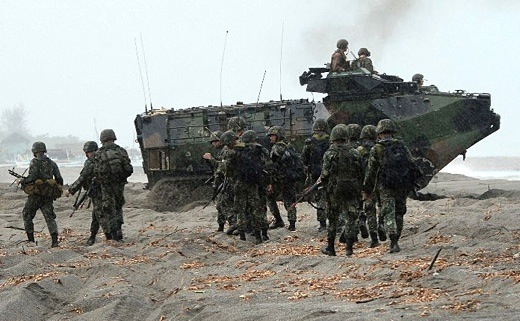
Image above: Philippine Marines walk past a US Marine amphibious assault vehicle during a mock beach assault as part of Cooperation Afloat Readiness and Training (CARAT14) during RIMPAC14.)

More than 200 US and Filipino Marines launched a mock amphibious assault on Monday on an enemy beachfront close to a disputed South China Sea outcrop.

Amid driving rain and rough waves, five amphibious assault tanks roared off from a US destroyer anchored off Zambales province, about two hours drive northwest of Manila, and landed on the soggy beach peppered with imaginary foes.

US Marines scanned the horizon on scopes mounted on assault rifles as they dramatically emerged from the hatch, while their Filipino counterparts took firing positions on the ground.

Shots later rang out towards enemy positions in an assault that lasted about an hour.

The drill was part of week-long, annual Cooperation Afloat Readiness and Training that the United States bilaterally holds with Asian allies, including the Philippines, to boost maritime security.

About 1,000 US and Filipino troops and five warships, including an American missile destroyer, took part in the training, which began last week.

Philippine fleet commander Jaime Bernardino told reporters at the start of the war games last week that they were designed to upgrade the Filipino navy's capability in guarding the country's long coastline.

"These are the gaps that we would like to address (to) make sure we detect (foreign vessels) properly, we intercept them and we neutralise them if necessary," he had said.

Monday's exercise took place on an uninhabited beach near a naval outpost on Zambales on Luzon island, 220 kilometres (137 miles) east of Scarborough Shoal on the South China Sea.

The shoal, a traditionally-rich fishing ground, has been effectively taken over by China following a tense year-long stand-off with the Philippines in 2012.

China claims nearly all of the South China Sea, including waters near its smaller neighbours' shores.
It has been accused of becoming increasingly aggressive in staking its claims to the sea, a vital shipping lane also believed to contain vast oil and mineral deposits. Parts of the sea are also claimed by Brunei, Malaysia, Vietnam and Taiwan.

Filipino military officials had said the manoeuvres were designed to plug "capability gaps" within the Philippine military, considered one of the weakest in the region.

The Philippines has increasingly looked at the United States to boost its military capabilities amid the Chinese threat.

In recent years, the Philippine acquired two US ships to patrol its coasts.

In April, the allies signed a defence pact that would see thousands of US troops stationed in the country in the next decade, including in Subic Bay.


Clearing way for wider military role
SUBHEAD: Japan opens door for Self Defense Force use abroad; Abe says risk of war lessens.

By Staff on 1 July 2014 for Asahi Shimbun -
(http://ajw.asahi.com/article/behind_news/politics/AJ201407010053)


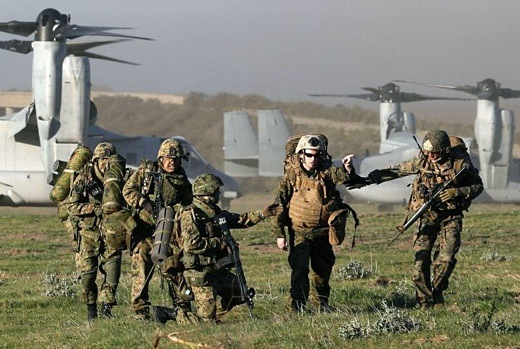
Image above American Marines and Japanese special Self Defense Force members emerge from US Osprey helicopters for joint  battle simulation in California. From original article.

Prime Minister Shinzo Abe is poised to achieve his long-held goal of reinterpreting Article 9 of the Constitution to allow Japan to exercise its right to engage in collective self-defense under the U.N. Charter.

In February, Abe reconvened an advisory panel of security experts for the first time since his previous, short-lived stint as prime minister nearly six years ago. He also appointed Ambassador to France Ichiro Komatsu, a collective defense advocate, as new head of the Cabinet Legislation Bureau, which has long upheld the ban on collective defense according to the government’s current interpretation of Article 9, which renounces the use of force to settle international disputes.

Reinterpreting Article 9, which Abe eventually hopes to amend, would be a big change for a nation that has effectively had a defense-only posture since the war.

Here are some questions and answers on collective self-defense and interpreting the Constitution:

What is the right?
Article 51 of the United Nations Charter authorizes member states to exercise collective self-defense — the use of force to defend an ally under armed attack.

Japan thus has this right under international law, but the government has banned its use because it implies the use of force beyond what is necessary to defend Japan.

Article 9 states: “Aspiring sincerely to an international peace based on justice and order, the Japanese people forever renounce war as a sovereign right of the nation and the threat or use of force as means of settling international disputes.

“In order to accomplish the aim of the preceding paragraph, land, sea, and air forces, as well as other war potential, will never be maintained. The right of belligerency of the state will not be recognized.”
The present interpretation dates to a report submitted to the Diet in 1972 by the then-Liberal Democratic Party-led government. The report said Japan as a sovereign state is entitled to the right to collective self-defense under international law but cannot exercise it under Article 9.

This stance was repeated in 1981. Then-LDP Prime Minister Zenko Suzuki’s Cabinet said in a written response submitted to the Lower House that Article 9 allows only minimum self-defense and any collective activity would go beyond that scope, thus the exercise of that right is banned by the Constitution, which took effect in 1947. This interpretation stands.

Collective self-defense did not become a major bone of contention until 1960, when the Japan-U.S. Security Treaty was revised and questions were raised about whether the Constitution allows Japan to send the Self-Defense Forces overseas to defend an ally.

As demands from the U.S. for Japan to boost its defense cooperation increased in the 1980s and as the SDF started to participate in joint military exercises with the U.S., the debate heated up, leading the government to clarify Japan’s stance on the use of force other than for its own defense.

Why has Abe been eager to change the status quo?
The general argument has been that Japan needs to strengthen its security alliance with the U.S. to counter North Korea’s growing missile and nuclear threats and China’s expanding military might and provocations in the East China Sea. Cybersecurity and terrorism are also new angles Japan needs to consider, experts say.

What did the advisory panel set up in 2007 discuss?
Abe presented four hypothetical scenarios to the panel in 2007, asking them to determine if Japan can act on them.

In response, the panel compiled a report in 2008 recommending Japan be allowed to use force in all the scenarios, which included: shooting down a ballistic missile headed toward the U.S.; defending U.S. military ships on the high seas that are in joint operations with the SDF; using arms in U.N.-led peacekeeping operations to defend allied troops; and providing logistic support for U.N.-led troops fighting overseas.

After Abe stepped down in 2007, the panel in June 2008 submitted its recommendations to his successor, Yasuo Fukuda, who took no further action.

When Abe revived the panel in February, he picked the same 13 experts, headed by ex-Ambassador to the U.S. Shunji Yanai, to resume talks on lifting the self-imposed ban. The panel plans to make its recommendations by year’s end.

Will the same four scenarios be revisited?
The panel is reportedly expected to discuss more than the four hypothetical cases this time.
It will also consider extending the parameters of collective self-defense to include other countries than the U.S. They also plan to weigh whether to aid countries that defend sea lanes to protect oil shipments from the Middle East, reports said.

International University President Shinichi Kitaoka, the panel’s acting chairman, said in a recent interview with Kyodo News that its new report will state Japan can exercise the right of collective self-defense when “countries with close ties” are under attack.

Although Kitaoka said the panel won’t specify which countries Japan may seek to defend, Australia, South Korea and Southeast Asian nations were floated at its February meeting.

Last week, Kitaoka said his team is also looking at allowing Japan to engage in U.N.-led collective security — as allowed by the U.N. Charter. This is an arrangement whereby nations agree to take joint action against a state that attacks any one of them.

Can the government engage in collective self-defense merely by reinterpreting Article 9?
No. It will also need to change any laws related to the execution of the right, including the Self-Defense Forces Law, to stipulate the procedures and other details needed for the SDF to do so.

What opposition would a reinterpretation face?
The Japanese Communist Party, the Social Democratic Party and even the LDP’s junior partner, New Komeito, are opposed to reinterpreting Article 9 and collective self-defense in any way.

But lifting the ban would also draw heavy criticism from China and what is now South Korea, which suffered heavily from Japanese conquest during the war.


See also:
Ea O Ka Aina: The Pacific Pivot 6/28/14
Ea O Ka Aina: Kauai's PMRF is bang out of sight 6/26/14
Ea O Ka Aina: RIMPAC IMPACT 6/8/14
Ea O Ka Aina: RIMPAC Then and Now 5/16/14
Ea O Ka Aina: Earthday TPP Fukushima RIMPAC 4/22/14
Ea O Ka Aina: The Asian Pivot - An ugly dance 12/5/13
Ea O Ka Aina: Help save Mariana Islands 11/13/13
Ea O Ka Aina: End RimPac destruction of Pacific 11/1/13 
Ea O Ka Aina: Moana Nui Confereence 11/1/13
Ea O Ka Aina: Navy to conquer Marianas again  9/3/13
Ea O Ka Aina: Pagan Island beauty threatened 10/26/13
Ea O Ka Aina: Sleepwalking through destruction 7/16/12
Ea O Ka Aina: Okinawa breathes easier 4/27/12
Ea O Ka Aina: Navy Next-War-Itis 4/13/12
Ea O Ka Aina: America bullies Koreans 4/13/12
Ea O Ka Aina: Despoiling Jeju island coast begins 3/7/12
Ea O Ka Aina: Jeju Islanders protests Navy Base 2/29/12
Ea O Ka Aina: Hawaii - Start of American Empire 2/26/12
Ea O Ka Aina: Korean Island of Peace 2/26/12   
Ea O Ka Aina: Military schmoozes Guam & Hawaii 3/17/11
Ea O Ka Aina: In Search of Real Security - One 8/31/10
Ea O Ka Aina: Peace for the Blue Continent 8/10/10
Ea O Ka Aina: Shift in Pacific Power Balance 8/5/10
Ea O Ka Aina: RimPac to expand activities 6/29/10
Ea O Ka Aina: RIMPAC War Games here in July 6/20/10
Ea O Ka Aina: Pacific Resistance to U.S. Military 5/24/10
Ea O Ka Aina: Guam Land Grab 11/30/09
Ea O Ka Aina: Guam as a modern Bikini Atoll 12/25/09
Ea O Ka Aina: GUAM - Another Strategic Island 11/8/09
Ea O Ka Aina: Diego Garcia - Another stolen island 11/6/09
Ea O Ka Aina: DARPA & Super-Cavitation on Kauai 3/24/09
Island Breath: RIMPAC 2008 - Navy fired up in Hawaii 7/2/08
Island Breath: RIMPAC 2008 uses destructive sonar 4/22/08
Island Breath: Navy Plans for the Pacific 9/3/07
Island Breath: Judge restricts sonar off California 08/07/07
Island Breath: RIMPAC 2006 sonar compromise 7/9/06
Island Breath: RIMPAC 2006 - Impact on Ocean 5/23/06
Island Breath: RIMPAC 2004 - Whale strandings on Kauai 9/2/04
Island Breath: PMRF Land Grab 3/15/04 .

Powder Keg in the Pacific

SUBHEAD: While war clouds gather in the Pacific sky, the question remains: Why, pray tell, is this happening now?

By Michael Klare on 22 January 2013 for Tom Dispatch -
(http://www.tomdispatch.com/post/175640/tomgram%3A_michael_klare%2C_the_next_war)


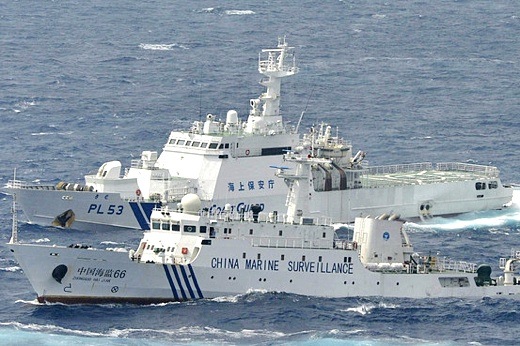
Image above: A Chinese surveillance ship (front) gets close to a Japanese coast guard vessel in East China Sea. From (http://online.wsj.com/article/SB10000872396390444358804578015873329670886.html).

Don’t look now, but conditions are deteriorating in the western Pacific. Things are turning ugly, with consequences that could prove deadly and spell catastrophe for the global economy.

In Washington, it is widely assumed that a showdown with Iran over its nuclear ambitions will be the first major crisis to engulf the next secretary of defense -- whether it be former Senator Chuck Hagel, as President Obama desires, or someone else if he fails to win Senate confirmation. With few signs of an imminent breakthrough in talks aimed at peacefully resolving the Iranian nuclear issue, many analysts believe that military action -- if not by Israel, then by the United States -- could be on this year’s agenda.

Lurking just behind the Iranian imbroglio, however, is a potential crisis of far greater magnitude, and potentially far more imminent than most of us imagine. China’s determination to assert control over disputed islands in the potentially energy-rich waters of the East and South China Seas, in the face of stiffening resistance from Japan and the Philippines along with greater regional assertiveness by the United States, spells trouble not just regionally, but potentially globally.

Islands, Islands, Everywhere

The possibility of an Iranian crisis remains in the spotlight because of the obvious risk of disorder in the Greater Middle East and its threat to global oil production and shipping. A crisis in the East or South China Seas (essentially, western extensions of the Pacific Ocean) would, however, pose a greater peril because of the possibility of a U.S.-China military confrontation and the threat to Asian economic stability.

The United States is bound by treaty to come to the assistance of Japan or the Philippines if either country is attacked by a third party, so any armed clash between Chinese and Japanese or Filipino forces could trigger American military intervention. With so much of the world’s trade focused on Asia, and the American, Chinese, and Japanese economies tied so closely together in ways too essential to ignore, a clash of almost any sort in these vital waterways might paralyze international commerce and trigger a global recession (or worse).

All of this should be painfully obvious and so rule out such a possibility -- and yet the likelihood of such a clash occurring has been on the rise in recent months, as China and its neighbors continue to ratchet up the bellicosity of their statements and bolster their military forces in the contested areas. Washington’s continuing statements about its ongoing plans for a “pivot” to, or “rebalancing” of, its forces in the Pacific have only fueled Chinese intransigence and intensified a rising sense of crisis in the region. Leaders on all sides continue to affirm their country’s inviolable rights to the contested islands and vow to use any means necessary to resist encroachment by rival claimants. In the meantime, China has increased the frequency and scale of its naval maneuvers in waters claimed by Japan, Vietnam, and the Philippines, further enflaming tensions in the region.

Ostensibly, these disputes revolve around the question of who owns a constellation of largely uninhabited atolls and islets claimed by a variety of nations. In the East China Sea, the islands in contention are called the Diaoyus by China and the Senkakus by Japan. At present, they are administered by Japan, but both countries claim sovereignty over them. In the South China Sea, several island groups are in contention, including the Spratly chain and the Paracel Islands (known in China as the Nansha and Xisha Islands, respectively). China claims all of these islets, while Vietnam claims some of the Spratlys and Paracels. Brunei, Malaysia, and the Philippines also claim some of the Spratlys.

Far more is, of course, at stake than just the ownership of a few uninhabited islets. The seabeds surrounding them are believed to sit atop vast reserves of oil and natural gas. Ownership of the islands would naturally confer ownership of the reserves -- something all of these countries desperately desire. Powerful forces of nationalism are also at work: with rising popular fervor, the Chinese believe that the islands are part of their national territory and any other claims represent a direct assault on China’s sovereign rights; the fact that Japan -- China’s brutal invader and occupier during World War II -- is a rival claimant to some of them only adds a powerful tinge of victimhood to Chinese nationalism and intransigence on the issue. By the same token, the Japanese, Vietnamese, and Filipinos, already feeling threatened by China’s growing wealth and power, believe no less firmly that not bending on the island disputes is an essential expression of their nationhood.

Long ongoing, these disputes have escalated recently. In May 2011, for instance, the Vietnamese reported that Chinese warships were harassing oil-exploration vessels operated by the state-owned energy company PetroVietnam in the South China Sea. In two instances, Vietnamese authorities claimed, cables attached to underwater survey equipment were purposely slashed. In April 2012, armed Chinese marine surveillance ships blocked efforts by Filipino vessels to inspect Chinese boats suspected of illegally fishing off Scarborough Shoal, an islet in the South China Sea claimed by both countries.

The East China Sea has similarly witnessed tense encounters of late. Last September, for example, Japanese authorities arrested 14 Chinese citizens who had attempted to land on one of the Diaoyu/Senkaku Islands to press their country’s claims, provoking widespread anti-Japanese protests across China and a series of naval show-of-force operations by both sides in the disputed waters.

Regional diplomacy, that classic way of settling disputes in a peaceful manner, has been under growing strain recently thanks to these maritime disputes and the accompanying military encounters. In July 2012, at the annual meeting of the Association of Southeast Asian Nations (ASEAN), Asian leaders were unable to agree on a final communiqué, no matter how anodyne -- the first time that had happened in the organization’s 46-year history. Reportedly, consensus on a final document was thwarted when Cambodia, a close ally of China’s, refused to endorse compromise language on a proposed “code of conduct” for resolving disputes in the South China Sea. Two months later, when Secretary of State Hillary Rodham Clinton visited Beijing in an attempt to promote negotiations on the disputes, she was reviled in the Chinese press, while officials there refused to cede any ground at all.
As 2012 ended and the New Year began, the situation only deteriorated. On December 1st, officials in Hainan Province, which administers the Chinese-claimed islands in the South China Sea, announced a new policy for 2013: Chinese warships would now be empowered to stop, search, or simply repel foreign ships that entered the claimed waters and were suspected of conducting illegal activities ranging, assumedly, from fishing to oil drilling. This move coincided with an increase in the size and frequency of Chinese naval deployments in the disputed areas.

On December 13th, the Japanese military scrambled F-15 fighter jets when a Chinese marine surveillance plane flew into airspace near the Diaoyu/Senkaku Islands. Another worrisome incident occurred on January 8th, when four Chinese surveillance ships entered Japanese-controlled waters around those islands for 13 hours. Two days later, Japanese fighter jets were again scrambled when a Chinese surveillance plane returned to the islands. Chinese fighters then came in pursuit, the first time supersonic jets from both sides flew over the disputed area. The Chinese clearly have little intention of backing down, having indicated that they will increase their air and naval deployments in the area, just as the Japanese are doing.

While war clouds gather in the Pacific sky, the question remains: Why, pray tell, is this happening now?

Several factors seem to be conspiring to heighten the risk of confrontation, including leadership changes in China and Japan, and a geopolitical reassessment by the United States.

* In China, a new leadership team is placing renewed emphasis on military strength and on what might be called national assertiveness. At the 18th Party Congress of the Chinese Communist Party, held last November in Beijing, Xi Jinping was named both party head and chairman of the Central Military Commission, making him, in effect, the nation’s foremost civilian and military official. Since then, Xi has made several heavily publicized visits to assorted Chinese military units, all clearly intended to demonstrate the Communist Party’s determination, under his leadership, to boost the capabilities and prestige of the country’s army, navy, and air force. He has already linked this drive to his belief that his country should play a more vigorous and assertive role in the region and the world.

In a speech to soldiers in the city of Huizhou, for example, Xi spoke of his “dream” of national rejuvenation: “This dream can be said to be a dream of a strong nation; and for the military, it is the dream of a strong military.” Significantly, he used the trip to visit the Haikou, a destroyer assigned to the fleet responsible for patrolling the disputed waters of the South China Sea. As he spoke, a Chinese surveillance plane entered disputed air space over the Diaoyu/Senkaku islands in the East China Sea, prompting Japan to scramble those F-15 fighter jets.

* In Japan, too, a new leadership team is placing renewed emphasis on military strength and national assertiveness. On December 16th, arch-nationalist Shinzo Abe returned to power as the nation’s prime minister. Although he campaigned largely on economic issues, promising to revive the country’s lagging economy, Abe has made no secret of his intent to bolster the Japanese military and assume a tougher stance on the East China Sea dispute.

In his first few weeks in office, Abe has already announced plans to increase military spending and review an official apology made by a former government official to women forced into sexual slavery by the Japanese military during World War II. These steps are sure to please Japan’s rightists, but certain to inflame anti-Japanese sentiment in China, Korea, and other countries it once occupied.

Equally worrisome, Abe promptly negotiated an agreement with the Philippines for greater cooperation on enhanced “maritime security” in the western Pacific, a move intended to counter growing Chinese assertiveness in the region. Inevitably, this will spark a harsh Chinese response -- and because the United States has mutual defense treaties with both countries, it will also increase the risk of U.S. involvement in future engagements at sea.

* In the United States, senior officials are debating implementation of the “Pacific pivot” announced by President Obama in a speech before the Australian Parliament a little over a year ago. In it, he promised that additional U.S. forces would be deployed in the region, even if that meant cutbacks elsewhere. “My guidance is clear,” he declared. “As we plan and budget for the future, we will allocate the resources necessary to maintain our strong military presence in this region.” While Obama never quite said that his approach was intended to constrain the rise of China, few observers doubt that a policy of “containment” has returned to the Pacific.

Indeed, the U.S. military has taken the first steps in this direction, announcing, for example, that by 2017 all three U.S. stealth planes, the F-22, F-35, and B-2, would be deployed to bases relatively near China and that by 2020 60% of U.S. naval forces will be stationed in the Pacific (compared to 50% today). However, the nation’s budget woes have led many analysts to question whether the Pentagon is actually capable of fully implementing the military part of any Asian pivot strategy in a meaningful way. A study conducted by the Center for Strategic and International Studies (CSIS) at the behest of Congress, released last summer, concluded that the Department of Defense “has not adequately articulated the strategy behind its force posture planning [in the Asia-Pacific] nor aligned the strategy with resources in a way that reflects current budget realities.”

This, in turn, has fueled a drive by military hawks to press the administration to spend more on Pacific-oriented forces and to play a more vigorous role in countering China's "bullying" behavior in the East and South China Seas. “[America’s Asian allies] are waiting to see whether America will live up to its uncomfortable but necessary role as the true guarantor of stability in East Asia, or whether the region will again be dominated by belligerence and intimidation,” former Secretary of the Navy and former Senator James Webb wrote in the Wall Street Journal. Although the administration has responded to such taunts by reaffirming its pledge to bolster its forces in the Pacific, this has failed to halt the calls for an even tougher posture by Washington. Obama has already been chided for failing to provide sufficient backing to Israel in its struggle with Iran over nuclear weapons, and it is safe to assume that he will face even greater pressure to assist America’s allies in Asia were they to be threatened by Chinese forces.

Add these three developments together, and you have the makings of a powder keg -- potentially at least as explosive and dangerous to the global economy as any confrontation with Iran. Right now, given the rising tensions, the first close encounter of the worst kind, in which, say, shots were unexpectedly fired and lives lost, or a ship or plane went down, might be the equivalent of lighting a fuse in a crowded, over-armed room. Such an incident could occur almost any time. The Japanese press has reported that government officials there are ready to authorize fighter pilots to fire warning shots if Chinese aircraft penetrate the airspace over the Diaoyu/Senkaku islands. A Chinese general has said that such an act would count as the start of "actual combat." That the irrationality of such an event will be apparent to anyone who considers the deeply tangled economic relations among all these powers may prove no impediment to the situation -- as at the beginning of World War I -- simply spinning out of everyone’s control.

Can such a crisis be averted? Yes, if the leaders of China, Japan, and the United States, the key countries involved, take steps to defuse the belligerent and ultra-nationalistic pronouncements now holding sway and begin talking with one another about practical steps to resolve the disputes. Similarly, an emotional and unexpected gesture -- Prime Minister Abe, for instance, pulling a Nixon and paying a surprise goodwill visit to China -- might carry the day and change the atmosphere. Should these minor disputes in the Pacific get out of hand, however, not just those directly involved but the whole planet will look with sadness and horror on the failure of everyone involved.
• Michael Klare is a professor of peace and world security studies at Hampshire College, a TomDispatch regular, and the author, most recently, of The Race for What’s Left, just published in paperback.  A documentary movie based on his book Blood and Oil can be previewed and ordered at www.bloodandoilmovie.com. You can follow Klare on Facebook by clicking here.

.

Philippine Organic Transition

SUBHEAD: After decades of chemicals, farmers in the Philippines are seeing the benefits of organic farming. But what convinced them to make the switch in the first place? By John Cavanagh & Robin Broad on 31 January 2011 for Yes! - (http://www.yesmagazine.org/blogs/john-cavanagh-and-robin-broad/buying-only-2-percent-of-what-you-eat) Image above: Presentation during an organic farming seminar in Calamba City, the Philippines. From (http://www.sulit.com.ph/index.php/view+classifieds/id/1860306/Organic+Farming+Seminar,+Calamba+City).

We spend an afternoon with Gil and Teresa, who have farmed one and a quarter hectares of non-irrigated land in the southern Philippines since 1973. We walk into their land through a line of young trees, past a row of pineapples, and over a narrow patch of rice. Chickens wander the yard with chaotic authority. We sit on a bench in their front yard, shaded by an impressive diversity of fruit trees: mango, pomelo, and others.

Rice farmers, we discover, are like the rest of us in that they do not like to change their ways unless they are convinced that change will bring tangible benefits. Several families of rice farmers in three Philippine provinces showed us clear evidence that organic rice was better than rice grown with chemical inputs in reducing costs, in improving the health of the farmer and consumer, and in preserving the soil, water, and environment.

But, we wanted to know, what triggered farmers to make the switch from decades of chemical farming to a more “rooted” organic agriculture?

Gil starts their story, with Teresa standing quietly by his side. They farmed with chemicals for over a quarter century until 1999, when Gil, tired of being in debt, went to a training by the Don Bosco Foundation on sustainable agriculture. “I was sick of the loans and the high costs of conventional farming.”

Gil started with a small portion of his land, where he planted “zero-chem” rice in one plot and string beans on two. “I really wanted to try what I learned in the seminar. I wanted to leave chemicals.” His wife Teresa was skeptical: “I thought zero-chem would mean zero-caldero [nothing in the pot].”

According to Gil, Teresa “was very happy because we harvested two big basins of string beans and we were able to earn money even before the rice harvest. It was the string beans that did the trick.” They quickly diversified the farm to other fruits and vegetables so that today, a decade later, they have enough healthy food to feed their family, and they are virtually self-sufficient. According the Gil: “Only about 2 percent of what we eat comes from outside the farm: salt, some cooking oil, spices. That’s it.”

A couple of miles down the road, another couple, Romeo and Elsie, describes their conversion. We join them in an open-air bamboo hut at the side of their home and their 5 hectares of irrigated rice fields. Romeo, quiet with a powerful build, starts in his native language: “Elsie was the key person because she is in charge of the finances on the farm. Already during land preparation, we regularly incurred debts from the middle-men and the lenders. By harvest time, there was very little left, sometimes not even enough to repay the lenders and get new loans for the next cropping. That was the cycle; always lots of debt.”

Elsie continues: “Romeo was no longer inspired [to farm] since nothing was left for us after the harvest. Sometimes he wondered why he was even going through with the harvest.”

So, they too attended a Don Bosco training on sustainable agriculture. This time it was Romeo who was skeptical: “If I’m not going to spray chemicals, how will there be a harvest?” So they compromised. They did a trial on one of their five hectares, the one that Elsie inherited from her father. The result was phenomenal as far as they were concerned: Costs plummeted and the yield was only slightly less. Recalls Romeo: “The experience of that one hectare was more powerful than the training.”

Elsie is now extremely animated as she describes the full conversion of all 5 hectares to organic: “Our debts have been repaid. Our four children have finished their schooling. We can buy used or even new clothing. And, our health has improved.” And, they tell us, two of their children are working, trying to save enough money to buy land so that they too can do sustainable farming.

We want to learn more about the conversion of farmers like Gil, Teresa, Elsie and Romeo, so we visit the director of the Don Bosco Foundation. Betsy Adarna, a petite woman with short, black curly hair and seemingly boundless energy, runs the foundation, which has trained these two couples along with thousands of other farmers in a version of sustainable agriculture called “biodynamic” farming.

In addition to spreading traditional seed varieties and recipes for natural fertilizers and pesticides (more on these “concoctions” in our next blog), biodynamics trains farmers to know the right time to plant and harvest in sync with cycles of the moon: for example, you do not want to harvest in a full moon since it attracts many pests. And, biodynamic farming emphasizes a healthy lifestyle and a reverence of the plants one is growing. “It’s not simply farming,” one farmer explains to us. “It’s healing the earth.”

Betsy is fighting the expansion of banana plantations, which are not only encroaching on rice land, but are also “hijacking” the water needed by rice farmers. And, with financial assistance from Europe, the Don Bosco Foundation helped a group of farmers purchase a large rice mill so that they can maintain their independence from the rice traders and other “middle-men.” Don Bosco also has six retail stores. Betsy and Don Bosco are demonstrating that sustainable farming can work on a large-scale, from farm to retail.

As we learn in the Philippines, a number of nonprofits like Don Bosco are helping speed this transition to organic. The Philippine Rural Reconstruction Movement and other nonprofits, for example, launched a large “Go-Organic” coalition in 2009 that aims to increase organic rice farming to 10 percent of the Philippine’s rice land. A dynamic network of organizations called Rice Watch and Action Network (R1) provides policy ideas to help government, with its army of agricultural extension workers and its key role in upgrading irrigation canals, play a strong role.

But still, the transition occurs farmer by farmer and, at the end of the day, new farmers will make the conversion when they see the real benefits on the ground, as did Teresa and Gil and Romeo and Elsie.

• John Cavanagh and Robin Broad wrote this article for YES! Magazine, a national, nonprofit media organization that fuses powerful ideas with practical actions. Robin is a Professor of International Development at American University in Washington, D.C. and has worked as an international economist in the U.S. Treasury Department and the U.S. Congress. John is on leave from directing the Institute for Policy Studies, and is co-chair (with David Korten) of the New Economy Working Group. They are co-authors of three books on the global economy, and are currently traveling the country and the world to write a book entitled "Local Dreams: Finding Rootedness in the Age of Vulnerability".

.