
SUBHEAD: Collapse for the middlemen-skimmers is akin to the collapse of debt-based serfdom. It's called freedom.
By Charles Hugh Smith on 11 February 2014 for Of Two Minds -
(http://www.oftwominds.com/blogfeb14/middlemen2-14.html)
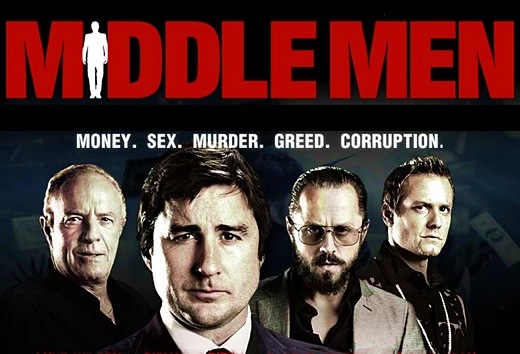
Image above: Detail of movie poster fr film "Middlemen" From (http://sorabhsamsukha.blogspot.com/2011/11/movie-review-middle-men.html).
The Internet is enabling sellers and buyers to bypass the predatory State and the parasitic middlemen the State enforces.
Why do we read commentaries and analyses? To understand why the Status Quo is dying and to have a hand in shaping the new way of living that will replace it. Longtime correspondent Zeus Y. recently encapsulated the core dynamic of our era:
There's a couple of things we need to understand about middlemen before we can grasp the revolutionary nature of a social/community economy.
A middleman adds value to both supplier and buyer by making transactions faster, easier and cheaper. A bank, for example, clears payments made with checks, and takes depositors' savings and loans the money out at interest to borrowers. Both of these transactions are fraught with various risks and complications, and the bank charges a fee for taking on the management of the transactions.
A wholesaler adds value by providing a market for both sellers and buyers that enables a transfer of risks and transaction costs to the wholesaler in exchange for lower prices to the seller and higher prices to the buyer.
The keys to this middleman economy are transparency, voluntary choices and the competition that arises in transparent voluntary markets. Middleman economies function for both sellers and buyers only as long as all transactions are voluntary and the costs and risks of using middlemen are transparent to all participants.
The problem, as Marx foresaw, is that profits are always at risk in such a competitive marketplace. Middlemen who raise their prices enough to skim big profits are soon abandoned by sellers and buyers who can get lower transaction costs elsewhere.
The ideal system for middlemen is the exact opposite of an open competitive market: low-risk fat profits flow to monopolies or cartels that obscure costs, and turn sellers and buyers into involuntary participants who have no other choice but to give money to the middlemen.
This is the middleman-skimming economy, in which middlemen are free to skim enormous profits from participants who've been left no other choice. The classic skimming middleman is of course the State (government), which holds a monopoly on violence and other forms of coercion (for example, threats from the F.B.I.: Green is the new red: Will Potter on the problem of treating environmentalists like terrorists).
Everyone who thinks the State is a warm and fuzzy uncle here to help the disadvantaged should study these paragraphs closely:
I really want to think that I wouldn’t be affected by something like that, especially given my activist background, but it just scared the daylights out of me. It really did. That fear eventually turned into an obsession with finding out how this happened, how nonviolent protestors are being labeled as terrorists.
They knew everywhere I worked, they knew my editors at the Tribune, they knew different journalism awards I received — and their message was, “Help us or we’re going to put you on a different path.” And they kept saying, “Don’t throw all this away.” And so at one point, I just said, “What are you going to make go away?
This is a class C misdemeanor for leafletting, there’s no way it’s going to hold up in court, and you’re talking about ruining my life.” I of course never became an informant, and never thought about doing anything like that, but — it changed the focus of my work, without a doubt.
There's your warm and fuzzy State in action. I can attest from personal experience that these are exactly the same tactics used to suppress, undermine and criminalize the anti-war movement in the late 1960s and 70s.
The State is thus the ultimate skimming middleman: Every transactional fee is set by a monopoly seeking maximum profit and/or leverage from every transaction.
In our middleman-skimming economy, the State partners with various private cartels to fix prices, guaranteeing immense profits for the corporate cartels and the State functionaries who enforce the involuntary trade.
Would you like to see the "competitive" healthcare available in your area? It turns out all the insurance plans are ultimately operated by two companies in the cartel--ditto for the hospitals, Big Pharma medications, and so on.
How about our "competitive" national defense weapons industry? Oops, there's only a handful of suppliers--or in many cases, one supplier. Here's your $1,000 hammer--sorry about the high cost, but our overhead costs include very large bribes paid to politicos under the polite guise of "campaign donations." We're sure you understand (snicker).
Higher education is another middleman-skimming operation. Want a degree that may (or may not) still have a few shreds of "value" in the real economy? Pony up $100,000, buster, or better yet, make that $200,000. Here's the friendly Federal government which will issue you the loans to pay us.
Oh, and these loans can't be discharged in bankruptcy--they're due and payable for the rest of your days (with rare exceptions that require a full-time legal team and many years of effort).
In a no-middleman system such as the one I propose in The Nearly Free University and The Emerging Economy: The Revolution in Higher Education, students (buyers) pay the lecturers, working professionals/mentors, adaptive learning providers, etc. directly, cutting out the middleman universities entirely because the system is based on the professional model of accredit the student, not the institution.
The same elimination of middleman-skimming is possible in a cash-barter only healthcare system: The "Impossible" Healthcare Solution: Go Back to Cash (July 29, 2009).
The Internet is enabling sellers and buyers to bypass the predatory State and the parasitic middlemen the State enforces. Banks--no longer needed. Sickcare cartels--no longer needed. Higher education cartel--no longer needed.
If you still think all these cartels are essential, please re-read the article on how people find new ways of living and interacting once the corrupt skimming operations of the State and cartels collapse.
After Crisis, Greeks Work to Promote ‘Social’ Economy.
Collapse of this system is akin to the collapse of debt-based serfdom. It's called freedom, and it's only a disaster for the middlemen-skimmers. For the rest of us, it's a new arrangement with many advantages over the long term.
.
By Charles Hugh Smith on 11 February 2014 for Of Two Minds -
(http://www.oftwominds.com/blogfeb14/middlemen2-14.html)
Image above: Detail of movie poster fr film "Middlemen" From (http://sorabhsamsukha.blogspot.com/2011/11/movie-review-middle-men.html).
The Internet is enabling sellers and buyers to bypass the predatory State and the parasitic middlemen the State enforces.
Why do we read commentaries and analyses? To understand why the Status Quo is dying and to have a hand in shaping the new way of living that will replace it. Longtime correspondent Zeus Y. recently encapsulated the core dynamic of our era:
"Here's the deal between the two worlds right now: the Status Quo is dying but trying to take everything with it and the other is trying to hold the old world up enough to avoid complete collapse, buy time, and construct the airplane of the new world, all while flying."Humans avoid changing current arrangements until there is no choice left but to change them--usually when the arrangement collapses in a heap. Greece is an interesting example of just this dynamic: the political parties left, right and center are desperate to keep the corrupt Status Quo intact, while those whose slice of the swag has vanished have already moved on to new arrangements that no longer depend on Central State swag or the many layers of middlemen that skimmed off most of the wealth for various monopolies, cartels and Elites:
After Crisis, Greeks Work to Promote ‘Social’ EconomyHere's the Status Quo arrangement: the Elites trying to take everything they can before their vast skimming arrangement finally collapses:
Corruption in the EU and Greece (Acting Man)
Greek official bribed 'more times than he can remember'
At the time, Mr. Kantas, a wiry former military officer, did not actually have the authority to decide much of anything on his own. But corruption was so rampant inside the Greek equivalent of the Pentagon that even a man of his relatively modest rank, he testified recently, was able to amass nearly $19 million in just five years on the job.
Corruption across EU 'breathtaking' (BBC)It's instructive to study the key strategy in Greece's social/community economy: get rid of the middleman.
There's a couple of things we need to understand about middlemen before we can grasp the revolutionary nature of a social/community economy.
A middleman adds value to both supplier and buyer by making transactions faster, easier and cheaper. A bank, for example, clears payments made with checks, and takes depositors' savings and loans the money out at interest to borrowers. Both of these transactions are fraught with various risks and complications, and the bank charges a fee for taking on the management of the transactions.
A wholesaler adds value by providing a market for both sellers and buyers that enables a transfer of risks and transaction costs to the wholesaler in exchange for lower prices to the seller and higher prices to the buyer.
The keys to this middleman economy are transparency, voluntary choices and the competition that arises in transparent voluntary markets. Middleman economies function for both sellers and buyers only as long as all transactions are voluntary and the costs and risks of using middlemen are transparent to all participants.
The problem, as Marx foresaw, is that profits are always at risk in such a competitive marketplace. Middlemen who raise their prices enough to skim big profits are soon abandoned by sellers and buyers who can get lower transaction costs elsewhere.
The ideal system for middlemen is the exact opposite of an open competitive market: low-risk fat profits flow to monopolies or cartels that obscure costs, and turn sellers and buyers into involuntary participants who have no other choice but to give money to the middlemen.
This is the middleman-skimming economy, in which middlemen are free to skim enormous profits from participants who've been left no other choice. The classic skimming middleman is of course the State (government), which holds a monopoly on violence and other forms of coercion (for example, threats from the F.B.I.: Green is the new red: Will Potter on the problem of treating environmentalists like terrorists).
Everyone who thinks the State is a warm and fuzzy uncle here to help the disadvantaged should study these paragraphs closely:
At the Tribune, I was covering breaking news, shootings, murders and local government, and it was all horribly depressing. It was not the type of thing I went into journalism to do. I had a background in college in environmental activism, and protesting the World Trade Organization and the economic sanctions on Iraq, and I wanted to be involved in something positive like that again.
So I went out leafletting with a group of people. We just passed out pieces of paper in a residential neighborhood about animal testing. I thought that was the most I could do as a working journalist — something so benign. And of course, since I have the worst luck ever, we were all arrested and charged. It was the only time I’ve been arrested. Those charges were later thrown out, of course. It was a frivolous arrest. And it’s still lawful to pass out handbills.A couple weeks later, I was visited by two FBI agents at my home, who told me that unless I helped them by becoming an informant and investigating protest groups, they would put me on a domestic terrorist list. They also made some threats about making sure I wouldn’t receive a Fulbright I had applied for, and making sure my girlfriend at the time wouldn’t receive her PhD funding.
I really want to think that I wouldn’t be affected by something like that, especially given my activist background, but it just scared the daylights out of me. It really did. That fear eventually turned into an obsession with finding out how this happened, how nonviolent protestors are being labeled as terrorists.
They knew everywhere I worked, they knew my editors at the Tribune, they knew different journalism awards I received — and their message was, “Help us or we’re going to put you on a different path.” And they kept saying, “Don’t throw all this away.” And so at one point, I just said, “What are you going to make go away?
This is a class C misdemeanor for leafletting, there’s no way it’s going to hold up in court, and you’re talking about ruining my life.” I of course never became an informant, and never thought about doing anything like that, but — it changed the focus of my work, without a doubt.
There's your warm and fuzzy State in action. I can attest from personal experience that these are exactly the same tactics used to suppress, undermine and criminalize the anti-war movement in the late 1960s and 70s.
Pimping the Empire, Conservative-StyleSubstitute middleman-skimming operation for empire and you get the basic idea.
Pimping the Empire, Progressive-Style
The State is thus the ultimate skimming middleman: Every transactional fee is set by a monopoly seeking maximum profit and/or leverage from every transaction.
In our middleman-skimming economy, the State partners with various private cartels to fix prices, guaranteeing immense profits for the corporate cartels and the State functionaries who enforce the involuntary trade.
Would you like to see the "competitive" healthcare available in your area? It turns out all the insurance plans are ultimately operated by two companies in the cartel--ditto for the hospitals, Big Pharma medications, and so on.
How about our "competitive" national defense weapons industry? Oops, there's only a handful of suppliers--or in many cases, one supplier. Here's your $1,000 hammer--sorry about the high cost, but our overhead costs include very large bribes paid to politicos under the polite guise of "campaign donations." We're sure you understand (snicker).
Higher education is another middleman-skimming operation. Want a degree that may (or may not) still have a few shreds of "value" in the real economy? Pony up $100,000, buster, or better yet, make that $200,000. Here's the friendly Federal government which will issue you the loans to pay us.
Oh, and these loans can't be discharged in bankruptcy--they're due and payable for the rest of your days (with rare exceptions that require a full-time legal team and many years of effort).
In a no-middleman system such as the one I propose in The Nearly Free University and The Emerging Economy: The Revolution in Higher Education, students (buyers) pay the lecturers, working professionals/mentors, adaptive learning providers, etc. directly, cutting out the middleman universities entirely because the system is based on the professional model of accredit the student, not the institution.
The same elimination of middleman-skimming is possible in a cash-barter only healthcare system: The "Impossible" Healthcare Solution: Go Back to Cash (July 29, 2009).
The Internet is enabling sellers and buyers to bypass the predatory State and the parasitic middlemen the State enforces. Banks--no longer needed. Sickcare cartels--no longer needed. Higher education cartel--no longer needed.
If you still think all these cartels are essential, please re-read the article on how people find new ways of living and interacting once the corrupt skimming operations of the State and cartels collapse.
After Crisis, Greeks Work to Promote ‘Social’ Economy.
Collapse of this system is akin to the collapse of debt-based serfdom. It's called freedom, and it's only a disaster for the middlemen-skimmers. For the rest of us, it's a new arrangement with many advantages over the long term.
.
