Showing posts with label Marijuana. Show all posts

Save Earth planting Weed

SUBHEAD: The cheapest fastest way to avoid climate collapse and extinction is to plant cannabis.

By Ellen Brown on 24 July 2019 for TruthDig -
(https://www.truthdig.com/articles/the-cheapest-way-to-save-the-planet-grows-like-a-weed/)
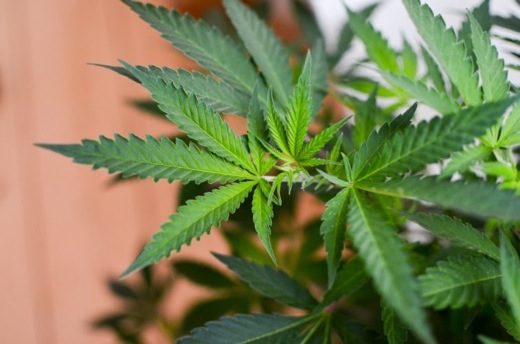

Image above: Closeup of marijuana leaf. From original article.

Planting billions of trees across the world is by far the cheapest and most efficient way to tackle the climate crisis. So states a Guardian article, citing a new analysis published in the journal Science. The author explains:
As trees grow, they absorb and store the carbon dioxide emissions that are driving global heating. New research estimates that a worldwide planting programme could remove two-thirds of all the emissions that have been pumped into the atmosphere by human activities, a figure the scientists describe as “mind-blowing”.
For skeptics who reject the global warming thesis, reforestation also addresses the critical problems of mass species extinction and environmental pollution, which are well-documented.

A 2012 study from the University of Michigan found that loss of biodiversity impacts ecosystems as much as does climate change and pollution. Forests shelter plant and animal life in their diverse forms, and trees remove air pollution by the interception of particulate matter on plant surfaces and the absorption of gaseous pollutants through the leaves.

The July analytical review in Science calculated how many additional trees could be planted globally without encroaching on crop land or urban areas. It found that there are 1.7 billion hectares (4.2 billion acres) of treeless land on which 1.2 trillion native tree saplings would naturally grow.

Using the most efficient methods, 1 trillion trees could be restored for as little as $300 billion—less than 2% of the lower range of estimates for the Green New Deal introduced by progressive Democrats in February.

The Guardian quoted Professor Tom Crowther at the Swiss university ETH Zürich, who said, “What blows my mind is the scale. I thought restoration would be in the top 10, but it is overwhelmingly more powerful than all of the other climate change solutions proposed.” He said it was also by far the cheapest solution that has ever been proposed.

The chief drawback of reforestation as a solution to the climate crisis, as The Guardian piece points out, is that trees grow slowly. The projected restoration could take 50 to 100 years to reach its full carbon sequestering potential.

A Faster, More Efficient Solution

Fortunately, as of December 2018, there is now a cheaper, faster and more efficient alternative—one that was suppressed for nearly a century but was legalized on a national scale when President Trump signed the Agriculture Improvement Act of 2018.

This is the widespread cultivation of industrial hemp, the nonintoxicating form of cannabis grown for fiber, cloth, oil, food and other purposes. Hemp grows to 13 feet in 100 days, making it one of the fastest carbon dioxide-to-biomass conversion tools available.

Industrial hemp has been proved to absorb more CO2 per hectare than any forest or commercial crop, making it the ideal carbon sink. It can be grown on a wide scale on nutrient-poor soils with very small amounts of water and no fertilizers.

Hemp products can promote biodiversity and reverse environmental pollution by replacing petrochemical-based plastics, which are now being dumped into the ocean at the rate of one garbage truck per minute. One million seabirds die each year from ingesting plastic, and up to 90% have plastic in their guts.

Microplastic (resulting from the breakdown of larger pieces by sunlight and waves) and microbeads (used in body washes and facial cleansers) have been called the ocean’s smog. They absorb toxins in the water, enter the food chain and ultimately wind up in humans. To avoid all that, we can use plastic made from hemp, which is biodegradable and nontoxic.

Other environmental toxins come from the textile industry, which is second only to agriculture in the amount of pollution it creates and the voluminous amounts of water it uses. Hemp can be grown with minimal water, and hemp fabrics can be made without the use of toxic chemicals.

Environmental pollution from the burning of fossil fuels can also be reversed with hemp, which is more efficient and environmentally friendly than wheat and corn as a clean-burning biofuel.

Hemp cultivation also encourages biodiversity in the soil, by regenerating farmland that has long been depleted from the use of toxic chemicals. It is a “weed” and grows like one, ubiquitously, beating out other plants without pesticides or herbicides; and its long taproot holds the soil, channeling moisture deeper into it.

Unlike most forestry projects, hemp can be grown on existing agricultural land and included as part of a farm’s crop rotation, with positive effects on the yields and the profits from subsequent crops.

A Self-Funding Solution

Hemp cultivation is profitable in many other ways—so profitable that it is effectively a self-funding solution to the environmental crisis. According to a Forbes piece titled “Industrial Hemp Is the Answer to Petrochemical Dependency,” crop yields from hemp can range from $20,000 to $50,000 per acre.

Its widespread cultivation can happen without government subsidies. Investment in research, development and incentives would speed the process, but market forces will propel these transformations even if Congress fails to act.

All farmers need for incentive is a market for the products, which hemp legalization has provided. Due to the crop’s century-long suppression, the infrastructure to capitalize on its diverse uses still needs to be developed, but the infrastructure should come with the newly opened markets.

Hemp can break our dependency on petrochemicals, not only for fuel but for plastics, textiles, construction materials and much more. It has actually been grown for industrial and medicinal purposes for millennia, and today it is legally grown for industrial use in hundreds of countries outside the U.S.

Just after the nationwide ban established by the Marihuana Tax Act in 1937, an article in Popular Mechanics claimed it was a billion-dollar crop (the equivalent of about $16 billion today), useful in 25,000 products ranging from dynamite to cellophane.

New uses continue to be found, including eliminating smog from fuels, creating a cleaner energy source that can replace nuclear power, removing radioactive water from the soil and providing a very nutritious food source for humans and animals. Cannabidiol (CBD), a nonpsychoactive derivative of hemp, has recently been shown to help curb opioid addiction, now a national epidemic.

Hemp can also help save our shrinking forests by eliminating the need to clear-cut them for paper pulp. One acre planted in hemp produces as much pulp as 4.1 acres of trees, according to the USDA; and unlike trees, hemp can be harvested two or three times a year. Hemp paper is also finer, stronger and lasts longer than wood-based paper.

Benjamin Franklin’s paper mill used hemp. Until 1883, it was one of the largest agricultural crops (some say the largest), and 80–90% of all paper in the world was made from it. It was also the material from which most fabric, soap, fuel and fiber were made; and it was an essential resource for any country with a shipping industry, since sails were made from it.

In early America, growing hemp was considered so important that it was illegal for farmers not to grow it. Hemp was legal tender from 1631 until the early 1800s, and taxes could even be paid with it.

Banned by the Competition?

The competitive threat to other industries of this supremely useful plant may have been a chief driver of its apparently groundless criminalization in the 1930s. Hemp is not marijuana and is so low in psychoactive components that it cannot produce a marijuana “high.” It was banned for nearly a century simply because it was in the same plant species as marijuana.

Cannabis came under attack in the 1930s in all its forms. Why? Hemp competed not only with the lumber industry but with the oil, cotton, petrochemical and pharmaceutical industries. Many have speculated that it was suppressed by these powerful competitors.

William Randolf Hearst, the newspaper mogul, owned vast tracts of forest land, which he intended to use for making wood-pulp paper. Cheap hemp-based paper would make his forest investments a major money loser. Hearst was a master of “yellow journalism,” and a favorite target of his editorials was “reefer madness.”

He was allied with the DuPont Corporation, which provided the chemicals to bleach and process the wood pulp used in the paper-making process. DuPont was also ready to introduce petroleum-based fibers such as nylon, and hemp fabrics competed with that new market.

In fact, hemp products threatened the entire petroleum industry. Henry Ford first designed his cars to run on alcohol from biofuels, but the criminalization of both alcohol and hemp forced him to switch to the dirtier, less efficient fossil fuels that dominate the industry today.

A biofuel-based infrastructure would create a completely decentralized power grid, eliminating the giant monopolistic power companies. Communities could provide their own energy using easily renewable plants.

None of this is news. Hemp historians have been writing about the crop’s myriad uses and its senseless prohibition for decades. (See “The Emperor Wears No Clothes” by Jack Herer, 1992 and “Hemp for Victory: A Global Warming Solution” by Richard Davis, 2009.)

What is news is that hemp cultivation is finally legal across the country. The time is short to save the planet and its vanishing diversity of species. Rather than engaging in endless debates over carbon taxes and Silicon Valley style technological fixes, we need to be regenerating our soils, our forests and our oceans with nature’s own plant solutions.

.

Derek Kawakami violated our trust

SUBHEAD: Kawakami should have reported his interest in a marijuana dispensary business as required.

By Editorial Board on 31 May 2017 for Civil Beat -
(http://www.civilbeat.org/2017/05/kauai-councilman-violated-the-publics-trust/)


Image above: Photo of Derrick Kawkami as he says 'I am my mother's son,' talking about how the lei given him by supporters reminds him of his mother, and how he misses not having her with the party.' We think he is a manipulative pol who we now know has been corrupted. From (http://thegardenisland.com/news/local/kawakami-tops-race-for-council/article_08e69100-a2fd-560e-b7d2-b83fa080107b.html).

Financial disclosures are, by their definition, somewhat tantalizing. They offer an inside glimpse into government officials’ personal finances, including their sources of income, their investments, their properties and the businesses in which they have a position or interest.

It’s interesting, for example, to explore the state Ethics Commission website and discover that state Sen. Laura Thielen owns from $50,000 to $100,000 in Microsoft stock.

These disclosures help to balance the scales of power in our democracy, ensuring that public servants remain just that — servants — and that we know and understand their motivations and conflicts of interest as best we can.

Given the importance of these required reports, then, it’s disappointing when government officials don’t disclose what they should.

Civil Beat’s Anita Hofschneider reported last week that Kauai County Council Chairman Derek Kawakami failed to disclose that he owns more than 14 percent of a company that’s trying to become licensed to grow and sell medical marijuana in Hawaii.

Asked about the oversight, Kawakami essentially shrugged his shoulders to Hofschneider, saying “there was nothing to disclose,” since his company, HK Medicinal, did not receive a permit from the Department of Health.

But HK Medicinal is still a functional, active company that is currently fighting in court to overturn the department’s decision. If it wins its appeal, it could end up growing and selling cannabis to thousands of patients on Kauai.

Given the ongoing legal battle, the potential for future business in a somewhat controversial industry and Kawakami’s growing involvement in the firm since the death of his father six months ago, Kawakami’s statement that “there was nothing to disclose” comes off as a total disregard for public accountability.

With all due respect to our local and state officials, it’s not up to them to decide what is and isn’t worthy of disclosure.

This is an important reminder since Wednesday is the deadline for state officials to file their annual financial disclosure statements, and June 30 is the deadline for gifts disclosure statements.

The state Ethics Commission tries to help officials determine what should and shouldn’t be disclosed. It offers regular training sessions, “quick guides” to explain the rules and regulations, and even an on-call lawyer who can answer questions confidentially over the phone or email.

If legislators or state officials have any confusion or doubts about whether something should be disclosed or not, they have easy access to help.

And it’s understandable that officials might need it. The bureaucratic red tape surrounding financial disclosures can be cumbersome. We imagine many officials feel both exposed and annoyed by the process.

But more often than not, it seems like politicians like Kawakami use that frustration as an excuse to gloss over their disclosures, as if no one will actually read or be interested in the details.

In addition to holding public servants accountable, these disclosures — or the lack of them — have a major effect on the public’s trust in government. As the Hawaii state ethics code explains it, all these rules and regulations matter “so that public confidence in public servants will be preserved.”

At the national level, we’ve seen what happens when that confidence erodes — currently, only 20 percent of Americans trust the federal government to do the right thing. Local governments have typically fared better, but oversights like Kawakami’s abuse that trust.

If we don’t demand better, our public servants will end up only serving themselves.


.

Can hemp save small farms?

SUBHEAD: As tobacco declines, some hope that hemp can be a “gateway crop” to financial sustainability.

By Catherine V. Moore on 20 July 2016 for Yes Magazine -
(http://www.yesmagazine.org/new-economy/can-industrial-hemp-save-kentuckys-small-farms-20160720)


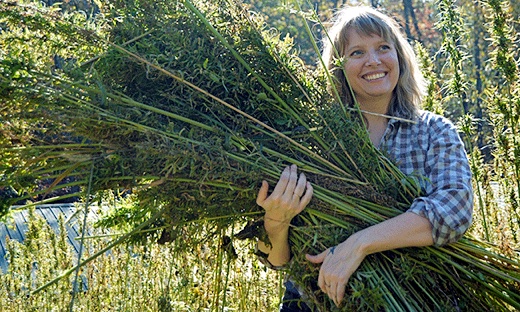
Image above: Lora Smith of Big Switch Farm holds a bundle of hemp. From original article.

At the birth of any industry, uncertainty abounds. So does opportunity, say Kentuckians like Joe Schroeder of Freedom Seed and Feed, who is among those growing industrial hemp and advocating for others in Appalachia to do the same.

“It’s really speculative,” says Schroeder. “But people are making a lot of money, and that money is real.”

But don’t take that talk of money to mean Schroeder is greedy. At a time when the region’s collapsing coal and tobacco industries have left gaping holes in central Appalachia’s economy, at least some of Kentucky’s hemp experimenters want to maximize the benefit to as many local people as possible.

Hemp was so important to early America that colonists in Virginia were required to grow it. A short boom during World War II notwithstanding, the shift to cotton and the anti-marijuana movement put an end to the industry by the mid-20th century.

But in 2014, a new farm bill cleared the way for states to begin research-driven pilot programs to test the crop’s viability in producing fiber, medication, and food. Twenty-seven states, including Kentucky, have passed their own pro-hemp legislation so far. And yet the plant remains a Schedule I controlled substance, in the same category as heroin, LSD, and bath salts.

That’s why Jane Herrod feels like she’s starting from scratch, even though hemp was grown on her family farm near Lexington, Kentucky, as far back as the early 1800s. Hemp may be rife with legal contradiction, but things don’t appear so complicated this afternoon at her farm. The cows graze. The Kentucky River flows. And Herrod, a middle-aged woman with close-cropped grey hair and a deep tan, looks out across her pastureland with obvious joy. She loves this land, and she’s not giving up on it.

Kentucky is home to a vast patchwork of small former tobacco farms like Herrod’s. Beginning in the 1930s, a system of quotas and other price supports from the federal government made tobacco a pretty secure crop to grow, even on a small number of acres. But all that came to a halt in 2004, when these tobacco-friendly policies were discontinued.

A payment system was set up to assist tobacco farmers until they could figure out a replacement crop, but that ended in 2014. Now, with smoking in decline and imported tobacco on the rise, the industry is down to less than a quarter of its size a few decades ago. But the land, much of the infrastructure, and at least some of the farmers are still there.

Hemp advocates hope that reintroducing the crop will help farmers like Herrod keep her 10 tillable acres in production and make money too. But whether and how hemp can justify itself financially on a small farm are open questions and critical ones for Kentuckians to answer if they are to significantly benefit from the potential new industry.

Last year, Herrod hosted a small test plot of hemp on her land, and now she’s applying to grow two acres of the plant for cannabidiol (CBD) oil, one of the highest-value hemp products being tested.

 The oil is used to treat epilepsy and has shown potential for Crohn’s disease, cancer, and autism. She and other growers and processors must go through a lengthy permitting process run by Kentucky’s agriculture department and the Drug Enforcement Agency. This year, 166 applications were approved in the state.

Though she doesn’t expect to get rich, Herrod believes the high-value CBD oil could bring in enough income for her to start building other enterprises and investing in infrastructure on her farm so that she can pass it on to her kids as the income-generating business it used to be. For this reason, some are describing hemp as a “gateway crop” that could help keep family farms viable.

Another strong motivator for Herrod is the opportunity to grow something that heals and feeds people instead of poisoning them. Herrod’s mother, who passed the tobacco farm down to her daughter, died of lung cancer caused by the very crop she raised. Edible hemp seed, on the other hand, packs in omega-3s and -6s, nutritious oils that facilitate healthy nerves. And its flowers contain a host of biochemicals that are being tested for medicinal uses. For all these reasons, Herrod says she’s ready to turn over a new leaf.

“There’s not a negative thing about the plant that I can see, other than you might not be able to make money with it,” Herrod says, laughing. “But I’m going to find out.”

Hemp is defined in the farm bill as cannabis that’s less than 0.3 percent THC content by weight. THC, of course, is the psychoactive chemical in marijuana, which contains 10 percent THC on average.

It’s easy to see why boosters describe hemp as a kind of miracle plant. It’s a sector filled with a certain amount of utopian thinking, especially from marijuana legalization advocates. But not all of the boosters are partaking.

A 1998 study by North Dakota State University estimates that hemp has 25,000 uses, which include food, green building materials, textiles, paper, fuel, body care products, and as a replacement for plastic and fiberglass. BMW even used it in the door panels of its new electric car.

That’s why farmers in China and Europe have been growing hemp for decades. But in the United States, the federal government still considers it a narcotic. And that makes it harder to find buyers, get insurance, and obtain seed.

A flier for prospective hemp growers put out by the Kentucky Department of Agriculture warns that “markets are limited; revenues should not be counted on.” Likewise, a report by the Congressional Research Service last year said it’s impossible to make predictions about sales and employment. Still, the same report describes a “mostly positive market outlook” for hemp, citing “rising consumer demand and the potential range of product uses.”

Right now, how much a farmer can make on hemp depends on what they’re growing it for, and whom you’re asking. Hemp is grown mainly for its fiber, seed, or flowers. The fiber is most often used in textiles or building materials, while seeds are made into nutritious oil, snacks, or livestock feed. Flowers are harvested for pharmaceutical products, including CBD oil.

A 2013 economic study on hemp by the University of Kentucky assumes that farmers can get between 50 and 80 cents per pound for seed. Freedom Seed and Feed, on the other hand, reports getting $12 per pound for the protein-rich, organic hemp seed they sell to a local granola maker.

Meanwhile, the Hemp Industries Association estimates that Americans purchased $620 million in hemp products in 2014. China is America’s biggest supplier of fiber, while Canada provides most of the seed and oilcake (a byproduct of pressing hemp seeds for oil).

Since there’s more money in seed and oil than in fiber, Canada will likely be the major competitor for U.S. hemp farmers. Canada legalized hemp in 1998, so farmers there are now 17 years ahead of American ones.

What kind of money are those Canadian farmers making? According to the Canadian Hemp Trade Alliance, the average hemp grower earned about $550 per acre, annually, for seed. That’s about half of what Kentucky farmers are expecting to earn.

But a huge industrial farm growing oilseed in Canada for a commodity market looks a lot different than Big Switch Farm, nestled in a sloping valley in Jackson County, Kentucky, where Joe Schroeder is harvesting his last sliver of a hemp test plot on a shimmering October morning. His Ray-Bans and blue flannel shirt conceal a farmer’s tan as deep as Jane Herrod’s. The crucial question for both hemp-curious farmers: How small is too small?


Image above: Jane Herrod hopes that high-value CDB oil will help her small farm turn a profit. Photo by Catherine V. Moore. From original article.

Running a chainsaw across a swath of rangy hemp plants, Schroeder is right in the middle of trying to figure out just that. He seeded his test plots at different rates of density to study which ones maximized yield and, more broadly, the economics of growing hemp seed for food and fiber on a small scale. His permit is for five acres, which 18 straight days of rain and one pesky groundhog have not helped.

Schroeder is chief operating officer of Freedom Seed and Feed, one of a handful of private, “values-driven” companies to crop up in the Kentucky hemp play. The company works with nontraditional farmers in the Amish community, who grew 60 acres last year, some in high-CBD varieties. Meanwhile, Schroeder’s business partner, Mike Lewis, is working to turn Kentucky’s war veterans into hemp farmers.

“I have an aspirational approach to the market,” says Schroeder. “A lot of this is about the market you make.”

Freedom Feed and Seed's business model is based on differentiating itself from commodity-based agriculture, which produces high volumes of raw product. Instead, Schroeder’s company is catering to specialized buyers and developing products that fetch higher prices. It simply doesn’t make sense, Schroeder’s logic goes, for a former tobacco farmer on five acres in Kentucky to compete with a grower on a thousand acres in Canada.

The fact that the industry’s in its infancy creates additional opportunities. “We’re going to be able to push for a standard that farmers can survive at,” says Schroeder. “If they get rich too, then that’s a consequence we could deal with.”

One way to ensure farmers get their fair share, Schroeder believes, is to organize cooperatives modeled on those that existed in the tobacco era. These structures offered farmers collective control over who to sell to and at what price, in addition to lowering the cost of production through shared infrastructure and group purchasing. That kind of advocacy is exactly what hemp farmers need to navigate an emerging market, says Schroeder.

The industry may also be able to get help from Washington, D.C. Federal funding is now available to support struggling, coal-reliant communities in Appalachia. Why not use some of this money to, for example, build a hemp processing plant in the layoff-riddled coal country of eastern Kentucky, putting people to work and capturing more of the plant’s value within the region?

Some relatively established companies, like GenCanna Global, are already investing in Kentucky’s fledgling industry.

“What we’ve decided to do at GenCanna with our farmers is make them partners,” says Chris Stubbs, GenCanna’s chief science officer. “They are going to participate in the value chain all the way through.”

In that profit-sharing partnership, GenCanna brings its technical knowledge, materials, and investment. The company has in some cases paid farmers’ rent, covered the expense of retrofitting their operation to grow hemp, and even cut their payroll checks. The growers bring their local knowledge, land, and existing infrastructure. Both parties learn from each other and share in the profits.

The net result, says founder and CEO Matty Mangone-Miranda, is an acceleration of the industry and a move away from existing agriculture models in which the farmer is used and underappreciated. GenCanna estimates that the company touches a couple hundred people at all levels, including everyone from production managers and seasonal workers to research scientists. Mangone-Miranda expects to work with more than 30 farms this season, ranging in size from three to 130 acres.

The small scale of the farms in Kentucky, compared to the average commodity-growing farm, means the company will be able to pay more attention to detail, which in the long term will translate into higher quality—like a microbrew, says Mangone-Miranda.

But that would be a microbrew that’s classified as a Schedule I narcotic. When you ask Kentuckians what they need to make hemp a success, their first answer is always to take the plant off the federal list of controlled substances. That’s exactly what the Industrial Hemp Farming Act of 2015 would do. Its supporters include both Bernie Sanders and Sen. Mitch McConnell, a Kentucky Republican, as co-sponsors.

The bill was introduced in the Senate last year and now sits in the judiciary committee, awaiting further action. The five-year window opened by the 2014 farm bill for hemp experimentation will expire in two years. At that point, congress will renegotiate a new farm bill, and anything could happen.

Last year, Freedom Feed and Seed helped produce an American flag made out of American hemp by American hands, a project they say is a metaphor for what they’re trying to do: extend the American dream of honest pay for honest work to people who have long been left out. The collaboration called on artisans, textile producers, veterans-turned-farmers, and private and nonprofit partners throughout the tobacco belt and beyond.

The flag flew over the stage at the 2015 Farm Aid concert as a reminder of America’s grassroots production power. As a prototype, it was one of a kind and absurdly expensive to make. But as a talking point for the potential rebirth of an industry, it served its purpose.

.

Marijuana improves exercise

SUBHEAD: Six reasons you should consider lighting up a joint before you work out.

By anthony Franciosi on 2 September 2015 for Alternet -
(http://www.alternet.org/6-reasons-you-should-light-joint-you-work-out)


Image above: Ex-California governor and ex-Mr. Universe, Arnold Schwarzenegger takes a break smoking mariuana while a professional athlete. From (http://azmarijuana.com/arizona-medical-marijuana-news/marijuana-exercising-chemically-linked/).

The words “marijuana” and “exercise” may not go together upon first glance, but they actually go hand in hand. The marriage of the two is something you may have not considered, but if you’re looking to get ripped--you really should. Listen up.

Did you know that weed is actually the best thing you can do for your workout routine?
ADVERTISING
Sure, we know pot has the power to relieve pain and stress, but did you know it can also improve focus, increase metabolism, and make you BETTER at your favorite sports?

Let’s look at the facts. Some of the most incredible athletes are actually pot smokers. Don’t believe me? Hmmmm.

I mean, this may sound crazy, but think about it. Remember Michael Phelps? He has 22 Olympic medals and, as we all know, he’s a big fan of the reefer.

Okay, so he got in trouble and whatever, but seriously: If Phelps can smoke weed and be that great at swimming, wouldn’t you think it might play some part in his athletic achievement?

If that’s not reason enough to introduce pot into your fitness regime, I’m really not sure what is. But, in case you do need a little more convincing, here are 6 concrete reasons why exercise is better on weed:

1. Weed raises your metabolism
Let’s start with the basics so we can get the ball rolling on an explanation as to why you should be ROLLING a fatty before hitting the gym.

Marijuana can help speed up your metabolism so you can actually get a fat-burning boost before hitting the elliptical.

According to a study recorded in Men’s Journal: “The compounds THCV and cannabidiol found in marijuana may help raise metabolism, speed fat loss, and lower cholesterol.”

So, if you’re looking for a little something extra pre-workout, smoke a little weed. This might seem counterintuitive but, nope, it really does help.

Pot smokers are just thinner. As Wellspring notes:
“American Journal of Medicine researchers have discovered that pot smokers actually have 16% higher levels of fasting insulin in their bodies than those who abstain from marijuana. In addition, the study indicated that cannabis users have 17% lower insulin resistance levels as well as significantly smaller average waist circumferences than their non-smoking counterparts.”
Controlled insulin levels are key to energy and weight-loss. Pot is good for insulin levels which means pot is good for your body.

2. Weed reduces anxiety and gets you revved up to workout
Strangely enough, weed is actually the key ingredient in pumping you up for a workout. After smoking, we feel more heightened and ready to take on the gym by storm.

As Stanford Medical School professor Keith Humphreys told Outside Magazine, “We have cannabinoid receptors throughout our brains, and when the THC hits those receptors, it triggers a system that reduces anxiety. That you would feel more aggressive is a natural reaction to the drug.”
So, while you might think that weed would chill you out and force you to complacently melt into the couch, forging the gym completely, it actually can help you get ready for your routine.

It reduces anxiety and pumps you up! Who knew?!

3. Weed can make you better at sports.
Marijuana can literally make you better at the games you love to play. While participating in activities DRUNK might impair your judgment and compromise your performance, smoking weed will actually IMPROVE your skills.

In an interview with Men’s Journal, well-known triathlete Clifford Drusinsky, a Colorado gym owner who actually holds sessions where everyone gets high, said:
"Marijuana relaxes me and allows me to go into a controlled, meditational place. When I get high, I train smarter and focus on form."
Since you’re relaxed after smoking, you’re automatically more aware of the tasks at hand, which of course is crucial to sports aptitude.

According to Business Insider, Outside Magazine correspondent Gordy Megroz said weed actually made him better at skiing. He said that once he got high, he felt really pumped up and was ready to take on all of the slopes.

So, there you have it, smoking weed improves sports and science says so. Take that, mom and dad!

4. Weed helps your muscles recover
You know what seriously blows about a super hardcore workout? Being super sore the next couple of days after. Luckily, the answer is even simpler than eating a ton of protein and having a trusty spotter: get high AF.

According to Megroz, smoking weed actually helped his muscles recover more quickly than going at it alone. He reported that when he did squats while high, he wouldn’t get as sore.

Smoking weed means the end of the muscle pain after workouts. Wouldn’t that make you just want to workout more? Hell yeah.

5. Weed does the same thing as exercise
STONERS, REJOICE! Here’s another zinger. Weed actually has a similar effect on your body that the gym has. LOL forever, amiright?!

According to Wellspring, marijuana can activate the same areas of the body that exercise can:
“As a group of lipids, fats, and cell receptors that THC bind to when smoking weed, the endocannabinoid system plays a prominent role in the neurological system for maintaining homeostasis for overall human health. In short, the endocannabinoid system is responsible for easing our pain, controlling our appetite, relieving our stress, influencing our mood, and even regulating our memory.”
So, think about combining the exercise AND pot! It’s like a recipe for happiness, wellness, and delight.

6. Weed keeps you in the zone
On top all the aforementioned, magical things weed can do to help improve your fitness strategy, it can also help you stay ultra-focused during your routine.

As Wellspring points out:
“Many long-distance runners admit to using vaporizers or edibles before participating in a marathon, because the cannabis enables them to remove the monotony and stay in a steady rhythmic zone for keeping at a competitive running speed.”
So if you’re looking to stay in the zone and improve your longevity like so many top performers (cough, Michael Phelps, cough) just light up!

• Anthony Franciosi is the Founder of HonestMarijuana.com, an organic marijuana growery based on Colorado.

.

Congress protects medical marijuana

SUBHEAD: Congress passes historic medical marijuana protections for states that legalized it.

[IB Publisher's note: A small silver lining to the $1.1 trillion dollar spending bill that included poison pills of FDIC guarantees for bankster ponzi schemes and almost unlimited political dollar donations for elites. I guess even elites smoke marijuana too.]

By Matt Ferner on 14 December 2014 for Huffington Post -
(http://www.huffingtonpost.com/2014/12/14/congress-medical-marijuana_n_6317866.html)


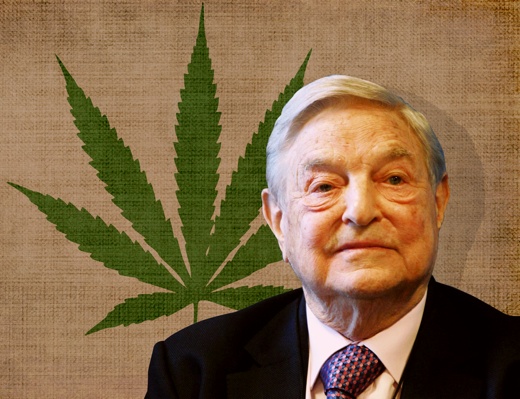
Image above: George Soros, a supporter of pot legalization, with marijuana leaf poster. From (http://www.washingtontimes.com/news/2014/apr/2/billionaire-george-soros-turns-cash-into-legalized/).

Congress dealt a historic blow to the United States' decades-long war on drugs Saturday with the passage of the federal spending bill, which contains protections for medical marijuana and industrial hemp operations in states where they are legal.

The spending bill includes an amendment that prohibits the Department of Justice from using funds to go after state-legal medical cannabis programs. If the bill is signed into law, it will bring the federal government one step closer to ending raids on medical marijuana dispensaries, as well as stopping arrests of individuals involved with pot businesses that are complying with state law.

“When the House first passed this measure back in May, we made headlines; today we made history," Rep. Sam Farr (D-Calif.), who in May introduced the medical marijuana protections amendment with co-sponsor Rep. Dana Rohrabacher (R-Calif.), told The Huffington Post regarding the bill's passage.

"The federal government will finally respect the decisions made by the majority of states that passed medical marijuana laws," Farr added. "This is great day for common sense because now our federal dollars will be spent more wisely on prosecuting criminals and not sick patients.”

The bill protects medical marijuana programs in the 23 states that have legalized marijuana for medical purposes, as well as 11 additional states that have legalized CBD oils, a non-psychoactive ingredient in marijuana that has shown to be beneficial in some severe cases of epilepsy.

“Congress has finally initiated a drawdown in the federal government’s war on medical marijuana,” said Mason Tvert, director of communications for the Marijuana Policy Project, in a statement. “This legislation makes it clear that the DEA has no business interfering in states’ medical marijuana laws. Taxpayer money should not be used to punish seriously ill people who use medical marijuana and the caregivers who provide it to them.”

Under the Obama administration, the DEA and several U.S. attorneys have raided marijuana dispensaries and sent people to prison, even though they complied with state laws. According to a report released last year by advocacy group Americans for Safe Access, the Obama administration has spent nearly $80 million each year cracking down on medical marijuana, which amounts to more than $200,000 per day.

Under the Controlled Substances Act, marijuana is still classified as a Schedule I substance with "no currently accepted medical use," alongside heroin and LSD. Since that doesn't change with the passage of the omnibus package, it's not entirely clear how the protections will work in practice.

"This isn't finely written policy yet," Farr said in June after the amendment first passed in the House, Forbes' Jacob Sullum reported. “This is a statement of congressional intent that [the] DEA [should] back off on these issues. We will have to continue to reconcile federal policy with state policy.”

A statement issued by Americans for Safe Access following the spending bill's passage Saturday called the measure "historic" and said patients' rights advocates believe it "will dramatically impact DOJ enforcement, including ending federal medical marijuana raids, arrests, criminal prosecutions, and civil asset forfeiture lawsuits."

Industrial hemp also received new protections from DEA intervention under the spending bill. The same plant species as marijuana, cannabis sativa, hemp contains little to no THC, the psychoactive ingredient in marijuana associated with the "high" sensation. The farm bill, which President Barack Obama signed into law in February, legalized industrial hemp production in states that permit it.

Eighteen states have legalized industrial hemp production, and more than a dozen others have introduced legislation that would authorize research into the plant, set up a regulatory framework or legalize growing it.

Earlier this year, the DEA made headlines when it seized hemp seeds intended to be used in the launch of Kentucky's legal hemp research pilot program. A month later, the hemp seeds were released, and the state began planting its research crop.

It wasn't all victories for marijuana in the spending bill -- the legalization of recreational marijuana in Washington, D.C., which nearly 70 percent of voters approved, appears to be blocked. However, several members of Congress have taken issue with the language used in bill, arguing that law may still be able to move forward.

See also:
Ea O Ka Aina: Congress looting the Commons 12/11/14
Ea O Ka Aina: Bank derivative losses 12/9/14
.

'Bout time brother

SUBHEAD: Baby steps. Five years into his presidency Obama says marijuana not more dangerous than alcohol.

By Reuters on 19 January 2014 in The Guardian -
(http://www.theguardian.com/world/2014/jan/19/obama-marijuana-bad-habit-minorities)


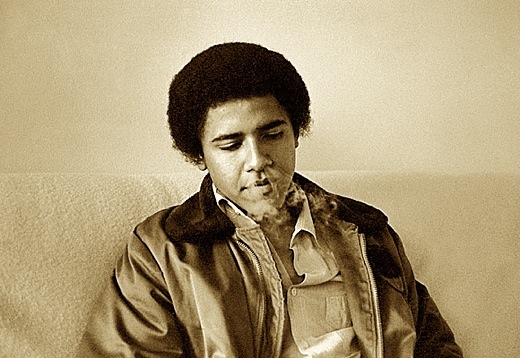
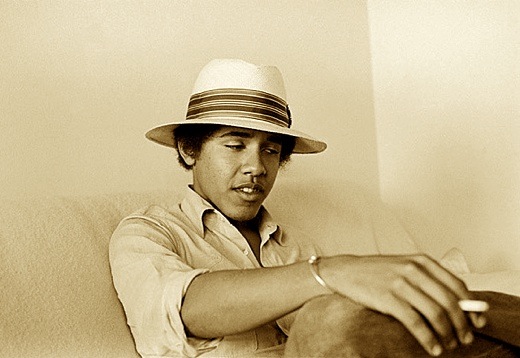
Image above: Barack Obama smoking in 1980. From (http://centerforiiit.wordpress.com/2010/11/16/barack-obama-1980-dont-miss/).

President Barack Obama believes smoking marijuana is a "bad habit" but thinks legal penalties now fall disproportionately on minorities and that states legalising pot should go ahead with their plans, he said in a profile released on Sunday.

"As has been well documented, I smoked pot as a kid, and I view it as a bad habit and a vice, not very different from the cigarettes that I smoked as a young person up through a big chunk of my adult life," he is quoted as saying in a New Yorker magazine article. "I don't think it is more dangerous than alcohol."

The president said he has told his two daughters that smoking marijuana is "a bad idea, a waste of time, not very healthy".

However, he said he is concerned that marijuana-related arrests fall far more heavily on minorities than on others. Legalisation of pot should go forward in the states of Colorado and Washington because "it's important for society not to have a situation in which a large portion of people have at one time or another broken the law and only a select few get punished," he said.

Marijuana remains illegal in the United States under federal law, but 21 US states allow or are about to allow medical marijuana use, and Colorado and Washington have decriminalised use of pot entirely. Alaska and the District of Columbia are considering following suit.

The Obama administration said last year that federal law enforcement will not target users in Colorado and Washington, as long as they comply with their respective states' laws. The Department of Justice says it will not interfere with states' efforts to regulate and tax marijuana provided they are able to meet a set of requirements, including keeping it from children and restricting its flow into other states.


Image above: Barack Obama smoking in 1980. From (http://centerforiiit.wordpress.com/2010/11/16/barack-obama-1980-dont-miss/).


The president also said he believes that those who argue that legalising marijuana will solve a number of social problems "are probably overstating the case". Legalisation in Colorado and Washington will probably be a challenge, he said.

In the lengthy profile, the president also muses over race, the Middle East and criticism of his efforts to woo Congress, among other topics. Discussing race, he said that he believes some people will never accept having a black president.

The president said that the three sets of negotiations involving Iran, Israel and the Palestinians, and Syria each have less than a 50-50 chance of succeeding, but are necessary steps toward achieving stability in a volatile region.

“If we were able to get Iran to operate in a responsible fashion … you could see an equilibrium developing between Sunni, or predominantly Sunni, Gulf states and Iran in which there's competition, perhaps suspicion, but not an active or proxy warfare," he said.

On the question of whether Obama will write a memoir, former adviser David Axelrod called it a "slam dunk" that the president will. A literary agent estimated publishers will pay between $17m and $20m.

Obama said narrowing the gap between rich and poor would be a key part of his legacy. "I will measure myself at the end of my presidency in large part by whether I began the process of rebuilding the middle class and the ladders into the middle class and reversing the trend toward economic bifurcation in this society," he said.
.

Christie's marijuana plea strategy

SUBHEAD: Roger Christie, founder of The Hawaii Cannabis (THC) Ministry enters a plea on marijuana.

By John Burnett on 28 September 2013 for Hawaii Tribune -
(http://hawaiitribune-herald.com/sections/news/local-news/pot-preacher-pleads-guilty.html)


Image above: Roger and Share Christie before his three year incarceration without bail. From (http://files.hawaiinewsdaily.com.s3.amazonaws.com/wp-content/uploads/2012/01/rogershare.jpg).

The founder of a Hilo ministry that openly promoted marijuana use as a sacrament pleaded guilty Friday in federal court to possession of almost 300 pot plants but reserved the right to appeal his case based on religious grounds.

Roger Christie, who founded The Hawaii Cannabis (THC) Ministry entered a plea to one count of conspiring to manufacture, distribute and possess marijuana and two counts of failing to file tax returns, for the years 2008 and 2009.

Sentencing is set for Jan. 22 at 2:45 p.m. before U.S. District Judge Leslie Kobayashi, and Roger Christie faces up to 20 years imprisonment on the marijuana charge, with a mandatory minimum term of five years. The maximum term of imprisonment on each tax offense is one year.

As part of the plea deal, Christie will forfeit his Wainaku apartment and $21,494 confiscated by the feds during a raid in 2010. Other marijuana-related charges were dropped in return for the plea.

Christie’s wife, Sherryanne “Share” Christie, pleaded guilty to one count of conspiring to manufacture, distribute and possess marijuana. Share Christie, who appeared in court holding a white purse adorned with an embroidered marijuana leaf, also reserved the right to appeal her case on religious grounds. She could receive up to 20 years in prison.

“Roger and Share are not giving up their fight today. They’re simply taking their fight to a higher court,” said lawyer Thomas Otake, who represents Roger Christie.

His client decided to plead guilty, Otake said, after Kobayashi ruled against allowing a defense based on the Religious Freedom Restoration Act of 1993, which allows certain Native American religions to use the hallucinogens peyote and ayahuasca as sacraments.

Otake said the ruling put the Christies at a disadvantage and they decided to take the case to the 9th U.S. Circuit Court of Appeals.

Federal sentencing guidelines could allow Roger Christie to be released from custody in about six months, with credit for more than three years he has served while being held without bail, Otake said.

Share Christie, 62, has been free on bail since 2010, when federal agents arrested the couple and 12 other people. She’ll remain free on bail while she appeals. She and her lawyer, Lynn Panagakos, left court without commenting.

The charges stemmed in part from wiretaps on Christie’s business and personal telephones, as well as the searches of his home and safe deposit box.

Federal authorities said they seized 3,000 plants with a retail value of $4.8 million during raids on the Christies and their co-defendants three years ago. They also said they recovered nine firearms.

The prosecutor, Assistant U.S. Attorney Michael Kawahara, said there was little religion in Roger Christie’s ministry.

“We believe, and from the undercover wiretapping investigation that we did in this case, that the religious idea is merely a front that camouflaged a long-term marijuana trafficking operation,” Kawahara said.

Under Christie’s “express” orientation to the ministry, started in 2009, new members just showed their ID card, paid the full donation price for marijuana, then walked off with their “sacrament,” he said.

Otake said Kawahara’s claim contradicted the judge’s ruling, which he said accepted the church as a legitimate ministry but stated that the government had a compelling interest in regulating it.

Roger Christie’s cause has received national attention, with marijuana advocates saying his pretrial detention without bail was unconstitutional. Some called him a political prisoner in the feds’ “war on drugs.”

During Christie’s incarceration, voters in Colorado, where Christie was born, and Washington, have passed initiatives legalizing adult personal use of marijuana.
.

Marijuana law turns to reason

SUBHEAD: Police groups furiously protest Eric Holder's marijuana policy announcement not to pursue state sanctioned recreational use of marijuana.

By Staff on 5 August 2013 in The Last Marijuana Trial - 
(http://the-last-marijuana-trial.com/judge-cannabis-ministers-religion-protected-under-rfra/)

Image above: Roger Christie in happier days before being incarcerated without trial for three years at the request of ObamaJustice Department. From (http://www.420magazine.com/forums/international-cannabis-news/196576-religion-marijuana-infused-faith-pushes-commonly-held-limits.html)

On Wednesday, July 31, 2013, U.S. District Court Judge Leslie E. Kobayashi ruled that imprisoned Cannabis Minister, Rev. Roger Christie, can present a religious defense at trial.

The court ruled as a matter of law that Christie’s religion is legitimate, his belief is sincere, and that the government’s action was a substantial burden on the legitimate exercise of his religion.

The ruling establishes that the prosecution must now prove at a hearing that Christie’s arrest and incarceration was the least restrictive means of upholding the law — and that the federal government had a compelling interest in prosecuting him.

The Court has yet to rule on Christie’s recent RFRA (Religious Freedom Restoration Act) motion. If she grants the motion, the case against Christie will be dismissed. If she does not grant the motion, Christie will still be able to present a religious defense at trial as to the element of the intent to distribute.

Christie has been held in detention without bail at the Honolulu Federal Detention Center since his arrest by federal authorities on July 8, 2010. He is charged with distributing marijuana to his parishioners.

Comment by Vicki:
 The case of Roger Christie will go down in history as one of the most egregious abrogations of a citizen’s Constitutional rights – ever. Murderers, rapists, psychopaths, even cannibals roam free on bail while the Reverend of a Church sits in a dungeon for the crime of seeking God with the help of the herb that He placed here to take care of most of our needs.

Cannabis nourishes our bodies and our souls, clothes us, inspires ideas and provides the paper to write them on, inspires music and the joy to dance to it, can be used as fuel, and is the most potent medicine available that can cure cancer and a myriad other ills, with no toxic side effects. No one has ever died from taking it.

Yet, these agents of our Federal Government whom we pay with our hard-earned tax dollars to keep us safe, have seen fit to deny him his Constitutional rights – the very rights that define us as a nation. The rights that once set this nation apart from those such as North Korea or China.

I ask you, who presents the greatest threat to our safety? Roger, or these misguided agents?


Justice Dept won't challenge States

By Phil Mattingly on 30 August 2013 for Bloomberg News
(http://www.bloomberg.com/news/2013-08-29/u-s-won-t-sue-to-block-state-marijuana-legalization.html)

The U.S. won’t challenge laws in Colorado and Washington that legalized the recreational use of marijuana and will focus federal prosecutions on ties to criminal organizations, distribution to minors and transportation across state lines, the Justice Department said.

Attorney General Eric Holder told the governors of the two states that U.S. attorneys will focus on certain priority areas and work with them to set rules for the marijuana industry.

The decision marks the first time the U.S. government has condoned recreational marijuana use and opens the door for other states to consider it. Voters in Washington and Colorado became the first to legalize it in November. Nineteen states allow medical marijuana use, according to the National Conference of State Legislatures.

In a memo to federal prosecutors around the country, Deputy Attorney General James Cole said that, beyond the priority areas, “the federal government has traditionally relied on states and local law enforcement agencies to address marijuana activity” under their own laws.

The new guidelines are “a major and historic step toward ending marijuana prohibition,” said Dan Riffle, federal policy director for the Marijuana Policy Project.

“The next step is for Congress to act,” said Riffle, whose Washington-based group is the largest advocating legalization. “We need to fix our nation’s broken marijuana laws and not just continue to work around them.”

Growing, selling or possessing marijuana remains illegal under federal law.

Criminal Activity

The federal priorities include monitoring marijuana activities for ties to criminal organizations, distribution to minors and transportation across state lines. Prosecutors have also been instructed to focus on preventing state-authorized endeavors from being used as a cover for trafficking other illegal drugs, violence in pot cultivation and driving under the influence of marijuana.

The government will also pursue cases where marijuana is grown on public lands or when it is carried on federal property, according to the Justice Department’s memo.

Officials in Washington and Colorado, as well as businesses associated with marijuana, have been pressing the Justice Department to make a decision on what the federal government would do where recreational use has been legalized.

“This very carefully considered approach by the federal government will allow our state to move forward and show the country a way a well-regulated system can be effectuated in a state while still respecting the federal Controlled Substances Act,” Washington Governor Jay Inslee, a 62-year-old Democrat, said today at a news briefing in Olympia.

Trusting States

“What I’m hearing from the federal government is that they believe there’s a reason to trust the states of Colorado and Washington,” Inslee told reporters. “So we’re not going to allow distribution of this product in a way that has massive leakage outside the state of Washington. We’re not going to allow distribution of this product to minors.”

Colorado Democratic Governor John Hickenlooper, 61, said the state shares the Justice Department’s enforcement priorities. The state is “determined to keep marijuana businesses from being fronts for criminal enterprises or other illegal activity,” he said in a statement.

‘A Mistake’

New Jersey Governor Chris Christie, 50, a Republican who is seeking re-election in November and may run for president in 2016, called Holder’s decision not to challenge recreational marijuana laws “a mistake.”

It amounts to a “de facto” legalization, said Christie, a former U.S. attorney. New Jersey won’t move toward legalizing the recreational use of marijuana, the governor told reporters in Point Pleasant today.

Washington and Colorado have been designing regulations for the cultivation and sale of recreational marijuana while the Obama administration formulated its position on the state laws.

The Justice Department said it reserves the right to preempt the states should they run afoul of the new guidelines.


 Cops want continuing drug money 

By Ryan Grim on 30 August 2013 for Huffington Post -
(http://www.huffingtonpost.com/2013/08/30/police-eric-holder-marijuana-_n_3846518.html)


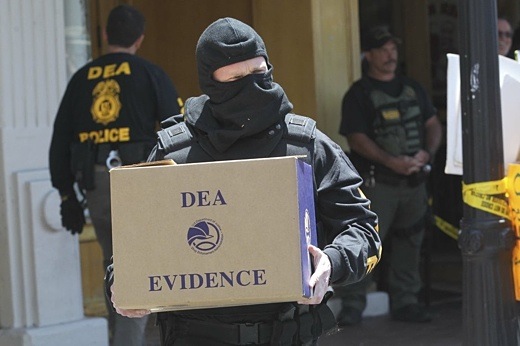
Image above: DEA agents remove "evidence" in pot dispensary raid in san Diaego 4/23/13. Look like regular cops to me - except for the face hoods. From (http://www.utsandiego.com/news/2013/Apr/23/marijuana-dispensary-cole-ntf-raid/)


A broad coalition of law enforcement officers who have spent the past three decades waging an increasingly militarized drug war that has failed to reduce drug use doesn't want to give up the fight.

Organizations that include sheriffs, narcotics officers and big-city police chiefs slammed Attorney General Eric Holder in a joint letter Friday, expressing "extreme disappointment" at his announcement that the Department of Justice would allow Colorado and Washington to implement state laws that legalized recreational marijuana for adults.

If there had been doubt about how meaningful Holder's move was, the fury reflected in the police response eliminates it. The role of law enforcement is traditionally understood to be limited to enforcing laws, but police organizations have become increasingly powerful political actors, and lashed out at Holder for not consulting sufficiently before adopting the new policy.

"It is unacceptable that the Department of Justice did not consult our organizations -- whose members will be directly impacted -- for meaningful input ahead of this important decision," the letter reads. "Our organizations were given notice just thirty minutes before the official announcement was made public and were not given the adequate forum ahead of time to express our concerns with the Department’s conclusion on this matter.

Simply 'checking the box' by alerting law enforcement officials right before a decision is announced is not enough and certainly does not show an understanding of the value the Federal, state, local and tribal law enforcement partnerships bring to the Department of Justice and the public safety discussion."

The missive was signed by the Major County Sheriffs’ Association, the National Sheriffs’ Association, the Association of State Criminal Investigative Agencies, the International Association of Chiefs of Police, the National Narcotic Officers Associations’ Coalition, the Major Cities Chiefs Police Association and the Police Executive Research Forum.

Law enforcement, the police groups said, "becomes infinitely harder for our front-line men and women given the Department’s position."

The Justice Department declined to respond.

Local law enforcement agencies rely heavily on the drug war for funding. Police departments are often able to keep a large portion of the assets they seize during drug raids, even if charges are never brought. And federal grants for drug war operations make up a sizable portion of local law enforcement funding.

The letter warns that marijuana can cause suicidal thoughts, impairs driving and is a "gateway drug." The missive does not, however, address the failure of law enforcement generally to reduce drug use, even while tripling the number of people behind bars. Instead, the police warn that liberalizing pot laws will lead to an increase in crime.

"The decision will undoubtedly have grave unintended consequences, including a reversal of the declining crime rates that we as law enforcement practitioners have spent more than a decade maintaining," the officers write.

Worse, they warn, more states are likely to follow Washington and Colorado.

"The failure of the Department of Justice to challenge state policies that clearly contradict Federal law is both unacceptable and unprecedented. The failure of the Federal government to act in this matter is an open invitation to other states to legalize marijuana in defiance of federal law," they write.E


.

Council date with Syngenta

SUBHEAD: The Kauai County Council turns to pro-GMO and anti medical marijuana proponents.

By Andy Parx on 26 March 2013 for Parx Daily News -
(http://parxnewsdaily.blogspot.com/2013/03/now-playing-in-cesspool-near-you.html)


Image above: A spoof of Syngenta styled ad. "How Syngenta poisons people and the environment". Click to enlarge. From (http://mieuxprevenir.blogspot.com/2012/12/how-syngenta-poisons-people-and.html).

Whether it's Syngenta's disinformation campaign about Atrazine, new information about cancer and pesticides, the so-called Monsanto Protection Act recently passed by congress or the state Department of Agriculture’s admission at last week's Kaua`i County Council meeting that they failed to perform a study- one we paid $50,000 for, of the apparent pesticide poisoning of Waimea Elementary School students four years ago and instead accepted the seed-corn industry's claim that it was simply something called "stink-weed" that sent the kids to the hospital, something really, well, stinks about the biotech industry... especially on Kauai.

But you ain't seen nothing yet- just wait until this Wednesday's council meeting when James Pacopac, lobbyist for the county and Syngenta, brings his dog and pony show to town.


According to the agenda for this week's council meeting:
Council Chair Furfaro (is) requesting the presence of Mr. Scott Matsuura, and Mr. James Pacopac, JS Hawaii Consultants, LLC, to provide the Council with an update on the 2013 Legislative Session to include, but not be limited to, the status of the Kauai County, Kauai County Council, and Hawaii State Association of Counties (HSAC) Legislative Packages for 2013.

A recent post by journalist/blogger Ian Lind titled Profiling members of the Honolulu Planning Commission reveals that Pacopac is not only a member of that august body- along with various and sundry developers, bankers and other lobbyists
...but:

Pacopac... is a partner with Scott Matsuura in the lobbying firm of SPJ Consulting LLC.

Pacopac was lobbyist for the Honolulu Board of Water Supply until March 2012. He currently is a registered lobbyist for the County of Kauai, the Kauai Island Utility Cooperative, and Syngenta Crop Protection of GMO fame.

Matsuura and Pacopac have been paid $60,000 for 4 or 5 months worth of work to represent the County of Kauai at the legislature but don't seem to have done much of any lobbying, especially and specifically when it comes to bills that pit the county against the seed-corn industry such as bill SB727 and SB 590. Those bills would take away the county's power to protect the health and safety of its citizens including those who claim they are being poisoned by pesticides used by Syngenta and the rest of the seed-corn industry on the island's westside.

Anyone concerned about whether the county is getting their money's worth or is in fact being scammed by SPJ Consulting's dynamic duo might want to show up Wednesday when, if the agenda is correct, the item will be the first one that will be taken up after a short list of perfunctory items.

And speaking of dog and pony shows, one of the more insanely laughable tag teams will be bringing their anachronistic reefer madness routine back for another commanded-by-no-one appearance.

According to the agenda:
Councilmember (Mel) Rapozo has request(ed) agenda time for a briefing from Keith Kamita, Deputy Director, State of Hawai`i, Department of Public Safety, on the Bills that are currently before the State Legislature relating to the legalization of marijuana.
Folks may remember Kamita as the diabolical yet comical official who thinks the marijuana scourge must be stopped at all cost lest civilization as we know it cease to exist. In lock and goose step with Lieutenant Rapozo, Kamita continues his lost cause to kill one bill that would switch the medical marijuana program from DPW control to that of the Department of Health and of course opposes another to decriminalize small amount of the evil weed.

So prepare some testimony, get some popcorn and join in the fun at the Historic County Building in Lihue on Wednesday March 27 at 8:30am. Or if you really can't make it, catch it live on-line.

Just imagine - people complain there's nothing to do on Kauai but the county brings the circus to town every week. Lions and tigers and bears... oh my, indeed.

.

Rev. Roger Christie still in jail

SUBHEAD: After embarrassing the federal government on marijuana policy he's been held without bail for three years.

By Staff on 19 March 2013 for Hawaiian News Daily -
(http://hawaiinewsdaily.com/2013/03/hawaii-roger-christie-resolution-headed-for-senate-hearing/)


Image above: Roger Christie in better days. free on the beach. From (http://www.tokeofthetown.com/2012/11/minister_still_behind_bars_on_marijuana_charge.php).


The Senate Committee on Public Safety, Intergovernmental and Military Affairs has scheduled SCR75/SR42 Urging the Federal Government to Release Roger Christie on Bail Pending Trial.

The resolutions are scheduled for hearing on Thursday, March 21, 2013 at 2:45pm in room 224. Here is the link to the hearing notice.

Christie has been detained at the Honolulu Federal Detention Center on marijuana charges since his arrest by federal authorities on 8 July 2010.

Christie’s 13 co-defendants were released on bail pending trial following their mass arrests nearly 3 years ago.

Federal prosecutors have opposed Christie’s release on bail on the basis that his long history as a marijuana activist makes him a “danger to the community.” He has been denied bail 7 times by a series of federal judges.

Another Hawaii State Senate Resolution, S.R. No. 12, comes close to accusing federal authorities of retaliation for Christie’s role in ending “Operation Green Harvest“, a federal marijuana eradication program, and for his efforts to pass the Lowest Law Enforcement Priority Ordinance on the Big Island in 2008.

According to SR No. 12, “Reverend Christie’s political activities have caused annoyance and embarrassment to the Federal Government leading some Hawaii residents to suggest that his denial of bail is based on his prior political acts rather than any ‘danger” he poses;”

Persons wishing to offer comments for SCR75/SR42 should submit testimony at least 24 hours prior to the hearing. Testimony should indicate:
  • Testifier’s name with position/title and organization;
  • The Committee(s) to which the comments are directed;
  • The date and time of the hearing; and
  • Measure number.
To submit testimony to the Senate Committee on Public Safety, Intergovernmental and Military Affairs:

In person: Deliver to Committee Clerk in room 231.
Submit Online Testimony: (Click here and then click SUBMIT TESTIMONY)
E-mail: PSMtestimony@capitol.hawaii.gov

Indicate the measure and date and time of the hearing. Submit testimony to only ONE committee that is indicated on the hearing notice; 10MB limit)
Fax: 808-586-6361

THE SENATE
THE TWENTY-SEVENTH LEGISLATURE
REGULAR SESSION OF 2013

COMMITTEE ON PUBLIC SAFETY, INTERGOVERNMENTAL AND MILITARY AFFAIRS
Senator Will Espero, Chair
Senator Rosalyn H. Baker, Vice Chair

NOTICE OF HEARING

DATE: Thursday, March 21, 2013
TIME: 2:45 p.m.
PLACE: Conference Room 224, State Capitol, 415 South Beretania Street

PSM, WAM
SCR 75 / SR 42

Status & Testimony / Status & Testimony

URGING THE FEDERAL GOVERNMENT TO RELEASE ROGER CHRISTIE ON BAIL PENDING TRIAL.

PSM, JDL

Click here to submit testimony to the Senate Committee on Public Safety, Intergovernmental and Military Affairs.

Testimony may be submitted up to 24 hours prior to the start of the hearing.

FOR FURTHER INFORMATION, PLEASE CALL THE COMMITTEE CLERK AT (808)586-6360.
.

Legal to tote in Washington State

SUBHEAD: It is time we accept that marijuana should be age-regulated like cigarettes or alcohol?

By Mac Slavo on 7 December for SHTF Plan -
(http://www.shtfplan.com/headline-news/washington-pleads-the-10th-under-state-law-you-may-responsibly-get-baked_12072012)


Image above: The Dude Abides photo illustration from still frame of movie "The Big Lebowski". From article below.
Make the most you can of the Indian Hemp seed and sow it everywhere.
President George Washington in a note to his gardener at Mount Vernon (1794)
Residents of Seattle, Washington lit up publicly and without worry one minute after midnight, relieved that under State law they no longer have to concern themselves over being arrested or prosecuted for the possession and use of marijuana. As of November 2012, medically prescribed marijuana is legal in 18 U.S. states and Washington D.C.

Voters in the states of Colorado and Washington, however, have outright rejected the federal government’s 75 year prohibition on the naturally grown substance by altogether decriminalizing it.

Police in Seattle, Washington have been told to refrain from making any arrests or issuing citations for possession or use in private residences, though ‘firing one up in public’ still carries a $100 fine (something the city won’t be enforcing).
Tonight at midnight, Initiative 502 goes into effect, meaning it’s no longer a violation of state law to use and possess certain quantities of marijuana in Washington. Basically, you can have pot and use pot, but you’re only supposed to use it in the privacy of your own home. 
“Until further notice, officers shall not take any enforcement action—other than to issue a verbal warning—for a violation of I-502.”
If you’re over 21, then starting December 6th you can use marijuana, and possess marijuana—up to an ounce of marijuana buds, 16 ounces of solid marijuana-infused product, like cookies, or 72 ounces of infused liquid, like oil. But it also clearly states that you’re not supposed to use marijuana in public, and that selling it or giving it to anyone is still a felony (the state’s working on setting up a system to license growers and sellers, but it could take up to a year).
Source: Seattle Police Department
SPD spokeman Jonah Spangenthal-Lee explained the position of the department and State of Washington:
“The department’s going to give you a generous grace period to help you adjust to this brave, new, and maybe kinda stoned world we live in.”
He added: “The police department believes that, under state law, you may responsibly get baked, order some pizzas and enjoy a Lord of the Rings marathon in the privacy of your own home, if you want to.”
The department also posted a picture of actor Jeff Bridges as the cannabis-smoking character “The Dude” from the comedy film “The Big Lebowski”.
Encouraging indoor cannabis smoking, it carried the caption: “The Dude abides, and says, ‘take it inside!”
The question now becomes whether or not Federal statutes override the States.

In California, where medically prescribed marijuana was legalized in 1996, a network of local growers and dispensaries has come under fire from Federal drug enforcement and tax agencies, with one of the largest shops in Los Angeles having been raided as recently as last June.

Despite decriminalization by over one third of State governments, the U.S. Department of Justice maintains that marijuana is a Schedule I narcotic similar to heroin, LSD and meth. According to federal law, marijuana has no accepted medical use in the United States and therefore cannot be legally prescribed by doctors.

This now sets the stage for a Constitutional battle between States and the Federal government. Under the 10th Amendment, any powers not delegated to the United States (as a federal entity), nor prohibited by it to the States, are reserved to the States respectively, or to the people.

Clearly, the U.S. Constitution does not make mention of marijuana, and thus applicable laws surrounding its sale, possession and use are reserved solely for the people of each State.

Is it time we accept that it’s 4:20 in some parts of America and that marijuana should be age-regulated like cigarettes or alcohol? Or should the federal government step in?


Seattle Police goes Big Lebowski

The Seattle Police Department is really rocking this I-502 marijuana legalization thing for all its worth. In what feels like the PR equivalent of sharing a bowl with the public, the agency - via hired-pen Jonah Spangenthal-Lee - has now released two truly epic statements (each featuring at least one Lord of the Rings reference) on the state of marijuana enforcement in Seattle. You probably saw the first on the Rachel Maddow show, or just about anywhere else you looked.

*See Also: SPD's Comprehensive Guide to Smoking Hella Weed in Seattle

Spangenthal-Lee's latest gem - featuring a photo Jeff 'The Dude' Lebowski - hit the SPD Blotter blog at around 6:30 p.m. Wednesday night, less than six hours before possession of up to an ounce of processed pot was set to become legal under Washington state law for adults 21 and older.

It's fantastic -- the new marijuana law, and SPD's latest marijuana-related statement. And the latter is the kind of once unimaginable, frank pot talk from law enforcement that would seem to ensure the media attention and Maddow fist-bumps are going to keep coming for Seattle's police force. Turns out it's thrilling and fascinating and disorienting and awesome to watch the cops on the front lines of marijuana legalization act totally rad about it. And from a public relations standpoint, that's what SPD has managed to accomplish through its blog and Spangenthal-Lee's weed jokes.

"Tonight at midnight, Initiative 502 goes into effect, meaning it's no longer a violation of state law to use and possess certain quantities of marijuana in Washington. Basically, you can have pot and use pot, but you're only supposed to use it in the privacy of your own home," the statement opens.
It continues:
And this is what the Seattle Police Department is telling its 1300+ officers tonight via email about public marijuana use (full email posted below): "Until further notice, officers shall not take any enforcement action--other than to issue a verbal warning--for a violation of I-502."
Above is the message everyone came to see. Honestly, it would have been enough. SPD could have stopped there and got plenty of props for its reaction to Washington's new stance on weed.
But Spangenthal-Lee wasn't done. Far from it ...
So why won't SPD be citing people for openly using marijuana in public? Here's where things get a bit complicated for your friendly neighborhood police department: the Seattle Police Department is in the business of law enforcement and, as of today, the Revised Code of Washington or Seattle Municipal Code don't contain anything that gives officers clear direction on how to deal with the provisions of I-502 prohibiting public use of marijuana. What's more, it could take at least another 30 days for the state or city to craft legislation which would give officers the ability to cite not-so-courteous people for lighting up in public. 
In the meantime, in keeping with the spirit of I-502, the department's going to give you a generous grace period to help you adjust to this brave, new, and maybe kinda stoned world we live in.
Awesome, right?
There's so much more ...
Does this mean you should flagrantly roll up a mega-spliff and light up in the middle of the street? No. If you're smoking pot in public, officers will be giving helpful reminders to folks about the rules and regulations under I-502 (like not smoking pot in public). But the police department believes that, under state law, you may responsibly get baked, order some pizzas and enjoy a Lord of the Rings marathon in the privacy of your own home, if you want to. 
Also, please remember it's still not legal to drive stoned, use marijuana in a public place or anywhere else smoking a cigarette is prohibited.
If you have questions about enforcement we haven't answered here or in our Marijwhatnow FAQ, send them to us on Twitter via @SeattlePD.
And remember, folks: the dude abides, and so can you!


The Dude abides, and says "take it inside!"
As of last night at 10 p.m. Spangenthal-Lee's now-famous "Marijwhatnow?" post had received 37K Facebook "Likes." His latest effort, in three hours of work, had garnered 358 "Likes" and counting.
My guess is there's plenty more to come.

.

One High Day

SUBHEAD: The blessings of a bong - a single gorgeous meal and a few laughs after weeks of chemotherapy and nausea.  

By Marie Myung-Ok Lee on 10 December 2011 for the New York Times -  
(http://www.nytimes.com/2011/12/10/opinion/medical-marijuana-and-the-memory-of-one-high-day.html)

 
Image above: Woman smoking medical marijuana. From (http://medicalmarijuana411.com/mmj411_v3/?cat=4275&paged=2).


When my mother-in-law was in the final, harrowing throes of pancreatic cancer, she had only one good day, and that was the day she smoked pot.

So I was heartened when, at the end of last month, the governors of Washington and Rhode Island petitioned the Obama administration to classify marijuana as a drug that could be prescribed and distributed for medical use. While medical marijuana is legal in 16 states, it is still outlawed under federal law.

My husband and I often thought of recommending marijuana to his mother. She was always nauseated from the chemotherapy drugs and could barely eat for weeks. She existed in a Percocet and morphine haze, constantly fretting that the sedation kept her from saying all the things she wanted to say to us, but unable to face the pain without it. And this was a woman who had such a high tolerance for pain, coupled with a distaste for drugs, that she insisted her dentist not use Novocain and gave birth to her two children without anesthesia. But despite marijuana’s power to relieve pain and nausea without loss of consciousness, we were afraid she would find even the suggestion of it scandalous. This was 1997, and my mother-in-law was a very proper, law-abiding woman, a graduate of Bryn Mawr College in the 1950s. She’d never even smoked a cigarette.

But then an older family friend who worked in an AIDS hospice came bearing what he said was very good quality marijuana. To our surprise, she said she’d consider it. My husband and I — though we knew nothing about marijuana paraphernalia — were dispatched to find a bong, as the friend suggested water-processing might make the smoking easier for her. We found ourselves in a head shop in one of the seedier neighborhoods in New Haven, where my husband went to graduate school, listening attentively to the clerk as he went over the finer points of bong taxonomy, finally just choosing one in her favorite color, lilac.

She had us take her out on the flagstone patio because she refused to smoke in her meticulously kept-up house. Then she looked about nervously, as if expecting the police to jump out of the bushes. She found it awkward and strange to smoke a bong, but after a few tries managed to get in two and a half hits.

And then she said she wanted to go out to eat.

For the past month, we’d been trying to get her to eat anything: fresh-squeezed carrot juice made in a special juicer, Korean rice gruel that I simmered for hours, soups, oatmeal, endless cans of Ensure. Sometimes she’d request some particular dish and we’d eagerly procure it, only to have her refuse it or fall back asleep before taking a bite. But this time she sat down at her favorite restaurant and ordered a gorgeous meal: whitefish poached with lemon, hot buttered rolls, salad — and ate every bite.

Then she wanted to go to Kimball’s, a local ice cream place famous for cones topped with softball-size scoops. The family had been regular customers starting all the way back when my husband and his brother were children, but they hadn’t been there since her illness. My husband and I shared a small cone, which we could not finish, and looked on in awe as my mother-in-law ordered a large and, queenishly spurning any requests for a taste, polished the whole thing off — cone and all — and declared herself satisfied.

We were of course raring to make the magic happen again, but it never did. The pot just frightened her too much. She was scared her friend would be arrested for interstate drug trafficking, that my husband and I would be mugged in New Haven; she was afraid she’d become addicted or (à la “Reefer Madness”) go insane. It was difficult watching her reject something that had so clearly alleviated her nausea and pain and — let’s admit it — lightened her mood in the face of the terrible fact that cancer had invaded nearly every essential organ. And it was even worse to watch her pumped, instead, full of narcotics that made her feel horrible. The Percocet gave her a painfully dry mouth, but even ice chips made her heave. We were reduced to swabbing her lips with little sponges dipped in water, and waiting out her agony.

My husband and I have dredged up the memory of that one good day many times since, how she smiled and joked, for the last time seeming a little like her old self.

After the funeral, saying goodbye to all the family and friends, supervising the removal of the hospital bed, bedpans and related paraphernalia, one of the last things my husband and I did, under the watchful eyes of the hospice nurse, was destroy her remaining Percocets. We opened the multiple bottles and knelt in front of the toilet to perform this secular water rite, wishing there had been other days, other ways, a softer way for her to leave us.

• Marie Myung-Ok Lee, the author of the novel “Somebody’s Daughter,” teaches writing at Brown University.
.