Showing posts with label Murder. Show all posts

National Geospatial-Intelligence Agency

SUBHEAD: This is the American organization you don't hear about that tracks down, spies on and kills people  

By Alice Salles on 29 March 2017 for The Anti-Media -
(http://theantimedia.org/agency-dangerous-nsa/)
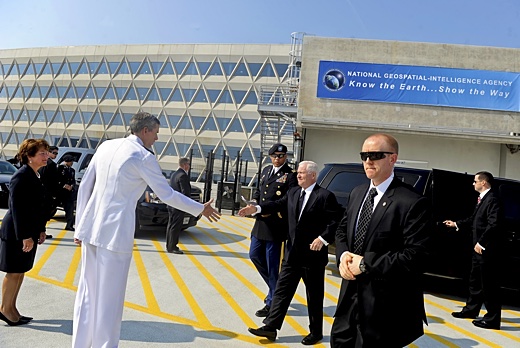
http://www.islandbreath.org/2017Year/04/170401gatesbig.jpg
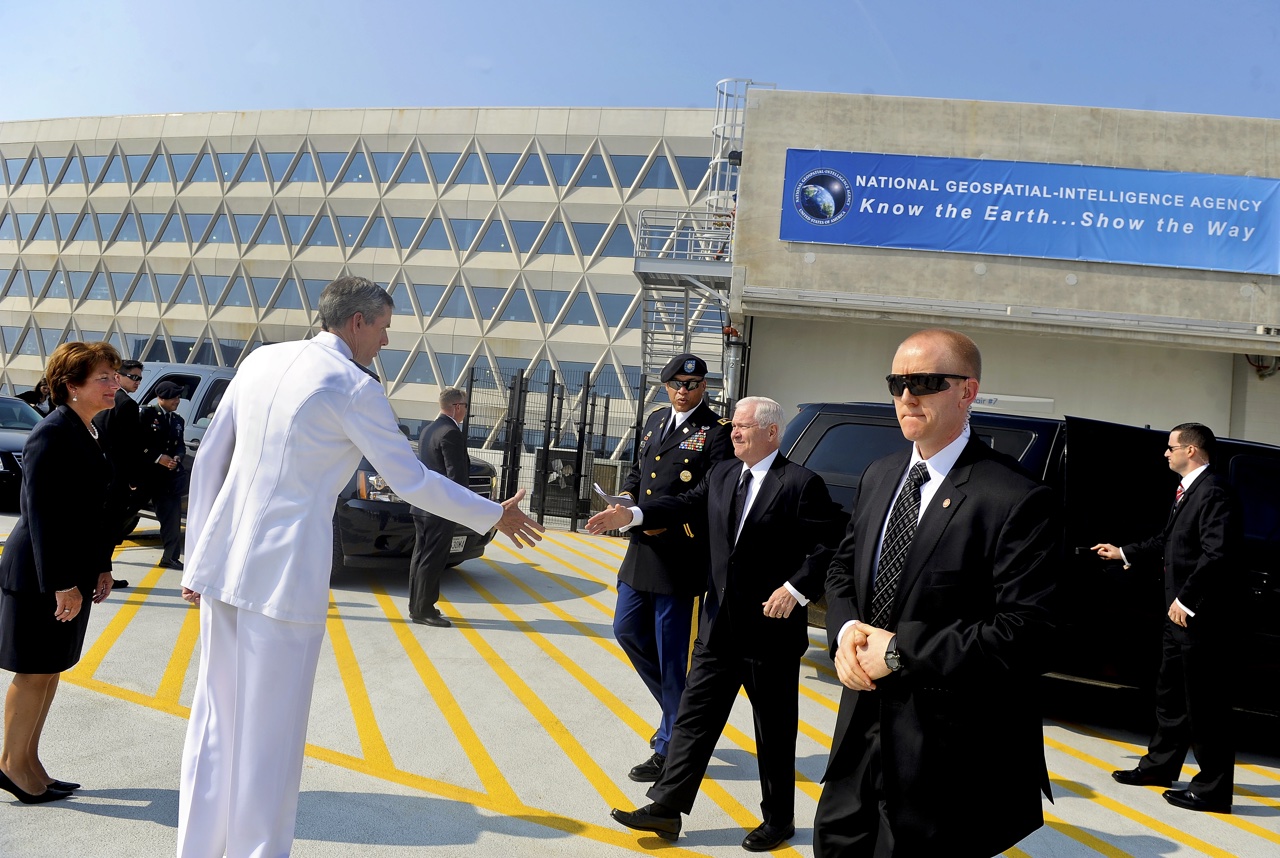
Image above: Defense Secretary Robert Gates shakes hands with Navy Vice Adm. Robert  Murrett, outgoing director of the National Geospatial-Intelligence Agency, as incoming director Letitia Long stands at left, in Springfield, Virginia on 9 August 2010. Long is the first female to head a U.S. intelligence agency. Photo by Cherie Cullen. Click to enlarge. From (http://archive.defense.gov/photoessays/PhotoEssaySS.aspx?ID=1813)

 If you’re one of the countless Americans who was distraught to learn of the revelations made by former National Security Agency (NSA) contractor Edward Snowden, the mere idea that there might be yet another agency out there — perhaps just as powerful and much more intrusive —  should give you goosebumps.

Foreign Policy reports that the National Geospatial-Intelligence Agency, or NGA, is an obscure spy agency former President Barack Obama had a hard time wrapping his mind around back in 2009.

But as the president grew fond of drone warfare, finding a way to launch wars without having to go through Congress for the proper authorization, the NGA also became more relevant. Now, President Donald Trump is expected to further explore the multibillion-dollar surveillance network.

Like the Central Intelligence Agency (CIA) and the National Security Agency (NSA), the NGA is an intelligence agency, but it also serves as a combat support institution that functions under the U.S. Department of Defense (DOD).

With headquarters bigger than the CIA’s, the building cost $1.4 billion to be completed in 2011. In 2016, the NGA bought an extra 99 acres in St. Louis, building additional structures that cost taxpayers an extra $1.75 billion.

Enjoying the extra budget Obama threw at them, the NGA became one of the most obscure intelligence agencies precisely because it relies on the work of drones.

As a body of government that has only one task — to analyze images and videos captured by drones in the Middle East — the NGA is mighty powerful. So why haven’t we heard of it before?

The Shadow Agency That Sees It All

Prior to Trump’s inauguration, the NGA only targeted the Middle East or whatever spy satellites orbiting the globe captured. As far as most of us knew, the agency refrained from pointing its ultra-high-resolution cameras toward the United States. That alone may be why the NGA has been able to stay out of scandals for the most part.

But under Trump, things may look much worse — as if spying on countless people abroad weren’t enough.

Recently, for instance, he gave the CIA the power to wage covert drone warfare, shielding important information on such operations simply by allowing the agency to carry out missions without first seeking authorization from the Pentagon.

Now, Trump might as well move on to NGA, hoping to boost “national security” by turning the agency’s all seeing eyes toward American soil.

As the president hopes to get more money for defense, many have speculated whether he will start to use drones at home, especially since he has already suggested he supports agencies like the NSA based on his desire to target “terrorists.” There’s nothing that implies he wants to slow down the surveillance state.

The White House has expressed its desire to renew Obama-era spying powers — even as the president battles critics who deny his claims that his conversations were intercepted at the same time foreign nationals were under surveillance in 2016.

A partially redacted March 2016 report released by the Pentagon revealed that drones had already been used domestically on about 20 or fewer occasions between 2006 and 2015.

Though some of these operations mostly involved natural disasters, National Guard training, and search and rescue missions, quotes from an Air Force law review article found their way into the report. In it, Dawn M. K. Zoldi wrote that technology designed to spy on targets abroad could soon be used against American citizens.

“As the nation winds down these wars,” the report explains, and ”assets become available to support other combatant command (COCOM) or U.S. agencies, the appetite to use them in the domestic environment to collect airborne imagery continues to grow.”

Up until 2015, oversight was so loose that the capabilities provided by the DOD’s unmanned aircraft system weren’t under scrutiny by any other agency. Without statutes that specify the rules such federal government agencies should follow, watchdogs find it hard to keep track. But would it be any better if there were an agency or a branch of the same government overseeing what the government itself is doing?

The short answer is no.

NGA Has A Precedent, And Trump May Want To Explore It

As fears grow that Trump will revamp the NGA, domestic stories of police departments using drones to spy on locals are also resurfacing.

Some of the most highly publicized instances involved Baltimore and Compton, where police departments deployed aerial surveillance technology without issuing a warrant or seeking authorization from local or state lawmakers.

With a precedent already set, the president might as well ignite a new fight in his continued efforts to fight a war against an imaginary, impossible-to-target enemy. After all, he’s not a stranger to scandals and likely wouldn’t feel overwhelmed one bit if he decided to turn the country’s ultra-high definition cameras toward its citizens.

What could help to put an end to his plans might be exactly what helped halt President George W. Bush’s attempts at setting up spy satellites domestically. In 2007, Bush’s Department of Homeland Security set up an agency known as the National Applications Office with the goal of establishing direct spy satellite stakeouts in America. Thankfully, Congress stepped in and cut off the agency’s funding.

But with Americans seldom showing any interest for important violations of privacy or even basic human rights here and abroad, it’s easy to see how this massive spying agency could end up getting a carte blanche to do whatever it wants once Trump realizes he has the power to order it done. After all, who will pressure Congress to stop him?


.
Japanese whale slaughter

SUBHEAD: Sea Shepherd catches Japanese poaching fleet with dead minke whale in Australian Whale Sanctuary.

By Staff on 15 January 2017 for Sea Shepherd Global -
(http://www.seashepherdglobal.org/news-and-commentary/news/sea-shepherd-catches-japanese-poaching-fleet-with-dead-whale-in-australian-sanctuary.html)


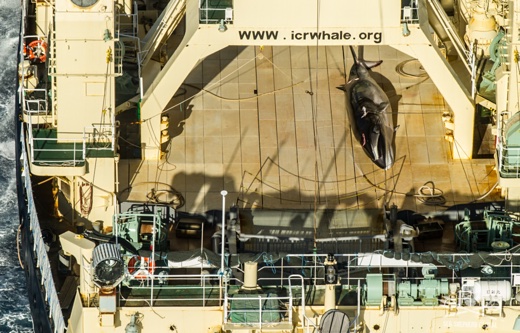
Image above: Slaughtered minke whale on deck of Japanese "research" vessel. From Sea Shepherd.org.

After five weeks of patrolling the Southern Ocean, Sea Shepherd has located the Japanese whale poachers’ factory whaling vessel in the Australian Whale Sanctuary with a dead minke whale on its flensing deck, the first to be documented since the International Court of Justice ruled against their whaling operations in the Antarctic in 2014.

The Nisshin Maru was spotted by the helicopter of Sea Shepherd’s MY Steve Irwin at 12:34AM GMT (11:34AM AEDT) at a position of 64 57.6S - 085 09.6E, within the Australian Whale Sanctuary.

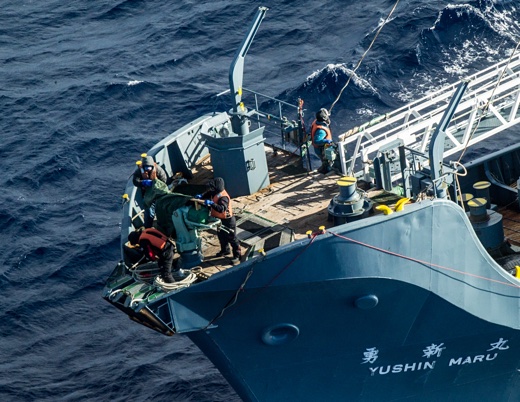
When the helicopter approached, the Nisshin Maru crew scrambled to hide the slaughtered whale with a tarp, while the fleet’s harpoon ships Yushin Maru and Yushin Maru #2 quickly covered their harpoons.  

"The whale killers from the Nisshin Maru were caught red-handed slaughtering whales in the Australian Whale sanctuary,” says Captain Adam Meyerson of the Ocean Warrior, Sea Shepherd’s newest Southern Ocean patrol ship. “The Steve Irwin has shut down their illegal operations and caught them trying to hide the evidence."


Image above: Crew covers harpoon gun with tarp as Sea Shepherd helicopter nears Japanese whale hunting vessel Yushin Maru. From SeaShepherd.org.

These are the first photographs documenting the Japanese whaling fleet’s killing of whales since the International Court of Justice (ICJ) ruled their whaling program illegal in 2014 and the Australian Federal Court found the Japanese whaling industry in contempt for killing protected whales in the Australian Whale Sanctuary.

Sea Shepherd’s discovery of the factory ship and the slaughtered whale comes just a day after Japan’s Prime Minister Shinzo Abe was in Australia on an official state visit.

Jeff Hansen, Managing Director of Sea Shepherd Australia stated, "The lack of action by the Turnbull government while whales are being killed in Australian waters just a day after Japan's Prime Minister was on a state visit in Australia shows that the government has no spine when it comes to protecting the wishes of Australians to defend the Southern Ocean Whale Sanctuary."

Sea Shepherd’s helicopter has relayed the whaling fleet's position to the MY Steve Irwin, now on an intercept course with the factory ship. No more whales will be killed today.

“The fact that the Japanese crew went to cover up their harpoons and the dead minke whale on deck just shows that they know what they’re doing is wrong,” says Captain Wyanda Lublink of the MY Steve Irwin;
“They know they are in contempt of the ruling of the International Court of Justice and the Australian Federal Court. How can the Australian government ignore these actions when the majority of Australians condemn what they are doing?”
About Operation Nemesis
Operation Nemesis is Sea Shepherd’s 11th Antarctic whale defense campaign. In Sea Shepherd’s past ten campaigns over 6,000 whales have been spared the grenade-tipped harpoons of the illegal Japanese whaling fleet. Japan’s so-called “scientific research” program used to justify the killing of whales has been rejected by the International Court of Justice and the International Whaling Commission’s scientific committee. In 2015 the Australian Federal Court fined the Japanese whalers $AU1 million for hunting within an Australian whale sanctuary, however it remains unpaid.

See more here: http://www.seashepherdglobal.org/nemesis/about-operation-nemesis.html

For further information, photos, video footage and interview requests, contact:

Heather Stimmler, Sea Shepherd Global Media Director
E-mail: heather@seashepherdglobal.org
Tel: +339 7719 7742 (EUROPE, GMT+1)

For Australia and New Zealand media requests, contact:
Adam Burling, Media Coordinator Sea Shepherd Australia
E-mail: adam@seashepherd.org.au
Tel : +61 409 472 922 (AUSTRALIA, GMT+11)

.

Drone Whistleblower's Claim

SUBHEAD: Former drone operation pilots say they were "horrified by cruelty of assassination program.

By Murtaza Hussain on 19 November 2015 for the Intercept -
(https://theintercept.com/2015/11/19/former-drone-operators-say-they-were-horrified-by-cruelty-of-assassination-program/)


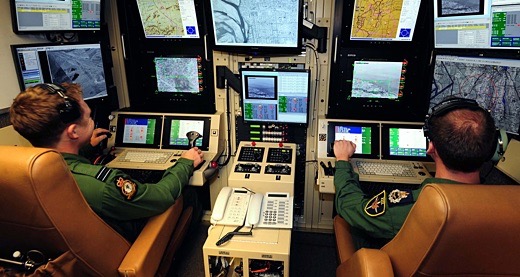
Image above: Drone pilots during operations.  From original article.

U.S. drone operators are inflicting heavy civilian casualties and have developed an institutional culture callous to the death of children and other innocents, four former operators said at a press briefing today in New York.
 
The killings, part of the Obama administration’s targeted assassination program, are aiding terrorist recruitment and thus undermining the program’s goal of eliminating such fighters, the veterans added. 

Drone operators refer to children as “fun-size terrorists” and liken killing them to “cutting the grass before it grows too long,” said one of the operators, Michael Haas, a former senior airman in the Air Force. Haas also described widespread drug and alcohol abuse, further stating that some operators had flown missions while impaired.

In addition to Haas, the operators are former Air Force Staff Sgt. Brandon Bryant along with former senior airmen Cian Westmoreland and Stephen Lewis. The men have conducted kill missions in many of the major theaters of the post-9/11 war on terror, including Iraq, Afghanistan and Pakistan.
“We have seen the abuse firsthand,” said Bryant, “and we are horrified.”

An Air Force spokesperson did not address the specific allegations but wrote in an email that “the demands placed on the [drone] force are tremendous. A great deal of effort is being taken to bring about relief, stabilize the force, and sustain a vital warfighter capability. … Airmen are expected to adhere to established standards of behavior. Behavior found to be inconsistent with Air Force core values is appropriately looked into and if warranted, disciplinary action is taken.”

Beyond the press conference, the group also denounced the program yesterday in an interview with The Guardian and in an open letter addressed to President Obama.

Read the full letter the drone whistleblowers sent to Obama below or here, or (http://www.islandbreath.org/2015Year/11/151125droneletter.pdf)


President Barack Obama
The White House Washington, D.C.
Secretary Ashton B. Carter
Department of Defense

Director John O. Brennan
Central Intelligence Agency

Dear President Obama, Secretary Carter and Director Brennan:

We are former Air Force service members. We joined the Air Force to protect American lives and to protect our Constitution.

We came to the realization that the innocent civilians we were killing only fueled the feelings of hatred that ignited terrorism and groups like ISIS, while also serving as a fundamental recruitment tool similar to Guantanamo Bay. This administration and its predecessors have built a drone program that is one of the most devastating driving forces for terrorism and destabilization around the world.

When the guilt of our roles in facilitating this systematic loss of innocent life became too much, all of us succumbed to PTSD. We were cut loose by the same government we gave so much to ­­ sent out in the world without adequate medical care, reliable public health services, or necessary benefits. Some of us are now homeless. Others of us barely make it.

We witnessed gross waste, mismanagement, abuses of power, and our country’s leaders lying publicly about the effectiveness of the drone program. We cannot sit silently by and witness tragedies like the attacks in Paris, knowing the devastating effects the drone program has overseas and at home. Such silence would violate the very oaths we took to support and defend the Constitution.

We request that you consider our perspective, though perhaps that request is in vain given the unprecedented prosecution of truth­tellers who came before us like Chelsea Manning, Julian Assange, and Edward Snowden. For the sake of this country, we hope it is otherwise.

Sincerely,

Brandon Bryant
Staff Sergeant
MQ­1B Predator Sensor Operator
SERE Instructor Trainee
USAF Joint Special Operations Command 3rd Special Operations Squadron Disabled Iraq and Afghanistan Veteran Founder of Project RED HAND
Cian Westmoreland
Senior Airman
RF Transmissions Systems
USAF CENTCOM
73rd Expeditionary Air Control Squadron
Disabled Afghanistan Veteran
Project RED HAND's Sustainable Technology Director

Stephen Lewis
Senior Airman
MQ­1B Predator Sensor Operator
USAF Joint Special Operations Command 3rd Special Operations Squadron
Iraq and Afghanistan Veteran
Michael Haas
Senior Airman
MQ­1B Predator Sensor Operator Instructor USAF Air Combat Command
15th Reconnaissance Squadron
Iraq and Afghanistan Veteran


At the press conference, Bryant said the killing of civilians by drone is exacerbating the problem of terrorism. “We kill four and create 10 [militants],” Bryant said. “If you kill someone’s father, uncle or brother who had nothing to do with anything, their families are going to want revenge.”

The Obama administration has gone to great lengths to keep details of the drone program secret, but in their statements today the former operators opened up about the culture that has developed among those responsible for carrying it out.

Haas said operators become acculturated to denying the humanity of the people on their targeting screens. “There was a much more detached outlook about who these people were we were monitoring,” he said. “Shooting was something to be lauded and something we should strive for.”

The deaths of children and other non-combatants in strikes was rationalized by many drone operators, Haas said. As a flight instructor, Haas claimed to have been non-judicially reprimanded by his superiors for failing a student who had expressed “bloodlust,” an overwhelming eagerness to kill.

Haas also described widespread alcohol and drug abuse among drone pilots. Drone operators, he said, would frequently get intoxicated using bath salts and synthetic marijuana to avoid possible drug testing and in an effort to “bend that reality and try to picture yourself not being there.”

Haas said that he knew at least a half-dozen people in his unit who were using bath salts and that drug use had “impaired” them during missions.

The Obama administration’s assassination program has come under increasing scrutiny in recent months. This October, The Intercept published a cache of classified documents leaked by a government whistleblower that showed how the program killed people based on unreliable intelligence, that the vast majority of people killed in a multi-year Afghanistan campaign were not the intended targets, and that the military by default labeled non-targets killed in the campaign as enemies rather than civilians.

The operators said that they felt increasing urgency to speak out in the wake of the deadly terrorist attacks in Paris last week; they believe drone assassinations have fed the rise of the extremist group the Islamic State, which has claimed responsibility for the attacks.

Westmoreland said of drones: “In the short term they’re good at killing people, but in the long term they’re not effective. There are 15-year-olds growing up who have not lived a day without drones overhead, but you also have expats who are watching what’s going on in their home countries and seeing regularly the violations that are happening there, and that is something that could radicalize them.”

In their open letter to Obama, the former drone pilots made a similar point, writing that during their service they “came to the realization that the innocent civilians we were killing only fueled the feelings of hatred that ignited terrorism and groups like ISIS,” going on to describe the program as “one of the most devastating driving forces for terrorism and destabilization around the world.”

 At the press conference today, the pilots echoed these sentiments. “It seems like our actions of late have only made the problems worse. …

The drones are good at killing people, just not the right ones,” Bryant said. “Have we forgotten our humanity in the pursuit of vengeance and security?”

.

Building trust with police

SUBHEAD: Cops can get into a state of mind where they're scared to death and they panic and they act out on that panic.

By Steve Inskeep on 5 December 2014 for NPR News -
(http://www.npr.org/blogs/codeswitch/2014/12/05/368545491/civil-rights-attorney-on-how-she-built-trust-with-police)


Image above: A young man kneels before a line of Los Angeles police officers about to charge at protesters reacting to a grand jury’s decision not to indict a white police officer who shot dead an unarmed black teenager in Ferguson, Missouri. From (http://online.wsj.com/articles/what-it-felt-like-to-be-a-suspicious-black-teenager-1416956319).

[IB Publisher's note: Listen to this story at (http://www.npr.org/blogs/codeswitch/2014/12/05/368545491/civil-rights-attorney-on-how-she-built-trust-with-police).]

As a civil rights attorney, Constance Rice became known in the 1990s for, as she puts it, going to war with the Los Angeles Police Department.

Rice filed lawsuits against the department, mainly over their treatment of minorities in underprivileged communities.

Following the recent decisions not to indict white cops in the deaths of two black men — President Obama has said one of his top priorities is building trust between minority communities and local police.

Rice's time battling the LAPD, and specifically captain Charlie Beck, who is now LA's police chief, eventually led to a place where there could be trust. They worked together to reform the department.
Some of that change included LAPD officers going into projects to set up youth sports programs and health screenings, things that made people's lives better and brought police and predominantly black communities closer together.

Here are some interview highlights:

On use of police force on minorities:
Cops can get into a state of mind where they're scared to death. When they're in that really, really frightened place they panic and they act out on that panic. I have known cops who haven't had a racist bone in their bodies and in fact had adopted black children, they went to black churches on the weekend; and these are white cops. They really weren't overtly racist. They weren't consciously racist.

But you know what they had in their minds that made them act out and beat a black suspect unwarrantedly? They had fear. They were afraid of black men. I know a lot of white cops who have told me.

And I interviewed over 900 police officers in 18 months and they started talking to me, it was almost like a therapy session for them I didn't realize that they needed an outlet to talk.

They would say things like;
"Ms. Rice I'm scared of black men. Black men terrify me. I'm really scared of them. Ms. Rice, you know black men who come out of prison, they've got great hulk strength and I'm afraid they're going to kill me. Ms. Rice, can you teach me how not to be afraid of black men." 
I mean this is cops who are 6'4". You know, the cop in Ferguson was 6'4" talking about he was terrified. But when cops are scared, they kill and they do things that don't make sense to you and me.

On whether or not racism plays a factor in police force:
He doesn't feel like it's racism. The black community experiences it as racism, that's very clear. So what I'm saying is that for people who have to be in the business of solving this dilemma you have to be able to step into the frightened tennis shoes of black kids; black male kids in particular.

You have to be able to step into the combat boots and scared cops, and racist cops, and cruel cops, and good cops. You have to be able to distinguish between all of those human experiences and bring them together. On a single platform of we're going to solve this by empathizing. We're going to solve it with compassion and we're going to solve it with common sense.

On whether improving life in poor neighborhoods causes police to be less fearful:
Not only does it cause cops to be less fearful, it causes the community to embrace them. I have taken a group of 50 cops and the chief (Charlie) Beck let me train them.

I trained them in what I community partnership policing. The first thing I tell these cops is that you are not in the arrest business; you are in the trust business. We are going to train you in Public Trust Policing. It goes beyond community policing.

What it does is it puts police in a position of helping a community solve its problems. These cops come into the black housing projects and they said to these populations who hate them "We know you hate us, but we're here to serve. We're going to win your trust."


Darren Wilson killing Michael Brown

By Juan Wilson on 5 December 2014 for Island Breath - 
(http://islandbreath.blogspot.com/2014/12/building-trust-with-police.html)

There are several eyewitness accounts of how Officer Darren Wilson shot to death Michael Brown. Most of the details I have heard or read isolate detail of accounts to highlight conflicting testimony.

It seems to me the the conduction of the Grand Jury was quite unusual. setup with a deal. Eyewitness testimony was presented as being unreliable. One could only rely on the testimony of Wilson himself.

My opinion is that Wilson’s resignation was baked into the cake if he was not indicted. Anyway,

A good article in the Atlantic on the subject is (http://www.theatlantic.com/national/archive/2014/11/major-contradictions-in-eyewitness-accounts-of-michael-browns-death/383157/)
Brown attacked Wilson
Brown ran from Wilson
Brown had his hands in the air
Brown did not have his hands in the air
Brown tried to surrender to Wilson
Brown did not try to surrender to Wilson
What makes sense?

All of it might!

If one does not discredit the eyewitness testimony - and for the sake of attempting to find some clarity - one tries to sew together a narrative that makes sense  - then a whole new characterization of events might emerge.

Here’s one way of looking various details. I am only including actions between Brown and Wilson. Brown was with a friend but I have eliminated him from the action.

Wilson driving his patrol car came upon Michael Brown walking down the middle of the street. There was a police radio report about a nearby store theft by some fitting Brown’s description.

Brown was 19 but huge at 6’-5” and weighing almost 290 pounds. A physically intimidating individual to take on. Wilson was alone in the patrol car. As he neared Brown he made is service revolver available for immediate use if necessary.

Wilson in the patrol car, with is driver window down, stopped Brown walking in the middle of the street. Upon being questioned Brown gave the officer a wise-ass response. Wilson commanded Brown off the road. There was more back talk from Brown. As if to intimidate Brown Wilson showed the gun to Brown.

Brown told Wilson he was too much of a pussy to shoot him. Brown may have reached for the gun. Wilson fired the revolver, hitting Brown in the right shoulder. There was some blood in the car. Brown momentarily pulled back not knowing if he was badly hurt or not.

Brown did not want to be shot again. A struggle for the gun ensued. They wrestled for control. Wilson was punched. Without getting control of the gun Brown made a decision to flee and took off. Wilson makes a radio call that shots have been fired. Brown ran a short distance away as Wilson got out of his car.

Wilson yells at Brown to get on ground. Brown turned to Wilson with the gun pointed at him but did not get on the ground.  Brown may have partially raised is arms to surrender saying “I don’t have a gun.Stop shooting!”

He may not have been able to raise his right arm fully. Brown tucked his wounded right arm in his waist band of his pants. More shots were fired. His right arm was hit more times.

Brown realized he was likely going to be shot to death and decided to make a rush to stop Wilson from killing him. As he ran at Wilson another volley of shots hits Brown from a few few dozen feet away. One shot hit Wilson in the right side of his neck. After that Brown walked toward Wilson without menace.

Brown fell to the ground and onto his face. Wilson shot Brown through the top of his head.

I think Darren Wilson feared Michael Wilson on sight. His fear pulled the trigger...many times.

Conclusion:
Michael Brown may have been a small time criminal and a brutish thoughtless kid. Darren Wilson was not the person to deal with that. Darren was playing Grand Theft Auto Five with a real patrol car and real gun. He should have stayed in the basement with his XBox 360.

Darren Wilson should never again have a loaded gun in his hand.

See also:
Island Breath: KPD need bikes not riot gear 4/5/08
Island Breath: The Kauai Police Mission 5/15/08
Island Breath: The future KPD we want 5/28/08
Island Breath: KPD alternatives to patrol cruising 6/7/08
Island Breath: TGI column cancelled by KPD 6/18/08


.

Grand Jury Runaround

SUBHEAD: Flame before spark. Michael Brown in Ferguson Was the spark — Eric Garner in New York is the fire.

By John McWhorter on 3 December 2014 for Time Magazine  -
(http://time.com/3617369/eric-garner-grand-jury-protests/)


Image above: Eric Garner being choked to death by Ofiicer Pantaleo while three other policeman struggle to hold him down. Garner repeated "I can't breath!" several times before losing consciousness. His offense selling loose cigarettes on the sidewalk.  From (http://time.com/3617369/eric-garner-grand-jury-protests/).

Here’s a look at the future, and probably not that far into it. People will learn two things:
  1. That an officer was not indicted for murdering Eric Garner—black, 43, and detained simply for selling single cigarettes—despite the fact that the killing was recorded from start to finish for all of America to see. 
     
  2. That an officer was not indicted for killing Michael Brown after Brown had stolen from a store, refused the officer’s request to step aside and perhaps tried to grab his gun, with the officer shooting when Brown repeatedly lunged toward him for some reason, with none of this recorded and the details murkily varying from one witness to the next. 

Perfectly sensible people will be wondering why so many people in late 2014 thought of the Ferguson case, in particular, as the civil rights case of the 21st century. Yes, Brown should not have died—I have heartily agreed, repeatedly. But people in the future will see the current focus on Ferguson as evidence of people losing sight of the fact that activism is supposed to be about results.

Are we trying to create a humanity devoid of any racist bias, or are we trying to stop cops from shooting black men? The two aren’t the same. A world without racism would be a world without dirt. A world where episodes like what has happened just this year to Garner, Brown, John Crawford, Akai Gurley, and Tamir Rice is much more plausible. We need special prosecutors, body cameras, and, if you ask me, an end to the war on drugs.

As such, we must be pragmatic. I know the people protesting Michael Brown’s death nationwide are sincere. But it’s easy to forget that in cases like this, sincerity is supposed to be forward-focused. It’s all too human for people to end up mistaking the heightened emotions, the threats, the media attention, the catharsis, as progress itself. But drama alone burns fast and bright. Think about how Trayvon is already—admit it—seeming more like history than the present.

Are we really committed to this thing lasting past the winter?

If so, then we have to ask ourselves—is Michael Brown more important somehow because he was killed with a gun? Is Garner somehow less worthy of iconic, implacable protest because he was older than Brown, less “glamorous” than a teenager? Is it, in other words, that Brown is more dramatic?

Because there are other kinds of drama, if we must. For example, Officer Daniel Pantaleo’s statement about Garner is outright tragedy—so disgustingly detached coming from someone’s murderer that it constitutes drama in itself.

“It is never my intention to harm anyone,” Pantaleo says—as if we were thinking now of “harm,” a formal term you can use to refer to a dent in your car. “I feel very bad about the death of Mr. Garner”—my God, “very bad” sounds like he broke someone’s window with a baseball, and “the death of Mr. Garner” sounds like something he watched on TV rather than did with his bare hands. “Accept my personal condolences” says this man twice brought up on misconduct charges before, as if it were his aunt by marriage who passed away after a brief illness.

This, to me, is an articulate testament to how some whites can be unable to see black people as human—and, especially if cops, be more likely to kill them. This, ladies and gentlemen, is a precious teaching moment. Pantaleo’s statement is, in its way, as useful as Reverend King’s Letter From a Birmingham Jail as a look into a human mind.

>Yet one hears that however iffy the Ferguson details are, we should just go with it because it has struck a chord. That our message to America is to be “Even when my son steals from a store, refuses a cop’s order and tries to take his gun, he shouldn’t get shot.”

And he shouldn’t, but wow, what a delicate and hopelessly controversial point that is in such a key moment as this. It’s a tricky, subtle assertion, which has not struck a chord with the disinterested middle because the facts are too murky. We want to make history, not just headlines.

How about this, as a story we can tell the next generation without taking a deep breath and thinking about how to paper over the holes?

Ferguson was the spark, but Garner was “it.”

Here is where I am quite sure Reverend King and Bayard Rustin would be planning not just statements and gestures, but boycotts. The recording of Garner’s death has the clear, potent and inarguable authority of the Birmingham newsreels. We must use that. Yes, use—we are trying to create change, not just perform.


No Reckless Endangerment?
SUBHEAD: Grand Jury in Eric Garner case wasn't asked to consider 'Reckless Endangerment' charge.

By Andres Jauregui on 5 December 2014 for Huffington Post  -
(http://www.huffingtonpost.com/2014/12/05/eric-garner-reckless-endangerment_n_6275698.html)

The Staten Island District Attorney did not ask the Eric Garner grand jury to consider reckless endangerment charges against NYPD officer Daniel Pantaleo, NBC New York reports.

An unnamed source familiar with the case told the station that District Attorney Daniel Donovan only asked jurors to consider charges of manslaughter or criminally negligent homicide as they heard evidence.

Under New York law, reckless endangerment entails conduct that causes a substantial risk of serious physical injury or death to another person. Garner, a 43-year-old asthmatic, died after Pantaleo put him in a chokehold in July.

The jury determined that there was no probable cause to indict Pantaleo in Garner's death Wednesday, a decision that has been met with criticism from people across the political spectrum and sparked nationwide protests.

Although grand jury proceedings are typically sealed by law, Donovan petitioned a judge to release limited information about them, according to ABC New York. None of the evidence presented was included in the release, only the following:
  • Jurors sat for nine weeks
  • Testimony was heard from 50 witnesses
  • Those witnesses included 22 civilians and 28 cops, EMTs or doctors
  • There were 60 exhibits, including videos, records and photos
  • The grand jury was instructed in law regarding physical use of force
The D.A.'s office issued a statement Thursday that said he was "constrained by New York law to reveal nothing further regarding these proceedings."

In New York, indictment by grand jury requires at least 12 jurors to agree that there is sufficient evidence and reasonable cause to believe a crime was committed. The D.A.'s role is to present evidence and instruct the jury in the principles of relevant law.

Legal experts told SILive.com that Pantaleo's testimony was likely a huge factor in the decision not to indict. The 29-year-old officer, who has received resounding support from the NYPD union, testified before the jury for two hours before Thanksgiving, his lawyers said.

At least one expert who talked to the site was unconvinced by the ruling.

"I'm disappointed in the result. I believe the officer's actions were not necessary to effectuate the arrest of Eric Garner," Mark J. Fonte, a criminal defense lawyer and former prosecutor, said. "It seems to me there was a better way to handle the situation with Eric Garner. No person should lose their life for selling loose cigarettes."


Witnessing a Police Killing
SUBHEAD: David Corn told a grand jury he saw a cop shoot and kill an unarmed man. It didn't indict.

By David Corn on 4 December 2014 for Mother Jones  -
(http://www.motherjones.com/politics/2014/12/grand-jury-witness-police-killing-indictment-david-corn)


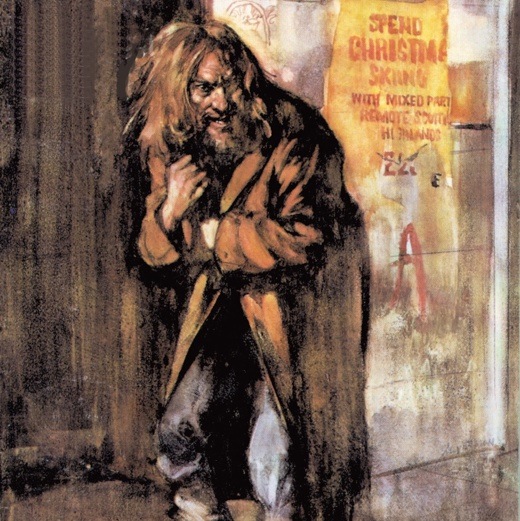
Image above: Painting of man on cover of 1971 Jethro Tull studio album LP record "Agualung".   From (http://en.wikipedia.org/wiki/Aqualung_%28Jethro_Tull_album%29).

Many years ago, during the 1980s, I witnessed a killing: a New York City cop shooting an unarmed homeless man near the Metropolitan Museum of Art. I was later called as a grand jury witness in the case. The grand jury did not indict the officer.

It was a summer evening. I was heading to play softball in Central Park. At the corner of Fifth Avenue and 79th Street, I got off my bicycle to walk toward the Great Lawn. The west side of Fifth was crowded with New Yorkers enjoying the beautiful night. People were streaming in and out of the park. Sidewalk vendors were doing brisk business. The vibe was good.

And in the midst of the hubbub, I spotted a fellow wearing dirty and tattered clothing. His hair was filthy, his face worn. It was hard to determine his age. He reminded me of Aqualung. (See this Jethro Tull album cover.)

He was carrying a large and heavy rock with both of his hands, pushing his way through the throng, and muttering unintelligible words. I wondered, what's his story? But I didn't give it much more thought.

Most of the people on the corner were not paying attention to him. Those in his direct path, as he lumbered north, did quickly step out of his way. But no one seemed much alarmed by the guy. In New York City, unfortunately, you often saw broken people—and shrugged them off as just another crazy.

I was about to head down the footpath toward the baseball fields, when I saw a commotion to my right. Several police officers—four or so, I recall—were approaching the man with the rock. And their guns were drawn. As they neared the fellow, he dropped the rock, he then began to run in the same direction he had been walking.

The cops were not grouped together; they were spread out—in a circle that was drawing tighter. The man, displaying a fair degree of agility, leaped into the street and tried to cut between two of the officers to get away.

Shots were fired. Two or three. Maybe four. And he went down.

The cops surrounded the man. He didn't move. This was no longer a person. This was a body.
I moved closer to the scene. Passersby had stopped to watch. It was still difficult to assess his age. His clothes were a grimy gray. I saw his dirty hands. Both were empty.

Soon police cars and an ambulance arrived. The paramedics did not move fast. They covered the body with a sheet. Several police officers were standing around a female officer. She was in anguish. They were consoling her. It was obvious: She had fired the shots that killed the man.

Her race? She was white. His skin color? I thought it was dark, but it was tough to tell if it was dirt or pigment.

Cops were buzzing about the scene. Flashing lights illuminated this ritzy stretch of Fifth Avenue. On-lookers gawked. And I noticed something that struck me as odd: The police officers were not talking to any of the witnesses. They were talking to each other and the paramedics. I approached one cop and said that I had seen it all. He wasn't impressed and looked at me as if to say, "So what?" I had thought the police would want to round up eyewitnesses to the shooting.

"Shouldn't I talk to someone?" I asked this officer. He nodded his head toward another policeman. I went up to that cop. "Excuse me, officer," I began. "I saw what happened." Again, I received a look of disinterest. "Shouldn't I...." He cut me off: "Talk to him." He was looking at another officer who was barking instructions to other cops.

I tried once more. I approached this officer who seemed to be in charge. "Officer, I saw...." He shut me up with a wave of his hand, signaling I should wait. And wait I did, as he directed other cops to do this or do that. The paramedics were preparing to cart off the body. After a few minutes, I went up to this officer again and told him I had witnessed the whole episode.

"Okay," he said.

He said nothing else. He didn't ask me for my name. He didn't ask if I would provide a statement. I was surprised by his lack of interest.

"Shouldn't I tell someone what I saw," I said.

"If you want to," he said, not in an encouraging tone.

"Okay, who do I talk to?" I ask.

"If you want to make a statement," he said, as if I was inconveniencing him and the entire police force, "you can go down to the station and do it there." Now I got it: He didn't want my statement, even though he had no idea what I would say. He was not interested in taking my name and contact information. It was my job apparently to make it to the police station on my own, and the station was a mile or so south.

This ticked me off. He was essentially trying to shoo me away. As the paramedics were loading the body on to the ambulance and as the cop who had shot the man was surrounded by her colleagues, I got on my bike and started to ride down Fifth.

At the station, I approached the front desk and told the officer staffing it that I had witnessed the shooting and had been told to come to the station to provide a statement. This fellow looked surprised to see me. He asked me to wait on a bench.

I waited. Five minutes, fifteen minutes. I went back to the desk. Yes, yes, I was told, someone will be with you shortly. Another five minutes, another fifteen minutes. Obviously, no one would have minded if I gave up and left.

Sitting next to me in this waiting area was a woman—middle-aged and white (if that matters)—who was also a witness. We probably weren't supposed to compare our accounts, but we did. (No one had told us not to.) She mentioned that she thought she had seen the victim holding something in his hand, perhaps a knife, when he started to run.

Her vantage point had not been as good as mine, and I told her that I had seen the man drop the big rock and immediately begin to run. There had been no time for him to pull out a knife. Moreover, I had been in a position to see his hands—before and after he was killed—and I saw no knife. We looked at each other and didn't know what else to say.

Finally, a detective—I think he was a detective, he didn't say—came over and gave me a form on a clipboard and asked me to write a statement of what I had seen. I did. I stuck to the facts: nutty-looking homeless man carrying a small boulder, approached by cops, drops rock and runs, cops get closer, he darts between two of the officers, cop fires on him.

It was clear to me that the officer did not have to shoot the man. He was not threatening the officers. He was trying to run from them. But I didn't write down this conclusion. I presented the facts; I believed their implication were undeniable.

When I finished, I handed my statement to one of the officers. I was told, "You'll be contacted, if that's necessary." None of my interactions with the police led me to believe that a thorough investigation was in the works.

As I left the station, I saw the female officer who had fired the fatal shots. She was with several colleagues. She was upset and appeared to be crying. The other cops were being supportive. I couldn't help but feel sorry for her. My interpretation was that she had screwed up; she had overreacted or panicked and fired her shots too soon. My hunch was that she knew that.

The next day—this was long before the internet era—I checked the newspapers and saw no stories on the shooting. Some time later—I think it was a couple of months—I received a call. A grand jury was examining the shooting, and my presence was requested.

I went to the courthouse at the appointed hour and waited to be called into the grand jury room. My time in the drab conference room with the grand jury was brief. The jury was, as they say, a diverse group. But most of the jurors looked bored. A few seemed drowsy.

The prosecutor asked me to identify myself and certify I had filed the statement. He asked me to describe where I had been and whether I had seen the full episode. But he never asked me to provide a complete account. The key portion of the interview went something like this:
Prosecutor: You saw him start to run?

Me: I did.

Prosecutor: Did you see anything in his hand?

Me: No.

Prosecutor: Did you see him holding a knife?

Me: No. But I....

Prosecutor: Thank you.
I had wanted to say that I had seen him drop the heavy rock and bolt and that it was unlikely he had been able to grab and brandish a knife while sprinting. And I thought the grand jurors should know that he had not charged at any of the officers; he had been trying to dash through an opening between two of the cops in order to flee. And if they were interested in my opinion regarding the necessity of firing on him, I would have shared that, too.

But the prosecutor cut me off. He didn't ask about about any of this. And not one of the jurors asked a question or said anything.

I left the room discouraged. This was not a search for the truth. It appeared to be a process designed to confirm an account that would protect the officer who had killed the man. The prosecutor was in command and establishing a narrative. (A knife!) The jurors appeared to be only scenery. (Insert your own ham sandwich reference here.)

Long before the present debate spurred by the non-indictments in the Michael Brown and Eric Garner cases, it seemed clear to me that the system contained a natural bias in favor of police officers. That certainly makes sense. Police officers have damn tough and dangerous jobs, and they are going to look out for their comrades-in-blue who slip up.

And prosecutors work closely with cops to rack up convictions, and they don't want to alienate their law enforcement partners. No one in that grand jury room was there to serve the interests of the dead guy.
On the way out of the courthouse, I realized I did not know the name of the victim.

I subsequently called a reporter who worked on the metro desk of the New York Times to tell him about my experience, hoping the paper would dig into the case. But I never saw a Times story on it. (At the time, I was working for a magazine that covered arms-control issues and in no position to write about the event. And back then, there was no equivalent to tweeting, blogging, or Facebooking.)

Several weeks, or a month or two, after my grand jury appearance, I called the person who had contacted me about testifying. Whatever happened? I asked. Oh, the man said, the case is over. I took that to mean the officer was not charged. Before I hung up, another question occurred to me.

I don't know why I thought about this, but I asked, "Whatever happened to the body of the man who was shot?" He was never identified and buried somewhere, he replied. And I wondered, never identified? How hard did they try?


.

Manning verdict & Snowden's future

SUBHEAD:  Edward Snowden's father, Lonnie, said: "I have absolutely no faith in the attorney general of the United States."

By Eyder Peralta on 30 January 2013 for NPR News -
(http://www.npr.org/blogs/thetwo-way/2013/07/30/207042272/what-the-manning-verdict-says-about-edward-snowdens-future)


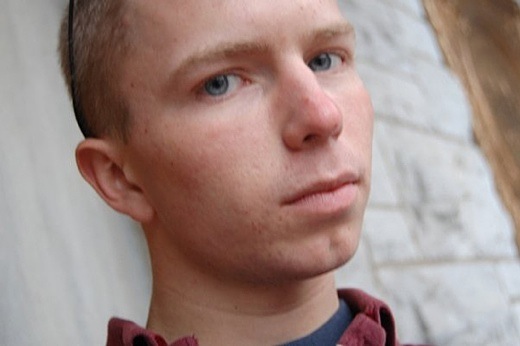
Image above: Photo courtesy of Bradley Manning Support Network. From (http://www.bu.edu/today/2012/the-making-of-a-cyber-libertarian/).

In the wake of of aiding the enemy, the natural question is, what does this say about Edward Snowden's future?

is, of course, the Army private responsible for the biggest leak of classified information in U.S. history. is responsible for revealing some of the most secretive and sensitive intelligence programs inside the National Security Agency.

The U.S. government charged Manning with aiding the enemy. , that was an unprecedented charge that had the potential of casting a long shadow over future leak cases.

Mary-Rose Papandrea, a professor of law at Boston College, is in the middle of writing an academic paper that explores the difference between leakers and traitors.

Papandrea said an aiding-the-enemy charge essentially amounts to treason; the fact that Col. Denise Lind, the military judge presiding over the Manning case, found him not guilty of the charge bodes well for Snowden and whoever may come next.

"It is good news for people who have the intent to inform the public that they will be protected," Papandrea said. "What I think the court did — without having seen any explicit rationale here — is to make a distinction between true aiding the enemy — intent to aid the enemy, knowledge that information will be read by the enemy and an intent to have that information read by the enemy — versus individuals who disclose information without authorization but with the intent to disclose them to the public at large."

During the trial, the U.S. government argued that when Manning released information to WikiLeaks — instead of traditional news outlets — it was because he wanted the data to be available in an indiscriminate manner. As an intelligence analyst, the government argued, he should have known that the information was going to end up in the hands of al-Qaida.

Many civil libertarians worried about the kind of precedent the case would set for investigative journalism in the United States. In essence, they said, this meant anyone could be charged with aiding the enemy for handing information to a website or news outlet because al-Qaida was free to visit that website.

What's more, aiding the enemy is one of only three crimes in the Uniform Code of Military Justice that theoretically applies to everyone.

Eugene Fidell, a lecturer at Yale Law School and an expert on military law, said the Manning verdict will likely revive talk about whether you can aide the enemy by releasing information to a news organization. One thing that seems clear, he says, is that Snowden will not be tried on that most-serious charge.

"On paper, the statute applies to any person. But in fact the Supreme Court would not tolerate a court martial of a civilian for aiding the enemy," Fidell said. "I don't think Mr. Snowden has to worry about being court martialed."

Papandrea agrees, but she says that while Manning beat the most serious charge against him, he could still face decades in prison for his other crimes, including espionage and theft.

"It's not like Bradley Manning is getting off scot-free. All it means is that he was not found guilty of what essentially amounts to treason," Papandrea says. "So as far as the message for Snowden, he still would face potential Espionage Act charges and other lesser charges."

In fact, the U.S. government has already charged the former NSA contractor with .

Papandrea argues, however, there are stark differences between Manning and Snowden.

"I don't think the espionage charges [against Manning] were that controversial," she said. "I think some people thought that Bradley Manning may have been engaged in whistle-blowing.

But I think the Snowden disclosures raise much bigger questions about the role of leakers in our society. You have Congress right now considering and coming close to passing legislation that would stop the program that Snowden revealed.

Clearly, his disclosures have had a big impact on the public debate. They are meaningful; they are important."

Manning, on the other hand, disclosed some 700,000 classified documents that "did not have significant impact on public discourse."

That was the argument, Snowden's father Lonnie and his attorney, Bruce Fein, made on CNN this afternoon. Snowden, Fein said, should be treated as a whistle-blower not a spy.

"He has sparked a conversation that Mr. Obama said was urgent," said Fein.

In Manning's case, judge Lind found the 25-year-old was not a traitor, but in six different instances, she rejected the defense's argument that Manning was a whistle-blower intent on sparking a debate about war and diplomacy.

If Lind sticks to maximum sentences, Manning could be in prison for decades.

Lonnie Snowden, who had called for his son to come back to the United States and face justice, had a different message for his son today: Stay safe, in Russia, he told him on CNN.

He added: "I have absolutely no faith in the attorney general of the United States."


Holden indicates US Government attitude

SUBHEAD: A.G. Holden says U.S. will not seek death penalty or torture Snowden if he returns. What a pathetic thing for him to have to say.

Mariano Castillo on 27 July 2013 for CNN News -
(http://www.cnn.com/2013/07/26/us/nsa-snowden/index.html)


Image above: Eric Snowden as a teen in an online post. Photo courtesy elitedaily.com — “The Voice of Generation Y”From (http://dhogle.wordpress.com/tag/edward-snowden/).
The U.S. Justice Department will not seek the death penalty for U.S. intelligence leaker Edward Snowden, Attorney General Eric Holder wrote to Russian authorities in a letter dated July 23.

In the letter, Holder says Snowden's arguments for temporary asylum in Russia are without merit.

Snowden is seeking asylum because he claims he will be tortured and face the death penalty if returned to the United States.

But the death penalty is not an option given the current charges against Snowden, and even if additional charges are filed, the United States would still not seek capital punishment, Holder wrote.

Once back in the United States, Snowden would not be tortured and would face a civilian trial with a lawyer appointed to him, the attorney general wrote.

"We believe that these assurances eliminate these asserted grounds for Mr. Snowden's claim that he should be treated as a refugee or granted asylum," Holder wrote.

He also said it is untrue that Snowden cannot travel because his U.S. passport was revoked. Snowden is still a U.S. citizen and is eligible for a limited-validity passport that would authorize a direct return to the United States.

"The United States is willing to immediately issue such a passport to Mr. Snowden," Holder wrote.

Father asks Obama to rein in Holder
In a letter released Friday, Snowden's father called on President Barack Obama to order Holder to dismiss the criminal complaint filed against his son.

Lon Snowden defended his son's actions, comparing them to acts of civil disobedience.

"We are also appalled at your administration's scorn for due process, the rule of law, fairness and the presumption of innocence as regards Edward," the letter said.

Earlier in the day, Lon Snowden said on NBC's "Today" that Snowden did the right thing by leaking U.S. intelligence and helping Americans see the truth.

"I think my son, when he takes his final breath, whether it's today or 100 years from now, (will) be comfortable with what he did," he said. "He did what he knew was right. He shared the truth with the American people. What we choose to do with it is up to us as a people."

Lon Snowden expressed his disappointment with the recent House vote that continued funding for the spy program that Edward Snowden exposed.

There is a need for a strong intelligence community, Lon Snowden said, but many who voted for continued funding for the program are really looking out for the special interests that will benefit.

"It's all about the money," he said.

The father said he has not been in direct contact with his son, but there has been indirect contact through intermediaries.

The intermediaries do not include WikiLeaks, Lon Snowden said, but he added that he is thankful to that group for aiding his son.

"I'm thankful for anybody at this point that is providing him with assistance to keep him safe and secure," he said.

U.S., Russian officials continue talks

Meanwhile, the Kremlin said that the Russian security agency FSB is talking to American officials.

"The situation around Snowden is not being discussed at the top level. There's a discussion between heads of FSB and FBI," the Kremlin press office said.

A spokesman for Vladimir Putin said the Russian president "expressed a firm intention to not allow" further damage to U.S. interests, including a pledge by Snowden not to release any more intelligence. "And I have no doubt this is how it will be, no matter how the situation develops," the spokesman said, according to the Russian news agency RIA Novosti.

The many mysteries of Snowden's transit zone

Snowden isn't yet allowed to step outside the Moscow airport where he's been confined for weeks. He is waiting for permission to stay elsewhere in Russia while his request for temporary asylum is considered.

He has been searching for a place to settle after the United States charged him with espionage.

The former National Security Agency contractor, who admitted last month to revealing sweeping U.S. electronic surveillance programs to the news media, left Hong Kong for Moscow on June 23.

Snowden may remain stuck in the transit area for weeks and maybe months, the head of Russia's migration service, Vladimir Volokh, told the Russian news agency Interfax. The maximum length of time Snowden can spend at the airport is six months, he said.
.

Targeted Occupy Leaders

SUBHEAD: Redacted FBI documents show plot to kill Occupy leaders in Texas if ‘Deemed Necessary’.

By Alexander Reed Keiiy on 29 June 2013 in ThruthDig -
(http://www.truthdig.com/eartotheground/item/redacted_fbi_document_shows_plot_to_kill_occupy_leaders_20130629/)


Image above:Occupy Houston Participants on October 6, 2011.  From (http://socialmediacorrespondents.net/?p=366).

“Did the FBI ignore, or even abet, a plot to assassinate Occupy Houston leaders?” asks investigative reporter Dave Lindorff at WhoWhatWhy. “What did the Feds know? Whom did they warn? And what did the Houston Police know?”

A Freedom of Information Act request filed by the Washington, D.C.-based Partnership for Civil Justice Fund yielded an FBI document containing knowledge of a plot by an unnamed group or individual to kill “leaders” of the Houston chapter of the nonviolent Occupy Wall Street movement.

Here’s what the document said, according to WhoWhatWhy:
An identified [DELETED] as of October planned to engage in sniper attacks against protestors (sic) in Houston, Texas if deemed necessary. An identified [DELETED] had received intelligence that indicated the protesters in New York and Seattle planned similar protests in Houston, Dallas, San Antonio and Austin, Texas. [DELETED] planned to gather intelligence against the leaders of the protest groups and obtain photographs, then formulate a plan to kill the leadership via suppressed sniper rifles. (Note: protests continued throughout the weekend with approximately 6000 persons in NYC. ‘Occupy Wall Street’ protests have spread to about half of all states in the US, over a dozen European and Asian cities, including protests in Cleveland (10/6-8/11) at Willard Park which was initially attended by hundreds of protesters.)
Paul Kennedy of the National Lawyers Guild in Houston and an attorney for a number of Occupy Houston activists arrested during the protests said he did not hear of the sniper plot and expressed discontent with the FBI’s failure to share knowledge of the plan with the public. He believed that the bureau would have acted if a “right-wing group” plotted the assassinations, implying that the plan could have originated with law enforcement.

“[I]f it is something law enforcement was planning,” Kennedy said, “then nothing would have been done. It might seem hard to believe that a law enforcement agency would do such a thing, but I wouldn’t put it past them.”

He added that the phrase “if deemed necessary,” which appeared in the bureau’s report, further suggests the possibility that some kind of official organization was involved in the plan.

Texas law officials have a history of extreme and inappropriate violence. “Last October,” Lindorff writes, “a border patrol officer with the Texas Department of Public Safety, riding in a helicopter, used a sniper rifle to fire at a fast-moving pickup truck carrying nine illegal immigrants into the state from Mexico, killing two and wounding a third, and causing the vehicle to crash and overturn.”

Kennedy has seen law enforcement forces attempt to secretly entrap Occupy activists and disrupt their activities in the city. He represented seven people who were charged with felonies stemming from a protest whose organizing group had been infiltrated by undercover officers from the Austin Police department. The felony charges were dropped when police involvement with a crucial part of that action was discovered.

A second document obtained in the same FOIA request suggested the assassination plans might be on the plotters’ back burner in case Occupy re-emerges in the area.

When WhoWhatWhy sent an inquiry to FBI headquarters in Washington, officials confirmed that the first document is genuine and that it originated in the Houston FBI office. Asked why solid evidence of a plot never led to exposure of the perpetrators’ identity or arrest, Paul Bresson, head of the FBI media office, deflected the question. According to WHoWhatWhy, he said:
The FOIA documents that you reference are redacted in several places pursuant to FOIA and privacy laws that govern the release of such information so therefore I am unable to help fill in the blanks that you are seeking. Exemptions are cited in each place where a redaction is made. As far as the question about the murder plot, I am unable to comment further, but rest assured if the FBI was aware of credible and specific information involving a murder plot, law enforcement would have responded with appropriate action.Lindorff wants us to note that “the privacy being ‘protected’ in this instance (by a government that we now know has so little respect for our privacy) was of someone or some organization that was actively contemplating violating other people’s Constitutional rights—by murdering them.” He says “[t]hat should leave us less than confident about Bresson’s assertion that law enforcement would have responded appropriately to a ‘credible’ threat.”
When the Houston Police department was asked about its knowledge of the plot, public affairs officer Keith Smith said it “hadn’t heard about it” and directed future questions to the Houston FBI office.

The obvious question to ask in attempting to determine the identities of the planners is this: Who has sniper training? A number of Texas law enforcement organizations received special training from Dallas-based mercenary company Craft International, which has a contract for training services with the U.S. Department of Homeland Security. The company was founded by a celebrated Army sniper who was killed by a combat veteran he accompanied to a shooting range.

Remington Alessi, an Occupy Houston activist who played a prominent role in the protests and hails from a law enforcement family, agrees with attorney Kennedy that the plot likely did not originate with a right-wing group. “If it had been that, the FBI would have acted on it,” he said. “I believe the sniper attack was one strategy being discussed for dealing with the occupation.”

The grotesque irony here, Lindoff writes, is that “while the Occupy Movement was actually peaceful, the FBI, at best, was simply standing aside while some organization plotted to assassinate the movement’s prominent activists.”

Lindorff concludes: “The FBI’s stonewalling response to inquiries about this story, and the agency’s evident failure to take any action regarding a known deadly threat to Occupy protesters in Houston, will likely make protesters at future demonstrations look differently at the sniper-rifle equipped law-enforcement personnel often seen on rooftops during such events. What are they there for? Who are the threats they are looking for and potentially targeting? Who are they protecting? And are they using ‘suppressed’ sniper rifles? Would this indicate they have no plans to take responsibility for any shots silently fired? Or that they plan to frame someone else?”
.

Peaceful protest a crime

SUBHEAD: Punishing free speech and letting murder off the hook is the new normal in today's America.

By - Brian Terrell on 12 October 2012 for ZNet -
(http://www.zcommunications.org/nonviolent-protester-of-drone-wars-sentenced-to-federal-prison-by-brian-terrell)


Image above: Brian Terrell on 9/17/11 taken at the annual Sugar Creek Gathering of the Midwest Catholic Workers. From (http://www.flickr.com/photos/frank_cordaro_and_the_dm_catholic_worker/6175885183/in/set-72157627738372908).

[IB Esitor's note: Catholic Worker Brian Terrell of Maloy, Iowa has been sentenced to serve 6 months in a federal prison for his witness against the use of drone warfare. Below is a message from Brian and his statement before the court.]

MESSAGE:
Friends, we are just out of court. I have been ordered to surrender to a federal prison not yet designated on November 30 to serve six months in lock up, co-defendant Ron Faust was sentenced to five years on probation. Below is the statement I made to the court. Judge Whitworth took great offense at my reference to Air Force security personnel as "goosestepping riot police."

Comparing our fighting men to Nazis (the judge's word, not mine) was reprehensible, he said. He is not offended, apparently, by goosestepping US military police intimidating nonviolent protestors, nor by Air Force drones committing crimes against humanity and murdering children. Mentioning these embarrassing facts, however, is an affront to good manners.

Many thanks for love, prayers and solidarity from many quarters.

[IB Esitor's note: The following is Brian Terrell’s statement at sentencing, US District Court, Jefferson City, Missouri, October 11, 2012.]

STATEMENT:
Mark Twain called free speech the "privilege of the grave," a privilege never afforded the living save as an empty formality, not to be regarded seriously as an actual possession. "As an active privilege, it ranks with the privilege of committing murder: we may exercise it if we are willing to take the consequences. Murder is forbidden both in form and in fact; free speech is granted in form but forbidden in fact….Murder is sometimes punished, free speech always."

Punishing free speech and letting murder off the hook is the order of the day in this courtroom.

How to speak of an appropriate sentence where no crime has been committed? No crime committed, at least, by the defendants? Last month’s trial in this courtroom concerning a protest of killer drones flown from Whiteman Air Force Base left no doubt that this is the case.

Each of the government’s witnesses, all of them Air Force police personnel, testified that participants in this protest were nonviolent, respectful and peaceable in assembling at Whiteman Air Force Base, a government installation, to petition that government for redress of a grievance, demanding that the remote control killing carried out daily from Whiteman cease. They testified that at no time, before or during our protest, did they perceive us as a threat.

Our expert witnesses testified that our behavior was consistent with the activities that the drafters of the First Amendment intended to be protected, not persecuted, by the government. The order and security of the base would not have been compromised had the security police allowed us to proceed to the headquarters to deliver our petition. No testimony to the contrary was offered this court.

Instead of planning to accommodate a constitutionally protected peaceable assembly, however, the Air Force chose intimidation and conspired to deprive us of the rights they are sworn to protect. We learned from government witnesses that that the phalanx of goose stepping riot police is a “Confrontation Management Team,” deployed only in the case of preannounced events. Whiteman security did not call out the Team to defend the base but to intimidate citizens engaged in lawful activities.

The court was mistaken a month ago when it said that our group was “allowed” to assemble on the highway right of way by the Air Force and that this space provided for us met free speech requirements of reasonable time and place. This place in question is not only outside the base’s jurisdiction, it is outside the sight and hearing of anyone on the base.

The court’s decision is part of a widening disintegration of civil liberties, where speech is tolerated only in designated and remote “free speech zones” where it cannot be heard by the government, and criminalized in any place where that speech might actually have a chance to be understood. Intended or not, the court’s message is a chilling one- that a citizens’ constitutional right to assemble to petition the government extends only to places outside government facilities and where the government does not have to hear it.

The court’s easy dismissal of international law as not “trumping” domestic law has precedents, but is all the more disturbing for this fact. Last fall, I was on trial for a drone protest in a New York State where, in contrast to this court, former United States Attorney General Ramsey Clark was permitted to testify on international law.

Judge Gideon, after listening to Ramsey Clark speak of the Nuremburg Principles at length, leaned over the bench and asked him, “This is all interesting, but what is the enforcement mechanism? Who is responsible for enforcing international law?” “They are,” responded Mr. Clark, pointing to us defendants, “and so,” he said to Judge Gideon, “are you!” Every citizen is responsible under international law and every judge more so.

In our trial here last month, as at our protest in April, our intention has been to put the illegally operated predator drones on trial and so we have focused on the machines that are sowing death and terror in Afghanistan and Pakistan by remote control from Whiteman Air Force Base. It was never our intention to address or to protest the weapons system that is the larger mission of Whiteman, namely the B-2 Stealth Bomber.

However, Judge Whitworth, both in sentencing Mark Kenney and in our trial, you noted that your commitment to maintain the security of the B-2 weighs heavily in your decisions.

For a judge to admit to being swayed by a consideration other than the law, not to mention when that consideration is the security of weapons of mass destruction, raises obvious questions about that judge’s impartiality. For my part, Judge Whitworth, I am grateful to you for calling our attention to the larger picture. It is not, of course, the technology of robotics that we protest but the murderous and criminal uses the government puts it to.

Drones are the weapon of choice in the current administration’s wars of aggression, but it was the B-2s from Whiteman that first violated Afghan airspace eleven years ago this week and began killing the people of Afghanistan. The crimes against humanity that began in October, 2001, with B-2 airstrikes on a defenseless civilian population continue today with drones operated from that very same base.

The B-2 Bomber, blasphemously nicknamed the “Spirit Bomber,” is also ready at a moment’s notice to commit the ultimate and unthinkable war crime of delivering the first nuclear payload to any place on earth. A cold war boondoggle, the B-2’s stealth capability shields it from radar the Soviets never got around to developing before their own tragic empire finally imploded.

It is a prime illustration of President Eisenhower’s admonition, “Every gun that is made, every warship launched, every rocket fired signifies, in the final sense, a theft from those who hunger and are not fed, those who are cold and not clothed. This world in arms is not spending money alone. It is spending the sweat of its laborers, the genius of its scientists, the hopes of its children. This is not a way of life at all in any true sense. Under the cloud of threatening war, it is humanity hanging from a cross of iron.”

On the official website for Whiteman Air Force Base I found the base’s mission statement. It is as brief as it is vicious: “Skilled and proud Airmen providing full spectrum, expeditionary, B-2 global strike and combat support capabilities to geographic commanders and the Commander, USSTRATCOM, while supporting Team Whiteman. We kick down doors and kill targets… Weapons on Target, On Time!”

I have visited Afghanistan and know that eleven years of NATO troops kicking down doors has not brought peace there. Often soldiers don’t seem to know whose door they’ve kicked in or whether the “target” they kill is who they are hunting for. B-2 bombers from a great height or even drones with state of the art video feed do no better.

We know that even children are sometimes named as targets to be killed by drones. Children regularly are among their “collateral damage.” The targets themselves are often victims of assassination rather than legitimate casualties of war. Eleven years of kicking down doors has only made the world a more frightening place and has earned our nation more enemies and less security. Whiteman’s mission is not counter-terrorism- it is terrorism.

Judge Whitworth, you told me at the close of our trial that you do not take sentencing someone to prison lightly. This case offers certain challenges. As my presentence report attests, “There are no identifiable victims of the offense.” Beyond your own surmises, there was no suggestion at trial that our conduct threatened any person, property or institution. The question for you is, how to pass a sentence commensurate with harm done when the substance of the “crime” itself is only a good deed without harmful consequences to any?

I expect nothing other than a prison sentence today. I accept this without regret and will, if allowed, surrender myself to a designated prison some weeks from now, but I cannot say that I see justice in this. I admit that my conduct was as the government described it at trial. That conduct, however, does not constitute a crime but was a response to one. It is conduct this court should be protecting.

Our expert witness Professor Bill Quigley spoke from the stand here last month about the difference between law and justice and the ongoing struggle to bring these into one. Since first entering this courthouse back in June, I have been ruminating over the words circling the Great Seal of the United States in the floor of the rotunda of this courthouse, “Let Justice Flow Like a River.” How did these words from the Bible make it into this modern, tax-supported government building?

I wonder if these words of scripture might have made their way here to the secular domain from the prophet Amos through Dr. Martin Luther King, Jr., who quoted them in his classic “Letter from the Birmingham Jail.” In any case, these lofty words ring hollow in this place. Justice has not flowed through these proceedings and even law itself has proved but a disappointing trickle.

Another Biblical quote suggests itself for the trampling under the feet of the litigants, defendants, judges and attorneys who enter this building oblivious to the unpunished murder in places far away but perpetrated from a place not so far from here; this from the prophet Isaiah:

“My Beloved looked for justice and found it denied, for righteousness but heard cries of distress.”
.

Brazilians murder indigenous leader

SUBHEAD: An indigenous leader in southern Brazil has been shot dead in front of his community for ranchland. By Staff on 18 November 2011 for the BBC News - (http://www.bbc.co.uk/news/mobile/world-latin-america-15799712) Image above: Nisio Gomes (center) faces unidentified man hours before his murder. From (http://www.survivalinternational.org/news/7887).

Nisio Gomes, 59, was part of a Guarani Kaiowa group that returned to their ancestral land at the start of this month after being evicted by ranchers.

He was killed by a group of around 40 masked gunmen who burst into the camp.

Brazil's Human Rights Secretary condemned the murder as "part of systematic violence against indigenous people in the region".

In a statement, Human Rights Minister Maria do Rosario Nunes said the region in Mato Grosso do Sul state was "one of the worst scenes of conflict between indigenous people and ranchers in the country".

She said those responsible must not be allowed to escape with impunity.

Mr Gomes was shot in the head, chest, arms and legs and his body was then driven away by the gunmen, community members said.

His son was reportedly beaten and shot with a rubber bullet when he tried to intervene.

Unconfirmed reports say two other Guaranis were abducted by the gunmen and may also have been killed.

Many of the community's 60 residents fled the camp to hide in the surrounding forest

Tribe defiant

The incident happened near the town of Amambai near the border with Paraguay.

Federal Police and representatives of Brazil's main indigenous organisations have travelled to the area to investigate the killing.

"The people will stay in the camp, we will all die here together. We are not going to leave our ancestral land," one of the Guaranis told the Roman Catholic Indigenous Missionary Council (CIMI) .

CIMI said the community wanted to recover Mr Gomes's body so he could be buried in the land he tried to defend throughout his life.

The group had been camping on a roadside following their eviction until they decided to return to their land at the beginning of November.

The killing has been condemned by the campaign group Survival International, which campaigns for indigenous rights.

"It seems the ranchers won't be happy until they've eradicated the Guarani," Survival's director Stephen Corry said.

"This level of violence was commonplace in the past and it resulted in the extinction of thousands of tribes," he added.

The Guarani are Brazil's largest indigenous minority, with around 46,000 members living in seven states.

Many others live in neighbouring Paraguay, Bolivia and Argentina.

The group suffers from a severe shortage of land in Brazil, which has worsened as a boom in agriculture has led farmers and ranchers to extend their holdings.

Indigenous activists say farmers in Mato Grosso do Sul frequently use violence and threats to force them off their ancestral territory, and that the local authorities do little to protect them.

Video above: From (http://www.survivalinternational.org/films/marcosveron). .

A 51st State for Armed Drones

SUBHEAD: 94,000 square miles over Colorado and New Mexico could be given over to remote-controlled flying murder machines. By David Swanson on 27 October 2011 for War Is a Crime - (http://warisacrime.org/content/51st-state-armed-robotic-drones) Image above: Detail of map of Colorado and New Mexico affected by plan. Click to see all. From (http://www.not1moreacre.net).

Weaponized UAVs (unmanned aerial vehicles), also known as drones, have their own caucus in Congress, and the Pentagon's plan is to give them their own state as well.

Under this plan, 7 million acres (or 11,000 square miles) of land in the southeast corner of Colorado, and 60 million acres of air space (or 94,000 square miles) over Colorado and New Mexico would be given over to special forces testing and training in the use of remote-controlled flying murder machines. The full state of Colorado is itself 104,000 square miles. Rhode Island is 1,000 square miles. Virginia, where I live, is 43,000 square miles.

The U.S. military (including Army, Navy, Air Force, and Marines) is proceeding with this plan in violation of the public will, new state legislation on private property rights, an exceptionally strong federal court order, and a funding ban passed by the United States Congress, and in the absence of any approved Environmental Impact Statement. Public pressure has successfully put the law on the right side of this issue, and the military is disregarding the law.

I spoke with Jean Aguerre, whose organization "Not 1 More Acre" ( http://not1moreacre.net ) is leading the pushback against this madness. Jean told me she grew up, during the 1960s, on the vast grasslands of southeast Colorado, where the Comanche National Grasslands makes up part of a system of grasslands put in place to help the prairie recover from the dust bowl. The dust bowl, Aguerre says, was the worst environmental disaster in the United States until BP filled the Gulf of Mexico with oil. The dust bowl had been brought on by the government's policy of requiring homesteaders to plow the prairie. The recovery programs created large tracts of land, of 100,000 acres and more, owned by "generational ranchers," that is families that would hand the ranches off to their children.

Aguerre said she grew up on a ranch of incredible beauty and natural wealth, with a 165-million-year-old dinosaur track way and petroglyphs from 12,000 years back. Grasslands are the most threatened ecosystems in the world because they are so accessible, Aguerre says, and the only intact short grassland left in this country is the one being targeted for the "51st state."

Round One began in the 1980s. Fort Carson, an Army base in Colorado Springs, had been kept open after World War II and now began looking for more land. The people of the area were opposed. The U.S. Congressman representing the area agreed to oppose any landgrab. But Senator Gary Hart took the opposite position. As a result, during the early 1980s, the Army Corps of Engineers started telling ranchers to sell out or risk seeing their land condemned and taken from them.

The ranch next to Aguerre's is called Wine Glass Rourke. It was sold to a shill, as Aguerre describes the buyer. He ran the place into the ground with too many cattle, she says, and then sold it to the military, "And they were off and running!" With condemnations the military put together 250 thousand acres. Ranchers, along with their cattle, were moved off their own land by federal marshals. "We didn't know when we'd be next," Aguerre says of her own family.

Luckily for the people of Colorado and New Mexico, and all of us, Aguerre got involved in politics. She became a political director for Congressman Tim Werth who later became a U.S. senator. Aguerre took him to see the Wine Glass Rourke ranch and told him "Let's take it back." Werth dedicated his staff to the effort for three years, resulting in the transfer to the Forest Service of 17,000 key acres.

The Army used its new land less than twice a year for maneuvers, but caused horrible environmental damage whenever it did. That was the case for about 30 years, until the activity of recent years made everything that came before look sensitive and sustainable.

In the meantime, people like Dick Cheney and Donald Rumsfeld were theorizing the transformation of the U.S. military into a force for robotic warfare. Aguerre believes it was in 1996 that a decision was made that the military would need a robotic warfare center. Around 1999 the Programmatic Environmental Impact Statement was created. This precedes the more specific Site Environmental Impact Statements. The U.S. public, just like the public of any foreign nation where new U.S. bases are being planned, was told nothing.

In 2006, Aguerre was working in Oregon when friends started asking her to come home and help because something big was happening. An Army land expansion map had been leaked that showed plans for taking over 6.9 million acres, the whole southeast corner of the state. Aguerre thought she would come home for two weeks but has never left. An Environmental Impact Statement for the site was about to be released, and Aguerre knew that meant the project was pretty far along. She formed organizations and found a lawyer in Colorado Springs named Steve Harris to help. The two of them, she says, were absolutely dedicated to NEPA and FOIA. NEPA is the National Environmental Policy Act of 1969. FOIA is the Freedom of Information Act of 1966. "NEPA is intended to prevent our government taking our world apart piece by piece without our knowing it," explains Aguerre.

Aguerre and others persuaded the area's county commissioners to vote against the military's plans in 2006, and the state legislature to pass a private property rights bill in January 2007 -- a bill that required approval of such plans by the state legislature.

Ken Salazar was the military's hired servant. He had been Attorney General of Colorado from 1999 to 2005. He was a U.S. Senator from 2005 to 2009. President Barack Obama has made him Secretary of the Interior. Around 2007, Jean Aguerre recounts, Salazar held a public meeting in Pueblo, Col., with about 300 ranchers packing the room. He turned his palms up to the ceiling and announced: "I will lift the golden curtain that falls at the end of El Paso county so that prosperity can flow onto the eastern plains." This meant that military spending was economically beneficial. Military expansion, people were being told, was good for them -- even if it stole their families' land, and regardless of what momentum it created for the launching and continuing of wars.

"Instead of putting together frameworks for nonproliferation," says Aguerre, "Ken Salazar worked to destroy the last intact short grass prairie because the money was too good."

Senators Wayne Allard, who would join the military lobbyist company the Livingston Group within weeks of leaving the Senate, and Ken Salazar passed an authorization for taking land as part of the 2007 John Warner Defense Authorization Act. "None of the ranchers knew they were in line to be condemned for the second damn time," says Aguerre.

John Salazar, Ken's brother, at this time represented Colorado's third congressional district, while Republican Marilyn Musgrave represented the fourth. Musgrave was persuaded by ranchers that there was no need for the government to take their land. Aguerre worked with Musgrave's staff to draft a one-sentence funding ban. Aguerre and her allies then organized massive public pressure to recruit John Salazar as a Democratic co-sponsor. Ken Salazar failed in his effort to block this measure in the Senate. The ban passed both houses and became law, but it must be renewed every year.

In 2009, Aguerre and her allies won a federal court ruling throwing out the military's Environmental Impact Statement with harsh and unequivocal language -- "one of the strongest court orders under NEPA," says Aguerre. By 2008, the military had begun using its land a lot more, and the court ruling did not stop them.

The funding ban, too, is not stopping increased activity. This past year, the funding ban was missing from a committee chairman's markup in which it had appeared in previous years. Not 1 More Acre and its allies pressured Third-District Congressman Scott Tipton. People from all over the country phoned his office. They were told that as non-constituents their views did not matter. Aguerre advised people to reply: "When you pick my pocket you don't ask what district I'm from." Tipton was won over, and the funding ban, for what it's worth, remains for now.

Nonetheless, says Aguerre, the military is proceeding with and increasing trainings and environmental destruction daily .

Senators Mark Udall and Michael Bennet of Colorado and Tom Udall of New Mexico don't receive high marks from Jean Aguerre. "Mark Udall on Armed Services and Michael Bennet on Agriculture sit with their thumbs in their pie. Udall has never once come to southeastern Colorado and looked young ranchers in the eye and said 'this is why we need this military takeover of your lands.'"

Aguerre continues: "And Tom Udall puts out this pap the other day, mumbo jumbo about the Air Force. It's not Air Force; it's Special Operations. Aguerre said that her group and others are preparing a comment letter seeking legal standing to challenge the Air Force, and potentially to pry loose more information from the iron grip of our "transparent" government. Aguerre points out that the Air Force Special Operations Command Environmental Assessment was written by SAIC, a global military contractor that also makes voting machines.

"We found out that the state national guard is completely involved in UAV warfare," says Aguerre. "So when your house floods and you don't have the national guard there, they may be remotely piloting something somewhere else."

Aguerre says that in 2006 she knew of four countries that were manufacturing armed UAVs, and that now she knows of 56. So, the argument that drones keep "people" out of harm's way (with people redefined to mean U.S. citizens) doesn't hold up very solidly. We have also already had a suicide bomb attack on a drone piloting location and had drone pilots commit suicide, not to mention the risks of long-term blowback, the damage being done to the rule of law, and all the human beings killed and injured from among the non-U.S. 95% of humanity.

Aguerre asks scientists who love unarmed UAVs to consider the full effect of supporting such technology. I would ask environmentalists to consider the full effect of not resisting the destruction of what Not 1 More Acre describes as:

  • unique bioregions of canyonlands, forested mesas, grasslands and riparian systems providing habitat for diverse flora and fauna found nowhere else on Earth and the largest block of native prairie remaining on the High Plains;
  • restored Dust Bowl lands – Comanche, Kiowa and Rita Blanca National Grasslands — offering robust safe haven to threatened and endangered species of plants and animals, including rare insects and reptiles yet to be named;
  • wild rivers and complex wetlands vital to native fish, migrating birds, unique wildlife and environmental health.

I would ask opponents of drone warfare to consider the likely impact of setting aside 60 million acres of air space for testing drones.

"We cannot allow the sacrifice of our democracy to politicians who are bought by military contractors," says Aguerre. "If they are able to get this 51st state for robotic warfare, I think the economy will be irretrievably lost. These are unbelievably beautiful and pristine lands. Our rural areas are where the genetically modified seeds are being planted, where the lands and mountains are being mined, and where the military is going to destroy an area the size of a state, because the rural people are so few. Gary Hart was able to attack the last short grass prairie without political cost."

Why is there no political cost? Because "we can't get the word out."

Let's help get the word out by sharing this link: http://not1moreacre.org

.