Showing posts with label Pacific. Show all posts

Activism in the Anthropocene

SUBHEAD: To withstand the coming waves, winds and wars, we need to be addressing our own incoherence.

By Sam Allen on 15 December 2017 for Transition Network -
(https://transitionnetwork.org/news-and-blog/activism-in-the-anthropocene/)


Image above: The Pacific Climate warriors prepare for their journey to the Vatican, carrying traditional mats that weave together stories from the low-lying islands of the Pacific. Photo by Fenton Lutunatabua. From original article.

This is the first in a series of blogs from Kevin Buckland, a Barcelona-based artivist, storyteller, facilitator and organizer who engages art as a tool for enabling change.

Look out the window, see the air between your eyes and the horizon.

This is the Anthropocene – a new geological age characterized by the critical impacts of human activities on the Earth’s systems. Every word you will ever speak will be articulated using this changed air.

The Anthropocene can be understood not as an issue but a context: it is the world we do and will, from now on, inhabit – the rest of our lives will be defined increasingly by an accelerating political and ecological destabilization of unimaginable scale.

Sit with that feeling, hold it – it is not going away, internalizing this knowledge will allow us as individuals and as movements to build structural resilience that prepares us for coming destabilization.
But if climate change is inevitable, global and profoundly altering human culture – then so too can our movements react on scale with the crisis.
The word “crisis” first appeared in English (from the greek origin krinein “decide”) to mean “the turning point of a disease”. Global warming is Gaias’s fever, a symptom of an unsustainable relationship to the physical world.

But as this fever rises, global movements are swarming like antibodies to the underlying causes of the disease. The global climate crisis presents a great challenge, but also a great opportunity. Climate change means that our human civilization has to change.

Yet, the direction this now inevitable cultural shift takes is still left to be decided. As the ecological security of our vital life systems degrade there is a grave danger for the neoliberal logic of scarcity to accumulate more power, and already the rise of the far-right is hailing a response to this crisis with enhanced borders, racism, centralization and militarism.

For movements to thrive and survive in the anthropocene, we need to look beyond the “activism-as-usual” that has shaped the past century, and gaze deeper into long-term cultural change that can withstand in the coming centuries of accelerating entropy.

If the left is to provide a more effective proposal to this collective crisis than the world that capitalism proposes, it requires the deep work of targeting not only the symptom of the illness, but also its causes.

This means addressing the long history of white-supremacy, racism, sexism, anthropocentrism, imperialism and colonialism that have shaped both our world and our atmosphere.

This is hard work, that many environmental movements have shied away from due to the urgency of the crisis, but this also reframes the vast majority of the world who have been victim of structural injustice as our allies.

But to create a movement wide enough for everyone, history demands the left provides not only an alternative politic to neoliberalism, but an alternative process.

If this process is a truly bottom-up democratic process, then each coming disaster provides the opportunity for it to spread, allowing movements for justice to flourish inside the oncoming chaos, rather than be derailed by it.

This series of articles and interviews digs into the space where resistance becomes resilience; where people are experimenting with alternative organizing cultures inside their place of struggle.

These articles will investigate how movements are working together, rather than just what we are working on; and examining the socio-cultural shift underway inside those on the edges who are nudging the mainstream into new directions.

Our movements’ desires to foment alternative futures – encouraging democratic, prefigurative and decentralized solutions – may actually have less to do with solar panels and community gardens than with nurturing scalable and democratic organizing cultures that can be shared with allies, volunteers and partners in ways that improve access to autonomy as we move together into an exponentially tumultuous future.

We will examine organizing that is intentional about its cultural legacy, and focus on process for participation rather than as a product of participation. It is, perhaps, these organizing cultures that are already incubating the next chapter of human history.

This series of articles will examine a diversity of spaces from across the global movement for climate justice.
  1. In our first article, we will look at how eco-feminist principles are reshaping cultures of mass direct action though Ende Gelande.
  2. Our second article will focus on the “Pacific Warriors”, indigenous activists from the low-lying islands of the Pacific and the people most vulnerable to sea level rise.
  3. Our third article will look at Cooperation Jackson, that combines black-led eco-social cooperativism with local municipal politics to provide an alternative future for the “deep south” of the United States.
  4. Finally, we will look to Imider, a small community on the edge of the Sahara who are transforming their indigenous political cultures as they protect their communities’ water from an expanding silver mine.
It is my intention that by looking at Emergent movement organizing structures on a diversity of scales and contexts, there is potential to look at how other groups are developing and enacting political processes that are coherent with their shared values and ambitions.

While the climate crisis cannot be avoided; disaster can be. The main question regarding the severity of the Anthropocene will be how human beings organize in this unpredictable and hostile terrain and what processes have the structural integrity to survive constant destabilization.

If our “movement of movements” is to withstand the coming waves, winds and wars, we need to be addressing our own incoherencies, lest they open fissures in our structures at every weak point.

Across the world, bottom up processes are gaining force as the global climate justice movement begins to inhabit its politics, tilting from being diverse protest movements towards being a truly revolutionary force that can rise faster than the oceans.

.

Octopus - Deep Intellect, Soul, Alien

SUBHEAD: "Deep Intellect" was an article that led to the book "The Soul of an Octopus".

By Sy Montgonery on 24 October 2011 for Orion Magazine  -
(https://orionmagazine.org/article/deep-intellect/)
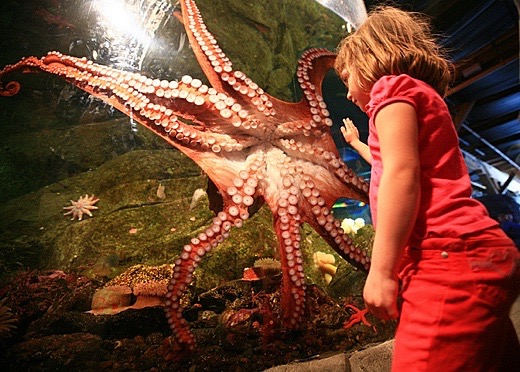

Image above: A young girl and giant pacific octopus meet at the Seattle Aquarium. Photo by Lazlo. From (https://www.wired.com/2011/11/strange-mind-stranger-brain-of-the-octopus/).

On an unseasonably warm day in the middle of March, I traveled from New Hampshire to the moist, dim sanctuary of the New England Aquarium, hoping to touch an alternate reality. I came to meet Athena, the aquarium’s forty-pound, five-foot-long, two-and-a-half-year-old giant Pacific octopus.

For me, it was a momentous occasion. I have always loved octopuses.

No sci-fi alien is so startlingly strange. Here is someone who, even if she grows to one hundred pounds and stretches more than eight feet long, could still squeeze her boneless body through an opening the size of an orange; an animal whose eight arms are covered with thousands of suckers that taste as well as feel; a mollusk with a beak like a parrot and venom like a snake and a tongue covered with teeth; a creature who can shape-shift, change color, and squirt ink.

But most intriguing of all, recent research indicates that octopuses are remarkably intelligent.

Many times I have stood mesmerized by an aquarium tank, wondering, as I stared into the horizontal pupils of an octopus’s large, prominent eyes, if she was staring back at me — and if so, what was she thinking?

Not long ago, a question like this would have seemed foolish, if not crazy. How can an octopus know anything, much less form an opinion?

Octopuses are, after all, “only” invertebrates — they don’t even belong with the insects, some of whom, like dragonflies and dung beetles, at least seem to show some smarts. Octopuses are classified within the invertebrates in the mollusk family, and many mollusks, like clams, have no brain.

Only recently have scientists accorded chimpanzees, so closely related to humans we can share blood transfusions, the dignity of having a mind.

But now, increasingly, researchers who study octopuses are convinced that these boneless, alien animals — creatures whose ancestors diverged from the lineage that would lead to ours roughly 500 to 700 million years ago — have developed intelligence, emotions, and individual personalities. Their findings are challenging our understanding of consciousness itself.

I had always longed to meet an octopus. Now was my chance: senior aquarist Scott Dowd arranged an introduction. In a back room, he would open the top of Athena’s tank. If she consented, I could touch her.

The heavy lid covering her tank separated our two worlds. One world was mine and yours, the reality of air and land, where we lumber through life governed by a backbone and constrained by jointed limbs and gravity.

The other world was hers, the reality of a nearly gelatinous being breathing water and moving weightlessly through it. We think of our world as the “real” one, but Athena’s is realer still: after all, most of the world is ocean, and most animals live there. Regardless of whether they live on land or water, more than 95 percent of all animals are invertebrates, like Athena.

The moment the lid was off, we reached for each other. She had already oozed from the far corner of her lair, where she had been hiding, to the top of the tank to investigate her visitor. Her eight arms boiled up, twisting, slippery, to meet mine. I plunged both my arms elbow deep into the fifty-seven-degree water.

Athena’s melon-sized head bobbed to the surface. Her left eye (octopuses have one dominant eye like humans have a dominant hand) swiveled in its socket to meet mine. “She’s looking at you,” Dowd said.

As we gazed into each other’s eyes, Athena encircled my arms with hers, latching on with first dozens, then hundreds of her sensitive, dexterous suckers. Each arm has more than two hundred of them. The famous naturalist and explorer William Beebe found the touch of the octopus repulsive. “I have always a struggle before I can make my hands do their duty and seize a tentacle,” he confessed.

But to me, Athena’s suckers felt like an alien’s kiss — at once a probe and a caress. Although an octopus can taste with all of its skin, in the suckers both taste and touch are exquisitely developed.

Athena was tasting me and feeling me at once, knowing my skin, and possibly the blood and bone beneath, in a way I could never fathom.

When I stroked her soft head with my fingertips, she changed color beneath my touch, her ruby-flecked skin going white and smooth. This, I learned, is a sign of a relaxed octopus. An agitated giant Pacific octopus turns red, its skin gets pimply, and it erects two papillae over the eyes, which some divers say look like horns. One name for the species is “devil fish.”

With sharp, parrotlike beaks, octopuses can bite, and most have neurotoxic, flesh-dissolving venom. The pressure from an octopus’s suckers can tear flesh (one scientist calculated that to break the hold of the suckers of the much smaller common octopus would require a quarter ton of force). One volunteer who interacted with an octopus left the aquarium with arms covered in red hickeys.

Occasionally an octopus takes a dislike to someone. One of Athena’s predecessors at the aquarium, Truman, felt this way about a female volunteer. Using his funnel, the siphon near the side of the head used to jet through the sea, Truman would shoot a soaking stream of salt water at this young woman whenever he got a chance.

Later, she quit her volunteer position for college. But when she returned to visit several months later, Truman, who hadn’t squirted anyone in the meanwhile, took one look at her and instantly soaked her again.

Athena was remarkably gentle with me — even as she began to transfer her grip from her smaller, outer suckers to the larger ones. She seemed to be slowly but steadily pulling me into her tank. Had it been big enough to accommodate my body, I would have gone in willingly. But at this point, I asked Dowd if perhaps I should try to detach from some of the suckers. With his help, Athena and I pulled gently apart.

I was honored that she appeared comfortable with me. But what did she know about me that informed her opinion? When Athena looked into my eyes, what was she thinking?

While Alexa Warburton was researching her senior thesis at Middlebury College’s newly created octopus lab, “every day,” she said, “was a disaster.”

She was working with two species: the California two-spot, with a head the size of a clementine, and the smaller, Florida species, Octopus joubini. Her objective was to study the octopuses’ behavior in a T-shaped maze. But her study subjects were constantly thwarting her.

The first problem was keeping the octopuses alive. The four-hundred-gallon tank was divided into separate compartments for each animal. But even though students hammered in dividers, the octopuses found ways to dig beneath them — and eat each other.

Or they’d mate, which is equally lethal.

Octopuses die after mating and laying eggs, but first they go senile, acting like a person with dementia. “They swim loop-the-loop in the tank, they look all googly-eyed, they won’t look you in the eye or attack prey,” Warburton said. One senile octopus crawled out of the tank, squeezed into a crack in the wall, dried up, and died.

It seemed to Warburton that some of the octopuses were purposely uncooperative. To run the T-maze, the pre-veterinary student had to scoop an animal from its tank with a net and transfer it to a bucket. With bucket firmly covered, octopus and researcher would take the elevator down to the room with the maze.

Some octopuses did not like being removed from their tanks. They would hide. They would squeeze into a corner where they couldn’t be pried out. They would hold on to some object with their arms and not let go.

Some would let themselves be captured, only to use the net as a trampoline. They’d leap off the mesh and onto the floor — and then run for it. Yes, run. “You’d chase them under the tank, back and forth, like you were chasing a cat,” Warburton said. “It’s so weird!”

Octopuses in captivity actually escape their watery enclosures with alarming frequency. While on the move, they have been discovered on carpets, along bookshelves, in a teapot, and inside the aquarium tanks of other fish — upon whom they have usually been dining.

Even though the Middlebury octopuses were disaster prone, Warburton liked certain individuals very much. Some, she said, “would lift their arms out of the water like dogs jump up to greet you.” Though in their research papers the students refer to each octopus by a number, the students named them all.

One of the joubini was such a problem they named her The Bitch. “Catching her for the maze always took twenty minutes,” Warburton said. “She’d grip onto something and not let go. Once she got stuck in a filter and we couldn’t get her out. It was awful!”

Then there was Wendy. Warburton used Wendy as part of her thesis presentation, a formal event that was videotaped. First Wendy squirted salt water at her, drenching her nice suit. Then, as Warburton tried to show how octopuses use the T-maze, Wendy scurried to the bottom of the tank and hid in the sand.

Warburton says the whole debacle occurred because the octopus realized in advance what was going to happen. “Wendy,” she said, “just didn’t feel like being caught in the net.”

Data from Warburton’s experiments showed that the California two-spots quickly learned which side of a T-maze offered a terra-cotta pot to hide in. But Warburton learned far more than her experiments revealed. “Science,” she says, “can only say so much. I know they watched me. I know they sometimes followed me.

But they are so different from anything we normally study. How do you prove the intelligence of someone so different?”

Measuring the minds of other creatures is a perplexing problem. One yardstick scientists use is brain size, since humans have big brains. But size doesn’t always match smarts. As is well known in electronics, anything can be miniaturized.

Small brain size was the evidence once used to argue that birds were stupid — before some birds were proven intelligent enough to compose music, invent dance steps, ask questions, and do math.

Octopuses have the largest brains of any invertebrate. Athena’s is the size of a walnut — as big as the brain of the famous African gray parrot, Alex, who learned to use more than one hundred spoken words meaningfully. That’s proportionally bigger than the brains of most of the largest dinosaurs.

Another measure of intelligence: you can count neurons. The common octopus has about 130 million of them in its brain. A human has 100 billion. But this is where things get weird. Three-fifths of an octopus’s neurons are not in the brain; they’re in its arms.

“It is as if each arm has a mind of its own,” says Peter Godfrey-Smith, a diver, professor of philosophy at the Graduate Center of the City University of New York, and an admirer of octopuses.

For example, researchers who cut off an octopus’s arm (which the octopus can regrow) discovered that not only does the arm crawl away on its own, but if the arm meets a food item, it seizes it — and tries to pass it to where the mouth would be if the arm were still connected to its body.

“Meeting an octopus,” writes Godfrey-Smith, “is like meeting an intelligent alien.” Their intelligence sometimes even involves changing colors and shapes.

One video online shows a mimic octopus alternately morphing into a flatfish, several sea snakes, and a lionfish by changing color, altering the texture of its skin, and shifting the position of its body. Another video shows an octopus materializing from a clump of algae. Its skin exactly matches the algae from which it seems to bloom — until it swims away.

For its color palette, the octopus uses three layers of three different types of cells near the skin’s surface. The deepest layer passively reflects background light. The topmost may contain the colors yellow, red, brown, and black.

The middle layer shows an array of glittering blues, greens, and golds. But how does an octopus decide what animal to mimic, what colors to turn? Scientists have no idea, especially given that octopuses are likely colorblind.

But new evidence suggests a breathtaking possibility. Woods Hole Marine Biological Laboratory and University of Washington researchers found that the skin of the cuttlefish Sepia officinalis, a color-changing cousin of octopuses, contains gene sequences usually expressed only in the light-sensing retina of the eye. In other words, cephalopods — octopuses, cuttlefish, and squid — may be able to see with their skin.

The American philosopher Thomas Nagel once wrote a famous paper titled “What Is It Like to Be a Bat?” Bats can see with sound. Like dolphins, they can locate their prey using echoes.

Nagel concluded it was impossible to know what it’s like to be a bat. And a bat is a fellow mammal like us — not someone who tastes with its suckers, sees with its skin, and whose severed arms can wander about, each with a mind of its own. Nevertheless, there are researchers still working diligently to understand what it’s like to be an octopus.

Jennifer Mather spent most of her time in Bermuda floating facedown on the surface of the water at the edge of the sea. Breathing through a snorkel, she was watching Octopus vulgaris — the common octopus. Although indeed common (they are found in tropical and temperate waters worldwide), at the time of her study in the mid-1980s, “nobody knew what they were doing.”

In a relay with other students from six-thirty in the morning till six-thirty at night, Mather worked to find out. Sometimes she’d see an octopus hunting. A hunting expedition could take five minutes or three hours. The octopus would capture something, inject it with venom, and carry it home to eat.

“Home,” Mather found, is where octopuses spend most of their time.

A home, or den, which an octopus may occupy only a few days before switching to a new one, is a place where the shell-less octopus can safely hide: a hole in a rock, a discarded shell, or a cubbyhole in a sunken ship. One species, the Pacific red octopus, particularly likes to den in stubby, brown, glass beer bottles.

One octopus Mather was watching had just returned home and was cleaning the front of the den with its arms. Then, suddenly, it left the den, crawled a meter away, picked up one particular rock and placed the rock in front of the den.

Two minutes later, the octopus ventured forth to select a second rock. Then it chose a third. Attaching suckers to all the rocks, the octopus carried the load home, slid through the den opening, and carefully arranged the three objects in front. Then it went to sleep. What the octopus was thinking seemed obvious: “Three rocks are enough. Good night!”

The scene has stayed with Mather. The octopus “must have had some concept,” she said, “of what it wanted to make itself feel safe enough to go to sleep.” And the octopus knew how to get what it wanted: by employing foresight, planning — and perhaps even tool use.

Mather is the lead author of Octopus: The Ocean’s Intelligent Invertebrate, which includes observations of octopuses who dismantle Lego sets and open screw-top jars. Coauthor Roland Anderson reports that octopuses even learned to open the childproof caps on Extra Strength Tylenol pill bottles — a feat that eludes many humans with university degrees.

In another experiment, Anderson gave octopuses plastic pill bottles painted different shades and with different textures to see which evoked more interest. Usually each octopus would grasp a bottle to see if it were edible and then cast it off.

But to his astonishment, Anderson saw one of the octopuses doing something striking: she was blowing carefully modulated jets of water from her funnel to send the bottle to the other end of her aquarium, where the water flow sent it back to her. She repeated the action twenty times.

By the eighteenth time, Anderson was already on the phone with Mather with the news: “She’s bouncing the ball!”

This octopus wasn’t the only one to use the bottle as a toy. Another octopus in the study also shot water at the bottle, sending it back and forth across the water’s surface, rather than circling the tank. Anderson’s observations were reported in the Journal of Comparative Psychology. “This fit all the criteria for play behavior,” said Anderson. “Only intelligent animals play — animals like crows and chimps, dogs and humans.”

Aquarists who care for octopuses feel that not only can these animals play with toys, but they may need to play with toys. An Octopus Enrichment Handbook has been developed by Cincinnati’s Newport Aquarium, with ideas of how to keep these creatures entertained. One suggestion is to hide food inside Mr. Potato Head and let your octopus dismantle it.

At the Seattle Aquarium, giant Pacific octopuses play with a baseball-sized plastic ball that can be screwed together by twisting the two halves. Sometimes the mollusks screw the halves back together after eating the prey inside.

At the New England Aquarium, it took an engineer who worked on the design of cubic zirconium to devise a puzzle worthy of a brain like Athena’s. Wilson Menashi, who began volunteering at the aquarium weekly after retiring from the Arthur D. Little Corporation sixteen years ago, devised a series of three Plexiglas cubes, each with a different latch.

The smallest cube has a sliding latch that twists to lock down, like the bolt on a horse stall. Aquarist Bill Murphy puts a crab inside the clear cube and leaves the lid open. Later he lets the octopus lift open the lid. Finally he locks the lid, and invariably the octopus figures out how to open it.

Next he locks the first cube within a second one. The new latch slides counterclockwise to catch on a bracket. The third box is the largest, with two different locks: a bolt that slides into position to lock down, and a second one like a lever arm, sealing the lid much like the top of an old-fashioned glass canning jar.

All the octopuses Murphy has known learned fast. They typically master a box within two or three once-a-week tries. “Once they ‘get it,'” he says, “they can open it very fast” — within three or four minutes. But each may use a different strategy.

George, a calm octopus, opened the boxes methodically. The impetuous Gwenevere squeezed the second-largest box so hard she broke it, leaving a hole two inches wide. Truman, Murphy said, was “an opportunist.” One day, inside the smaller of the two boxes, Murphy put two crabs, who started to fight. Truman was too excited to bother with locks.

He poured his seven-foot-long body through the two-inch crack Gwenevere had made, and visitors looked into his exhibit to find the giant octopus squeezed, suckers flattened, into the tiny space between the walls of the fourteen-cubic-inch box outside and the six-cubic-inch one inside it. Truman stayed inside half an hour. He never opened the inner box — probably he was too cramped.

Three weeks after I had first met Athena, I returned to the aquarium to meet the man who had designed the cubes. Menashi, a quiet grandfather with a dark moustache, volunteers every Tuesday. “He has a real way with octopuses,” Dowd and Murphy told me. I was eager to see how Athena behaved with him.

Murphy opened the lid of her tank, and Athena rose to the surface eagerly. A bucket with a handful of fish sat nearby. Did she rise so eagerly sensing the food? Or was it the sight of her friend that attracted her? “She knows me,” Menashi answered softly.

Anderson’s experiments with giant Pacific octopuses in Seattle prove Menashi is right. The study exposed eight octopuses to two unfamiliar humans, dressed identically in blue aquarium shirts. One person consistently fed a particular octopus, and another always touched it with a bristly stick.

Within a week, at first sight of the people, most octopuses moved toward the feeders and away from the irritators, at whom they occasionally aimed their water-shooting funnels.

Upon seeing Menashi, Athena reached up gently and grasped his hands and arms. She flipped upside down, and he placed a capelin in some of the suckers near her mouth, at the center of her arms. The fish vanished. After she had eaten, Athena floated in the tank upside down, like a puppy asking for a belly rub. Her arms twisted lazily.

I took one in my hand to feel the suckers — did that arm know it had hold of a different person than the other arms did? Her grip felt calm, relaxed. With me, earlier, she seemed playful, exploratory, excited. The way she held Menashi with her suckers seemed to me like the way a long-married couple holds hands at the movies.

I leaned over the tank to look again into her eyes, and she bobbed up to return my gaze. “She has eyelids like a person does,” Menashi said. He gently slid his hand near one of her eyes, causing her to slowly wink.

Biologists have long noted the similarities between the eyes of an octopus and the eyes of a human.

Canadian zoologist N. J. Berrill called it “the single most startling feature of the whole animal kingdom” that these organs are nearly identical: both animals’ eyes have transparent corneas, regulate light with iris diaphragms, and focus lenses with a ring of muscle.

Scientists are currently debating whether we and octopuses evolved eyes separately, or whether a common ancestor had the makings of the eye. But intelligence is another matter. “The same thing that got them their smarts isn’t the same thing that got us our smarts,” says Mather, “because our two ancestors didn’t have any smarts.” Half a billion years ago, the brainiest thing on the planet had only a few neurons. Octopus and human intelligence evolved independently.

“Octopuses,” writes philosopher Godfrey-Smith, “are a separate experiment in the evolution of the mind.” And that, he feels, is what makes the study of the octopus mind so philosophically interesting.

The octopus mind and the human mind probably evolved for different reasons. Humans — like other vertebrates whose intelligence we recognize (parrots, elephants, and whales) — are long-lived, social beings. Most scientists agree that an important event that drove the flowering of our intelligence was when our ancestors began to live in social groups.

 Decoding and developing the many subtle relationships among our fellows, and keeping track of these changing relationships over the course of the many decades of a typical human lifespan, was surely a major force shaping our minds.

But octopuses are neither long-lived nor social. Athena, to my sorrow, may live only a few more months — the natural lifespan of a giant Pacific octopus is only three years. If the aquarium added another octopus to her tank, one might eat the other. Except to mate, most octopuses have little to do with others of their kind.

So why is the octopus so intelligent? What is its mind for? Mather thinks she has the answer. She believes the event driving the octopus toward intelligence was the loss of the ancestral shell. Losing the shell freed the octopus for mobility. Now they didn’t need to wait for food to find them; they could hunt like tigers.

And while most octopuses love crab best, they hunt and eat dozens of other species — each of which demands a different hunting strategy. Each animal you hunt may demand a different skill set: Will you camouflage yourself for a stalk-and-ambush attack? Shoot through the sea for a fast chase? Or crawl out of the water to capture escaping prey?

Losing the protective shell was a trade-off. Just about anything big enough to eat an octopus will do so. Each species of predator also demands a different evasion strategy — from flashing warning coloration if your attacker is vulnerable to venom, to changing color and shape to camouflage, to fortifying the door to your home with rocks.

Such intelligence is not always evident in the laboratory. “In the lab, you give the animals this situation, and they react,” points out Mather.

But in the wild, “the octopus is actively discovering his environment, not waiting for it to hit him. The animal makes the decision to go out and get information, figures out how to get the information, gathers it, uses it, stores it. This has a great deal to do with consciousness.”

So what does it feel like to be an octopus? Philosopher Godfrey-Smith has given this a great deal of thought, especially when he meets octopuses and their relatives, giant cuttlefish, on dives in his native Australia. “They come forward and look at you.

They reach out to touch you with their arms,” he said. “It’s remarkable how little is known about them . . . but I could see it turning out that we have to change the way we think of the nature of the mind itself to take into account minds with less of a centralized self.”

“I think consciousness comes in different flavors,” agrees Mather. “Some may have consciousness in a way we may not be able to imagine.”

In May, I visited Athena a third time. I wanted to see if she recognized me. But how could I tell? Scott Dowd opened the top of her tank for me. Athena had been in a back corner but floated immediately to the top, arms outstretched, upside down.

This time I offered her only one arm. I had injured a knee and, feeling wobbly, used my right hand to steady me while I stood on the stool to lean over the tank. Athena in turn gripped me with only one of her arms, and very few of her suckers. Her hold on me was remarkably gentle.

I was struck by this, since Murphy and others had first described Athena’s personality to me as “feisty.” “They earn their names,” Murphy had told me. Athena is named for the Greek goddess of wisdom, war, and strategy. She is not usually a laid-back octopus, like George had been. “Athena could pull you into the tank,” Murphy had warned. “She’s curious about what you are.”

Was she less curious now? Did she remember me? I was disappointed that she did not bob her head up to look at me. But perhaps she didn’t need to. She may have known from the taste of my skin who I was. But why was this feisty octopus hanging in front of me in the water, upside down?

Then I thought I might know what she wanted from me. She was begging. Dowd asked around and learned that Athena hadn’t eaten in a couple of days, then allowed me the thrilling privilege of handing her a capelin.

Perhaps I had understood something basic about what it felt like to be Athena at that moment: she was hungry. I handed a fish to one of her larger suckers, and she began to move it toward her mouth. But soon she brought more arms to the task, and covered the fish with many suckers — as if she were licking her fingers, savoring the meal.

A week after I last visited Athena, I was shocked to receive this e-mail from Scott Dowd: “Sorry to write with some sad news. Athena appears to be in her final days, or even hours. She will live on, though, through your conveyance.” Later that same day, Dowd wrote to tell me that she had died. To my surprise, I found myself in tears.

Why such sorrow? I had understood from the start that octopuses don’t live very long. I also knew that while Athena did seem to recognize me,

 I was not by any means her special friend. But she was very significant to me, both as an individual and as a representative from her octopodan world. She had given me a great gift: a deeper understanding of what it means to think, to feel, and to know. I was eager to meet more of her kind.

And so, it was with some excitement that I read this e-mail from Dowd a few weeks later: “There is a young pup octopus headed to Boston from the Pacific Northwest. Come shake hands (x8) when you can.”

This article, along with other landmark Orion essays about our connection to the animal world, are collected in a new anthology, Animals & People. Order your copy here. The article also became the basis for the author’s 2015 book, The Soul of an Octopus. See excerpt below.


 Excerpt from The Soul of an Octopus


By Sy Montgonery on 1 July 2015 for SyMontgonemery.com  -
(http://symontgomery.com/the-soul-of-an-octopus-excerpt/)


Image above: Sy Montgomery strokes octopus Athena. From (https://www.azpm.org/s/37601-finding-the-soul-of-an-octopus-and-who-killed-vincent-van-gogh/).

On a rare, warm day in mid-March, when back in New Hampshire the snow was melting into mud, and in Boston, everyone else was strolling along the harbor or sitting on benches licking ice cream cones, I quit the blessed sunlight for the moist, dim sanctuary of the New England Aquarium. I had a date with a giant Pacific octopus.

Her name was Athena, but I didn’t know that then. I knew little about octopuses—not even that the correct plural is not octopi, as I had always believed (it turns out you can’t put a Latin ending—i—on a word derived from the Greek, like octopus).

But what I did know intrigued me. Here is an animal that has venom like a snake, a beak like a parrot, and ink like an old-fashioned pen. It can weigh as much as a man and stretch as long as a car, yet can pour its baggy, boneless body through an opening the size of an orange. It can change color and shape. It can taste with its skin. Most fascinating of all, I had read that octopuses are smart.

This bore out what scant experience I had already had; like many who visit octopuses in public aquaria, I’ve often had the feeling the octopus I was watching was watching me back, with an interest as keen as my own.

How could that be? It’s hard to find an animal more unlike a human than an octopus. They have no bones. They breathe water. Their bodies aren’t organized like ours. We go: head, body, limbs. They go: body, head, limbs. Their mouths are in their armpits—or, if you prefer to liken their arms to our lower, instead of upper, extremities, between their legs. Their appendages are covered with suckers, a structure for which no mammal has any analog.

And not only are octopuses on the opposite side of the great vertebral divide that separates the backboned creatures like mammals, birds, reptiles, amphibians, and fish from everything else; they are classed within the invertebrates as mollusks, like slugs and snails and clams, animals who are not particularly renowned for their intellect. Clams don’t even have brains.

The lineage that would lead to octopuses and the one leading to humans separated more than half a billion years ago. Was it possible, I wondered, to touch another mind on the other side of that divide?
Octopuses represent the great mystery of the Other.

They seem completely alien, and yet their world—the ocean—comprises far more of the earth (70 percent of its surface area; more than 90 percent of its habitable space) than the land.

Most animals on this planet live in the ocean. And most of them are invertebrates like Athena.
That was why I wanted to meet the octopus. I wanted to touch an alternate reality. I wanted to explore a different kind consciousness, if such a thing exists. What is it like to be an octopus? Is it anything like being a human? Is it even possible to know?

So when the aquarium’s director of public relations, Tony LaCasse, met me in the lobby, and offered to introduce me to Athena, I felt like a privileged visitor to another world.

But what I began to discover that day, after half a century of life on this earth, and much of it as a naturalist, was my own, sweet, blue planet—a world breathtakingly alien, startling and wondrous, a world in which I would at last feel fully at home.
***
Tony tells me that Athena’s lead keeper, senior aquarist Bill Murphy, isn’t in. My heart sinks; not just anyone can open up the octopus tank, and that’s for good reason. A giant Pacific octopus—the largest of the world’s 250 or so octopus species—can easily overpower a person. Just one of a big male’s three-inch-diameter suckers can lift 30 pounds, and a giant Pacific has 1600 of them.

Also, octopuses can bite, and they can inject a neurotoxic venom, as well as saliva with the ability to dissolve flesh. Worst of all, they can take the opportunity of an open tank to escape, and an escaped octopus is a big problem for both the octopus and the aquarium.

Happily, Tony finds another senior aquarist who is familiar with octopus to help me. Scott Dowd, a big guy in his early 40s with a silvery beard and twinkling blue eyes, is the senior aquarist for the Freshwater Gallery down the hall from Cold Marine, where Athena lives.

Scott first came to the aquarium in diapers on its opening day, June 20, 1969, and basically never left. He knows almost every animal in the aquarium personally.

Athena, Scott explains, is about two and a half years old, and weighs about 40 pounds. He lifts the heavy lid covering her tank. I mount the three short steps of a small moveable stair and lean over to see. She stretches about five feet long. Her head–by ‘head,’ I mean both the actual head and the mantle, or body, because that’s where we mammals expect an animal’s head to be— is about the size of a small watermelon. “Or at least a honeydew,” says Scott, staying with the fruit theme.

“When she first came, it was the size of a grapefruit.” The giant Pacific octopus is one of the fastest-growing animals on the planet. Hatching from an egg the size of a grain of rice, one can grow both longer and heavier than a man in three years.

By the time Scott has propped the tank cover open, Athena has already oozed from the far corner of her 560-gallon tank to investigate us. Still holding to the corner with two arms, she unfurls the others, red with excitement, and reaches to the surface. Her white suckers face up, like a person extending a palm for a handshake.

 “May I touch her?” I ask Scott. “Sure,” he says. I take off my wrist watch, remove my scarf, roll up my sleeves and plunge both arms elbow-deep into the shockingly cold, 47-degree F. water.

Twisting, gelatinous, her arms boil up from the water, reaching for mine. Instantly both my hands and forearms are engulfed with dozens of soft, questing suckers.

It occurred to me later that not everyone would like this. The naturalist and explorer William Beebe found the touch of the octopus repulsive. “I have always a struggle before I can make my hands do their duty and seize a tentacle,” he confessed.

Victor Hugo imagined such an event an unmitigated horror leading to certain doom. “The spectre lies upon you; the tiger can only devour you; the devil-fish, horrible, sucks your life blood away,” Hugo wrote in Toilers of the Sea.

“The muscles swell, the fibres of the body are contorted, the skin cracks under the loathsome oppression, the blood spurts out and mingles horribly with the lymph of the monster, which clings to the victim with innumerable hideous mouths….”

Fear of the octopus lies deep in the human psyche. “No animal is more savage in causing the death of man in the water,” Pliny the Elder wrote in Naturalis Historia, circa AD 79, “for it struggles with him by coiling round him and it swallows him with sucker-cups and drags him asunder…”

But Athena’s suction is gentle, though insistent. It pulls me like an alien’s kiss. Her melon-sized head bobs to the surface, and her left eye—octopuses have a dominant eye, as people have dominant hands—swivels in its socket to meet mine. Her black pupil is a fat hypen in a pearly globe. Its expression reminds me of the look in the eyes of paintings of Hindu gods and goddesses—serene, all-knowing, heavy with wisdom stretching back beyond time.

“She’s looking right at you,” Scott says.

As I hold her lidless, silvery gaze, I instinctively reach to touch her head. “Supple as leather, tough as steel, cold as night,” Hugo wrote of the octopus’ flesh; but to my surprise, her head is silky, and softer than custard. Her skin is flecked with ruby and silver, a night sky reflected on the wine-dark sea. As I stroke her with my fingertips, her skin goes white beneath my touch. Later, I learn this is the color of a relaxed octopus; in cuttlefish, close relatives of octopus, females turn white when they encounter a fellow female, someone who they need not fight or flee.

It is possible, I later learn, that Athena, in fact, knows I am a female. Though octopuses can taste with all their bodies, this sense is most exquisitely developed in the suckers. Hers is an exceptionally intimate embrace: she is at once touching and tasting my skin, and possibly the muscle, bone and blood beneath. Female octopuses, like us, possess estrogen; she could be tasting and recognizing mine. Though we have only just met, Athena already knows me in a way no being has known me before.

And she seems curious to know more—as curious about me as I am about her. Slowly, she is transferring her grip on me from the smaller, outer suckers at the tips of her arms to the larger, stronger ones, nearer her head. I am now bent at a 90 degree angle, folded like a half-open book, as I stand on the little stepstool. I realize what is happening: she is pulling me steadily into her tank.
How happily I would go with her! But alas, I know I would not fit. Her lair is beneath a rocky overhang, into which she can flow like water, but I cannot, constrained as I am by bones and joints.

 The water in her tank would come to chest-height on me, if I were standing up; but the way she is pulling me, I would instead be upside down, head first in the water, and soon facing the limitations of my air-hungry lungs. I ask Scott if I should try to detach from her grip. Gently he pulls us apart, her suckers making popping sounds like small plungers as my skin is released.
"Diving deeper than Jules Verne ever dreamed, The Soul of an Octopus is a page-turning adventure that will leave you breathless. Has science ever been this deliciously hallucinatory? Boneless and beautiful, the characters here are not only big-hearted, they're multi-hearted, as well as smart, charming, affectionate...and, of course, ambidextrous. If there is a Mother Nature, her name is Sy Montgomery."
—Vicki Constantine Croke, author of the New York Times bestselling book Elephant Company
Sources recommended by Sy Montgomery include:

Kingdom of the Octopus, by Frank W. Lane. Pyramid Publications: New York, 1962. Thrilling details. Some of the science is now outdated, but the historical accounts are fabulous. My copy cost seventy-five cents when published; the book is now out of print but findable.

Kraken: The Curious, Exciting and Slightly Disturbing Science of Squid, by Wendy Williams. Abrams: New York, 2011. Highly readable accounts of octopuses and their close relatives, the squid, by a respected popular science writer.

Octopus: The Ocean's Intelligent Invertebrate, by Jennifer Mather, Roland C. Anderson, and James B. Wood. Timber Press: Portland, 2010. This is surely the most comprehensive scientific overview available, written by the top experts in the field for a lay audience. Lively and readable.
.

TPP won't get Senate vote now

SUBHEAD: Republicans will not seek lame duck vote on Trans Pacific Partnership. Thank God!

By Deidre Fulton on 26 August 2016 for Common Dreams -
(http://www.commondreams.org/news/2016/08/26/good-news-says-sanders-mcconnell-signals-no-lame-duck-vote-tpp)


Image above: People attend a rally protesting the Trans-Pacific Partnership (TPP) in Maui, Hawaii, the United States, July 29, 2015. From (http://thebricspost.com/if-tpp-fails-us-will-cede-trade-leadership-role-to-china-us-trade-rep/#.V8M86LUnqe8).

Senate Majority Leader Mitch McConnell said Thursday that the U.S. Senate will not vote on the 12-nation, corporate-friendly Trans Pacific Partnership (TPP) this year, buoying progressive hopes that the trade deal will never come to fruition. 

Responding to the news, Sen. Bernie Sanders (I-Vt.)—whose opposition to the TPP was a hallmark of his presidential campaign—said: "This is good news for American workers, for the environment, and for the ability to protect public health."

McConnell told a Kentucky State Farm Bureau breakfast in Louisville that the agreement, "which has some serious flaws, will not be acted upon this year."

Grassroots groups have led a concerted campaign to prevent a vote during the so-called "lame-duck" session of Congress, after the November election and before President Barack Obama leaves office in January. The White House recently vowed to wage an "all-out push" in favor of such a vote.

"We never thought we would agree with Mitch McConnell on something, but we do agree on not bringing the TPP to a vote in the lame-duck session," said Adam Green, Progressive Change Campaign Committee co-founder, on Friday. "There's widespread, bipartisan opposition to the corporate-written TPP and an unaccountable, lame-duck Congress voting on it."

However, The Hill reports, "McConnell said that while the trade agreement won't get approved in its current form, it could pass next year with some changes."

"It will still be around," said the Republican from Kentucky. "It can be massaged, changed, worked on during the next administration."

Both Republican presidential nominee Donald Trump and Democratic presidential hopeful Hillary Clinton say they're against the deal, but that opposition isn't guaranteed. And that's why opponents need to keep the pressure on.

Indeed, added Sanders: "This treaty is opposed by every trade union in the country and virtually the entire grassroots base of the Democratic Party.

In my view, it is now time for the leadership of the Democratic Party in the Senate and the House to go on the record in opposition to holding a vote on this job-killing trade deal during the lame-duck session of Congress and beyond."

To that end, Reuters notes that earlier this month, Republican House Speaker Paul Ryan "said he saw no point in bringing up the TPP deal for a vote in any 'lame duck' session of Congress later this year because 'we don't have the votes.'"

.

Sea level can drive climate change

SUBHEAD: Pacific sea levels slosh back and forth, when they rise so does the temperature.

By Jan TenBruggencate on 20 Auguat 2016 for Raising Islands -
(http://raisingislands.blogspot.com/2016/08/sea-level-can-drive-temperature-change.html)


Image above: Bridgetown, Barbados is only a meter above sea level. From (http://www.unep.org/newscentre/default.aspx?DocumentID=2791&ArticleID=10879).

Scientists have long tried to calculate sea level rise from estimates of temperature rise, but now researchers believe they can work the other way.

They think they can predict global temperatures from sea level change.

Based on their calculations, they figure air temperatures will be up half a degree, Fahrenheit, by the end of this year (2016) from 2014. Half a degree in two years; that’s a lot.

It indicates a higher-than usual rise in global atmospheric temperatures, which is bad news. But the research also helps explain a long period of low temperature rise a decade ago--a slowdown that critics of climate theory used to suggest global warming was a hoax. More on that at the end of this post.

The new paper (http://onlinelibrary.wiley.com/doi/10.1002/2016GL069401/abstract) Pacific sea level rise patterns and global surface temperature variability, is published in the journal Geophysical Research Letters. It was written by Cheryl Peyser, Jianjun Yin and Julia Cole of the Department of Geosciences, University of Arizona, and Felix Landerer of NASA’s Jet Propulsion Laboratory in Pasadena.

“We find a significant and robust correlation between the east-west contrast of dynamic sea level in the Pacific and global mean surface temperature variability on both interannual and decadal time scales,” they wrote, with typical scientific impenetrability.

The fact that sea level rise and atmospheric temperatures are linked is no surprise. Warmer weather causes polar ice and glaciers to melt, adding water to the seas. Rising atmospheric temperature transmits energy into the ocean, and warmer water expands. Both thing make sea levels go up.

But apparently it works the other way, too. Changes in ocean temperature patterns impact the atmosphere. When you think about it, that makes perfect sense.

Science Daily summarizes the new paper here (https://www.sciencedaily.com/releases/2016/08/160818212759.htm).

“We're using sea level in a different way, by using the pattern of sea level changes in the Pacific to look at global surface temperatures -- and this hasn't been done before," Peyser said.

They found that when sea levels in the western Pacific rise more than usual, worldwide surface temperature rise slows. And when sea levels drop in the Western Pacific but go up in the eastern Pacific, global air temperatures jump. Apparently that’s because a lot of ocean heat is lost back to the atmosphere.

Water appears to slosh back and forth across the Pacific east to west and west to east. Strong tradewinds pushing water westward is part of that sloshing phenomenon. (Sloshing back and forth may not be the best analogy, since some of the sea level rise isn’t from movement of water but from the expansion in volume of warmed water. But it helps visualize the activity.)

There was a period from about 1998 to 2012 when conservative pundits were touting a slowdown in global temperature rise as proof that climate change wasn’t happening. It now turns out that slowdown was associated with a dramatic slosh to the west, when sea levels in the western tropical Pacific were significantly higher than average global sea level change.

Now it’s sloshing back, and atmospheric temperatures are rising faster again.

The research helps explain why atmospheric temperature rise slows and speeds up at various times.

“Our research shows that the internal variability of the global climate system can conceal anthropogenic global warming, and at other times the internal variability of the system can enhance anthropogenic warming,” said paper co-author Yin.

.

Fukushima and Chernobyl

SUBHEAD: We continue to be damaged by these extremely cautionary nuclear catastrophes.

By Robert Snefjella on 28 May 2016 for Counter Currents -
(http://www.countercurrents.org/snefjella280516.htm)


Image above: Black plastic waste bags of nuclear waste from Fukushimadaiichi nuclear plant disaster in 2011 stacked five high at the perimeter surround an inner pile of chaotically placed bags. From (http://www.catchnews.com/india-news/keep-your-nuclear-power-mr-shinzo-abe-we-can-do-without-a-fukushima-1449883672.html).

With phenomenal ingenuity and extreme folly, technically-advanced humanity has managed to conceive and implement a technology that has done much harm to life, and will do much greater harm to life, and that even threatens our extinction.

Whether suddenly through nuclear war, or through a pernicious slow motion assault on life's wondrous, intricate, amazing inner workings and accurate reproductive capabilities, nuclear technology is inherently, inescapably, anti-life. Given that the rest of the marvels of creation – that which has so far survived us – is also along for the ride, it's not just about us.

One might wonder, if the rest of creation were capable of hope, if it would be clinging to the fading hope that humanity at this late hour would transform itself into a species characterized by a decisively dominant strain of sane, careful, sensible behavior, or, if it would be hoping for our demise, the sooner the better, come what may. If we are to extricate ourselves from the trap into which we have placed ourselves, it will take much more ingenuity, and much reduced folly.

This piece is an incomplete overview of our situation, intended to boost general understanding of these subjects. Some reflections on essential reforms close out the piece.

“[In 1936] ... [Fatu Hiva's ocean pools and shorelines] literally teemed with life.”

From the book Fatu-Hiva, By Thor Heyerdahl. (He lived on the Polynesian Island of Fatu-Hiva in 1936)

“[In 2015] … everything [flora and fauna] is missing!” [along the shorelines and in the tidal pools of British Columbia]

Dana Durnford's words, after his 15000 mile odyssey along the west coast of Canada in 2014 and 2015

The unprecedented mass mortality of much life in the North Pacific Ocean in recent years has been given inadequate coverage by corporate mass media, and has not gained widespread public awareness.

In local media close to the 'situation', there have been many reports of unusual numbers of deaths, of strange diseases, of mass disappearances of life forms. And sometimes these reports appear in national and international media. But such reports are typically brief, sporadic, disconnected from each other, and often narrowly focused.

Poorly represented has been the scale and breadth of the devastation: But then, no one knows just how many whales and sea lions and walrus and sardines and sea stars and mussels and sea urchins and sea birds, and countless other creatures large and small, have in recent years died, starved, disappeared, ‘melted away’ in the water, rotted on the shores. And we mustn't forget humans' industrial scale ocean 'harvest'.

But when one puts together the many reports, the scale of the disaster over recent years is pretty mind-boggling. Kelly Ann Thomas has compiled one such list. [1]

A few examples from my own notes:

From National Geographic online, 2015: “...a die off of sea stars...largest marine disease outbreak ever recorded....”; “... no one is sure what is causing it ….” “... we think there's [also] a wasting event going on with [sea] urchins.” [2]

California Senator Mike McGuire in 2015: “We are facing a fishery disaster ….” “... historic crisis [in] the salmon and crab fisheries.” [3]

On March 15, 2015, New Mexico State U. Online, asked what was killing Baja's marine animals, and reported decomposing gray whales, sea lions, dolphins, turtles, and birds on the beaches of Baja. [4]

Feb. 26, 2016 “Sardines off the West Coast [are forecast to be in 2016] 93% lower than in 2007.” [5]

National Geographic from Jan. 24, 2015 offers the headline: “Mass Death of Seabirds in Western U.S. is Unprecedented” [6]

From Alaska Dispatch news, January 29, 2016: “Scientists Think Gulf of Alaska's seabird die- off is biggest ever recorded”; “...staggering die-off … something is awry in the Gulf of Alaska ....” [7]

In August of 2014 large numbers of whales and common murres [ seabirds] were reported as dying along the Alaska coast. [8]

Alaska Dispatch News published an article on August 20, 2015, about the unusual number of dead whales being encountered. [9]

From the Toronto Globe and Mail, Aug. 12, 2013: “...sockeye salmon returns [to British Columbia] plunge to historic lows.” “... scientists don't know why the return numbers are so low.” [10]

From ENE news, citing a document from the Alaska Marine Science Symposium of Jan. 20-24, 2014: “During summer of 2011 it became evident to [Alaskan] coastal communities and wildlife management agencies that there was a novel disease outbreak occurring in several species of Arctic ice-associated seals. Gross symptoms included lethargy, no new hair growth, and skin lesions....”

The paper mentioned concerns that the Fukushima nuclear catastrophe in March of 2011 might be implicated. The pdf document that ENE cited appears to be no longer available on line. [11]

National Geographic in 2013 reported that the quantity of dead stuff on the Pacific Ocean floor had 'mysteriously exploded' recently in many locations. [12]

California Fish and Wildlife Director Chuck Bonham in 2015: “Something's going on in the oceans [that] doesn't fit our historical understandings .... numerous anomalies ….” [13]

From a May 24, 2015 Talk Radio Europe interview with experienced small-boat sailor Ivan Macfadyen, commenting on his voyage across the Pacific from Australia to Japan in 2013: “Ten years ago [on an identical route and at the same time of year]

I could catch fish every day.” Macfadyen noted that in 2003 there were lots of birds, dolphins, turtles, whales, sharks; [But in 2013] “The ocean is broken.” “... quite literally there isn't any fish. … [fish and other lifeforms] are just all gone.” [14]

And Macfadyen again, commenting on his 2013 voyage: “We [saw] a whale, … 1000 miles south of Japan … with like a big tumor on the side of its head ….” [15]

Japanese scientists in 2013 reported finding radioactive cesium, from the Fukushima nuclear catastrophe, in plankton [a basic part of the food chain of the ocean] at all ten places tested in the Pacific. [16]

Nature.com on Feb. 4, 2016, published a report by Japanese scientists that they had found on the Pacific coast of Japan a “decline in inter-tidal biota after … the Fukushima nuclear disaster.” “... the number of species and population densities in the inter-tidal zones were much lower at sites near … Fukushima.” [17]

The most revealing description of the situation on the Pacific coast of North America has been compiled by intrepid Canadian sailor and former diver Dana Durnford. In 2014 and 2015 he journeyed over 15000 miles by small boat to document the decimation of life in the tidal pools and along the shorelines of British Columbia.

Durnford took many thousands of photographs and filmed underwater, proving, in his own words, “just about everything [flora and fauna] is missing.”

Durnford also noted a very great decline in bird numbers, and in insects. Until recent years, the tidal pools and shorelines were home to diverse abundance: thousands of species of flora and fauna. [18]

Note that it has been two experienced sailors, Durnford and Macfadyen, independent human beings who love the ocean and who have witnessed the disaster in the Pacific at close quarters, who have given us especially compelling descriptions of the situation.

One might think that Durnford would have been lauded, especially in Canada, for his amazing determination to document, and to tell the world about, the situation along the Pacific shores. He has been largely ignored, when he isn't being vilified.

Latterly, he has had criminal charges brought against him in Canada, for criminal harassment. Here is one journalist's defense of Durnford. [19]

Marine scientists have seemed stumped to explain unprecedented mass mortality and disease in and around the North Pacific. The scientists typically vary from distraught perplexity to stabs in the dark: musings range from we don't know what's going on, to climate change, fungi, bacteria, viruses, over fishing, cyclical ups and downs, acidic water, domoic acid, warm water and cold water.

In fumbling for explanations for unprecedented recent death in the Pacific, there has been an obvious reluctance by scientists to assign significant suspicion to the unprecedented industrial/technological catastrophe which began in Japan at the Fukushima Dai-ichi nuclear reactor complex on the shores of the Pacific on March 11th of 2011.

Four large nuclear reactors were destroyed, melting down and blowing up, and have for over five years released massive amounts of dangerous radioactive elements into the biosphere.

A typical example of the marginal status given to Fukushima radiation: The Journal of Environmental Radioactivity, Feb. 2016: “... Fukushima-derived radionuclides [have been detected] in a variety of marine products harvested off the western coast of North America....” The abstract opined that the level of radioactivity found was not a health problem. [20]

Significant for what is happening now in the Pacific,a study published in 1971, authored by E. J. Sternglass, titled 'Fallout and Reproduction of Ocean Fish Populations', showed the huge impact that nuclear fallout from atomic bomb testing had on life in the oceans.

From the study's summary statement: “...very large declines of fish-populations after low-altitude nuclear tests … have been observed in the Atlantic and Pacific, strongly suggesting that the eggs of fish and the developing young are far more sensitive to internal radiation … than had been anticipated, very much as is the case of the human-embryo and fetus.” [21]

So what about Fukushima?

There have been various attempts to quantify the amount and types of radioactive elements that have been released from Fukushima into the biosphere, but these are all guesswork handicapped by an official and corporate policy dedicated to lying and censoring. [22]

Three reactors were destroyed by powerful explosions. [23]

The Fukushima Dai-ichi nuclear site contained in total over 4000 tons of highly radioactive nuclear fuel. [24] Reactor 3 at Fukushima Dai-ichi contained especially dangerous fuel rods, combining plutonium with uranium. Much material from the exploding reactors, including reactor 3, was ejected into the biosphere, some circling the planet. [25]

The total amount of radioactive cesium-137 alone, contained in the spent fuel assemblies at Fukushima, is estimated by Robert Alvarez, former Senior Policy Adviser at the US Department of Energy, in an extraordinary letter to the author of Allegedly Apparent Blog, Michael Van Broekhoven, to be roughly 85 times the amount released by Chernobyl. [26]

In desperation, a large amount of sea water was sprayed onto the wrecked reactors. It is questionable whether this did more harm than good. The creation of durable spherical radioactive clusters of materials – buckeyballs – has been reported to be among the fruits of this labor. Some highly radioactive water has been collected in many hundreds of steel tanks of dubious quality. Much water sprayed went wherever water was able to go.

But there is also a large natural flow of water under the destroyed reactors. Extremely radioactive material from the reactors has likely burned its way into the ground below the reactors, to a depth which is either unknown or if known we are not being told, adding to the radioactive contamination of guesstimated hundreds of tonnes of water daily discharging into the Pacific Ocean for near five years now. [26]

In Nov. 2014, for example, TEPCO admitted that 400 tons of radioactivity-contaminated water was reaching the Pacific daily, and that measures to prevent the discharge had been unsuccessful. [28]

It should be emphasized that TEPCO has earned a reputation for hiding and minimizing and distorting the actual situation. And the Japanese government has attempted quite successfully to suppress honest reporting of the situation at Fukushima.

The destroyed reactors continue, and will continue, far into the future, to contaminate the environment with dangerous radionuclides. There remain unapproachable areas, and horrific problems defying solution.

Desperately, millions of large plastic bags of questionable durability have been filled with radioactive material, and this massive effort has managed to temporarily confine a tiny fraction of the radioactive contamination emitted over the five-plus years since the catastrophe.

Robots sent in to inspect areas of high radioactivity have been destroyed by the radioactivity. The Japanese, five years into the catastrophe, are still trying to determine how to proceed. [29]

Arnie Gundersen in 2012 collected 5 random soil samples from Tokyo and all five were radioactive enough to be classified as nuclear waste, under United States standards. [30]

“... 70 percent of [Japan is contaminated by Fukushima radioactivity] … 20 percent [of Japan] including Tokyo, is contaminated with highly toxic radiation.” [31] [32]

But the worst may yet be to come. A German study has predicted that Strontium-90 levels would rise and remain at high levels for many years after a meltdown such as Fukushima, And there is evidence for ongoing out of control fission at the destroyed reactors: long after the initial melt down and explosions, short-lived radioactive iodine-131 has been found both in Japan and on the other side of the planet. [33]

Over the last months of 2015 and in 2016, Michael van Broekhoven's Allegedly Apparent Blog has shone a near solitary public light on evidence indicating that some globally significant nuclear catastrophe has occurred recently.

He also offers evidence that radiation monitors around the world are routinely used to hide, not reveal, high radiation readings, as well as evidence that the situation at, and radiation from, the nuclear catastrophe at Fukushima, far from winding down, may be worsening. His work deserves serious attention. [34]

The Fukushima catastrophe obviously merited, and now perhaps more than ever, merits extreme political, scientific, engineering, mass media and public attention, reflection, and concern, and our utmost intelligence in brainstorming; and, to what extent possible, an all out mitigation response.

But this has not happened. So, not surprisingly, countless people are not even aware of the Fukushima disaster. And of those who do know about it, many think that the problem has been resolved, or is not all that serious.

Nothing could be further from the truth.

It has not been easy, from the very beginning of the nuclear age, to find out what's actually going on with nuclear mishaps, generally, because dishonesty and censorship have been the default position for the nuclear military and nuclear industry since its inception.

So, for example, the World Health Organization, which cheerfully announced immediately after the beginning of the Fukushima catastrophe that no increased cancer risk was to be expected, made a secret agreement in 1959 with the nuclear lobby and promoter IAEA (International Atomic Energy Agency) to give the IAEA control over WHO pronouncements pertaining to radioactivity and human health. [35] Since the beginning of the atomic age, humanity has been the victim of both nuclear-related deception and radioactive contamination.

And what about the health impact from Fukushima on the Japanese people? In Sept. of 2015, the Asia-Pacific Journal published a study by Eiichiro Ochiai titled 'The Human Consequences of the Fukushima Dai-ichi Nuclear Power Plants Accidents'. [36]

Ochiai's document includes the important point that damage from chronic exposure to radioactivity is strongly related to whether that exposure is through internal contamination. This critical difference between internal and external exposure to radioactivity has been largely ignored by 'official' bodies and pronouncements and standards regarding the health impact of radiation.

Another key defect in the conventional depiction of the dangers of chronic radiation exposure is that genetic damage, reproductive problems, mutations, chromosomal abnormalities and the like – the entire spectrum of DNA damage, which may endure for generations – is largely ignored. [37]

Cancer risk is highlighted, then minimized. Little mention is made of the hundreds of other serious ailments which increased exposure to artificial radionuclides is implicated as contributing to.

From Ochiai's document: [“... as a result of the Fukushima accident”] “All indications are that incidence of many diseases is increasing not only in Fukushima but also all over Japan.” Ochiai shows charts based on data from Japanese hospitals for incidents of various diseases for the years 2010, 2011, 2012 and 2013.

At the Fukushima Prefectural Medical School, data is for the years 2010 to 2012. Here are the figures for 2010 (before Fukushima) compared to 2012 (two years after Fukushima) : cataracts up 227%; angina up 157%; bleeding in brain up 300%; lung cancer up 163%; esophagus cancer up 122%; stomach cancer up 129%; cancer in small intestine up 400%; colon cancer up 297%; prostate cancer up 300%.

Ochiai included data from fifteen Prefectures re thyroid cancer. Rates went up in all areas, with Japan as a whole having a 148% increase from 2010 to 2013. Incidents of myocardial infarction increased in all 13 prefectures listed; Japan as a whole 151%. Acute leukemia increased 142% overall. The author comments that his data represents only the “tip of the iceberg”.

On Oct. 15, 2015, Japanese Professor Toshihide Tsuda announced the results of an epidemiological study of thyroid cancer in Fukushima prefecture since the catastrophe, and described the increase as “drastic”. The increase was 20 to 50 times 'normal', depending on the specific area and amount of contamination, and this increase was far beyond what the WHO had predicted.

And based on the Chernobyl experience, cited below, an estimated 1000 additional thyroid problems can be expected for every cancer, as a result of heavy radioactive contamination. Tsuda pointed out that preventative iodine had not been given to vulnerable people after the Fukushima disaster, which might have prevented many of the subsequent thyroid problems. [38]

In an interview published Mar. 18, 2016 Arnie Gundersen of Fairewinds has disclosed that there has been “a huge spike in the death rates within Fukushima Prefecture for young children....” This information has been suppressed. [39]

One chronological retrospective on Fukushima is found at Modern Survival Blog. [40]

For extraordinary pertinent musical poetry from Japan, attend this video. [41]

Leaving Fukushima for the moment, what can we learn about the health repercussions from massive releases of artificial radioisotopes from the global nuclear catastrophe at Chernobyl in 1986?

An extremely disturbing and illuminating work on the effects of serious and chronic human-created radiation exposure is the detailed examination of the impact of the Chernobyl nuclear disaster in the book: 'Chernobyl: Consequences of the Catastrophe for People and the Environment'. [42]

The book has been largely ignored by corporate mass media, and when mentioned, attempts have been made to denigrate it, belittling its competence, methods, and conclusions. This denigration is due to the threat that the document poses to the nuclear delusion: The Chernobyl study is not a good news story.

The Chernobyl book above was based on approximately 5000 studies, but the authors point out that these were only a fraction of those available. Many of the studies were in the Russian language, and some have still not been translated.

The document notes that Chernobyl radiation harmed all life forms studied. And the authors assert that at the time of writing the document, the problems were increasing on the whole, not decreasing.

Here are a few examples of what was found:

Thirteen European countries had over half of their area contaminated, and some European countries have areas that remain contaminated, nearly thirty years later. For example, 10,000 farms in the United Kingdom were contaminated. [43] Four hundred million people live within significantly contaminated areas, and 5 million still live in areas of high contamination in Russia, Belarus and Ukraine.

The quantity of deposition of dangerous radioactive material varied greatly from place to place, over the entire northern hemisphere. Many different types of conglomerations of radioactive elements were emitted.

Marked increases in a myriad of non-malignant and malignant health problems, including damage to reproductive health and the immune system, have been observed and recorded in the populations exposed to Chernobyl contamination. Over vast areas and in diverse populations and in all age groups that experienced contamination, there has been greatly increased morbidity. In many instances this increase has worsened steadily over time.

Prior to Chernobyl, healthy children were the norm in all countries in question. After Chernobyl, especially in places of heavy contamination, healthy children became fewer, with some areas now reporting virtually no healthy children.

Contaminated areas of Belarus, Ukraine, and European Russia have seen the percentage of ‘practically healthy’ children reduced from 80 or 90% of the child population prior to Chernobyl, to less than 20% more recently.

Markedly higher death rates, reproductive disabilities, low birth weights, and a wide range of illnesses and diseases, and greatly increased numbers of invalid children, were documented in areas of serious contamination. There was a continuing deterioration in the health of children exposed to serious radiation, even from the late 1990s into the new millennium.

There were increases in stillbirths, miscarriages, infant mortality and congenital malformations in many countries following the Chernobyl disaster.

The hundreds of thousands of people – the ‘liquidators’ - who worked in close proximity to the reactor site in the attempt to mitigate the disaster; have experienced extreme decline of well being and greatly increased morbidity. For example, for the Ukraine among liquidators about one in twenty remained reasonably healthy by 2004, and those suffering chronic illness increased 600%.

Russian men, young and healthy prior to Chernobyl, and who participated in cleanup and mitigation efforts, suffered a severe decline in health, leaving only 2% healthy by 1992. By 2004 nearly two thirds of Russian liquidators were disabled.

Accelerated aging was documented in both children and adults living in heavily contaminated areas. Diseases of the blood, circulatory and lymphatic systems increased markedly in populations living in areas of radioactive contamination, as did increases of chromosomal aberrations, mutations, and Down syndrome.

Thyroid problems increased greatly, with 1000 thyroid problems for every thyroid cancer. The damage by Chernobyl radiation to the endocrine system was far greater than previously expected, with millions seriously affected. Immune system impairment strongly correlated with exposure to radiation.

Marked increases in respiratory system problems were documented. A wide range of reproductive system disorders increased greatly in heavily contaminated areas. Serious radiation exposure was strongly associated with impaired brain function and mental health problems.

There have been many surprises: for example, Cesium-137 has been far more persistent than predicted; hot particles are breaking down quickly into a surprising melange of radioactivity; Highly soluble Strontium-90 and Americium-241 are moving through the food chain much more rapidly than had been predicted.

Levels of contamination in plants vary widely, even within species. There was increased and widespread genetic damage, tumour-like growth, and mutation in many plant species in areas of high contamination as compared to areas of low contamination.

Since Chernobyl, in heavily contaminated areas, all resident animal species studied have exhibited increased genetic abnormalities and increased mortality, and generally, the same damage that humans have suffered. This will continue far into future.

In less than half a year after Chernobyl, in heavily contaminated areas, marine species had decreased by up to four fifths of their pre-catastrophe numbers. Bird populations in heavily contaminated areas were greatly reduced.

So where are we? Even without Chernobyl and Fukushima, we were not doing well, us talented, foolish, war-making humans. Neither to ourselves or the rest of life on the planet. The oceans would have been in trouble without Fukushima.

And on land all the creatures that compete in any way with us, or whose death profits us – the lions and tigers and bears and elephants and giraffes and gorillas, etc – would have been in trouble at our hands had we never gone down the cursed nuclear path.

The more fragile creatures, the butterflies and birds and bees and the rest, would be in trouble given a human globe-spanning culture that combines dirty technology and 'living better with chemistry' with a chronic inclination for war, greed, and a too general insensitivity to nature; even if we were without one nuclear bomb or reactor.

But the atomic bomb and the nuclear reactor have introduced a new deadly circumstance. We have been teetering on the edge of nuclear weapons being used in a cataclysmic war since shortly after the second world war.

And nuclear technology, which creates, and spread around the planet, countless new alien atoms that are inherently inimical to life, is also a pernicious step too far, even if nuclear war were to be averted permanently.

As adjuncts to the bomb, many hundreds of nuclear power plants, civilian and military, have been built. There have been catastrophic accidents, with many accidents larger and smaller covered up, and lied about.

Whether from sabotage, from negligence, from stupidity, from natural disasters, from engineering faults, from war, from major coronal ejections that periodically strike earth, more reactors will go badly wrong. And at the best of times, and chronically, as part of normal operating procedure, nuclear reactors contribute to increasing levels of artificial, inimical-to-life radionuclides in the biosphere. [44]

At the dawn of the possibility of a new benign-energy age, at that moment in history when we have created the basis of a transition to a relationship with the natural world that is predominantly respectful and careful, some countries are building new nuclear reactors.

Those hundreds of nuclear power plants already built are aging, deteriorating, often leaking unannounced radioactivity, becoming more and more susceptible to breakdown, and are ever-present terrorist targets; and some are being re-licensed for financial gain in rickety old age, when it had been previously announced they would be 'decommissioned'. [45]

And we still don't really know what to safely do with the highly radioactive results of running nuclear reactors. Fukushima and Chernobyl have been and remain and will continue to be catastrophic problems. But apart from those two majorly lethal conundrums, massive amounts of highly radioactive waste in thousands of locations remain a permanent disposal problem and danger.

Future generations has been given the unwelcome and unasked for task of guarding, paying for, dealing with, being injured by, and having their lives and prospects and social options lessened by this most hellish means by which water is boiled to make electricity for us, and by which nuclear weapons' essential needs are met.

So, wherein does our best chance lie of reducing the harm and risk of our nuclear folly? How do we provide the basis by which we could begin to dismantle our folly and reconstruct cultures that are viable.

Those iconic personages Albert Einstein and Dwight Eisenhower are among the many concerned people who have located hope for policy sanity in an informed public:

Einstein found our “only hope” [regarding nuclear technology] in “an informed citizenry” [that] “will act for life and not for death.”

Eisenhower offered that

“only an alert and knowledgeable citizenry can compel the proper meshing of the huge industrial and military machinery of defense with our peaceful methods and goals, so that security and liberty may prosper together.”

Note well: they did not base their hope on experts or oligarchs or generals or silly people who are enthralled by the illusion of their own extraordinary intelligence. They based hope on a well informed us.

Implied in Einstein and Eisenhower's hope is that the broad public, well informed, has a far greater potential repository of creativity and common sense and decency and such – beneficent functionality - than any cult, tribe, institution or faction thereof.

If indeed an informed public is essential, then modern mass media is largely a hope destroyer: the current use of mass media is largely as a 'public perception management' tool on behalf of demented control freaks and oligarchic wannabees; most mass media is used to brainwash, sell, propagandize, censor, mislead, confuse.

Much of so-called journalism is a real-journalism-free zone. This is lethally dysfunctional and must be overcome. Significant steps in the right direction can be taken via intelligent political initiative, mandating and giving financial and legal aid to priority-sensitive free and full discourse and unfettered information in media.

The real world is challenging enough at the best of times. It requires all the realism and intelligence and heart we can muster. We cannot attain a cultural predominance of sensible public policy via lies and censorship.

If we are to salvage any kind of reasonably benign and propitious human prospect, we must achieve a dominant public discourse which is integrity and forthrightness based. Such honesty is the nemesis of criminals and tyrants, but the indispensable basis for sound public and personal decisions. Again, a fully well informed public is our best chance.

And we might use direct democracy mechanisms – that is to say – a fully politically empowered public - to override the pernicious dysfunctions and corruptions of so many institutions. From Paul Craig Roberts' discerning perspective, every public and most private institutions in the United States are corrupt. [46] The same problem is commonplace in most other countries.

Often the basic source of dysfunction in institutions lies at the executive and managerial level, with political and corporate appointees serving agendas other than the broad public interest.

Direct democracy procedures can be used to set primary policies, select real good leaders to executive positions, and to monitor them, and to replace the inadequate or corrupt people that have been appointed or have wormed their way into so many positions of power.

Local and national direct democracy, informed by honest and free and full public discourse, offers the possibility of achieving genuine public-interest and planetary-interest cultural reform.

We might also begin what has become a more and more desperate journey towards cultural sanity by recognizing the artificiality of all financial barriers for undertaking a full effort to fix deadly problems, especially the nuclear one: unlimited credit is just sane policy away. If trillions can be handed to criminal and dysfunctional banks, trillions can be endowed for beneficent and necessary public and earthly purposes.

The current global financial system is in effect and in fact a criminal system which predominantly serves narrow private interests, and oligarchic agendas and enterprises; and is parasitic upon the people of the planet, and egregiously, tragically disabling of the human prospect. To transform the current global private-interest-enabling financial system into forms that function as in effect public utilities, serving broad human and earthly interests, is necessary and possible. [47]

Another essential reform is to place corporations under, not over, the public and earthly interest. It is self-destructive madness to allow the narrow interests of corporations to trump essential human needs, and the well being of the biosphere. And those individuals who guide corporations and may reap great financial gain and social and political influence through corporate power, are largely immune from paying an appropriate personal penalty for corporate crimes committed and harm done. This too can and must be corrected.

The over-riding need is to transition to a global diversity of cultures that have in common the attempt to function in harmony with each other and the biosphere: Good people, clean air, good nourishment, good water, respecting and caring about all life on the planet. [48]

If we can't achieve essential basic improvements, but cling to a culture of deception, criminality, brutality and dysfunction, then the horrors of the last generations, such as the first and second world wars, the horrors of the war of aggression inflicted upon the innocents of IndoChina, the 2011 destruction of beautiful Libya, Chernobyl's disabled children, the Fukushima catastrophe, a terribly harmed North Pacific, and many more already achieved large crimes and big sorrows, are prelude to even greater horror.

“The world is very different now. For man holds in his mortal hands the power to abolish all forms of human poverty and all forms of human life.” JFK, in his inaugural address.


Video above: A drone buzzes Fukushima temporary a seemingly endless storage facility for bags of nuclear waste shown on Russia Times. From (https://youtu.be/UCP7PFT9coU).


• Robert Snefjella is a retired organic farmer

Notes:

[1] http://www.globalresearch.ca/no-one-mentions-the-f-word-fukushima-the-die-off-of-marine-and-animal-life-in-the-north-pacific-ocean-scientists-refuse-to-admit-it/5474170?print=1

[2] http:news.nationalgeographic.com/2015/03/150401-urchins-sea-stars-monterey-bay-california-animals/

[3] http://www.pressdemocrat.com/news/5211805-181/scientists-and-lawmakers-foresee-grim?artslide=0

[4] http://fnsnews.nmsu.edu/whats-killing-bajas-marine-animals/

[5] http://www.seattletimes.com/seattle-news/environment/west-coast-sardine-populations-long-sinking-look-even-worse-in-forecast/

[6] http://news.nationalgeographic.com/news/2015/01/150123-seabirds-mass-die-off-auklet-california-animals-environment/

[7] http://www.adn.com/article/20160129/scientists-think-gulf-alaska-seabird-die-biggest-ever-recorded/

[8] http://www.aol.com/article/2015/08/21/dozens-of-whales-are-mysteriously-dying-off-the-coast-of-alaska/21225729/

[9] http://www.adn.com/article/20150820/mysterious-deaths-gulf-alaska-whales-trigger-stepped-investigation

[10] http://www.theglobeandmail.com/news/british-columbia/lake-babine-sockeye-fishery-at-risk-of-unprecedented-closure/article13715638/?service=print

[11] http://enenews.com/scientists-link-unusual-alaska-seal-deaths-fukushima-fallout-skin-lesions-hair-loss-lethargy-pulsed-release-built-radionuclides-set-free-ice-melted-discussion-wildlife-health-implications-due/

[12] http://voices.nationalgeographic.com/2013/11/22/sea-snot-explosions-feed-deep-sea-creatures/

[13] http://obrag.org/?p=103962

[14] https://www.youtube.com/watch?v=aQujxNTyO3Q&feature=youtu.be&t=855

[15] http://enenews.com/sailor-fukushima-impact-dead-thousands-miles-pacific-ocean-between-japan-talking-about-makes-feel-like-cry-birds-fish-sharks-dolphins-turtles-theyre-all-gone-audio

[16] http://www.japantimes.co.jp/news/2013/05/22/national/researchers-find-high-cesium-in-some-pacific-plankton/#.VtmYl_krJAm

[17] http://www.nature.com/articles/srep20416

[18] Dana Durnford's website: http://www.thenuclearproctologist.org/ https://www.youtube.com/watch?v=DLzbO6l4bfw for one of many podcasts. Durnford has not been hesitant to place primary blame on Fukushima for the massive death in the North Pacific.

[19] http://rense.com/general96/fukupolitical.html

[20] http://www.sciencedirect.com/science/article/pii/S0265931X15301405

[21] http://www.mindfully.org/Nucs/Fallout-Fish-Sternglass8oct71.html
[22] It is not known how much radioactivity was actually released in the first cataclysmic week at Fukushima Daiichi, and how much has been released since then over five years is again unknown. Official estimates are contaminated by secrecy and dishonesty. Independent estimates vary widely. Safe to say Fukushima has released far more radioactivity than Chernobyl, and hasn't stopped. For example, even early on, the unprecedented scale of the disaster was evident to many: http://enenews.com/experts-contamination-fukushima-worse-chernobyl-many-2051-goal-unrealistic-given-scale-catastrophe-will-be-alive-when-completed Here is agreenroad.blogspot's assessment, which includes more recent considerations: http://agreenroad.blogspot.ca/2013/05/fukushima-radiation-measured-in-pacific.html It should be noted that other nuclear power plants in Japan also had problems in March of 2011. http://enenews.com/us-commission-14-nuclear-reactors-at-4-sites-in-eastern-japan-were-affected-on-311-according-to-nisa-fukushima-daiichi-had-the-most-serious-damage-daini-onagawa-and-tokai-were-others

[23] It has been repeatedly reported that all the explosions at Fukushima were hydrogen explosions. But this is at best extremely dubious: In the cases of reactors 3 and 4, especially, the explosions were powerful enough to cause massive structural damage, including to heavily reinforced concrete walls. Here are photographs of the results: http://cryptome.org/eyeball/daiichi-npp/daiichi-photos.htm ; here is a link to a video of the explosion of reactor 3: https://www.youtube.com/watch?v=7naSc81WSqA Note the yellow flash near midpoint of video, and the enormous detonation force. Among many who consider the hydrogen explosion theory dubious, Japanese reactor designer Setsuo Fujiwara has been quoted as offering that the explosion at reactor 3 gives clear evidence of being a nuclear explosion: http://enenews.com/reactor-designer-it-was-a-nuclear-explosion-at-fukushima-unit-3-plutonium-was-scattered-after-blast-abc-theres-willful-denial-and-lying-going-on-here-even-at-the-highest-levels How Reactor 4, which was not running at the time, was destroyed by a massive explosion also remains unclear. So much has not been explained; so many lies told: The melt down of reactor cores has been blamed on the failure of back up generators, but that doesn't explain the failure of the emergency systems for circulating cooling water, which were steam driven and not dependent on electricity.

[24] http://www.zerohedge.com/article/amount-radioactive-fuel-fukushima-dwarfs-chernobyl

[25] http://www.washingtonsblog.com/2014/05/nuclear-fuel-fragment-fukushima-found-europe.html
http://blog.alexanderhiggins.com/2011/04/27/plutonium-levels-california-43-times-hawaii-11-times-highest-levels-20-years-20549/
http://nukeprofessional.blogspot.ca/p/uranium-aerosolized-into-atmosphere.html

[26] https://allegedlyapparent.wordpress.com/2014/11/09/one-year-ago-i-woke-up-in-fukushima-meanwhile-good-news-all-spent-fuel-removed-from-fukushima-daiichis-sfp-4/

[27] http://www.naturalnews.com/043464_Fukushima_nuclear_reactors_groundwater_contamination.html

[28] http://nuclear-news.net/category/2-world/asia/japan-asia/fukushima-2014/page/2/

[29] http://enenews.com/major-blow-fukushima-robot-loses-control-inside-reactor-moved-10-meters-before-failing-max-radiation-levels-doubled-2012-video

http://www.globalresearch.ca/containing-fukushima-is-beyond-current-technology-worldwide-radiation-is-the-unspoken-consequence/5441434?print=1 For a video of some of the millions of garbage bags see: https://www.youtube.com/watch?v=5ZI9xrqTByY For a rough outline of the attempt to achieve some manner of 'decommissioning' see http://export.gov/japan/build/groups/public/@eg_jp/documents/webcontent/eg_jp_085467.pdf

[30] http://enenews.com/gundersen-tokyo-soil-hot-be-shipped-radioactive-dump

[31] http://enenews.com/professor-it-is-true-that-about-70-of-japans-territory-is-polluted-with-radioactive-materials-from-fukushima-tokyo-contaminated-with-highly-toxic-radiation-experts-worried-about-the

[32] http://www.i-sis.org.uk/Tokyo_contaminated_and_not_fit_for_habitation.php

[33] link to German study in reference to Strontium-90: http://www.irpa.net/irpa8/cdrom/VOL.1/M1_97.PDF link to iodine 131 detection: http://optimalprediction.com/wp/iodine-131-detections-in-finland-and-norway-preceded-by-detections-in-japan/

[34] https://allegedlyapparent.wordpress.com/2016/05/09/eurdep-radnet-nullschool-fukushima-hanford-radiation-graphs-red-alert-situation/ See Broekhoven's urgent late May 2016 missives to the planet https://allegedlyapparent.wordpress.com/

[35] http://agreenroad.blogspot.ca/2014/05/who-is-iaea-what-does-iaea-do-who-funds.html For a lucid interview on WHO corruption re radioactive dangers: https://www.youtube.com/watch?v=ftU9BIclJrM To compound the difficulties of making sense of things nuclear, sudden high radioactivity readings around the planet often coincide with monitors being turned off and gaps in data, as independent sleuth Michael Van Broekhoven has repeatedly reported. https://allegedlyapparent.wordpress.com/2016/03/07/peculiar-radiation-spikes-in-europe-early-march-2016-suggest-mystery-radiological-emergency-is-ongoing/

[36] Eiichiro Ochiai also noted the consistent turning off of monitors in Japan to coincide with spikes in radioactivity. http://apjjf.org/-Eiichiro-Ochiai/4382

[37] http://www.counterpunch.org/2016/03/18/ts-not-just-cancer-radiation-genomic-instability-and-heritable-genetic-damage/

[38] http://japaneseperspective.com/pediatric-thyroid-cancer-after-fukushima-accident-press-conference-by-professor-toshihide-tsuda-at-foreign-correspondents-club-of-japan/

[39] http://www.fairewinds.org/podcast//put-on-a-happy-face-japan-speaking-tour-series-no-4-1

[40] http://modernsurvivalblog.com/nuclear/west-coast-usa-danger-if-japan-nuclear-reactor-meltdown/

[41] https://www.youtube.com/watch?v=Q5p283KZGa8&list=RDXk6Sy1cNgXo&index=4

[42] http://www.strahlentelex.de/Yablokov_Chernobyl_book.pdf

[43] http://www.bbc.com/news/uk-wales-17472698

[44] Dr. Dr. Gofman Professor Emeritus, and pioneer in nuclear physics, at the University of California, Berkley: "Licensing a nuclear power plant is in my view, licensing random premeditated murder.” http://www.ratical.org/radiation/inetSeries/nwJWG.html

[45] http://commondreams.org/views/2016/03/10/7-top-nrc-experts-break-ranks-warn-critical-danger-aging-nuke-plants And let us note well the illusion, more like the mad, irresponsible delusion, of being able to safely and competently store the dangerous radioactive materials for vast periods of time. Ask Hanford how it's doing with its never-ending story of gonna fix it tomorrow. Ask anyone else in more or less the same situation.

[46] http://www.paulcraigroberts.org/2014/08/27/americas-corrupt-institutions-paul-craig-roberts/

[47] http://www.globalresearch.ca/print-the-money-trumps-reckless-proposal-echoes-franklin-and-lincoln/5525191

[48] Radioactive hydrogen - tritium - does not good H2O/water make: https://toxnet.nlm.nih.gov/cgi-bin/sis/search/a?dbs+hsdb:@term+@DOCNO+6467

See also:
Ea O Ka Aina: Nuclear Power Zombies 5/12/16
Ea O Ka Aina: Fukushima radiation damages Japan 4/14/16
Ea O Ka Aina: Indian Point Nuclear Accident 3/5/16
Ea O Ka Aina: Big Fat Radioactive Lie 12/6/15
Ea O Ka Aina: San Onofre left radioactive debris 9/30/15
Ea O Ka Aina: Nuclear is not alternative energy 8/7/15
Ea O Ka Aina: Fukushima - the end of atomic power 3/13/15
Ea O Ka Aina: Molten Salt Nuclear Reactors 9/25/14
Ea O Ka Aina: The false science of science 9/2/14
Ea O Ka Aina: Nuclear Wasteland 8/6/14
Ea O Ka Aina: WIPP Worse than you think 5/21/14
Ea O Ka Aina: Fukushima - What me worry? 11/29/13
Ea O Ka Aina: Nuclear Power on the Run 8/18/13
Ea O Ka Aina: Five reactors shutdown by Sandy 10/30/12
Ea O Ka Aina: Ten Chernobyls enter Pacific 5/27/11

.