Showing posts with label Self Defense. Show all posts

Find and Limit Ourselves

SUBHEAD: The only way into the future for humanity is a reduction in our numbers by an order of magnitude.

By Juan Wilson on 17 February 2017 for Island Breath -
(http://islandbreath.blogspot.com/2017/02/find-and-limit-ourselves.html)


Image above: Painting "The Concert" by Gerard van Honthorst, 1623 From (https://en.wikipedia.org/wiki/Gerard_van_Honthorst).

Yes ! I drone on - but I can't help it.

I'm afraid it is too late for the Earth, America, Hawaii and Kauai. At the international, national, state, and county level our organizational institutions have failed... or more precisely ...they have failed because we failed to put down the fossil-fuel crack-pipe and face the music of reality.

County Level
I do not think that is possible anymore. As I watched our county planning department push through a ill conceived update to the Kauai General Plan it became obvious that the old plan's motto of "Keep Kauai Rural!" was to be replaced with "Make Kauai Suburban!"

This new General Plan proposal is based on doubling the population of Kauai over the next few decades and the requirement for transforming thousands of acres of agricultural land into suburban sprawl. It's exactly the wrong formula for the future.

State Level
Hawaii continues its dependence on tourism and the military for much of its economy. It has ignored the imperative of achieving food independence. It has put off reaching energy self sufficiency. It encourages the growth of American Consumerism.

The State of Hawaii has avoided any implementation of Hawaiian sovereignty, and delayed the promise of Hawaiian Homelands.

National Level
Since last year America dropped the Democratic and Republican parties that had governed the nation  through the 20th century. Some called it Pax Americana or The American Century. It was in actuality the century of America's military-industrial domination of the a world.

Well, that is over and done. We've replaced it with a flawed duopoly of the Deep State and Trump-Bannererism seeking a way towards war with Russia, China or both. 

International Level 
With the reduction of world natural resources andc heap energy modern industrialization the world has come to rely on  globalization and financialization to keep wheels of the economy spinning - all a giant Ponzi Scheme.

The Earth's nations are incapable of putting together and sticking to a plan for the future. The Conference of the Parties (COP) refers to the countries that signed up to the 1992 United Nations Framework Convention on Climate Change. It is now twenty-five years old and has barley nudged the needle on the speedometer measuring our rush to extinction.

Natural Level
To the living Earth we appear to have become a malignant cancer. Something, if not cut our or reduced will destroy Gaia along with ourselves. I know, I know. That sounds harsh, but sadly it is an apt analogy.

As the planet's resources have dwindled humanity has become obsessed with virtual reality.  We are stuck with our self absorbed delusions on tiny handheld screens that have replaced nature and the reality of collapse. TIME TO WAKE UP! Turn off the fascination devices.

Solutions?
For nature to be whole again we must cease breaking it into small parts by roads, suburban squalor and flattened-out industrial agriculture. Nature's continuity is more important than ours. We can live in distinct separate self-contained communities, or even better yet - in Nature itself - as do some of our still indigenous cousins.

That means giving up oil for our muscle and the delusions it provides. In a practical sense it was the replacement of coal by oil as the means by which to plunder the Earth's resources and run industrial civilization that did the trick of defeating Nature. Our leverage over Nature increased by nearly order of magnitude as did our population.

We must return to a balance with nature that provides some continuity forward. Continuity cannot be achieved without achieving Sustainability. That means a smaller population using much less of the worlds resources. At this point that means something like the Renaissancein Europe - If we're lucky or the Middle Ages - if we are not.

That should not be not news to you - but it is still necessary. Have you stopped flying in jets for your own amusement yet?

Sustainability is not a means for the continuing the status quo.

Nature herself will provide the solution to her problems if we cannot. A short bitter worldwide nuclear exchange between nations would suffice. Even ignoring the current of human caused disasters, like meltdown Fukushima Daiichi, will do the trick in a generation for two.


.

Hard Nosed Optimism

SUBHEAD: Unless we are able to build human cultures that truly deserve to survive, what’s the point of survival?

By Richard Heinberg on 14 February 2017 for Post Carbon Institute -
(http://www.postcarbon.org/a-hard-nosed-optimism/)


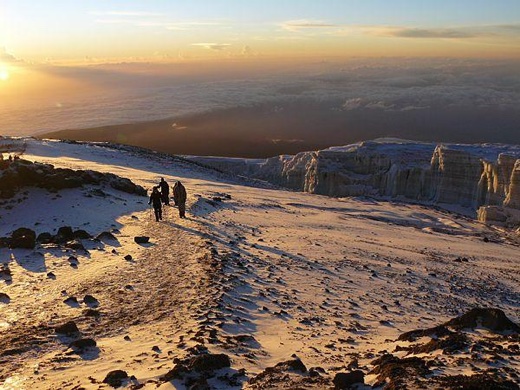
Image above: Facing an arduous trek in a difficult environment with with the confidence of friends. From (https://www.tripoto.com/trip/how-to-survive-in-the-mountains-9307).

In last week’s essay I used the phrase “hard-nosed optimism” to describe the attitude needed now as “an alternative to the lies of divisive bullies who take advantage of the elites’ failures in order to promote their own patently greedy interests.”

This is the optimism Antonio Gramsci probably had in mind when he coined the memorable phrase,

“Pessimism of the intellect, optimism of the will.”

For those who are paying attention to what’s happening in the world these days, pessimism of the intellect is easy enough to muster. There’s gloom in the air, especially in the United States, where Trump voters responded positively to what was easily the most downbeat pitch from any politician in living memory.

In his inaugural address Trump spoke of “American carnage,” and in his campaign speeches and debates he often described the U.S. as virtually a blasted ruin, its cities in a state of advanced decay due to “crime, gangs, and drugs.” Jobs are gone, hope is nearly extinguished; “You walk down the street, you get shot.”

Now, following the election, what is arguably a more reality-based, anger-tinged melancholy has spread to those who voted against Trump. In an interview with Chris Hedges, Kali Akuno, the co-director of Cooperation Jackson and an organizer with the Malcolm X Grassroots Movement in Jackson, Miss, paints about as grim a picture as possible, but one that would likely resonate in the minds of many American progressives:
“All forms of dissent will soon be criminalized. Civil liberties will no longer exist. Corporate exploitation, through the abolition of regulations and laws, will be unimpeded. Global warming will accelerate. A repugnant nationalism, amplified by government propaganda, will promote bigotry and racism. Hate crimes will explode. New wars will be launched or expanded.”
But for those who are really paying attention, the apprehension goes even deeper. The fact is, we are living at history’s greatest inflection point, as I tried to explain in my 2007 book Peak Everything.

We today face an extreme ecological crisis (resource depletion, climate change, overpopulation). In addition, there are good reasons to conclude that our financial economy is a house of cards vulnerable to a moderately strong puff of wind. It’s time to brace for impact.

Without pessimism of the intellect, our behaviors are disconnected from reality. If you’re in a ship that’s sinking, it may be possible to act in a way that increases the number of survivors (perhaps only by one). But that requires, first of all, an acknowledgment of the dire situation; denial that your vessel is in trouble merely forecloses possibilities.

But without optimism of the will, intellectual pessimism is paralyzing. What exactly did Gramsci mean by “optimism of the will”? Permit me to speculate a little.

Crisis can often bring out the worst qualities in people. Tumult creates opportunities for . . . well, opportunists—bullies and hucksters.

We have an example readily at hand: someone of Donald Trump’s character probably could not have arisen in American politics during a period of generally growing affluence such as prevailed in the 20th century (yes, we endured some dullards and crooks—but no one even approaching Trump’s level of pugnacious mendacity).

But while bullies and hucksters can gain power and sow discord, they can’t be looked to as agents for improvement of our long-term survival prospects. For that, entirely different qualities of character are required.

As global industrial civilization fragments, persistence of the best of what we humans are and have achieved will require us to build resilient, enduring communities—ones with high internal levels of mutual trust, and that are capable of adapting quickly to changing conditions and responding effectively to a range of threats. Such communities arise and sustain themselves only by nurturing and prizing certain qualities of character on the part of their members.

The people who are most likely to be of use in such communities are those who exhibit old-fashioned virtues, including honesty, bravery, self-control, cheerfulness, humility, and generosity.

The ability to amuse and entertain oneself and others will be a welcome bonus; likewise the ability to speak convincingly, and the willingness both to endure discomfort and to find satisfaction in small things. I think qualities like these may start to get at what Gramsci meant by “optimism of the will.”

None of us scores 100 on the character test. In fact, writing about noble qualities of character is uncomfortable, because doing so inevitably invites investigation into the character of the writer—and I’m certainly not proposing to set myself up as an example. All I can say is, I’m trying (not hard enough, I’m sure some would say). Nevertheless the subject of character seems unavoidable.

Initially, character is formed by early childhood experiences, by culture, and perhaps also by heredity. Consumer culture reliably produces generations of self-absorbed whiners, and social media don’t seem to be helping much with that.

But even with such excuses readily at hand, no competent adult can abdicate the responsibility for character building, which is an ongoing and cumulative task.

Indigenous people knew all about this. They had to rely on direct daily interactions with one another for nearly everything, and everyone knew that habitual complaining, lying, and boasting could eventually get you ostracized—effectively a death sentence.

Reading accounts by early European explorers, or by later first-contact field anthropologists, one cannot help but be struck by the degree to which people in the simplest societies held themselves and one another to a high standard of speech and behavior.

Modern economies appear to run less on character, more on energy, resources, investment, debt, and innovation. But in the world that’s coming, who we are may once again matter more than what we have.

Notice I haven’t mentioned technology much in this essay. Most future gazing, whether of the utopian or dystopian variety, focuses on tools and what they can do for us. If civilization gets downsized in the next few decades, then knowing how to build and operate low-tech devices for meeting human needs will undoubtedly aid with survival. But really effective preparation for what’s coming may best begin not with our choice of gadgetry, but with ourselves.

Unless we are able to build human cultures that truly deserve to survive, what’s the point of survival? And such cultures must be comprised of, and sustained by, people who hold quality of character as the highest good.

If it takes a Donald Trump to remind us of this ancient truth, then at least he will have done us that service.

.

November's architectural eyesore

SUBHEAD: It will never be renovated. It will have one generation of life and nobody will be able to repair it or maintain it.

By James Kunstler on 4 November 2015 for Kunstler.com -
(http://kunstler.com/eyesore-of-the-month/november-2015/)


Image above: Elevation view of UTS building in Sidney, Australia by Los Angeles architect Frank Gehry. From original article.

Behold the stylish new Dr Chau Chak Wing Building at the University of Technology Sydney (Australia) by starchitect Frank Gehry.

Every college has to have its Gehry. This one appears to be a stack of old-fashioned brown paper grocery bags, or something like that.

Here’s the catch: it will never be renovated. It will have one generation of life (or less) and then nobody will be able to repair it or maintain it.


Image above: Aerial perspective view of Frank Gehry UTS building showing more of its complications. From original article.

It’s a product of extraordinary complexity and hence enormous fragility. Do you assume that computer-aided fabrication will be available fifty years from now? Don’t bet on it.

The grid may be kaput. The server farms may be down.

The exotic metal alloys may not be available for the window sashes, not to mention the plate glass and the special brick (very energy-intensive).

All the curves, twerks, and weird angles detract from the building’s lifetime, not to mention its capacity for adaptive re-use (probably nil). Our attention-getting stunts-of-the-day represent stealing from our future ability to remain civilized.

G’day mates!


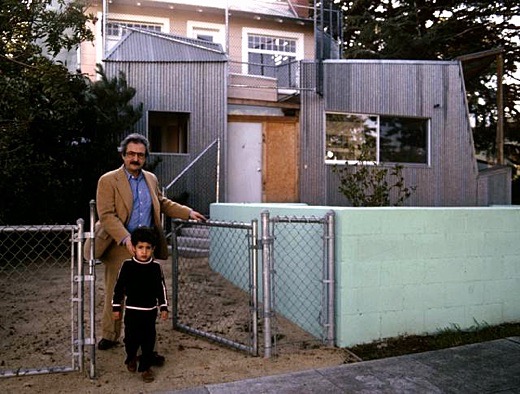
Image above: Frank Gehry and his son, in 1980, standing in front of his remodeled Santa Monica CA pink bungalow. Note the metal gate, corrugated metal siding, and cyclone fencing on roof (for security?).  This is the the work that brought him fame and eventually international prestige. From (http://architecture.about.com/od/houses/ss/Gehry-House-Inside-Out.htm).


.

US Retail Collapsing

SUBHEAD: An exodus of giant retailers at shopping malls across America will soon make them seem a whole lot emptier.

By Daisy Luther on 13 January 2015 for the Organic Prepper -
(http://www.theorganicprepper.ca/the-us-retail-industry-is-collapsing-heres-why-youre-in-trouble-01132015)


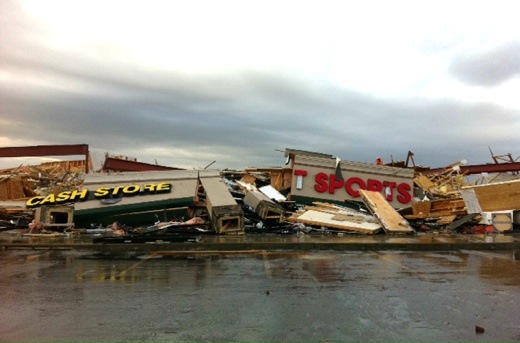
Image above: Mall after a tornado. These vinyl-clad beadfoam paneled buildings are not much more than product packaging scattered on the floor after Christmas. From (http://hypothetical-events.wikia.com/wiki/File:Tornado_Damage_%2811%29.jpg) and similar to image on original article.

[IB Publisher's note: Here on Kauai we have just one "mall" at Kukui Grove. It has recently lost the Border's Books and Sears as well as the Quiznos and Cold Stone Ice Cream restauraunts. According to this article we may soon lose KMart. Macy's, GameStop and RadioShack. How long will the new Pier One Imports, Ross's and Sports Authority last after that?] 

Shopping malls across America are going to look a whole lot emptier soon. An exodus of giant retailers is beginning with the announcement of hundreds of store closures and thousands of people newly unemployed.

The first of January, I broke with my usual tradition and wrote not about positive resolutions, but about the impending rockslide of the US economy. And “rockslide” is an apt word: as one thing starts rolling down the mountain, it will pick up other things until a veritable avalanche of other businesses and people are affected and rolling pell-mell right alongside.

Last year, we saw announcements of the expected closure of some retail giants. In February of 2013, Michael Snyder wrote on The Economic Collapse Blog that we would see the following:
Best Buy
Forecast store closings: 200 to 250
Sears Holding Corp.
Forecast store closings: Kmart 175 to 225, Sears 100 to 125
J.C. Penney
Forecast store closings: 300 to 350
Office Depot
Forecast store closings: 125 to 150
Barnes & Noble
Forecast store closings: 190 to 240, per company comments
Gamestop
Forecast store closings: 500 to 600
OfficeMax
Forecast store closings: 150 to 175
RadioShack
Forecast store closings: 450 to 550
Unfortunately, it didn’t stop there. This morning, a World News Daily report announced:
Macy’s is closing 14 of its 790 stores across the country.
JCPenney is closing 39 of its stores and laying off 2,250 workers.
Sears has been around for 122 years, but it, too, is closing 235 under-performing stores. 
C. Wonder, the preppy retailer, is going out of business, closing all 11 of its U.S. stores in the next few weeks.
Wet Seal is closing 338 retail stores while dealing with bankruptcy proceedings. Nearly 3,700 full- and part-time workers will be unemployed.
Aeropostale, suffering from declining sales, closed 75 stores during the holiday season, which runs from November through January. And in 2015, they expect to close an additional 50 to 75 stores.
RadioShack, which is negotiating with lenders to gain approval to shutter 1,100 stores, said last month that it closed 175 locations in 2014. (source)
Even holiday sales, normally high, plummeted this Christmas.

How does this affect you?

You may not work in retail yourself, but never doubt that the mass closure of these businesses will directly affect you.

Maybe you are wondering how.  You aren’t much of a shopper. You aren’t a retail worker. Perhaps you believe you can compartmentalize this information, pack it away, and go on with your life as you always have.

The thing is, it’s not just the patrons and employees of these stores who are affected. This is going to be catastrophic on a variety of levels.

Let’s go a little bit deeper.

Think about the people who worked in these stores. Now, they’re without jobs. There will be more competition for the smaller number of jobs in America, and many people will not be able to find work. They’ll survive by going on assistance, draining the US coffers even more.

As formerly employed people search for work that just isn’t there, we’ll see an increase in foreclosures, repossessions, and welfare.

Think about those who provided the inventory for these stores. Yes, I know a lot of it was made in other countries. But, it was imported here and distributed here. Most businesses work on a “Net-30″ basis, meaning the inventory is delivered, and the payment for that inventory is due in 30 days.

And guess what? The companies that imported the merchandise aren’t going to get paid. This will ripple through and cause other businesses to go under, which means still more people are unemployed.

Think about those who transport the inventory. Trucking companies and the independent operators who drive the trucks won’t get money owed to them either. As companies struggle to keep trucks on the road, transport costs will go up, which will cause future inventory in stores to be priced higher.
This is how we’ll be affected:
  • The price of everything is going to go up because wary distributors are going to try to recoup what they’ve lost from these companies that went under, while transporters increase prices to try to cover losses.
  • Jobs will be even harder to get than they were previously – and looking at the unemployment rates, it was pretty darned difficult before.
  • When people have no jobs, they spend no money, crushing the manufacturer’s and retailer’s economy even more.
  • As financial desperation increases, so will crime. And it won’t just be property crime – expect an uptick in violence as property owners fight back.
If you don’t live in an entirely self-sufficient bubble, you can bet you’ll be affected in one way or another.

What can you do about the collapsing economy?

It’s more vital than ever to be aware of what’s going on and to start getting prepared for it on all levels. You need to consider the following:

Create multiple streams of income.
We’d all like to feel like we’re reliably employed, but that’s just not true. You need only to look at the numbers above to see that jobs can be ephemeral. You need to be making money from more than one source (multiple streams of income). Start a small business that provides a safety net. Check out this great article on Graywolf Survival for more information on how to do it.

Learn to shop wisely.
A couple of years ago, I wrote this article about how shopping wisely can save you a fortune on your regular purchases. Each purchase needs to be thought out carefully because the day may come when your own personal economic collapse occurs in the form of a job loss, an illness, or a catastrophic bill.

Build a pantry.
A well-stocked larder can be your lifeline in the event that your personal finances take a hit. Your supply of food, toiletries, and household items can mean the difference between weathering a storm in relative comfort or going under completely. When I got laid off from my job in the automotive industry, it took 4 weeks before the severance pay arrived, and 9 weeks before my unemployment insurance kicked in. We were able to survive in total comfort due to the supplies we had laid in, and the lower amount of money I was receiving was enough to cover things like the mortgage, car payments, and utilities. Check out my book on building a one-year food supply in 3 months. Another option (although not as thrifty) is to stock up on freeze-dried food for your family. The nice thing is, you can put this at the back of your closet until the day you need it. It’s packaged for the long haul in buckets and it keeps for ages.

Learn to do it yourself.
Really, the epitome of preparedness is self-sufficiency. Only when you reduce your dependence on the economy can you be truly unaffected by the things going on in retail-land. Grow it, make it, build it. No matter where you live, you can take steps towards personal independence.  The last half of this book is all about being as self-reliant as possible - it’s a must-read. Learn to live like there are no stores, and if a day comes when there aren’t, you’ll be just fine. Learn skills like canning, sewing, and homesteading, and figure out how to apply them to your personal situation. Also, don’t just learn them: DO THEM.

Learn to live on less (and enjoy it).
When my oldest daughter was a newborn, my husband lost his job. We went through the toughest financial period I ever faced. Quite literally, at one point we had 2 bags of bagels in our freezer, half a jar of peanut butter, and the desperate hope that our vegetable garden would produce enough to get us through until unemployment checks started arriving or a new job was found. I read a book (borrowed from the library and signed out for the maximum allowed number of times) that completely changed my life. If you haven’t read The Complete Tightwad Gazette, I strongly encourage you to read this gigantic bible of frugality from cover to cover.  I still hear Amy Dacyzyn’s “voice” in my head sometimes and my own work is strongly influenced by those lessons she taught me back when I was a new mama. Here’s an article to get you in the frugal mindset.

If you can’t protect it, you don’t own it.
Lots of people hate this part, but it’s true. You absolutely must have a strategy for protecting your home and family.  That means you need weapons. You need to figure out how to harden your property against attacks. You must be mentally and physically prepared for the increase in crime that comes with the increase in desperation. I know in my small, sleeping town, property crimes have been on the rise, and sadly, violent crimes are popping up now when they were so rare as to be an anomaly before. This article talks about hardening your home, and this one tells you how to prepare your home for battle, should things really go awry.

Have you seen evidence of this collapse?

How are things in your neck of the woods? I know that where I live, some of the nearby malls are turning into ghost towns. Crime has been steadily rising for the past six months. I personally know several people who have lost their jobs recently due to the closure of the businesses with whom they were employed. Have you seen evidence of this financial downturn? Let’s compare notes in the comments section below.

Resources:

The economy is indeed collapsing, but for most of us, there’s still time to get prepared. If your own situation has collapsed, don’t despair – there are ways to live very well on less. Here are some resources to help you become more self-reliant and less dependent on the financial well-being of others.

Books:

The Prepper’s Blueprint: The Step-By-Step Guide To Help You Through Any Disaster
The Encyclopedia of Country Living, 40th Anniversary Edition: The Original Manual of Living Off the Land & Doing It Yourself
The Pantry Primer: How to Build a One Year Food Supply in Three Months
The Complete Tightwad Gazette
The Organic Canner
Prepper’s Home Defense: Security Strategies to Protect Your Family by Any Means Necessary
How To Use Your Sewing Machine: A Complete Guide for Absolute Beginners
Tools for Survival: What You Need to Survive When You’re on Your Own

Websites:

Ready Nutrition
SHTFplan
Graywolf Survival
Survival at Home
Natural News
About the author:
Please feel free to share any information from this site in part or in full, leaving all links intact, giving credit to the author and including a link to this website and the following bio.

• Daisy Luther  lives in a small village in the Pacific Northwestern area of the United States.  She is the author of The Organic Canner and The Pantry Primer: How to Build a One Year Food Supply in Three Months. On her website, The Organic Prepper, Daisy uses her background in alternative journalism to provide a unique perspective on health, preparedness, and the pursuit of personal liberty.  Daisy's articles are widely republished throughout alternative media. You can follow her on Facebook, Pinterest,  and Twitter, and you can email her at daisy@theorganicprepper.ca

.

Building trust with police

SUBHEAD: Cops can get into a state of mind where they're scared to death and they panic and they act out on that panic.

By Steve Inskeep on 5 December 2014 for NPR News -
(http://www.npr.org/blogs/codeswitch/2014/12/05/368545491/civil-rights-attorney-on-how-she-built-trust-with-police)


Image above: A young man kneels before a line of Los Angeles police officers about to charge at protesters reacting to a grand jury’s decision not to indict a white police officer who shot dead an unarmed black teenager in Ferguson, Missouri. From (http://online.wsj.com/articles/what-it-felt-like-to-be-a-suspicious-black-teenager-1416956319).

[IB Publisher's note: Listen to this story at (http://www.npr.org/blogs/codeswitch/2014/12/05/368545491/civil-rights-attorney-on-how-she-built-trust-with-police).]

As a civil rights attorney, Constance Rice became known in the 1990s for, as she puts it, going to war with the Los Angeles Police Department.

Rice filed lawsuits against the department, mainly over their treatment of minorities in underprivileged communities.

Following the recent decisions not to indict white cops in the deaths of two black men — President Obama has said one of his top priorities is building trust between minority communities and local police.

Rice's time battling the LAPD, and specifically captain Charlie Beck, who is now LA's police chief, eventually led to a place where there could be trust. They worked together to reform the department.
Some of that change included LAPD officers going into projects to set up youth sports programs and health screenings, things that made people's lives better and brought police and predominantly black communities closer together.

Here are some interview highlights:

On use of police force on minorities:
Cops can get into a state of mind where they're scared to death. When they're in that really, really frightened place they panic and they act out on that panic. I have known cops who haven't had a racist bone in their bodies and in fact had adopted black children, they went to black churches on the weekend; and these are white cops. They really weren't overtly racist. They weren't consciously racist.

But you know what they had in their minds that made them act out and beat a black suspect unwarrantedly? They had fear. They were afraid of black men. I know a lot of white cops who have told me.

And I interviewed over 900 police officers in 18 months and they started talking to me, it was almost like a therapy session for them I didn't realize that they needed an outlet to talk.

They would say things like;
"Ms. Rice I'm scared of black men. Black men terrify me. I'm really scared of them. Ms. Rice, you know black men who come out of prison, they've got great hulk strength and I'm afraid they're going to kill me. Ms. Rice, can you teach me how not to be afraid of black men." 
I mean this is cops who are 6'4". You know, the cop in Ferguson was 6'4" talking about he was terrified. But when cops are scared, they kill and they do things that don't make sense to you and me.

On whether or not racism plays a factor in police force:
He doesn't feel like it's racism. The black community experiences it as racism, that's very clear. So what I'm saying is that for people who have to be in the business of solving this dilemma you have to be able to step into the frightened tennis shoes of black kids; black male kids in particular.

You have to be able to step into the combat boots and scared cops, and racist cops, and cruel cops, and good cops. You have to be able to distinguish between all of those human experiences and bring them together. On a single platform of we're going to solve this by empathizing. We're going to solve it with compassion and we're going to solve it with common sense.

On whether improving life in poor neighborhoods causes police to be less fearful:
Not only does it cause cops to be less fearful, it causes the community to embrace them. I have taken a group of 50 cops and the chief (Charlie) Beck let me train them.

I trained them in what I community partnership policing. The first thing I tell these cops is that you are not in the arrest business; you are in the trust business. We are going to train you in Public Trust Policing. It goes beyond community policing.

What it does is it puts police in a position of helping a community solve its problems. These cops come into the black housing projects and they said to these populations who hate them "We know you hate us, but we're here to serve. We're going to win your trust."


Darren Wilson killing Michael Brown

By Juan Wilson on 5 December 2014 for Island Breath - 
(http://islandbreath.blogspot.com/2014/12/building-trust-with-police.html)

There are several eyewitness accounts of how Officer Darren Wilson shot to death Michael Brown. Most of the details I have heard or read isolate detail of accounts to highlight conflicting testimony.

It seems to me the the conduction of the Grand Jury was quite unusual. setup with a deal. Eyewitness testimony was presented as being unreliable. One could only rely on the testimony of Wilson himself.

My opinion is that Wilson’s resignation was baked into the cake if he was not indicted. Anyway,

A good article in the Atlantic on the subject is (http://www.theatlantic.com/national/archive/2014/11/major-contradictions-in-eyewitness-accounts-of-michael-browns-death/383157/)
Brown attacked Wilson
Brown ran from Wilson
Brown had his hands in the air
Brown did not have his hands in the air
Brown tried to surrender to Wilson
Brown did not try to surrender to Wilson
What makes sense?

All of it might!

If one does not discredit the eyewitness testimony - and for the sake of attempting to find some clarity - one tries to sew together a narrative that makes sense  - then a whole new characterization of events might emerge.

Here’s one way of looking various details. I am only including actions between Brown and Wilson. Brown was with a friend but I have eliminated him from the action.

Wilson driving his patrol car came upon Michael Brown walking down the middle of the street. There was a police radio report about a nearby store theft by some fitting Brown’s description.

Brown was 19 but huge at 6’-5” and weighing almost 290 pounds. A physically intimidating individual to take on. Wilson was alone in the patrol car. As he neared Brown he made is service revolver available for immediate use if necessary.

Wilson in the patrol car, with is driver window down, stopped Brown walking in the middle of the street. Upon being questioned Brown gave the officer a wise-ass response. Wilson commanded Brown off the road. There was more back talk from Brown. As if to intimidate Brown Wilson showed the gun to Brown.

Brown told Wilson he was too much of a pussy to shoot him. Brown may have reached for the gun. Wilson fired the revolver, hitting Brown in the right shoulder. There was some blood in the car. Brown momentarily pulled back not knowing if he was badly hurt or not.

Brown did not want to be shot again. A struggle for the gun ensued. They wrestled for control. Wilson was punched. Without getting control of the gun Brown made a decision to flee and took off. Wilson makes a radio call that shots have been fired. Brown ran a short distance away as Wilson got out of his car.

Wilson yells at Brown to get on ground. Brown turned to Wilson with the gun pointed at him but did not get on the ground.  Brown may have partially raised is arms to surrender saying “I don’t have a gun.Stop shooting!”

He may not have been able to raise his right arm fully. Brown tucked his wounded right arm in his waist band of his pants. More shots were fired. His right arm was hit more times.

Brown realized he was likely going to be shot to death and decided to make a rush to stop Wilson from killing him. As he ran at Wilson another volley of shots hits Brown from a few few dozen feet away. One shot hit Wilson in the right side of his neck. After that Brown walked toward Wilson without menace.

Brown fell to the ground and onto his face. Wilson shot Brown through the top of his head.

I think Darren Wilson feared Michael Wilson on sight. His fear pulled the trigger...many times.

Conclusion:
Michael Brown may have been a small time criminal and a brutish thoughtless kid. Darren Wilson was not the person to deal with that. Darren was playing Grand Theft Auto Five with a real patrol car and real gun. He should have stayed in the basement with his XBox 360.

Darren Wilson should never again have a loaded gun in his hand.

See also:
Island Breath: KPD need bikes not riot gear 4/5/08
Island Breath: The Kauai Police Mission 5/15/08
Island Breath: The future KPD we want 5/28/08
Island Breath: KPD alternatives to patrol cruising 6/7/08
Island Breath: TGI column cancelled by KPD 6/18/08


.

Grand Jury Runaround

SUBHEAD: Flame before spark. Michael Brown in Ferguson Was the spark — Eric Garner in New York is the fire.

By John McWhorter on 3 December 2014 for Time Magazine  -
(http://time.com/3617369/eric-garner-grand-jury-protests/)


Image above: Eric Garner being choked to death by Ofiicer Pantaleo while three other policeman struggle to hold him down. Garner repeated "I can't breath!" several times before losing consciousness. His offense selling loose cigarettes on the sidewalk.  From (http://time.com/3617369/eric-garner-grand-jury-protests/).

Here’s a look at the future, and probably not that far into it. People will learn two things:
  1. That an officer was not indicted for murdering Eric Garner—black, 43, and detained simply for selling single cigarettes—despite the fact that the killing was recorded from start to finish for all of America to see. 
     
  2. That an officer was not indicted for killing Michael Brown after Brown had stolen from a store, refused the officer’s request to step aside and perhaps tried to grab his gun, with the officer shooting when Brown repeatedly lunged toward him for some reason, with none of this recorded and the details murkily varying from one witness to the next. 

Perfectly sensible people will be wondering why so many people in late 2014 thought of the Ferguson case, in particular, as the civil rights case of the 21st century. Yes, Brown should not have died—I have heartily agreed, repeatedly. But people in the future will see the current focus on Ferguson as evidence of people losing sight of the fact that activism is supposed to be about results.

Are we trying to create a humanity devoid of any racist bias, or are we trying to stop cops from shooting black men? The two aren’t the same. A world without racism would be a world without dirt. A world where episodes like what has happened just this year to Garner, Brown, John Crawford, Akai Gurley, and Tamir Rice is much more plausible. We need special prosecutors, body cameras, and, if you ask me, an end to the war on drugs.

As such, we must be pragmatic. I know the people protesting Michael Brown’s death nationwide are sincere. But it’s easy to forget that in cases like this, sincerity is supposed to be forward-focused. It’s all too human for people to end up mistaking the heightened emotions, the threats, the media attention, the catharsis, as progress itself. But drama alone burns fast and bright. Think about how Trayvon is already—admit it—seeming more like history than the present.

Are we really committed to this thing lasting past the winter?

If so, then we have to ask ourselves—is Michael Brown more important somehow because he was killed with a gun? Is Garner somehow less worthy of iconic, implacable protest because he was older than Brown, less “glamorous” than a teenager? Is it, in other words, that Brown is more dramatic?

Because there are other kinds of drama, if we must. For example, Officer Daniel Pantaleo’s statement about Garner is outright tragedy—so disgustingly detached coming from someone’s murderer that it constitutes drama in itself.

“It is never my intention to harm anyone,” Pantaleo says—as if we were thinking now of “harm,” a formal term you can use to refer to a dent in your car. “I feel very bad about the death of Mr. Garner”—my God, “very bad” sounds like he broke someone’s window with a baseball, and “the death of Mr. Garner” sounds like something he watched on TV rather than did with his bare hands. “Accept my personal condolences” says this man twice brought up on misconduct charges before, as if it were his aunt by marriage who passed away after a brief illness.

This, to me, is an articulate testament to how some whites can be unable to see black people as human—and, especially if cops, be more likely to kill them. This, ladies and gentlemen, is a precious teaching moment. Pantaleo’s statement is, in its way, as useful as Reverend King’s Letter From a Birmingham Jail as a look into a human mind.

>Yet one hears that however iffy the Ferguson details are, we should just go with it because it has struck a chord. That our message to America is to be “Even when my son steals from a store, refuses a cop’s order and tries to take his gun, he shouldn’t get shot.”

And he shouldn’t, but wow, what a delicate and hopelessly controversial point that is in such a key moment as this. It’s a tricky, subtle assertion, which has not struck a chord with the disinterested middle because the facts are too murky. We want to make history, not just headlines.

How about this, as a story we can tell the next generation without taking a deep breath and thinking about how to paper over the holes?

Ferguson was the spark, but Garner was “it.”

Here is where I am quite sure Reverend King and Bayard Rustin would be planning not just statements and gestures, but boycotts. The recording of Garner’s death has the clear, potent and inarguable authority of the Birmingham newsreels. We must use that. Yes, use—we are trying to create change, not just perform.


No Reckless Endangerment?
SUBHEAD: Grand Jury in Eric Garner case wasn't asked to consider 'Reckless Endangerment' charge.

By Andres Jauregui on 5 December 2014 for Huffington Post  -
(http://www.huffingtonpost.com/2014/12/05/eric-garner-reckless-endangerment_n_6275698.html)

The Staten Island District Attorney did not ask the Eric Garner grand jury to consider reckless endangerment charges against NYPD officer Daniel Pantaleo, NBC New York reports.

An unnamed source familiar with the case told the station that District Attorney Daniel Donovan only asked jurors to consider charges of manslaughter or criminally negligent homicide as they heard evidence.

Under New York law, reckless endangerment entails conduct that causes a substantial risk of serious physical injury or death to another person. Garner, a 43-year-old asthmatic, died after Pantaleo put him in a chokehold in July.

The jury determined that there was no probable cause to indict Pantaleo in Garner's death Wednesday, a decision that has been met with criticism from people across the political spectrum and sparked nationwide protests.

Although grand jury proceedings are typically sealed by law, Donovan petitioned a judge to release limited information about them, according to ABC New York. None of the evidence presented was included in the release, only the following:
  • Jurors sat for nine weeks
  • Testimony was heard from 50 witnesses
  • Those witnesses included 22 civilians and 28 cops, EMTs or doctors
  • There were 60 exhibits, including videos, records and photos
  • The grand jury was instructed in law regarding physical use of force
The D.A.'s office issued a statement Thursday that said he was "constrained by New York law to reveal nothing further regarding these proceedings."

In New York, indictment by grand jury requires at least 12 jurors to agree that there is sufficient evidence and reasonable cause to believe a crime was committed. The D.A.'s role is to present evidence and instruct the jury in the principles of relevant law.

Legal experts told SILive.com that Pantaleo's testimony was likely a huge factor in the decision not to indict. The 29-year-old officer, who has received resounding support from the NYPD union, testified before the jury for two hours before Thanksgiving, his lawyers said.

At least one expert who talked to the site was unconvinced by the ruling.

"I'm disappointed in the result. I believe the officer's actions were not necessary to effectuate the arrest of Eric Garner," Mark J. Fonte, a criminal defense lawyer and former prosecutor, said. "It seems to me there was a better way to handle the situation with Eric Garner. No person should lose their life for selling loose cigarettes."


Witnessing a Police Killing
SUBHEAD: David Corn told a grand jury he saw a cop shoot and kill an unarmed man. It didn't indict.

By David Corn on 4 December 2014 for Mother Jones  -
(http://www.motherjones.com/politics/2014/12/grand-jury-witness-police-killing-indictment-david-corn)
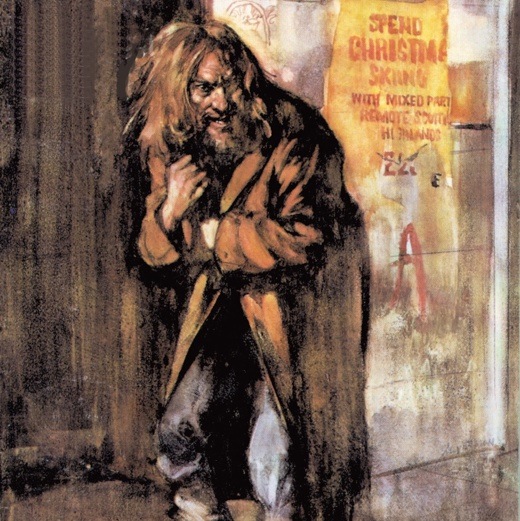

Image above: Painting of man on cover of 1971 Jethro Tull studio album LP record "Agualung".   From (http://en.wikipedia.org/wiki/Aqualung_%28Jethro_Tull_album%29).

Many years ago, during the 1980s, I witnessed a killing: a New York City cop shooting an unarmed homeless man near the Metropolitan Museum of Art. I was later called as a grand jury witness in the case. The grand jury did not indict the officer.

It was a summer evening. I was heading to play softball in Central Park. At the corner of Fifth Avenue and 79th Street, I got off my bicycle to walk toward the Great Lawn. The west side of Fifth was crowded with New Yorkers enjoying the beautiful night. People were streaming in and out of the park. Sidewalk vendors were doing brisk business. The vibe was good.

And in the midst of the hubbub, I spotted a fellow wearing dirty and tattered clothing. His hair was filthy, his face worn. It was hard to determine his age. He reminded me of Aqualung. (See this Jethro Tull album cover.)

He was carrying a large and heavy rock with both of his hands, pushing his way through the throng, and muttering unintelligible words. I wondered, what's his story? But I didn't give it much more thought.

Most of the people on the corner were not paying attention to him. Those in his direct path, as he lumbered north, did quickly step out of his way. But no one seemed much alarmed by the guy. In New York City, unfortunately, you often saw broken people—and shrugged them off as just another crazy.

I was about to head down the footpath toward the baseball fields, when I saw a commotion to my right. Several police officers—four or so, I recall—were approaching the man with the rock. And their guns were drawn. As they neared the fellow, he dropped the rock, he then began to run in the same direction he had been walking.

The cops were not grouped together; they were spread out—in a circle that was drawing tighter. The man, displaying a fair degree of agility, leaped into the street and tried to cut between two of the officers to get away.

Shots were fired. Two or three. Maybe four. And he went down.

The cops surrounded the man. He didn't move. This was no longer a person. This was a body.
I moved closer to the scene. Passersby had stopped to watch. It was still difficult to assess his age. His clothes were a grimy gray. I saw his dirty hands. Both were empty.

Soon police cars and an ambulance arrived. The paramedics did not move fast. They covered the body with a sheet. Several police officers were standing around a female officer. She was in anguish. They were consoling her. It was obvious: She had fired the shots that killed the man.

Her race? She was white. His skin color? I thought it was dark, but it was tough to tell if it was dirt or pigment.

Cops were buzzing about the scene. Flashing lights illuminated this ritzy stretch of Fifth Avenue. On-lookers gawked. And I noticed something that struck me as odd: The police officers were not talking to any of the witnesses. They were talking to each other and the paramedics. I approached one cop and said that I had seen it all. He wasn't impressed and looked at me as if to say, "So what?" I had thought the police would want to round up eyewitnesses to the shooting.

"Shouldn't I talk to someone?" I asked this officer. He nodded his head toward another policeman. I went up to that cop. "Excuse me, officer," I began. "I saw what happened." Again, I received a look of disinterest. "Shouldn't I...." He cut me off: "Talk to him." He was looking at another officer who was barking instructions to other cops.

I tried once more. I approached this officer who seemed to be in charge. "Officer, I saw...." He shut me up with a wave of his hand, signaling I should wait. And wait I did, as he directed other cops to do this or do that. The paramedics were preparing to cart off the body. After a few minutes, I went up to this officer again and told him I had witnessed the whole episode.

"Okay," he said.

He said nothing else. He didn't ask me for my name. He didn't ask if I would provide a statement. I was surprised by his lack of interest.

"Shouldn't I tell someone what I saw," I said.

"If you want to," he said, not in an encouraging tone.

"Okay, who do I talk to?" I ask.

"If you want to make a statement," he said, as if I was inconveniencing him and the entire police force, "you can go down to the station and do it there." Now I got it: He didn't want my statement, even though he had no idea what I would say. He was not interested in taking my name and contact information. It was my job apparently to make it to the police station on my own, and the station was a mile or so south.

This ticked me off. He was essentially trying to shoo me away. As the paramedics were loading the body on to the ambulance and as the cop who had shot the man was surrounded by her colleagues, I got on my bike and started to ride down Fifth.

At the station, I approached the front desk and told the officer staffing it that I had witnessed the shooting and had been told to come to the station to provide a statement. This fellow looked surprised to see me. He asked me to wait on a bench.

I waited. Five minutes, fifteen minutes. I went back to the desk. Yes, yes, I was told, someone will be with you shortly. Another five minutes, another fifteen minutes. Obviously, no one would have minded if I gave up and left.

Sitting next to me in this waiting area was a woman—middle-aged and white (if that matters)—who was also a witness. We probably weren't supposed to compare our accounts, but we did. (No one had told us not to.) She mentioned that she thought she had seen the victim holding something in his hand, perhaps a knife, when he started to run.

Her vantage point had not been as good as mine, and I told her that I had seen the man drop the big rock and immediately begin to run. There had been no time for him to pull out a knife. Moreover, I had been in a position to see his hands—before and after he was killed—and I saw no knife. We looked at each other and didn't know what else to say.

Finally, a detective—I think he was a detective, he didn't say—came over and gave me a form on a clipboard and asked me to write a statement of what I had seen. I did. I stuck to the facts: nutty-looking homeless man carrying a small boulder, approached by cops, drops rock and runs, cops get closer, he darts between two of the officers, cop fires on him.

It was clear to me that the officer did not have to shoot the man. He was not threatening the officers. He was trying to run from them. But I didn't write down this conclusion. I presented the facts; I believed their implication were undeniable.

When I finished, I handed my statement to one of the officers. I was told, "You'll be contacted, if that's necessary." None of my interactions with the police led me to believe that a thorough investigation was in the works.

As I left the station, I saw the female officer who had fired the fatal shots. She was with several colleagues. She was upset and appeared to be crying. The other cops were being supportive. I couldn't help but feel sorry for her. My interpretation was that she had screwed up; she had overreacted or panicked and fired her shots too soon. My hunch was that she knew that.

The next day—this was long before the internet era—I checked the newspapers and saw no stories on the shooting. Some time later—I think it was a couple of months—I received a call. A grand jury was examining the shooting, and my presence was requested.

I went to the courthouse at the appointed hour and waited to be called into the grand jury room. My time in the drab conference room with the grand jury was brief. The jury was, as they say, a diverse group. But most of the jurors looked bored. A few seemed drowsy.

The prosecutor asked me to identify myself and certify I had filed the statement. He asked me to describe where I had been and whether I had seen the full episode. But he never asked me to provide a complete account. The key portion of the interview went something like this:
Prosecutor: You saw him start to run?

Me: I did.

Prosecutor: Did you see anything in his hand?

Me: No.

Prosecutor: Did you see him holding a knife?

Me: No. But I....

Prosecutor: Thank you.
I had wanted to say that I had seen him drop the heavy rock and bolt and that it was unlikely he had been able to grab and brandish a knife while sprinting. And I thought the grand jurors should know that he had not charged at any of the officers; he had been trying to dash through an opening between two of the cops in order to flee. And if they were interested in my opinion regarding the necessity of firing on him, I would have shared that, too.

But the prosecutor cut me off. He didn't ask about about any of this. And not one of the jurors asked a question or said anything.

I left the room discouraged. This was not a search for the truth. It appeared to be a process designed to confirm an account that would protect the officer who had killed the man. The prosecutor was in command and establishing a narrative. (A knife!) The jurors appeared to be only scenery. (Insert your own ham sandwich reference here.)

Long before the present debate spurred by the non-indictments in the Michael Brown and Eric Garner cases, it seemed clear to me that the system contained a natural bias in favor of police officers. That certainly makes sense. Police officers have damn tough and dangerous jobs, and they are going to look out for their comrades-in-blue who slip up.

And prosecutors work closely with cops to rack up convictions, and they don't want to alienate their law enforcement partners. No one in that grand jury room was there to serve the interests of the dead guy.
On the way out of the courthouse, I realized I did not know the name of the victim.

I subsequently called a reporter who worked on the metro desk of the New York Times to tell him about my experience, hoping the paper would dig into the case. But I never saw a Times story on it. (At the time, I was working for a magazine that covered arms-control issues and in no position to write about the event. And back then, there was no equivalent to tweeting, blogging, or Facebooking.)

Several weeks, or a month or two, after my grand jury appearance, I called the person who had contacted me about testifying. Whatever happened? I asked. Oh, the man said, the case is over. I took that to mean the officer was not charged. Before I hung up, another question occurred to me.

I don't know why I thought about this, but I asked, "Whatever happened to the body of the man who was shot?" He was never identified and buried somewhere, he replied. And I wondered, never identified? How hard did they try?


.

Eco-Defense = Self-Defense


SUBHEAD: Let’s not be afraid to open our hearts and minds and start caring caring for our "Collective Soul".

By Micky Z on 8 November 2013 for World News Trust-
Image above: Occupy sign "Solidarity - Community - Resilience". From original article. Photo by author.

“I don't even call it violence when it's in self defense; I call it intelligence.”
- Malcolm X
Let’s say you’re a handy man/woman/human and you get hired for a job. I’m guessing you’d bring your full toolbox to the worksite. After all, you can never be sure what might pop up and it would be illogical to decide beforehand that certain tools are off limits.

Lesson: Keep all your tools at your disposal -- even if some remain untouched -- just in case.

Some Tools
Perhaps, as citizens/consumers/taxpayers in the most culpable nations, we can begin by accepting reality: Due to our compliance and/or silence and/or inaction, we’ve played a role in bringing our planet to the brink of social, economic, and environmental collapse. But remember:
  • We’re not being “attacked” for our choices when fellow activists suggest we change. For the record, I prefer to save the word “attack” for, say, those being targeted by U.S. predator drones (subsidized by our tax dollars and thus launched in our name).
  • We’re not being judged as guilty. It’s a little too late for that.
  • 
We’re not being judged as innocent either. We’re all participants and/or witnesses.
  • We may think it’s not “fair” that we’re the generation that has to change everything about the way we live… but to paraphrase Clint Eastwood in The Unforgiven: “Fair’s got nothing to do with it.”
  • We are not alone. There are more of us than you ever imagined. As Utah Phillips reminds us: “If you can’t change (your community), if you can’t make this place where you work and live better, then where can you? Just get busy.” If you feel like you don’t have a community, create one.
In the book (and movie), The Grapes of Wrath, the Tom Joad character ponders something along these lines: “Maybe we’re not all individual souls, but maybe we’re all part of one big soul.”

Incredibly basic, yes… but within that simplicity lies what I see as the secret: If we were to view all living things -- along with ourselves -- as part of one collective soul how could we not defend that soul by any means necessary?

By the way, Utah Phillips also sez: “The earth is not dying. It is being killed, and the people killing it have names and addresses.”

The 4 R’s of Defending Our Collective Soul
To be taken as literally or metaphorically as you personally choose…

Reality
  • Self-defense “moves” rarely (if ever) work and can cause you to not trust your instincts as you struggle to remember what you’re “supposed to do.” Memorizing a few moves before a conflict is not unlike only learning 20-30 words prior to a spelling bee.
  • The attacker always has the advantage -- at least initially. He knows before you when, where, and how he’s going to attack.
  • Practice awareness of your habits, surroundings, routines, etc.
Reaction
  • Your first option: run. If you can’t run, create and maintain distance from your attacker(s).
  • Know your enemy: Expect the worst because that’s exactly what you’ll get.
  • Facing a weapon can be frightening but some weapons can serve to “limit” the attacker’s psychological approach and thus, his options. Exploit that advantage.
  • Contrary to popular belief, you are never unarmed. Use your body and/or whatever you can get your hands on.
Readiness
  • Decide in advance to survive. Ask Derrick Jensen explains: “The Jews who participated in the Warsaw Ghetto Uprising had a much higher rate of survival than those who went along. We need to keep that in mind over the next 10 years.”
  • Condition your mind to defend what you love (read: courage).
  • Condition your body to endure -- through exercise, lifestyle choices, and healthy, earth-friendly/plant-based eating habits.
  • Take time to learn some useful tools like kicks, punches, blocks, etc. But never forget: anything goes. There’s no such thing as fighting “dirty.”
Repeat
  • Memorize these 13 “magic words” when dealing with members of your local Blue Bloc:
    “I am going to remain silent. I would like to see a lawyer.”
Face Up to Your Fears
Participating in sustained activism and/or direct action is not a popular choice. It could put us at odds with our friends, family, and community. It could jeopardize our careers. It could even lead to direct conflict with law enforcement officers. Scary stuff, for sure.

But ask yourself this: What frightens you more, being judged for getting arrested for disorderly conduct or comprehending that 80 percent of the world’s forests are already gone? How will you answer when future generations ask what you did to defend all life on earth?

There are good reasons to be afraid. There are better reasons to be bold.

Let’s not opt for the illusion of safety over the quest for justice. Let’s not be afraid to accept that we’ve been lied to and manipulated and that much of what we’ve been taught is no longer or ever was relevant or real. 

Let’s not be afraid to open our hearts and minds and start caring like we've never cared before. Let’s not be afraid to find out what we’re capable of.

.