Showing posts with label Evil. Show all posts

Trump expects the Earth will boil

SUBHEAD: His administration expects the planet is going to experience temperature rise of 7ºF and doesn't care.

By Bill McKibbon on 2 October 2018 for the Guardian -
(https://www.theguardian.com/commentisfree/2018/oct/02/trump-administration-planet-boil-refugee-camps)
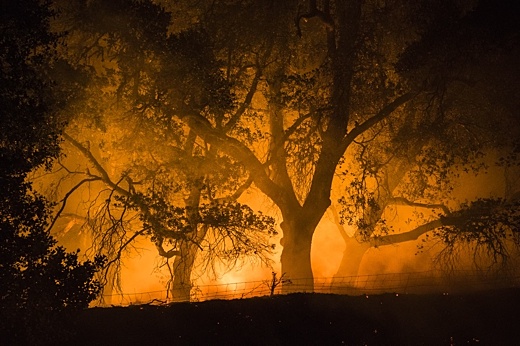

Image above: Trees silhouetted by flames in recent out of control wild fire in California seen in Washington Post article dated 9/28/18 titled "Trump administration sees a 7-degree rise in global temperatures by 2100". From (https://www.washingtonpost.com/national/health-science/trump-administration-sees-a-7-degree-rise-in-global-temperatures-by-2100/2018/09/27/b9c6fada-bb45-11e8-bdc0-90f81cc58c5d_story.html).

In the cloud of toxic dust thrown up by the Kavanaugh hearings last week, two new Trump initiatives slipped by with less notice than they deserve. Both are ugly, stupid – and they are linked, though in ways not immediately apparent.

In the first, the administration provided the rationale for scrapping President Obama’s automobile mileage standards: because Trump’s crew now officially expects the planet to warm by 4C . In the environmental impact statement they say it wouldn’t make much difference to the destruction of the planet if we all keep driving SUVs.

The news in that statement is that administration officials serenely contemplate that 4C rise (twice the last-ditch target set at the Paris climate talks). Were the world to actually warm that much, it would be a literal hell, unable to maintain civilizations as we have known them.

But that’s now our policy, and it apparently rules out any of the actions that might, in fact, limit that warming. You might as well argue that because you’re going to die eventually, there’s no reason not to smoke a carton of cigarettes a day.

Meanwhile, reporters also discovered that the administration has set up what can only be described as a concentration camp near the Mexican border for detained migrant children, spiriting them under cover of darkness from the foster homes and small shelters across the nation where they had been staying.

Not an extermination camp – these aren’t Nazis – but a camp that literally concentrates this “problem” in one place: a tent city in the middle of the desert. Schooling is not available there, as it was in the shelters they came from; instead the kids are given “workbooks that they have no obligation to complete. Access to legal services is limited.”

That camp is linked to climate change because, first, it’s in a desert. If you searched high and low across the North American continent, you could barely find a place hotter and drier than Tornillo, Texas, where in June the average high is 96F and where, as one climate data source succinctly puts it, “there is virtually no rainfall during the year”.

But the link goes much deeper. Most of those migrants are from Central America and Mexico, and they might as easily be described as refugees fleeing gang violence (much of it rooted originally in the US) and a changing climate. Guatemala, El Salvador and Honduras first saw an outbreak of coffee rust linked to higher nighttime temperatures; the El Niño that began in 2015 led to years of unprecedented drought.

Deep new droughts this summer wiped out more harvests: “total or partial loss of crops means that subsistence farmers and their families will not have enough food to eat or sell in coming months,” the UN’s Food and Agriculture Organization warned.

The author Todd Miller, writing in the Nation, described meeting men trying to jump a train in Guatemala headed north toward the border. “When I asked why they were heading for the United States, one responded simply, “No hubo lluvia.” (“There was no rain.”)

This will, of course, get steadily worse in the years ahead – every climate forecast shows deserts spreading and water evaporating across the region. And of course more migration will follow, in every corner of the world.

The World Bank predicts we may see 140 million climate migrants before long, and given the chaos that even a million people fleeing the (partially drought-fueled) crisis in Syria created, we better come to grips.

Some of that migration will be internal – perhaps six million people will abandon their coastal property in Florida alone, according to recent reports. And much of it will be international, as people flee because their lives depend on it.

And telling people to stay home is not a moral option, either. Because the climate chaos setting off waves of refugees is born above all from the unconstrained migration of carbon dioxide molecules from America over the last century.

No wall can prevent the exhaust from our armada of oversized cars from raising the temperature in Mexico; if Guatemala could ship its changed climate back north it doubtless would, but it can’t.

We have to realize that global warming stems from the fact that we are a world without atmospheric borders, where the people who have done the least to cause the problem feel its horrors first and hardest.

That’s why, over the last half-decade, the environmental and migrant-rights movement have grown ever closer.

The Trump years are a fantasy land where we pretend we can go on living precisely as in the past, unwilling even to substitute electric SUVs for our gas guzzlers, and able to somehow insist that the rest of the world stay locked in place as well.

It’s impractical, it’s unfair, and when it ends up with camps for kids in the desert it’s downright evil.


.
Google employees discuss protest

SUBHEAD: Some employees disturbed about the potential applications of a project for the military.

By Rebecca Klein on 1 June 2018 for Huffington Post -
(https://www.huffingtonpost.com/entry/google-maven-protests_us_5b119678e4b0d5e89e1fa730)


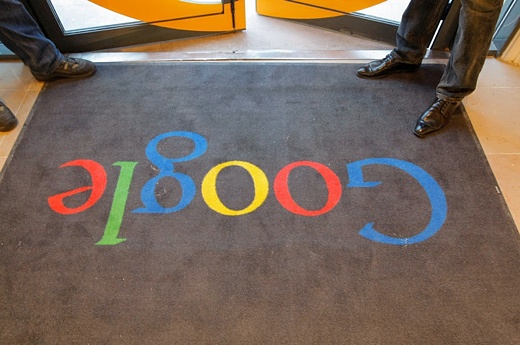
Image above: Door mat at Google entrance door. Photo by Jaques Brinin. From original article.

A small group of Google employees, in response to a company contract with a Pentagon-backed program called Maven, have discussed the idea of staging a protest at a conference in July. Employees fear that the project, which provides artificial intelligence tools to the military, could be used in fatal drone strikes.

The protest, as discussed in preliminary exchanges over Google’s internal communications platform, would take place at a Google Cloud conference in San Francisco, according to messages obtained by HuffPost and an interview with an employee.

More than a dozen Google employees have resigned over the project, according to Gizmodo, and thousands of employees have signed a letter protesting it.

Now Google employees are debating showing resistance in a more active way, through a potential demonstration.

Discussions regarding the possibility of a protest took place this week on an internal thread devoted to criticism of Maven. The thread, called “maven conscientious objectors,” includes hundreds of employees, but only a small percentage of those were active in the discussion.

The debate about staging a physical demonstration took place on Wednesday and Thursday and was started by a departing engineer. The employee called the project “the greatest ethical crises in technology of our generation” and suggested that “Maven protesters” go to the conference with the aim of “making some noise.”

The employee’s last day was Friday, but by late morning, someone from human resources had asked them to leave immediately due to their “recent statements” related to the conference. “As such, we’re going to move up your exit by a few hours and we’ve ended access, effective immediately,” the HR person wrote.

In response to the initial thread, another employee called the engineer an “agent provocateur.” Someone else said such an action would “be enough reason to fire us lot with popular support.”

The debate became heated and personal, with some employees questioning whether their colleague who originally suggested the idea of a physical protest should even belong in the “conscientious objectors” group.

But there were a few employees who supported the idea, calling the discussion “legitimate topics for this mailing list.” Another said that while they were not based in San Francisco and were thus unable to join the action, they personally thought the protest was “a good idea since it increases Google’s PR cost of getting involved in military projects.”

Representatives for Google did not respond to HuffPost’s request for comment. The Intercept reported Friday afternoon that Google will not renew its contract to work on Project Maven, though the company plans to work on the project through June 2019 and has not ruled out taking on similar work in the future.

This isn’t the first round of discord from Google employees. In an April petition to Google CEO Sundar Pichai protesting the Pentagon contract and signed by thousands, petitioners referenced “Don’t be evil,” Google’s famous former unofficial motto, as an argument for canceling the contract.

“This contract puts Google’s reputation at risk and stands in direct opposition to our core values. Building this technology to assist the US Government in military surveillance ― and potentially lethal outcomes ― is not acceptable,” the signers of the petition wrote.

Hundreds of academics subsequently wrote a letter to Google co-founder Larry Page, as well as Pichai and other company leaders, supporting the petitioning employees.

The academics expressed concern that Project Maven will help the military become “just a short step away from authorizing autonomous drones to kill automatically, without human supervision or meaningful human control.”

The letter also cited recent Cambridge Analytica scandals as demonstrating “growing public concern over allowing the tech industries to wield so much power.”

At a recent companywide meeting, Sergey Brin, one of Google’s co-founders, reportedly responded to a question about the project and addressed some of the controversies, according to The New York Times. Brin explained that he thought it was better for the world’s militaries to be partnered with an international company like Google, rather than nationalistic defense contractors.

The employee who started the discussion about protesting Google’s involvement with Maven implied on the thread that they gave notice due to a violation of their own ethical standards.

“The time to protest is now or never,” the employee wrote.

Are you a Google employee who wants to talk about your experience with Maven? Email rebecca.klein@huffpost.com.

.

Evil is now fine for Google

SUBHEAD: The Google corporate code of conduct has been modified. It's no longer "Don't be Evil".

By Jessica Corbett on 21 May 2018 for Common Dreams -
(https://www.commondreams.org/news/2018/05/21/evil-fine-now-google-ditches-dont-be-evil-company-code-conduct)


Image above: Illustration of Google as Evil. From original article.

I guess the cognitive dissonance between working on drone weapons-targeting systems and the quaint notice of 'don't be evil' got too loud at Google.

Is Google finally embracing its evil side?

The company has reportedly stripped from its employee code of conduct a section outlining its longtime unofficial motto, "Don't be evil," provoking a swift reaction on social media: "File under: 'Evil is fine now.'" "Glad this question has been settled!" "Google has finally done what was inevitable—abandoned informal commitment to its founding principle."

When the company restructured in 2015, Alphabet—Google's new parent company—was widely condemned for its watered down replacement, "Do the right thing," but Google's maintained the "Don't be evil" language in its official code of conduct. That all changed "sometime in late April or early May," Gizmodo reported Friday, after reviewing archives on the Wayback Machine.
According to a Wayback Machine archive from April 21, 2018, the related section of the code of conduct read:
"Don't be evil." Googlers generally apply those words to how we serve our users. But "Don't be evil" is much more than that. Yes, it's about providing our users unbiased access to information, focusing on their needs and giving them the best products and services that we can. But it's also about doing the right thing more generally—following the law, acting honorably, and treating co-workers with courtesy and respect.
The Google Code of Conduct is one of the ways we put "Don't be evil" into practice. It's built around the recognition that everything we do in connection with our work at Google will be, and should be, measured against the highest possible standards of ethical business conduct. We set the bar that high for practical as well as aspirational reasons: Our commitment to the highest standards helps us hire great people, build great products, and attract loyal users. Trust and mutual respect among employees and users are the foundation of our success, and they are something we need to earn every day.
So please do read the Code, and follow both its spirit and letter, always bearing in mind that each of us has a personal responsibility to incorporate, and to encourage other Googlers to incorporate, the principles of the Code into our work. And if you have a question or ever think that one of your fellow Googlers or the company as a whole may be falling short of our commitment, don’t be silent. We want—and need—to hear from you.
The updated section, visible as early as May 4, reads:
The Google Code of Conduct is one of the ways we put Google's values into practice. It's built around the recognition that everything we do in connection with our work at Google will be, and should be, measured against the highest possible standards of ethical business conduct. We set the bar that high for practical as well as aspirational reasons: Our commitment to the highest standards helps us hire great people, build great products, and attract loyal users. Respect for our users, for the opportunity, and for each other are foundational to our success, and are something we need to support every day.
So please do read the Code and Google's values, and follow both in spirit and letter, always bearing in mind that each of us has a personal responsibility to incorporate, and to encourage other Googlers to incorporate, the principles of the Code and values into our work. And if you have a question or ever think that one of your fellow Googlers or the company as a whole may be falling short of our commitment, don’t be silent. We want—and need—to hear from you.
"Despite this significant change, Google's code of conduct says it has not been updated since April 5, 2018," Gizmodo noted. Additionally, the last sentence of the code is still "And remember... don't be evil, and if you see something that you think isn't right—speak up!"—but without any further context on the phrase and its history at the company.

Critics of Google have long used the phrase as a rallying cry to challenge practices and policies that strike them as "evil," from concerns about what the company does with users' personal data to its increasing contract wrokg with the U.S. military.

Invoking the longtime motto, a dozen employees recently resigned and some 4,000 have signed on to a petition demanding that Google immediately halt its once-secret work on drones for the Pentagon, which was revealed in a pair of reports published earlier this year. Some critics tied the latest move to the drone program by tweeting:
Mike Rundle: 4:53 AM - May 20, 2018 Google removed “don’t be evil” from its Code of Conduct just in time to work on military grade image recognition ML software for a Pentagon tactical drone program. https://arstechnica.com/gadgets/2018/05/google-employees-resign-in-protest-of-googlepentagon-drone-program/ 
DHH: 3:28 PM - May 18, 2018 Guess the cognitive dissonance between working on drone weapons-targeting systems and the quaint notice of “don’t be evil” got too loud at Google. https://gizmodo.com/google-removes-nearly-all-mentions-of-dont-be-evil-from-1826153393 
The report about Google's apparent decision to ditch the phrase as a foundational corporate principle was followed by a segment on CBS's "60 Minutes" Sunday that sought to answer the question, "How did Google get so big?" and explore the implications of its power, both for users and other tech companies.

As Silicon Valley antitrust lawyer Gary Reback explained, "Google is so dominant in search and search advertising that analysts and venture capitalists in Silicon Valley say it's extremely difficult for startups to get funding if their business model requires them to compete with Google for ad revenue."

"If I were starting out today, I would have no shot of building Yelp. That opportunity has been closed off by Google and their approach," said Yelp founder Jeremy Stoppelman. "Because if you provide great content in one of these categories that is lucrative to Google, and seen as potentially threatening, they will snuff you out."

Beyond the consequences for small and startup businesses in the tech industry, there's also an impact on Google users, and internet users more broadly. As Reback put it: "People tell their search engines things they wouldn't even tell their wives.

I mean, it's a very powerful and yet very intimate technology. And that gives the company that controls it a mind-boggling degree of control over our entire society."


.

Exxon must reveal CO2 research

SUBHEAD: A Massachusetts judge has refused to block the climate fraud investigation of Exxon.

By By David Hasemyer on 12 January 2017 for Inside Climate News -
(https://insideclimatenews.org/news/12012017/mass-judge-ruling-climate-investigation-exxon-tillerson)


Image above: An ice sculpture fashioned by protesters slowly melts outside the Exxon Mobil shareholders meeting in Dallas. From (https://thinkprogress.org/50-years-ago-big-oil-bragged-about-being-able-to-melt-glaciers-while-they-knew-about-climate-change-728efe887daa#.6d54cpe8f).

Exxon had fought state Attorney General Maura Healey's demand for documents about potential climate fraud, but a Massachusetts judge backs Healey's right to the probe.  


A Massachusetts Superior Court judge has refused to block the climate fraud investigation of ExxonMobil opened last year by state Attorney General Maura Healey.

The ruling Wednesday means Exxon must comply with Healey's civil investigative demand for company records. Healey requested the documents as part of an investigation to determine if Exxon misled consumers about the risks climate change posed to its business.

Exxon had argued Healey lacked the jurisdiction to pursue the investigation and maintained Texas was the proper venue for any legal action because the company is headquartered in Dallas.

But Judge Heidi Brieger disagreed.

"This matter involves the Massachusetts consumer protection statute and Massachusetts case law arising under it about which the Massachusetts Superior Court is certainly more familiar than would be a federal court in Texas," according to Brieger's ruling.

The parallel legal battle Exxon is waging in a federal court in Texas to derail Healey's investigation remains under way.

The Massachusetts court ruling affirms the authority of the attorney general to investigate fraud, said Chloe Gotsis, a spokeswoman for Healey.

"Exxon must now end its obstructive tactics and come clean about whether it misled Massachusetts consumers and investors about what it knew about climate change, its causes and effects," Gotsis said.

A spokesman for Exxon did not respond to a request for comment.

Healey opened the investigation in April under the state's consumer protection laws seeking documents back to 1976 related to Exxon's understanding of climate change and the effects it could have on its business.

The civil investigative demand—similar to a subpoena—included a request for documents detailing the company's decades of climate research, how it was preparing for sea-level rise and materials prepared for potential investors.

The demand also sought statements by Exxon officials, including by the company's then-chief executive, Rex Tillerson, who was questioned Wednesday about climate change during his Senate confirmation hearing to become secretary of state.

The company argued that Healey's investigation amounted to an "arbitrary and capricious" abuse of power and was politically motivated.

But the judge said that under state law Healey was empowered to open the investigation based on her belief that a person or company was engaged in unfair or deceptive business practices in the state and that she should have "broad access" to Exxon records to determine if there were any violations of law.

Brieger also rejected Exxon's contention that the company was targeted by Healey because of its views on global warming.

"The court finds that the Attorney General has assayed sufficient grounds her concerns about Exxon's possible misrepresentations to Massachusetts consumers—upon which to issue the CID," said the 14-page ruling.

"In light of these concerns, the court concludes that Exxon has not met its burden showing that the Attorney General is acting arbitrarily or capriciously toward it."

See also:
Ea O Ka Aina: Exxon - The Road not Taken 12/25/16

.

Exxon - The Road Not Taken

SUBHEAD: Their own research confirmed fossil fuels' role in global warming decades ago.

By N. Banerjee, L. Song , D. Hayesmyer on 16 September 2015 for Inside Climate News-
(https://insideclimatenews.org/news/15092015/Exxons-own-research-confirmed-fossil-fuels-role-in-global-warming)


Image above: Photo of the "Esso Atlantic" oil tanker aboard which Esso gathered CO2 climate data. Built in 1977 it was one of the ten biggest boats ever constructed. It was scrapped for its steel in 2001. From (http://informasiduniasekitar.blogspot.co.id/2014/11/10-largest-ships-ever-built-in-world.html).

Top executives were warned of possible catastrophe from greenhouse effect, then led efforts to block solutions.

At a meeting in Exxon Corporation's headquarters, a senior company scientist named James F. Black addressed an audience of powerful oilmen. Speaking without a text as he flipped through detailed slides, Black delivered a sobering message: carbon dioxide from the world's use of fossil fuels would warm the planet and could eventually endanger humanity.

"In the first place, there is general scientific agreement that the most likely manner in which mankind is influencing the global climate is through carbon dioxide release from the burning of fossil fuels," Black told Exxon's Management Committee, according to a written version he recorded later.
It was July 1977 when Exxon's leaders received this blunt assessment, well before most of the world had heard of the looming climate crisis.

A year later, Black, a top technical expert in Exxon's Research & Engineering division, took an updated version of his presentation to a broader audience.

He warned Exxon scientists and managers that independent researchers estimated a doubling of the carbon dioxide (CO2) concentration in the atmosphere would increase average global temperatures by 2 to 3 degrees Celsius (4 to 5 degrees Fahrenheit), and as much as 10 degrees Celsius (18 degrees Fahrenheit) at the poles.  Rainfall might get heavier in some regions, and other places might turn to desert.

"Some countries would benefit but others would have their agricultural output reduced or destroyed," Black said, in the written summary of his 1978 talk.

His presentations reflected uncertainty running through scientific circles about the details of climate change, such as the role the oceans played in absorbing emissions. Still, Black estimated quick action was needed. "Present thinking," he wrote in the 1978 summary, "holds that man has a time window of five to ten years before the need for hard decisions regarding changes in energy strategies might become critical."

Exxon responded swiftly. Within months the company launched its own extraordinary research into carbon dioxide from fossil fuels and its impact on the earth. Exxon's ambitious program included both empirical CO2 sampling and rigorous climate modeling. It assembled a brain trust that would spend more than a decade deepening the company's understanding of an environmental problem that posed an existential threat to the oil business.

Then, toward the end of the 1980s, Exxon curtailed its carbon dioxide research. In the decades that followed, Exxon worked instead at the forefront of climate denial. It put its muscle behind efforts to manufacture doubt about the reality of global warming its own scientists had once confirmed. It lobbied to block federal and international action to control greenhouse gas emissions. It helped to erect a vast edifice of misinformation that stands to this day.

This untold chapter in Exxon's history, when one of the world's largest energy companies worked to understand the damage caused by fossil fuels, stems from an eight-month investigation by InsideClimate News.

ICN's reporters interviewed former Exxon employees, scientists, and federal officials, and consulted hundreds of pages of internal Exxon documents, many of them written between 1977 and 1986, during the heyday of Exxon's innovative climate research program. ICN combed through thousands of documents from archives including those held at the University of Texas-Austin, the Massachusetts Institute of Technology and the American Association for the Advancement of Science.

The documents record budget requests, research priorities, and debates over findings, and reveal the arc of Exxon's internal attitudes and work on climate and how much attention the results received.

Of particular significance was a project launched in August 1979, when the company outfitted a supertanker with custom-made instruments. The project's mission was to sample carbon dioxide in the air and ocean along a route from the Gulf of Mexico to the Persian Gulf.

In 1980, Exxon assembled a team of climate modelers who investigated fundamental questions about the climate's sensitivity to the buildup  of carbon dioxide in the air. Working with university scientists and the U.S. Department of Energy, Exxon strove to be on the cutting edge of inquiry into what was then called the greenhouse effect.

Exxon's early determination to understand rising carbon dioxide levels grew out of a corporate culture of farsightedness, former employees said. They described a company that continuously examined risks to its bottom line, including environmental factors. In the 1970s, Exxon modeled its research division after Bell Labs, staffing it with highly accomplished scientists and engineers.

In written responses to questions about the history of its research, ExxonMobil spokesman Richard D. Keil said that "from the time that climate change first emerged as a topic for scientific study and analysis in the late 1970s, ExxonMobil has committed itself to scientific, fact-based analysis of this important issue."

"At all times," he said, "the opinions and conclusions of our scientists and researchers on this topic have been solidly within the mainstream of the consensus scientific opinion of the day and our work has been guided by an overarching principle to follow where the science leads. The risk of climate change is real and warrants action."

At the outset of its climate investigations almost four decades ago, many Exxon executives, middle managers and scientists armed themselves with a sense of urgency and mission.

One manager at Exxon Research, Harold N. Weinberg, shared his "grandiose thoughts" about Exxon's potential role in climate research in a March 1978 internal company memorandum that read: "This may be the kind of opportunity that we are looking for to have Exxon technology, management and leadership resources put into the context of a project aimed at benefitting mankind."

His sentiment was echoed by Henry Shaw, the scientist leading the company's nascent carbon dioxide research effort.

"Exxon must develop a credible scientific team that can critically evaluate the information generated on the subject and be able to carry bad news, if any, to the corporation," Shaw wrote to his boss Edward E. David, the president of Exxon Research and Engineering in 1978. "This team must be recognized for its excellence in the scientific community, the government, and internally by Exxon management."

Irreversible and Catastrophic
Exxon budgeted more than $1 million over three years for the tanker project to measure how quickly the oceans were taking in CO2. It was a small fraction of Exxon Research's annual $300 million budget, but the question the scientists tackled was one of the biggest uncertainties in climate science: how quickly could the deep oceans absorb atmospheric CO2? If Exxon could pinpoint the answer, it would know how long it had before CO2 accumulation in the atmosphere could force a transition away from fossil fuels.

Exxon also hired scientists and mathematicians to develop better climate models and publish research results in peer-reviewed journals. By 1982, the company's own scientists, collaborating with outside researchers, created rigorous climate models – computer programs that simulate the workings of the climate to assess the impact of emissions on global temperatures. They confirmed an emerging scientific consensus that warming could be even worse than Black had warned five years earlier.


Between 1979 and 1982, Exxon researchers sampled carbon dioxide levels aboard the company's Esso Atlantic tanker (shown here).
Exxon's research laid the groundwork for a 1982 corporate primer on carbon dioxide and climate change prepared by its environmental affairs office. Marked "not to be distributed externally," it contained information that "has been given wide circulation to Exxon management." In it, the company recognized, despite the many lingering unknowns, that heading off global warming "would require major reductions in fossil fuel combustion."

Unless that happened, "there are some potentially catastrophic events that must be considered," the primer said, citing independent experts. "Once the effects are measurable, they might not be reversible."

The Certainty of Uncertainty
Like others in the scientific community, Exxon researchers acknowledged the uncertainties surrounding many aspects of climate science, especially in the area of forecasting models. But they saw those uncertainties as questions they wanted to address, not an excuse to dismiss what was increasingly understood.

"Models are controversial," Roger Cohen, head of theoretical sciences at Exxon Corporate Research Laboratories, and his colleague, Richard Werthamer, senior technology advisor at Exxon Corporation, wrote in a May 1980 status report on Exxon's climate modeling program. "Therefore, there are research opportunities for us."

When Exxon's researchers confirmed information the company might find troubling, they did not sweep it under the rug.

"Over the past several years a clear scientific consensus has emerged," Cohen wrote in September 1982, reporting on Exxon's own analysis of climate models. It was that a doubling of the carbon dioxide blanket in the atmosphere would produce average global warming of 3 degrees Celsius, plus or minus 1.5 degrees C (equal to 5 degrees Fahrenheit plus or minus 1.7 degrees F).

"There is unanimous agreement in the scientific community that a temperature increase of this magnitude would bring about significant changes in the earth's climate," he wrote, "including rainfall distribution and alterations in the biosphere."

He warned that publication of the company's conclusions might attract media attention because of the "connection between Exxon's major business and the role of fossil fuel combustion in contributing to the increase of atmospheric CO2."

Nevertheless, he recommended publication.

Our "ethical responsibility is to permit the publication of our research in the scientific literature," Cohen wrote. "Indeed, to do otherwise would be a breach of Exxon's public position and ethical credo on honesty and integrity."

Exxon followed his advice. Between 1983 and 1984, its researchers published their results in at least three peer-reviewed papers in Journal of the Atmospheric Sciences and an American Geophysical Union monograph.

David, the head of Exxon Research, told a global warming conference financed by Exxon in October 1982 that "few people doubt that the world has entered an energy transition away from dependence upon fossil fuels and toward some mix of renewable resources that will not pose problems of COaccumulation." The only question, he said, was how fast this would happen.

But the challenge did not daunt him. "I'm generally upbeat about the chances of coming through this most adventurous of all human experiments with the ecosystem," David said.

Exxon considered itself unique among corporations for its carbon dioxide and climate research.  The company boasted in a January 1981 report, "Scoping Study on CO2," that no other company appeared to be conducting similar in-house research into carbon dioxide, and it swiftly gained a reputation among outsiders for genuine expertise.

"We are very pleased with Exxon's research intentions related to the CO2 question. This represents very responsible action, which we hope will serve as a model for research contributions from the corporate sector," said David Slade, manager of the federal government's carbon dioxide research program at the Energy Department, in a May 1979 letter to Shaw. "This is truly a national and international service."

Business Imperatives
In the early 1980s Exxon researchers often repeated that unbiased science would give it legitimacy in helping shape climate-related laws that would affect its profitability.

Still, corporate executives remained cautious about what they told Exxon's shareholders about global warming and the role petroleum played in causing it, a review of federal filings shows. The company did not elaborate on the carbon problem in annual reports filed with securities regulators during the height of its CO2 research.

Nor did it mention in those filings that concern over CO2 was beginning to influence business decisions it was facing.

Throughout the 1980s, the company was worried about developing an enormous gas field off the coast of Indonesia because of the vast amount of CO2 the unusual reservoir would release.
Exxon was also concerned about reports that synthetic oil made from coal, tar sands and oil shales could significantly boost CO2 emissions.

 The company was banking on synfuels to meet growing demand for energy in the future, in a world it believed was running out of conventional oil.

In the mid-1980s, after an unexpected oil glut caused prices to collapse, Exxon cut its staff deeply to save money, including many working on climate. But the climate change problem remained, and it was becoming a more prominent part of the political landscape.

"Global Warming Has Begun, Expert Tells Senate," declared the headline of a June 1988 New York Times article describing the Congressional testimony of NASA's James Hansen, a leading climate expert. Hansen's statements compelled Sen. Tim Wirth (D-Colo.) to declare during the hearing that "Congress must begin to consider how we are going to slow or halt that warming trend."

With alarm bells suddenly ringing, Exxon started financing efforts to amplify doubt about the state of climate science.
Exxon helped to found and lead the Global Climate Coalition, an alliance of some of the world's largest companies seeking to halt government efforts to curb fossil fuel emissions. Exxon used the American Petroleum Institute, right-wing think tanks, campaign contributions and its own lobbying to push a narrative that climate science was too uncertain to necessitate cuts in fossil fuel emissions.
As the international community moved in 1997 to take a first step in curbing emissions with the Kyoto Protocol, Exxon's chairman and CEO Lee Raymond argued to stop it.

"Let's agree there's a lot we really don't know about how climate will change in the 21st century and beyond," Raymond said in his speech before the World Petroleum Congress in Beijing in October 1997.

"We need to understand the issue better, and fortunately, we have time," he said. "It is highly unlikely that the temperature in the middle of the next century will be significantly affected whether policies are enacted now or 20 years from now."

Over the years, several Exxon scientists who had confirmed the climate consensus during its early research, including Cohen and David, took Raymond's side, publishing views that ran contrary to the scientific mainstream.

Paying the Price
Exxon's about-face on climate change earned the scorn of the scientific establishment it had once courted.

In 2006, the Royal Society, the United Kingdom's science academy, sent a harsh letter to Exxon accusing it of being "inaccurate and misleading" on the question of climate uncertainty. Bob Ward, the Academy's senior manager for policy communication, demanded that Exxon stop giving money to dozens of organizations he said were actively distorting the science.

In 2008, under mounting pressure from activist shareholders, the company announced it would end support for some prominent groups such as those Ward had identified.

Still, the millions of dollars Exxon had spent since the 1990s on climate change deniers had long surpassed what it had once invested in its path-breaking climate science aboard the Esso Atlantic.

"They spent so much money and they were the only company that did this kind of research as far as I know," Edward Garvey, who was a key researcher on Exxon's oil tanker project, said in a recent interview with InsideClimate News and Frontline. "That was an opportunity not just to get a place at the table, but to lead, in many respects, some of the discussion. And the fact that they chose not to do that into the future is a sad point."

Michael Mann, director of the Earth System Science Center at Pennsylvania State University, who has been a frequent target of climate deniers, said that inaction, just like actions, have consequences. When he recently spoke to InsideClimate News, he was unaware of this chapter in Exxon's history.

 "All it would've taken is for one prominent fossil fuel CEO to know this was about more than just shareholder profits, and a question about our legacy," he said. "But now because of the cost of inaction—what I call the 'procrastination penalty'—we face a far more uphill battle."

Click here for Part II, an accounting of Exxon's early climate research; Part III, a review of Exxon's climate modeling efforts; Part IV, a dive into Exxon's Natuna gas field project; Part V, a look at Exxon's push for synfuels; Part VI, an accounting of Exxon's emphasis on climate science uncertainty.

.

Obama sells soul to Monsanto

SUBHEAD: In a time he could do the right thing, he persists in GMO evil doing.

By Nathanial Johnson on 29 July 2016 for Grist Magazine -
(http://grist.org/politics/gmo-labels-are-now-the-law-of-the-land/)


Image above: A sample of digital VR code that would pass for food ingredient labeling under law signed by Monsanto tool Obama. From (http://www.activistpost.com/2016/07/house-passes-gmo-labeling-bill-obama-set-to-sign.html).

We’re officially a country that labels GMOs now. President Obama signed a bill on Friday that requires food companies to label products with genetically engineered ingredients. They can do this by writing it on the box, slapping on a symbol, or applying a Quick Response (QR) code — something like a barcode. For more on the law, check out our previous coverage.

Democratic Sen. Debbie Stabenow of Michigan, who was instrumental in pushing the bill through Congress, praised its passage in a statement. She said the law “gives our nation’s farmers and food companies a fresh opportunity to start a conversation with consumers about the importance and safety of biotechnology.”

The U.S. Department of Agriculture now has two years to figure out how to define a GMO. Are they crops that have had their genes tweaked or silenced, or mutated with radiation? Should the definition be narrowly focused on the original transgenic crops? There will undoubtedly be fights during the rule-making process.

This new law overrides Vermont’s GMO-labeling law and prevents any other state-level GMO-labeling attempts, but it allows voluntary labeling to continue.


Obama leaves most in the DARK

By Staaff on 29 July 2016 for Food Safety Center -
(http://www.centerforfoodsafety.org/press-releases/4438/president-obama-signs-gmo-non-labeling-bill-leaves-millions-of-americans-in-the-dark#)


Image above: Demonstrators supporting California's Proposition 37 to label GMO food ingredients that narrowly failed. From original article.

Today President Obama signed into law a GMO labeling bill that discriminates against more than 100 million Americans. The bill recently passed through Congress and allows companies and producers to use QR codes, 1-800 numbers and other difficult to access technology to label food products that contain GMOs, instead of clear, on-package text.

The law also sets a dangerous precedent to override the sovereignty of states, as many state labeling laws, including Vermont’s recently enacted GMO labeling law, are now void.

Consumer, food safety, farm, environmental, and religious groups along with several food corporations representing hundreds of thousands of Americans condemned the bill when it was before Congress.

The FDA said the bill’s narrow and ambiguous definition of “bioengineering,” would “likely mean that many foods from GE sources will not be subject to this bill” and that it “may be difficult” for any GMO food to qualify for labeling under the bill.

 Civil rights activist Rev. Jesse Jackson said the bill raised “serious questions of discrimination” and left “unresolved matters of equal protection of the law”.

The following is statement from Andy Kimbrell, executive director at the Center for Food Safety:
“I don’t know what kind of legacy the president hopes to leave, but denying one-third of Americans the right to know what is in the food they feed their families isn’t one to be proud of.

This law is a sham and a shame, a rushed backroom deal that discriminates against low-income, rural, minority and elderly populations.

The law also represents a major assault on the democratic decision making of several states and erases their laws with a vague multi-year bureaucratic process specifically designed to provide less transparency to consumers.”
 See also:
Ea O Ka Aina: Why Obama should veto DARK Act 7/29/16
Ea O Ka Aina: Tell Obama to Veto GMO DARK Act 7/23/16
Ea O Ka Aina: GMO guys the dumbest in the room 7/10/16
Ea O Ka Aina: Sham GMO labeling vote passes 7/8/16
Ea O Ka Aina: Senate endangers GMO labeling 7/4/16
Ea O Ka Aina: GMO Labeling Flimflam 7/2/16
Ea O Ka Aina: Vermont GMO labeling impact 5/30/16
Ea O Ka Aina: GMO labeling issue over? 4/18/16
Ea O Ka Aina: General Mills to label GMOs 3/21/16
Ea O Ka Aina: Congress may block GMO labeling 9/12/15
Ea O Ka Aina: US Congress & GMO labeling 4/25/13
.

Fuck the PMRF's Aegis plan!

SUBHEAD: The Dark Lord is planning to turn Kauai into a Death Star for the Evil Empire.

By Andrea Shalai on 22 January 2016 for Business Insider -
(http://www.businessinsider.com/r-exclusive-us-weighs-making-hawaii-missile-test-site-operational-sources-2016-1)


Image above: "Aegis Ashore" with the "Standard Missile 3" (SM-3)
Combat System above is identical to the fielded maritime system. From Lockheed-Martin product brochure. (http://www.lockheedmartin.com/content/dam/lockheed/data/ms2/documents/Aegis-Ashore-brochure.pdf).


[IB Publishers note: This is another step by floundering American Empire to hold onto its Full Spectrum Dominance of the world throughout the Pacific Ocean on islands like Jeju, Okinawa, Guam, and all of Hawaii. Besides the Nation of Hawaii countries under the thumb of the US Navy includes South Korea, Japan, the Philippines, the Marianas.]  

The US military has stepped up discussions on converting its Aegis missile defense test site in Hawaii into a combat-ready facility that would bolster American defenses against ballistic missile attacks, according to sources familiar with the discussions.

The proposal, which has been discussed sporadically for several years, was given fresh impetus by North Korea's fourth nuclear test on Jan. 6 and by recent strides in China's missile technology capabilities, said current and former US military officials, congressional aides and other sources.

A Chinese official in Washington suggested that Beijing would see such a US move as counter-productive to relations.

Aegis, developed by Lockheed Martin Corp for use on US Navy destroyers, is among the most advanced US missile defense systems, integrating radars, software, displays, weapons launchers and missiles.

Setting up its land version -- Aegis Ashore -- in Hawaii and linking it with Aegis destroyers would add a permanent missile defense site to the Pacific, providing an extra layer of protection for the US islands and the West Coast at a time when North Korea is improving its missile capabilities.
Ground-based interceptors in Alaska and California provide the current defense for Hawaii and the continental United States against missile attacks.

The Navy also relies on deploying Aegis-equipped destroyers based on US intelligence warnings about imminent threats.

North Korea's development of mobile missile launchers has made it more difficult to predict launches in advance.

To make the test site combat-ready, the US military would need to add personnel, stockpile live missiles and beef up security, at an estimated cost of around $41 million, said the sources, who were not authorized to speak publicly.

It would also need to integrate the site into the larger US ballistic missile defense system, with control likely shifting from the Pentagon's Missile Defense Agency to the US Navy, the sources said.

US Navy Admiral Harry Harris, commander of US Pacific Command, has been engaged in high-level discussions about ways to protect Hawaii, Guam and the continental United States from threats like North Korea, his spokesman, Captain Darryn James told Reuters.

James said no decisions had been made, but the Aegis Ashore site in Hawaii had a "proven test capability."

"Admiral Harris is always exploring options to forward deploy and operationalize the latest advancements in ballistic missile defense technologies in the Pacific, where we face increasingly sophisticated threats to the homeland," James said.

It remains unclear when the US administration could reach a decision, but implementing the changes could be done swiftly, the sources said.

North Korea's nuclear test in January underscored US concerns that the secretive state has the ability to place a bomb on a long-range ballistic missile that could reach the US West Coast.

Any moves to boost missile defenses could inflame growing military rivalry between China and Washington and its allies.

Converting the site on Hawaii's Kauai island into combat use could rankle China at a time of heightened tensions with Washington over the disputed South China Sea.

Beijing has already expressed concern about the possible deployment of the mobile US Terminal High Altitude Area Defense (THAAD) system to South Korea.

Zhu Haiquan, spokesman for the Chinese Embassy in Washington, said Beijing believed the nuclear proliferation issue would be best resolved diplomatically.

"All measures seeking to increase military capacities will only intensify antagonism and will not help to solve the problem," he said when asked about the possible US move.

"China hopes the relevant country will proceed on the basis of regional peace and stability, adopt a responsible attitude and act prudently in regard to the anti-missile issue."

Russia, meanwhile, has repeatedly objected to the US Aegis Ashore site in Romania, which is due to become operational in the coming weeks. A similar site is due to open in Poland in 2018.

The Missile Defense Agency explored the prospect of putting the Hawaii test site into full operation in a classified report to Congress in September 2014, according to one of the sources.

Congress requires the agency to update its estimate of the cost, feasibility and effectiveness of adding more Aegis Ashore sites this spring.

The Aegis Ashore test site in Hawaii completed its first intercept test in December, using a Raytheon Co Standard Missile-3 Block 1B to destroy a target that replicated an Iranian Ghadr-110 medium-range missile.

Riki Ellison, who heads the non-profit Missile Defense Advocacy Alliance, said the new Aegis installation would in effect give the US military three chances to shoot down a missile aimed at Hawaii, up from one currently.

"If you have the assets on the island, why not use them to protect against possible missile attacks from North Korea?" Ellison said.

The December test proved the Aegis Ashore system could fire two different Raytheon Co missiles -- one inside the earth's atmosphere and one outside -- at an enemy missile.

Expansion of military operations in Hawaii have sparked protests by residents in the past.

But Hawaii Representative Mark Takai, a Democrat and member of the House Armed Services Committee, said the conversion is "the best way to ensure we have protection for Hawaii’s critical defense infrastructure against increasingly belligerent actors that threaten our country."

.