Showing posts with label Tokyo. Show all posts

Tokyo damaged by nuclear pellet rain

SUBHEAD: Intensely radioactive glass pellets rained down on Tokyo from Fukushima explosions with impact on human health.

By Admin on 28 June 2016 for ENE News -
(http://enenews.com/intensely-radioactive-glass-rained-downtown-tokyo-fukushima-nuclear-fuel-particles-500-trillion-becquerelskg-significant-consequences-human-health-scientists-understanding-disaster-extreme-im) 
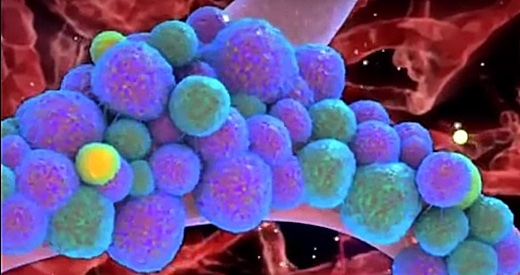

Image above: Still fame of simulation of radioactive particles clinging to living cell structures. From video below.

[IB Publisher's Note: I know this article is old (June 2016), but it is still informative. We've known for a while about the radioactive elements including cesium embedded in tiny glass particles or carbon buckyballs. That does not mean the issue has gone away and does not need attention. These particles will persist and be a threat for a very long time.]

Public Release from Goldschmidt Conference, Jun 26, 2016: New research shows that most of the radioactive fallout which landed on downtown Tokyo a few days after the Fukushima accident was concentrated and deposited in non-soluble glass microparticles, as a type of ‘glassy soot’. This meant that most of the radioactive material was not dissolved in rain and running water…

The particles also concentrated the radioactive caesium (Cs), meaning that in some cases dose effects of the fallout are still unclear… Japanese geochemists… analysed samples collected from within an area up to 230 km from the FDNPP…

It had been anticipated that most of the radioactive fallout would have been flushed from the environment by rainwater. However… most of the radioactive caesium in fact fell to the ground enclosed in glassy microparticles…

These particles… formed during the molten core-concrete interaction inside the primary containment vessel in the Fukushima reactor units 1 and/or 3. Because of the high Cs content in the microparticles, the radioactivity per unit mass was as high as ~4.4×10^11 Bq/g [440,000,000,000,000 Bq/kg]…

Analysis from several air filters collected in Tokyo on 15 March 2011 showed that 89% of the total radioactivity was present as a result of these caesium-rich microparticles, rather than the soluble Cs, as had originally been supposed.

Discovery (Seeker), Jun 27, 2016: Fukushima Accident Rained Glass Particles on Tokyo… Most of the radioactive fallout that descended upon downtown Tokyo in the days after the March 2011 accident [was] glass microparticles — essentially, glass-filled soot. As a result, the fallout, which contained concentrated radioactive cesium, wasn’t dissolved by rainfall, and probably lingered in the environment…

Japanese scientists thought that most of it would be washed away by rainwater. Instead, analysis… revealed that most of the radioactive cesium in fact fell to the ground enclosed in glassy microparticles.

ANI, Jun 28, 2016: Research indicates Fukushima radioactive fallout may be worse than expected… Most of the radioactive fallout, which landed on downtown Tokyo a few days after the Fukushima accident, was concentrated and deposited in non-soluble glass microparticles, as a type of ‘glassy soot’…

Inverse, Jun 26, 2016: Radioactive “Glassy Soot” Fell Over Tokyo After the Fukushima Meltdown… The findings… show that the radioactive fallout… has been poorly understood. Previously, it was assumed that most of the radiation that fell dissolved in rain. This would mean that it would wash out of the soil and through the environment…

These tiny glass particles entered the air and fell as soot on the surrounding region. Because the radioactive molecules are contained in an insoluble medium, they will not wash out of the soil with rainwater to the same extent…

Beyond the consequences for the environment, there are significant consequences for human health. Breathing caesium encased in glass particles may have a very different impact from exposure to it as radioactive rain…


Image above: Video on the creation and contamination created by radioactice nano-particles from Fukushima affecting health. From (https://youtu.be/YDZMhywXwHY).

Scientists from Fukushima Univ., Japan Atomic Energy Agency, Stanford Univ., etc, June 2016: Cesium-rich micro-particles unveil the explosive events in the Fukushima Daiichi Nuclear Power Plant — Cesium-rich micro-particles (CsMPs) retain novel information on the molten core-concrete interaction… CsMPs specimens were discovered… in atmospheric particulates collected at Suginami, Tokyo… [Note: "The author has requested that this abstract is not discussed on social media."]

Dr Satoshi Utsunomiya, Kyushu Univ.: “This work changes some of our assumptions about the Fukushima fallout… This may mean that our ideas of the health implications should be modified“.

Prof. Bernd Grambow, Director of SUBATECH laboratory, France: “[The observations] presented here are extremely important. They may change our understanding of the mechanism of long range atmospheric mass transfer of radioactive caesium from the reactor accident at Fukushima to Tokyo, but they may also change the way we assess inhalation doses from the caesium microparticles inhaled by humans. Indeed, biological half- lives of insoluble caesium particles might be much larger than that of soluble caesium“.

See also:
Nuclear fuel found 15 miles from Tokyo — Fukushima uranium in ‘glassy’ spheres flew over 170 km
Fukushima Nano Bucky Ball Hot Particles Filled With Uranium, Plutonium, And Cesiu

Ea O KA Aina: Nuclear Power and Climate Failure 8/24/16 
Ea O Ka Aina: High radioactivity in Tokyo  8/22/16
Ea O Ka Aina: Nuclear Blinders 8/18/16
Ea O Ka Aina: Fukushima and Chernobyl 5/29/16
Ea O Ka Aina: Fukushima radiation damages Japan 4/14/16
Ea O Ka Aina: Fukushima's Nuclear Nightmare 3/13/16
Ea O Ka Aina: Fifth Fukushima Anniversary 3/11/16
Ea O Ka Aina: Fukushima impacts are ongoing 11/8/15
Ea O Ka Aina: Petroleum and Nuclear Coverups 10/21/15
Ea O Ka Aina: Fukushima Radiation Contamination 10/13/15
Ea O Ka Aina: Radioactive floods damage Japan 9/22/15
Ea O Ka Aina: Fir trees damaged by Fukushima 8/30/15
Ea O Ka Aina: Japan restarts a nuclear plant 8/11/15
Ea O Ka Aina: Fukushima disaster will continue 7/21/15
Ea O Ka Aina: Too many fish in the sea? 6/22/15
Ea O Ka Aina: Fukushima prefecture uninhabitable 6/6/15
Ea O Ka Aina: In case you've forgotten Fukushima 5/27/15
Ea O Ka Aina: Radiation damages top predator bird 4/24/15
Ea O Ka Aina: Fukshima die-offs occurring 4/17/15
Ea O Ka Aina: Fukushima Impact Update 4/13/15
Ea O Ka Aina: Fukushima - the end of atomic power 3/13/15
Ea O Ka Aina: Where is the Fukushima Data? 2/21/15
Ea O Ka Aina: Fuku-Undo 2/4/15
Ea O Ka Aina: Fukushima MOX fuel crossed Pacific 2/4/15
Ea O Ka Aina: Fukushima worst human disaster 1/26/15
Ea O Ka Aina: Japan to kill Pacific Ocean 1/23/15
Ea O Ka Aina: Japan's Environmental Catastrophe 8/25/14
Ea O Ka Aina: Earthday TPP Fukushima RIMPAC 4/22/14
Ea O Ka Aina: Fukushima Daiichi hot particles 5/30/14
Ea O Ka Aina: Japanese radiation denial 5/12/14
Ea O Ka Aina: Entomb Fukushima Daiichi now 4/6/14
Ea O Ka Aina: Fukushima Disaster 3 Years Old 4/3/14
Ea O Ka Aina: Tsunami, Fukushima and Kauai 3/9/14
Ea O Ka Aina: Japanese contamination 2/16/14
Ea O Ka Aina: Bill for Fukushima monitoring 2/9/14
Ea O Ka Aina: Tepco under reporting of radiation 2/9/14
Ea O Ka Aina: Fukushima Fallout in Alaska 1/25/14
Ea O Ka Aina: Fukushima engineer against nukes 1/17/14
Ea O Ka Aina: California to monitor ocean radiation 1/14/14
Ea O Ka Aina: Demystifying Fukushima Reactor #3 1/1/14
Ea O Ka Aina: US & Japan know criticality brewing 12/29/13
Ea O Ka Aina: Fukushima Forever 12/17/13
Ea O Ka Aina: Brief radiation spike on Kauai 12/27/13
Ea O Ka Aina: USS Ronald Reagan & Fukushima 12/15/13
Ea O Ka Aina: Fukushima Pacific Impact 12/11/13
Ea O Ka Aina: Berkeley and Fukushima health risks 12/10/13
Ea O Ka Aina: Madness engulfs Japan 12/4/13
Ea O Ka Aina: Edo Japan and Fukushima Recovery 11/30/13
Ea O Ka Aina: Reaction to Fukushima is Fascism 11/30/13
Ea O Ka Aina: Radioisotopes in the Northern Pacific 11/22/13
Ea O Ka Aina: Fukushima cleanup in critical phase 11/18/13
Ea O Ka Aina: Fukushima fuel removal to start 11/14/13
Ea O Ka Aina: Fukushima, What me worry? 11/13/13
Ea O Ka Aina: Remove other Fukushina fuel 10/29/13
Ea O Ka Aina: End to Japanese Nuclear Power? 10/3/13
Ea O Ka Aina: Fukushima & Poisoned Fish 10/3/13
Ea O Ka Aina: Fuel Danger at Fukushima 9/27/13
Ea O Ka Aina: Reactor #4 Spent Fuel Pool 9/16/13
Ea O Ka Aina: Fukushima is Not Going Away 9/9/13
Ea O Ka Aina: X-Men like Ice Wall for Fukushima 9/3/13
Ea O Ka Aina: Fukushima House of Horrors 8/21/13
Ea O Ka Aina: Fukushima Apocalypse 8/21/13
Ea O Ka Aina: Fukushima Radioactive Dust 8/20/13
Ea O Ka Aina: Cocooning Fukushima Daiichi 8/16/13
Ea O Ka Aina: Fukushima radiation coverup 8/12/13
Ea O Ka Aina: Leakage at Fukushima an emergency 8/5/13
Ea O Ka Aina: Fukushima burns on and on 7/26/13
Ea O Ka Aina: What the Fukashima? 7/24/13
Ea O Ka Aina: Fukushima Spiking 7/15/13
Ea O Ka Aina: G20 Agenda Item #1 - Fix Fukushima 7/7/13
Ea O Ka Aina: Fukushima and hypothyroid in Hawaii 4/9/13
Ea O Ka Aina: Japan to release radioactive water 2/8/13
Ea O Ka Aina: Fukushima as Roshoman 1/14/13
Ea O Ka Aina: Fukushia Radiation Report 10/24/12
Ea O Ka Aina: Fukushima Fallout 9/14/12
Ea O Ka Aina: Fukushima Unit 4 Danger 7/22/12
Ea O Ka Aina: Fukushima denial & extinction ethics 5/14/12
Ea O Ka Aina: Fukushima worse than Chernobyl 4/24/12
Ea O Ka Aina: Fukushima dangers continue 4/22/12
Ea O Ka Aina: Fukushima children condemned 3/8/12
Ea O Ka Aina: Fukushima fights chain reaction 2/7/12
Ea O Ka Aina: Tepco faking Fukushima fix 12/24/11
Ea O Ka Aina: The Non Battle for Fukushima 11/10/11
Ea O Ka Aina: Fukushima Debris nears Midway 10/14/11
Ea O Ka Aina: Fukushima Radiation Danger 7/10/11
Ea O Ka Aina: Fukushima Abandoned 9/28/11
Ea O Ka Aina: Deadly Radiation at Fukushima 8/3/11
Ea O Ka Aina: Fukushima poisons Japanese food 7/25/11
Ea O Ka Aina: Black Rain in Japan 7/22/11
Ea O Ka Aina: UK PR downplays Fukushima 7/1/11
Ea O Ka Aina: Fukushima #2 & #3 meltdown 5/17/11
Ea O Ka Aina: Fukushima sustained chain reaction 5/3/11
Ea O Ka Aina: Ocean Radioactivity in Fukushima 4/16/11
Ea O Ka Aina: Japan raises nuclear disaster level 4/12/11
Ea O Ka Aina: Fukushima No Go Zone Expanding 4/11/11
Ea O Ka Aina: Fukushima to be Decommissioned 4/8/11
Ea O Ka Aina: Fukushima Poisons Fish 4/6/11
Ea O Ka Aina: Learning from Fukushima 4/4/11
Ea O Ka Aina: Fukushima Leak goes Unplugged 4/3/11
Ea O Ka Aina: Stick a fork in it - It's done! 4/2/11
Ea O Ka Aina: Fukushima reactors reach criticality 3/31/11
Ea O Ka Aina: Fukushima Non-Containment 3/30/11
Ea O Ka Aina: Fukushima Meltdown 3/29/11
Ea O Ka Aina: Fukushima Water Blessing & Curse 3/28/11
 
.

High radioactivity in Tokyo

SUBHEAD: Not only Fukushima is still contaminated with radioactive particles from the meltdowns.

By Admin on 22 August 2016 for ENE News -
(http://enenews.com/tv-astronomical-amounts-radiation-found-downtown-tokyo-horrific-readings-detected-children-playing-fukushima-extreme-contamination-found-food-grown-school-lunches-nuclear-expert-shocked-upsettin)


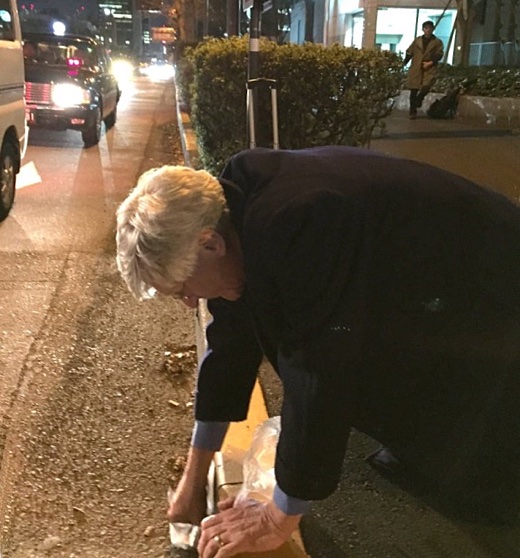
Image above: Arnie Gundersen, chief engineer of Fairwinds Associates,  on his knees in Tokyo collecting curbside dirt particles. Tests indicate sample measured radioactivity at 4,000 Bq/kg on a street outside the METI building - Japan's nuclear regulator. From (https://nuclear-news.net/2016/05/11/arnie-gundersen-measured-4000-bqkg-on-a-tokyo-street/).

Margaret Harrington, host:
I know you mentioned Arnie Gundersen, the chief engineer at Fairewinds, and he said that he measured the radiation there, too. Could you talk about that a little bit?

Maggie Gundersen, Fairewinds Energy Education founder and CEO:
He’s working with some other scientists who are studying — both Japanese scientists, the samples that they took, and the US scientists who are evaluating the samples — and they’re finding astronomical amounts of radiation, even in downtown Tokyo outside of METI’s door. METI is the regulatory agency over nuclear power…

When he and others were downtown in Tokyo, they took samples right there in a garden right outside the door and on the front doormat, and these are really, really high samples. Frightening, because people walking in Tokyo will then be inhaling that dust. What was the film we saw from Japan that had the mothers who were in an area where kids play and run from middle school?

Caroline Phillips, Fairewinds Energy Education:
It’s a fantastic video… it’s a mothers organization, they live in the Fukushima Prefecture and they’re actually using Geiger counters that have been issued by the government. They’re walking along the river [in Fukushima City.]

Maggie Gundersen: What’s so tragic about it – kids are running along dirt paths doing gym class and track and things like that and the mothers are right down in areas that are not posted and the kids can go after school and play, and people do nature hikes and stuff. And the radiation readings are horrific.

Gendai Business Online (article in Japanese here), Jun 14, 2016:
Just before the 5th anniversary of the triple meltdown at Fukushima Daiichi, a group of young girls in the city of Minami-Soma rode their bikes to school past a shocked and saddened pedestrian. That upset observer was Arnie Gundersen, nuclear reactor expert…

“What surprised me at this visit to Japan… is that the decontaminated area is contaminated again,”

Mr. Gundersen said while explaining why it was such as sad shock to witness the girls on their bicycles. “This was not what I had expected. I had thought that we would not find such high doses of radiation in the decontaminated area. But, sadly, our results prove otherwise.”…

Gundersen collected samples of dust [though] the official data cannot be released before the publication of formal scientific papers, it is evident that high doses of radiation, usually found in nuclear waste, was detected from these samples.
“This means that highly radioactive dust is flying around the city. In other words, the decontaminated land is contaminated again. Little girls are affected by the radiation 20 times as much as adult men. The Japanese government’s standard of 20 mSv is based on exposure assessments for adult men. The girls on their bicycles are actually being affected by a radiation dose equivalent to as much as 400 mSv.”
Mr. Gundersen also pointed out that human lungs are heavily affected by internal exposures to radiation.
“At this visit, I wore a radiation proof mask that can filter out 99.98% of radiation for six hours. I sent my filter to the lab, and they found a high dose of Cesium. But, unfortunately, the Japanese government only cares about the number on a Geiger counter and does not consider the internal exposure. This has resulted in a hazardous downplay of this kind of data and human lungs are affected by the serious internal exposure.”…
The radiation from the mountains are coming back to the city by way of wind and rain. Mr. Gundersen noted the extreme radioactive contamination of the mountains… vegetables grown in that area exceed the government’s standard by 1500 Bq.

These vegetables were sold at the MichinoEki in Tochigi prefecture, and the bamboo shoot grown in this contaminated region was used for elementary school lunches in Utsunomiya.

These school lunches contained more than twice as much radiation as the government’s standard…

However, the government continues to push for the end of people’s relocation and force the return to recontaminated areas…

Mr. Gundersen also found that Tokyo remains contaminated. He measured dust… and found a high dose of radiation. That dust is in the air that will be inhaled by the visitors and athletes of the 2020 Olympic Games. Needless to say, the current residents are inhaling it every day…


Video above: Interview on  Vermont CCTV channel 17 with representative of Fairwinds Energy Education 6/20/16. From (https://youtu.be/s3ftKuV5Zis).

See also:
Ea O KA Aina: Nuclear Power and Climate Failure 8/24/16
Ea O Ka Aina: Nuclear Blinders 8/18/16
Ea O Ka Aina: Fukushima and Chernobyl 5/29/16
Ea O Ka Aina: Fukushima radiation damages Japan 4/14/16
Ea O Ka Aina: Fukushima's Nuclear Nightmare 3/13/16
Ea O Ka Aina: Fifth Fukushima Anniversary 3/11/16
Ea O Ka Aina: Fukushima impacts are ongoing 11/8/15
Ea O Ka Aina: Petroleum and Nuclear Coverups 10/21/15
Ea O Ka Aina: Fukushima Radiation Contamination 10/13/15
Ea O Ka Aina: Radioactive floods damage Japan 9/22/15
Ea O Ka Aina: Fir trees damaged by Fukushima 8/30/15
Ea O Ka Aina: Japan restarts a nuclear plant 8/11/15
Ea O Ka Aina: Fukushima disaster will continue 7/21/15
Ea O Ka Aina: Too many fish in the sea? 6/22/15
Ea O Ka Aina: Fukushima prefecture uninhabitable 6/6/15
Ea O Ka Aina: In case you've forgotten Fukushima 5/27/15
Ea O Ka Aina: Radiation damages top predator bird 4/24/15
Ea O Ka Aina: Fukshima die-offs occurring 4/17/15
Ea O Ka Aina: Fukushima Impact Update 4/13/15
Ea O Ka Aina: Fukushima - the end of atomic power 3/13/15
Ea O Ka Aina: Where is the Fukushima Data? 2/21/15
Ea O Ka Aina: Fuku-Undo 2/4/15
Ea O Ka Aina: Fukushima MOX fuel crossed Pacific 2/4/15
Ea O Ka Aina: Fukushima worst human disaster 1/26/15
Ea O Ka Aina: Japan to kill Pacific Ocean 1/23/15
Ea O Ka Aina: Japan's Environmental Catastrophe 8/25/14
Ea O Ka Aina: Earthday TPP Fukushima RIMPAC 4/22/14
Ea O Ka Aina: Fukushima Daiichi hot particles 5/30/14
Ea O Ka Aina: Japanese radiation denial 5/12/14
Ea O Ka Aina: Entomb Fukushima Daiichi now 4/6/14
Ea O Ka Aina: Fukushima Disaster 3 Years Old 4/3/14
Ea O Ka Aina: Tsunami, Fukushima and Kauai 3/9/14
Ea O Ka Aina: Japanese contamination 2/16/14
Ea O Ka Aina: Bill for Fukushima monitoring 2/9/14
Ea O Ka Aina: Tepco under reporting of radiation 2/9/14
Ea O Ka Aina: Fukushima Fallout in Alaska 1/25/14
Ea O Ka Aina: Fukushima engineer against nukes 1/17/14
Ea O Ka Aina: California to monitor ocean radiation 1/14/14
Ea O Ka Aina: Demystifying Fukushima Reactor #3 1/1/14
Ea O Ka Aina: US & Japan know criticality brewing 12/29/13
Ea O Ka Aina: Fukushima Forever 12/17/13
Ea O Ka Aina: Brief radiation spike on Kauai 12/27/13
Ea O Ka Aina: USS Ronald Reagan & Fukushima 12/15/13
Ea O Ka Aina: Fukushima Pacific Impact 12/11/13
Ea O Ka Aina: Berkeley and Fukushima health risks 12/10/13
Ea O Ka Aina: Madness engulfs Japan 12/4/13
Ea O Ka Aina: Edo Japan and Fukushima Recovery 11/30/13
Ea O Ka Aina: Reaction to Fukushima is Fascism 11/30/13
Ea O Ka Aina: Radioisotopes in the Northern Pacific 11/22/13
Ea O Ka Aina: Fukushima - What me worry? 11/21/13
Ea O Ka Aina: Fukushima cleanup in critical phase 11/18/13
Ea O Ka Aina: Fukushima fuel removal to start 11/14/13
Ea O Ka Aina: Remove other Fukushina fuel 10/29/13
Ea O Ka Aina: End to Japanese Nuclear Power? 10/3/13
Ea O Ka Aina: Fukushima & Poisoned Fish 10/3/13
Ea O Ka Aina: Fuel Danger at Fukushima 9/27/13
Ea O Ka Aina: Reactor #4 Spent Fuel Pool 9/16/13
Ea O Ka Aina: Fukushima is Not Going Away 9/9/13
Ea O Ka Aina: X-Men like Ice Wall for Fukushima 9/3/13
Ea O Ka Aina: Fukushima House of Horrors 8/21/13
Ea O Ka Aina: Fukushima Apocalypse 8/21/13
Ea O Ka Aina: Fukushima Radioactive Dust 8/20/13
Ea O Ka Aina: Cocooning Fukushima Daiichi 8/16/13
Ea O Ka Aina: Fukushima radiation coverup 8/12/13
Ea O Ka Aina: Leakage at Fukushima an emergency 8/5/13
Ea O Ka Aina: Fukushima burns on and on 7/26/13
Ea O Ka Aina: What the Fukashima? 7/24/13
Ea O Ka Aina: Fukushima Spiking 7/15/13
Ea O Ka Aina: G20 Agenda Item #1 - Fix Fukushima 7/7/13
Ea O Ka Aina: Fukushima and hypothyroid in Hawaii 4/9/13
Ea O Ka Aina: Japan to release radioactive water 2/8/13
Ea O Ka Aina: Fukushima as Roshoman 1/14/13
Ea O Ka Aina: Fukushia Radiation Report 10/24/12
Ea O Ka Aina: Fukushima Fallout 9/14/12
Ea O Ka Aina: Fukushima Unit 4 Danger 7/22/12
Ea O Ka Aina: Fukushima denial & extinction ethics 5/14/12
Ea O Ka Aina: Fukushima worse than Chernobyl 4/24/12
Ea O Ka Aina: Fukushima dangers continue 4/22/12
Ea O Ka Aina: Fukushima children condemned 3/8/12
Ea O Ka Aina: Fukushima fights chain reaction 2/7/12
Ea O Ka Aina: Tepco faking Fukushima fix 12/24/11
Ea O Ka Aina: The Non Battle for Fukushima 11/10/11
Ea O Ka Aina: Fukushima Debris nears Midway 10/14/11
Ea O Ka Aina: Fukushima Radiation Danger 7/10/11
Ea O Ka Aina: Fukushima Abandoned 9/28/11
Ea O Ka Aina: Deadly Radiation at Fukushima 8/3/11
Ea O Ka Aina: Fukushima poisons Japanese food 7/25/11
Ea O Ka Aina: Black Rain in Japan 7/22/11
Ea O Ka Aina: UK PR downplays Fukushima 7/1/11
Ea O Ka Aina: Monju Madness 6/19/11
Ea O Ka Aina: Fukushima #2 & #3 meltdown 5/17/11
Ea O Ka Aina: Fukushima sustained chain reaction 5/3/11
Ea O Ka Aina: Ocean Radioactivity in Fukushima 4/16/11
Ea O Ka Aina: Japan raises nuclear disaster level 4/12/11
Ea O Ka Aina: Fukushima No Go Zone Expanding 4/11/11
Ea O Ka Aina: Fukushima to be Decommissioned 4/8/11
Ea O Ka Aina: Fukushima Poisons Fish 4/6/11
Ea O Ka Aina: Learning from Fukushima 4/4/11
Ea O Ka Aina: Fukushima Leak goes Unplugged 4/3/11
Ea O Ka Aina: Stick a fork in it - It's done! 4/2/11
Ea O Ka Aina: Fukushima reactors reach criticality 3/31/11
Ea O Ka Aina: Fukushima Non-Containment 3/30/11
Ea O Ka Aina: Fukushima Meltdown 3/29/11
Ea O Ka Aina: Fukushima Water Blessing & Curse 3/28/11
.
Fukushima impacts are ongoing

SUBHEAD: There will be at least 100,000 and as many as one million more cancers in Japan because of Fukushima disaster.

By Arne Gundersen on 4 November 2015 for Fairewinds Assoc.(http://www.fairewinds.org/nuclear-energy-education/cancer-on-the-rise-in-post-fukushima-japan)

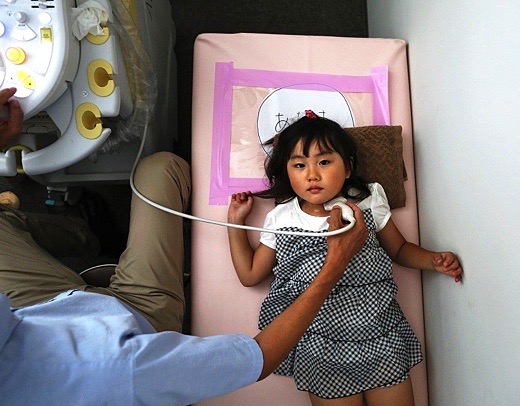
Image above: A doctor conducts a thyroid examination on four-year-old Maria Sakamoto in Iwaki, Japan. From (http://www.theguardian.com/world/2014/mar/09/fukushima-children-debate-thyroid-cancer-japan-disaster-nuclear-radiation).

Cancer on the Rise in Japan

It’s been almost five years from the Fukushima Daiichi meltdowns, and the news from Japan is still not good. Two reports recently released in Japan, one by Japanese medical professionals and the second from Tokyo Power Corporation – TEPCO – acknowledged that there will be numerous cancers in Japan, much greater than normal, due to the radioactive discharges from the triple meltdown at Fukushima Daiichi.


In Fairewinds’ latest update of the ongoing nuclear catastrophe at Fukushima Daiichi, Chief Engineer Arnie Gundersen presents two reports that confirm the direct link of numerous cancers in Japan to the triple meltdown. Based upon data from Japanese medical professionals and utility owner of the meltdown site, Tokyo Electric Power Company (TEPCO), Arnie concludes that heavy radioactive discharges will be the cause of enormous spikes in cancer in Japan.

TEPCO’s press release confirms the leukemia diagnosis for a TEPCO worker due to his ongoing exposure during the last four years to radiation from the Fukushima Daiichi triple meltdown. Sadly, during the early months of the Fukushima Daiichi emergency, most TEPCO workers did not wear the required dosimeters required to measure each employee’s exposure to radiation, which has made accurate assessment of the radiation doses received by TEPCO employees impossible.

The second report, provided by esteemed Japanese medical professionals, reveals that the incidence of thyroid cancer is approximately 230 times higher than normal in the Fukushima Prefecture.  This disturbing number for the people of Japan is solely due to the Fukushima Daiichi disaster and the ongoing radioactivity emanating from the decimated nuclear site.

In this video, Arnie recounts his presentation from 2013 at the New York Academy of Medicine where he forecast continuous radiation releases from the Fukushima Daiichi nuclear plant, and also the devastating health effects for the Japanese people, despite the chronically underestimated radiation exposure levels propagated by the International Atomic Energy Agency, and the Japanese government.

In this video below, Arnie recounts his presentation from 2013 at the New York Academy of Medicine where he forecast continuous radiation releases from the Fukushima Daiichi nuclear plant, and also the devastating health effects for the Japanese people, despite the chronically underestimated radiation exposure levels propagated by the International Atomic Energy Agency, and the Japanese government.


Video above: From (http://www.fairewinds.org/nuclear-energy-education/cancer-on-the-rise-in-post-fukushima-japan). From (https://vimeo.com/144307674).


Uncontrolled chain reaction
SUBHEAD: Former Japanese Ambassador calls for Japan calling off 2020 Olympics in Tokyo because of ongoing and future dangers posed by Fukushima disaster.

By Admin on 4 November 2015 for ENE News -
(http://enenews.com/former-japan-ambassador-uncontrolled-nuclear-chain-reactions-suspected-fukushima-troubling-indications-recurring-criticality-tellurium-132-detected-100-miles-plant-recriticality-issue-discussed)


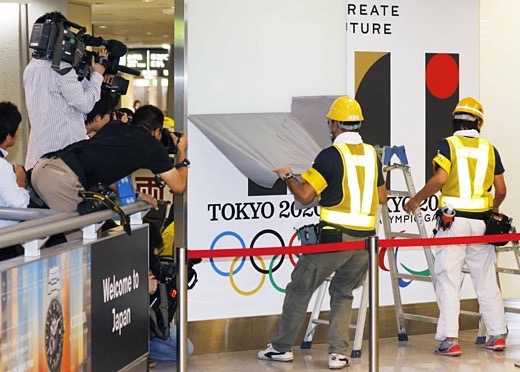
Image above: Time for a retreat. Workers removing logo from Tokyo 2020 Olympic Games poster after accusation of plagiarism. From (http://www.japantimes.co.jp/community/2015/11/04/voices/time-come-honorable-retreat-tokyo-2020-fukushima#.Vj-r58onpBo).

Japan Times, Nov 4, 2015 (emphasis added): The former Japanese ambassador to Switzerland, Mitsuhei Murata, recently suggested that Japan should stage an ‘honorable retreat’ from hosting the 2020 Olympics due to the unpredictable situation at the crippled Fukushima No. 1 nuclear power plant.

Japan Times (Hotline to Nagatacho — Brian Victoria, Kyoto), Nov 4, 2015: [F]ormer Japanese ambassador to Switzerland, Mitsuhei Murata, recently proposed… for Japan to stage an “honorable retreat” from hosting the 2020 Olympics…

In the September issue of Gekkan Nippon, Murata… noted the danger still posed by large numbers of spent fuel rods suspended in spent fuel pools in reactors 1, 2 and 3 [which] can’t be removed from the damaged reactor buildings due to the high levels of radioactivity surrounding these reactors…

Murata’s gravest concern is a number of troubling indications of recurring criticality [ i.e. uncontrolled nuclear chain reactions] in one or more of the reactors at Fukushima No. 1. For example, he notes that in December 2014, both radioactive iodine-131 and tellurium-132 were reported as having been detected in Takasaki city, Gunma Prefecture [~130 miles SW of Fukushima Daiichi]. Given the short half-lives of these radioactive particles, their presence could not be the result of the original meltdowns at Fukushima.

Ambassador Murata to Dr. Thomas Bach (President of the International Olympic Committee), Jun 15, 2015: Allow me to send you a letter, motivated by my sense of mission to inform you of the worsening situation in Fukushima, which regrettably is being downplayed by our Government and does not seem to be well known internationally…

Contrary to the assurances of the Japanese Government and [TEPCO], the situation at the site of the Fukushima Daiichi Nuclear Power Plant is not at all under control… Not only do we have a continued contamination of the groundwater and the Pacific Ocean… but the brittle structure of the damaged plant represents itself a serious threat, in particular in our earthquake prone region.

Ambassador Murata to Susana Malcorra (United Nations Chef de Cabinet), Aug 27, 2015: I am sending you my fourth message to President Bach of The IOC. I inform him of my message addressed to Prime Minister Abe. In my message… I ask for the first concrete international cooperation concerning the method  of cooling spent fuel rods making use of zinc instead of water. This is crucially important.

The Pacific Ocean is more and more contaminated with the daily release of more than 300 tons radioactive groundwater. I remind Prime Minister Abe that the decision to retreat from the Tokyo Olympic Games and carry out an international verification of the suspected re-criticality is urgently needed…

My interview article was published in the magazine “Monthly Japan” (September). The article entitled “An honorable retreat from the Tokyo Olympic Games” is given a central place. Reactions are noteworthy and encouraging. Conscientious citizens start questioning the integrity of the IOC. Please convey my warmest greetings to Secretary-General Ban-kimoon.

Interestingly, two weeks ago the head of Japan’s Nuclear Regulation Authority addressed the recriticality issue:
Fukushima Minpo, Oct 20, 2015: Nuclear regulator chief says Fukushima Daiichi recriticality “physically impossible” — Shunichi Tanaka, chairman of the Nuclear Regulation Authority, visited the Minamisoma city government for talks with Mayor Katsunobu Sakurai on Oct. 22. 
Regarding Tokyo Electric Power Co.’s crippled Fukushima Daiichi nuclear power plant, Tanaka said, “We are no longer in a situation that prevents residents from returning (to their evacuated hometowns). Recriticality is physically impossible.”

See also: MIT professor: “There is a high probability that, if a quake of magnitude 7.9 or above, or some other serious event, strikes Fukushima, a ‘criticality’ will occur… The next criticality may be far more serious”

And: Gov’t Document: Re-criticality a threat at Fukushima


.

Should Tokyo be evacuated?


SUBHEAD: Doctor and journalist recommend evacuating children and even adults from greater Tokyo area.

Interview of Dr. Shigeru Mita on 11 November 2013 in Mama Revo -
(http://www.save-children-from-radiation.org/2013/11/11/title-dr-shigeru-mita-addresses-the-need-of-blood-examination-among-children-in-the-kanto-area/)

[Note: (Original Japanese text by Mama-revo Magazine, translated by the World Network for Saving Children From Radiation team.] 


Image above:Thyroid cancer found from Fukushima children one year after nuclear catastrophe. From (http://fukushima-diary.com/2012/09/thyroid-cancer-found-from-fukushima-children/).

The Mita clinic in Kodaira city, Tokyo, has carried out blood examination and thyroid ultrasound examination on 1,500 patients, including children. Mamarevo Magazine here interviews Dr. Mita, the head of the clinic, about what he has seen through the blood exam.

Q: Please tell us about the examinations that are conducted by the Mita clinic. 

A: Since October 2011, we have carried out blood examinations, which include ‘differential white blood cell count’, and thyroid ultrasound examinations. The WBC (white blood cells) consist of 5 different kinds of cells: neutrophil, lymphocyte, eosinocyte, basophil, and monocyte.

The ‘differential WBC count’ consists of comparing the ratio of occurrence between these five cell types. Workers who work in environments with high radiation levels have to take ‘ionized radiation health checks’, which particularly focus on ‘differential WBC count’.

In the current situation, thyroid ultrasound examinations have been getting a lot of attention, but I consider differential WBC count to be rather important as well, for assessing the effects of radiation.

Q: Do you mean that we can understand the impact of radiation on humans by checking differential WBC count?

Mita: Yes. Blood is produced in the bone marrow which is one of the organs that are most vulnerable to radiation. If the bone marrow is exposed to high doses of radiation, the quality and ratio of blood corpuscle cells can be changed. The values of differential WBC count can be affected easily by even tiny inflammation in the body.

So, in our clinic, we first take a close look at patient’s condition such as the symptom of inflammation and liver function. If a patient is diagnosed with such conditions, we ask him/her to undergo the blood examination only after full recovery.

It is possible to see tendencies of areas by evaluating the data of hundreds and thousands of people.

So, if the mean value of the result of the collective blood exams is not very good, it can indicate the need for decision-making of whether one should keep living in the area.

By the way, in the ongoing Fukushima Health Management Survey in Fukushima prefecture, the differential WBC counts have been conducted only on residents who have resided in the evacuation zone. But I think that all the residents in Northern Kanto and Metropolitan Tokyo areas should be encouraged to take this examination.
 
Q:  You have found changes in the children’s differential WBC counts. Could you tell us about it?

Mita: Yes. Our patients mostly come from Tokyo, Chiba, Kanagawa, Saitama, and other Northern Kanto areas. I have found an obvious decline of neutrophil value in leukocyte (WBC) of these children.

The pediatricians’ general textbook says that reference value of neutrophil for healthy children (6-12 years old) is between 3000 and 5000.  3000 is considered as the threshold value. But the mean number of neutrophil values of the children who have visited our clinics since the accident has decreased to 2500. The mean value should normally be 4000, but it has shifted to 2500.  It is lower than the threshold value of 3000. I think this points at a serious problem.

 
Younger  than 1 month
 
Younger  than 1 year old
1-5 years old
Older than 6 years old
WBC (leukocyte)
7000-25000
 
7000-15000
7000-11000
6000-10000
Neutrophil
5000-15000
 
4000-8000
2500-5000
3000-5000
Lymphocyte
3000-14000
 
4000-11000
3000-7000
2500-45000
Neutrophil %
60±10%
 
60±10%
40±10%
65±10%
Lymphocyte %
30±10%
30±10%
40±10%
25±10%


Table above: From Japanese Doctors Assciation magazine, Volume 141, Special volume (1) Pediatric/adolescent treatment, the latest manual.

Q: What would happen if the ratio of neutrophil in WBC declines?

Mita: Decrease of neutrophil does not directly cause lowered immunity strength. Neutrophil usually takes up 60% of all leukocytes and it kills bacteria and fungus which enter the body by incorporating them inside its own cell. Neutrophil functions as the last bastion of the immune system, which means that there are a number of stages in the system before neutrophil is called upon to suppress the actions of bacteria and fungus.

So, a decline of neutrophil value does not mean it immediately causes weakness in catching cold and infectious diseases. But we should be careful that extremely low values of neutrophil can lead to fatal illnesses such as septicemia in the case of aggravated colds.

Q: Can you give some concrete examples of the kind of symptoms we will see when the value of neutrophil decreases?

Mita: Even if the level of neutrophil is low, that doesn't necessarily mean that children will feel bad or that they will be vulnerable to disease.  Like I said before, it means that once a child becomes sick and the condition doesn't improve, the risk of that child’s condition becoming serious increases.     Furthermore, not only will the value of neutrophil become abnormal but you will also see some changes in the physical condition.

In the summer of 2011, there were many children with bloodshot eyes; and what we saw most were children with dark circles under the eyes.  We also had increased occurrence of sinusitis.  Previously, these patients got better soon after they were given proper treatment; however, we are seeing more cases of sinusitis accompanied with mild case of asthma continuing for longer periods.  And when these children spend some time in the West, they get better. If at all possible, I would like them to move away from East Japan.

Q: Is the decrease in the value of neutrophil caused by the radioactive contamination?

Mita: Since radioactive substances coming from Fukushima Daiichi nuclear power plant have reached Tokyo, and huge amounts of contaminated waste is being burned here as well, I cannot deny the possibility that we are inhaling radioactive substances contained in the air. 

Again, let me repeat that after the nuclear accident, enormous amounts of nuclear substances were released in the environment. Therefore, if we see an increase in symptoms that are different from the ones we've seen before, we physicians should "first consider the effects of radioactivity."

Q: What should be done if the value of neutrophil is low?

Mita: As far as the numerical values of tests taken by children at our clinic are considered, even if the neutrophil value is low, we have seen that in most cases these children will recover after spending more than two weeks in Western Japan.

When we tested a child whose original neutrophil value was 1,000, after the child had spent some time in Nagano, the level had recovered to 4,000.  We've also had a child whose value was 0 (zero), but the level rose to 2,000 after spending about 2 months in Kyushu and then eventually to 4,000.

But if the value is really low, some children have difficulty recovering to the average level of 4,000 even after evacuating to the West.  So my advice is: if you see some abnormal changes in the numerical neutrophil value, you should evacuate to a place that is not contaminated.

The value of neutrophil has been relatively stable among children who have evacuated to a clean place even for a few weeks at a time.  But my real hope is to have not just children but also adults move away from Tokyo.

Q:  Have you seen some abnormal values of neutrophil among adults as well?

Mita:  I have not seen any real change among adults, but their conditions are definitely different compared to how it was before the nuclear accident.

With elderly people, it takes more time for asthma to heal.  The medication doesn't seem to work.  We also see more patients with diseases that had been rare before; for example, polymyalgia rheumatica is a disease common among those above age 50 and contracted by 1.7 people out of every 100,000. Before 3.11, we had one or less patient per year.  Now, we treat more than 10 patients at the same time.

Q:  How do you evaluate the overall results of the thyroid ultrasound scan tests?

Mita:  We didn't observe any serious results among the children we tested.  However, we have found two mothers in their 30s with thyroid cancer.   Women are more likely to contract some kind of thyroid disease, and it is possible that the radioactivity may have caused the nodules to develop into cancer. 

It is also possible that we may always have had a certain number of young people with thyroid microcarcinoma that eventually developed into real cancer as the young patients became older.  And it just so happens that now, by conducting close examination, we have come across these cases of thyroid cancer.

Ten years after the Chernobyl accident, the number of adult thyroid cancer patients rose as well.  So, I think we need to give regular checkups not just on children but on adults as we I want doctors to rise as well.

Q:  Isn't it true that after the Chernobyl accident, local doctors were aware of the effects seen among their patients.

Mita: Yes.  I think doctors who knew their patients well should become aware of the strange things that were happening to them.  But since we don't know exactly how much these patients were exposed to radiation, it is really difficult to present a cause and effect relationship.

What we need to do is to have one group of people who have been exposed to radiation and another group who have not been exposed; then conduct the same tests.  But we don't even know how much the people in Tokyo were exposed in the first place.  It would also mean having to bring in hundreds of healthy children and take blood samples.

That's something, which is simply beyond the reach of one single physician.  In other words, it's impossible under the present state to collect the kind of data that would be printed in a prestigious science magazine.  Still, as long as I know that something strange is clearly happening, I can't just sit here doing nothing.

After 3/11, I've asked a group of doctors many times to "conducblood tests on children," but all they said was "there are no effects caused by radiation," without any explanation.  These types of tests need to be conducted for the next 20 or 30 years in order to understand the effects. 

We've already wasted the first two-and-a-half years, but since we have the data from Belarus and Ukraine, doctors should study and learn properly about the effects of radiation on the human body, listen to the sayings of patients and conduct investigations.

Mita: Try to be honest and tell your doctor that you are concerned about the effects of radiation; therefore, you would like to have your blood tested.  Some doctors may give you an unhappy look, but this is the only way we can change their way of thinking. I recommend people to get their blood tested along with the thyroid ultrasound scan test once every year.
  • Blood count (white blood cell count, red blood cell count, hematocrit, hemoglobin, blood platelet count, differentiated white blood cell)

  • Blood biochemistry (AST, ALT,γ-GTP, TG, GDL-C, LDL-C, HbA1c, fasting blood-sugar level, serum creatinine level, uric acid)

  • Thyroid function test (FT4, TSH)

  • CRP (check for inflammation)


Anti-Nukers denied Tokyo contamination

SUBHEAD: There has been self denial of health risks to Japanese outside of Fukushima prefecture.

By Staff on 6 July 2012 for Fukushima Voice - 
(http://fukushimavoice-eng.blogspot.com/2012/07/kouta-kinoshitas-stance-on-weekly.html)

Anti-nuclear demonstrations in front of the prime minister’s official residence on Fridays have been growing rapidly in size week by week.

The organizers, Metropolitan Coalition Against Nukes, is a coalition of multiple anti-nuclear groups and individuals, particularly inspired to try and prevent the restart of the nuclear power plants all of which had been offline since May 5, 2012.

Lately, there has been a move from some of the organizers to “remove” a prominent activist, Kouta Kinoshita, or rather, remove his claim of health effects from radiation exposure from the anti-nuclear movement. An investigative journalist who did an onsite coverage of the 1999 Tokaimura nuclear accident, Kinoshita was keenly aware of dangers of radiation when the Fukushima accident happened.

He has spearheaded an effort to bring truth to the public about radiation and radiation exposure, calling for evacuation of children, pregnant women, and women of childbearing potential from Tokyo and Kanto regions. (Evacuation from Fukushima and other severely contaminated areas goes without saying.)

Apparently some of the organizers do not like Kinoshita’s claim. Kinoshita encouraged readers of his popular blog (http://blog.goo.ne.jp/nagaikenji20070927) to attend the protest on June 22 and June 29. He no longer recommends the protest to his readers, as he does not agree with their stance of not acknowledging health effects and of lack of opposition to the debris distribution and incineration. In addition, he is not recommending that his readers attend the protest because the organizers do not seem to have contingency plans. Even when he was recommending protest attendance, he discouraged people from taking children there.

As Kinoshita has claimed over and over, the Tokyo area has a significant degree of radiation contamination. Some places are as contaminated as Kiev was after Chernobyl. However, some do not want to admit Tokyo is contaminated. It is very inconvenient for them. Kinoshita has been verbally attacked numerous times for “spreading the baseless rumors” and “scaring people.”

However, health effects are real. People contact Kinoshita to report their health problems since the Fukushima nuclear accident, as doctors do not seem to acknowledge them. Children who evacuated from Tokyo and Kanto region are being diagnosed with thyroid cysts and/or nodules.

One of the main members of the coalition with the Twitter account name, @bcxxx, declared that anything relating to Kinoshita be “removed” from the anti-nuclear movement. Kinoshita had already received slanderous comments from this individual in the past. He contacted the coalition for an explanation.

One individual, who seemed to be the central figure in organizing the demonstration itself, replied saying she was too busy at the moment and wanted some time to answer the question. Someone from one of the coalition’s groups revealed to Kinoshita that the coalition was simply a get-together of groups and individuals without regular face-to-face meetings.

Soon after the initial exchange, Kinoshita received a polite e-mail from one of the coalition’s members, Yasumichi Noma http://twitter.com/kdxn, thanking him for his effort to attract people to the demonstration. Noma stated that @bcxxx’s opinion did not necessarily reflect the coalition’s position and asked for Kinoshita’s understanding. Noma also stated the coalition had no particular representative.

This sequence of events is well documented in Kinoshita’s blog post.
http://blog.goo.ne.jp/nagaikenji20070927/e/85e55cd696fc34b6212baaf6d09ce5fc

Within 24 hours of receiving Noma’s e-mail, Kinoshita saw surprising Twitter exchanges between Noma and @bcxxx. Kinoshita had already called for non-attendance of the Friday demonstration, after @bcxxx’s “Kinoshita removal” declaration. Noma tweeted that it was rather preferable that Kinoshita called for non-attendance. Noma also tweeted that he thought the fact they were “hated” by Kouta Kinoshita would be a positive influence on their movement.

What is being uncovered from this whole sequence of events is that some of the organizers of the demonstration do not seem to have any views beyond just being “against nuclear power plants.” They don’t seem to acknowledge the existence of health effects from radiation exposure.

They don’t seem to recognize the ramification of regional distribution and incineration of contaminated disaster debris. They just care about stopping nuclear power plants. As a matter of fact, some protesters have been asked by them not to bring up such topics as health effects or debris incineration at the demonstration.

The organizers do not have cohesive unity among themselves. They do not seem to have any contingency plans in case the demonstration becomes violent. They are telling everyone to just “come on over” to the prime minister’s residence to protest. As a result, there are families with children, mothers with strollers, and literally people of all ages and background in attendance.

A wonderfully democratic sight? Think again.

Without a clear consensus amongst the organizers about what their collective stance is, where is this demonstration going? Just a bunch of people gathering? Has everyone thought beyond “Saikado hantai!” or “We oppose restart!”? What if the Prime Minister Noda answers the call and comes out to greet the protesters? Does the coalition have a letter of statement prepared to present?

It might be a matter of time before the demonstration become violent and out of control. Is it really a good idea to bring babies and children there? It is not a parade after all. Not to forget potential for radiation exposures.

There is even talk of the demonstration being setup by the pro-nuclear side to let citizens “vent” their anger to pacify them.

Whatever the truth is, this might be a time to profoundly consider where we want to go and how we want to present our concerns.

• Kouta Kinoshita, after graduating from Chuo University Law School, began investigative reporting. In 1995, he covered a series of cases including the Subway Sarin Incident by Aum Shinrikyo, a Japanese cult group. Also, he did an on-site coverage of Tokaimura nuclear accident from the very beginning, which was the first nuclear accident in Japan that resulted in deaths from radiation exposure. This experience led to his awareness of dangers of radiation.

Furthermore, he organized soil testing for radiation contamination for the entire country of Japan and developed the Radiation Defense Project in order to prevent the spread of health damage due to radiation. There are volunteer groups in Okinawa, Kyushu, Chugoku, Kinki, Shikoku, Chubu, Tokyo, Hokkaido and Europe at this time, allowing the interaction between a total of 3000 members. His blog, a very important information source, is accessed by an average of 20,000 viewers on a daily basis.