Just wait a little while

SUBHEAD: You’ll have to earn everything worth having, including self-respect and your next meal.

By James Kunstler on 7 August 2017 for Kunstler.com -
(http://kunstler.com/clusterfuck-nation/just-wait-little/)


Image above: Aarly 20th century Russian painting of "A Peasant Leaving His Landlord on Yuri's Day" by Sergei V. Ivanov. From (https://www.kp.ru/radio/26511/3430500/).

The trouble, of course, is that even after the Deep State (a.k.a. “The Swamp”) succeeds in quicksanding President Trump, America will be left with itself — adrift among the cypress stumps, drained of purpose, spirit, hope, credibility, and, worst of all, a collective grasp on reality, lost in the fog of collapse.

Here’s what you need to know about what’s going on and where we’re headed.

The United States is comprehensively bankrupt. The government is broke and the citizenry is trapped under inescapable debt burdens. We are never again going to generate the kinds and volumes of “growth” associated with techno-industrial expansion.

That growth came out of energy flows, mainly fossil fuels, that paid for themselves and furnished a surplus for doing other useful things. It’s over.

Shale oil, for instance, doesn’t pay for itself and the companies engaged in it will eventually run out of accounting hocus-pocus for pretending that it does, and they will go out of business.

The self-evident absence of growth means the end of borrowing money at all levels. When you can’t pay back old loans, it’s unlikely that you will be able to arrange new loans.

The nation could pretend to be able to borrow more, since it can supposedly “create” money (loan it into existence, print it, add keystrokes to computer records), but eventually those tricks fail, too.

Either the “non-performing” loans (loans not being paid off) cause money to disappear, or the authorities “create” so much new money from thin air (money not associated with real things of value like land, food, manufactured goods) that the “money” loses its mojo as a medium of exchange (for real things), as a store of value (over time), and as a reliable index of pricing — which is to say all the functions of money.

In other words, there are two ways of going broke in this situation: money can become scarce as it disappears so that few people have any; or everybody can have plenty of money that has no value and no credibility.

I mention these monetary matters because the system of finance is the unifying link between all the systems we depend on for modern life, and none of them can run without it.

So that’s where the real trouble is apt to start. That’s why I write about markets and banks on this blog.

The authorities in this nation, including government, business, and academia, routinely lie about our national financial operations for a couple of reasons.

One is that they know the situation is hopeless but the consequences are so awful to contemplate that resorting to accounting fraud and pretense is preferable to facing reality.

Secondarily, they do it to protect their jobs and reputations — which they will lose anyway as collapse proceeds and their record of feckless dishonesty reveals itself naturally.

The underlying issue is the scale of human activity in our time. It has exceeded its limits and we have to tune back a lot of what we do. Anything organized at the giant scale is headed for failure, so it comes down to a choice between outright collapse or severe re-scaling, which you might think of as managed contraction.

That goes for government programs, military adventures, corporate enterprise, education, transportation, health care, agriculture, urban design, basically everything. There is an unfortunate human inclination to not reform, revise, or re-scale familiar activities.

We’ll use every kind of duct tape and baling wire we can find to keep the current systems operating, and we have, but we’re close to the point where that sort of cob-job maintenance won’t work anymore, especially where money is concerned.

Why this is so has been attributed to intrinsic human brain programming that supposedly evolved optimally for short-term planning. But obviously many people and institutions dedicate themselves to long-term thinking.

So there must be a big emotional over-ride represented by the fear of letting go of what used to work that tends to disable long-term thinking. It’s hard to accept that our set-up is about to stop working — especially something as marvelous as techno-industrial society.

But that’s exactly what’s happening. If you want a chance at keeping on keeping on, you’ll have to get with reality’s program. Start by choosing a place to live that has some prospect of remaining civilized. This probably doesn’t include our big cities.

But there are plenty of small cities and small towns out in America that are scaled for the resource realities of the future, waiting to be reinhabited and reactivated.

A lot of these lie along the country’s inland waterways — the Ohio, Mississippi, Missouri river system, the Great Lakes, the Hudson and St. Lawrence corridors — and they also exist in regions of the country were food can be grown.

You’ll have to shift your energies into a trade or vocation that makes you useful to other people. This probably precludes jobs like developing phone apps, day-trading, and teaching gender studies.

Think: carpentry, blacksmithing, basic medicine, mule-breeding, simplified small retail, and especially farming, along with the value-added activities entailed in farm production.

The entire digital economy is going to fade away like a drug-induced hallucination, so beware the current narcissistic blandishments of computer technology.

Keep in mind that being in this world actually entitles you to nothing. One way or another, you’ll have to earn everything worth having, including self-respect and your next meal.

Now, just wait a little while.

.

Grow food for collapse

SUBHEAD: Getting ready for a sustainable lifestyle takes more practice than most people suspect.

By Juan Wilson on 6 August 2017 for Island Breath -
(http://islandbreath.blogspot.com/2017/08/grow-food-for-collapse.html)


Image above: "Occupy the Farm -  Take Back the Tract". From a film "The Wisdom to Survive: Climate Change, Capitalism & Community" From (http://www.spiritualityandpractice.com/films/reviews/view/27313).

A few decades ago back on the mainland in rural north-west New York state my wife Linda and I did a website named The Gobbler. See TheGobbler. It followed a printed version that we put out eight times a year and distributed to local businesses and to subscribers through the 1990s: 
The Gobbler was a seasonal & regional journal from
the Chautauqua Lake area of New York with a
Green Philosophy towards nature, spirit, art and politics.

The Gobbler was been part chronicle, part almanac,
part journal of fiction and even environmental newsletter.
The area we focused on was within what used to be called "courtin' distance" to our place in Panama, New York. "Courtin' distance" was how far a boy might travel to visit a girl and get back home to finish his chores before dinner. We thought that covered an area of about 50 square miles.  

A lot of that area around our place was either state conservation land, trailers on old lots,  and Amish or "English" farms. Some gravel covered roads near us had no power or telephone lines. You might see a horse and buggy there.

The point is that that is where we are headed back to - that is if we can survive the times we are in right now. Printed local publications, some telephone and maybe even telegraph communication. If we're lucky there will be some ham radios left too.

What there will not be are high resolution small portable screens with stereo sound and motion and touch detection that absorb hours of our days and know more about us than we do. We will more likely be using those Samsungs, iPhones and tablets for drink coasters and sushi plates.

Here in Hawaii, where there is close ground water (until the rain cycle fails,) all the added sunlight, humidity and CO2 which have created an environment that is causing the plants to grow like crazy.

Find a place and grow food now!
The moral of the story is to start growing as much food as you can immediately. Don't wait for the kids to be gone or retirement. Don't wait for the money to buy that homestead or farm.  Join a community garden or start one.

We are getting closer to that time when the shipping containers crossing the the Pacific (on the water or in the air) won't be coming cheaply and reliably. When that occurs we will really be on our own.

A worldwide reset is on the way. When completed there will be far fewer people and much less available energy for getting work done. We will all be on our way to a life like the indigenous Hawaiians or the faithful Amish.

We will all be on a path back to something like the 17th to 19th century - if we're lucky. And it is going to take quite a bit of practice to get along in that world.

Getting a headstart is not only fair, it is required.

Hone your skills. As Dmitry Orlov said on several occasions "Collapse now and avoid the rush!"

Below is a video of a talk given by Orlov about that subject (less than two weeks after "3/11" the Fukushima Daiichi triple meltdown).


Video above: "The Wisdom to Survive: Climate Change, Capitalism & Community". From (https://youtu.be/7QLIOuRS1n4).


Video above: "The Collapse -Dmitry Orlov". From (https://youtu.be/Ecfxl1wZDpE).

See also:
Ea O Ka Aina: Find and Limit Ourselves 2/17/17
Ea O Ka Aina: Capitalism is a form of Cancer 10/7/16
Ea O Ka Aina: How about a "Grown" economy? 10/11/16
Ea O Ka Aina: From Here on Down 8/4/15
Ea O Ka Aina : Oases on a future Eaarth 6/28/15
Ea O Ka Aina: The Last Straw 12/17/14 
Ea O Ka Aina: Worse than you think 5/21/14
Ea O Ka Aina:Things won't get back to normal 2/10/14
Ea O Ka Aina: The New Game 11/10/13
Ea O Ka Aina: Food, Water, Energy & Shelter 1/31/13
Ea O Ka AIna: Embrace the Change 7/24/12
Ea O Ka Aina: Trick or Treat! 10/31/11
Ea O Ka Aina: Last Trip to the Moon 5/10/11
Ea O Ka Aina: The Five Year Plan 3/4/10
Ea O Ka Aina: All Aboard! 12/9/09


.

South Korea's stubborn peace effort

SUBHEAD: Peace movement refusing to give up is taking the long view of its campaign. 

By Jon Letman on 4 August 2017 for Truth Out -
(http://www.truth-out.org/news/item/41486-taking-the-long-view-why-south-korea-s-peace-movement-refuses-to-give-up)


Image above: Jeong Young-hee is a Korean tangerine farmer in Gangjeong village on Jeju island. Like many residents, she strongly opposes the newly built South Korean naval base just two miles from her farm. Photo by Jon Letman. From original article.

In August, 1945, as Japan smoldered in the ruins of war, the question of what would become of the Korean peninsula after 35 years of Japanese occupation and a Soviet army advancing southward spurred the hasty selection of an artificial division along the 38th parallel drawn by two American officials as a border between US and Soviet "zones of occupation."

That line, never intended to be permanent, hardened like stubborn mud before the newly liberated Korea ever had the chance to form an independent, unified and democratic nation. Today 38°N still marks a potentially catastrophic flashpoint between North and South Korea.

The DMZ -- demilitarized zone -- despite its name, is one of the most militarized places on the planet. This hyper-militarization, in fact, extends south across the peninsula and today, 64 years after an armistice halted (but never formally ended) the Korean war, South Korea remains peppered with scores of US military installations -- at least 80 by the Pentagon's own count.

US bases, and the 28,500 US troops and joint military exercises they support, are not only opposed by North Korea; many South Koreans see them as a problematic construct that perpetuates the likelihood of war.

Despite frequent media coverage of North Korea's highly choreographed military parades, increasing missile launches, and Kim Jong-un's threats to turn Seoul into a "sea of fire," far less attention is paid to South Korea's tireless, well-organized peace movement opposed to militarism on both sides of the DMZ.

South Korean civil groups and NGOs like People's Solidarity for Participatory Democracy and the Korean Confederation of Trade Unions are skilled at forming coalitions with peace activists and religious groups opposed to a military buildup, which they see as increasing tensions with the North and militarization across Northeast Asia.

Your Old Farm Is Our New Base


Image above: Candle light protests have been held outside the Seongju County office nightly since the deployment of the THAAD antimissile defense system was announced in July 2016. Photo by John Letman. From original article.

With the bulk of US bases concentrated in and around Seoul and within range of North Korean artillery, the US is in the middle of a major realignment of its forces as it consolidates bases, moving tens of thousands of troops, their families and civilian contractors to US Army Garrison Humphreys in the city of Pyeongtaek, 40 miles south of Seoul.

In 2002, when the US announced its plan to triple Humphreys in size, Pyeongtaek residents living around the base organized fierce protests that raged for five years.

Thousands of police were deployed, citizens were arrested and villages were demolished. In the end, however, the base's walls were pushed outward, and Camp Humphreys grew from just over 1,000 acres to more than 3,400 acres, making it the US's largest overseas military base in the world.

Now in the final years of construction, US Army Garrison Humphreys is equipped to serve as the new headquarters for the Eighth US Army and US Forces Korea command center.


Image above: A representative of the Korean Confederation of Trade Unions holds an anti-THAAD banner at a demonstration in Soseong-ri, Seongju County, South Korea. Photo by John Letman. From original article.

The Humphreys expansion is slated for completion by 2020 and will eventually be home to up to 46,000 military and civilian personnel living and working behind razor wire-topped walls and gates.

The $10.7 billion expansion, the US's largest-ever peacetime military construction project, is being paid for overwhelmingly (around 90 percent) by the South Korean government. In 2016, Gen. Vincent Brooks (now head of US Forces Korea) publicly stated that it's cheaper to station US troops in South Korea than in the United States.

The Humphreys expansion does have supporters in the community, and many businesses have come to depend on the US military's presence.

Pyeongtaek's city government, unable to refuse the influx of thousands of US forces, has done its best to promote Humphreys' expansion as an opportunity to court non-military business and infrastructure investment and push for internationalization through increased cultural exchanges with military personnel and their families.

Still, many residents view the base as an unwelcome intrusion on Korean sovereignty and a source of crime, pollution and noise from military aircraft like F-16s, A-10 Thunderbolts, Chinook and Apache helicopters.


Image above: Demonstrators march toward the former golf course in Seongju County where the controversial THAAD antimissile defense system is being deployed by the US. Photo by John Letman. From original article.

Since 2002, Kang Song-won of the Pyeongtaek Peace Center has been working closely with residents from communities affected by Humphreys, particularly those who were forcibly relocated from the villages of Daechu-ri and Dodu-ri. Kang works with volunteers to monitor military incidents and accidents around the base.

Beyond the noise and inherent danger, he told Truthout the most harmful impact of Humphreys' expansion has been the deep divisions sown in the community between base supporters and opponents.

Giving up, however, is not an option. "Even though we lost the fight against the US military, I think it is still necessary to keep fighting ... against the problems of the US military base," Kang said.

Island of Peace, Tides of War


Image above: US Army Garrison Humphreys is a helicopter base in what will soon be the the United States' largest overseas military base. Just beyond the fence are small farming villages. Photo by John Letman. From original article.

An hour's flight south of Seoul is sub-tropical Jeju island. Home to nine UNESCO Global Geoparks and a World Heritage site, the volcanic island is renowned for its natural beauty and biodiversity both on land and sea. Jeju has also been heavily developed for tourism. On the south coast, in Gangjeong village, is the site of a new Korean naval base.

Muddying its primary purpose, the base is sometimes called the Jeju Multipurpose Port Complex and is touted as having a (future) dual civilian-military function, but for now it's strictly a Korean naval base and headquarters for the South Korean Navy's Mobile Task Force Flotilla-7, which includes Aegis warfare destroyers, KDX III helicopter destroyers and a submarine force command.

Like the expansion of Camp Humphreys, the 2007 announcement of the Jeju naval base sparked widespread outcry from residents opposed to the militarization of what was dubbed "Island of Peace" in recognition of Jeju's horrific April 3 massacre (1947-54).

In that massacre, as many as 30,000 island residents were killed by Korean forces over a seven-year period beginning in 1947 during the US military administration that occupied the southern part of the Korean peninsula immediately after the August 1945 defeat of Japan.

As in Pyeongtaek, Jeju base protesters clashed with the police for years. Base opponents, including the former mayor, were arrested and heavily fined but in the end, the base was built.


Image above: Many of the residents protesting against the deployment of the THAAD antimissile defense system are elderly farmers who don't want their remote mountain village to be militarized. Photo by John Letman. From original article.

Tangerine farmers Jeong Young-hee and her husband Kang Sung-won have been growing Jeju's famous citrus varieties for 30 years in greenhouses less than two miles from the base. Young-hee and Sung-won are concerned about the environmental impact of the base, especially the effects on the sea -- including soft corals, sea urchins, abalone and other marine life -- and the destruction of what was a sacred lava rock coastal field called Gureombi.

Construction on the base is not yet complete. Young-hee and Sung-won worry that as it grows, if a future exclusion zone (a zone that would restrict new construction) is declared, it would surround their farm, almost certainly driving down land values.

Peeling one of her sweet hallabong oranges, Young-hee explains how the base has caused a rift between friends and family members. The base has also divided many citrus farmers and Jeju's famous Haenyeo free divers. "Our relationship was destroyed," says Young-hee, who joined her male counterparts in shaving her head as a gesture of protest against the base.


Image above: Retired Catholic priest Father Mun Jeong-hyeon holds a daily mass along along a roadside site that doubles as a protest against the Jeju naval base in Gangjeong village, Jeju island. Photo by John Letman. From original article.

In the early days of the struggle, when base opponents pointed fingers at the US accusing it of pressuring South Korea (also known as the Republic of Korea), South Korean officials denied that the base would permanently host US warships.

This year, in March and June, US warships made their first visits to the Jeju base with short, inconspicuous port calls similar to what was recommended in a 2013 US Army War College strategy research project. Last January, US Pacific Command's Adm. Harry Harris suggested the possibility of deploying the US's newest, most lethal stealth destroyer, the USS Zumwalt to Jeju waters.

The Jeju navy base became operational in February 2016. Resistance continues daily, with activists gathering each morning in front of the entry gate to perform one hundred bows as a nonviolent, meditative protest.

Nearby, in a roadside tent chapel, retired Catholic priest Father Mun Jeong-hyeon leads a daily mass, before joining protesters who gather with flags and banners playing raucous music outside the base.

The mood of the protesters is defiant and the message is serious: they want a shift away from militarization of the Korean peninsula and northeast Asia.

This week (July 30-August 5), for the eighth year since 2008, apeace march is underway, in which activists are walking from the Jeju naval base around the island to raise awareness of the continuing struggle and to call for peace.

In Defense of Who?


Image above: Guards look out from behind a razor wire fence surrounded the new South Korean naval base on Jeju island, South Korea. Photo by John Letman. From original article.

South Korea's latest struggle against militarization began in July 2016 in rural, traditionally conservative Seongju County 135 miles south of Seoul.

Residents of Seongju and neighboring Gimcheon were caught off guard when the central government, under deposed President Park Geun-hye, offered Seongju to the US as a location for the US antimissile defense Terminal High Altitude Area Defense (THAAD) system.

For more than a year since that announcement, daily protests have been taking place in Seongju and elsewhere around the country. In June, an anti-THAAD protest of several thousand people briefly and peacefully surrounded the US embassy in Seoul.

THAAD manufacturer Lockheed Martin says the system is intended to defend "US troops, allied forces, population centers and critical infrastructure against short and medium range ballistic missiles."

Seongju residents and Koreans across the country, however, recite a litany of reasons they are opposed to THAAD, from environmental and health concerns to the lack of a democratic process to ever-increasing deployment of foreign weapons, as well as economic repercussions and tension with its neighbors China and Russia.


Image above: Korean Army personnel stand guard at the Demilitarized Zone/Joint Security Area outside the Military Armistice Commission buildings along the tense border. Photo by John Letman. From original article.

Two weeks before South Korea's snap election on May 9 this year, the US, citing North Korean threats, hurriedly began the deployment of THAAD in what had been a golf course outside a small village called Soseong-ri.

When South Korea's newly elected President Moon Jae-in learned that his own Ministry of Defense had failed to notify him of the presence of an additional four THAAD launchers, Moon called for a temporary suspension of THAAD to conduct an environmental assessment.

That suspension, however, is being reevaluated now as South Korea considers deploying additional launchers in response to a North Korean intercontinental ballistic missile test last week.

Like other aspects of the military alliance between the US and South Korea, THAAD is supported by some South Koreans and reviled by others. And like the communities in Gangjeong village on Jeju and Pyeongtaek near Seoul, the people of Seongju and Gimcheon are divided.

Speaking at a candlelight vigil outside the Seongju County government office on May 30, three local women were eager to share their thoughts with Americans.

On this 310th day of consecutive protests, the women told Truthout they wanted their lives back the way they were before THAAD.

They said their community was being torn apart -- even relations between parents and children were being strained by strong disagreements over THAAD.

Some of their neighbors have given up opposition to THAAD, either accepting it as unavoidable or simply focusing on other matters.

These women, however, refuse to give up and say they feel a responsibility to attend nightly demonstrations against THAAD. They also admit feeling a growing resentment toward what they see as an unequal alliance.

"We are starting to have anti-American sentiments even though we don't hate Americans," a woman who identified herself as Mrs. Kim said.

"To be honest, I want the US military to go home," said a second woman, who also goes by the name Mrs. Kim, adding the English phrase, "Yankee, go home."

The Truth Is Very Powerful


Image above: Demonstrators perform 100 bows for peace six days a week as a protest against the South Korean Jeju naval base in Gangjeong village, Jeju island. Photo by John Letman. From original article.

Even as new bases are built, old bases expanded and more weapons imported, what fuels South Korean peace movements in the face of overwhelming power?

In Seoul, Jungmin Choi who works with Durebang (My Sister's Place), an NGO that provides counseling to foreign women working in bars and clubs near US bases, says those women are living witnesses to the impact of military bases.

Choi calls the impacts of the bases "indescribably huge" and both tangible and intangible, but insists, "we believe this fight cannot be defeated … we will fight in a creative way with a long-term view."

On the other side of the country, Jeju base opponent Choi Sung-hee says that even though the Jeju base is operational and US warships have started visiting, the protests must continue.

Not only does the military know it is being watched, but protests build solidarity with other anti-base movements across South Korea and internationally, in places like Okinawa, Guam, the Philippines and Hawaii, particularly among women.


Image above: A protester is blocked by a security guard as he sits in silent protest outside the entry to the South Korean naval base on Jeju island. Photo by John Letman. From original article.

"That's the role of people ... we should constantly demand: we do not need arms, we do not need THAAD, we do not need more military bases," Choi says. "If the people's movement is strong, I think it can also influence the decisions of the South Korean president."

Nearby, in the St. Francis Peace Center, Father Mun carves messages of peace into wooden boards after each morning's protest. Nearly 80 years old, Father Mun has been a peace activist for decades in Pyeongtaek, on Jeju and elsewhere acting, in his words, as "a witness for truth."

When asked why he continues to resist in the face of overwhelming power, Father Mun declared, "The truth cannot be thrown away. The truth will stand up some day. The truth is very powerful. So, I believe the truth is going to win all enemies."

.

Lehua Island rodenticide info

SUBHEAD: Site available with links to articles, research and  testimony letters about the aerial drop.

By Kawai Warren on 5 August 2017 in Island Breath -
(http://islandbreath.blogspot.com/2017/08/lehua-island-rodenticide-info.html)


Image above: There is no question that the introduction of rats, by humans, to Hawaii has been a disasters, especially for places like Lehua with ground nesting birds. Poisoning mammals may not directly kill birds but it may kill mammals like monk seals and whales near the shores where poison reaches the water.  From (http://www.landcareresearch.co.nz/publications/newsletters/kararehe-kino/kararehe-kino-issue-19/which-toxin-is-best-for-eradicating-rodents).

A new website is now live for anyone wanting quick links to articles, research and public testimony letters about the Lehua aerial drop. The link is (https://www.lehua-island-hawaii-conservation.org/).

It is a resource for concerned residents, fishermen, journalists and scientists who need reliable information about the project.

The site states in part:

LEHUA ISLAND, 18 miles from Kaua'i in western Hawaii, is a rare and pristine State Wildlife Sanctuary. It harbors Federally-listed endangered and threatened species such as monk seals, green sea turtles, and three species of endangered birds.

Endangered loggerhead turtles have been sighted, and a rare species of reef coral (Cosinaraea wellsi) has been reported at a depth of 120 ft. Whales, dolphins, manta rays and eagle rays frequent the area. A native Hawaiian subsistence community of Ni'ihauans, 3/4 mile from Lehua, catches fish and ama crab in Lehua's waters to feed their families.

Starting August 8, 2017, the state Department of Land and Natural Resources and US Fish and Wildlife intend to drop approximately 11.5 tons of diphacinone rodenticide on Lehua Island.

The diphacinone rodenticide will enter the coastal waters below the high tide line, resulting in an unknown level of collateral damage to non-target species within this precious marine and cultural ecosystem.

In their agency comment letters, NOAA, the EPA, Hawaii Department of Health, and many scientists have expressed concern about the lack of baseline, Lehua-specific data to justify the poison drop, as well as lack of a rigorous monitoring commitment and enforcement mechanisms for the proposed biosecurity acitivities.

The EPA urged DLNR to conduct effective consultation with the local Hawaiian and marine community. Yet, two native Hawaiian organizations and a representative of OHA submitted comment letters and an Opposition Statement describing environmental justice issues and lack of inclusion in decisionmaking.

A public meeting called by DLNR to announce the Final Environmental Assessment for the aerial drop was met with intense community outrage.

In 2009 DLNR had conducted a very similar aerial drop of diphacinone on Lehua that failed in its rodent eradication goal. Mortalities that followed included two whales and a large-scale fish die off that agencies claimed were not related to the aerial rodenticide drop.

Nevertheless, following the 2009 diphacinone aerial drop, the head of Hawaii Department of Agriculture's Pesticide Branch, prior to his retirement, directed staff "not to issue aerial application permits that might result in pellets entering into marine ecosystems until the EPA develops study protocols for such ecosystems."

This Archive provides quick access links to official source documents, research reports and other official information for those wanting to learn more about the concerns raised in the Lehua aerial rodenticide operation.

The Archive was assembled through the input of scientists, legal researchers, policy watchdogs and others concerned about the lack of public awareness about this project, questionable statements made by agency staff, and significant omissions within the Environmental Assessment documents approved by the project's state and federal agencies.

See also:
Ea O Ka Aina: Impact of Lehua rat poisoning 6/8/17
Ea O Ka Aina: Navy operation coincides with fishkill 3/18/09
.

Trump's lazy lack of interest

SUBHEAD: Trump, America's Boy King, should know golf and television won't make America great again.

By Lee Moran on 4 August 2017 for Huffington Post -
(http://www.huffingtonpost.com/entry/newsweek-cover-donald-trump_us_598418d1e4b041356ebef616)


Image above: Cover of Newsweek illustrates Trump's Lazyboy lifestyle labeled "Donald Trump is bored and tired. Imagine how bad he'd feel if he did any work." From (http://www.newsweek.com/2017/08/11/donald-trump-hillary-clinton-gop-white-house-potus-bannon-643996.html).

“I would have added past due bills on floor...”

President Donald Trump won’t want to hang this uncomplimentary magazine cover at any of his golf clubs.

Newsweek depicted the president as a junk food-eating television addict on the front of its next issue, dated Aug. 11.

Under the headline “LAZY BOY,” the edited photo shows Trump slumped in a recliner with a remote control in one hand and a Diet Coke in the other.

An open bag of Cheetos is perched on his lap while an empty McDonald’s hamburger carton is discarded on the floor.

“Donald Trump is bored and tired,” the sub-headline reads. “Imagine how bad he’d feel if he did any work.”

Newsweek shared the cover on its home page late Thursday, two days after it published the cover story itself, which examined “America’s boy king” and his apparent lack of enthusiasm for the job.

The image went viral, sparking a myriad of responses.


Image above: Could Trump be afraid? From (http://www.newsweek.com/2017/08/11/donald-trump-hillary-clinton-gop-white-house-potus-bannon-643996.html).


.

Amazon is the New Tech Crash

SUBHEAD: There is only a handful of big tech winners - Amazon, Apple, Microsoft, Google Facebook & Netflix.

By David Stockman on 1 August 2017 for the Daily Reckoning -
(https://dailyreckoning.com/amazon-new-tech-crash/)


Image above: Sign on an unidentified Amazon building. From original article.

It won’t be long now. During the last 31 months the stock market mania has rapidly narrowed to just a handful of shooting stars.

At the forefront has been Amazon.com, Inc., which saw its stock price double from $285 per share in January 2015 to $575 by October of that year. It then doubled again to about $1,000 in the 21 months since.

By contrast, much of the stock market has remained in flat-earth land.

For instance, those sections of the stock market that are tethered to the floundering real world economy have posted flat-lining earnings, or even sharp declines, as in the case of oil and gas.

Needless to say, the drastic market narrowing of the last 30 months has been accompanied by soaring price/earnings (PE) multiples among the handful of big winners. In the case of the so-called FAANGs + M (Facebook, Apple, Amazon, Netflix, Google and Microsoft), the group’s weighted average PE multiple has increased by some 50%.

The degree to which the casino’s speculative mania has been concentrated in the FAANGs + M can also be seen by contrasting them with the other 494 stocks in the S&P 500.

The market cap of the index as a whole rose from $17.7 trillion in January 2015 to some $21.2 trillion at present, meaning that the FAANGs + M account for about 40% of the entire gain.

Stated differently, the market cap of the other 494 stocks rose from $16.0 trillion to $18.1 trillion during that 30-month period.

That is, 13% versus the 82% gain of the six super-momentum stocks.

Moreover, if this concentrated $1.4 trillion gain in a handful of stocks sounds familiar that’s because this rodeo has been held before.

The Four Horseman of Tech (Microsoft, Dell, Cisco and Intel) at the turn of the century saw their market cap soar from $850 billion to $1.65 trillion or by 94% during the manic months before the dotcom peak.

At the March 2000 peak, Microsoft’s PE multiple was 60X, Intel’s was 50X and Cisco’s hit 200X.

Those nosebleed valuations were really not much different than Facebook today at 40X, Amazon at 190X and Netflix at 217X.

The truth is, even great companies do not escape drastic over-valuation during the blow-off stage of bubble peaks.

Accordingly, two years later the Four Horseman as a group had shed $1.25 trillion or 75% of their valuation.

More importantly, this spectacular collapse was not due to a meltdown of their sales and profits. Like the FAANGs +M today, the Four Horseman were quasi-mature, big cap companies that never really stopped growing.

Now I’m targeting the very highest-flyer of the present bubble cycle, Amazon.

Just as the NASDAQ 100 doubled between October 1998 and October 1999, and then doubled again by March 2000, AMZN is in the midst of a similar speculative blow-off.

Not to be forgotten, however, is that one year after the March 2000 peak the NASDAQ 100 was down by 70%, and it ultimately bottomed 82% lower in September 2002. I expect no less of a spectacular collapse in the case of this cycle’s equivalent shooting star.

In fact, even as its stock price has tripled during the last 30 months, AMZN has experienced two sharp drawdowns of 28% and 12%, respectively. Both times it plunged to its 200-day moving average in a matter of a few weeks.

A similar drawdown to its 200-day moving average today would result in a double-digit sell-off.

But when — not if — the broad market plunges into a long overdue correction the ultimate drop will exceed that by many orders of magnitude.

Amazon’s stock has now erupted to $1,000per share, meaning that its market cap is lodged in the financial thermosphere (highest earth atmosphere layer). Its implied PE multiple of 190X can only be described as blatantly absurd.

After all, Amazon is 24 years-old, not a start-up. It hasn’t invented anything explosively new like the iPhone or personal computer.

Instead, 91% of its sales involve sourcing, moving, storing and delivering goods. That’s a sector of the economy that has grown by just 2.2% annually in nominal dollars for the last decade, and for which there is no macroeconomic basis for an acceleration.

Trade Secrets From Investing Legends

Don't be drawn into the suckers rally: Listen to the guys who have beaten the market! Chris Mayer lays out eight unusual rules for becoming a better investor.

In the report he reveals the five greatest investment books you have never heard of -- you get them immediately. Sign up for the Daily Reckoning today and receive your FREE report.

Yes, AMZN is taking share by leaps and bounds. But that’s inherently a one-time gain that can’t be capitalized in perpetuity at 190X.

And it’s a source of “growth” that is generating its own pushback as the stronger elements of the brick and mortar world belatedly pile on the e-commerce bandwagon.

Wal-Mart’s e-commerce sales, for example, have exploded after its purchase of Jet.com last year — with sales rising by 63% in the most recent quarter.

Moreover, Wal-Mart has finally figured out the free shipments game and has upped its e-commerce offering from 10 million to 50 million items just in the past year. Wal-Mart is also tapping for e-commerce fulfillment duty in its vast logistics system — including its 147 distribution centers, a fleet of 6,200 trucks and a global sourcing system which is second to none.

In this context, even AMZN’s year-over-year sales growth of 22.6% in Q1 2017 doesn’t remotely validate the company’s bubblicious valuation — especially not when AMZN’s already razor thin profit margins are weakening, not expanding.

Based on these basic realities, Jeff Bezos will never make up with volume what he is losing in margin on each and every shipment.

The Amazon business model is fatally flawed. It’s only a matter of the precise catalyst that will trigger the realization in the casino that this is another case of the proverbial naked emperor.

Needless to say, I do not think AMZN is a freakish outlier. It’s actually the lens through which the entire stock market should be viewed because the whole enchilada is now in the grips of a pure mania. Stated differently, the stock market is no longer a discounting mechanism nor even a weighing machine. It’s become a pure gambling hall.

So Bezos’ e-commerce business strategy is that of a madman — one made mad by the fantastically false price signals emanating from a casino that has become utterly unhinged owing to 30 years of Bubble Finance policies at the Fed and its fellow central banks around the planet. Indeed, the chart below leaves nothing to the imagination.

Since 2012, Amazon stock price has bounded upward in nearly exact lock-step with the massive balance sheet expansion of the world’s three major central banks.


Image above: Comparison of stock values of G3 Central Banks and Amazon Corp. From original article.

At the end of the day, the egregiously overvalued Amazon is the prime bubble stock of the current cycle. What the Fed has actually unleashed is not the healthy process of creative destruction that Amazon’s fanboys imagine.

Instead, it embodies a rogue business model and reckless sales growth machine that is just one more example of destructive financial engineering, and still another proof that monetary central planning fuels economic decay, not prosperity. Amazon’s stock is also the ultimate case of an utterly unsustainable bubble.

When the selling starts and the vast horde of momentum traders who have inflated it relentlessly in recent months make a bee line for the exits, the March 2000 dotcom crash will seem like a walk in the park. .

Maui conservation effort working

SUBHEAD: Large landscape scale reforestation at Auwahi on Haleakala is proof.

By Jan TenBruggencate on 21 July 2017 for Raising Islands-
(http://raisingislands.blogspot.com/2017/07/landscape-scale-conservation-can-work.html)

http://www.islandbreath.org/2017Year/08/170803auwahibig.png
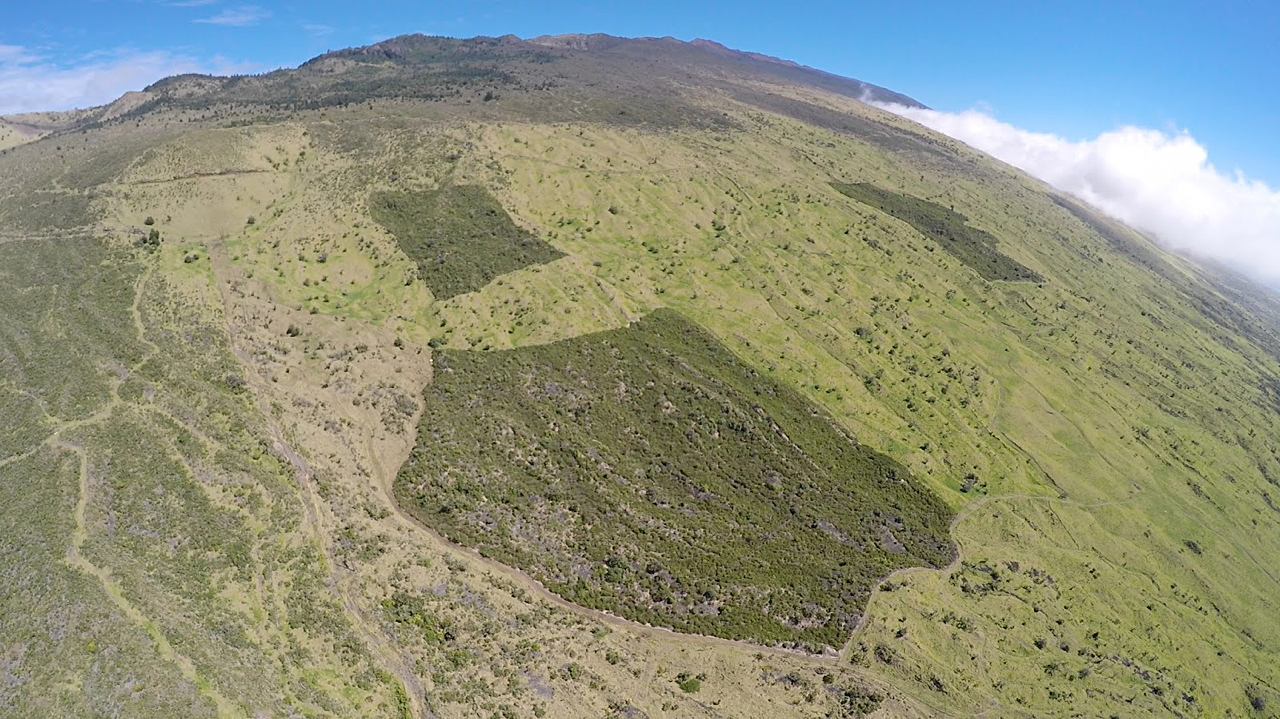
Image above: Southern flank of southwest Maui where Auwahi reforestation project is turning Haleakela green. From original article. Click to enlarge.

When Art Medeiros fenced some Maui pasture that had a smattering of native dryland forest plants on it, most folks figured he was engaged in a pipe dream.

He hoped that by excluding deer and cattle, and with a little loving care and some outplanting, something approaching a healthy native dryland forest could result.

Medeiros was right. The image above is the proof. The three dark green patches are areas fenced to keep grazing animals out and then planted with dryland natives. The 10-acre center square was fenced and planted 20 years ago, the bottom 23 acres 12 years ago, and the 23-acre shape at the right eight years ago.

Medeiros worked with the landowners, `Ulupalakua Ranch’s Erdman family, along with the U.S. Fish and Wildlife Service and the Natural Resources Conservation Service, to form the Auwahi Forest Restoration Project. You can learn more about it at this website.

What they found is that landscape-scale conservation efforts work.

It is a remarkable example, but certainly not the only example in Hawaii.
  • When the Territory of Hawai`i removed feral cattle from the Koke`e grasslands on Kaua`i, those rolling acres of pasture were able to convert back to forest that is now Koke`e State Park.

  • When George Munro on Lana`i fenced hundreds of acres at Kanepu`u a century ago to keep out deer and mouflon sheep, he protected a native forest that survives today.

  • When Lida and David Burney took the analysis of ancient pollen samples at Makawehi on Kaua`i  and planted those plants into a nearby former cane field, they restored something long gone from that landscape. 
Medeiros a few decades ago saw a few botanical gems in a severely degraded landscape. When he proposed trying to restore it, he got a lot of pushback. It was a dead forest standing, he was told - Degraded landscapes were inevitably going to further decline.

He didn’t give up.

“The question was whether we could rebuild this system, or was this (an example of) the end of all natural systems?”

At Auwahi, there were priceless old endemic trees, but they were not reproducing and had not reproduced for decades. The native species covered only 3 percent of the landscape.

Why care? Native dryland forest is some of the rarest treasure in the Hawaiian realm. It has been displaced by development, agriculture, pasture and constant pressure from non-native predators on the natural landscape, like cattle, deer, goats, sheep, pigs and rats.

Medeiros and his team fenced out the cattle and deer at Auwahi, starting with the 10-acre square they now call A-1. With the help of teams of community volunteers, teachers, canoe clubs and many others, they began planting out native species—more than 125,000 seedlings to date.
The result: Native species cover in some areas is now 82 percent.

“Near two-thirds of native tree species at Auwahi are now producing seedlings naturally, a sign of a healthy functioning ecosystem, including some species that had not done so in centuries,” Medeiros said.

And on a dry slope of Haleakala, where much of the landscape is brown and yellow, here it is deep green. Not only an indication that the plants are back, but that the landscape is functioning as a watershed.

Medeiros gives special credit to the landowners, Pardee and Sumner Erdman and their family, for their dedication to conservation, and their willingness to convert pasture to native forest—without compensation.

“`Ulupalakua Ranch has...served largely as a silent and enthusiastic partner. In all my years in conservation, I have never seen another for-profit group act in this way,” he said.

Donors to the project over the years included the Frost Family Foundation, Maui County Department of Water Supply, Hawai`i Community Foundation, Hawai`i Tourism Authority, Maui County Office of Economic Development and the Edward J Anderson Foundation.
.

Kauai Council is Climate Change

SUBHEAD: The County Council turns down $100,000 in private donations to fund climate action plan.

By Nathan Eagle on 3 august 2017 for Civil Beat -
(http://www.civilbeat.org/2017/08/kauai-council-says-no-thanks-to-100k-to-fight-climate-change/)


Image above: Kauai County Council members 2016-2018 -  Mason Chock, Arthur Brun, Chair Mel Rapozo, JoAnn Yukimura, Ross Kagawa, Derek Kawakami and Arryl Kaneshiro. From original article.

Opponents of taking the money question whether the county needs its own plan. One said the work should be left to the federal government.

Kauai County Council members have rejected $100,000 in private donations to fund a climate action plan for their rural island, which is particularly susceptible to rising sea levels, stronger storms and other effects of climate change.

In a 4-3 vote last week, Council Chair Mel Rapozo and members Arryl Kaneshiro, Ross Kagawa and Arthur Brun opposed a request from Mayor Bernard Carvalho’s administration to accept $50,000 from the Hawaii Community Foundation and a matching $50,000 from the nonprofit Partners for Places.

They expressed skepticism about the need for a county climate plan, saying they didn’t want to duplicate the state’s efforts. They also felt the county economic development director’s explanation of the potential funding was insufficient.

“You don’t need a plan to tell you that you help the environment if you walk more, if you bike more, catch the bus more,” Kagawa said. “If the federal government is working on it, let them do it.”

Councilwoman JoAnn Yukimura, who along with Councilmen Derek Kawakami and Mason Chock supported accepting the money, pointed out at the meeting that the United States is no longer leading on climate change.

“Under President Trump, we’re withdrawing from it and really losing face in the world,” Yukimura said, referring to Trump’s decision to withdraw from the Paris climate accord.

The Paris agreement, signed by 195 nations in 2015, established a goal of limiting the global temperature increase to 1.5 degrees Celsius above pre-industrial levels and laid out plans for countries to work together to adapt to the adverse effects of climate change.

“That’s why the cities now are rising to address it and saying we’re going to do it because it’s affecting the lives of our citizens, it’s affecting the planet and I think this county needs to join in and do that,” Yukimura said.

The council’s Economic Development and Intergovernmental Relations Committee took up the matter again Wednesday, but the deadline had passed Monday to use the foundation’s grant to apply for the matching funds from Partners for Places.

George Costa, director of Kauai’s Office of Economic Development, said Wednesday that he had been reluctant to disclose Monday’s grant deadline at last week’s meeting because of the way council members had reacted the previous time the administration came before them with a last-minute request to apply for a Transportation Alternatives Program grant.

At least one council member said the additional information provided Wednesday by the county’s energy and sustainability manager, Ben Sullivan, who was unable to attend their meeting last week, would have changed their vote.

“Had we had this information last week, this would have passed,” Rapozo said.

Costa said the administration tries to give the council as much notice as possible, but in this case was uncertain whether the private funding would be available until July — although the county started talking to the Hawaii Community Foundation in January.

“A lot of these opportunities do come at the last minute,” Costa said.

Still, Yukimura questioned during Wednesday’s meeting why the county would not want to have the council accept the foundation’s funding, since there was ample time to use it to meet the next deadline in January to apply for a matching grant from Partners for Places.

Sullivan said there’s still a chance the administration will come back to the council to ask for such approval, but he noted that the foundation is now looking for a nonprofit or other third party to receive the funds. He was not sure if new recipients had been determined.

“We’re kind of strategizing and rethinking,” Sullivan said.

‘Defining Issue Of Our Lives’
Kagawa said at last week’s meeting that the idea of a county climate action plan reminded him of Kauai’s efforts to address “all this fear” over genetically modified organisms.

The county passed a bill in 2013 to require GMO companies to disclose more information about the pesticides they use and abide by setbacks for spraying. A federal court later overturned the law.

“I don’t think it necessarily makes sense that the county is getting into the business of telling people on Kauai what to do to help this problem,” he said. “It needs to be done nationwide.”

Kaneshiro had his own fears over what a climate action plan might obligate the county to do.

“Is it going to say airplanes are causing a lot of carbon emissions so we should reduce the amount of airplanes coming to Kauai?” he asked. “Or, you know, vehicles are a main cause of carbon emissions so reduce the amount of miles people can drive on Kauai?”

Yukimura said the plan would not obligate the county to do anything, but instead would provide data and possible strategies.

Sullivan said the county’s climate action plan would add a greater level of detail to the data the state Department of Health is collecting about greenhouse gas emissions, for instance.

Better Communication Needed
The council members, even those supporting accepting the funding, said they did not get the information they needed from Costa last week. Even Yukimura later called his answers “weak.” But those in favor said it still made sense to accept the money and then work out the details for the plan.

Kawakami, who was concerned about the message last week’s vote would send to future potential donors, said he wants a plan that produces results.

“At what point do we get some tangible recommendations on what we need to do with our wastewater facilities, with our county roads and state highways being impacted by sea level rise, and when do we get some sort of tangible to-do list instead of studying this thing?” Kawakami said. “If we study this thing to death then by the time we come out with any real action plan it’s going to be too late.”

Costa said $10,000 of the grant would have gone to a greenhouse gas study that looked at emission levels from various sectors, such as electricity, the landfill and transportation.

He said $40,000 would have gone to community engagement, $10,000 would have been for contingencies and the rest would have been used to contract with the University of Hawaii’s Department of Urban and Regional Planning to drive the plan.

Rapozo said at last week’s meeting that community engagement could be part of a county plan to address climate change, but he questioned spending the money on that, even it wasn’t from Kauai taxpayers.

“I don’t understand how you can get information on a plan with community engagement,” he said. “When you’re doing a plan, I think you’ve got to use scientific data.”

This was the third time the council has rejected funding a climate action plan. Last year, the Hawaii Community Foundation said it would provide $75,000 if the county chipped in $30,000, Costa said.

Kagawa said last week at the meeting that he still did not trust the administration when it comes to addressing climate change.

“I don’t believe they’ll have the plan with the silver bullet to solve the problem,” he said. “That’s just my gut.”

Yukimura, in an email trying to rally her constituents after the vote, called climate change the “defining issue of our lives.” She said Kauai’s fragile and unique environment in particular has a great challenge ahead that demands leadership, community involvement and consensus on a course of action.

In April 2016, Sullivan tried to convey the urgency of coming up with a plan to address climate change while encouraging the council to support the mayor’s $30,000 budget request.

“It’s past time for us to champion this,” he told The Garden Island newspaper at the time.

On Wednesday, Sullivan said in an email that the mayor is committed to developing and implementing a climate action plan and the Hawaii Community Foundation has been “extremely supportive.”

“Despite some communications challenges, today’s meeting seemed to illustrate that our County Council, and quite a few people in our community are also in full support of this effort, so I am confident that we will find a way forward with this work,” he said.

Darcy Yukimura, the foundation’s senior philanthropic officer on Kauai, said the island still has the opportunity to be a leader in the state.

Read more about the administration’s plan below.
(http://www.documentcloud.org/documents/3912056-Council-OED-7-31-17-C-2017-168-Development-of-a.html?embed=true&responsive=false&sidebar=false) 


.

Energy consumption by states

SUBHEAD: Texas consumes the most energy, Vermont the least. Per capita New York the least. Hawaii close.

By Mickey Francis on 2 August 2017 for EIA.gov -
(https://www.eia.gov/todayinenergy/detail.php?id=32312)


Image above: Mountain of damaged oil drums near Exxon refinery. From (https://commons.wikimedia.org/wiki/File:A_MOUNTAIN_OF_DAMAGED_OIL_DRUMS_NEAR_THE_EXXON_REFINERY_-_NARA_-_546000.jpg).

EIA’s State Energy Data System (SEDS) recently released 2015 data estimates for all 50 U.S. states and the District of Columbia. The estimates include data on both total energy consumption and energy consumption per capita, which is calculated by dividing total consumption by population.

In 2015, Texas consumed a total of 13 quadrillion British thermal units (Btu), or about 13% of total U.S. energy consumption. Texas has consumed the most energy in every year since 1960, the earliest year for which EIA has data. California ranked second in energy use, with a total consumption of 8 quadrillion Btu, about 8% of U.S. total energy use.

Louisiana, Florida, and Illinois round out the top five energy-consuming states, which together account for more than one-third of total U.S. total energy use. Total energy consumption by the top 10 states exceeded the combined energy use of the other 41 states (including the District of Columbia).

Vermont was the lowest energy-consuming state in 2015 at about 132 trillion Btu; it was the only state with a lower consumption level than the District of Columbia’s 179 trillion Btu. Historically, Vermont has used less energy than any other state since 1961. Rhode Island, Delaware, Hawaii, and New Hampshire round out the top five lowest energy-consuming states, which together accounted for only 1% of total U.S. energy use in 2015.

Overall, total U.S. energy consumption in 2015 was about 97 quadrillion Btu, a decrease of about 1% from 2014. In percentage terms, the states with the largest year-over-year percentage changes in energy use ranged from Minnesota, with a 7.6% decrease from 2014, to Florida, with a 3.7% increase from 2014.

Thirty-five states and the District of Columbia had less energy consumption in 2015 than in 2014, led by states in the Midwest.

The seven largest percentage decreases in energy use all occurred among Midwestern states: energy consumption in Minnesota, Michigan, Illinois, Wisconsin, Ohio, Indiana, and Missouri decreased by a total of 704 trillion Btu from 2014 to 2015, accounting for nearly half of the total decline among states that had lower energy use in 2015 than in 2014.


Image above: Total BTU consumption by state. From original article.

In terms of total energy consumption per capita, Louisiana ranked the highest of any state, totaling 912 million Btu (MMBtu) per person in 2015. These rankings reflect the total consumption across all sectors in the state: residential, commercial, transportation, industrial, and electric power. Wyoming ranked second with 893 MMBtu, followed by Alaska (840 MMBtu), North Dakota (802 MMBtu), and Iowa (479 MMBtu).

High per capita energy consumption in these states is largely attributable to industrial sector energy consumption, which accounts for more than 50% of all consumption in those five states.

High production in the energy-intensive fossil fuel industry contributes to the high industrial sector consumption: Louisiana, Alaska, and North Dakota are all among the top ten states in crude oil production, while Wyoming is a leading producer of coal and natural gas. Iowa’s agriculture and manufacturing industries contribute to its relatively high consumption of energy in the sector.


Image above: Total BTU consumption per capita by state. From original article.

In 2015, New York had the lowest total energy consumption per capita at 189 MMBtu, followed by Rhode Island, California, Hawaii, and Florida. Again, relatively low per capita consumption reflects the relatively low industrial sector energy consumption in those states. Overall, the 2015 U.S. national average total energy consumption per capita was 303 MMBtu in 2015, about 2% lower than in 2014 and 1.6% lower than in 2000.

EIA’s State Energy Data System contains a complete set of state-level estimates of energy production, consumption, prices, and expenditures through 2015.

.

An evolutionary cul-de-sac

SUBHEAD: Disappointments to my inner Neanderthal, who, wrinkling his jutting brow, mutters, What’s next?

By Brian Miller on 23 July 2017 for Winged Elm Farm -
(http://www.wingedelmfarm.com/blog/2017/07/23/on-becoming-an-evolutionary-cul-de-sac/)


Image above: Chain drum lifter rated for 2,000pound loads available from Amazon.com available for under $100. From (https://www.amazon.com/Vestil-CDL-2000-Chain-Lifter-Capacity/dp/B002KLJUSK).

I was 16 when I put brand new brakes on my car. It took most of an afternoon, and it was a task that finally completed gave me a real sense of accomplishment. True, I had a couple of small parts left over. But I was young and I operated under the assumption that the auto parts store had given me either spares or parts that didn’t go with my model.

Once finished, I climbed in the driver’s seat, turned the ignition, and took off down the road. Wow! It was a smooth ride and I felt great. That is, until I came up fast to my first stop sign and applied the brakes.

Odd feeling, pushing down on the brake pedal at 50 miles an hour and encountering no resistance. It’s a memory I can still summon readily to this day. Fortunate for me, the auto engineers had built in a backup breaking mechanism called the emergency brake, a handy invention that I deduced might be best to deploy … quickly.

I give you this preamble as evidence that even though a person comes from solid civil engineering stock, basic mechanical skill is not an inherited gene. We all have the friend, often on speed dial, who is great at teasing out the workings of ‘most any thingamajig.

But my solutions to mechanical failures are victories hard won. The puzzles that five-year-olds routinely solve on Facebook in a cute two minutes elude me — sometimes for hours, and sometimes for many years.

The Neanderthals who lurk in my ancestry were a smartish but conservative group of bipeds. They developed a reliable tool kit over the millennia to make their lives run smoother. But then they apparently had a community meeting and said,

Enough is enough, and they settled in for the next 100,000 years and made no new improvements. I kind of admire that about them; perhaps we could learn a thing or two from that approach to technology.

But then there is my H. sapiens DNA. It allows me, eventually, to not only see a solution but also want to implement it.

Yesterday, for instance, we were unloading 55-gallon-drum feed barrels. Cindy backed up the tractor and boom pole to the bed of the truck. Dangling from the boom pole was a nifty contraption called a barrel lifter.

This simple invention is the best $40 we ever spent. It has two metal “hands” at the end of a chain that grab the edge of the barrel. Once the boom pole is raised, the barrel lifter and barrel in tow swing up and out of the truck bed. No muscling required.

The first barrel was a breeze. The second barrel presented a slight problem. It didn’t completely clear the bed of the truck. Taking on my finest Thinker pose, I struggled for a solution. After some minutes, the little gray cells began to sing: It’s the weight, I deduced triumphantly!

Each 300-pound feed barrel removed took more weight off the truck suspension, thereby raising the bed of the truck a couple of inches and causing each subsequent barrel to drag along the tailgate when hoisted. But voilà!

A few adjustments to the tractor’s three-point hitch, which in turn shortened the top link’s angle after each barrel, gave the boom pole a higher lift. Problem solved.

This Eureka moment may not mean much to you engineering types. But small successes like this one are huge to my sapiens self. Victories for H. sapiens, yet disappointments to my inner Neanderthal, who, wrinkling his jutting brow, mutters, What’s next? Will he be wanting to invent block and tackle?

Perhaps. But I must leave that astonishing accomplishment for later. I’ve just had a brain flash that there just might be a better way to knap flint! Stay tuned.

.

Saving Hawaiian cultural sites

SUBHEAD: Fearing future development of a valley rich with Hawaiian history, community members want preservation.

By Blaze Lovell on 31 July 2017 for Civil Beat  -
(http://www.civilbeat.org/2017/07/the-fight-to-save-ancient-hawaiian-archeological-sites/)


Image above: Tim Pickering, the owner of about 400 acres in Ohikilolo Valley. He said there are no plans now to develop the land. From original article.

This is a fight to save ancient Hawaiian archeological sites. Fearing future development of a Leeward valley rich with cultural history, some community members are pushing for preservation.

Glen Kila’s family has defended parts of the Waianae Coast from development for generations. The family traces its genealogy to the aboriginal inhabitants of the area.

They consider one of their most sacred sites to have been under threat by foreign developers and mainland owners since the 1980s.

Now, luxury developments in nearby Makaha have spawned a new round of worries that this area in Kea’au Valley, known as Ohikilolo, may face a similar fate if nothing is done to preserve the land.

More than 600 acres of former ranchland in Ohikilolo have been eyed at various times as a possible landfill, golf course and luxury subdivision.

What is so important about this valley?

Drivers passing by the ranchland just off Farrington Highway see just trees and possibly some cows grazing in a field. But beneath the brush hides the densest collection of archeological sites on the island, according to an archeological study conducted in 1992.


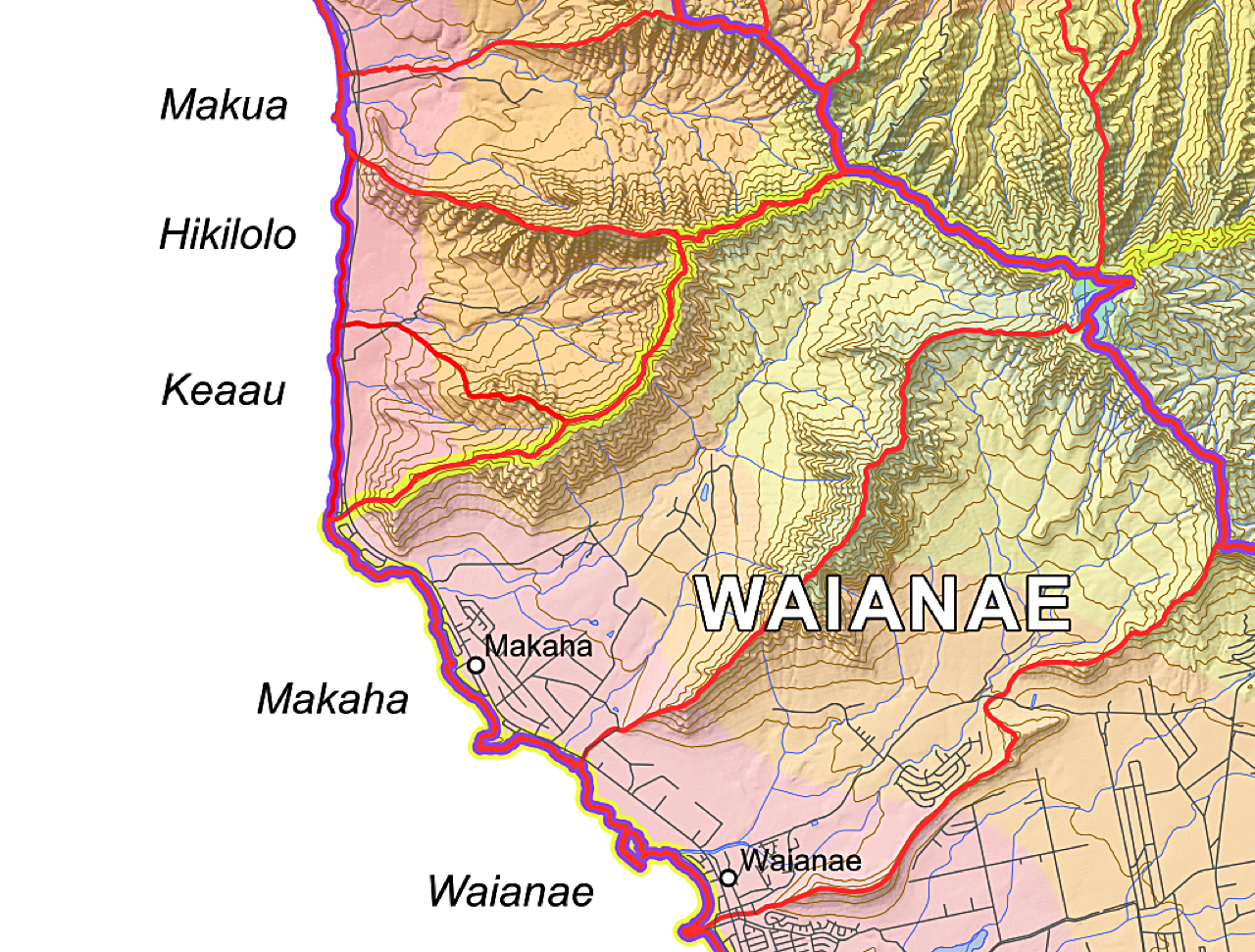
Image above:  Detail part of of Moku & Ahupuaa map of leeward Oahu showing ahupuaa areas of Waianae including Keaau and Hikiolo done by  Juan Wilson. Click to enlarge.  From (http://www.islandbreath.org/hawaiinei/M6Oahu/M6OahuRasterFile.png).


The study was originally done for a proposed golf course, and researchers recorded 461 sites in just 60 acres of the valley.

What may look like piles of rocks to some people are actually the remains of a once-vibrant community that existed more than 1,500 years before the time of Kamehameha I.

Kila, a former teacher and principal on the Waianae Coast, is spearheading a movement to turn Ohikilolo into an area for kanaka maoli (Native Hawaiians) to practice their culture as well as a place for the public to learn about that culture.

“There’s a lot of history that hasn’t been shared … right now we are releasing it so that we can protect the land,” Kila said.

Other community members, including state Sen. Maile Shimabukuro, are on board with the idea of trying to preserve Ohikilolo.

Most of the land is owned by the Pickering family of Arizona, and any push toward creating a state conservation district in Ohikilolo would require approval by the state Board of Land and Natural Resources and cooperation from the family.

One of the family members, Tim Pickering, told Civil Beat that there are currently no plans to develop the area.

As a first step, community members have asked Shimabukuro to request that the state conduct a study that not only considers the archeological sites in the area, but also analyzes how those sites relate to Hawaiian culture. Such a study could be used to recommend the property to the National Registry of Historic Places.

Sacred Lands
The aboriginal families of the Waianae Coast considered Ohikilolo to be part of Kanehunamoku — the sacred lands of Kane, the Hawaiian sun deity.

They believe that in this valley, the first human, La’ila’i, was born. In the Kumulipo, the Hawaiian creation story, La’ila’i becomes the mother of the Hawaiian race.


Image above: From ().

Ohikilolo and the rest of the Kea’au Valley represent a complete ahupua’a, a land district stretching from the mountains to the sea.

Residents of each ahupua’a depended on the others for survival. Coastal dwellers would often trade their fish to valley residents for taro or sweet potatoes, for instance.

“It was a living community made of Native Hawaiians that took care of the land,” Kila said.

In Ohikilolo, the people adhered to the concept of Ka’anani’au — meaning to manage the beauty of time — that regulated land areas through wet and dry seasons.

Kila says the archeological sites could demonstrate the interplay between Native Hawaiian religion and culture. The 1992 study found tools for agriculture and fishing, rock piles that may have once been heiau (Hawaiian temples), foundations for dwellings and walls to divert water for farming.

“The archaeological remains here may be the last representative of a complete prehistoric settlement system on leeward Oahu,” the report said.

After being deeded to a servant of Kamehameha I, spending much of its history as a ranch, and getting glances from a Japanese corporation for a golf course and the city for a dump, parts of Ohikilolo became the property of the Pickerings.

Residents On The Lookout
Cynthia Rezentes, Nanakuli-Maili Neighborhood Board chairwoman, said possible development in Ohikilolo by the Pickerings has been an issue for seven years. In 2007, Robert Pickering acquired 735 acres of land in Ohikilolo and the surrounding area for $3.8 million, according to property documents.

Around 2010, the Pickerings first had the idea to put a luxury housing development on the property, Rezentes said.

Tim Pickering told Civil Beat that the land was never developed because he couldn’t find any investors nor could he negotiate retrofitting the area with roads and adding sewer lines. Pickering hasn’t filed for any building permits or conditional use permits on the agricultural land.

Residents were worried when they recently found a $3.5 million real estate listing from Chaney Brooks & Co. for the 60 acres that includes most of the archeological sites, but representatives of the real estate company told Civil Beat that the listing is from about six years ago and the property is no longer on the market.

In the time that Pickering had the property on the market, even creating a website to try to sell it himself, he only had one person who ever contacted him about it, but that “faded pretty fast,” he said.

“It’s just staying the way it is,” Pickering said. Development “wouldn’t happen for a long time if it happens at all.”

In March, residents worried that Makaha La, another development, would stretch into Ohikilolo.

But Tom Tisher, a real estate agent working with Makaha La, said that the new subdivision would be in Makaha, not Ohikilolo.

The potential for development of Ohikilolo still troubles some community members.

“It’s a waiting game to see whether or not they want to package something again,” Rezentes said. “But they need the draw. If you can get investors to tap into something like this you can potentially build something.”

Hiking To A Temple
On a recent weekend, Chris Oliveira took a small group of hikers up a Makaha hillside to a sacred site. The people of Waianae have traditionally been stubborn, said Oliveira, Kila’s nephew.

In fact, while other Hawaiians were converting to Protestantism, many who lived in Waianae became Catholic. Stories tell of the people’s ancestors being so bold as to call the fire goddess Pele a malihini — a foreigner, he said.

From the road, the hillside wouldn’t necessarily catch anyone’s eye. But the terraces are actually man-made retaining walls stacked to create a temple out of the mountain.

Hawaiians “believed that the preservation of land is more important than the ambitions of man,” Oliveira said. “You see constructions that add to the already natural surroundings … Who could build a bigger temple than this?”

The temple has been ravaged by time and desecrated by a large water pipe that once ran across the hill, Oliveira said.


Image above: About 200 acres, parts of which contain burial sites and petroglyphs, are being used for a solar farm. From original article.

Next to the temple is a large solar farm covering burial sites and petroglyphs.

A solar farm and other military developments such as the Kaena Point Satellite Tracking Station and U.S. Army practice range in Makua Valley are just a few in a long line of developments that have covered up the history of the Waianae Coast, Kila said.

In World War II, the beach fronting Pokai Bay became a recreational center for military officers.

Kila’s relatives once owned portions of that land and refused to leave. They were onipa’a, he said — stubborn. When they resisted, the military shut off their water and electricity and moved them away in trucks.

In the 1960s, much of the coast was designated for hotel developments. Many landowners, including Kila’s family, stood to gain financially if they sold out to would-be hotel and condo builders, Kila said.

Pokai Bay was supposed to become a yacht harbor for residents who would have moved into condos along the coast. The development would have destroyed a heiau that is still used for cultural practices and ceremonies today, Kila said.

Kila’s family went door to door along the coast to convince property owners, as well as legislators who originally backed developers, to block the proposals. It worked. Now, the only buildings near Pokai Bay are the military recreational center, several small home and one apartment building.

The World As A Canoe
When Kila was being taught by his elders, no videotaping or even writing was allowed. Stories, prayers and chants needed to be remembered and passed on orally.

In addition, public sharing of their cultural practices was forbidden.

They were even reluctant to reveal the location of many sites for fear they would be destroyed.

He’s more open now, however, and wants to fight further development by educating the public on the cultural significance of different areas.

“We believe that by preserving Ohikilolo, not developing it, and expanding it as an educational system, the whole world can learn about who we are as human beings and our relationship with the ‘aina,” Kila said.

Kila and Oliveira run the Marae Ha’a Koa, a cultural learning center in Waianae. Its focus is the “preservation and perpetuation of the rich cultural heritage of the Waianae Coast,” according to its website.

Oliveira has taken the helm of education efforts on culture and regularly takes community members to historic sites. He also has authored several children’s books on Native Hawaiian culture.

Kila said his kuleana, or responsibility, is to pass on his knowledge; Oliveira’s is to spread, chronicle and contextualize it.

In the 1992 study, researchers recommended that the area surveyed in Ohikilolo should be recommended to the National Registry of Historic Places. The study was only done on about 60 acres of the Pickerings’ land, and some community members think more archeological sites exist in other areas of the valley.

To eventually protect the entirety of the valley, Kila has suggested the state conduct a Traditional Cultural Properties study.

TCPs go beyond analyzing physical features and include the cultural significance of an area.
Shimabukuro said she will contact the Historic Preservation Division of the state Department of Land and Natural Resources to see what can be done to begin the TCP process.

Community members have requested that she also ask for access to Ohikilolo for cultural practices.

Shimabukuro, who has been involved with preserving Ohikilolo since earlier this year, said that eventually she, and others in the community, want the land to be designated as a conservation district.

The state law for creating a conservation subzone in Ohikilolo includes cooperating with the landowner as well as creating maps and conducting additional studies of the area, according to state documents.

Because of its archeological sites, Ohikilolo could be eligible for the highest conservation subzone, protective, which would effectively ban most development there.

“This world is one canoe. If we jump up and down in a canoe, it hulis. It turns over, and we all perish,” Kila said. “We can’t have people hurting it or one group of people jumping up and down and turn the world into nothingness.”

Read the 1992 archeological study below.
(http://www.documentcloud.org/documents/3899943-Kea-au-Valley-Study-1992.html#document/p1)

• Blaze Lovell is an intern for Civil Beat and a senior at the University of Nevada Las Vegas. He was born and raised on Oahu and graduated from Pearl City High School.

.

The worst product ever marketed

SUBHEAD: Eventually we learn what's the good way to do things. Too bad that it is almost always too late.

By Ugo Bardi on 30 July 2017 for Cassandra's Legacy -

(http://cassandralegacy.blogspot.com/2017/07/what-is-worst-product-ever-marketed.html)


Image above: Detail of Bic advertisement celebrating the 40th anniversary of the introduction of the Bic lighter.  From original article.

Greens often exaggerate in inviting people to save energy and be happier by staying in the dark and eating insects. However, it is also true that sometimes wastefulness goes a few notches higher and becomes truly a scandal. It is the case of the ordinary disposable lighter.

Bic alone produces almost a billion lighters per year and has produced some 20 billions of them in the past 30 years. The whole world production is probably of a few billion per year. A good example of a successful product, but is it a good product?

The disposable lighter is surely practical but also, if you think about it, a very bad deal. It contains some 5 cc of butane, that you pay, typically, more than $1. That means around $200 per liter, or $800/gallon.

You wouldn't be happy to pay that kind of money when you refill the tank of your car. And, being powered by a fossil fuel, butane, every time you light up one you add some CO2 to the atmosphere, some of which will stay there for tens of thousands of years.

Then, the disposable lighter doesn't contain just non-renewable fuel but plastics manufactured from fossil fuels and also polluting. Then, it contains metals such as cerium, lanthanum, neodymium, praeseodymium and more.

These metals are classified as "rare earths;" they are not so rare as the name seems to imply, but they are not so common, either. And the lighter is thrown away after use and it will never be recycled. The rare earths it contains will be lost forever.

Is all that enough to qualify disposable lighters as "the worst product ever marketed"? Well, everything can be questioned, but if you line up the characteristics of a bad product as;
  1. uses rare and non-renewable resources, 
  2. is not recycled and not supposed to be recyclable, 
  3. is manufactured on a large scale, 
  4. it has non-polluting and less expensive alternatives, there are few examples other than lighters for which you can tick all the four boxes.
I can hardly think of anything so wasteful to set something on fire, no matter whether you are a professional arsonist or simply an ordinary smoker.

After all, what was so wrong with using the old matches? Matches contain only recyclable materials: wood, paper, phosphorous, sulfur. I can't see anything that can be done with a lighter that cannot be done with a match, except that a lighter can burn steadily for a longer time.

But if your purpose is to light up a cigarette or a kitchen burner, it makes no difference. And, by all means, there is no way that a lighter would cost less than a match, at least if manufactured on a comparable scale.

So, disposable lighters are all an example of how a combination of financial factors and government regulations can push a bad product to dominate the market. It is, after all, what has happened with fossil fuels, still gathering large government subsidies, despite the damage they are doing to all of us.

In the case of lighter vs. matches, the playing field has been made unfavorable to matches from the beginning, because they have been traditionally taxed by governments (also lighters, in some cases, but not always).

Add to that the rapid expansion of the cigarette market during the past decades, with some six billion cigarettes sold worldwide every year, and growing, some large companies saw their chance.

They engaged in the large scale manufacturing of lighters and they crushed the match manufacturers, mainly small companies that couldn't match (indeed!) the financial power of large corporations.

The advertising power, too, played a big role, with the appeal of colored and fashionable items that could also be collected. And it was world domination for the disposable lighter.

Could we reverse this demonic trend? Maybe there are signs of an inversion of the tendency and, not long ago, I saw again courtesy matchboxes appearing in an Italian Hotel.

Maybe it was because finally (in 2015) the Italian government decided to abolish the tax on matches, a good idea that, unfortunately, arrived at least 50 years too late (the French Government did that in 1999).

Whatever the case, it is high time that someone realizes that some ideas, such as disposable lighters, are evil to the bone. And that the mythical "free market" cannot turn evil into good.

But maybe you think that the old matches are passé? In this case, we have technologies for getting rid of the obsolete propane lighters without having to get back to the somewhat primitive matches. For instance, we have spark lighters that use only electricity.

They are a solid state alternative to propane lighters in the same way as photovoltaic energy is a solid state alternative to fossil energy. In the picture, you see one of these super hi-tech lighters in the hands of my daughter, Donata.


Image above: Donata Bardi holds solid state spark lighter.  From original article.

So, eventually, we learn what's the good way to do things. Too bad that it is almost always too late.

.