Showing posts with label Forest. Show all posts

A search for words in Indian country

SUBHEAD: In a tribal-managed forest I could not use the English language to describe what I was seeing.

By Stephanie Woodard on 3 September 2018 for Yes Magazine -
(https://www.yesmagazine.org/peace-justice/finding-the-words-for-indian-country-20180903)

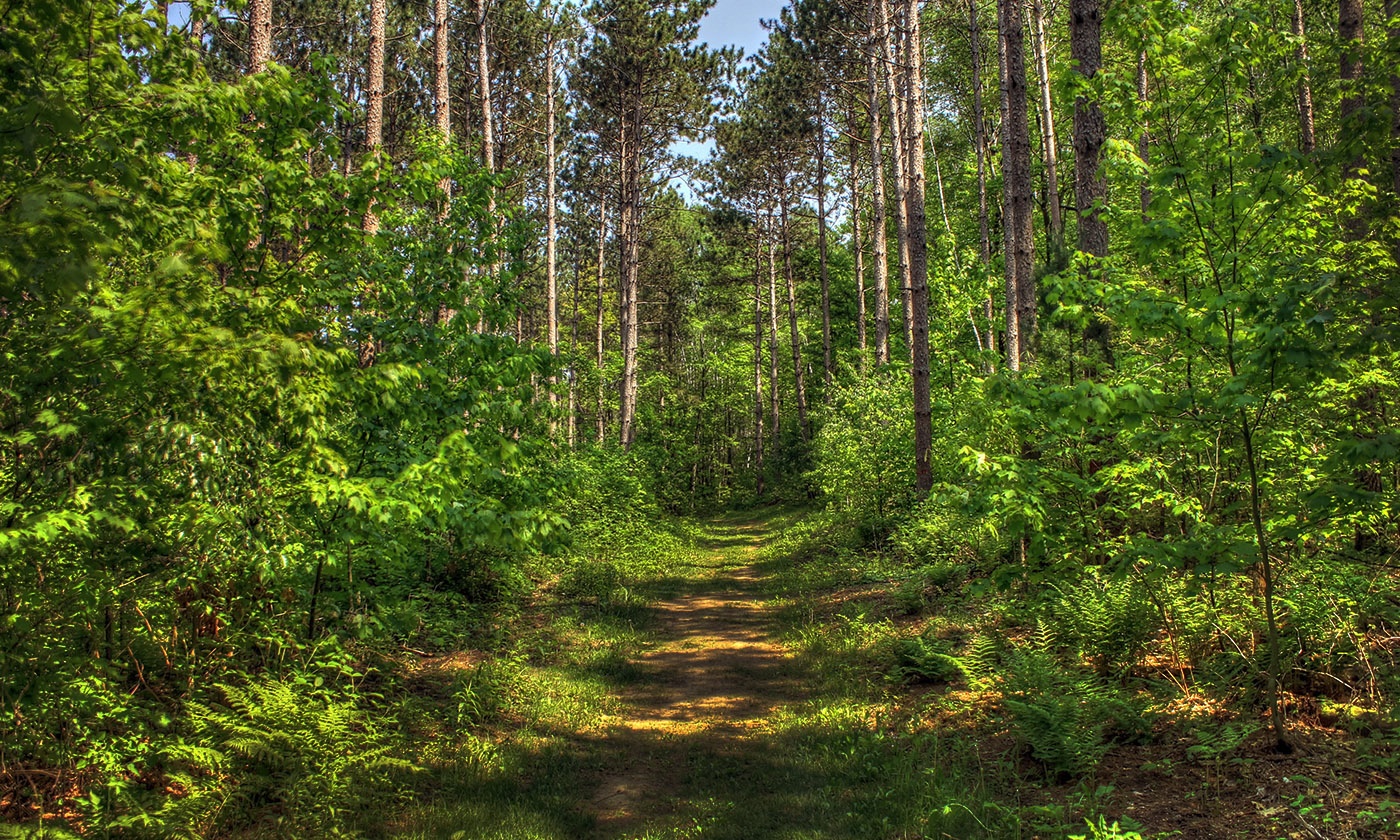
http://www.islandbreath.org/2018Year/09/180911forestbig.jpg
Image above: Photo of a sustainably managed Native American forest. From original article. Click to enlarge.

My focus on Native subject matter started in the late 1990s, when I was deputy editor of Garden Design magazine. As part of an effort to offer readers more environmental coverage, I assigned a writer to report the story of a guitar owned by music star Rosanne Cash.

The Gibson guitar company had made the instrument from sustainably logged wood provided by the Menominee Tribe’s timber-products firm.

Before asking the writer to trace the guitar back to its origins in the Wisconsin forest, I did the due diligence any editor engages in when assigning a story. I visited Cash at her New York City house and talked to representatives of Gibson and the tribal enterprise.

I interviewed forest-products engineers who had visited the forest as part of a Rainforest Alliance program that certified timber as sustainably logged for buyers that wanted such products.

I learned unexpected things, which would set a pattern for my reporting in years to come. In Indian Country, you can expect to be frequently surprised by facts or ideas that lie around the next corner. Officials of Menominee Tribal Enterprises told me that the tribe had logged its 235,000-acre forest intensively for 150 years, extracting 2.5 billion board feet of lumber according to principles laid down by 19th-century chiefs.

The tribe had, in essence, removed the forest three times over during that period. Yet the tract looked untouched, said the engineers who had toured it. They raved about its biodiversity and beauty.

I saw striking satellite photographs, in which the tribe’s forest was a darker green than the surrounding areas. The Menominees had managed this by making harvesting decisions with all the forest’s inhabitants in mind.

If felling a tree in a certain direction would destroy a butterfly habitat or food for ruffled grouse, the forester looked for another option. Essentially, the forest was treated like a garden. As a result, it was in radiant health.

According to one engineer, the timber cut from it was so good, new grades had been created just for the Menominees. To top it all off, the forest-products company supported job creation that easily outstripped that of most small businesses its size.

The tribe had improved its forest by using it aggressively: to me, sitting in an office building in New York City, this sounded like alchemy.

At the time, not interacting with nature was more typically understood as the way to protect it—a concept that has fallen by the wayside to a large degree because of the influence of indigenous people and their ideas. I thought, if Native timber-products companies were so interesting, their gardens must be amazing.

I called Native Seeds/SEARCH, a Tucson seed bank for heirloom indigenous crops, and talked to Angelo Joaquin, a Tohono O’odham tribal member who was then its director. He suggested I talk to Clayton Brascoupé, a Mohawk/Algonquin farmer who lives at Tesuque Pueblo and runs the Traditional Native American Farmers Association, in Santa Fe.

Brascoupé showed me around the remains of ancient Puebloan plots north of the city, then put me in touch with farmers at Cochiti Pueblo, which is south of Santa Fe. I ended up in a field there, face-to-face with corn, beans, squash, and an indigenous culture’s time-honored yet contemporary way of doing and being.

A culture’s concepts are most accurately conveyed in its own language.

My first inchoate thought was that I had no idea how to use the English language to describe what I was seeing. A culture’s concepts are most accurately conveyed in its own language, so even the basics confused me.

To begin with, was I looking at a garden, which implies guardianship by a caretaker who cultivates each plant as an individual, as the Menominees did the trees in their forest? Or was this large prolific plot better called a farm, which connotes large-scale (and nowadays often industrial) production of food?

If there were no exact equivalents, which words came closest? I started to worry about the ancestry of the English synonyms from among which I would choose as I wrote about this place. Anglo-Saxon contributions to our vocabulary have a sense of simplicity and candor that made sense for these unpretentious plots.

The Latin contribution came into English as the language of scholars; using this part of our vocabulary might convey the contemplative aspects of Native life, including the thinking and activities surrounding the growing of food crops.

I was dumbstruck—no other way to describe it. I posed the language question to two older Pueblo gentlemen who were showing me around Cochiti: Gabe Trujillo and Joseph Benado. “Those aren’t the distinctions we make,” Benado said. He went on to describe a vocabulary that tracked the English words in some ways but diverged in others.

Shifting from English to Keres, the language of the southern Pueblos, Benado explained, as the governor of the Pueblos translated, that plant-rearing is akin to child-rearing for his people. The two activities share terms and concepts. Both involve spiritual and practical considerations.

Benado expanded on the linguistic characteristics of Keres by describing the life cycle of corn: “You plant the corn, and the seed has one name. When it sprouts, it has another. As it grows, it has another name. As the ear comes to life, it is called another thing.

When it is ripe, it is called another, and when it’s harvested, another. As it dries, it has another name. When the stalk has dried in the field, it has another; and what’s left goes back into the earth.” Returning to English, Benado added, “I enjoy what I do so much.

When I look at my family’s table, filled with what I have grown, I feel such joy at having provided for them. Farming makes you a better person, because you are always looking forward to next year.”

When Benado made that first language shift, from English to Keres, the timbre of his voice changed. When he spoke in English, it was low-pitched, or what we might call bass. In Keres, he was a baritone, with the words accompanied by a resonant breathiness and overtones, or higher related notes, that proceeded in harmony with the basic pitch.

Had I not been there in person, I would have thought two different people had spoken in turn. Embedded in each language was an identity so powerful that it transformed the speaker physiologically and further emphasized the cultural divide.

Over the years, I have become used to writing across the divide and describing, however imperfectly, what I saw in one Native community after another. Though I started out writing about agriculture and culture, I quickly realized that you cannot talk about crops without talking about the land, and you cannot talk about the land without talking about why the original people of this country have so little of what they once held.

And you cannot consider that without looking at the human-rights crisis this has wrought in communities whose interaction with the natural world is the basis of every aspect of life, from the most mundane to the most rarified.

Early on, I began receiving weekly and sometimes daily calls—and later emails and texts as well—from all over Indian Country alerting me to events and people I might want to look into and write about. A lot of the leads ended up as articles; some became yearlong, or even multiyear, series. Eventually, they led to this book.

Along the way, I have never lost the feeling that with each reporting assignment I am a visitor to a world whose outlines I can only begin to sense.

• Excerpt from American Apartheid: The Native Struggle for Self-Determination and Inclusion by Stephanie Woodard, with photographs by Joseph Zummo, published with permission of IG Publishing.

.

The Charter of the Forest

SUBHEAD: This 800 year old partner to the Magna Carta is vital for managing our future being challenged by eco-collapse.

By Guy Standing on 6 November 2017 for Open Democracy UK -
(https://www.opendemocracy.net/uk/guy-standing/why-youve-never-heard-of-charter-thats-as-important-as-magna-carta)


Image above: An English forest in summer. From (https://thinkingcountry.com/2016/03/29/from-the-charter-of-the-forest-to-the-charter-for-trees-woods-and-people/).

Eight hundred years ago this month, after the death of a detested king and the defeat of a French invasion in the Battle of Lincoln, one of the foundation stones of the British constitution was laid down.

It was the Charter of the Forest, sealed in St Paul’s on November 6, 1217, alongside a shortened Charter of Liberties from 2 years earlier (which became the Magna Carta).

The Charter of the Forest was the first environmental charter forced on any government. It was the first to assert the rights of the property-less, of the commoners, and of the commons. It also made a modest advance for feminism, as it coincided with recognition of the rights of widows to have access to means of subsistence and to refuse to be remarried.

The Charter has the distinction of having been on the statute books for longer than any other piece of legislation. It was repealed 754 years later, in 1971, by a Tory government.

In 2015, while spending lavishly on celebrating the Magna Carta anniversary, the government was asked in a written question in the House of Lords whether it would be celebrating the Charter this year. A Minister of Justice, Lord Faulks, airily dismissed the idea, stating that it was unimportant, without international significance.

Yet earlier this year the American Bar Association suggested the Charter of the Forest had been a foundation of the American Constitution and that it was more important now than ever before. They were right.

It is scarcely surprising that the political Right want to ignore the Charter. It is about the economic rights of the property-less, limiting private property rights and rolling back the enclosure of land, returning vast expanses to the commons. It was remarkably subversive. Sadly, whereas every school child is taught about the Magna Carta, few hear of the Charter.

Yet for hundreds of years the Charter led the Magna Carta. It had to be read out in every church in England four times a year. It inspired struggles against enclosure and the plunder of the commons by the monarchy, aristocracy and emerging capitalist class, famously influencing the Diggers and Levellers in the 17th century, and protests against enclosure in the 18th and 19th.

At the heart of the Charter, which is hard to understand unless words that have faded from use are interpreted, is the concept of the commons and the need to protect them and to compensate commoners for their loss. It is scarcely surprising that a government that is privatizing and commercializing the remaining commons should wish to ignore it.


In 1066, William the Conqueror not only distributed parts of the commons to his bandits but also turned large tracts of them into ‘royal forests’ – ie, his own hunting grounds. By the time of the Domesday Book in 1086, there were 25 such forests. William’s successors expanded and turned them into revenue-raising zones to help pay for their wars. By 1217, there were 143 royal forests.

The Charter achieved a reversal, and forced the monarchy to recognize the right of free men and women to pursue their livelihoods in forests. The notion of forest was much broader than it is today, and included villages and areas with few trees, such as Dartmoor and Exmoor. The forest was where commoners lived and worked collaboratively.

The Charter has 17 articles, which assert the eternal right of free men and women to work on their own volition in ways that would yield all elements of subsistence on the commons, including such basics as the right to pick fruit, the right to gather wood for buildings and other purposes, the right to dig and use clay for utensils and housing, the right to pasture animals, the right to fish, the right to take peat for fuel, the right to water, and even the right to take honey.

The Charter should be regarded as one of the most radical in our history, since it asserted the right of commoners to obtain raw materials and the means of production, and gave specific meaning to the right to work.

It also set in train the development of local councils and judiciary, notably through the system of Verderers, which paved the way for magistrate courts. In modern parlance, it extended agency freedom, giving commoners voice in managing the commons, as well as system freedom, by opposing enclosure.

The Charter set the foundation for what is now called the communal stewardship of pooled assets and resources. Its ethos is the antithesis of the Government’s pretentious Natural Capital Committee, which is trying to capitalize the natural commons, to make them ‘profitable’. The commons exist for a way of living, not profits.

Over the centuries, the ethos of the Charter has been under constant attack. The Tudors were the most egregious, with Henry VIII confiscating ten million acres and disbursing them to favorites, the descendants of whom still possess hundreds of thousands of acres. The enclosure act of 1845 was another mass landgrab, mocking the pretensions of private property rights. Between 1760 and 1870, over 4,000 acts of Parliament, instituted by a landowning elite, confiscated seven million acres of commons. It is no exaggeration to say that the land ownership structure of Britain today is the result of organised theft.

Despite having endured centuries of abuse, the ethos of the Charter is still alive. But one feature of the neo-liberal economic paradigm that has shaped recent governments is a disregard for the commons, which the current British government has turned into a plunder under cover of the ‘austerity’ terminology. In the USA, the Trump administration has quietly prepared for the giveaway of millions of acres of federal commons.

For neo-liberals, the commons have no price, and therefore no value. So, they can be sold for windfall gains, or given away to their backers. By asserting the right to subsistence on the commons, the Charter recognized an alternative principle, something our ancestors defended with courage. We must do so now. We must resist the plunder of the commons and revive them.

A group is organizing a series of events to do so. Everybody is free to join. Developing national and localized Charters of the Commons should go alongside the worthy Charter of Trees, Woods and People that will be issued on the anniversary day. Our modest efforts will not only emphasize environmental principles enshrined in the Charter, but also its subversive commitment to the right to subsistence that underpins the basic income movement of today.

The campaign began with an event laden with symbolism, a barge trip on the Thames from Windsor to Runnymede on September 17, where a public event highlighting the need for a Charter of the Commons was held under the awesome 2,500 year old Ankerwycke yew.

The Runnymede meadow symbolises the commons. An earlier Tory government tried to privatise it, but an occupy movement organised by Britain’s first woman barrister succeeded in blocking the auction.

The barge trip’s symbolism does not stop there. Margaret Thatcher privatised our water in 1989. She gave nine corporations regional monopolies and gave them over 400,000 acres from the commons. Today, those corporations, mostly foreign owned, are among the country’s largest 50 landowners.

They mock the principles of the Charter of the Forest. Thames Water, while paying its foreign shareholders £1.6 billion, has been convicted and had its hands slapped for pouring 1.4 billion tonnes of untreated sewage into the Thames, and is also doing too little to fix leaks. The Charter asserted that the commoners had the right to water. It should be a public good, and be renationalised as a matter of high priority.

As well as an event in Sherwood Forest emphasizing fracking, there is an event in Durham, where one of the two originals of the Charter is preserved.

And on November 7, a meeting in the House of Commons will discuss a draft Charter of the Commons. In Lincoln, where the other original Charter is held, the Labour Party is organizing an event on November 11.

Further information can be obtained from www.charteroftheforest800.org . If any organization feels their agenda is relevant and that has not been contacted, let us know. We want all voices to be heard, all commoners to stand up and all of us to remember that reviving the commons is about recovering the future.


Image above: Copy of "The Charter of the Forest" from 1225.  From (https://upload.wikimedia.org/wikipedia/commons/8/84/Forest-charter-1225-C13550-78.jpg).

.

Maui conservation effort working

SUBHEAD: Large landscape scale reforestation at Auwahi on Haleakala is proof.

By Jan TenBruggencate on 21 July 2017 for Raising Islands-
(http://raisingislands.blogspot.com/2017/07/landscape-scale-conservation-can-work.html)

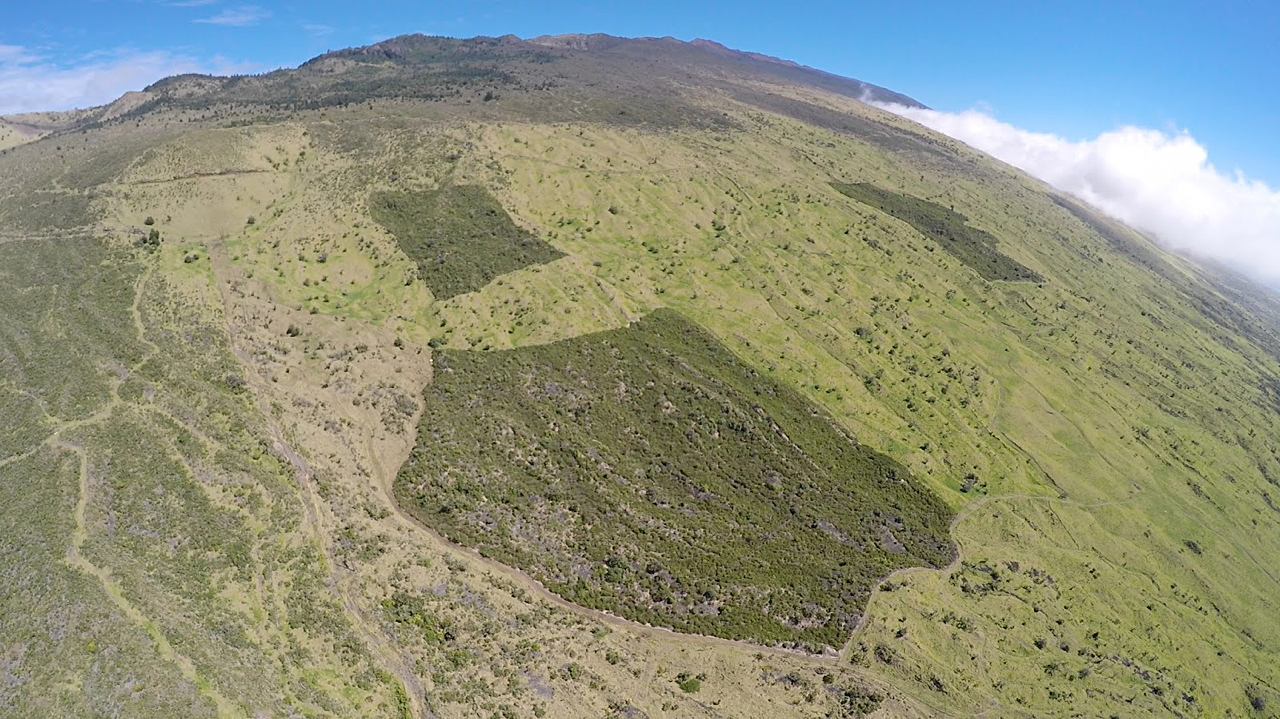
http://www.islandbreath.org/2017Year/08/170803auwahibig.png
Image above: Southern flank of southwest Maui where Auwahi reforestation project is turning Haleakela green. From original article. Click to enlarge.

When Art Medeiros fenced some Maui pasture that had a smattering of native dryland forest plants on it, most folks figured he was engaged in a pipe dream.

He hoped that by excluding deer and cattle, and with a little loving care and some outplanting, something approaching a healthy native dryland forest could result.

Medeiros was right. The image above is the proof. The three dark green patches are areas fenced to keep grazing animals out and then planted with dryland natives. The 10-acre center square was fenced and planted 20 years ago, the bottom 23 acres 12 years ago, and the 23-acre shape at the right eight years ago.

Medeiros worked with the landowners, `Ulupalakua Ranch’s Erdman family, along with the U.S. Fish and Wildlife Service and the Natural Resources Conservation Service, to form the Auwahi Forest Restoration Project. You can learn more about it at this website.

What they found is that landscape-scale conservation efforts work.

It is a remarkable example, but certainly not the only example in Hawaii.
  • When the Territory of Hawai`i removed feral cattle from the Koke`e grasslands on Kaua`i, those rolling acres of pasture were able to convert back to forest that is now Koke`e State Park.

  • When George Munro on Lana`i fenced hundreds of acres at Kanepu`u a century ago to keep out deer and mouflon sheep, he protected a native forest that survives today.

  • When Lida and David Burney took the analysis of ancient pollen samples at Makawehi on Kaua`i  and planted those plants into a nearby former cane field, they restored something long gone from that landscape. 
Medeiros a few decades ago saw a few botanical gems in a severely degraded landscape. When he proposed trying to restore it, he got a lot of pushback. It was a dead forest standing, he was told - Degraded landscapes were inevitably going to further decline.

He didn’t give up.

“The question was whether we could rebuild this system, or was this (an example of) the end of all natural systems?”

At Auwahi, there were priceless old endemic trees, but they were not reproducing and had not reproduced for decades. The native species covered only 3 percent of the landscape.

Why care? Native dryland forest is some of the rarest treasure in the Hawaiian realm. It has been displaced by development, agriculture, pasture and constant pressure from non-native predators on the natural landscape, like cattle, deer, goats, sheep, pigs and rats.

Medeiros and his team fenced out the cattle and deer at Auwahi, starting with the 10-acre square they now call A-1. With the help of teams of community volunteers, teachers, canoe clubs and many others, they began planting out native species—more than 125,000 seedlings to date.
The result: Native species cover in some areas is now 82 percent.

“Near two-thirds of native tree species at Auwahi are now producing seedlings naturally, a sign of a healthy functioning ecosystem, including some species that had not done so in centuries,” Medeiros said.

And on a dry slope of Haleakala, where much of the landscape is brown and yellow, here it is deep green. Not only an indication that the plants are back, but that the landscape is functioning as a watershed.

Medeiros gives special credit to the landowners, Pardee and Sumner Erdman and their family, for their dedication to conservation, and their willingness to convert pasture to native forest—without compensation.

“`Ulupalakua Ranch has...served largely as a silent and enthusiastic partner. In all my years in conservation, I have never seen another for-profit group act in this way,” he said.

Donors to the project over the years included the Frost Family Foundation, Maui County Department of Water Supply, Hawai`i Community Foundation, Hawai`i Tourism Authority, Maui County Office of Economic Development and the Edward J Anderson Foundation.
.

See "The Strangled Sea"

SUBHEAD: The courageous Okinawan struggle against U.S. military destruction of their beautiful island.

By Katherine Muzik PHD on 9 May 2017 in Island Breath -
(http://islandbreath.blogspot.com/2017/05/see-stranged-sea.html)

http://www.islandbreath.org/2017Year/05/170509poster.pdf
Image above: Poster for "The Strangled Sea" event. Click for enlarged PDF file to post around the island.

WHAT:
See film "The Strangled Sea" (in Japanese with English Subtitles)
Presented by Professor Kosuzu Abe, an activist and Social Scientist, Ryukyu University
For the Okinawans it is a matter of "Peace, Beauty and Agony".

WHEN:
Saturday, 20 May 2017 at 7:00 - 9:30pm

WHERE:
Kealia Farm Market
2345 Kealia Road, Kealia, Kauai, HI 96746
Venue phone number: +1 808-635-4100

COST:
Free (but donations appreciated).

ENDORSED: 
by the Kauai Alliance for Peace ans Social Justice

MORE INFO:
For more information call +1 (808) 346-6167

Besides the film their will be a presentation of “Threatened to Death“ honoring the wonders of Okinawa’s Oura Sea and Yambaru Forest by Katherine Muzik, Ph.D., Marine Biologist

There will also ne Q & A to discuss America's increased militarization of Okinawa, Puerto Rico, Korea and Kauai...

.

The Forest Economy

SUBHEAD: The natural environment as a metaphor for how we organize our own human economies.

By Rob Hopkins on 20 June 2016 for Transition Network -
(https://www.transitionnetwork.org/blogs/rob-hopkins/2016-06/forest-economy-woodland-new-economy-metaphor)


Image above: Trees with leaves and moss moderate the movement of water over the landscape. From original article. See more photos in original article.

I spent Sunday afternoon having a beautiful walk in the woods with my son at Venton Brook, near Holne on Dartmoor, one of the most beautiful places on earth. 

As we walked down through this ancient woodland, with its stream, its waterfalls, its trees, moss and lichen, the sun breaking through the canopy, I found myself thinking of this woodland not as an ecosystem, but as a metaphor for the kind of economy we are seeking to create in Transition.

As Bill Mollison wrote in 'Permaculture: a Designers' Manual', "trees are, for the earth, the ultimate translators and moderators of incoming energy".  You can think of a forest as the most incredibly sophisticated water management system.  Indeed, as you walk through a forest, all but 5-10% of what you're looking at is water.

When it rains over a wood like Venton Brook, the canopy intercepts it first.  The leaves break the heavier droplets into a finer mist.  Some of the water is held by the surface of the leaves, which are themselves small reservoirs of water, sometimes referred to as a "lake in the sky".

This interrupting of the power of the rain reduces the damage that heavy rain would otherwise do to bare soil.

The water that continues groundwards is no longer just water.  It has picked up all manner of dust and other nutrients which it transfers to the soil.  From the top of the trees to the bottom of their roots, woodlands have evolved many sophisticated ways of capturing water.

These include: Mosses on trees that act as sponges, able to hold a lot of water all the way up the trees, and crevasses on the trees, fissures in the bark and other plants growing on trees who also capture water:


Image above: Rockface covered in moss, lichen and ferns hold water. From original article.

Mosses and lichens on the rocks, such as those on the rockface near a waterfall which were holding a huge amount of water.  This rockface held so much more water than bare rock would.

Dead wood, rather than being removed to keep the wood 'tidy', acts as an incubator for new life and, increasingly as it decomposes, as a sponge.  Great thick mats of moss and decomposing wood are scattered across the ground, acting as a nursery to all manner of plants:

The leaf litter and deep rich soil that has formed beneath is also a key store of water.  Soils with high organic matter are able to capture and hold high levels of water (1 cm of water for every 3cm of depth).

That top 60cm of soil contains 85% of the roots and 94% of the soil water.  That fine mat of tree roots is then able to take what is now the perfect 'tree tea' and feed it back into the tree and back up to the leaves, as well as to slow its percolation into the soil.  As Mollison puts it, "the forests represent great lakes of actively managed and actively recycled water".

And then of course there are the mycorrhizal fungi, those vast networks which store water while acting as the forest's brain, distributing resources and managing its response to disturbance.

Forests such as this have evolved as incredibly sophisticated, self-organising systems for holding and storing water and nutrients.  It's why they are such a vital strategy in preventing the kind of flooding seen in the UK and elsewhere in recent years.  Rather than surges of water, they act as a vast sponge, moderating the throughflow of water.

Even the brook itself seemed to have decided to get as much out of the water passing through it as possible: wide shallow sections full of water weeds, and piles of branches washed down in storms which collect at bottlenecks and which then, over time, become home to a range of plants.


Image above: Stream with decaying branch and ferns. From original article.

As we walked through the woods, I was thinking about what a perfect metaphor this place was for the kind of economy we strive to create in Transition initiatives.  An economy based on maximising the Multiplier Effect.  In this kind of economy, we become more skilful at capturing money that would otherwise just pass through our economy.

Then, once it is there, we strive get it to circulate as many times as possible, to pass from hand to hand to hand, incubating a great diversity of enterprises and businesses.

The alternative, the globalised neo-liberal economy, is the mirror opposite of our forest economy.

Rather than trying to maximise the number of places money can pass through or be stored, distributing it as much as possible, it aims to centralise, to concentrate that water into a handful of places.

The equivalent that I could think of would be to put plastic guttering around all our trees, dig channels to concentrate the water, so that as soon as a raindrop landed it was being channelled towards one of several large reservoirs. Not quite the same experience at all.

Nowhere in that wood could I see any one single species sucking up all that water to the detriment of others.  Everything in the ecosystem acted as a good neighbour, stronger due to the diversity of what's around it.  Nothing was wasted.  It's a resilient system.  In the event of a drought, a lack of input of water, it would survive so much longer than a monocultural field of crops or our more 'tidy' gardens.

If we can protect local economies from the predations of large extractive corporations, keep the metaphorical plastic guttering at bay, they will naturally move towards the kind of self-organising, diverse resilient systems that our woodland was modelling.  It's a system designed to maximise the wellbeing of its community, through an approach based not on austerity but on being regenerative.

It's an economy that isn't about locking resources up, but allowing them to flow at different speeds, to allow some throughput, but to strive to ensure the maximum amount of circulation as possible.  It's the thinking that underpins local currencies, although it can happen without them.

Mollison once also famously described tidiness as "maintained disorder".  Extracting money from local economies requires highly efficient systems that have none of the disorder of natural systems.

Think of the difference between supermarket aisles and a marketplace with its diversity of eclectic stalls.  Or the clone produce of the supermarket veg section, bereft of wonky carrots and nobbly potatoes as opposed to what appears in your CSA vegetable box.

As you walk through the woodland, what initially appears to be a messy riot of untidy chaos is in fact a highly sophisticated, vibrant, thriving ecosystem.  It works.  As do resilient local economies.  And they're beautiful.  As Mollison once said, "if we lose the Universities we lose nothing: if we lose the forests we lose everything".  Amen to that.

.

War over Olympic National Forest

SUBHEAD: Did the US Navy break federal laws to push war games over our Olympic National Forest?

By Dahr Jamail on 26 October 2015 for Truth Out -
(http://www.truth-out.org/news/item/33387-us-navy-allegedly-broke-federal-laws-to-push-forward-electromagnetic-war-training-over-national-forests)


Image above: Shoreline of Olympic National Forest. From (http://www.stateparks.com/olympic_national_forest_in_washington.html).

The US Navy aims to begin conducting electromagnetic warfare training across much of Washington State's Olympic Peninsula soon.

Meanwhile, it is being accused of breaking federal laws in order to secure the permits necessary to move forward with its training operations.

Karen Sullivan worked for the US Fish and Wildlife Service for 15 and a half years, and is an expert in the bureaucratic procedures the Navy is supposed to be following.

She is now part of the West Coast Action Alliance, one of two large multistate and international citizen groups who have tasked themselves with watchdogging the Navy, due to what they believe are ongoing violations of the law, blatant acts of disrespect toward human and environmental health, and ongoing bellicose behavior by the military branch in their areas.

"Ethical and legal questions about the Navy's conduct abound: hidden notices, comment periods that have been shortened or wholly eliminated, and last-minute publication of key documents coupled with total disregard for NEPA's [National Environmental Policy Act] prohibitions on segmentation present a clear and present danger that the Navy is hastily proceeding with plans regardless and in defiance of federally mandated processes," Sullivan's organization wrote recently in a memorandum to the Navy.

Some of the points of concern about the Navy's actions include: failure to provide reasonable notice to the public about their planned war games, failure to provide adequate comment process, failure to address functionally connected activities and their cumulative impacts, and failure to adequately consider impacts to Olympic National Park's World Heritage designation, among others.

Sullivan, who worked for over 15 years in the US Fish and Wildlife Service's Division of Endangered Species and External Affairs, told Truthout she believes the Navy's final environmental impact statement (EIS) about their upcoming warfare training is "unlawful and fatally flawed."

"The Navy has an astonishing sense of entitlement to public lands and waters," Sullivan said about how the Navy has approached the public's concerns over its operations. "Northwest Training and testing range manager Kent Mathes told me last year after a public meeting, 'We own the airspace and there's nothing anyone can do about it.'"

As Truthout previously reported, if it gets its way, the Navy would be flying Growler jets - electronic attack aircraft that specialize in radar jamming - in 2,900 training exercises over wilderness, communities and cities across the Olympic Peninsula for 260 days per year, with exercises lasting up to 16 hours per day. Naval surface fleet ships will also be participating by homing in on ground-based emitters - a topic that was never discussed in the Navy's environmental assessment.

Dozens of naval EA-18G Growler supersonic jet warplanes will fly as low as 1,200 feet above the ground in some areas in order to conduct war games with 14 mobile towers on the ground in national forests.

Medical doctors, scientific reports and even the Navy's own documents show that enough electromagnetic radiation will be emitted to be capable of damaging human eye tissue, causing breast cancer, causing childhood leukemia and damaging human fetuses, let alone impacting wildlife in the area. The Navy has denied that these impacts will occur.

Medical doctors also told Truthout that noise from the Navy's jets is a major health risk.

Nevertheless, the Navy appears to be rapidly moving forward with its plans to war game over the Olympic Peninsula. In doing so, Sullivan believes it is opening itself up to major lawsuits - because it is taking blatantly illegal actions.

Fatal Flaws
John Mosher, the Navy's northwest environmental manager for the US Pacific Fleet, has stated that its planes will be flying as low as 1,200 feet above the ground.

Yet the Navy's environmental impact assessment does not even mention jet noise pollution or the sound of the Navy's jets, and states that there are "no significant impacts" on public health and safety, biological resources, noise, air quality or visual resources.

Tens of thousands of outraged residents from around the Olympic Peninsula have expressed their opposition via letters to the US Forest Service, public meetings, letters to the editor in newspapers across the peninsula, flooding article comment sections and via social media.

"Olympic Forest Coalition is extremely concerned with all aspects of the Navy's proposal, but of primary concern is for the disruption to wildlife activities in both the national park, the forest and our coast.

Endangered species such as the marbled murrelet are at a 5 percent population decline due to loss of habitat and other disruptions," Connie Gallant, president of the Olympic Forest Coalition, which co-authored the recent memorandum to the Navy, told Truthout. "The Olympic Coast Marine Sanctuary area is also in peril due to the many 'takes' the Navy plans. It is as if our entire ecosystem has been targeted for destruction and, so far, the Navy is showing very little concern for it."

But apparently the Navy is not having any of it: It has simply ignored or neglected to address residents' outcries about its actions.

The October 13 memorandum sent to the Navy by the West Coast Action Alliance states, "Reasonable concerns and objections presented by the public and allied organizations continue to be utterly disregarded, and this controversy intensifies by the day."

Even some politicians have become concerned about the Navy's negligence; in fact, Rep. Derek Kilmer (D-Washington State) requested that the Navy undertake a sound study under the auspices of the Federal Interagency Committee on Aviation Noise (FICAN).

But according to Sullivan's group, "The Navy failed to do so. Instead it reconstituted an older study using data from Prowler jets, which are no longer being flown, to justify no significant impacts on the soundscapes of Olympic National Park."

Sullivan explained to Truthout that the Navy's EIS is "fatally flawed" for a number of reasons. One of the requirements of the law is for the Navy to give the public reasonable time to read and comment on their proposed operations, before the review period ends.

"Notices in local papers did not appear until five to seven days into the 30-day 'review' period, and as of October 10 only one individual we knew of had received the copy as requested, with more than one-third of the allotted 30 days already past," Sullivan explained. "Libraries in northern California have still not received their copies as of October 20. The public review period ends November 2, and the documents are more than 4,000 pages long."

This was just one of several examples of how, according to West Coast Action Alliance, the Navy has been in violation of the law.

"The bottom line is the Navy doesn't care how we feel about it and they don't want to hear from us," Sullivan said. "If they did, there'd be a real person manning the jet noise complaint hotline, and there'd be a way to get information from them in a timely manner, and there'd be a way for the public to be heard on the record. Their message to communities on the Olympic Peninsula is: Go away. Your comments don't count."

Sullivan is far from alone in feeling this way. Even naval veterans are troubled by the Navy's current behavior.

"I'm one of them, and always will be," Navy and Vietnam veteran Patrick Noonan told Truthout. "I'm deeply committed to what it is the Navy has to do. Given that, they need to learn to be better neighbors rather than worse neighbors to the surrounds and the cities they fly over."

Noonan, who was also a naval test pilot, added, "They are going in the wrong direction. They are becoming worse neighbors and becoming more belligerent. These people just want the Navy to be more considerate."

Other "fatal flaws" in the Navy's final EIS, Sullivan told Truthout, include "segmenting connected actions into smaller pieces that get evaluated separately. What this means is nobody gets to evaluate the totality of effects, or what agencies would call cumulative impacts."

Another issue she takes with the Navy's EIS is that it fails to consider the impacts to the soundscape of Olympic National Park, which is a World Heritage site.

"They did not conduct a 'neutral' study on the effects of jet noise after being specifically requested to do so last May by Congressman Derek Kilmer," Sullivan said. "The Navy ignored Congressman Kilmer's request and reconstituted an old study using data from aircraft that are no longer being flown."

She went on to point out how the Growlers are notably more powerful and far louder than the Prowlers, the aforementioned aircraft the Navy used in the reconstituted study. Her data came from calculations performed by Noonan, the former Navy test pilot.

"The new airplane is dramatically louder than even that monster F4 I used to fly," Noonan said.
As Truthout has previously reported, doctors have shown that the intense jet noise from the Navy's warplanes causes our bodies to go into functions that cause hypertension, increased triglycerides, lack of sleep, anxiety, lack of enough REM and other negative impacts. Several medical studies also show that the higher the decibels and the longer the hours, the higher potential for increased myocardial infarction, hypertension, anxiety and other issues.

Possible Lawsuits
The Navy has left itself open to being sued on many fronts. Sullivan said the Navy failed to provide adequate public notice nor provide libraries the Navy listed with their EIS in hard copy or CD format for the public to read.

"They also violated NEPA by pre-selecting an alternative long before making anything public," Sullivan said. "The Navy applied for an incidental take permit [permit allowing the Navy to kill certain numbers of wildlife] from NOAA [National Oceanic and Atmospheric Administration] last April, long before this EIS was finalized, yet they still have not announced their preferred alternative, so what this means is they have already selected it, applied for the permit and the public's comments don't matter a bit with regard to their final choice. That's illegal."

This leaves the Navy potentially vulnerable to Endangered Species Act and National Historic Preservation Act violations. The types of violations in which the Navy has engaged, according to Sullivan, are not simply routine blunders.

"The release of the EIS before consultation is complete is unprecedented," Sullivan said. "To sign a record of decision before consultations are complete, while not strictly illegal, is unethical. Basically, it would amount to making up one's mind before knowing what the impacts are."

The US Forest Service has to grant the Navy the permit it needs to use national forest roads for driving its mobile emitters for the war games. The Forest Service has said it will issue its decision in November, but many activists involved in the situation believe the Forest Service is poised to rubber-stamp the Navy's permit, despite thousands of formal public comments made in opposition to naval plans.

Consequently, Sullivan said, the Forest Service has also now left itself open to lawsuits.
"This could leave them [Forest Service] vulnerable on many fronts," she said. "For example, they did not conduct their own scientific investigations to validate the Navy's claims of no significant impacts."

She believes there are "egregious" factual errors in the Navy's environmental assessment, yet the Forest Service has nonetheless indicated it may adopt it wholesale anyhow.

"This violates the National Forest Management Act, among other laws, which basically prohibits them from accepting scientific conclusions from other agencies without verifying them," Sullivan explained. "The fact that they received 4,000 comments from the public, all but 31 opposed, and that they are prepared to ignore that as well as the laws they've violated, makes them vulnerable."

Resistance
Gene Marx is a former Navy pilot who flew as an airborne electronic warfare officer in Vietnam. Nowadays, he lives in Bellingham, and is publicly critical of the Navy's plans for the Olympic Peninsula.

"They will be flying over the Olympic Peninsula without restriction to altitude or speed; this will without a doubt have major negative consequences on the environment," Marx told Truthout. "The Navy isn't telling you a thing about what the overflights will be doing to the environment - so if we look at the noise impact, that alone will have a major impact on the peninsula."

Marx called the Growler aircraft the Navy is using "a killing machine and a jamming machine," and does not believe the Navy is doing anything in the best interests of the environment. "They are being disingenuous telling us they will be stewards of the environment and that they will not impact the peninsula with their training," he added. "That is just crazy."
Sullivan agrees.

"We have the right and the duty to oversee the actions of federal agencies, including the military, and to insist that they follow the law and their own policies," she said. "We have the right to be heard on the official record, a right that is currently being denied. It is not unpatriotic to insist on these rights, and to demand that our government follow the law and its own policies."

And similar to Marx, she is extremely disappointed by the Navy's actions, on a personal level.
"Not that many years ago I used to feel a sense of pride whenever a Navy ship would pass by," she said. "Being a mariner, I used to dip the ensign, or lower my boat's American flag, to them in salute, and they always returned the salute. I used to be proud when they'd pass by."

But her experience today has changed her sentiment.

"Now it feels like they have nothing but contempt for their neighbors," she said. "The public is being left out of too many major decisions by our government, and that's wrong."

Noonan believes one immediate solution would be for the Navy to use already existing training ranges, instead of "going to pristine lands and imposing their noise on them."

"They have the Yakima range, which gets very little air use," he explained. "That range is vast and totally available to them, and it's eight minutes [flying] from Whidbey. I'm frustrated by the Navy's method and how inconsiderate they are being of the environment when they don't have to be. I don't understand that."

Sullivan is acutely aware of how the deck is stacked against the public when it come to standing up against any arm of the US military.

"The Navy has teams of lawyers, and we citizens have only our powers of observation and freedom of speech," she said. "However, we have the right and the obligation to speak out as informed citizens, across the country, wherever unwarranted encroachment into public and private land is happening, and it's happening in a lot of places."

In other words, she intends to fight.

"We are not giving up," Sullivan said. "We will make them follow the law."

.

Decline of vast Boreal Forests

SUBHEAD: The huge forest that circle the Earth's northern hemisphere is breaking apart and diminishing .

By Jim Robbins on 12 October 2015 for Yale 360 -
(http://e360.yale.edu/feature/the_rapid_and_startling_decline_of_worlds_vast_boreal_forests/2919/)


Image above: Global perspective on extent of Earth's boreal forests. From (https://climatechange911.wordpress.com/2015/05/25/thunderclap-standforforests-support-here/).

Scientists are becoming increasingly concerned about the fate of the huge boreal forest that spans from Scandinavia to northern Canada. Unprecedented warming in the region is jeopardizing the future of a critical ecosystem that makes up nearly a third of the earth’s forest cover.

The boreal forest wraps around the globe at the top of the Northern Hemisphere in North America and Eurasia. Also known as taiga or snow forest, this landscape is characterized by its long, cold and snowy winters.

In North America it extends from the Arctic Circle of northern Canada and Alaska down into the very northern tip of the United States in Idaho, Washington, Montana, and Minnesota. It's the planet's single largest biome and makes up 30 percent of the globe's forest cover.

Moose are the largest ungulate in the boreal, adapted with their long legs to wade in its abundant marshes, lakes and rivers eating willows, aspen and other plants. In the southern boreal forest of northern Minnesota, moose were once plentiful, but their population has plummeted.

Thirty years ago, in the northwest part of the state, there were some 4,000; they now number about a hundred. In the northeast part, they have dropped from almost 9,000 to 4,300. They’ve fallen so far, so fast that some groups want them listed as endangered in the Midwest.Moose carcasses deteriorate rapidly before they are found, and so forensics has not been able to determine why they are dying.

Some experts surmise it could be that tens of thousands of ticks that mob an animal and weaken it.

Others think it's a parasite called liver flukes, or the fact that winters have gotten so warm the animals can't regulate their body temperature and die from heat stress.

But Dennis Murray, a professor of ecology at Trent University in Peterborough, Ontario, thinks the dying moose of Minnesota and New Hampshire and elsewhere are one symptom of something far bigger – a giant forest ecosystem that is rapidly shrinking, dying, and otherwise changing. "The boreal forest is breaking apart," he says. "The question is what will replace it?"

Many scientists, in fact, are deeply concerned about the state of the world’s largest forest. The Arctic and the boreal region are warming twice as fast as other parts of the world. Permafrost is thawing and even burning, fires are burning unprecedented acres of forest, and insect outbreaks have gobbled up increasing numbers of trees.

Climate zones are moving north ten times faster than forests can migrate. And this comes on top of increased industrial development of the boreal, from logging to oil and gas. The same phenomena are seen in Russia, Scandanavia, and Finland.

These disturbing signals of a forest in steep decline are why NASA just launched a large-scale research project called ABoVE — Arctic Boreal Vulnerability Experiment, a “major field campaign” with 21 field project sover the next decade. But the studies will confirm in detail what many know is well underway.

“Boreal forests have a potential to hit a tipping point this century,” said Anatoly Shvidenko, of the International Institute for Applied Systems Analysis and a co-author of a survey of a recent research on boreal forests in the journal Science. “It is urgent we place more focus on climate mitigation and adaptation with respect to these forests.”

A tipping point would include the mother of all concerns: the unbridled melting of permafrost, one of the main thrusts of the ABoVE project. The permafrost in the boreal is more susceptible to thawing than in the Arctic because it’s closer to the freezing point.

If large-scale melting occurs it would release more carbon dioxide and methane, which have been bound up in the frozen soil for thousands of years, and bring on more warming, and then more thawing, a dangerous loop. “Scientists call it a positive feedback, but most people call that a vicious cycle,” said Peter Griffith, chief support scientist for the ABoVE project.

Murray has been researching the boreal forest for 25 years, and he and his colleagues have seen many changes firsthand. In British Columbia, 80 percent of the province's mature lodgepole, another boreal species, have recently died from the mountain pine beetle, whose range and season both expanded greatly because of a warmer world.

White and black spruce, the main trees species in the boreal, are also dying in vast numbers “The southwest Yukon looks dramatically different than it did 25 years ago when I did my master’s [degree],” he said. “Everywhere you go there is deadfall.

NASA has also seen a lot of forest browning in its studies, large swaths of forests with reduced growth that turn brown in the hotter than normal summers, and which contribute to much bigger and hotter fires and the thawing of the permafrost.

“Severe fires burn a foot or more of organic soil and that's the insulating layer that keeps the permafrost frozen,” said Scott Goetz, lead scientist on the ABoVE project. “Once that is removed the thaw is much more rapid.”

The fires also change the vegetation. “When you remove that organic soil you get deciduous re-growth that lasts for decades,” said Goetz. “Maybe it will never come back as coniferous.”

Typically, when black spruce dies, it is replaced with new black spruce. “That’s been going on for a long, long time, [but] not anymore,” Murray says. “You lose spruce and you lose everything that lives in spruce and that is basically everything in the boreal forest.

We’re seeing the same phenomena that we’ve seen with moose with lynx and snowshoe hares. And caribou are going belly up very, very fast. Their ranges are receding northward rapidly.”

The boreal is also home to some 5 billion birds. Many species have shifted their ranges north. “Climate change is having an impact much more quickly than we thought,” said Jeff Wells, a senior scientist with the International Boreal Campaign who focuses on birds. “Shifts that researchers thought

But the changes in such a large system are complex. The forest isn’t merely receding north, it’s dying in some places in its interior and surviving quite well in others. A 2015 study found that while boreal spruce forest in interior Alaska is dying out because of warm temperatures, the same forest on the state’s west coast is thriving.

The dying spruce and moose and lynx and other changes are the dots that scientists are trying to connect to get a sense of what the boreal forest in North America will look like in the next half century.

The caveat is that in a system this massive and complex there are so many variables it's difficult to forecast with much certainty. The projected changes, for example, are based on the Intergovernmental Panel on Climate Change's temperature forecast of a rise of some 10 degrees by 2100.

Should things warm faster or go higher, the changes could come faster and be deeper or different than modeled. And many changes could simply be unpredictable.

Murray’s modeling shows that a large gap is opening in the boreal in Ontario and Quebec, a gap some 500 by 350 kilometers. It will essentially split the contiguous forest into two separate forests — one to the east, the other to the west — as the black spruce and white spruce disappear.

That gap could then become grassland or Carolinian, the forest ecosystem that dominates south of the boreal in Ontario, characterized by oak, maple, black walnut and other deciduous species.

As the spruce goes, so goes its inhabitants. "We're predicting there’s going to be no lynx, moose, or hare in central Ontario in the years to come,” Murray says, “so we’re going to have disjunct populations on either side." It could cause a break between populations of species and a loss of genetic diversity.

Murray has coined a term for the patchy quality of the effects of warming on the boreal – climate fragmentation. “Because it’s a gradual transition, it won’t be real boreal and it won’t be real deciduous,” says Murray. “Ecosystems will likely be less stable and more open to invasives.”

Changes in snow cover are already driving changes. In some places snow covers the ground for shorter periods, and the conditions of the snow are also changing. Instead of three feet of fluffy snow all winter, temperatures rise and melt the snow and then get cold and freeze it and compact it into ice, again and again.

 In such conditions, lynx, which have thick, padded paws that serve as de facto snowshoes and allow them to hunt atop deep snow, loses it evolutionary advantage. “It affects their ability to survive,” says Murray. “Coyotes, on the other hand, are extremely plastic and flexible. They weren't in the boreal a hundred years ago, but they are there now. They aren't everywhere, because they don’t do well in deep snow, but that's changing.” They are competing with lynx by foraging for their kills and preying on hares and squirrels.

The die-off of much of the boreal forest could have serious and unpredictable repercussions on the global climate system. When British Columbia’s lodgepole forests died, the province went from being a carbon sink to a carbon source because the dead forests released massive amounts of stored CO2.

If the spruce forests of the boreal disappear they could also alter climate systems by releasing CO2.

Because they are dark, they also absorb heat, but a treeless, snow-covered landscape would reflect far more solar energy back into the atmosphere.

Knowing what could happen in the next 50 or 60 years, and where, is important for conservation and other strategies. The boreal, especially in Canada, isn’t just a forest. It’s woven into the fabric of the region’s life and culture.

Hundreds of First Nations call the boreal home, and they depend on it for sustenance, hunting moose and caribou, picking berries, and fishing. Paper and lumber industries also depend on a healthy boreal.

The research NASA is doing will be used to help determine how communities and land managers in the boreal might adapt to changes. Dall sheep in the Yukon, for example, are in decline and a subject of one of NASA's studies.

The results will be given to provincial and federal officials in Canada to make decisions on issues ranging from hunting to access to land management.

Meanwhile, in the hope of slowing the thawing of boreal permafrost, the International Boreal Conservation Campaign has launched a “cold carbon storage campaign.” This initiative is aimed at managing the boreal in ways that keep as much as possible frozen — no road building atop it, for example, or the creation of new large scale carbon reserves.

But such measures can only do so much. The real decisions on the fate of the boreal are up to the world community. It’s not a good sign that when I contacted Canadian Forest Service scientist Sylvie Gauthier, the lead author of the Science paper that surveyed threats to the boreal, I was told by a public affairs officer that the interview would be on “deep background only” with no attribution to her or her employer.

The federal government of Canada, facing some the world’s most serious climate change threats, has gone to great lengths to squelch any discussion of this issue.

Yet even as they redouble their research efforts, scientists know the ultimate answer is not about adaptation or more research, but a rapid reduction in global CO2 emissions, which so far has shown little hope of being achieved.

NASA’s Griffith says the situation reminds him of his father, a small-town doctor. “Even when the patient ignored his advice over and over again, he would continue to treat the patient,” he said. “A lot of us in the climate and ecosystem world are finding ourselves dealing with a similar kind of problem.” 

.

Pine Air Fresheners

SUBHEAD: Research indicates that the smell of forest pine can limit climate change.

By Matt McGrath on 26 February 2014 for the BBC News-
(http://www.bbc.com/news/science-environment-26340038)


Image above: Path through a scented pine forest. From (http://freehdw.com/wallpaper/pine-forest-path-86629.html).

New research suggests a strong link between the powerful smell of pine trees and climate change.

Scientists say they've found a mechanism by which these scented vapours turn into aerosols above boreal forests.

These particles promote cooling by reflecting sunlight back into space and helping clouds to form.
The research, published in the journal Nature, fills in a major gap in our understanding, researchers say.

One of the biggest holes in scientific knowledge about climate change relates to the scale of the impact of atmospheric aerosols on temperatures.

Perfumed Air

These particles form clouds that block sunlight as well as reflecting rays back into space.
They can be formed in a number of ways, including volcanic activity and by humans, through the burning of coal and oil.

According to the Intergovernmental Panel on Climate Change (IPCC), they "continue to contribute the largest uncertainty to estimates and interpretations of the Earth's changing energy budget."

One of the most significant but least understood sources of aerosols are the sweet-smelling vapours found in pine forests in North America, northern Europe and Russia.

These aerosols have confounded climate models as scientists haven't been able to accurately predict how many of the particles form.

Now an international team of researchers say they have solved the chemical mystery by which the rich odours become reflective, cooling particles.

They've long understood that the smell of pine, made up of volatile organic compounds, reacts with oxygen in the forest canopy to form these aerosols.

The scientists now found that, in fact, there is an extra step in the process, what they term a "missing link".

They've discovered ultra-low volatility organic vapours in the air that irreversibly condense onto any surface or particle that they meet.

"These vapours are so crazy in structure from what we had known before," said one of the authors, Dr Joel Thornton, from the University of Washington.

"It turns out that this level of craziness is what gives them the special properties to stick to those smallest particles and help grow them up in size to become aerosols."

The scientists say that having a clear understanding of the way in which forest smells become aerosols will improve the accuracy with which they can predict the ability of these particles to limit rising temperatures.

"It's certainly crucial for explaining the response of the boreal forest to a changing climate," said Dr Thornton.

"It's thought that the vapours being emitted from the vegetation in the pine forests are contributing roughly half of the aerosols over the forest," he said.

"We've found the reasons how the vapours get converted into particles, so we are basically explaining around 50% of the aerosol particles."

Cooling Effect

The authors believe that this is playing a significant role in reducing the impact of rising temperatures. They argue that this effect is likely to strengthen in the future.

"In a warmer world, photosynthesis will become faster with rising CO2, which will lead to more vegetation and more emissions of these vapours," said lead author, Dr Mikael Ehn, now based at the University of Helsinki.

"This should produce more cloud droplets and this should then have a cooling impact, it should be a damping effect."

The researchers sampled the air in the forests of Finland and carried out experiments at an air chamber at the Julich Research Centre in Germany.

They believe that the discovery was down to a combination of technique and technology.

"One very important thing is that before now, people haven't had the instrumentation to detect these ultra-low volatile compounds," said Dr Ehn.

"When you pull them through a metal tube into your instrument they come into contact with the tube walls and they are lost, you won't detect them."

"We have an instrument that is as wall-less as can be, we have a very high flow of air and a very short inlet line so that it is almost sampled right from atmosphere."

The scientists stress that the new understanding is not a panacea for climate change as forests will stop emitting vapours if they become too stressed from heat or lack of water.

However, Dr Ehn believes the vapours could have a significant impact in the medium term.

"If you go into a pine forest and notice that pine forest smell, that could be the smell that actually limits climate change from reaching such levels that it could become really a problem in the world."
.

The art of farming with trees

SUBHEAD: Agroforestry techniques to create more varied productive, profitable, healthy, and sustainable approaches to land use.

By Dan Kiprop Kibet on 5 November 2013 fr Resilience.org -
(http://www.resilience.org/stories/2013-11-05/agroforestry-the-art-of-farming-with-trees)


Image above: Luceana tree is an excellent nitogen fixer. In Hawaii it is known as Haole Koa (false koa). It is a  pioneering tree on the south shore of Kauai between Poipu and Hanapepe. In the valleys it competes with Opiuma (Manila Tamerind). Further west, to Mana, it mixes with Kiawe (Mesquite). Both are also nitrogen fixers.  From original article.

Kenya is an agricultural country, endowed with an abundance of fertile soils. Farming serves as the most important economic activity for up to 80 per cent of its population. Out of this majority, a large number are small scale farmers, owning plots of less than five acres of land across the country.
Small scale farmers play a key economic role, not only in food production, but by contributing to self employment and boosting the local economies all over the country.

As the UN Special Rapporteur on right to food affirms: “small scale farming is creating employment and contributing to rural development…it is better at preserving ecosystems because farmers combine various plants, trees and animals on the piece of land.”

Like any other pursuit, small scale farming is fraught with challenges that prevent farmers from reaching their full potential. Obstacles range from:
  1. Depletion of soils resulting from overuse of the “shamba”- a Swahili word for land.  
  2. Lack of information on sustainable farming approaches
  3. Pest and disease management and to 
  4. Drought, extreme precipitation and cold weathers.
Despite all these setbacks, efforts to end hunger and keep the land productive, however small, are now geared toward low-cost, sustainable approaches to farming. Agroforesty is now prominent among these solutions, deemed as the next agricultural solution to feed the world; it is defined as a dynamic and ecological method of land management involving the simultaneous cultivation of farm crops and trees.


Image above: Beans growing in Kenya under partial shade of Luceana trees can utilize the nitrogen enriched soil. One advantage of Luceana trees over Opiuma and Mesquite is that it does not have the long nasty thorns of those species.  From original article.   

Agroforestry combines agricultural and forestry techniques to create more varied productive, profitable, healthy, and sustainable approaches to land use. It diversifies and sustains production for increased social, economic, and environmental benefits on plots of land of any size.

Having been practiced by farmers for decades, agroforestry focuses on a wide range of trees that act as fertilizers, soil improvers, fruit providers, fodder, fuel wood, and medicine. Today, trees in farms are seen as a crucial bridge between forestry and agriculture, striking a balance between conservation and production. While Kenya’s forests diminish, more trees are being planted in farms, and small scale farmers are doing this for their own benefit and that of Mother Nature. More so, it is a strategy to compliment the 10% forest cover advocated by the Kenyan government.

Representing Kenya’s agroforestry for this article is John’s small plot; trees form part of his farming endeavors. Through this noble partnership, he has experienced a constant production of food and other tree products in a rejuvenated soil. He says that, if done well, agroforestry offers the best use of land if joined with good agricultural practices, such as organic farming. “It thus increases resiliency towards fighting hunger,” he adds.

John Chepsoi, 45 year old small scale farmer  living in Nakuru, North west of Nairobi has incorporated trees which do not compete with his crops (silvoarable system), but bring in multiple benefits to him, his livestock, crops, soil, and the environment at large. They are Nitrogen Fixing Trees (NFTs).

It began when he planted a few trees on a section of the plot four years back. He observed that the soil in the area with the trees usually looked fertile and alive. The crops were healthier and yielded more compared to the bare land. This led him to introduce more trees on his plot to increase fertility and increase production. He has harvested potatoes and his beans are blossoming. He is expecting a good harvest this season as he says all systems are functioning well under this agroforestry method of farming.

Walking round his farm, trees which are fast maturing and able to fix nitrogen in the soil are planted; he uses these trees as fodder for livestock and also as fire wood. When cut, he says that they are able to coppice again, hence avoiding the urge to invade the forest. Some of these trees include: grevillea, luceana, calliandra, acacia and sesbania sesban. The Kenya Forestry Research Institute (KEFRI) provides useful information to field workers and farmers on different useful trees that can be planted in farmland. (www.kefri.org)

One example of the acacia tree, which has long been combined with traditional farming in Africa, is the Faidherbia albida, also known as “Mgunga” in Swahili. It possesses the unique ability to produce much needed nitrogen for the soil and plants. With its phenology, Faidherbia goes dormant and sheds its nitrogen-rich leaves during the early rainy season, when crops are being planted, and resumes leaf growth in the dry season.

The air we breathe consists of approximately 80% nitrogen gas. This Nitrogen is normally unavailable to plants, but nature has devised a unique way to cycle those nutrients through the trees. This is done through Nitrogen Fixing Trees (NFTs) which are able to utilize the atmospheric nitrogen through an association with a Rhizobium, a bacterium which is hosted in the root system of nitrogen fixing trees. These plants biologically accumulate nitrogen by pulling essential nutrients out of the air for their own use, and if managed well, can make it available to other crops as well. This reduces the need for commercial nitrogen fertilizers.

Through an agroforestry system, John farms without the application of synthetic fertilizers (DAP/CAN) commonly used by many farmers, but lets nature perform this duty through NFTs.  His style of farming has been a productive and conservative one, and he sees these as a long-term strategy and is happy he followed the path of agroforestry.  “The goodness of agroforest trees is that they are there to offer their free services all year round,” he adds.

He is planning to establish an agroforestry nursery in the future where he can raise and sell seedlings to other farmers, in the effort of spreading the benefits of agroforestry in building sustainable future and earning income.

John explains that during the dry season, from December to March, some trees are able to shed their leaves, while others remain green, which he uses to feed his livestock. He further says that producing staple food crops like maize, sorghum and millet under these agroforestry conditions dramatically increases their drought resilience in dry years because of the positive soil moisture and better microclimate.

The fallen leaves, weeds and crop residues don’t go to waste. They are heaped to naturally decompose and later used to fertilize the farm. John is keen not to throw away any of this, as he calls it a treasure. After they are heaped, they usually attract many beneficial micro organisms, which feed on them. As we turn a heap together, there were hundreds of earthworms at work. Earthworms are described as “ecosystem engineers.” Charles Darwin referred them as “Earth ploughs.”

They contribute to enriching and improving soil for plants, animals and even humans. Earthworms create tunnels in the soil by burrowing, which aerates the soil to allow air, water and nutrients to reach deep within the soil.

Earthworms eat the soil which has organic matter. After the organic matter is digested, the earthworms release waste from their bodies, called castings, which contain many nutrients for the crops. As an important addition to their other roles, trees not only act as natural fertilizers, but as niche for these hardworking earthworms and microbial life.


Through constant pruning and cutting firewood, he is able to increase the organic matter (leaves) in the soil, which act as mulch, keeping it moist and well aerated, and increases the activity and population of microbial life in the soil. The leaves also act as humus, a very important feature in building soil fertility.


John also acknowledges that trees are able to suppress weeds, reducing the time and energy needed for weeding, and promoting “easy to work” soil. Other trees, like luecena, attract bees during flowering. While collecting nectar, they help in pollination and repelling harmful insects. Trees here are able to provide a microclimate.

The place is cool, and you could feel the breeze. John says he is able to work without feeling the hot sun, and the same applies to the crops. “These trees protect my crops from both dry season and heavy rains,” John says. And adds that, “it conserves soils and reduces run off in my small plot.”

With growing concerns about how small holder farmers can continue to feed themselves in their small farms without destroying local ecosystems agroforestry is the best thing to happen to sustainable farming. I applaud small scale farmers like John and hope that other small scale farmers will follow suit and plant trees on their farms for a better and more productive future.

See also:
Ea O Ka Aina: Growingfruit in a nuthouse 11/4/13

.

Indigenous people and Google

SUBHEAD: Amazonian indigenous tribe move from the Stone Age to the Digital Age in one Big Leap.

By Juan Forero on 28 March 2013 for NPR News -
(http://www.npr.org/2013/03/28/175580980/from-the-stone-age-to-the-digital-age-in-one-big-leap)


Image above: Villagers in Surui territory in imbedded YouTube video on GoogleEarth Surui territory cultural database. From video below.

In the heart of the Amazon in western Brazil, an Indian tribe called the Surui lived in the Stone Age as recently as the late 1960s. They wore loincloths, hunted monkeys with bows and arrows, and knew little of the increasingly modernized country in which they lived.

These days, the Surui are perhaps the most technology-savvy tribe in the Amazon. Their chief is among the most traveled of Indian leaders, one who has journeyed as far away as Dubai and Indonesia to lobby for international partnerships to save the rainforest in the Surui's reserve.

Chief Almir Surui, 38, has built alliances with American technology companies, environmental groups and lawmakers in the capital, Brasilia, and in cities far beyond Brazil. And the Surui reserve, called Seventh of September for the date in 1969 when the outside world made its first sustained contact with the tribe, has become a hotbed of technology designed to protect the jungle.

The Indians use smartphones to monitor illegal logging and Google Earth Outreach to show the world what their reserve is like.

"Our model calls for saving the forest and fighting for sustainable development," says Chief Almir, as he stands in the middle of the forest surrounded by chirping birds and many species of trees. "It's a challenge because it's very important to do all this. But other countries do not always pursue responsible policies."

On a recent day, Chief Almir and two other Indians, an uncle and nephew, use machetes to hack through the brush at the reserve, which is about the size of Rhode Island and mostly covered by trees.

It's a bewilderingly diverse stretch of jungle — a land rich in animal life, like tapirs and monkeys. There are many different trees and lots of bird life, from woodpeckers to parrots to eagles.

"The forest has much to offer," Chief Almir says, as he stares up into the trees. "Products like nuts. Wood, if the logging is well regulated. And the forest pumps and protects water."

And without that, Chief Almir asks, what would we drink?

Traveling The World

The chief doesn't just pose those kinds of questions to visitors; rather, he travels to tell it to statesmen and Wall Street financiers, tech-company executives and environmental activists.

"I wouldn't have gone to 33 countries to talk about our culture, our health care, our education and the way things are if it wouldn't work," says Chief Almir, who has made 16 forays to the United States.

The Surui's first sustained contact with modern Brazil came a little over 40 years ago with the arrival of road-building crews and settlers, loggers and Brazil's government. The federal Indian affairs agency laid out trinkets, as well as machetes, for the Surui, who wandered out of the forest and, in essence, into a new world.

Indeed, it changed their lives forever, says Jose Itabira Surui, Chief Almir's uncle, who, who like all in the tribe, uses Surui as a last name.

"It was very sad because they almost finished off the Surui people," he says.

The settlers killed Indians, he recalls, and so did a range of diseases, from small pox to tuberculosis. A tribe with 5,000 members bottomed out at 300.

But the tribe still had some elders, and they fostered a younger generation of leaders. The first to go to college was Almir, in the early 1990s.

He returned knowledgeable about technology and also convinced that the Surui had to find partners to save themselves.
Getting Google's Support

Rebecca Moore of Google was among the first to come on board, back in 2007. She describes Chief Almir as "very savvy. I've never seen anyone who could say 'no' to him."

She recalled how Chief Almir told Google executives that his father's way of defending the Surui was obsolete.

"He realized that the time had come, he says, to put down the bow and arrow and pick up the laptop, that that was the future for defending their territory and strengthening their tribe," she says. "How could you say 'no'?"

Beto Borges, a Brazilian-born environmentalist who works at Forest Trends based in Washington, D.C.,, says Chief Almir knows how to get people's attention, whether it's in Rio de Janeiro or New York.

"Walking with the crowds with Almir is like walking with a pop star," says Borges, the company's director of the Communities and Markets Program. "All of a sudden here's an indigenous person from the Amazon. And not only an indigenous person, but he's a chief, wearing this huge headdress with feathers."

But what wins over converts to the Surui cause, says Borges, is Chief Almir's ability to lay out a cogent argument and persuade.

"All of a sudden, they're facing an indigenous person who can speak at the same level that they can, who can talk about strategic vision, for the companies as well as for his people," says Borges. He says it often leaves listeners astonished.

"I think that really shocks people to the point that they fall in love with him," Borges says. " 'Oh, this guy is fantastic, so we want to do something with him.' "

Developing Partnerships
Those partnerships have led to tangible projects with the Surui.

Rhiza, a Pittsburgh company, worked with the Surui to design the interfaces on the smartphones the Surui would use to collect data about the forest for some of their projects.

Other projects include a slick film, made by the Surui with Google's help, which appears on Google Earth Outreach.

The Surui put together a 3-D mapping project that shows off old battle sites, animal breeding areas, burial grounds and hamlets.

Surui rangers film illegal logging with Android phones and then upload it to the Web. And they use global-positioning devices to map territory, Chief Almir says.

"We want to generate information," he says, "show who are the Surui people and what are the difficulties that we face, to educate people around the world about that."

The tribe's main goal now is a carbon-credit program in which developing countries would pay the Surui to keep the forest intact.

This has been a yearslong process that entailed the difficult task of auditing the forest to determine how much carbon its trees contain. By calculating how much carbon is not released if the trees on Surui lands are left standing, the tribe hopes to sell so-called carbon credits internationally to polluters or governments that want to burnish a green image.

The long-range goal is for industries around the world that spew big amounts of carbon to buy credits and thus ensure that forests from Brazil to the Congo to Indonesia are left standing.

If an environmental governance system is created — the great hope of environmentalists and some governments — then polluters would meet environmental standards by paying others, like the Surui, to ensure carbon is not released into the atmosphere.

For now, the Surui hope to collect up to $1 million annually. It's not a big amount, but Chief Almir considers it an important first step.

"I think it's working," he says.

The Surui still face threats and problems of all kinds, from those who sneak onto their territory to illegally cut down trees to Indians within their ranks who are open to being bribed by loggers.
Still, it's hard not to see how the tribe has made great advances. The Surui have maintained their language and customs. The population has risen to 1,200 and Surui hamlets, like the one where Chief Almir lives, bustle with activity.

Girls carve jewelry to sell in the towns outside the reserve, and men enjoy a game of dominoes on a sleepy afternoon. The tribe also has three computer centers where people can surf the Web.

And then there are the bows and arrows. In a field, Chief Almir fires an arrow and hits his target — a banana tree — from 30 feet away.

The chief celebrates with a whoop, noting that a foreign reporter was there to see it.

And then he says he has to get back to work. He's been developing a 50-year master plan for the Surui, which includes harvesting nuts in the forest and cultivating fruits in small groves.

"This is the great economic potential that the forest has," Chief Almir says.


Video above: Getting Google involved. "Trading Bows & Arrows for Laptops". From (http://youtu.be/XFIieYbNl6Y).

See also:
Ea O Ka Aina:Moku & Ahupuaa Maps 1/30/12

.

A Personal Forest

SUBHEAD: Tree planting is our best bet. Franklin Roosevelt’s CCC planted massive shelterbelts to end the Dust Bowl.


By Albert Bates on 20 January 2013 for The Great Change -
(http://peaksurfer.blogspot.co.uk/2013/01/a-personal-forest.html)


Image above: Boy meets Mother Earth at picnic.  From original article.

[IB Editor's note: See the original article for additional charts and diagrams in support of its arguements.]

When I was a young boy my parents moved from the Chicago suburbs to a hardwood forested area of Connecticut, which is where I grew up. My back yard was those woods, and I used to have play forts, many different camping or hiding areas, and a succession of tree houses. I liked to overnight on a mattress of pine needles in a small grove of pines, and sometimes even did that in a foot of fresh, powdered snow. My parents also let me climb trees and play on an old rug covering scrap timber I had placed across the lower boughs of a large post oak. Later I built a round pole tipi in that tree and spent many summer nights living there, learning to climb up and down with ropes.

I guess you could say trees are as family to me. They remain a part of my life wherever I go.

When I was 17 I learned to work horses on the long line, and later, when I arrived at the Farm in Tennessee, fresh out of grad school, I put those skills to use snaking logs from the forest with a team of Belgian mares. I built a tent home for my bride on a platform of hand hewn oak logs acquired that way. People would sometimes come to the Ecovillage Training Center at The Farm and marvel at the small-diameter round poles used for rafters on the very large living roof spanning our Green Dragon tavern, but I knew when I built that roof that round poles were much stronger than milled lumber. They were like the tree limbs that had supported my tree houses.

Deep Well Injection

In my thirties I was a pubic interest attorney fighting against a chemical company in a town 15 miles from The Farm. The company was manufacturing organophosphate pesticides and herbicides and injecting its waste products, including its bad batches, into a deep well. The State Water Quality labs had tested the green luminescent effluent and said it was the most toxic they’d ever encountered. A single drop dripped into their fish tank killed all the fish within 24 hours.

That deep well went nearly a mile down and pressure fractured bedded limestone — it “fracked” it — to make the rock more receptive to millions of gallons of this witches’ brew. The fracturing also opened pathways into the Knox Aquifer, one of the largest underground rivers in North America, and presumedly went on to contaminate other large, potentially important, fresh water reserves for the Southeastern United States over a very large area.

Each test well the company drilled showed that the contamination had already traveled farther away from the site than the company was willing to track. The State did not have the resources to drill million-dollar test wells, so the full extent of the damage may never be known. As well water in the area gradually turned fluorescent green, the company bought out the landowners and sealed their wells.

When our local environmental group sued the company, the company told the judge that there was no reason to protect the aquifer because the Southeast region had plenty of fresh water on or close to the surface. In written briefs, I made two arguments against that: population and climate change. Freshwater resources were valuable, and would only become more so.

This was the early 1980s, and there I was, going into a Tennessee court and trying to make a case for global warming. It forced me to read nearly every study I could get my hands on and to contact experts and beg them to come and testify. I tried to simplify an extremely complex subject so that the average judge or juror could understand it, despite confusing and confounding webs of arcane psuedoscience spun by company lawyers, and exceptions in the federal Resource Conservation and Recovery Act that you could pump a lake through.

As it turned out, the case never went to trial. The Tennessee Department of Health and Environment contacted me and persuaded me I should help them draft regulations banning deepwell injection and hydro-fracking, which I agreed to do. That was a much less costly route for the local environmental group, letting the State bear the expense of experts to fight off the well-funded and unscrupulous industrial lobby. We had won, although it took a few years before the victory was sealed and the chemical companies packed up and left town. Their toxic waste is still down there, for now.

In any nonviolent campaign there are four basic steps: collection of the facts to determine whether injustices exist; negotiation; self purification; and direct action. — M.L. King, Letter from a Birmingham Jail (1963).\
In that time I had spent reading and speaking with experts I had scared myself. Global warming was a much bigger deal than I originally thought. We were up only a half-degree over the prior century at that point, but already there were signs the poles were melting, sea levels were rising, and more frequent droughts were coming to mid-continents.

In 1988, the Mississippi River had gotten so low that barge traffic had to be suspended. My young congressman, Al Gore Jr., opened hearings on Capitol Hill. Scientists began going public to sound the alarm. Big Oil and Coal began funding campaigns to undermine the smear those scientists and to poison the public debate with bogus studies and conspiracy theories. The Bush Administration’s official policy was climate science censorship. All these signs were ominous.

Carbon Sinks

Fossil fuels have had such a profound change on civilization that it is difficult to imagine giving them up voluntarily. They issued in the industrial revolution and globalized the world with railroads and steamships. They ended a particularly odious practice that had been the traditional method of Empire-building for the previous 5000 years, supplanting the long tradition of human slaves with “energy slaves” and “energy-saving” home appliances.

The American Civil War was a last gasp of plantation economics, and it ended with a crushing victory for steely industrialists and their fossil energy, who went on to extend their new empire with the Mexican War, the Spanish American War, and all the resource wars thereafter. Does the end of coal and oil mean a return to human slavery or can we learn to craft an egalitarian society within a solar budget? Time will tell.
On the other side of the ledger, there are a few promising signs that something can be done to reverse the effects of three centuries of oil and coal addiction. The forests of North America remain a net carbon sink, but when land goes from forest to farm, it generates a huge spike in atmospheric carbon. In Mexico, which is losing more than 5000 km2 of forest every year, logging, fires and soil degradation account for 42% of the country’s estimated annual emissions of carbon. In addition to the carbon lost from trees, soils lose 25-31% of their initial carbon (to a depth of 1 m) when plowed, irrigated and cultivated.

In the US, croplands increased from about 2500 km2 in 1700 to 2,360,000 km2 in 1990 (although nearly all of that occurred before 1920). Pastures expanded from 1000 km2 to 2,300,000 km2 over the same period. The fabled era of the cowboy was between 1850 and 1950, and the pattern was repeated in Canada and Mexico. But then something different happened.

Partly because of the Dust Bowl and the organized responses of the Roosevelt Administration, partly because of the Great Depression, and partly because of an emerging conservation ethic, after 1920 many farmlands were abandoned in the northeast, southeast and north central regions and 100,000 km2 were reforested by nature. Between 1938 and 2002 the US gained 123 million acres of forest from farm abandonment while losing 150 million acres to logging, primarily in the Southeast and Pacific Northwest. This trend, net marginal loss, continues today in the US and Canada, in contrast to Mexico which is rapidly destroying its forests, and not re-growing them anywhere.

TABLE: Carbon budget for Harvard Forest from forest inventory and eddy-covariance flux measurements, 1993-2001. Positive values are sink, negative values are source. From Barford, C.C., et al., Factors controlling long- and short-term sequestration of atmospheric CO2 in a mid-latitude forest. Science, 294:5547;1688-1691 (2001).

TABLE: Comparison of net ecosystem exchange (NEE) for different types and ages of temperate forests. Negative NEE means the forest is a sink for atmospheric CO2. Eighty-one site years of data are from multiple published papers from each of the AmeriFlux network sites, and a network synthesis paper (Law et al., 2002). NEE was averaged by site, then the mean was determined by forest type and age class. SD is standard deviation among sites in the forest type and age class. From The First State of the Carbon Cycle Report (SOCCR): The North American Carbon Budget and Implications for the Global Carbon Cycle. A Report by the U.S. Climate Change Science Program and the Subcommittee on Global Change Research. A. W. King, L. Dilling, et al, eds. (2007), Appendix D, p 174.\

The net sink effect of a recovering forest is variable but the average for Eastern deciduous successional forest is 200 grams C per m2 per year, or two metric tons per hectare. This is calculated by considering annual growth and mortality above and below ground, the chemical changes in dead wood, and net changes in soil carbon. (Pacla S., et al., Eddy-covariance measurements now confirm estimates of carbon sinks from forest inventories, in King & Dilling, ibid, 2007).

Sometime around 1985 I began planting trees to offset my personal carbon footprint. Today that forest is about 30 acres (12 ha) and annually plants itself. I wrote a book, Climate in Crisis, pulling together my legal research and laying the climate science out in lay terms that non-scientists, such as myself, could grasp. In 1995, I retired from law to become a permaculture teacher and ecovillage designer. I continued to attend scientific meetings and international negotiations on climate, and I contributed a blog, many magazine articles and books to the discussion. I kept myself current with the latest findings, always exploring pathways that might provide solutions, not just for my personal footprint, but also to the coming climate catastrophe for us all.

Atmospheric Scrub Brushes

We could spend print here discussing geoengineering, replacements for fossil energy, biochar, and shifting to some form of ecological agriculture, but the truth of the matter is, nothing can heal our global chemical imbalance faster than trees.

As I wrote in Climate in Crisis, and later in other books, forests are scrub brushes. They absorb CO2 from the air, transform it to O2 with the magic of photosynthesis, and sequester the C in lignin and cellulose. They also transfer it deep into the ground through their roots and the soil food web.

We, the humans, might be able, under optimal conditions, to get up to sequestering as much as 1 gigaton of carbon (petagram C or PgC) annually by switching to “carbon farming:” holistic management; compost teas; keyline; and organic no-till. Biochar’s full potential is estimated at 4 to 10 PgC per year, if the world were to widely employ biomass-to-energy pyrolysis reactors.  \Forests, with all-out reforestation and afforestation, have a potential yield of 80 PgC/yr.

The climate cycle, with 393 ppm C in the air, is currently adding 2 parts per million to the atmosphere annually. That represents an additional retention of 3.2 PgC over what Earth is able to flush back to the land or the oceans. The oceans are acidifying — at a disastrous pace — because of the excess C being flushed, so what needs to happen is that more C needs to be taken from both the oceans and the atmosphere and entombed in the land, which is, in point of fact, where the excess came from in the first place.

Going Beyond Zero

To get back to 350 ppm — Bill McKibben’s goal — we need to lower atmospheric carbon by 42 ppm, or 67.4 PgC. If we wanted to accomplish that goal as quickly as say, 2050 (37 years from now), we would need to average a net C removal rate of 1.82 PgC/yr. So we need to go from plus 3.2 to minus 1.8, on average, over about 40 years. Of course, many, myself included, don’t believe 350 is good enough to pull our fat from the fire. I would prefer we aim for 320 ppm by 2050 if we want to escape the worst Mother Nature is now preparing to dish up.\
A 320 goal in 37 years means we need to lower atmospheric carbon by 72 ppm, or 115 PgC; an average a net C removal rate of 3.1 PgC/yr. In other words, we need to flip from adding 3.2 PgC greenhouse gas pollution every year to removing about that amount. We have to go net negative, for at least the next 40 years.

Organic gardening and soil remineralization, as Vandana Shiva, Elaine Ingham, Dan Kittredge and others are so enthusiastic for, will not get us there, although it is a good start and an important wedge, with many other benefits. Biochar could get us there, but the industry is immature, poorly understood by environmentalists, and dependent on financing that may or may not be available in an era of de-growth and economic collapse. To scale up to 3 or 4 PgC/yr is likely to take longer than 40 years.

Tree planting is our best bet. Franklin Roosevelt’s Civilian Conservation Corps planted massive shelterbelts to end the Dust Bowl, and the jobs provided helped lift the USA out of the Great Depression. The same could be done in Spain and Greece, not to mention Africa. And, lest we forget, two of the world’s greatest reforestitians, Christopher Columbus and Genghis Khan, demonstrated our species’ ability to rapidly change climate. They showed that we could even jump start a minor Ice Age if we wanted. Talk about air conditioning! Fageddaboutit.

Right now, the planet isy still rapidly losing forest. I drew this illustration for my newletter, Natural Rights, in the mid-1980s\In 1988, borrowing from federal agency reports being suppressed from publication by the first Bush administration, I drew graphics to show what would happen to the Eastern forest in a 5 degree warmer world, and the kind of species migrations that might be expected:
\A more important point, which I raised in Climate in Crisis, was that individual forest patch compositions are less important than the synergies that are lost when those compositions are broken up. It matters what happens between patches, and it is not just about plants, either. We need to consider the pollinators and seed storing animals. They can’t just have food in one season, they need it in all seasons, or they will leave. Some plants and animals are fast migrators (armadillos and spruce) and some are much slower (leafcutter ants and ginkgo). When you force a rapid system change, the network of connections is broken, and it may take some time to find new equilibrium. In the meantime, biodiversity crashes and ecological services are impaired. The web unravels.

GHG Footprints

In the early Nineties I used to quip that before I wrote my book on climate my greenhouse pollution footprint had been in steady decline for 10 years. After I wrote my book it went through the roof. Invitations to speak continue to increase, even now, 23 years later.

Every year on New Years Day I write down my annual electric meter reading, chart the milage of whatever vehicles I used, including buses, trains and airplanes, and also quantify my use of propane gas, firewood, etc. Using a conversion formula from the book, I convert my personal energy slaves into tree-years. From that I determine how many trees I need to plant in the coming year to offset the climate impact of my lifestyle.

Planting trees as a personal offset requires a bit of advance planning, because the calculation depends on how long a tree will grow, how big it will become, and what it will likely give back to the atmosphere at the end of its life. Also, one has to anticipate the changing dynamics ushered in by rapid climate change. This led me to arrange for a long-term contract of some land and to acquire new knowledge on how best to plant and manage a climate-resilient forest.

I now have the benefit of visits to the Pioneer and Alford forests in the Ozarks, which I describe in The Biochar Solution (2010), as well as to wilderness old growth in Scotland, British Columbia, Northern Queensland in Australia, Muir Wood in California, the Darien Peninsula of Colombia, the Mesoamerican highlands and the Amazonian Basin, to name a few. I have studied permaculture, with special reference to the work of Christopher Nesbitt, David Jacke and Eric Toensmeier in designing a methodology for building food-resource forests. But, back in 1985, I had none of that, and so I began on a part of my parents’ farm that was in the process of transitioning from vegetable field production to low brush.

• In the second installment of this series, I will describe the planting of my personal forest and how I calculate its carbon sequestration impact.

.