Showing posts with label Future. Show all posts

Another Half a Year passes

SUBHEAD: Same old Wake-up time. If you can't smell the smoke yet... take another deep sniff.

By Juan Wilson -
(INSERT_LINK_BETWEEN_PARENTHESES)


Image above: From ()

We trust you have buckled down and are anticipating that time when the gas stations and supermarkets are empty. Trust me... that time has just over an upcoming horizon. 

If you are not collecting rainwater, don't have a water well,  are not growing much of your own veggies and don't have a chicken coop (for eggs & meat) then you could get into some serious trouble when the farmers who use "supply ships" to stock Hawaii and can sell their all their crops without paying for the long Trans-Pacific shipping.

Despite how many "climate change observers" are in denial, it is obvious to me that the whole system of climate stability the expected results, will fall by the wayside.

If you have not lately  taken a look at climate warming, and the crucial environmental conditions necessary to allow the human population to quadruple in the last half century;  then as Mr. T (born Laurence Tureaud, May 21, 1952) said:

         "I pity the fool!" 

Here in Hawaii we have not yet seen catastrophically high temperatures or failures of rainfall in the crucial food growing areas that re experiencing environmental collapse... but it is a real possibility. Here on Kauai we have had an unusual low lying  ring cumulus clouds 360 degrees around our horizon with otherwise sunny skies.

It rained less than normal last winter. And  there is no reason to think it will be otherwise this coming winter. As the Pacific Ocean warms the clouds over Hawaii they will rise to higher altitude... meaning the rain clouds will be a little higher in altitude and miss supplying the water to all 5 of the of the only rivers in the state of Hawaii.

Much of Hawaii has been blessed for a long line with gentle climes. That is about to change, whether we like it or not... even if we are avid gardeners and living off the "grid" with our own water well powered by photovoltaic solar panels... the clouds will cease and the water table will drop.

When the shit hits the fan you will want to be in the greenest, wettest, sunniest place you can find inhabited by friendly like minded people. 

I hope you are there now. It takes a while to get it right, and there is not a lot of time left for Costco Walmart and Home Depot.

I am going to try and get back on a regular schedule of posting. The biggest hang-ups are difficulties getting the illustrations the way I want them it is much harder than it used to be... I know... picky... but that's important to me...


One more lap around the Sun

SUBHEAD: Whatever seemed normal, is about to vanish in the rear view mirror.

By Juan Wilson on 14 July 2022 for Island Breath -
(http://islandbreath.blogspot.com/2022/07/one-more-lap-around-sun.html

Image below: View of Hawaiian Islands from hear space looking northwest. From (https://www.nasa.gov/image-feature/the-hawaiian-island-chain).


There were times in the past when we would publish 2 or even 3 articles in a day for Island Breath. Back then we used ti have a subscription to a Kauai published and printed daily paper. In those days the ability to find a job, rent an apartment, and buy a car were vital services of a local daily news paper. 

That world has blown away like tumbleweed by the onslaught of features and function of the ubiquitous iPhone and it's copycat competitors. 

As a result one can hardly find a restaurant with a printed menu any more. You're invited by the "staff" to "scan it!"... Some people (like some baby-boomers, and and toddlers don't have an iPhone. "No Prob... we have a printed menu behind the bar... I'll see if I can find it. 

When we cannot keep up the near space telecommunication technology we have developed along with the wireless networks utilized by the iPhone and its copycats.

All might have gone well if we were not in total denial of the dire straights humanity has cornered itself into. Too many people, ruining, abandoning and throwing a way too much stuff for too long.

We have had half a century -since 1972- when the Club of Rome first published its predictions for our future based on resource losses, consumption increases, human population growth.

I'm going to try and get back in the saddle... meaning getting back to doing fresh, new articles... although I suspect they will not all avoid some cynicism.

I'll be back... soon I hope... Juan Wilson

Getting Through Collapse

SUBHEAD: Things are unwinding, but there are preparations you should begin immediately.


By Juan Wilson 29 January 2021 for Island Breath -
(http://islandbreath.blogspot.com/2021/01/getting-through-collapse.html)


Image above: Plowing a field in a community garden near suburban homes. From (https://www.treehugger.com/how-to-start-a-small-farm-3016691).

There has been a sense of dread for some time...  by that I mean decades. Much of the 20th Century was embroiled in World Wars, the Great Depression, the Cold War and fear of nuclear extinction. Now we face a disease that appears more dangerous than the Spanish Influenza Pandemic of 1918.

As we wrote in "Winning the Trifecta last year - See (http://islandbreath.blogspot.com/2020/06/winning-trifecta.html) with the subhead "To win we will have to solve all our problems together... health, wealth and environment."

That has not changed, other than to intensify. The human condition is rapidly changing and not under our control or in our perceived interests. The trappings of civilization and culture are wearing thin under the yoke of lock-downs, indebtedness, fear of the future, and isolation.

There are not many realistic ways out of our dilemma that does not include a major human population reduction and a severe reduction in our consumption of Earth's resources and will require a monumental increase in recycling, repurposing and renewing those resources we have converted to "garbage". 

Here in Hawaii it is a realistic possibility that modern trans-Pacific container shipping will no longer be economically feasible. We will have to grow the majority of the food we consume in the islands. And more food will be necessary for feeding the eggeries, fisheries, dairy farms and other food and resource related agricultural operations that won't be distant factory operations but neighborhood businesses. 

In short, sustainable farming will become the major human operation in Hawaii. And that will be true in any place that has sustained human population. 

Yes, there will be some nomadic hunter gatherers... small bands of tribal people that move with the herds and the seasons. But the majority will exist in a condition more like the early18th century in rural America... but without great abundance of natural resources that was cut down, plowed up and mined.

I do not expect to see the complete transition myself. I'm a Baby Boomer in my late 70's. But I imagine it will be a life without personal automobiles, vast shopping plazas and on demand multi-media entertainment. 

My wife, Linda, and I are trying to grow as much food and herbal plants as we can and creating tradable "refined" products... like organic eggs and vegetables, macadamia nut butter, bottled hot sauce, jams, comfrey salves, etc.

These and other self employed efforts like:

    • Providing fresh water through rain-catchment, solar water-pump.

    • Providing multiple, overlapping systems for power hot water, and communication.

    • Growing and storing food from a place you have some managing control over. 

    • Having stock of materials, tools and know-how to maintain and repair what you have.

    • Ways to entertain yourself with neighborhood theater, music, card games, puzzles, or crafts.

Just remember there will be no TGI Fridays, Bed Bath & Beyond, Starbucks or GameStop to fill your cravings.

Bottom line... we are on our own in a land we are unfamiliar with. We are in a "New Normal" that is not going away, but is evolving into another world.  One that is not nearly as friendly as the Garden of Eden, but hopefully more comfortable than the Dark Ages, "1984" or "The Matrix"

Getting better at navigating that new landscape will be a major  determination of how happy you are.

That navigation will require the capability of fixing and maintaining some 20th century tech - like a small simply designed diesel engine or electric tools - but won't include repairing iPhone or maintaining full spectrum satellite communications systems.

So get yourself a good set of tools for the shop, garden, garage and sewing room... you're going to need them. Once you have the tools - start using them so when the time arrives you'll be useful.


 .

Winning the Trifecta

SUBHEAD: To win we will have to solve all our problems together... health, wealth and environment.

By Juan Wilson on 24 June 2020 for Island Breath -
(https://islandbreath.blogspot.com/2020/06/winning-trifecta.html)


Image above: An urban street in America after a major collapse. From (https://www.masktactical.com/urban-survival-series-part-1/).

A trifecta is a certain kind of bet in a horse race. The better makes a great deal of money if he wins, but the chances are slim. The better must not only win on picking the first place finisher of the race, but also the second and third place winners.

We humans have to win against a trifecta of disasters that we have brought unto ourselves by greed, complacency and ignorance.

We have known for  more than three generations that the jig was up. We realized humans were destroying the Earth that is our only home. Its was 1970 (50 years ago) that President Richard Nixon, a conservative Republican, who signed into law the US Environmental Protection Agency.

There were high hopes that some remedy to our environmental plight might be found. It wasn't found and it wasn't in our short term interest to do so.  We avoided finding a way to save the Earth and the creatures that inhabit it because it wasn't as profitable or as comfortable as continuing on  burning up the planet for profit and comfort. 

Well, now we will have to win a trifecta to survive and flourish any longer. We face three implacable dangers that are intertwined.
  • Economic Collapse
  • Environmental Collapse
  • Worldwide Fatal Pandemic
The financial collapse is from over-borrowing against the future to continue economic growth as the means of creating wealth.

The environmental collapse is a result of supplying and utilizing the resources for the energy and resources for ever growing economic growth.

In my mind the worldwide fatal pandemic is a correction by Gaia (Mother Nature) for the financial and environmental collapse we have created. Mother Nature is shaking off her blood sucking tics.

There is little time or the will among us to change our ways... but for those that survive the 2020's it will because they have embraced small scale locally resourced food and fabrication. Those survivors will be using hand tools and sailboats rather than tractors and container ships to operate their steady state economy.

As we have been recommending for years... get a head start! As John Michael Greer wrote in 2012 "Collapse Now and Avoid the Rush!". That means getting educated to the situation and acting on it right now. 

If you are a newby to these thoughts you will have to work overtime to catch up. As James Howard Kunstler envisioned in his Would Made By Hand novels, most middle class suburbanites like car salesmen and insurance men will be lucky if they end up living on a productive plantation doing manual labor. 

Manual skills, whether making a barrel, playing a violin, or stitching up a wound, will have real and lasting value in the future. 

As things stand now, I have no clue how long we will have a "world wide web" to go to in the future. Right now we can count on it to inform us the answer to all the questions that we have. 

Once it is unreliable or down we will have only the hard copy left in the schools the libraries or your bookshelves for reference. You might try finding an Encyclopedia set that's been abandoned by your local library or at a local garage sale.


.

Covid19 Best Case Scenario

SUBHEAD: Imagining the aftermath of the pandemic and monetary collapse as a time of rebirth.

By Atossa Araxia Abrahamian on 20 March 2020 for the Nation -
(https://www.thenation.com/article/world/coronavirus-future-fiction/)

   
Image above: A view of optimism from a perspective of Islam. From (https://aboutislam.net/spirituality/be-optimistic-about-the-future-trust-in-allahs-plan/).

The virus made itself known in the Chinese city of Wuhan in December in the form of a respiratory illness not unlike pneumonia.

At first, no one knew quite where the disease had come from, but it seemed to touch workers at a wet market where exotic live animals were sold.

Before long, a 61-year-old man with preexisting health conditions died. He’d been a regular at the market, so they blamed the bats, then the pangolins, then the shoppers who procured these delicacies, and finally, just China.

Within weeks, the region was on lockdown, and flights were canceled.

But it was too late for containment. The virus had taken up residence in lungs and on fingertips, clothing and cardboard. Deterred only by soap and water, it traveled far and wide: to South Korea and Thailand, to Seattle and London.

One case was detected in the prophetically named French ski town of Contamines; a large outbreak occurred in Milan before spreading thick and fast throughout Italy. Hospital wards filled.

People panic-shopped for hand sanitizer and, bafflingly, toilet paper. On January 30, the World Health Organization declared the virus a public health emergency; six weeks later, it deemed the crisis a full-blown pandemic.

As winter gave way to spring, the virus crept into schools, cafés, subway cars, and nursing homes. Universities closed dorms and moved to conduct classes online. Remote work protocols were adopted. Service work dried up, dealing cab drivers and waiters and aestheticians an economic blow.

Children were told to stay home from school; parents were not told what to do with their children. But we are social creatures, unfit for long periods of solitude. When large gatherings were shut down, phone calls went unscreened and were even answered. People checked in. People cared.

As the plague spread, the human cost was staggering. Tens of thousands died. Millions more were sickened. It hit the elderly the hardest, as well as those with underlying conditions. The funeral industry boomed, as did the appeal of apocalyptic cults and slickly branded start-up religions.

Fortunately, children were mostly spared, and communities came together to make sure they caught up on their schoolwork in the absence of classrooms, courses, and teachers.

Facing anger, outrage, and grief from their citizens, governments realized that those who could not do their jobs remotely—not to mention those whose work had dried up–would be destitute if they did not receive significant aid.

So that’s what workers received: help, in the form of cash, food, and services. Means-testing went out the window. Work requirements were a joke. Debt payments and water bills and evictions were suspended, then canceled altogether.

Central banks enacted radical measures to stimulate the economy. There were no interest rates left to cut, so lending turned into giving.

No one asked where all the money was coming from, because everyone understood that this was where it had always come from. Some states actually ended up saving money: the happy result of all wars’ being put on hold thanks to a unanimous resolution in the UN Security Council.

Iran reached a détente with Israel after medical researchers banded together to develop a treatment that saved the life of millions, including former prime minister Benjamin Netanyahu. The treatment prevented him from infecting his cellmates in his supermax prison; he ended up succumbing to a stroke.

All but a tiny number of inmates in the United States were released. State funerals for politicians who said they could pray their way out of becoming sick were broadcast online, but attended by no one.

Military contractors started churning out medical supplies; soldiers mobilized to build homes and hospitals; unemployed workers pledged to build small-scale local green infrastructure. Austerity became a distant nightmare of the past.

With the airline industry in shambles and industrial activity at a virtual standstill, carbon emissions dropped dramatically. Demand for oil dried up, too.

Endangered species, unaffected by the virus, began to proliferate. Bats were studied and revered for their immunity to this virus, and many others. Pangolins were never seen at the dinner table again.

Because of stringent precautionary measures and warmer temperatures, the virus did not hit African states as hard as Western ones—a small mercy that nonetheless pushed countries there to establish a continental health system, with the help of the World Health Organization and an interest-free grant from the World Trade Organization, which changed its mission statement entirely.

Instead of lending to economically ailing nations, it would pool funding and make debt-free development grants, reasoning it was the only way to avoid a market crash.

Refugees living in camps—in South America, Lebanon, Greece, and beyond—were rehoused in decent accommodations to cut back on the risk of spreading the infection. They helped with relief efforts, earning them the admiration of locals and helping them integrate in their new homes.

Under the crushing weight of an overburdened health care system, countries began recognizing each others’ medical licenses, easing visa restrictions on doctors and nurses from less affected regions to emigrate and offering high-quality health care to everyone, no questions asked.

People necessarily crossed fewer borders, but when they did, they were greeted with open arms.

The TSA stopped banning liquids on flights, beginning with 12-ounce containers of hand sanitizer. Scientists worked around the clock to develop vaccines; philanthropists poured money into the initiative, even though they would no longer receive tax breaks for their efforts.

As their daily lives were upended, reorganized, and reimagined by the demands of the pandemic and the community, workers around the world adjusted to their new rhythms.

In China, where the crisis began, months of lockdown gave way to blue skies and clean breezes. The smog had cleared—a result of massive factory shutdowns. The sun shone brighter. It was easier to breathe.

Young peopled wondered, Why couldn’t the air be so clean every day? Why did they have to choose?

Farmers even found their livestock thriving, and their crops growing better—a consequence of cleaner soil and water, as well as regulation by health authorities to prevent immunocompromization and animal-borne infections.

For office workers, as the months passed, they began to question the way they had been living before the virus. They missed human contact, but not their commutes.

They wanted to see their colleagues, though were relieved to shed the artifice of the nine-to-five, the endless meetings, the pretending to be busy at all hours of the day, the sad desk lunches and minute-counting.

They worked when they needed to, and stopped when it was over. They spent more time with their families and made bad music and bad art.

See also:
World After Covid-19 Pandemic 3/20/20
Island Breath: Is Corona Virus a Bioweapon 2/20/20
.

World after the COVID-19 Pandemic

SUBHEAD: The pandemic will changes the world. Here are the thoughts of several global thinkers.

By contributors to Foreign Policy Magazine on 20 March 2020 -
(https://foreignpolicy.com/2020/03/20/world-order-after-coroanvirus-pandemic/)


Image above: Illustration of fight against 2019 Novel Coronavirus pandemic. From original article.

Like the fall of the Berlin Wall or the collapse of Lehman Brothers, the coronavirus pandemic is a world-shattering event whose far-ranging consequences we can only begin to imagine today.

This much is certain: Just as this disease has shattered lives, disrupted markets and exposed the competence (or lack thereof) of governments, it will lead to permanent shifts in political and economic power in ways that will become apparent only later.

To help us make sense of the ground shifting beneath our feet as this crisis unfolds, Foreign Policy asked 12 leading thinkers from around the world to weigh in with their predictions for the global order after the pandemic.


A World Less Open, Prosperous, and Free

By Stephen M. Walt

The pandemic will strengthen the state and reinforce nationalism. Governments of all types will adopt emergency measures to manage the crisis, and many will be loath to relinquish these new powers when the crisis is over.

COVID-19 will also accelerate the shift in power and influence from West to East. South Korea and Singapore have responded best, and China has reacted well after its early mistakes. The response in Europe and America has been slow and haphazard by comparison, further tarnishing the aura of the Western “brand.”

What won’t change is the fundamentally conflictive nature of world politics.

Previous plagues—including the influenza epidemic of 1918-1919—did not end great-power rivalry nor usher in a new era of global cooperation. Neither will COVID-19. We will see a further retreat from hyperglobalization, as citizens look to national governments to protect them and as states and firms seek to reduce future vulnerabilities.

In short, COVID-19 will create a world that is less open, less prosperous, and less free. It did not have to be this way, but the combination of a deadly virus, inadequate planning, and incompetent leadership has placed humanity on a new and worrisome path.


The End of Globalization as We Know It

By Robin Niblett

The coronavirus pandemic could be the straw that breaks the camel’s back of economic globalization.

China’s growing economic and military power had already provoked a bipartisan determination in the United States to decouple China from U.S.-sourced high technology and intellectual property and try to force allies to follow suit.

Increasing public and political pressure to meet carbon emissions reduction targets had already called into question many companies’ reliance on long-distance supply chains. Now, COVID-19 is forcing governments, companies, and societies to strengthen their capacity to cope with extended periods of economic self-isolation.

It seems highly unlikely in this context that the world will return to the idea of mutually beneficial globalization that defined the early 21st century. And without the incentive to protect the shared gains from global economic integration, the architecture of global economic governance established in the 20th century will quickly atrophy.

It will then take enormous self-discipline for political leaders to sustain international cooperation and not retreat into overt geopolitical competition.

Proving to their citizens that they can manage the COVID-19 crisis will buy leaders some political capital. But those who fail will find it hard to resist the temptation to blame others for their failure.


A More China-Centric Globalization

By Kishore Mahbubani

The COVID-19 pandemic will not fundamentally alter global economic directions. It will only accelerate a change that had already begun: a move away from U.S.-centric globalization to a more China-centric globalization.

Why will this trend continue? The American population has lost faith in globalization and international trade. Free trade agreements are toxic, with or without U.S. President Donald Trump. By contrast, China has not lost faith.

Why not?

There are deeper historical reasons. Chinese leaders now know well that China’s century of humiliation from 1842 to 1949 was a result of its own complacency and a futile effort by its leaders to cut it off from the world. By contrast, the past few decades of economic resurgence were a result of global engagement.

The Chinese people have also experienced an explosion of cultural confidence. They believe they can compete anywhere.

Consequently, as I document in my new book, Has China Won?, the United States has two choices. If its primary goal is to maintain global primacy, it will have to engage in a zero-sum geopolitical contest, politically and economically, with China.

However, if the goal of the United States is to improve the well-being of the American people—whose social condition has deteriorated—it should cooperate with China. Wiser counsel would suggest that cooperation would be the better choice. However, given the toxic U.S. political environment toward China, wiser counsel may not prevail.


Democracies Will Come out of Their Shell

By G. John Ikenberry

In the short term, the crisis will give fuel to all the various camps in the Western grand strategy debate. The nationalists and anti-globalists, the China hawks, and even the liberal internationalists will all see new evidence for the urgency of their views.

Given the economic damage and social collapse that is unfolding, it is hard to see anything other than a reinforcement of the movement toward nationalism, great-power rivalry, strategic decoupling, and the like.

But just like in the 1930s and ’40s, there might also be a slower-evolving countercurrent, a sort of hardheaded internationalism similar to the one that Franklin D. Roosevelt and a few other statesmen began to articulate before and during the war. The 1930s collapse of the world economy showed how connected modern societies were and how vulnerable they were to what FDR called contagion.

The United States was less threatened by other great powers than by the deep forces—and Dr. Jekyll and Mr. Hyde character—of modernity. What FDR and other internationalists conjured was a postwar order that would rebuild an open system with new forms of protection and capacities to manage interdependence.

The United States couldn’t simply hide within its borders, but to operate in an open postwar order required the building of a global infrastructure of multilateral cooperation.

So the United States and other Western democracies might travel through this same sequence of reactions driven by a cascading sense of vulnerability; the response might be more nationalist at first, but over the longer term, the democracies will come out of their shells to find a new type of pragmatic and protective internationalism.


Lower Profits, but More Stability

By Shannon K. O’Neil

COVID-19 is undermining the basic tenets of global manufacturing. Companies will now rethink and shrink the multistep, multicountry supply chains that dominate production today.

Global supply chains were already coming under fire—economically, due to rising Chinese labor costs, U.S. President Donald Trump’s trade war, and advances in robotics, automation, and 3D printing, as well as politically, due to real and perceived job losses, especially in mature economies.

COVID-19 has now broken many of these links: Factory closings in afflicted areas have left other manufacturers—as well as hospitals, pharmacies, supermarkets, and retail stores—bereft of inventories and products.

On the other side of the pandemic, more companies will demand to know more about where their supplies come from and will trade off efficiency for redundancy. Governments will intervene as well, forcing what they consider strategic industries to have domestic backup plans and reserves. Profitability will fall, but supply stability should rise.


This Pandemic Can Serve a Useful Purpose

By Shivshankar Menon

It is early days yet, but three things seem apparent. First, the coronavirus pandemic will change our politics, both within states and between them. It is to the power of government that societies—even libertarians—have turned.

Government’s relative success in overcoming the pandemic and its economic effects will exacerbate or diminish security issues and the recent polarization within societies

Either way, government is back. Experience so far shows that authoritarians or populists are no better at handling the pandemic. Indeed, the countries that responded early and successfully, such as Korea and Taiwan, have been democracies—not those run by populist or authoritarian leaders.

Secondly, this is not yet the end of an interconnected world. The pandemic itself is proof of our interdependence.

But in all polities, there is already a turning inward, a search for autonomy and control of one’s own fate. We are headed for a poorer, meaner, and smaller world.

Finally, there are signs of hope and good sense. India took the initiative to convene a video conference of all South Asian leaders to craft a common regional response to the threat. If the pandemic shocks us into recognizing our real interest in cooperating multilaterally on the big global issues facing us, it will have served a useful purpose.


American Power Will Need a New Strategy

By Joseph S. Nye, Jr.

In 2017, U.S. President Donald Trump announced a new national security strategy that focuses on great-power competition. COVID-19 shows this strategy to be inadequate. Even if the United States prevails as a great power, it cannot protect its security by acting alone.

As Richard Danzig summarized the problem in 2018: “Twenty-first century technologies are global not just in their distribution, but also in their consequences.

Pathogens, AI systems, computer viruses, and radiation that others may accidentally release could become as much our problem as theirs. Agreed reporting systems, shared controls, common contingency plans, norms, and treaties must be pursued as means of moderating our numerous mutual risks.”

On transnational threats like COVID-19 and climate change, it is not enough to think of American power over other nations. The key to success is also learning the importance of power with others. Every country puts its national interest first; the important question is how broadly or narrowly this interest is defined. COVID-19 shows we are failing to adjust our strategy to this new world.


The History of COVID-19 Will Be Written by the Victors

By John Allen

As it has always been, history will be written by the “victors” of the COVID-19 crisis. Every nation, and increasingly every individual, is experiencing the societal strain of this disease in new and powerful ways.

Inevitably, those nations that persevere—both by virtue of their unique political and economic systems, as well as from a public health perspective—will claim success over those who experience a different, more devastating outcome.

To some, this will appear as a great and definitive triumph for democracy, multilateralism, and universal health care. To others, it will showcase the clear “benefits” of decisive, authoritarian rule.

Either way, this crisis will reshuffle the international power structure in ways we can only begin to imagine. COVID-19 will continue to depress economic activity and increase tension between countries.

Over the long term, the pandemic will likely significantly reduce the productive capacity of the global economy, especially if businesses close and individuals detach from the labor force. This risk of dislocation is especially great for developing nations and others with a large share of economically vulnerable workers.

The international system will, in turn, come under great pressure, resulting in instability and widespread conflict within and across countries.


A Dramatic New Stage in Global Capitalism

By Laurie Garrett

The fundamental shock to the world’s financial and economic system is the recognition that global supply chains and distribution networks are deeply vulnerable to disruption. The coronavirus pandemic will therefore not only have long-lasting economic effects, but lead to a more fundamental change.

Globalization allowed companies to farm out manufacturing all over the world and deliver their products to markets on a just-in-time basis, bypassing the costs of warehousing. Inventories that sat on shelves for more than a few days were considered market failures

Supply had to be sourced and shipped on a carefully orchestrated, global level. COVID-19 has proven that pathogens can not only infect people but poison the entire just-in-time system.

Given the scale of financial market losses the world has experienced since February, companies are likely to come out of this pandemic decidedly gun-shy about the just-in-time model and about globally dispersed production.

The result could be a dramatic new stage in global capitalism, in which supply chains are brought closer to home and filled with redundancies to protect against future disruption. That may cut into companies’ near-term profits but render the entire system more resilient.


More Failed States

By Richard N. Haass

Permanent is not a word I am fond of, as little or nothing is, but I would think the coronavirus crisis will ​at least for a few years lead most governments ​to turn inward, focusing on what takes place within their borders rather than ​on what happens beyond them.

I anticipate greater moves toward selective self-sufficiency (and, as a result, decoupling) given supply chain vulnerability; even greater opposition to large-scale immigration; and a reduced ​willingness or commitment to tackle regional or global problems (including climate change) given the perceived need to dedicate resources to rebuild at home and deal with economic consequences of the crisis​.
I would expect many countries will have difficulty recovering from the crisis, with state weakness and failed states becoming an even more prevalent feature of the world. The crisis will likely contribute to the ongoing deterioration of Sino-American relations and the weakening of European integration.

On the positive side, we should see some modest strengthening of global public health governance. But overall, a crisis rooted in globalization will weaken rather than add to the world’s willingness and ability to deal with it.


The United States Has Failed the Leadership Test

By Kori Schake


The United States will no longer be seen as an international leader because of its government’s narrow self-interest and bungling incompetence.

The global effects of this pandemic could have been greatly attenuated by having international organizations provide more and earlier information, which would have given governments time to prepare and direct resources to where they’re most needed.

This is something the United States could have organized, showing that while it is self-interested, it is not solely self-interested. Washington has failed the leadership test, and the world is worse off for it.


In Every Country, We See the Power of the Human Spirit

By Nicholas Burns

The COVID-19 pandemic is the greatest global crisis of this century. Its depth and scale are enormous. The public health crisis threatens each of the 7.8 billion people on Earth. The financial and economic crisis could exceed in its impact the Great Recession of 2008-2009.

Each crisis alone could provide a seismic shock that permanently changes the international system and balance of power as we know it.

To date, international collaboration has been woefully insufficient. If the United States and China, the world’s most powerful countries, cannot put aside their war of words over which of them is responsible for the crisis and lead more effectively, both countries’ credibility may be significantly diminished.

If the European Union cannot provide more targeted assistance to its 500 million citizens, national governments might take back more power from Brussels in the future. In the United States, what is most at stake is the ability of the federal government to provide effective measures to stem the crisis.

In every country, however, there are many examples of the power of the human spirit—of doctors, nurses, political leaders, and ordinary citizens demonstrating resilience, effectiveness, and leadership. That provides hope that men and women around the world can prevail in response to this extraordinary challenge.

Things Have Changed

SUBHEAD: Something old and played-out is limping offstage, and something new is stepping on.

By James Kunstler for Kunstler.com on 16 March 2020 -
(https://kunstler.com/clusterfuck-nation/things-have-changed/)


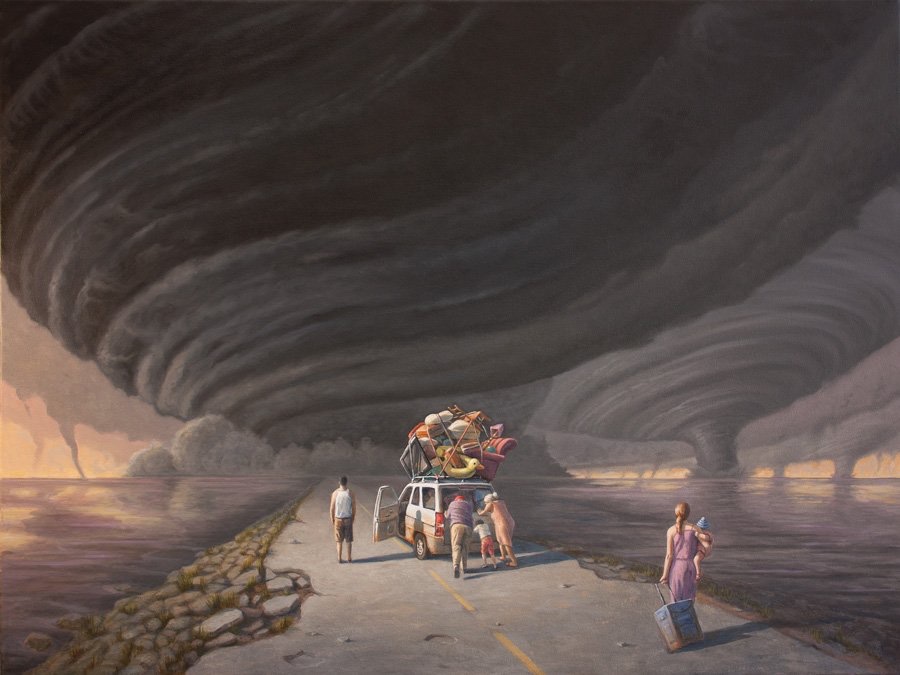
Image above: Painting by Mark Bryan in 2012  titled "The Causeway". From (https://www.artofmarkbryan.com/landscape/). Click to enlarge.

At least in wartime, the bars stay open. That’s how you know this is a different thing altogether from whatever else you’ve seen in your lifetime.

Even those of us who signed up for this trip — that is, who expected a long emergency — may be a little bit in cosmic awe at just how much shit is flying into the ol’ fan. I know I am. The gods must have glugged down a mighty draft of Dulcolax.

Did you get the feeling, as I did, watching the Sanders-Biden debate the other night — the inadequate versus the irrelevant — that the world they were blathering about possibly doesn’t exist anymore?

The world of institutions that actually function? Like, the ones that conjure up whatever sum of money you demand to keep all the wheels spinning? 

Remember that Hemingway line about the guy who went broke? Slowly, then all at once. That’s us.

Medicare for all now? Really? 

More like, a year from now every physician in America may be the equivalent of the old country doc toting a black bag around to home visits. Unfortunately, there aren’t enough horses left in America, and the few buggies we’ve got are all in the museum.

The mega financial bubble-of-bubbles is deflating with frightful velocity precisely because of the efforts since 2008 to artificially inflate it. The Federal Reserve gave it one final blast Sunday night — while everybody else was counting their rolls of toilet paper — and the effect was like blowing hot air into a shredded Zeppelin. Stock futures are “limit down” as I write, before the Wall Street open. 

Gold is getting pounded into the ground like a grape stake and silver is so low it looks like the hedge fund managers are down to pawning grandma’s table service. (Hint, the PMs will bounce back hard; the rest, probably not so much.)

Nobody really knows how deep and how harsh this gets (and perhaps the ones who have a clue ain’t sayin’). But the situation presents two salient questions: how much disorder is entailed in this ordeal? And what does the world look like when the convulsion phase of this thing is over?

Americans have never been through anything remotely like this. The disorders of the Civil War were sharp and horrendous military operations conducted mostly in cornfields, pastures, and woods (yes, and some small cities like Richmond, pop. 38,000, and Atlanta, pop. 10,000). When the smoke cleared, battered Dixieland emerged to numb civil order. 

Up in Yankeedom, the New York draft riots ran for a week around the small patch of Manhattan island, but everybody else went along with Mr. Lincoln’s program.

After all that, America got on quickly with the lively business of the 19th century: railroads, mines, factories, and all that. The world wars took place in foreign lands, and the home-front scene of the 1940s now looks nostalgically idyllic.

The stresses mounting on the national scene today reflect the extreme fragilities of the way-of-life we constructed since then, and an awful lot of bad choices we made in the process, like suburbanizing the nation and making everybody a hostage to happy motoring. 

I won’t belabor that point, except to ask how are those vast regions of the country going to manage daily life as the supply chains wobble? I’d say a shortage of toilet paper may only be the beginning of their problems.

The cities — at least, the few that didn’t already implode from the inside out — made assumptions about how big and tall they could grow which don’t jibe with the new circumstances chugging ferociously down the line.

Just think what a lockdown of the global economy will do to all those residential skyscraper projects lately hoisted up in New York, San Francisco and Boston? I’ll tell you: They are assets instantly converted into liabilities. 

And how will these cities even begin to pay for maintaining their complex infrastructures and services when the money for all that no longer exists and there’s no way to pretend that it will ever come back? Answer: They won’t be able to keep borrowing and they won’t manage. These cities will depopulate and there will be battles over who gets to live in the parts that still may have some value, like riverfronts.

I guess just about everybody can now see the idiocy of concentrating the nation’s commercial life in super-gigantic organisms like Big Box stores. It seemed like a good idea at the time, like so many blunders in history, and now that time is over. 

Any ecology thrives on redundancy — a lot of players doing similar things at the appropriate scale — and America’s chain retail model for a commercial ecology was an obvious fiasco waiting to happen. 

The people who run that, and other people who run other things in our society, must be wondering whether those supply-chains from China will come back. It’s no different than the cargo cults of the Solomon Islanders circa 1947, after the military airplanes stopped landing with all their magical goodies: time to go back to fishing from the dugout canoe.

The foolish, idiotic identity politics ginned up by the Left and their racially-inflamed, sexually-disturbed scribes in the Thinking Class have successfully destroyed the last shred of an American common culture that held the country together through earlier vicissitudes. So, one concludes that we’ll be left stewing in poisonous tensions, and perhaps some violent conflicts, before those matters head toward some sort of resolution.

Where does this all lead? Eventually, to a land and a people who operate their society in a very different way at a much more modest scale. The task of reorganizing our national life is immense. (There will be plenty to do, so don’t worry about that.) 

You can forget about the grandiose techno-narcissistic visions of electrified motoring and a robotic nirvana of perpetual sex-crazed leisure. Everything we do has to be downscaled, from whatever manufacturing we can cobble back together to rebuilding commercial ecosystems at a finer grain from region to region — in other words, what we now call small business, geared locally.

Expect giant AgriBiz to founder on a shortage of capital, especially, and expect smaller farms to organize emergently, worked by more humans working together. That is, if we want to keep eating. Expect the small towns in the well-watered parts of the country to revive while the groaning metroplexes spiral down into entropic sclerosis.

Consider the value of our vast inland waterway system and the opportunities to move goods on them, when the trucking industry unravels. Consider lending a hand at rebuilding the railroad system in this country.

There will be economic roles and social roles for all those willing to step up to some responsibility. Young people may see tremendous opportunity replacing the wounded economic dinosaurs wobbling across the landscape. It’ll be all about going local and regional and making yourself useful in exchange for a livelihood and the esteem of others around you — aka, your community.

Government has been working tirelessly to make itself superfluous, if not completely ineffectual, impotent, and rather loathsome in the face of this crisis that has been slowly-but-visibly building for half a century.

Something old and played-out is limping offstage, and something new is stepping on. Aren’t you glad you watched all those debates?

IB Editor Juan Wilson's note: I have admired James Kunstler from around 2005 when I read his book 'The Long Emergency'.  The subtitle of the book was "Surviving the converging catastrophes of the twenty-first century". The book changed my life as if I had found myself standing on a trapdoor and then realized it was about to open wide. Jim had kn the delicacy and weakness of our civilization's dependence on fossil fuels. Back then my wife Linda and I were visiting upstate New York each summer. One year, around 2007, we visited Jim in Saratoga, NY, near his home. I found him sharp, amusing, and observant. Back then I was earning part of my living as a movie script consultant. After Jim wrote his fictional novel 'World Made By Hand' in 2008, I talked to him about trying to turn the book into a movie. He had some interest so I connected with his agent and followed through with treatment that included a opening segment that described the experience of his protagonist, Robert Earle, in the fast transformation of his suburban lifestyle as the Grid brakes down and he relocates to upstate New York  Jim and his agent turned it down. We have remained friendly acquaintances   Following his publication of 'Too Much Magic: Wishful Thinking, Technology And The Fate Of The Nation' in 2012 Linda and I visited Jim in his new haunt in upstate Greenwich, New York. He had bought some acreage not accessed by a public road and built a deer proof eight foot high fence all around it. The place featured a large vegetable garden and extensive arbor of fruit trees. He was hunkering down for an end of times. Well folks, the take away from his latest post to his website indicates that the time is ripe for a major breakdown. I'm hoping that if we can avoid a nuclear war, or other substantial suicidal behavior humans may end up with a smaller population in a more stable environment with less pollution. One can only hope. But as Betty Davis says in the 1950's movie 'All About Eve' - "Fasten your seat belts. It's going to be a bumpy night!"
.

Whither do we go?

SUBHEAD: What will you be doing when you cannot be where you are doing what you do now.

By Juan Wilson on 1 February 2020 for Island Breath -
(https://islandbreath.blogspot.com/2020/02/whither-do-we-go.html)


Image above: Napa Road Ends. If we could only be so lucky. From (https://www.adsoftheworld.com/media/print/napa_road_ends_2).

If you have been paying attention it should be pretty obvious now... we are much like Wile E. Coyote, from the Warner Brothers' Luney Tunes "Roadrunner" cartoon series. The coyote would chase the roadrunner in order to kill and eat him.

The coyote wants to eat the roadrunner, but the roadrunner was to fast and agile for him. The coyote would then purchase some manufactured equipment from a company called ACME (A Company that Makes Everything). His order would often include items like catapults, anvils, dynamite, springs, bear traps or other deadly materials to capture and kill the roadrunner when he stops to eat some birdseed bait.

The traps never worked as expected and the disappointed coyote usually would then test the equipment to see why it failed. Needless to say, the coyote would set off the trigger to the trap and end up crushed by an anvil or catapulted off a cliff.

And this is where I see humanity today. We have employed technology (agriculture, industrialization, computers, etc.) to feed us, lesson our load, and solve our problems... and that is our problem.

We have been so successful in this endeavor that all that remains of nature are human settlements and what they consume. As far as humans are concerned that is all that matters.

Unfortunately that has shown itself to be a dead end road and we are at the end of it... There may be another road we can take but we will have to reduce our numbers and consumption of resources by some orders of magnitude to get there.

We have shown ourselves to be too self-absorbed and greedy to even attempt to meet the goal of sustainability even after the scientific report "A Limit to Growth" by the Club of Rome a half century ago demonstrated we were about to crash life on planet Earth.

Well we are well on the way extinguishing the forests, killing the oceans and melting the polar ice. We have exterminated all but a few wild creatures and will only permit what we eat or put in captivity to live.

We won!

Now what?

If there are any human survivors to the conflagration we are about two witness they will have to begin again as we have in the past. See "Once Through the Bottleneck" - subtitled "Almost 200,000 years ago humans faced extinction. Only a few hundred were saved along the coast of Cape Horn".  

In my opinion we will be lucky if there are even a few settlements of humans that get through the  coming bottleneck. It is hard to say what might be an oasis through the coming changes.

But be warned - it may be already past time to have any choices as to where you will be, and what you will be doing when you cannot be where you are doing what you do now.

As John Michael Greer has written:
  • "The Long Descent: A User's Guide to the End of the Industrial Age" (2008) 
  • "Not the Future we Ordered: Peak Oil, Psychology and the Myth of Progress" (2013) 
  • "Collapse Now and Avoid the Rush: the Best of the Archdruid Report" (2015) 
  • "Dark Age America: Climate Change, Cultural Collapse, the Hard Future Ahead" (2016) 
  • "The Retro Future: Looking to the Past to Remake the Future" (2017) 
To see Greer's blog visit (https://www.ecosophia.net)


Anticipating Collapse

SUBHEAD: Collapse can’t happen soon enough, as far as I’m concerned.

By Damaris Zehner on 16 January 2020 for Integrity of Life -
(https://www.damariszehner.com/post/anticipating-collapse)


Image above: "How the West Was Won" painting by Mark Bryant. For more detail and many other paintings by Mark visit (https://www.artofmarkbryan.com/recent-work/#!jig[1]/NG/427).

Collapse can’t happen soon enough, as far as I’m concerned.

By collapse, I mean the breakdown of the complexities of our current society. 

Those would be government bureaucracies, educational and credentialing systems, laws and regulations of all sorts, tax codes, the interconnected layers of our identities on the internet, the ballooning administrative sector, insurance, the stock market, multinational corporations, the military-industrial complex – all the way down to the proliferation of single-purpose kitchen gadgets cluttering our cupboards.

It's not that I long for the feral world, red in tooth and claw, portrayed in collapse fiction, although I know there are those who fantasize about mastering a post-apocalyptic wasteland. I acknowledge that the collapse of complex societies (the name of a great study by Joseph Tainter) is both the result of problems and the cause of problems in human relations and survival.


Collapse seems always to be tied to environmental degradation, although there are many other related causes, and is often accompanied by war, hunger, displaced people, and a fall in population. I would have to be a monster to want my family and neighbors to suffer all those things, and I'm not.

But there are two points I want to make about collapse: that it is inevitable; and that it is necessary before genuine reform can take place.

First the inevitability.

History and archaeology show that every complex society that has ever arisen has fallen. Ancient China, Babylon, Assyria, Hittites, Persians, Greeks, Romans, Mongols, Mayans, Incas, Mali, Zimbabwe, the Spanish Empire, the British Empire – these all followed a similar pattern of expansion, administration, and dissolution.

Some have fallen spectacularly and vanished from history, while others have rearranged themselves and emerged in another form, but none has survived for long at its peak of power.

There are lots of theories about timelines and patterns that you can read if you’re interested, but the central point is that complex human societies, like everything else in this universe, do not expand infinitely.

Eventually they all collapse, partially or completely, and something different rises in their place. This process will certainly be compounded and sped up in our generation by the looming climate catastrophe.

Discussion of the issue of collapse often takes a moral tone, asking what we've done that God, gods, or nature is punishing us for – and that is an appropriate and helpful process, one we should spend a lot of time thinking about, because we are moral creatures.

But the moral element sometimes distracts us from the natural inevitability of collapse, the pattern that we see when a sapling sprouts in a forest, grows, ages, falls, and leaves a gap for other saplings to fill.

Too often the moral approach assumes that we can avoid that natural pattern if we just shape up. To a degree and for a time that’s true, but ultimately it is hubris to expect that we and our institutions can live forever.

So the current Western society that we take for granted will collapse. I don’t know when or how or to what degree, but I know it will. It would be wonderful if we could assert our collective will to downsize voluntarily, to “collapse now and avoid the rush,” as John Michael Greer puts it.

It would be great if we could restrict our appetites, break away from our expectations, and be willing to imagine an unknowable future, rather than fighting to preserve the status quo. I have a tiny hope that some people might being willing to collapse well, which is what keeps me writing about human-shaped institutions.

On the whole, however, I expect that the collapse will be messy, not carefully managed by people of goodwill. I expect there will be conflict and competition, selfishness defending itself against need, and a dearth of imagination about how things could be different but still good. ]

Western society has made enemies of people and nature in its expansion, and those enemies will pour in when they get the chance if we don’t make peace with them first.

But the future doesn’t need to be a Book of Eli scenario of blasted landscapes, gangs, and cannibalism. My second point is that collapse is also an opportunity for new life, new systems, a new attempt at balance. In the gaps left by the fall of complicated, ossified institutions, more human-shaped ones can grow. It will be messy, but it could be good.

Think about this as an example.

I’ve been writing a lot about educational reform. I have a picture of the kind of school I’d love to start, and have even worked on making it a reality at various times in the past.

But starting a small, sane, countercultural school right now involves a lot of complexity: at minimum, credentials from states and/or independent agencies, which would dictate the training and qualifications of teachers; building codes; insurance of all sorts; and financing to rent or buy space. 

It involves competing with other schools for families who assume that interschool competitions in sports, music, debate, and other areas are necessary. It involves dealing with colleges who have become ever more demanding about transcripts and activities, and with parents who are afraid that alternative education would interfere with their children’s ability to get scholarships. 

And even if all of those issues could be successfully addressed, it means that only wealthy families could send their children to the kind of school that I think all children should go to.

If the public school system and its related institutions collapsed, however, the school I’d like to start would be a valuable alternative for the people who wouldn’t even consider it now. I could start it in my house, if I had to, and barter goods and services with parents who couldn't afford cash, all outside of the current bureaucracy. 

The same is true of all other fields: I know there are doctors who would love to open a practice independent of the nationwide networks, and, not dragged down by the crazy costs of education and insurance, treat patients for a reasonable price. 

There are farmers who would be more successful if they were no longer crushed by regulations designed for industrial-level food producers and no longer competing against the subsidized foodlike substances sold throughout our fast food nation. The same is true of producers of all sorts: clothes designers, carpenters, builders, writers, artists, and others.

(Let me insert a quick explanation here: I am not against regulations guaranteeing safety and quality. I have no problem with reasonable government at the appropriate level for the issues being considered. I’m just saying that the expansion of complexity ultimately stifles freedom and creativity, and that collapse creates an opening for freedom and creativity.)

The next question that needs to be asked, then, is what should we do in anticipating collapse, and how should we participate in the process? Is violent revolution inevitable, as Marx said? Should we proactively start a violent revolution to hurry things along, as Soviet Marxists thought? Should we use heinous methods to destabilize the status quo like the accelerationists

Should we try to work through our current institutions of law and government to create reform, as activists want? Or should we retreat to woods and communes to start a parallel society apart from our metastasized system, as used to happen millennia ago when there was more unoccupied land to retreat to?

I’m not confident that any of these methods would yield the results that I’d like to see. Nor am I sure that revolutions and reforms can direct the mighty forces of expansion and collapse that rule the universe. I see us more like people on a raft hurtling toward a surf-torn shore, arguing about whether we should be paddling forward, paddling backward, or jumping overboard.

Can we really change anything, or are the forces driving us forward too powerful to divert? I don’t know. You can go ahead and try the method that makes sense to you, so long as you act within moral bounds and don’t assume that the ends justify the means; I just don’t think it will make that much difference to the ultimate collapse of society. 

However, the choices we make will mean everything in the world to the kind of people we become and the future society we form: either motivated by greed, competition, and entitlement, or founded on kindness, humility, and balance.

.

Moon Shot Fever Over

SUBHEAD: Landing on the Moon seemed a big deal at the time... But it was not the future we planned.

By Juan Wilson on 20 July 2019 for Island Breath -
(https://islandbreath.blogspot.com/2019/07/moon-shot-fever-over.html)


Image above: Colored pen drawing by Juan Wilson of campsite in Titusville Florida, on the Banana River, looking towards the launch pad for the first moonshot a day before the flight as the launch tower was returning to the VAB (Vehicle Assemply Building). Note mop pole and plastic sheet camp tent behind our rented Camaro. From (Moonshot Part III: Natives Witness the Launch).

It has been fifty years since I witnessed the takeoff of the first successful landing of humans on the Moon. At the time it seemed to be heralding a new future - but it turned out to be a blind alley... a dead end.

Just the year before Martin Luther King and Bobby Kennedy had been assassinated and the country was in a mood for good news. Throwing a wet blanket on the party was the Reverend Ralph Abernathy, who had succeeded Martin Luther King as leader of the Southern Christian Leadership Council. During the week before the moonshot Abernathy lead  the SCLC in a series of demonstrations titled the Poor Peoples Campaign march in and around the NASA Cape Canaveral launch site. Their rallying cry,
“If we can spend $100 a mile to send three men to the moon, can’t we, for God’s sake, feed our hungry?”
Instead of a Saturn V rocket the symbolic vehicle Abernathy chose to lead the demonstration was a conestoga wagon pulled by mules. I remember thinking at the time that it seemed so senseless and unrelated their effort.

Now I know better. Interest in the moon landings jumped the shark early on. Apollo 14 was the eighth manned mission in the United States Apollo program, and the third to land on the Moon. Interest in the Apollo series was waning. Fuzzy black and white images of grown men jumping around in the dust and desolation of the Moon got old fast.

Alan Shepard, in a feeble attempt to spark interest in the effort famously hit two golf balls on the lunar surface with a makeshift club he had brought from Earth. They did fly far but nobody really cared.

Surviving the next 50 years seems the real challenge for life on Earth now.

See also:
Moooshot Part I: A Rocky Road to the Cape
Moonshot Part II: Up Close to a Saturn V Rocket
Moonshot Part III: Natives Witness the Launch
Woodstock Forgotten: An alternate Adventure 


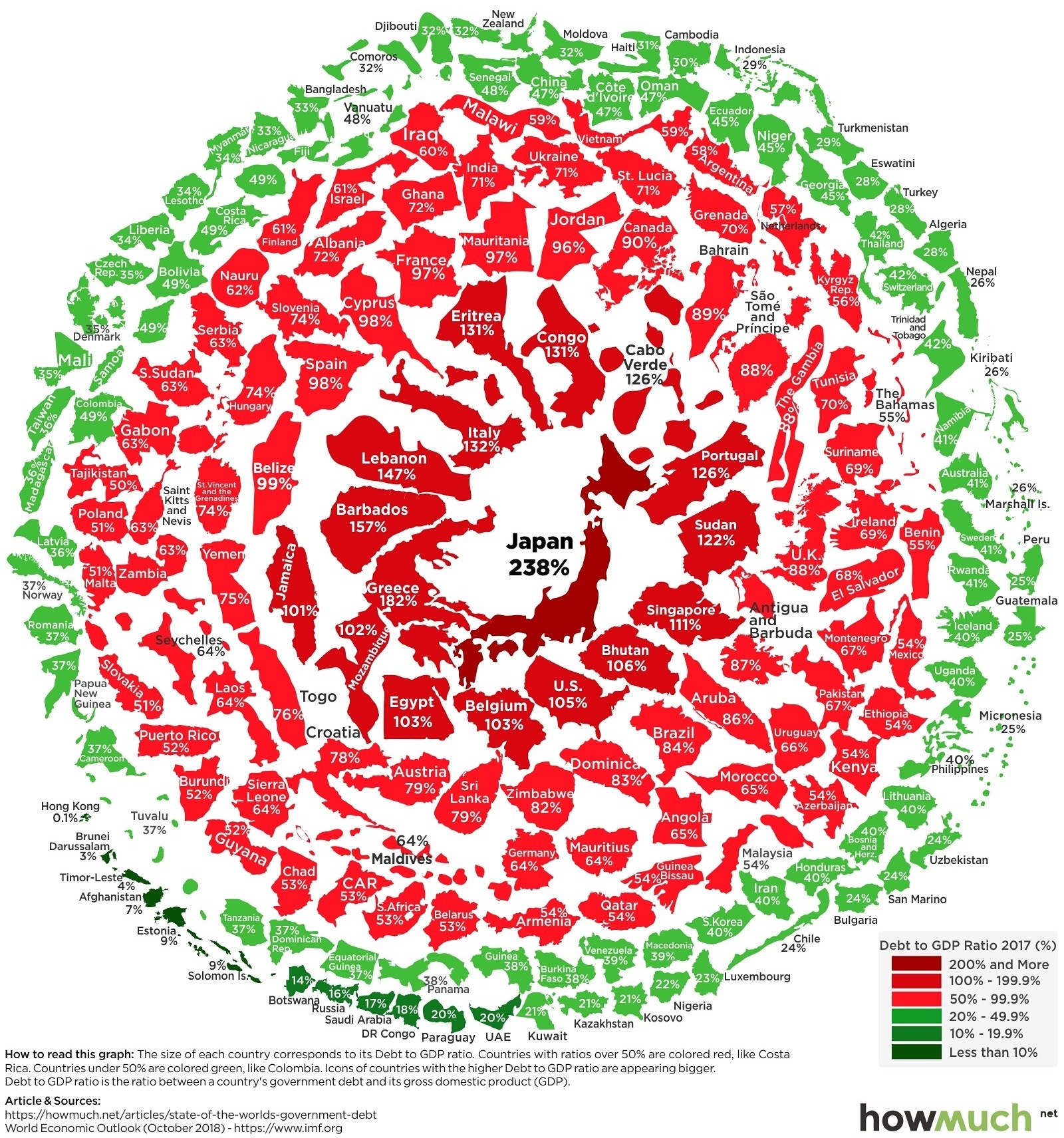
The Debt Whirlpool

SUBHEAD: Visualizing the status of the whirlpooling increase of world government debt to GDP.

By Jeff Desjardins on 21 January 2019 for Visual Capitalist -
(https://www.visualcapitalist.com/visualizing-the-snowball-of-government-debt/)

http://www.islandbreath.org/2019Year/01/190121debtballbig.jpg
Image above: Click to enlarge. Swirling around the drain-hole of history are the national economies in red with between 50% and over100% of government debt to Gross Domestic Product (GDP). From (https://www.visualcapitalist.com/visualizing-the-snowball-of-government-debt/).

Over the last five years, markets have pushed concerns about debt under the rug.

While economic growth and record-low interest rates have made it easy to service existing government debt, it’s also created a situation where government debt has grown in to over $63 trillion in absolute terms.

The global economic tide can change fast, and in the event of a recession or rapidly rising interest rates, debt levels could come back into the spotlight very quickly.

The Debt Snowball
Today’s visualization comes to us from HowMuch.net and it rolls the world’s countries into a “snowball” of government debt, colored and arranged by debt-to-GDP ratios. The data itself comes from the IMF’s most recent October 2018 update.

The structure of the visualization is apt, because debt can accumulate in an unsustainable way if governments are not proactive. This situation can create a vicious cycle, where mounting debt can start hampering growth, making the debt ultimately harder to pay off.

Here are the countries with the most debt on the books:

RankCountryDebt-to-GDP Ratio (2017)
#1Japan237.6%
#2Greece181.8%
#3Lebanon146.8%
#4Italy131.8%
#5Portugal125.7%
#6Sudan121.6%
#7Singapore111.1%
#8United States105.2%
#9Belgium103.4%
#10Egypt103.0%

Note: Small economies (GDP under $10 billion) are excluded in this table, such as Cabo Verde and Barbados
 
Japan and Greece are the most indebted countries in the world, with debt-to-GDP ratios of 237.6% and 181.8% respectively. Meanwhile, the United States sits in the #8 spot with a 105.2% ratio, and recent Treasury estimates putting the national debt at $22 trillion.

 Light Snow
On the opposite spectrum, here are the 10 jurisdictions that have incurred less debt relative to the size of their economies:
RankCountryDebt-to-GDP Ratio (2017)
#1Macao (SAR)0.0%
#2Hong Kong (SAR)0.1%
#3Brunei2.8%
#4Afghanistan7.0%
#5Estonia9.0%
#6Botswana14.0%
#7Russia15.5%
#8Saudi Arabia17.2%
#9DRC18.1%
#10Paraguay19.5%

Note: Small economies (GDP under $10 billion) are excluded in this table, such as Timor-Leste and Solomon Islands

Macao and Hong Kong – both special administrative regions (SARs) in China – have virtually zero debt on the books, while the official country with the lowest debt is Brunei (2.8%).

.

Living in a Shitstorm

SUBHEAD: Get over despair. The big problems won't be fixed. A planetary adjustment is at hand.

By Chris Jordan on 17 October 2018 for Huffington Post -
(https://www.huffingtonpost.com/entry/despair-environment-politics_us_5bc5d910e4b0a8f17ee5d240)


Image above: Man hanging onto "Caution" sign as braking storm wave breaks. From internet.

[IB Publisher's note: My advise to the author of this piece... Get over the despair. The big problems won't be fixed. A planetary adjustment is at hand. There is much work to be done by the survivors. Some places will be much safer than others. If you are not in one, find such a spot. Abandon your dependence on "The System" to a degree you never imagined (ditch the car,  the grid, discount retailing and the  information cloud as soon as possible. Hunker down with people you trust and can work or trade with. Entertain each other until the new dawn. P.S. This is the 7,000th post to this blog. Where does the time go?] 

Like all of you, I pay close daily attention to the increasingly grotesque environmental and political shitshow we are witnessing unfold before our astonished eyes. The question is how to respond.

I have never at the same time felt such a strong desire to make a positive difference and less empowered to do so.

In my own psyche, something has shifted on a foundational level.

Most conversations now, even among my wisest and most engaged friends, lead down familiar rabbit holes that end in shrugged shoulders, dumb jokes that mask disempowerment and worn out memes about “solutions” that are infinitesimal in proportion to the scale of the problems.

Ask young people what two words most characterize our future and the response is as instant as it is ubiquitous: “We’re fucked.”

The most relevant internet comment people seem to be able to muster is “vote,” which raises a whole separate conversation, but the crux for me is, “Of course ― and what else?” Politics is an increasing disaster that can be seen as both a cause and a symptom.

I try to step back to a meta-perspective in the hope of achieving a clearer-headed view, but the wide-angle picture becomes even more chaotic. The panopticon turns out to be a Halloween hall of mirrors.

And in this space I find myself steeped in the familiar feeling of dread that I had before going to Midway Island to photograph dead albatrosses whose stomachs are filled with plastic.

To take the next step forward, I know I must face something dark that lies inside of myself, but I can’t quite make out what it is ― something so taken for granted that I don’t see it, like the water we swim in, right in front of our nose but invisible.

Yet its presence is just strong enough to swing the needle of my internal compass in its direction.

The abyss I went to encounter on Midway was grief, which at the time I knew little about and thought was the scariest feeling there is to bear.

Now the form of a new monster emerges through the mist, a hundred times more frightening than grief, a lurking layer in the psyche that possesses the horrible power to drain individual and collective life force. It carries such strong cultural taboos that even naming it risks a kind of social suicide.

But I can no longer deny its residency in my consciousness, like a new roommate who showed up uninvited and now sleeps in my bed next to me and walks with me everywhere I go. I wonder if it accompanies you too. It is that state of mind we call despair.

On uttering the awful term, I realize I know barely anything about it. In my 14 years of individual and group therapy, I don’t recall any of the therapists or clients ever mentioning it, and I have rarely if ever read anything about it or heard discussion of it.

One thing I can observe about it right away is, in the same way I was grief averse, I am exponentially more despair averse. Admitting despair feels like surrendering the game for lost. An abhorrent kind of giving up seems to lie at its core.

At least grief expresses itself in the cathartic flow of tears, with the possibility of moving through to the other side.

Despair presents as an existential energy sink, like bleeding from an artery, a black hole that if approached pulls inescapably toward implosion and emotional collapse.

Acknowledging despair may amplify it, but denying it may feed it even more. The unconscious defense mechanism is avoidance:

Keep up a hopeful facade, say something positive, focus on trivia, talk about solutions, point to some small evidence of improvement somewhere, quote a self-help one-liner, any old cliche will do.

I wonder what it would mean to allow for some measure of despair as a natural response to the ever more fucked-up realities of our world.

Can despair be held and contained as a natural human experience alongside fear, anger, rage, grief, joy, beauty and love?

Or does it somehow diminish or cancel out everything else?

Perhaps there is something empowering and transformative that comes from standing in despair’s crucible.

Given we may create the very depression we fear by holding despair at bay, I want to know what happens if we take the risk of looking all the way into that darkness.

Let us consider the possibility that there may be value in exploring the territory of despair together, embracing it not as an exercise in negativity or capitulation but as a liberating doorway we can step through toward the healing of our relationship with each other and the world.

.

Capitalism and ecological collapse

SUBHEAD: Our consumer economy will be the "Final Solution" for organic life on Earth.

By Ed Simon on 9 October 2018 for History News Netrwork -
(https://historynewsnetwork.org/article/170192)


Image above: Chiseled upside down into the stone embankment of the Elbe River four centuries ago, at a time of historic drought, are the words "If you see me, weep!" From (https://twitter.com/lfulg/status/1022831523920310279).

Four centuries ago, somebody starving in the drought afflicted Elbe region in what is today the Czech Republic, anonymously chiseled onto the stone of the receding river bank a warning.

Here, along the river where one day American and Soviet troops would meet on their duel approach to Berlin, a graffito made by unknown hand marks 1616 as the oldest year recorded on one particular “Hunger Stone”, and on that surface there is a memento mori which reads

“Wenn du mich sicht, dann weine.” 

This summer, among the hottest recorded, and the Elbe once again receded to the point where observers could read that ominous missive:

“If you see me, weep.”

Something to tattoo on the brain with the Monday release of the United Nations Intergovernmental Report on Climate Change.

Authored by 91 scientists, representing 40 countries and based on over 6,000 peer-reviewed scientific studies, the conclusions of the commission are horrifying.

According to Coral Davenport at the New York Times the climatologists discovered that if “greenhouse gas emissions continue at the current rate, the atmosphere will warm up by as much as 2.7 degrees Fahrenheit” by 2040, radically earlier than had been thought, meaning that most readers of this article will bear witness to “inundating coastlines and intensifying droughts and poverty.”

A child born today will have just turned the drinking age in a world where close to all of the coral reefs will be extinct and where massive storms like Hurricane Florence or Hurricane Maria, which has nearly destroyed a Puerto Rico abandoned by the government of the United States, will be common.

Where the social, cultural, and economic affects of climate change will be recorded not on revealed hunger stones, but in pandemics, wars, famines, and genocides exacerbated by the effects of higher temperatures.

Brandon Miller and Jay Croft at CNN write that we’ll see in starker detail the horrific results of industrial man-made global warming earlier than in two decades, with the report concluding that humanity has “only till 2030 to stem catastrophic climate change.”

Alterations to human behavior which might hasten the worst effects of climate change are technically possible, though the study’s authors doubt such change is politically feasible, as it would require direct action on the part of the industrial economies of the world, something with “no documented historic precedent.”

Myles Allen of Oxford University explained that “we need to reverse emissions trends and turn the world economy on a dime” if we’re to stave off an ecological apocalypse which we now understand isn’t centuries in the future, but rather mere decades, if not years.

We already see the effects in the increasing ferocity of storms, the droughts that mark not just the developing world, but increasingly North America and Europe, and in the wildfires, which have burnt their way across the west.

As the world’s temperature rises we see an equivalent political slow burn, nations increasingly moving toward the delusional reactionary nationalisms as a means of punishing refugee populations often affected either directly by climate change or by the civil strife made possible by it.

For as Mark Fishcetti describes the Syrian civil war in Scientific American, Human-induced drying in many societies can push tensions over a threshold that provokes violent conflict” – a reality that if the Trump administration pretends to deny, has long been acknowledged by the Pentagon.

Climate change has resulted in civilization catastrophe before.

Historian John Kelly notes in The Great Mortality, his book on the Black Death of fourteenth-century Europe, that pestilence was furthered by “climactic and ecological instability,” the bubonic plague encouraged by weakened immune systems brought on by drought and famine.

Polymathic anthropologist Jared Diamond has considered how climate change brought collapse in cultures as varied as the Anasazi and Maya or the medieval Norse settlements of Greenland, writing that the “collapse of industrial civilization… could assume various forms, such as the worldwide spread of diseases or else of wars, triggered ultimately by scarcity of environmental resources.”

Arguably the civilizations of ancient Mesopotamia and the Indus River Valley were felled by climate change, and one wonders if the peasants of Sumer were as despondent as that German speaker on the Elbe who asked future generations to weep, or if they were rather as myopic as we are, saying of such changes that “This too shall pass” while what expires is civilization itself?

Humans are unable to imagine the actual passing of their way of life. A sense that history changes has been novel for most cultures, even apocalyptic minded ones, as medieval paintings which depict Christ as a Flemish peasant or ancient Judeans as Florentine nobleman can attest.

The idea that the past was radically different from the present and that tomorrow will be distant from today is an innovation of Renaissance humanism and then modernity.

Rather, it’s always been easier to imagine that your world will literally pass into oblivion than that the values your civilization holds dear might disappear (or need to disappear).

During those lean times on the Indus River, on the Euphrates, or the Elbe, women and men may have dreamt of the end of days, but they couldn’t have quite dreamt of us. The myths that structured their world precluded it.

Lest we be too arrogant, ours is not so different a perspective, for as the literary theorist Frederic Jameson famously noted, it is “easier to imagine the end of the world than to imagine the end of capitalism.”

Similar for the hungry penitent in the temple to all the gods of Sumer, or to the starving medieval pilgrim who could envision the return of Christ, but not that he might look different from those who populated his world.

Limited perspective is the wage of any totalizing ideology, and all eras are structured by such paradigms.

As a priest in Moloch’s temple or a monk in a medieval monastery had their religions, so have we ours, but the cracked gods of our world differ in one important respect – only capitalism’s Mammon has the capability of bringing about the apocalypse.

Only capitalism was able to inaugurate a new geological epoch in the Anthropocene; unique is our dominant ideology’s status in being able to obliterate all of humanity.

IPCC Co-Chair Debra Roberts said that the report is a “line in the sand and what it says to our species is that this is the moment and we must act now,” but what should disturb us most is the authors’ accurate alarm at the lack of political will to avert catastrophe.

In the United States the coal, oil, and gas industries’ obfuscate, high percentages of Americans believe the lie that climate change is a hoax (while record heat affects the Midwest this October), and the Trump administration trashes the Paris Accords.

Noam Chomsky has said that the Republican “party is dedicated to racing as rapidly as possible to destruction of organized human life."

There is no historical precedent for such a stand, with modern fascism directly correlated to the increasing chaos of climate change itself.

Roy Scranton in We’re Doomed. Now What? writes that as the “gap between the future we’re entering and the future we once imagined grows ever wider, nihilism takes root in the shadow of our fear…. [Y]ou can see it in the pull to nationalism, sectarianism, war, and racial hatred. We see it in the election of Donald Trump.”

What must be reckoned with is how this situation was directly engendered by industrial capitalism, and in particular by the partisans of its most extreme ideological manifestations of libertarianism and neoliberalism who have provided cover for policies that have enflamed the crisis.

Past centuries were circumscribed by their worldviews, be it medieval Catholicism, or classical Roman Augustan paganism, or the varied gods of Sumer in ancient Mesopotamia.

Even the most visionary of individual perspectives must be limited by a culture’s dominant way of thinking, but while our adherence to the market is as all-encompassing as a Babylonian’s loyalty to Marduk, it is only our dark religion which actually threatens Armageddon.

Unfettered, unregulated, capricious, vampiric capitalism has brought us to the brink, and the mass inability to comprehend this fact evidences how ingrained said ideology is.

Our blinders are such that human tragedy that is attributable directly to our economic system is often naturalized as simply being “The way that things are,” thus precluding even the possibility of different ways of arranging our world.

Death due to differing ideologies is always interpreted as conscious and preventable, but capitalist tragedy is simply understood as how life operates.

Consideration of those who have died because of capitalism (and those who will, which may yet include us all) doesn’t require a cover-up.

So inured are we to seeing capitalism as its own imposed ideology that we fail to understand its death toll. Franco-Bulgarian philosopher Tzvetan Todorovwrote that “remembrance of our own woes prevents us from seeing the suffering of others,” and while true, the converse is also accurate.

While admitting that capitalism provided for unprecedented class mobility and technological innovation, an honest consideration of its death toll in any hypothetical Black Book of Capitalism would have to include not just the obvious fatalities of those who died in industrial accidents or whose lives were shortened by their labor, but indeed the victims of colonialism, the trans-Atlantic slave trade, and of fascismo corporativo, which is simply capitalism driven to its horrifying end.

Invisibility of such atrocities through normalization is a species of what the philosopher Louis Althusser termed “interpellation,” that is to say that we’re all molded subjects of the ideology that governs our world so that we mostly hold uncritical assumptions about capitalism’s normativity.

Writer William T. Vollmann addresses future generations in his new tome on climate change Carbon Ideologies, explaining that “We all lived for money, and that is what we died for.” As 2040 approaches our ignorance is a form of collective suicide.

The Editorial Board of theWashington Post writes that future “Historians will look in absolute astonishment” that not only did our governments and corporate elite fail to halt climate change, but that our policy makers “actually pushed in the wrong direction.”

That’s assuming that there will even be any historians left after the climate change horseman of pestilence, famine, war, and death gallop across the scorched and burning world, their riders named “Deregulation,” “Bottom Line,” “Market,” and “Profit.”

An August environmental impact statement prepared by the National Highway Traffic Safety Administration concedes that far from being a “Chinese hoax” as Trump has alleged, the average temperature will rise seven degrees by century’s end.

Quite a wide gulf between what the Trump administration knows to be true and what his deluded believers will swallow.

Juliet Eilperin, Brady Dennis, and Chris Mooney at the Washington Post write that the Trump “administration did not offer this dire forecast … as part of an effort to combat climate change,” for their “analysis assumes the planet’s fate is already sealed.”

Why prevent collapse when Trump concludes that there is still so much money to be made in not averting disaster?

This is the nightmare logic of scarcity capitalism, the macabre calculus which is content to let millions of people starve in the third world and that will ultimately exterminate refugees who dare to escape a parched landscape, all so that the economic status quo can be maintained before the process kills us all.

The puritanism of corporate eco-individualism which configures environmental protection as simply a matter of driving a Prius or taking short showers is moral contrition or personal branding rather than policy, a quasi-theological sacrifice before the altar of the dying Earth.

What’s actually required is a massive, international, eco-socialist mobilization of governments and industries that are responsible for this calamity. Because right now capitalism’s final solution is nothing less than complete ecological collapse.

In his 1888 autobiographical Ecce Homo, the German philosopher Friedrich Nietzsche eerily predicted that the 20th century would witness “wars as have never happened on earth.”

With chaos brought about by the scarcity resulting from climate change, we may reevaluate how prescient Nietzsche was about the last century, realizing that he was perhaps actually off by a hundred years.

.