Showing posts with label Development. Show all posts

NTHE is a four letter word

SUBHEAD: Near Term Human Extinction may be coming after a few of us get through the eco-bottleneck.

By Albert Bates on 25 March 2018 for The Great Change -
(http://peaksurfer.blogspot.com/2018/03/nthe-is-four-letter-word.html)


Image above: Illustration of a cityscape post near term human extinction. From (http://thefallingdarkness.com/near-term-human-extinction-a-conversation-with-guy-mcpherson/).

"Collective neurosis can be attributed to a concatenation of causes — diet, electrosmog, epigenetic triggering by microplastics in our toothpaste — take your choice."

We are not talking about climate deniers now, who have their own brand of insanity, but we keep hearing the same mantra chanted by otherwise respectable scientists and policymakers that, “climate change may be catastrophic but it won’t be the end of us.”

We hear that so often we almost never challenge it, not wishing to divert an otherwise productive conversation into what we know to be a blind alley. Nonetheless, we think the statement is at best deluded and at worst just a milder form of denialism. It is not science. It is faith. It is also human neurophysiology.
Brain imaging research has shown that a major neural region associated with cognitive flexibility is the prefrontal cortex — specifically two areas known as the dorsolateral prefrontal cortex (dlPFC) and the ventromedial prefrontal cortex (vmPFC). Additionally, the vmPFC was of interest to the researchers because past studies have revealed its connection to fundamentalist-type beliefs. For example, one study showed individuals with vmPFC lesions rated radical political statements as more moderate than people with normal brains, while another showed a direct connection between vmPFC damage and religious fundamentalism. For these reasons, in the present study, researchers looked at patients with lesions in both the vmPFC and the dlPFC, and searched for correlations between damage in these areas and responses to religious fundamentalism questionnaires.
— Bobby Azarian, Raw Story, March 14, 2018

In the quote above, Azarian is referring to a study published a year ago in Neuropsychologia that connected cognitive flexibility with the ventromedial prefrontal cortex and proved that damage to that part of the brain hinders adaptive or flexible behavior, locking out world views that run contrary to some preconception. The study correlated brain-damaged veterans with religious fundamentalism.

The preconception most often grasped by NTHE (Near Term Human Extinction ) deniers is the notion that “humans survived far worse cataclysms to arrive at their present condition” —  the Toba event 70,000 years ago, for instance, when the human population was reduced to perhaps 10,000–30,000 individuals — “and we invariably rebound.”

The example most often cited is the 2005 Rutgers mDNA study showing all pre-1492 native populations of the Americas  —  well over 1 billion by some estimates  —  having descended from 70 or fewer individuals who crossed the land bridge between Asia and North America.

This is a variant of the techno-cornucopianism of Bill Gates or Elon Musk, but in their cases — building new desert cities in Arizona or seed colonies on Mars — that being externalized, absent a cold fusion Spindletop, is biophysical economics.

We have previously reviewed the hypothesis of Danny Brower and Ajit Varki that an evolutionary leap allowed homo to access higher consciousness by hard-wiring a neural pathway for denying reality.

Arguably that same pathway induces otherwise rational-seeming people to allow for the possibility of catastrophic climate change (already well underway) while denying the possibility of it leading to near-term human extinction (NTHE).

In our view, this colors the debate over what we should be doing by reducing the urgency.

Ironically there may have been human genotypes that suppressed their denial gene better than ours does. One of the effects of genetic bottlenecks is that selected genes (such as those offering a more balanced use of denial) fail to be passed along to succeeding populations.

Our personal view is that while we think NTHE can yet be avoided, the time for action grows short and as we as we walk out onto the razon’s edge and grow more desperate we will likely make many foolish mistakes, any one of which could trigger NTHE.

Appointing John Bolton the National Security Advisor, for instance. In 2016 USAnians fed up with the tweedledee-tweedledum two-party system opted to just hurl a hand grenade into the White House and stand back.

If one grenade was not enough, we still have President Bannon to look forward to in 2020 or 2024 if Cambridge Analytica can keep up with the AI revolution with respect to Big Data.

Collective neurosis can be attributed to a concatenation of causes — diet, electrosmog, epigenetic triggering by microplastics in our toothpaste — take your choice. Visionary forebears who saw these bottlenecks coming — Garrett Hardin, R. Buckminster Fuller, M. King Hubbert — all argued that the best antidote was better public education.

But at least in the US, public education was hijacked in the ‘90s by the vmPFC-lesioned hoards of Zombie Fundamentalists before being handed over to Betsy DeVoss for the final coup d’gras.

Whatever long wave or ergot diet issued humanity into the Dark Ages seems to be replaying now, and it could hardly arrive at a worse time from the standpoint of the organized climate solutioneering required to avert Anthropogenic NTHE.

We need to be in top form to survive this next bottleneck. We’d do better without the denial. Too bad climate scientists can’t afford to hire Cambridge Analytica themselves.

.

Science of a Vanishing Planet

SUBHEAD: Because science is supposed to be smart, and there’s nothing smart about destroying your own world.


By Raul Ilargi Meijer on 27 March 2018 for The Automatic Earth -
(https://www.theautomaticearth.com/2018/03/the-science-of-a-vanishing-planet/)


Image above: Vanishing point in the woodland. From (https://www.lightandmatter.org/2011/learn-photography/composition/photo-composition-vanishing-point/).

There are numerous ways to define the Precautionary Principle. It’s something we can all intuitively understand, but which many parties seek ways to confuse since it has the potential to stand in the way of profits. Still, in the end it should all be about proof, not profits.

That is exactly what the Principle addresses. Because if you first need to deliver scientific proof that some action or product can be harmful to mankind and/or the natural world, you run the risk of inflicting irreversible damage before that proof can be delivered.

In one of many definitions, the 1998 Wingspread Statement on the Precautionary Principle says: “When an activity raises threats of harm to human health or the environment, precautionary measures should be taken even if some cause and effect relationships are not fully established scientifically.”

Needless to say, that doesn’t easily fly in our age of science and money. Cigarette makers, car manufacturers and oil companies, just to name a few among a huge number of industries, are all literally making a killing while the Precautionary Principle is being ignored.

Even as it is being cited in many international treaties. Lip service “R” us. Are these industries to blame when they sell us our products, or are we for buying them? That’s where governments must come in to educate us about risks. Which they obviously do not.

Nassim Nicholas Taleb -of Black Swan and Antifragile fame- has made the case, in his usual strong fashion, for applying the Precautionary Principle when it comes to GMOs.

His argument is that allowing genetically modified organisms in our eco- and foodsystems carries unknown risks that we have no way of overseeing, and that these risks may cause irreversible damage to the very systems mankind relies on for survival.

Taleb is not popular among GMO producers. Who all insist there is no evidence that their products cause harm. But that is not the point. The Precautionary Principle, if it is to be applied, must turn the burden of proof on its head.

The absence of evidence is not evidence of absence.

Monsanto et al must prove that their products do no harm. They can not. Which is why they have, and need, huge lobbying, PR and legal departments.

But I didn’t want to talk about GMOs today, and not about Precautionary Principle alone. I wanted to talk about this: Paragraph 2 of article 191 of the European Union’s Lisbon Treaty (2009) states that:
“Union policy on the environment shall aim at a high level of protection taking into account the diversity of situations in the various regions of the Union. It shall be based on the precautionary principle and on the principles that preventive action should be taken, that environmental damage should as a priority be rectified at source and that the polluter should pay.”
In other words, the EU has committed itself to the Precautionary Principle. Well, on paper, that is. However, then we get to a whole series of reports on wildlife in Europe, and they indicate all sorts of things, but not that Brussels cares even one bit about adhering to the Precautionary Principle, either for its people or its living environment. One voice below calls it a “state of denial”, but I would use some other choice words. Let’s start with the Guardian this morning, because they have an interesting perspective:
Most Britons remain blithely unaware that since the Beatles broke up, we have wiped out half our wildlife…
…since the fall of the Berlin Wall in 1989, the number of flying insects on nature reserves in Germany had dropped by at least 76% – more than three-quarters…
Things like ‘since you were born’, ‘since man landed on the moon’, ‘since the wall came down’ or ‘since 9/11’ may be a bit clearer than 100 years, or 25 years. Moreover, I read somewhere that since Columbus landed in 1492, America has lost on third of all its biodiversity, but that doesn’t yet explain the rate of acceleration that is taking place.

In October last year, the Guardian had this:

The abundance of flying insects has plunged by three-quarters over the past 25 years , according to a new study that has shocked scientists.
Insects are an integral part of life on Earth as both pollinators and prey for other wildlife and it was known that some species such as butterflies were declining. But the newly revealed scale of the losses to all insects has prompted warnings that the world is “on course for ecological Armageddon”, with profound impacts on human society.
The new data was gathered in nature reserves across Germany but has implications for all landscapes dominated by agriculture, the researchers said.
The cause of the huge decline is as yet unclear, although the destruction of wild areas and widespread use of pesticides are the most likely factors and climate change may play a role. The scientists were able to rule out weather and changes to landscape in the reserves as causes, but data on pesticide levels has not been collected.
“The fact that the number of flying insects is decreasing at such a high rate in such a large area is an alarming discovery,” said Hans de Kroon, at Radboud University in the Netherlands and who led the new research. “Insects make up about two-thirds of all life on Earth [but] there has been some kind of horrific decline,” said Prof Dave Goulson of Sussex University, UK, and part of the team behind the new study.
“We appear to be making vast tracts of land inhospitable to most forms of life , and are currently on course for ecological Armageddon. If we lose the insects then everything is going to collapse.” 
[..] When the total weight of the insects in each sample was measured a startling decline was revealed. The annual average fell by 76% over the 27 year period, but the fall was even higher – 82% – in summer, when insect numbers reach their peak.
Previous reports of insect declines have been limited to particular insects, such European grassland butterflies, which have fallen by 50% in recent decades. But the new research captured all flying insects, including wasps and flies which are rarely studied, making it a much stronger indicator of decline.
Then last week from AFP:

Bird populations across the French countryside have fallen by a third over the last decade and a half, researchers have said. Dozens of species have seen their numbers decline, in some cases by two-thirds, the scientists said in a pair of studies – one national in scope and the other covering a large agricultural region in central France.
“The situation is catastrophic,” said Benoit Fontaine, a conservation biologist at France’s National Museum of Natural History and co-author of one of the studies. “Our countryside is in the process of becoming a veritable desert,” he said in a communique released by the National Centre for Scientific Research (CNRS), which also contributed to the findings.
The common white throat, the ortolan bunting, the Eurasian skylark and other once-ubiquitous species have all fallen off by at least a third, according a detailed, annual census initiated at the start of the century. A migratory song bird, the meadow pipit, has declined by nearly 70%.
museum described the pace and extent of the wipe-out as “a level approaching an ecological catastrophe”. The primary culprit, researchers speculate, is the intensive use of pesticides on vast tracts of monoculture crops, especially wheat and corn. The problem is not that birds are being poisoned, but that the insects on which they depend for food have disappeared. 
“There are hardly any insects left, that’s the number one problem,” said Vincent Bretagnolle, a CNRS ecologist at the Centre for Biological Studies in Chize. Recent research, he noted, has uncovered similar trends across Europe, estimating that flying insects have declined by 80%, and bird populations has dropped by more than 400m in 30 years.
Despite a government plan to cut pesticide use in half by 2020, sales in France have climbed steadily, reaching more than 75,000 tonnes of active ingredient in 2014, according to EU figures. “What is really alarming, is that all the birds in an agricultural setting are declining at the same speed, even ’generalist’ birds,” which also thrive in other settings such as wooded areas, said Bretagnolle.
Not that it’s just Europe, mind you. Still ‘ove’ this one from Gretchen Vogel in ScienceMag, about a year ago, on a phenomenon most of you stateside will have noticed too:

Entomologists call it the windshield phenomenon. “If you talk to people, they have a gut feeling. They remember how insects used to smash on your windscreen,” says Wolfgang Wägele, director of the Leibniz Institute for Animal Biodiversity in Bonn, Germany. Today, drivers spend less time scraping and scrubbing. “I’m a very data-driven person,” says Scott Black, executive director of the Xerces Society for Invertebrate Conservation in Portland, Oregon. “But it is a visceral reaction when you realize you don’t see that mess anymore.”
Some people argue that cars today are more aerodynamic and therefore less deadly to insects. But Black says his pride and joy as a teenager in Nebraska was his 1969 Ford Mustang Mach 1—with some pretty sleek lines. “I used to have to wash my car all the time. It was always covered with insects.” Lately, Martin Sorg, an entomologist here, has seen the opposite: “I drive a Land Rover, with the aerodynamics of a refrigerator, and these days it stays clean.”
Though observations about splattered bugs aren’t scientific, few reliable data exist on the fate of important insect species. Scientists have tracked alarming declines in domesticated honey bees, monarch butterflies, and lightning bugs. But few have paid attention to the moths, hover flies, beetles, and countless other insects that buzz and flitter through the warm months. “We have a pretty good track record of ignoring most noncharismatic species,” which most insects are, says Joe Nocera, an ecologist at the University of New Brunswick in Canada.
After all those numbers, and before they get worse -which they will, it’s already baked in the cake-, you would expect the EU to remember the Precautionary Principle all its member nations signed on to for the Lisbon Treaty. You would expect wrong. Instead Brussels vows to continue with the exact same policies that have led to its mind-boggling biodiversity losses.

Europe’s crisis of collapsing bird and insect numbers will worsen further over the next decade because the EU is in a “state of denial” over destructive farming practices, environmental groups are warning. European agriculture ministers are pushing for a new common agriculture policy (CAP) from 2021 to 2028 which maintains generous subsidies for big farmers and ineffectual or even “fake” environmental or “greening” measures, they say.
In a week when two new studies revealed drastic declines in French farmland birds – a pattern repeated across Europe – the EU presidency claimed that the CAP continued to provide safe food while defending farmers and “protecting the environment”
“The whole system is in a state of denial,” said Ariel Brunner, head of policy at Birdlife Europe. “Most agriculture ministers across Europe are just pushing for business as usual. The message is, keep the subsidies flowing.” Farm subsidies devour 38% of the EU budget and 80% of the subsidies go to just 20% of farmers , via “basic payments” which hand European landowners £39bn each year. 
Because these payments are simply related to land area, big farmers receive more, can invest in more efficient food production – removing hedgerows to enlarge fields for instance – and put smaller, less intensive farmers out of business. France lost a quarter of its farm labourers in the first decade of the 21st century, while its average farm size continues to rise.
A smaller portion – £14.22bn annually – of EU farm subsidies support “greening” measures but basic payment rules work against wildlife-friendly farming: in Britain, farmers can’t receive basic payments for land featuring ponds, wide hedges, salt marsh or regenerating woodland. Signals from within the EU suggest that the next decade’s CAP [..] will continue to pay farmers a no-strings subsidy, while cash for “greening”, or wildlife-friendly farming, may even be cut.
Birdlife Europe said the “greening” was mostly “fake environmental spending” and wildlife-friendly measures had been “shredded” by “loophole upon loophole” introduced by member states.
[..] This week studies revealed that the abundance of farmland birds in France had fallen by a third in 15 years – with population falls intensifying in the last two years. It’s a pattern repeated across Europe: farmland bird abundance in 28 European countries has fallen by 55% over three decades, according to the European Bird Census Council. Conservationists say it’s indicative of a wider crisis – particularly the decimation of insect life linked to neonicotinoid pesticides.
About 20% of farmers work 80% of the land in Europe. That is used as an argument to single them out to pay them billions in subsidies. But it simply means these 20% use the most detrimental farming methods, most pesticides, most chemicals. The subsidies policy guarantees further deterioration of an already disastrous situation. The polluter doesn’t pay, as the Lisbon Treaty demands, but the polluter gets paid.

And even that is apparently still not enough for the fast growing bureaucracy. In a move perhaps more characteristic of the EU than anything else, it approved something last week that a million people had vehemently protested: the Bayer-Monsanto merger. The European parliament may have thrown out all Monsanto lobbyists recently, and voted to ban Roundup, but the die has been cast.

A million citizens can protest in writing, many millions in France and Germany and elsewhere may do the same on the street, none of it matters. The people who brought you WWII nerve gases and Agent Orange can now come together to take over your food supply.

German conglomerate Bayer won EU antitrust approval on Wednesday for its $62.5bn (£44.5bn) buy of US peer Monsanto, the latest in a trio of mega mergers that will reshape the agrochemicals industry. The tie-up is set to create a company with control of more than a quarter of the world’s seed and pesticides market.
Driven by shifting weather patterns, competition in grain exports and a faltering global farm economy, Dow and Dupont, and ChemChina and Syngenta had earlier led a wave of consolidation in the sector. Both deals secured EU approval only after the companies offered substantial asset sales to boost rivals.
Environmental and farming groups have opposed all three deals, worried about their power and their advantage in digital farming data, which can tell farmers how and when to till, sow, spray, fertilise and pick crops based on algorithms. The European Commission said Bayer addressed its concerns with its offer to sell a swathe of assets to boost rival BASF [..]
“Our decision ensures that there will be effective competition and innovation in seeds, pesticides and digital agriculture markets also after this merger,” European Competition Commissioner Margrethe Vestager said in a statement. “In particular, we have made sure that the number of global players actively competing in these markets stays the same.”
[..] Vestager said the Commission, which received more than a million petitions concerning the deal, had been thorough by examining more than 2,000 different product markets and 2.7 million internal documents to produce a 1,285-page ruling. [..] Online campaigns group Avaaz criticised the EU approval.
“This is a marriage made in hell. The Commission ignored a million people who called on them to block this deal, and caved in to lobbying to create a mega-corporation which will dominate our food supply,” Avaaz legal director Nick Flynn said.
Dow-Dupont, ChemChina and Bayer Monsanto have a lot more political influence than a million Europeans, or ten million Americans. They have even convinced numerous, if not most, people that without their products the world would starve. That their chemicals are needed to feed a growing human population. Farming based on algorythms.

They are not ‘seed companies’. They are ‘seeds-that-need-our-chemicals-to-grow’ companies. And they are out to conquer the entire world. A 100-times worse version of Facebook. And our governments subsidize the use of their products. As we not-so-slowly see our living world be massacred by those products.

We don’t know how bad GMOs will turn out to be. Which is in itself a very good reason to ban them. Since once they spread, they can’t be stopped anymore. Then the chemical boys will own all of our food. But we do know how bad the pesticides and other chemicals they produce are. And we’re not even banning those. We just eat all that sh*t and shut up.

It’s a failure to understand what science is: that you must proof harm first before banning stuff. The only real science is the one that has adopted the Precautionary Principle.

Because science is supposed to be smart, and there’s nothing smart about destroying your own world.

Because science should never be used to hurt people or nature. Science can only be good if it benefits us. Not our wallets, but our heads and hearts and forests, and our children. Do no harm.

Yeah, I know, who am I fooling, right?
.

Hawaiians removed from Wailua site

SUBHEAD: Sacred Kauai location to be re-developed as tourist resort despite Hawaiian claims.
]
By By Brittany Lyte on 22 February 2018 for Civil Beat -(http://www.civilbeat.org/2018/02/authorities-oust-protesters-from-coco-palms-resort-land)


Image above: Three officers block access to the encampment at the former Coco Palms resort property last Thursday. From original article.

[IB Publisher's note:  
"Authorities shut down a protest camp on the grounds of the famed Coco Palms Resort." 

That is the first sentence of this article and precisely represents the false premise of the American position on it's illegal takeover of the Hawaiian Islands in order to first achieve navel domination the Pacific Ocean and second, to make money anyway possible with the resources of the land. Some points to ponder - 

Number 1: tthe they state of Hawaii thinks it has authority over practices of Native Hawaiians on their sacred sites. 

Number 2: This site was been used for crass commercial tourism (built in part on the celebrity of Elvis Presley's movie "Blue Hawaii" until a hurricane Iniki destroyed the resort in 1992. The wreckage of the resort still stands at a choke point for traffic on Kauai. The con artists attempting to sell this project are pandering to unfounded nostalgia and greed.  

Number 3: Thew site is low lying and will be a likely place to inundation as the oceans rise due to global warming. The best use of this land would be for native cultural practices (like growing taro) and to act as a natural wetland that might absorb future flooding and ocean rise... a state park comes to mind. Certainly, the last thing Kauai needs is more tourism jamming up the Eastside.]

Authorities shut down a protest camp on the grounds of the famed Coco Palms resort Thursday morning, ordering campers off the property and blocking entry by those who had lived at the site for weeks, months and in some cases almost a year.

Almost a month after a judge ordered the eviction in the case of two encampment leaders, 25 deputy state sheriffs arrived to clear the property. About a dozen Native Hawaiians claiming ancestral ties to the land had continued to live on the property, farming taro, keeping watch over ancient burials and hosting Hawaiian language classes.

Mahealani Hanie-Grace, 23, who had been living at the camp, was arrested Thursday on suspicion of trespass and booked at the Kauai Police Department, according to the Hawaii Department of Public Safety.

“We were under the assumption that the ejectment was pending,” said Ke’ala Lopez, 22, an anthropology student at Columbia University who has been sleeping at the camp since New Year’s Day. “So when you are under that assumption and dozens of police officers come in and block the road and take over your hale, it’s devastating.”

Lopez told Civil Beat she wasn’t sure what her next step would be.

“I truly believe this place is protected,” she said. “Coco Palms got destroyed by a hurricane and for 20 years that one hurricane kept it from functioning. Now there are developers wanting to start again and the kanaka have been called in to protect it.”

As a trio of law enforcement agents blocked access to the encampment, Noa Mau-Espirito, one of two defendants in a land ownership dispute with Coco Palms Hui, displayed a map of the former Coco Palms resort property and informed the authorities of his plans to relocate the protest camp outside the bounds of the land parcel that is subject to the court order.

“I’m just letting you guys know these two plots are considered unencumbered state lands so that’s where I’m going,” Espirito said.


Image above: Noa Mau-Espirito, a defendant in the land ownership dispute, displays a map of the resort property Thursday. He informed authorities that he plans to relocate the protest camp elsewhere on the property and outside the bounds of the land effected by a recent court order. From original article.

The dispute over the Wailua property’s ownership has lasted almost a year, stalling a planned redevelopment of the hotel where Elvis Presley’s “Blue Hawaii” was filmed in 1961.

Long before the resort popularized torch-lighting ceremonies as a mainstay of Hawaii hospitality, the property was the 19th century home of Kauai’s last queen, Deborah Kapule Kaumuali’i.

Chad Waters and Tyler Greene of the Honolulu-based redevelopment firm Coco Palms Hui say they are committed to reopening the site as the Coco Palms Resort by Hyatt with an estimated $135 million project that will pay tribute to the property’s storied heritage.

The resort has been closed since it was heavily damaged in 1992 by Hurricane Iniki.

“Coco Palms Hui LLC is grateful that this particular saga in the rebuild of the Coco Palms Resort is now history,” Waters said Thursday. “We look forward to the next steps with final designs, engineering, permitting and then starting construction.”

Kauai Mayor Bernard Carvalho issued this statement Thursday:
I empathize with our Hawaiian community in this very emotional dispute. As Mayor, I understand the cultural and spiritual significance of this property. But above all emotions, I understand that we must all follow and respect the law. The court’s recent decision is very clear, and I continue to encourage all involved to move forward in a peaceful and respectful manner.
See also:
Ea O Ka Aina: Wailua Nui Update 2/2/18
Ea O Ka Aina: Okay given to destroy Paradise 6/10/17
Ea O Ka Aina: Coco Palms Good to Go 3/11/15
Ea O Ka Aina: Annals of pure bullshit - Coco Palms 6/22/14  
Ea O Ka Aina: Coco Palms Travesty 8/10/13
Ea O Ka Aina: Wailua Beach "Elephant Path" 12/22/12
Ea O Ka Aina: Wailua Bike Path Consideration  12/12/12
Ea O Ka Aina: Prehistory Wailua Ahupuaa 1/20/11
Ea O Ka Aina: Kauai Future 2020 - Part 1 1/18/10
Ea O Ka Aina: Hawaiian Ceremony for Wailua 11/11/09
Ea O Ka Aina: Preserve Wailua Beach 9/13/09
Island Breath: Annals of False Advertizing - Kauai Lagoons 3/18/08
Island Breath: Coco Palms Developers Break Promises 1/14/07
Island Breath: Coco Palms & Traffic Problem 3/1/06
Island Breath: Coco Palms Review 1/8/06
Island Breath: Kauai Coconut Coast Overdeveloped 11/12/05
Island Breath: Coco Palms Development 12/28/04

.

Wailua Nui Update

SUBHEAD: No sign of County or State authorities yet as Hawaiian "occupation" of Kauai Coco Palms site continues.

By Brittany Lyte on 2 February 2018 for Civil Beat -
(http://www.civilbeat.org/2018/02/no-sign-of-authorities-yet-as-occupation-of-kauai-resort-continues/)


Image above: Photo of the entry gate to the Wailua Nui Hawaiian encampment. Photo by Brittany Lyte. From original article.

[IslandBreath Publisher's note: The young Hawaiians doing indigenous farming near the mouth of the Wailua River are doing what we all should be doing - living on the land and growing food. The Coco Palms Resort site was always an abomination to Hawaiian sovereignty, culture and history. The site is part of a large, intricate and most sacred Hawaiian cultural system on Kauai that extends from the mouth of the Wailua River (largest in Hawaii) past the giant heiau near Opaekaa Falls. The site is totally inappropriate for commercial resort development in that it is located at a choke point for traffic and is threatened by rising seas, beach erosion and storm surge caused by global warming. The developers of the Coco Palms Resort are scam artists who will be in and out of the deal as fast as they can, and off to paramilitary protected estates in New Zealand if their Ponzi scheme is successful. We stand with the Hawaiian "occupiers".]

Authorities have not intervened in the ongoing occupation of Kauai’s famed Coco Palms resort, but the number of people who remain there in defiance of a court order had dwindled Thursday night.

Four days after a judge-ordered property eviction went into effect for two encampment leaders, about a dozen Native Hawaiians claiming ancestral ties to the land continued to live on the property while farming taro, keeping watch over ancient burials and hosting Hawaiian language classes.

The State Sheriff Division is the entity that is responsible for responding to a violation of a court order, and Hawaii Department of Public Safety spokesperson Toni Schwartz said Wednesday that the division has received an official request for assistance from the property owner’s representative.

“The Sheriffs will work with the property owner, (Kauai Police Department) and the occupants towards a resolution to this matter,” Schwartz said in an email. “For safety and security reasons, we are not at this time, free to discuss any strategies that may be utilized in any related enforcement action.”

On Thursday evening, an ashen sky periodically squeezed out rain showers as a protester harvested a coconut tree. Seated in a row of folding beach chairs lining the encampment entry gate, five occupiers kept watch for anything coming their way — be it food donations from supporters or a widely anticipated visit from police. More than humidity, the night air held a palpable anxiety.

“I’m not trying to be a hero,” said Ke’ala Lopez, 22, an anthropology student at Columbia University who has been sleeping at the camp since New Year’s Day. “If law enforcement does come, I would like to have a civil conversation with them. I would like to show them documentation of why we are allowed to be here and why we are not under their direction or authority.

On social media occupiers made requests for supporters to join them in keeping a physical presence on the property. Beyond donations of tents, extension cords and ice, they asked supporters to bring cellphones and cameras to help document any police “action.”

“Sheriffs waiting for there to be little presence to move in, we need as many people as possible to hold space at gates 24/7,” Lopez posted on her Facebook page.


Image above: Photo of e’ala Lopez, 22, stands beside thriving taro plants cultivated by Coco Palms site Hawaiian gardeners. Photo by Brittany Lyte. From original article.

“We’re still here because we’re trying to continue our mission of stewarding the land regardless of what has been happening legally,” Lopez said Thursday. “If the sheriffs come and try to forcibly remove me from being able to do that then that’s a reflection on them. I am a peaceful person.”

At issue is an impassioned battle over land rights at the site of the long-shuttered resort. A judge’s ruling last week confirmed the validity of the special warranty deed to the property which Coco Palms Hui had purchased from an insurance company.

Defendants Noa Mau-Espirito and Kamu “Charles” Hepa employed Hawaiian kingdom law when they fought for their standing as the lineal descendants of the property’s last owners prior to the overthrow of the kingdom.

Judge Michael K. Soong ordered the ejection of the co-defendants from the property effective 6 p.m. last Sunday. Occupiers said Mau-Espirito and Hepa were still at the encampment Thursday night.

The dispute has lasted almost a year, stalling a planned redevelopment of the hotel where Elvis Presley’s “Blue Hawaii” was filmed in 1961. Long before the resort popularized torch-lighting ceremonies as a mainstay of Hawaii hospitality, the property was the 19th century home of Kauai’s last queen, Deborah Kapule Kaumuali’i.

Chad Waters and Tyler Greene of the Honolulu-based redevelopment firm Coco Palms Hui say they are committed to reopening the site as the Coco Palms Resort by Hyatt with an estimated $135 million project that will pay tribute to the property’s storied heritage.

The resort has been closed since it was heavily damaged in 1992 by Hurricane Iniki.

“Our commitment to rebuild the Coco Palms resort has never wavered,” Waters told Civil Beat. “All development projects have their own set of unique challenges. We work very hard to resolve all issues in a fair manner. “We know that when the court is asked to step in that it is going to take much longer than hoped or desired,” he said. “At this point, the Court has heard both sides and they have ruled that exclusive possession belongs to Coco Palms Hui, LLC. The writ was issued and now in the hands of law enforcement.

See also:
Ea O Ka Aina: Okay given to destroy Paradise 6/10/17 
Ea O Ka Aina: Coco Palms Good to Go 3/11/15
Ea O Ka Aina: Annals of pure bullshit - Coco Palms 6/22/14  
Ea O Ka Aina: Coco Palms Travesty 8/10/13
Ea O Ka Aina: Wailua Beach "Elephant Path" 12/22/12
Ea O Ka Aina: Wailua Bike Path Consideration  12/12/12
Ea O Ka Aina: Prehistory Wailua Ahupuaa 1/20/11
Ea O Ka Aina: Kauai Future 2020 - Part 1 1/18/10
Ea O Ka Aina: Hawaiian Ceremony for Wailua 11/11/09
Ea O Ka Aina: Preserve Wailua Beach 9/13/09
Island Breath: Annals of False Advertizing - Kauai Lagoons 3/18/08
Island Breath: Coco Palms Developers Break Promises 1/14/07
Island Breath: Coco Palms & Traffic Problem 3/1/06
Island Breath: Coco Palms Review 1/8/06
Island Breath: Kauai Coconut Coast Overdeveloped 11/12/05
Island Breath: Coco Palms Development 12/28/04

.

Kauai Community Coalition meeting

SUBHEAD: The Kauai Planning Department plan for the future needs to be fixed by the people.

By By Juan Wilson on 22 August 2017 for Island Breath -
(http://islandbreath.blogspot.com/2017/08/kauai-community-coalition-meeting.html)


Image above: Detail ofillustration of County General Plan proposal superimposed over photo of the landscape of Kauai. From Kauai Community Coalition website.

WHAT:
All are invited to a public meeting to discuss changes needed in the Kauai General Plan Update as presented by the Kauai Planning Commission. 

WHEN:
 Thursday, August 31st 2017 from 6:30pm to 9:00pm

WHERE:
Lihue Neighborhood Center
3353 Eono Street
 Lihue, HI 96766

WHO:
Kauai Community Coalition
Website: https://www.communitycoalitionkauai.org/
Email:  communitycoalitionofkauai@gmail.com

For Kauai’s Future, for our Keiki – Fix the Plan!
Please join us in this coordinated community-wide effort to speak with one voice about the need to have a General Plan that first and foremost meets the needs of the residents of Kauai.

See also:
Ea O Ka Aina: We need "our" Kauai General Plan 7/24/17
Ea O Ka Aina: Fact or Fantasy: Kauai General Plan 7/9/17
Ea O Ka Aina: Commission accepts General Plan 6/15/17
Ea O Ka Aina: Lima Ola mess to begin in 2018 6/15/17
Ea O Ka Aina: Testimony against General Plan 6/14/17
Ea O Ka Aina: Kauai Nui Kuapapa 5/14/17
Ea O Ka Aina: Find and Limit Ourselves 2/17/17
Ea O Ka Aina: Kauai General Plan open house 12/8/16
Ea O Ka Aina: Reject the Kauai General Plan update 11/30/16
Ea O Ka Aina: Kauai County "Keep Kauai Rural!" 11/17/16
Ea O Ka Aina: Planet Kaauai 2/26/16
Ea O Ka Aina: Kauai General Plan Update 9/4/16
Ea O Ka Aina: Kauai Plan disappoints 12/9/15
Ea O Ka Aina: Kauai Agricultural Goals 4/30/09
Ea O Ka Aina: Kauai General Plan 4/2/09


.

Kauai and Tesla are newlyweds

SUBHEAD: "The power grid of the future will require sunny skies above and energy storage below. Thanks to Tesla, Kauai has both." ... and now the corporate takeover marriage will be complete.

By Juan Wilson on 10 August 2017 for Island Breath -
(http://grist.org/climate-energy/welcome-to-paradise-batteries-now-included/)


Images above: A corporation supported by underwriting by the Federal government. An average day of energy use on Kauai, before and after Tesla’s batteries came online. In 2016, the period of highest energy demand is met mostly with fossil fuels, after the sun has set. In 2017, solar power generated during the day is stored up and used at night, shrinking the island’s fossil fuel use by as much as 1.6 million gallons a year. From Kauai Island Utility Cooperative.

Kauai is now in bed with Tesla. There is good and bad to that. Tesla is a corporation interested in space travel and autonomous technology. They have not found a way to make money manufacturing cars or spaceships - maybe because they are a thing of the past - or ought to be. Tesla now wants to be your power grid. They chose to make colorful Kauai a test case for their plans. A great public relations stunt as well as a real experiment.

You can bet their smart meters will know everything Siri and Alexa have found out in your home... and more. You can also bet that Teslaand the County through KIUC will make it increasingly difficult for individual home owners to be off the grid and on their own system.

Within our Means?
Living within our resources looks like an impossible goal. Even our best sustainability efforts are corrupted by an inability to let go of our planet crushing appetites. Our efforts to "keep it all running" on solar power cannot run the colorful display screens, the refrigerators/freezers, the microwaves, washing machines and automobiles 24/7/365.

There are not enough rare earth metals and other required resources to supply that life we had suicidally burning fossil fuels. However, solar PV power can support a modified and reduced appetite for power. particularly if the PV panels are on your roof and the batteries in the garage.

You'll stay within a reasonable energy budget or wreck your system. As Luke Evslin found out with six solar panels and a small bank of batteries. (see Ea O Ka Aina: Failing to live Off-Grid 1/3/16).

The online article at Grist Magazine reproduced below is named "Welcome to Paradise: Batteries Now Included!"... It's about Tesla and Solar City teaming up to building a game changing solar PV farm with battery storage on Kauai.

What's funny to me is on the Grist website splash-page the article is tilted "Empire of the Sun: How Tesla is powering America's first clean energy paradise." That is closer to the truth.

Nikola Tesla
Tesla Corporatiion is doing what the Edison Company was doing over a century ago... creating a monopoly for power distribution. A century ago Nikola Tesla worked for Thomas Edison as Edison attempted to make power distribution practical.
Early on, Edison recognized the limitations of DC power. It was very difficult to transmit over distances without a significant loss of energy, and the inventor turned to a 28-year-old Serbian mathematician and engineer Nikola Tesla whom he’d recently hired at Edison Machine Works to help solve the problem.
Tesla claimed that Edison even offered him significant compensation if he could design a more practical form of power transmission. Tesla accepted the challenge. With a background in mathematics that his inventor boss did not have, he set out to redesign Edison’s DC generators. The future of electric distribution, Tesla told Edison, was in alternating current—where high-voltage energy could be transmitted over long distances using lower current—miles beyond generating plants, allowing a much more efficient delivery system. Edison dismissed Tesla’s ideas as “splendid” but “utterly impractical.”
See (http://www.smithsonianmag.com/history/edison-vs-westinghouse-a-shocking-rivalry-102146036/#8xRjVLp0MuvbdEUk.99)
Tesla's AC scheme was rejected and after selling his related power patents to Westinghouse he became a recluse while attempting, and unable, to convince the world to transmit power through the air like radio waves.

The irony is that Tesla's scheme to transmit power would have been impossible to meter, and therefore of no use to Edison or Westinghouse interests. Tesla died a recluse feeding uncountable pigeons in his New York hotel room.

Elon Musk
It is ironic that Elon Musk invokes the "Tesla" name for his corporate interests. Free anything is the last thing on Musk's mind... unless its free money for Tesla Corporation in capitalizing and underwriting the cost of unaffordable electric cars.

KIUC was "supposed" to be a customer owned co-operative, but was really a creation to bail out the failing Kauai Electric company for a whopping $270 million.  As I've said before, we should have let Kauai Electric go bankrupt and suffered a bit and not end up saddled with unpayable debt charges added to our bills.

The Tesla-Solar City offer will be another monopolistic yoke around Kauaians necks. It will discourage solo homeowner efforts or neighborhood and community attempts to generate any power.
It will make Kauai self sufficiency less resilient as well as more brittle. Generating your own power produces a heightened awareness of limitations to power consumption.

If the Tesla-SolarCity system encourages running AC through the night and unlimited use of refrigeration and electric cars, it will be merely another crutch in enabling us to go on with business as usual. All the throw-away technology, the plastics, the imported foods, flat-screen screen hi-def entertainment and sprawling development will continue like a cancer to devour natural life on Earth.

Maybe we should be putting more effort into getting people not only "Off-The-Oil" but "Off -The-Grid". It may lead us into a cooperative, a commune, a commons, a guild, or life as a solo practitioner of a craft.

Real life is in the water, soil, the plants, the birds and bees. Not the Tesla SUV multi-tasking trip to Costco for fresh imported tropical fruit.

Of course, the efforts at the most local levels will be the most valuable. These Tesla Farms will supplant some agriculture, but worse their presence will accelerate suburban residential development.


Batteries Now Included
SUBHEAD: In fact there is an option that there might be a monopoly on energy worse than under Kauai Island Utility Coop (KIUC) in partnership with TESLA (probably along with Amazon, Google and Ebay).

By Amelia Urry on 8 august 20-17 for Grist Magazine -
(http://grist.org/climate-energy/welcome-to-paradise-batteries-now-included/)


Images above: An industry supported by underwriting by the Federal government can afford to build a monopoly on Kauai as a test for bigger things. Centralized power distribution from free sunlight.

When people ask Luke Evslin why he decided to live off the grid, he starts with the time he almost died.

Evslin grew up on Kauai, a nub of a former volcano at the oldest end of the Hawaiian archipelago, but he was living on nearby Oahu at the time of the accident, working and competing in races with an outrigger canoe club.

The biggest race of the year is a daylong ocean crossing from the island of Moloka’i to Oahu’s Waikiki Beach, which can take between five and eight hours. Exhausted paddlers rotate out of the canoe during the race, jumping into the water to be scooped up by a waiting motorboat.

During the first switch, Evslin was getting ready to heave himself into the canoe when the motorboat struck him.

The propeller sliced across his back in five places, severing muscle and bone along his spine and pelvis, each cut a potential death blow. His teammates pulled him out of the ocean and rushed him to shore. Judging from the looks on everyone’s faces, Evslin wasn’t sure he would survive the hour-long trip to land.

“I wasn’t scared to die,” he wrote a month later from his hospital bed, “but I was sad to die. I realized how much I love our beautiful world and everyone that is a part of it … and I was sad that I’d only just noticed.”

Soon after, still recovering from his wounds, “I made the terrible choice to read Walden Pond,” Evslin recalls. He came across these famous words from Henry David Thoreau: “I went to the woods because I wished to live deliberately, to front only the essential facts of life, and see if I could not learn what it had to teach, and not, when I came to die, discover that I had not lived.”

Evslin began dreaming of a self-sufficient life, in touch with nature and free of the careless consumption of modern society. He convinced his then-fiancee, Sokchea, to move to a rainy acre on his native Kauai, where they built an off-grid yurt powered by six solar panels and a bank of batteries.


Image above: Luke Evslin and family stand in front of their yurt on Kauai. Not exactly paradise if you have to drive to get anything - even if you're driving a Tesla. From original article.

They planned to use only their own energy, eat what they grew, and eliminate their carbon footprint. Luke even planted a few coffee trees, imagining he would keep up his caffeine habit guilt-free.

“I had this grand plan of being an example for people,” he says, “showing how easy it was going to be.”

He had good reason to think that. Bathed in Pacific sunlight year-round, Kauai has all the hallmarks of a renewable energy paradise. Others thought so, too. In 2008, the member-owned electricity cooperative set an ambitious goal to run the entire island on 50 percent renewable energy by 2023.

At the time, Kauai had no utility-scale solar at all. But by the final day of 2015, the island’s main power plant — a rusty sugar plantation-era diesel generator — shut down for the first time since firing up the 1960s. For a few hours in the middle of the afternoon, two large solar farms did the heavy lifting on the island of 65,000, and the diesel plant sat dormant.

It was a good omen. By the end of 2016, the utility was on track to hit its 50 percent renewable goal five years ahead of schedule.

This February, the co-op board voted to move the goalposts again: 70 percent renewable energy by 2030. It will probably clear that mark early, too.

But, as Evslin quickly learned, the path to a low-carbon future can be tougher than it seems. Even in Hawaii, the sun doesn’t always shine — and when it does, sometimes you end up with more power than you can use in the moment.

How to collect that solar energy, predict it, get it to the right places at the right time, save it up for a rainy day — those are the kind of challenges our massive, spread-out, and unevenly populated country faces as we make the switch to clean energy. It’s one of the reasons that Tesla is making a major investment on Kauai, hoping to get it right.

And it all comes down to a lesson that the Evslins learned the hard way: It’s not about getting off the grid. It’s about building a better one.

“I imagine that there will be a lot more failures than successes to report,” Luke Evslin wrote in the first post of a blog he started to document his life off the grid, on January 1, 2011. “But that’s the point of it.”

Evslin didn’t know just how much he would come to reconsider what counts as failure and what constitutes success. On a visit with the family this summer, I walk the property with Luke as he points out trees he had planted. He’s tailed by a handsome dog named Asher and a mismatched set of terrier mixes, Peanut and Pico. A calico cat appears and settles on the railing with a view of the yard, where ducks and wild chickens peck hopefully.

“I’ve failed at most things I’ve grown,” Luke says with a shrug. Other than the fruit trees dotting the property — supplying all the banana, papaya, breadfruit, and lychee the Evslins could want — little else has taken root. His attempts at arugula and tomatoes fell prey to the chickens, and the ducks discovered a taste for sweet potato; other crops didn’t take to the damp.

“The only real success I’ve had is taro,” Luke says. An easygoing, water-loving crop that can be regrown from its own stem, taro makes up the bulk of the calories the Evslins get from the land. Their one-year-old daughter, Finley, subsists largely on homegrown poi. For Luke and Sokchea, the grocery store remains a necessity.

Then there’s the water. Their water tank, which collects rain from the hill above the yurt, also provides a welcoming home for mosquito larvae. The tank’s lining recently sprung a leak, so the family has been living on jugs of municipal water hauled from Luke’s sister’s house.

At one time, Luke might have thought of this as a betrayal of principle; now it’s mostly just inconvenient.

But the biggest problem for Luke, like the utility that serves his island, has been the sun itself. He and Sokchea scaled back their lives to live within their solar-powered means — ditching their toaster and microwave, giving up laundry on cloudy days when their batteries wouldn’t be able to recharge. But they still have rainy weeks where they run out of power and have to run their gas-powered generator to keep the refrigerator from spoiling.

Most days, however, produced more solar power than they could use or successfully store in their batteries. If they were connected to the grid, Luke thought, that power could be used by his neighbors.

It took about a year for Luke to regret his move off the grid. “It’s not that it wasn’t what we expected,” he explains. “We wanted the difficulty of it.” But he also wanted to show people it was possible to live with a smaller carbon footprint; instead, he was burning gasoline and watching the island’s electric utility outpace him, installing solar power and cutting carbon all over the island.

“That was all happening, not because of me,” he remembers thinking, “but despite me and my efforts.”

Just after 10 a.m., the sun comes down hot on Kauai’s biggest solar field. Rows of darkly gleaming panels ripple toward a horizon of jungle-green mountaintops and whipped-cream clouds.

By high noon on the sunniest days, the Kauai Island Utility Cooperative generates 97 percent of its energy needs from a combination of three large solar fields, residential rooftop solar, biomass, and hydropower. Last year, 42 percent of the electricity used on island came from renewable sources.

In fact, Kauai is capable of generating so much energy from sunlight that any additional solar power the utility installs would likely go unused much of the time. Unlike the mainland United States, where a massive power grid connects far-flung regions, Kauai has nowhere to send the power it doesn’t use — and right now, it’s got about as much solar power in the middle of a day as it needs.

Yet even on the brightest day, the utility’s diesel-fired power plants start chugging back to full speed as the sun sets. It’s the solar version of feast or famine. And it’s why, despite all its advantages, Kauai is still a long way from complete clean-energy conversion.

That’s where the ranks of industrial, refrigerator–sized boxes lined up beside the solar field come in. Grouped together on neat concrete pads, only the occasional Tesla logo hints at what lies inside: batteries.

In March, Tesla cut the ribbon on this groundbreaking grid-scale battery installation, a key test of the viability of energy storage in making renewable energy a more reliable part of the grid. With 50,000 solar panels and 272 batteries, the combined solar-and-storage plant provides enough energy to power 4,500 homes for four hours.

If Tesla can help keep Kauai solar-powered around the clock with its batteries, then it can apply what it has learned elsewhere in the country, and around the world.

On this particular sunny day, Tesla engineers are doing some final tests before signing off on the plant. The site manager unlocks the front panel and swings the door open to reveal lithium-ion battery cells stacked like cafeteria trays.

Much of this hardware was borrowed directly from the electric cars that Elon Musk built his company on. (The coolant reservoir fastened to the door looks especially automotive.) Decades of research and development into smartphones and electric cars make lithium-ion batteries the most reliable and cheap battery on the market today.

“We designed the Tesla plant to be like a conventional power plant,” Brad Rockwell tells me. He is the head of power supply for Kauai’s utility cooperative, the one in charge of balancing supply and demand.

“I can say, ‘OK, give me 5 megawatts on the grid,’” Rockwell says. “And the plant looks around and says, ‘Am I getting any solar? What do you know, I’m getting 7 megawatts of solar — the grid only needs 5, so I’m going to give them a solid 5, and 2 will go to the battery.’”

He moves a pen across a sheet of paper to underline the shifting arithmetic. “Then when a cloud comes over and the [solar panels are] only putting out 2 megawatts, now I need 2 from the solar and 3 from the battery. And it just does that all day long.”

Rockwell is a former U.S. Navy engineer, familiar with photovoltaic and battery systems because he studied them in the early 1990s. “It turns out that most remote islands are powered like ships are,” he says. Neither can rely on copious cheap fuel, and they can’t afford to waste what power they do have.

Below are two charts of power supplied through KIUC to Kauai. Hydro-electric is in blue, burning biomass is in green, diesel generated electricity is in gray and solar PV (with battery storage in 20917) farm is in yellow.


Image above: An average day of energy use on Kauai, before and after Tesla’s batteries came online. In 2016, the period of highest energy demand is met mostly with fossil fuels, after the sun has set. Solar PV power (in yellow) without battery storage is ineffective from dinner time until breakfast the next day. From original article by From KIUC.


Images above: In 2017, solar power generated during the day is stored up and used overnight, shrinking the island’s fossil fuel use by as much as 1.6 million gallons a year. From original article by From KIUC.

Most places, including Kauai, see two big, predictable peaks in energy use every day: one in the morning, when most people are waking up and getting ready for work, and a bigger one at night, when they return home. Both of those peaks occur outside the period when most solar power can be generated.

That’s why “there’s a finite limit” to how much solar power Kauai can consume right now, Rockwell says, showing me a graph of energy use over the course of a day.

Between 10 a.m. and 4 p.m. on most days, Kauai nearly reaches its 100 percent renewable goal. Rockwell points out a gap of only a few megawatts between solar supply and the total electricity demand during the daytime hours, represented on the graph as a slim gray wiggle of conventional power under a heap of solar power.

“We’re already adding that much in rooftop solar every year. But,” he goes on, “if we can keep adding projects that don’t have to deliver here,” he taps the sunny yellow hill, “then we can start to erase this stuff,” he says, gesturing to the twin peaks of dark gray conventional power book-ending the day. “And that’s how we get to 100 percent renewable.”

Now that the Tesla battery plant is up and running, the utility will be able to cut 1.6 million gallons of fuel use per year. That power will come right off the top of the morning and evening peak demand. Because those peaks are also the most expensive times to generate power, Kauai’s customers should see a drop in their electric bills, too.

The co-op is already looking to its next solar-plus-storage installation, this one in partnership with the energy company AES. Announced in January, the AES plant will be about twice as big as the Tesla plant, and will supply 11 percent of the island’s annual electricity needs by the end of 2018.

By 2025 — three years ahead of their latest goal — the utility expects to get 70 percent of its annual energy from renewables, much of it stored in those battery packs for use during the evening and morning peaks.


Image above: Kauai Mayor Bernard Carvalho has been a corporate stooge for the Chemical-pesticide-GMO companies since he was elected. Now he a shill for unfettered suburban growth on Kauai tarted up with a "new" but not improved Kauai General Plan Update changing "Keep it Rural!" to "Make it Suburban!" and fueled by subsidized corporate energy monopoly.  From (http://grist.org/people/this-hawaiian-mayor-is-scoring-touchdowns-for-clean-energy/).

In June, Hawaii became the first state to formally adopt the Paris Climate Accord, in the wake of President Trump’s announcement that he planned to pull out. The mayor of Kauai, Bernard Carvalho, also threw his support behind the agreement.

“Although Kauai is a small island,” Carvalho said, “we believe it is our responsibility to take a leadership position on climate change mitigation. And we are strongly committed to staying on course to build a more sustainable and resilient future.”

But what will that future look like? It’s increasingly clear that it won’t be the off-the-grid Eden that folks like Evslin once imagined. Personal solar panels and other attempts to live the virtuous life look outdated in a place like Kauai, where the utility is committed to cutting carbon and costs at the same time.

The economies of scale are such that Kauai’s utility cooperative can install a solar-and-storage unit for about half what it would cost a family to install the same amount on a house.

Even when it comes to the island’s fossil fuel–generated power, the utility can produce more from a gallon of gasoline than someone with a $100 generator in their basement.


Image above: Ester Emery and her family have been living off grid for years in the wooded northeast of America. First they built a yurt and added solar power with four panels and two 12v batteries for $1,000. It provided much needed lighting and other light duty like charging small battery operated tools  - of course without a microwave or washing machine. They have built a bigger home from wood harvested off their property and are still off the grid. See more at (http://estheremery.com/videos/). From (https://mollygreen.com/blog/winter-in-a-yurt-with-three-children/).


This became obvious to Evslin midway through his yurt experiment: Inefficiency is the ultimate downfall of any individual effort to address climate change.

“Either you’re wasting electricity in a closed system, because it’s sunny and your batteries are full, or you don’t have enough power and you gotta run your generator,” Evslin says. “That’s not a bug in my system. That’s a feature of any off-grid system.”

These trends mean incentive programs set up to encourage homeowners to install solar panels are now out of whack. Hawaii’s public utility commission still requires Kauai’s utility to pay early solar adopters for power they generate, based on “avoided cost of fuel.” But these days, the power that’s being avoided doesn’t come from fossil fuels — it’s being provided by the island’s solar farms.

So although the utility is offsetting some panel owners’ bills for their (less efficient) solar power, the rest of the utilities’ costs (like batteries) are divided among members who don’t have access to rooftop solar power.

As the island around them goes solar, Luke and Sokchea are looking at houses — they’ve tentatively picked one out — that would put them back on the grid, and back in a community they could feel a part of. If they lived in town, they could cut down on a huge chunk of their remaining energy use by walking or biking to work, or to run errands.

Still, they both admit they are reluctant to leave the yurt. Settling onto the couch with their dogs in the evening, Finley sleeping in a crib on the other side of their single large room, Luke and Sokchea weigh the pros and cons. They could shell out several thousand dollars to the utility company to hook them up to the grid out here, sure, but they’d still be left with many unanswered questions.

What about the benefits of neighbors, a little lacking out here at the end of the road? What about walls, which might come in handy as Finley gets older? It’s still beautiful here, but it’s no longer the dream it was when they moved in.

The experience taught Luke a lot. He learned first-hand the challenges of solar power — how cheap it seems when he needs to run a fan in the middle of the day, how expensive when he’s rationing out the last watts in his batteries.

By retreating to his hideaway, Luke came to understand the power of civic participation. He’s pursuing a masters in public policy online, and it’s not hard to imagine him — wry, self-deprecating, easy to talk to — running for a seat in county government, or maybe even on the utility board.

“The solutions to all of this can’t be individual,” he says — and by “all of this,” it’s clear he’s thinking about the challenges facing society as a whole, not just Kauai, not just energy.

Walking me out past the taro patch, back across the swinging bridge that spans the creek surrounding his property, Luke points out one last thing. “It’s funny,” he says, “it was only recently I learned that Thoreau had his mom bring him food out in the woods.”

See also:
Ea O Ka Aina: Failing to live Off-Grid 1/3/16

.

Saving Hawaiian cultural sites

SUBHEAD: Fearing future development of a valley rich with Hawaiian history, community members want preservation.

By Blaze Lovell on 31 July 2017 for Civil Beat  -
(http://www.civilbeat.org/2017/07/the-fight-to-save-ancient-hawaiian-archeological-sites/)


Image above: Tim Pickering, the owner of about 400 acres in Ohikilolo Valley. He said there are no plans now to develop the land. From original article.

This is a fight to save ancient Hawaiian archeological sites. Fearing future development of a Leeward valley rich with cultural history, some community members are pushing for preservation.

Glen Kila’s family has defended parts of the Waianae Coast from development for generations. The family traces its genealogy to the aboriginal inhabitants of the area.

They consider one of their most sacred sites to have been under threat by foreign developers and mainland owners since the 1980s.

Now, luxury developments in nearby Makaha have spawned a new round of worries that this area in Kea’au Valley, known as Ohikilolo, may face a similar fate if nothing is done to preserve the land.

More than 600 acres of former ranchland in Ohikilolo have been eyed at various times as a possible landfill, golf course and luxury subdivision.

What is so important about this valley?

Drivers passing by the ranchland just off Farrington Highway see just trees and possibly some cows grazing in a field. But beneath the brush hides the densest collection of archeological sites on the island, according to an archeological study conducted in 1992.


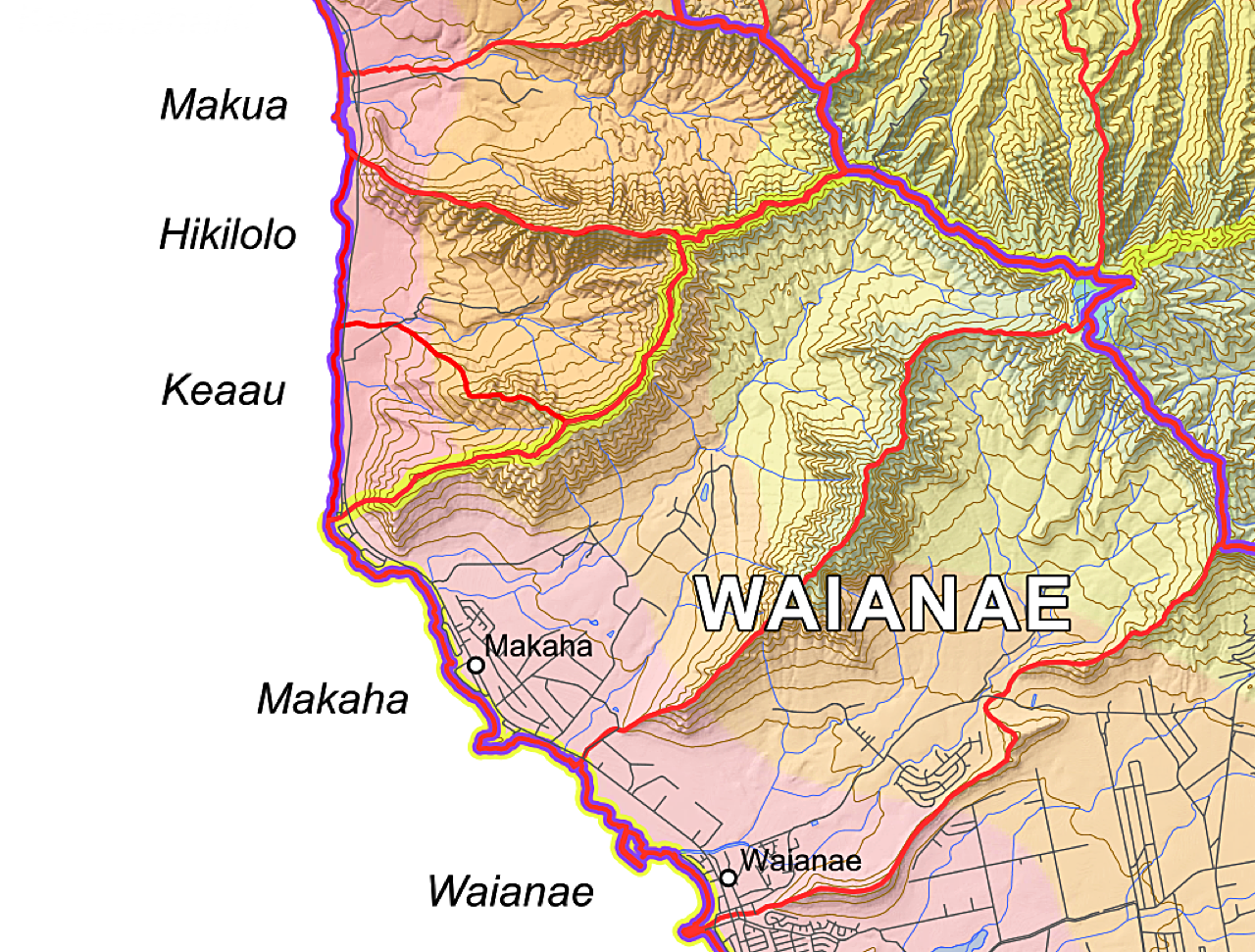
Image above:  Detail part of of Moku & Ahupuaa map of leeward Oahu showing ahupuaa areas of Waianae including Keaau and Hikiolo done by  Juan Wilson. Click to enlarge.  From (http://www.islandbreath.org/hawaiinei/M6Oahu/M6OahuRasterFile.png).


The study was originally done for a proposed golf course, and researchers recorded 461 sites in just 60 acres of the valley.

What may look like piles of rocks to some people are actually the remains of a once-vibrant community that existed more than 1,500 years before the time of Kamehameha I.

Kila, a former teacher and principal on the Waianae Coast, is spearheading a movement to turn Ohikilolo into an area for kanaka maoli (Native Hawaiians) to practice their culture as well as a place for the public to learn about that culture.

“There’s a lot of history that hasn’t been shared … right now we are releasing it so that we can protect the land,” Kila said.

Other community members, including state Sen. Maile Shimabukuro, are on board with the idea of trying to preserve Ohikilolo.

Most of the land is owned by the Pickering family of Arizona, and any push toward creating a state conservation district in Ohikilolo would require approval by the state Board of Land and Natural Resources and cooperation from the family.

One of the family members, Tim Pickering, told Civil Beat that there are currently no plans to develop the area.

As a first step, community members have asked Shimabukuro to request that the state conduct a study that not only considers the archeological sites in the area, but also analyzes how those sites relate to Hawaiian culture. Such a study could be used to recommend the property to the National Registry of Historic Places.

Sacred Lands
The aboriginal families of the Waianae Coast considered Ohikilolo to be part of Kanehunamoku — the sacred lands of Kane, the Hawaiian sun deity.

They believe that in this valley, the first human, La’ila’i, was born. In the Kumulipo, the Hawaiian creation story, La’ila’i becomes the mother of the Hawaiian race.


Image above: From ().

Ohikilolo and the rest of the Kea’au Valley represent a complete ahupua’a, a land district stretching from the mountains to the sea.

Residents of each ahupua’a depended on the others for survival. Coastal dwellers would often trade their fish to valley residents for taro or sweet potatoes, for instance.

“It was a living community made of Native Hawaiians that took care of the land,” Kila said.

In Ohikilolo, the people adhered to the concept of Ka’anani’au — meaning to manage the beauty of time — that regulated land areas through wet and dry seasons.

Kila says the archeological sites could demonstrate the interplay between Native Hawaiian religion and culture. The 1992 study found tools for agriculture and fishing, rock piles that may have once been heiau (Hawaiian temples), foundations for dwellings and walls to divert water for farming.

“The archaeological remains here may be the last representative of a complete prehistoric settlement system on leeward Oahu,” the report said.

After being deeded to a servant of Kamehameha I, spending much of its history as a ranch, and getting glances from a Japanese corporation for a golf course and the city for a dump, parts of Ohikilolo became the property of the Pickerings.

Residents On The Lookout
Cynthia Rezentes, Nanakuli-Maili Neighborhood Board chairwoman, said possible development in Ohikilolo by the Pickerings has been an issue for seven years. In 2007, Robert Pickering acquired 735 acres of land in Ohikilolo and the surrounding area for $3.8 million, according to property documents.

Around 2010, the Pickerings first had the idea to put a luxury housing development on the property, Rezentes said.

Tim Pickering told Civil Beat that the land was never developed because he couldn’t find any investors nor could he negotiate retrofitting the area with roads and adding sewer lines. Pickering hasn’t filed for any building permits or conditional use permits on the agricultural land.

Residents were worried when they recently found a $3.5 million real estate listing from Chaney Brooks & Co. for the 60 acres that includes most of the archeological sites, but representatives of the real estate company told Civil Beat that the listing is from about six years ago and the property is no longer on the market.

In the time that Pickering had the property on the market, even creating a website to try to sell it himself, he only had one person who ever contacted him about it, but that “faded pretty fast,” he said.

“It’s just staying the way it is,” Pickering said. Development “wouldn’t happen for a long time if it happens at all.”

In March, residents worried that Makaha La, another development, would stretch into Ohikilolo.

But Tom Tisher, a real estate agent working with Makaha La, said that the new subdivision would be in Makaha, not Ohikilolo.

The potential for development of Ohikilolo still troubles some community members.

“It’s a waiting game to see whether or not they want to package something again,” Rezentes said. “But they need the draw. If you can get investors to tap into something like this you can potentially build something.”

Hiking To A Temple
On a recent weekend, Chris Oliveira took a small group of hikers up a Makaha hillside to a sacred site. The people of Waianae have traditionally been stubborn, said Oliveira, Kila’s nephew.

In fact, while other Hawaiians were converting to Protestantism, many who lived in Waianae became Catholic. Stories tell of the people’s ancestors being so bold as to call the fire goddess Pele a malihini — a foreigner, he said.

From the road, the hillside wouldn’t necessarily catch anyone’s eye. But the terraces are actually man-made retaining walls stacked to create a temple out of the mountain.

Hawaiians “believed that the preservation of land is more important than the ambitions of man,” Oliveira said. “You see constructions that add to the already natural surroundings … Who could build a bigger temple than this?”

The temple has been ravaged by time and desecrated by a large water pipe that once ran across the hill, Oliveira said.


Image above: About 200 acres, parts of which contain burial sites and petroglyphs, are being used for a solar farm. From original article.

Next to the temple is a large solar farm covering burial sites and petroglyphs.

A solar farm and other military developments such as the Kaena Point Satellite Tracking Station and U.S. Army practice range in Makua Valley are just a few in a long line of developments that have covered up the history of the Waianae Coast, Kila said.

In World War II, the beach fronting Pokai Bay became a recreational center for military officers.

Kila’s relatives once owned portions of that land and refused to leave. They were onipa’a, he said — stubborn. When they resisted, the military shut off their water and electricity and moved them away in trucks.

In the 1960s, much of the coast was designated for hotel developments. Many landowners, including Kila’s family, stood to gain financially if they sold out to would-be hotel and condo builders, Kila said.

Pokai Bay was supposed to become a yacht harbor for residents who would have moved into condos along the coast. The development would have destroyed a heiau that is still used for cultural practices and ceremonies today, Kila said.

Kila’s family went door to door along the coast to convince property owners, as well as legislators who originally backed developers, to block the proposals. It worked. Now, the only buildings near Pokai Bay are the military recreational center, several small home and one apartment building.

The World As A Canoe
When Kila was being taught by his elders, no videotaping or even writing was allowed. Stories, prayers and chants needed to be remembered and passed on orally.

In addition, public sharing of their cultural practices was forbidden.

They were even reluctant to reveal the location of many sites for fear they would be destroyed.

He’s more open now, however, and wants to fight further development by educating the public on the cultural significance of different areas.

“We believe that by preserving Ohikilolo, not developing it, and expanding it as an educational system, the whole world can learn about who we are as human beings and our relationship with the ‘aina,” Kila said.

Kila and Oliveira run the Marae Ha’a Koa, a cultural learning center in Waianae. Its focus is the “preservation and perpetuation of the rich cultural heritage of the Waianae Coast,” according to its website.

Oliveira has taken the helm of education efforts on culture and regularly takes community members to historic sites. He also has authored several children’s books on Native Hawaiian culture.

Kila said his kuleana, or responsibility, is to pass on his knowledge; Oliveira’s is to spread, chronicle and contextualize it.

In the 1992 study, researchers recommended that the area surveyed in Ohikilolo should be recommended to the National Registry of Historic Places. The study was only done on about 60 acres of the Pickerings’ land, and some community members think more archeological sites exist in other areas of the valley.

To eventually protect the entirety of the valley, Kila has suggested the state conduct a Traditional Cultural Properties study.

TCPs go beyond analyzing physical features and include the cultural significance of an area.
Shimabukuro said she will contact the Historic Preservation Division of the state Department of Land and Natural Resources to see what can be done to begin the TCP process.

Community members have requested that she also ask for access to Ohikilolo for cultural practices.

Shimabukuro, who has been involved with preserving Ohikilolo since earlier this year, said that eventually she, and others in the community, want the land to be designated as a conservation district.

The state law for creating a conservation subzone in Ohikilolo includes cooperating with the landowner as well as creating maps and conducting additional studies of the area, according to state documents.

Because of its archeological sites, Ohikilolo could be eligible for the highest conservation subzone, protective, which would effectively ban most development there.

“This world is one canoe. If we jump up and down in a canoe, it hulis. It turns over, and we all perish,” Kila said. “We can’t have people hurting it or one group of people jumping up and down and turn the world into nothingness.”

Read the 1992 archeological study below.
(http://www.documentcloud.org/documents/3899943-Kea-au-Valley-Study-1992.html#document/p1)

• Blaze Lovell is an intern for Civil Beat and a senior at the University of Nevada Las Vegas. He was born and raised on Oahu and graduated from Pearl City High School.

.

Land resources of indigenous wanted

SUBHEAD: International labor organization helps legalize land grabs on indigenous people's territories.

By Renata Bessi &Santiago Navarro on 24 July 1027 for Truth Out -
(http://www.truth-out.org/news/item/41328-international-labor-organization-s-convention-169-helps-legalize-land-grabs-on-indigenous-territories)


Image above: Garifuna community in Honduras, threatened by tourism projects and oil palm monoculture. Photo by Aldo Santiago. From original article.

[IB Publisher's note: This humble homestead looks a bit like rural Hawaii or other pealsant subtropical locations where there are still indigenous people living lightly on the land in preservation with nature. That's not to say that the indigenous do not weigh on nature, but compare their living environment with a goldmine, hydroelectric dam or mono culture palm oil megafarm.]

Indigenous peoples' territories are some of the few places where natural resources are preserved throughout the world. In fact, they protect about 80 percent of the planet's biodiversity but are legal owners of less than 11 percent of these lands, according to the World Bank.

Because of this -- and the fact that so many companies hope to get a piece of these resources -- Indigenous peoples are often in a vulnerable position, and in a permanent kind of war with businesses and governments.

The International Labor Organization's (ILO) Convention 169 on Indigenous and Tribal Peoples' Rights, together with the United Nations 2007 Declaration on the Rights of Indigenous Peoples, have been the main international legal tools to defend territorial rights.

In theory, Convention 169 guarantees Indigenous people residing in the signatory countries the right to their land. To this end, it establishes that for any project that a company or government plans in their territories, they must be guaranteed a free, prior and informed consultation.

Because Convention 169 commits the signatory states to guarantee the integrity of Indigenous peoples, it's been frequently invoked by Indigenous communities and peoples, especially in Latin America, when defending their territories in court. But the Convention has clear limitations that actually jeopardize its intent.

Indeed, the Convention is unprecedented in that it establishes that "all peoples have the right to self-determination."

But in several official yet not-so-public statements, the ILO makes clear how far it sees Indigenous rights as going: "One of the concerns expressed in both political and business circles has to do with a misinterpretation of the Convention where the outcome of the consultations could be the vetoing of projects.

Said consultations don't imply the right of veto and it's imperative that an agreement or consent be obtained," as stated in the document entitled "ILO Convention 169: Indigenous Peoples and Social Inclusion."

While in many parts of Latin America, Indigenous peoples are defending their struggle for self-determination through consultations, for high-level ILO officials, the mechanism's use is clear.

"It's not a 'plebiscite' to obtain a 'yes or no' vote, nor to obtain a 'veto' around decisions with general benefit.

It's a dialogue in good faith to enhance the benefits for Indigenous people regardless of the decision (the state) makes," said Carmen Moreno, director of ILO's Latin America regional office during the forum "Situation of the Right to Consultation in Convention 169," which was held in conjunction with the World Bank in Guatemala in April.

In fact, according to the international organization, it's governments that have the last word on Indigenous territories. "The power of the Convention is that it's an instrument through which the peoples concerned can participate freely in a dialogue with the State.

But the State, ultimately, is the one who must make a decision," the ILO Convention 169: Indigenous Peoples and Social Inclusion reads. Regarding the most serious cases where peoples must be relocated from their territories, "even in these situations the people have no decision-making power," said Moreno.

In addition, Convention 169 establishes that the rights of Indigenous peoples in relation to natural resources must be protected, but it does not grant them exclusive rights over those resources.

Latin America: Principal Signatory
The Convention was signed in 1989 and went into effect in 1991. To date, 15 of the 22 countries that have ratified it are in Latin America: Argentina, Bolivia, Brazil, Chile, Colombia, Costa Rica, Dominica, Ecuador, Guatemala, Honduras, Mexico, Nicaragua, Paraguay, Peru and Venezuela. (In addition to Denmark, Spain, Fiji, Nepal, Norway, the Netherlands and the Central African Republic.)

The significant number of Latin American adherents to the Convention is not a coincidence. It's an attempt to appease the high-intensity conflicts generated by the massive growth of development projects throughout the region.

The Latin American Mining Conflict Observatory (OCMAL) points out that over the last decade, Latin America has become one of the epicenters of mining expansion.

"Guaranteeing indigenous people's rights in Latin America: Progress in the past decade and remaining challenges," a report put out by the Economic Commission for Latin America and the Caribbean (ECLAC), registered more than 200 conflicts in Latin American Indigenous territories linked to extraction of hydrocarbons and mining from 2010 and 2013.


Image above: Baudillo Salles Sánchez, member of the Briri tribe with his family in Costa Rica. Photo by Renata Bessi. From original article.

Térraba: Marked Cards
Carmen Moreno claims that development is the main objective. "The consultations established in Convention 169 are an instrument of good governance to contribute to the development and growth of countries," she said.

However, not everyone the Convention supposedly protects feels included. "They just forgot to ask if our definition of development is the same as their plan for our territories," says Broran tribe member Pablo Sivar, from the Térraba-Boruca Indigenous territory in Costa Rica, who is a part of the Council of Elders. "I definitely don't believe in their type of development."

Sivar and his community are aware of impending threats to their lands and water. "In Térraba, there used to be a lot of water, but not anymore. And they wanna finish off the main river we have, the Térraba River, also known as river Diquís, which in the Boruca language means 'big water'."

He went on to explain that the El Diquís Hydroelectric Project would be the largest hydroelectric plant in Central America, despite official statistics that show that about 99 percent of the country already has electricity. "Who will the Diquís Project favor? Who it will develop? Is it the Térraba Indigenous people? Is it the Indigenous people of the south? Or is it just a few people?"

Work on the Diquís Project began in 2006. After much resistance by the local community, the project was halted in 2011.

Without any additional information, the company simply announced -- on the same day the United Nations Special Rapporteur on the Rights of Indigenous Peoples James Anaya visited -- that it would withdraw its machinery and infrastructure from Térraba territory.

Approximately three years later, the government arrived to begin developing a consultation protocol for Indigenous peoples, with the financial cooperation of international organizations, such as the ILO and the United Nations Development Program (UNDP).

This was announced at one of the government meetings in Térraba, where Truthout was. "We know why they're here. We know what they want," Pablo Sivar stated.

In the same meeting, the locals wanted to know if the process was linked to the Diquís Project. Immediately, government officials denied any link and tried to change the subject. "This process has nothing to do with the project. We're here to develop a consultation protocol for Indigenous peoples," said Ana Gabriel, Costa Rica's vice minister for political affairs and citizen dialogue.

Government officials aren't transparent about the link between projects and the protocol in these public forums, and make contradictory statements to the media. The plan to build the dam in Broran territory continues.

The Indigenous consultation would be the last stage before handing in all necessary documentation to obtain environmental viability and move forward with the project. Feasibility studies and designs are already in place. The construction is scheduled to start in 2018, and operation in 2025.

The attempt to obscure the relationship between the protocol and the project is not in vain. The Indigenous resistance of the hydroelectric dam is longstanding.

"We know that everything is ready for them to resume the work," Cindy Broran of the Broran Indigenous Movement, founded by Térraba tribe members to resist the hydroelectric Project, told Truthout.

"Consultation is the way to legitimize the company's presence in the territory and with it they'll be able to secure financing from international bodies, such as the World Bank. We know that everything's in place."

Project Halted Due to Lack of Consultation
According to Ana Gabriel, who's responsible for developing the consultation protocol in Costa Rica, the country owes a historic debt to its Indigenous peoples and the current government plans on making up for it.

"It's no small matter that the president himself has issued a directive and given a mandate to develop this consultation protocol," she told Truthout.

Despite the politically correct rhetoric of healing and historical debts to Indigenous peoples, the truth is that development projects, funded by international institutions, are unviable because of the lack of consultation.

The vice minister of Costa Rica himself admitted it: "There have been projects that have had to be stopped in Indigenous territories due to lack of consultation."


Image above: Gold mine in a Honduran indigenous community. Photo by Renata Bessi. From original article.Diquís Project: A Bitter Experience

In 2006, the Diquís Project began in Broran territory with a permit issued by the Development Association, a government entity responsible for land management. "Before we knew it, trucks, cars and people were entering the community," said Broran.

"We went to request information and they told us that they had moved forward with it because they had 76 signatures of people affiliated with the Development Association. The association gave the go-ahead for the company to come in and build the dam."

"When the company moved in, it became chaotic," Broran said. "They messed up the whole river, killing many species. Many shops sprang up to sell food, but mostly canteens and bars for workers from outside.

The association gave permission for these businesses, without considering that Indigenous law prohibits the sale of alcohol within its territory. The illegal sale of land increased. Health centers and schools ran out of supplies."

Additionally, ancestral patrimony of the Broran people was looted. Between 2006 and 2010, archaeologists contracted by the company did intense work, recounts Broran. They dug three tunnels that still exist.

"We learned from folks who worked there that they found many archeological sites, including our ancestors' cemeteries. They took everything they found. They took everything and we don't know where it is."

With Sights on Energy
Since the 1970s, the Costa Rican government has conducted studies to implement a hydroelectric project in the region. "Before, it was called Boruca Hydroelectric Project, which was about 15 km downstream from where the Diquís Project is today, but because of the resistance by the Boruca people, the project was cancelled.

So, they moved it higher, in our lands, but it's the same project. It will affect the same river only now on Broran ancestral lands," Cindy Broran said.

According to a study by the World Rainforest Movement, geologists from the company Alcoa (where former US Treasury Secretary Paul O'Neill was the CEO between 1987 and 1999) found deposits of bauxite in the General River Valley's subsoil. Bauxite is the prime material used to make aluminum.

In 1970, Costa Rica's Legislative Assembly passed a law (No. 4562) saying Alcoa -- one of the three largest aluminum companies in the world and considered a defense company since one of its main clients is the United States armed forces -- could exploit up to 120 million tons of bauxite over 25 years and with a possible 15 years of extension, in exchange for building an aluminum refining plant in the same area.

Aluminum foundries require a great quantity of low-cost electric energy. The project is feasible provided a hydroelectric dam were to be built on the Rio Grande de Térraba, the study said.

The dam project triggered major resistance because many people considered it a violation and dangerous. Large demonstrations and protests took place, forcing Alcoa to give up its project.

Energy for the US
The Costa Rican Electricity Institute (ICE) in charge of the Diquís Project has shifted its objectives.

According to the document "National and Transnational Pressures on Energy in Costa Rica," produced by the Association of Popular Initiatives Ditsö, the main reason for resuming construction of the hydroelectric project is the possibility of selling energy abroad, mainly to Mexico and the United States.

The dam is part of the Mesoamerica Project, initially called Puebla-Panama Plan (PPP) and funded by the United States government.

It's an initiative which, among other things, includes an extensive network of infrastructure projects from Mexico to Panama "necessary to export -- or better yet, to plunder -- many of our natural resources, whose common destination is the U.S. and Mexico," the document states.

Diquís: Clean Energy?
To date, the Inter-American Development Bank (IDB) has financed feasibility, environmental and social impact studies around the Diquís project.

They explained their investment as "contributing to increased energy supply in Costa Rica and Central America, promoting sustainability, efficiency and competitiveness of the region's energy sector, in order to address the impact of CAFTA (a "free trade" agreement between the United States, Central America and the Dominican Republic) in the region, through the implementation of a large-scale clean and renewable energy project."

The Process Is Finalized
The process of developing a consultation protocol was designed by the government to occur in four phases and began in March 2016. Of the 24 Indigenous territories of Costa Rica, 20 agreed to everything up until the last phase, including the people of Térraba. Now, the president must issue an order legitimizing the consultation protocol for Costa Rica.

"We debated a long time over whether or not to participate in this process. We're aware that the government always has political gains in mind," said Broran.

"We also know that they manipulate the term 'consultation,' that they're trying to show good faith for public relations. But we want to be there, and say what we think, in front of all Costa Rica."

The Bribri people of Talamanca, a territory in southern Costa Rica, refused to participate in the development of the consultation protocol. "This whole process is a performance," Bribri tribe member Baudillo Salles Sánchez told Truthout.

"Protocols and consultations are tools to justify entering and exploiting the territory. They do the consultation as they wish, and then they can say that they're exploiting our resources with our consent."


.