If you have been paying attention it should be pretty obvious now... we are much like Wile E. Coyote, from the Warner Brothers' Luney Tunes "Roadrunner" cartoon series. The coyote would chase the roadrunner in order to kill and eat him.
The coyote wants to eat the roadrunner, but the roadrunner was to fast and agile for him. The coyote would then purchase some manufactured equipment from a company called ACME (A Company that Makes Everything). His order would often include items like catapults, anvils, dynamite, springs, bear traps or other deadly materials to capture and kill the roadrunner when he stops to eat some birdseed bait.
The traps never worked as expected and the disappointed coyote usually would then test the equipment to see why it failed. Needless to say, the coyote would set off the trigger to the trap and end up crushed by an anvil or catapulted off a cliff.
And this is where I see humanity today. We have employed technology (agriculture, industrialization, computers, etc.) to feed us, lesson our load, and solve our problems... and that is our problem.
We have been so successful in this endeavor that all that remains of nature are human settlements and what they consume. As far as humans are concerned that is all that matters.
Unfortunately that has shown itself to be a dead end road and we are at the end of it... There may be another road we can take but we will have to reduce our numbers and consumption of resources by some orders of magnitude to get there.
We have shown ourselves to be too self-absorbed and greedy to even attempt to meet the goal of sustainability even after the scientific report "A Limit to Growth" by the Club of Rome a half century ago demonstrated we were about to crash life on planet Earth.
Well we are well on the way extinguishing the forests, killing the oceans and melting the polar ice. We have exterminated all but a few wild creatures and will only permit what we eat or put in captivity to live.
We won!
Now what?
If there are any human survivors to the conflagration we are about two witness they will have to begin again as we have in the past. See "Once Through the Bottleneck" - subtitled "Almost 200,000 years ago humans faced extinction. Only a few hundred were saved along the coast of Cape Horn".
In my opinion we will be lucky if there are even a few settlements of humans that get through the coming bottleneck. It is hard to say what might be an oasis through the coming changes.
But be warned - it may be already past time to have any choices as to where you will be, and what you will be doing when you cannot be where you are doing what you do now.
As John Michael Greer has written:
"The Long Descent: A User's Guide to the End of the Industrial Age" (2008)
"Not the Future we Ordered: Peak Oil, Psychology and the Myth of Progress" (2013)
"Collapse Now and Avoid the Rush: the Best of the Archdruid Report" (2015)
"Dark Age America: Climate Change, Cultural Collapse, the Hard Future Ahead" (2016)
"The Retro Future: Looking to the Past to Remake the Future" (2017)
Image above: Deforestation in Indonesian to make way for a palm oil concession. Photograph: Ulet Ifansasti/Greenpeace From original article.
The world must thrash out a new deal for nature in the next two years or humanity could be the first species to document our own extinction, warns the United Nation’s biodiversity chief.
Ahead of a key international conference to discuss the collapse of ecosystems, Cristiana Pașca Palmer said people in all countries need to put pressure on their governments to draw up ambitious global targets by 2020 to protect the insects, birds, plants and mammals that are vital for global food production, clean water and carbon sequestration.
“The loss of biodiversity is a silent killer,” she told the Guardian. “It’s different from climate change, where people feel the impact in everyday life. With biodiversity, it is not so clear but by the time you feel what is happening, it may be too late.”
Pașca Palmer is executive secretary of the UN Convention on Biological Diversity – the world body responsible for maintaining the natural life support systems on which humanity depends.
Its members – 195 states and the EU – will meet in Sharm el Sheikh, Egypt, this month to start discussions on a new framework for managing the world’s ecosystems and wildlife. This will kick off two years of frenetic negotiations, which Pașca Palmer hopes will culminate in an ambitious new global deal at the next conference in Beijing in 2020.
Conservationists are desperate for a biodiversity accord that will carry the same weight as the Paris climate agreement. But so far, this subject has received miserably little attention even though many scientists say it poses at least an equal threat to humanity.
Eight years ago, under the Aichi Biodiversity Targets, nations promised to at least halve the loss of natural habitats, ensure sustainable fishing in all waters, and expand nature reserves from 10% to 17% of the world’s land by 2020. But many nations have fallen behind, and those that have created more protected areas have done little to police them. “Paper reserves” can now be found from Brazil to China.
The issue is also low on the political agenda. Compared to climate summits, few heads of state attend biodiversity talks. Even before Donald Trump, the US refused to ratify the treaty and only sends an observer. Along with the Vatican, it is the only UN state not to participate.
Pașca Palmer says there are glimmers of hope. Several species in Africa and Asia have recovered (though most are in decline) and forest cover in Asia has increased by 2.5% (though it has decreased elsewhere at a faster rate). Marine protected areas have also widened.
But overall, she says, the picture is worrying. The already high rates of biodiversity loss from habitat destruction, chemical pollution and invasive species will accelerate in the coming 30 years as a result of climate change and growing human populations.
By 2050, Africa is expected to lose 50% of its birds and mammals, and Asian fisheries to completely collapse. The loss of plants and sea life will reduce the Earth’s ability to absorb carbon, creating a vicious cycle.
“The numbers are staggering,” says the former Romanian environment minister. “I hope we aren’t the first species to document our own extinction.”
Despite the weak government response to such an existential threat, she said her optimism about what she called “the infrastructure of life” was undimmed.
One cause for hope was a convergence of scientific concerns and growing interest from the business community. Last month, the UN’s top climate and biodiversity institutions and scientists held their first joint meeting.
They found that nature-based solutions – such as forest protection, tree planting, land restoration and soil management – could provide up to a third of the carbon absorption needed to keep global warming within the Paris agreement parameters.
In future the two UN arms of climate and biodiversity should issue joint assessments.
She also noted that although politics in some countries were moving in the wrong direction, there were also positive developments such as French president, Emmanuel Macron, recently being the first world leader to note that the climate issue cannot be solved without a halt in biodiversity loss. This will be on the agenda of the next G7 summit in France.
“Things are moving. There is a lot of goodwill,” she said. “We should be aware of the dangers but not paralysed by inaction. It’s still in our hands but the window for action is narrowing. We need higher levels of political and citizen will to support nature.”
Image above: A child finding magic in the forest. From original article.
"Every year on New Years Day I write down my annual electric meter reading, chart the milage of whatever vehicles I used, including buses, trains and airplanes, and also quantify my use of propane gas, firewood, etc. From that I determine how many trees I need to plant in the coming year to offset the climate impact of my lifestyle."
When I was a young boy my parents moved from the Chicago suburbs to a hardwood forested area of Connecticut, which is where I grew up. My back yard was those woods, and I used to have play forts, many different camping or hiding areas, and a succession of tree houses.
I liked to overnight on a mattress of pine needles in a small grove of pines, and sometimes even did that in a foot of fresh, powdered snow.
My parents also let me climb trees and play on an old rug covering scrap timber I had placed across the lower boughs of a large post oak. Later I built a round pole tipi in that tree and spent many summer nights living there, learning to climb up and down with ropes.
I guess you could say trees are as family to me. They remain a part of my life wherever I go. When I was 17 I learned to work horses on the long line, and later, when I arrived at the Farm in Tennessee, fresh out of grad school, I put those skills to use snaking logs from the forest with a team of Belgian mares.
I built a tent home for my bride on a platform of hand hewn oak logs acquired that way.
People would sometimes come to the Ecovillage Training Center at The Farm and marvel at the small-diameter round poles used for rafters on the very large living roof spanning our Green Dragon tavern, but I knew when I built that roof that round poles were much stronger than milled lumber. They were like the tree limbs that had supported my tree houses.
Deep Well Injection
In my thirties I was a pubic interest attorney fighting against a chemical company in a town 15 miles from The Farm. The company was manufacturing organophosphate pesticides and herbicides and injecting its waste products, including its bad batches, into a deep well.
The State Water Quality labs had tested the green luminescent effluent and said it was the most toxic they’d ever encountered. A single drop dripped into their fish tank killed all the fish within 24 hours.
That deep well went nearly a mile down and pressure fractured bedded limestone — it “fracked” it — to make the rock more receptive to millions of gallons of this witches’ brew.
The fracturing also opened pathways into the Knox Aquifer, one of the largest underground rivers in North America, and presumedly went on to contaminate other large, potentially important, fresh water reserves for the Southeastern United States over a very large area.
Each test well the company drilled showed that the contamination had already traveled farther away from the site than the company was willing to track.
The State did not have the resources to drill million-dollar test wells, so the full extent of the damage may never be known. As well water in the area gradually turned fluorescent green, the company bought out the landowners and sealed their wells.
When our local environmental group sued the company, the company told the judge that there was no reason to protect the aquifer because the Southeast region had plenty of fresh water on or close to the surface.
In written briefs, I made two arguments against that: population and climate change. Freshwater resources were valuable, and would only become more so.
This was the early 1980s, and there I was, going into a Tennessee court and trying to make a case for global warming. It forced me to read nearly every study I could get my hands on and to contact experts and beg them to come and testify.
I tried to simplify an extremely complex subject so that the average judge or juror could understand it, despite confusing and confounding webs of arcane psuedoscience spun by company lawyers, and exceptions in the federal Resource Conservation and Recovery Act that you could pump a lake through.
As it turned out, the case never went to trial. The Tennessee Department of Health and Environment contacted me and persuaded me I should help them draft regulations banning deepwell injection and hydro-fracking, which I agreed to do.
That was a much less costly route for the local environmental group, letting the State bear the expense of experts to fight off the well-funded and unscrupulous industrial lobby.
We had won, although it took a few years before the victory was sealed and the chemical companies packed up and left town. Their toxic waste is still down there, for now.
In any nonviolent campaign
there are four basic steps: collection of the facts to determine whether
injustices exist; negotiation; self purification; and direct
action. — M.L. King, Letter from a Birmingham Jail (1963).
In that time I had spent reading and speaking with experts I had scared myself. Global warming was a much bigger deal than I originally thought. We were up only a half-degree over the prior century at that point, but already there were signs the poles were melting, sea levels were rising, and more frequent droughts were coming to mid-continents.
In 1988, the Mississippi River had gotten so low that barge traffic had to be suspended. My young congressman, Al Gore Jr., opened hearings on Capitol Hill.
Scientists began going public to sound the alarm. Big Oil and Coal began funding campaigns to undermine the smear those scientists and to poison the public debate with bogus studies and conspiracy theories. The Bush Administration’s official policy was climate science censorship. All these signs were ominous.
Carbon Sinks
Fossil fuels have had such a profound change on civilization that it is difficult to imagine giving them up voluntarily. They issued in the industrial revolution and globalized the world with railroads and steamships.
They ended a particularly odious practice that had been the traditional method of Empire-building for the previous 5000 years, supplanting the long tradition of human slaves with “energy slaves” and “energy-saving” home appliances.
The American Civil War was a last gasp of plantation economics, and it ended with a crushing victory for steely industrialists and their fossil energy, who went on to extend their new empire with the Spanish American War and all the resource wars thereafter.
Does the end of coal and oil mean a return to human slavery or can we learn to craft an egalitarian society within a solar budget? Time will tell.
On the other side of the ledger, there are a few promising signs that something can be done to reverse the effects of three centuries of oil and coal addiction. The forests of North America remain a net carbon sink, but when land goes from forest to farm, it generates a huge spike in atmospheric carbon.
In Mexico, which is losing more than 5000 km2 of forest every year, logging, fires and soil degradation account for 42% of the country’s estimated annual emissions of carbon.
In addition to the carbon lost from trees, soils lose 25–31% of their initial carbon (to a depth of 1 m) when plowed, irrigated and cultivated.
In the US, croplands increased from about 2500 km2 in 1700 to 2,360,000 km2 in 1990 (although nearly all of that occurred before 1920). Pastures expanded from 1000 km2 to 2,300,000 km2 over the same period.
The fabled era of the cowboy was between 1850 and 1950, and the pattern was repeated in Canada and Mexico. But then something different happened.
Partly because of the Dust Bowl and the organized responses of the Roosevelt Administration, partly because of the Great Depression, and partly because of an emerging conservation ethic, after 1920 many farmlands were abandoned in the northeast, southeast and north central regions and 100,000 km2 were reforested by nature.
Between 1938 and 2002 the US gained 123 million acres of forest from farm abandonment while losing 150 million acres to logging, primarily in the Southeast and Pacific Northwest.
This trend, net marginal loss, continues today in the US and Canada, in contrast to Mexico which is rapidly destroying its forests, and not re-growing them anywhere.
The net sink effect of a recovering forest is variable but the average for Eastern deciduous successional forest it is 200 grams C per m2 per year, or two metric tons per hectare.
This is calculated by considering annual growth and mortality above and below ground, the chemical changes in dead wood, and net changes in soil carbon. (Pacla S., et al., Eddy-covariance measurements now confirm estimates of carbon sinks from forest inventories, in King & Dilling, 2007).
Sometime around 1985 I began planting trees to offset my personal carbon footprint. Today that forest is about 30 acres (12 ha) and annually plants itself. I wrote a book, Climate in Crisis, pulling together my legal research and laying the climate science out in lay terms that non-scientists, such as myself, could grasp.
In 1995, I retired from law to become a permaculture teacher and ecovillage designer. I continued to attend scientific meetings and international negotiations on climate, and I contributed a blog, many magazine articles and books to the discussion.
I kept myself current with the latest findings, always exploring pathways that might provide solutions, not just for my personal footprint, but also to the coming climate catastrophe for us all.
Atmospheric Scrub Brushes
We could spend print here discussing geoengineering, replacements for fossil energy, biochar, and shifting to some form of ecological agriculture, but the truth of the matter is, nothing can heal our global chemical imbalance faster than trees.
As I wrote in Climate in Crisis, and later in other books, forests are scrub brushes. They absorb CO2 from the air, transform it to O2 with the magic of photosynthesis, and sequester the C in lignin and cellulose.
They also transfer it deep into the ground through their roots and the soil food web.
We, the humans, might be able, under optimal conditions, to get up to sequestering as much as 1 gigaton of carbon (petagram C or PgC) annually by switching to “carbon farming:” holistic management; compost teas; keyline; and organic no-till. Biochar’s full potential is estimated at 4 to 10 PgC per year, if the world were to widely employ biomass-to-energy pyrolysis reactors.
Image above: Carbon cycle in undisturbed (or fully reforested) tropical forest. From original article.
Image above: Carbon cycle after ten years in a deforested tropical forest. From original article.
Forests, with all-out reforestation and afforestation, have a potential yield of 80 PgC/yr.
The climate cycle, with 393 ppm C in the air [this was written in January 2013. The number now is 407], is currently adding 2 parts per million to the atmosphere annually. That represents an additional retention of 3.2 PgC over what Earth is able to flush back to the land or the oceans. The oceans are acidifying — at a disastrous pace — because of the excess C being flushed, so what needs to happen is that more C needs to be taken from both the oceans and the atmosphere and entombed in the land, which is, in point of fact, where the excess came from in the first place.
Going Beyond Zero
To get back to 350 ppm — Bill McKibben’s goal — we need to lower atmospheric carbon by 42 ppm, or 67.4 PgC. If we wanted to accomplish that goal as quickly as say, 2050 (37 years from now), we would need to average a net C removal rate of 1.82 PgC/yr. So we need to go from plus 3.2 to minus 1.8, on average, over about 40 years. Of course, many, myself included, don’t believe 350 is good enough to pull our fat from the fire. I would prefer we aim for 320 ppm by 2050 if we want to escape the worst Mother Nature is now preparing to dish up.
Image above: Carbon cycle in conventional logging in a forest. From original article.
Image above: Carbon cycle with reduced impact logging in a forest. From original article.
A 320 goal in 37 years means we need to lower atmospheric carbon by 72 ppm, or 115 PgC; an average a net C removal rate of 3.1 PgC/yr.
In other words, we need to flip from adding 3.2 PgC greenhouse gas pollution every year to removing about that amount. We have to go net negative, for at least the next 40 years.
Organic gardening and soil remineralization, as Vandana Shiva, Elaine Ingham, Dan Kittredge and others are so enthusiastic for, will not get us there, although it is a good start and an important wedge, with many other benefits.
Biochar could get us there, but the industry is immature, poorly understood by environmentalists, and dependent on financing that may or may not be available in an era of de-growth and economic collapse.
To scale up to 3 or 4 PgC/yr is likely to take longer than 40 years.
Tree planting is our best bet. Franklin Roosevelt’s Civilian Conservation Corps planted massive shelterbelts to end the Dust Bowl, and the jobs provided helped lift the USA out of the Great Depression.
The same could be done in Spain and Greece, not to mention Africa. And, lest we forget, two of the world’s greatest reforestitians, Christopher Columbus and Genghis Khan, demonstrated our species’ ability to rapidly change climate.
They showed that we could even jump start a minor Ice Age if we wanted. Talk about air conditioning! Fageddaboutit.
Right now, the planet is still rapidly losing forest. In 1988, borrowing from federal agency reports being suppressed from publication by the first Bush administration, I drew graphics to show what would happen to the Eastern forest in a 5 degree warmer world, and the kind of species migrations that might be expected.
Image above: Migration towards the arctic of some North American forest trees with 5 degrees centigrade increase in temperature due to global warming.
A more important point, which I raised in Climate in Crisis, was that individual forest patch compositions are less important than the synergies that are lost when those compositions are broken up.
It matters what happens between patches, and it is not just about plants, either. We need to consider the pollinators and seed storing animals. They can’t just have food in one season, they need it in all seasons, or they will leave.
Some plants and animals are fast migrators (armadillos and spruce) and some are much slower (leafcutter ants and ginkgo).
When you force a rapid system change, the network of connections is broken, and it may take some time to find new equilibrium. In the meantime, biodiversity crashes and ecological services are impaired. The web unravels.
GHG Footprints
In the early Nineties I used to quip that before I wrote my book on climate my greenhouse pollution footprint had been in steady decline for 10 years. After I wrote my book it went through the roof. Invitations to speak continue to increase, even now, 23 years later.
Every year on New Years Day I write down my annual electric meter reading, chart the milage of whatever vehicles I used, including buses, trains and airplanes, and also quantify my use of propane gas, firewood, etc.
Using a conversion formula from the book, I convert my personal energy slaves into tree-years. From that I determine how many trees I need to plant in the coming year to offset the climate impact of my lifestyle.
Planting trees as a personal offset requires a bit of advance planning, because the calculation depends on how long a tree will grow, how big it will become, and what it will likely give back to the atmosphere at the end of its life.
Also, one has to anticipate the changing dynamics ushered in by rapid climate change. This led me to arrange for a long-term contract of some land and to acquire new knowledge on how best to plant and manage a climate-resilient forest.
I now have the benefit of visits to the Pioneer and Alford forests in the Ozarks, which I describe in The Biochar Solution (2010), as well as to wilderness old growth in Scotland, British Columbia, Northern Queensland in Australia, Muir Wood in California, the Darien Peninsula of Colombia, the Mesoamerican highlands and the Amazonian Basin, to name a few.
I have studied permaculture, with special reference to the work of Christopher Nesbitt, David Jacke and Eric Toensmeier in designing a methodology for building food-resource forests.
But, back in 1985, I had none of that, and so I began on a part of my parents’ farm that was in the process of transitioning from vegetable field production to low brush.
AUTHOR'S
Apologies to regular followers of our blog who may read the above when
it was first published in 2013. We are re-running this two-part series
this week and next while absorbed teaching a Permaculture course in
Ireland. In the second installment of this series, I will describe the
planting of my personal forest and how I calculate its carbon
sequestration impact.
Warwick Manfrinato, the director of Brazil's Department of Protected Areas, has a deep understanding of biological interdependence, as well as its importance.
"If we are of utter service to nature, then we provide the benefits to all other living things on the planet," Manfrinato told Truthout in his office at Brazil's capital city recently. "I have the same value as a human as a jaguar has in nature, and both should be protected, otherwise we all go extinct, no matter what."
Manfrinato, whose department falls within the Secretariat of Biodiversity in Brazil's Ministry of Environment, is working on a variety of projects, including the establishment of a whale sanctuary that will cover the better part of the entire South Atlantic Ocean between Brazil's vast coastal area all the way across to the west coast of Africa. And on June 23, he and his colleagues launched a national "Corridors Program," with the goal of fostering "connectivity and genetic flux."
"We know the flow of genetics in biomes [biological systems] in life is critical," Manfrinato said. "We have to re-establish this, so a jaguar that exists in Mexico should be able to come all the way here without being killed. Physical connectivity allows for genetic connectivity. A monkey should be able to travel from one part of Brazil to another, without having to pass through land that has been cleared, where there is no forest."
Manfrinato's colleague, Everton Lucero, who is Brazil's secretary for Climate Change and Environmental Quality, was blunt with Truthout about what could happen if dramatic action is not taken to address the impacts of anthropogenic climate disruption (ACD).
"The worst-case IPCC [Intergovernmental Panel on Climate Change projection] is 4.5C by 2100, but at local levels here we see very different impacts already, and are already even seeing an 8C increase in places," Lucero told Truthout.
Manfrinato echoes this: The crisis, he says, has already arrived.
"Everything that is bad has already happened," he explained. "We've come to terms with who we are, and we are those who destroy the planet. We've already destroyed it."
Because of this, Manfrinato believes we already know what needs to be done.
"If we're going to look for solutions, we have to look for the solution for the complexity, not one individual thing," he said. "If there is no connectivity, there is nothing. And that is why I'm busy with building corridors of biodiversity."
He has his work cut out for him. But he's not alone: Many people are working toward similar goals in the Amazon.
A Giant Water Pump
The Amazon is one of the most critically important ecosystems on Earth, and certainly the most biodiverse. It is the world's single largest rainforest, as it is larger than the next two largest rainforests -- the Congo Basin and Indonesia -- combined.
The Amazon River is by far the world's largest river by volume, and has more than 1,100 tributaries, 17 of which are each longer than 1,000 miles. The Amazonian water system is so massive and complex that it influences rainfall patterns as far away as the US, and 70 percent of South America's gross domestic product is produced in areas that receive precipitation influenced by the Amazon.
Brazil's role in protecting the Amazon is critical, given that two-thirds of the rainforest is located within Brazil's borders.
In order to get a sense of the connections between Amazon protection and water issues, Truthout met with Fabio Eno, the coordinator for the Natural Sciences Unit of UNESCO in Brazil, in his office in the capital.
Eno thinks it is more than timely that Brazil happens to be hosting the World Water Forum in March 2018.
"Water and drought are critical issues here now, which is so ironic since Brazil is hosting this huge event on water next year, and we are facing water crisis in some of the largest cities here," Eno told Truthout. "What we are seeing in Brazil is that climate change has been and continues to be very clearly visible."
He pointed out that in Brasilia, where there used to be very clearly demarcated dry and rainy seasons, they are now imbalanced: The dry season is starting earlier, and there is less rain during the rainy season. This is a reflection of the progression of climate-related changes in the country.
"In the south, well known for rice production, which has high water consumption, they are facing more droughts and this is affecting local farmers," Eno explained. "States in the northeast are now more intensely affected by the dry season, so we see clearly the effects of climate change in all portions of Brazil."
Eno noted that the impacts have been so intense that Brazil has been caught unprepared, and sees this shift in climate as having contributed to a major international health crisis: Zika virus.
"With the major drought recently in Sao Paolo, people were encouraged to store water in basins in their residence, and even in their toilets," he said. "Then, not coincidentally, we have Zika virus outbreaks that came about the same year Sao Paolo was storing so much more water. People were storing water in every way they could after what happened, but weren't taking necessary care for safeguards. This caused a major international health issue."
Manfrinato sees water-related problems as the biggest climate disruption impacts humans have had.
"What differentiates this planet from every other planet is liquid water," he explained. "It has taken Earth millions of years to find the right balance of liquid water, and people don't understand how important that is and are messing it up with their greed and ambition, of which awareness is far more important."
Manfrinato explains that as humans have "fooled around" with temperature, they have shaken the very foundation of biology.
"Fooling around with water is impossible, as that is the tree of the fruit of life," Manfrinato said. "You mess with it, you mess with everything ... and we've already messed with it."
Lucero also underscored the Amazon's critical role in the watery realms, especially regionally. The rainforest, he said, provides "flying rivers" -- massive amounts of air-borne moisture that develop above the canopy and move with the clouds and rainfall patterns across South America.
"If you remove the forest, you will cause extreme drought in other regions," he told Truthout.
But he says that biodiversity is the Amazon's biggest contribution to the world -- and is the most important reason to care for the rainforest.
"The forest itself is suffering from climate change, as are other biomes," he said. "Variability of climate is affecting the forest from increasing flooding and wildfires, which may, in a doomsday scenario, compromise the entire forest."
Manfrinato sees humans as part of the ecosystem, and an integral part at that, but most assuredly not the apex.
"What is required is a shift of awareness of our being part of nature," he said. "The apex is the complexity. Humans are not the apex, and the awareness that comes from this is how dynamic the system is that allows for all of life on Earth.... It'll do this as long as we allow it to do so."
Manfrinato is deeply passionate about his work, and in the discussion, sounds as much like a philosopher for the planet as Brazil's director of protected areas.
"We need to respect complexity in order to survive as a species," he said. "Everybody and everything wins, or everybody and everything loses if we hold onto this lack of awareness that the complexity is the most important thing. Your apex contribution is to be aware of the complexity, and then to protect it."
Brazil's Forest Code
Many people are acutely aware that there is a massive problem with deforestation in the Amazon. Beginning in 2004, however, deforestation started to decline in the Amazon, primarily because of better protection policies in Brazil. However, the last two years have seen a dramatic increase again. Brazil's government has been in crisis, and monitoring and enforcement have been stymied, allowing for a resurgence.
Fabio Feldmann served in Brazil's parliament for 12 years in the 1980s and 1990s. He is famous for helping to bring positive changes to the forest code -- protections for the Amazon -- into Brazil's constitution in 1988.
"The single most important issue facing Brazil is protecting all of the critical biomes," Feldmann told Truthout during an interview at his home in Sao Paolo. "If you destroy the Amazon region in Peru, you have a great impact in Brazil, and vice versa."
He explained that there is currently only weak collaboration between the countries in South America regarding the Amazon, and this is a problem.
"When I was elected, there was a radical change [in consciousness] about environmental areas," he said. "But this design has not been translated into effective public policies, so now our generation must reflect about what our legacy is to be because right now the deforestation rates in the Amazon are unbelievably high, after so many years."
Feldmann said he is optimistic, and cites heightened public awareness about the land today as compared to 30 years ago. However, he asked, "Do we have time to do what must be done?"
Clayton Lino is president of the Biosphere Reserve Association of Brazil and is a member of the advisory committee for UNESCO's Atlantic Forest Biosphere Reserve. Truthout interviewed him at his office in the Biosphere Reserve of the Mata Atlantica rainforest in Sao Paolo, a beautifully forested island in the middle of the sprawling polluted city.
"We are under attack daily, because we have laws in the process of being made that destroy other laws that were there to protect the land," Lino said.
This is important to understand, Lino said, because there is so much international pressure on the Brazilian government to continue deforesting. Cattle ranching accounts for roughly 70 percent of the total deforestation in Brazil, and the demand for Brazilian beef in the US and Europe is driving that ranching.
"While local NGOs are working to protect the Amazon and the Mata Atlantica, we do not see any light now," he explained. "There is no international help, and the culture of corruption has infected many Brazilians now because corruption has come from the top down, so more and more people are starting to not respect basic laws."
He is so concerned because his beloved Mata Atlantica, the second biggest rainforest reserve in Brazil, is the most threatened area of rainforest in the world, second only to the Madagascar rainforest.
"We have more biodiversity here than even in the Amazon," he said while pointing out the window. "The Amazon is far bigger, but in the Mata ... we have more endemism [species that live only in one area] than anywhere else in the world."
Lino explained that fragmentation (isolating sections of the forest) is the primary problem in the Mata.
"There is high biodiversity and fragility, because if you destroy something in one place, it cannot come back in another area of the Mata," he said. "So, fragmenting it causes a very big problem."
Today, only 8 percent of the Mata Atlantica remains.
Caring as Protecting
"Without connectivity for evolutionary movement, it cannot proceed," Manfrinato explained of the natural corridors he is striving to create across his country. "This adaptation process needs north/south corridors, because species in the southern hemisphere need to migrate south, and in the north, they'll need to migrate northwards as global temperatures continue to increase."
Image above: Warwick Manfrinato, Director of Brazil's Department of Protected Areas, is working to reconnect all of the biodiversity corridors across the Amazon. Photo by Dahr Jamail. From original article.
Previous to his current job, Manfrinato was a member of the University of Sao Paolo's Amazon research group, which bore the idea of ecological corridors. This is why he was given the position he has in the government: to implement these ideas on the ground.
"Protection is connection, and vice versa; it has to be both," he said.
Claudio Angelo is the head of communications for Climate Observatory, an NGO. A former journalist, he now runs a news website for a vast network of 41 Brazilian NGOs which produces annual estimates of the country's greenhouse gas emissions.
Angelo explained to Truthout that observable shifts in rainfall patterns are now becoming common across the country, along with a shifting of the timings of the wet and dry seasons. Plus, like much of the world, Brazil is seeing far higher temperatures than ever before. He points to some farming regions that have already seen 6C increases.
"Brazil has warmed faster than the global average, since we are in the tropics," Angelo said. "Since 1961, it is 1C hotter in Brazil, and it took us half the time to warm the same as the rest of the world."
Angelo noted that the Amazon has seen two 100-year drought events (extreme drought events that only happen every 100 years) in a five-year period -- the first in 2005 and then another in 2010.
"The feedback mechanisms that exist between deforestation and climate change are my biggest concerns," he said. "Deforestation was 46 percent of our emissions last year, so our main focus is on mitigation. Hence, we are advocating for zero deforestation in Brazil."
Like Feldmann, Angelo had grown hopeful that his country was finally getting the deforestation of the Amazon under control, until recently.
"Over the last two years we saw this not to be the case, as we had a 60 percent increase in deforestation in just the last two years," he said. "Because of this, Brazil ranks in the top 10 [countries, in terms of] global greenhouse gas emissions."
When trees are chopped down, all the CO2 they sequestered from the atmosphere is released. Angelo pointed out the window and discussed the obvious changes.
"Brazil is still water rationing as we speak, after two record-drought years in a row," he explained. "2015 saw a 45-day heat wave. There is no way you can take off a huge chunk of some part of the planet and think it won't have a major impact on climate change."
As a climate journalist Angelo has reported from the Arctic, Greenland, Antarctica and deep into the Amazon. But right now, he is most struck by what he is seeing in his hometown of Brasilia. When he was a child, he remembers how cold it was in the evenings during the winter, and how summers were not as hot as they are now.
"The number of warm nights, when it is not below 20C, has increased 10 times more than it was 30 years ago," he lamented. "Most of the year here now it's just nasty. It's just hot, and it wasn't like this 20-30 years ago."
Personal experience plays a core role in Manfrinato's motivations, as well. He shared his experience from a recent long hike he'd taken that had a deep effect on his perception of the planet.
"It was in a newly protected area of Brazil and I came out of there feeling part of that place, meaning, that place is mine, and I'm going to protect it," he explained. "And so, we need everyone to start feeling that way about places ... about the planet. You belong to it because it belongs to you. You don't protect it because it belongs to everybody, you protect it because it belongs to you. The land belongs to me, because I belong to the land."
Manfrinato continues his work to reconnect wildlife habitat on the local levels. He aims to move it from local to regional connections, then regional to national, then across borders, then continental.
"We are promoting this internationally," Manfrinato said. "Because without reconnection, we will not survive." .
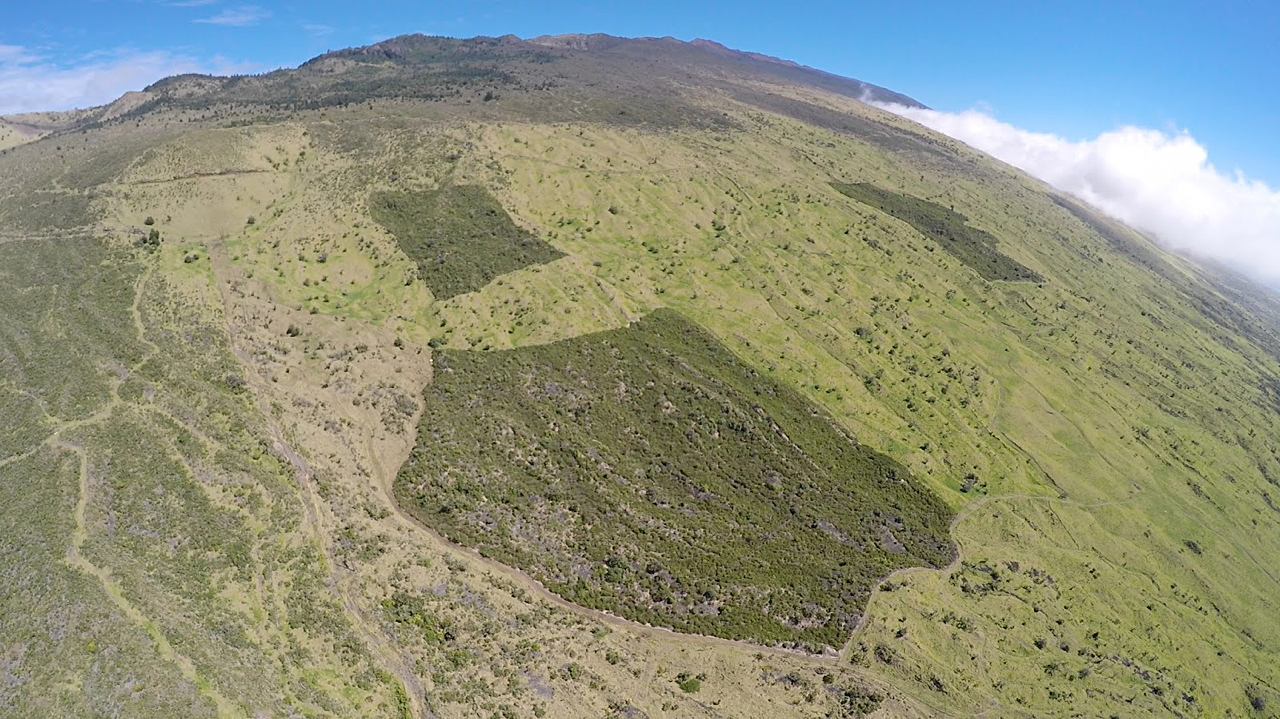
Image above: Southern flank of southwest Maui where Auwahi reforestation project is turning Haleakela green. From original article. Click to enlarge.
When Art Medeiros fenced some Maui pasture that had a smattering of native dryland forest plants on it, most folks figured he was engaged in a pipe dream.
He hoped that by excluding deer and cattle, and with a little loving care and some outplanting, something approaching a healthy native dryland forest could result.
Medeiros was right. The image above is the proof. The three dark green patches are areas fenced to keep grazing animals out and then planted with dryland natives. The 10-acre center square was fenced and planted 20 years ago, the bottom 23 acres 12 years ago, and the 23-acre shape at the right eight years ago.
Medeiros worked with the landowners, `Ulupalakua Ranch’s Erdman family, along with the U.S. Fish and Wildlife Service and the Natural Resources Conservation Service, to form the Auwahi Forest Restoration Project. You can learn more about it at this website.
What they found is that landscape-scale conservation efforts work.
It is a remarkable example, but certainly not the only example in Hawaii.
When the Territory of Hawai`i removed feral cattle from the Koke`e grasslands on Kaua`i, those rolling acres of pasture were able to convert back to forest that is now Koke`e State Park.
When George Munro on Lana`i fenced hundreds of acres at Kanepu`u a century ago to keep out deer and mouflon sheep, he protected a native forest that survives today.
When Lida and David Burney took the analysis of ancient pollen samples at Makawehi on Kaua`i and planted those plants into a nearby former cane field, they restored something long gone from that landscape.
Medeiros a few decades ago saw a few botanical gems in a severely degraded landscape. When he proposed trying to restore it, he got a lot of pushback. It was a dead forest standing, he was told - Degraded landscapes were inevitably going to further decline.
He didn’t give up.
“The question was whether we could rebuild this system, or was this (an example of) the end of all natural systems?”
At Auwahi, there were priceless old endemic trees, but they were not reproducing and had not reproduced for decades. The native species covered only 3 percent of the landscape.
Why care? Native dryland forest is some of the rarest treasure in the Hawaiian realm. It has been displaced by development, agriculture, pasture and constant pressure from non-native predators on the natural landscape, like cattle, deer, goats, sheep, pigs and rats.
Medeiros and his team fenced out the cattle and deer at Auwahi, starting with the 10-acre square they now call A-1. With the help of teams of community volunteers, teachers, canoe clubs and many others, they began planting out native species—more than 125,000 seedlings to date.
The result: Native species cover in some areas is now 82 percent.
“Near two-thirds of native tree species at Auwahi are now producing seedlings naturally, a sign of a healthy functioning ecosystem, including some species that had not done so in centuries,” Medeiros said.
And on a dry slope of Haleakala, where much of the landscape is brown and yellow, here it is deep green. Not only an indication that the plants are back, but that the landscape is functioning as a watershed.
Medeiros gives special credit to the landowners, Pardee and Sumner Erdman and their family, for their dedication to conservation, and their willingness to convert pasture to native forest—without compensation.
“`Ulupalakua Ranch has...served largely as a silent and enthusiastic partner. In all my years in conservation, I have never seen another for-profit group act in this way,” he said.
Donors to the project over the years included the Frost Family Foundation, Maui County Department of Water Supply, Hawai`i Community Foundation, Hawai`i Tourism Authority, Maui County Office of Economic Development and the Edward J Anderson Foundation. .
Image above: Indigenous farmer with nearby forest trees. From original article.
Agroforestry — integrating trees into cropland or pastureland — is often discussed as a promising strategy for helping to ease the threat of climate change because trees are particularly good at sucking carbon dioxide from the air and socking it away for the long term.
However, most global and regional calculations of carbon capture and storage, including those of the Intergovernmental Panel on Climate Change, ignore farm forests.
That could change, thanks to a new study published in Scientific Reports that takes a look at trees on agricultural land and quantifies the powerful role they play in sequestering carbon.
Using estimates of global farmland tree cover derived from remote sensing observations, a team of researchers from Asia, Africa and Europe calculated the amount of carbon captured and stored by trees growing on farmland.
When carbon stored by these trees was included, total carbon storage for agricultural land measured more than four times higher than current IPCC default values.
“These results show that existing tree cover — thus far ignored in most global and regional calculations — makes a major contribution to the carbon pool on agricultural lands,” the researchers wrote.
The study found that as the world’s forest resources decline, tree cover on agricultural land is expanding. Analysis of the remote sensing results revealed that 43 percent of the world’s agricultural land was forested in 2010, a 2 percent increase over the previous 10 years.
Looking at regional patterns in the distribution of agricultural tree cover, the researchers found high percentages of tree cover occurring in humid regions such as Southeast Asia, Central America, eastern South America and central and coastal Africa.
Tree cover was moderate in the majority of agricultural areas in South Asia, sub-humid Africa, Central and Western Europe, Amazonian South America and Midwestern North America. Agricultural areas with low tree cover included Southwest Australia, Eastern China, the northern prairies of North America, and the southern border of the Sahara.
Heavily populated areas tended to have less tree cover, despite their climate, so regional variations and trends were also investigated. This analysis revealed many areas where higher tree cover density and carbon storage are possible.
Encouraging agroforestry in these regions through policy and incentives, the researchers noted, could be an “achievable and relatively fast” path to increasing greenhouse gas absorption.
The researchers also examined the amount of carbon stored on agricultural land in individual countries and found insightful differences. Places where forests are regarded as nationally important, for example Brazil or Indonesia, have high and increasing carbon storage levels on agricultural land.
In Brazil, some of the increase may stem from policy initiatives and the adoption of agroforestry practices.
Argentina, on the other hand, has experienced substantial loss of carbon capture and storage, most likely due to widespread adoption of large scale mechanized soy cultivation over the past decade.
The report notes that more research is necessary to understand what is driving these trends so effective policies and market incentives can be developed to both reduce forest conversion and encourage more trees on farmland.
In addition to being an efficient strategy to offset carbon losses due to deforestation, the researchers noted that integrating trees into the agricultural landscape also benefits small farmers around the globe by helping to optimize soil moisture, boosting soil nitrogen, and in general encouraging a more diverse, productive, profitable, healthy and sustainable use of land.
“In summary,” they conclude, “our analyses highlight that agroforestry, and tree cover on agricultural land in general, has clear potential to contribute to climate change mitigation while providing an array of adaptation benefits.”
UPDATED 09.22.16: The journal citation was corrected to Scientific Reports.
Scientists are becoming increasingly concerned about the fate of the huge boreal forest that spans from Scandinavia to northern Canada. Unprecedented warming in the region is jeopardizing the future of a critical ecosystem that makes up nearly a third of the earth’s forest cover.
The boreal forest wraps around the globe at the top of the Northern Hemisphere in North America and Eurasia. Also known as taiga or snow forest, this landscape is characterized by its long, cold and snowy winters.
In North America it extends from the Arctic Circle of northern Canada and Alaska down into the very northern tip of the United States in Idaho, Washington, Montana, and Minnesota. It's the planet's single largest biome and makes up 30 percent of the globe's forest cover.
Moose are the largest ungulate in the boreal, adapted with their long legs to wade in its abundant marshes, lakes and rivers eating willows, aspen and other plants. In the southern boreal forest of northern Minnesota, moose were once plentiful, but their population has plummeted.
Thirty years ago, in the northwest part of the state, there were some 4,000; they now number about a hundred. In the northeast part, they have dropped from almost 9,000 to 4,300. They’ve fallen so far, so fast that some groups want them listed as endangered in the Midwest.Moose carcasses deteriorate rapidly before they are found, and so forensics has not been able to determine why they are dying.
Some experts surmise it could be that tens of thousands of ticks that mob an animal and weaken it.
Others think it's a parasite called liver flukes, or the fact that winters have gotten so warm the animals can't regulate their body temperature and die from heat stress.
But Dennis Murray, a professor of ecology at Trent University in Peterborough, Ontario, thinks the dying moose of Minnesota and New Hampshire and elsewhere are one symptom of something far bigger – a giant forest ecosystem that is rapidly shrinking, dying, and otherwise changing. "The boreal forest is breaking apart," he says. "The question is what will replace it?"
Many scientists, in fact, are deeply concerned about the state of the world’s largest forest. The Arctic and the boreal region are warming twice as fast as other parts of the world. Permafrost is thawing and even burning, fires are burning unprecedented acres of forest, and insect outbreaks have gobbled up increasing numbers of trees.
Climate zones are moving north ten times faster than forests can migrate. And this comes on top of increased industrial development of the boreal, from logging to oil and gas. The same phenomena are seen in Russia, Scandanavia, and Finland.
These disturbing signals of a forest in steep decline are why NASA just launched a large-scale research project called ABoVE — Arctic Boreal Vulnerability Experiment, a “major field campaign” with 21 field project sover the next decade. But the studies will confirm in detail what many know is well underway.
“Boreal forests have a potential to hit a tipping point this century,” said Anatoly Shvidenko, of the International Institute for Applied Systems Analysis and a co-author of a survey of a recent research on boreal forests in the journal Science. “It is urgent we place more focus on climate mitigation and adaptation with respect to these forests.”
A tipping point would include the mother of all concerns: the unbridled melting of permafrost, one of the main thrusts of the ABoVE project. The permafrost in the boreal is more susceptible to thawing than in the Arctic because it’s closer to the freezing point.
If large-scale melting occurs it would release more carbon dioxide and methane, which have been bound up in the frozen soil for thousands of years, and bring on more warming, and then more thawing, a dangerous loop. “Scientists call it a positive feedback, but most people call that a vicious cycle,” said Peter Griffith, chief support scientist for the ABoVE project.
Murray has been researching the boreal forest for 25 years, and he and his colleagues have seen many changes firsthand. In British Columbia, 80 percent of the province's mature lodgepole, another boreal species, have recently died from the mountain pine beetle, whose range and season both expanded greatly because of a warmer world.
White and black spruce, the main trees species in the boreal, are also dying in vast numbers “The southwest Yukon looks dramatically different than it did 25 years ago when I did my master’s [degree],” he said. “Everywhere you go there is deadfall.
NASA has also seen a lot of forest browning in its studies, large swaths of forests with reduced growth that turn brown in the hotter than normal summers, and which contribute to much bigger and hotter fires and the thawing of the permafrost.
“Severe fires burn a foot or more of organic soil and that's the insulating layer that keeps the permafrost frozen,” said Scott Goetz, lead scientist on the ABoVE project. “Once that is removed the thaw is much more rapid.”
The fires also change the vegetation. “When you remove that organic soil you get deciduous re-growth that lasts for decades,” said Goetz. “Maybe it will never come back as coniferous.”
Typically, when black spruce dies, it is replaced with new black spruce. “That’s been going on for a long, long time, [but] not anymore,” Murray says. “You lose spruce and you lose everything that lives in spruce and that is basically everything in the boreal forest.
We’re seeing the same phenomena that we’ve seen with moose with lynx and snowshoe hares. And caribou are going belly up very, very fast. Their ranges are receding northward rapidly.”
The boreal is also home to some 5 billion birds. Many species have shifted their ranges north. “Climate change is having an impact much more quickly than we thought,” said Jeff Wells, a senior scientist with the International Boreal Campaign who focuses on birds. “Shifts that researchers thought
But the changes in such a large system are complex. The forest isn’t merely receding north, it’s dying in some places in its interior and surviving quite well in others. A 2015 study found that while boreal spruce forest in interior Alaska is dying out because of warm temperatures, the same forest on the state’s west coast is thriving.
The dying spruce and moose and lynx and other changes are the dots that scientists are trying to connect to get a sense of what the boreal forest in North America will look like in the next half century.
The caveat is that in a system this massive and complex there are so many variables it's difficult to forecast with much certainty. The projected changes, for example, are based on the Intergovernmental Panel on Climate Change's temperature forecast of a rise of some 10 degrees by 2100.
Should things warm faster or go higher, the changes could come faster and be deeper or different than modeled. And many changes could simply be unpredictable.
Murray’s modeling shows that a large gap is opening in the boreal in Ontario and Quebec, a gap some 500 by 350 kilometers. It will essentially split the contiguous forest into two separate forests — one to the east, the other to the west — as the black spruce and white spruce disappear.
That gap could then become grassland or Carolinian, the forest ecosystem that dominates south of the boreal in Ontario, characterized by oak, maple, black walnut and other deciduous species.
As the spruce goes, so goes its inhabitants. "We're predicting there’s going to be no lynx, moose, or hare in central Ontario in the years to come,” Murray says, “so we’re going to have disjunct populations on either side." It could cause a break between populations of species and a loss of genetic diversity.
Murray has coined a term for the patchy quality of the effects of warming on the boreal – climate fragmentation. “Because it’s a gradual transition, it won’t be real boreal and it won’t be real deciduous,” says Murray. “Ecosystems will likely be less stable and more open to invasives.”
Changes in snow cover are already driving changes. In some places snow covers the ground for shorter periods, and the conditions of the snow are also changing. Instead of three feet of fluffy snow all winter, temperatures rise and melt the snow and then get cold and freeze it and compact it into ice, again and again.
In such conditions, lynx, which have thick, padded paws that serve as de facto snowshoes and allow them to hunt atop deep snow, loses it evolutionary advantage. “It affects their ability to survive,” says Murray. “Coyotes, on the other hand, are extremely plastic and flexible. They weren't in the boreal a hundred years ago, but they are there now. They aren't everywhere, because they don’t do well in deep snow, but that's changing.” They are competing with lynx by foraging for their kills and preying on hares and squirrels.
The die-off of much of the boreal forest could have serious and unpredictable repercussions on the global climate system. When British Columbia’s lodgepole forests died, the province went from being a carbon sink to a carbon source because the dead forests released massive amounts of stored CO2.
If the spruce forests of the boreal disappear they could also alter climate systems by releasing CO2.
Because they are dark, they also absorb heat, but a treeless, snow-covered landscape would reflect far more solar energy back into the atmosphere.
Knowing what could happen in the next 50 or 60 years, and where, is important for conservation and other strategies. The boreal, especially in Canada, isn’t just a forest. It’s woven into the fabric of the region’s life and culture.
Hundreds of First Nations call the boreal home, and they depend on it for sustenance, hunting moose and caribou, picking berries, and fishing. Paper and lumber industries also depend on a healthy boreal.
The research NASA is doing will be used to help determine how communities and land managers in the boreal might adapt to changes. Dall sheep in the Yukon, for example, are in decline and a subject of one of NASA's studies.
The results will be given to provincial and federal officials in Canada to make decisions on issues ranging from hunting to access to land management.
Meanwhile, in the hope of slowing the thawing of boreal permafrost, the International Boreal Conservation Campaign has launched a “cold carbon storage campaign.” This initiative is aimed at managing the boreal in ways that keep as much as possible frozen — no road building atop it, for example, or the creation of new large scale carbon reserves.
But such measures can only do so much. The real decisions on the fate of the boreal are up to the world community. It’s not a good sign that when I contacted Canadian Forest Service scientist Sylvie Gauthier, the lead author of the Science paper that surveyed threats to the boreal, I was told by a public affairs officer that the interview would be on “deep background only” with no attribution to her or her employer.
The federal government of Canada, facing some the world’s most serious climate change threats, has gone to great lengths to squelch any discussion of this issue.
Yet even as they redouble their research efforts, scientists know the ultimate answer is not about adaptation or more research, but a rapid reduction in global CO2 emissions, which so far has shown little hope of being achieved.
NASA’s Griffith says the situation reminds him of his father, a small-town doctor. “Even when the patient ignored his advice over and over again, he would continue to treat the patient,” he said. “A lot of us in the climate and ecosystem world are finding ourselves dealing with a similar kind of problem.”
[IB Publisher's note: Sounds like Brazil is taking a lesson from American dealings with Native Americans and the Hawaiians in stripping the land of natural life. One definition of Fascism is an authoritarian government organized by the military and industry to exploit the resources of "other" people through intimidation and violence. Racism and violence simply come with the territory.]
Image above: The military police were constantly present, protecting the headquarters of Brazil's three branches of government from the indigenous protesters. Photo by Santiago Navarro. From original article.
In an effort to make way for new investment projects, the Brazilian government and transnational corporations have been taking over ancestral indigenous lands, triggering a rise in murders of indigenous people in Brazil.
According to the report, "Violence Against Indigenous People in Brazil," recently published by the Indigenous Missionary Council (CIMI by its Portuguese initials), the number of indigenous people killed in the country grew 42 percent from 2013 to 2014; 138 cases were officially registered. The majority of the murders were carried out by hit men hired by those with economic interests in the territories.
The states of Mato Grosso del Sur, Amazonas and Bahía figure heavily in the statistics. An emblematic case was the brutal killing of the indigenous woman Marinalva Kaiowá, in November of 2014. She lived in recovered territories, land that for over 40 years has been claimed by the Guaraní people as the land of their ancestors. Marinalva was assassinated - stabbed 35 times - two weeks after attending a protest with other indigenous leaders at the Federal Supreme Court in the Federal District of Brasilia. The group was protesting a court ruling that annulled the demarcation process in the indigenous territory of the Guyraroká.
In addition to this, there has been a steady flow of people forced to move to small territories after being displaced by economic development projects, as in the case of the state of Mato Grosso do Sul, where the majority of the population - over 40,000 people - live concentrated on small reservations. These are communities that are exposed to assassinations by hired hit men, lack education and basic necessities, and endure deplorable health conditions. Infant mortality rates in the community are high and rising: According to official statistics, last year 785 children between the ages of 0 and 5 died.
"We, the Guaraní, principally from Mato Grosso do Sul, have been the greatest victims of massacres and violence," the Guaraní Kaiowá indigenous leader Araqueraju told Truthout. "They have killed many of our leaders, they have spilled much blood because we are fighting for the respect for and demarcation of what is left of our territories that the government does not want to recognize."
The rise in the rate of violence is related in large part to the development policies of the Brazilian government - policies that have been denounced by the Indigenous Missionary Council. Another report, titled "Projects that impact indigenous lands," released by CIMI in 2014, revealed that at least 519 projects have impacted 437 ancestral territories, directly affecting 204 indigenous groups.
The energy sector has most deeply affected indigenous people; of the 519 documented projects, 267 are energy-related. In second place is infrastructure, with 196 projects. Mining is third, with 21 projects, and in fourth place, with 19 expansive projects, is agribusiness. Ecotourism comes next with 9 projects.
"In the Amazon region, the region of the Tapajos River, we are being fenced in," João Tapajó - a member of the Arimun indigenous group - told Truthout. "The Teles waterway is being constructed and the BR163 highway widened. This is being done to transport the transnational corporations' grain and minerals," added Tapajó, who is part of one of the groups that make up the Indigenous Movement of the region Bajo Tapajós, in the state of Pará.
"We live under constant threat from agribusinesses and lumber companies. There is a construction project to build five hydroelectric dams on the same river. To top it off, our region is suffering from a process of prospecting for the exploitation of minerals, by the companies Alcoa y Vale do Rio Doce."
Similarly, a report produced by the Federal Public Ministry, based on its own evaluations and carried out by anthropologists María Fernanda Paranhos and Deborah Stucchi, shows that the processes of social change generated by these projects principally affect those who live in rural contexts. This includes many groups living collectively who are relatively invisible in the sociopolitical context of Brazil.
"The evaluations provide evidence that the intense social changes, the possibility of the breaking up of productive circuits, the disappearance of small-scale agriculture, fishing, and forested areas, a reduction in jobs, and the impoverishment and degradation of material and immaterial conditions of life ... have led to strong reactions and an avalanche of social conflict," according to the ministry's report.
Hydroelectric Dams in the Brazilian Amazon
The government's Ten-Year Plan for energy expansion - 2023, which projects for the period of 2014 to 2023 an expansion of over 28,000 megawatts of energy generation by way of hydroelectric dams, claims that none of the 30 hydroelectric dams projected for construction in this country during this period will have any direct effect on indigenous lands.
Data from the Institute of Socioeconomic Studies, through an initiative called Investments and Rights in the Amazon, tells a different story. According to research carried out by Ricardo Verdum, a PhD in social anthropology and member of the Center for the Study of Indigenous Populations at the Federal University in the state of Santa Catarina, of the 23 hydroelectric dams that will be built in the Amazon, at least 16 will have negative social and environmental effects on indigenous territories.
They will destroy the environmental conditions that these indigenous groups depend on to live and maintain their way of life.
"The difference in results is due to the way the idea of 'impact' or 'interference' is defined conceptually and materially," Verdum told Truthout. "According to current legislation, interference in indigenous lands occurs when a parcel of land is directly affected by the dam itself or the reservoir. The territorial and environmental criteria do not consider the human and social aspects of the interference, or influence of the project on the population."
A Militaristic Approach to the Economy
Image above: The atmosphere grew tense as Federal Police came in to oust the Pataxo blocking the highway through their land,one of the richest areas in terms of flora and fauna in the world. Photo by Santiago Navarro. From original article.
Brazil's development model - a model adopted by most countries in Latin America within the old international division of labor - leads the country to specialize in the export of raw materials or basic products at a low cost in relation to the import of final products that return to Brazil at elevated prices.
This is a logic that is based on the colonial model, according to Clovis Brighenti, a professor of history at the Federal University of Latin American Integration. "It is an entry into the globalized world by way of intense exploitation of the environment with few results," Brighenti told Truthout.
"What's more, these results are in exchange for high investment costs, made with public resources and subsidized interest rates, concentrated in a tiny group of beneficiaries. It is a dried-up model but in its death throes, it causes irreversible damage to the environment and for the people that depend on these ecosystems."
The design of this development model, according to Brighenti, is connected to the modern myth that an economy needs to grow rapidly and continuously to satisfy the material necessities of society.
"However, behind this myth, is hidden the essence of the capitalist system: the need to guarantee a logic that is based on consumerism, and in this way, guarantee the accumulation and the benefit of the elites and the privileged sectors of society."
In Brazil, the belief is that material happiness is connected to the search for new spaces for development expansion. "In other words, it is searching for constant advancement into 'new' territories, where there is still a natural environment to be explored and appropriated," Brighenti said. "Thus, capital's interests revolve around indigenous and traditional territories, as ideal spaces for the execution of these projects."
He added that in Brazil there is a continuity of a militaristic mentality, due to the fact that the country was shaped by a military dictatorship from 1964 to 1985. During that time, the United States was involved through a program called Operation Brother Sam.
The objective was to remove peasants and indigenous people from their lands to concentrate territories in the hands of businesses that currently produce soy, sugar cane and eucalyptus. These companies include Monsanto, ADM, Cargill, Bunge, Louis Dreyfus Commodities, Coca-Cola, Nestlé and Ford.
In this sense, current governments did not inherit just the military structure but also a business platform that dominates production and the raw materials market.
"The principal similarity between the military government and what we are currently living is the development perspective, which means thinking about natural resources as infinite and readily available. In order to make a country grow economically, the amount of territory that is occupied for economic projects must increase," Brighenti said.
Another similarity is the relationship that they establish with communities. "It could be said that there is no dialogue," Brighenti said. "The government makes a decision and all that is left for the communities to do is to hand over their territories in the name of these initiatives.
Trying to keep indigenous communities quiet is a recurring action in the sense that these populations are seen as barriers to the establishment of these projects ... thus, the continuance of a militaristic mentality is explicit - proceed with development and stop the protests of those who are affected."
An essential point that sets the period of the dictatorship apart from progressive governments is the source of financing for the projects. "Today the works are financed with public resources, through the National Economic and Social Development Bank, which is the principal funder of these megaprojects, while under the military dictatorship they were financed by the World Bank and the Inter-American Development Bank," he said.
In 2013, the Brazilian government published an order that allowed the intervention of the Armed Forces in protests against development projects. That same year, the military police in southern Brazil killed an indigenous Terena man and wounded others in the fulfillment of an order to re-take the land that the Terena had reclaimed as part of their ancestral territories. This was disputed by Ricardo Bacha, a former congressman from the Brazilian Social Democratic Party, who said that the lands had belonged to his family since 1927.
Similarly, at the request of the ex-governor of Bahia, Jaques Wagner, who is the current defense minister of Brazil, President Dilma Rousseff signed in 2014 an authorization by the federal government to dispatch close to 500 military personnel to the Tupinambá territory, alleging that his objective was the "guarantee of law and order" and to "pacify" the region. To this very day, the Tupinambá region continues to be militarized.
Institutional Violence Against Indigenous Communities
The assassinations are just the tip of the iceberg. Among the constitutional amendments that are being debated in Brazil's Congress is PEC-215, which transfers the power to decide the demarcation of indigenous territories to the legislative branch, when it has historically been in the hands of the executive branch.
The amendment would leave indigenous people in the hands of Congress and the Senate, which are primarily made up of the family members of large businessmen and the owners of huge extensions of land.
"These proposed constitutional amendments favor a group of 264 parliamentarians of Brazil's Congress, who have received campaign financing from multinational corporations, such as Monsanto, Cargill, Bunge and Syngenta. PEC-215 favors the expansion of big agriculture, using the discourse of food production, but Brazil's food is produced by small-scale producers," Lindomar, of the Terena people, told Truthout.
The principal cause of the conflicts, according to the Indigenous Missionary Council, is the negation on the part of the Brazilian government to recognize and demarcate indigenous territories.
n 2014, of the almost 600 indigenous territories currently claimed by different groups, only two were recognized (Xeta Herarekã, in the state of Paraná, and Xakriabá, in the state of Minas Gerais) and one was approved (Paquicamba, in the state of Pará).
The current government of the Workers Party, led by Dilma Rousseff, is that which has demarcated the fewest indigenous lands since the end of the military dictatorship in Brazil.
In the state of Mato Grosso do Sul, the state with the highest rates of violence against indigenous people, communities live on the edges of highways, in precarious living conditions. The recognition of indigenous territories was outlined in an agreement that was signed in 2007 by the National Indigenous Foundation, a government agency, which later broke the agreement.
Even if the demarcation had gone into effect, indigenous people would only occupy 2 percent of the state, in one of the regions of Brazil where the largest number of indigenous people reside.
Resisting the Old Development Model
Image above: A Xucuru dancer in front of the National Congress in April 2015. The indigenous Xucuru people from the state of Pernambuco are from one of the best-organized groups in Brazil. Photo by Santiago Navarro. From original article.
According to Brighenti, since the start of the Luiz Inácio Lula da Silva (Lula) administration, indigenous people have expressed to the government that they wanted to share their knowledge and practices with the new administration.
"But the government ignored them, and what's worse, Lula declared that Brazil needed to overcome three great obstacles to development, including indigenous groups, environmental laws and the Federal Public Ministry," he said. "Thus, since the beginning, he made it clear that for the indigenous movement and its allies, the government had chosen a different model and aligned himself with other sectors that are unfortunately at odds with indigenous groups, big agro-industry."
Indigenous people realized that they needed to come together to avoid losing their rights. "Few social and union movements supported them. Each social movement defined its relationship with the government and indigenous people were many times criticized for their radicalness," Brighenti added.
Indigenous lands in Brazil, as recognized by the federal government, are property of the government. Indigenous people can possess and use the land, with the exception of the subsoil and water resources. "It is necessary to advance in the sense of constructing autonomous communities, which does not mean independence, but the freedom to decide their own future," Brighenti said.
Even with the demarcation of indigenous territories, there is no assurance against intervention in indigenous lands, since the law allows for the intervention of the federal government at any time because the lands are considered property of the government.
"All the government projects are threatening to us and the entire Amazon," María Leus, an indigenous Munduruku woman, told Truthout. "We do not accept any negotiation with the government, because we cannot make negotiations regarding our mother and because we do not accept any of these projects that are going to affect us.
We have always been here: These are the lands of our ancestors, and today we continuing fighting for the respect for our way of life, because governments have never respected how we live, and today they are devastating what is left of our lands in order to continue with their projects."
[IB Publisher's note: This long article is not reproduced in full here. See original full article for charts on Baseline Scenario 1 other diagrams, illustrations and details.]
Image above: A Mayan pyramid in the Yucatan in Caracól, Belize. From original article.
The ancient Maya provide an example of a complex social-ecological system which developed impressively before facing catastrophic reorganization. In order for our contemporary globally-connected society to avoid a similar fate, we aim to learn how the ancient Maya system functioned, and whether it might have been possible to maintain resilience and avoid collapse.
The MayaSim computer model was constructed to test hypotheses on whether system-level interventions might have resulted in a different outcome for the simulated society. We find that neither collapse nor sustainability are inevitable, and the fate of social-ecological systems relates to feedbacks between the human and biophysical world, which interact as fast and slow variables and across spatial and temporal scales.
In the case of the ancient Maya, what is considered the ‘peak’ of their social development might have also been the ‘nadir’ of overall social-ecological resilience. Nevertheless, modelling results suggest that resilience can be achieved and long-term sustainability possible, but changes in sub-systems need to be maintained within safe operating boundaries.
The MayaSim model represents the development and reorganization of an integrated social-ecological system. Perturbing the system, we can test what parameter combinations result in either sustainability or collapse.
The complex nature of social-ecological systems means there is no single-cause explanation of sustainability or collapse. Interacting human and biophysical sub-systems regulate the magnitude of reorganizations.
The capacity of the system to avoid undesirable outcomes is related to rates of change in these interacting sub-systems, the interaction of fast and slow-changing variables, and the effect of cross-scale dynamics.
Mayan History The archaeological record reveals diverse societies that flourished in their time and place and succeeded in achieving impressive works of architecture, novel technological advancement, complex economies, and other measures of human achievement.
The archaeological record also shows complex societies having declined, some gradually, others precipitously, with common explanations including changing environmental conditions, greedy rulers, wars and conquest, resource depletion, pathogens, and overpopulation. However, single-cause explanations, or even a string of single-cause explanations do not do justice to past peoples, who like us, must have known their vulnerabilities and must have sought to adapt.
In this article, we explore whether the concept of resilience, as represented within a simulation model, can help explain the collapse of a civilization. We use the ancient Maya as an example to explore how that society might have avoided collapse, and provide insight into the resilience of our current global civilization.
he political and economic history of the ancient Maya (specifically the lowland Maya of the Yucatan Peninsula) suggests a pattern of regional and sub-regional growth, decline, and reorganization during the Preclassic (1000 BCE –250 CE), Classic (250–900 CE), and Postclassic periods (900–1500 CE). Classic Maya culture reached its height around 700 CE before a rapid and fundamental transformation altered its political, social, economic, and demographic organization, commonly referred to as the "Classic Maya Collapse".1,2,3
This significant reorganization defines the transition from the Classic to Postclassic period at a time when Maya society was growing at its fastest rate, building many of its most impressive monuments, and increasing in its socioeconomic connectivity. For example, Temple IV at Tikal in present-day Guatemala is the tallest building in the pre-Columbian Americas, and was constructed in 747 CE.4
The majority of Tikal’s population was lost soon after, during the period from 830 to 950 CE.5 The largest building in present-day Belize is still the main Maya architectural complex at Caracol, abandoned around 900 CE. At the end of the Classic period the population of the Maya lowlands had reached an ople.6
Following their Late Classic peak, there was a political, social, and economic crisis, and many cities, some supporting up to 100,000 people, were abandoned.7,8,9
This narrative should be balanced with a perspective of the entire Maya historical timeline given the Maya are today a populous, diverse and resilient people, speaking 29 Mayan languages.
Simulating the ancient Maya
The Integrated History and future of People on Earth (IHOPE) initiative (http://ihopenet.org/)10,11,12,13 developed a simulation model of the ancient Maya civilization.14 This model can be used to test hypotheses of societal development, resilience and social-ecological vulnerabilities. The MayaSim model is presented as one possible set of assumptions about how the ancient Maya social-ecological system might have functioned. The model is a simplified representation of the Maya system.
MayaSim represents individual settlements as 'agents' located in a landscape represented as a grid of cells. Settlement agents manage agriculture and forest harvestingover a set of local cells, and establish trade with neighbours, allowing trade networks to emerge.
Agents, cells, and networks are programmed to represent elements of the historical Maya civilization, including demographics, trade, agriculture, soil degradation, provision of ecosystem services, climate variability, hydrology, primary productivity, and forest succession. Simulating these in combination allows patterns to emerge at the p landscape level, effectively growing the social-ecological system from the bottom up.
The MayaSim model is able to reproduce spatial patterns and timelines that mimic relatively well some elements of what we know about ancient Maya history, such as the general location of important capital cities, and the maximum overall population.
The baseline case best represents the historical 'life cycle' as we understand it for the ancient Maya, with model parameters generating results that mimic the transition between the Maya Preclassic, Classic and Postclassic periods. This baseline scenario shows spatial outcomes for four indicators of:
a) population density;
b) forest condition,
c) settlement 'trade strength'; and
d) soil degradation.
Each indicator contains a narrative describing the development and reorganization of the simulated social-ecological system.
By simulated year 250 BCE, settlements have expanded into all regions, first occupying areas with greater ecosystem services, and progressively growing with agricultural development. Population densities are higher in areas where settlements have clustered and formed local trade connections.
By simulated year 500 CE, the value of trade increases, extending local trade connections to 'global' connectivity. The centre of the trade network is approximately located in the region where the ancient Maya capitals of Tikal and Caracol existed. The condition of the forest is markedly changed, with only small patches of climax forest remaining in agriculturally unsuitable areas, forming ecological refugia within the near-completely settled landscape.
By simulated 1500 CE, the trade network has disintegrated, the centre of the most densely populated areas is nearly entirely abandoned, leaving only a small number of locally connected settlements in what was once the fringe. Abandoned cropland and decreased fuelwood harvesting allows broad-scale secondary regrowth, and climax forest eventually expands out from refugia to an extent similar to pre-population expansion levels.
Can loss of resilience predict collapse?
Resilience has been defined in different ways15,16 and here we use a working definition as the capacity of the system to handle whatever the future brings without being altered in undesirable ways.17
Resilience is thus a necessary condition for system sustainability. A resilient system must have 'room to manoeuvre', i.e., it must be able to adapt in response to changing conditions. A social-ecological system’s room to manoeuvre is positively correlated with social and natural capital, and when either is scarce (social networks are broken down or ecosystem services are degraded), a system loses resilience and becomes more vulnerable to perturbations.
As an analogy to vulnerability and collapse, consider the idea of societal resilience as 'slack in the system'. If society is near the 'edge of the cliff' so to speak, a small push will force it over the edge, whereas if that cliff is further off, the system can adjust and recover. The distance to the cliff is a moving target that moves forward and back depending on the current state of system vulnerabilities. With a computer model, we can determine the location of the resilience 'cliff edge'.
Different candidate statistics can be proposed to estimate how vulnerable the system is, and we can evaluate which of the statistics perform best as estimators of sustainability or collapse. The 'cliff edge' is multidimensional, so resilience metrics will, by definition, be complex functions.
Modelling a social-ecological system, as shown here using the Classic Maya as an example, represents a computational laboratory that can be used to test hypotheses around how the system will perform under different sets of assumptions. We can test different candidate resilience indicators with the aim of defining conditions under which a society is able to develop, achieve sustainability, and avoid collapse.
Just as an indicator of patient health would entail several metrics such as heart rate, BMI, blood pressure, and caloric intake, an indicator for resilience will combine several different metrics, such as those presented in Figure 2. We can attempt to observe patterns in (and importantly between) the metrics in order to generate an indicator of resilience.
The resilience indicator might ideally tell us how vulnerable a social-ecological system might be to disturbance. The indicator would be most useful if it could consider the direction and magnitude of changes in sub-systems, correlations with other indicators, the points where thresholds exist and under which of these conditions the integrated system shuts down.
Once we know the predictor and thresholds of collapse, we can then identify ways to increase the chances of avoiding that outcome. The MayaSim model identifies that resilience indicators must consider cross-scale interactions, such as how the global trade system is related to local food security, and how rates of change in fast and slow variables contribute to vulnerabilities, such as rapid change in forest cover and gradual change in soil productivity.
Could the Maya have avoided collapse?
Was the collapse of the Maya social-ecological system inevitable, or did it become inevitable after a certain point in their history? Given sufficient foresight, could the Maya have avoided collapse and achieved a sustainable outcome?
To answer these questions we can perform sensitivity analyses on the model and search for combinations of interventions that may have helped the Maya avoid collapse. Input parameters can be altered to show which combinations lead to different development pathways, achieve sustainability, or result in collapse. Some configurations do not lead to development of what we might recognise as a 'peak' in human civilization.
Some configurations maintain large populations without collapse. This suggests that neither growth nor collapse is inevitable, and that win-win solutions at least exist, even if we do not yet fully know what the ranges might be for critical variables in this simulated social-ecological system.
The MayaSim model was tested to see what variables affect overall sustainability.Nine experiments were performed along with the baseline collapse scenario.
The experiments involved various combinations of the following interventions: a) limiting loss of soil productivity due to agricultural production; b) limiting forest harvesting above rates of natural disturbance regardless of local population density; c) limiting the trade network or value of trade; and d) high and low reduction of birth rates.
Scenario 1 Baseline
Representing the historical record through MaySim.
Scenario 2, 3, 4 - Extreme Variables
There are three 'extreme' scenarios—2, 3, and 4 which test boundary conditions. Scenario 2, with no trade value, does not result in any significant development. This scenario might be analogous to a broad scale form of swidden agriculture. Scenarios 3 and 4 are somewhat unrealistic in that they assume human impacts on forests and soils are reduced to zero. Nevertheless, the zero soil productivity loss scenario produces the most - overall real income and stabilises without collapse. It also generates, by far, the most people, and overall results in a large number of poor - settlements ubiquitously covering the landscape. Scenario 3, with no forest harvesting, actually causes the collapse to be magnified because there is no prior limiting signal from degraded forests, and the system significantly overshoots.
Scenario 5, 6, 7 - Moderate Variables
Scenarios 5, 6, and 7 control the human population in some way. Scenario 5 limits the value of trade to not exceed the value of agriculture for any given city. This causes a lower level of development because major trade nodes are not able to develop and the critical links in the skeleton of the trade network do not fully form. Scenarios 6 and 7 institute population control in larger cities. Low population control slightly mitigates the collapse and high levels of population control shows an only slightly declining trend in population, but again, development does not reach 'peak' levels due to critical nodes in the network not achieving their largest size and wealth.
Scenario 8, 9, 10 - Conservative Variables
Scenarios 8, 9, and 10 combine these different interventions in some way and depict the most sustainable outcomes. Combining population control and soil conservation at different rates can allow for the 'peak' to occur, and also to somewhat mitigate the severity of the collapse. With high population control and soil conservation, a 'near sustainable' outcome is possible, and still allows for a peak.
However, of all scenarios examined, once the system begins decline it is irreversible.
The exception is Scenario 10, in which all 3 forms of intervention examined are implemented, including high population control, and both soil degradation and forest harvesting are reduced by half from their baseline rates. In this case, the socio-ecological system develops, peaks, and declines, but the reorganization is not severe and the system begins to again fluoresce as it recovers into another (albeit muted) Classical age.
Conclusions
The archaeological record is encoded with societies' interactions with their environments. Our computer model of the ancient Maya is a simplification of a real-world social-ecological system, which allows us to propose alternative assumptions, and to test hypotheses about system resilience. We present the model as a tool to broaden our understanding of how social-ecological systems function across temporal and spatial scales.
We find that developing and maintaining a sustainable and desirable society requires that interactions between different system components be maintained within some bounds. The bounds are not hard and fast absolute numbers, but are described in relationships between variables. Managing for sustainability, therefore, requires a holistic system-level perspective with an understanding of how change in one sub-system can be manifested in other sub-systems, and across scales.
Some historical pathways lead to growth and reorganization, with the possibility of either sustainability or collapse. Through the exploration of scenarios, we can identify key interventions that might lead to a resilient and sustainable society. The baseline scenario shows a pattern of development and collapse, and although natural capital can recover to some extent as forests regrow, the loss of soil productivity limits future re-settlement opportunities, and the trade network structure is gone, no longer providing high trade value. As a result, trade connectivity and population numbers do not recover.
Scenarios 2 through 7 test one-shot interventions, such as trade reduction or population control. Overall, these scenarios provide the worst outcomes in terms of either population numbers or real income, teaching us that no one intervention can do it all. In addition, the modelled society in these one-shot intervention scenarios rarely develops an advanced trading network with large population centres, and arguably never flourishes.
Using population control in combination with soil conservation (Scenario 8) mitigates the steepness and severity of the collapse, however, most indicators continue to decline in the following centuries. Implementing three interventions in parallel can level off the slope of the early development curve, and avoid overshoot to some degree.
The scenario in which three interventions are implemented (Scenario10: population control, reduced forest harvesting and reduced soil productivity loss) is the only outcome where the collapse is mitigated, and the trade network, real income levels, and population all begin to recover. Notably, a significantly higher real income is achieved in this scenario, suggesting that multiple interventions can yield win-win solutions, and the more points of intervention available, the more degrees of freedom exist for managing towards a sustainable and desirable society.
What does this mean for our modern society? We might interpret our achievements in global development as analogous to the Classic Maya, building their most impressive cities and monuments immediately before a precipitous reorganization. Although considered to be the 'height' of that impressive civilization, our model suggests that despite the grandeur, the social-ecological system as a whole may have been fundamentally undermined.
Like the ancient Maya, the world today is highly interconnected, and is pushing production into ever more marginal areas, potentially moving us closer to the edge of reorganization. In order to know how close we are to this system-level edge, we need to consider the relationships between components of our system, such as how global trade, agricultural production, and demographics interact. Have we lost resilience and are we standing at the precipice of reorganization like the Classic Maya?
Can we implement strategies like population control, ecosystem protection and restoration, and trade regulation that could have altered the course of history for the Maya? Modelling complex social-ecological systems can help to answer these questions, provide guidance for resilient policies, and assist in avoiding unintended consequences.
Viewing civilization as a complex system highlights that feedbacks and interactions across scales are the nuts and bolts of a resilient system. A reductionist view of resilience and vulnerability cannot be used to identify a single cause (or a linear progression of single causes) of the unravelling of the social-ecological system.
A novel finding of the MayaSim model is that collapse does not require an 'instigating shock.' In the baseline scenario the dynamics of collapse are embedded in the system, and it does not require an invader, meteorite, volcano, or any other human-wrought or natural calamity to push it off the edge. Reorganization is simply a property of complex systems, and the magnitude of the reorganization depends on system resilience.
Acknowledgements
The authors would like to acknowledge the contributions of Christian Isendahl, Joel Gunn, Simon Brewer, Vernon Scarborough, Arlen Chase, Diane Chase, Nicholas Dunning, Carsten Lemmen, Timothy Beach, Sheryl Luzzadder-Beach, David Lentz, Paul Sinclair, Carole Crumley, and Sander van der Leeuw.
References
Culbert, TP. The Classic Maya Collapse (University of New Mexico Press, Albuquerque 1973).
Webster, DL. The Fall of the Ancient Maya: Solving the Mystery of the Maya Collapse (Thames & Hudson, New York, 2002).
Diamond, J. Collapse: How Societies Choose to Fail or Succeed (Viking Press, New York, 2005).
Harrison, PD. The Lords of Tikal: Rulers of an Ancient Maya City (Thames and Hudson, London, 1999).
Webster, DL. The Fall of the Ancient Maya: Solving the Mystery of the Maya Collapse (Thames & Hudson, New York, 2002).
Rice, DS. & Culbert, TP. Historical Contexts for Population Reconstruction in the Maya Lowlands. In Precolumbian Population History in the Maya Lowlands (University of New Mexico Press, Albuquerque, 1990), 1-36.
Prufer, K, et al. IHOPE Maya: Resilience and Rigidity in the Development and Disintegration of Complex Societies in the Tropical Lowlands of Mesoamerica. Presented at Resilience 2011, Arizona State University, Tempe, AZ (March 2011).
Guderjan, T, Beach, T, Luzzadder-Beach, S & Bozarth, S. Understanding the Causes of Abandonment in the Maya Lowlands. Archaeological Review from Cambridge Vol. 24(2): 99-121 (2009).
Turner, BL. II, & Sabloff, JA. The Classic Maya Collapse in the Central Lowlands: Insights about Human-environment Complexity for Sustainability Science. PNAS 109(35), 13908-13914 (2012).
Costanza, RL, et al. Sustainability or Collapse: What Can We Learn from Integrating the History of Humans and the Rest of Nature? AMBIO 36:522-527 (2007a).
Costanza, RL, Graumlich, J, & Steffen, W (eds.). Sustainability or Collapse? An Integrated History and Future of People on Earth. Dahlem Workshop Report 96 (MIT Press. Cambridge, MA, 2007b).
Van der Leeuw, S, et al. Toward an Integrated History to Guide the Future. Ecology and Society. (16)4 (2011).
Costanza, R, et al. Developing an Integrated History and Future of People on Earth (IHOPE). Current Opinion in Environmental Sustainability 4:106–114 (2012).
Heckbert, S, et al. Growing the Ancient Maya Social-ecological System from the Bottom Up. Isendahl, C, & Stump, D (eds.). Applied Archaeology, Historical Ecology and the Useable Past. Oxford University Press (in press).
Folke, C. Resilience: The Emergence of a Perspective for Social-ecological Systems Analyses. Global Environmental Change 16(3), 253–267 (2006).
Walker, B, Holling, CS, Carpenter, SR, & Kinzig, A. Resilience, Adaptability and Transformability in Social–ecological Systems. Ecology and Society 9(2) (2004).
Glaser, M, Ratter, BMW. Krause, G & Welp, M. New Approaches to the Analysis of Human-nature Relations. Human-Nature Interactions in the Anthropocene (Glaser, M, Ratter, BMW, Krause, G & Welp, M (Eds.) (Routledge, New York, NY. 2012), 3-12.
We invite articles submitted by our readers. You can add an article (subject to editorial approval) by emailing the Juan Wilson with what you want to post.
We will include your name as the author, or, if you are forwarding another's words, we will add you as the source.