Showing posts with label Monsanto. Show all posts

Bayer Battered

SUBHEAD: After buying Monsanto Bayer suffers major blow losing second RoundUp cancer trial.

By Tyler Durden on 20 March 2019 for Zero Hedge -
(https://www.zerohedge.com/news/2019-03-20/bayer-battered-after-suffering-major-blow-second-roundup-cancer-trial-loss)


Image above: Plaintiff DeWayne Johnson looks on at the start of the Monsanto trial in San Francisco, California on July, 09, 2018. From (https://www.sfgate.com/nation/article/Does-Roundup-cause-cancer-Patient-s-case-13061244.php).

Bayer AG shares are down over 12% in European trading - the biggest drop since 2003 - after a U.S. jury found the RoundUp weed killer was a substantial factor in a California man's cancer. This is the second case that has gone against manufacturer Monsanto, acquired by Bayer last year.

On Tuesday, a federal court jury in San Francisco ruled unanimously for plaintiff DeWayne Johnson,  in a lawsuit against Monsanto. Attorneys say the trial, which will determine in a second phase whether the company is liable and if so, for how much, could help determine the fate of hundreds of similar lawsuits.

The plaintiff's attorneys said he developed non-Hodgkin lymphoma after 26 years of regularly using Roundup to tackle weeds and poison oak, according to the Wall Street Journal. The active ingredient in Roundup and Ranger Pro is glyphosate, a herbicide.

Hardeman’s case is considered a “bellwether” trial for hundreds of other plaintiffs in the US with similar claims, which means the verdict could affect future litigation and other cancer patients and families. Monsanto, now owned by the German pharmaceutical company Bayer, is facing more than 9,000 similar lawsuits across the US.

The decision strikes another blow to the German pharmaceuticals group. In August, a jury ordered its Monsanto unit to pay $289 millionafter determining it failed to warn customers of the potential cancer risks of two of its weedkillers, Roundup and Ranger Pro. The verdict was cut to $78.5 million on appeal.

Analysts are broadly negative on the news, BUT appear to be buyers of any dip... and today's a big dip.
News is a “major blow,” according to Baader (buy, PT EU123), which says Bayer shares might move towards EU60 in the short-term. If stock falls toward 2018 lows, probability of Bayer becoming a target for activists or a takeover will increase.
Morgan Stanley (overweight, PT EU82) says there was “budding enthusiasm” among investors for either a potential “surprise” verdict in favor, or a hung jury, given multiple days elapsing during deliberations.
Overhang on Bayer shares “could be significant” as outcome was considered by some investors to be a potential bellwether for ~765 outstanding glyphosate cases, Goldman Sachs analyst Keyur Parekh (buy, PT EU78) writes.
Citi says “steady heads required” as >EU20b of litigation risk is already priced into the shares. Says legal checks instruct bank to be more focused on the upcoming Hall vs Monsanto trial being held in St Louis from April 1. St Louis result will better determine whether the estimate of a potential settlement liability of $1-6b needs to be refined.
Any extreme weakness is an opportunity to buy, according to Bernstein (outperform, PT EU86) as an ultimate liability well above the $5b is already “baked-in
Monsanto says studies have established that Roundup's active ingredient, glyphosate, is safe. It has appealed a separate U.S. court decision last year in favor of a man who used Roundup.
"We are disappointed with the jury's initial decision, but we continue to believe firmly that the science confirms that glyphosate-based herbicides do not cause cancer," Bayer said in a press release.
"Bayer stands behind these products and will vigorously defend them."


.
RoundUp and honey bee decline

SUBHEAD: Millions of bees mysteriously disappeared, leaving farms with fewer pollinators for crops.

By Tyler Durden on 26 September 3018 for Zero Hedge -
(https://www.zerohedge.com/news/2018-09-25/weed-killer-linked-colony-collapse-disorder-honey-bees)

http://www.islandbreath.org/2018Year/09/180927roundupbig.jpg
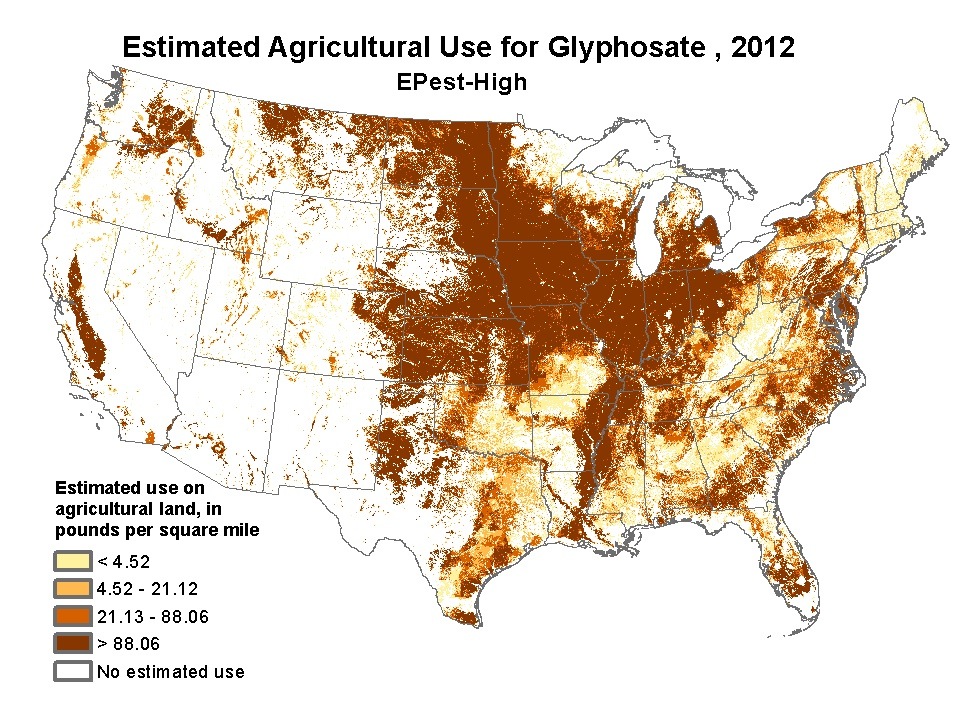
Image above: United State Geological Survey map of the continental states showing extent and intensity of the use of glyphsoates applied to cropland in 2012. Click to enlarge.  From (https://water.usgs.gov/nawqa/pnsp/usage/maps/show_map.php?year=2012&map=GLYPHOSATE&hilo=L).

Glyphosate, the world's most common weed killer, has caused significant concerns over its potential risk to human health, animals, and the environment for several decades. Earlier this month, a US court awarded a groundskeeper $289 million who claimed Bayer AG unit Monsanto's glyphosate-based weed-killers, including Roundup, gave him terminal cancer.

Now, a new report from PNAS alleges that glyphosate may be indirectly killing honey bees around the world, a threat that could potentially also leave a major mark on the global economy.
“We need better guidelines for glyphosate use, especially regarding bee exposure, because right now the guidelines assume bees are not harmed by the herbicide.
Our study shows that’s not true.” said Erick Motta, the graduate student who led the research, along with professor Nancy Moran.
UT News of The University of Texas at Austin says that glyphosate interferes with an important enzyme found in plants and microorganisms, but not in animals, it has long been assumed to be nontoxic to animals, including humans and bees.

However, the latest study reveals that by altering a bee’s gut microbiome — the ecosystem of bacteria living in the bee’s digestive tract, including those that protect it from harmful bacteria — glyphosate jeopardizes its ability to fight infection.

For this study, scientists exposed honeybees to glyphosate at normal levels found on farms. The researchers painted the bees' backs with colored dots so they could be tracked and later recaptured.

Three days later, they saw that the honeybees exposed to glyphosate suffered a significant loss of bacteria in their guts and were more susceptible to infection and death from harmful bacteria.
“Studies in humans, bees and other animals have shown that the gut microbiome is a stable community that resists infection by opportunistic invaders,” Moran said. “So if you disrupt the normal, stable community, you are more susceptible to this invasion of pathogens.”
In recent times, US beekeepers have reported a massive loss of bees or Colony Collapse Disorder (CCD). Millions of bees mysteriously disappeared, leaving farms with fewer pollinators for crops. Officials have been baffled, and the media has been quiet about the bee population collapse.

Explanations for the phenomenon have included exposure to pesticides or antibiotics, habitat loss, and bacterial infections. The latest study now adds herbicides to the list as a possible contributing factor.
“It’s not the only thing causing all these bee deaths, but it is definitely something people should worry about because glyphosate is used everywhere,” said Motta.
Among the nuts, almond growers have the largest need for bee pollination. Bee pollination is worth $15 billion to the US farming industry.

Any sharp change in global bee populations could affect the beef and dairy industries. Bees pollinate clover, hay, and other forage crops. As the bee population dwindles, it increases the cost of feedstock.

That forces inflation into beef and milk prices at the grocery store and ultimately hurts the American consumer. This could then lead to increased imports of produce from foreign countries where bee populations are healthy, further widening the trade deficit.

Couple this with the current trade war and this particular "black swan" - or rather "black bee" - problem, may be just the tipping point that finally forces the US economy to catch down to the rest of the world.


Image above: United State Geological Survey map of the continental states showing extent and intensity of the use of glyphsoates applied to cropland in 1992, twenty years earlier than map above. Note that  at that time the Central Valley in California was the densest and most intense use of glyphosates on food crops.  From (https://water.usgs.gov/nawqa/pnsp/usage/maps/show_map.php?year=1992&hilo=H&map=GLYPHOSATE).

See also:
Ea O Ka Aina: Bayer Beware! 9/11/18
Ea O Ka Aina: Side effect of Monsanto's Roundup 6/24/17
Ea O Ka Aina: Glyphosate harms gut enzyme 6/21/17
Ea O Ka Aina: RoundUp for Breakfast 4/20/16
Ea O Ka Aina: RoundUp carcenogenic in California 9/14/15
Ea O Ka Aina: Roundup Threatens Coral Reefs 12/30/14
Ea O Ka Aina: Word out on Roundup soaked wheat 11/24/14
Ea O Ka Aina: Gluten or Glyphosate Intolerance? 11/18/14
Ea O Ka Aina: Roundup and Lymphoma 6/10/14
Ea O Ka Aina: Roundup and human health 4/25/13
.

Bayer Beware!

SUBHEAD: Lawyers claim to have "Explosive" documents concerning Monsanto and RoundUp.

By Tyler Durden on 11 September 2018 for Zero Hedge -
(https://www.zerohedge.com/news/2018-09-07/bayer-beware-lawyers-claim-have-explosive-monsanto-documents)


Image above: Common Ragweed is becoming resistant to glyphsate applications in Nebraska. Ragweed plants from a glyphosate-resistant (left) and susceptible population (right) three weeks after application of 44 ounces per acre of Roundup PowerMax (that is one ounce per thousand square feet). From (https://cropwatch.unl.edu/glyphosate-resistant-common-ragweed-confirmed-nebraska).

Lawyers involved in a California lawsuit against Monsanto claim to have "explosive" documents concerning the Bayer-owned agrochemical giant's activities in Europe, according to Euronews.
"What we have is the tip of the iceberg. And in fact we have documents now in our possession, several hundreds documents, that have not been declassified and some of those are explosive," said US lawyer Robert Kennedy Jr, adding - "And many of them are pertinent to what Monsanto did here in Europe. And that's just the beginning."
Monsanto - bought by Germany's Bayer AG in June for $66 billion, was ordered in August to pay a historic $289 million to a former school groundskeeper, Dewayne Johnson, who said Monsanto's Roundup weedkiller gave him terminal cancer. Monsanto says it will appeal the verdict.

Environmental lawyers have been in Brussels in order to address a European Parliament special committee on the issue.
"They are fighting a fight for more democracy and for transparency and to get a better insight in how big corporation such as Monsanto act and try to manipulate the facts," said Belgium MEP Bart Staes.
Last November EU approved the use of glyphosate - a key chemical in Roundup, following five years of heated debate over whether it causes cancer. While it was approved for just five years until 2022 vs. the usual 15 years, there are now rumors that they will withdraw Roundup's license this year altogether.

Labeled a carcinogen by the EPA in 1985, the agency reversed its stance on glyphosate in 1991. The World Health Organization's cancer research agency, however, classified the compound as "probably carcinogenic to humans" in 2015. California, meanwhile, has the chemical listed in its Proposition 65 registry of chemicals known to cause cancer. 

See also:
Ea O Ka Aina: A MAtch Made in Hell 6/30/18

.

Breakfast with a dose of Roundup?

SUBHEAD: Weed killer is found in most of the oat cereals and granola bars tested, including some organic.

By Alexis Tempkin - Toxicologist on 15 August 2918 for EWG.org -
(https://www.ewg.org/childrenshealth/glyphosateincereal/#.W3con4WeGPX)


Image above: A child pouring Cheerios into a cereal bowl. From original article.

Popular oat cereals, oatmeal, granola and snack bars come with a hefty dose of the weed-killing poison in Roundup, according to independent laboratory tests commissioned by EWG.

Glyphosate, an herbicide linked to cancer by California state scientists and the World Health Organization, was found in all but two of 45 samples of products made with conventionally grown oats.

Almost three-fourths of those samples had glyphosate levels higher than what EWG scientists consider protective of children’s health with an adequate margin of safety. About one-third of 16 samples made with organically grown oats also had glyphosate, all at levels well below EWG’s health benchmark.

 Glyphosate does not belong in cereal. Act and urge the EPA to restrict pre-harvest applications of glyphosate and tell companies to identify and use sources of glyphosate-free oats.
 Report on samples tested indicates even organic oat products contained measurable amounts of glyphosate, but none were above the EWG's Health Benchmark of 160 parts per billion.
Samples Tested Conventional   Organic
Samples Tested 45   16
Glyphosate Detected 43   5
Detects above EWG’s Health Benchmark       31   0
Glyphosate is the active ingredient in Roundup, the Monsanto weed killer that is the most heavily used pesticide in the U.S. Last week, a California jury ordered Monsanto to pay $289 million in damages to a man dying of cancer, which he says was caused by his repeated exposure to large quantities of Roundup and other glyphosate-based weed killers while working as a school groundskeeper.

EWG tested more than a dozen brands of oat-based foods to give Americans information about dietary exposures that government regulators are keeping secret. In April, internal emails obtained by the nonprofit US Right to Know revealed that the Food and Drug Administration has been testing food for glyphosate for two years and has found “a fair amount,” but the FDA has not released its findings.

Each year, more than 250 million pounds of glyphosate are sprayed on American crops, primarily on “Roundup-ready” corn and soybeans genetically engineered to withstand the herbicide. But when it comes to the food we eat, the highest glyphosate levels are not found in products made with GMO corn.

Increasingly, glyphosate is also sprayed just before harvest on wheat, barley, oats and beans that are not genetically engineered. Glyphosate kills the crop, drying it out so that it can be harvested sooner than if the plant were allowed to die naturally.

Roundup was produced for decades by Monsanto, which this year merged with the German pharmaceutical company Bayer AG. In the case decided last week, the jury found that Monsanto knew for decades of the product’s hazards and not only failed to warn customers, but schemed to publicly discredit the evidence.

The California case that ended Friday was the first of reportedy thousands of lawsuits against Monsanto. These suits have been brought by farm workers and others who allege that they developed cancer from years of exposure to Roundup.

In 2015, the International Agency for Research on Cancer, part of the World Health Organization, reviewed extensive U.S., Canadian and Swedish epidemiological studies on glyphosate’s human health effects, as well as research on laboratory animals. The IARC classified the chemical as probably carcinogenic to humans, and has steadfastly defended that decision despite ongoing attacks by Monsanto.

In 2017, California listed glyphosate in its Proposition 65 registry of chemicals known to cause cancer. The state’s Office of Environmental Health Hazard Assessment, or OEHHA, has proposed a so-called No Significant Risk Level for glyphosate of 1.1 milligrams per day for an average adult of about 154 pounds. That level of exposure is more than 60 times lower than the safety level set by the Environmental Protection Agency.

California’s level represents an increased lifetime risk of cancer of one in 100,000 for an average adult. But for many cancer-causing drinking water contaminants, OEHHA’s lifetime risk factor is set at one in 1 million.

Additionally, because children and developing fetuses have increased susceptibility to carcinogens, the federal Food Quality Protection Act supports including an additional 10-fold margin of safety. With this additional children’s health safety factor, EWG calculated that a one-in-a-million cancer risk would be posed by ingestion of 0.01 milligrams of glyphosate per day.

To reach this maximum dose, one would only have to eat a single 60-gram serving1 of food with a glyphosate level of 160 parts per billion, or ppb. The majority of samples of conventional oat products from EWG’s study exceeded 160ppb, meaning that a single serving of those products would exceed EWG’s health benchmark.

As part of a glyphosate risk assessment, the EPA estimated potential highest dietary exposure levels for children and adults. The EPA has calculated that 1-to-2-year-old children are likely to have the highest exposure, at a level twice greater than California’s No Significant Risk Level and 230 times EWG’s health benchmark.

Studies suggest that glyphosate-sprayed crops such as wheat and oats are a major contributor to glyphosate in the daily diet. In EWG lab tests, 31 of 45 samples made with conventionally grown oats had 160 ppb or more of glyphosate.

The highest levels, greater than 1,000 ppb, were detected in two samples of Quaker Old Fashioned Oats. Three samples of Cheerios had glyphosate levels ranging from 470 ppb to 530 ppb. Twelve of the food samples had levels of glyphosate lower than EWG’s health benchmark, ranging from 10 ppb to 120 ppb. Only two samples had no detectable glyphosate.

Glyphosate was also detected at concentrations of 10 ppb to 30 ppb in five of 16 samples made with organic oats. The five samples came from two brands of organic rolled oats: Bob’s Red Mill and Nature’s Path.

A third brand of organic rolled oats and all other organic oat products tested did not contain detectable concentrations of glyphosate.

How does glyphosate get into organic foods? It could come from glyphosate drifting from nearby fields of conventionally grown crops, or by cross-contamination during processing at a facility that also handles non-organic crops. Nature's Path explains:
While organic farming certifications prohibit the use of glyphosate, organic products do not always end up completely free of glyphosate residue. While this news may come as disappointing, it is not entirely surprising. Glyphosate use has skyrocketed in the past decade, and it maintains the ability to adhere to water and soil particles long enough to travel through the air or in a stream to nearby organic farms.
The problem of glyphosate contamination of organic foods underscores the need to restrict pre-harvest uses of glyphosate and the need for more data on glyphosate levels in products, an area where U.S. federal agencies are falling short.

Two years ago, under pressure from the Government Accountability Office, the FDA began testing for glyphosate in a limited number of foods. At the 2016 North American Chemical Residue Workshop, an FDA scientist presented data showing that glyphosate has been detected in several oat-based food products.

After a Freedom of Information Act request by US Right to Know, earlier this year the FDA released documents that said the agency has found “a fair amount” of glyphosate in several processed foods. The results have not been released, but could be made public later this year or in early 2019.

In 2016, the non-profit Food Democracy Now tested for glyphosate in single samples of a variety of popular foods. “Alarming levels” of glyphosate were found in a number of cereals and other products, including more than 1,000 ppb in Cheerios. More recently, the Center for Environmental Health tested single samples of 11 cereal brands and found glyphosate levels ranging from about 300 ppb to more than 2,000 ppb.

EPA has denied that glyphosate may increase the risk of cancer, and documents introduced in the recent California trial showed how the agency and Monsanto worked together to promote the claim that the chemical is safe.

EWG has been urging the EPA to review all evidence linking glyphosate to increased cancer risk and other adverse health effects in human and animal studies. The EPA should limit the use of glyphosate on food crops, including pre-harvest application.

Oat-based foods are a healthy source of fiber and nutrients for children and adults, and oat consumption is linked to health benefits such as lowered cholesterol and decreased cardiovascular risk.

Parents should not have to wonder whether feeding their children these heathy foods will also expose them to a pesticide that increases the risk of cancer.

.

A match made in Hell

SUBHEAD: Monsanto partnership with Bayer increases threat to all life on Earth.

By Robert Bridge on 30 June 2018 for Strategic Culture Foundation- (https://www.strategic-culture.org/news/2018/06/30/match-made-hell-bayer-monsanto-partnership-signals-death-knell-for-humanity.html)


Image above: Demonstrators protesting merger of GMO companies Monsanto and Bayer. From original article.

On what plane of reality is it possible that two of the world’s most morally bankrupt corporations, Bayer and Monsanto, can be permitted to join forces in what promises to be the next stage in the takeover of the world’s agricultural and medicinal supplies?

Warning, plot spoiler: There is no Mr. Hyde side in this horror story of epic proportions; it’s all Dr. Jekyll.

Like a script from a David Lynch creeper, Bayer AG of poison gas fame has finalized its $66 billion (£50bn) purchase of Monsanto, the agrochemical corporation that should be pleading the Fifth in the dock on Guantanamo Bay instead of enjoying what amounts to corporate asylum and immunity from crimes against humanity.

Such are the special privileges that come from being an above-the-law transnational corporation.

Unsurprisingly, the first thing Bayer did after taking on Monsanto, saddled as it is with the extra baggage of ethic improprieties, was to initiate a rebrand campaign.

Like a Hollywood villain falling into a crucible of molten steel only to turn up later in some altered state, Monsanto has been subsumed under the Orwellian-sounding ‘Bayer Crop Science’ division, whose motto is: "Science for a better life."

Yet Bayer itself provides little protective cover for Monsanto considering its own patchy history of corporate malfeasance. Far beyond its widely known business of peddling pain relief for headaches, the German-based company played a significant role in the introduction of poison gas on the battlefields of World War I.

Despite a Hague Convention ban on the use of chemical weapons since 1907, Bayer CEO Carl Duisberg, who sat on a special commission set up by the German Ministry of War, knew a business opportunity when he saw one.

Duisberg witnessed early tests of poison gas and had nothing but glowing reports on the horrific new weapon: “The enemy won’t even know when an area has been sprayed with it and will remain quietly in place until the consequences occur.”

Bayer, which built a department specifically for the research and development of gas agents, went on to develop increasingly lethal chemical weapons, such as phosgene and mustard gas. “This phosgene is the meanest weapon I know,”

Duisberg remarked with a stunning disregard for life, as if he were speaking about the latest bug spray. “I strongly recommend that we not let the opportunity of this war pass without also testing gas grenades.”

Duisberg got his demonic wish. The opportunity to use the battlefield as a testing ground and soldiers as guinea pigs came in the spring of 1915 as Bayer supplied some 700 tons of chemical weapons to the war front.

On April 22, 1915, it has been estimated that around 170 tons of chlorine gas were used for the first time on a battlefield in Ypres, Belgium against French troops. Up to 1,000 soldiers perished in the attack, and many more thousands injured.

In total, an estimated 60,000 people died as a result of the chemical warfare started by Germany in the First World War and supplied by the Leverkusen-based company.

According to Axel Koehler-Schnura from the Coalition against BAYER Dangers: “The name BAYER particularly stands for the development and production of poison gas.

Nevertheless the company has not come to terms with its involvement in the atrocities of the First World War. BAYER has not even distanced itself from Carl Duisberg’s crimes.”

The criminal-like behavior has continued right up until modern times. Mike Papantonio, a US attorney and television presenter discussed one of the more heinous acts committed by this chemical company on Thomas Hartmann’s program, The Big Picture: “They produced a clotting agent for hemophiliacs, in the 1980s, called Factor VIII.

This blood-clotting agent was tainted with HIV, and then, after the government told them they couldn’t sell it here, they shipped it all over the world, infecting people all over the world. That’s just part of the Bayer story.”

Papantonio, citing Bayer’s 2014 annual report, said the company is facing 32 different liability lawsuits around the world. For the 2018 Bayer liability report, click here.

Before flushing your Bayer products down the toilet, you may want to put aside an aspirin or two because the story gets worse.

One of the direct consequences of the ‘Baysanto’ monster will be a major hike in prices for farmers, already suffering a direct hit to their livelihood from unsustainable prices.

“Farmers have already experienced a 300% price increase in recent years, on everything from seeds to fertilizer, all of which are controlled by Monsanto,” Papantonio told Hartmann. “And every forecaster is predicting that these prices are going to climb even higher because of this merger.”

Yet it’s hard to imagine the situation getting any worse for the American farmer, who is now facing the highest suicide rate of any profession in the country. The suicide rate for Americans engaged in the field of farming, fishing and forestry is 84.5 per 100,000 people - more than five times that of the broader population.

This tragic trend echoes that of India, where about a decade ago millions of Indian farmers began switching from farming with traditional farming techniques to using Monsanto’s genetically modified seeds instead.

In the past, following a millennia-old tradition, farmers saved seeds from one harvest and replanted them the following year. Those days of wisely following the rhythms and patterns of the natural world are almost over.

Today, Monsanto GMO seeds are bred to contain 'terminator technology', with the resulting crops ‘programmed’ not to produce seeds of their own. In other words, the seed company is literally playing God with nature and our lives.

Thus, Indian farmers are forced to buy a new batch of seeds – together with Monsanto pesticide Round Up - each year and at a very prohibitive cost. Hundreds of thousands of Indian farmers

But should the world have expected anything different from the very same company that was involved in the production of Agent Orange for military use during the Vietnam War (1961-1971)?

More than 4.8 million Vietnamese suffered adverse effects from the defoliant, which was sprayed over vast tracts of agricultural land during the war, destroying the fertility of the land and Vietnam’s food supply.

About 400,000 Vietnamese died as a result of the US military’s use of Agent Orange, while millions more suffered from hunger, crippling disabilities and birth defects.

This is the company that we have allowed, together with Bayer, to control about one-quarter of the world’s food supply. This begs the question: Who is more nuts? Bayer and Monsanto, or We the People?

It’s important to mention that the Bayer – Monsanto convergence is not occurring in a corporate vacuum. It is all part of a race on the part of the global agrochemical companies to stake off the world’s food supplies.

ChemChina has bought out Switzerland’s Syngenta for $43 billion, for example, while Dow and DuPont have forged their own $130 billion empire.

However, none of those companies carry the same bloodstained reputations as Bayer and Monsanto, a match made in hell that threatens all life on earth.

.

CRISPR and Genedrive danger

SOURCE: Jerry DiPietro (ofstone@aol.com)
SUBHEAD: Letting genedrives loose outside labs is too risky, says scientist who promoted idea.

By Paul Koberstein on 22 Devember 2017 for Earth Island Journal -
(http://www.earthisland.org/journal/index.php/elist/eListRead/letting_gene_drives_loose_outside_labs_is_too_risky_says_scientist_who_prom/)


Image above: Illusration of mosquito and genexrive. From (http://www.earthisland.org/journal/index.php/eij/article/editing_evolution/).

[IB Publisher's note: As more people are avoiding GMO produced food you can bet that "players" in the GMO/Pesticide development in Hawaii are salivating to get out of that business and into open field testing of gene drive technology. And if GMO companies' indifference to the health and welfare of the people living on these islands is an indicator we are all endangered. See accompanying article "Editing Evolution" by Paul Koberstein further explaining genedrive technology.]

A large cache of emails released this month show that the Bill and Melinda Gates Foundation is stepping up its efforts to promote the deployment of a controversial new genetic engineering tool known as “gene drive” to help eradicate malaria in Africa.

Malaria killed an estimated 438,000 worldwide in 2015. Sub-Saharan Africa continues to carry a disproportionately high share of the global malaria burden. 

However, some of the scientists who had initially proposed using the technology for public health and conservation purposes are having serious second thoughts about deploying it outside of labs.

In a effort to combat the disease, researchers funded by the Bill and Melinda Gates Foundation are planning a field trial of gene drive equipped Anopheles gambiae mosquitoes – the main malaria vector in Africa – in Burkina Faso.

Gene drives can help circumvent traditional rules of genetic inheritance and force a desired, specifically selected, genetic trait through a population.

Given the almost magical possibilities it offers to enhance beneficial traits or remove undesired characteristics in living things – think eradicating pests without using toxins, or saving an endangered species by making them immune to certain diseases – the technology has captured the imagination of many in the fields of conservation and public health.

The Bill and Melinda Gates Foundation, which considers gene drives “necessary” to end malaria, has invested some $70 million on Target Malaria, a research organization based at Imperial College in London that is working on preventing deaths from malaria, which numbered 438,000 worldwide in 2015.

Target Malaria is planning to release genetically modified Anopheles gambiae mosquitoes – the main malaria vector in Africa – in Burkina Faso.

These modified mosquitoes would be equipped with gene drives that would disrupt the reproductive systems of successive generations and eventually cause them to go extinct. The project would be the first field trial of gene drive technology.

The release of 1,200 emails by the Genetic Biocontrol of Invasive Rodents (GBiRD) program at North Carolina State University, provide fresh insights into the work of groups like the Gates Foundation and GBiRD that are promoting the use of gene drive biotechnology.

(GBiRD is a partnership of seven university, government and non-government organizations advancing gene drive research.)

The emails – which were released in response to freedom of information requests submitted by Edward Hammond, a biosafety activist from Austin, Texas –also show that the environmental advocacy group Island Conservation is developing plans to use gene drives as a mechanism for exterminating invasive species on the islands of Hawaii, New Zealand, and Australia.

Hammond made the emails public just two weeks after one of the key proponents of the gene drive technology, Kevin Esvelt, published a report saying the technology was too risky to be used in field trials to control invasive species.

Esvelt, a professor at MIT who first identified the potential for gene drives to alter wild populations of organisms in 2013, is now warning, once unleashed, gene drives will prove difficult if not impossible to control.

Esvelt said that projects that are planning to conduct gene drive experiments to control invasive species in the wild should first invent safer forms of the technology.

In theory, the release of these genetically altered mosquitoes or invasive pests like rats, would cause all the members of a targeted population of mosquitoes or rats to go sterile, eventually exterminating that and only that population.

But new research by Esvelt and his colleagues at MIT and Harvard University suggests that gene drive deployments are more than likely to go haywire, with potentially disastrous consequences for non-targeted animal populations and ecosystems. (*Check update/clarification on this below.)

In a paper published in the non-peer reviewed scientific journal BioRxiv, Esvelt and his colleagues wrote that, once unleashed, gene drives will prove difficult if not impossible to control.

The paper, “Current CRISPR gene drive systems are likely to be highly invasive in wild populations,” is currently in pre-publication review. CRISPR refers to Clustered Regularly Interspaced Short Palindromic Repeats, a new technology that allows scientists to alter genes by editing strands of DNA.

CRISPR’s invention in 2012 by scientists at the University of California-Berkeley and MIT led to the development of gene drives two years later in Esvelt’s research laboratory.

In the BioRxiv paper, the scientists said that mathematical models based on existing empirical data show that in their current form, gene drives cannot be deployed without harmful side effects. Their modeling showed that gene drives can be very aggressive and even a handful of gene drive modified organisms could carry the new gene, not only through much of the targeted population of a certain species, but also on to non-intended populations.

For example, under their models, a gene drive released in Hawai’i to kill a specific kind of mosquito on the island of Kauai would eventually start targeting a different kind of mosquito on the island.

“Releasing a small number of organisms often causes invasion of the local population, followed by invasion of additional populations connected by very low gene flow rates,” they wrote. “Highly effective drive systems are predicted to be even more invasive.”

On the same day his BioRxiv paper was released, Esvelt expressed regret for ever proposing gene drives be used in real word experiments.

In an interview with the New York Times, Esvelt called his championing the notion “an embarrassing mistake” given the predicted invasiveness of current CRISPER-based drive systems.

But he and his colleagues still thinks researchers should continue exploring ways in which gene drives could help save species that are in peril.

The new report confirms concerns that many within the scientific and environmental community have had about the unknown ecological and public health risks posed by a technology whose basic purpose is to spread genetic mutations.

Nevertheless, the GBiRD emails show that that the Gates Foundation is ploughing ahead with its research on gene drives as a mechanism for eradicating the mosquito that causes malaria (which, it should be noted again, is not an effort to control an invasive species, but rather an effort to eradicate a disease-carrying insect).

In 2016, it made a $1.6 million payment to Emerging Ag, a PR firm it retained for the purpose of influencing a United Nations expert group that has been addressing gene drive issues. The group, the Ad Hoc Technical Expert Group on Synthetic Biology (AHTEG), was convened by the UN’s Convention on Biological Diversity.

Hammond, who posted the emails to his website, is a former member of AHTEG.

In one of the emails, the Gates Foundation said it hired EmergingAg to “increase awareness, understanding, and acceptance of possible gene drive applications for public good purposes.”

One of EmergingAg’s initiatives has been to recruit scientists who will advocate for gene drives. For example, in an Aug. 1, 2017 email thread, Isabelle Coche, a vice president of EmergingAg, is trying to recruit Fred Gould, codirector of the Genetic Engineering and Society Center at North Carolina State, for advocacy work.

The email asks Gould to "support advocacy and engagement activities on gene drive.” Gould, however, demurs, saying, “it would be problematic for me to be involved,” adding that such advocacy would “compromise” his role on a gene drive ethics committee.

Coche’s role at EmergingAg, according to another email, is “to fight back against gene drive moratorium proponents before the next CBD meeting in 2018.”

This was in reference to calls from several anti-gene drive groups for an international moratorium on gene drive research in petitions last year before the United Nations Convention on Biological Diversity (CBD). The CBD rejected those petitions, which are likely to be repeated at next year’s CBD meeting.

On its website, Emerging Ag calls itself “a boutique international consulting firm providing communications and public affairs services.”

Its president and founder is Robynne Anderson, a former international communications director of CropLife, the global lobby group for the biotechnology, seed, and pesticide industries based in Brussels, Belgium.

On her personal website, Anderson praises gene drives without actually mentioning the biotechnology by name.

“The Target Malaria team is researching approaches that can reduce the numbers of mosquitoes that spread malaria,” she writes. 
“By reducing the population of the malaria mosquito, (a very specific beast called Anopheles), they are able to combat transmission of the disease. Their strategy relies on reducing the number of female malaria mosquitoes.”
She said this approach “is expected to be complementary to other mosquito control methods, easy and inexpensive to implement, because the mosquitoes themselves do the work of stopping malaria. The control method would be a long-term, sustainable, and cost-effective solution to prevent malaria.”

Austin Burt, professor of evolutionary genetics at Imperial College London and principle investigator for the Target Malaria consortium, said in an email that “a blanket assertion that ‘gene drive field trials pose unacceptable risks for ecosystems’ is not consistent with how I understand [Esvelt’s] position – risks must always be assessed on a case-by-case basis, as they will depend on the exact features of the construct and the species / population into which it is to be released.

Rather, I believe he is calling for inclusive, informed discussion of the risks, which I certainly agree with.”

Burt said Esvelt’s paper “just shows that a particular type of gene drive construct may be expected to spread from one population to another when there is naturally-occurring gene flow, which indeed is correct.”

As for the Target Malaria initiative, he said that although “we are one of the leading groups working on developing this sort of technology, we are still many years (>5) from having something that we might propose to release in the field, and indeed we are still working on the path to get to that point.” Safety, he said, “is paramount, for humans and the environment.

Malaria imposes an appalling burden across too much of sub-Saharan Africa, and we want to be in a position to offer something that people and governments will want to use to help reduce this burden.”

He emphasized that when Target Malaria develops a gene drive it “will go through extensive safety testing before we would consider releases.”

Island Conservation, meanwhile, sees gene drives as a tool that can rid islands of invasive pests without the use of chemical pesticides.

The group says that 180,000 islands around the world are infested with alien rodents, but only 400 rodent eradication programs to date have been successful, and each relied on rodenticides to remove the non-native populations.

Heath Packard, a spokesman for the group, told Earth Island Journal that the group “is investigating the feasibility and suitability of a potential gene drive mouse construct that could safely and effectively remove invasive species from islands. The question is not only could we, but should we and under what conditions.

Local communities and their governments will need to decide on a case by case basis.”

But he said that Island Conservation “would never contemplate even asking a community to consider a highly-contained field trial unless work in the genetic laboratories demonstrated that the mouse construct could not, itself pose unmitigated harm to well-established parts of our ecosystem.”

“This work must be done, cautiously, thoroughly, and stepwise,” he said. “That’s exactly what our partnership is doing.”

*UPDATE, December 22: To be clear, this risk is not of gene drives spreading to other species. The risk is that they could spread to other populations, or rather, sub-species of the same species — for example to any of the other 205 mosquito species in the Anopheles subgenus — and as a result impact local ecosystems where they might serve key roles, such as, as a food source for other critters. This report isn't implying that gene drives can jump the species barrier spread to other species.

.

France votes against glyphosate

SUBHEAD: The French government has voted against the renewal of an EU Commission license for glyphosate use.

By Staff on 1 September 2017 for Farming UK -
(https://www.farminguk.com/News/France-votes-against-the-use-of-pesticide-glyphosate_47307.html)


Image above: Grape vine spraying near Mersault village, Burgundy, France. From (https://www.pourquoidocteur.fr/Articles/Question-d-actu/2888-Pesticides-les-effets-reels-sur-la-sante).

The French government has voted against the renewal of an EU Commission license for the pesticide glyphosate.The decision by the French government comes as evidence emerges of the risk of birth defects caused by exposure to pesticides.

Monsanto is the major supplier of products containing glyphosate, with ‘Roundup’ being the best-known product.

The product is widely used by farmers, gardeners and local authorities to control weeds. In 2015 the World Health Organisation’s (WHO) classified glyphosate as a probable carcinogen.

But in March, the EU's chemicals agency said glyphosate should not be classed as a carcinogen. And a survey has shown that a ban on glyphosate in the UK could force one in five wheat farms into 'serious financial difficulty'.

More than half of British farmers say they are concerned that a ban could cost them more than £10,000 every year.Speaking at Cereals 2017, NFU Vice President Guy Smith said:
“This year looks like being a watershed year for classical chemistry for arable farms with these three decisions on the horizon from Europe.

“A poor decision on endocrine disruptor definition could see an end to the availability of around 26 active ingredients; the European Commission is proposing a ban on the use of neonicotinoids on all outdoor crops; and a decision on the reauthorisation of glyphosate is due by the end of the year.

“The NFU will continue to make the case for evidence-based decisions to be made in all three of these areas, and we will continue to work with our members to help them make the case to politicians and other decision makers about the importance of these products and to demonstrate the damage that bad decisions will have on farming and our food supply.”
.

Side effect of Monsanto's Roundup

SUBHEAD: Algae worry about the notorious glyphosate pesticide discovered in Great Lakes.

By Lorraine Chow on 7 July 2017 for Alternet -
(http://www.alternet.org/environment/glyphosate-sprayed-gmo-crops-linked-lake-eries-toxic-algae-bloom)


Image above: A dead fish surrounded by algae in Lake Erie during a record-setting algae bloom in 2011. Photo by Tom Archer. From original article.

Glyphosate, the controversial main ingredient in Monsanto's Roundup and other herbicides, is being connected to Lake Erie's troubling algae blooms, which has fouled drinking water and suffocated and killed marine life in recent years.

Phosphorus—attributed to farm runoff carried by the Maumee River—has long beenidentified as a leading culprit feeding the excessive blooms in the western Lake Erie basin. Now, according to a new study from chemistry professor Christopher Spiese, a significant correlation has been established between the increased use of glyphosate to the percentage of dissolved reactive phosphorus (DRP) in the runoff.

As No-Till Farmer observed from the study, DRP loads in Lake Erie increased in the mid-1990s at the same time that farmers began the widespread cultivation of crops genetically engineered to withstand multiple applications of Roundup.

"For every acre of Roundup Ready soybeans and corn that you plant, it works out to be about one-third of a pound of P [phosphorus] coming down the Maumee," Spiese told the agricultural publication.

Here's how the team came to the conclusion, as No-Till Farmer reported:

Through his own and others' research, Spiese found that depending on the types of metal in the soil, glyphosate does release P. For example, when glyphosate is applied to soil containing iron oxide-hydroxide, P is immediately released. But almost nothing is removed when it's an iron oxide material.

Finally, Spiese took soil samples all over the Maumee watershed, applied P to them and then sprayed glyphosate to see how much P was released vs. soil that wasn't sprayed with glyphosate after 24 hours. He saw desorption occurred all over the watershed, but certain areas were higher than others, specifically in the southeastern corner.

Based on the average two glyphosate applications growers make every year, Spiese estimates that overall, 20-25 percent of the DRP runoff is caused by glyphosate. But depending on the location within the watershed, that percentage could be much lower or much greater.

"Some of those sites, it's less than a percent. Other sites it's almost 100 percent," he says.

Previous studies have tied glyphosate to the phosphorous fueling Lake Erie's blue-green algae. In 2009, Ohio Sea Grant researchers, Drs. R. Michael McKay and George Bullerjahn of Bowling Green State University, found that glyphosate could only be detected in the lake at certain times of year—after crops are planted.

"Our research is finding that Roundup is getting into the watershed at peak farming application times, particularly in the spring," McKay said.

Approximately 1,000 metric tonnes (about 2.2 million pounds) of Roundup is applied in the Lake Erie watershed per year, and it is being detected in adjacent waterways particularly in the spring, the Ohio Environmental Protection Agency (EPA) noted from McKay and Bullerjahn's study.

The researchers also found that the blue-green algae (cyanobacteria) in the lake are capable of using phosophonates.

"It turns out that many cyanobacteria present in Lake Erie have the genes allowing the uptake of phosphonates, and these cyanobacteria can grow using glyphosate and other phosphonates as a sole source of phosphorus," Bullerjahn said.

• Lake Erie’s Toxic Algae Bloom Forecast for Summer 2016 http://ow.ly/2f31301dia5 @greenpeaceusa@HuffPostGreen

• EcoWatch (@EcoWatch) 3:55 PM - 13 Jun 2016

Harmful Lake Erie blooms have increased at record levels over the last decade,according to the U.S. EPA and are expected to become more common due to warmer temperatures and heavy rainfall that feed algae growth.

The toxic algae rob oxygen from the waters creating dead zones where fish and other marine life are unable to survive. The algae is also a threat to humans—swallowing it can cause health problems such as rashes, vomiting, numbness and difficulty breathing.

In February this year, the U.S. and Canada announced a goal to reduce the amount of phosphorus entering affected areas of Lake Erie by a total of 40 percent by 2025.

See also:
Ea O Ka Aina: Glyphosate harms gut enzyme 6/20/17
Ea O Ka Aina: Monsanto and EPA collusion 3/29/17
Ea O Ka Aina: Corporate monster Monsanto 3/20/17
Ea O Ka Aina: Monsanto colluded with EPA 3/14/17
Ea O Ka Aina: Monsanto and First Amendment 1/24/17
Ea O Ka Aina: EPA obedient to Monsanto 12/17/16
Ea O Ka Aina: 'Non-GMO' labels not strong enough 9/29/16
Ea O Ka Aina: Monsanto's Bizzaro World 8/13/16
Ea O Ka Aina: Our Right to Health 7/17/15
Ea O Ka Aina: Pope on a roll 7/3/15
Ea O Ka Aina: Gluten or Glyphosate Intolerance? 11/18/14
Ea O Ka Aina: Sri lanka bans RoundUp 3/17/14
Ea O Ka Aina: Roundup and human health 4/25/13
Ea O Ka Aina: Monsanto knew of birth defects 6/7/11
Ea O Ka Aina: Feds lay down for GMOs 2/15/11
Ea O Ka Aina: Monsanto Lies, Again and Again 10/17/09

.

Monsanto's army of online bullies

SUBHEAD: Trolls for the GMO company are bullies aboard a sinking ship. Show them links to the truth. 

By Jeffery Smith 12 July 2017 for Light on Conspiracy  -
(https://www.lightonconspiracies.com/monsantos-army-of-online-bullies/)


Image above: Graphic for ignoring GMO bullies and supporting World Health Organization International Agency for Research on Cancer. From (https://www.pinterest.com/pin/316026098837545704).

There are hundreds, possibly thousands of them—paid to bully, shame, and endlessly argue with anyone posting a comment deriding GMOs or pesticides. And when a high-profile person stands up to Monsanto’s technology, watch out. The trolls swarm in and gang up.

Take Marion Nestle, for example. When a GMO propaganda film called Food Evolution purposely quoted her out of context, she demanded that her 10-second clip be removed. Nestle’s blog was then ambushed with 870 comments by Monsanto’s minions, forcing her to block all comments from her site, Food Politics.

The presence of a troll army was revealed during the on-going lawsuit against Monsanto over the cancer-causing properties of their herbicide Roundup. The lawyers wrote:

“Monsanto even started the aptly-named “Let Nothing Go” program to leave nothing, not even Facebook comments, unanswered; through a series of third parties, it employs individuals who appear to have no connection to the industry, who in turn post positive comments on news articles and Facebook posts, defending Monsanto, its chemicals, and GMOs.”

Scientists Attacked

The legal brief also points out that, “Monsanto quietly funnels money to ‘think tanks’ such as the ‘Genetic Literacy Project’ and the ‘American Council on Science and Health,’ organizations intended to shame scientists . . .”

As a frequent target of these groups, I know well their unethical bullying tactics. And so too do the scientists who discover evidence that GMOs are harmful.

World renowned biologist Arpad Pusztai, for example, was pummeled by the biotech machinery when he accidentally discovered that GMOs caused massive damage to rats in just 10 days. In the late 1990s. he led a team that was designing test protocols to be used by European authorities to evaluate GMO safety.

His research, however, revealed that the generic process of creating a GMO caused dangerous and unpredictable side-effects that might already be eroding the health of consumers. Because his shocking discovery could have destroyed the entire GMO industry, they came after Pusztai with far more than just a shaming campaign.

Within days, his employer of 35 years terminated his contract. Pusztai’s 20-member team was dismantled. He was silenced with threats of a lawsuit. And the biotech industry and pro-GMO UK government unleashed a campaign to destroy his reputation.

Although Pusztai was the first scientist to undergo this type of industry battering, many others have since been targeted. One told me that these types of attacks have deterred hundreds of other scientists from doing research on GMOs.

The online bullies have a similar intimidating effect. Their well-chosen words are sharp and condescending, designed to scare away others from making comments—lest they become the next target.

The folks at the International Fitness Profesionals Association learned this the hard way. After posting what they considered to be a balanced article on GMOs, a troll got wind of it, posted a negative comment on the Pro-GMO FB site “We Love GMOs and Vaccines,” and asked his comrades to also make comments. The trolls swarmed.

They not only challenged the GMO article, they attacked the integrity and reputation of the organization. And of course, the trolls avoided commenting on details about GMOs, since they would quickly lose that argument with anyone familiar with the science. Facts are not their strong point. They prey on emotions.

Standing up to the Bully
Bullying and shaming can traumatize. In schools, online, at work, they have damaged and destroyed lives. It works. That’s why the biotech industry uses them.

Before discussing what to do, the first step is how to feel. The answer: INVINCIBLE!

After reporting for years about Monsanto’s strong-arm tactics, I finally became their target about eight years ago. Rather than feeling hurt or depressed, I felt uplifted. I viewed their baseless attacks as a badge of honor. I was now such a threat to their business dealings around the world, they invested a significant amount of money trying to distort my work and discredit me.

I considered whether I should spend time countering their spin to set the record straight, but soon realized that it was a black hole that would suck up my life. After all, why would I want to write posts to correct the views of the handful of people who wander onto their site, when I could reach millions of others with real information.

And so I smile, shake my head, and don’t even bother to read their posts about me. We’re winning the battle against GMOs and soon these bounty hunters will be hired by the next toxic industry.

That’s right, I said we are TOTALLY WINNING. Mainstream food companies in the US are falling over themselves to remove genetically engineered ingredients in order to boast a Non-GMO label.

With 57% of surveyed Americans saying that they are concerned about the health impacts of GMOs, we are now the majority. We have the average American on the right side of this issue.

And that’s why Monsanto has unleashed its online army. It’s a last-ditch attempt to turn the tide.

So, if you get a troll on your case or see one doing their dark dance on someone else’s post, feel GREAT! Let it remind you that our collective work sharing the truth about GMO dangers has been so successful, we are seeing the dying embers of a desperate and failing industry.

And have absolutely no anxiety or concern about any details of their accusations. They will portray themselves as mainstream, pretending to have logic and science on their side. They will appear absolutely sure of themselves. And their colleagues will give them support.

It’s their game. It’s just a game. It means nothing. And by the way, we have become the mainstream in this argument (finally).

So What Do We Do? Strike Back!
Arguing with a professional GMO huckster is hopeless. Forget about it. (Or as my NY colleagues say: fugedabowdit.)

If you are in charge of the website or account, just delete their comments. Don’t waste the time or damage the emotions of your readers. Replace their mindless ramble with a statement like:

We just found a Monsanto troll! That’s right. Monsanto hired and trained an online army to attack anyone who dares to reveal the dangers of GMOs and pesticides like Roundup. Their campaign is called “Let Nothing Go.”

So we deleted a post that had all the markings of a troll: It was emotionally bullying or shaming. It used talking points made popular by Monsanto’s PR companies, including myths like GMOs feed the world, increase yield, reduce pesticide use, or are proven safe.

And it was clearly uninformed. So it was either posted by a paid troll, or worse yet, some poor person who actually believes and emulates them. Read more about the GMO trolls and GMO dangers in general.

If you can’t delete the offending post, here’s a similar type of statement you can post in response:

Looks like we’ve found a Monsanto troll! If you haven’t heard, Monsanto hired and trained an online army to attack anyone who dares to reveal the problems with GMOs and pesticides like Roundup. Their campaign is called “Let Nothing Go.” You can decide for yourself if this is one of Monsanto’s minions.

The tone of the trolls are typically emotionally bullying or shaming. They claim the high ground, pretending that science is on their side. They often roll out one of the many talking point myths made popular by Monsanto’s PR companies, pretending that GMOs feed the world, increase yield, reduce pesticide use, and are proven safe, etc.

And they are clearly uninformed. So either this is a troll, or worse yet, some poor person who actually believes and emulates them. Read more about the GMO trolls and GMO dangers in general.

If they engage you in an online argument (and if they’re a troll, they or their friends will) you can ignore the baseless claims and just use the opportunity to post links to one of the many informative articles that shreds Monsanto’s myths.

Find lots of stuff to post at ResponsibleTechnology.org or on our Facebook page.

Please subscribe to our newsletter and like our page so we can get you more ammunition—and stories of success.

This is a time to celebrate our victories, but we can’t let up. Let’s nail the coffin shut on this dangerous and irresponsible use of genetic engineering and protect future generations. With life itself at stake, we can withstand the buzzing of a few online gnats.

Safe eating and posting.

See also:
Ea O Ka Aina: Monsanto colluded with EPA 4/14/17
Ea O Ka Aina: Glyphosate harms gut enzyme 6/21/17
Ea O Ka Aina: Monsanto and EPA collusion 3/29/17
Ea O Ka Aina: Corporate monster Monsanto 3/20/17
Ea O Ka Aina: Monsanto and First Amendment 1/24/17
Ea O Ka Aina: EPA obedient to Monsanto 12/17/16
Ea O Ka Aina: Whole Foods and Monsanto partners 7/1/16
Ea O Ka Aina: Molokai says "A'ole GMO" 9/8/13
Ea O Ka Aina: Monsanto lobbying Congress 5/18/13
Ea O Ka Aina: Roundup and human health 4/25/13
Ea O Ka Aina: Supreme Court Monsanto seed case 2/19/13
Ea O Ka Aina: Hungary denies GMOs & IMF 9/8/12
Ea O Ka Aina: GMO Corn HFCS & Cancer 8/4/10 .

Glyphosate harms gut enzyme

SUBHEAD: There are new claims against Monsanto in consumer lawsuit over Roundup herbicide.

By Carey Gillam on 20 June 2017 for Huffington Post -
(http://www.huffingtonpost.com/entry/new-claims-against-monsanto-in-consumer-lawsuit-over_us_59496379e4b0f500e5526088)


Image above: Store display of RoundUp for consumer use on home yards. From original article.

Another day, another lawsuit against global seed and chemical giant Monsanto Corporation. In a complaint filed Tuesday in federal court in Wisconsin, six consumers alleged that the company’s top-selling Roundup herbicide has been falsely promoted as uniquely safe when it actually can have profound harmful impacts on human gut bacteria critical to good health.

The lawsuit, which also names Roundup distributor Scotts Miracle-Gro Co. as a defendant, specifically alleges that consumers are being deceived by inaccurate and misleading statements made by Monsanto regarding glyphosate, the active weed-killing ingredient in Roundup.

Plaintiffs include residents of Wisconsin, Illinois, California, New York, New Jersey and Florida.

Glyphosate, which Monsanto introduced as an herbicide in 1974 and is widely used in growing food crops, has been promoted for years as a chemical that kills plants by targeting an enzyme that is not found in people or pets.

The lawsuit claims that assertion is false, however, and argues that research shows glyphosate can target an enzyme found in gut bacteria in people and animals, disrupting the immune system, digestion, and “even brain function.”

“Defendants repeat these false and misleading representations throughout their marketing, including in video advertisements produced for their websites and YouTube Channel,” states the lawsuit, which is filed in U.S. District Court for the Western District of Wisconsin.

Monsanto did not respond to a request for comment and neither did Scotts.

Monsanto is currently defending itself against nationwide claims that Roundup has caused hundreds of people to suffer from a type of blood cancer called non-Hodgkin lymphoma (NHL).

More than 1,100 plaintiffs have lawsuits pending in state and federal courts with many of the lawsuits combined in multidistrict litigation in federal court in San Francisco.

Those lawsuits were triggered by a 2015 decision by the World Health Organization’s International Agency for Research on Cancer (IARC) to classify glyphosate as a probable human carcinogen.

IARC said research showed an association between NHL and glyphosate, with limited evidence from epidemiology data collected on humans and stronger evidence seen in laboratory animals exposed to glyphosate.

The lawsuit filed in Wisconsin is markedly different from the Roundup cancer claims, though some of the same attorneys are involved in both lines of litigation.

Plaintiffs do not claim physical injury; rather they claim violations of trade and business practices laws, and allege Monsanto and Scotts were “unjustly enriched” as plaintiffs purchased and paid for more Roundup products than they would have in absence of the alleged false promotions.
.

Executive Order pushes pesticides

SUBHEAD: We can’t allow the protections we depend on for clean water, clean air, and safe food to be gutted.

By Staff on 26 April 2017 for Center for Food Safety -
(http://salsa3.salsalabs.com/o/1881/t/0/blastContent.jsp?email_blast_KEY=1370269)


Image above: Photo detail of can of Dow Chemical's chlorpyrifos pesticide distributed by David Gray Co. with warning: "This product is too hazardous for use by householders. Householders must not use this product in or around the home." From (http://www.fertilisersdirect.com.au/pco-chlorpyrifos-1l.html).
 
The hits to our food, farms, and environment just keep coming.
Just hours ago, President Trump signed a new Executive Order, this time specifically on agriculture, directing the Secretary of Agriculture to undertake a 180-day review to “identify and eliminate" what Trump says are "unnecessary regulations”.1

The Presidential Order also creates a new task force to recommend eliminating food and agriculture legislation, policies, and regulations that might hinder the profit-making of “agribusiness.”

What kind of regulations are they looking at? Well, the details are slim, but what is there doesn’t look good. We know that regulations regarding the oversight, production, and export of genetically engineered crops are high on the list.2

The Executive Order also seems to push for faster and/or easier approvals for pesticides and biotech crops, pushing biotech crops abroad to ease export market access, easing the privatization of scarce public water resources for corporate gain, and opening public lands up to mining, farming, ranching and other activities that don’t belong on our public lands.3

We know that Agribusiness has Trump’s ear. He picked Sonny Perdue, one of Big Ag’s own, for his USDA Secretary.

And this week, the Associated Press dropped a bombshell:
Dow Chemical gave $1,000,000 to Trump’s inauguration fund, and the chemical giant is now urging the Environmental Protection Agency (EPA) to set aside its findings on chlorpyrifos and three other pesticides that federal scientists from several agencies found were harmful to endangered species and human health.4
Trump’s EPA also just green-lighted Dow’s new “Enlist Duo” genetically engineered crops, resistant to 2,4-D, part of the Vietnam Era Agent Orange pesticide.

In January, then President-elect Trump sat down chemical giant Bayer’s CEO Werner Baumann and Monsanto’s CEO Hugh Grant at Trump Tower and had a “productive meeting” on “the future of the agriculture industry” and the pending merger between the two companies.

Combined, President Trump, EPA Administrator Pruitt, and newly confirmed USDA Secretary Perdue have received millions of dollars from Big Ag and chemical companies.

We can’t allow the protections we depend on for clean water, clean air, and safe food to be gutted by the new administration and the corporations which have purchased great influence over the President and his policies.

Trump needs to hear from you – add your name  to petition

1. http://www.nydailynews.com/newswires/news/national/latest-trump-aims-ease-farming-regulations-article-1.3099884
2. https://www.politicopro.com/tech/whiteboard/2017/04/perdue-to-chair-trumps-task-force-on-rural-america-086691
3. https://www.whitehouse.gov/the-press-office/2017/04/25/presidential-executive-order-promoting-agriculture-and-rural-prosperity
4. http://bigstory.ap.org/article/a29073ecef9b4841b2e6cca07202bb67/ap-exclusive-pesticide-maker-tries-scrap-risk-study

.

From Standing Rock to Maui

SUBHEAD: We are like the Dakota Sioux fighting to protect the Missouri River because Water is Life.

By Jonathan Greenberg on 25 March 2017 for Maui Independent -
(http://mauiindependent.org/native-wisdom-water-protector-alika-atay-on-the-power-of-we-the-people/)


Image above: From ().

In November, organic farmer Alika Atay, the grassroots leader of Hawaii’s ʻĀina Protector’s United effort was elected to the Maui County Council in a stunning upset (described in detail here).
Atay was the lead plaintiff in the SHAKA Movement’s federal lawsuit over the invalidation of Maui’s successful GMO Moratorium initiative in 2014.

This Maui Independent In Their Own Words features the barrel-chested, deep-voiced leader known to many Native Hawai’ians as “Uncle Alika.” His words are from interviews conducted during the past year by journalist Jonathan Greenberg.

Protect Our Water

I stand to protect our drinking water. We are very similar to our brothers and sisters in the Dakotas fighting to protect the Missouri River because Ola Ka Wai: Water is life.

Aina Protectors United is like-minded people who have been raised under the values of Aloha Aina (love of the land). Everything we do has a connection to the earth and our resources. Given our responsibility under Aloha Aina, we must stand up and protect.

I am speaking for the land, for the water, for the children. We all have a responsibility to stand up for future generations. The importance of native water rights and the ʻĀina Protectors movement is to allow those of us who are of the ʻĀina to understand that this is our indigenous right that we are born with.

We need to stand up and say enough of the oppression.

For me and the people, we are all kanakas. If they poison us, if they allow this to continue, they are creating cultural ethno genocide. They are slowly killing us, the kanaka–Hawaiians and my children and my future descendants. If we die or if we get sick and this place gets polluted, where else do we go? We don’t have anywhere else to go in the world to call our homeland.

This is our homeland. And as Kanaka Maoli, as indigenous people of this land, we cannot allow corporations such as Monsanto to be more important than the health and welfare of our people.

We are into into grassroots democracy. Grassroots democracy comes from the ground up, from the indigenous, spiritual, and cultural level. It says we will live the way we want to live.

My involvement with this movement began 40 years ago, when agrochemical companies sprayed DDT onto their plants, like the pineapple plantations. After soaking the plants, the DDT soaked the soil, and after soaking the soil, it went down and hit our water aquifer. It tainted our drinking water well until we could no longer drink fresh water from the well. Forty years later that well is still tainted. We cannot drink that water. It is still tainted.

Monsanto fields are only 40 feet above sea level. We ran into a Monsanto field and saw their spray board. It said they sprayed a 100-acre field four times a day, and the next day, five times a day, the very next day four times. With different chemicals.

You drench the fields, and then you get a big rain. The earth becomes a wet sponge and gets saturated, and all that chemical poison gets pushed down. The question is not if it’s going to hit our water table. The question is if they keep this up unchecked, when will it hit our water table to also make it unsafe for us to be drinking fresh water?

I believe this is about water and the pesticides that affect water. I am concerned with the drenching of our land with pesticides and the effect this has on our water. We live on an island and must protect our sacred water.

We have to look at the damage heavy chemical pesticides are doing to the soil and the aquifer. Not only what affects us now but more so the long-term future concerns. What kind of water will our future generations have to drink?

Look at what our experience has been for the last two years against the biotech pesticide companies. During the [GMO Moratorium Initiative] contest, there was big, big involvement of organized corporate money, spending close to $8 million.

Yet the people voted yes, and the people defeated them. The big lesson was the power of the people; what was victorious was organized people.

If You Are Not at the Table, You Are On the Menu

If you are not at the table, you are on the menu.
Whatever community you are, whatever country you are, you’ve got to open your eyes and be at the table.

We have that power. We the people can organize ourselves to stand up against them and say, “This is wrong.” Yes we call out Aloha ʻĀina; love the land. But it is not as simple as that. You cannot interpret it just by the words. You have to understand the values that are in there. How do you practice Aloha ʻĀina values? By protecting our natural resources, protecting our water.

Right now, with this [November Council election] victory, we are setting the cornerstone of the house that we want to live in. It is up to the rest of the village to be involved in the construction of the house.

I am looking forward to setting policy, regulations, and enforcement that will protect our natural resources. We need our entire village to be involved to solve these problems.

We live on an island, and our job is to protect this aquifer, our sacred water. There is a wave of momentum for change to protect our Maui way of living. Everyone sees the handwriting on the wall and is concerned with protecting the environment, which also protects our tourist economy.

Our Responsibility to Become Great Ancestors

Our ancestors, my ancestors, they lived here for 1,500 years. They lived here organically, naturally.

They didn’t live with chemical poisons. Then my ancestors handed it over to me: green pristine, clean, and sacred.

And in a very short period, westernization came in and almost killed us. Almost. Unless we come in and say, “Nuff already. This ain’t happening.”

We want to become great ancestors.

I don’t want to pass on and have my descendants say, “My tutu—he didn’t do a good job by giving us this place all polluted.”

We have a responsibility to our future. That’s why we do this.


Video above: "Water Protector Alika Atay on People Power" From original article. (https://youtu.be/Gu5dZ1_agNY). 

See also:
Ea O Ka Aina: Lessons from Standing Rock 3/14/17
Ea O Ka Aina: Standing Rock will not go away 2/24/17
Ea O Ka Aina: DAPL fight not over yet 2/19/17
Ea O Ka Aina: Tribes divest DAPL bankers 2/13/17
Ea O Ka Aina: Army Corps okays DAPL easement 2/8/17
Ea O Ka Aina: Trump orders go on DAPL EIS 2/3/17
Ea O Ka Aina: Trump orders shale oil pipelines 1/24/17
Ea O Ka Aina: Missile launcher at Standing Rock 1/19/17
Ea O Ka Aina: Lockdown at Trans-Pecos Pipeline 1/10/17
Ea O Ka Aina: Standing Rock has changed us 12/9/16
Ea O Ka Aina: As Standing Rock celebrates... 12/5/16
Ea O Ka Aina: Army Corps denies DAPL easement 12/4/16
Ea O Ka Aina: My Whole Heart is With You 12/2/16
Ea O Ka Aina: The Loving Containment of Courage 12/1/16
Ea O Ka Aina: The Beginning is Near 12/1/16
Ea O Ka Aina: Obama hints at DAPL rerouting 11/3/16
Ea O Ka Aina: New military attack on NODAPL 11/3/16
Ea O Ka Aina: How to Support NoDAPL 11/3/16
Ea O Ka Aina: Standing Rock has changed us 12/9/16
Ea O Ka Aina: As Standing Rock celebrates... 12/5/16
Ea O Ka Aina: Army Corps denies easement 12/4/16
Ea O Ka Aina: My Whole Heart is With You 12/2/16
Ea O Ka Aina: The Loving Containment of Courage 12/1/16
Ea O Ka Aina: The Beginning is Near 12/1/16
Ea O Ka Aina: Feds to shutdown NoDAPL Camp 11/25/16
Ea O Ka Aina: NoDAPL people are going to die 11/23/16
Ea O Ka Aina: Hundreds of vets to join NoDAPL 11/22/16
Ea O Ka Aina: Obama must support Standing Rock 11/21/16
Ea O Ka Aina: Trump's pro oil stance vs NoDaPL 11/15/16
Ea O Ka Aina: Kauai NoDAPL Demonstration 11/12/16
Ea O Ka Aina: Obama to Betray Standing Rock 11/12/16
Ea O Ka Aina: Trump impact on Standing Rock 11/12/16
Ea O Ka Aina: Ann Wright on Standing Rock 11/8/16
Ea O Ka Aina: Turning Point at Standing Rock 11/6/16
Ea O Ka Aina: Jackson Browne vs DAPL owner 11/5/16
Democracy Now: Boycott of DAPL Owner's Music Festival
Ea O Ka Aina: World responds to NoDAPL protests 11/5/16
Ea O Ka Aina: NoDAPL victory that was missed 11/5/16
Ea O Ka Aina: DAPL hid discovery of Sioux artifacts 11/5/16
Ea O Ka Aina: Dakota Access Pipeline will leak 11/5/16
Ea O Ka Aina: Route of the Dakota Access Pipeline 11/4/16
Ea O Ka Aina: Sanders calls for stopping DAPL 11/4/16
Ea O Ka Aina: Obama hints at DAPL rerouting 11/3/16
Ea O Ka Aina: New military attack on NODAPL 11/3/16
Ea O Ka Aina: How to Support NoDAPL 11/3/16
Unicorn Riot: Tweets from NoDAPL 11/2/16
Ea O Ka Aina: Standing Rock & the Ballot Box 10/31/16
Ea O Ka Aina: NoDAPL reclaim new frontline 10/24/16
Ea O Ka Aina: How far will North Dakota go? 10/23/16
Ea O Ka Aina: Amy Goodman "riot" charge dropped 10/17/16
Ea O Ka Aina: Amy Goodwin to face "Riot Charge" 10/16/16
Ea O Ka Aina: Shutdown of all tar sand pipelines 10/11/16
Ea O Ka Aina: Why Standing Rock is test for Oabama 10/8/16
Ea O Ka Aina: Why we are Singing for Water 10/8/16
Ea O Ka Aina: Labor's Dakota Access Pipeline Crisis 10/3/16
Ea O Ka Aina: Standing Firm for Standing Rock 10/3/16
Ea O Ka Aina: Contact bankers behind DAPL 9/29/16
Ea O Ka Aina: NoDAPL demo at Enbridge Inc 9/29/16
Ea O Ka Aina: Militarized Police raid NoDAPL 9/28/16
Ea O Ka Aina: Stop funding of Dakota Access Pipeline 9/27/16
Ea O Ka Aina: UN experts to US, "Stop DAPL Now!" 9/27/16
Ea O Ka Aina: No DAPL solidarity grows 9/21/16
Ea O Ka Aina: This is how we should be living 9/16/16
Ea O Ka Aina: 'Natural Capital' replacing 'Nature' 9/14/16
Ea O Ka Aina: The Big Difference at Standing Rock 9/13/16
Ea O Ka Aina: Jill Stein joins Standing Rock Sioux 9/10/16
Ea O Ka Aina: Pipeline temporarily halted 9/6/16
Ea O Ka Aina: Native Americans attacked with dogs 9/5/16
Ea O Ka Aina: Mni Wiconi! Water is Life! 9/3/16
Ea O Ka Aina: Sioux can stop the Pipeline 8/28/16
Ea O Ka Aina: Officials cut water to Sioux 8/23/16 

.